METHODS
Reading edition
The general procedure for this study was to attempt to capture an intact pack of wolves in Minnesota, fit each animal with a radio-collar (Cochran & Lord 1963), release them in northern Michigan, and follow their fate through aerial and ground radio-tracking (Kolenosky and Johnston 1967).
A pack was selected from an area near Ray, Minnesota (Fig. 3), south of International Falls (48° N Latitude, 93° W Longitude), where wolf hunting and trapping were legal. Two male and two female wolves were captured by professional trapper Robert Himes, under contract for the project, between December 24, 1973 and January 21, 1974 (Table 2). Three of the wolves were trapped (Fig. 4) in No. 4 or 14 steel traps (Mech 1974), and one (No. 13) was live-snared (Nellis 1968). If these animals had not been solicited for this study, they would have been killed and their pelts sold, as part of the trapper's livelihood, before the Endangered Species Act of 1973 took effect.
Fig. 3.—Capture and release points of the translocated wolves
At capture each wolf was immobilized with a combination of phencyclidine hydrochloride (Sernylan) and promazine hydrochloride (Sparine) intramuscularly (Mech 1974), with dosage recommendations from Seal et al. (1970). They were then carried out of the woods (Fig. 5), held in pens in Minnesota, and fed road-killed white-tailed deer, supplemented with beef scraps.
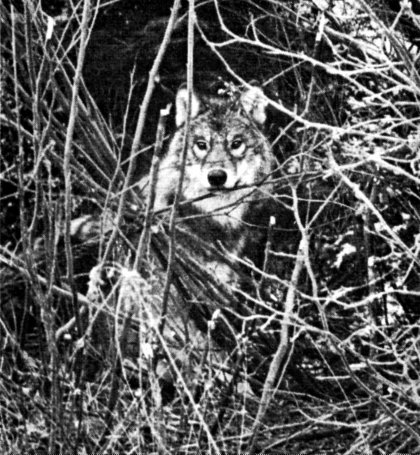
Fig. 4.—Wolf caught in trap (Photo by Don Breneman)
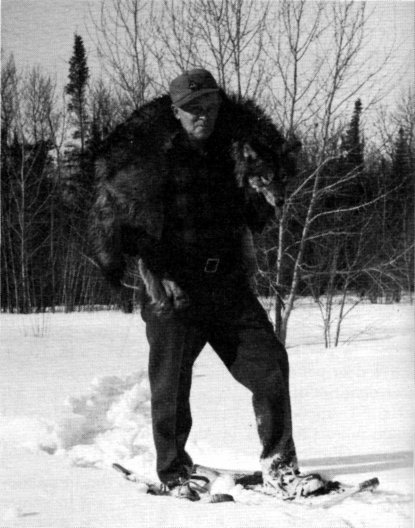
Fig. 5.—The captured wolves were drugged and carried to an enclosure in Minnesota (USFWS Photo by L. David Mech)
There is no certain way of ascertaining that wolves are related or that they belong to the same pack. Thus to maximize chances that members of the same pack would be captured, the trapper set traps where he suspected only one pack ranged. To try to determine whether the individual wolves he caught were socially related, we instructed the trapper to hold the wolves in individual pens until we could observe their introductions to each other. Wolves No. 10 and 11 were placed together on January 23, 1974, and No. 13 and 14 were released into the pen with No. 10 and 11 on February 4.
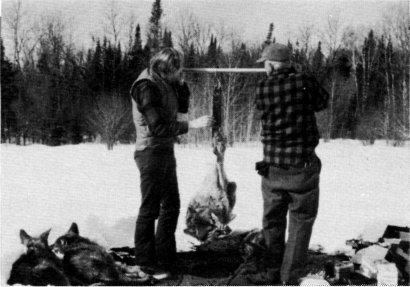
Fig. 6.—Before being transported to Michigan, each wolf was weighed (USFWS Photo by Don Reilly)
Table 2. Background information on the translocated wolves
Wolf Number 10 11 12 13
Sex F F M M
Estimated age[9] 1–2 years 6–7 years 2–3 years 2–3 years
Capture date 12-24-73 1-5-74 1-19-74 1-21-74
Capture Method Trapped Trapped Trapped Live-snared
Capture foot Left front Right front Right front
Capture-related damage Two nails lost Three nails lost None None
Weight at capture 55 lb. 65 lb. 74 lb. 75 lb.
(24.9 kg) (29.4 kg) (33.5 kg) (33.9 kg)
Weight, March 5 46 lb. 58 lb. 66 lb. 60 lb.
(20.8 kg) (26.3 kg) (29.9 kg) (27.2 kg)
% weight loss 16% 11% 11% 20%
Canine length, upper 0.83" 0.25–0.50" 0.93" 0.87"
(21 mm) (6–13 mm) (24 mm) (22 mm)
Canine length, lower 0.75" very worn 0.82" 0.85"
(19 mm) (21 mm) (21 mm)
Testes[10] —— —— 0.5 × 1.0" 0.5 × 0.75"
(13×25 mm) (13×19 mm)
Teats Tiny, not apparent Dark, evident —— ——
On March 5, 1974, the wolves were again immobilized for pre-release processing in Minnesota. An initial dose, and several supplemental doses of phencyclidine and promazine were administered intramuscularly and intraperitoneally between 9:00 a.m. and 4:30 p.m. CDT. The wolves were restrained with muzzles and their legs were bound together during processing and transport. Two of the wolves were blindfolded because they were too active otherwise.
The wolves were ear-tagged with both Minnesota and Michigan Department of Natural Resources tags, and weights and body measurements were taken (Fig. 6, 7). Their teeth were inspected and canines were measured to try to obtain an indication of age. Each animal was fitted with a radio transmitter (AVM Instrument Co., Champaign, Illinois[11]) molded into an acrylic collar (Mech, 1974).
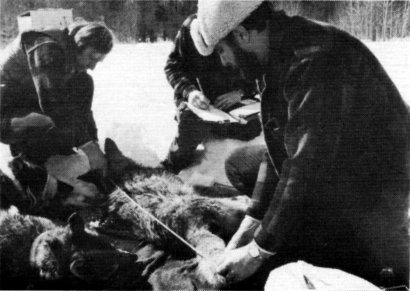
Fig. 7.—Standard body measurements were also taken (USFWS Photo by Don Reilly)
Each wolf was injected with 1,200,000 units of Bicillin (Wyeth), 2 cc of distemper-hepatitus-leptospirosis vaccine (BioCeutic Laboratories D-Vac HL), 0.5 cc of vitamins A, D, E, (Hoffman-LaRoche[11] Injacom 100), 1 cc of vitamin C-fortified vitamin B complex (Eli-Lilly, Betalin Complex FC), and 2 cc anti rabies vaccine (Fromms Raboid). These injections (Fig. 8) were given to insure that the wolves would be as healthy as possible upon release, and would not contract or introduce diseases in the release area.
Some 30 to 60 cc of blood were drawn from each wolf for analysis of its physical condition (Seal et al. 1975).
The processing of the wolves took from 8:45 a.m. to 2:00 p.m. CDT on March 5, 1974. The animals were then transported by truck to International Falls, loaded on an airplane (Fig. 9), and flown for 2 hours (Fig. 10) to the Marquette County Airport, Michigan. They were turned on different sides each half hour while drugged during their processing and transport to prevent lung congestion. At the Marquette Airport they were transferred by van to a 25 foot by 25 foot by 12 foot (7.6 m × 7.6 m × 3.7 m) holding pen on the Huron Mountain Club property 35 miles (56.3 km) northwest of Marquette.
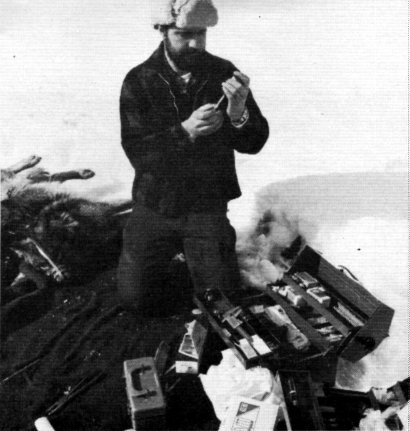
Fig. 8.—Various vitamins and vaccines were administered to each wolf to insure their health and freedom from common canine diseases (USFWS Photo by Don Reilly)
The wolves were released individually into the holding pen while each was still partly under sedation (Fig. 11). The transmitting frequency of each wolf's collar was rechecked on the receiver as each wolf was released into the pen (Fig. 12). All wolves were in the pen by 10:00 p.m. EDT, and were held there until March 12.
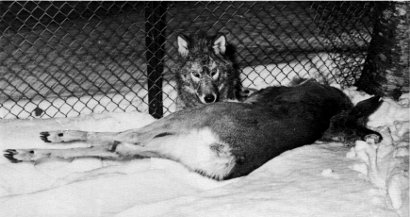
Four road-killed deer carcasses, provided by the Michigan Department of Natural Resources, had been placed inside the pen for food (Fig. 13), and a tub of drinking water was provided. Carcasses of five road-killed deer and a black bear (Ursus americanus) were placed within a half-mile (0.8 km) of the release pen as food for the wolves after their release.
We had scheduled the release for mid-March for several reasons which we felt would maximize chances for success. Deer are concentrated then in the Huron Mountain area and vulnerable to predation. Pregnancy and subsequent whelping of the alpha female might increase her attachment to the new area. Furthermore, the snow is usually deepest then and hinders travel. However, a few days before the release, a freak rainstorm had settled the snow, and cold temperatures had frozen it so hard that animals could walk readily on top, making travel conditions excellent.
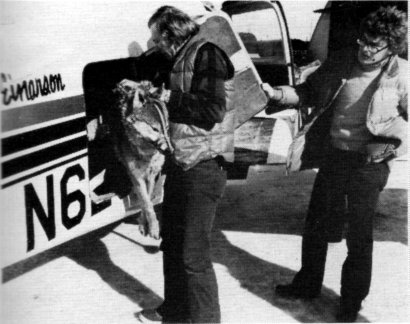
Fig. 9.—The anesthetized wolves were placed aboard an aircraft in International Falls, Minnesota (USFWS Photo by Don Reilly)
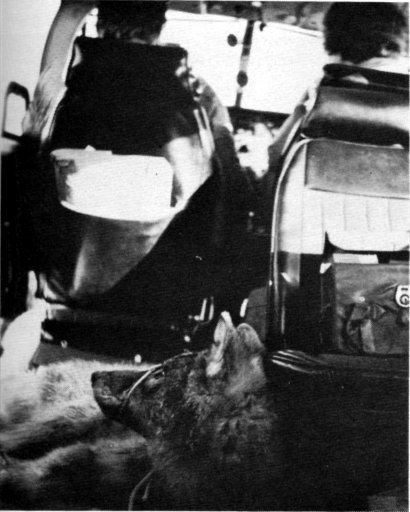
Fig. 10.—The wolves were kept lightly drugged during the flight to Michigan (USFWS Photo by L. David Mech)
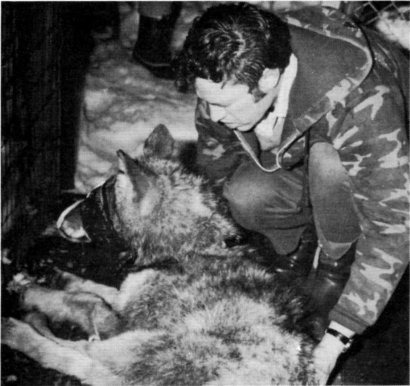
Fig. 11.—In the Huron Mountain area of Upper Michigan the wolves were taken to another holding pen (Photo by Don Pavloski)
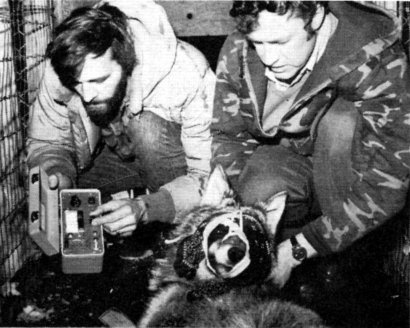
Fig. 12.—Biologists checked the signal from each radio-collar before the wolves were released into the holding pen (Photo by Don Pavloski)
An observation shack 120 feet (36.6 m) from the pen was used to determine the activities and interactions of the four wolves. Weise spent three nights in the shack and also observed the wolves each day of the one-week penned period, for a total of 20 hours of observation (Fig. 14).
During preliminary air and ground checks of radio equipment, we discovered that Wolf No. 10 had a defective collar. Thus on March 12, we subdued her with a choker, restrained her with ropes, replaced her collar and released her just after sunset. We then opened the pen, and let the other wolves loose.
Fig. 13.—While in captivity, the wolves were fed primarily on road-killed deer (Photo by Don Pavloski)
The subsequent locations of the wolves were then checked intermittently through aerial radio-tracking (Mech 1974), with a receiver and antenna from the AVM Instrument Co., Champaign, Illinois, used in a Cessna 172 and a Piper Colt. We made two flights each day for the first 2 days after release, one each day when weather permitted, until April 20, three per week in May, approximately two per week from June through September, and three per week in October and November. A total of 194 hours were flown, 80 per cent by Weise, and the remainder by Hook. Aerial locations were usually recorded to the nearest 40 acres (16 ha.).
We also tracked the wolves from the ground whenever interesting or significant activities were observed during flights or were reported by ground observers. Carcasses of prey animals were investigated from the ground after consumption was complete and the wolves had left. Deer eaten by the wolves were considered killed by them if the ground check revealed fresh blood or flesh, or signs of a struggle. Scats were collected along the tracks of the wolves in the snow whenever possible.
When radio signals were received from the same location for unusually long periods, ground checks were made to determine the cause.
Attempts were made to verify all sightings and track records reported by local citizens, by comparing them with the aerially-determined locations.