PART II. (continued 3)
Reading edition
In some parts of Persia they are very numerous, described by white Heads and black Body, four Cubits long, and dangerous to those who dabble in the Water by Night, as they often do in that hot Country where these Animals feed upon Fish and Frogs[297]; and breed upon Land, according to Aristotle[298].
Its common Habitation is in the Myclean Lake, in Corcina or Corcyra, now Corfou, (a little rich Island in the Venetian Dominion) and also about Taracina (a City of the Volscians in Campania, in Italy, not far from Amyclæ) where the People, not daring to kill Serpents, were overthrown by them; to mention no more. Ibid.
CXXVII. The Natrix-Torquata, Jonston makes different from the former, and describes it thus——Called Torquata from its beautiful Neck, which looks as if incircled with a strong Collar of Pearls.... On the hinder part of the Head is a little narrow Space in the form of two Scales, where the Spots on both sides end acutely in a triangular form. The Scholiast upon Nicander, compliments those pretty Spots with the Title of little Crowns[299].
It goes under various Appellations. The Greeks called it Guardian of their Houses[300], it being of the innocent sort. Some of the Italians call it Carbonarium, a Collier, because its Colour inclined to Coal-black, or Iron. Mr. Ray calls it, the common Snake. It is larger than a Viper, and more gross in Body; brings forth its Young by Eggs, hatch’d by foreign Heat; feeds on 143Mice; sucks Cows, upon which follows Blood. The Reader is referred to a former.
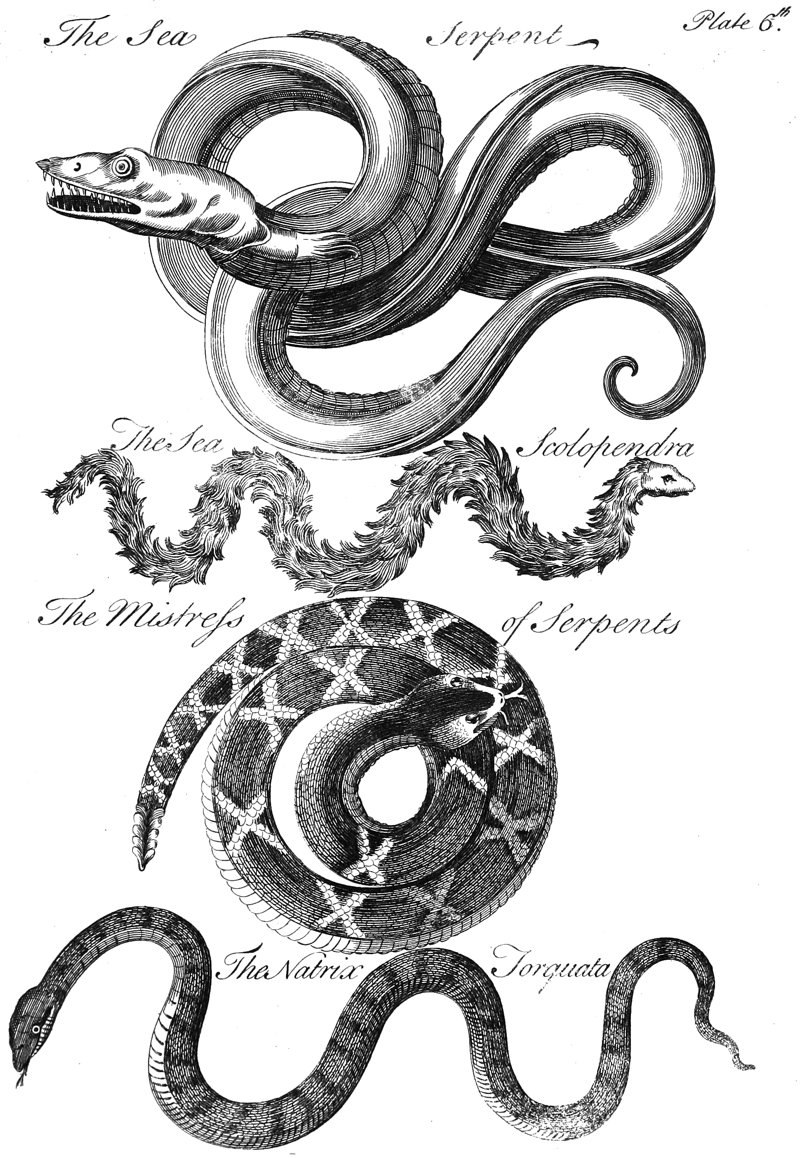
Plate 6th.
CXXVIII. The Marine-Dragon, as Pliny calls it, or the true Marine-Serpent, in the Dialect of Jonstonus, who, in his Description of Fishes, gives a particular account of it. We have already accounted for monstrous Serpents in the Indies, where some have Teeth in the form of a Saw, with which they do more hurt than with their Poison, says the Greek Historian[301].
In Africa, are some large and strong enough to contend with Oxen by Land, and to overturn a three-oar’d Galley by Water; which agrees in Character with those of Norway already described: There we found some of 200 Foot long, winding themselves about Ships, according to Olaus Magnus, Archbishop of Upsal.
In several of the Persian Islands are some of twenty Cubits long, and very terrifying to Sailors. Such also are seen in the Promontory of Carmania, the Residence of the Ichthyophagi, a People that feed wholly upon Fish; a fine Country for such who are inclin’d to keep a perpetual Lent. Tho’ these Monsters are born in the Deep, yet are they found in fresh Waters, and sometime sporting upon Land, where they sleep[302].
The same Author tells us, of a terrible Battle that happen’d in Turkey, in the time of Bajazet, between the land and marine Serpents, that continued from Morning to Night, when after a great Destruction on both sides, the Marines fled. Ibid.
CXXIX. The Rubetarian-Serpent is a very noisy Animal, who for its croaking Noise is resembled to a land Toad. It also engages the Attention of the Eye, for it excels in Beauty: It’s known among Country People by these two Characteristicks, viz. Loud and Pretty. Here we see, what is an Offence to the Ear may be a pleasing Entertainment to the Eye; thus the Five Senses agree to differ in their several Perceptions, and to meet in several distinct Apartments of the capital Temple, in the pacifick Empire. But to return to the beautiful Padalica of the Polonians:
It is said of this Serpent, that when it wounds any in the Foot, the Remedy is to put the wounded part into the next Earth, 144that is inclined to the moist, for twenty-four hours. This seems to differ from the American Rubeta.
CXXX. The Serpent de Boa is another of the monstrous kind; called Boa from Bos, the Latin word for an Ox, which it devours at once: The young ones, which grow to a great Bulk, are nourished by sucking the Cow.
In the Emperor Claudius’s time, in one of them that was killed, they found a Child that was whole. In Calabria are some monstrous Animals, not unlike these, says the Historian; who adds, that not many Years ago a certain Bishop speaks of a large mischievous Serpent, that was shot near St. Archangel, whose Jaws were almost two Palms long, the Portraiture of which is yet seen in a certain Temple there[303].
CXXXI. I Am informed by some Persons, who had it by Tradition from ancient People, that formerly there was in this Country a monstrous Serpent of four or five Yards long, and thicker than a common Axle-tree of a Cart, and very mischievous, preying upon Lambs, &c. Its chief Residence was in a Wood, near Pickopbank, a few Miles from Blackburn, in Lancashire, called Ouse-Castle, wherein there is yet a little Spot of Ground, called Griom’s-Ark, which is a deep Cavern, situated among Rocks, in a Wood, from whence it was seen to come out, and bask itself on a sunny Bank.
The Picture of this Serpent is drawn with Wings, two Legs, and Talons like an Eagle, which is seen in some ancient Houses, (and particularly at Clayton-hall, near Dunkin-hall) by which it appears to be very large and furious.
It’s said, one —— Grimshaw Esq; Proprietor of that Hall, shot the Monster with Arrows, and had an Estate offer’d him for that good Service done to his Country, which he generously refused, and only desired he might have a Passage thro’ that Wood to a Township he had on t’other side of it, which was granted, the Title of which is to be found in old Writings. By another hand I am informed, that it was supposed to be a Griffin, which 145is a Bird of Prey, and of the Eagle kind, which, I take to be the Ossifrage of Moses, and mentioned Levit. xi.
There is also a fabulous Griffin, represented with four Legs, Wings, and a Beak; the upper part like an Eagle, and the lower a Lion. They conjecture it to watch over golden Mines and hidden Treasures. This Bird was consecrated to the Sun, therefore the Chariot of the Sun was represented as drawn by a Set of Griffins.
This poetick Griffin is frequently seen in antient Medals, and is still bore in Coat-Armor. The antient and honourable Family of the Guillims blazons it rampant, alledging any very fierce Animal may be so blazon’d as well as a Lion. It is observable, says my Author, that in the Front of Clayton-hall are two Figures drawn in Plaister in the form of a Coat of Arms; on the right side of the Escutcheon is a Figure with Wings, four Feet, and a Tail twisted in the Form of a Serpent. The like Figure is drawn in Plaister in several antient Houses in that Neighbourhood, which go under the Name of the Griffin’s Picture, and the Sign is used at Publick-houses: There is a Place in that Wood called the Griffin’s-Ark.
N. B. This seems to carry some Probability with it, since Eagles are voracious Creatures, and very destructive to Fawns and Lambs, especially the black Eagle, which is of a lesser Size than the other.
In some of the Scots Islands, the Natives observe, that this Eagle fixes its Talons between the Deer’s Horns, and beats its Wings constantly about its Eyes; several other Eagles flying at the same time on both sides, which puts the Deer upon a continual Run, till it fall into a Pit, or down a Precipice, where it dies, and so becomes a Prey to the Enemy[304].
CXXXII. In some of the Western Islands of Scotland are several Serpents: There is one that is yellow with brown Spots, and another with brown Spots; but that which is the most poisonous, is the black and white spotted, three or four Foot long.
The Remedies are such as these: The Natives cut off the Head of the Serpent that gives the Wound, and apply it to the Place as the best Remedy: Others, by the Application of new 146Cheese, extract the Poison; and some make use of the Rump of a Cock stript of its Feathers, which they apply to the Wound with Success, according to the Historian[305].
In the Library at Manchester, is the Skin of a Serpent which was five Yards long, as thick as the Calf of a Man’s Leg; has a forked Tongue, scaly Skin, yellow Colour.
CXXXIII. MARTINIUS in his Atlas relates, that in the Province of Quangsi in China, there are Serpents thirty Foot long. The Flora Sinensis reports of the Serpent call’d Geuto, that it devours whole Stags, but is not very venemous. ’Tis of an ash Colour, from eighteen to twenty-four Foot long; will often seize on a Man, by leaping from a Tree, and kill him, by its violent windings about him.—The Chinese preserve his Gall to cure the Diseases of the Eyes.—Marcus Paulus Venetus testifies the same of the Serpents of Carrajam.—Some are in length ten Paces, in thickness ten Palms, and able to swallow a Man. Are taken thus: The Serpent in the Day lies in Caves of Mountains; in the Night hunts for Prey, and then returns to its Cave, with the weight of its Body, plowing deep the Earth, being sandy in the Track it goes along: Here the Huntsmen fix strong Stakes pointed with Iron, covered with Sand; and as the Serpent travels along, the Spikes gore its Entrails, and are fasten’d therein, by which ’tis kill’d; and the Huntsmen sell the Gall at a great Price for Medicine, and the Flesh for Meat. These, continues he, may be reckon’d among Dragons, but are without Poison: Instead of Feet, they have Claws like those of a Lion or Falcon.—There are other Serpents in China full of rank Poison, especially the hairy-headed Serpent. So far Martin.
N. B. This Province of Quamsi or Quangsi is able to raise a Million of fighting Men. It is not so much frequented as the Province of Quantung or Canton, where they have two Harvests a year. One says, there is a Mountain here with a Pool in it, which makes a Noise like Thunder, if a Stone be cast into it, and causes Showers from the Sky[306]. Their Winter is warm, and their Fields always verdant, producing great Quantities of Gold, Pearl, Silk, Copper, Steel, Iron, Salt,—and odoriferous Woods.—They hatch their Ducks Eggs and those of other Fowls in Ovens, or Dunghills.
147CXXXIV. There is a kind of Reptiles and Insects (I don’t mean the common Tortoise) which is a certain sort of Snake, small in Body and of white Colour, found in Lydia, Arabia,—cased over with a white colour’d Shell, which shines like a sparkling Margarite[307].
I shall close this Part with an Experiment made by the noble Roman before-mentioned, who (being sollicitous to take a compleat View of a Serpent) after he had dissected one, preserved the Flesh and Bones, and having, secundum artem, reduced them to Ashes,—extracted Aqua Fontana,—whose Virtues were equal to those drawn from the Ashes of other Animals, and of Plants.
To this venemous Tribe, I shall annex a few Reptiles, in whose Veins I find something of the Serpent’s Blood; and close the variegated List with a large Account of the Tarantula, its Wound, and Cure by Musick; then inquire into the Reasons of that strange Operation; the Nature and Force of Sounds, not only on the Animal Passions, but Inanimate Matter. I shall begin with,
I. The Bee, called the Honey-Fly, a little Animal that has four Feet, which it carries close to the Belly, and not easily separated: It has four Wings, small Teeth, and a long Tongue, which usually it carries out of the Mouth. Its Sting cleaves to the Belly, which, when it strikes, it parts with, and becomes uncapable of wounding a second time; which, I think can’t be said of any other Member of the stinging Race, unless it be the Wasp and Hornet.
The Sting, in the Design of it, seems to be only a Weapon of Defence; it looks like a Tube or Pipe, hollow, with a little Bag of sharp penetrating Liquid (which is its Poison) joined to the Extremity of it within the Body, which, in stinging, is injected into the Wound thro’ the Tube; and tho’ venemous and painful, is not strong enough to corrupt the Mass of Blood.
148One may, with the naked Eye, sometimes see this little Insect discharge its Venom, in which, says the ingenious Dr. Mead, by the help of a Glass, I can easily discover a great Number of minute Salts floating. In Brazil, Bees are distinguish’d into twelve kinds, among which are some that sting in a most furious and fatal manner, called Mateecas by the Indians.
In Ceylon in the East-Indies, are several Bees, the largest are of a brighter Colour than ours; they make their Combs on the Boughs of Trees: At proper Seasons, the Inhabitants hold Torches under them, till they drop down, which they carefully gather, boil and eat, and are accounted excellent Food. In Quatemala are Bees and Honey of a white Colour, and some without a Sting, says the Historian[308].
II. To the Bee, I add the Wasp, which, as it is something larger, makes a deeper Wound; it differs also from it in its Food, which is Flesh and Carrion, when it can be got; whereas the Bee regales itself with delicious Entertainments, and enriches its Family with all the Glories of the vegetable Kingdom. From whence is the Honey? I answer, That in Flowers is found a viscid sweet Juice, and accordingly we see Children gather Cowslips, Honeysuckles, and suck the Honey from them. The Bees visit all Flowers within their Reach, and putting it in their Trunks, suck out the Honey, with which they load their Stomachs, to be discharg’d, and laid up in their Combs. Among the Antients, Honey was taken for a Dew that fell on Flowers; but this is a mistake, because the Bees only gather it after the Sun is up, when there is no Dew left, or very little.
III. The Hornet is yet more dangerous, and has been known to pursue a Sparrow, and kill it, and then suck its Blood. The Hornet and Wasp have strong Jaws tooth’d, by which they can dig into Fruits, for Sustenance; yea, and into harder Substances, for Quarters.
If you take a Bee, a Wasp, or Hornet, and gently squeeze the Tail, so that you can see the Sting, you may perceive a Drop of transparent Liquor at the very end of it; which if wiped off, you shall soon see it renew’d, that Liquid passing down the Cavity 149into the end thereof: ’Tis said the Decoction of Hornets dropt on the Skin, makes it swell.
IV. I proceed to the Spider, another little venemous Insect, whose forked Tongue or Sting, is very fine and sharp; by this he pierces Flies—and at the same time, instils a poisonous Juice into the Wound, by which the Prey being kill’d, it sucks out the Moisture, and leaves nothing but a husky dry Carcass: Tradition says, it poisons by spitting, or breathing, because it dare not approach so near to a large Fly as to a little one; but keeps at some distance, and uses a kind of shoving Motion, upon which the Fly has done struggling.
There are various sorts of these little strange Creatures, whose Stings are hurtful, as the Astorius, (so called from its resemblance to a Star) whose Wound produces Heaviness, and Relaxation of the Nerves. The Cæruleus, or blue Spider, whose Sting is attended with Vomiting and Pain at the Heart. The Lycos, the least of the kind, that causes an Asthma, and Swelling about the wounded Part. In the Philosophical Transactions, we have a Table of thirty-three kinds of Spiders found in England, by Dr. Lister[309].
There is something very curious and admirable in those long Threads they make in the Air, during some part of Summer, especially towards September, so much wonder’d at, in such Quantities every where. The Method of Operation, I take to be as follows, viz.
All Spiders that spin in a Thread, are the Makers of those Threads, most visible in the Autumn. In all the ways of weaving, they still let down the Thread they make use of, and draw it after them. Attending on one that wrought a Net, I saw it, says a very nice Observer, suddenly in the Mid-work desist, and turning his Tail into the Wind, to dart out a Thread, with the Violence we see Water spout out of a Spring: This Thread taken up by the Wind, was in a Moment emitted some Fathoms long, still issuing out of his Belly; by and by the Spider leapt into the Air, and the Thread mounted her up swiftly.—And I found the Air fill’d with young and old, sailing on their Threads, and undoubtedly, says the Relator, seizing Gnats and other Insects in 150their Passage; there being often manifest Signs of Slaughter, as Legs, and Wings of Flies ... on these Lines, as in their Webs below[310].
Spiders have been observed to get to the Top of a Branch or such like thing, where they exercise this darting of Threads into the Air. After the first Flight, all the time of their sailing on those Threads, they make Locks, still darting forth fresh Supplies of Thread to sport and sail by. N. B. Those called Shepherds, or long-legg’d Spiders, are no Spinners.
I have seen Spiders, says the Learned Dr. Hulse[311], shoot their Webs three Yards long before they begin to sail upon them. So the Learned Derham observes, that with pleasure he had often seen Spiders dart out their Webs, and sail away by the Help thereof.
AMERICA turns out diverse kinds of these araneous Insects: In Peru are Spiders as large as a Man’s Hand, and have Eyes as big as those of Sparrows. In Brasil there is one kind of Spider, whose Skin is rough and black, and whose Sting proves incurable, without immediate Relief. On the other hand, we read of monstrous Spiders in the Antilles, whose Eyes are so small and deep in the Head, that they are scarcely visible: They feed on flying Insects, and their Webs are strong enough to catch small Birds[312].
CEYLON in the East-Indies produces a long, glittering, and hairy Spider, called Democulo, whose Wound is not mortal, but sometimes deprives People of their Senses. There is an Experiment made by Mr. Leeuwenhoek, who put a Frog and Spider together into a Glass, and having made the Spider sting the Frog diverse times, the Frog died in about an hour’s time[313].
There is another Instance of the Poison of some of them (for all are not poisonous) given by the Learned Scaliger, who relates, that in Gascony in France, there are Spiders of that Virulency, that if a Man treads upon them to crush them, their Poison will pass thro’ the very Soles of his Shoe[314].
151V. The Scolopendra is a little venemous Worm, and amphibious. When it wounds any, there follows a Blueness about the affected Part, and an Itch over all the Body, like that caused by Nettles. Its Weapons of Mischief are much the same with those of the Spider, only larger; its Bite is very tormenting, and produces not only pruriginous Pain in the Flesh, but very often Distraction of Mind. These little Creatures make but a mean Figure in the Rank of Animals, yet have been terrible in their Exploits, particularly in driving People out of their Country: Thus the Inhabitants of Rhytium, a City of Crete, were constrained to leave their Quarters for them[315]. There is a minute Scolopendra, accounted for by Dr. Molyneux.
VI. The Shrew-Serpent in Norway, is a Creature of admirable Beauty; small in Body, and slow in Motion, but of fiery Venom, and its Wounds most dangerous.
VII. The Lacertus Facetanus, or Tarantula, whose Bite gives Name to a new Disease. Those who are wounded by it are denominated Tarantati: It is a kind of an overgrown Spider, about the Size of a common Acorn.
It borrows its Name from Tarentum in Apulia, a City in the Kingdom of Naples, built by a Band of Lacedemonian Bastards, who having no Inheritance at home, were sent thither to seek their Fortunes, where they built that Town, and made it the Capital of Magna Græcia.
This little Animal is furnish’d with eight Eyes, and eight Legs: Its Skin is tender and soft, of various Colours, and always hairy: ’Tis of the oviparous kind, and propagates its Species by Eggs, and sometimes a hundred Eggs have been found in one Female.
In the Opinion of some, ’tis not only an Inhabitant of Apulia, but peculiar to that Province, a Situation that may be called, A Garden of Rarities; Plenty of generous Wine, delicate Honey and Oil, an early Spring, a soft Winter—render it a most delightful Habitation, especially to old Persons, according to the Poet[316]; 152and yet in that most agreeable Region, this little Tyrant reigns and spreads Terror.
It’s found in other Parts of Italy, and even in the Isle of Corsica; but those of Apulia, ’tis said, are only dangerous; though I think to have read something like it in Persia, where there is an Insect like a Spider, about two Inches round, which the Holstein Ambassadors suppose to be the Latin Stellio, and the Italian Tarantula: It lets its Poison fall like a Drop of Water, which causes an insupportable Pain in that Part ... immediately causes a profound Sleep, from which the Patient is not to be recovered, but by crushing one of the same Creatures upon the Wound; or, if this can’t be had, by pouring as much Milk down his Throat as they can, and then put him on an Engine, which they turn round with great Violence, till by that violent Agitation, his Stomach discharges the Milk, which appears greenish, because of the Poison. Those who are cured thus, have some Remnant of the Pain once a Year, about the same Season[317].
But to return to Italy; ’tis observable, that it hurts no where but in Apulia, and that only in Summer, especially in the Canicular-Days, so called from Canicula, that signifies a Dog; hence Dog-Star, which rises cosmically with the Sun the 19th of July, and is supposed to be the brightest, as well as the largest Star in the Firmament.
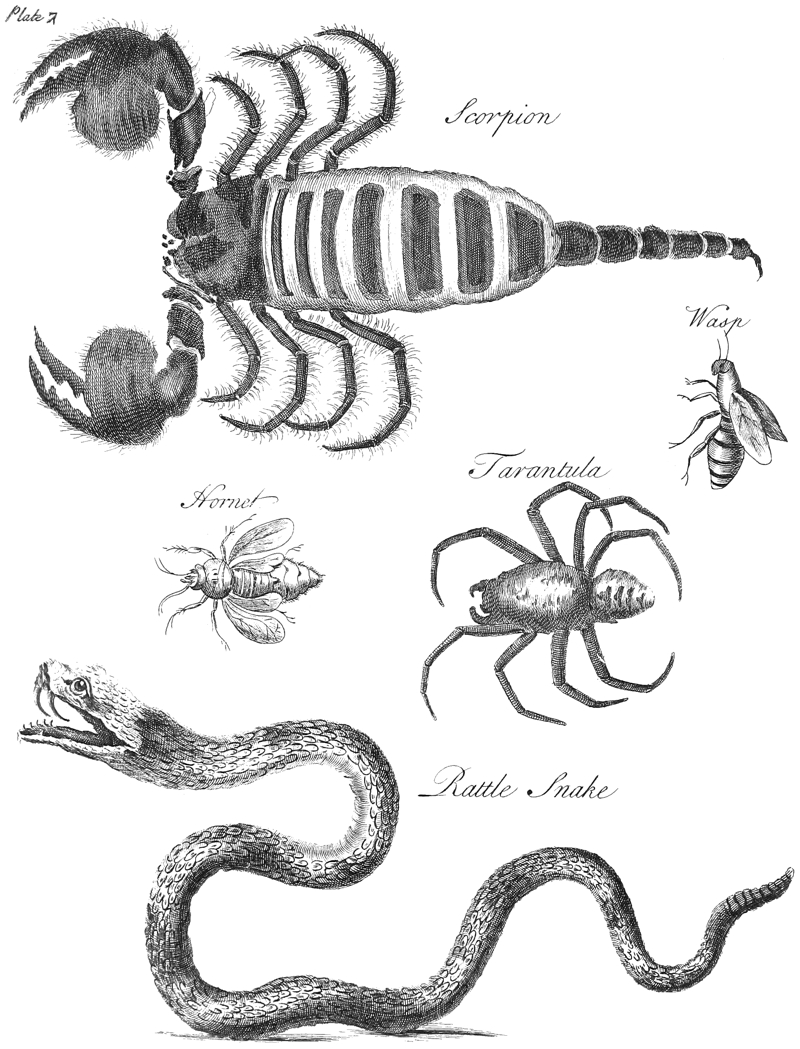
Plate 7th
The Dog-Days denote certain Days before and after the Rising of this Star, to whose Appearance the Antients ascrib’d terrible Effects: the very first Day it appears, they say (but without Reason) the Sea becomes boisterous and boils like a Cauldron, produces Variety of Distempers, sours Wine, and Dogs grow mad.... The Romans, dreading the Indignation of this Star, sacrificed a Dog every Year to it, (viz. at its first Appearance in our Hemisphere) to appease its Rage against Mortals.
In Winter, this Italian Spider lurks in Caverns, and solitary Places; and if it happens to bite, hurts not: There it lives in a drowsy Posture, and keeps Lent till Summer; when the whole Tribe creeps out, and disperse themselves over that pleasant Land; and Wo to the Body asleep, and bare Legs, in Corn-Fields.
Those on the Plains are much to be feared, the Air being hotter there than on the Mountains, where their Bite is not dangerous, 153the Solar Rays not being so strong in those Heights: and what is yet more surprizing, is, that if they wound any out of Apulia, though in places not remote from it, the Wounded receive no deadly Hurt[318].
When it bites, the Pain resembles that given by the Sting of a Bee, and is attended with various Symptoms, according to their different Natures: The Northern Tarantula is the most terrible; those that are inclin’d to the white Colour are not so dangerous; the spotted differs from both.
The Wound given by any of them is dangerous, and has different Indications. In some that are bitten, an universal Stupor follows; others weep: Some tremble and vomit; others laugh, fancying themselves to be Kings. This perhaps made Dr. Cornelio represent this as an imaginary Disease; that those who imagine themselves hurt, are most of our young wanton Girls, who, falling from some particular Indisposition into Melancholy and Madness, persuade themselves that they have been stung by a Tarantula[319].
Some grow pale, sick and faint, and die in a short time, unless relieved by Musick, which alone, without the Help of Medicine, performs the Cure.
The Wounded are as Men half dead, but at the first Sound of a musical Instrument, though they are very weak, and seemingly unable to stir, they begin by degrees to move their Hands and Feet, till at last they get up, and then fall to dancing with wonderful Vigour, for two or three Hours, their Strength and Activity still encreasing. Some will continue the Dance, without Intermission for six Hours; and when tired they are put to Bed, and after they are sufficiently recruited by Rest, they are called up again by the same Tune, and renew the Dance with great Violence, the Musick still playing; and when the Patients grow weary, they are put into Bed again, and kept warm to encourage Perspiration. These Exercises being continued six or seven Days, the Patient finds himself fatigued and unable to dance any longer, which is the Characteristic of a Cure.
They usually spend ten or twelve Hours a-day in this violent Exercise, and continue it for three or four, or six Days; by which 154time they are generally freed from all their Symptoms, tho’ not always, says the learned Baglivi, who observes, that about the same time next Year, the Distemper returns, and will prove fatal, if not prevented by the same musical Application.
In Apulia is a Scorpion, whose Wounds are accompanied with the same Effects as those produced by the Tarantula, and are only curable by Musick and Motion. These Apulian Scorpions, are less violent than those of Africa, but more virulent than those in other Parts of Italy. I shall only offer two Remarks here.
1. THAT different Patients must be entertain’d with different Tunes, according to the different Symptoms of the Disease; in which the great Art of curing them seems to consist. e. g. Some are roused by a Pipe, others by a Timbrel: Some are roused by a Violin, others by the Harp; and all must be entertain’d with different Airs. The Musicians therefore make Trial before they can accommodate the Sound to the Venom; which requires the most brisk and lively Tunes, to produce a powerful Vibration in the Body; and till this be done, the miserable Patients stand still, sighing and sobbing. The Vibrations must be quick and frequent.
2. DURING the Time of Cure, the wounded People throw themselves into a Variety of strange Forms, and behave like Drunkards and Madmen ... talking foolishly ... diverting themselves with naked Swords, red Cloth, &c. but the Sight of any Object that appears black is terrible to them. Ibid.
To this Account of the Tarantula, I have (by way of Illustration) added the Remarks of another learned Foreigner, who says.... The venemous Bite of the Tarantula is quickly follow’d with a very acute Pain, and soon after, with Numbness, profound Sadness, difficult Respiration: The Pulse grows weak, the Sight disturbed; Persons lose their Knowledge, Sense, and Motion; and if destitute of Help, they die.... The most effectual and certain Remedy is Musick: When the Person becomes destitute of Knowledge and Motion, a Musician tries a Variety of Airs: Shou’d he hit on that whose Harmony is suited to the Patient, he begins to move by successive Degrees, and keeps Time with his Fingers, Arms, Legs, &c. he raises himself, and dances about six Hours without Intermission....
When the Musick ceases, the sick Person gives over dancing, and is put to Bed: The same Air brings him out of Bed for a new 155Dance, an Exercise that lasts six or seven Days.——N. B. Every sick Person must have his particular and specific Tune, and always one that is very sprightly and moving.
The Poison of the Tarantula, adds he, thickens the Blood, and stops several of its Passages; thence the Numbness: The Blood being thick, furnishes but a small Quantity of animal Spirits, their Canals are shrunk up in the Brain: The Nerves being destitute of Spirits, relax; thence proceed the Inactivity, and Defect of Knowledge and Motion: But the Vibrations of the quick Airs which are play’d, agitate the Blood and the rest of the animal Spirits, which are soon increased by the Agitation of the Blood: Being agitated and multiply’d, they run into the Fibres and Nerves, which being put into Unison with the sonorous Strings, receive their Vibrations, and are shorten’d or extended successively; whence proceeds the successive Motion of the Fingers, Arms, Legs, &c.[320]
The action of Dancing augments the Agitation of the Blood, and makes the Patient sweat. The Poison being agitated and attenuated, is exhaled by Transpiration; in proportion as the Poison is exhaled, the sick Person perceives himself eased; this Ease continually inclines him to dance: When all the Poison is dissipated by Agitation and Sweat, the Blood recovers its Fluidity and usual Course.
I Shall conclude this historical Account, with a Passage taken out of a formed History of the Tarantula[321], writ by a learned Author, who having described the Disease, proceeds to the manner of Cure, viz. The salivous Poison of that Spider seizes principally on the Nerves and Muscles––the manner of Cure thus––
The Air moved by the musical Motion of Instruments, moves the next, and so onwards (as we see in the circular increasing Motion of the Water, when a Stone is cast into it) till the like be produced in the Spirits of the Body, to which the Air is impelled.––Now, adds he, the Commotion of the Passions depends upon the Spirits, and the viscous Humour of the Tarantula is a very capable Subject of Sound: Hence the next Air being moved by a musical Tone suitable to the Patient, the lurking Poison, and 156Spirits of a Man are put into a Commotion; by which Agitation, the Nerves being vellicated, the Spirits vehemently stirred, and Muscles moved, the Dancing, or something like it, must of necessity ensue, by which the Cure is performed: For, by vehement Motion the Blood is heated, the Pores are opened, and the Poison rarified; which can’t be done by common Sudorificks, because the Medicines can’t reach, or at least can’t stir those little Particles where the Poison lies, as Motion by Dancing does.
I shall add here some Reflections on the Power of Musick, and give Instances of it in the human Mind, in animal, and inanimate Bodies.
MUSICK appears to be one of the most antient of Arts, and of all other, vocal Musick must have been the first kind, and borrowed from the various natural Strains of Birds[322]; as stringed Instruments were from Winds whistling in hollow Reeds, and pulsatile Instruments (as Drums and Cymbals) from the hollow Noise of concave Bodies. This is the Conjecture.
Musick has ever been in the highest Esteem in all Ages, and among all People. Nor could Authors express their Opinions of it strongly enough, but by inculcating, that it was in Heaven, and was one of the principal Entertainments of the Blessed. The Effects ascribed to Musick by the Antients, almost amount to Miracles; by means thereof Diseases are said to have been cured, Unchastity corrected, Seditions quelled, Passions raised and calmed, and even Madness occasioned.——
Musick has been used as a Sermon of Morality.... Athenæus tells us, that the Lives and Actions of illustrious Men were written in Verse, and publickly sung by a Chorus, to the Sound of Instruments, which was found to be the most effectual means to impress Morality, and a right Sense of Duty on the human Mind[323].
Thus the Pythagoreans made use of Musick to cultivate the Mind, and settle in it a passionate Love of Virtue. Pythagoras instituted a most profitable Correction of Manners by Musick, which, he says, conduces very much to Health; and he made use of it, not only against Diseases of the Mind, but those of the 157Body. It was the common Custom of the Pythagoreans to soften their Minds with Musick before they went to sleep; and also in the Morning, to excite themselves to the Business of the Day[324].
This Cure of Distempers by Musick sounds odd, but was a celebrated Medicine among the Antients. We have already considered, how those wounded by the Tarantula were healed by Musick; the Evidence of which is too strong to be overturned: That which now lies before me, is, to prove this to be the Practice of Antiquity, which will appear by the following Instances.
I shall begin with Democritus (a Philosopher of the first Rank, and a most diligent Inquirer into the Mysteries of Nature) who taught in his Works, that Musick of Pipes was a Medicine for most Distempers.... Thales of Crete, being sent for by the Lacedemonians to remove the Plague, came, and by the Help of Musick he did so; and he is said to do it by the Command of Apollo, as appears from the Great Chæronean Moralist[325]. If any Credit be given to Terpander, it appears he supprest an Insurrection in their Town by the Use of Musick. Ibid.
We read of a young Man among others of Tautomenium, whose Passions being inflamed by Musick in the Phrygian Mood, was going to force open a Matron’s House, but his Rage was soon calmed, when the Piper (by Pythagoras’s Advice) changed his Air into the Spondaic Mood; and he went home quietly, which the Philosopher could not make him do by Persuasives. This historical Passage is confirmed by Ammonius, and Cicero, and is thus related, viz.
When as some young Men, being drunk, and irritated by the Musick of Flutes, would have broke into an honest Woman’s House, but upon hearing one playing a Spondaic Air, their outragious Heat was allay’d by the Slowness of the Mood, and Solemness of the Tune....
St. Basil gives another Instance to the same purpose, viz. That Pythagoras meeting with some that came with Musick from a Feast, drunk, requested the Musician to change his Tune; which he did, and playing a Doric Air, they were so brought to themselves, that they threw away their Garlands, and walked home, ashamed of their Folly.
158THEOPHRASTUS is said to cure Persons that had been wounded by Serpents, with various kinds of Musick—Probatum est[326]. Another Observation of his was, that Diseases were made and mitigated by Musick. Plato forbids Musick and Wine to young Persons, lest one Fire should kindle another[327].
The Pythagoreans, to appease the Troubles of the Mind, lulled themselves asleep by Tunes upon the Harp: Thus Homer brings in Achilles relieving his Melancholy by playing on his Lute, and mitigating his Anger against Agamemnon by Musick, which he had learned of Chiron. Asclepiades, a Roman Physician of great Reputation, is said to heal frantic Melancholy, and mad People, by vocal and instrumental Musick[328]. The learned Neapolitan adds, Tanta hominis naturæ cum harmonia consensio est.
Whatever be the Cause of it, there is nothing more powerful than Musick for moving the human Passions, making some pensive and melancholy, others brisk and lively. The truth is, says the Learned Wallis, we can match most of the antient Stories of this kind in the modern Histories. e. g.
If Timotheus could excite Alexander’s Fury with the Phrygian Mood, and sooth him into Indolence with the Lydian, a more modern Musician is said to have driven Eric King of Denmark, into such a Rage, as to kill his best Servants. The Occasion was thus—The King willing to make Trial in his own Person, whether a Musician spoke true, who boasted, that by virtue of his Musick, he could make People mad: The Artist play’d, and the King became outragious, and experienced the Truth of it so thoroughly, that in the Excess of his Rage, he kill’d some of his best Friends[329].
This may be owing to the Impression made by the Vibrations of the Air, being carried as far as the Origin of the Nerves, passes into the Soul, and puts the animal Spirits into a rapid Motion, determines them to run into different Nerves, diffused thro’ 159different Parts of the Body, and is communicated to those Nerves, according as it finds them more or less in Unison.... Hence the Passions and Madness itself. Ibid.
In Musick are different Tastes, which seems to proceed from the different Constitutions of the Fibres or the animal Spirits: The Fibres of the auditory Nerves are differently disposed in different Persons, and in the same Person at diverse Times; but generally speaking, Musick inspires more pleasing Sentiments, e. g.
A certain famous French Physician being ill, fell into a violent Delirium, after some Days Illness of a continued Fever: the third Day of his Delirium, I know not by what Instinct, (says the Learned Father Regnault) made him desire a Concert of Musick; upon which, they play’d, and sung to him the Songs of M. Bernier[330]: Scarcely had he heard the first Notes, but his Eyes were calm; a Serenity was spread all over his Countenance, the Convulsions ceased, and he wept thro’ Excess of Pleasure; he was free from his Fever all the time of the Concert, but whenever they ceased singing, he relapsed into his former Condition: They fail’d not to continue so marvellous a Remedy, which always suspended his Indisposition. In short, after ten Days musical Entertainment, he was restored to his former Health. Ibid.
Another Instance, is a Dancing-Master of Alais in France, who had the same Fate in the Year 1708; after a Fever of about four Days, and a long Lethargy, he fell into a Delirium, both mad and dumb. One of his Friends took his Violin, and plaid to him those Airs he was most accustom’d to: People thought at first, that the Player was as mad as the Patient; but, in a short time, the sick Man raised himself upright in his Bed, with the Air of a Man agreeably surpriz’d.... All his Motions discover’d the Pleasure he felt: Soon after he fell into a deep Sleep, and the Crisis he had during his Sleep, perfected his Cure. Ibid.
One Reason of this strange Operation might be this, viz. The Sound of the Instrument agitates the Fibres, especially those that are in Unison, by that means brings to his Remembrance agreeable Perceptions ... sets the animal Spirits going, and restores them to their natural Course: These Spirits being moved, run into the Nerves and Muscles, where they have been used to run, in order to form the Motion of certain Airs; the Passages of the 160Blood thereby become more free: Hence that serene Air diffused all of a sudden over the Face of the sick Musician, who was cured by the Charms of his own Art.
These two Instances are quoted by the Learned Dr. Nieuwentyt, who says, both of them (the Musician and Dancing-Master) were perfectly restored to their Senses by Musick. He also observes, that the Wound given by the Tarantula can only be cured by the Sound of Musick, of which different Airs and Tunes must be play’d, according to the different Nature and Colour of those Tarantula’s that have given the Wound[331]. Then adds;
That the famous Italian Musician, Angelo Vitali had related to him the following Story, and assured him of the Truth of it, viz.
That a certain Player on the Flute at Venice had boasted, that by his playing, he could deprive the Hearers of the Use of their Understanding: Whereupon he was sent for by the Doge, who was a Lover of Musick, and commanded to put his Art in practice before him; where, after having play’d some time very finely, (and to the Amazement of the Hearers) he at last begun a mournful Tune, with a Design, as far as he was able, to put the Doge into a melancholy Humour; and presently, he struck up a jovial one, to dispose him to Mirth and Dancing; and after having repeated these two kind of Tunes several times by turns, the Doge being no longer able to endure those different Emotions, which he felt in his Soul, he was ordered to forbear playing any longer. Ibid. p. 271.
FROM the Account given of Concords and Discords in Musick, a Reason may be form’d why two Strings of a Viol, that are Unisons or Octaves one to another, if one be struck the other will tremble, so as to be visibly perceived.
What is this Unison? In Musick, Unison is a Consonance of two Sounds, produced by two Strings, or other Bodies of the same Matter, Length, Thickness, and Tension, equally struck, and at the same Time, so that they yield the same Tone or Note. Others define it, the Union of two Sounds, so like each other, that the Ear perceiving no Difference, receives them as one and the same Sound.
161What constitutes Unisonance, is the Equality of the Number of Vibrations: Unison is the first and greatest of Concords. Others say, it is only that in Sounds which Unity is in Numbers.
Being once in a Room where there was a Bass-Viol, and striking one of the Strings, a loose Quarry of Glass in the Window, jarr’d every time that String was struck, which it wou’d not do upon striking any of the other discordant Strings. The Reason may be, viz. That the times of the Vibration of the loose Quarry, were equal or near Concordance to those of the String. A Gentleman of my Acquaintance, when he sounded a particular Tone on the Bass-Viol, very plainly heard the Noise of the Glass of the Clock in his Chamber, which Glass never moved, upon his sounding any other Tone.... It is a general Remark, that an Unison-String will receive the Motion, and so tremble, when another Unison is made to sound; and yet all other Strings of the same Instrument, that are not Unisons, shall remain silent and unmoved.
Musick does not only exert its Force on the Passions and Affections, and musical Instruments, but on the Parts of the human Body also. Witness the Gascoigne-Knight, (mention’d by Mr. Boyle) who could not contain his Water, at the playing of a Bag-pipe: The Woman, mention’d by the same Author, who would burst out in Tears, at the hearing of a certain Tune, with which other People were but little affected: And in this County, near Rochdale, there is a certain Man, who can’t forbear dancing, if in a House, or Market, upon hearing a certain Tune sung.
Wonder not at the strange Effects of musical Sounds, when other Sounds strangely affect the Mind. How are the Passions excited by the Sound of a Drum and the Discharge of Canons.... Not only human Minds and Bodies are affected by the Impression of Sounds, but even Things without Life.
KIRCHER tells us of a large Stone that would tremble at the Sound of one particular Organ-Pipe. Mersenne also tells us, of a particular part of a Pavement that would shake and tremble, as if the Earth would open, when the Organs play’d. Mr. Boyle adds, that Seats will tremble at the Sound of Organs, that he has felt his Hat do so under his Hand, at certain Notes, both of Organs and Discourse; and that he was well inform’d, every well-built Vault, would answer some determinate Note.
162We may observe the like mechanic Perception in several empty Drinking-Glasses, of fine white Metal. Thus if we cause the Strings of a musical Instrument to be stretched to a certain Tone or Note, it would make one of the Glasses ring, and not the other; nor would the Sound of the same String, tuned to another, sensibly affect the same Glass. Morhoff mentions one Petter, a Dutchman, who could break Rummer-Glasses with the Tone of his Voice. The same, I think, is said of Purcel.
When two Viols are tuned in Unison, one of them being touch’d, the other will answer, tho’ at some distance. This is a noble Proof of an harmonious Creation: This Unison looks like a more pure sort of sympathising that is found in all the Creatures, when those of the same Species flock together.
Here give me leave to observe, that all Nature is as it were a System of divine Musick, and delightful Harmony; or, in the sacred Language, a Poem which is a Work of Skill, curious and polite, lofty and sublime; in which Numbers and Measures are exactly observed. Under this Idea of a Poem the old and new Creation are represented.
THE invisible things of him from the Creation of the World are clearly seen, being understood by the things that are made, τοις ποιημασι[332], Poems that are made. The Creation is, as it were, a Poem in the Sublime: Every Species of created Beings is a Stanza, and every individual Creature, a Verse in it, as a certain learned Divine expresses it. Creation here is not stiled εργον, which is a Work of manual Labor, but ποιημα[333], a Work of Skill; not so much the Operation of the Hand, as of the Head and Heart: No Creature so small and mean, but glitters with a Beam of divine Skill.
So the new Creation is stil’d a Poem.... We are his Workmanship in Christ Jesus, Eph. ii. 10. In the Greek, we are his Poem in Christ Jesus.
As for the several Moods, which, in musical Composition, were observed by the Antients, for moving particular Passions, there is a remarkable Fragment of Damon the Musician, mentioned by Aristides in Plutarch. This is supposed to be that kind of Musick used by David and Elisha, as a Prescription to remove mental Disorders; and may suppose to point at the Original of 163the Pagans curing Diseases of the Body and Mind by instrumental Musick.
It’s said, when an evil Spirit from God was upon Saul, David took a Harp and play’d with his Hand, so Saul was refreshed, and was well, and the evil Spirit departed from him. 1 Sam. xvi. 23.
... AND Elisha said to Jehoram, King of Israel.... Were it not that I regard the Presence of the King of Judah, I would not look towards thee, but now bring me a Minstrel. And it came to pass when the Minstrel play’d, that the Hand of the Lord came upon him. 2 Kings iii. 13,-15.
It is observable here, that the Mind of Elisha the Prophet was very much ruffled; now, under this Discomposure, he calls for a Minstrel, not out of Levity, but for a religious End; and that was, to compose his Mind, and to bring it into a serene and sedate Frame, and thereby to prepare himself for divine Exercises; or perhaps, a devout Levite, well skill’d in musical Performances, might play before him, and intermix with it, Psalms and spiritual Songs, according to the Constitutions of those Times.
As the Prophets might indispose themselves for the Spirit of Prophecy, so they were to use Means to dispose themselves for the Impulses of the Holy Spirit; and for this End the School of the Prophets was appointed, in which the Students were trained up in the Science of Musick, in strict Virtue, Self-denial, Contempt of worldly Grandeur, Knowledge of the Law, &c. These Schools were Seminaries of Religion, in which the intended Guardians of the Spirituality were instructed, and prepared to receive the extraordinary Gifts of the Spirit.
We read how the Indians performed their Worship by dancing to Songs, the Priests of Cybele with Cymbals, the Curetes with Drums and Trumpets, the Romans sung Spondaic Verses, while they offer’d their Sacrifices; the musical Sound that calm’d the Passions (consisting of Spondees principally) Aristotle calls moral; (to distinguish it from the Diatonic and Phrygian) from whence the Custom might be derived. When the Spartans went to War, they march’d to the Sound of Flutes, to animate the Soldiers; as is now done by Drum and Trumpet, to lessen the Terror of Death.
164THE Antients having related wonderful Things done by Musick in their days, by which Diseases were suspended, the Sick restored ... I shall make a short Inquiry into the Reasons of it. Tho’ the Report be strange, and in some degree hyperbolical, yet some Account may be given of the surprizing Effects of Musick, and is attempted by the learned Dr. Willis, (among others;) a Hint of which I shall add here, to what was observed before upon the Subject.
REASONS (or rather Conjectures) for Medicinal Cures
by MUSICK.
I. That Musick, if not new, was in those Days a rare thing, which the Vulgar, on whom ’tis reported to have mighty Effects, had scarce heard any before, and on whom a little Musick will do great Feats, as we now find a Bag-pipe at a Morris-Dance.
II. Antient Musick was much more simple and plain than ours now, having only one single Voice or Instrument apart, which to a rude Ear is much more taking, than compound Musick; the former not exceeding their Capacity, whereas a Concert of Musick confounds them quite, and ’tis by no means distinguishable by them, so as to affect them with the Harmony of its Parts.
III. Musick, with the Antients, was of a much larger Extent than what we now call by that Name; for Poetry, and Dancing or graceful Motion, were then counted part of Musick, when it had arrived to some degree of Perfection: And we see that Verse alone, if in good Measure and moving Words, sung by an agreeable Voice, with soft instrumental Musick, will work strangely on the Ear, and move all Affections suitable to the Tune and Ditty ... especially if attended with proper Gestures and Actions.... Thus suitable Acting on the Stage, gives great Life to the Words[334].
165If a deliberate pathetick Reading of a well-penn’d Romance, will strike the Passions, and produce Mirth, Tears, Joy, Grief, Pity, Wrath, Indignation, suitable to the respective Intents of it; much more would it so do, if accompanied with all those Attendants.——
If it be ask’d, Why may not all this be done now? I answer, No doubt but it may, if the Address be made in proper Words, emphatically spoken, with agreeable Voice, attended with a decent Gesture; and all these adjusted to the Passion and Temper of the Mind, particularly design’d to be produced, (be it Joy, Grief, Pity, Courage, Indignation) will certainly now, as well as then, produce great Effects upon the Mind, especially upon a Surprize, and where Persons are not otherwise pre-engaged. Ibid.
The Antients had the Art of exciting this or that particular Passion of the Mind, the Tunes being suitably adapted to such Designs; whereas those now are almost quite neglected in our modern Musick.
The Chromatick Genus[335], with its greater and lesser Semi-Tones, either ascending or descending, is very proper for the Pathetick in Musick; as is also an artful Management of Discords, with a Variety of Motions; now brisk, now languishing; now swift, now slow. The Venetian Musician before-mentioned, excell’d in the Pathetick to that degree, that he was able to play any of his Auditors into Distraction.... The great Means he made use of, was the Variety of Motions.——
Even little Children, when crying, are charm’d and quieted by a jingling Sound, a Shadow of Musick. In short, Musick attends the Man to his Grave, where Elegies were formerly sung in Honour of the Deceased: Thus the Phenicians added Flutes to their Mournings, and the Romans had their Siticines, that is, those who sung to a Pipe, or blow’d the Trumpet at their Funerals, a Custom not yet entirely abolish’d among the antient Britons and some Parts of England, who, when they take up the Corps, sing Psalms before it all the way to Church; a common Practice about seventy Years ago: So far I can charge my Memory.
We are not without modern Instances of Persons extraordinarily affected by the Powers of Musick, as appears from our Opera’s, and the very particular Devotion paid to the Farinello’s of 166the Age, and to Italian Musick, display’d in Temples as well as on the Stage, the first Erection of which was intended for the Honour and Defence of Virtue.
The Laconians were wont at the Death of their King to tinkle a Caldron, instead of a Bell: Yea, the Jews had their Minstrels at Funerals; for, at the raising to Life the Daughter of Jairus, ’tis said, the Musicians were commanded to troop off, Matth. ix. Before the Roman Funerals, a Trumpeter went, follow’d by the Præficæ, i. e. old Women, singing Songs in Praise of the Deceased.
Thus we have had a general View of Serpents, their Poison and Cure; and a particular Account of Persons wounded by the Tarantula, and cured by Musick; the Effects of which musical Operation, have past for Miracles; for, by means of it, dangerous Distempers have been cured, Insurrections quelled, Passions calm’d and raised, even to Distraction and Madness.
Antiently all Laws, Exhortations to Knowledge and Virtue, and Lives of illustrious Men, were written in Verse, and publickly sung by a Chorus to the Sound of musical Instruments, which was found a most effectual way to impress Morality. So much for Serpents in particular.
N. B. In the Description of some Serpents by different Authors, ’tis difficult to know whether they mean the same, or another; some having the same Description with different Names, and some different Description with the same Name. Another Mistake may arise from some Difference in the same Serpent, in different Climates, as in Situation (N. or S.) and Size.

167

A
NATURAL HISTORY
OF
SERPENTS
PART III.
Containing Six Dissertations.
I. Upon the Primæval Serpent.
II. Fiery Serpent.
III. The Brazen Serpent.
IV. Adoration of Serpents.
V. Reasons of that monstrous Worship;
VI. And for the Adoration of different Animals.