CHAP. I.
Reading edition
Contagious Diseases are generally defin'd by Physicians to be such, as are capable of being communicated to us by the Air, or the Effluvia of Morbid Bodies. When the Cause producing these Diseases is general, and not occasioned by the peculiar Qualities of particular Places, but brought from Abroad, they are stiled Epidemic.
The Causes therefore of these Diseases must either be generated in the Air, or produced from the Effluvia of Animal, Vegetable, or Mineral Substances floating in it. And consequently the Effects of the Contagious Particles must be extreamly various, according to the Qualities of the Bodies from which they are produced.
When any of these Causes is of so deleterious a Nature, as not only to be Infectious, but to destroy all or most of those that are affected by it, That Disease is called a Pestilence.
But before I proceed to examine the particular Properties and Effects of the Contagious Particles, it will be Necessary to Demonstrate the following Propositions.
Prop. I.
The Magnitude of the Particles of the Blood being increased, Obstructions will be formed in the Ramifications of the smaller Vessels, which will happen sooner or later, in Proportion to the increased Magnitude of the Particles, and the smallness of the Vessels.
Demonstration.
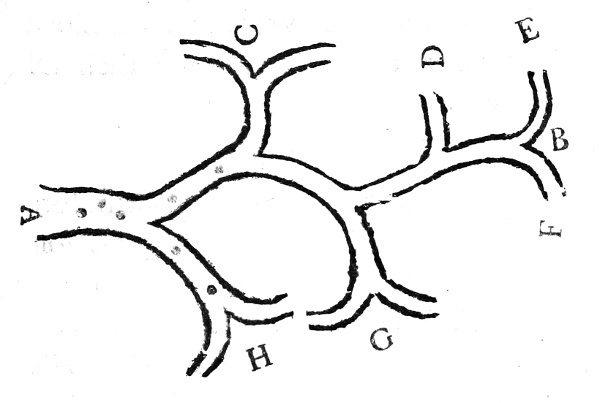
Let the Canal A be an Artery of a middle Size, sending out the Branches C, D, E, F, G, H; Let the Dotts represent the increased Moleculæ of the Blood, it is evident that these must be stopt some where or other in the Ramifications of the Vessels C, D, E, F, G, H, whenever the Diameters of the Moleculæ exceed those of the containing Vessels.
Prop. II.
The Magnitude of the Particles of the Blood being increased, those Capillary Vessels nearest the Heart will be soonest obstructed, and vice versa; The rest in Proportion to the Velocity of the Blood, Diameters of the Canals, and their Distance from the Heart.
Demonstration.
This is sufficiently evident from the foregoing; For the sooner those Moleculæ arrive at the Capillary Vessels, the sooner those Vessels will be obstructed, and vice versa, and consequently cæteris paribus the Capillaries of the Branches C, H, in the preceeding Figure, which are nearest the Heart, will be sooner obstructed than those of E, F.
Prop. III.
The Magnitude of the Particles of the Blood must be increased either by the Union of a greater Number of them than in a Natural State; Or by the Alteration of their Figure, by which their Surfaces become larger than before.
Demonstration.
This is evident from the Observations of Lewenhoeck and Malpighius on the perspirable and other ultimate Vessels, which are visible by the Microscope, and consequently larger than the Orifices of the Lacteals, which the best Glasses will not discover. Whence it will follow, that no Particle can pass this way into the Blood, which single can obstruct the Vessels, and consequently this Effect can only be produced by the Action of the Particles upon each other, viz. either by the Union of a greater Number, or some Alteration in their Figures, whereby their Surfaces become larger than before. Thus the Globules of the Blood as appears by the Microscope, are nearly of a Spherical Figure, which being the most capacious, as well as most apt to constitute a Fluid Body, by touching in the fewest Points The farther any Particles deviate from this Figure, the more likely they will be to obstruct the Vessels, and vice versa.
Prop. IV.
The Contagious Particles being admitted into the Blood, do there coagulate its Parts, and form Moleculæ of a larger Size than ordinary.
Demonstration
The Force of the Heart and Cavities of the Canals being the same, when the Infection is first taken, as before, the Blood would pass with the same Facility thro' the Vessels as at other Times, and Obstructions could not be formed, were not the Moleculæ thus increased; as our Senses show they are by the Eruption of Pustules in the Small-Pox, by the great Inflammations, Mortifications, Buboes, and Carbuncles in Malignant and Pestilential Fevers; and consequently the Contagious Particles do increase the Bulk of several of the constituent Parts of the Blood, by altering the Figures of its Particles, and forming Moleculæ of a larger Size than in a Natural State.
