Front matter (continued 3)
Reading edition
When in their burrows the posterior legs are extended behind the insect and push, while the anterior and intermediate ones are thrust forwards, the claws being firmly inserted, so as to enable the insect to pull itself along. Travelling along the burrow in this manner, they frequently evade all efforts to extract them, until they are stopped by arriving at the end of the gallery.
The sexes of this species are readily distinguishable, the male (Plate XVIII., fig. 2) possessing an immense head furnished with a pair of enormously powerful mandibles. The female (Plate XVII., fig. 8) is a more attractive insect, her gracefully curved ovipositor and smaller head having a much more pleasing appearance than the terribly menacing jaws of her mate. Both sexes are able to give severe bites, but it is extremely doubtful whether they would prove anything worse than slight mechanical injuries, as the insect is not likely to be poisonous. I am, however, unable to speak from experience.
Family Gryllidæ.
Xiphidium maoricum (Plate XVII., fig. 1).
This pretty insect may be found in great abundance round Nelson during the autumn, but is rarer in the Wellington Province. Its presence may be at once detected by the curious chirping heard in various directions shortly before sunset and lasting till eight or nine o'clock in the evening. This sound is produced with the wing-cases, which the male insects may be seen vigorously rubbing together. The females are quite mute, and they may be also distinguished by possessing a short curved ovipositor at the end of the body. The peculiarly leaf-like shape of the insect and its bright green colour render its discovery amongst the herbage a most difficult matter, even when its whereabouts is indicated by its cry—in fact, were it not for their music, there is little doubt that very few of these insects would ever be captured, as they are practically invisible, and are an instance of protective resemblance carried to great perfection.
When disturbed these crickets fly about twenty yards and again settle in a bush or amongst herbage, carefully avoiding alighting on the ground where they would be readily visible. Their flight is somewhat feeble for such large insects. Great care must be taken, when capturing specimens for preservation, not to hold them by their powerful hind-legs, as they will not infrequently cast one off while endeavouring to escape.
I have not yet noticed the larva of this species, but should imagine it would closely resemble a wingless imago.
Family Locustidæ.
Caloptenus marginalis (Plate XVII., fig. 4).
This is the little grasshopper which rises before our footsteps in swarms on a hot summer's day; it is one of the last insects to leave us in the autumn, being frequently found in warm situations on fine days in the middle of winter. Owing to its great abundance this species must inflict considerable damage on the grass, as it has taken up its quarters like the English grasshopper in the cultivated fields, where an unlimited supply of food is always at hand. Formerly, no doubt, it was much less common round Wellington than at present, owing to the few open spots then existing, none of these grasshoppers being found in the forest.
The perfect insect may be recognized by the rudimentary wings which are present on the thorax, thus causing it to closely resemble the larval form of many of the winged species, and for which it might readily be mistaken were its true character unknown.
Family Locustidæ.
Œdipoda cinerascens (Plate XVII., fig. 3).
This large and conspicuous insect occurs abundantly in all open situations near Nelson, but is very rare in the Wellington district, becoming, however, again common further north.
When disturbed it leaps into the air, spreads its wings, and flies away with great rapidity for thirty or forty yards, when it alights, and allows its pursuer to get within a few yards of his prize before again making off. This habit renders the capture of a good series of this insect a most arduous matter. The sexes may be readily distinguished by their size, the female being nearly twice as large as her mate.
This species is very variable in colour, some individuals being dark green whilst others are of a uniform drab.
The food of this insect consists of various domestic grasses, but I do not think it is at present sufficiently abundant to exercise any harmful influence on agriculture. By some entomologists, however, it is regarded as only a variety of the renowned migratory locust (Locusta migratoria), and as such its advent in large numbers might be viewed with serious apprehension.
It is also strange that although I have often seen large numbers of this species in the perfect state I have never observed the larva. I can only conjecture that the insect breeds in very secluded localities and then migrates in search of fresh food supplies.
Group Euplexoptera.
Family Forficulidæ.
Forficesila littorea (Plate XVII., fig. 7).
Abundant on the sea beach throughout the year, where it may be readily captured under stones and seaweed. It is a very bold insect, and when disturbed will grasp a blade of grass, or other object, very firmly with its powerful abdominal forceps, and allow itself to be lifted off the ground and carried away rather than relinquish its hold.
The food of this species probably consists of seaweed, although it is possibly carnivorous, and feeds on the small insects and crustaceans, which are numerous on the beach. Being permanently apterous, mature individuals can only be recognized by their large size, and the perfect development of their anal forceps. It is evidently erroneous to regard these as organs exclusively employed in opening and shutting the wings, as we see that in the present insect, which does not require them for that purpose, they are larger than in many of the flying earwigs. They are probably chiefly used to intimidate intruders.
This species is strictly marine in its habits and is seldom found more than a few yards above high-water-mark. The females may be often observed hatching their eggs. For this purpose they excavate an oval chamber underneath a log or large stone, and after carefully smoothing it within, deposit the eggs at the bottom. These eggs are most faithfully guarded by the mother, which boldly attacks all intruders, and will suffer herself to be killed rather than leave the spot. She also remains with the young ones for a considerable time after they are hatched, as we sometimes observe the females accompanied by a number of larvæ of quite a large size.
CHAPTER IX

The present Order of insects, although of very limited extent, contains several important species, of which the noisy Cicadas, destructive Aphides, and numerous Bugs, and Lice, can be cited as familiar examples. The Hemiptera may be conveniently divided into the two following groups:—
The Homoptera, comprising all the species in which the anterior wings are entirely membranous, and—
The Heteroptera, including those having the basal portion of the anterior wings thickened, and quite opaque.
These peculiarities have induced some entomologists, who regard the structure of the wings of the greatest importance in classifying, to arrange the insects included in the Homoptera and Heteroptera, into two distinct Orders; but their uniform character in all other respects renders this, I think, hardly desirable.
Group Homoptera.
Family Cicadidæ.
Cicada cingulata[22] (Plate XX., fig. 1, 1a pupa).
This beautiful insect may be found in great numbers amongst brushwood during the hot sunny days so common from January till March. Its larva inhabits the earth earlier in the summer, and its curious pupa can often be observed crawling up the stems of trees in order to allow the perfect insect to emerge. After this has taken place the exuviæ still remain firmly attached to the tree, and are very conspicuous objects; but if it is desired to remove them great care must be taken not to break off the legs, which are always very brittle.
The perfect insects are at once betrayed by their loud singing, which, in certain localities, becomes quite deafening. This noise is entirely confined to the males, and proceeds from two large drum-like organs, situated on the under surface of the abdomen near its base, which, in conjunction with the curious ovipositor existing in the females constitute good sexual distinctions throughout the family. The structure of these two organs having been admirably described by several European authors renders it quite unnecessary for me to do so here.
Closely allied to the present insect is Cicada muta, the female of which is depicted on Plate XX., fig. 2. The male is often of a reddish-brown colour, but the insect is an extremely variable one. It is found in similar situations to C. cingulata, but appears rather earlier in the year.
Family Cicadidæ.
Cicada iolanthe, n.s. (Plate XX., fig. 3, 3a larva, 3b pupa).
This is the first species of Cicada to appear in the spring, and is found during November and December. Its larva (Fig. 3a) is a curious little animal, the two hind-legs being very long. I am at present unable to state with certainty what constitutes its food, but am extremely doubtful whether it consists of the juices imbibed from the roots of plants, as is generally supposed. The anterior legs, although probably chiefly constructed for digging, appear to be also suited for raptorial purposes, which leads me to believe that the insect may be carnivorous in its habits. The pupa (Fig. 3b) does not materially differ from that of the last, except in size, and its empty exuvia is also frequently found attached to the stems of trees.
The perfect insect may be at once discovered by the peculiarly shrill note emitted by the male.
Family Aphidæ.
This family is extensively represented in New Zealand, but as I have not yet been able to obtain any information respecting their specific identity I am compelled to pass them by for the present, hoping that future investigation will reveal much that is interesting in their habits, and also help both gardener and agriculturist to protect himself from their ravages.
Family Coccididæ.
Coelostoma zealandicum (Plate XX., fig. 4 ♂).
This species is figured as a representative of this very curious family chiefly on account of its great similarity to a Dipterous insect, the rudimentary condition of its posterior wings being most perplexing to the beginner. Its habits have been amply described by Mr. Maskell, in his work on the Coccididæ of New Zealand, to which I consequently refer.
Group Heteroptera.
Family Notonectidæ.
Corixa zealandica, n.s. (Plate XX., fig. 5).
Abundant throughout the summer in all slow-running streams. The larva closely resembles the imago except that it has no wings. Its food probably consists of the juices of other insects. The present insect invariably swims with its back exposed, thus differing considerably from the English Water-boatman (Notonecta glauca), whose keel-like back is kept beneath the water, while the two long hind-legs are rapidly moved backwards and forwards like oars.
Family Scutelleridæ.
Cermatulus nasalis (Plate XX., fig. 6, 6a larva).
This insect may be beaten out of various trees during the summer, and is usually taken in some abundance in February amongst white rata blossoms, on which it may be often observed sucking the honey from the blossoms with its long rostrum. Its larva, which is represented at Fig. 6a, is found in similar situations.
This concludes the series of insects I have selected as representative of the several orders in New Zealand. The brief sketch of entomology thus given is of necessity extremely fragmentary, and many important groups and families are entirely unrepresented. Should, however, this little book induce some of its readers to investigate insects for themselves, I shall feel that my efforts have been amply rewarded.
THE END.
GENERAL INDEX.
PAGE
Abdomen, 4
Acanthoderus, 110
" horridus, 110
" prasinus, 111
Acroceridæ, 56
Acrocera, 56
" longirostris, 56
Achetidæ, 112
Acheta, 112
" fuliginosa, 112
Andrenidæ, 33
Antennæ, 2
Ants, 35
Ant-lions, 99
Anus, 4
Aphides destroyed by Syrphus, 57
Aphidæ, 120
Aphaniptera, 64
Aquatic insects, 22, 40, 100, 103
Argyrophenga, 65
" antipodum, 65
Asilidæ, 55
Asthena, 91
" schistaria, 91
" pulchraria, 92
Atta antarctica, 37
Attracting by light, 14
Atropos, 107
" pulsatorium, 107
Bacillus, 110
" hookeri, 110
Beating, 9
Bee parasites, 63
Bees, 33
Beetles, 19
Beetles under sacks, 9
" killing, 10
" pinning, 10
Bibio, 52
" nigrostigma, 52
Blattidæ, 109
Blatta, 109
" conjuncta, 109
"Bloodworm", 43
Blossoms, 13
Blue butterfly, 69
"Blue-bottles", 60
Bolitophila, 49
" luminosa, 49
Bombycidæ, 73
Bombylidæ, 54
Book tick, 107
Boxes, 10
Brachelytra, 25
Brachocera, 54
Breathing organs, 4
Butterflies, 65
" setting, 12
" rearing, 15
Cacoecia, 95
" excessana, 95
Calliphora, 60
" quadrimaculata, 60
Camphor, 17
Catocala, 83
Caloptenus, 115
" marginalis, 115
Caterpillar cages, 15
Carabidæ, 21
Carbolic acid, 17
Case-bearing larvæ, 74
Casting skin, 111
Ceratopogon, 45
" antipodum, 45
Cermatulus, 121
" nasalis, 121
Chætosoma, 24
" scaritides, 24
Chalastra, 84
" pelurgata, 84
Chalcididæ, 37
Chauliodes, 102
" diversus, 102
Chironomus, 43
" zealandicus, 43
" plumosus, 43
Chrysophanus, 68
" salustius, 68
" boldenarum, 68
" feredayi, 68
" enysii, 68
Cicadidæ, 118
Cicada, 118
" cingulata, 118
" muta, 119
" iolanthe, 119
Cicindela, 19
" tuberculata, 19
" parryi, 20
Cicindelidæ, 19
Clavicornia, 23
Cloniophora, 50
" subfasciata, 50
Clothes moth, 96
Click beetles, 29
Cockchaffer, 27
Cockroaches, 109
Coccididæ, 120
Cœlopa, 63
" littoralis, 63
Cœlostoma, 120
" zealandicum, 120
Coleoptera, 5, 19
" rearing, 15
" collecting, 9
Collecting insects, 9
" at night, 13
Collection, 17
Collectional journal, 18
Coloburus, 105
Colon, 4
Colymbetes, 22
" rufimanus, 22
Comptosia, 54
" bicolor, 54
" virida, 55
Copper butterflies, 68
Cordulia, 104
" smithii, 104
Corethra, 43
" antarctica, 43
Corixa, 120
" zealandica, 120
Compound eyes, 2
Coxa, 3
Crambus, 93
" flexuosellus, 93
" tahulalis, 93
Crickets, 112
Crop, 4
Ctenopseustis, 96
" obliquana, 96
Culex, 40
" argyropus, 42
" iracundus, 40
Culicidæ, 40
Curculionidæ, 31
Cylindria, 62
" sigma, 62
Danais, 65
" plexippus, 65
Dasycolletes, 33
" hirtipes, 33
" purpureus, 34
Declana, 83
" floccosa, 83
" floccosa v. junctilinea 84
Deinacrida, 112
" megacephala, 112
Diadema, 65
" nerina, 65
Digestive system, 4
Diptera, 6, 40
Dorcus, 26
" punctulatus, 26
" reticulatus, 26
Dorsal vessel, 4
Dragon-flies, 103
Dryocora, 24
" howittii, 24
Dyticidæ, 22
Earwigs, 116
Eggs of insects, 5
Elateridæ, 28
Elytra, 5
Endrosis, 96
" fenestrella, 96
Engidæ, 24
Entomologist in winter, 10
Entomological pins, 13
Ephemeridæ, 105
Ephemera, 105
Epuræa, 23
" zealandica, 23
Eristalis, 57
" cingulatus, 57
Erana, 78
" graminosa, 78
Erebia pluto and butleri, 66
Euplexoptera, 116
Eurigaster, 60
" marginatus, 60
Exaireta, 56
" spiniger, 56
External organs, 2
Eyes, 2
Family, 8
Femur, 3
Flea, 64
Forficulidæ, 116
Forficesila, 116
" littorea, 116
Formicidæ, 35
Formica, 35
" zealandica, 35
Ganglia, 4
Genus, 8
Geodephaga, 19
Geometridæ, 83
Geometer, 83
Gerris, 43
Glow-worm, 49
Gilt pins, 13
Gizzard, 4
Grasshopper, 115
Gryllidæ, 112
Head, 2
Heart, 4
Heliothis, 81
" armigera, 81
Helophilus, 58
" trilineatus, 58
" ineptus, 59
" hochstetteri, 59
Hemerobiidæ, 101
Hemiptera, 8, 118
Hepialus, 70
" virescens, 70
Hepialidæ, 69
Heterocera, 69
Heteromera, 29
Heteroptera, 118
Homoptera, 118
Host, 38
Hydradephaga, 22
Hydriomena, 91
" deltoidata, 91
Hymenoptera, 6, 33
Ichneumon, 38
" deceptus, 38
" sollicitorius, 38
Ichneumonidæ, 38
Ilium, 4
Imago, 4
Internal organs, 4
Insect, definition of, 1
Isonomeutis, 94
" amauropa, 94
Jaws, 2
Journal, 18
Killing insects, 10, 12
" bottle, 12
Labelling insects, 18
Labial palpi, 2
Labium, 2
Labrum, 2
Lace-wings, 101
Lamellicornes, 26
Larva, 4
Lasiorhynchus, 32
" barbicornis, 32
Laurel bottle, 12
Lepidoptera, 6, 65
Lestes colensonis, 104
Leucania, 78
" atristriga, 78
" nullifera, 77
Libanasa macropathus, 113
Libellulidæ, 103
Light, insects at, 14
Locusta, 116
" migratoria (?), 116
Locustidæ, 115
Longicornia, 30
Lower lip, 2
Lucanidæ, 26
Luminous larva, 49
Lycænidæ, 68
Lycæna, 69
" phœbe, 69
Mamestra, 79
" composita, 80
" mutans, 79
" ustistriga, 81
Mandibles, 2
Mantidæ, 109
Maxillae, 2
Mayflies, 105
Melampsalta, 118
Melolonthidæ, 26
Melolontha, 27
" vulgaris, 27
Mesothorax, 2
Mesonotum, 2
Mesosternum, 2
Metamorphosis, 4
Metablax, 29
" acutipennis, 29
Metathorax, 2
Migrations of ants, 37
Miltogramma, 59
" mestor?, 59
Mosquito, 40
Moths, 69
" setting, 12
Musca, 61
" cæsar, 61
" domestica, 61
Muscidæ, 59
Mycetophila, 46
" antarctica, 46
Myrmeleontidæ, 99
Nemocera, 40
Nemorea, 59
" nyctemerianus, 59
Nervous system, 4
Net, 11
Neuroptera, 7, 99
Nitidulidæ, 23
Noctuidæ, 77
Notonectidæ, 120
Notonecta, 121
" glauca, 121
Nyctemera, 73
" annulata, 73
Nymphalidæ, 65
Œceticus, 74
" omnivorus, 74
Œcophora, 97
" scholæa, 97
Œdipoda, 115
" cinerascens, 115
Œstridæ, 63
Œstrus, 63
" perplexus, 63
Ochrocydus, 31
" huttoni, 31
Orders, 5
Oreda, 31
" notata, 31
Orthoptera, 7, 103
Ovipositor, 38
Oxyethira, 99
" albiceps, 99
Painted Lady Butterfly, 67
Palpi, 2
Parasites, 59
Periplaneta, 109
" fortipes, 109
" orientalis, 109
" undulivitta, 109
Perla, 107
" cyrene, 107
Perlidæ, 106
Phasmidæ, 110
Philonthus, 25
" œneus, 25
Phora, 62
" omnivora, 62
Phryganidæ, 99
Pinning insects, 12
Pins, 13
Plant-lice, 118
Ploseria, 85
" alectoraria, 86
" hemipteraria, 85
Plusia, 82
" eriosoma, 82
" gamma, 83
Pompilus, 34
" fugax, 34
" " and spider, 35
Porina, 69
" signata, 69
" cervinata, 69
" umbraculata, 69
Ponera, 36
" castanea, 36
Prionidæ, 30
Prionus, 30
" reticularis, 30
Pronotum, 2
Prothorax, 2
Prosternum, 2
Proventriculus, 4
Psepholax, 31
" coronatus, 31
Psocidæ, 107
Psocus, 107
" zealandicus, 107
Psychidæ, 74
Psychoda, 46
" conspicillata, 46
Pteromalus, 37
Pterostichus, 21
" opulentus, 21
Pulicina, 64
Pupa, 4
Pupipara, 64
Pyralidæ, 92
Pyrameis, 66
Pyronota, 28
" festiva, 28
Queens, 34
Rearing Insects, 15
Rhopalocera, 65
Rhyncophora, 31
Rhyphus, 51
" neozealandicus, 51
Sandfly, 53
Sarcophaga, 61
" læmica, 61
Sarapogon, 55
" viduus, 55
Scutelleridæ, 121
Scolobates, 39
" varipes, 39
Scoparia, 92
" hemiplaca, 92
" sabulosella, 93
Selidosema, 87
" dejectaria, 87
" panagrata, 89
" productata, 90
Sestra, 87
" humeraria, 87
Setting boards, 12
" insects, 12
Semiocosma, 97
" platyptera, 97
Sialidæ, 102
Siculidæ, 94
Siculodes, 94
" subfasciata, 94
Simple eyes, 2
Simulia, 53
" australiensis, 53
Skipjack beetles, 29
Social bees, 34
Soldiers, 108
Sphegidæ, 34
Sphinx, 69
" convolvuli, 69
Sphingidæ, 69
Staphylinus, 25
" oculatus, 25
Stenoperla, 106
" prasina, 106
Stenosmylus, 101
" incisus, 101
Stick insects, 110
Sternoxi, 28
Stethaspis, 26
" suturalis, 26
Stolotermes, 107
" ruficeps, 107
Stomach, 4
" sucking, 4
Stuffing insects, 15
Stratiomidæ, 56
Sugaring, 13
Syrphidæ, 56
Syrphus, 56
" ortas, 56
Tabanus, 54
" impar, 54
Tatosoma, 91
" agrionata, 91
Tarsus, 3
Telebasis, 105
" zealandica, 105
Tenebrionidæ, 29
Tenodera, 109
" intermedia, 109
Termitidæ, 107
Thoramus, 28
" wakefieldi, 28
" perblandus, 29
Thorax, 2
Throat, 4
Tinea, 96
" tapezella, 96
Tineidæ, 96
Tipula, 47
" holochlora, 47
" fumipennis, 48
Tipulidæ, 43
Tortricidæ, 94
Trap-door, 71
Trochanter, 3
Uloma tenebrionides, 29
Umbrella, 9
Uropetala carovei, 103
Vanessa cardui, 67
" gonerilla, 66
" itea, 67
Vegetable caterpillar, 73
Ventriculus, 4
Weevils, 32
White rata, 13
Wings, 4
Wireworm, 30
Wood destroyers, 30
Workers, 108
Xantholinus, 26
Xiphidium maoricum, 114
EXPLANATION OF PLATES.
Note.—In all the Plates and references thereto the sign ♂ indicates that the specimen figured belongs to the male sex, ♀ to the female sex, and ☿ to the neuter sex.
In the case of enlarged figures the insect's natural size is indicated by a line.
PLATE I. Coleoptera. Fig. 1.—Cicindela tuberculata. " 1a.—Larva. " 2.—Chætosoma scaritides. " 3.—Pterostichus opulentus. " 3a.—Larva. " 4.—Colymbetes rufimanus. " 4a.—Larva. " 5.—Staphylinus oculatus. " 6.—Dryocora howittii. " 6a.—Larva. " 7.—Dorcus punctulatus. " 8.—Stethaspis suturalis. " 8a.—Larva.
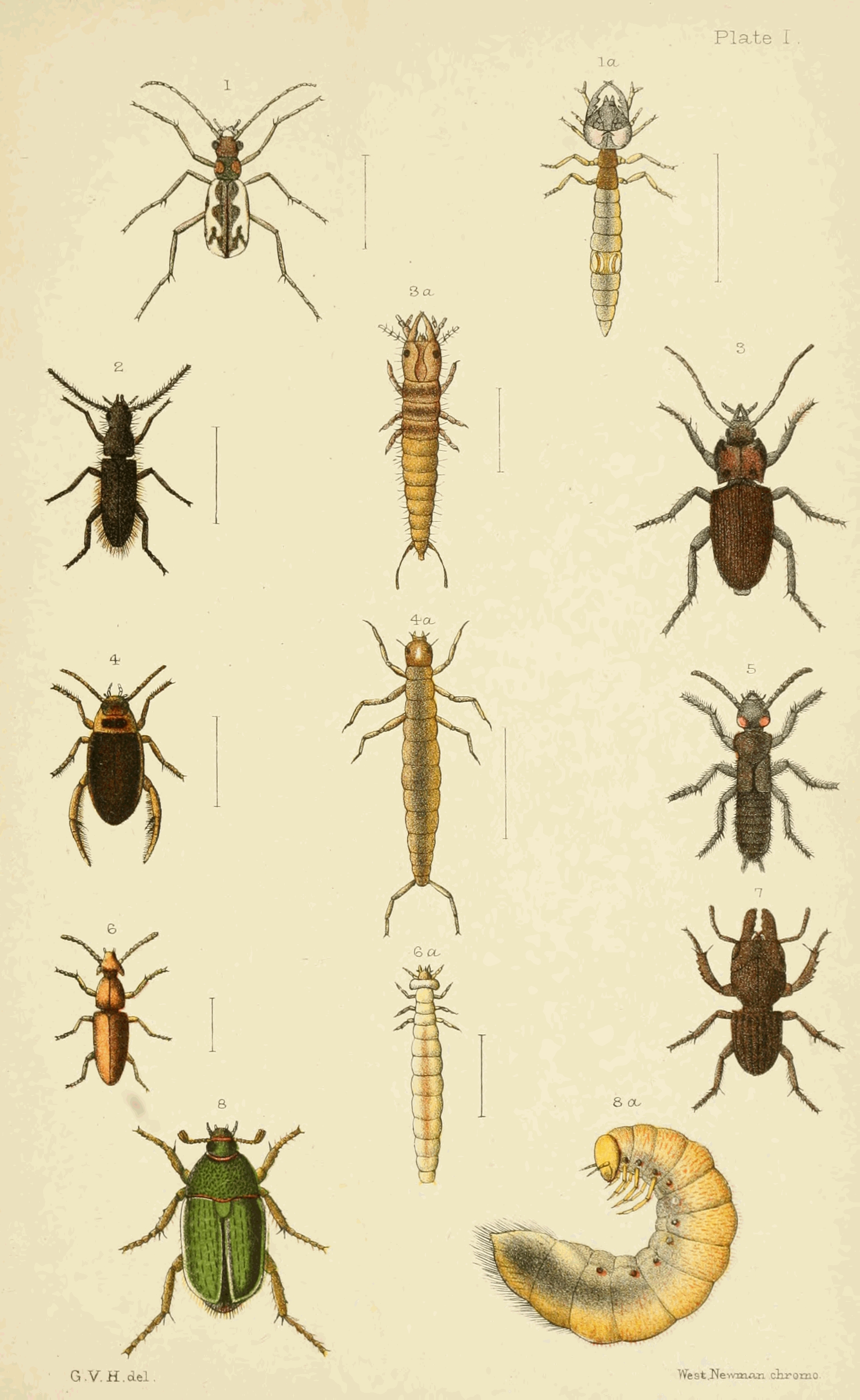
PLATE I.
Coleoptera.
Fig. 1.—Cicindela tuberculata.
" 1a.—Larva.
" 2.—Chætosoma scaritides.
" 3.—Pterostichus opulentus.
" 3a.—Larva.
" 4.—Colymbetes rufimanus.
" 4a.—Larva.
" 5.—Staphylinus oculatus.
" 6.—Dryocora howittii.
" 6a.—Larva.
" 7.—Dorcus punctulatus.
" 8.—Stethaspis suturalis.
" 8a.—Larva.
PLATE II. Coleoptera (concluded). Fig. 1.—Thoramus wakefieldi. " 1a.—Pupa. " 1b.—Larva. " 2.—Uloma tenebrionides. " 2a.—Larva. " 2b.—Pupa. " 3.—Prionus reticularis. " 3a.—Pupa. " 3b.—Larva. " 4.—Oreda notata. " 4a.—Larva. " 5.—Psepholax coronatus ♀. " 5a.—Pse"olax coron"tus ♂.
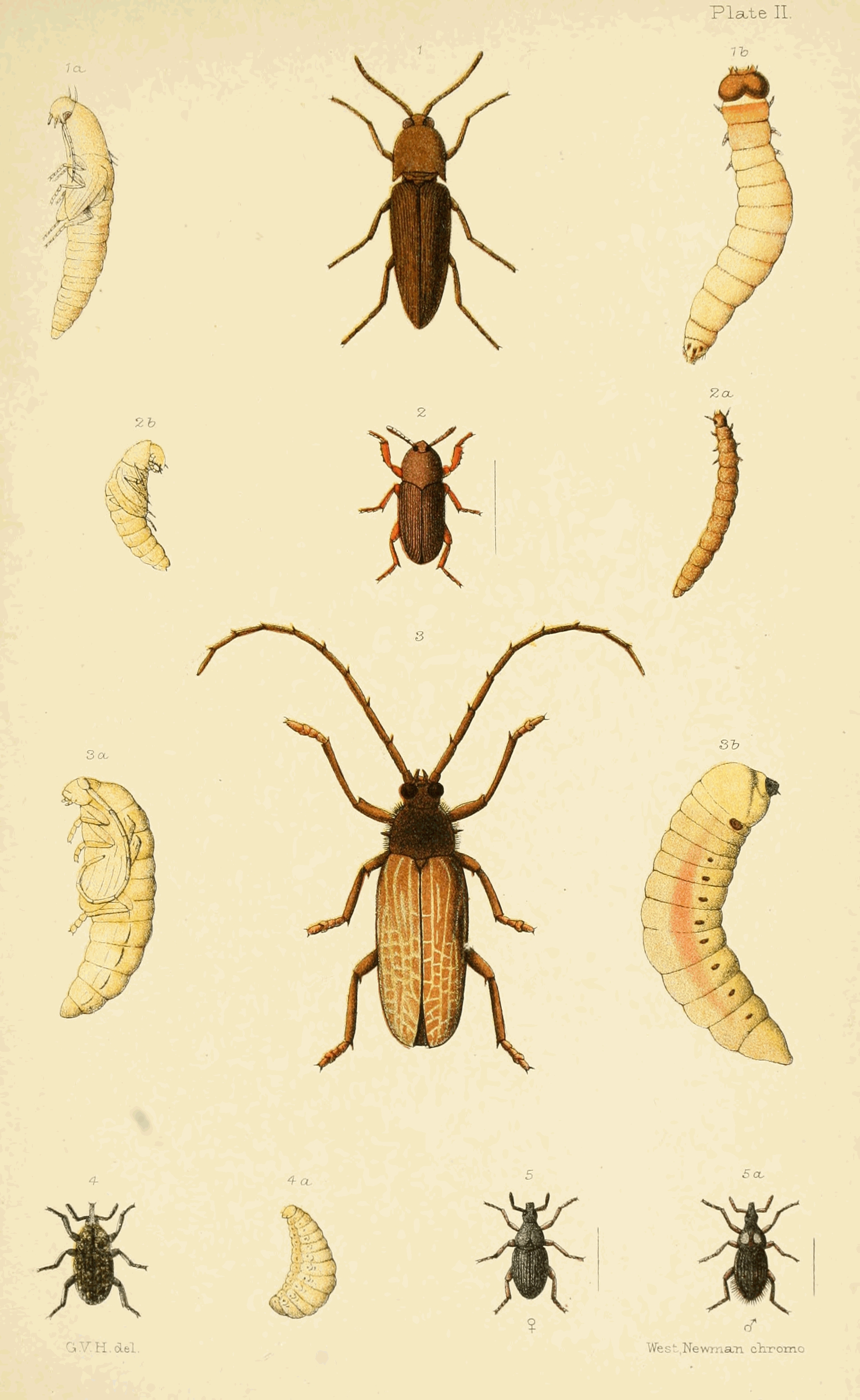
PLATE II.
Coleoptera (concluded).
Fig. 1.—Thoramus wakefieldi.
" 1a.—Pupa.
" 1b.—Larva.
" 2.—Uloma tenebrionides.
" 2a.—Larva.
" 2b.—Pupa.
" 3.—Prionus reticularis.
" 3a.—Pupa.
" 3b.—Larva.
" 4.—Oreda notata.
" 4a.—Larva.
" 5.—Psepholax coronatus ♀.
" 5a.—Pse"olax coron"tus ♂.
PLATE III. Hymenoptera. Fig. 1.—Dasycolletes hirtipes. (?) " 2.—Pompilus fugax. " 3.—Formica zealandica ♂. " 3a.—Fm"ica zeal"ndica ♀. " 3b.—Fm"ica zeal"ndica ☿. " 3c.—Cocoon. " 4.—Ponera castanea ♂. " 4a.—Po"ra cas"anea ☿. " 4b.—Larva. " 5.—Atta antarctica ♂. " 5a.—A"a anta"ctica ♀. " 5b.—Larva. " 6.—Ichneumon sollicitorius. " 7.—Ichn"umon deceptus. " 8.—Scolobates varipes. " 9.—Pteromalus (?), n.s. " 10.—Dasycolletes purpureus.
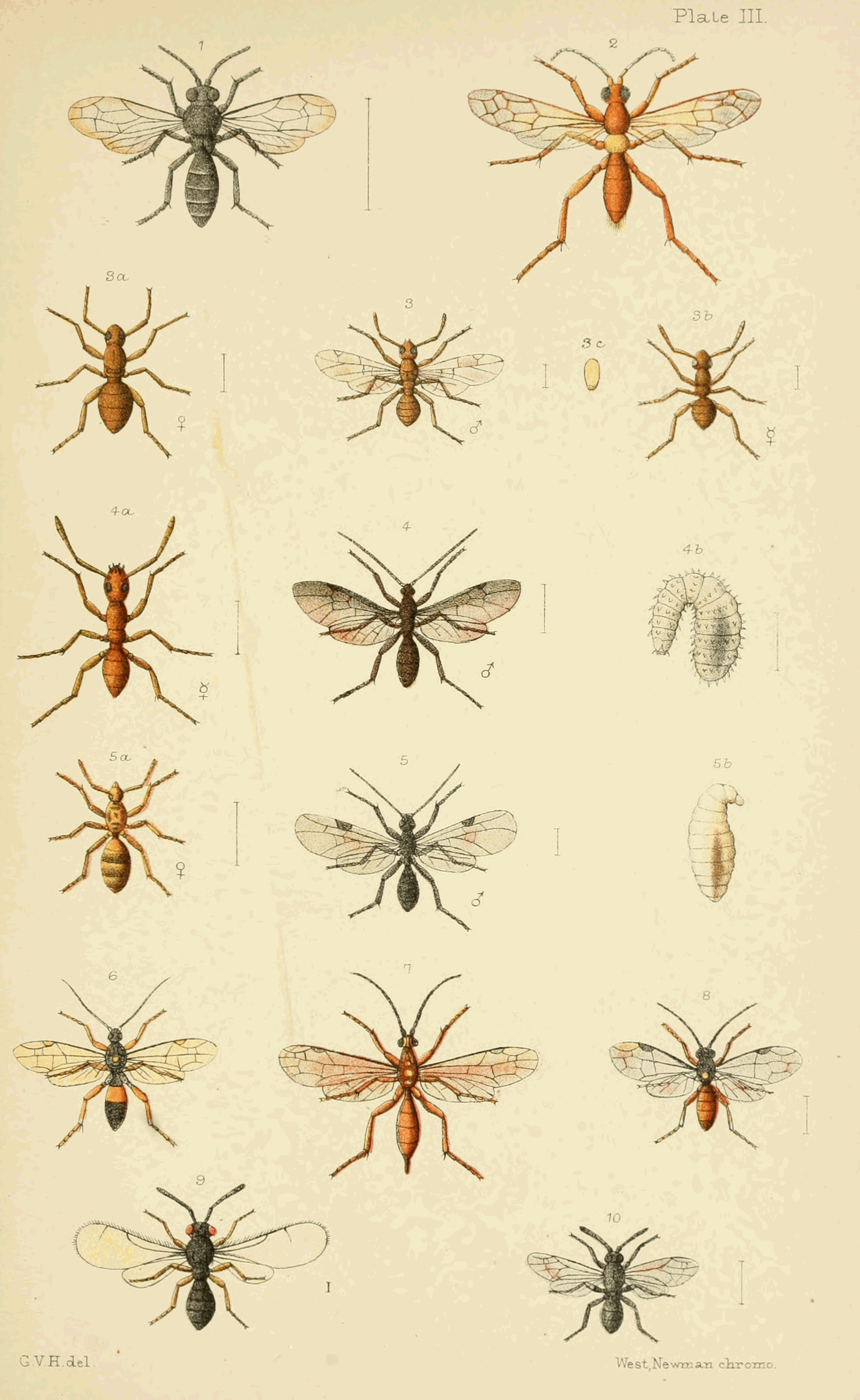
PLATE III.
Hymenoptera.
Fig. 1.—Dasycolletes hirtipes. (?)
" 2.—Pompilus fugax.
" 3.—Formica zealandica ♂.
" 3a.—Fm"ica zeal"ndica ♀.
" 3b.—Fm"ica zeal"ndica ☿.
" 3c.—Cocoon.
" 4.—Ponera castanea ♂.
" 4a.—Po"ra cas"anea ☿.
" 4b.—Larva.
" 5.—Atta antarctica ♂.
" 5a.—A"a anta"ctica ♀.
" 5b.—Larva.
" 6.—Ichneumon sollicitorius.
" 7.—Ichn"umon deceptus.
" 8.—Scolobates varipes.
" 9.—Pteromalus (?), n.s.
" 10.—Dasycolletes purpureus.
PLATE IV. Diptera. Fig. 1.—Culex iracundus ♀. " 1a.—Larva. " 1b.—Pupa. " 2.—Chironomus zealandicus, n.s. " 2a.—Larva. " 2b.—Pupa. " 3.—Corethra antarctica, n.s. " 3a.—Larva. " 3b.—Pupa. " 4.—Ceratopogon antipodum, n.s. " 4a.—Larva. " 4b.—Pupa. " 5.—Mycetophila antarctica, n.s. " 5a.—Larva. " 5b.—Pupa. " 6.—Psychoda conspicillata.
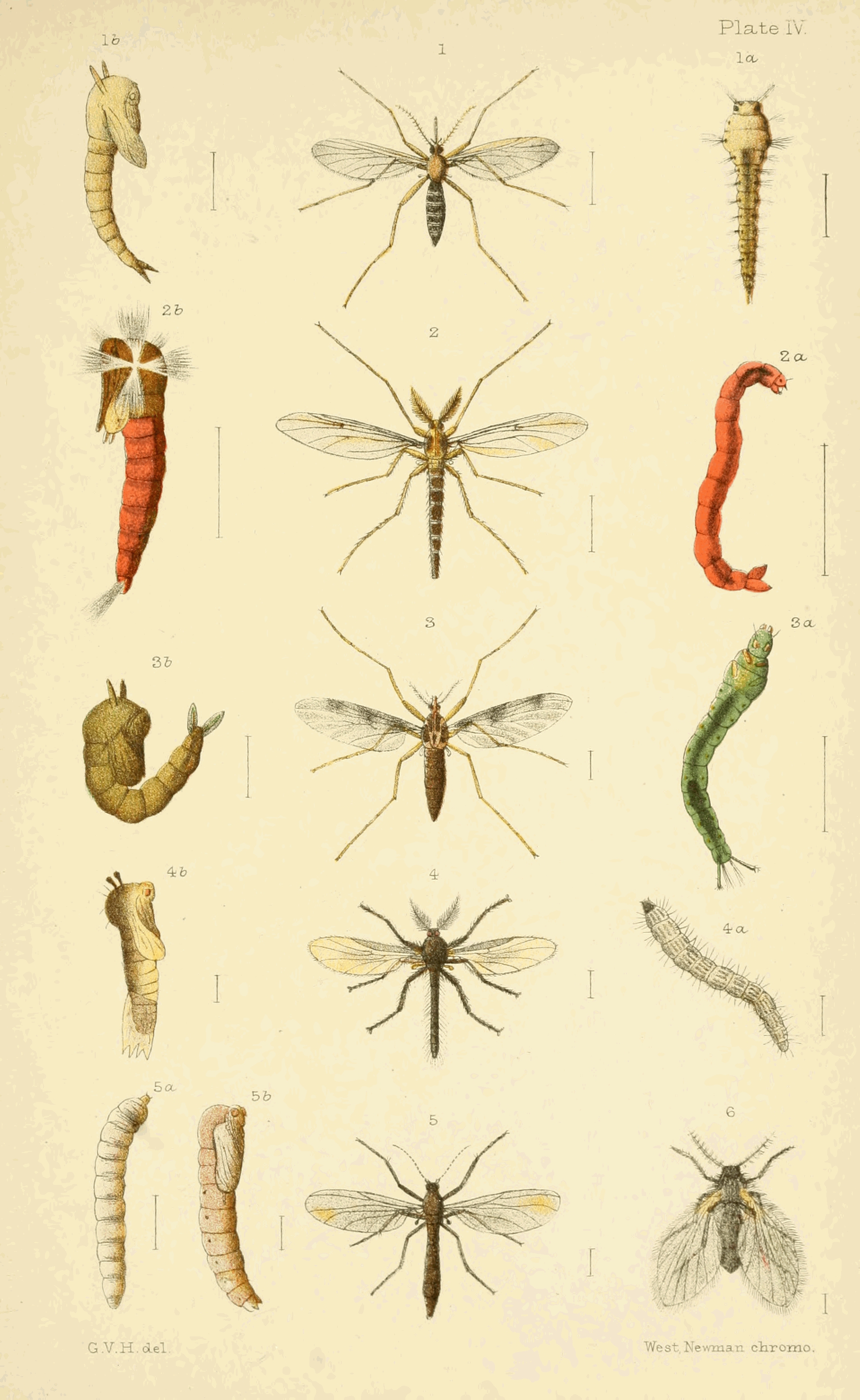
PLATE IV.
Diptera.
Fig. 1.—Culex iracundus ♀.
" 1a.—Larva.
" 1b.—Pupa.
" 2.—Chironomus zealandicus, n.s.
" 2a.—Larva.
" 2b.—Pupa.
" 3.—Corethra antarctica, n.s.
" 3a.—Larva.
" 3b.—Pupa.
" 4.—Ceratopogon antipodum, n.s.
" 4a.—Larva.
" 4b.—Pupa.
" 5.—Mycetophila antarctica, n.s.
" 5a.—Larva.
" 5b.—Pupa.
" 6.—Psychoda conspicillata.
PLATE V. Diptera (continued). Fig. 1.—Tipula holochlora. " 1a.—Larva. " 1b.—Pupa. " 2.—Tipula fumipennis, n.s. " 2a.—Larva. " 2b.—Pupa. " 3.—Cloniophora subfasciata. " 3a.—Larva. " 4.—Rhyphus neozealandicus. " 4a.—Larva. " 4b.—Pupa. " 5.—Bibio nigrostigma ♂. " 5a.—Larva. " 5b.—Pupa.
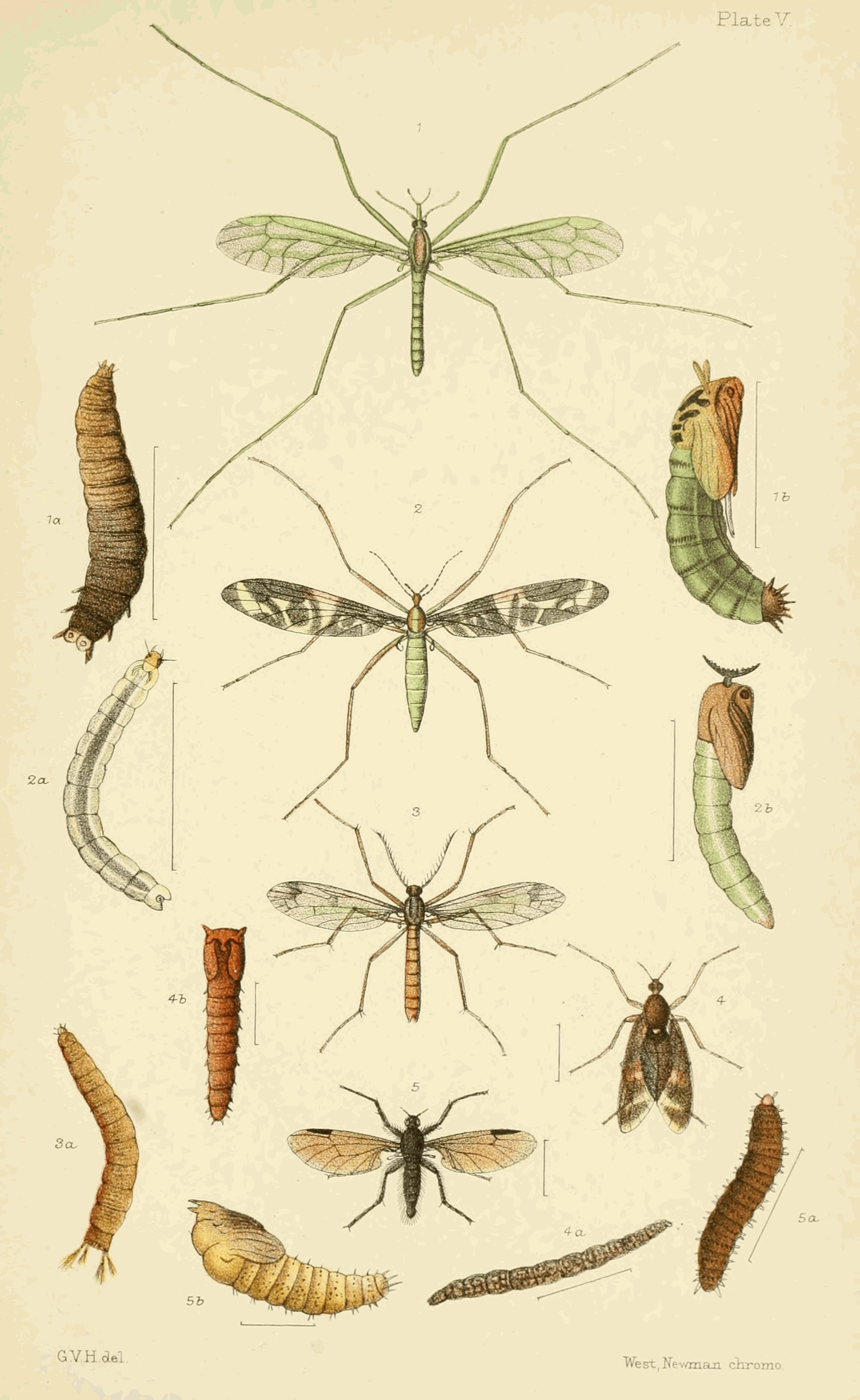
PLATE V.
Diptera (continued).
Fig. 1.—Tipula holochlora.
" 1a.—Larva.
" 1b.—Pupa.
" 2.—Tipula fumipennis, n.s.
" 2a.—Larva.
" 2b.—Pupa.
" 3.—Cloniophora subfasciata.
" 3a.—Larva.
" 4.—Rhyphus neozealandicus.
" 4a.—Larva.
" 4b.—Pupa.
" 5.—Bibio nigrostigma ♂.
" 5a.—Larva.
" 5b.—Pupa.
PLATE VI. Diptera (continued). Fig. 1.—Simulia australiensis. " 1a.—Larva. " 1b.—Pupa. " 2.—Comptosia bicolor. " 3.—Comptosia virida, n.s. " 3b.—Pupa. " 4.—Sarapogon viduus. " 4a.—Larva. " 4b.—Pupa. " 5.—Exaireta spiniger. " 6.—Tabanus impar.
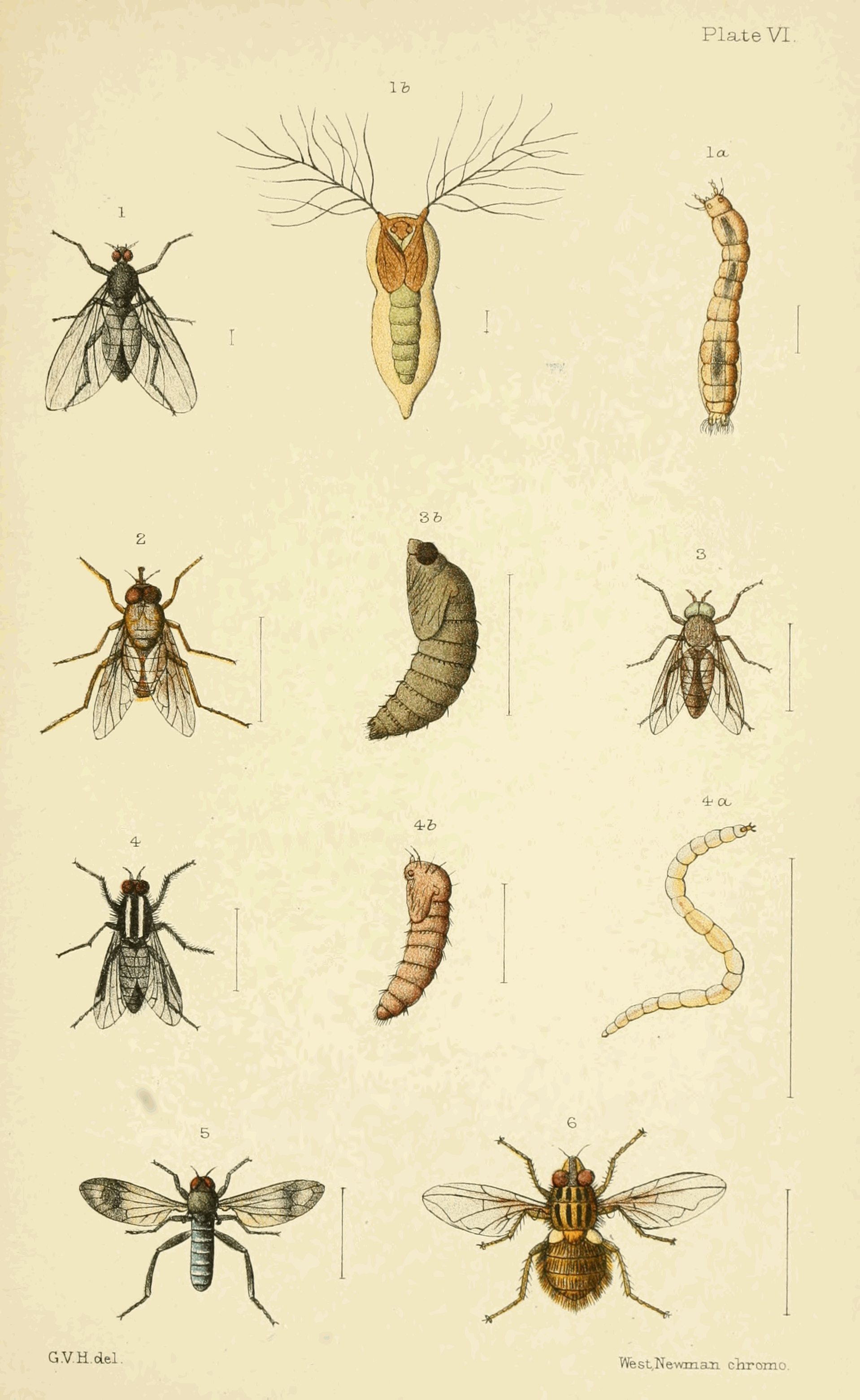
PLATE VI.
Diptera (continued).
Fig. 1.—Simulia australiensis.
" 1a.—Larva.
" 1b.—Pupa.
" 2.—Comptosia bicolor.
" 3.—Comptosia virida, n.s.
" 3b.—Pupa.
" 4.—Sarapogon viduus.
" 4a.—Larva.
" 4b.—Pupa.
" 5.—Exaireta spiniger.
" 6.—Tabanus impar.
PLATE VII. Diptera (concluded). Fig. 1.—Helophilus trilineatus. " 1a.—Larva. " 1b.—Pupa. " 2.—Eristalis cingulatus. " 3.—Syrphus ortas. " 3a.—Larva. " 3b.—Pupa. " 4.—Acrocera longirostris, n.s. " 5.—Miltogramma mestor? " 6.—Nemorea nyctemerianus, n.s. " 7.—Eurigaster marginatus. " 9.—Calliphora quadrimaculata. " 10.—Sarcophaga læmica. " 12.—Œstrus perplexus, n.s. " 13.—Cœlopa littoralis. " 14.—Cylindria sigma. " 15.—Phora omnivora, n.s. " 15a.—Pupa.
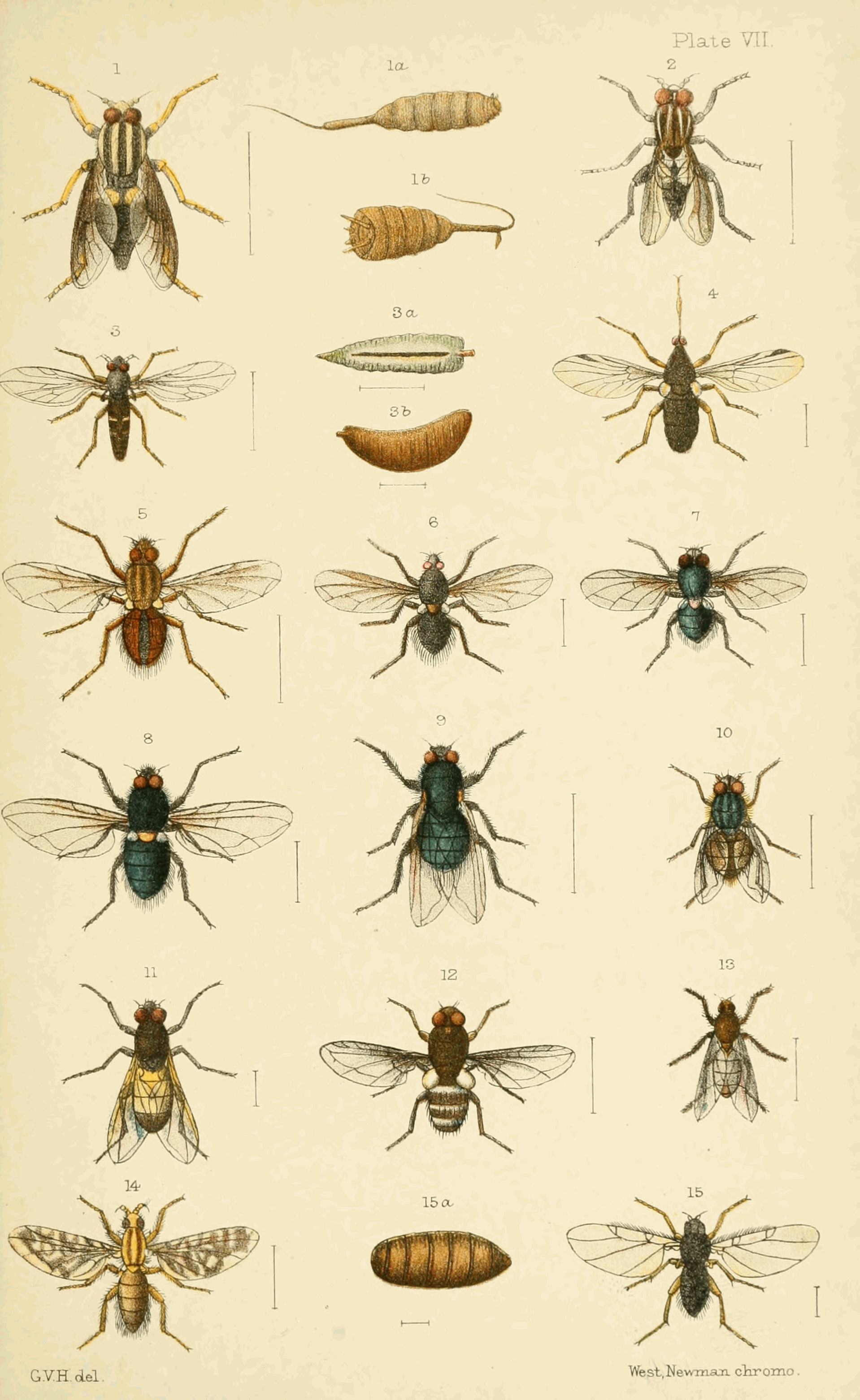
PLATE VII.
Diptera (concluded).
Fig. 1.—Helophilus trilineatus.
" 1a.—Larva.
" 1b.—Pupa.
" 2.—Eristalis cingulatus.
" 3.—Syrphus ortas.
" 3a.—Larva.
" 3b.—Pupa.
" 4.—Acrocera longirostris, n.s.
" 5.—Miltogramma mestor?
" 6.—Nemorea nyctemerianus, n.s.
" 7.—Eurigaster marginatus.
" 9.—Calliphora quadrimaculata.
" 10.—Sarcophaga læmica.
" 12.—Œstrus perplexus, n.s.
" 13.—Cœlopa littoralis.
" 14.—Cylindria sigma.
" 15.—Phora omnivora, n.s.
" 15a.—Pupa.
PLATE VIII. Lepidoptera. Fig. 1.—Argyrophenga antipodum. " 1a.—Northern form of same insect. " 2.—Vanessa gonerilla. " 2a.—Underside. " 2b, 2c.—Larvæ. " 2d, 2e.—Pupæ. " 3.—Chrysophanus salustius ♂. " 3a.—Chyso"hanus salu"tius ♀. " 3b.—Young larva (magnified).
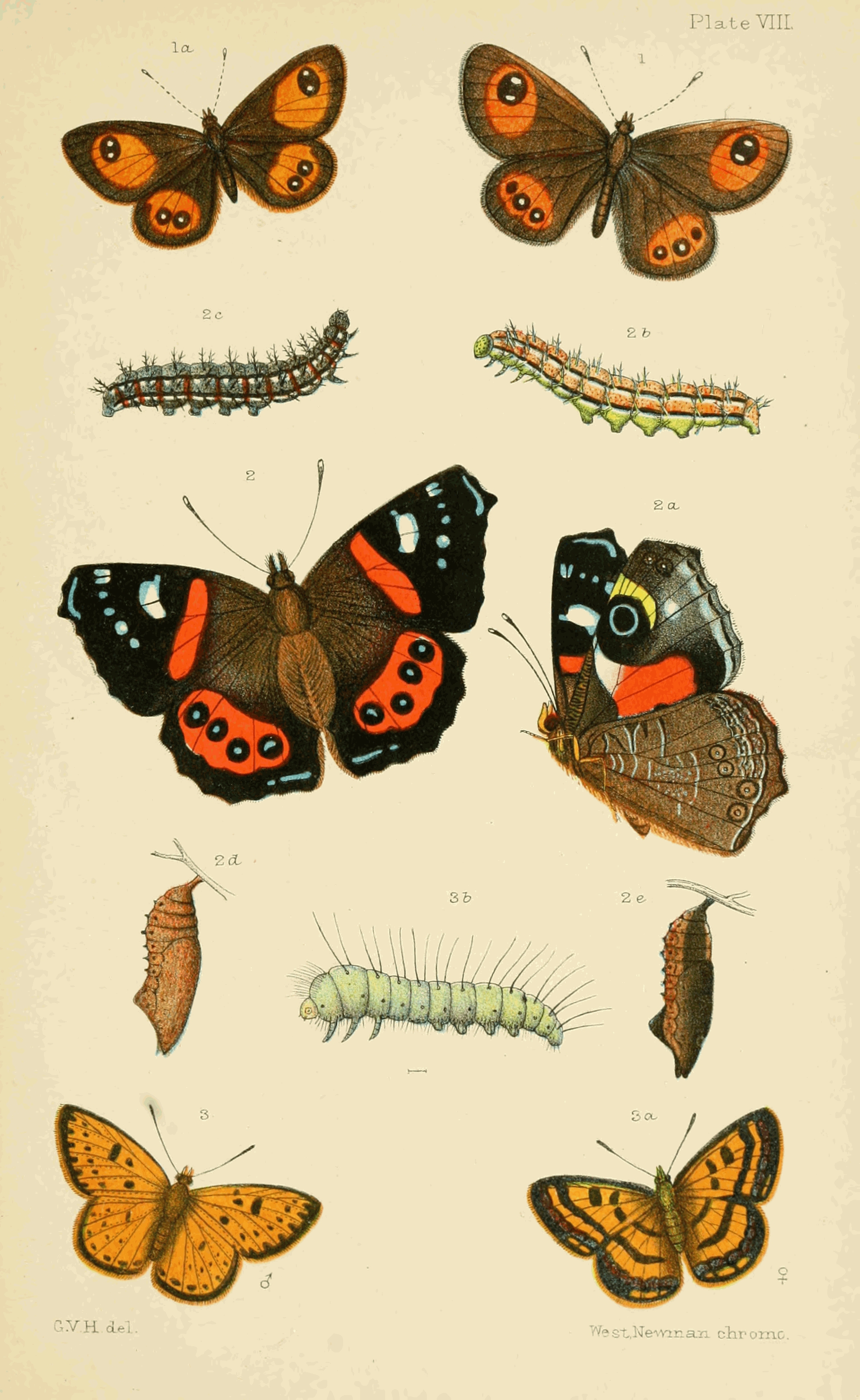
PLATE VIII.
Lepidoptera.
Fig. 1.—Argyrophenga antipodum.
" 1a.—Northern form of same insect.
" 2.—Vanessa gonerilla.
" 2a.—Underside.
" 2b, 2c.—Larvæ.
" 2d, 2e.—Pupæ.
" 3.—Chrysophanus salustius ♂.
" 3a.—Chyso"hanus salu"tius ♀.
" 3b.—Young larva (magnified).
PLATE IX. Lepidoptera (continued). Fig. 1.—Hepialus virescens ♂. " 1a.—Hp"alus vire"cens ♀. " 1b.—Pupa. " 1c.—Larva. " 2.—Porina signata. " 3.—Nyctemera annulata ♂. " 3a.—Larva. " 3b.—Pupa.
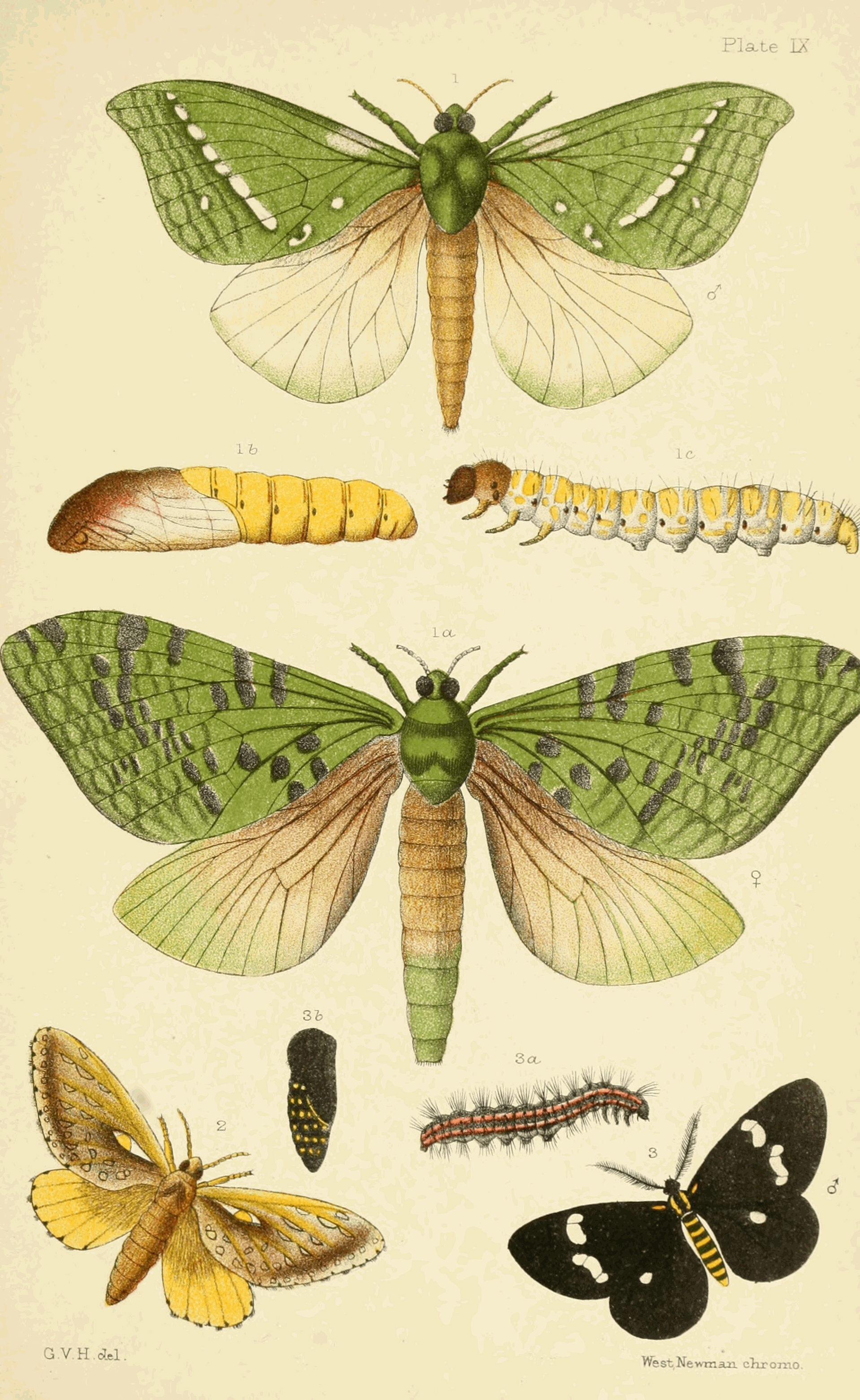
PLATE IX.
Lepidoptera (continued).
Fig. 1.—Hepialus virescens ♂.
" 1a.—Hp"alus vire"cens ♀.
" 1b.—Pupa.
" 1c.—Larva.
" 2.—Porina signata.
" 3.—Nyctemera annulata ♂.
" 3a.—Larva.
" 3b.—Pupa.
PLATE X. Lepidoptera (continued). Fig. 1.—Œceticus omnivorus ♂. " 1a.—Œ"ticus om"ivorus ♀. " 1b.—Larva. " 1c.—Male pupa. " 2.—Leucania atristriga ♂. " 3.—Mamestra composita ♂. " 3a.—Larva. " 4.—Heliothis armigera ♂. " 4a.—Larva. " 5.—Erana graminosa ♂. " 5a.—Larva. " 6.—Mamestra ustistriga, ♂. " 7.—Mam"stra mutans ♂. " 7a.—Larva. " 7b.—Pupa. " 8.—Plusia eriosoma ♀. " 8a.—Larva.
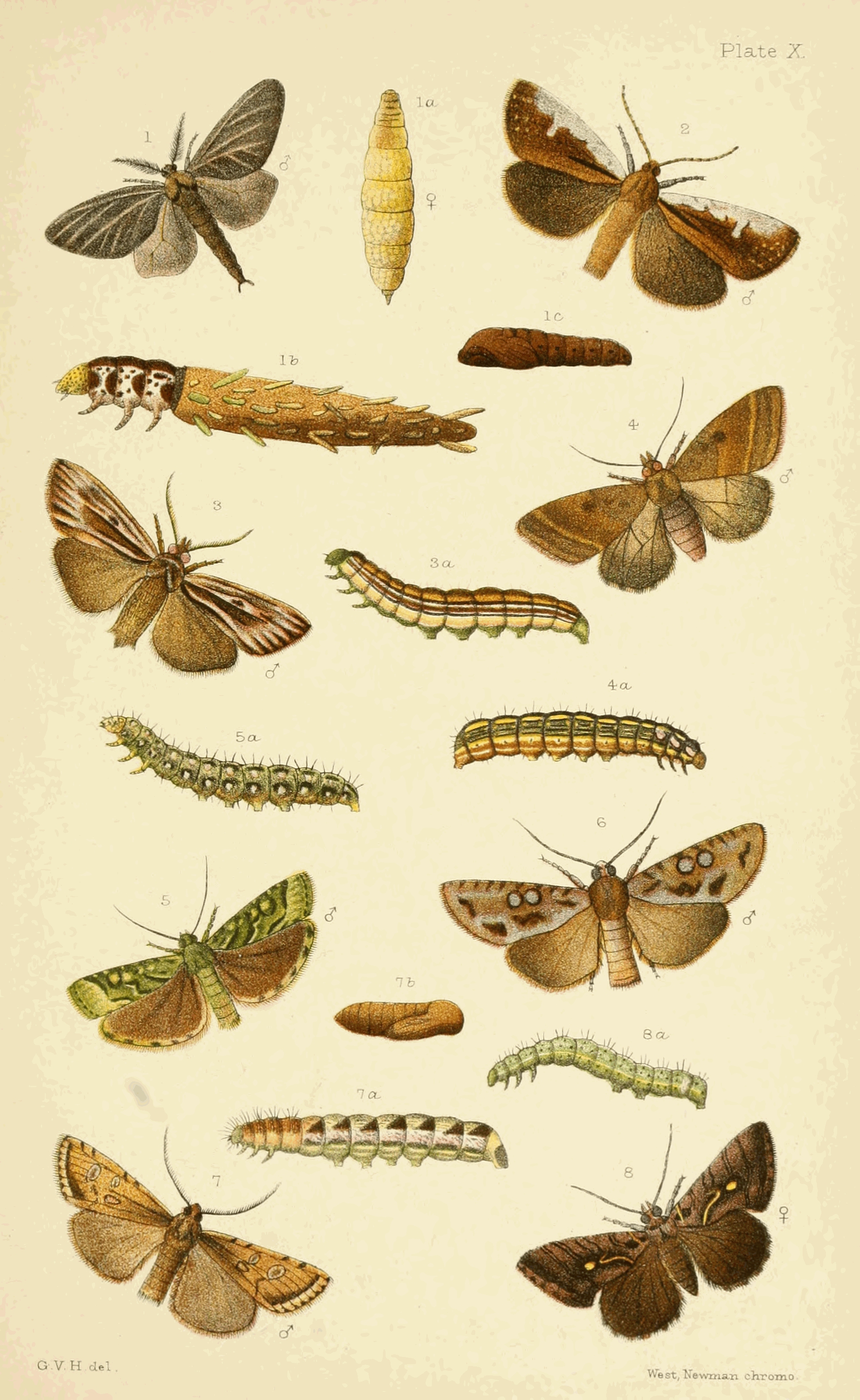
PLATE X.
Lepidoptera (continued).
Fig. 1.—Œceticus omnivorus ♂.
" 1a.—Œ"ticus om"ivorus ♀.
" 1b.—Larva.
" 1c.—Male pupa.
" 2.—Leucania atristriga ♂.
" 3.—Mamestra composita ♂.
" 3a.—Larva.
" 4.—Heliothis armigera ♂.
" 4a.—Larva.
" 5.—Erana graminosa ♂.
" 5a.—Larva.
" 6.—Mamestra ustistriga, ♂.
" 7.—Mam"stra mutans ♂.
" 7a.—Larva.
" 7b.—Pupa.
" 8.—Plusia eriosoma ♀.
" 8a.—Larva.
PLATE XI. Lepidoptera (continued). Fig. 1.—Declana floccosa ♂. " 1a.—Larva. " 1b.—Declana floccosa, var. junctilinea ♂. " 2.—Chalastra pelurgata ♂. " 2a.—Chl"stra pel"rgata ♀. " 2b.—Larva. " 3.—Ploseria hemipteraria. " 3a.—Larva. " 4.—Ploseria alectoraria. (Larva at Plate XIII. fig. 7.) " 5.—Sestra humeraria. " 5a.—Larva. " 6.—Sestra humeraria, var. (?) " 7.—Selidosema panagrata ♂. " 7a.—Slid"sema pa"agrata ♀. " 7b.—Larva. " 8.—Selidosema dejectaria ♂. " 8a.—Slid"sema deje"taria ♀. " 8b.—Larva.
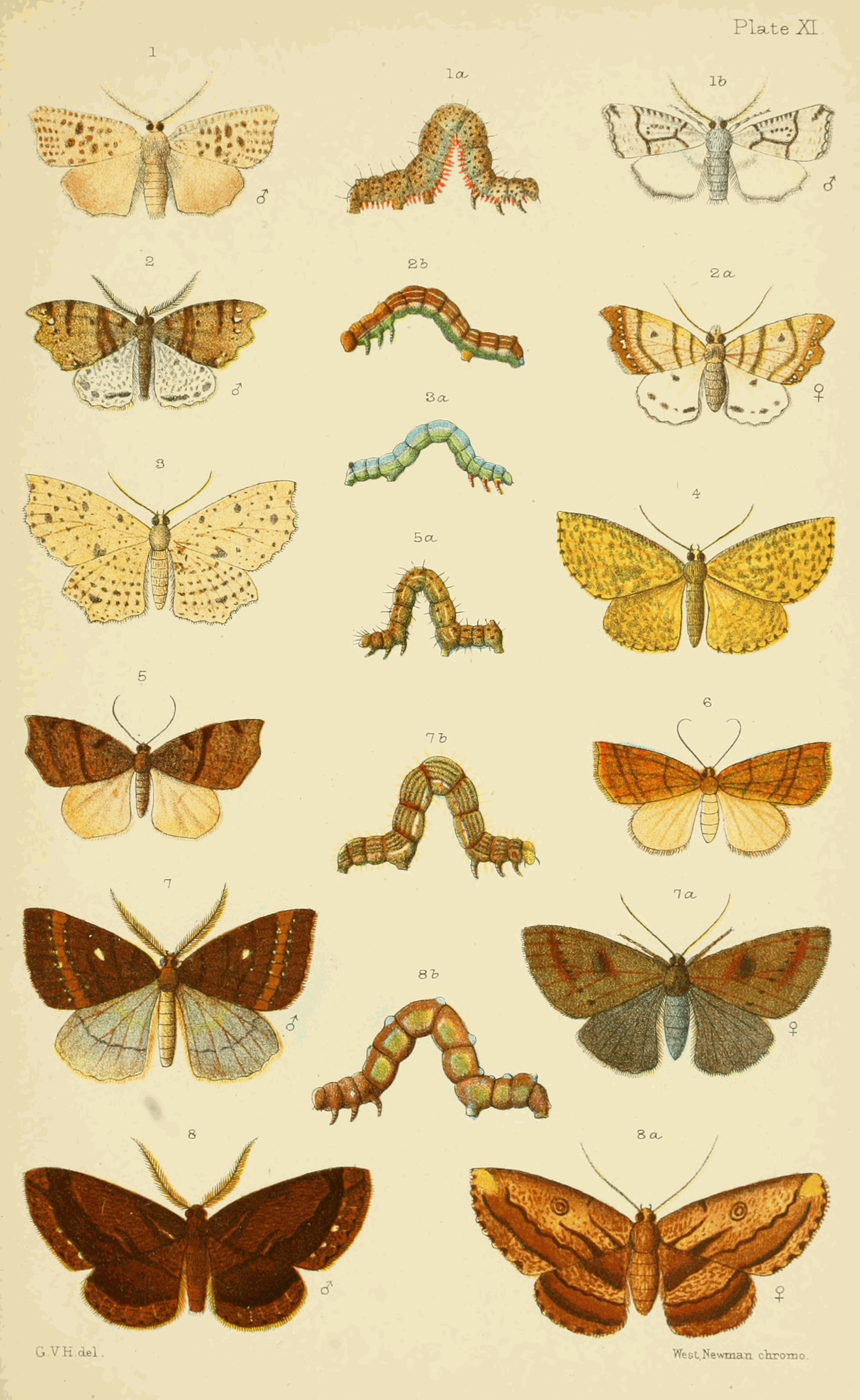
PLATE XI.
Lepidoptera (continued).
Fig. 1.—Declana floccosa ♂.
" 1a.—Larva.
" 1b.—Declana floccosa, var. junctilinea ♂.
" 2.—Chalastra pelurgata ♂.
" 2a.—Chl"stra pel"rgata ♀.
" 2b.—Larva.
" 3.—Ploseria hemipteraria.
" 3a.—Larva.
" 4.—Ploseria alectoraria.
(Larva at Plate XIII. fig. 7.)
" 5.—Sestra humeraria.
" 5a.—Larva.
" 6.—Sestra humeraria, var. (?)
" 7.—Selidosema panagrata ♂.
" 7a.—Slid"sema pa"agrata ♀.
" 7b.—Larva.
" 8.—Selidosema dejectaria ♂.
" 8a.—Slid"sema deje"taria ♀.
" 8b.—Larva.
PLATE XII. Lepidoptera (continued). Fig. 1.—Selidosema productata ♂. " 1a.—Slid"sema prod"ctata ♀. " 1b.—Larva. " 2.—Asthena schistaria. " 2a.—Larva. " 3.—Siculodes subfasciata. " 3a.—Larva. " 3b.—Section of stem showing enclosed pupa and aperture (*) through which moth escapes. " 4.—Scoparia hemiplaca. " 5.—Crambus flexuosellus. " 6.—Ctenopseustis obliquana. " 7.—Endrosis fenestrella. " 7a.—Larva. " 7b.—Pupa. " 8.—Semiocosma platyptera. " 8a.—Larva. " 8b.—Pupa.
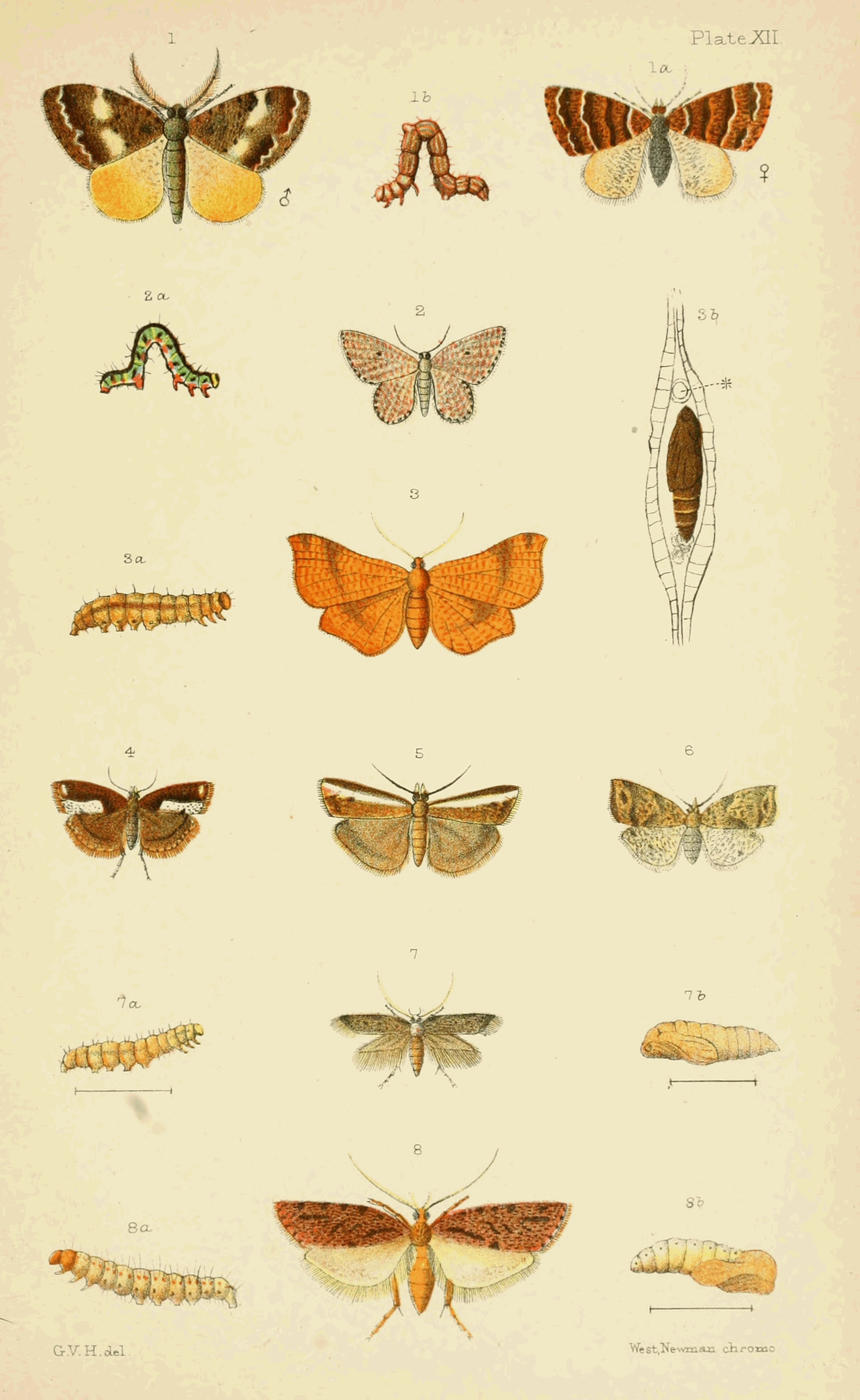
PLATE XII.
Lepidoptera (continued).
Fig. 1.—Selidosema productata ♂.
" 1a.—Slid"sema prod"ctata ♀.
" 1b.—Larva.
" 2.—Asthena schistaria.
" 2a.—Larva.
" 3.—Siculodes subfasciata.
" 3a.—Larva.
" 3b.—Section of stem showing enclosed pupa and aperture (*) through which moth escapes.
" 4.—Scoparia hemiplaca.
" 5.—Crambus flexuosellus.
" 6.—Ctenopseustis obliquana.
" 7.—Endrosis fenestrella.
" 7a.—Larva.
" 7b.—Pupa.
" 8.—Semiocosma platyptera.
" 8a.—Larva.
" 8b.—Pupa.
PLATE XIII. Lepidoptera (concluded). Fig. 1.—Hydriomena deltoidata. " 1a.—Larva. " 2.—Isonomeutis amauropa. " 2a.—Larva. " 3.—Leucania nullifera. " 3a.—Larva. " 4.—Scoparia sabulosella. " 4a.—Larva. " 5.—Cacoecia excessana. " 5a.—Larva. " 6.—Œcophora scholæa. " 6a.—Larva. " 7.—Larva of Ploseria alectoraria. (For imago see Plate XI. Fig. 4.)
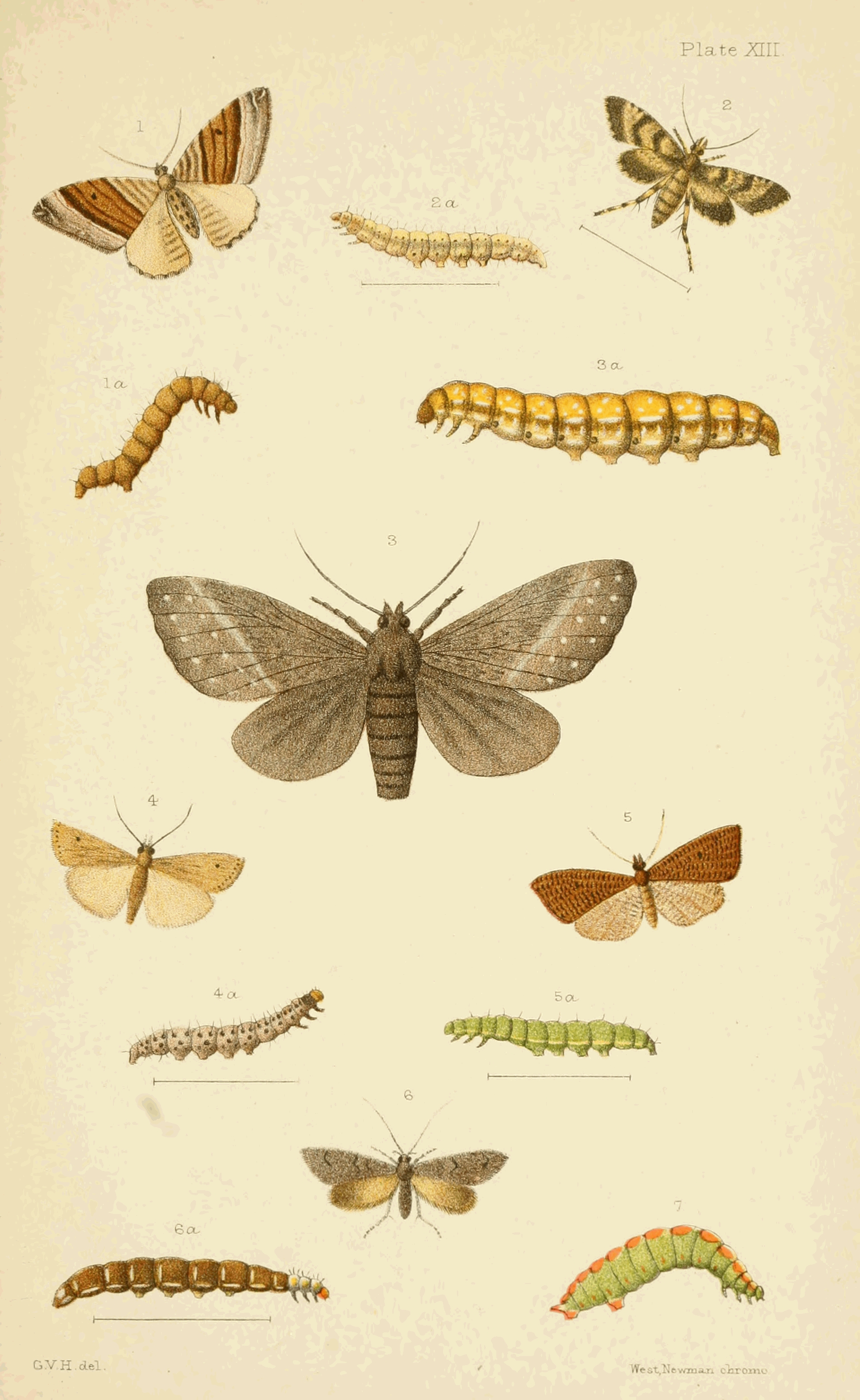
PLATE XIII.
Lepidoptera (concluded).
Fig. 1.—Hydriomena deltoidata.
" 1a.—Larva.
" 2.—Isonomeutis amauropa.
" 2a.—Larva.
" 3.—Leucania nullifera.
" 3a.—Larva.
" 4.—Scoparia sabulosella.
" 4a.—Larva.
" 5.—Cacoecia excessana.
" 5a.—Larva.
" 6.—Œcophora scholæa.
" 6a.—Larva.
" 7.—Larva of Ploseria alectoraria.
(For imago see Plate XI. Fig. 4.)
PLATE XIV. Neuroptera. Fig. 1.—Chauliodes diversus. " 1a.—Larva. " 1b.—Pupa. " 2.—Stenosmylus incisus. " 3.—Oxyethira albiceps. (?) " 3a.—Larva. " 3b.—Pupa.
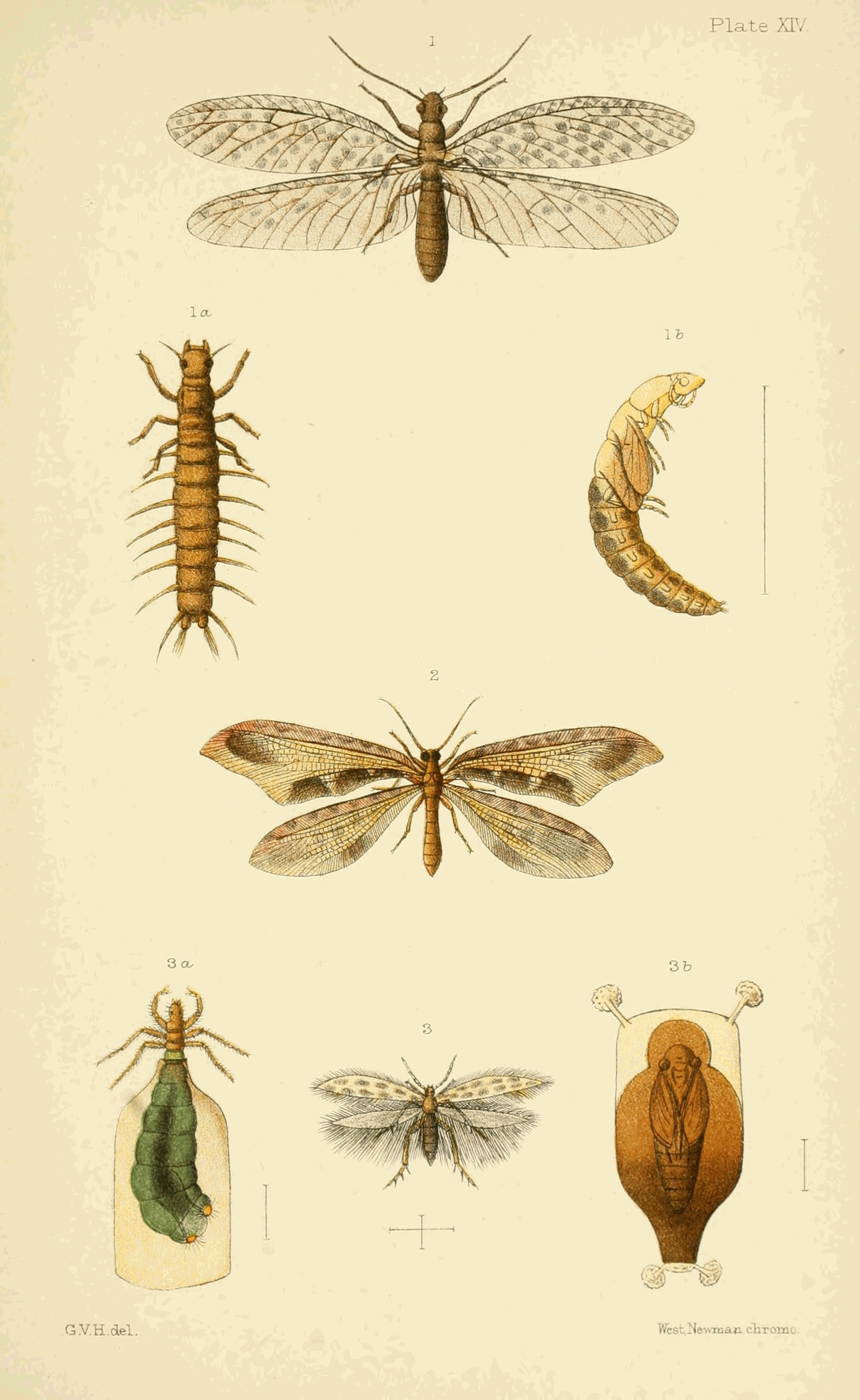
PLATE XIV.
Neuroptera.
Fig. 1.—Chauliodes diversus.
" 1a.—Larva.
" 1b.—Pupa.
" 2.—Stenosmylus incisus.
" 3.—Oxyethira albiceps. (?)
" 3a.—Larva.
" 3b.—Pupa.
PLATE XV. Orthoptera. Fig. 1.—Uropetala carovei ♂. " 1a.—Larva. " 2.—Cordulia Smithii ♂. " 3.—Lestes Colensonis ♂. " 3a.—Larva. " 4.—Telebasis zealandica
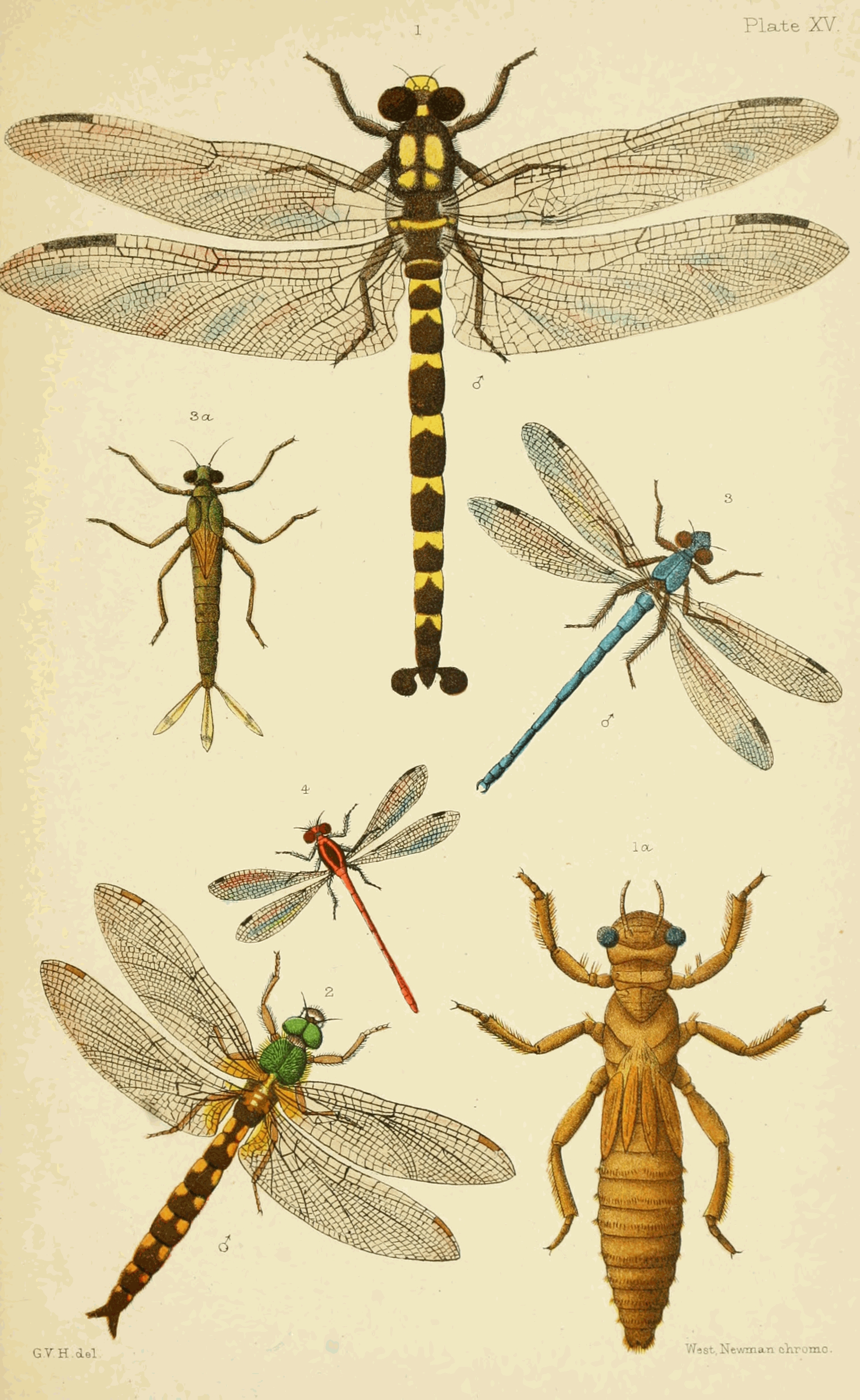
PLATE XV.
Orthoptera.
Fig. 1.—Uropetala carovei ♂.
" 1a.—Larva.
" 2.—Cordulia Smithii ♂.
" 3.—Lestes Colensonis ♂.
" 3a.—Larva.
" 4.—Telebasis zealandica
PLATE XVI. Orthoptera (continued). Fig. 1.—Stolotermes ruficeps ♂. " 1a.—Female. " 1b.—Soldier. " 1c.—Worker. " 2.—Psocus zealandicus, n.s. " 2a.—Larva. " 3.—Stenoperla prasina. " 3a.—Larva. " 4.—Ephemera, n.s. (near Coloburus). " 4a.—Larva.
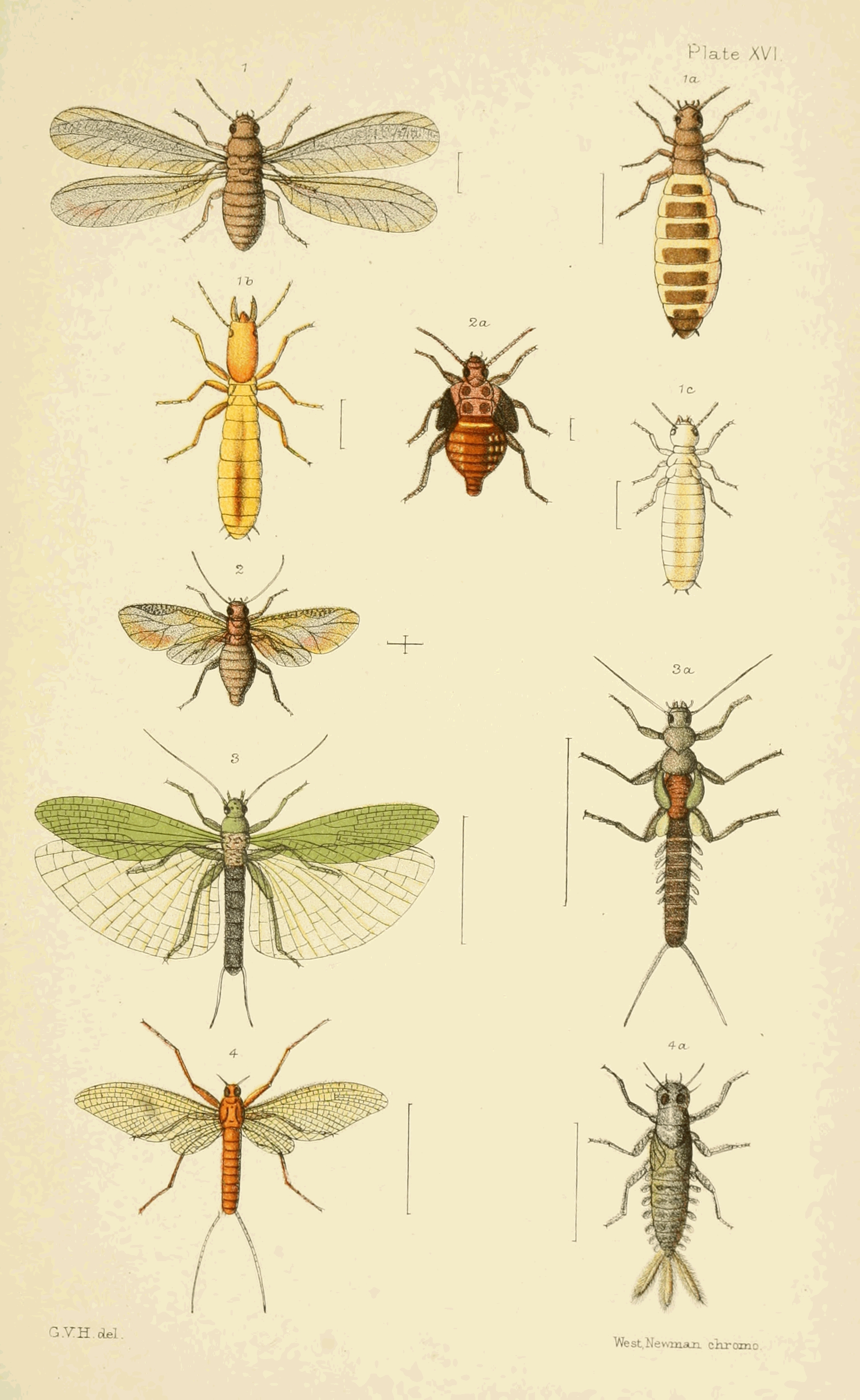
PLATE XVI.
Orthoptera (continued).
Fig. 1.—Stolotermes ruficeps ♂.
" 1a.—Female.
" 1b.—Soldier.
" 1c.—Worker.
" 2.—Psocus zealandicus, n.s.
" 2a.—Larva.
" 3.—Stenoperla prasina.
" 3a.—Larva.
" 4.—Ephemera, n.s. (near Coloburus).
" 4a.—Larva.
PLATE XVII. Orthoptera (continued). Fig. 1.—Xiphidium maoricum ♂. " 2.—Tenodera intermedia. " 3.—Œdipoda cinerascens. " 4.—Caloptenus marginalis. " 5.—Periplaneta fortipes. " 6.—Blatta conjuncta. " 7.—Forficesila littorea. " 8.—Deinacrida megacephala ♀.
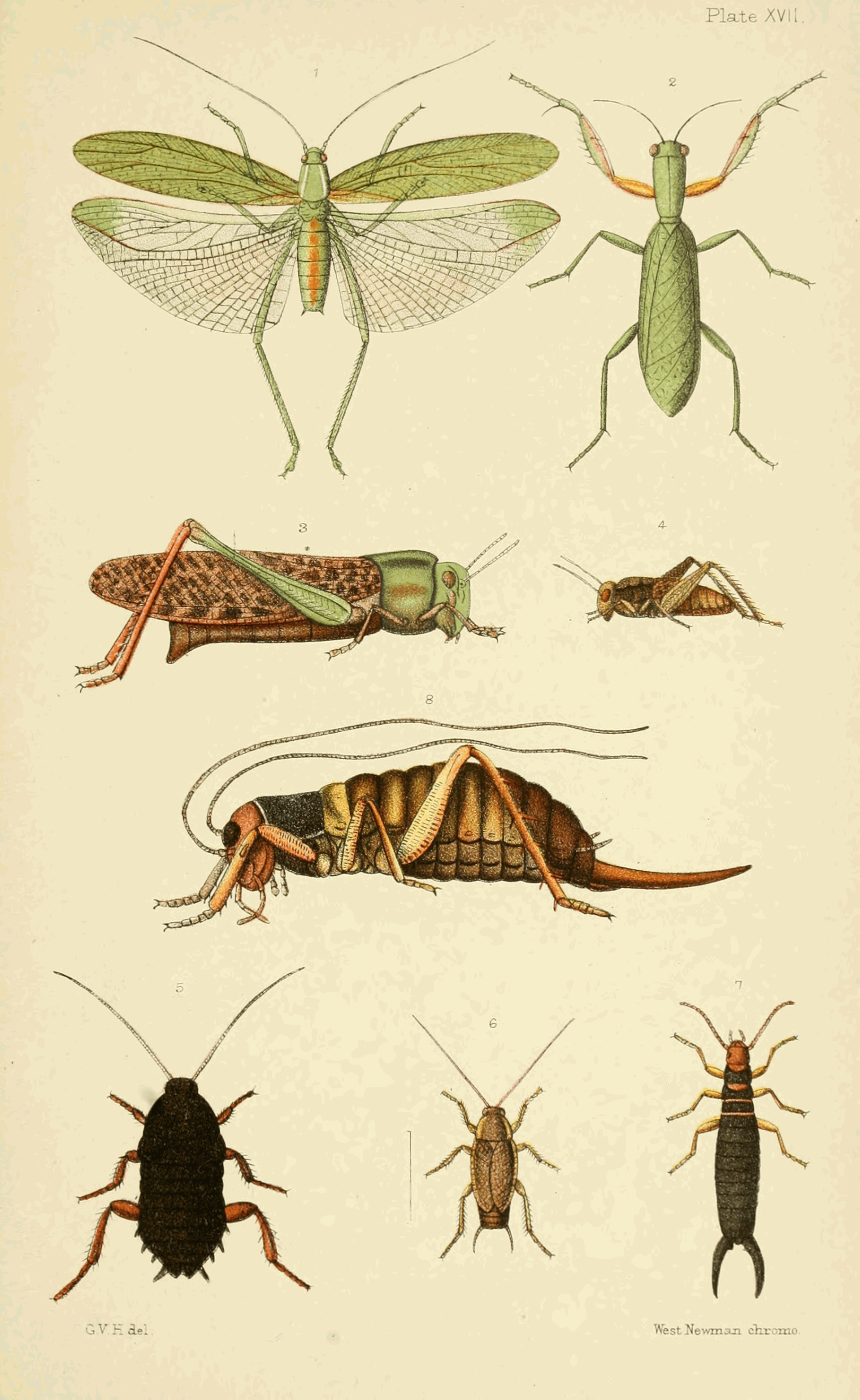
PLATE XVII.
Orthoptera (continued).
Fig. 1.—Xiphidium maoricum ♂.
" 2.—Tenodera intermedia.
" 3.—Œdipoda cinerascens.
" 4.—Caloptenus marginalis.
" 5.—Periplaneta fortipes.
" 6.—Blatta conjuncta.
" 7.—Forficesila littorea.
" 8.—Deinacrida megacephala ♀.
PLATE XVIII. Orthoptera (continued). Fig. 1.—Acheta fuliginosa ♀. " 2.—Deinacrida megacephala ♂.
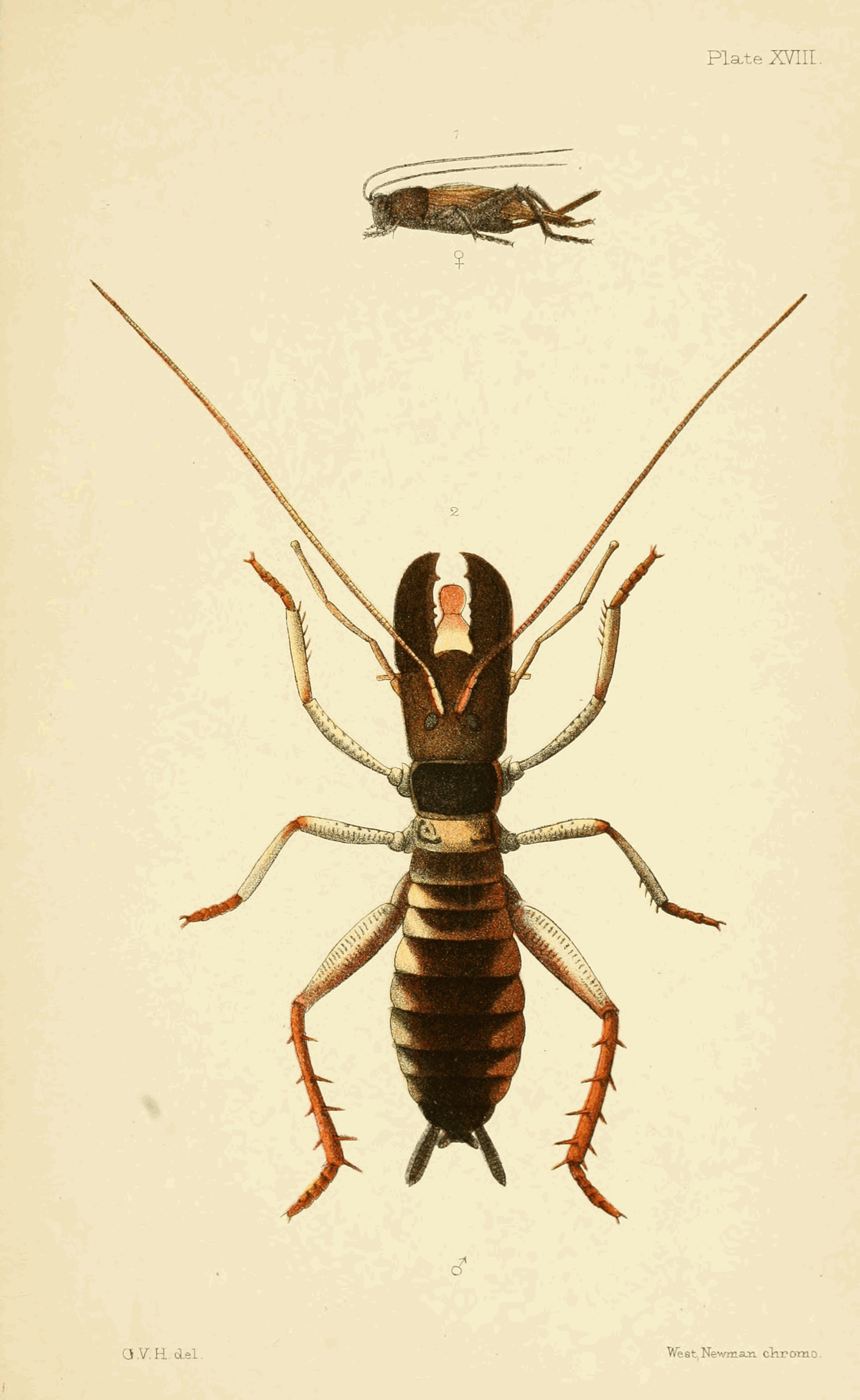
PLATE XVIII.
Orthoptera (continued).
Fig. 1.—Acheta fuliginosa ♀.
" 2.—Deinacrida megacephala ♂.
PLATE XIX. Orthoptera (concluded). Fig. 1.—Acanthoderus horridus.
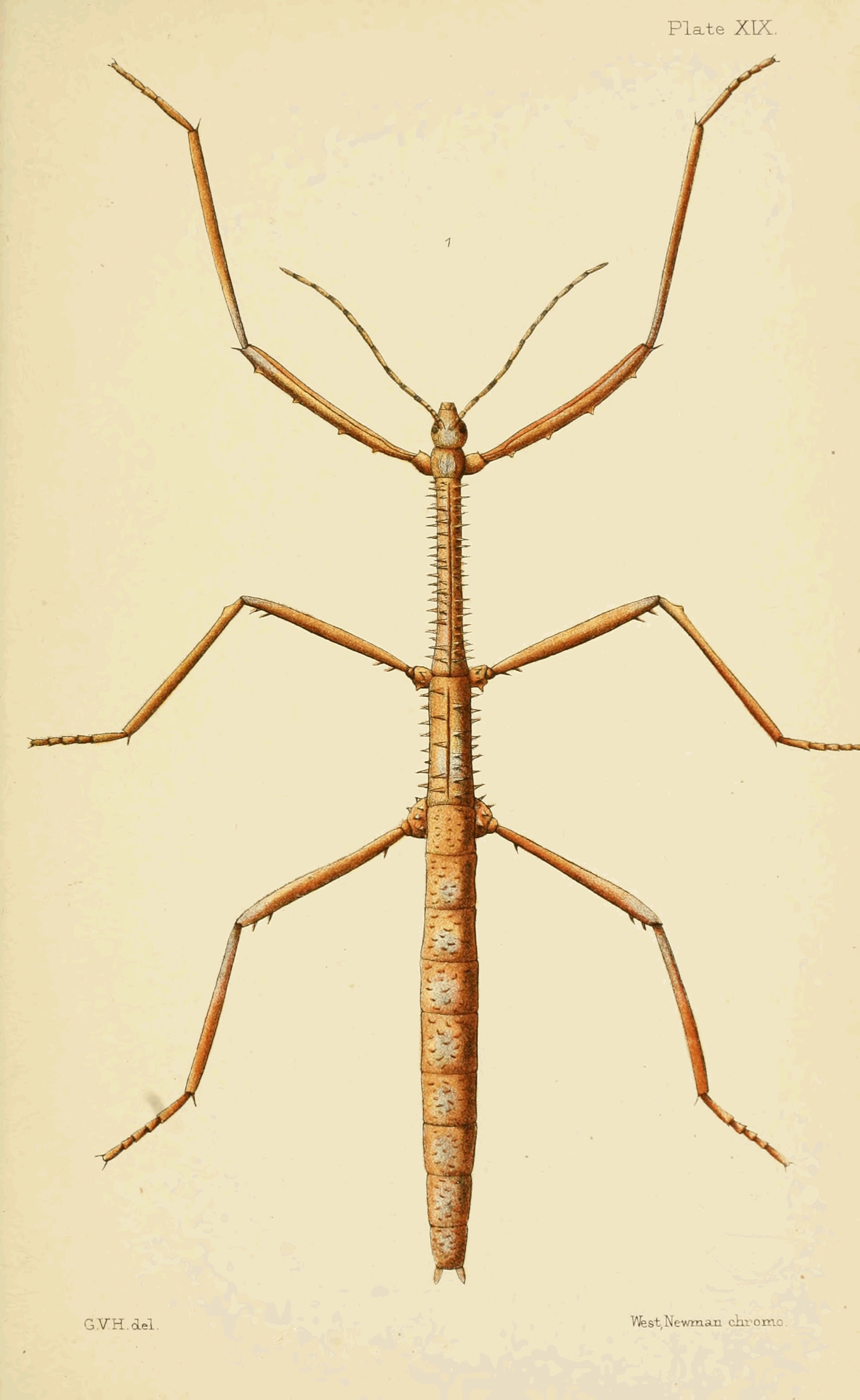
PLATE XIX.
Orthoptera (concluded).
Fig. 1.—Acanthoderus horridus.
PLATE XX. Hemiptera. Fig. 1.—Cicada cingulata ♀. " 1a.—Pupa. " 2.—Cicada muta ♀. " 3.—Ci"ada iolanthe, n.s. " 3a.—Larva. " 3b.—Pupa. " 4.—Cœlostoma zealandicum ♂. " 5.—Corixa zealandica. " 6.—Cermatulus nasalis. " 6a.—Larva.
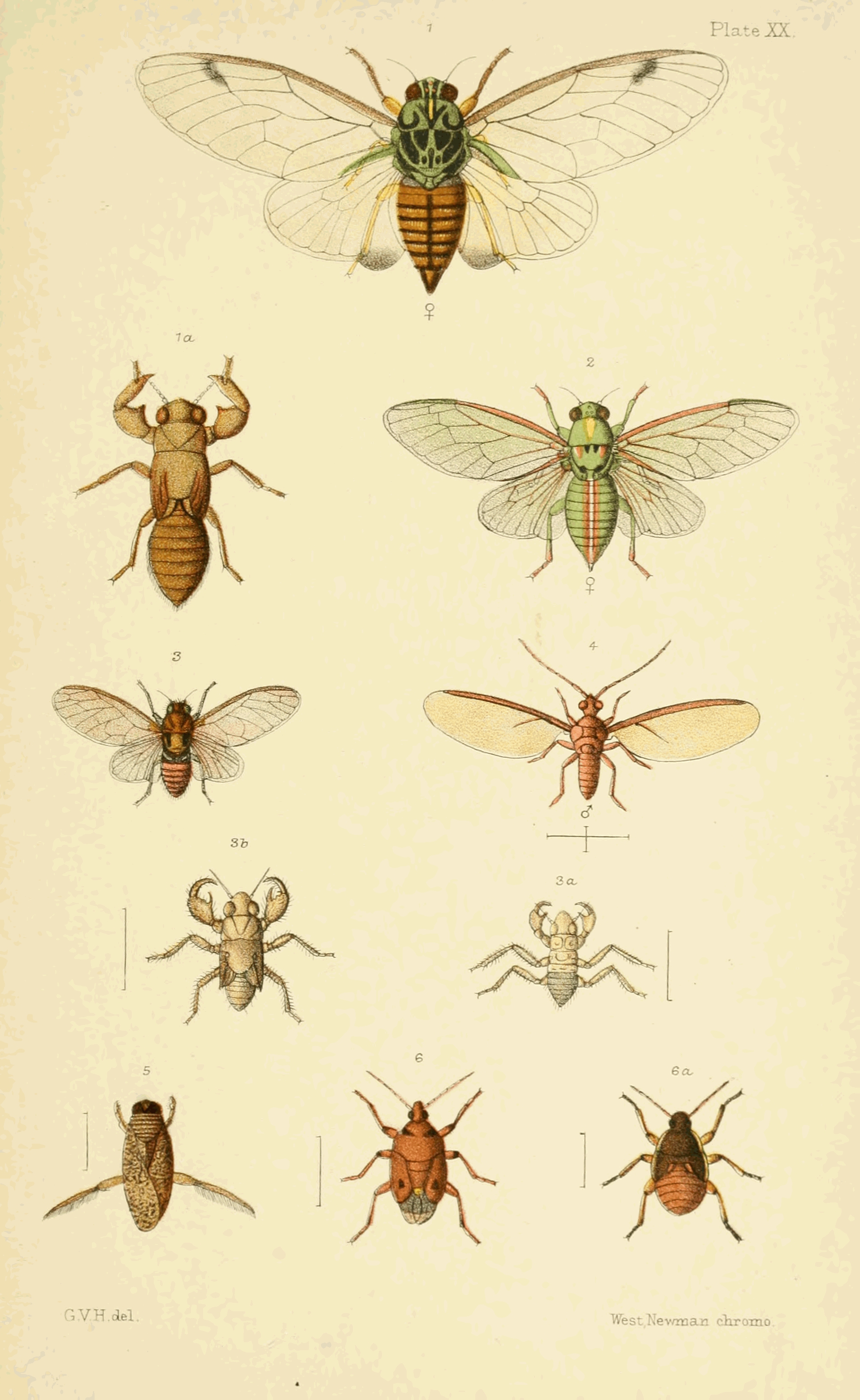
PLATE XX.
Hemiptera.
Fig. 1.—Cicada cingulata ♀.
" 1a.—Pupa.
" 2.—Cicada muta ♀.
" 3.—Ci"ada iolanthe, n.s.
" 3a.—Larva.
" 3b.—Pupa.
" 4.—Cœlostoma zealandicum ♂.
" 5.—Corixa zealandica.
" 6.—Cermatulus nasalis.
" 6a.—Larva.
Notes.
[1]
For Lepidoptera I can strongly recommend "Jahncke's Patent Round Boxes" with glass lids. They may be obtained from any chemist, or from Messrs. Sharland & Co., Wholesale Druggists, Wellington.
[2]
Metrosideros scandens.
[3]
Hyperparasite is an animal parasitic in a parasite.
[4]
"Host" is a term applied to any animal harbouring a parasite.
[5]
Ovipositor, a boring instrument employed in depositing the eggs.
[6]
A genus of Hemipterous insects commonly seen skipping over ponds in England.
[7]
"n.s." is the accepted abbreviation for new species.
[8]
Thread-like.
[9]
For an extended account of these observations see "Transactions of the New Zealand Institute," vol. xxiii. (1890).
[10]
Metrosideros scandens.
[11]
Or lay eggs.
[12]
Scutellum: A horny plate situated on the mesonotum, usually somewhat triangular in form.
[13]
For life-history of this insect see page 73.
[14]
Mamestra composita, M. mutans, M. ustistriga, Erana graminosa, &c.
[15]
This genus, as represented in New Zealand, is often called Pyrameis.
[16]
For a more detailed account of the metamorphosis of this insect see The Entomologist, vol. xviii. p. 30.
[17]
For accounts of parasites and hyperparasites of this insect see pages 60 and 37, also The Entomologist, vol. xviii. p. 153.
[18]
On one occasion I enclosed a full-grown caterpillar of this insect in a pot of earth with a recently formed Noctua pupa, whose internal portions it immediately devoured, employing the empty shell of the unfortunate chrysalis as a cocoon. It is impossible to say whether this horrible proceeding often occurs in a state of nature.
[19]
The Libellulidæ, Ephemeridæ, Perlidæ, Psocidæ, and Termitidæ are usually included in the Neuroptera.
[20]
One mutilated ♀ specimen of this insect was sent to Mr. McLachlan, but was too imperfect to describe from.
[21]
For account of the earlier stages of this, or a closely allied insect, see "Transactions of New Zealand Institute," vol. xvi. p. 114.
[22]
This genus is frequently called Melampsalta.