FROM KAMBARA TO MIYANOSHITA—A LETTER FROM A KAGO
Reading edition
September 28.
I am writing in a kago.[13] You do not know what an achievement this is, but I shall explain later on what a kago is, why I am in it, and why it is not exactly the place to expect a letter from. To begin at the beginning, we were yesterday afternoon at Kambara, on the gulf of Suruga Bay. We had eaten there in an inn by the water, while I watched through the screens the waving of a palm tree in the wind, which was now blowing autumnally and had cleared the sky and enlivened us with a hope of continuous view of Fuji. Along the beach, as we rode away, the breakers ran far up the sand, and the water was green as emerald from the brown, wet shore to the distant blue haze of the ocean in the south. At the end of the great curve of the gulf stretched the lines of green and purple mountains, which run far off into Idzu, and above them stood Fuji in the sky, very pale and clear, with one enormous band of cloud half-way up its long slope, and melting into infinite distance toward the ocean. Its nearest point hung half across the mountain's base, more solid than the mountain itself, and cast a long shadow upon it for miles of distance. Above, the eye could but just detect a faint haze in the delicate blue of the sky. Best of all weather, we thought; a breeder of bad weather, according to our men, who, alas! knew more of it than we did. For a mile now, perhaps, we ran along between the sea and the abrupt green wall of hills, so steep that we could not see them, and, turning sharply around a corner, beheld Fuji, now filling the entire field of sight, seeming to rise even from below us into the upper sky, and framed at its base by near green mountains; these opened as a gate, and showed the glittering streak of the swollen Fujikawa, the swiftest river in Japan.
The lower eastern slope was cut off by clouds, but its western line, ineffably delicate in clearness, stretched to the left out of our range of vision. Below its violet edge the golden slope spread in the sun, of the color of an autumn leaf. Along the center of this province of space the shadow of the great cloud rested. The marks of the spurs of the mountain were as faint as the streaks of the wind on a grain-field. Its cone was of a deep violet color, and as free of snow as though this had been the day of poetic tradition upon which the snow entirely disappears to fall again the following night. No words can recall adequately the simple splendor of the divine mountain. As A—— remarked, it was worth coming to far Japan for this single day.
Right into this marvelous picture we rode, through green plantations and rice-fields, which edged the bases of the nearest hills and lay between us and the river. There we found no means of crossing. All bridges had been carried away by the flood. The plain was inundated; travelers had been detained for a week by a sea of waters, and were scattered there and in neighboring villages, filling every resting-place; and, worst of all, the police officials would not allow us to tempt the fishermen to make the dangerous crossing.
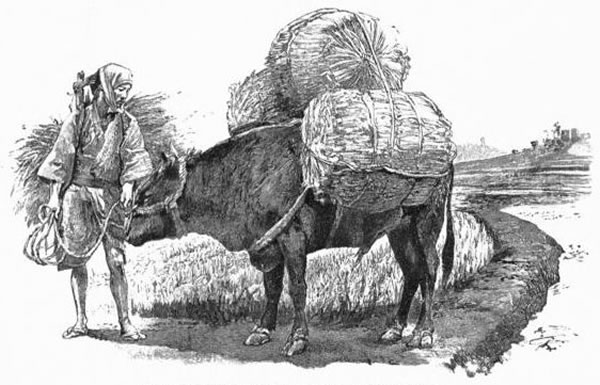
PEASANT CARRYING FODDER, AND BULL CARRYING LOAD.
The occasion was a solemn one. The police representative, upon seeing us come in person to request help, slipped off the easy Japanese dress which he was wearing in these days of forced idleness, and reappeared from behind the screen clad in his official European costume. I have no doubt that our interpreter explained to him what important persons we were, and what important letters we bore to important people of the land, for he kindly suggested that we might sail past the mouth of the river, from near Kambara, whence we had just come, so as to land far away from the spread of all this devastation; and he offered to send a deputy with a requisition for a junk and sufficient sailors from the nearest fishing-village on the bay—and so we returned. While Hakodate and the messenger went on to make all arrangements, A—— and myself stopped at the place where we had had our view of Fuji, to make a more careful sketch. You can have no idea of how much closer the clearer mind worked out the true outline of the mountain, which my excitement had heightened at least a couple of thousand feet; nor should I forget how my two-legged horse of a runner held my paint-box for me, and seemed to know exactly when and where I wished to dip my brush. It seemed to me that only a few moments had passed when the messenger returned to say that the boat was ready to launch, and that we must hurry to be out at sea before sunset; this too in view of the storm, which we might escape if we hurried. The implied threat made no impression on me. The picture before us had not changed any more than if painted by man. The great cloud hung fixed, apparently, in the same place. All was still: perhaps in the uppermost sky one could distinguish some outlines of white in the blue. Still we hurried off and arrived upon a scene of confusion and wild excitement. A captain and a crew had been found; their boat stood high up on the crest of the surf, now beating on the shore, and carried the line with which to pull out the small junk, still far up on the beach. The wheels of our kurumas had been taken off and their bodies had been placed in the hold.
As we got on board at least a hundred naked men pushed and tugged to start the junk upon the slope of sand. The sun was setting suddenly behind the headland of Shizuoka, and the air was filled with the moisture from the sea; a rosy bloom, pink as the clouds themselves, filled the entire air, near and far, toward the light. On the other side the distance was fading into gray and violet mist. The great mountain was still a great clear mass, but colorless, like the northern sky behind it, while, bathed in the color of fairyland, we rose and fell over the breakers—the spray, the waves, the boat, the bodies of the men, glistening and suffused with pink.
No painter ever saw a more ideal light. And suddenly it faded, leaving us in a still brilliant twilight, through which we looked at the tossing of the hazy sea. The mast was lifted and set, the great square sail was hoisted, and the captain took hold of the ponderous tiller. We stretched ourselves on the poop deck, prepared for a dance of seventeen miles; then under my protecting blanket I fell asleep—to wake and see before me a sheet of rain. The predicted storm had flooded us; we lay in the water that covered the deck, our waterproofs insufficient, and glad to be able to find some protection under the Japanese rain-coats of straw, whose merits I had not yet understood.
From under my shelter I could see that our mast was lowered, and that the captain and the sailors forward were working at the heavy sweeps. Below, under hatches, I could hear the groaning of our seasick runners. Between the gusts of rain came the voice of the captain, now in the straining agony of seasickness, next keeping up a steady, chanted talk with a mate forward. A lantern was lashed to the post of the tiller, and the captain's bare feet rose and fell with his steps at the great oar, showing sharply the action of tendons and muscles. I tried to sketch under my cover, then dozed,—sleepy with the rocking and the cold and the wet,—and with every waking hearing the whistling of the wind and the continuous monotonous voice in a language not understood. So passed the night.
We saw the morning break on a lonely, high, gray bank, streaked by the sea lines of different tides, and crowned with a line of pines of all sizes and shapes, stretching for miles dark green against the white clouds which covered the base of the mountains behind. Out of these white banks stood dull blue peaks, while the highest mountains were lost in cloud, and all was gray and desolate with the rain. The surf broke on the sand not more than a hundred yards from us. We lay there some time, waiting for more light, for all wind had ceased; then four men swam ashore with a rope, and towed us along the bank. The surf had abated, but landing was too difficult, and we were to be dragged, while our other men worked at the big sculls and pushed us along. We wore along four miles to a little bar, over which we were pulled by the men now in the water into a singular little harbor with an entrance not more than a hundred feet wide. On this the surf broke gently—white on the gray sea. To our left the backs of two sand-spits dotted the water, and on the right, looking out to sea, rose the edge of a grove of pines, with four or five houses, heavy roofed and thatched, against its green darkness.
On the curve of the beach before it stood a high pointed rock almost touched by the water, edged around and covered with pines—all but the perpendicular side facing the harbor. On its summit stood a little red temple, whose back we saw. On the other side, landwards, as we left our boat and followed our guides ashore around its base, a hundred steps ran straight up to the front of the little shrine—so steep and sudden that we could just look along their edge. From the high rock, recessed, ran back the shore, on which stood in a row three large junks with their sterns to the sea—behind them trees and houses. On the opposite side of the little harbor four of our men, up to their middle or up to their armpits in water, slowly dragged our junk nearer to the shore. All was quiet and gray—the men reflected in the moving water, the boat creaking along slowly. As I went up the beach, following our guide and the boatmen, I thought how like this was to the Homeric haven—the grove looking out to sea and frequented by "fowls maritimal"; the sacred rock; the meadows and the little stream; the long galleys drawn up on the beach. The little houses of the fishing-village were surrounded by gardens, and their walls largely made of plaited bamboo. There was no inn, but we found a house half shop, and were welcomed to some tea and to a room which the family hastened to abandon for us. There were only two rooms besides the entrance, which was a large passage floored with earth, and along one side of it a raised surface, from which began the level of our flooring.
Sliding partitions, hurriedly run up, made us a room, but the outside screens were full of holes, through which, in a few minutes, peered all the women and children of the village, who occasionally even pushed aside the screens to see more completely. The little passage in front of our open room was filled with girls and children intent upon our ways of smoking, of taking tea, and of eating—for we had biscuits with us, and fifteen hours at least without food had made us fairly hungry. Meanwhile the men landed their wagons and the trunks, and took their meal of rice, hastily made up, on the ledge of the platform on which we sat. This they did in a row, the whole twenty eating quietly but rapidly,—I was going to say firmly,—shoving into their mouths the rice from the bowls, and tearing with their fingers the fish just cooked. Meanwhile, among all the ugliness around us in women, shone out, with beautiful complexions,—lost in the others by exposure to wind and sun, by hard work, and probably by child-bearing,—three girls, who stood before us a long time, with sweet faces and bright eyes and teeth. They stared hard at us until stared at in return, when they dispersed, to watch us again like children from the doors and from the kitchen.
Our hostess, small, fat, good-natured, and polite, showing black-lacquered teeth between rosy lips, like ripe seeds in a watermelon, bustled about hurrying everything, and at the end of our meal our host appeared—from the kitchen apparently—and knelt before us. Poor and ragged as the house was, with ceilings black with age and smoke, and screens torn and worn by rubbing, the little tokonoma held a fairly good picture, and a pretty vase with flowers below it. But it was evidently one of the poorest of places, and had never seen a foreigner in it. This may have been the cause of the appearance of the ubiquitous Japanese policeman within five minutes of our arrival. He alone betrayed no curiosity, and disappeared with dignity on getting our credentials.
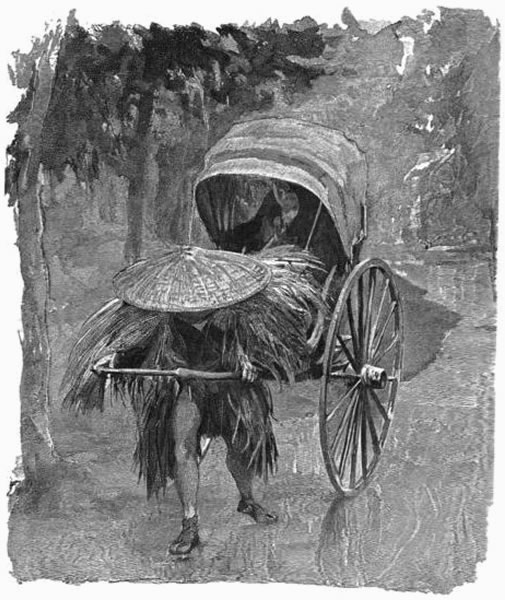
The rain still held off. We entered our kurumas, now ready, and hastened to the main road which we were to find at Numadsu, if that be the name of the place. But, alas! the rain came down, and my views were confined within the outline of an umbrella. My only adventure was stopping at some hovel on the road to buy some more of that heavy yellow oiled paper which replaces the leather apron that we usually find attached to our European carriages. By and by I consented to have the hood of my wagon put up, through which I could see little more than the thatched backs of my runners, their bowls of hats, off which the rain spattered upon their straw cloaks and aprons, and their wet brown legs, lifted with the regularity of automatons. It was getting cold, too, and women under their umbrellas wore the graceful short overcoat they call haori, and tottered over the wet ground on high wooden pattens.
This I noticed as we came into Mishima, from which place we were to begin our ascent up the Hakone Pass. On our way, were it to clear, we might see Fuji again—at any rate, if it cleared in the least we would enjoy the mountains. Meanwhile we shivered at lunch, trying to get into corners where the wind would not leak through the cracks of the shojis, and beginning to experience the discomforts of Japanese inns. And now my bashfulness having gradually abandoned me, I could take my hot bath, separated from the household by a screen not over high, over which the fat servant-girls kindly handed me my towels. Excuse these trivial details, but I cannot otherwise give you the "local color," and my journal is one of small things. Had I come here in the old days when I first fell in love with Japan, I might have met with some thrilling experience in an inn.
I might have had such an experience as our poor friend Fauvel met with not far from here. I might have met some young sworded men, anxious to maintain their dignity and ripe for a quarrel with the foreigner. Do you remember that he jostled the sword of some youngster—"the sword, the soul of the Samurai"—which its owner had left upon the floor. The insult would have been impossible to explain away had not some sensible Japanese official decided that a man who was so careless with his sword as to leave it on the mat, instead of on the reputable sword-rack, had no right to complain of another's inadvertence.
I sometimes wonder which of the courteous persons I meet, when age allows the supposition, obeyed these rules when they were younger; which ones now dressed in black broadcloth wore the great helmet with branching horns, or strapped the two great swords at their waist. And I am lost in respect and bewilderment to think that all this wondrous change—as great as any that the world can have seen—was effected with such success and accepted in such a lofty spirit.
A RUNNER IN THE RAIN.
We were now to give up the kuruma and to travel by the kago, which, you will remember, I promised to describe. The kago is a curious institution, partly superseded by the kuruma, but lingering in many places, and necessary where the pack-horse would be unsafe, and where one would otherwise have to walk. It consists of a small litter hung by stiff bamboos from a great pole, over which is steadied a little matted roof, from which various protections from rain or sun can be dropped. The kago has its discomforts: one lies down in it all doubled up, with legs crossed as far as they can be made to, because the basket, which is the body of the litter, is only about three feet long; and with head to one side, because, if one lifted it, it might strike the ridge-pole. The proper way is to lie not quite in the axis. This is all the more natural, as the men at either end do not carry it in a straight line, but at an angle, so that from one side you can see a little in front of you.
Into the kagos we were folded, and in a torrent of rain we departed. I resisted my being shut up in my litter by the oiled-paper sides that are used in the rain, and I depended upon mackintosh and blanket to protect me. The rain came down in sheets. We trotted uphill, the men going on for a few minutes, then changing shoulders, and then again another pair taking their turn—four to each litter. Meanwhile they sang, as they trotted, something which sounded like "Hey, hey, hey, het tue hey." The road was almost all paved, and in the steeper ascents was very bad.
And now I began to experience some novel sensations not easy to describe. My feet were turned in upon the calves of the legs like an Indian Buddha's, and I soon began to ache along sciatic lines; then elsewhere, then everywhere. Then I determined to break with this arrangement, as anger seized me; fortunately a sort of paralysis set in, and I became torpid and gradually resigned; and gradually also I fell asleep with the curious motion and the chant of the men, and woke accustomed, and so I am writing.
I can just remember large trees and roads protected by them; some places where we seemed alone in the world, where we left trees and stood in some narrow path, just able to see above its sides—all else shut out of existence by the rain; and I have all along enjoyed the novel sensation of moving on the level of the plants and shrubs.
We are now going downhill again, and can look down an avenue of great trees and many steps which we descend. We are coming to Hakone; I can see the lake beyond a Torii, and at the first corner of the road under the trees begins the village.
Miyanoshita, September 28.
Again the kago, and the rain as soon as we departed. I turned as well as I could, to find the lovely lines, now lost in general shapes and values, blurred into masses. Once the light opened on the top of some high hill, and I could see, with wild roses right against me, some flat milestone marked with an image against the edges of distant mountains, and a sky of faint twilight pink; or again we pattered along in wet grass, past a great rock with a great bas-relief image—a Jizo (patron of travelers) sitting in the loneliness with a few flowers before him. Then in the rain, and mingling with the mist, thicker cloudings marked the steam from hot springs, which make these parts of the mountains a resort for invalids and bathers.
Soon the darkness: then pine knots were lighted and we descended among the trees, in a path like a torrent, the water running along between the stones, which the feet of the bearers seemed to find instinctively. The arms of the torch-bearers were modeled in wild lights and shadows; the hats of the men made a dusky halo around their heads; the rain-coats of straw glistened with wet; occasionally some branch came out, distinct in every leaf, between the smoke and the big sparks and embers. The noise of torrents near by rose above the rain and the patter and the song of the men. The steepness of the path seemed only to increase the rapidity of our runners, who bounded along from stone to stone. After a time anxiety was lost in the excitement of the thing and in our success, but quite late in our course I heard behind me a commotion—one of A——'s runners had slipped and the kago had come down; no one hurt—the kago keeps its occupant packed too tightly. Then the path left the wild descent; we trotted through regular, muddy roads, stopped once on disbanding our torch-bearers, and reached the Europeanized hotel at Miyanoshita, where I intend to sleep to-night on a European bed, with a bureau and a looking-glass in my room. One little touch not quite like ours, as a gentle lady of uncertain age offers me her services for the relief of fatigue by massage, before I descend to drink Bass's ale in the dining-room, alongside of Britons from the neighboring Yokohama, only one day's journey farther.