PREFACE. (continued 3)
Reading edition
After a brief account of the preliminary journey of the queen, this veracious chronicler informs us that she was "met in the Park, about a flight shoot from the Brayz and first gate of the castl" by a person representing "one of the ten Sibills, comely clad in a Pall of white Sylk, who pronounced a proper Poezi in English Rime and meeter."... "This her majestie benignly accepting, passed foorth untoo the next gate of the Brayz, which, for the length, largenes, and use they call now the Tylt-yard; whear a Porter, tall of Person, big of lim and stearn of countinance, wrapt also all in Sylke, with a club and keiz of quantitee according, had a rough speech full of Passions, in meeter aptly made to the purpose."
A Giant's Portrait.
Be it here recorded that the Charioteers had the pleasure while in London of looking upon the portrait of this giant porter, which hangs in the King's Guard Chamber at Hampton Court Palace. It is supposed to have been painted by the Italian artist Ferdinando Zucchero, who, it will be remembered, visited England. The fellow is truly called "big of lim," for the canvas is more than nine feet high and the figure, which is said to be of life size, measures eight and a half feet. His hand is seventeen inches long. He stands with his left hand on his hip and his right on a long rapier; is dressed in large balloon breeches, with black stockings, and a white quilted vest with a black waistcoat over it; and wears a cap with a feather in it and a small ruff. The picture was painted after the queen's visit to Kenilworth, for the date 1580 is plainly to be seen in one of the upper corners.
When the great porter had concluded, "six Trumpetoours, every one an eight foot hye in due proportion of Parson beside, all in long garments of Sylk suitabl," who stood upon the wall over the gate, sounded a "tune of welcum." These "armonious blasterz mainteined their music very delectably," while the queen rode into the inner gate, "where the Ladye of the Lake (famous in King Arthurz Book) with two Nymphes waiting uppon her, arrayed all in Sylks, attended her highness' coming. From the midst of the Pool, whear uppon a moovable Iland bright blazing with Torches, she floating to land, met her majestie with a well-penned meeter," expressive of the "Anncientie of the castl" and the hereditary dignity of its owners.
"This Pageant was cloz'd up with a delectabl harmony of Hautboiz, Shalmz, Cornets, and such oother loord Muzik," that held on while her majesty crossed a bridge over a dry valley in front of the castle gate, the different posts of which were decorated with fruits, flowers, birds, and other decorations emblematic of the gifts of Sylvanus, Pomona, Ceres, Neptune, and other divinities. Having passed this, the main gate of the castle was reached. Over it, on a "Tabl beautifully garnisht aboove with her Highness' Arms" was inscribed a Latin poem descriptive of the various tributes paid to her arrival by the gods and goddesses. The verses were read to her by a poet "in a long ceruleoous garment, with a side and wide sleevz Venecian wize drawen up to his elboz, his dooblet sleevz under that Crimson, nothing but Sylk: a Bay garland on his head, and a skro in his hand."... "So passing into the inner Coourt, her majesty (that never rides but alone), thear sat down from her palfrey, was conveied up to Chamber: When after did follo so great peal of gunz, and such lightning by fyrwork a long space toagither, as Jupiter woold sheaw himself too be no furthur behind with his welcoom than the rest of his gods."
The chronicler then gives an account of the festivities, which lasted seventeen days and comprised nearly every amusement known to the period. On Sunday, after "divine servis and preaching," the afternoon was spent in "excellent muzik of sundry swet Instruments and in dauncing of Lordes and Ladiez, and other woorshipfull degreez, uttered with such lively agilitee and commendable grace az whither it moought be more straunge too the eye, or pleazunt too the minde, for my part indeed I coold not discern."
Bearbaiting.
One morning was devoted to a bearbaiting, in which thirteen bears and bandogs took part, "with such fending and prooving, with plucking and tugging, skratting and byting, by plain tooth and nayll a to side and toother, such expens of blood and leather waz thear between them, as a moonths licking I ween will not recoover."
Refined amusement, you say, for the Queen of England and her court only three hundred years ago. But not so fast, my dear lady; think what three hundred years hence will say of you and your amusements. Did you not give us a lively description the other evening of your riding after the hounds? Lady Gay Spanker herself, I thought, could not have done it better, and I am sure she was not more fascinating than you. But long before one hundred years shall pass, my friend, ladies in your station will be equally amazed that you could so torture a poor hare or fox and feel it to be not only not unworthy of a lady but a source of enjoyment to you. I say your grandchild will blush for her grandma as she shows to her children the picture of your lovely face. What Queen Elizabeth is now in your eyes, what Roman emperors in the bloody Coliseum were in hers, you will be in the eyes of the third generation after you. Think of this. Remember what Cowper says:
"I would not rank among my list of friends, Though graced with polished manners and fine sense, That man who needlessly sets foot upon a worm."
Men will give up such sports after a time; but surely we may expect women to find even in this day not only no pleasure but even positive pain in such sports and leave them to coarser natures.
Sunday Amusements.
Another day was marked by the exhibition of an Italian tumbler, who displayed "such feats of agilitee, in goinges, turninges, tumblinges, castings, hops, jumps, leaps, skips, springs, gambaud, soomersauts, caprettiez, and flights; forward, backward, sydewize, a doownward, upward, and with sundry windings, gyrings and circumflexions; allso lightly and with such eaziness, as by me in feaw words it is not expressibl by pen or speech I tell yoo plain." On the second Sunday, after a "frutefull Sermon," a "solemn Brydeale of a proper Coopl was appointed in the tylt-yard," attended by all the country folk in holiday costume. This was followed by Morris dances, a Coventry play, and other games. "By my troth, Master Martyn, 'twaz a lively pastime; I beleeve it woold have mooved sum man to a right meerry mood, though had it be toold him hiz wife lay a dying." And all this on the Holy Sawbath—for shame, Queen Bess!
Nearly every hour had its appointed sport, one amusement following another in endless variety, and the park was peopled with mimic gods and goddesses who surprised the queen with complimentary dialogues and addresses at every turn. Dancing and feasting were kept up all day long and far into the night, for no note was taken of time. "The clok bell sang not a note all the while her highness waz thear; the clok also stood still withall; the handz of both the tablz stood firm and fast, allwayz poynting at two a clok," the hour of banquet.
The day of our visit to Kenilworth was very warm, even for Americans, and after luncheon we became a lazy, sleepy party. I have a distinct recollection of an upward and then a downward movement which awoke me suddenly. One after another of the party, caught asleep on a rug, was treated to a tossing amid screams of laughter. We were all very drowsy, but a fresh breeze arose as the sun declined, and remounting the coach late in the afternoon we had a charming drive to Stratford-on-Avon.
Stratford-on-Avon, June 23.
Our resting-place was the Red Horse Inn, of which Washington Irving has written so delightfully. One can hardly say that he comes into Shakespeare's country, for one is always there, so deeply and widely has his influence reached. We live in his land always; but, as we approached the quiet little village where he appeared on earth, we could not help speculating upon the causes which produced the prodigy. One almost expects nature herself to present a different aspect to enable us to account in some measure for the apparition of a being so far beyond all others; but it is not so—we see only the quiet beauty which characterizes almost every part of England. His sweet sonnets seem the natural outbirth of the land. Where met he the genius of tragedy, think you? Surely not on the cultivated banks of the gentle Avon, where all is so tame. But as Shakespeare resembled other burghers of Stratford so much, not showing upon the surface that he was that
"largest son of time Who wandering sang to a listening world,"
Shakespeare's Tomb.
our search for external conditions as to his environment need not be continued. Ordinary laws are inapplicable—he was a law unto himself. How or why Shakespeare was Shakespeare will be settled when there shall be few problems of the race left to settle. It is well that he lies on the banks of the Avon, for that requires us to make a special visit to his shrine to worship him. His mighty shade alone fills the mind. True monotheists are we all who make the pilgrimage to Stratford. I have been there often, but I am always awed into silence as I approach the church; and when I stand beside the ashes of Shakespeare I cannot repress stern, gloomy thoughts, and ask why so potent a force is now but a little dust. The inexplicable waste of nature, a million born that one may live, seems nothing compared to this—the brain of a god doing its work one day and food for worms the next! No wonder, George Eliot, that this was ever the weight that lay upon your heart and troubled you so!
A cheery voice behind me. "What is the matter? Are you ill? You look as if you hadn't a friend in the world!" Thanks, gentle remembrancer. This is no time for the Scribe to forget himself. We are not out for lessons or for moralizing. Things are and shall be "altogether lovely." One must often laugh if one would not cry.
Here is a funny conceit. A worthy draper in the town has recently put an upright stone at the head of his wife's grave, with an inscription setting forth the dates of her birth and death, and beneath it the following verse:
"For the Lord has done great things for us, whereof we are exceeding glad."
The wretch! One of the wives of our party declared that she could not like a man who could think at such a crisis of such a verse, no matter how he meant it. She was confident that he was one of those terribly resigned kind of men who will find that the Lord has done great things for him in the shape of a second helpmeet within two years.
This led to a search for other inscriptions. Here is one which struck our fancy:
"Under these ashes lies one close confined, Who was to all both affable and kind; A neighbor good, extensive to ye poor, Her soul we hope's at rest forevermore."
This was discussed and considered to go rather too far. Good Swedenborgians still dispute about the body's rising again, and make a great point of that, as showing their superior wisdom, as if it mattered whether we rise with this body or another, any more than whether we wear one suit of clothes or another; the great matter being that we rise at all. But this good friend seems to bespeak rest forever for the soul. One of us spoke of having lately seen a very remarkable collection of passages from Scripture which seemed to permit the hope that all for whom a kind father has nothing better in store than perpetual torture will kindly be permitted to rest. One of the passages in question was: "For the wicked shall perish everlastingly." The question was remitted to the theologians of our party, with instructions to give it prayerful consideration and report.
Everlasting Punishment.
If there be Scriptural warrant for the belief, I wish to embrace it at once. Meanwhile I am not going to be sure that any poor miserable sinner is to be disturbed when after "life's fitful fever he sleeps well" on the tender, forgiving bosom of mother earth, unless he can be finally fitted for as good or a better life than this. Therefore, good Emma and Ella and the rest who are staunch dogmatists, be very careful how you report, for it is a fearful thing to charge our Creator unjustly with decreeing everlasting torture even to the worst offender into whom He has breathed the breath of life. Refrain, if possible,
"Under this conjuration speak; For we will hear, note, and believe in heart That what you speak is in your conscience washed As pure as sin with baptism."
I have not yet been favored with the report asked for, and therefore the question rests.
The Charioteers got upon delicate ground occasionally, as was to be expected, and although in all well regulated families two subjects—politics and religion—are proscribed, we came near running foul of the latter to-day. There were wide differences of opinion among us, of course, from the true blue Presbyterian, strong for all the tenets of Calvin, down to the milder Episcopalian who took more hopeful views and asked:
"Shall there not be as good a 'Then' as 'Now'? Haply much better! since one grain of rice Shoots a green feather gemmed with fifty pearls, And all the starry champak's white and gold Lurks in those little, naked, gray spring-buds."
I related an incident which happened in Rome. As I entered the general drawing room one evening, an exciting discussion was going forward on the very subject which we were then considering. A lady of rank was giving expression to very advanced ideas which others were combatting. An old gentleman at last said: "Ladies and gentlemen, all this reminds me of a discussion we young men were having once in my good old father's hall, when my father happened to enter. After listening to us a few minutes he said: 'Young men, you may as well cease your arguing. I'll tell you all about it. In this life
"Our ingress is naked and bare, Our progress is trouble and care, Our egress is—no one knows where. If you do well here, you'll do well there,— I could tell you no more if I preached for a year."'"
The effect was instantaneous. Unanimous adhesion was given to the old gentleman's conclusion, and the party bid each other a cordial good night and went reconciled to bed. I am happy to record that such was also the effect upon the Charioteers.
Shakespeare Stories.
It will be taken for granted that while the Charioteers were in this hallowed region many stories were told about Shakespeare. Two of the gentlemen of our party, at least, dated our love of letters to the circumstance that we were messenger boys in the Pittsburgh telegraph office; and when we carried telegrams to the managers of the theatre, good kind Mr. Porter (followed by one equally kind to us, Mr. Foster) permitted us after delivering them to pass up to the gallery among the gods, where we heard now and then one of the immortal plays. Having heard the melodious flow of words, which of themselves seem to have some spiritual meaning apart from the letter—differing in this from all other combinations of words—how could we rest till we got the plays and learnt most of the notable passages by heart, crooning over them till they became parts of our intellectual being? One story, I remember, shows how completely the master pervades literature. It is authentic, too, for the teller was one of the actors in it.
Visiting friends in a country town, he went with the family to church Sunday morning. The clergyman called in the evening and seeing upon the parlor table an open copy of Shakespeare, perhaps suspecting (which was true) that our friend had been entertaining the ladies with selections from it, Sunday evening as it was, he felt moved to say that it was the worldling's bible, which for himself he thought but little of and never recommended for general reading. It was the mainstay of the theatre. That is very strange, said our friend, for we have all been saying that the finest part of your sermon was a short quotation from Shakespeare, and I have been reading the whole passage to the ladies. Here it is:
"The quality of mercy is not strained; It droppeth, as the gentle rain from heaven, Upon the place beneath: it is twice blessed; It blesses him that gives, and him that takes."
Imagine the feelings of the narrow, ignorant man, who really thought he had a call from God to teach mankind. But he could not help it. A man can no more escape the influence of Shakespeare than he can that of surroundings. Shakespeare is the environment of all English-speaking men.
Davie's Shakespearean story was of a fellow in Venango County who, having just "struck ile," bought from a pedler a copy of "As You Like It." He was so pleased with Touchstone that he wrote to the pedler: "If that fellow Shakespeare ever writes anything more, be sure to get me one of the first copies—and d— the expense!"
We had one of the loveliest mornings imaginable for leaving Stratford. Many had assembled to see the start, and our horn sounded several parting blasts as we crossed the bridge and rode out of the town. Our destination was Coventry, twenty-two miles away, and the route lay through Charlecote Park and Hampton Lucy. This was one of the most perfect of all our days. The deer in hundreds gazed on us as we passed. There were some noble stags in the herd, the finest we had seen in England, and Charlecote House was the best specimen of an Elizabethan mansion. It was built about 1558 by Sir Thomas Lucy. the very Sir Thomas Lucy whom Shakespeare satirized as Justice Shallow. The original family name was Charlecote or Cherlcote, but about the end of the twelfth century William, son of Walter de Cherlcote, assumed the name of Lucy and took for his arms three luces (pike fish); so Justice Shallow was warranted in affirming that his was an "old coat." The poet's verses will stick to him as long as the world lasts; but judging from other circumstances, Sir Thomas was a very good sort of a man and no doubt a fair specimen of the English Squire of the time. His effigy may still be seen on his tomb in Charlecote Church, beside that of his wife—a not unintelligent face, with moustache and peaked beard cut square at the end, surrounded by the ruff then in fashion. There is no epitaph of himself, but the marble bears a warm memorial of his wife, who died five years before him, concluding thus:
"Set down by him that best did know What hath been written to be true." Thomas Lucy.
It is commonly said that Shakespeare was arrested for poaching in this very park, but the antiquaries have decided that it was the old park of Fulbrook on the Warwick road, where Fulbrook Castle once stood. But it makes little difference where the precise place was. That is of interest only to the Dryasdusts. All we care to know is that Shakespeare wanted a taste of venison which was denied him, and took it without leave or license. The descendant of that squire, my gentle Shakespeare, would give you the entire herd for another speech to "the poor sequestered stag," which you could dash off—no, you never dashed off anything; create? no; evolved? that's nearer it; distilled—there we have it—distilled as the pearls of dew are distilled by nature's sweet influences unknown to man. He would exchange Charlecote estate, man, for another Hamlet or Macbeth, or Lear or Othello, and the world would buy it from him for double the cost of all his broad acres, and esteem itself indebted to him forever. The really precious things of this world are its books.
To do things is not one-half the battle. Carlyle is all wrong about this. To be able to tell the world what you have done, that is the greater accomplishment! Cæsar is the greatest man of the sword because he was in his day the greatest man of the pen. Had he known how to fight only, tradition would have handed down his name for a few generations with a tolerably correct account of his achievements; but now every school-boy fights over again his battles and surmounts the difficulties he surmounted, and so his fame goes on increasing forever.
What a man says too often outlives what he does, even when he does great things. General Grant's fame is not to rest upon the fact that he was successful in killing his fellow-citizens in a civil war, all traces of which America wishes to obliterate, but upon the words he said now and then. His "Push things!" will influence Americans when Vicksburg shall be forgotten. "I propose to fight it out on this line" will be part of the language when few will remember when it was spoken; and "Let us have peace" is Grant's most lasting monument. Truly, both the pen and the tongue are mightier than the sword!
Beautiful Trees.
The drive from Warwick to Leamington is famous, but not comparable to that between Leamington and Coventry. Nowhere else can be found such an avenue of stately trees; for many miles a strip about two hundred feet wide on both sides of the road is wooded. In passing through this plantation many a time did we bless the good, kind, thoughtful soul who generations ago laid posterity under so great an obligation. Dead and gone, his name known to the local antiquary and appreciated by a few of the district, but never heard of beyond it. "So shines a good deed in a naughty world." Receive the warm thanks and God bless you of pilgrims from a land now containing the majority of the English-speaking races, which was not even born when you planted these stately trees. Americans come to bless your memory; for what says Sujata:
"For holy books teach when a man shall plant Trees for the travellers' shade, and dig a well For the folks' comfort, and beget a son, It shall be good for such after their death."
Who shall doubt that it is well with the dear, kind soul who planted the thousand trees which delighted us this day, nodding their graceful boughs in genial welcome to the strangers and forming a triumphal arch in their honor.
Coventry, June 24.
George Eliot.
Coventry in these days has a greater than Godiva. George Eliot stands alone among women; no second near that throne. We visited the little school-room where she learnt her first lessons; but more than that, the Mayor, who kindly conducted us through the city, introduced us to a man who had been her teacher. "I knew the strange little thing well," he said. A proud privilege indeed! I would have given much to know George Eliot, for many reasons. I heard with something akin to fellowship that she longed to be at every symphony, oratorio, or concert of classical music, and rarely was that strong, brooding face missed at such feasts. Indeed, it was through attending one of these that she caught the cold which terminated fatally. Music was a passion with her, as she found in it calm and peace for the troubled soul tossed and tried by the sad, sad things of life. I understand this. A friend told me that a lady friend of hers, who was staying at the hotel in Florence where George Eliot was, made her acquaintance casually without knowing her name. Something, she knew not what, attracted her to her, and after a few days she began sending flowers to the strange woman. Completely fascinated, she went almost daily for hours to sit with her. This continued for many days, the lady using the utmost freedom, and not without feeling that the attention was pleasing to the queer, plain, and unpretending Englishwoman. One day she discovered by chance who her companion really was. Never before, as she said, had she felt such mortification. She went timidly to George Eliot's room and took her hand in hers, but shrank back unable to speak, while the tears rolled down her cheeks. "What is wrong?" was asked, and then the explanation came. "I didn't know who you were. I never suspected it was you!" Then came George Eliot's turn to be embarrassed. "You did not know I was George Eliot, but you were drawn to plain me all for my own self, a woman? I am so happy!" She kissed the American lady tenderly, and the true friendship thus formed knew no end, but ripened to the close.
The finest thing not in her works that I know this genius to have said is this: Standing one day leaning upon the mantel she remarked: "I can imagine the coming of a day when the effort to relieve human beings in distress will be as involuntary upon the part of the beholder as to clasp this mantel would be this moment on my part were I about to fall." There's an ideal for you! Christ might have said that.
The state here imagined is akin to her friend Herbert Spencer's grand paragraph.
"Conscientiousness has in many outgrown that stage in which the sense of a compelling power is joined with rectitude of action. The truly honest man, here and there to be found, is not only without thought of legal, religious, or social compulsion, when he discharges an equitable claim on him; but he is without thought of self-compulsion. He does the right thing with a simple feeling of satisfaction in doing it, and is indeed impatient if anything prevents him from having the satisfaction of doing it." Who is going to cloud the horizon of the future of our race with traitor-doubts when already, in our own day, amid much which saddens us, the beams of a brighter sun, herald of a better day, already touch the mountain tops, for such are this woman and this man towering above their fellows. By and by these beams will reach the lesser heights—and anon, the very plains will be transformed by them, and
"Man to man the world o'er shall brothers be, And a' that."
I think that because we are so happy in this glorious life we are now leading, we are disposed to be so very kind to each other. The Charioteers, one and all, seem to me to have reached Mr. Spencer's ideal. If there's a thing that can be done to promote the happiness of others, they are only impatient till they have the satisfaction of doing it. Happiness is known to be a great beautifier—but is it not also a great doer of good to others? It was resolved to debate the question whether the happy person is not also the one who really thinks most and does most for others—not for hope of reward or fear of punishment, but simply because he has reached the stage where he has a simple satisfaction in doing it.
George Eliot's Poetry.
Here is George Eliot's greatest thing in poetry, for her poems are much less known than they should be.
"O may I join the choir invisible Of those immortal dead who live again In minds made better by their presence: live In pulses stirred to generosity, In deeds of daring rectitude, in scorn For miserable aims that end with self, In thoughts sublime that pierce the night like stars, And with their mild persistence urge men's search To vaster issues. * * * * * * * * * * * "May I reach That purest heaven, be to other souls The cup of strength in some great agony, Enkindle generous ardor, feed pure love, Beget the smiles that have no cruelty— Be the sweet presence of a good diffused, And in diffusion ever more intense. So shall I join the choir invisible Whose music is the gladness of the world."
One thing more about our heroine, and a grand thing, said by Colonel Ingersoll. "In the court of her own conscience she sat pure as light, stainless as a star." I believe that, my dear Colonel. Why can you not give the world such gems as you are capable of, and let us alone about future things, concerning which you know no more than a new-born babe or a D.D.?
There is a good guide-book for Coventry, and there's much to tell about that city. It was once the ecclesiastical centre of England. Parliaments have sat there and great things have been done in Coventry. Many curious and valuable papers are seen in the hall. There is the order of Queen Elizabeth to her truly and well-beloved Mayor of Coventry, directing him to assist Earls Huntingdon and Shrewsbury in good charge of Mary Queen of Scots. There is a mace given by Cromwell to the corporation. You see that ruler of men could bestow maces as well as order his troopers to "take away that bauble" when the commonwealth required nursing. These and many more rare treasures are kept in an old building which is not fire-proof—a clear tempting of Providence. If I ever become so great a man as a councillor of Coventry, my maiden speech shall be upon the enormity of this offence. A councillor who carried a vote for a fire-proof building should some day reach the mayorship. This is a hint to our friends there.
The land question still troubles England, but even in Elizabeth's time it was thought not unconstitutional to fix rents arbitrarily. Here lies an edict of Her Majesty good Queen Bess, fixing the rates for pasturage on the commons near Coventry: "For one cow per week, one penny; for one horse, two-pence." Our agriculturists should take this for a basis, a Queen Elizabeth valuation! I suppose some expert or other could figure the "fair rent" for anything, if given this basis to start upon.
Coventry Cathedral.
The churches are very fine, the stained-glass windows excelling in some respects any we have seen, the amount of glass is so much greater. The entire end of one of the cathedral churches is filled by three immense windows reaching from floor to roof, the effect of which is very grand. The choir of this church is not in line with the other portion of the building. In reply to my inquiry why this was so, the guide boldly assured us, with a look of surprise at our ignorance, that all cathedrals are so constructed, and that the crooked choir symbolizes the head of Christ, which is always represented leaning to one side of the cross. This idea made me shiver; I felt as if I should never be able to walk up the aisle of a cathedral again without an unpleasant sensation. Thanks to a clear-headed, thorough-going young lady, who, "just didn't believe it," we soon got at the truth about cathedrals, for she proved that they are everywhere built on straight lines. This guide fitly illustrates the danger of good men staying at home in their little island. His cathedral is crooked, and therefore all others are or should be so. Very English this. Very. There are many things still crooked in the dear old tight little isle which other lands have straightened out long ago, or rather never built crooked. Hurry up, you leader of nations in generations past! It's not your rôle in the world to lag behind; at least it has not been till lately, when others have "bettered your instruction." Come along, England, you are not done for; only stir yourself, and the lead is still yours. The guide was a theological student, and therefore could not be expected to have much general knowledge, but he surely should have known something about cathedrals.
It rained at Coventry during breakfast, and friend G. ventured to suggest that perhaps some of the ladies might prefer going by rail to Birmingham and join the coach there, at luncheon; but
"He did not know the stuff Of our gallant crew, so tough, On board the Charioteer O."
He was "morally sat upon," as Lucy says. Not a lady but indignantly repelled the suggestion. Even Mrs. G., a bride, and naturally somewhat in awe of her husband yet, went so far as to say "Tom is a little queer this morning."
Waterproofs and umbrellas to the front, we sallied forth from the courtyard of the Queen's in a drenching down-pour.
"But what care we how wet we be, By the coach we'll live or die."
That was the sentiment which animated our breasts. For my part I was very favorably situated, and I held my umbrella very low to shield my fair charge the better. Of course I greatly enjoyed the first few miles under such conditions. My young lady broke into song, and I thought I caught the sense of the words, which I fondly imagined was something like this:
"For if you are under an umbrella With a very handsome fellow, It cannot matter much what the weather may be."
I asked if I had caught the words correctly, but she archly insinuated there was something in the second line that wasn't quite correct. I think, though, she was only in fun; the words were quite right, only her eyes seemed to wander in the direction of young B.
The Oxford Don.
None of the ladies would go inside, so Joe had the compartment all to himself, and no doubt smiled at the good joke as we bowled along. Joe was dry inside, and Perry, though outside, was just the same ere we found an inn. This recalled the story of the coachman and the Oxford Don, when the latter expressed his sympathy at the condition of the former; so sorry he was so wet. "Wouldn't mind being so wet, your honor, if I weren't so dry." But I think R. P.'s story almost as good as that. A Don tried to explain to the coachman the operation of the telegraph as they drove along. "They take a glass about the size of an ordinary tumbler, and this they fill with a liquid resembling—ah—like—ah—" "Anything like beer, your honor, for instance?" If Jehu didn't get his complimentary glass at the next halt, that Don was a muff.
The rain ceased, as usual, before we had gone far, and we had a clear dry run until luncheon. We see the Black Country now, rows of little dingy houses beyond, with tall smoky chimneys vomiting smoke, mills and factories at every turn, coal pits and rolling mills and blast furnaces, the very bottomless pit itself; and such dirty, careworn children, hard-driven men, and squalid women. To think of the green lanes, the larks, the Arcadia we have just left. How can people be got to live such terrible lives as they seem condemned to here? Why do they not all run away to the green fields just beyond? Pretty rural Coventry suburbs in the morning and Birmingham at noon; the lights and shadows of human existence can rarely be brought into sharper contrast. If
"Better fifty years of Europe than a cycle of Cathay"
surely better a year in Leamington than life's span in the Black Country! But do not let us forget that it is just Pittsburgh over again; nay, not even quite so bad, for that city bears the palm for dirt against the world. The fact is, however, that life in such places seems attractive to those born to rural life, and large smoky cities drain the country; but surely this may be safely attributed to necessity. With freedom to choose, one would think the rush would be the other way. The working classes in England do not work so hard or so unceasingly as do their fellows in America. They have ten holidays to the American's one. Neither does their climate entail such a strain upon men as ours does.
Overworked Americans.
I remember after Vandy and I had gone round the world and were walking Pittsburgh streets, we decided that the Americans were the saddest-looking race we had seen. Life is so terribly earnest here. Ambition spurs us all on, from him who handles the spade to him who employs thousands. We know no rest. It is different in the older lands—men rest oftener and enjoy more of what life has to give. The young Republic has some things to teach the parent land, but the elder has an important lesson to teach the younger in this respect. In this world we must learn not to lay up our treasures, but to enjoy them day by day as we travel the path we never return to. If we fail in this we shall find when we do come to the days of leisure that we have lost the taste for and the capacity to enjoy them. There are so many unfortunates cursed with plenty to retire upon, but with nothing to retire to! Sound wisdom that school-boy displayed who did not "believe in putting away for to-morrow the cake he could eat to-day." It might not be fresh on the morrow, or the cat might steal it. The cat steals many a choice bit from Americans intended for the morrow. Among the saddest of all spectacles to me is that of an elderly man occupying his last years grasping for more dollars. "The richest man in America sailing suddenly for Europe to escape business cares," said a wise Scotch gentleman to me, one morning, as he glanced over the Times at breakfast. Make a note of that, my enterprising friends, and let it be recorded here that this was written before my friend Herbert Spencer preached to us the gospel of relaxation.
It has always been assumed that dirt and smoke are necessary evils in manufacturing towns, but the next generation will probably wonder how men could be induced to live under such disagreeable conditions. Many of us will live to see all the fuel which is now used in so thriftless a way converted into clean gas before it is fed to the furnaces, and thus consumed without poisoning the atmosphere with smoke, which involves at the same time so great a loss of carbon. Birmingham and Pittsburgh will some day rejoice in unsullied skies, and even London will be a clean city.
We spent the afternoon in Birmingham, and enjoyed a great treat in the Public Hall, in which there is one of the best organs of the world. It is played every Saturday by an eminent musician, admission free. This is one of the little—no, one of the great—things done for the masses in many cities in England, the afternoon of Saturday being kept as a holiday everywhere.
Here is the programme for Saturday, June 25:
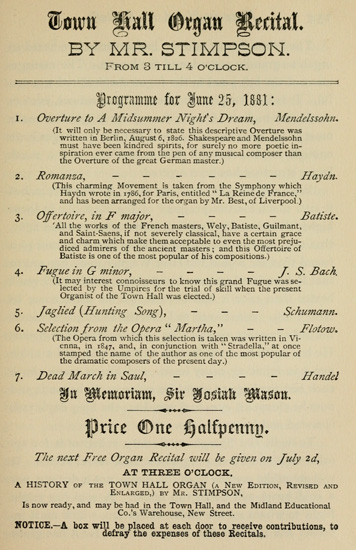
Town Hall Organ Recital.
BY MR. STIMPSON
From 3 till 4 o'clock.
Programme for June 25, 1881:
1. Overture to A Midsummer Night's Dream,Mendelssohn.
(It will only be necessary to state this descriptive Overture was written in Berlin, August 6, 1826. Shakespeare and Mendelssohn must have been kindred spirits, for surely no more poetic inspiration ever came from the pen of any musical composer than the Overture of the great German master.)
2. Romanza,Haydn.
(This charming Movement is taken from the Symphony which Haydn wrote in 1786, for Paris, entitled "La Reine de France," and has been arranged for the organ by Mr. Best, of Liverpool.)
3. Offertoire, in F major,Batiste.
(All the works of the French masters, Wely, Batiste, Guilmant, and Saint-Saens, if not severely classical, have a certain grace and charm which make them acceptable to even the most prejudiced admirers of the ancient masters; and this Offertoire of Batiste is one of the most popular of his compositions.)
4. Fugue in G minor,J. S. Bach.
(It may interest connoisseurs to know this grand Fugue was selected by the Umpires for the trial of skill when the present Organist of the Town Hall was elected.)
5. Jaglied (Hunting Song),Schumann.
6. Selection from the Opera "Martha"Flotow.
(The Opera from which this selection is taken was written in Vienna, in 1847, and, in conjunction with "Stradella," at once stamped the name of the author as one of the most popular of the dramatic composers of the present day.)
7. Dead March in Saul,Handel.
In Memoriam, Sir Josiah Mason.
Price One Halfpenny.
The next Free Organ Recital will be given on July 2d,
AT THREE O'CLOCK.
A HISTORY of the TOWN HALL ORGAN (a New Edition, Revised and Enlarged,) by Mr. STIMPSON,
Is now ready, and may be had in the Town Hall, and the Midland Educational Co.'s Warehouse, New Street.
NOTICE.—A box will be placed at each door to receive contributions, to defray the expenses of these recitals.
The Prima Donna said she had never before heard an organ so grandly played, and she knows. The management of the left hand in the fugue she declared wonderful. It is best to give the best for the masses, even in music, the highest of our gifts. John Bright has made most of his speeches in this hall, but it is no longer large enough for the Liberal demonstrations, and a much larger structure has been erected.
We are behind in providing music for the people, but it says much for the progress of the Republic in these higher domains, from whence come sweetness and light, that the greatest tragic singer, Frau Materna, said to a friend that she would tell Herr Wagner upon her return that if he wished to hear his greatest music performed better than ever it had been before he must come to New York. Alas! even as I re-write these pages comes the sad news that we can reap no more from that genius. He has made his contribution to the world, and a noble one it is, rejoicing many hearts and lifting many above their surroundings to exquisite enjoyments beyond; and now he closes his eyes and vanishes; the long day's task is ended and he must sleep.
To-night the Symphony Society substitutes for another number of their programme his Funeral March. It will seem like a voice from the grave; not a dry eye, nor a cold heart will be in the house. A soul has taken flight to whom we are under obligation, which must increase and increase the longer we live, for it has given expression to much that is of our highest and best, and suggested a thousandfold more than ever could be expressed. Our benefactor is indeed gone, in a sense material, but his soul lives with us and his voice will still be heard calling us up higher. The man who reveals new beauties in music enriches human life in one of its highest phases, and is to be ranked with the true poet. He who composes great music is the equal of him who writes great words; Beethoven, Handel, and Wagner are worthy compeers of Shakespeare, Milton, and Burns.
Furnaces and Coalpits.
The eleven miles between Birmingham and Wolverhampton are nothing but one vast iron-working, coal-mining establishment. There is scarcely a blade of grass of any kind to be seen, and not one real clean pure blade did we observe during the journey. It was Saturday afternoon and the mills were all idle, and the operatives thronged the villages through which we drove. O mills and furnaces and coal-pits and all the rest of you, you may be necessary, but you are no bonnie! Pittsburghers though many of us were, inured to smoke and dirt, we felt the change very deeply from the hedgerows, the green pastures, the wild flowers and pretty clean cottages, and voted the district "horrid." Wolverhampton's steeples soon came into sight, and we who had been there and could conjure up dear, honest, kindly faces waiting to welcome us with warm hearts, were quite restored to our usual spirits, notwithstanding dirt and squalor. The sun of a warm welcome from friends gives many clouds a silver lining, and it did make the black country brighter. The coach and horses, and Joe and Perry, not to mention our generalissimo, belong to Wolverhampton, as you know, and our arrival had been looked for by many. The crowd was quite dense in the principal street as we drove through. One delegation after another was left at friends' houses, the Charioteers having been billeted upon the connection; and here for the first time we were to enjoy a respite.
Wolverhampton, June 25-30.
We were honored by an entertainment at his Honor the Mayor's. As usual on fine days in England, the attractions of the mansion (and they are not small in this case) gave place to open-air enjoyments on the lawn—the game, the race, the stroll, and all the rest of the sports which charm one in this climate. The race across the lawn was far better fun than the Derby, but our gentlemen must go into strict training before they challenge those English girls again. It is some consolation that Iroquois has since vindicated the glory of the Republic.
We coached one day about fourteen miles to Apley House, and had a joyous picnic day with our friends Mr. and Mrs. S——, of Newton. The party numbered seventy odd, great and small. That day the Charioteers agreed should be marked as a red-letter day in their annals, for surely never was a day's excursion productive of more enjoyment to all of us. There are few, if any, prettier views in England than that from the terrace at Apley House. The Vale of Severn deserves its reputation. We had a trip on the river for several miles from Bridgenorth to the grounds as part of the day's pleasure.
Small Rivers.
How very small England's great rivers are! I remember how deeply hurt Mr. F—— was when his Yankee nephew (H. P. Jr., Our Pard) visited him for the first time, and was shown the river by his uncle, who loved it. "Call this a river?" exclaimed he, "why, it's only a creek! I could almost jump across it there." But H. P. was young then, and would not have hesitated to "speak disrespectfully of the equator" upon occasion. I won the good man's heart at once by saying that small though it was in size (and what has either he or I to boast of in that line, I wonder?) little Severn filled a larger space in the world's destiny and the world's thoughts than twenty mighty streams. Listen:
"Three times they breathed and three times did they drink Upon agreement of swift Severn's flood, Who then, affrighted with their bloody looks, Ran fearfully among the trembling reeds And hid his crisp head in the hollow bank, Blood-stained with these violent combatants."
Why, you have not a river like that in all America. H. P. was judiciously silent. But I do not think he was ever quite forgiven. These Americans have always such big ideas.
The free library at Wolverhampton interested me. I do not know where better proof of the advantages of such an institution is to be found. It was started upon a small scale, about fifteen thousand dollars being expended; now some forty thousand dollars have been spent upon the building. Last year eighty-six thousand books were issued. I counted at noon, June 30th, sixty-three persons in the reading-room, and at another time nearly two hundred readers. On Saturdays, between two and ten p.m., the number averages fully a thousand. In addition to the circulating library, there are a reference library, a museum, and large reading-rooms. Several courses of lectures are connected with the institution, with teachers for the various branches. One teacher, a Mr. Williams, has "passed" scholars in the science and art department every year, and one year every one of his scholars passed the Kensington examination. A working plumber who attended these classes gained prizes for chemistry and electricity, and is now secretary of the water-works at Chepstow. We may hear more of that climber yet. Plenty of room at the top! No sectarian papers are subscribed for, but all reputable publications are received if sent. In this way all sects are represented by their best, if the members see fit to contribute them. This is the true plan. "Error may be tolerated if truth be free to combat it. Let truth and error grapple." This city levies one penny per pound upon the rates, as authorized by the Libraries act. This nets about four thousand dollars per annum. Just see what powerful agencies for the improvement of the people can be set on foot for a trifling sum.
A People's Library.
And do not fail to note that this library, like all others in Britain organized under the Libraries act, does not pauperize a people. It is no man's library, but the library of the people—their own, maintained and paid for by public taxation to which all contribute. An endowed library is just like an endowed church, at best half and generally wholly asleep. It is a great mistake to withdraw from such an institution the healthy breeze of public criticism; besides this, people never appreciate what is wholly given to them so highly as that to which they themselves contribute.
Wolverhampton is a go-ahead city (I note a strong Scotch element there). A fine park, recently acquired and laid out with taste, shows that the physical well-being of the people is not lost sight of. The administration of our friend ex-Mayor D. is to be credited with this invaluable acquisition. Mr. D. took the most prominent part in the matter, and having succeeded he can consider the park his own estate. It is not in any sense taken away from him, nor one of its charms lessened, because his fellow-citizens share its blessings. Indeed as I strolled through it with him I thought the real sense of ownership must be sweeter from the thousands of his fellows whom we saw rejoicing within it than if he were indeed the lordly owner in fee and rented it for revenue. This whole subject of meum and tuum needs reconsideration. If Burns, when he held his plough in joy upon the mountain-side and saw what he saw, felt what he felt, was not more truly the real possessor of the land than the reputed nominal landlord, then I do not grasp the subject. There are woeful blunders made as to the ownership of things. Who owns the treasures of the Sunderland or Hamilton libraries? and who will shed the tears over their dispersion, think you, chief mourner by virtue of deepest loss, the titled dis-graces, in whose names they stand, or the learned librarian whose days have been spent in holy companionship with them? It is he who has made them his own, drawn them from their miserable owners into his heart. I tell you a man cannot be the real owner of a library or a picture gallery without a title from a much higher tribunal than the law. Nor a horse either, for that matter. Who owns your favorite horse? Test it! I say the groom does. Call Habeeb or Roderick. So slow their response! I won't admit they don't know and like me too. John knows my weakness and stands out of sight and lets me succeed slowly with them; but after that, see at one word from him how they prick up their ears and neigh, dance in their boxes, push their grand heads under his arm, and say as plainly as can be, "This is our man." I'm only a sleeping partner with John in them after all. It's the same all through; go to your dogs, or out to your flocks, and see every sheep, and even the little lambs, the cows with their kind, glowering eyes, the chickens, and every living thing run from you to throng round the hand that feeds them. There is no real purchase in money, you must win friendship and ownership in the lower range of life with kindness, companionship, love; the coin of the realm is not legal tender with Trust, or Habeeb, or Brownie, nor with any of the tribe.
Sister Dora.
Let us not forget to chronicle a visit paid to Walsall, the scene of Sister Dora's labors. It is only seven miles from Wolverhampton in the very heart of the black country. Dr. T. drove us out to the crowded smoky town, and we followed him through the hospital and heard from the officials many interesting stories of that wonderful woman. Our friend the Doctor also knew her well. She has been known to rush through a crowd and separate brutal men who were fighting. The most debased of that ignorant mining and iron manufacturing population seemed under her influence to an incredible degree; but then her sympathy and her tender devotion to every human being in distress were no doubt the secret of her power. A desperate case was brought into the hospital late one night. The physicians pronounced his recovery hopeless, but Sister Dora was not satisfied; indeed, she seemed to feel instinctively that the man had still a chance. She told the physicians to leave him, as she felt that they could do little good after they had given up hope, and took charge of the case herself. She told the poor wretch that she was going to stand by him all night and bring him through; and having faith herself she inspired it in the patient, and the result was that she actually saved the man's life. Here is the very material for a saint. Had this occurred a few generations ago, or were it to occur in some parts of Italy to-day, Saint Dora would surely be added to the calendar, and why not! Let us dispute over the miraculous and supernatural as we may, who will deny that the faith of this noble woman and the faith transmitted from her sympathetic heart to the poor sufferer were the foundation upon which his recovery was built up?
This incident gave rise to a discussion upon the coach one day as to the influence of faith in one's ability to do certain things affecting the result. The man who goes in to win may win: the one who goes in to lose can't win. So far all were agreed. Some of our party were disposed to lament the lack of faith which characterizes this age. "There are no Abrahams now-a-days," said one. "What would you do, Tom, if you should receive a message commanding you to offer up your son upon the altar?" "Well," said Tom, who was a telegraph operator in his early days, "I think I should first ask to have that message repeated." All right. So would we all of us. Still there is a wide province for faith. If it does not exactly remove mountains now a days, it at least enables us to tunnel them, which is much the same thing as far as practical results are concerned.
English Hospitality.
We can tell you nothing of the hotels of Wolverhampton, but the fourteen of us can highly recommend certain quarters where it was our rare privilege to be honored guests. Whether the English eat and drink more than the Americans may be a debatable question, but they certainly do so oftener. The young ladies quartered at Newbridge reported this the only bar to perfect happiness; they never wanted to leave the garden for meals nor to remain so long at table. As the Prima Donna reported, they "just sound a gong and spring luncheons and teas and suppers on you." The supper is an English institution, even more sacred than the throne, and destined to outlive it. You cannot escape it, and to tell the truth, after a little you have no wish to do so. There is much enjoyment at supper, and in Scotland this is the toddy-time, and who would miss that hour of social glee!
Mention must be made of the private theatricals at Merridale and of the amateur concert at Clifton House, both highly creditable to the talented performers and productive of great pleasure to the guests. I find a programme of the latter and incorporate it as part of the record:
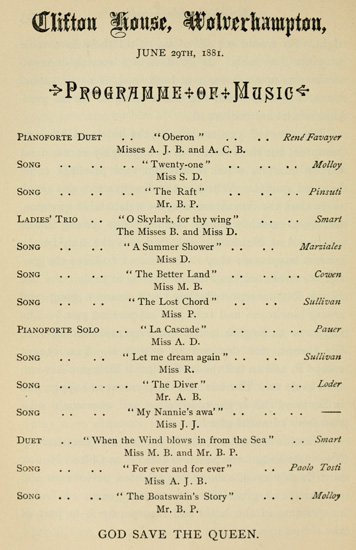
Clifton House, Wolverhampton,
June 29th, 1881.
Programme of Music
Pianoforte Duet"Oberon"René Favayer
Misses A. J. B. and A. C. B.
Song"Twenty-one"Molloy
Miss S. D.
Song"The Raft"Pinsuti
Mr. B. P.
Ladies' Trio"O Skylark, for thy wing"Smart
The Misses B. and Miss D.
Song"A Summer Shower"Marziales
Miss D.
Song"The Better Land"Cowen
Miss M. B.
Song"The Lost Chord"Sullivan
Miss P.
Pianoforte Solo"La Cascade"Pauer
Miss A. D.
Song"Let me dream again"Sullivan
Miss R.
Song"The Diver"Loder
Mr. A. B.
Song"My Nannie's awa'"——
Miss J. J.
Duet"When the Wind blows in from the Sea"Smart
Miss M. B. and Mr. B. P.
Song"For ever and for ever"Paolo Tosti
Miss A. J. B.
Song"The Boatswain's Story"Molloy
Mr. B. P.
GOD SAVE THE QUEEN.
Private Theatricals.
A great many fine compliments have been paid to performers in this world, but do you remember one much better than this? Our Prima Donna sang "My Nannie's awa'," my favorite among twenty favorites; and she did sing it that night to perfection. We were all proud of her. When she returned to her seat next to M., there was whispered in her ear: "Oh, Jeannie, the lump's in my throat yet!" All the hundred warm expressions bestowed upon her did not weigh as much as that little gem of a tribute. When you raise the lump in the throat by a song you are upon the right key and have the proper style, even if your teacher has been no other than your own heart, the most important teacher of all.
After the theatricals at Merridale came the feast. The supper-table comes before me, and the speeches. The orator of the Wolverhampton connection is ex-Mayor B. He speaks well, and never did he appear to greater advantage than on that evening. It's a sight "gude for sair een" to see a good-natured, kindly English gentleman presiding at the festive board, surrounded by his children and his children's children, and the family connections to the number of seventy odd. They are indeed a kindly people, but oh dear! those who have never been out of their little island, even the most liberal of them, have such queer, restricted notions about the rest of mankind! This, however, is only natural; travel is in one sense the only possible educator. England has been so far ahead of the world until the present generation, that it is difficult for her sons to believe she is sleeping too long. The best speech of the evening upon our side was made by Our Pard, who said he felt that after he had forgotten all else about this visit, the smiling faces of the pretty, rosy-cheeked English young ladies he had been admiring ever since he came to Wolverhampton, and never more ardently than this evening, would still haunt his thoughts; and then, with more emphasis, he closed with these memorable words: "And I tell you, if ever young men ask me where they can find the nicest, sweetest, prettiest, and best young ladies for wives, they won't have to ask twice." (Correct! shake, Pard!)
We were fortunate in seeing the statue of Mr. Villiers unveiled. Earl Granville spoke with rare grace and ease, his style being so far beyond that of the other speakers that they suffered by comparison. The sledge-hammer style of oratory is done. Let ambitious youngsters make a note of that, and no longer strut and bellow, and tear a passion all to tatters, to very rags. Shakespeare understood it:
"In the very tempest and I may say whirlwind of your passion, You must beget a temperance to give it utterance."
Coffee Houses.
The effort now making throughout Great Britain to provide coffee-houses as substitutes for the numerous gin palaces has not been neglected in Wolverhampton. The Coffee House Company which operates in the city and neighborhood has now fourteen houses in successful operation, and, much to my astonishment and gratification, I learned that seven and a half per cent. dividends were declared and about an equal amount of profit reserved for contingencies. In Birmingham there are twenty houses, and cash dividends of ten per cent. per annum have been made. If they can be generally made to pay even half as well, a grand advance has been made in the war against intemperance. I visited one of the houses with ex-Mayor D., who, I rejoice to say, is Chairman of the Company, and in this great office does more for the cause than a thousand loud-mouthed orators who only denounce the evil about which we are all agreed, but have no plan to suggest for overcoming it. It is so easy to denounce and tear down; but try to build up once and see what slow, discouraging labor is involved.
The prices in these coffee-houses are very low: one large cup of good tea, coffee, or cocoa, at the counter, 1d. (2 cents); one sandwich, 1d. (2 cents). If taken upstairs in a room at a table, one-half more.
There is a reading-room with newspapers free, bagatelle-table, and comfortable sitting-rooms; also a ladies' room and a lavatory, and cigars, tobacco, and all non-alcoholic drinks are provided. Men go there at night to read and to play games. The company has been operating for three years, and the business increases steadily. We saw similar houses in most of the towns we passed, and wished them God-speed.
A chairman of a company like this has it in his power to do more good for the masses, who are the people of England, than if he occupied his time as member of Parliament; but the English exalt politics unduly and waste the lives of their best men disputing over problems which the more advanced Republicans have settled long ago and cleared out of their way. They will learn better by and by. We must not be impatient. They are a slow race and prone to makeshifts politically.
Lincoln and the Deserter.
A delegation of the Charioteers passed a happy day visiting one of the celebrated homes of England, Bilton Grange, near Rugby, the residence of Mr. John Lancaster, whom Americans will remember as the owner of the yacht "Deerhound," who rescued Commander Semmes, when the "Kearsarge" swept the infamous "Alabama" from the seas. Mr. Lancaster showed us the pistols presented to him by the Confederate Officer as token of gratitude. This seems like ancient history already, so rapidly has the Rebellion and all thoughts thereof faded away. Jefferson Davis goes to and fro exciting no remark, arousing some pity. Had he been invested with the crown of martyrdom, how different would be the feeling of his people to-day! It is with Davis as with the deserter of whom Hon. Daniel J. Morrell tells: He took the mother of the runaway to see President Lincoln, in Washington, to plead for the life of her darling boy, who had been court-martialed and was to be shot in a few days. Lincoln first upbraided my friend for subjecting him to such an ordeal, but the poor woman was already in the room, sobbing as if her heart would break, and there was no help for it. Lincoln conducted her to a seat, asked a great many questions, learned that the boy had returned to work at Johnstown, and provided for his mother and sister from his earnings, giving as an excuse for leaving the army, that it was lying idle on the banks of the Potomac and he knew it could not move until spring.
The President mused a few moments, apparently undecided what action to take. Even the woman held her breath for the time and awaited in silence the word which was to rejoice her or doom her to misery forever.
"Well, I don't believe it would do him any good to shoot him, do you, madam?" asked Father Abraham of the mother, in a tone of inquiry so natural that one would have thought he was actually in doubt upon the subject himself and wanted the opinion of the person who knew the boy best.
The mother was speechless. During the inquiry the President had been rolling a small strip of paper into a ball. He handed this to Mr. Morrell, saying: "Read that when you get out, Daniel, but mind you don't tell Stanton."
Mr. Morrell beckoned the woman to the door, placed her in the carriage, read the slip, and ordered the coachman to drive at once to the office of the Provost Marshal. Here is what he found in that tiny strip: "P.M. Washington—Send Private Johnston, Company B, 9th Penn. Infantry, to his regiment. A. L."
That is the kind of thing that took our trusting hearts and gave this wood-chopper of Illinois such power as all the hereditary monarchs of the world can never hope to acquire. Just so with Jefferson Davis:—it wouldn't do anybody any good to shoot him. Happy America! strong enough to laugh at all powers which talk of assailing you.
Moral for Englishmen.
In driving to and from Bilton Grange, we passed famous Rugby and talked of our favorite Tom Brown. What a sad pity that Mr. Hughes was carried away by the fascinations of a scheme for transplanting gentle manly Englishmen to the Rugby colony in Tennessee! It was foredoomed to failure, and to much heart-burning and recrimination. Of all men in the world, your well-educated young Englishman is least adapted for such a life as Tennessee has to offer. Had the West or North-west been selected, the result should have been different so far as pecuniary considerations are concerned, for even poor management there could not have kept the land from rising in value. The stream of emigration from the older States to the new might have told these men where to go; but it seems that whenever foreigners attempt to do anything in America through an organization, their first thought is how to do it in a manner as far as possible from that of the Americans. The consequence is, they generally lose their money. Moral for our English cousins: "When in America do as the Americans do." If they settle in Iowa do you go and sit down beside them there. And to my iron and steel friends in this little island, just one word: If Americans are not overpoweringly anxious to develop the wonderful resources, say of Alabama, for instance, just you take Rip Van Winkle's plan "go home and t'ink about it jest a leetle" before you undertake the task. These Americans do not know everything, of course, but it is just possible they may know something about their own country.
"Nae man can tether time nor tide, The hour approaches, Tam maun ride."
Our six days at Wolverhampton had passed rapidly away in one continual round of social pleasures, and now we were off again to fresh woods and pastures new. The horn sounds. We call the roll once more. Mr. B., Senior, had left us at Windsor, but the Junior B. he sent us fitly represented the family. If he couldn't tell as many funny stories nor quote as much poetry as his sire, the young Cambridge wrangler could sing college songs and give our young ladies many glimpses of young England. He was a great favorite was Theodore (young Obadiah).
Miss B. and he left us at Banbury, much to our regret, but London engagements were imperative. Mr. and Mrs. K. arrived. If ever a couple received a warmer welcome I never saw nor heard of it. It seemed as if we had been separated for years, and how often during our journey had one or another of the party regretted that Aggie and Aaleck were missing all this.
It was upon the ocean that Ben and Davie conceived the idea that a run to Paris would be advisable. Leave of absence for two week was accordingly granted to four—Mr. and Mrs. McC., Miss J. and Mr. V.
We bade them good-bye at Wolverhampton, Thursday, June 30th, and saw them fairly off, not without tears upon both sides from the weaker sex. These partings are miserable things always. Their places were taken by Miss J. R. (a Dunfermline bairn), Miss A. B., and Mr. D. Next morning we gathered the clans at Mr. G.'s, calling at the houses of several other friends for the contingent they had so kindly entertained; thence to Merridale for the remainder and the final start.
It was a sight to see the party on the lawn there as we drove off, giving three hearty cheers for Wolverhampton. In special honor of the head of the clan there, the master of Merridale, we had just sung "For he is an Englishman." Yes, he is the Englishman all over. Our route for many miles was still in the black country, but near Lichfield we reached again the rural beauties of England. How thankful to get away once more from the dirt and smoke and bustle of manufactories!
The new members had not gone far before they exhibited in an aggravated form all the usual signs of the mania which had so seriously affected all who have ever mounted our coach. The older members derived great pleasure from seeing how completely the recent acquisitions were carried away. Their enthusiasm knew no bounds, and we drove in to the Swan at Lichfield brimful of happiness. We had left Wolverhampton about noon, the stage for the day being a short one, only twenty miles.
Lichfield, July 1.
Lichfield Cathedral.
The cathedral deserves a visit, out of the way of travel as it is. Its three spires and its chapter house are the finest we have yet seen; and then Chantrey's sleeping children is worth travelling hundreds of miles to see. Never before has marble been made to express the childish sleep of innocence as this does.
It was strange that I should stumble upon a monument in the cathedral to Major Hodson, whose grave I had seen in India. He lies with Havelock and Lawrence in the pretty little English cemetery at Lucknow, poor fellow, and here his friends and neighbors away in quiet Lichfield have commemorated his valor.
How well do I remember my visit to that historic burial place in far off India and the impression made upon me as I stood beside the tombs of the heroes who fell in the days of the great mutiny! The inscription on Lawrence's is: "Here lies Henry Lawrence, who tried to do his duty." What could you add that would not weaken that?
We talked, standing by Hodson's monument, of the long struggle and the relief at Lucknow, and of what I had written of it in my "Notes of a Trip round the World." As it pleased the Charioteers, perhaps I may be pardoned for quoting a part of it.
"Our first visit was to the ruins of the Residency, where for six long months Sir Henry Lawrence and his devoted band were shut up and surrounded by fifty thousand armed rebels. The grounds, which I should say are about thirty acres in extent, were fortunately encompassed by an earthern rampart six feet in height. You need not be told of the heroic resistance of the two regiments of British soldiers and one of natives, nor of the famous rescue. Hour after hour, day after day, week after week, and month after month, the three hundred women and children, shut in a cellar under ground, watched and prayed for the sound of Havelock's bugles, but it came not. Hope, wearied out at last, had almost given place to despair. Through the day the attacks of the infuriated mob could be seen and repelled, but who was to answer that as darkness fell the wall was not to be pierced at some weak point of the extended line? One officer in command of a critical point failing—not to do his duty, there was never a fear of that—but failing to judge correctly of what the occasion demanded, and the struggle was over. Death was the last of the fears of those poor women night after night as the days rolled slowly away. One night there was graver silence than usual in the room; all were despondent and lay resigned to their seemingly impending fate. No rescue came, nor any tidings of relief. In the darkness one piercing scream was heard from the narrow window. A Highland nurse had clambered up to gaze through the bars and strain her ears once more. The cooling breeze of night blew in her face and wafted such music as she could not stay to hear. One spring to the ground, a clapping of hands above her head, and such a shriek as appalled her sisters who clustered around; but all she could say between the sobs—'The slogan! the slogan!' Few knew what the slogan was. 'Didna ye hear? Didna ye hear?' cried the almost demented girl, and then listening one moment that she might not be deceived, she muttered, 'It's the Macgregors Gathering, the grandest o' them a',' and fell senseless to the ground.
Jessie of Lucknow.
"Truly, my lassie, the 'grandest o' them a',' for never came such strains before to mortal ears. And so Jessie of Lucknow takes her place in history as one of the finest themes for painter, dramatist, poet, or historian, henceforth and forever. I have some hesitation whether the next paragraph in my note-book should go down here or be omitted. Probably it would be in better taste if quietly ignored, but then it would be so finely natural if put in. Well, I shall be natural or nothing, and recount that I could not help rejoicing that Jessie was Scotch, and that Scotchmen first broke the rebel lines and reached the fort, and that the bagpipes led the way. That's all. I feel better now that this also is set down."
In Lichfield cathedral are seven very fine stained-glass windows which were found stowed away in a farm-house in Belgium, and purchased by an English gentleman for £200, and now they rank among the most valuable windows in the world. What a pity that the treasures wantonly destroyed during the Reformation had not found similar shelter, to be brought from their hiding-places once more to delight us!
Church Music.
We heard service Saturday morning, and mourned over the waste of exquisite music—twenty-six singers in the choir and only ten persons to listen in the vast cathedral, besides our party. It is much the same throughout England. In no case during week days did we ever see as many persons in the congregation as in the choir. Surely the impressive cathedrals of England are capable of being put to better uses than this. It seems a sin to have such choirs and not conduct them in some way to reach and elevate greater numbers. In no building would an oratorio sound so well. Why should not these choirs be made the nucleus for a chorus in every district, and let us have music which would draw the masses within the sacred walls? But maybe this would be sacrilegious. Theological minds may see in the music suggested an unworthy intruder in domains sacred to dogma; but they should remember that the Bible tells us that in heaven music is the principal source of happiness—the sermon seems nowhere—and it may go hard with such as fail to give it the first place on earth. In this view of the case it was decided to-day upon the coach that what some had hitherto thought a scandal, viz., that the choirs of most of our fashionable churches cost more than all the other expenses of the church, and that organists and sopranos receive a much larger salary considering the time given than the ministers; or, as one of the young ladies put it, "More is paid for music than for religion"—all this, instead of being reprehensible, as some have unthinkingly believed, may really be, and probably is, quite in accordance with the proper order of worship. Well, I am not going to grudge Miss B. her three thousand dollars a year any longer, said a vestryman; so he was converted to the theory that music stands upon strong ground. Some day, however, my lord bishop and lazy crew, the cathedrals of England will not be yours alone to drone in, but become mighty centres of grand music, from which shall radiate elevating influences over entire districts; and the best minds of the nation, remembering how narrow and bigoted the church was when these structures were built, will change the poet's line and say:
"To what great uses have they come at last!"
The world moves and the church establishment must move with it, or—this is a splendid place to stop—there is as great virtue in your "or" as in your "if," sometimes. Here is the best description of service in an English cathedral:
"And love the high embower'd roof, With antique pillars massy proof, And storied windows richly dight, Casting a dim religious light: There let the pealing organ blow, To the full voic'd choir below, In service high and anthems clear, As may with sweetness, through my ear, Dissolve me into ecstasies, And bring all heaven before mine eyes."
The music at Lichfield does indeed draw you into regions beyond and intimates immortality, and we exclaim with friend Izaak Walton, "Lord, what music hast thou provided for the saints in heaven, when thou affordest bad men such music on earth!"
I remember that when in China I read that Confucius was noted for his intense passion for music. He said one day to his disciples that music not only elevates man while he is listening, but that to those who love it music is able to create distinct images which remain after the strains cease and keep the mind from base thoughts. Think of the sage knowing this when he had probably only the sing-song Chinese fiddle to console him! I forget, he had the gongs, and a set of fine gongs of different tones make most suggestive music, as I have discovered.
The position of Lichfield Cathedral is peculiarly fine. Three sides of the square surrounding it are occupied by splendid ecclesiastical buildings connected with the diocese, including the bishop's palace. A beautiful sheet of water lies upon the lower side, so that nothing incongruous meets the eye.
We obtained there a better idea of the magnitude of the church establishment and its to us seemingly criminal waste of riches than ever before. To think of all this power for good wasting itself upon a beggarly account of empty benches, the choir outnumbering the congregation!
The Coach.
We had ordered the coach to come and await us at the cathedral, but had not expected Perry to drive up to the very door. There the glittering equipage was, however, surrounded by groups of pretty, rosy children and many older people gazing respectfully. There is something about a well-appointed coach and four which is calculated to puff a man up with vanity. I remember I had been absorbed in the service, and afterward in wandering about the cathedral had had my thoughts carried back to India. I was again in the crowded streets of Benares mounted upon the richly caparisoned elephants of the Rajah, and anon strolling upon the Apollo Bunder in Bombay, one of a crowd the gorgeous coloring of which equals any scene ever given in grand opera. I reached the cathedral door in a kind of trance; the gay coach, the horses and their sparkling harness, and Joe and Perry in their livery burst upon me, and looking up and around I did feel that we were a "swell" party, and had ever so much to be thankful for. It is a source of never failing pleasure to stand and see the Charioteers mount the coach—they are all so happy, and I am "so glad they are glad." And so we mounted and drove off, taking a last fond look of grand old Lichfield.
Dovedale, July 2-3.
Our objective point was Dovedale, thirty miles distant. When three miles out we stopped at Elmhurst Hall for Miss F., who had preceded us to pay a visit to Mr. and Mrs. F—x, who very kindly invited the party to dismount and lunch with them; but the thirty miles to be done would not permit us the pleasure. The next time we pass, however, good master and mistress of Elmhurst Hall, you shall certainly have the Charioteers within your hospitable walls, if you desire it, for such an inviting place we have rarely seen.
Sudbury Park.
We were to lunch in Sudbury Park, the residence of Lord Vernon. This was the first grassy luncheon of the five new-comers, and we were all delighted to see their enjoyment of this most Arcadian feature of our coaching life. It proved to be one of our pleasantest luncheons, for there is no finer spot in England than Sudbury Park. Of course it is not the glen nor the wimpling burn of the Highlands, but for quiet England it is superb.
The site chosen was near a pretty brook. Before us was the old-fashioned brick Queen Anne mansion, and behind us in the park was a cricket ground, where a match between two neighboring clubs was being worthily contested. The scene was indeed idyllic. There was never more fun and laughter at any of our luncheons. Aaleck had to be repressed at last, for several of the members united in a complaint against him. Their sides ached, but that they did not mind so much; their anxiety was about their cheeks, which were seriously threatened with an explosion if they attempted to eat. To avoid such results it was voted that no one should make a joke nor even a remark. Silence was enjoined; but what did that amount to! The signs and grimaces were worse than speech. Force was no remedy. It took time to get the party toned down, but eventually the lunch was finished.
We strolled over and watched the cricketers. It all depends upon how you look at a thing. So many able-bodied perspiring men knocking about a little ball on a warm summer's day, that is one way; so many men relieved from anxious care and laying the foundation for long years of robust health by invigorating exercise in the open air, that is the other view of the question. The ancients did not count against our little span of life the days spent in the chase; neither need we charge those spent in cricket; and as for our sport, coaching, for every day so spent we decided that it and another might safely be credited. He was a very wise prime minister who said he had often found important duties for which he had not time; one duty, however, he had always made time for, his daily afternoon ride on horseback. Your always busy man accomplishes little; the great doer is he who has plenty of leisure. The man at the helm turns the wheel now and then, and so easily too, touching an electric bell; it's the stoker down below who is pitching into it with his coat off. And look at Captain McMicken promenading the deck in his uniform and a face like a full moon; quite at his ease and ready for a story. And there is Johnnie Watson, chief engineer, who rules over the throbbing heart of the ship; he is standing there prepared for a crack. Moral: Don't worry yourself over work, hold yourself in reserve, and sure as fate, "it will all come right in the wash."
Leaving the contestants, we walked down to the lake in front of the mansion, and with our usual good fortune we were just in time to see the twenty acres of ornamental water dragged for pike, which play such havoc with other fish. The water had been drained into a small pond, which seemed alive with bewildered fish. We sat and watched with quiet interest the men drawing the net. Hundreds were caught at every haul, from which the pike were taken. A tremendous eel gave the men a lively chase; three or four times it escaped, wriggled through their legs and hands one after the other, and made for the water. Had the gamekeeper not succeeded in pinning it to the ground with a pitchfork, the eel would have beaten the whole party.
Adam and Eve.
Lord Vernon's park is rich in attractions. An old narrow picturesque arched bridge, which spans the pretty lake, has a statue of Adam at one end and Eve at the other. Over the former the ivy clusters so thickly as to make our great prototype a mass of living green; poor Eve has been less favored, for she is in a pitiable plight for a woman, with "nothing to wear."
But Eve was not used to kind treatment. Adam was by no means a modern model husband, and never gave Eve anything in excess except blame. Here she is still, the Flora McFlimsy of my friend William Allen Butler (minus the flora as I have said); but let her be patient, her dress is sure to come, for kind nature in England abhors nakedness. She is ever at work clothing everything with her mantle of green.
"Ever and ever bringing secrets forth, It sitteth in the green of forest glades Nursing strange seedlings at the cedar's root, Devising leaves, blooms, blades. This is its touch upon the blossomed rose, The fashion of its hand-shaped lotus leaves; In dark soil and the silence of the seeds The robe of Spring it weaves."
We had rare enjoyment at the lake, and envied Lord Vernon his princely heritage. The old forester who once showed me over a noble estate in Scotland was quite right. I was enchanted with one of the views, and repeated.
"Where is the coward who would not dare To fight for such a land!"
"Aye," said the old man, "aye, it's a grand country, for the lairds." It will be a grander country some day when it is less "for the lairds" and more for the toiling masses; but may the destroying angel of progress look kindly upon such scenes of beauty as Sudbury Park. The extensive estate may be disentailed and cultivated by a thousand small owners in smiling homes, with educated children within them, and the land bring forth greater harvests touched by the magic wand of the sense of ownership—for it makes an infinite difference to call a thing your own—and yet the mansion and park remain intact and give to its possessor rarer pleasures than at present. I think one of the greatest drawbacks to life in Britain in grand style must be the contrast existing between the squire and the people about him. It is bad enough even in Chester Valley, where the average condition and the education of the inhabitants are probably equal to any locality in the world, but in England it is far too marked for comfort, I should think.
While we were still lingering on the banks of the lake Perry's horn sounded from the main road to call us from the enchanting scene, and we were off for Dovedale through pretty Ashbourne.
Horseback Riding.
As we bowled along the conversation turned upon horseback riding, and some one quoted the famous maxim, "the outside of a horse for the inside of a man." "But what about a woman?" asked F. "Oh," answered Puss, "the outside of a horse for the inside of a woman and the outside as well, for in no other position can a woman ever possibly look so captivating as on a horse. Girls who ride in the park have double chances." A voice from the front—"You are right." Our Pard there admits that he had no idea of falling in love with Annie until he saw her on horseback; and when he had ridden with her a few times he was conquered. A woman looks her loveliest on horseback.
"That is not Mrs. Parr's opinion," rejoined a young lady on the front seat. "I think it is in her splendid 'Dorothy Fox' she says that a woman never shows so clearly the angel of beauty which dwells in a good woman's heart as when she murmurs her yes to her lover."
"Oh, that's not fair," came from the back row. "That's too short, only a moment; and besides only one man sees it. That doesn't count. We mean that a woman shows off better on horseback than anywhere else."
"Oh!" said the cynic, "is that it, Miss? Nothing counts without the showing off, eh!" And so we rattled on interrupted at intervals by exclamations called forth by England's unique beauty.
Can any one picture a resting-place so full of peace and beauty as the old Izaak Walton Inn? We arrived there in the twilight, and some of us walked down the long hill and got our first sight of the Dove from the bridge at the foot across the stream.
I got the memorable verses near enough from memory to repeat them on the bridge. Let me put them down here, for in truth, simple as they are, who is going to predict the coming of the day when they will cease to be prized as one of the gems of literature?
"She dwelt among the untrodden ways, Beside the springs of Dove, A maid whom there were none to praise, And very few to love. "A violet by a mossy stone, Half hidden from the eye; Fair as a star when only one Is shining in the sky. "She lived unknown, and few could know When Lucy ceased to be; But she is in her grave, and oh, The difference to me!"
But think of dear old Izaak and of his fishing excursions to this very spot. He actually stayed at our inn! He too is secure of his position as the author of a classic for as long a time as we care to look forward to. Is it not strange that no one has ever imitated this man's unique style? "God leads us not to heaven by many nor by hard questions," says the fisherman, and he knew a thing or two. There is a flavor about him peculiarly his own, but especially rich when read in this old inn, sacred to his memory. I enjoyed him with a fresh relish during the few hours of Sunday which I could devote to him, for there is a good sermon in many a sentence of the "Complete Angler." Dear old boy, your place in my library and in my heart too is secure.
Ilam Hall.
Ilam Hall, near the inn, is the great place, and there is a pretty little church within a stone's throw of it. We walked over on Sunday morning and saw the squire come into church with his family and take his seat among his people, for I take it most of the congregation were connected with the hall. The parson, no doubt, was the appointee of the squire, and we tried to estimate the importance of these two men in the district, their duties and influence—both great—for to a large extent the moral as well as the material well-being of a community in rural England depends upon the character of the hall and parsonage. The squire was Mr. Hanbury, M.P., who courteously invited our party to visit the hall after service, and to stroll as we pleased through his grounds. He had been in America, and knew our erratic genius and brother iron-master Abram S. Hewitt. In the evening we received from him some fine photographs of the hall (a truly noble one), which we prize highly. The accompanying note was even more gratifying, for it said that he had been so warmly received in America that it was always a pleasure when opportunity offered to show Americans such attentions as might be in his power. It is ever thus, cold indifference between the two English-speaking branches is found only among the stay-at-homes. The man who knows from personal experience the leading characteristics of the people upon both sides of the ferry is invariably a warm and sincere friend. The two peoples have only to become acquainted to become enthusiastic over each other's rare qualities.
This is a sheep-grazing district, quite hilly, and the rainfall is much beyond the average; but the weather question troubles us little; the Charioteers carry sunshine within and without. Our afternoon walk was along the Dove, which we followed up the glen between the hills for several miles, finding new beauties at every turn. Mr. H. has the stream on his estate reserved for five miles for his own fishing, but our landlord said he was very generous and always gave a gentleman a day's sport when properly applied for. We were offered free range by Mr. H., a privilege which Davie and I hold in reserve for a future day, that we may most successfully conjure the shade of our congenial brother of the angle; "for you are to note," saith he, "that we anglers all love one another." We at least all love Izaak Walton, "an excellent angler and now with God." Reading the ingenious defence of fishing by our author, "an honest man and a most excellent fly-fisher," is not waste time in these days of violent anti-vivisectionists, who have seen poor hares chased down for sport all their lives, and their Prince shoot pigeons from a trap without a protest, but who affect to feel pity for a cat sacrificed upon the holy altar of science. Miserable hypocrites, who swallow so large a camel and strain at so very small a gnat! It shows what demoralization is brought about in good people by rank and fashion; one rule for the Prince who disgraces himself by cruel sports, another for the medical student who exalts himself working for the good of his race.
Izaak Walton.
But to quaint Izaak's defence; and first as to the fish themselves.
"Nay, the increase of these creatures that are bred and fed in water is not only more and more miraculous, but more advantageous to man, not only for the lengthening of his life, but for the preventing of sickness; for 'tis observed by the most learned physicians that the casting off of Lent and other fish days hath doubtless been the chief cause of those many putrid, shaking, intermitting agues into which this nation of ours is now more subject than those wiser countries which feed on herbs, salads, and plenty of fish. And it is fit to remember that Moses (Levit. 11: 9; Deut. 14: 9) appointed fish to be the chief diet for the best commonwealth that ever yet was; and it is observable not only that there are fish, as namely the whale, three times as big as the mighty elephant that is so fierce in battle, but that the mightiest feasts have been of fish."