Philip Sidney Rice (continued 2)
Reading edition
Along the roads I sometimes saw big shell holes, enormous craters which made me very thoughtful. We were under fire day and night, whether on or off duty. Overhead, we daily watched the air duels of the avions. Sometimes a German plane would come across, flying straight, swift and low to attack an observation balloon and as it opened fire, we would see the man in the observation basket shoot straight down through the air, then his parachute would open up and perhaps he would land in safety. On one occasion I saw a French plane collapse in the air and come swirling down like a dead leaf—down, down, crashing to the ground, and I drove on not feeling a single sensation. I was dead tired and had passed the stage of feeling a thrill even of horror.
At night the avions were always overhead, dropping bombs—sometimes a munition plant would be hit and explosion after explosion would light the sky for several hours. Still we stayed on—the relief did not come.
And while we were voluntarily and willingly, yes even very cheerfully, under fire for the cause, it was most shocking to read in the papers that disloyalty went unpunished back in the United States. Our troops Over There are entitled to the assurance that it is not safe for anyone at home to stab them in the back.
XVII
In the Valley of the Shadow
On the morning of September first, after we had been at Verdun for a month under fire, as we were eating breakfast, three Englishmen walked into our dining tent. They were members of Section One, English Ambulance Corps. They informed us that their Section had been sent up to relieve us. We were elated. We invited them to sit down for breakfast with us, for we wanted to be decently polite and reserved. A little later it turned out they had been misinformed. They had merely been sent up to assist us. We were dejected. We were to stay on, “just three or four days longer.”
The French were going to follow up their success of August twentieth with another attack which would take place “’most any day” and then we would be sent back for rest. The centre of this attack was to take place in front of Fort Douaumont, and, if anything, it would be harder on us than when we were at Haudremont on the twentieth.
The attack took place on the seventh of September and while some ground was gained, the success was not as decisive as the previous attack.
But the relief did not come for us, we were to stay on, “just for two or three days longer,” through the counter attack of the Germans.
Personally I was playing out very rapidly. I was losing the ability to relax and recuperate when off duty. I was losing the ability to sleep—I was reaching the stage of premonitions. I hoped that I might last out until relief came. I wanted to finish decently. I was afraid of myself—I was afraid I might turn coward—I was afraid I might turn quitter.
Then came a drive that I shall always remember. It was during the counter attack of the Germans. I shall always remember it, for one reason, because I was almost tempted to turn coward and quit.
The wounded were coming in fast at Douaumont, both French and German, and all of our cars were on duty—at least all that were able to run. It was just about noon when I started, and the sun was shining cheerfully enough overhead but it was hell on earth. A short distance out I passed one of the English cars coming in and the driver shouted to me to have my gas mask ready. I confess I had a feeling of fear. I had seen the victims of poison gas and I had a greater dread of that than I had of shells, if such a thing were possible, and besides a couple of nights before during a period that I had been on constant duty for thirty hours in which time I had punctured six tires, had had a slight touch of gas and had felt rather ragged ever since. About four miles out, I passed one of our cars and the driver called to me something about big shells and gas. I stopped to call back for more particulars, but he was too far back to hear me. I was wavering but I drove on. A little further and I could see the shells coming in. I could see the gas clouds. I stopped my car—I got out and then I had the hardest argument I have ever had with myself. First I argued: “It is suicide to go on, I am justified in turning back and reporting the road is impassable.” Then I argued with myself, “But if I do go on and am hit, the agony will be over with in a few minutes, but if I turn back, the agony will be with me the rest of my life.” So I put on my gas mask and drove on.
Approaching the brow of the hill, I saw three of our cars drawn up alongside the road. I stopped my car directly behind them and walked ahead. The engine of one of the cars was still running, but the cars were all deserted. At that minute a shell struck just at the brow of the hill. The stop had undoubtedly saved me. I ran down an embankment into a deserted dug-out and there I crouched, sweltering in my gas mask. A few minuter later I ran out, jumped into my ambulance, passing the three deserted cars and drove on, trembling so that I could scarcely keep my feet on the right pedals. I reached the post at Douaumont and there in the entrance was our French Lieutenant Reymond in his steel helmet, calm and undisturbed, directing and assisting in the loading of the ambulances. He quietly and good-naturedly took me to task because my boots were not properly laced. I gave him a cigarette and lighted one myself. Then I went inside the post where tea was being ladled out to the stretcher bearers. This steadied me a bit. I went out. The place was littered with wounded, mostly Germans. Lieutenant Reymond assisted me in lifting wounded Germans into the car.
Then I drove back and went off duty. Some time in the middle of the night I had a terrible nightmare and went through the whole experience over again, and in it I dreamed that I had an urgent call to go back to the same post. I woke up, but the dream had been so vivid that I really thought I had received a call. I pulled on my boots and, partly dressed, started for my car. Stevenson and “Red” Day who were out there informed me there had been no call and sent me back to bed. Stevenson gave me a drug to make me sleep. Later, I found that “Red” Day deliberately fixed my car so it would not run in the event of my receiving any more imaginary calls in the night.
It was the day following that, as I was sitting on the end of my cot about to lie down, a shell struck outside and a piece of the shell about the size of an inkwell ripped a hole in the tent and struck on my pillow. I picked it up while it was still hot, walked out and showed it to Lieutenant Reymond and we laughed together over the incident. Lieutenant Reymond’s laugh was fairly hearty.
On the fifteenth of September, after forty-five days and forty-five nights under shell fire day and night, we received orders to go on repose. A little while later Stevenson packed me in his staff car and started me on my way to Paris to see a doctor.
I was not elated—I was utterly dejected. I had wanted to finish strong and I had all but finished in the discard. “Take a month off or as long as you need, but I want you to come back,” was Steve’s kind and cheering parting, as the car pulled down the road.
The men in the Section had all been wonderful. Lieutenant Reymond had been magnificent, but I am sure but for the brainy, watchful, sympathetic leadership of William Yorke Stevenson, the Section would never have held together those long days and nights, in the seething, shrieking, blood-stained hell in front of Verdun—“The valley of the shadow of death.”
XVIII
In Paris
On leaving the Section, I was feeling too tired and dejected to experience any deep regrets that I would not be with my friends for the celebration which had been planned upon reaching Bar le Duc. Also I was feeling a little depressed in starting off for Paris broke, penniless, not a franc in my pocket. As a matter of fact I had been in that financial condition (if such a condition can be called financial) for nearly two months, because a cablegram which I had sent to the United States the latter part of July had not reached its destination. Whether it had been lost in the ocean or had been confiscated and hypothecated for what it was worth by the enemy, I shall never know. Enough to say that I was broke.
During those long weary days and nights and weeks, I had not possessed the price of a cigarette and during that time I had grown to have the firmest convictions that anyone who is opposed to sending tobacco to the Allies is either most happily ignorant of the nerve-racking strain of war or is out and out pro-German.
Yet I was not allowed to suffer too much, for my friends in the Section, evidently believing that I was honest, were very kind to me, so I managed to have a smoke with a fair degree of regularity. I borrowed two francs from Stockwell with which I bought a pipe in which I smoked Ned Townsend’s “granulated” or even the terrible French tobacco when I thought that Ned Townsend might feel that I was imposing on him too much. I was rather clumsy at rolling cigarettes, but Frank Farnham was very helpful in that respect. He became so accustomed to performing this kind service for me that all I had to do was to look at him and say, “Farney” and out would come his bag of tobacco.
A few days before leaving the Section, I had written in to Paris to despatch a second cablegram to the United States and I hoped upon reaching Paris I would find the essential reply waiting for me at the banking house of Morgan-Harjes.
Just as I was about to get into the Staff car to start for Paris, it was “Farney” who came up to me and handed me twenty francs to see me through the journey.
It was midnight when I reached Paris and I was completely tired out. I engaged a taxicab and told the chauffeur to drive to Henry’s, Number Eleven, Rue Volney. Henry’s Hotel had been the semi-official headquarters of Section One in Paris practically since the war started. Here at least I could make myself known.
To be sure, I had some excellent letters to people in Paris but I certainty was not going to use them to establish credit, and I did not feel up to social calls.
Before the war, Henry’s had been something of a rendezvous for rich sporting men, those who followed the races and the like. Since the war, it was still patronized by those who had gone there before and also by aviators, ambulanciers, army officers, French, English and American. Henry had a transient business and he also held a clientèle. When I had been there in June, I had seen certain well dressed, well groomed young and middle aged men drifting in at certain hours. I saw these same faces there again in September and also saw them again in December. I wondered what their occupations might be, either real or ostensible. Almost any day between five and six, Henry could be seen shaking dice with his clientèle.
Henry was a little short trim fellow with a florid face, grey moustache and usually dressed immaculately in a frock coat. He wore glasses when he took inventory of the cash register. When he took inventory of people, he usually squinted his eyes into little slits, so that people who were being inventoried would scarcely realize that they were being noticed. Among foreigners and Parisians, Henry was one of the characters of the city. I say “was,” because Henry has since passed on to another world. When I reached there the hotel was closed but a ring on the bell brought the concièrge to the door in his pajamas and bath robe. I was shown to a room with a bed in it, white pillows, clean sheets—and it was very nice.
I was not long in getting to bed and not much longer in getting to sleep, but in my sleep I was once more back at Verdun. I could hear the aeroplanes whirring overhead—I could hear the bursting shells—I could see the dead horses on the crowded roads, the rats and filth, the desolation of the front. Not a very peaceful sleep; and when I awoke I felt somewhat confused as I looked over toward the windows and saw the heavy curtains drawn together. A clock was ticking on the mantel. It was nearly nine o’clock. Beside the bed I observed a telephone and without raising my head from the soft, comfortable, clean white pillow, I reached for it. I might be broke, but at least I was going to have one good meal to fortify me for the day. The office answered the call. “Grapefruit,” I said; “soft boiled eggs, toast with butter on it, coffee—and a pack of cigarettes.” I ordered an expensive brand of cigarettes, as I was afraid it might hurt my credit to call for cheap ones. Then I closed my eyes and dozed peacefully.
A little later in the morning, I met Henry. We sat down on the sofa at the foot of the stairs, and I told him Ned Townsend, Stevenson and the other men in the Section had sent him their best regards. Then I told him I was broke but added quickly that I expected a cablegram any day—perhaps to-day. Henry was very nice and polite about it and told me not to worry.
When I went out of the hotel, I intended to go over to the offices of Morgan-Harjes and learn whether a reply had come to my second cablegram, but I really did not feel strong enough to stand any unfavorable news. A hack driver coming along Rue Volney cracked his whip and I almost fell on the pavement. My nerves seemed to be temporarily shattered. I still had a few francs left that “Farney” had given me, so I called a taxi-cab and drove to 21 Rue Reynouard, the headquarters of the American Field Service. Dr. Lines looked me over and informed me that my heart was in bad condition and that I needed a complete rest. He suggested sending me out to a convalescent hospital in the country, but I did not feel well enough to go to a hospital—I did not want to see the inside of a hospital and—besides, I was waiting for a cablegram from the States. Later in the day I pulled myself together and went down Boulevard Haussmann to the offices of Morgan-Harjes. About that place I remembered having written to my partner in the banking business, that while their furniture is not as handsome as ours, they seemed to have more customers.
At Morgan-Harjes there was no news for me.
I went back to Henry’s and retired for the afternoon. I arose for supper, which I had in the café—and signed for it; a short walk as far as the Café de la Paix, back to Henry’s and to bed, back to sleep, back to Verdun—back to the shrieking shells, the whirr of the aeroplanes, the rats, and the crowded, bloodstained roads.
Waking the next morning, I reached for the telephone, breakfasted in bed and dozed until noon, then walked over to Morgan-Harjes.
No news—
After a fashion I have learned to study expression in faces; and on the days immediately following, when I got out of bed and went to Morgan-Harjes, I could tell by the expression of the clerk’s face before he spoke to me that there was no news. I also noticed by the expression on Henry’s face that I should begin to worry. He was not wearing his glasses but he was squinting his eyes.
I spent most of my time in bed. I needed the rest. The crowds, the boulevards, the early evening café life, the movies, the Follies—none of these had any allurement for me. I think it was on the fifth day that I ran into my poet friend young Bob Hillyer of Harvard and South Orange, New Jersey. He too had been out to the front with an Ambulance Section and was now on his way back to Cambridge, Massachusetts, where he was going to accept a professorship in the university which has made that town fairly famous.
I was very glad to see Bob Hillyer again in spite of the fact that he told me I looked perfectly terrible and should really return to the States and not think of going back to the front. He asked me to dinner with himself and a friend of his. I protested, mildly suggesting that they take dinner with me at Henry’s, but the stronger will prevailed and the three of us had dinner together at a little quiet outdoor café underneath the awnings.
They walked back to Henry’s with me, where my pride and hospitality got the better of my judgment.
Wouldn’t they come in and have a little cordial before going along?
Certainly!
We went inside—the cordials were ordered—I laid down three francs.
“Four francs, fifty, Mr. Rice,” said George, who had come to know me by name from having served me my breakfast in bed.
I picked up the three francs, put them in my pocket and said, “Please put it on my bill, George.” It is really terrible to be apparently well-to-do and not have any money to do it with.
Hillyer and his friend said “Good-night,” and I promptly went to bed. It was a little past midnight I think and I had been fast asleep for some time, back at Verdun with the bursting shells and scurrying and scurrilous rats, when I suddenly became conscious of the fact that a firm hand was resting on each one of my shoulders. I awoke with a start and there stood Ned Townsend smiling broadly.
“Get up,” he said. “Don’t you know it is your turn out to post?” At the foot of the bed stood “Red” Day. They had just reached Paris and informed me they had come on from the front to cheer me up a bit. “Farney” was with them too.
Why say I was glad to see them all? They sat on the side of the bed and told me about the banquet at Bar le Duc and Ned told me that “Red” and “Farney” were slated for the Croix de Guerre, which was very good news.
Townsend had received the Croix de Guerre a long time before.
We had late breakfast together and they paid for it and then I went around to Morgan-Harjes. I read the expression on the clerk’s face as I stepped up to the window. When I left, I discovered there was a spring to my step which had been absent on the previous days.
I walked rapidly back to Henry’s and into the hotel. Henry was in the hallway at the foot of the stairs. As he saw me, I observed the expression on his face—he was not wearing his glasses but his eyes were squinted into little slits. I knew what was coming as he said he would like to speak to me. I cheerfully replied: “It is all right, the cablegram has come.”
When I saw Ned Townsend, “Red” Day and “Farney,” I told them they were to have supper at a certain quiet little café of mine, opposite the “Chinese Umbrella.”
XIX
Aillianville
Though my leave had not expired, I decided to return to the front with Townsend, “Red” Day and “Farney.” The Section had moved down into Lorraine, in the foot hills of the Vosges, the land of Joan of Arc. We found our Section in the town of Aillianville. There a barn had been converted into a dining room and up in the loft some of the men had placed their cots, while others were billeted in the homes of the townspeople—plain but wonderfully kindhearted peasant folks whose dress was in keeping with the surroundings and who splashed around the muddy streets in their wooden sabots—and the streets were often muddy, for it rained a great deal of the time. But in spite of frequent rains it was none the less delightful here. It was a most pleasant contrast to the desolation in front of Verdun—to see unmolested forests, the foliage turning to autumn colors—to see cows grazing in the fields—sometimes a dog on a frolic, barking at their heels—to see peasant women sitting in the fields with their knitting and keeping a watchful eye on the cattle—and the war not so very many miles away.
Ned Townsend and I lost no time in finding quarters in the home of a peasant. The house, which could not have been built later than the seventeenth century, had two rooms and a garret. One room with open fire place served as a kitchen, living room and bedroom all combined. A bed was built in the wall and during the day was hidden by curtains. Here slept the patron Tourgant and his wife. Townsend and I took the other room, which had two beds in it. One of the window panes was gone, but this was none the less luxury. Our work was light and we enjoyed the life to the fullest extent. We could retire at night with a sense of security that we were not likely to be disturbed before morning. The house stood under the shadow of an ancient church and if we did lie awake, we could hear the clock in the steeple chiming off the quarter hours. It was sometimes pleasant to awaken in the middle of the night to hear the clock striking the hour and then to fall asleep again with the thought that there were some hours left for undisturbed rest.
It was usually Madame Tourgant, with wrinkled face, bronzed like a gipsy, who called us in the morning and set a cup of hot coffee by our beds. Sometimes when we came in late, chilled and wet with the rain, Monsieur Tourgant would get out of bed, pull on a few clothes, kick the dying embers of the faggots on the hearth into life and heat a cup of coffee for us. And so if there was some work to do, there was time for rest and relaxation.
In this country, it had once been the sport of kings to hunt the wild boar. Now the kings were otherwise engaged, but it was still the sport of peasants and poilus. Kings do not control all the sport there is—especially now.
One night we went out on a wild boar hunt, skirting the edge of a thick forest, not far from Aillianville down in the direction of the ancient town of Grand. Midnight, our hunt being unsuccessful, we sat down on the ground in the moonlight and enjoyed the feast which we had brought with us. We did not have another opportunity to go boar hunting because of the rains, which caused Ned Townsend—or was it “Red” Day?—to complain that the ground was too wet to sit on.
But if we had been unsuccessful on our hunt, our patron M. Tourgant fared better, bringing one in a couple of days later and the following night we were invited to sit around the open fireplace while Madame Tourgant put slices of it to sizzling over the faggots on the open fireplace. She prepared other things for the supper too. Some French soldiers that we knew were with us and I am sure ’most any king would have relinquished his crown for a night, to have sat under those old blackened rafters and enjoyed the sport of ordinary mortals.
Sometimes in Aillianville we would drop into the little “Cheval Blanc Café” to write letters or sit up at the open log fireplace with Madame Julie and her husband the patron and while drying our feet which were usually wet, read the romances of Alexandre Dumas and the like; sometimes the butcher maidens from the neighboring town of Grand would come driving along with their butcher wagon and from them we would procure a slice of ham or bacon which Madame Julie would cook for us with an omelette. Sometimes in the early evening, we played dominoes in the “Cheval Blanc” for stakes which were not ruinous. In the early evening Madame Julie’s niece Marie might drop in to help her with the dishes.
Marie was a cripple girl, but she was none the less the queen of all Aillianville. Her father owned his own comfortable little home and was the possessor of more cows than anyone else in the town. Marie’s cheeks were bronzed from the sun while watching her father’s cows. Her teeth shone white when she smiled. She had a noble brow and a regal face. Given the opportunity of two or three years in a fashionable finishing school, provided she did not become too highly educated, Marie could have been transplanted to Madison Avenue or Rittenhouse Square and scored a decided hit. I have it from one who lives not far from Madison Avenue and confirmed by one who lives not far from Rittenhouse Square. Marie will probably marry a poilu returning from the war with one arm and a Croix de Guerre and live happily ever after in the peaceful town of Aillianville.
Sometimes sitting by the log fire in the “Cheval Blanc,” we would hear the clank of wooden sabots on the stone pavement outside, the door would open and old Jacques, the blacksmith of rugged voice and jet black beard, would bluster in for his bottle of wine.
We lived with the peasants and loved them. They were kind, polite, chivalrous—they were real.
On occasion, there was music in the evening in the “Lion d’Or Café” further down the street. One night, toward the end of October, we held a dance in the “Lion d’Or.” A guitar and a mandolin furnished the music. The villagers came around in their wooden sabots. French soldiers in their blue uniforms were there. Back in the shadow of a corner, a group of officers sat enjoying the scene, no doubt wishing they might take an active part. In the course of the evening, a young fellow was lifted on a table and sang “Madelon,” a song popular with the French just then.
It was pretty close to midnight when a message came in that one of our cars had broken down along the road about ten miles out. A relief party was organized and the dance came to an end.
It had been snowing in the late afternoon and evening. When we went out of the Lion d’Or the moon was breaking through the clouds, and the streets, tile roofs of the houses and the church steeples were white with snow.
Not one of us who was not a little sad a few days later on receiving orders to move from the town of Aillianville to the ancient town of Beaufromont, built on the side of a steep hill. We were glad that the villagers also expressed sorrow at the parting. Some of those plain peasant women were kind enough to weep a little as they smilingly waved “Au ’voir” to us.
Our old patron, the boar hunter Tourgant, was so anxious to bid us a fitting farewell when we started in the early morning that he stayed up most of the night. When we moved out of the town he was asleep in the blacksmith shop of old Jacques of rugged voice and jet black beard.
As we drew up in line outside the village, someone commemorated the departure in verse:
Farewell, my Aillianville, in fair Lorraine, Town where sun shines through the rain, The “Cheval Blanc,” the “Lion d’Or,” “Au ’voir,” farewell forever more. I was with you when woods were brown, When boars were hunted on the down, When log fire crackled on the hearth And in the evening there was mirth And music in the town I love so well, Oh, Aillianville, au ’voir, farewell.
During our stay in Aillianville, Section One, American Field Service Volunteers, was taken over by the American army and there ceased to be any volunteer ambulance service. My work was done, but the Section being short of men I agreed to stay on indefinitely until new men came on.
One day, to be exact, Thanksgiving morning, outside the town of Neufchateau, on the road to Nancy, I saw some French troops drawn up on review. A band was playing at their head. By a strange coincidence I had heard that same band playing once before back in Houdainville as those same troops were advancing for the big offensive in front of Verdun.
On this Thanksgiving morning, the review being over, the men stacked arms and walked about the field. One of the soldiers walked over to where I was talking with some friends. He wore a steel helmet, but underneath the visor I could see a scar across his forehead and there was a scar on his cheek. He asked me if I remembered him and I was obliged to confess that I did not. He then informed me that on September second, in front of Douaumont, when he had received these two scars, I had carried him back. No wonder I had not recognized him.
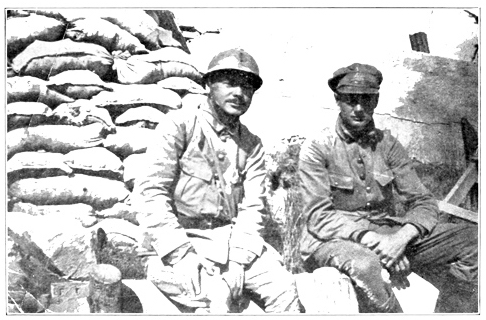
Rice Purdy In Front of Verdun
Then as we stood there I heard another band playing in the distance. It grew nearer and nearer till at last I saw an American flag rising over the brow of the hill and back of it swinging along the road four thousand men in khaki.
I confess I felt a thrill!
XX
Vive l’Amérique! Vive la France!
The delightful days at Aillianville will always stand out in my memory in marked contrast with the forty-five days and forty-five long nights that we spent before Verdun. I shall always remember a night in a dug-out in front of Verdun toward the end of our long siege. The place was dimly lighted. At one end was a table on which there was a telephone. A French officer sat there writing reports and answering telephone calls. “’Allo! ’Allo!” he would say, taking down the receiver. Along the wall was a wooden bench on which sat two weary poilus, their heads nodding under their steel helmets. On the floor, a wounded soldier lay on a stretcher. Outside I could hear the firing of the guns, the trampling of horses, the straining and groaning of the heavy munition trucks pulling up the grade.
I was very tired, in fact I had reached the stage of premonitions. I felt that luck had been with me just as long as might be expected and in the fagged, depressed condition of my brain I felt quite certain that my next time out would be my last. I have seen others pass through the same stage when they have been worn out. I suppose Alan Seeger must have felt like that when he wrote his wonderful poem “I have a rendezvous with Death.”
As I sat there waiting for my turn to go out and expecting a call each time the telephone rang, I got to thinking of my early impressions upon reaching France. It seemed a long time since I had landed in France. Then I got to thinking of my later impressions after coming to the Front. To keep my mind from dwelling on what was happening outside, where I must soon go, I took some scraps of paper and wrote a brief summary of my impressions, supposing that it might be the last words I would write. I had just finished writing when the telephone rang. The officer took down the receiver, “’Allo! ’Allo! San Fein!” The officer turned to me. It was my turn out. I put the scraps of paper in my pocket, slipped into my heavy coat, put on my steel helmet, shook hands with the officer and went out.
It was a short run but a bad one, shells were arriving and shells were departing. I found an Abri had been squarely hit and badly torn up. I got four wounded, who were in very bad condition. I drove back and got through. My premonitions were not realized. It was sunrise when I drove away from the hospital and my work for the night was over. Coming down the road I met Holt. He told me he was having trouble with his car and he asked me to wait while he made some repair. I drew up alongside the road, put my head down on the steering wheel and went to sleep. A few minutes later Holt woke me up and we drove on together. A short while later, over hot coffee, I confessed to Holt the premonitions I had the night before. And then he confessed that he had had them, too. Then I read to him what I had written:
“I gained my first impression of France while sailing up the broad Gironde River, flanked by its stately trees, its green and rolling fields, its Catholic spires, its old châteaux and ancient monasteries. I came on to Paris. I saw and admired that magnificent city which stoically smiles through sorrow. I stood at the tomb of Napoleon but I did not shed a tear; I sat in Nôtre Dame Cathedral on a Sabbath afternoon, and there I saw women with faces sad but brave, kneeling in prayer; I heard the organ’s sacred notes; perhaps I shed a tear, why should I say? I sat at one of the many crowded tables in front of the famous Café de la Paix and there I watched the Congress of the Armies of the Allied Nations, sipping drinks, smoking cigarettes, passing the time of day. I drove up the sloping, tree lined Champs Elysées at sunset and through the Arch of Triumph. At its crest I saw the tinted sky and clouds and tops of trees and as I drove on through the peaceful groves of the Bois du Boulogne by moonlight I thought that though I loved my native land I would love to live in France.
“Then I came on out to the battle front. I passed through desolate villages, past desecrated cathedrals; I saw deserted homes and shell wrecked towns. I heard the thunder and roar of many guns, I heard the crash of avion bombs, I heard the shriek, the whistle, the moan of shells. I saw the horror and havoc that these things wrought, the wounded, the dying, the countless dead. But through all the terrors of the days and nights I saw the noble Nation, fatigued, yet with Christlike resignation suffering and bleeding so that others might live to enjoy an honorable repose. And I thought that the prayer of this noble Nation must be the prayer of Christ: ‘O Lord, forgive them, for they know not what they do!’ And as I saw these things I thought that though I loved my Country, the land of Chance, though I loved my own Flag, I should be willing to die for France, but it has not thus far been willed and I am glad. I am glad to go on living and loving France. She is our kin. Her blood is on our soil, our blood on hers. She is our sister country.
“Vive l’Amérique! Vive la France!”
XXI
Afterthoughts
So now my story is told and as I close the pages of the book I pause to think and wonder if ever again I shall see France. I wonder if again I shall walk along the quays of the River Seine or up the sloping tree-lined Champs Elysées, or wander with friends around to the Café de la Paix, or if again I shall pass through the desolate villages at the front and hear the shrieking shells, the aeroplanes overhead singing in the night “Guerre, guerre, guerre,” their monotonous song of death. I wonder if again I shall see those noble, weary people of our Sister Country fighting bravely against the Iron Hand; whether I shall go back to see our own flag being carried on to final victory; and rejoice that America at last has ridden into the field full armed, the Savior of France, as was once the Maid of Orleans.
I wonder if I shall resist or follow that invisible finger beckoning to me—whether I shall listen to that voice whispering and saying to me, “Come back”?
I wonder if again I shall see the towers of Rheims Cathedral or stand upon the hill beside the resting place of Norton?
I wonder if again some day I shall walk into the peaceful town of Aillianville and sit down by the crackling fire and visit my friend Tourgant, the boar hunter, and his wife; whether I shall some evening step in the “Cheval Blanc” and to Madame Julie and the patron, say, as I have said before: “Bon soir, Madame, bon soir, Monsieur”; whether sometime I shall sit with Marie and her husband, who will wear the Croix de Guerre upon his breast, and with them talk about the war. I wonder if I shall again go in the “Lion d’Or,” and, in happy memory, hear the music as I did before, and if perhaps I shall see again my friends of Section One in France?
I wonder if I shall answer that voice which whispers to me as I walk along the crowded streets, which whispers as I lie awake at night, which whispers in my sleep and says to me—“Come back.”
FINIS
Le Général Commandant la 69ᵉ A. T.
Signe: Monroe.
Transcriber’s Note:
Footnotes were renumbered sequentially and were moved to the end of the book. Dialect, obsolete words, misspellings, and typographical mistakes were left unchanged.