ACCOUNTS OF SPECIES
Reading edition
In the following pages various aspects of the occurrence, life histories, ecology, and variation of the species of amphibians and reptiles known from southern El Petén are discussed. Only Cochranella fleischmanni reported by Stuart (1937) from Río Subín at Santa Teresa was not collected by us and is excluded. Because more worthwhile information was gathered for some species than others, the length and completeness of the accounts vary. All specimens listed are in the Museum of Natural History at the University of Kansas, to which institution all catalog numbers refer. Preceding the discussion of each species is an alphabetical list of localities from which specimens were obtained; numbers after a locality indicate the number of specimens obtained at each locality.
Bolitoglossa dofleini (Werner)
Chinajá, 1.
An adult female having minute ovarian eggs has a snout-vent length of 81 mm., a tail length of 59 mm., 13 costal grooves, two intercostal spaces between adpressed toes, 38-35 vomerine teeth in irregular rows forming a broad arch from a point posterolaterad to the internal nares to a point near the anterior edge of the parasphenoid teeth, and 43-44 maxilliary-premaxillary teeth. In life the dorsum was rusty brown with irregular black and orange spots and streaks. The flanks were bluish gray with black in the costal grooves and creamy tan flecks along the ventral edge of the flank. The belly and underside of the tail were yellowish tan with dark brown spots laterally. The limbs were orange proximally and black distally; the pads of the feet were bluish black. The dorsal and lateral surfaces of the tail were yellowish orange with black spots. The iris was grayish yellow.
Stuart (1943:17) reported this species from Finca Volcán, Alta Verapaz. He diagnosed his specimens as having 13 costal grooves and two or three intercostal spaces between adpressed toes. He stated that the vomerine teeth were about 12 in number and that in life the dorsum was mottled gray and black, the sides gray and brown, and the undersurfaces uniformly dark gray. These specimens differ noticeably from the individual from Chinajá in the number of vomerine teeth and in coloration.
In August, 1961, I obtained a specimen of Bolitoglossa dofleini at Finca Los Alpes, Alta Verapaz, approximately 13 kilometers airline south-southwest of Finca Volcán and at approximately the same elevation. Although the salamander was dead when found, it obviously was more heavily pigmented than the individual from Chinajá. The belly was bluish gray with black spots laterally; the dorsum was dull brownish gray with some brownish red streaks. The specimen is a female having small ovarian eggs, a snout-vent length of 90 mm., 13 costal grooves, and two intercostal spaces between adpressed limbs. There are 28-29 vomerine teeth, more than twice as many as in specimens from Finca Volcán (Stuart, 1943:17), but noticeably fewer than in the specimen from Chinajá.
The presence of this species at Chinajá lends support to the idea that the specimen from the Río de la Pasión listed by Brocchi (1882:116) also is Bolitoglossa dofleini. Furthermore, the confirmed presence of this species in the lowlands of El Petén suggests that there may be genetic connection between B. dofleini in the Alta Verapaz and B. yucatana in the Yucatán Peninsula. Bolitoglossa yucatana differs from B. dofleini in having five intercostal spaces between adpressed toes and in having a different color pattern. Both are robust species having no close relationships to other species of Bolitoglossa in northern Central America.
The specimen from Chinajá was found in water in the axil of a large elephant-ear plant (Xanthosoma) by day in March. Its stomach contained fragments of beetles and a large roach. The natives did not know salamanders and had no name for them.
Bolitoglossa moreleti mulleri (Brocchi)
Chinajá, 2; Río San Román, 1.
One specimen is a female having a snout-vent length of 80 mm., a tail length of 82 mm., and a total length of 162 mm. It contains 63 large eggs, the largest of which has a diameter of about three millimeters. This specimen has 13 costal grooves, four intercostal spaces between adpressed toes, and 12-13 vomerine teeth. A juvenile having a snout-vent length of 39 mm. and a tail length of 33 mm. has 12 costal grooves, three intercostal spaces between adpressed toes, and 8-8 vomerine teeth. In life these salamanders were uniformly dull brownish black above with a dull creamy yellow irregular dorsal stripe beginning on the occiput and continuing onto the tail. There are no yellow or orange streaks or flecks on the head or limbs. The specimen from the Río San Román was taken from the stomach of a Pliocercus euryzonus aequalis and has not been studied in detail, because of its poor condition.
The present specimens show no tendency for the development of a broad irregular dorsal band that encloses black spots or forms irregular dorsolateral stripes, as is characteristic of B. moreleti mexicanus, a subspecies that has been reported from La Libertad (Stuart, 1935:35) and Piedras Negras (Taylor and Smith, 1945:545) in El Petén, and from Xunantunich, British Honduras (Neill and Allen, 1959:20).
Schmidt (1936:151) and Stuart (1943:13) found B. moreleti mulleri in bromeliads at Finca Samac, Alta Verapaz. Taylor and Smith's (1945:545) and Neill and Allen's (1959:20) specimens of B. moreleti mexicanus were obtained from bromeliads, but Neill and Allen (loc. cit.) stated that the natives in British Honduras said that they had found salamanders beneath rubbish on the forest floor. My specimens were obtained from beneath logs on the forest floor in the rainy season. Possibly in drier environments the species characteristically inhabits bromeliads, at least in the dry season.
Bufo marinus (Linnaeus)
Chinajá, 3; 10 km. NNW of Chinajá, 1; 11 km. NNW of Chinajá, 1.
During both visits to Chinajá this large toad was breeding in a small permanent pond in the camp. During the day the toads took refuge in crevices beneath the buildings or beneath large boulders by the pond. At dusk from four to ten males congregated at the pond and called. Tadpoles of this species were in the pond in March and in July. One juvenile was found beneath a rock in the forest, and another was on the forest floor by day.
The natives' name for this species and the following one is sapo.
Bufo valliceps valliceps Wiegmann
Chinajá, 52; Río San Román, 8; Sayaxché, 2; Toocog, 1.
This is one of the most abundant, or at least conspicuous, amphibians inhabiting the forest. Breeding congregations were found on February 24, March 2, March 11, and June 27. At these times the toads were congregated at temporary ponds in the forest or along small sluggish streams. Throughout the duration of both visits to Chinajá individual males called almost nightly at the permanent pond at the camp.
The variation in snout-vent length of 20 males selected at random is 56.7 to 72.5 mm. (average, 64.8 mm.). Two adult females have snout-vent lengths of 80.4 and 87.6 mm. In all specimens the parotid glands are somewhat elongated and not rounded as in Bufo valliceps wilsoni (see Baylor and Stuart, 1961:199). My observations on the condition of the cranial crests of the toads in El Petén agree with the findings of Baylor and Stuart (op. cit.:198) in that hypertrophied crests are usual in large females. In the shape of the parotids and nature of the cranial crests the specimens from El Petén are like those from the Isthmus of Tehuantepec in México. As I pointed out (1960:53), the validity of the subspecies Bufo valliceps macrocristatus, described from northern Chiapas by Firschein and Smith (1957:219) and supposedly characterized by hypertrophied cranial crests, is highly doubtful.
In the toads from El Petén the greatest variation is in coloration. The dorsal ground-color varies from orange and rusty tan to brown, yellowish tan, and pale gray. In some individuals the flanks and dorsum are one continuous color, whereas in others a distinct dorsolateral pale colored band separates the dorsal color from dark brown flanks. In some individuals the venter is uniform cream color, in others it bears a few scattered black spots, and in still others there are many spots, some of which are fused to form a black blotch on the chest. In breeding males the vocal sac is orange tan. All specimens have a coppery red iris.
Aside from the breeding congregations, active toads were found on the forest floor at night; a few were there by day. Some individuals were beneath logs during the day.
Eleutherodactylus rostralis (Werner)
Chinajá, 10.
Because of the multiplicity of names and the variation in coloration, the small terrestrial Eleutherodactylus in southern México and northern Central America are in a state of taxonomic confusion. Stuart (1934:7, 1935:37, and 1958:17) referred specimens from El Petén to Eleutherodactylus rhodopis (Cope). Stuart (1941b:197) described Eleutherodactylus anzuetoi from Alta Verapaz and El Quiché, Guatemala, suggested that the new species was an upland relative of Eleutherodactylus rostralis (Werner), and used that name for the frogs that he earlier had referred to Eleutherodactylus rhodopis. Dunn and Emlen (1932:24) placed E. rostralis in the synonymy of E. gollmeri (Peters). Examination of series of these frogs from southern México, Guatemala, and Costa Rica causes me to think that there are four species; these can be distinguished as follows:
E. rhodopis.—No web between toes; one tarsal tubercle; tibiotarsal articulation reaches to nostril; iris bronze in life.
E. anzuetoi.—No web between toes; a row of tarsal tubercles; tibiotarsal articulation reaches to tip of snout; color of iris unknown.
E. rostralis.—A vestige of web between toes; no tarsal tubercles; tibiotarsal articulation reaches snout or slightly beyond; iris coppery red in life.
E. gollmeri.—A vestige of web between toes; no tarsal tubercles; tibiotarsal articulation reaches well beyond snout; iris coppery red in life.
The presence of webbing between the toes, the absence of tarsal tubercles, and the coppery red iris distinguish E. rostralis and E. gollmeri from the other species. Probably E. rostralis and E. gollmeri are conspecific, but additional specimens are needed from Nicaragua and Honduras to prove conspecificity. On the other hand, the characters of the frogs from Chinajá clearly show that they are related to E. gollmeri to the south and not to E. rhodopis to the north in México.
At Chinajá, Eleutherodactylus rostralis was more abundant than the few specimens indicate, for upon being approached the frogs moved quickly and erratically, soon disappearing in the leaf litter on the forest floor. Most of the specimens were seen actively moving on the forest floor in the daytime; one was found beneath a rock, and one was on the forest floor at night.
Eleutherodactylus rugulosus rugulosus (Cope)
Chinajá, 2; 15 km. NW of Chinajá, 4.
These frogs were found on the forest floor by day. With the exception of one female having a snout-vent length of 69.5 mm., all are juveniles. The apparent rarity of this species at Chinajá may be due to the absence of rocky streams, a favorite habitat of this frog. The local name for this frog is sapito, meaning little toad.
Leptodactylus labialis (Cope)
Toocog, 1.
One juvenile having a snout-vent length of 16.4 mm. was found at night beside a pond in the forest. The scarcity of the species of Leptodactylus in the southern part of El Petén probably is due to the lack of permanent marshy ponds.
Leptodactylus melanonotus (Hallowell)
Sayaxché, 1.
One individual was found beneath a rock beside a stream in the forest. The local name is ranita, meaning little frog.
Syrrhophus leprus Cope
Chinajá, 2; 15 km NW of Chinajá, 1.
An adult female having a snout-vent length of 27.5 mm. was found on the forest floor by day. Two juveniles having snout-vent lengths of 15.5 and 19.0 mm. were beneath rocks on the forest floor. The specimens are typical of the species as defined by Duellman (1958:8).
Hyla ebraccata Cope
Toocog, 66.
This small tree frog congregated in large numbers at a forest pond at Toocog. Between June 30 and July 2 we collected specimens and observed the breeding habits of this and other species at the pond. Calling males were distributed around the pond, where they called from low herbaceous vegetation at the edge of the pond or from plants rising above the water. Calling commenced at dusk and continued at least into the early hours of the morning. On one occasion a female was observed at a distance of about 50 centimeters away from a calling male sitting on a blade of grass. The female climbed another blade of grass until she was about eight centimeters away from the male, at which time he saw her, stopped calling, jumped to the blade of grass on which she was sitting and clasped her. Clasping pairs were observed on blades of grass and leaves of plants above the water; most pairs were less than 50 centimeters above the surface of the pond.
The eggs are deposited on the dorsal surfaces of leaves above the water. All eggs are in one plane (a single layer) on the leaf. External membranes are barely visible, as the eggs consist of a single coherent mass. Eggs in the yolk plug stage have diameters of 1.2 to 1.4 mm. Seventeen eggs masses were found; these contained from 24 to 76 (average 44) eggs. The jelly is extremely viscous and tacky to the touch. At time of hatching the jelly becomes less viscous; the tadpoles wriggle until they reach the edge of the leaf and drop into the water.
Eleven tadpoles were preserved as they hatched; these have total lengths of 4.5 to 5.0 (average 4.77) mm. Hatchling tadpoles are active swimmers and have only a small amount of yolk. The largest tadpoles preserved have total lengths of 13.0 and 13.5 mm. At this size distinctive sword-tail and bright coloration have developed.
Fig. 2. Tadpole of Hyla ebraccata (KU 59986) from Toocog, El Petén, Guatemala.
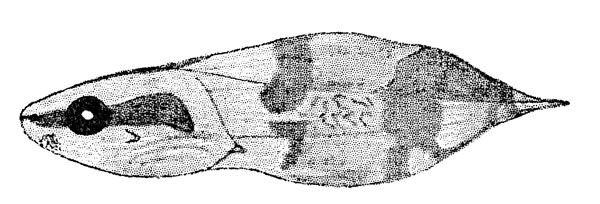
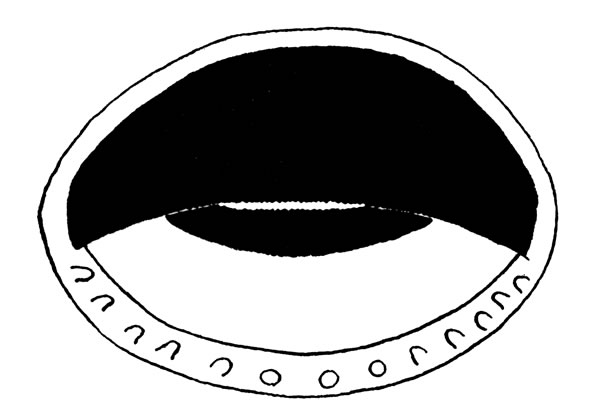
Description of fully developed tadpole (KU 59986): Total length, 13.5 mm.; tail-length, 8.4 mm., 62 per cent of total length. Snout, in dorsal view, bluntly rounded; in lateral view less bluntly rounded; body depressed; head flattened; mouth terminal; eye large, its diameter 25 per cent of length of body; nostrils near tip of snout and directed anteriorly; spiracle sinistral and situated postero-ventrad to eye; cloaca median. Tail-fin thrice depth of tail-musculature, which extends beyond posterior end of tail-fin giving sword-tail appearance (Fig. 2). In life, black stripe on each side of body and on top of head; black band on anterior part of tail and another on the posterior part; body and anterior part of tail creamy yellow; dark red band between black bands on tail. Mouth terminal, small, its width about one-fifth width of body; fleshy ridge dorsally and ventrally; row of small papillae on ventral lip; no lateral indentations of lips; upper beak massive, convex, and finely serrate; lower beak small and mostly concealed behind upper; no teeth (Fig. 3).
Fig. 3. Mouthparts of larval Hyla ebraccata (KU 59986) from Toocog, El Petén, Guatemala.
Hyla loquax Gaige and Stuart
Toocog, 14.
These specimens were found at night when they were calling from low vegetation in a forest pond. Most of the frogs were several meters away from the edge of the pond. Although two clasping pairs were found, we obtained no eggs or tadpoles referable to this species.
Hyla microcephala martini Smith
Chinajá, 1; Toocog, 21.
The specimen from Chinajá was calling from a small bush at the edge of a temporary grassy pond in a clearing in the forest. At Toocog this species was closely associated with Hyla ebraccata; males were calling from herbaceous vegetation in and around the forest pond. These frogs were not so abundant in the forest at Toocog as they were around ponds on the savanna at La Libertad.
Hyla picta (Günther)
Toocog, 8.
This small tree frog was calling from herbs in a pond in the forest on June 30 and July 2. The voice is weak; probably greater numbers of males were present than are indicated by the few specimens collected, for the din from the more vociferous species made it impossible to hear Hyla picta unless one was calling close by.
Hyla staufferi Cope
Chinajá, 1.
This individual was calling from a low bush in the clearing at Chinajá. None was found in the pond in the forest at Toocog. Stuart (1935:38) and Duellman (1960:63) noted that Hyla staufferi breeds early in the rainy season. Nevertheless, I think early breeding habits do not account for the near absence of this species in our collections from southern El Petén. In early July, 1960, a few individuals were heard at a pond on the savanna at La Libertad. In mid-July of the same year they were calling sporadically from temporary ponds in the lower Motagua Valley. Possibly the individual collected at Chinajá was accidentally transported there in cargo from Toocog, from which camp at the edge of the savanna planes fly to Chinajá weekly. My observations on this species throughout its range in México and Central America indicate that it inhabits savannas and semi-arid forests and usually is absent from heavy rainforest. Stuart (1948:34) obtained this species at Cubilquitz in the lowlands of Alta Verapaz.
Phyllomedusa callidryas taylori Funkhouser
Toocog, 25.
Between June 30 and July 2 this species was abundant at a pond in the forest at Toocog. Calling males were as high as five meters in bushes and trees around the pond. At dusk males were observed descending a vine-covered tree at the edge of the pond; this strongly suggests that the frogs retreat to this tree and others like it for diurnal seclusion. Clasping pairs were found on branches and leaves above the water. The eggs are deposited in clumps usually on vertical leaves, but sometimes on horizontal leaves or on branches, vines, and aerial roots above the water. Twenty-six clutches of eggs contained from 14 to 44 (average 29) eggs. In a clutch in which the eggs are in yolk plug stage the average diameter of the embryos is 2.3 mm. and that of the vitelline membranes, 3.4 mm. Most of the eggs are in the external part of the gelatinous mass; the jelly is clear. The yolk is pale green, and the animal pole is brown. As development ensues, the yolk becomes yellow and the embryo first dark brown and then pale grayish tan. Upon hatching the tadpoles wriggle free of the jelly and drop into the water. One clutch of 19 eggs was observed to hatch in three minutes. Apparently, on dropping into the water the hatchling tadpoles go to the bottom of the pond, for one or two minutes pass from the time they enter the water until they reappear near the surface. The average total length of seven hatchling tadpoles is 7.4 mm. There is a moderate amount of yolk, but this does not form a large ventral bulge. Large tadpoles congregate in the sunny parts of the pond, where they were observed just beneath the surface. Many had their mouths at the surface. Except for constant fluttering of the tip of the tail, they lie quietly with the axis of the body at an angle of about 45 degrees with the surface of the water.
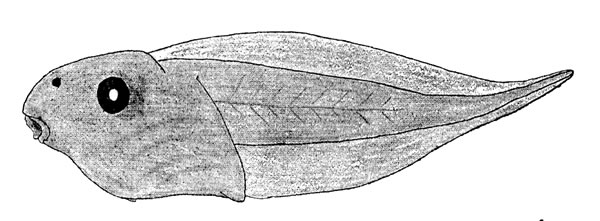
Description of tadpole (KU 60006): total length, 24.5 mm.; tail-length, 15.4 mm.; body broader than deep; head moderately flattened; snout viewed from above blunt; nostrils close to snout and directed dorsally; eyes of moderate size and directed laterally; mouth directed anteroventrally; anus median; spiracle ventral, its opening just to left of midline slightly more than one-half distance from tip of snout to vent. Tail-fin slightly more than twice as deep as tail musculature, which curves upward posteriorly; tail-fin narrowly extending to tip of tail (Fig. 4). Color in life pale gray; in preservative white with scattered melanophores; tail-fin transparent.
Fig. 4. Tadpole of Phyllomedusa callidryas taylori (KU 60006) from Toocog, El Petén, Guatemala.
Upper lip having single row of papillae laterally, but none medially; lower lip having single row of papillae; no lateral indentation of lips; two or more rows of papillae at lateral corners of lips; tooth-rows 2/3; second upper tooth row as long as first, interrupted medially; inner lower tooth-row as long as upper rows, interrupted medially; second and third lower rows decreasingly shorter; upper beak moderate in size and having long lateral projections; lower beak moderate in size; both beaks finely serrate (Fig. 5).
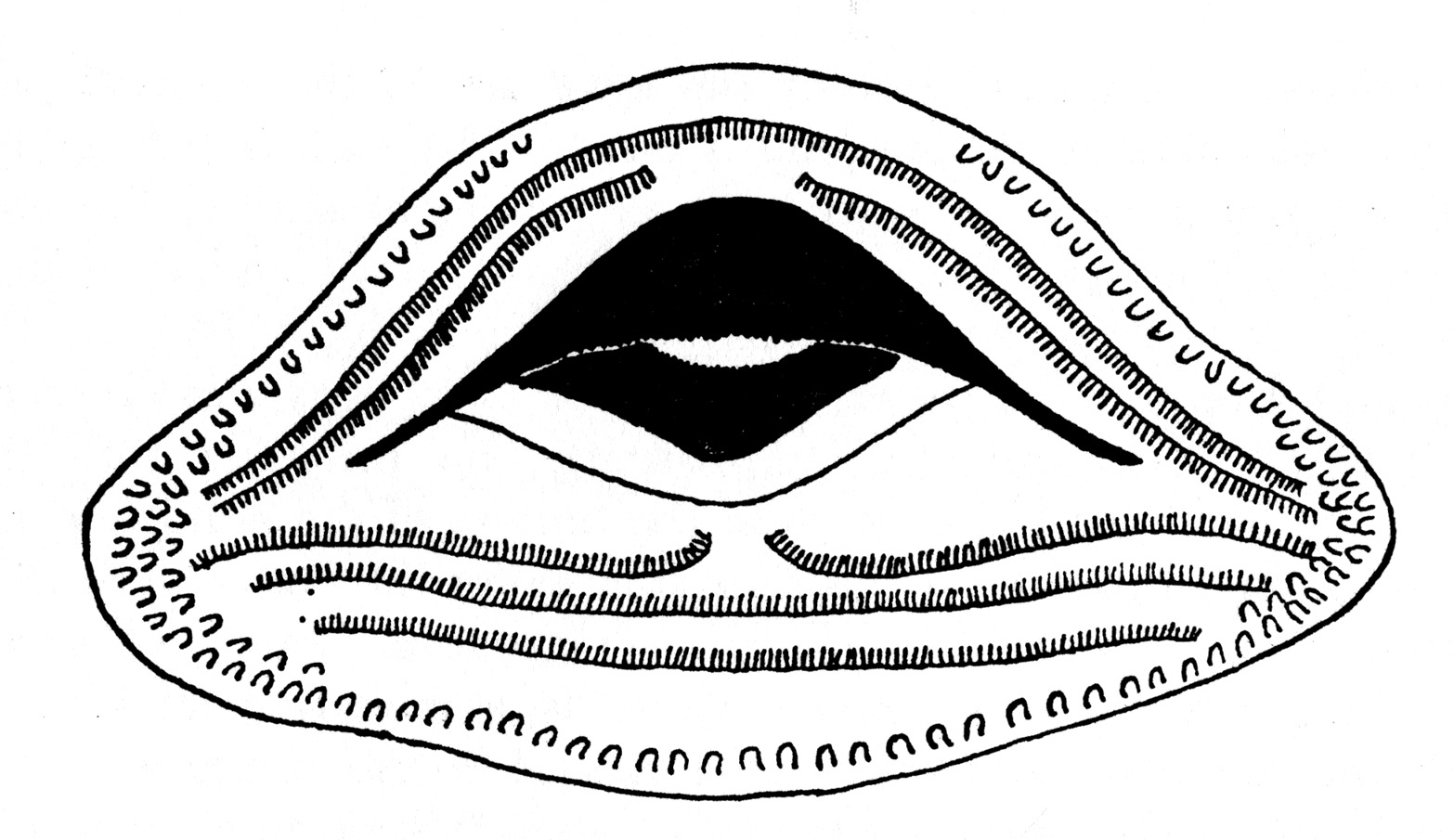
Fig. 5.
Mouthparts of larval
Phyllomedusa callidryas taylori
(KU 60006) from Toocog, El Petén, Guatemala.
Smilisca baudini (Duméril and Bibron)
Chinajá, 9; 20 km. NNW of Chinajá, 42; Río de la Pasión, 1; Río San Román, 5; Sayaxché; Toocog, 2.
Individuals of this species were found at night sitting on bushes and small trees in the forest in February and March and again in June and July. One was in the axil of a leaf of a Xanthosoma. In June and July males were heard nearly every night. The series of specimens from 20 kilometers north-northwest of Chinajá was taken from a breeding congregation in a shallow muddy pool in the forest. Tadpoles of this species were in small, often muddy pools in the forest. To my knowledge Smilisca baudini is the only hylid to breed in these pools at Chinajá, although perhaps Smilisca phaeota also utilizes them. The only other amphibian at Chinajá known to breed in the pools is Bufo valliceps valliceps. Although two specimens were on bushes at night at Toocog, Smilisca baudini was not present at the pond where five other species of hylids were breeding. Nevertheless, Smilisca baudini was calling from two ponds on the savannas near La Libertad. All of the specimens from southern El Petén have yellow or yellowish white flanks and ventrolateral surfaces.
Smilisca phaeota cyanosticta (Smith)
Chinajá, 4; 10 km. NNW of Chinajá, 1.
All specimens were found in February and March. Those from Chinajá were obtained from Xanthosoma and bromeliads; the individual from 10 kilometers north-northwest of Chinajá is an adult male that was calling from a puddle in a fallen tree on March 13. A juvenile having a snout-vent length of 34.7 mm. lacks the pale blue spots on the thighs; instead, the anterior and posterior surfaces of the thighs are bright red.
Hypopachus cuneus nigroreticulatus Taylor
Toocog, 1.
An adult male having a snout-vent length of 41.7 mm. was found at night on the forest floor at the edge of a temporary pond. In life the dorsum was dark brown with chocolate brown markings; the stripe on the side of the head was white; the middorsal stripe was pale orange; the belly was black and white, and the iris was a bronze color.
Characteristically this species inhabits savannas and open forest; thus, its occurrence in the rainforest at Toocog is surprising. This is the southernmost record for the species in El Petén; to the south in the highlands it is replaced by the smaller Hypopachus inguinalis, having rounded, instead of compressed, metatarsal tubercles.
Rana palmipes Spix
Chinajá, 11; 15 km. NW of Chinajá, 1; 20 km. NNW of Chinajá, 1.
With the exception of one recently metamorphosed juvenile having a snout-vent length of 30.7 mm. that was found on the forest floor by day on June 24, and one that was found beside a pool in a cave, all individuals were found at temporary woodland pools or along sluggish streams at night. The largest specimen is a female having a snout-vent length of 107 mm.
Rana pipiens Schreber
Chinajá, 1; 20 km. NNW of Chinajá, 1; Río San Román, 1; Toocog, 1.
All specimens were found near water at night. The largest individual is a female having a snout-vent length of 112.5 mm.
Crocodylus moreleti Duméril and Duméril
Chinajá, 1; Río San Román, 1.
One specimen was obtained from a quiet pool in the Río San Román at night; another was found in a small sluggish stream at Chinajá. Two large individuals were seen in tributaries to the Río San Román. On the savannas at Toocog two small individuals were obtained in the dry season, at which time the crocodiles apparently were migrating to water. The local name for this species is lagarto.
Chelydra rossignoni (Bocourt)
Chinajá, 1; 20 km. NNW of Chinajá, 1.
The paucity of specimens of Chelydra from Central America has resulted in rather inadequate diagnoses of various populations. The present specimens have carapace lengths of 250 and 238 mm. and plastral lengths of 185 and 176 mm. The length of carapace/bridge ratio is 6.0 and 6.1 per cent. Each individual has four barbels, the median pair of which are extremely long. In KU 55977 the lateral pair of barbels is forked at the base. The relative length of the plastral bridge in these specimens compares favorable with the ratio (.06-.08) given by Schmidt (1946:4) for five specimens from Honduras. Chelydra serpentina, which may occur sympatrically with C. rossignoni in some parts of Central America, has a narrower plastral bridge and only two barbels beneath the chin. Furthermore, C. rossignoni and C. osceola in Florida have long, flat tubercles on the dorsal and lateral surfaces of the neck, whereas C. serpentina has short, round tubercles.
The specimen from Chinajá was found in a small sluggish stream; the other individual was in a muddy pool in the forest. The local name is sambodanga.
Claudius angustatus Cope
20 km. NNW of Chinajá, 1.
One specimen was unearthed from the bank of a small muddy stream by a bulldozer. This individual represents the second record for the species in Guatemala; the first was provided by specimens, likewise found in muddy waters, at Tikal (Stuart, 1958:19). The local name is caiman.
Kinosternon acutum Gray
20 km. NNW of Chinajá, 4; 30 km. NNW of Chinajá, 2.
These turtles were found on the forest floor, in small sluggish streams, and in pools in the forest. One adult male had, in life, the top of the head yellow with black spots; the stripes on the head and neck were red. Specimens were obtained both in the dry and rainy seasons. The local name for both species of Kinosternon is pochitoque.
Kinosternon leucostomum Duméril and Bibron
Chinajá, 3; 15 km. NW of Chinajá, 1; 20 km. NNW of Chinajá, 2.
Individuals of this turtle were found on the forest floor and in small sluggish streams. In life most specimens had a tan or pale brown head with pinkish tan stripes on the head and neck. All individuals were obtained in February and March. No ecological differences between this species and K. acutum were evident.
Staurotypus triporcatus (Wiegmann)
Paso Subín, 1.
This species is represented in the collection by one complete shell found on the bank of the Río Subín. The carapace has a length of 292 mm. The local name is Guao. Natives stated that this turtle was not uncommon in clear rivers and lakes, a habitat suggested for the species by Stuart (1958:19).
Dermatemys mawi Gray
Chinajá, 1; Río San Román, 4.
The record from Chinajá is based on a carapace found in a chiclero camp, where the turtle evidently had been brought for food. The four specimens from the Río San Román were obtained from edges of deep pools in clear water. In adult males the top of the head was reddish orange in life. One of the specimens from the Río San Román currently is living in the Philadelphia Zoological Gardens. The local name for this turtle is tortuga blanca; it is sought for its meat.
Geoemyda areolata (Duméril and Bibron)
Chinajá, 2.
Two specimens were obtained from dense forest at Chinajá. The local name is mojina.
Pseudemys scripta ornata (Gray)
Paso Subín, 1.
One subadult was obtained from clear water in the Río Subín. The stripes on the head and neck were yellow; there was no red "ear" on the side of the head. The stripes on the forelimbs were orange, and the ocelli on the carapace were red. The local name is jicotea.
Coleonyx elegans elegans Gray
Toocog, 1.
One adult male having a snout-vent length of 89 mm. was found beneath a log in the forest. Locally this gecko is known as escorpión; the natives believe it to be deadly poisonous. The use of the name escorpión seems to be restricted to lizards thought to be venomous. Nearly everywhere in México and Central America some species of lizard carries this appellation. In El Petén I heard the name used only for Coleonyx elegans and Thecadactylus rapicaudus; in the lowlands of Guerrero, México, the name is applied to geckos of the genus Phyllodactylus. The venomous lizards of the genus Heloderma in the lowlands of western México are called escorpiónes. In the mountains of southern México various skinks of the genus Eumeces, as well as lizards of the genus Xenosaurus, carry the same appellation. Abronia in the mountains of México and Gerrhonontus throughout México and Central America likewise are called escorpiónes. Although many people in various parts of Middle America consider most lizards poisonous, there is a unanimity of opinion concerning the venomous qualities of the various kinds of escorpiónes. I know of only two other lizards in Middle America that are so uniformly regarded in native beliefs; these are Enyaliosaurus clarki in the Tepalcatepec Valley in Michoacán, called nopiche, and Phrynosoma asio in western México, called cameleón.
Sphaerodactylus lineolatus Lichtenstein
15 km. NW of Chinajá, 1; Toocog, 1.
These small geckos were much more abundant than the few specimens indicate. They frequently were seen on the trunks of corozo palms, where they quickly took refuge in crevices at the bases of the fronds. The specimen obtained at Toocog was under the bark of a standing dead tree. In life the ventral surface of the tail was orange. The individual from Chinajá was in the leaf litter on the ground at the base of a dead tree.
Thecadactylus rapicaudus (Houttuyn)
15 km. NW of Chinajá, 1; 20 km. NNW of Chinajá, 2.
Two specimens were found beneath the bark of standing dead trees; another was found in the crack in the trunk of a mahogany tree about 13 meters above the ground. In life the dorsum was yellowish tan with dark brown markings; the venter was yellowish tan with brown flecks, and the iris was olive-tan. The largest specimen is a male having a snout-vent length of 95 mm.; all specimens have regenerated tails. Individuals when caught twisted their bodies and attempted to bite; upon grabbing a finger they held on with great tenacity.
Anolis biporcatus (Wiegmann)
14 km. NNW of Chinajá, 1; 17 km. NNW of Chinajá, 1; 20 km. NNW of Chinajá, 3; 30 km. NNW of Chinajá, 1; Sayaxché, 1.
All specimens of this large anole were obtained from trees. Some individuals were found in the tops of trees immediately after they were felled. My limited observations on this anole suggest that it is an inhabitant of the upper levels of the forest. In life an adult male from 20 kilometers north-northwest of Chinajá was brilliant green above; the eyelids were bright yellow; the belly was white. The outer part of the dewlap was pale orange, and the median part was pinkish blue. A juvenile having a snout-vent length of 47 mm. and a tail length of 86 mm. was pale grayish green with pale gray flecks on the dorsum. The largest male has a snout-vent length of 98 mm. and a tail length of 217 mm.; the same measurements of the largest female are 89 and 213 mm. This species, together with all other anoles, is known locally as toloque.
Anolis capito Peters
Chinajá, 2; 14 km. NNW of Chinajá, 1; Río de la Pasión, 1.
All individuals were observed on trunks of trees between heights of three and ten meters above the ground. The largest male has a snout-vent length of 81 mm. and a tail length of 155 mm.; the same measurements of the largest female are 87 and 150 mm. The streaked brown dorsum, combined with the lizards' habit of pressing the body against the trunks of trees, make this anole especially difficult to see.
Anolis humilis uniformis Cope
Chinajá, 24; 15 km. NW of Chinajá, 22; 20 km. NNW of Chinajá, 6; Sayaxché, 1.
This small dull brown anole is a characteristic inhabitant of the forest floor, where the lizards move about in a series of quick, short hops and thus easily evade capture. Three individuals were found on small bushes, and four were on the bases of trees; otherwise, all were observed on the ground. Observations indicate that this species is active throughout the day, except during and immediately after heavy rains. The males have a deep red dewlap with a dark blue median spot.
Anolis lemurinus bourgeaei Bocourt
Chinajá, 11; 20 km. NNW of Chinajá, 4; 30 km. NNW of Chinajá, 2; Río de la Pasión, 1; Río San Román, 1; Sayaxché, 8; Toocog, 6.
This moderate-sized anole characteristically inhabits the low bushes and bases of trees in the forest. Individuals were most readily observed on the buttresses of some of the gigantic mahogany and ceiba trees. When approached the lizards usually ran around the tree or ducked to the other side of the buttress; if the observer moved closer, they jumped to the ground and ran off. None was observed to ascend large trees. Some individuals were observed foraging on the forest floor; these took shelter on the bases of trees. One individual was sleeping on a palm frond at night. The adult males have a uniformly orange-red dewlap.
Anolis limifrons rodriguezi Bocourt
15 km. NW of Chinajá, 2; 20 km. NNW of Chinajá, 1.
In dry forests and more open situations than occur at Chinajá this little anole is abundant, but in the wet forests of southern El Petén, only three specimens were found. Two were on palm fronds about two meters above the ground; the other was on a low bush. I suspect that ecologically this species overlaps A. humilis uniformis and A. lemurinus bourgeaei, but too few observations are recorded to justify a definite statement at this time.
Anolis sericeus sericeus Hallowell
Chinajá, 2; Sayaxché, 1; Toocog, 1.
This small anole is common and widespread in the Atlantic lowlands of southern México and northern Central America; usually it inhabits sub-humid regions. Consequently, its presence in the wet forests of southern El Petén was unexpected. The specimens from Chinajá were sleeping on low bushes at night, whereas the others were found on bushes by day.
Basiliscus vittatus Wiegmann
Chinajá, 6; Río de la Pasión, 1; Río San Román, 1; Sayaxché, 3; Toocog, 1.
Individuals of this abundant species were most frequently seen in dense bushes along the margins of rivers or small streams. None was observed far from water. These lizards, like the anoles, are known locally as toloque.
Corythophanes cristatus (Merrem)
Chinajá, 3; 20 km. NNW of Chinajá, 1.
Three individuals were found on tree trunks; the fourth was on a thick vine about one meter above the ground. The two largest males have snout-vent lengths of 121 and 115 mm. and tail lengths of 265 and 243 mm. The largest female (KU 59603), obtained on June 28, has a snout-vent length of 125 mm. and a tail length of 247 mm. This individual contained eight ova varying in greatest diameter from 10.6 to 12.2 (average 11.1) mm. Also present are numerous ovarian eggs having diameters up to about 3.5 mm.
One of the large males displayed a defensive behavior prior to capture. When first observed the lizard was clinging to a tree trunk about one and one-half meters above the ground. When I approached, the lizard turned its flanks towards me; then it flattened the body laterally, extended the dewlap, opened its mouth, and made short rushing motions. When touched it bit viciously. On the ground these lizards have a rather awkward bipedal gait that is much slower than in Basiliscus vittatus.
In life an adult male (KU 55804) was reddish brown dorsally with dark chocolate brown markings; the venter was creamy white, and the iris was dark red. The natives call this lizard piende jente.
Iguana iguana rhinolopha Wiegmann
Río San Román, 2.
The iguana, as this lizard is called locally, seems to be uncommon in the forested areas of southern El Petén. Possibly this is due to the fact that the flesh of this lizard is relished as food by the natives. My two specimens were in large trees at the edge of the river.
Laemanctus deborrei Boulenger
Chinajá, 1; Toocog, 5.
On June 26 a female having a snout-vent length of 129 mm. and a tail length of 502 mm. was found on a bush in the forest. The lizard, when approached, faced the collector and opened its mouth. In life the dorsum was bright green; the lateral stripe was white, and the iris was yellowish brown. This specimen contained four ova having lengths of 13.4 to 14.2 (average 13.9) mm.
On June 30 at Toocog five white-shelled eggs were found in a rotting log. Measurements of the eggs are—length, 23.5 to 25.0 (average 24.2) mm.; width, 15.0 to 15.5 (average 15.4) mm. These eggs hatched on August 30. The five young had snout-vent lengths of 43 to 45 (average 44) mm., and tail lengths of 137 to 140 (average 138) mm. In life the hatchlings had a dull dark green dorsum, pale bright green venter and stripes on head, and reddish brown iris. In preservative the hatchlings are creamy tan above with five or six square dark brown blotches middorsally.
The natives consider this lizard to be one of the anoles; consequently, it is known as toloque.
Lepidophyma flavimaculatum flavimaculatum Duméril
Chinajá, 8; 15 km. NW of Chinajá, 2.
Individuals were found beneath logs on the forest floor or moving about in the litter on the forest floor. One was observed crawling across a trail during a heavy rain. In some adults the tan dorsal spots are large and distinct; in others the spots are small and indistinct. Two juveniles, apparently recent hatchlings, were found on June 28 and July 5. These specimens have snout-vent lengths of 29 mm. and tail lengths of 38 and 41 mm.
Eumeces schwartzei Fischer
Chinajá, 1.
One specimen (KU 59551) was found on the forest floor at midday; it is an adult female having a snout-vent length of 125 mm. and a tail length of 210 mm. This specimen is larger than those recorded by Taylor (1936:99) and extends the known range of the species south of Ramate, approximately 125 kilometers south-south-westward to Chinajá.
Eumeces sumichrasti (Cope)
20 km. NNW of Chinajá, 1.
One adult male having a snout-vent length of 82 mm. was found beneath a palm frond on the forest floor. In life the dorsum was dull brown; the chin was cream; the belly was yellow, and the underside of the tail was orange. A juvenile having a black body, yellow dorsal stripes, and a bright blue tail was observed on the forest floor.
Scincella cherriei cherriei (Cope)
Chinajá, 2; 30 km. NNW of Chinajá, 1; Toocog, 1.
All individuals of this lizard were found in the leaf litter on the forest floor; many escaped capture. In life the tail is dull bluish gray. The number of dorsal scales varies from 59 to 61 (average 60); thus, these specimens fall within the range of variation of S. cherriei cherriei, and thereby differ from S. cherriei stuarti to the west and S. cherriei ixbaac to the north.
Ameiva festiva edwardsi Bocourt
Chinajá, 16; 15 km. NW of Chinajá, 10; Sayaché, 4; Toocog, 1.
This abundant terrestrial lizard, locally called lagartijo, is found throughout the forest. A juvenile obtained on March 14 at Sayaxché has a snout-vent length of 42 mm. and a prominent umbilical scar. Other juveniles were observed at Chinajá in February and March, thereby indicating that the young probably hatch in the early part of the year. Juveniles have bright blue tails.
Celestus rozellae Smith
20 km. NNW of Chinajá, 2.
Two specimens were obtained from trees by workmen in February. These lizards have snout-vent lengths of 70 and 83 mm. and tail lengths of 133 and 135 mm. There are 21 and 23 lamellae beneath the fourth toe; each has 31 longitudinal rows of scales around the body.
Boa constrictor imperator Daudin
15 km. NW of Chinajá, 1; 20 km. NNW of Chinajá, 2; Toocog, 1.
All specimens were found on the forest floor. One individual was found in combat with a large Drymarchon corais melanurus. Apparently, the Drymarchon was attempting to devour the Boa, which had a total length of 1683 mm. Locally this snake is called masacuata; it is one of the few snakes believed by the local inhabitants to be non-poisonous.
Clelia clelia clelia Daudin
15 km. NW of Chinajá, 1; 20 km. NNW of Chinajá, 1.
One specimen is represented only by the head; the snake was killed on the forest floor by workmen. Another individual was found in a pool of water at the base of a limestone outcropping in the forest; this specimen (KU 58167) is a female having a body length of 2220 mm. and a total length of 2634 mm. This snake contained 22 ova averaging 56 × 23 mm. Both specimens were uniform shiny black above and cream-color below. The local name is sumbadora.
Coniophanes bipunctatus bipunctatus (Günther)
Chinajá, 1.
This snake was found on the forest floor by day; it is a male having 130 ventrals, an incomplete tail; cream-colored belly, and a pair of large brown spots on each ventral scute.
Coniophanes fissidens fissidens (Günther)
Toocog, 1.
This male specimen was found beneath a rock in a sink hole. It has 122 ventrals and 77 caudals. A narrow temporal stripe extends along the upper edge of the anterior temporal and the lower edge of the upper secondary temporal. The belly is ashy white with a pair of small black spots on each ventral.
Coniophanes imperialis clavatus (Peters)
Chinajá, 3.
All specimens were found on the forest floor by day. These small snakes are capable of rapid movement and quickly disappear in the litter on the ground. Two individuals evaded capture. The belly is creamy white anteriorly and vermillion red posteriorly.
Dryadophis melanolomus laevis (Fischer)
Chinajá, 3.
These snakes, locally known as sumbadora, were found on the forest floor; two others were seen, but escaped. The variation in coloration has been a source of confusion in this species in northern Central America (see Stuart, 1941:86). All of the present specimens are males: KU 55709 has 178 ventrals, 121 caudals, and a total length of 914 mm.; the dorsum is olive-tan with six darker cross-bars on the neck; the belly is creamy white. KU 58160 has 188 ventrals, 123 caudals, and a total length of 1365 mm.; the dorsum is uniform olive-brown, except that some dorsal scales at midbody have black anterior borders like D. melanolomus melanolomus has in the Yucatán Peninsula; the venter is pale yellow. KU 58158 has 179 ventrals, 122 caudals, and a total length of 723 mm.; the dorsum is rich chocolate brown with eight dark cross-bars on the neck; the belly is bright orange.
Stuart (1941a:87) stated that in life two distinct color phases were observed in specimens collected by him in Alta Verapaz, Guatemala. One had an olive-brown dorsum and the other, a reddish orange dorsum. Stuart made no mention of variation in the color of the venter. Similar variation is known in D. melanolomus alternatus in Costa Rica, where some individuals have orange-red venters. This color phase has been recognized as a distinct species, Dryadophis sanguiventris, by Taylor (1954:722). Examination of 18 specimens from Costa Rica shows no differences in scutellation, nor geographic segregation of two populations. I am convinced that the red-bellied Dryadophis in Costa Rica, like those in Guatemala, represent a color phase of the subspecies inhabiting those areas and that Dryadophis sanguiventris Taylor is a synonym of Dryadophis melanolomus alternatus (Bocourt).
Drymarchon corais melanurus (Duméril, Bibron and Duméril)
15 km. NW of Chinajá, 1; Sayaxché, 1.
The specimen from Sayaxché was found at the edge of a clearing in the forest; that from 15 kilometers northwest of Chinajá was found on the forest floor coiled with a Boa constrictor imperator, which the Drymarchon apparently was trying to eat. The Drymarchon is a giant specimen having a total length of 2950 mm. (see Duellman, 1961:368). The Boa with which it was coiled has a total length of 1683 mm. I was attracted to the snakes by a loud thrashing noise. When I approached the writhing mass, the snakes separated, but I was able to see that the Drymarchon had its teeth firmly imbedded in the posterior part of the head of the Boa. From the Drymarchon I forced the regurgitation of a recently ingested Bothrops nummifer nummifer having a total length of 953 mm. These observations show that the snake-eating capabilities of Drymarchon can hardly be over-estimated.
In both Drymarchon the anterior one-half of the body is olive-tan, which changes to bluish black posteriorly. The local name is sumbadora.
Drymobius margaritiferus margaritiferus (Schlegel)
Chinajá, 3; Sayaxché, 1.
All individuals were obtained in clearings in the forest by day in the rainy season. Two individuals each contained a Similisca baudini and another contained a Bufo valliceps valliceps. Locally this snake is known by the appropriate name of ranera.
Imantodes cenchoa leucomelas Cope
Chinajá, 4.
With the exception of one that was found dead in camp, all individuals were taken from low vegetation by day. The dorsum is creamy tan with 28 to 35 (average 32) chocolate brown blotches, and the venter is ashy white with small brown flecks. Three males have 238 to 248 (average 244) ventrals and 148 to 154 (average 151) caudals; one female has 239 ventrals and 142 caudals. The largest specimen, a male, has a body length of 660 mm. and a total length of 943 mm.
Lampropeltis doliata polyzona Cope
Chinajá, 1.
One female (KU 57156) having 230 ventrals and 54 caudals was found on the forest floor by day. This individual has a black snout with a white bar across the nasals and prefrontals, a white spot in the middle of the frontal, and a white band across the temporals and parietals that is bordered posteriorly by a black band. There are 28 white and 28 red rings on the body. The tips of the red scales are darkened. The black rings between the white and red rings are not so expanded as to interrupt the white rings dorsally as in L. doliata abnorma as identified by Stuart (1948:70). Locally this snake, like all red, black, and white or yellow banded snakes, is called coral or coralillo.
Leptodeira frenata malleisi Dunn and Stuart
Toocog, 1.
This specimen, a male having 173 ventrals and 69 caudals, was found beneath the bark on a log in the forest. In life the dorsum was pinkish tan with 36 chocolate brown blotches on the body; the venter was rosy pink.
Leptodeira septentrionalis polysticta Günther
Chinajá, 3; Toocog, 11.
If numbers of specimens are indicative of abundance, this is the most common snake in southern El Petén. All were found at night in the rainy season. At a pond in the forest at Toocog these snakes were observed on low vegetation, on the ground, and in the water. Evidently they congregate at breeding choruses of frogs. One Leptodeira contained a Smilisca baudini and another contained eggs of Phyllomedusa callidryas taylori. The natives call this snake nahuyaca.
Leptophis ahaetulla praestans (Cope)
13 km. NNW of Chinajá, 1; 20 km. NNW of Chinajá, 1.
Both specimens were obtained from trees when they were felled. One individual (KU 55716) has a body length of 1345 mm. and a total length of 2035 mm. In life the entire snake was uniform bright green; the eye was yellow. In preservative the dorsum is dark blue, and the venter is green.
Leptophis mexicanus mexicanus Duméril, Bibron and Duméril
Chinajá, 1; 15 km. NW of Chinajá, 1; Sayaxché, 4.
All specimens came from low trees in the forest. The largest specimen is a male having a body length of 724 mm. and a total length of 1236 mm. In life the middorsum was a golden tan; the top of the head was a vivid green. One individual had ingested a Smilisca baudini. The local name is bejuquillo.
Ninia sebae sebae (Duméril, Bibron and Duméril)
Toocog, 1.
This specimen, a male having 144 ventrals and 55 caudals, was found beneath bark on a log in the forest. There is a black band five scales in length on the nape followed posteriorly by a red band six scales in length and then by a complete black band one and one-half scales in length. The rest of the body is dull red with 16 incomplete black bands one to one and one-half scales in length on the anterior two-thirds of the body.
Oxybelis aeneus aeneus (Wagler)
Chinajá, 1; 20 km. NNW of Chinajá, 1.
One individual was found in a low tree; the other was in a bush. Both specimens are males; the largest has a body length of 754 mm. and a total length of 1286 mm. Bogert and Oliver (1945:388) distinguished O. aeneus aeneus in Central and South America from O. aeneus auratus in México in that the diameter of the eye is more than the length of the internasal, whereas in O. aeneus auratus the diameter of the eye is less than the length of the internasal. Stuart (1958:27) stated that on the basis of this character three specimens from Tikal in northeastern El Petén definitely were O. aeneus aeneus. Of the present specimens from southern El Petén, one has an internasal:eye ratio of 1.08; the other has a ratio of 0.87. A careful review of these snakes is needed to verify the validity of the characters used to separate the subspecies and to determine areas of intergradation. The local name for the vine-snake is bejuquillo.
Pliocercus euryzonus aequalis Salvin
Chinajá, 1; Río San Román, 1.
These specimens are tentatively referred to P. euryzonus. KU 57160 is a female having 130 ventrals, 87 caudals, and 23 black rings on the body; KU 58150 is a juvenile having 128 ventrals, 79 caudals, and 27 black rings on the body. In both specimens the tip of the snout is yellow; a broad yellow band on the parietals and temporals is bordered posteriorly by a black band on the nape. The black rings on the body are not bordered by yellow, but black rings on the tail have yellow borders ventrally. In the red interspaces between the black rings, black flecks and spots, especially posteriorly, tend to form secondary black rings (Fig. 6a). According to Stuart (1948:71), P. euryzonus aequalis has 25 to 27 black rings on the body, whereas P. elapoides salvini, which also occurs in El Petén, has 15 to 23 black rings.
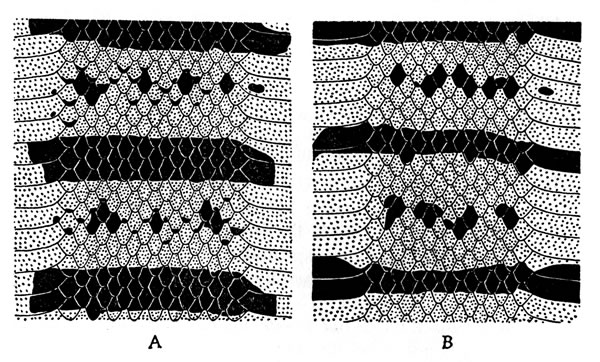
Fig. 6.
Dorsal color patterns of
Pliocercus euryzonus aequalis
(A) and
Micrurus affinis apiatus
(B).
The specimen from the Río San Román contained a partly digested Bolitoglossa moreleti mulleri. Locally Piocercus is called coral or coralillo.
Pseustes poecilonotus poecilonotus (Günther)
Chinajá, 3; 20 km. NNW of Chinajá, 1.
Two juveniles were on the forest floor; one juvenile and an adult were on low bushes. The juveniles have a tan dorsum with reddish brown blotches; the belly is gray, and the iris is cream-color above and brown below. The one adult is olive-brown above and creamy white below on the anterior three-fourths of the body; posteriorly it is black above and below. There are no paravertebral dark stripes nor pale spots on the dorsal scales.
Two specimens (one juvenile and the adult) when encountered compressed the anterior part of the body laterally and struck repeatedly. Locally the adults are called sumbadora.
Sibon dimidiata dimidiata (Günther)
20 km. NNW of Chinajá, 2.
Both snakes were obtained from trees when they were felled. In life the dorsum was pinkish orange with dark chocolate brown blotches narrowly edged with black.
Sibon nebulata nebulata (Linnaeus)
20 km. NW of Chinajá, 1.
This specimen, a male having a body length of 544 mm. and a tail length of 198 mm., was found in a felled tree. In life the belly was pink and black; the dorsal black blotches were narrowly outlined with pink.
Spilotes pullatus mexicanus (Laurenti)
Chinajá, 3; 20 km. NNW of Chinajá, 1; Sayaxché, 1.
This large snake, locally called mica, seems to be equally at home on the ground and in low trees and bushes. It is fast moving for a large snake; two individuals escaped capture. The natives said that this snake eats other snakes, but examination of stomachs revealed no supporting evidence.
Stenorrhina degenhardti (Berthold)
Chinajá, 1.
This specimen, a female having 158 ventrals, 37 caudals, and a total length of 489 mm., was found on the forest floor. On the olive-brown dorsum are 27 irregular, narrow, dark brown, transverse bands. The head is uniform olive-brown; the chin and labials are cream-color. The venter is cream-color with a row of brown spots forming a midventral stripe. A large spider was found in the stomach.
I have refrained from assigning a subspecific name to this snake. Cursory examination of specimens from throughout México and Central America reveals a bewildering array of variation in coloration that suggests that the subspecies mexicanus is not recognizable, or that two species occur sympatrically in parts of southern México and northern Central America.
Tretanorhinus nigroluteus lateralis Bocourt
Chinajá, 1.
A single male having 136 ventrals, 75 caudals, and a total length of 407 mm. was found by a stream in camp. The dorsum is pale grayish tan with 34 pairs of small chocolate brown spots, some of the anterior ones of which are connected across the back. A cream-colored lateral stripe is on the third and fourth dorsal scale-rows anteriorly and the second and third rows posteriorly. The lower dorsal scale rows are black. The venter is dark grayish brown with cream-colored flecks anteriorly and creamy gray posteriorly where the dark color is restricted to the midventral region and the lateral edges of ventrals and first dorsal scale-row.
Xenodon rabdocephalus mexicanus Smith
Chinajá, 1; 20 km. NNW of Chinajá, 1.
Both individuals were found on the forest floor. An adult male having a total length of 420 mm. has a cream-colored venter with brown flecks. A juvenile having a total length of 172 mm. has a creamy white belly with black crossbands.
At the suggestion of L. C. Stuart, I am following Schmidt (1941:501) in placing X. mexicanus as a subspecies of X. rabdocephalus.
Micrurus affinis apiatus (Jan)
20 km. NNW of Chinajá, 2; Sayaxché, 1.
All specimens were found beneath litter on the forest floor. All are males having 202 to 211 (average 205) ventrals, 53 to 56 (54.6) caudals, and 34 to 48 (41) primary black rings on the body. There are no yellow rings, and black spots in the red interspaces tend to form secondary black rings (Fig. 6b), the same as in Pliocercus euryzonus aequalis. The local name is coral or coralillo.
Bothrops atrox asper (Garman)
15 km. NW of Chinajá, 1; Sayaxché, 1.
Although we found only two specimens, natives and workmen at the camp at Chinajá stated that the barba amarilla, as this snake is known locally, had been abundant when the camp had been established less than two years before our visit.
Bothrops nasutus Bocourt
12 km. NW of Chinajá, 1.
This specimen, a male having a total length of 415 mm., was found on the forest floor. The dorsum is brown with dark brown blotches separated middorsally by a narrow orange-tan stripe extending from the nape to the base of the tail. The belly is grayish tan with white flecks on the lateral edges of the ventrals. The local name is nahuyaca.
Bothrops nummifer nummifer (Rüppell)
15 km. NW of Chinajá, 2; Sayaxché, 1.
Two individuals were found on the forest floor, and one adult, having a total length of 953 mm., was removed from the stomach of a large Drymarchon corais melanurus. There is considerable variation in color and pattern. A juvenile (KU 58104), having a total length of 332 mm., has a tan dorsum with 19 interconnected dark brown, diamond-shaped, middorsal blotches, the lateral extensions of which are black; the belly is a cream-color with brown squares. An adult female (KU 55706), having a total length of 779 mm., has a dorsal coloration like the preceding specimen, except that the lateral extensions of the dorsal blotches are brown; the belly is a uniform cream-color. A second adult female (KU 55707), having a total length of 953 mm., has a brown dorsum with 21 interconnected black, diamond-shaped, middorsal blotches, the lateral extensions of which are black; the belly is a cream-color with black squares.
The local name for this species is braza de piedra.
Bothrops schlegeli schlegeli (Berthold)
Paso Subín, 1.
This specimen was taken from the thatched roof of a house at the edge of the forest and contained the remains of a small mammal. The local name is nahuyaca.