TURTLES AND TORTOISES (order Chelonia)
Reading edition
Overview:
Large numbers of hatchling and adult turtles are sold or traded each year in the United States. Unfortunately, from the point of view of the turtles themselves, the majority of them are condemned to death by unintentional maltreatment and few manage to survive a year. The species most often abused is the red-eared slider, Chrysemys scripta elegans. Next most common are the map turtles, Graptemy, and third in abundance are the painted turtles, Chrysemys picta. All are water turtles and require much the same care in captivity. Since the red-eared slider is the most common of all, the general account that follows is based upon the slider group of turtles. This is the largest group of native turtles, including some 16 different kinds. All live in ponds and lakes, and may be given about the same care in captivity. Comparisons with other groups follow the general account, save the tortoises, or dry land turtles, which will be discussed in more detail after the aquatic turtle account.
Aquatic Species:
Description and diet: Water turtles, such as the red-eared slider, vary in color and usually have webbed feet for swimming. These turtles are generally carnivorous (meat eaters), and their primary diet consists of chopped raw beef, horsemeat, fish, worms, and also aquatic greens. Some water turtles will eat bits of green leafy vegetables, such as fresh greens, lettuce, endive, and spinach. All turtles are different, however, and a variety of foods should be offered to determine their likes and dislikes. Food supplements should also be used. Some of these are: cod liver oil, liquid multiple vitamins, and powdered calcium or bone meal. These may be added directly to their food.
Box, wood, and Muhlenberg’s turtles or other semi-aquatic species do well in captivity 14 when a basin of shallow water is provided for soaking. Diamondbacks need brackish or slightly salty water. These also generally eat vegetable matter as well as meat.
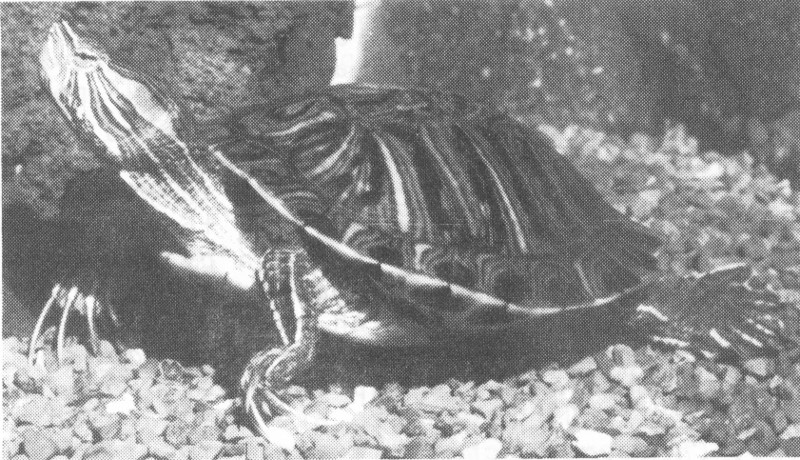
Red-Eared Slider Pseudemys scripta elegans
All weather care: As these turtles are generally kept indoors, an aquarium is the best means of maintaining them. Temperatures may be controlled by the use of a heater, thermostat, and thermometer. The best temperature will range between 72 to 85° F. A filter and pump may be used to keep the water clean. It is advisable to feed the turtles in a separate container, as foods foul the water quickly.
The aquarium and accessories should be kept clean and scrubbed periodically. Water turtles may be kept out of water for some time, if necessary, with no ill effects. However, they cannot eat out of the water. These turtles must also have sunlight in order to grow and maintain a hard shell and sound bones. They should be allowed to sun at least twice a week ... always with a shade of some type over a portion of the container, so they will not become over-heated.
The aquarium itself should be arranged so that the turtles can leave the water at will 15 and dry themselves periodically. A cluster of smooth, flat rocks in the middle, or at one end of the aquarium will permit them to do so.
Dry Land Species:
Description and diet: Tortoise is the term generally used in referring to dry land turtles. They seldom swim or enter the water. Carapace and plastron (upper and lower shell) range from light tan to dark brown in color; The skin is rough appearing and the legs are scaled and elephant-like, with no webbing of the feet. Food consists of vegetables, fruits, grass cuttings, dandelions, petals from various garden flowers, bits of raw meat that is finely chopped, and canned dog food. Foods such as carrots, string beans, and corn are valuable in the diet, and should be ground or scraped. Many of the tortoises are fond of earthworms, so these should also be offered. Food supplements, such as cod liver oil, liquid multiple vitamins, powdered calcium, and bone meal, should also be added to foods periodically. Box, wood, and Muhlenberg’s turtles (as well as other semi-aquatic species) will do well in captivity if a shallow water dish is provided. These species will generally eat meat as well as vegetable matter.
Cold weather care: In the fall, around late October or early November, your tortoise will want to hibernate. It will probably dig its own burrow out of doors, given it is in the correct environment. If the conditions outside are not proper for your tortoise to burrow, he may be placed in a box in a cool, dry area where a constant temperature can be maintained, such as a garage. Cover him with a layer or two of old, shredded newspapers. He is now ready to be “stored” for the winter. If your tortoise is to spend the winter in the house, be sure to keep food and water available. House temperatures do not permit a tortoise to hibernate properly, and starvation is possible if he is not allowed to eat when he stirs about during the winter.
16
Hot weather care: Hibernation ends some time in spring, usually in March. The tortoise may be a little sluggish at first, but as the weather becomes warmer, interest and appetite improve. Water, food, and shelter from the sun must always be available, and a night shelter is advised.
Illness and treatments: Most turtle owners are familiar with the basic care requirements of their pets; however, there are a few common ailments that may require prompt treatment. The simple remedies here have been found to be successful in many cases.
Respiratory ailments: Turtles and tortoises are usually susceptible to colds and pneumonia. Bubbling of the nose and mouth and “gasping” are symptoms of this. Isolation from the other turtles in a heated box or aquarium is mandatory. A heat lamp may be used several times a day—but always with a shaded corner into which the turtle can crawl when he gets too hot. Cold-remedy salves can also be rubbed on the turtle’s nose to help relieve congestion. The turtle should be kept warm and isolated until all traces of his cold have disappeared. (Injection of an anti-biotic serum into the leg or forelimb, once a day, is sometimes successful, as well as anti-biotic pills given orally; but consult a veterinarian or Society member before attempting this as some drugs are dangerous for turtles.) If caught in its early stages pneumonia can be overcome. The turtle in question should be isolated and kept warm, and the following medicine should be administered with an eye dropper: Dissolve together
½ ounce of water 1 tablet Chlortetracycline 4-5 drops liquid vitamins
Administer daily for two days and then skip a day. Repeat. This formula has proven itself quite effective after 5 or 6 days.
17
Cracked shell: Immediately place injured turtle in a clean, paper towel-lined box, and bring indoors so that ants and flies will not torment him. If shell is bleeding, gently wash it with a mild solution of boric acid and pat dry. This may have to be done several times before bleeding stops. Put his box in a warm, quiet spot in the house, and leave him completely alone except for offering a shallow bowl of drinking water from time to time. If he survives the first 24 hours, he will probably pull through. (The lungs are under the carapace, and if the broken shell has penetrated the lung area, there is practically nothing that can be done for the turtle.) If the wound is bad or jagged, it may be filled with Canadian Balsam—after bleeding has stopped and then securely tape with electrician’s tape. The tape may be left on for several months if necessary, but it should be checked every six weeks or so, to make sure infection has not set in. Once the turtle has started eating and resumed his normal routine, he is probably well on the road to recovery.
Soft shell, and swollen eyes: This is almost always due to an improper diet and lack of direct sunlight. Add vitamins and ground bone meal to the food; offer raw, lean chopped meat; and see that the turtle is placed in direct sunlight for several hours each day. (When turtles are placed in direct sun, they must have a shaded area into which they can retreat when the temperature goes too high.) Swollen eyes may also be bathed in a dilute solution of boric acid to alleviate swelling and puffiness.
Fungus: This appears as white spots, lumps, or flakes on the skin or shell. Addition of plain table salt to the aquarium water will often cure the condition. Fungus on the shell may be helped by painting the area with 5% iodine or 2% gentian violet solution. Always keep the turtle out of the water for a period of 2 to 4 hours after applying either 18 iodine or gentian violet, so as not to wash the medication from the shell or skin. If the fungus continues after several treatments, allow a week or so before experimenting with another medication, as many times the combination of medications can be detrimental to the turtle.
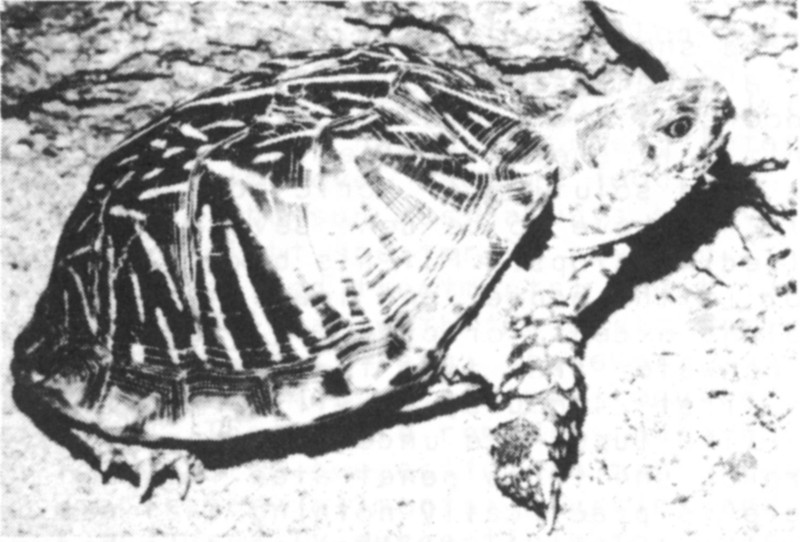
Ornate Box turtle Terrapene o. ornata
Parasites: Parasites may be suspected if the turtle suffers a great loss of weight or a loss of appetite without apparent cause, or if he has a ravenous appetite. Parasites may be evident in the stools, but are not always readily seen. If suspected, have a veterinarian diagnose and treat this condition. In addition, shots of vitamins can be administered periodically for maintaining good health. If, however, the turtle is on the proper diet, shots such as these may not be needed.
Conclusion:
Many different kinds of turtles make satisfactory additions for your collection. Actually, every one of our native turtles, at least when small in size, can be acceptable. Larger examples of some species, 19 however, are sometimes unpleasant and even positively dangerous as members of your collection. Below is a list of those turtles that should be avoided by the amateur herpetologist:
Adults: Common Snapping Turtles Alligator Snapping Turtle[1] Soft-shelled Turtles Very Large Sliders Musk Turtles Mud Turtles
The larger species, or large adults of some species, tend to become aggressive and dangerous as they grow older, and many times a finger is mistaken for a morsel of food. Avoid the aforementioned turtles if your interest in these hard-shelled friends is new.
These are some turtles, of course, that can be handled without fear of biting or scratching. Any of the smaller species of sliders can make acceptable additions to your collection. Below is a list of those turtles that are, and may be handled and studied by the amateur:
Young: Common Snapping Turtle Soft-shelled Turtles Sliders Musk Turtles Mud Turtles Diamond Back Terrapin
Although young turtles make safe additions to your collection, land turtles of all kinds are best, seldom if ever bite, feed readily, and survive a long time in captivity. They include: Eastern, Florida, Three-toed, and Ornate Box Turtles, and the Red-Foot Tortoise. None of these are commonly available from commercial dealers, however.
D.J.C.
20