Reverend T.P. Wilson (continued 6)
Reading edition
The humbled man tried to conceal his tears with his one uninjured hand, and said at last, “I think I can bear it now; let her come in.”
On her brother’s invitation Julia entered. The eyes of the two met,—the eyes of the oppressor and the oppressed; but how changed in position now! The once down-trodden wife now radiant with health and beauty, a beauty heightened by its passing cloud of tender sadness. The once overbearing, heartless husband now a stranded wreck. How haggard he looked! and how those hollow sunken eyes swam with a tearful look that craved a pity which they seemed at the same time to despair of! And could she give that pity? Had he not forsaken her and her children, and left them to grinding poverty? Had he not raised his hand against her and cruelly smitten her? Had he not laughed her to scorn? Had he not used her as a mere plaything, and then flung her aside, as the child does the toy which it has covered for a time with its caresses? He had done all this, and more; and now she was there before him, but out of his clutches, and able, without fear of harm to herself, to charge him with his past neglect and cruelty. Yes; the outraged wife could have done this, but the woman’s heart that throbbed in her bosom forbade it. She was the loving woman still, though the fountain of her love had been sealed for a time. Stealing gently up to his chair, lest any sudden movement should agitate him too much, and yet quivering all the while in every limb from suppressed excitement, she bowed herself over him, and gathered his head softly to her bosom, whispering, “Poor, dear Orlando, you are glad, are you not, to see me?” Then, as the huge rapid drops of the thunder-cloud, which has hung overhead for a time in the midst of oppressive stillness, patter at first on the leaves one by one, and then break into a sweeping deluge, so did a storm of weeping pour from the eyes and heart of that crushed and spirit-broken sinner. Hardly daring to place a hand with its pressure of answering love on the neck which that same hand had not long since disfigured with bruises and blood, he yet ventured at last to draw his wife closer to him, whispering, “It is too much.” Sweetly soothing him, Julia helped him to dry his tears, and then sat down by his side, taking the hand of his uninjured arm in her own.
No one spoke again for a while. At last Mr Vivian roused himself to an effort, and, disengaging his hand, looked his wife steadily and sorrowfully in the face. “Tell me, Julia,” he said, “tell me the truth,—tell me, can you really and from your heart forgive me?—nay, do not speak till you have heard me out,”—for she was about to give an eager reply. “Consider well. You know what I have been to you,—the brute, the tyrant, the traitor. Can you, then, in view of all the past, forgive me from your heart?”
“I can, I do, dear Orlando, from my very heart,” she cried; “and surely I too have much to be forgiven.”
“Not by me,” he said earnestly. “And now,” he added, “as you have assured me of your forgiveness, and as my days in this world can be but few,—nay, I know it, I know it,—I have two dying requests to make of you, and only two. Will you grant me them?”
“Oh yes, yes, dear husband, if they are in my power.”
“They are perfectly within your power. The first is, that you would try and pay back part of my deep debt of gratitude to your noblest of brothers, who is standing there—to Amos Huntingdon, whom I dare not call brother; and I will tell you how the payment is to be made—not in gold or silver, for he would not take such payment, but in giving yourself up to the service of that Saviour whom he has truly and courageously followed. That, I know, would be the only payment he would care to accept, and that will rejoice his heart. Will you promise?”
“Oh, that I will!” she exclaimed, clasping her hands passionately together. “I have misunderstood, I have thwarted dear Amos shamefully, but now I can truly say, ‘His people shall be my people, and his God my God.’”
“Thank you for that. My second request concerns our children. Promise me that you will not take them from under your brother’s eye, and that you will strive to bring them up as he would have you; then I shall know that they will be spared such misery as this, that they will not need to be reminded, by way of warning, of the disgraceful example of their unworthy and guilty father.”
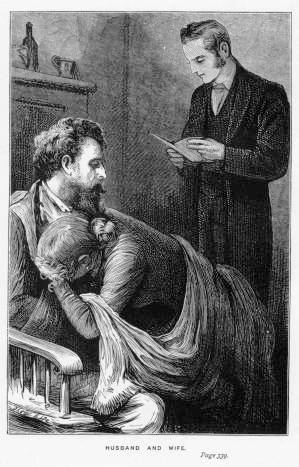
“I promise, I promise!” cried the weeping wife, burying her face in her husband’s bosom. When she raised her eyes to his again there was a sweet smile on her features as she said, “Dearest Orlando, all may yet be well, even should you be taken from us.”
“For you, yes; for me, I cannot say,” was his reply.
“Oh yes,” she cried earnestly; “I am sure that dear Amos has put before you the way to the better land, open to us all through our loving Saviour; and I prayed last night—oh, so earnestly—that you might find that way.”
“Thank you for that,” he said mournfully; “it may be so; at any rate I have got thus far—I shall not cease to cry, so long as I have breath, ‘God be merciful to me a sinner.’” And these were the last words on the poor penitent’s lips.
For three days after this interview he lingered in much pain, but without a murmur. Whenever Mr Harris or Amos read the Word of God and prayed he was deeply attentive, but made no remark. Julia was constantly with him, and poured out her rekindled love in a thousand little tender services. At last the end came: there was neither joy nor peace, but there was not despair,—just one little ray of hope lighted the dark valley.
When the unostentatious funeral was over, Amos and his sister returned home cast down yet hopeful and trustful. That evening a subdued but happy little group gathered in Miss Huntingdon’s private sitting-room, consisting of Amos, Julia, Walter, and their aunt. When Amos had answered many questions concerning the last days of his brother-in-law, Walter turned to his aunt and said, “Now, dear auntie, you have some examples of moral courage ready for us I am sure.—Amos, you are to be a good boy, and not to turn your back upon the teacher, as I see you are inclined to do. I know why; but it does not matter. Julia and I want doing good to, if you don’t; so let us all attend.”
“Yes,” said Miss Huntingdon, “I know what you mean, and so of course does your brother; he does not wish to listen to his own praises, but he must not refuse to listen to the praises of others, even though their conduct may more or less resemble his own. I have some noble examples of moral courage to bring before you, for I have been thinking much on the matter since Amos and Julia left us. My heroes and heroines—for I have some of each sex—will now consist of those who have braved death from disease or pestilence in the path of duty. And first of all, I must go back to our old example of moral heroism—I mean, to one who has already furnished us with a lesson—John Howard. That remarkable man was not satisfied with visiting the prisons, and bringing about reforms in them for the benefit and comfort of the poor prisoners. He wished to alleviate the sufferings of his fellow-creatures to a still greater extent; so he formed the plan of visiting the hospitals and lazarettos set apart for contagious diseases in various countries. Amongst other places he went to Smyrna and Constantinople when these cities were suffering from the plague. From Smyrna he sailed in a vessel with a foul bill of health to Venice, where he became an inmate of a lazaretto. Here he was placed in a dirty room full of vermin, without table, chair, or bed. He employed a person to wash the room, but it was still dirty and offensive. Suffering here with headache and slow fever, he was removed to a lazaretto near the town, and had two rooms assigned him, both in as dirty a state as that he had left. His active mind devised a plan for making these rooms more comfortable for the next occupant, and though opposed by the indolence and prejudices of the people about him, he contrived secretly to procure a quarter of a bushel of lime and a brush, and, by rising very early, and bribing his attendant to help him, contrived to have the place completely purified. Now his object in thus exposing himself to infection and disease was not that he might gratify some crotchet, or get a name with the world, but that from personal experience of the unutterable miseries of such places as these lazarettos were, he might be better able to suggest the needful improvements and remedies. This he had set before himself as his work; to this he believed that duty called him; and that was enough for him. Suffering, sickness, death, they were as nothing to him when weighed in the balance against high and holy duty.”
“A noble hero indeed, dear auntie,” cried Walter; “and now for another of the same sort.”
“Well, my dear boy, my second example embraces many excellent men, all devoted to the same self-denying and self-sacrificing work,—I am now alluding to the Moravian missionaries. These truly heroic men, not counting their lives dear, left home and friends, not to visit sunny lands, where the charms of the scenery might in a measure make up for the toils and privations they had to undergo, nor to find among Arctic frosts and snows at any rate pure and refreshing breezes, though many of them did go forth into these inclement regions to carry the gospel of peace with them, and in so doing to endure the most terrible hardships. But the Moravians I am now speaking of are those who volunteered to enter the pest-houses and infected places from which they could never come forth again. Here they lived, and here they died, giving up every earthly comfort and attraction that they might set gospel truth before those whose infected and repulsive bodies made them objects of terror and avoidance to all but those self-renouncing followers of their Saviour. Here, indeed, moral courage has reached its height.”
“How wonderful!” said Julia thoughtfully, and with a sigh; “I could never have done it.”
“No,” said Miss Huntingdon; “nor does God commonly require such service from us. And yet, dear Julia, ladies as tenderly brought up as yourself have gone forth cheerfully to little short of certain death from pestilential airs, and have neither shrunk nor murmured when the call came. And this brings me to my last example of what I may call sublime moral courage or heroism. It is taken from the records of the Church Missionary Society. When first that society’s noble work began, its agents went forth to settle among the poor negroes of Western Africa in the neighbourhood of Sierra Leone. But the fever that hovered on the coast was enough to terrify any one who loved his life more than Christ. In the first twenty years of that mission no fewer than fifty-three male and female missionaries died at their posts. In the year 1823, out of five who went out four died within six months, yet two years afterwards six presented themselves for that mission; and, indeed, since the formation of that mission there have never been men wanting—true heroes of the Lord Jesus Christ—who have willingly offered themselves for the blessed but deadly service. The women were as devoted as the men. A bright young couple, the Reverend Henry Palmer and his wife, landed at Sierra Leone on March 21, 1823. In the beginning of May, not two full months afterwards, the husband was dead; in June, just one month later, the wife was dead also. Yet neither spoke in their dying moments one word of regret, but gloried in the work and in the sacrifice they had been called to make. Another female missionary to the same parts, a widow, said: ‘I have now lived one year in Africa, eight months of which I have been a widow; but I cannot resolve to leave Africa.’ Another, whose course was finished in twenty-two short days, said to her husband on her death-bed: ‘Never once think that I repent of coming here with you.’ Her only fear seemed to be lest her death should discourage others, or damp her husband’s zeal.—I have now finished my examples. I am sure, dear children, that they are to the point; I mean, that they are examples of the sublimest moral courage—that courage which leads godly men and women not to shrink from duty though disease and death lie before them or hover over their path.”
“Thank you, dearest auntie,” said Walter; “you have indeed brought some glorious examples before us, and they just fit in with the conduct of our own dear hero here, who seems to wish us to forget that there ever was such a person as Amos Huntingdon, but he certainly won’t succeed.”
Chapter Twenty.
Further Progress.
How greatly did Amos rejoice that now one portion of the great purpose to which he had devoted himself had been so thoroughly accomplished; his dear sister had been restored to her earthly home, and the death of her unhappy husband had taken away all fear of her being withdrawn from it again. And, better still, she, the poor wayward and wandering sheep, who till late did not love the fold nor the Good Shepherd’s voice, had been sought and found by him, and brought back from the wilderness with rejoicings. The heart of the good brother overflowed with gratitude and praise for this, for it was more than he had yet dared to hope. But there could be no doubt about it. The eyes of his sister had been opened to see how entirely she had hitherto been living to self, while her husband’s dying words had led her to see her duty to her children, and to mourn over her ingratitude to Amos.
There was one little circumstance which specially touched that brother’s heart. On the Sunday after her return from her parting visit to her husband, Julia appeared at church in deep mourning, her children wearing the same; and at dinner she had put on a neat widow’s cap. Amos had rather expected that she would have treated her married life as a thing so entirely to be forgotten—a thing of misery and shame, a thing of the past to be henceforth to her and others as though it had never been, except so far as her children were concerned—that she would have continued to dress herself and her little ones as usual, so as not by any outward sign to remind those around her that she had suffered any loss, or recall their thoughts to the man who had brought nothing but degradation to herself and disgrace to her family. He was therefore deeply thankful to see that she had taken a different course; for it told of a subdued and chastened spirit, and of a willingness to bear patiently and meekly the burden which her own fault, in a measure at least, had laid upon her. Mr Huntingdon also appreciated her conduct in this matter, and, pressing her fondly to him as she was retiring to rest, kissed her tenderly, and whispered in her ear, as he looked lovingly into her tearful eyes, “Dear child, this is as it should be; you are right, I am sure, in adopting this dress; it would have been unworthy of you and unbecoming not to have done so.” Old Harry, however, was not quite of the same mind; but he would not wound any of the members of the family upstairs by giving expression to his feelings on the subject. But in the kitchen he spoke out his sentiments without any reserve. “Put herself and the children in mourning for such a scoundrel as him! Why, if it had been me, I’d have clothed myself and them in scarlet and gold, just to show how glad I was to be shut of such a scamp for good and all. But perhaps I’m wrong; they tell me the poor man repented at the last. Well, a good thing for him if he did, for I’m sure he’d a precious lot to repent of.”
And now Amos bent his mind and energies towards the accomplishment of that part of his life’s great purpose which lay yet nearer, if possible, to his heart than even his sister’s restoration to her father’s house and affection. His mother was still a stranger to her home;—how should he bring her back? He felt that he must deal in the matter with a gentle and cautious hand. His aunt and the old butler were the only members of the household who as yet knew of his desire and intention. Mr Huntingdon had come to acquiesce in his wife’s absence as a sad necessity, and it did not now occur to him to connect his daughter’s return with the possibility of its being directly or indirectly a link in the recovery of the mother from her mental disorder. Walter also never put the two things together. Indeed, the state of his mother was so distressing a subject, that he had come to act upon the conviction that the less he thought about it the better.
But what could Amos do? Turning matters over in his mind, it became an established purpose with him to bring about his mother’s perfect restoration to sanity without letting his father have any suspicion of what he was attempting. With all his love for that father, he could not help having a strong conviction that, were he to consult him in the matter, the attempt at restoration would probably prove a failure. Either Mr Huntingdon would take things into his own hands, and, acting with characteristic impetuosity and bluffness, would most likely hinder where he meant to help forward, or else he would fail perhaps to understand and appreciate his son’s views and methods of proceeding, and would prevent a successful issue by his impatience or interference. So Amos resolved that he would take the responsibility and mode of action on himself. Should he fail, his father would not have to suffer the pain of disappointment from that failure; should he succeed, he would have the happiness of bringing about a loving meeting again between those parents so dear to him, which would be to his father all the more delightful from its taking him by surprise. Secrecy, then, was an essential. No one must betray his purpose to his father. Therefore, when the family had all settled down peacefully, with the young widow sweetly and lovingly filling her place as a daughter and mother, Amos, one evening in the early part of the summer which followed his brother-in-law’s death, betook himself to the butler’s pantry.
“Harry,” he said, having seated himself on the closed lid of the plate chest, “I want just a word with you on a subject of great importance.”
“As many words as you like, my dear young master,” said the old man; “it’s always a privilege whenever I gets a visit from you, or dear Miss Julia as was, bless her. What a pity she ever changed Miss into Mrs; but perhaps some good man ’ll get her to change it into a better Mrs some day, and wipe the taste of that horrid cruel man’s name out of all our mouths.”
“I don’t know, Harry; things are better as they are at present. My dear sister’s trial has been blessed to her, I can see; she is being brought out by it decidedly on to the Lord’s side.”
“You’re right, Master Amos, you’re right; and I’m nothing but a stupid stumbling old donkey.—Now, please, sir, what’s this here important subject you wants to talk to me about?”
“Just this, Harry. You know that I want to get back my dear mother again among us, and I believe it can be done; but it will want a deal of wisdom and what people call ‘tact’ to bring it about. Now, I’m not going to speak to my father on the subject, because I think his feelings would so stir and excite him if I did, he would be so eager and anxious—it’s part of his nature, you know, and he cannot help it—that he might spoil all.”
“Just so, Master Amos; he’d just be going slap-bang about it, I daresay, and he’d drive the poor lady clean out of as many of her seven senses as she’d got still left, poor thing.”
“Something of that kind,” said Amos, smiling. “Well, you see, Harry, if I am to undertake the matter I must do it my own way; and it will require a great deal of care, and not a word must come out about it.”
“Ah, I see, Master Amos,” said the old man, “you want me to be ‘mum.’ Now, you look here, sir—try now if you can get a word out of me.” So saying, Harry closed his lips tight together, stuck his hands in his trousers’ pockets, and walked about the pantry with his head in the air.
“I am quite satisfied,” said Amos, laughing.
“You may well be so, Master Amos,” said the other. “Me speak about such a thing to them maids in the kitchen, or the coachman, or stable-boy, or any one else in the universal world! Let the whole on ’em put together try it on, that’s all.”
“Thank you, Harry,” said Amos; “no one as yet knows about it but my aunt and yourself. But I shall have to take my brother and sister into my confidence, as I shall want their help in carrying out my plan.”
“All right, sir, all right; and, if any one mentions the poor lady before me, you may depend upon it I shall look like a deaf and dumb statty cut out of stone.”
Amos then sought his aunt, and, having given her briefly his own views, asked his brother and sister to join him in Miss Huntingdon’s room. He unfolded to them his purpose, and then proceeded as follows: “What I propose to do is this: I want to spare our dear father all pain and trouble in the matter, and, if I am permitted to carry out my plan with success, to give him a gentle and happy surprise at the end. But I must have the help of my dear brother and sister. The place where our dear mother now lives in retirement is a few miles inland from the sea-coast. At the sea-side nearest to her residence I intend taking a house for a time. When I have secured this, I shall invite you, dear Julia and Walter, to be my guests there for a season. I shall easily, I have no doubt, persuade my father to spare you, on the ground that the little change to the sea-air will do us all good, which will be perfectly true, and that this short holiday has been a pet scheme of my own, which will be equally true. My father will be much occupied about electioneering business the next two or three months, and as this will take him a good deal from home, he will not miss us so much as he might otherwise have done; and Aunt Kate, who knows of my plans and approves of them, will kindly spare us for a while, and will look after the children, who will follow us in a few days, and may be of use in carrying out my object.”
“Capital,” said Walter; “but you will want a mint of money to do all this.”
“Never mind that,” replied his brother; “I have considered it all, and you may safely leave the ways and means to me.”
“And I am sure, dear Amos,” said his sister, “we shall be only too thankful to be helpful in any way in bringing back our dear mother amongst us.”
In about three weeks’ time from this conversation, during which Amos had been making his arrangements, he told his father of his sea-side scheme, and received his hearty approval. “It is very good of you, my dear boy,” he said, “to provide such a nice change for your sister and Walter. Perhaps your aunt and I may run over and see you, if this election business will allow me any spare time.”
Mr Huntingdon was well aware that the sea-side retreat which Amos had selected was near the place where his poor wife was in her retirement, but this was not at all displeasing to him; for though he had never himself mentioned that place of retirement by name to any of his family except his sister, he thought it not improbable that his children would have become by this time acquainted with it, and the thought that they might go over and see their afflicted mother once or more was a comfort to him. Not that he entertained any real hope of his wife’s return to such a state of mind as would allow of her coming home again. No such prospect had yet been held out to him, and, indeed, while his daughter was still shut out from his house, he had felt that, had there been sufficient improvement in his wife’s state to admit of her return, the continued absence of her daughter, and the very mention of that daughter’s name being forbidden in the family, would have been likely to throw her mind off its balance again. So he had learned to acquiesce in her permanent absence as a thing inevitable, and to drown, as far as possible, all thoughts about that absence in a multiplicity of business. But now that Amos and his brother and sister were going to spend some time in their poor mother’s neighbourhood, there arose in Mr Huntingdon’s mind a sort of vague idea that perhaps good to her might come of it. But the bustling election business so absorbed him at present that he never thought of bringing that idea into a definite shape.
It was now, as has been said, early summer. The little family party were sitting at breakfast the day before the intended trip to the sea, when Walter remarked to his brother, “What do you say, Amos, to our taking our ponies to the sea with us? It would do them good, and it would be capital fun to have some good gallops along the sands.”
Amos turned red, and did not answer. Walter repeated his question. His brother then replied, but with evident reluctance, “The fact is, I have sold Prince.”
“Sold Prince!” exclaimed his brother and sister.
“My dear Amos,” said his father, “what can have induced you to sell Prince? Surely you are imposing too great a burden on yourself. I remember now that I have not seen you riding lately. I am very sorry that you should have thought of such a thing. Why didn’t you come to me?”
“My dear father,” said Amos earnestly, and with a bright smile, “you have quite enough to do with your time and money just now, so I have not troubled you about the matter. I have a little scheme of my own which is a bit of a secret, and it needs a little self-denial to carry it out. I want the money more than I want Prince just now. I have found a capital master for him, who will treat him kindly; and by-and-by I shall be able to get him back again, perhaps. At any rate, will you be content to trust me in the matter, dear father?”
“Trust you, my dear boy!” exclaimed the squire; “indeed I ought, and will, for you thoroughly deserve my trust; only it grieves me to think that you should have parted with your favourite pony.”
“Oh, never mind that, father,” replied Amos cheerily, “it will be all right. Thank you so much for your kind confidence; what I have done will do me no harm.”
The conversation then passed on to other subjects, but Walter was clearly a little uneasy in his mind. “Amos,” he cried, when his father had left the breakfast-table for a few minutes to speak to a tenant who wanted an early word with him, “are you going into business soon?”
“Business, Walter! Not that I know of. What sort of business do you mean?”
“Oh, into the butter, cheese, and bacon line.”
“I don’t understand you.”
“Don’t you? Well, it seems to me that sundry pounds of butter which have not spread themselves lately on your bread or toast, as they ought to have done, are intended to turn up somewhere one of these days.”
The effect of this little speech on Amos was manifestly very disconcerting; he turned red, looked confused, then with knitted brows gazed at the window. Walter, sorry to have given him pain, was just about to make some further remark, when his eyes fell on the hands of Miss Huntingdon, which were crossed on the table. Nodding his head profoundly towards his aunt, he dashed off at once into another subject, and his brother soon recovered his equanimity.
That afternoon, Walter, with his sister leaning on his arm, came and seated himself by his aunt, who had taken her needlework to the summer-house. Amos did not join them, being busily engaged in preparations for the morrow’s journey. “And now, auntie,” said Walter, “here are two very docile and attentive scholars come for a promised lesson on moral courage.”
“Oh, but I have not promised them a lesson,” said Miss Huntingdon, laughing.
“No, auntie, perhaps not; but your hands have,—these hands, which were crossed at breakfast, they have promised the lesson.”
“Well, dear boy, that is true in a measure, but I hardly know how to begin. I have nothing to rebuke or find fault with in you, unless it was just a little want of consideration in your dealing with Amos; but I am sure you meant no unkindness.”
“Certainly not, auntie, not a bit of it. But now I don’t quite understand about Amos and his leaving off taking butter. It has something to do with that selling of his pony, I’m sure. Perhaps you can explain it, and give us a lesson of moral courage from it, illustrated by historical examples.”
“I will try, dear boy. The fact is—and I am under no promise of secrecy in the matter; for while Amos is not one to sound a trumpet before him to proclaim his good deeds, he has no wish to hide them, as though he were half-ashamed of them—the fact is that Amos wishes to save every penny just now, in order to be perfectly free to carry out anything he may see it right to undertake in this scheme of his for bringing back your dear mother once more amongst us. Every farthing spent on himself he grudges, and he would not for the world draw on your father; so he has not only sold his pony, but has also given up taking butter at meals, having made me promise, as I am housekeeper and hold the purse, to give him in money the worth of the butter he would eat, that he may put it to this special fund for his cherished scheme. And I have gladly consented to his wish. It is but a small matter, and he knows it, but it is through small things that great good is brought about. As Martin Tupper says, ‘Trifles light as air are levers in the building up of character.’ This self-denial on the part of dear Amos brings out and heightens the nobility of his character; and when the occasion for such self-denial shall have passed away, it will leave him far advanced on the upward and heavenward road.”
“He’s a brick, every inch of him,” said Walter, in a voice half-choked with tears; “and much more than a brick too—he’s a great square block of marble, or Scotch granite, as fine a one as ever Freemason tapped with a trowel—there. And now, auntie, for the historical examples.”
“My first,” said Miss Huntingdon, “is that of a very remarkable man—John Wesley, the father of the Methodists. An order having been made by the House of Lords in his day for the commissioners of excise to write to all persons whom they might have reason to suspect of having plate without having paid the duty on it, the accountant-general for household plate sent to Mr Wesley a copy of the order, with a letter stating that hitherto he had neglected to make entry of his plate, and demanding that he should do it immediately. Mr Wesley replied:—‘Sir, I have two silver tea-spoons at London, and two at Bristol. This is all the plate I have at present; and I shall not buy any more while so many around me want bread.—Your obedient servant, John Wesley.’
“My next example is that of an equally remarkable man, Oberlin, the French pastor of Ban-de-la-Roche, a wild mountainous district between Alsace and Lorraine, where, single-handed, and in the midst of extraordinary difficulties and privations, he was privileged to work wonders amongst a most ignorant and poverty-stricken people. The knowledge of several pious and excellent institutions had reached the secluded valley where Oberlin was stationed before it was received by the rest of France. No sooner had he learned that there were Christians who left their homes to convey to the benighted heathen the promises of the gospel, than he parted with all his plate, with the exception of one silver spoon, and contributed the proceeds of the sale to mission work, expressing at the same time his regret that he was unable to send more. That one silver spoon he afterwards bequeathed as a legacy to the Church Missionary Society.
“I have yet another example of the same kind to bring forward. It is that of a most earnest and devoted American missionary, Reverend George Bowen of Bombay. This good man was once an infidel. His father was a rich man; but when he himself was converted, he gave up friends, country, and fortune, and consecrated himself and his whole life to the service of Christ among the heathen. For many years he lived in a miserable hut in the native bazaar, among its sadly degraded population. Yet he was a man of deep learning and refined manners, who had travelled much, and knew some dozen languages. After spending about a year in India, he was led to believe that his influence would be greater if he were not in the receipt of a salary from a missionary society; so for thirty years past he has received none. For some years he earned his livelihood by giving an hour daily to private tuition; for a still longer time he has trusted to the Lord to supply his need without such occupation, and has always had enough and to spare.
“Now I have not mentioned these cases because I think we are all bound to do as these good men have done. When God calls to such special sacrifice, he gives special faith and grace for it; but he does not call all Christians to the same. My reason for selecting these instances has been that I might put them before you as beautiful examples of that kind of moral courage which is exhibited in acts of exalted self-denial. And surely we may learn from them this lesson, to be more willing than most professing Christians are to deny self, that we may do good to others, or carry out some great and self-sacrificing purpose. And another thing is to be noticed in such examples as these, that it requires more moral courage to go counter to our own tastes, likings, and habits in comparative trifles, and to persevere in this course, than to make some great sacrifice on the impulse of the moment.”
“Thank you, dear auntie,” said Walter. “Yes, you have hit the right nail on the head; for our dear hero Amos has been showing just such steady, persevering moral courage. I see it all. Well, I hope I shall be the better for what you have told us.”
At dinner-time Walter was nowhere to be found; all that was known was that he had gone off on his pony, and had left a message behind him that he had a little bit of business in hand, and that they must not wait dinner for him if he should happen to be late. The other members of the family were not particularly surprised at his absence, knowing that he would be leaving home for the sea-side next day, and that he might have some little matter to settle with some friend in the neighbourhood. But they became a little anxious when old Harry remarked, in reply to a question from his master, that he had seen Master Walter ride off two hours ago with his rifle and fishing-rod in front of him, and that it seemed to him a little late for catching a big fish and then blazing away at him. By nine o’clock, however, Walter had returned, his pony evidently having had a sharp gallop home.
“Much sport, Master Walter?” asked the butler, who was standing in the stable-yard when he rode up.
“Oh, pretty good,” was the reply; “just a whale or two, and some half-dozen sharks.”
“They must have been tremendous big ’uns, I should say,” remarked the old man, “for they seem to have swallowed your rifle and your rod.”
“Ah, they just were,” replied Walter; and then he made his way rapidly into the house.
That same night, as Amos was preparing for bed, Walter looked in, and walking up to his brother, said, “Here, Amos, take this; it’s my little contribution towards the general expenses,”—saying which, he put ten sovereigns into his brother’s hand.
“Walter, Walter! what does this mean?” cried Amos, touched and greatly agitated.
“It’s all straightforward and above board,” replied the other; “it means simply that I’ve been and sold my favourite rifle and fishing-rod, and one or two other trifles, and that’s the money I got for them. Nay, don’t look so astonished. What! you didn’t think to have a monopoly of the self-denial, did you? You see I don’t quite mean to let you.”
Chapter Twenty One.
“By the sad sea-waves.”
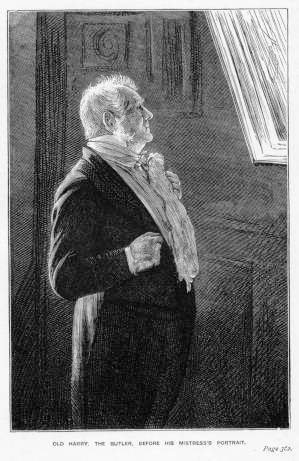
Next morning the brothers and their sister set off in high spirits for their temporary home at the sea-side. As Mr Huntingdon parted with Julia his voice trembled and his eyes swam with tears. She had got such a strong hold on his heart now that he felt it hard to part with her, even for a time. “She is so like what her mother was at her age,” he said mournfully to his sister, as they turned back into the house, when the carriage had fairly carried the young people away. Old Harry was quite as much affected as his master, though he showed it in a different way. The sight of “Miss Julia as was” getting into the carriage to go off again was almost more than he could bear. She saw it, and kissed her hand to him. At this he gave a sort of jump, and then jerked his elbow against his side with all his might, a proceeding intended to suppress the outward exhibition of his emotion. Then, when his master and Miss Huntingdon had returned to the breakfast-room, he stood gazing at a full-length portrait of Mrs Huntingdon, taken in her younger days, which hung in the hall, and bore a very striking resemblance to Julia Vivian as she now looked. Having feasted his eyes with the portrait for a minute or so, Harry uttered out loud one prolonged “Well;” and them betaking himself to his pantry, sat down after he had slammed to the door, and put his elbows on his knees and his face between his hands. And there he sat, his breast heaving, and his throat gurgling, till at last the simmering of his feelings fairly boiled over in a hearty flood of tears. “What an old fool I am!” he exclaimed at last. “It’s all the better for her; and why, then, should I take on in this way? But, eh! she getting so like an angel—not as I ever seed one, only in a picture-book, and that had got wings, and she ain’t got none. But she’s getting the right look now; she’s got into the narrow way, and so has Master Walter too, only there’s a bit of a swagger at present about his pilgrimage, but it’ll all get right. They’ve got Master Amos with ’em, bless his heart, and it ain’t much of the devil’s head or tail as’ll show itself so long as he’s got the management of things. And they’ll all be back again by-and-by, and the dear old missus too, I’m sure of it; so it’ll all be well.” Comforting himself with this thought, the old man wiped his eyes with his ample spotted pocket-handkerchief, and proceeded with his work, which he enlivened with a half—out—loud accompaniment of texts, scraps of hymns, and fragments of wise and proverbial sayings.
In the meantime the carriage was conveying the happy trio of travellers to the station, which being safely reached, they took train, and in the afternoon arrived at their destination. Amos had secured a nice little roomy cottage close to the seashore, which was in the hands of a middle-aged motherly woman, who, with her only daughter, a girl some fifteen years of age, waited on her guests. Having deposited their luggage, and ordered a substantial tea, the little party strolled down on to the sands.
It was a lovely summer day, and the sun was now hastening to the west. The tide was still running down, though it had come nearly to the turn, and its gentle rush, as it broke into a thousand sparkles of foam at each returning wave, made music in their ears. Far away to the left tall cliffs rose up, their majestic fronts scarred with the batterings of unnumbered storms. On either hand the shore swept round, completing the arc of one wide-extended bay, cleft in many places by paths which led up, now through lanes overhung by rocks of various coloured sand, and now along downs of softest turf, to the little town, or, further off, to solitary dwellings or clustering hamlets. Pebbles of dazzling whiteness lined the upper part of the slope down to the beach; and these were succeeded by a broad and even flooring of tough sand, along which visitors, old and young, found safe and ample space for exercise. There was no grand esplanade or terrace with its throng of health and pleasure-seekers. It was emphatically a quiet place, with its few neat lodging-houses and humble shops, one solitary bathing-machine, and a couple of pleasure boats now hauled up high and dry. To those who might seek excitement at the sea, this little retreat would have proved insufferably dull; but to those who brought their resources with them in heart, mind, and purpose, there was all that could be needed to cheer, elevate, and delight,—the grand old ocean, outspread in its vast dignity of space; the invigorating breezes; the passing ships; the glories of the most magnificent of nature’s painters, even the sun himself, who spread his tints of gold, crimson, and purple in broad, dazzling bands from the extreme verge where sea and sky met up to the centre of the blue vault overhead, though here in hues paler, yet as intensely beautiful. And all around now breathed peace. No storm was now ploughing up the water into mountains of angry foam; but a quiet ripple and a gentle splash at regular intervals soothed the spirit by the harmony of their ceaseless fall.
The three travellers felt the tranquillising influence of the scene. To Amos it was one of unmitigated pleasure. The others, no doubt, would naturally have preferred a livelier spot, but now the consciousness that they were there to aid in bringing about a great and noble object made them content and happy for the time. So, after a long stroll on the beach, they returned, when the great glowing ball of the sun had withdrawn the extreme edge of his fiery rim below the horizon, to their cottage.
Having finished their evening meal, a consultation was held as to the best way of carrying out the purpose which had brought them from home. The obvious thing seemed to be that Amos should go over alone to the house where his mother now lived, which was distant some eight or nine miles from their lodgings, and see what the physician in whose keeping she was might advise or suggest. So, early the next morning, he rode forth with a beating heart, and at the same time a happy trust, on his errand of love, his brother and sister having arranged to pay a visit for the day to a fashionable watering-place about five miles distant along the coast.
When Amos Huntingdon had reached his mother’s retreat and told his errand, he confided to the good physician under whose charge Mrs Huntingdon was placed his great purpose, and the hope that it might now be accomplished, since his sister had returned to her home. The kind-hearted friend at once entered into his plans, and gave him every encouragement to hope that he would meet with good success. But care and judgment and tact must be used, lest, in endeavouring to bring back the mind to its old balance, anything should be done which might rather throw it further out. Nothing sudden or exciting must be attempted; for the delicate structure, which care and sorrow had disarranged, must be brought into a right adjustment by gentle and cautious treatment. The jarring chords could not be made to vibrate in tune by sweeping them with a rough and unsympathising stroke; all could be reduced to harmony only by some loving and judicious action which would draw up or slacken the discordant strings with a force which would be felt only in its results. It was therefore arranged that on the morrow the physician should bring his patient to the sea-side at noon, and that, while he and she were seated in view of the waves, and were listening to their soothing plashing, Amos and his brother and sister should pass near, and be guided in what they should do as circumstances might suggest. “Your mother,” said the physician, “simply wants her mind clearing; all is more or less confused at present. She grasps nothing distinctly; and yet she is often very near a clear perception. But it is with her mind as with a telescope: it is near the right focus for seeing things clearly, but simply it wants the adjustment which would bring it to the point of unclouded vision, and then, when that adjustment has been reached, it wants to be kept fixed at the right focus. I cannot but hope that we may be able to come near to that adjustment to-morrow.”
Amos returned to his cottage much comforted. His brother and sister had not yet come back from their visit to the neighbouring watering-place; but at last they appeared, but not in the best of spirits. Something had gone wrong with them, but Amos was too anxious to talk over the morrow’s effort to ask them many questions about their excursion.
And now the critical day arrived. The sun rose gloriously, lighting up the heavens as he emerged from his eastern bed with a fan-shaped outpouring of his rays which streamed up over one hemisphere of the heavens, painting the edges of myriads of small fleecy clouds with a transient crimson splendour. The sea was almost glass-like in its calmness, only heaving up and down sluggishly, as though reluctant to be moved in its mighty depths. But, further out, a gentle breeze was filling the snowy sail of some graceful cutter as it stole across the bay, or steadily swelled out the canvas of some stately ship as she sped on with all sail crowded on her towards the desired harbour.
Just a few minutes before noon, Amos, with beating heart, saw his friend the physician conducting two ladies to a sunny bench on the edge of the shingles, facing the open sea. “Let us go,” he said to his brother and sister, “and walk near them, but take no notice at first.” So they all repaired to the beach, and with deeply anxious hearts drew near the little group. Which of the two ladies was their mother? One of them would probably be the physician’s wife. They neared the sitters, and passed on in front of them slowly, arm in arm. Who would have thought that mother and children, who had not met for years, were now so close to one another, and yet must for a while remain severed still? As the three on foot were passing the bench, Amos just bowed his head to the physician, and then looked at his two lady companions; and so did his brother and sister. There could not be a moment’s doubt—the children knew their mother at once. The dear familiar face was there, and not materially changed. And did the mother know her children? Something told her that they were beings in whom she had an interest; she saw in them something familiar. Yet she had not at all as yet grasped their relation to her with a realising consciousness.
“Pass on,” said the physician softly; and they passed on. A look of bewilderment and pain came over the face of the afflicted lady as the three walked forward. She followed them eagerly with her eyes. They turned towards her again, walking slowly back, and her face at once lighted up with a smile. “Sit down near us,” whispered the physician to Amos, as he came up close to him, and all three sat on the sloping bank not many feet away from the bench. Oh, how the heart of Amos ached with yearning to throw his arms round his mother’s neck; but he knew that it must not be yet. Julia and Walter also found it hard to restrain their impetuosity.
“Who are they?” at last said Mrs Huntingdon to the doctor. These were the first words that for seven years had fallen from that mother’s lips on the ears of her children. How full of music were they to those who had so long mourned her loss!
“They are visitors come here for change of air and to enjoy the sea,” was the reply.
She looked puzzled. “I think I have seen them before,” she said, and put her hand to her forehead.
“Shall they sing something?” asked the physician.
“Oh yes! it will be so sweet; it will remind me of old times,” she said.
Then Walter and his sister, at a nod from the doctor, began the touching duet, “What are the wild waves saying?”
Their mother listened with delight. Then she said, “That used to be one of my songs; I used to sing it with—with—ah, yes, with my husband Walter. Pray sing something else.”
Then the three united in singing “How sweet the name of Jesus sounds.”
As verse after verse was given by the three voices melodiously blending, a new light seemed to dawn into the lady’s eyes. “Ah!” she cried, “I used to sing that hymn with my dear children. Let me see. Yes, with Julia, and Walter, and Amos.—These are my dear children, are they not?”
“Yes, yes, dear mother,” cried Julia, unable to control herself.
“Who called me mother?” cried Mrs Huntingdon excitedly, and was about to rise, but the physician gently held her back, and motioned to her children to restrain themselves.
All was silent for a while, and then the medical man began to talk in an ordinary way with the young people on indifferent subjects, but all the while marking the effect of their voices on their mother. She was manifestly coming to feel that those voices were very familiar to her, and to have her heart and thoughts drawn out towards the speakers. “We will move on now,” said the physician after a few minutes had been spent in general conversation. Then, giving his arm to his patient, he turned to her children and said, “Shall we meet here again the day after to-morrow at the same hour?” Amos bowed his assent, and, without any special word of farewell, they parted.
On the appointed morning the same party met on the beach. The good doctor at once began, “I have brought your mother to see you to-day, my young friends. She was a little confused when you last met, not having been quite well; but I believe you will find her comfortable now.”
“Yes,” said Mrs Huntingdon, “it is all right now. Yes, I see you are my dear children, Julia, and Amos, and Walter; but what a long time it seems since I last saw you! Come to me, my children.”
They gathered round her, eager to show their love, and yet fearing to be too demonstrative.
“Ah, well,” she continued, “Dr Atkin has told me all about it. He says that I have not been well—that my mind has been confused, but is getting better now. Yes, you are my Julia, and you are my Walter and Amos. How kind of you to come and see me. And—and—your father, my husband, how is he? How it all crowds back upon me!”
“You must not excite yourself, dear mother,” said Amos.
“No, dear boy, that’s true,” she replied; “but all will be well, no doubt. Will you sing me a hymn?” So they all drew close to her, Julia laying her head in her lap, and there feeling a mother’s tears dropping fast upon her forehead, while Amos and Walter each held a hand. Then all joined in a hymn, Mrs Huntingdon taking her part.
As the party were breaking up, Dr Atkin took Amos aside and told him that the lost balance was now nearly recovered, that his mother had become able to think connectedly, and that the tangle in her mind had, through the judicious intercourse with her children, and the associations that intercourse had called forth, been unravelled and smoothed out. She might now form one of their party at the cottage, and by a careful avoidance on their part of all undue excitement, and the engaging her in cheerful and well-chosen subjects of conversation, the restored reason would become settled and strengthened, and she might return in a few weeks to her old home, and be able to bear by degrees the recurrence of old memories which old familiar scenes would call up, and the resuming of those duties and responsibilities from which her infirmities had so long shut her out.
Oh, with what thankfulness did Amos hear the physician’s conclusion; and how warm and loving was the welcome which greeted the poor restored one as she entered, a few days later, the sea-side cottage, and took her place in the comfortable armchair arranged for her in a snug corner, where she could look out upon the sea, and at the same time be close to all those dear ones who were now once more truly her own. And day by day, as the mind of that beloved mother became clearer and stronger, they were able with prudent gentleness to make her understand the state of things at home and the sad history of her unhappy son-in-law; while at the same time Amos never lost an opportunity of directing his dear mother to that Word of consolation, which he knew would be to her, as it had been to himself, the only true and satisfying fountain of abiding peace. And thus it was that she now learned to love that Bible which, in former days, had never been really her stay, for she had not then given her heart to Him who is the author, the centre, and the giver of all truth, peace, and consolation.
Chapter Twenty Two.
A Slip on the Road.
It will be remembered that Julia and Walter had an excursion to a neighbouring fashionable watering-place about five miles distant, and spent the day there while Amos was making his first call at his mother’s retreat, and that they returned in the evening out of spirits, something evidently having gone amiss with them. The incidents of that excursion will sufficiently explain the cause of their depression.
It can readily be understood that Walter’s progress in the higher paths of duty on which he had now sincerely entered was not at all times equally rapid. He was always meaning well, and could “put on a spurt and row hard against the stream,” as he himself expressed it, from time to time, but the long, steady, and regular stroke he found it very hard to keep up. Naturally full of spirits, cherished and encouraged in thoughts of his own superiority, and accustomed, as long as he could remember, to have pretty much his own way, it was no light thing for him to put a curb on his inclinations, or to check sudden impulses when they were in the direction of what was dashing or generous. So that, while his deliberate convictions were on the side of all that was right, he was very liable to be led to swerve a little from the narrow path when any sudden strain was put upon him by his own natural or acquired tastes, where he could not gratify these with a safe conscience.
With Julia the case was different. Long had she resisted the hand that would have led her heavenwards by trial and sorrow. High-spirited, self-willed, and self-absorbed though not selfish, she had struggled long against those cords of love which were drawing her out of the pathway of error and death. But she had yielded at last, and, having yielded, she struggled no longer. Her one great and abiding desire now was to make progress on the higher road. Not that she had lost her relish for amusement or her interest in outward things; but her spirit was chastened,—a new light burned within her. Not that she loved Walter less, but she loved Amos more; her heart was now more in unison with his, and she could now appreciate the delicacy, and deep tenderness, and consideration of his self-sacrificing love towards herself, which she had in time past so cruelly flung back upon him, and occasionally almost resented. So that now she felt it to be both her duty and her privilege to mark and copy the nobility of his unpretending but sterling character.
Such were brother and sister as they cantered off along the sands on the morning when Amos set off to call on and consult Dr Atkin about his mother. It was a charming summer day. The sea was sparkling in its numberless wavelets; a gentle breeze blew with just so much pressure in the faces of the riders as to add vigour to their spirits as they plunged forward against it. Sea-birds wheeled round and round before them, and everything spoke of brightness and enjoyment. The five miles, partly along the sands and partly along roads skirting the edge of the cliffs, and affording a magnificent extent of sea-view, were soon completed. Walter was full of life and fun, only regretting that he could not work up his sister into a mood as buoyant as his own. However, he did his best, and satisfied himself that it was only natural that the pressure of old sorrows could not yet be wholly taken off from Julia’s heart.
And now they were come to the outskirts of the little town. It was the height of the season, and gaiety and frolic seemed masters of the place. Old and young were to be met with at every turn, and, with the exception of the manifest invalids, all looked radiant with smiles, as though determined—and who could blame them?—to extract as much pleasure out of their little period of holiday as the place and its occupations could afford them. It so happened that the watering-place was this day flooded with one or two large arrivals of excursionists. These had evidently come down with the intention of making the very most of their time, and doing the whole thing thoroughly. Walter and his sister were highly entertained by watching some of these excursionists. Here, for instance, was the family of a worthy mechanic who were intent on getting the utmost possible out of the occasion that time and means would allow. Father, mother, children old and young, including a baby, with the wife’s old father and mother, made up the party. Hastening from the station to the beach, the whole family sat down together on the sands for some ten minutes or so, inhaling, with widely opened mouths, copious draughts of sea-air. Then the younger ones mounted donkeys, and the father and mother each a pony, while the old folks looked on. Having raced about hither and thither on the jaded animals in abrupt jerks of speed prompted by the resounding blows of the owners of the unfortunate brutes, all betook themselves to a sailing-boat; and landed again after half-an-hour’s sail, mostly pale, and with dismay in their looks, which manifestly proclaimed that “a life on the ocean wave” was certainly not a life to their taste. Then the old grandfather called to the driver of an open carriage, and took an airing in it with his wife, both sitting close behind the coachman with their backs to the horses, and leaving the best seat vacant, utterly unconscious that they were occupying the less desirable position, and smiling all the while blandly on the general public, pleased to have, for once in a way, a little taste of the pleasures of a higher grade of society than their own. The ride over, the entire party, baby and all, dived into some obscure region, where an unlimited amount of hot water and stale shrimps could be had for a very trifling charge.
While Walter and his sister were amusing themselves by watching the excursionists, they became aware of being the object of notice to two young men who were walking slowly along the esplanade near them. But they were so absorbed with what for the time had got their attention, that they failed to give any special heed to these strangers. Having put up their horses, they made for the sea, and mingled with the numerous comers and goers, keeping a special eye, from time to time, on the mechanic’s family and their doings. They were gazing down from the esplanade upon the busy crowds rushing backwards and forwards on the sands below them, when the two young men who had before noticed them passed slowly by them, raising their hats. The two were Saunders and Gregson. Now, it is true that Walter had, as he called it, dissolved partnership with these his old companions, and had not met them since the day of the sad disaster in the park; but, nevertheless, there still lingered in his heart a measure of liking for them which he could not altogether get rid of, and a certain amount of regret that all intercourse with them had been broken off. So he looked round hesitatingly as he marked their salutation, and they noticed it. Again they neared one another, and this time the young men smiled, and Walter returned the smile. Then the two stopped, and Gregson said, “Come, old fellow, shake hands; you’ve treated us rather shabbily to cut us as you have done, but we cannot bear the thought of our old friendship being so easily broken up. We’ve had many a jolly day together, and why should it not be so again?” He held out his hand, and Walter could not, or did not, resist the impulse to grasp it warmly. Then Saunders must have a similar grip, and Walter could not bring himself to refuse it. After this Julia was introduced, and the four went about amicably together, the two young men warming up, as they saw Walter’s resolution melting away, and rattling on with all sorts of light and frivolous talk, which grated sadly on the ear and heart of Julia Vivian.
It was now one o’clock, when Gregson exclaimed, “You must all come to the Ship, and dine at my expense. Nay, my dear old fellow”—addressing Walter—“I’ll not hear of a refusal. You know how I let you in for that second sovereign at the match, when Jim Jarrocks won so cleverly. I didn’t mean it, of course, but you must allow me the pleasure of making some little amends by having you and your sister as my guests to-day.” Julia tried, by a gentle pressure of her brother’s arm, to dissuade him from accepting the invitation, but without avail. Walter felt that he was now “in for it,” and must go through with it. So the four companions walked to the Ship Hotel, and partook of an excellent dinner ordered by Gregson, in a private room which commanded a full view of the sea and the crowds of pleasure-seekers who were swarming along the sands. Both the young host and his friend Saunders drank wine and beer freely. Walter, who had never been given to excess, was more cautious; but partly from the excitement of the occasion, and partly, it may be, to drown some uncomfortable whisperings of conscience, he took more of these stimulating drinks than he would have thought of doing under ordinary circumstances, and the result was that he was prepared, when the meal was over, to take his part in any scheme of fun or frolic that his new companions might propose. Julia saw this with deep shame and regret, but she also saw that now was not the time to remonstrate. She did speak to her brother, as they were leaving the hotel, about returning at once, as she did not wish to be late; but Walter replied in an impatient tone that there was plenty of time, and they might as well have a little bit of fun first. So, with trembling heart she took his arm as they emerged on to the esplanade, resolved that, at any rate, come what might, she would keep close to her brother, and be as much a check upon him as possible.
The four now made their way to the sands. As they did so, they observed a considerable number of the visitors making their way in a body towards a spot where a crowd had evidently assembled. “What’s up now?” cried Gregson. “Let us go and see.” They all joined the stream of walkers, and at last reached a spot where a large company of listeners were gathered round a group of men, some of whom were distributing tracts among the people, while one with a grave but pleasing countenance, standing on a stout oak stool which was firmly planted among the shingles, was giving out a verse of a popular hymn preparatory to addressing the spectators.
“Ain’t this capital?” said Gregson to Walter and Saunders in a loud whisper. “Won’t we just have a rare bit of fun!” He then spoke in a low voice in Saunders’s ear, and the young man stole round to the opposite side of the crowd. When the hymn had been sung, and the speaker was in the very act of commencing his discourse, a loud mew from Gregson, who was affecting to look very solemn, made the good man pause. He made a second attempt; but now a noise as of two cats fighting violently came from the opposite side of the concourse. The poor preacher looked sadly disconcerted; but when the pretended mewing and wrangling were continued, the sense of the ludicrous seemed to prevail in the crowd over everything else, and there was one general outburst of laughter, in which no one joined more heartily than Walter. The crowd began to surge backwards and forwards, and many to move off. But the preacher still maintained his stand. “Come here! come here!” cried Gregson in an undertone to Walter. Julia felt her brother suddenly disengage his arm from hers, and then he was lost in the crowd. A few minutes later, and there was a movement among the audience—if it could now be called an audience—in the rear of the speaker; and during the confusion, Julia, who was gazing intently on the spot where the preacher stood, saw two faces crouching down for a moment. One was Gregson’s, the other was Walter’s; and then two hands clutched the legs of the stool, and the preacher was pitched head-foremost into the sand. A roar of mirth followed this performance, but it soon gave place to cries of “Shame! shame!” Then there was a lull, and then a profound silence, as the good man who had been so cruelly used planted his feet firmly among the shingles, and said in a clear and unfaltering voice, “My friends, may the Lord forgive these misguided young men for their uncalled-for and unprovoked interference and ridicule! But their malice shall not stop the good work. Here I stand to preach God’s truth; and here I mean to stand, if the Lord will, every day during the season, opposition or no opposition, persecution or no persecution. Let us sing another verse of a hymn.” Amidst the profoundest stillness, and evidently with the hearty sympathy of the bulk of his hearers, the good evangelist proceeded with his holy work.
“Come along! come along!” whispered Gregson, creeping round to Walter, who had now regained his sister, and was feeling heartily ashamed of himself. They all hastened back to the hotel. Walter was now thoroughly subdued, and with a very cold leave-taking of his former friends, he and his sister sought their horses, and made the best of their way to the cottage, exchanging but few words as they rode along. Such was the shameful and sorrowful ending of what had promised to be a very happy day.
And now, when Mrs Huntingdon had been a few days established in the cottage, by her own earnest request, and with the hearty concurrence of her children, their aunt came over to spend a little time with them. This she could the more easily do as her brother was fully occupied with his endeavours to secure the return of the candidate whose politics he agreed with. Surely there can be few, who have a large circle of relations of different degrees of nearness, who have not among these some pre-eminently special ones who draw to themselves a more than ordinary share of affection from all their kindred—a special sister, or brother, or cousin, who does not however, make others less loved, while being the privileged object of a peculiarly tender regard. Such a special aunt was Miss Huntingdon to all her nephews and nieces. A visit from her was everywhere hailed with rejoicing. And so now every heart was glad when she joined the little party at the sea-side cottage. To Mrs Huntingdon the coming of her sister-in-law was eminently beneficial; for her tender love, her wise and judicious counsels, her earnest prayers, all helped to establish the restored mother in a healthful and happy tone of mind, and were the means of guiding her to that perfect peace which dwells nowhere but in the hearts of those who have sought and found in their Saviour the friend who loves above all others.
When Miss Huntingdon had been at the cottage two or three days, and was walking with Amos and Walter by the ebbing waves, Julia having remained behind with her mother, Walter suddenly stopped, and said, “Auntie, I have something very sad to tell you, and I want your advice.”
Both his aunt and Amos looked at him with surprise and anxiety, and then the former said, “Well, dear boy, I am sorry that there should be anything troubling you; but if I can be of any use or comfort to you in the matter. I shall be only too glad.”
“Sit down here then, Aunt Kate, if you please, on this bank; and if you are not both of you heartily ashamed of me and disgusted with me when I have told you all, well, you ought to be.”
When all three were seated, Walter fully related his adventure at the watering-place, concluding with the attack upon the preacher, laying a full share of blame on himself, and ending with the words, “Now, dear auntie, what do you say to that?”
Both his hearers looked very grave, and were silent for some time. At last Miss Huntingdon, laying her hand lovingly on Walter’s shoulder, said, “Dear boy, it is certainly a sad story, but you were led into what you did from want of watchfulness; and as you are now aware of your fault, and are sorry for it, I should not, if I were you; needlessly distress myself, but just make, if you can, some amends.”
“Ah! that’s the point,” cried Walter; “you mean, of course, make some amends to the good preacher. Yes, that can be done, for he said he should be at his post at the same hour every day during the season. But it will require some moral courage to do it, and no little of that valuable article too. Now I am sure, dear auntie, you have in that cabinet of your memory one drawer at least full of examples of moral courage, and you can pick me out one to suit this case.”
“Yes, dear boy,” said his aunt, smiling, “I daresay I can; for ever since you first asked me to help you in the matter of moral courage by examples drawn from real life, I have been noticing and storing up in one of these drawers you speak of whatever instances of moral courage have come before me in my reading.”
“What, then, is it to be to-day, dear Aunt Kate? Can you find me one that will show me how I ought to act in this sad business?”
After reflecting for a few minutes, Miss Huntingdon began: “I have rather a strange moral hero to mention now, and yet he is a most real one. His name is James Comley. He was for years a confirmed infidel—a most intelligent man, but in utter spiritual darkness. He lived at Norwich, and carried on the business of a tea-dealer. He had indoctrinated his wife and children with his own infidel views, and had never lost an occasion of publicly assailing the truths of religion. But at last he was brought to see the misery of his condition. He prayed earnestly for light, and God gave it him at last, and he became a truly changed man. And now, mark his conduct after this change had taken place. He at once tore down some lying placards which covered the shutters of his shop and the whole front of his house—placards which stated that his tea business was ‘The Eastern Branch of the Great European Tea Company,’ which company, in fact, had no existence. He disposed of about seventy empty tea-chests, which had been so arranged in his shop as to suggest the idea of an immense stock. A huge bale of unused placards he carried into the Norwich market-place, where he addressed the crowd that awaited his arrival, and then carried this bundle of lies to Mousehold Heath, where, after the singing of a hymn, praying, and addressing the crowd which had accompanied him, he committed it to the flames. He after this began publicly to preach that gospel which for nine years in Norwich he had done his best to destroy. Here was true moral courage indeed; and perhaps his example may be a help to you, dear Walter, in showing you what you ought to do.”
Her nephew had listened with the deepest interest, and now remained buried in thought. At length he said: “True, dear auntie; I see it all; my duty is plain enough. James Comley had publicly insulted God and religion, and he made amends as far as he could do so. At any rate he showed his sincerity by coming out boldly as an honest man, and as one who was sorry for the past, by his publicly burning those placards and then preaching the truth which he used to deny and revile. And I ought to do the same. I mean that, as I did a public wrong in open daylight, and before many people, to that good man at Stringby, so my duty is to go over to Stringby and just as publicly to confess to him, and to the people who may be there, and in open daylight, my sorrow for what I did. That’s just it, auntie, is it not?”
“It will certainly be making the best use of my example, dear boy,” she replied, “and will be showing true moral courage; but no doubt it will involve much self-denial, and require much strength from the only true fountain of strength.”
“It shall be done, and to-morrow,” said Walter firmly.
“Would it be any comfort or help to you if I were to go with you?” asked Amos.
“The greatest comfort in the world,” cried his brother joyfully; “yes, and let Julia come too. She was grieved to see me led away as I was, and it will therefore be a happiness to me if she will come with us and hear my confession.”
And so it was arranged.
Chapter Twenty Three.
Unexpected Fruit.
The next day, after luncheon, the brothers, with their sister, started for Stringby, but not in very buoyant spirits. Walter had no thought of drawing back, nevertheless he felt an almost overwhelming shrinking from the task which he had undertaken. The loving smile, however, and gentle words of affectionate concern with which his aunt had cheered him as they set off were a source of much strength and comfort to him; they hovered around his heart like the shadowing wing of an angel whenever the scorching heat of his furnace of trial swept by anticipation across his shrinking spirit. He had thought it wiser not to confide to his mother either the cause of his shame or his intended amends.
The weather was clear and bright as they began their ride, but a smart shower burst upon them when they had accomplished half the distance, and forced them to go out of their way to take shelter. Would the preacher, distrusting the sky, have given up his work just for this afternoon? If so, what pain and humiliation Walter would be spared! Oh, how he clung for a few moments to the hope that it might be so! for then he would have made the amends and the sacrifice, and shown the moral courage, in intention, and, at the same time, would be spared the actual heavy trial itself. But then he dashed away these thoughts from him, and with an inward prayer nerved himself for the coming effort.
Amos, as he rode by his side, seemed to guess what was passing through his mind, and said, “Can I speak to the preacher for you, Walter? It will save you some pain, and, as I shall be speaking for another, I should not have the same difficulty that you might feel.” But this suggestion at once roused Walter out of all his fears. “No, no, dear Amos,” he cried, “no; I have put my foot in it, and I must go through with it. Your being with me will be a great help, and it would not be right for me to accept any further assistance from you.”
Little more was said on the way. Julia scarcely opened her lips, but there was a sweet peace on her fair face. She felt that her brother Walter was going to do the right thing, and, though she thoroughly sympathised with him in his natural shrinking from his task, she was satisfied that he could not now retreat if he would do what duty plainly called him to. So they trotted or cantered leisurely along, while the dashing of the waves, and their ceaseless ebb and flow, seemed to remind them of that love which, in the midst of the ceaseless ebb and flow of this world’s trials, and of man’s personal failures and advances in the life of holiness, ever comes, like the sea-breeze, in breathings of spiritual health and heavenly pity to the souls that are pressing onward and upward to the land unclouded by sin.
At last the watering-place was gained. It seemed to Walter and his sister more thronged than ever. Several large excursion trains had brought their many hundreds of eager and excited holiday-keepers. Esplanade, sands, and by-streets were swarming with passers to and fro. Would they meet Gregson and Saunders there? Most earnestly did Walter and his sister, and indeed Amos also, hope that they would not. However, little time was there for scanning the faces of those they met, for now they pressed rapidly forward, Walter leading the way, as he was anxious to plunge at once into his difficult work and get it over as speedily as possible. “You know,” he said to Amos with a faint smile, “it’s just like going to the dentist’s. When you get into his room, you don’t go and ask to look at his instruments,—those horrid pinchers, and pliers, and screw-looking things,—it’s quite bad enough to feel them; and the sooner the wrench comes the sooner it’ll be over. So now for my wrench.” As he said this, they came within sight of the place where the unhappy disturbance occurred in which he had taken a part. A crowd had gathered, on the outskirts of which, people were moving backwards and forwards, but there were no sounds of uproar or interruption as they reached it. All were very attentive. The preacher—the sight of whom caused the blood to rush into Walter’s face—was the same he had encountered before. The good man was standing on his stool giving out two lines of a well-known hymn. And then a noble volume of praise from those united voices rolled up towards heaven.
Walter could see in a moment that the preacher’s eye had rested on him, and that he remembered him. So, flinging his horse’s reins to his brother, he slipped off his saddle and elbowed his way vigorously through the crowd. “Stop, young man,” said the evangelist calmly and solemnly, as he saw Walter pressing forward. But Walter made his way close up to him, and, while the other was evidently perplexed as to the meaning of his conduct, said quietly to him, “I am not come here to-day to hinder or make game, but to ask pardon.” The other looked at him in amazement, and for a moment knew not what to say. Then, while there arose a strange buzz of surprise and excitement among the bystanders, Walter asked, “May I stand in your place for a minute, and say a few words to these people?” The good man was clearly taken quite aback by this request, and looked hard at him who had made it. Was this a scheme for turning the preacher and his work into open ridicule? The other members of the evangelist’s party seemed to think so, and advised him to refuse; that it was only a dodge on the young man’s part to get up a piece of extra rich entertainment for his friends, who, no doubt, would not be far off. The good man had come down from his stool while these remarks were being addressed to him. He hesitated, but when he turned to Walter and looked in his face his mind was made up at once; for there was something, he said, in that face which satisfied him that good would come out of his yielding to the request made, and not evil. So, while the spectators were looking on and listening with breathless expectation, he said, in a clear voice, audible to those on the utmost verge of the great assembly,—“Friends, before I address you, a young man has asked leave to occupy my place for a short time. He shall do so, for I have confidence in him that he will not abuse the liberty I give him.”
There was a murmur of approbation and intense interest as Walter mounted the stool and looked upon the sea of upturned faces round him. He was very pale, and his voice trembled at first, but soon grew calm and firm. “My friends,” he began, “I have come here to-day to do an act of justice. Some days ago I was a spectator in this place, as you are now. This good man, the preacher, stood then where I now stand. He had come here to try and do you good; I came, I am sorry to say, in a different spirit. Joining with others as wrong and foolish as myself, I interrupted and ill-treated this servant of the good Master, our Saviour. I am come to-day to make what amends I can. As I then publicly ill-treated him, so I now equally publicly ask his pardon for what I did then; and I earnestly beg you all to give him a patient hearing, and to encourage him in his work of love.”
Not a word of this short address was lost by a single hearer, though the last part was almost stifled by the speaker’s emotion. As for the preacher, he knew not how to contain himself. When Walter had sprung to the ground amidst the profoundest silence, both his hands were grasped by the good man whose pardon he had asked, who, as he shook them warmly, could only say at the moment, “The Lord bless you! the Lord be praised!” Then, recovering himself, he sprang upon the stool, and cried out, “That’s a right noble young man, dear friends! There’s real courage there, and a generous heart, and no mistake. He has asked my pardon for what he did, and, had I twenty hearts, he should have it from the bottom of each. I thought, when he came here a few days since and put a little hindrance in the way, ‘Now, the devil’s very busy; what a crafty being he is!’ Ah, but see now. After all, he only outwits himself by his own craftiness. The Lord brings good out of Satan’s evil. Well, now, let us proceed with our proper work.” These words were followed by a hearty cheer from the assenting crowd, and then all listened attentively while the good man gave a plain, practical, faithful, and pointed gospel address.
When this was over, and the crowd was dispersing, Amos, whose heart was all in a happy glow, drew near the preaching-place with Julia, both of them having now dismounted. The good evangelist’s fellow-helpers were distributing tracts among the retiring audience, while the preacher himself was in earnest conversation with Walter. Julia held out her hand for some tracts, saying to the man who gave them, “I will do my best to distribute them among those who will be likely to benefit by them. Please let me have as many as you can spare.” He gladly did so.
In a short time all had left, except the preacher and his friends, Amos, and his brother and sister. As Walter was about to go, he took out his purse and said to the good man who had so heartily forgiven his former unkindness, “You must allow me to offer you a contribution to your tract fund. I am sure you will understand me. I am not asking you to accept this as any compensation for my abominable treatment of you the other day, but simply as a little token of my sincere desire to help on your good work in however small a way.”
The offering was at once and gratefully accepted. “There is no fear,” said the good man, smiling, “of my taking offence at anything which the Lord sends me, or at the way in which he chooses to send it. The work is his, and the silver and the gold are his, and he supplies us with the means in the best way, as he sees it, and therefore in the very best way. So I thank you for your contribution, and accept it with pleasure; and I think we shall neither of us forget this day as long as we live, neither on this side of the river nor on the other.”
With a hearty farewell on both sides, Walter and his companions remounted their horses, and rode slowly away, full of happy thoughts: Walter very happy, because he had been enabled to do what his conscience had bidden him; Amos quite as happy, because the brother he loved so dearly had behaved so nobly; and Julia calmly happy, because she felt that bright sunshine had poured through a dark cloud which had brooded for a while sadly over her spirit. And there was something yet more stirring in her heart in consequence of all that she had seen and heard,—it was a rising desire to be doing some real good to others, and to be doing this at the cost of personal sacrifice and self-denial. Ah, what a new and strange desire was this in one who had, till lately, allowed the idol of self to occupy the shrine of her heart. To be thinking of others, to be steadily keeping the good of others in view, to put self-pleasing in the background, or to find it in pleasing others, and that, too, from love to one who for her sake pleased not Himself,—this was something wondrous indeed to her, and yet how full of real and heavenly brightness when it had truly found an entrance into her soul!
But how and where was she to begin? She had a little bundle of tracts in her hand; should she begin at once with these? Of all things which she once would have shrunk from, nothing would have then been more repulsive than the office of a distributer of tracts. Some years before, when once asked by a pious friend of her aunt if she would like a few tracts to give away as she might have opportunity, her reply had been, “She had rather not, for she believed that tracts were vulgar, canting things, commonly given by hypocrites to their neighbours when they wanted to deceive them under a cloak of affected godliness.” She had been rather proud of this reply, which certainly for the time had the effect of completely shutting up the good lady who had recommended the tracts to her notice. But now she felt very differently, and looked at the little bundle in her hand, thinking how she might use it to the best advantage. Not that she felt naturally drawn to the work; it would require a considerable effort on her part to bring herself to offer a tract to a stranger, and a far greater effort to accompany the offer with a word or two from herself; but she now believed that she ought to make the effort, and that word “ought,” the idea of “duty” which it kept before her, was beginning to exercise a constraining force hitherto unknown to her. And there was a special advantage in the tract. Just the giving of it without comment would be a good preparation for more close and personal work in the loving Master’s service. So, grasping the papers with a trembling hand, she began to look out for an opportunity of parting with some of them, and she had not long to wait. When the little party turned away from the spot where the preaching had been held, and were thinking of returning to their cottage, as they were just directing their horses’ heads homewards, Julia uttered a sort of suppressed cry or exclamation, which at once drew the anxious attention of both her brothers to her.
“Anything amiss, dear Julia?” asked Amos and Walter together.
“No, not exactly,” she said in a troubled voice, and with a scared look. Then, recovering herself, she pointed to a young woman dressed rather fantastically, who had just passed them in a direction opposite to that in which they were going. “Do you see that woman?” she asked in a low humbled voice; “she is one I have reason to know too well. She was associated in a theatre with poor Orlando. Oh, I wish I could do her some good! Let us follow her; perhaps she would take a tract.”
Who would have thought of such a speech from Julia Vivian a few days back? But the earnest desire to do that poor outcast creature good had evidently got possession of her, and so the three turned their horses’ heads in the direction in which the actress was walking. But the object of their loving pursuit had now quickened her pace, and turned up a by-street before they could come up with her. Should they follow? Some impulse urged them forward. The side street led to a square or large open piece of ground, in the centre of which was erected a temporary theatre. The woman whom they were following was just about to enter this building, but turned about and looked back before doing so. Her eyes met those of Julia, and she at once recognised her with a peculiar smile, which sent the blood rushing back to Julia’s heart, and made her for the moment half resolve to turn and fly from the place. But she resisted the feeling and held her ground. The next moment the woman had entered the theatre. The little party lingered for a few moments, and then the theatre door again opened, and several persons in various stage dresses came out and gazed on the newcomers. Then they began to wink at one another as they stared at Julia, and to break out into a broad grin. How earnestly did the object of their curiosity and merriment long to rush away out of the reach of those mocking eyes and sneering lips! Yet she did not move. A purpose was coming into her heart; she might never have such an opportunity again. Yet how weak she felt in herself. But then she lifted up her heart in prayer to the Strong One, and, turning with blanched face, but perfect calmness, to her brothers, asked them to help her to dismount, and then, leaving her horse’s reins in Walter’s hands, advanced towards a group of some dozen persons of different ages who had come out of the theatre to gaze and to make merry.