PLATES
Reading edition
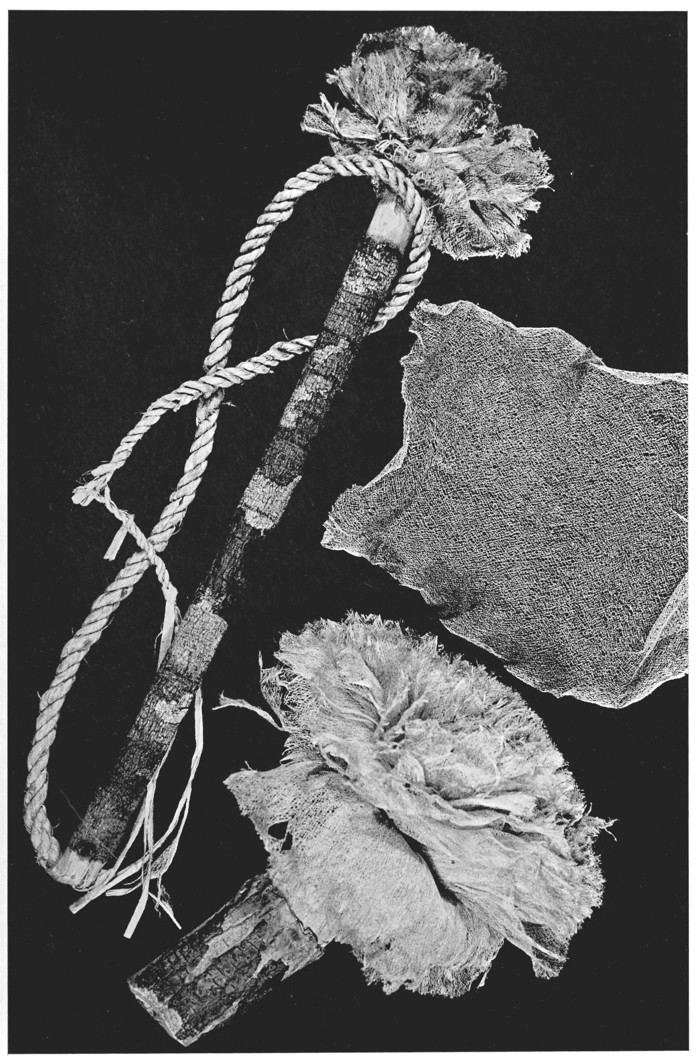
Plate 1.
Samples of lace from the lace-bark tree, or Lagetta lintearia, illustrating its manner of growth. These were brought from the island of Jamaica, West Indies, by Miss Edith Beach, of West Hartford, Connecticut. She has also a piece, resembling them, which was sent to her from Australia. It is reported that a similar variety grows in South Africa. Owned by Miss Beach.
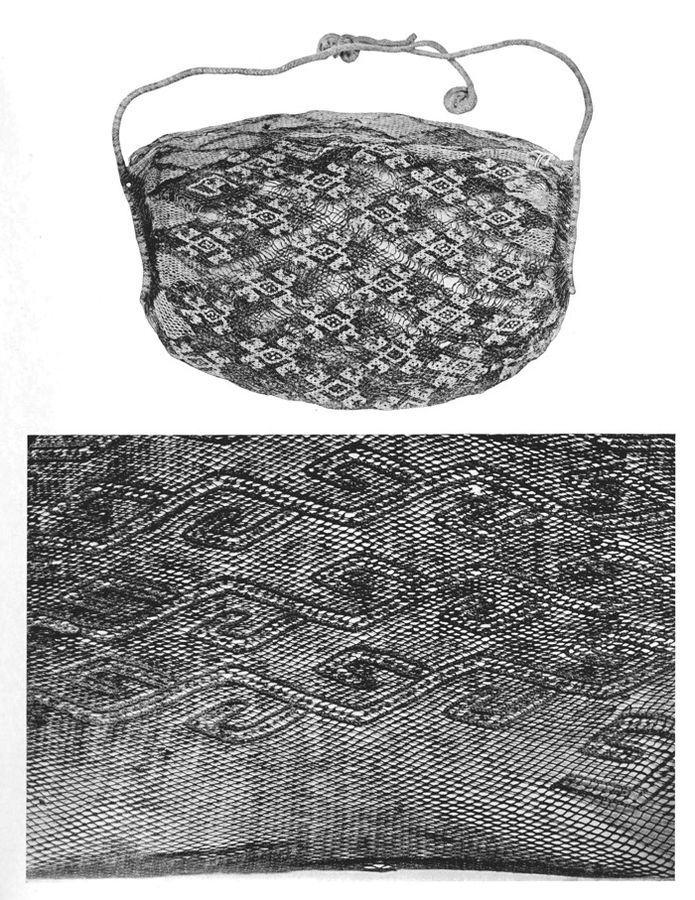
Plate 2.
Figure 1. Peruvian lace bag found in a tomb. Probably four thousand years old.
Figure 2. Peruvian lace. Prehistoric.
These are owned by the American Museum of Natural History, New York City.
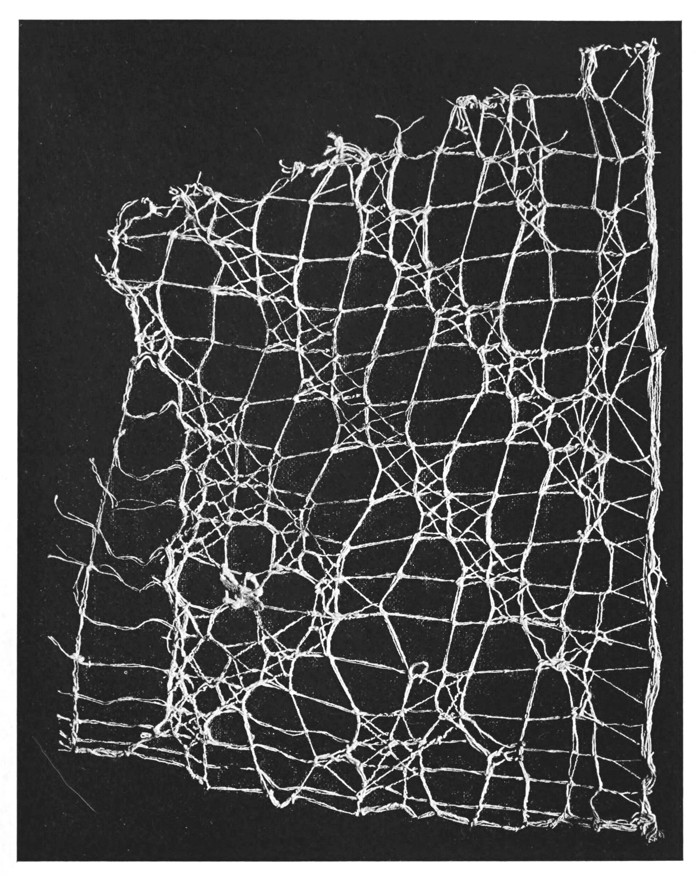
Plate 3.
Peruvian lace, two to four thousand years old. Lent by Miss Marian Powys, of the Devonshire Lace Shop, New York City. The American Museum of Natural History, New York City, which gave it to Miss Powys, states that “it was made with an oblong piece of wood like a net measure.”
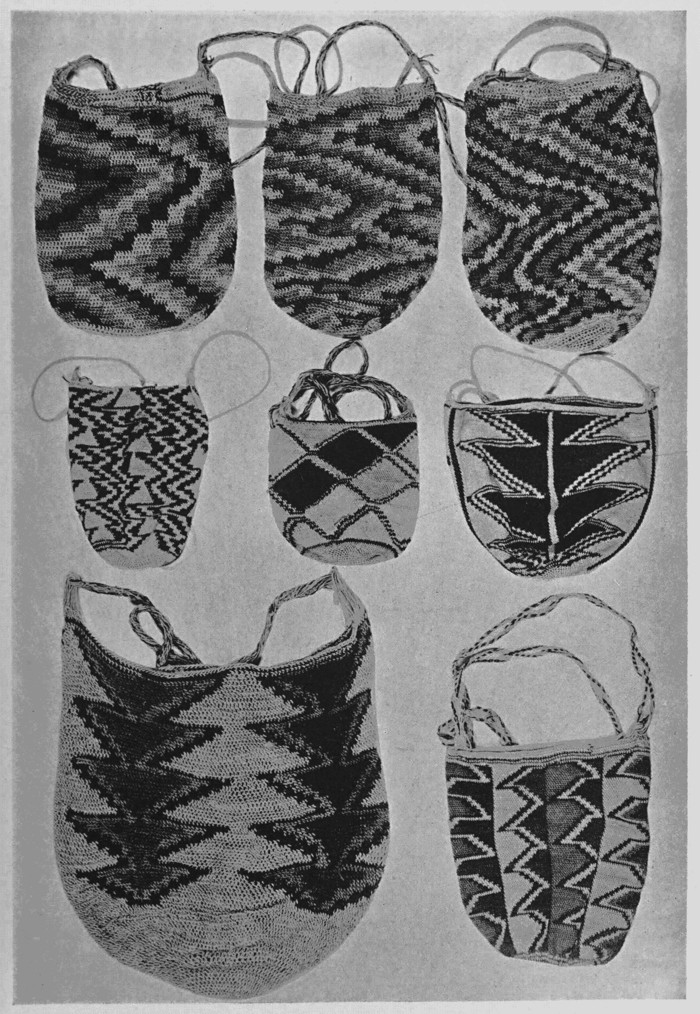
Plate 4.
Eight lace bags made by the Balienti Indians of Central America. Owned by the American Museum of Natural History, New York City.
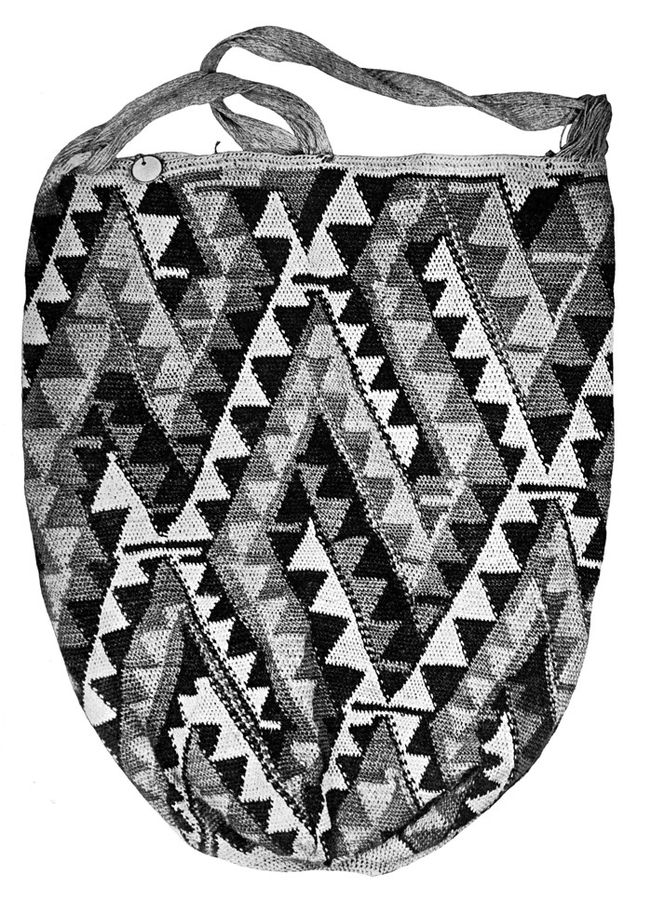
Plate 5.
Lace bag made by the Balienti Indians. Owned by the American Museum of Natural History, New York City.
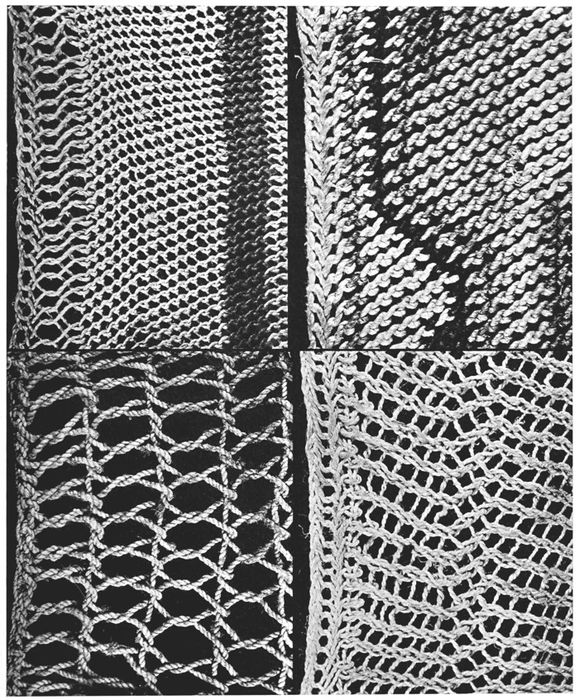
Plate 6.
Four details of the lace bags made by the Balienti Indians. (See Plates 4 and 5.)
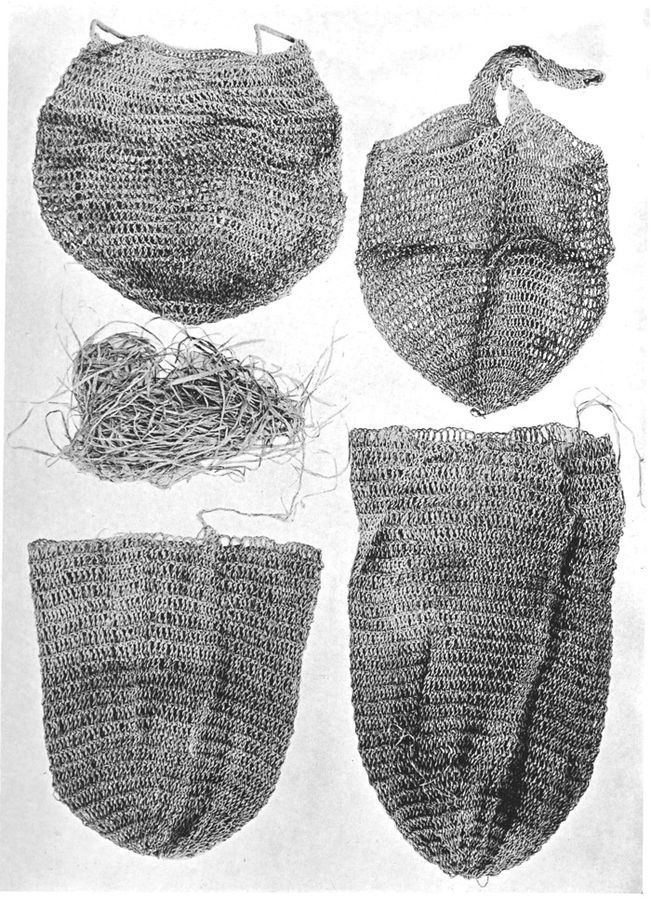
Plate 7.
Four lace bags made by the Honduras Indians of Central America. Owned by the American Museum of Natural History, New York City.
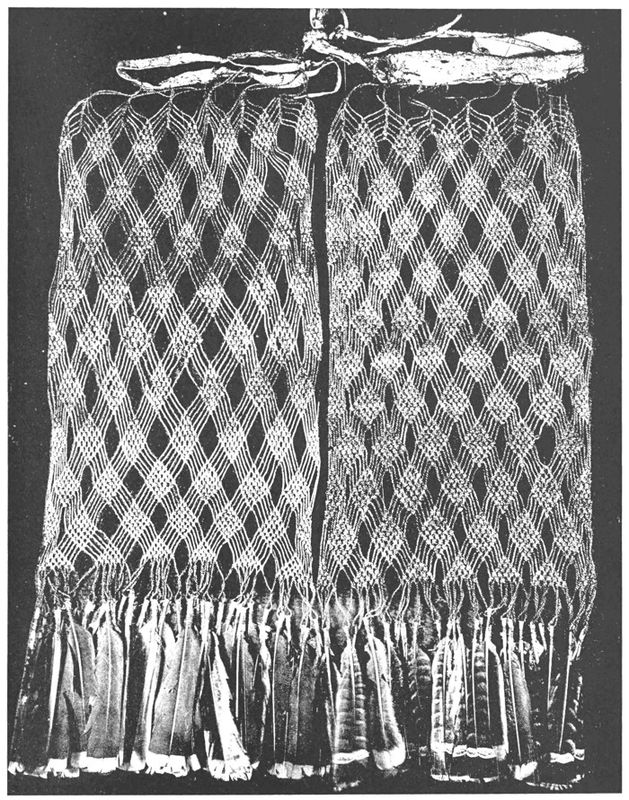
Plate 8.
Lace headdress trimmed with eagle and partridge feathers, made by a Hopi Indian. Less than one-half size. Owned by Miss Frances Morris, of the Metropolitan Museum of Art, New York City.
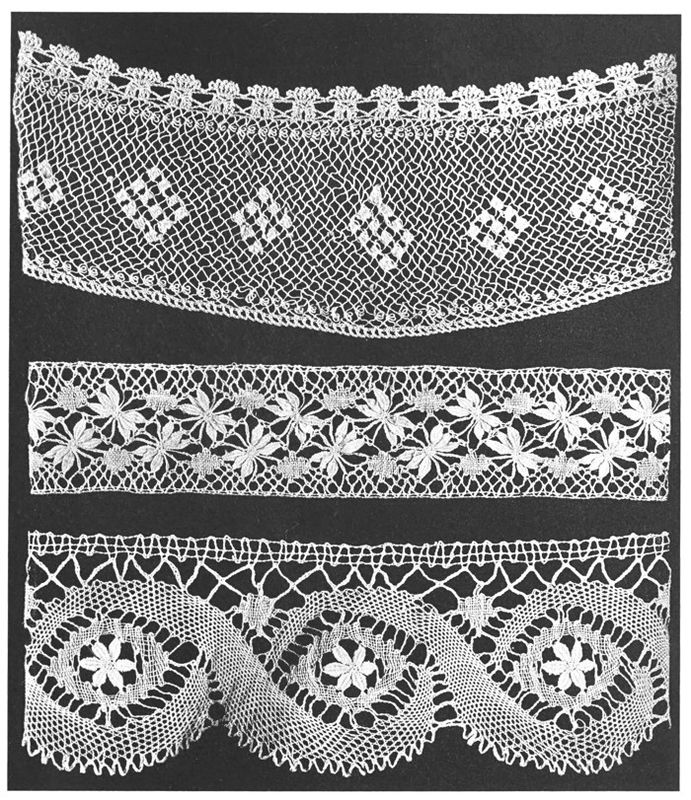
Plate 9.
Figure 1 (at the top). Very old style of lace, knotted, not netted, made only by one aged woman who lives in the interior of the island of Porto Rico and produces but little.
Figures 2 and 3. Pillow and bobbin lace made in Porto Rico. Makers unknown.
Originals of Figures 1, 2, and 3 owned by the Litchfield Historical Society.
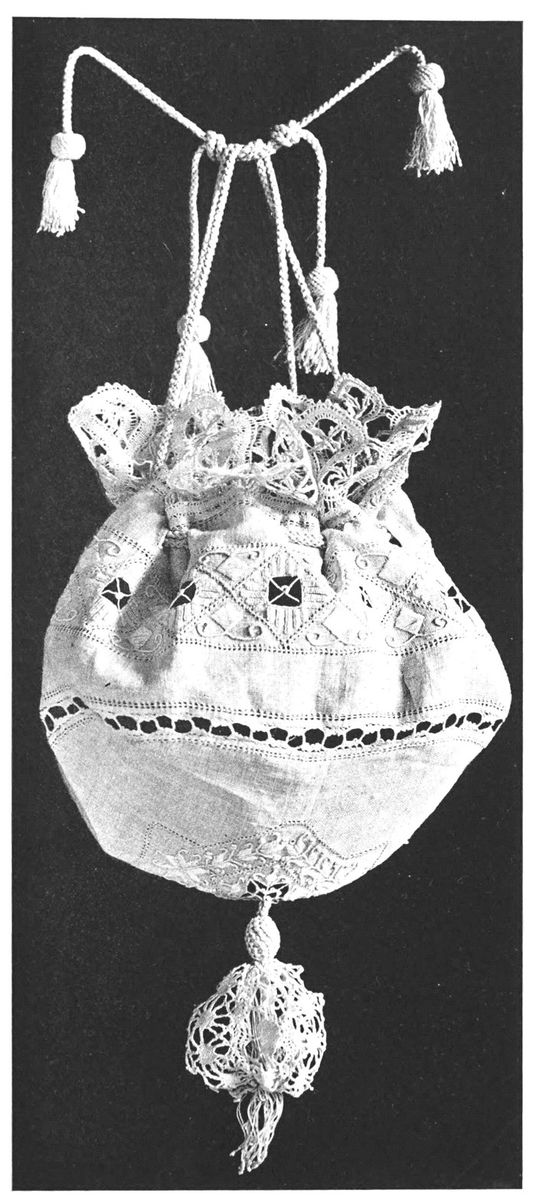
Plate 10.
Hand bag of linen cut-work.
(Plates 10–13 show work done by the Oneida Indians of North America, whose reservation is in Wisconsin. The lace was awarded gold medals at the Paris Exposition, 1900; at the Pan-American at Buffalo, 1901; at Liège, 1905; at Milan, 1906; and at the Australian Exposition, 1908; and at the Louisiana Purchase Exposition in 1904 it was awarded the Grand Prize, which is the highest recognition possible. Miss Carter’s association has eight centers, in which six tribes are represented: Onondagas, Oneidas, Chippewas, Sioux, Pueblos, and Mission Indians of Southern California. Loaned by the Sybil Carter Indian Lace Association, New York City, which owns the originals shown in Plates 10–13.)
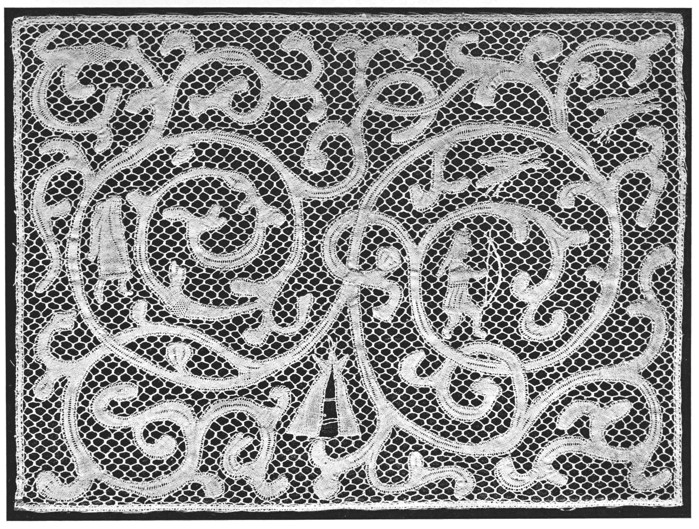
Plate 11.
Bobbin lace pillow cover with Indian hunting ducks, squaw with papoose on her back, and an Indian tepee introduced into the design. About one-third size. (See description of Plate 10.)
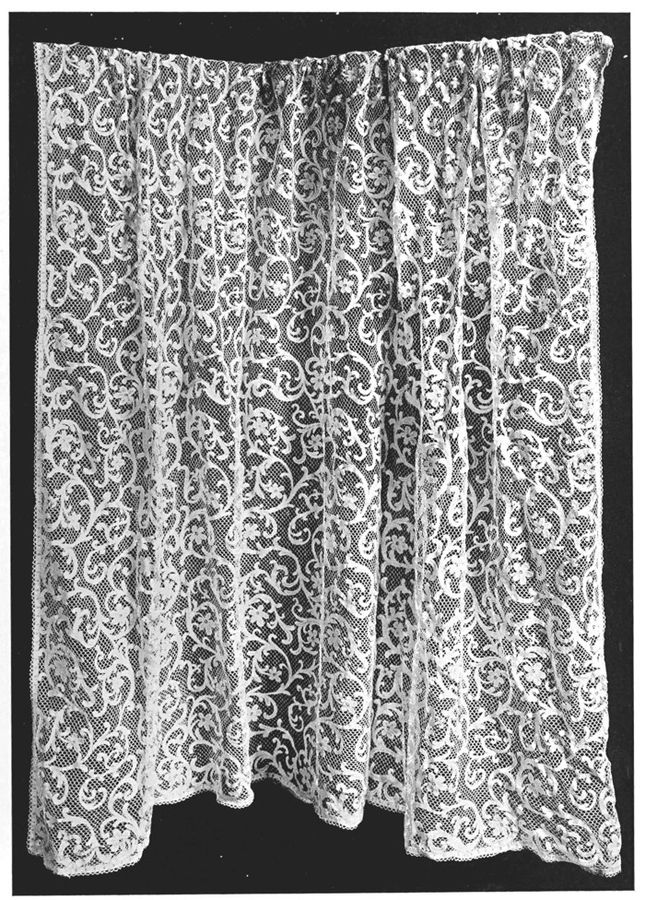
Plate 12.
Bobbin lace bed-spread. (See description of Plate 10; also Plate 13.)
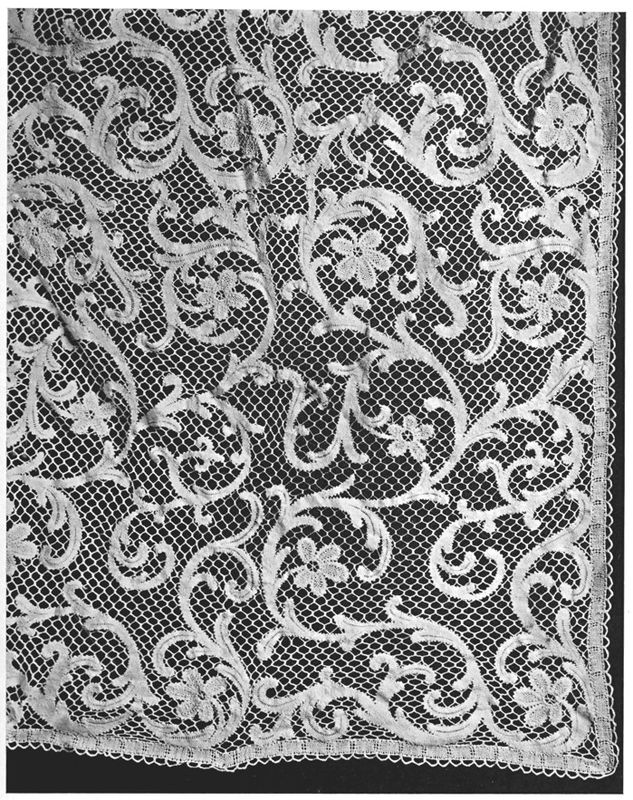
Plate 13.
Detail of bed-spread shown in Plate 12.
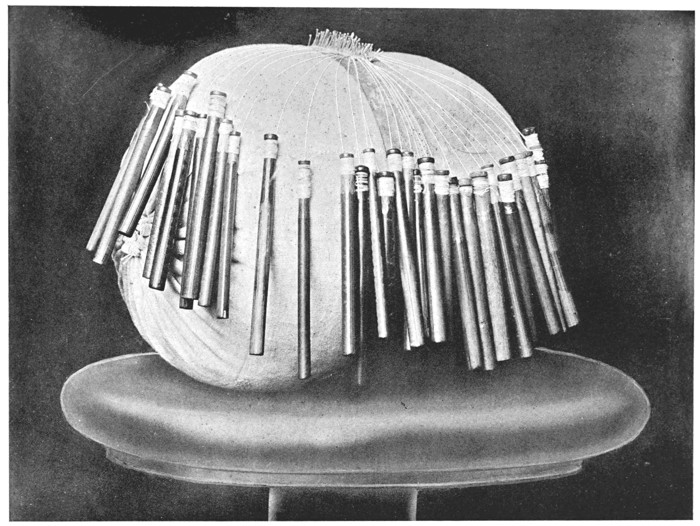
Plate 14.
Lace pillow with bobbins. Made by Lydia Lakeman, born at Ipswich, Massachusetts, in 1781. Originals of Plates 14–16 lent by Miss Sarah E. Lakeman.
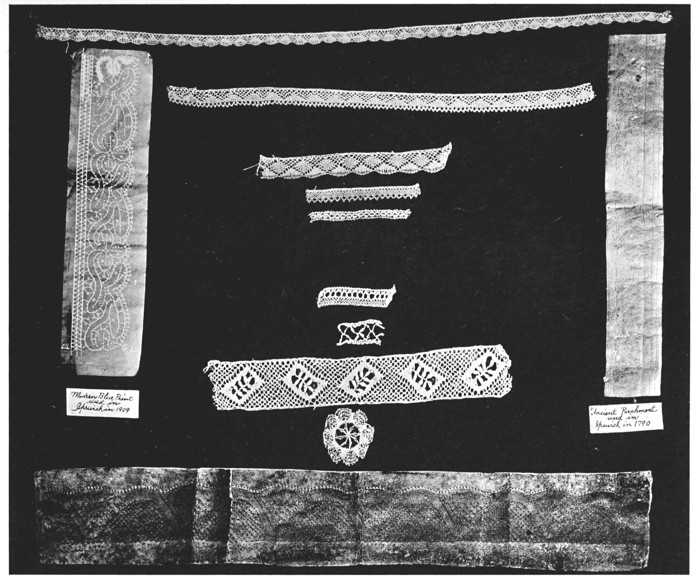
Plate 15.
Parchment patterns used in Ipswich, Massachusetts, in 1790; blue-print pattern used in Ipswich, Massachusetts, in 1909, at the time of an effort to revive lace-making in the town; and samples of pillow and bobbin laces made there. The narrow lace, of the pattern which was called “the cat’s eye,” was made by Sarah Sutton Russell, born in Ipswich in 1775. The wider laces were made by Mrs. Thomas Caldwell, who was born in the same place in 1780. Her great-grandmother was a lace-maker, born there as well, in 1736. The patterns all had local names, one of the wider ones being called “two and thrippenny.” The pillow, patterns, and laces have come down to a granddaughter of Mrs. Caldwell, Miss Sarah E. Lakeman, of Ipswich, Massachusetts. She makes lace now and lectures on the old industry.
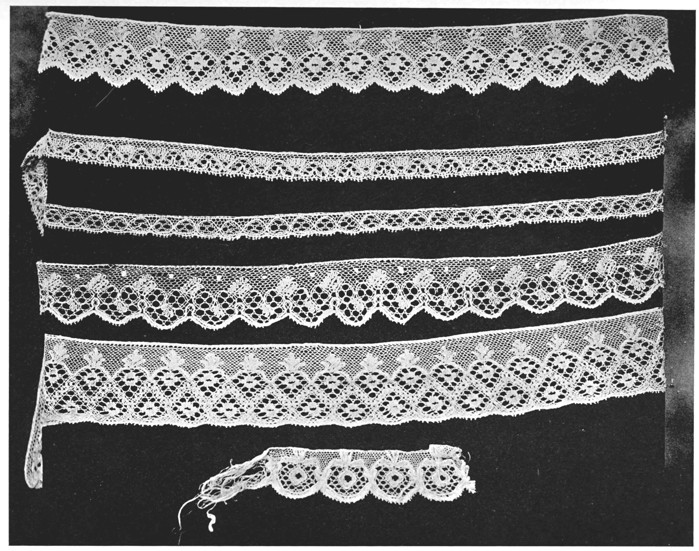
Plate 16.
Ipswich laces. Owned by Miss Sarah E. Lakeman. (See description of Plate 15.) Makers unknown.
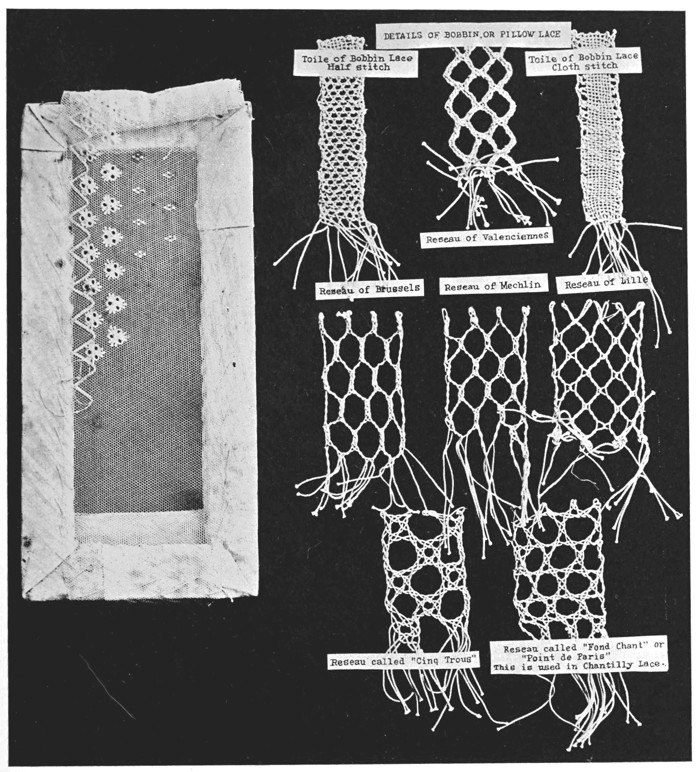
Plate 17.
Samples of the réseaux, or grounds, enlarged, which fill up the patterns of pillow and bobbin laces; also of the darned net called Limerick, still on its pasteboard frame. Makers unknown. Owned by the Essex Museum, Salem, Massachusetts.
Text from image:
DETAILS OF BOBBIN, OR PILLOW LACE
Toile of Bobbin Lace Half stitch Toile of Bobbin Lace Cloth stitch Reseau of Valenciennes Reseau of Brussels Reseau of Mechlin Reseau of Lille Reseau called “Cinq Trous” Reseau called “Fond Chant” or “Point de Paris” This is used in Chantilly Lace.
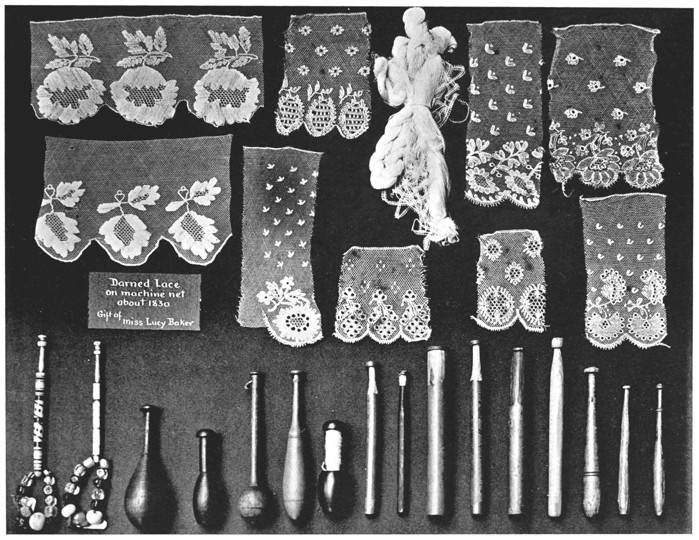
Plate 18.
Bobbins made of bamboo, wood, and ivory; linen thread for making lace; and samples of Limerick lace, or darned net. Makers unknown. Owned by the Essex Museum, Salem, Massachusetts.
Text from image:
Darned Lace on machine net about 1830 Gift of miss Lucy Baker
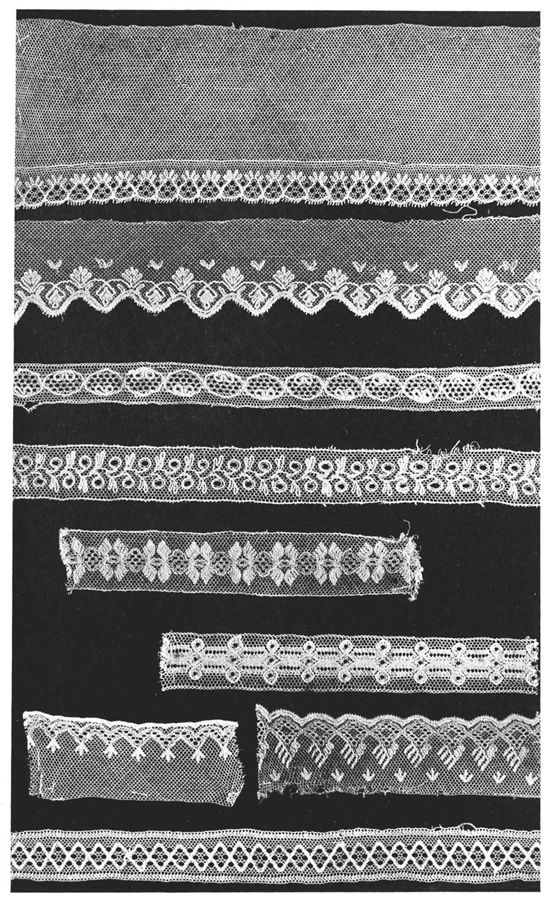
Plate 19.
Samples of American darned laces. Collected by Miss Anna P. Thompson, daughter of Hezekiah Thompson and his wife, Mabel Roberts, of New Haven, Connecticut. Owned by Miss Esther H. Thompson, of Litchfield, Connecticut. Mabel Roberts was born in 1814. At nine years of age, in the winter while at school, she made the lace shown in Figure 2 of Plate 19 and in Figure 1 of Plate 20, worked a sampler, and made a ruffled shirt for her brother, who was eight years old. (See also Figure 5 of Plate 23 and description.)
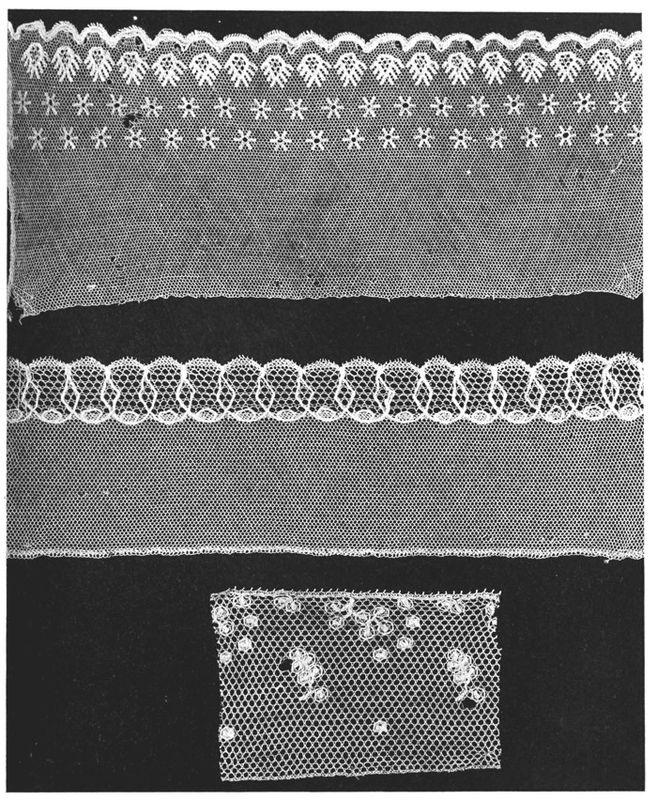
Plate 20.
Additional samples of American darned laces. Collected by Miss Anna P. Thompson. (See description of Plate 19.) The original of Figure 1 (top) was made by Mabel Roberts (Mrs. Hezekiah Thompson) when she was nine years old. Figure 2 (middle) shows the cap border of Mrs. (General) John Hubbard. (See description of Plate 91, Figure 3.) Owned by Miss Esther H. Thompson, of Litchfield, Connecticut.
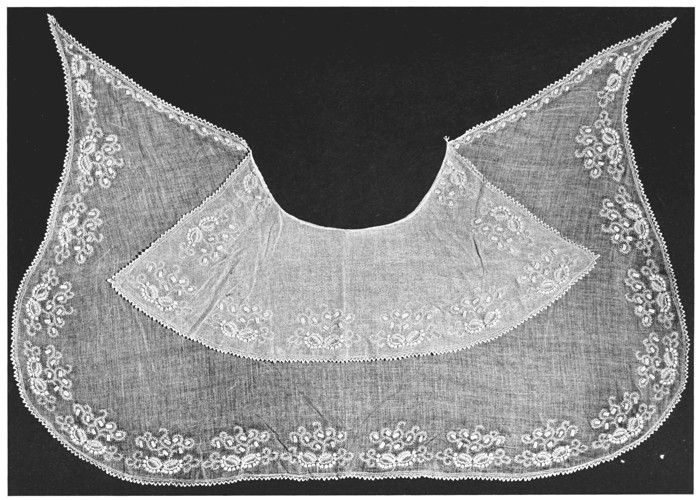
Plate 21.
A collar in the same collection (see descriptions of Plates 19 and 20). Brought from Savannah by Mrs. Erastus Merwin, of Cornwall Hollow, Connecticut. Maker unknown. Worked about 1830. About one-half size. Owned by Miss Esther H. Thompson, of Litchfield, Connecticut.
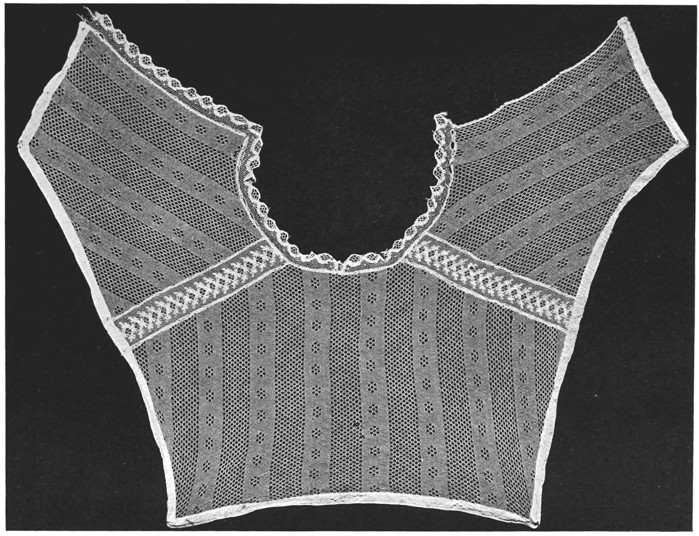
Plate 22.
A guimpe in the same collection (see Plates 19–21 and descriptions); about one-half size. Maker unknown. Owned by Miss Esther H. Thompson, of Litchfield, Connecticut.
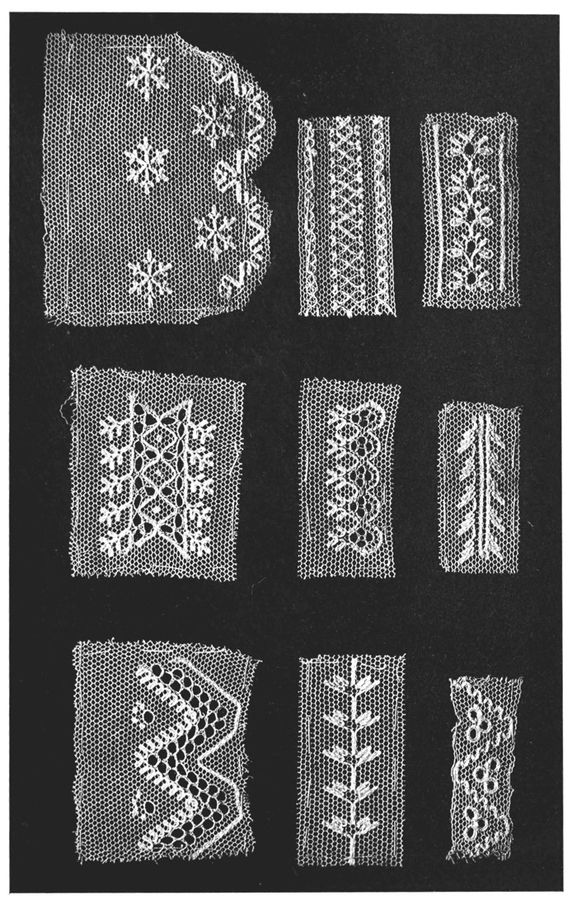
Plate 23.
One page from a sampler of darned net laces owned in Ipswich, England, brought from there by Mrs. Guy Antrobus (Mary Symonds), and lent by her for reproduction here. Figure 5 of this plate (middle of second row) proved to be of the same design as that of the American lace in Figure 1 of Plate 19. There are one hundred and forty-three different designs for darned net, insertion, and trimming lace in this little sampler book, made simply of sheets of blue paper on which the lace is sewed.
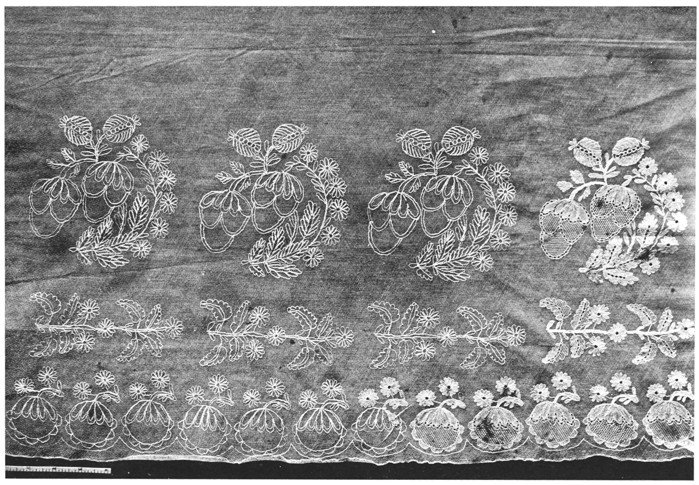
Plate 24.
Unfinished hand-run, or darned net, veil. Made by Mrs. Thomas L. Rushmore about 1825. Owned by the Metropolitan Museum of Art, New York City.
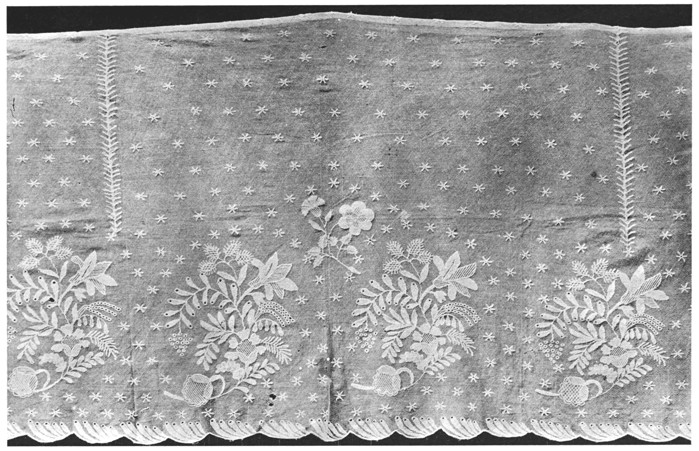
Plate 25.
Part of a dress skirt of white net. Worked by Cornelia Kingsland, born in 1806, died in 1890, daughter of Stephen and Mary Kipp Kingsland, cousin to Mayor Kingsland, of New York City. She married Captain Hatherly Barstow, who was lost at sea two years after her marriage. She was taught lace-making in her girlhood by a French lady, was an expert needlewoman, and made two whole lace dresses—this skirt in 1822. This lace was given by her niece, Mrs. Eleanor T. Smith, to the Metropolitan Museum of Art, New York City.
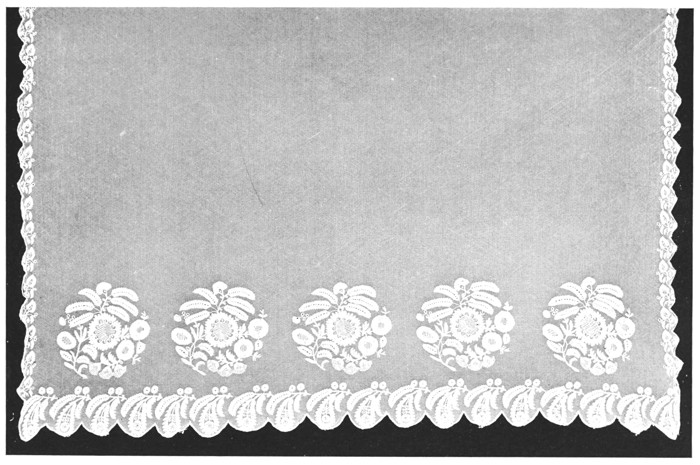
Plate 26.
White veil, 46 inches long and 42 inches deep. Worked in chain stitch, or tambour, by Catherine Roosevelt Kissam, of New York, daughter of Benjamin Kissam and his wife, Cornelia Roosevelt. She married Francis Armstrong Livingston in 1822. She attended the Moravian school at Bethlehem, Pennsylvania, where she was probably taught lace-making. Mr. Livingston died in 1830. This veil is owned by Miss Helena Knox. (See also Plates 27–29.)
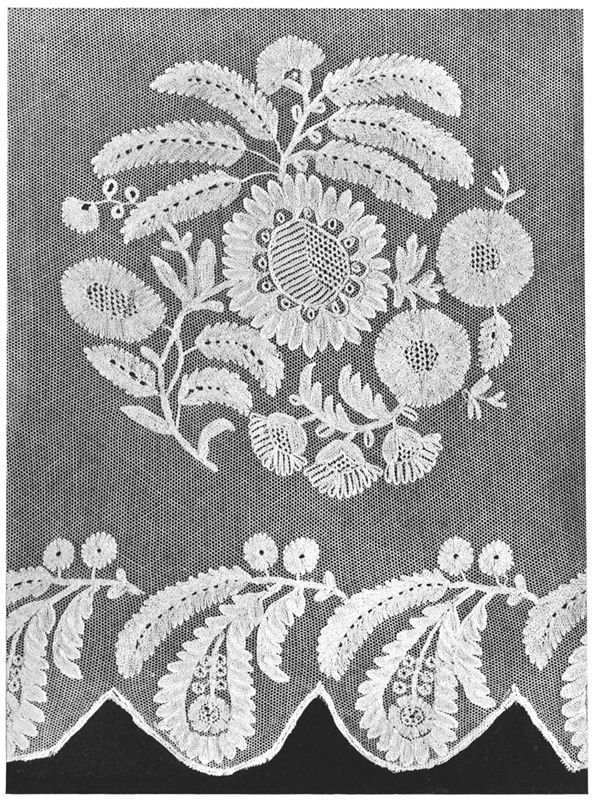
Plate 27.
Detail of veil shown in Plate 26.
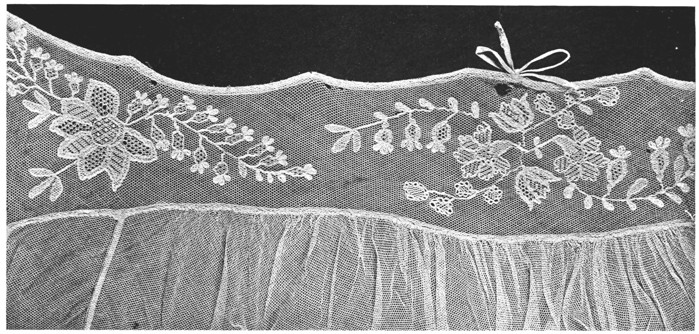
Plate 28.
Front of cap. Worked with a variety of lace stitches, probably by the same hand as the original of Plates 26 and 27. Both originals are owned by Miss Helena Knox, granddaughter of Catherine Roosevelt Kissam. (See also Plate 29.)
The school at Bethlehem, Pennsylvania, was the outgrowth of a religious community founded in 1722 at Herrnhut, Germany, by Count Zinzendorf. A number of its members came to Pennsylvania and there started a colony, which later developed into two schools, one for boys and one for girls. The one for girls became very popular. Fine needlework was taught, but as an extra; as the school records say, “Tambour and fine needlework” at the rate of “seventeen shillings and sixpence, Pennsylvania currency.” Here and there are remains of the fine work done by pupils of that school—all kinds of embroidery as well as pictures. Needlework was also taught at Miss Pierce’s Female Academy in Litchfield, Connecticut, from which a number of examples remain, besides pictures painted in water-colors.
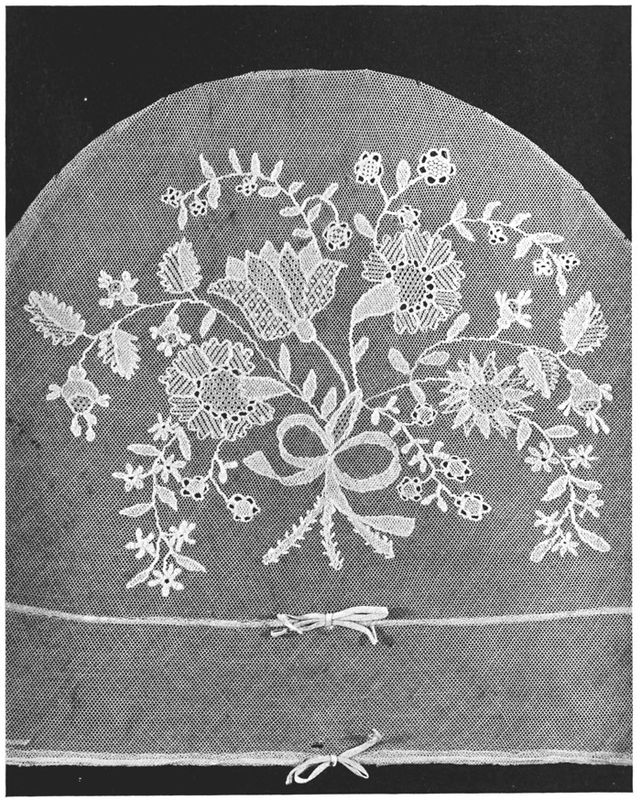
Plate 29.
Crown of cap shown in Plate 28.
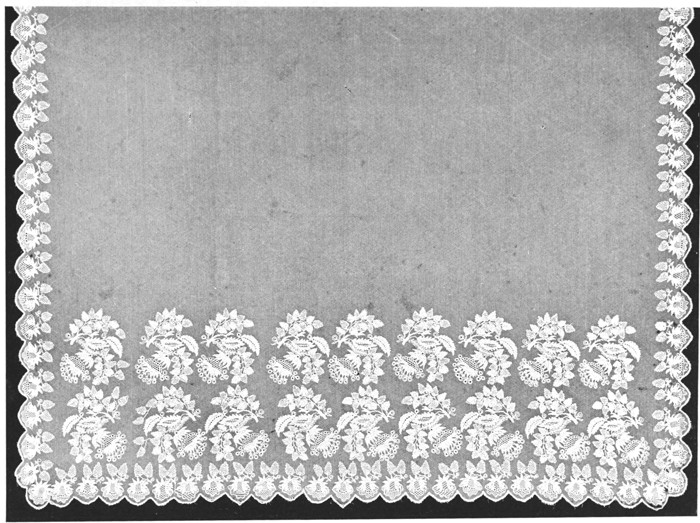
Plate 30.
White veil, 48 inches long, 38 inches wide. (See also Plate 31.) The linen thread used to work this veil, like much of that used in the other white lace, is of peculiar texture, much resembling silk.
This veil was made about 1827 and worn at her wedding by Mary W. Peck, stepdaughter of Dr. Abel Catlin, who lived in Litchfield, Connecticut, in the house on the west side of North Street now occupied by Mr. Frederick Deming. Her name is on the list of pupils of Miss Pierce’s Litchfield Female Academy for 1811. (She also appears on the list for 1825, but as teacher of drawing.) She married Edward D. Mansfield, a student of the Litchfield Law School. Her son, Charles, paymaster in the United States Navy, gave the veil, a baby’s dress (see Plate 89), and his mother’s album (which is ornamented with water-color paintings and contains written verses and sentiments, with autographs, of all the people prominent in Litchfield at that time) to the Litchfield Historical Society about 1890.
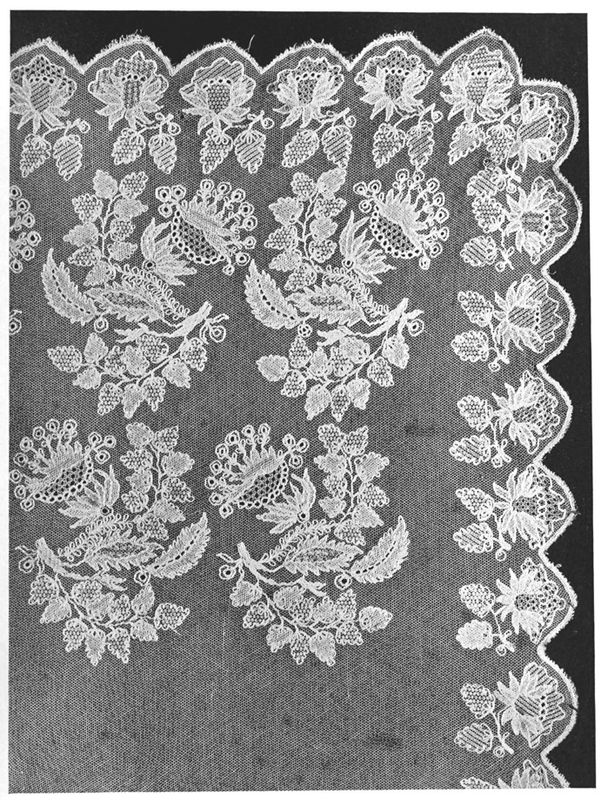
Plate 31.
Detail of veil shown in Plate 30.
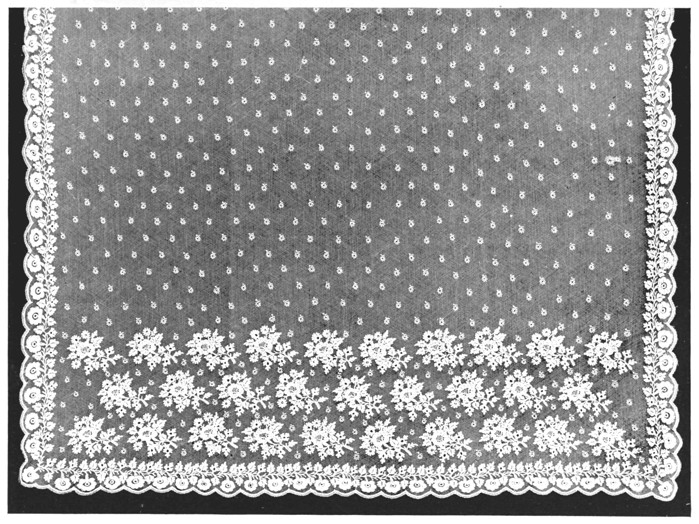
Plate 32.
Veil. Worked by Elizabeth Hannah Canfield about 1830. The maker was a daughter of Judge Judson and Mabel Ruggles Canfield, of Sharon, Connecticut, and a sister of Caroline Canfield. (See Frontispiece and Plates 51, 52, and 76–81.) She attended the well-known school kept by Miss Sarah Pierce in Litchfield, Connecticut. This school was contemporary with the first law school founded in the United States, also in Litchfield. Miss Canfield, being very handsome, was called by the law students “the Rose of Sharon.” She married Frederick Augustus Tallmadge, son of Colonel Benjamin Tallmadge and Mary Floyd, of Litchfield. She lived subsequently in New York City. The veil was given to the Litchfield Historical Society by her daughter, Mrs. Edward W. Seymour. (See Plates 33, 35, 51, 52, 54, and 55; also the description of Plate 81.)
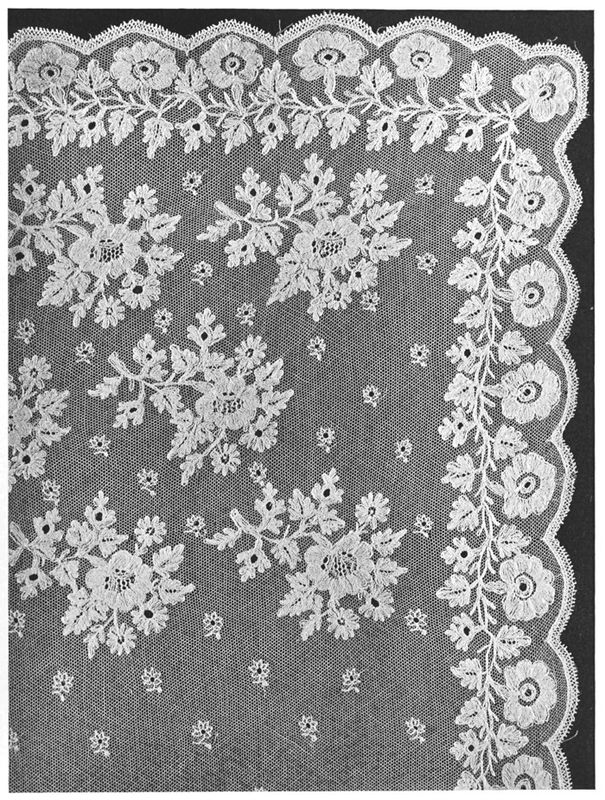
Plate 33.
Detail of veil shown in Plate 32.
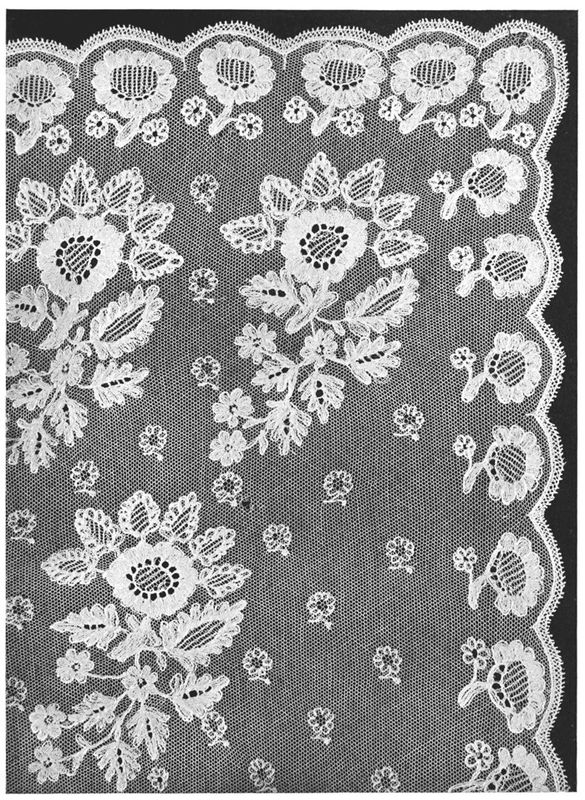
Plate 34.
Detail of similar white veil, 38 inches long by 38 inches wide. From the collection of Ellen McBride, wife of Judge Aaron Vanderpoel, of Kinderhook and New York. Made probably by her or a sister about 1835. Owned by the Litchfield Historical Society.
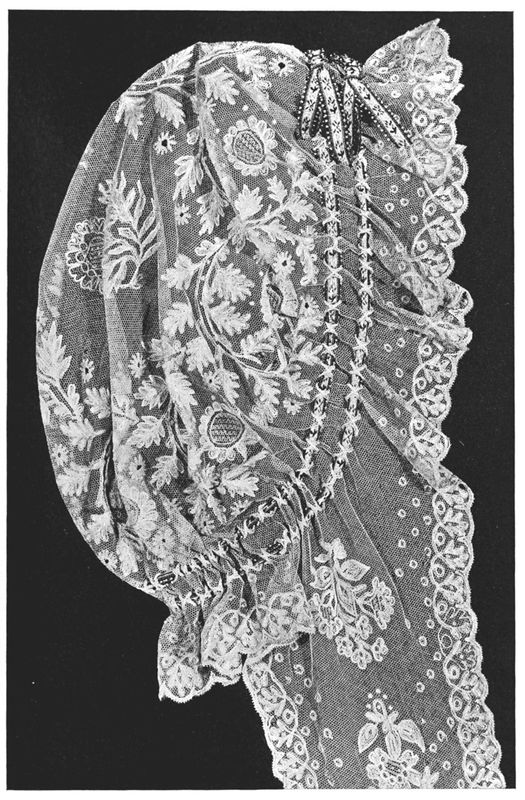
Plate 35.
Lace cap. Worked by Elizabeth Hannah Canfield (Mrs. Frederick Augustus Tallmadge) about 1830. Owned by the Litchfield Historical Society. (See Plates 32, 33, 51, 54, and 55; also description of Plate 81.)
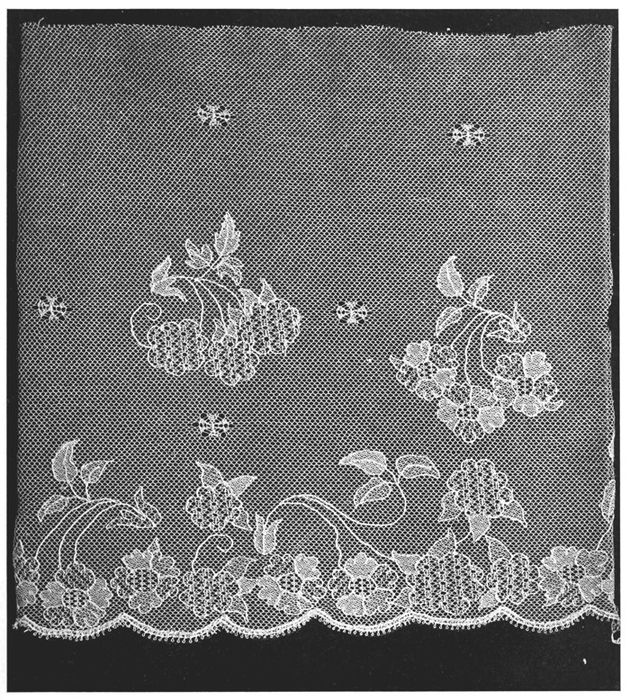
Plate 36.
A piece of Limerick trimming lace made in Limerick, Ireland. Bought in 1922 of Arnold, Constable & Company, New York City. This shows that the kind of lace taught by the girls taken to Limerick by Mr. Charles Walker in 1829 is still being made there and is of the same technique as that made in New England a hundred years ago. Owned by the Litchfield Historical Society.
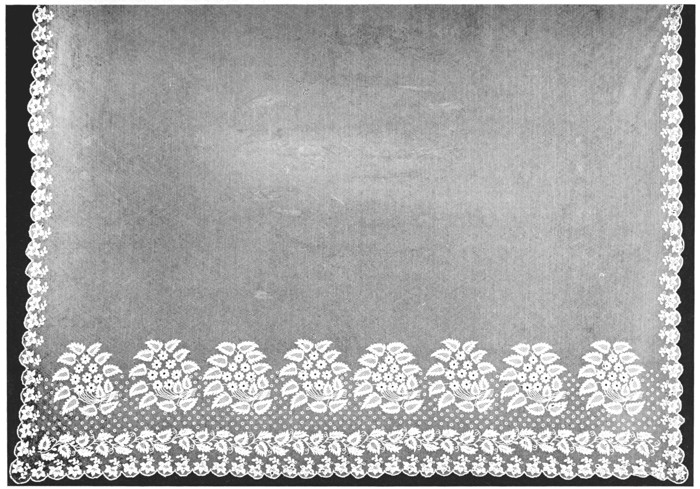
Plate 37.
White veil. “Made by Sarah Elizabeth Johnson, descended on one side from the first president of King’s College, New York, and on the other from Jonathan Edwards. She married in 1827 her second cousin, George Pollock Devereux, of Raleigh, North Carolina. The ten years of her married life were spent with him on a lonely plantation in Bertie County, North Carolina, and it was during this time that the lace was made. (Probably from 1830 to 1840.) She then returned to her old home in Stratford and New Haven and died in 1867.” (Extract from a letter written by her granddaughter, Miss Marianna Townsend, who owns the veil.)
The example given in this plate measures as a whole 42 inches wide by 33 inches long. (See also Plates 38 and 39.)
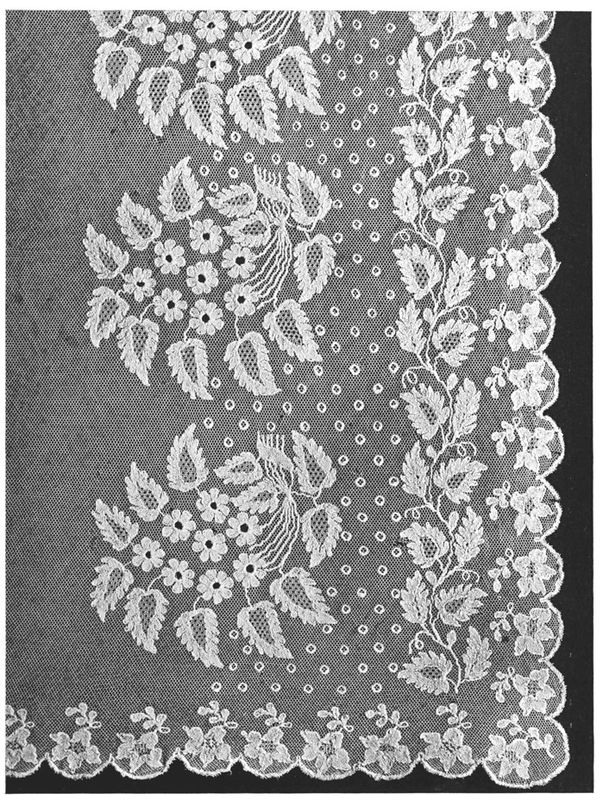
Plate 38.
Detail of veil shown in Plate 37.
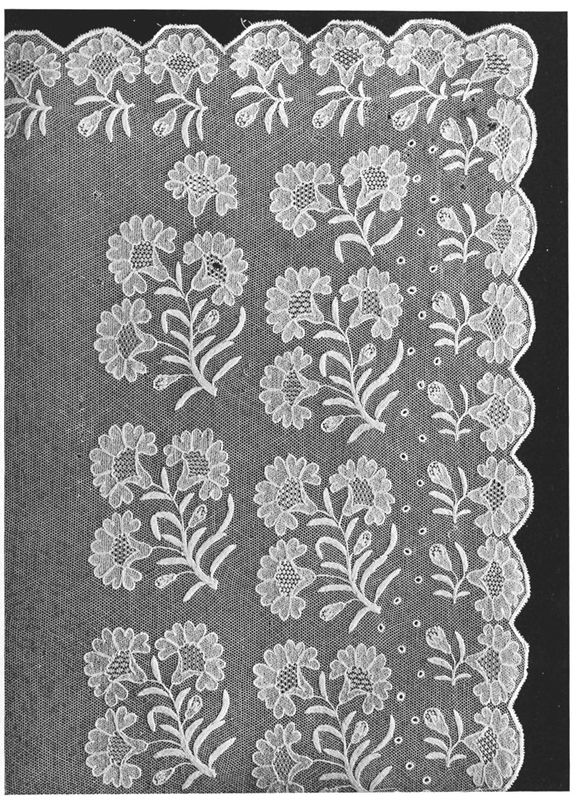
Plate 39.
Detail of a second veil made by Sarah Elizabeth Johnson (Mrs. George Pollock Devereux). (See Plate 37.) Owned by Miss Marianna Townsend.
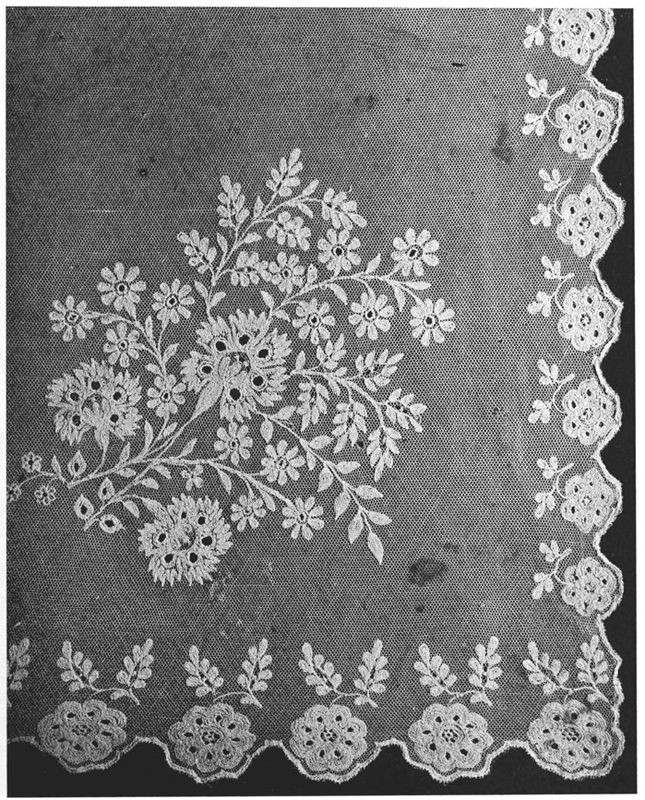
Plate 40.
White net veil, 34 inches wide by 36 inches long. This plate gives one corner of the veil, with one of the four sprays. It was worked in tambour stitch, in the family, for Ann Stodart’s wedding veil when she married Horace Gooch in 1830. She was the daughter of Robert and Sarah Stodart. The bride walked in a procession from her father’s house to the church in what was then a little village, though it is now a part of London. Highly cultivated, particularly in music, she was a pupil of Mendelssohn when he lived in England, and one of the ten pupils chosen by him to play with him before Queen Victoria. In 1830 she came to America with her husband, bringing in a sailing vessel all their household goods, including two pianos and a harp. They stopped on their way West for the birth of her first child. Mr. Gooch bought a large tract of land near Cincinnati and built on it a fine house. It is a show house to this day. She had eight children when her husband died, leaving house, land, and children, but no money. She then opened in her own house a large and successful school which lasted for many years. The veil shown here is owned by her granddaughter, Miss Clara Ray.
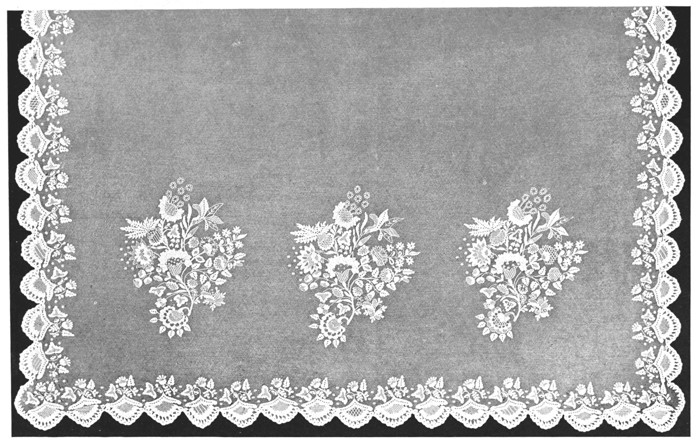
Plate 41.
White veil. Made by Marietta, or Mary, Smith, born July 18, 1806, died November 28, 1889, daughter of James Smith and his wife, Gloriana Shelton, of Derby, Connecticut. The whole veil is 48 inches wide by 46 inches long. It was made about 1830. It contains seventeen lace stitches. (See also Plates 42 and 43.)
Quaint details of the home and habits of her forebears and of the romance which saddened without spoiling her life, are interestingly portrayed in The Salt Box House , published some years ago. At thirteen years of age she was taken to Miss Pierce’s Female Academy at Litchfield, Connecticut, where her father left her with the admonition, “Never forget your accountability,” and where she made satisfactory progress in her studies. The tone of mind of the day can be understood from a letter written to her father. Returning from school by stage coach, she recorded her arrival at a friend’s house in New Haven, where she was to await him. She wrote that there had been ten passengers in the coach, all but two of them ladies, and that the tedium of the journey had been relieved by the ladies’ taking turns in reading aloud an essay on “Good Behavior”!
Without doubt she learned at Miss Pierce’s school to make the veil shown in these plates; for Miss Mary W. Peck, who made her own wedding veil (see Plates 30, 31, and 89), was a teacher there.
The family was a social one. We read of the white crêpe frock which Marietta Smith had for a ball-dress in her fifteenth year. The romance of her life took place at seventeen, when she met a young Southerner. A mutual affection brought them together, but the two natures did not quite understand each other. They parted; but when he died, three years later, she realized her mistake with uncontrollable grief and was faithful to his memory during all her life. She had many other lovers; she read and studied, became interested in music and other things, visited and travelled; but “through all her long life the love of her youth remained a potent factor,” though she was never a grim old maid.
Miss Mary began keeping a journal—in a desultory way at first; later, as years passed, as one of the important interests of her life. She chronicles her father’s and mother’s deaths in a loving fashion. Living alone became more and more satisfactory. She wrote: “I take a world of comfort all alone in my house; nobody makes me afraid, even if they molest me in a gossiping way.... Staying in my own house in solitary state is very pleasant to me, but worries my neighbors.” The love of travel became a ruling power. The elegancies of life appealed strongly to Miss Mary. She was a welcome guest in many a great house. “The spell of intellect and culture is always irresistible to me,” she wrote; and “there are a great many ‘field-days’ in society. I love these musters at home and abroad, and in my day and generation have Vibrated through a great number. I occasionally join the gay circles, taking into consideration the expediency of airing my manners, to make sure I am modern and extant!” “Trimmed my borders and cut my grass this morning, trimmed my self in my royal robes this afternoon and made calls.”
The veil was given to the Litchfield Historical Society by the Misses Alice and Edith Kingsbury, of Waterbury, Connecticut.
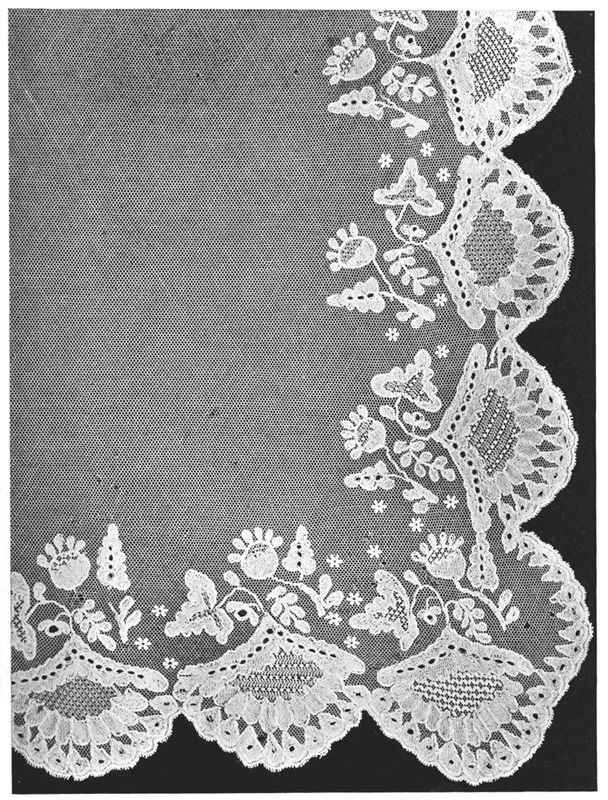
Plate 42.
Detail of veil shown in Plate 41.
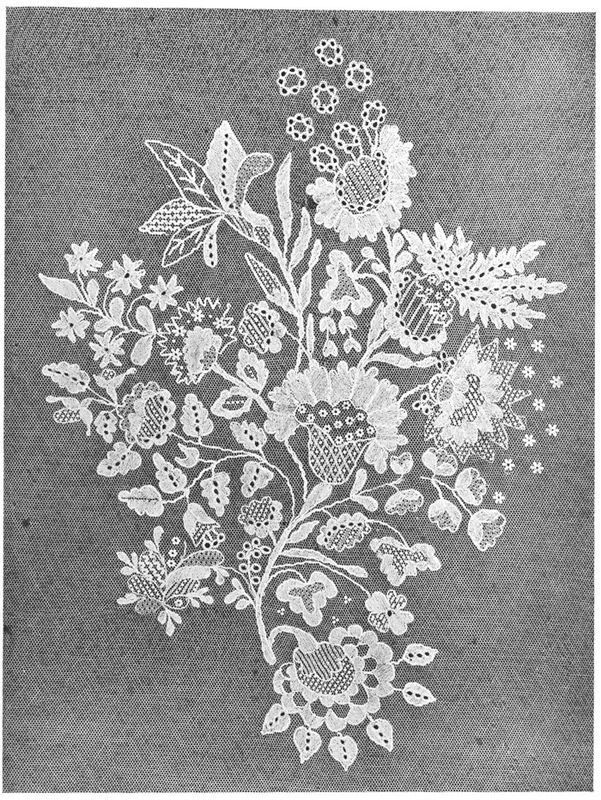
Plate 43.
Detail of veil shown in Plates 41 and 42.
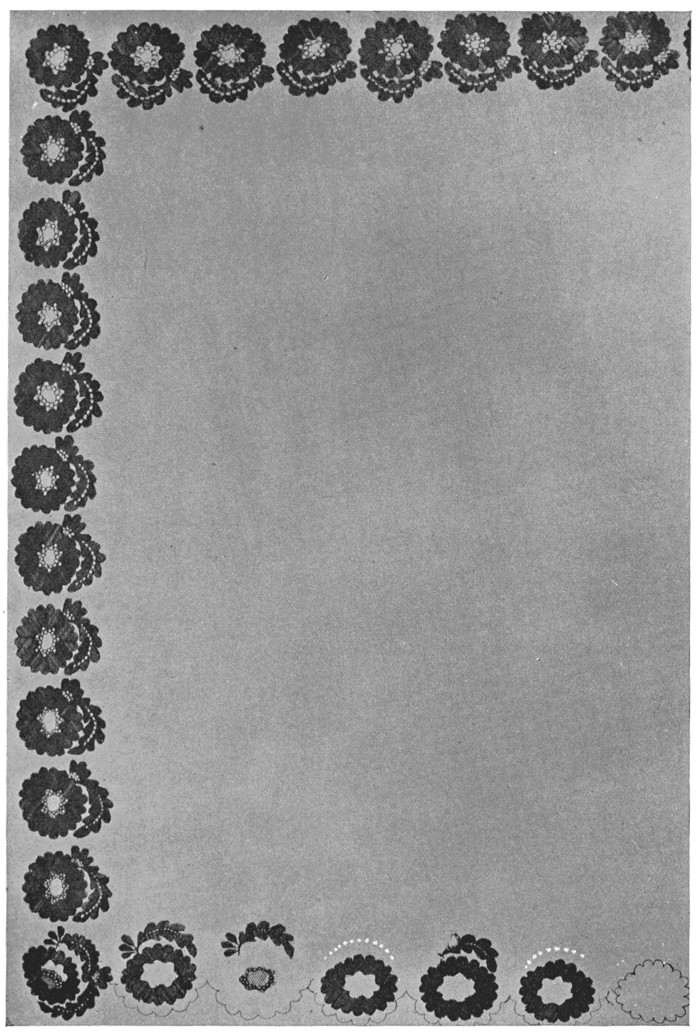
Plate 44.
Black net shawl, unfinished, 45 inches square. Begun about 1830 by Mrs. John Savage (Miss Barringer). She lived in New York City, at the corner of Varick and Franklin streets. Mr. John Savage was born at Portland, Connecticut. He was a vestryman of Christ Church, New York City. He died in 1845. The black lace seems to be entirely of silk net worked with silk of excellent quality, for it has kept well in both color and texture. (See also Plate 45.) Owned by the Litchfield Historical Society.
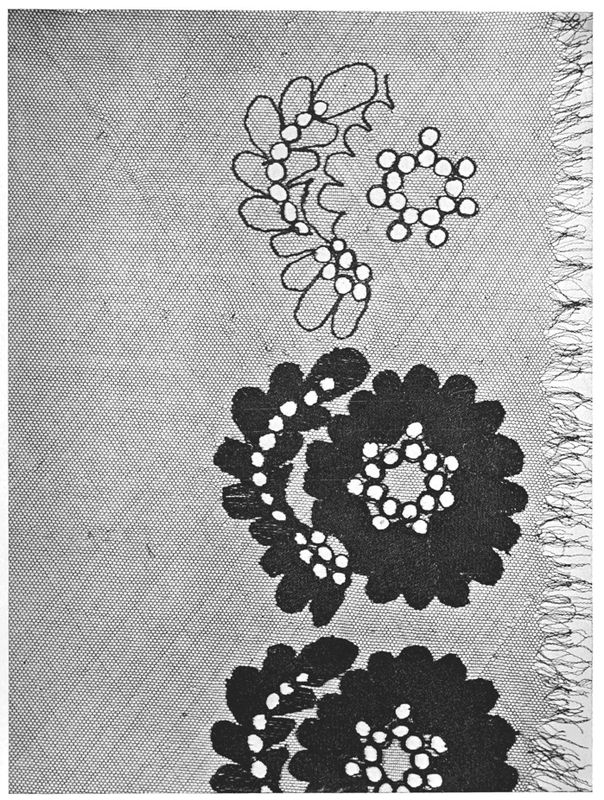
Plate 45.
Detail of shawl shown in Plate 44.
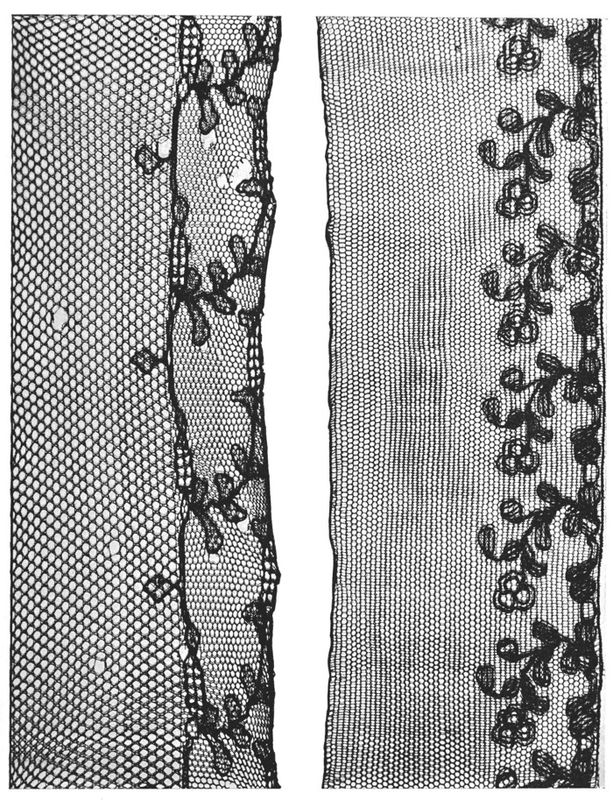
Plate 46.
Figure 1 (at left). Black trimming lace. Worked by Elizabeth, or Betsey, Peck, of Woodbridge, Connecticut, and worn on a velvet cloak. She married Camp Newton in 1798. (See also Plate 74, Figure 2.) Owned by her granddaughter, Mrs. Samuel H. Street, of Woodbridge, Connecticut.
Figure 2. Black trimming lace worked by Pamela Parsons. (See Plate 92.) Owned by Mrs. Charles B. Curtis. (See descriptions of Plates 93–96.)
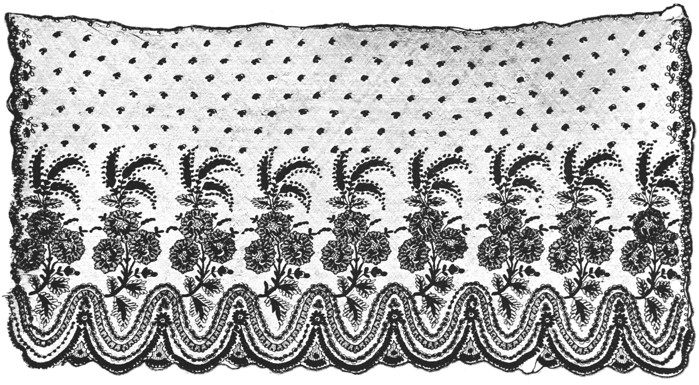
Plate 47.
Black veil, 40 inches wide by 21 inches long. From the Buel family of Litchfield, Connecticut. Date probably 1830. Owned by the Litchfield Historical Society.
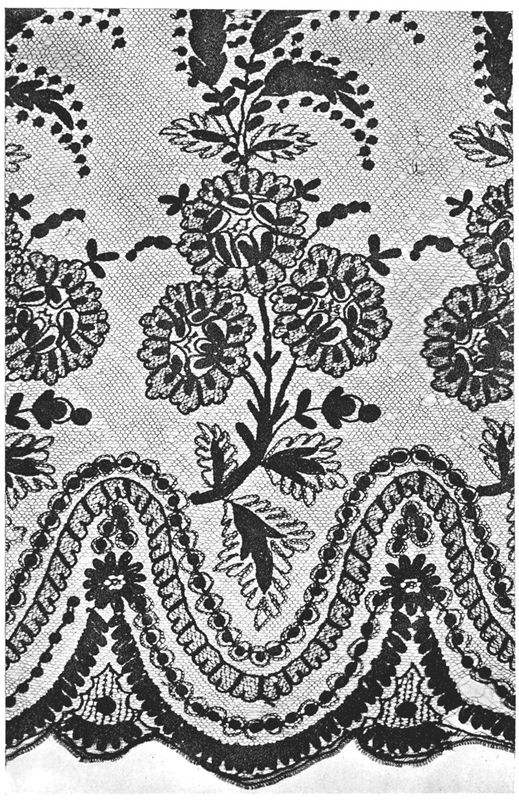
Plate 48.
Detail of veil shown in Plate 47.
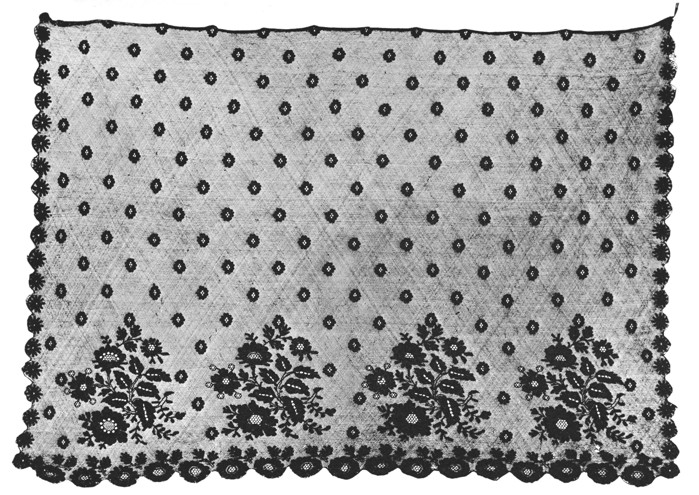
Plate 49.
Black lace veil, 27 inches long by 86 inches wide. Made by Polly Marsh, daughter of Elisha and Rhoda Kilbourn Marsh, about 1830. She was born December 9, 1804, and died January 8, 1892. She lived about three miles north of Litchfield, Connecticut, on the Goshen road, in a farmhouse where she took great pride in her parlor with its sanded floor and curtains of thin blue and white linen, which she had spun, woven, and dyed herself. She was a direct descendant of John Marsh, who went in May, 1715, alone on horseback, westward through the wilderness from Hartford, Connecticut, to find a suitable site for a new settlement. He chose what is now the town of Litchfield, Connecticut, situated on a long, high ridge running north and south. It took him five days to make the trip.
“Her entire life was spent in Litchfield and ... must have been uneventful. She did not marry, and the laborious duties of a farming household left little time for outside interest. [She was] modest and retiring by nature. Her ... industry and devotion to her home leave many memories fondly cherished by her kin.”
Owned by Polly Marsh’s niece, Mrs. Lewis Marsh.
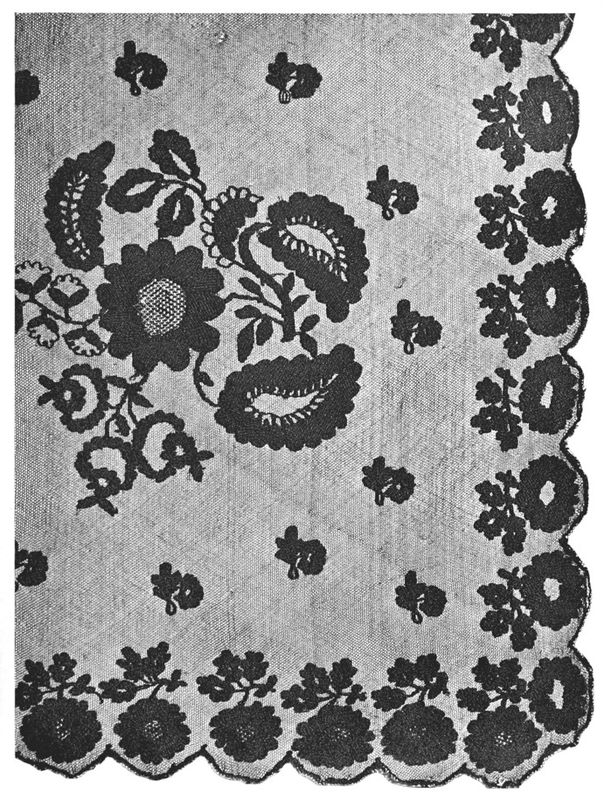
Plate 50.
Detail of a second black lace veil, 34 inches long by 42 inches wide, made by the same Miss Marsh. (See Plate 49.) Owned by her niece, Mrs. Lewis Marsh.
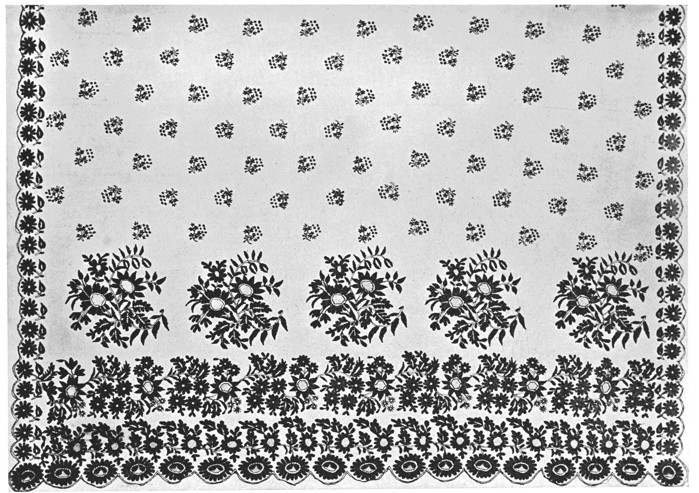
Plate 51.
Black lace veil. Made by either Caroline or Elizabeth Hannah Canfield, of Sharon, Connecticut, and New York City, about 1830. (See also Plate 52.) Forty inches wide by 38 inches long. Given by the daughter of one and niece of the other, Mrs. Edward W. Seymour, to the Litchfield Historical Society. (See also Frontispiece and Plates 32, 33, 35, 54, 55, and 76–81.)
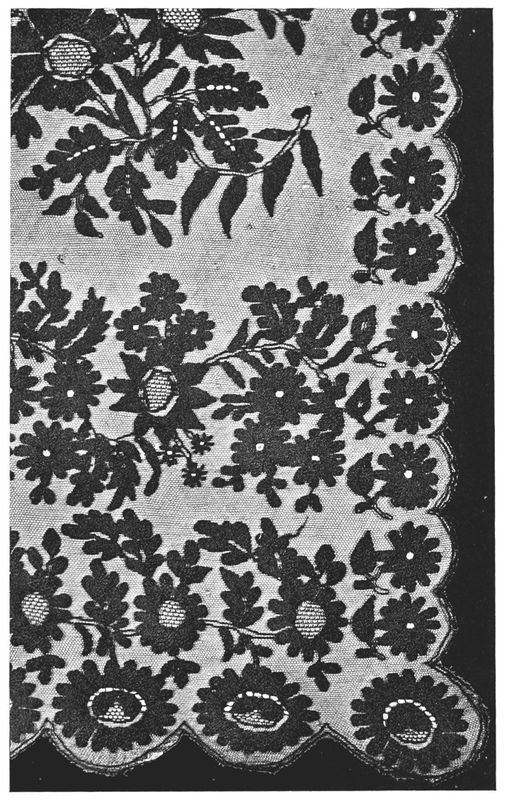
Plate 52.
Detail of veil shown in Plate 51.
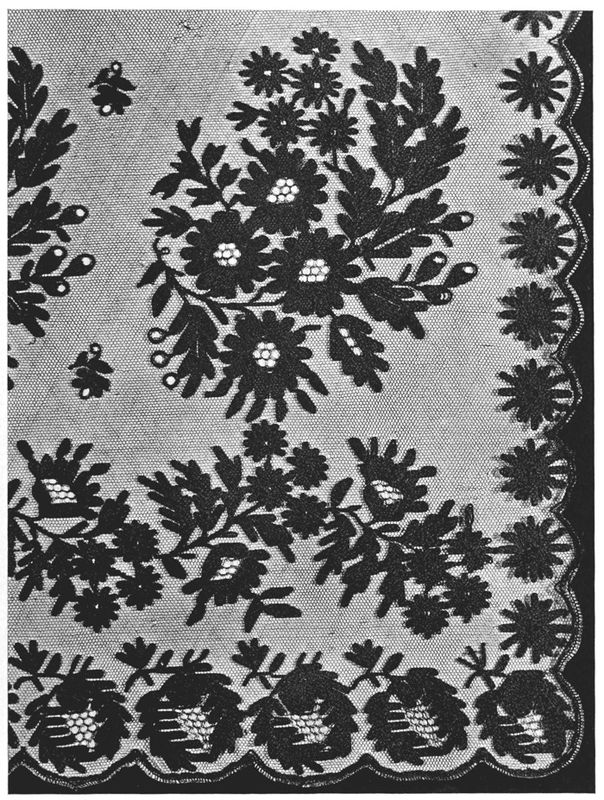
Plate 53.
Detail of black lace veil, 44 inches wide by 23 inches long. Made by Louisa Lewis (Mrs. Henry Phelps), of Litchfield, Connecticut, about 1825. Given by her daughter, Miss Mary Phelps, to the Litchfield Historical Society. (See also Plates 83 and 84.)
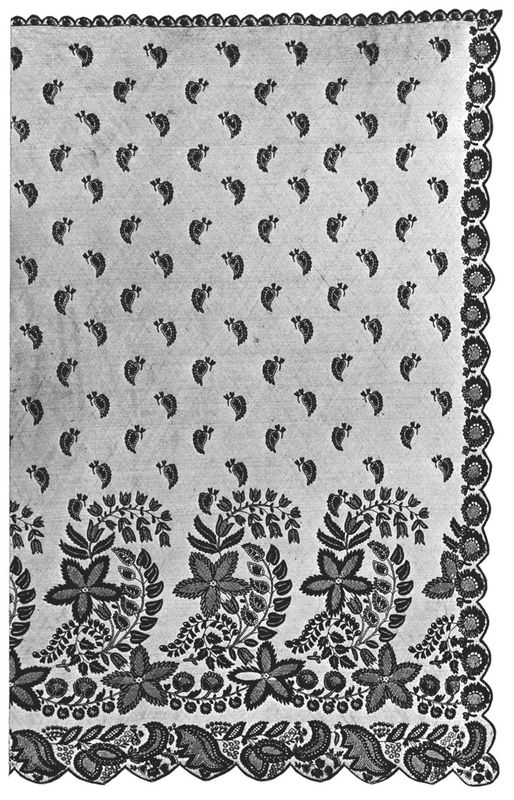
Plate 54.
Black veil. Made by Elizabeth Hannah Canfield about 1825. Owned by the Litchfield Historical Society; given by the maker’s granddaughter, the author. (See Plates 33, 35, 51, 52, and 55; also the description of Plate 81.)
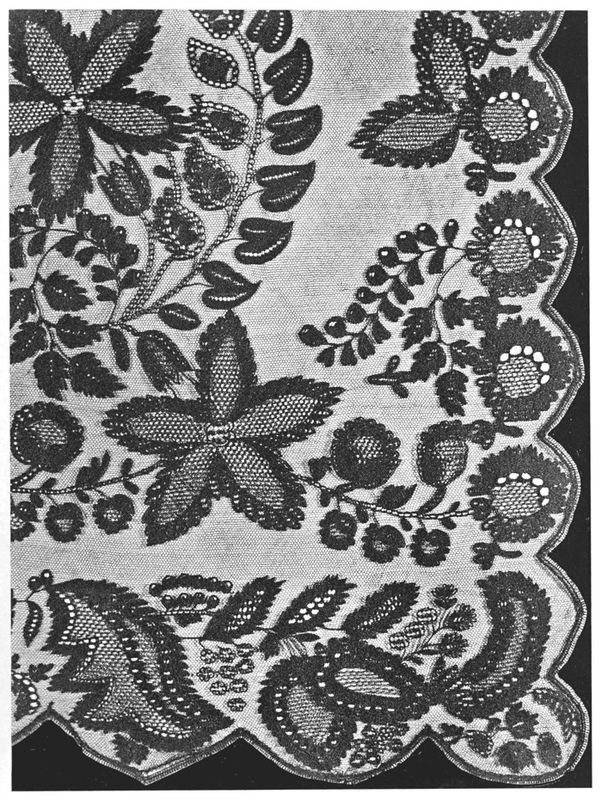
Plate 55.
Detail of veil shown in Plate 54.
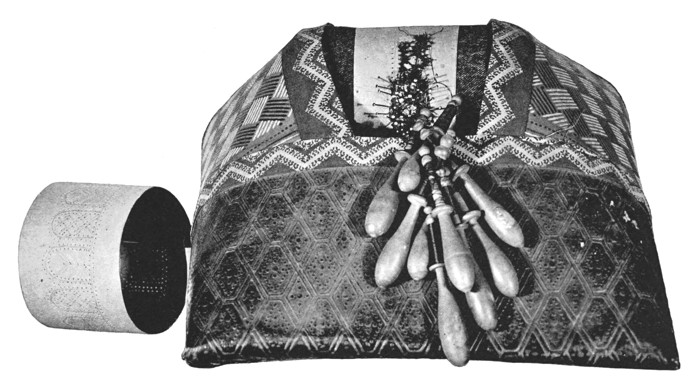
Plate 56.
Lace pillow and bobbins with black trimming lace. Begun by Miss Nina Hall Brisbane, of Charleston, South Carolina, born February 15, 1842, died at Brooklyn, New York, February 13, 1921. She learned to make pillow bobbin lace from nuns in a convent at St. Augustine about 1870. She gave her pillow to the Litchfield Historical Society while temporarily living in Litchfield.
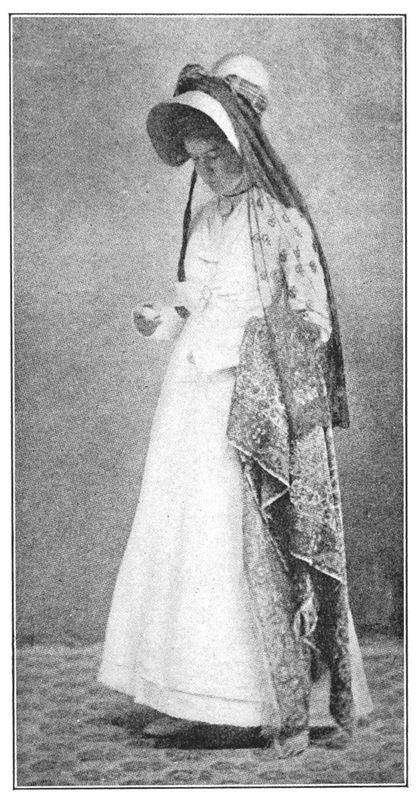
Plate 57.
Costume of 1825: gown, shawl, bonnet, and veil; showing how veils were then worn. The veil was made by Mary Bacon (Mrs. Chauncey Whittlesey; see Plate 71 and description). Lent by Mrs. Edward W. Preston, of Roxbury, Connecticut. (From Chronicles of a Pioneer School , by E. N. Vanderpoel.)
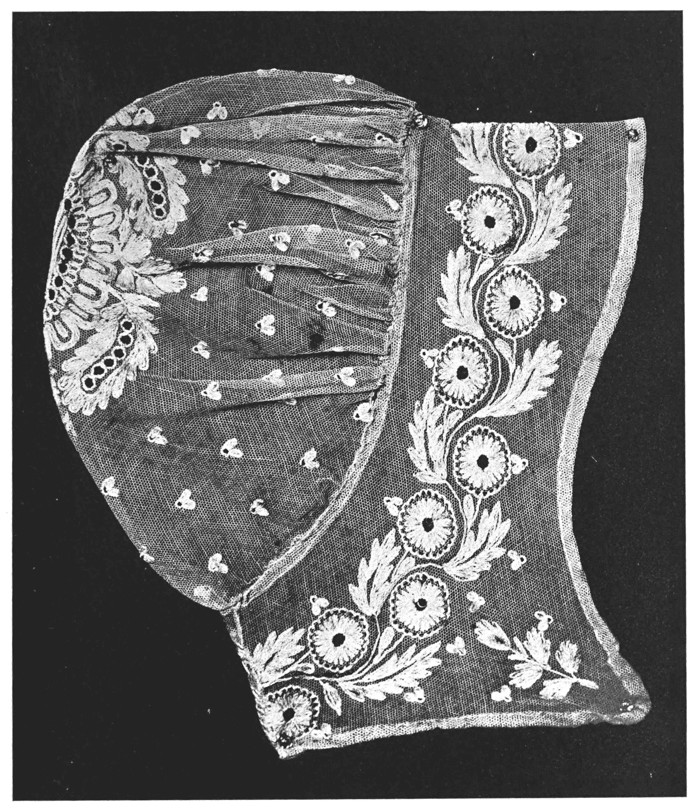
Plate 58.
Cap. Worked by Miss Elsie Philips, niece of the first mayor of Boston, Massachusetts. Owned by the Museum of Fine Arts, Boston, Massachusetts.
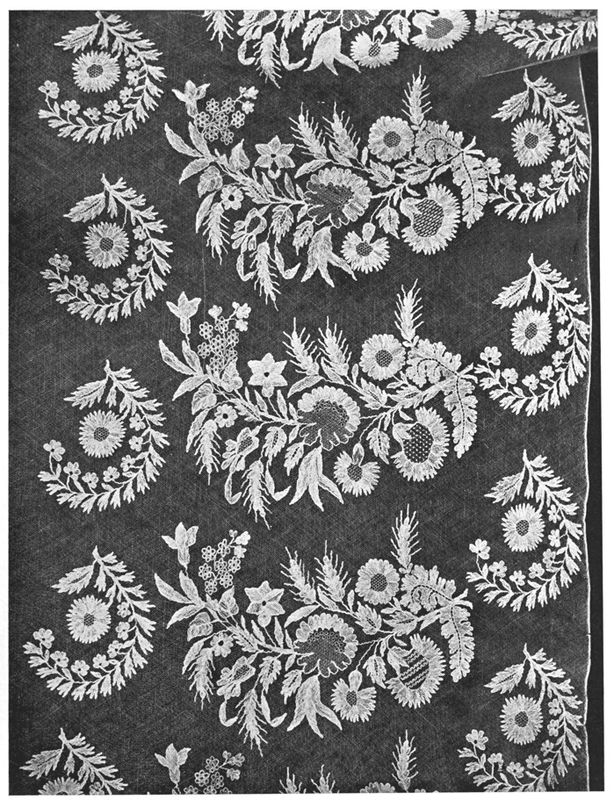
Plate 59.
Lace flounce on dress skirt. Made by Mrs. Charles Sever (Charlotte Webster), of Boston, between 1830 and 1834. Given to the Museum of Fine Arts, Boston, Massachusetts, by her daughter, Mrs. Walter H. Cowing.
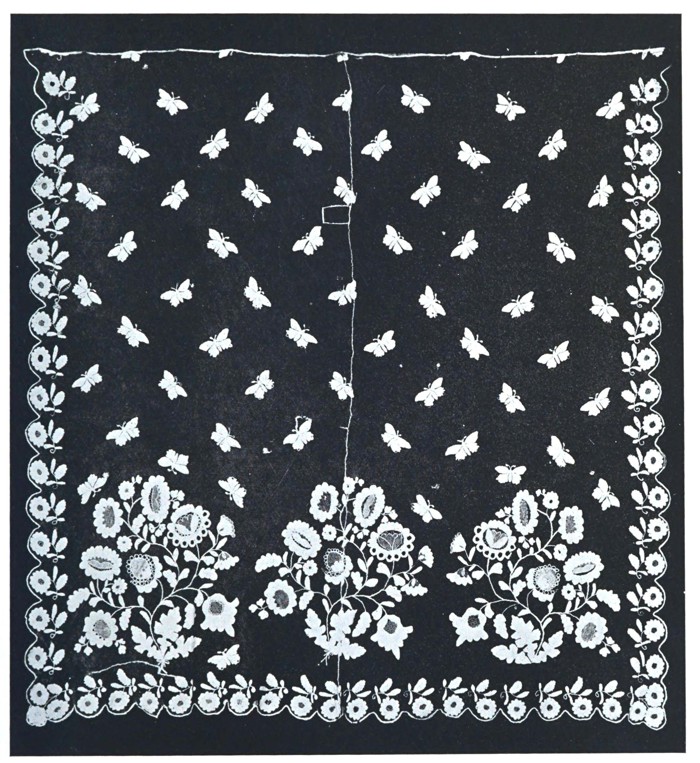
Plate 60.
Veil. Worked by Delia I. Beals, of Pavilion, Genesee County, New York, from her seventh to her tenth year, 1834–1837, and worn later by her at her wedding. The design was drawn by her mother. The lace of the ground is too fine to photograph well. Owned by the Museum of Fine Arts, Boston. (See also Plate 61.)
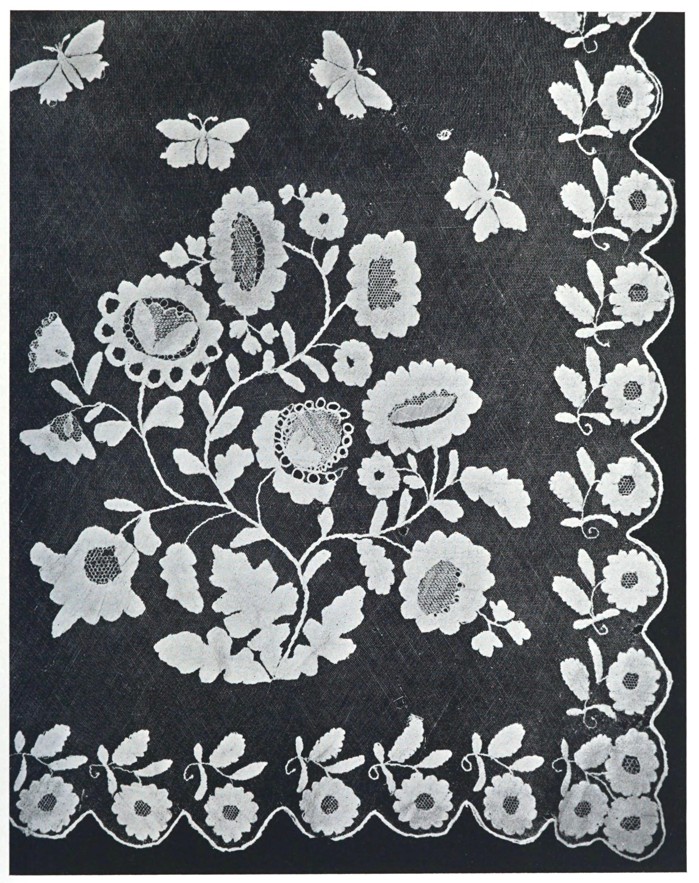
Plate 61.
Detail of veil shown in Plate 60.
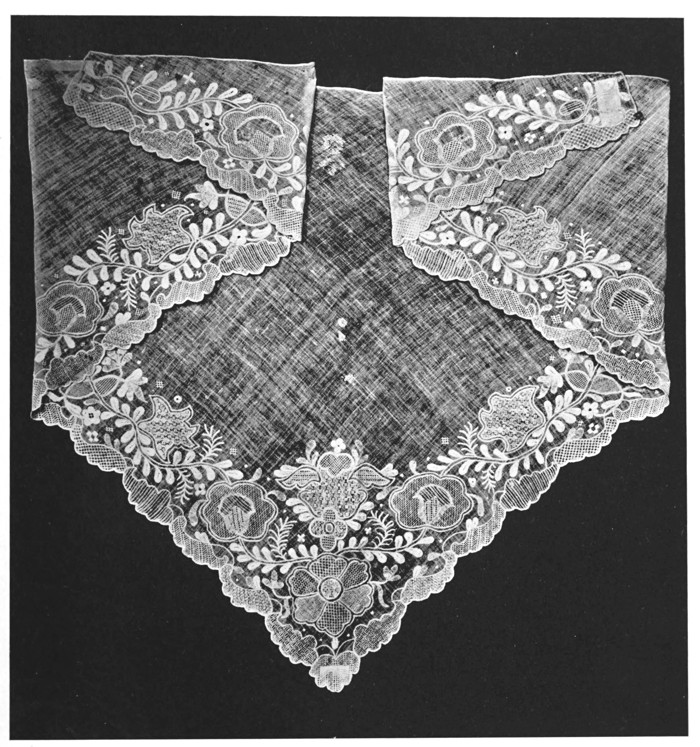
Plate 62.
Embroidered kerchief. Worked by Rachel Leonard in 1752. The date and her initials are worked on the ends. Owned by the Museum of Fine Arts, Boston.
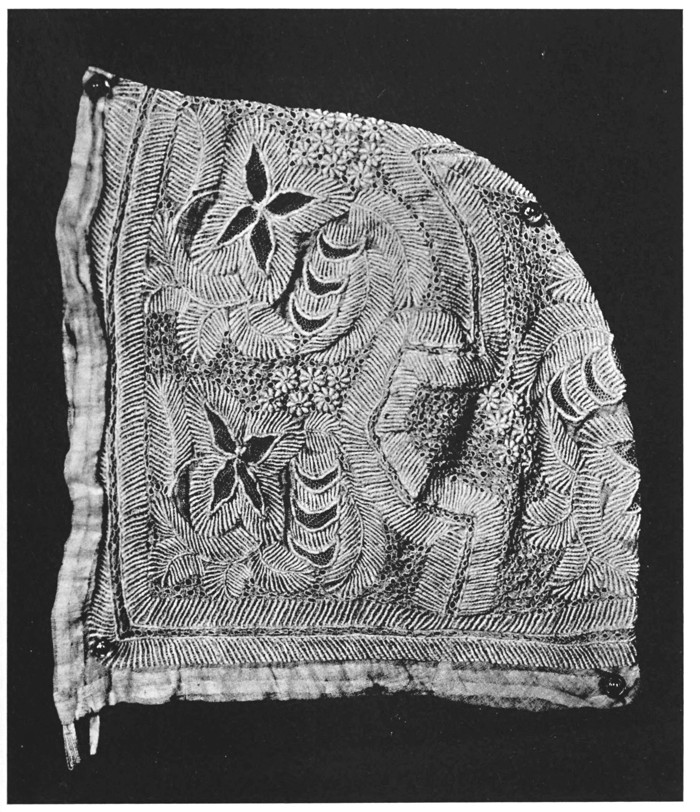
Plate 63.
Infant’s embroidered cap. Lent to the Museum of Fine Arts, Boston, by Miss Katherine Egbert. Maker unknown. Made about 1820.
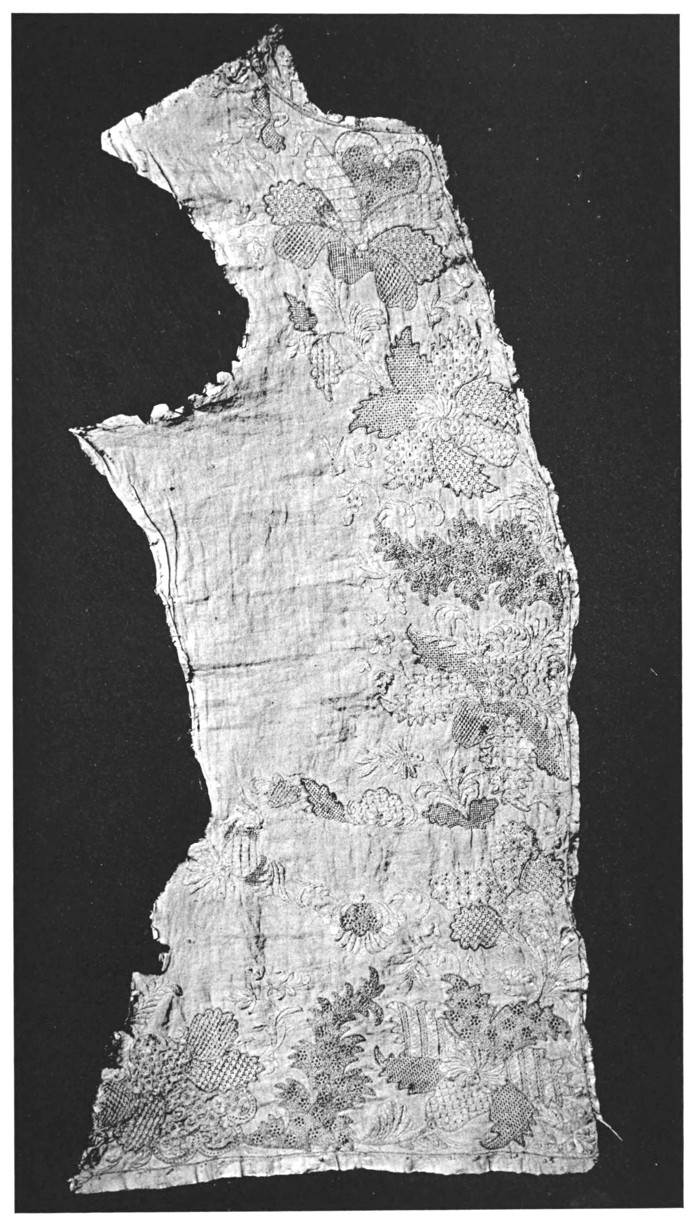
Plate 64.
Part of a man’s embroidered white linen waistcoat. Lent to the Museum of Fine Arts, Boston, by Mr. William S. Eaton. Maker unknown. A magnifying glass should be used with this plate for appreciation of the delicacy of the stitches.
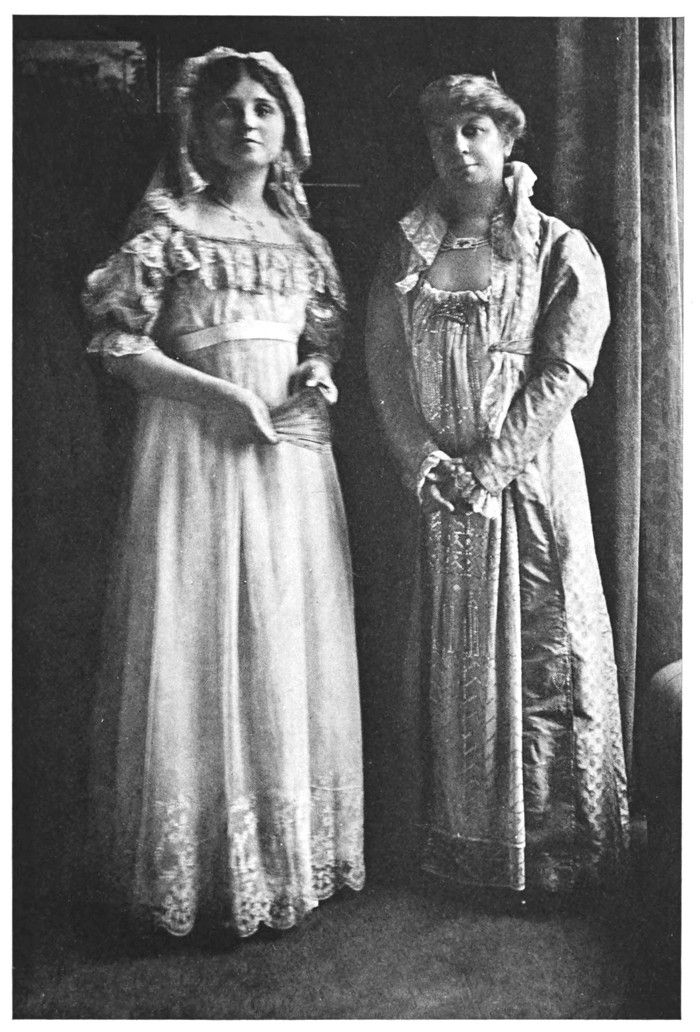
Plate 65.
Wedding-dress and marriage reception-dress of Catherine Van Houten. She made the lace herself.
(Plates 65–70 show laces and embroideries made by the same hand. Catherine Van Houten, daughter of Garrabrant and Jane Van Houten, was born June 8, 1806, and died March 9, 1874. She lived all her life at 113 Water Street, Paterson, New Jersey. She attended Miss DeLancey’s private school in Orange, New Jersey, and it was there that she learned to make lace. In June, 1830, she married Ralph Doremus.
The collection represented by Plates 65–70 is owned by her daughter, Mrs. William Nelson. It consists of the articles shown and, in addition, four lady’s caps, two infant’s caps, four infant’s dresses, one infant’s shirt, and a black lace veil about 36 by 42 inches—all the work of Mrs. Doremus; also slippers, gloves, and openwork silk stockings for the wedding, black satin slippers, and a housewife—“housewife” being the old name for a needlebook. See also description of Plate 76.)
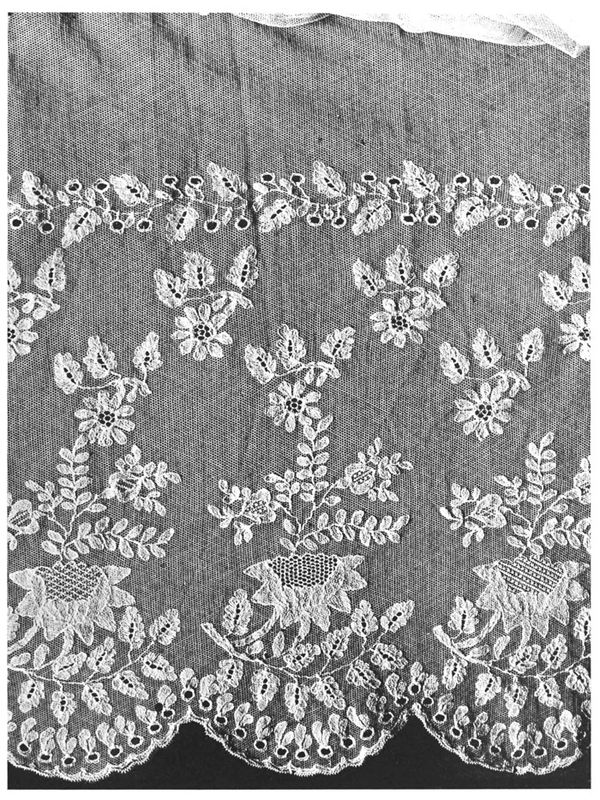
Plate 66.
Detail of skirt of wedding-dress shown in Plate 65.
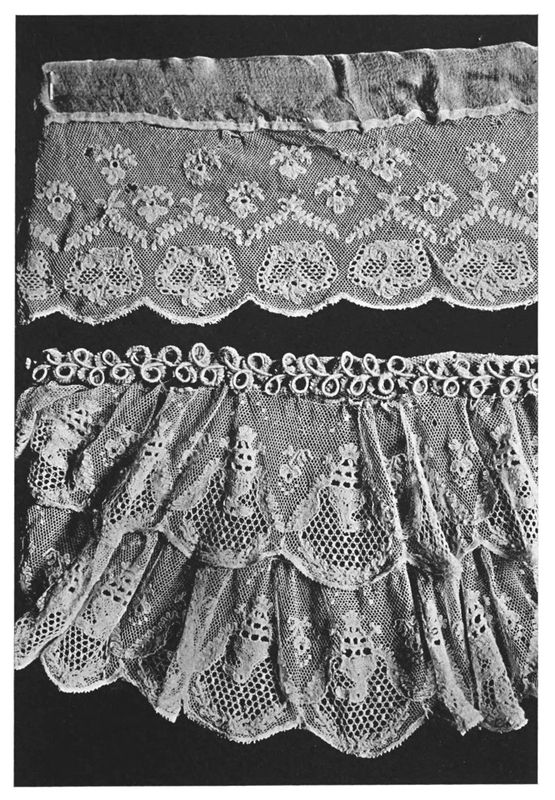
Plate 67.
Details of lace on waist of wedding-dress shown in Plate 65. Designs: crowns and spread eagles.
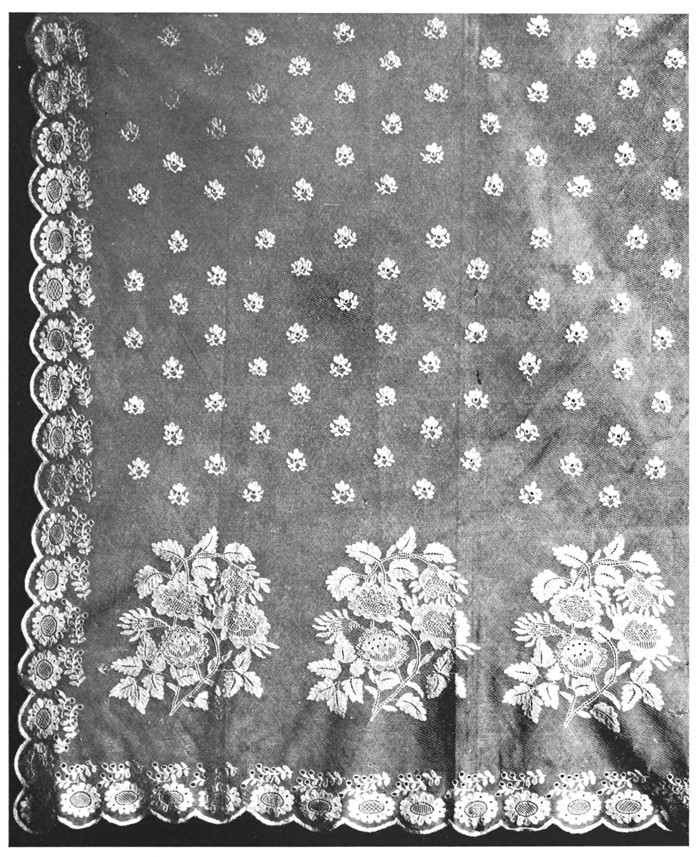
Plate 68.
Wedding veil. (See description of Plate 65.)
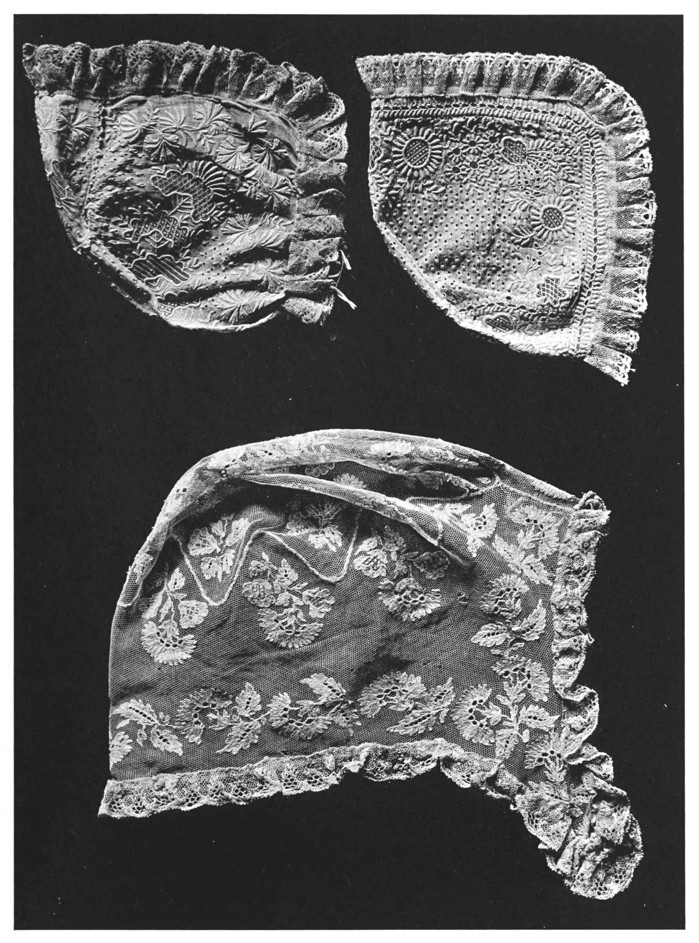
Plate 69.
Lady’s and infant’s caps. (See description of Plate 65.)
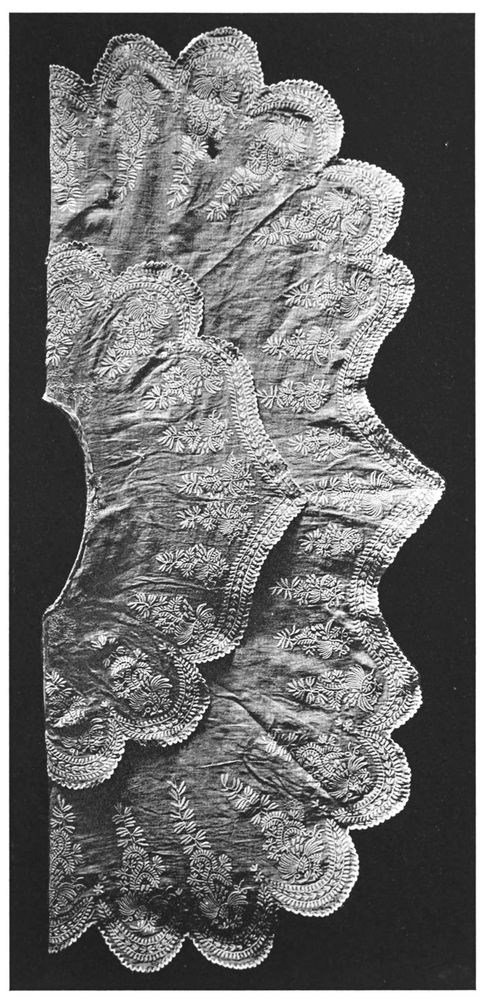
Plate 70.
The back of a collar or cape, about one-half size. Miss Van Houten saw the model from which she embroidered this in the trousseau of a friend, who had just brought it back from Paris. She said it was the only thing for which she envied her friend, who replied, “Then make one like it yourself”; and she did so, in the six weeks before her marriage. It has long lappets in front. (See description of Plate 65.)
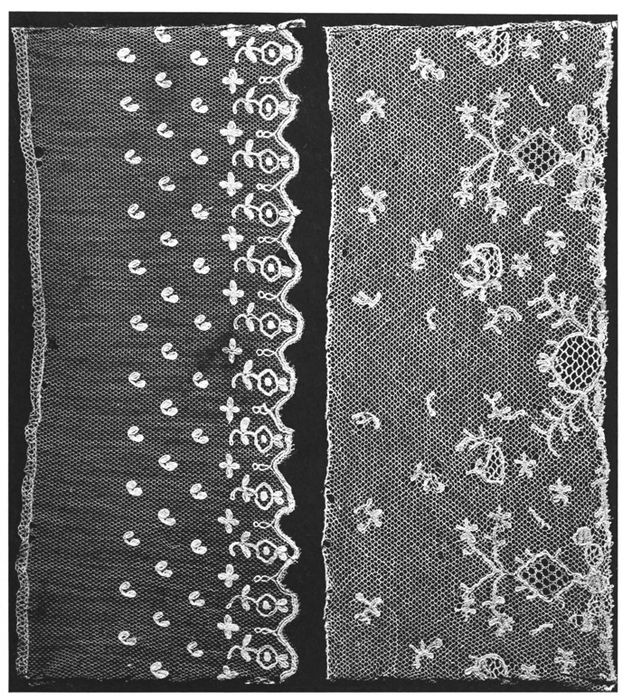
Plate 71.
Two pieces of white lace. Made by Mary Bacon, born February 9, 1787, in Roxbury, Connecticut. She married, November 13, 1815, Chauncey Whittlesey, also of Roxbury. She was a pupil at Miss Sarah Pierce’s Female Academy in Litchfield, Connecticut, in her fifteenth year (see Foreword). Besides painting in water-colors and embroidering pictures in silk, she learned to make lace. (See also Plate 57.) These laces and two views of Quebec, painted in water-colors, are owned by the Litchfield Historical Society.
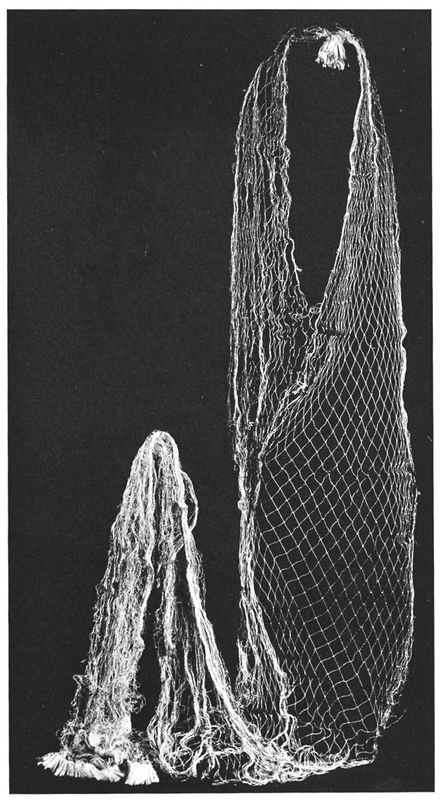
Plate 72.
Silk net wedding veil. Made and worn by Martha Harness when she married Isaac Darst on the plantation of her family, Moorefield, Virginia, June 17, 1817. Mulberry trees had been planted and silkworms raised quite extensively at that time in the United States, a speculation which failed grievously about 1830. However, this little bride made a success in growing her silkworms, reeling the silk from the cocoons and spinning it into a fine thread which she netted with a fine mesh into a veil, tubular in form, which enveloped her from head to foot except her face. When she wore it, it stretched to enclose her figure; when pulled off it was about seven feet long and edged at the bottom with a soft, narrow fringe of the silk.
Mrs. Harness died early, and her daughter, becoming mistress of the plantation while very young, carried at her belt the inevitable bunch of keys which every southern matron kept on her person in the days of slavery. The yearly store of supplies was kept on the plantation under lock and key. Some writers have assumed that the welfare of the slaves was not considered by their masters; but this mistress of the house, like many others, superintended the clothing of all the colored people each season before she attended to her own wardrobe, although she liked to dress well. Her husband was a good business man, and her ability contributed greatly to his success in the many enterprises in which he engaged. Two brothers brought her, from their trips on horseback to Philadelphia, many gifts, including pieces of dainty silverware. Her grandchildren remembered with delight her habit of keeping in her corner cupboard glass jars filled with sticks of lemon, vanilla, and peppermint candy as well as raisins, annis and caraway seed, and stick cinnamon.
The veil kept well till two years ago, when it began to fall to pieces; so that it has been difficult to reproduce it. It is owned by the maker’s great-granddaughter, Mrs. G. Glen Gould.
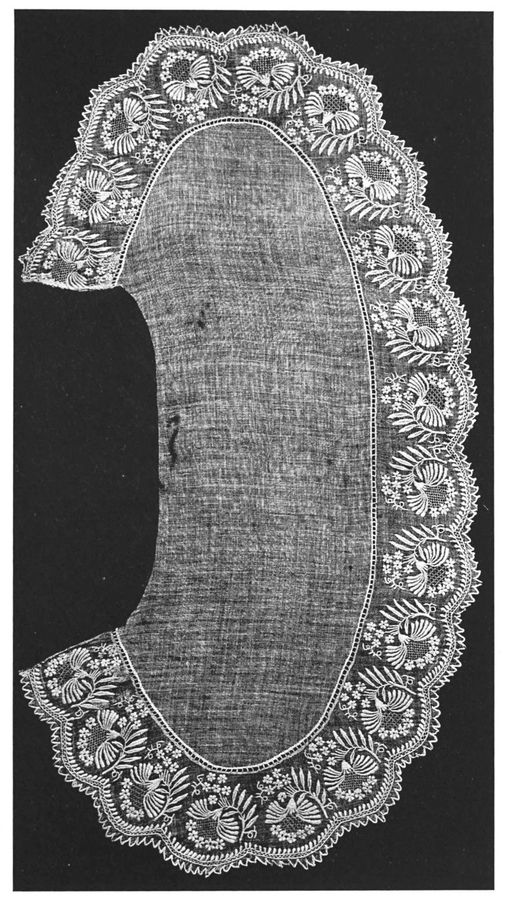
Plate 73.
The upper or outer one of two collars made to be worn together; about three-quarters size. In order that this upper piece might be even more elaborately ornamented than the under one, the edging was cut from the collar, both the edging and the collar were hemmed, and the two were then fastened together with a dainty openwork stitch. Embroidered by Elizabeth Taylor, daughter of Eldad Taylor and Thankful Day, his wife. She married Andrew Perkins, of Norwich, Connecticut, about 1745. This collar and portraits of Mr. and Mrs. Perkins done in pastel are owned by the Litchfield Historical Society. Given by their great-granddaughter, Mrs. W. W. Rockhill.
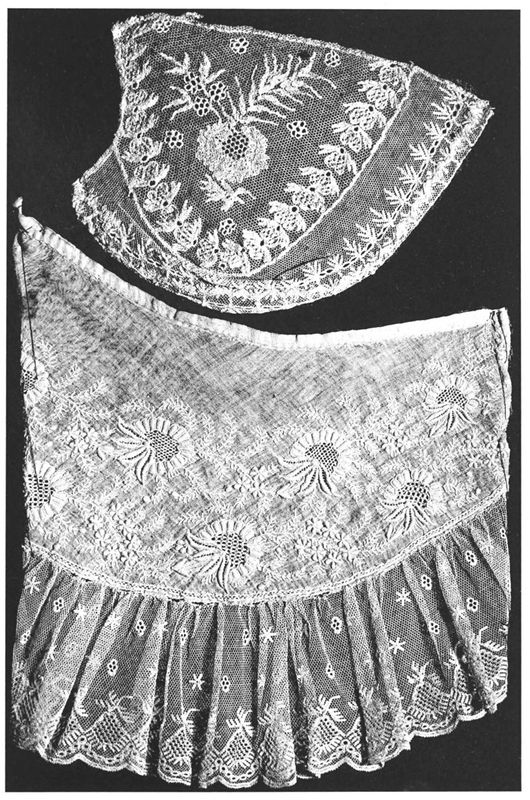
Plate 74.
Figure 1 (at top). Lace cap. Worked about 1810 by Sybil (Bradley) Hotchkiss, of East Haven, Connecticut, grandmother of Samuel H. Street, of Woodbridge, Connecticut.
Figure 2. Collar, embroidered, and lace. Made about 1820 by Elizabeth, or Betsey, Peck, who married Camp Newton, of Woodbridge, Connecticut, in 1798. She was aunt of Mrs. Samuel H. Street, of Woodbridge, Connecticut, who owns both pieces. (See also Plate 46, Figure 1.)
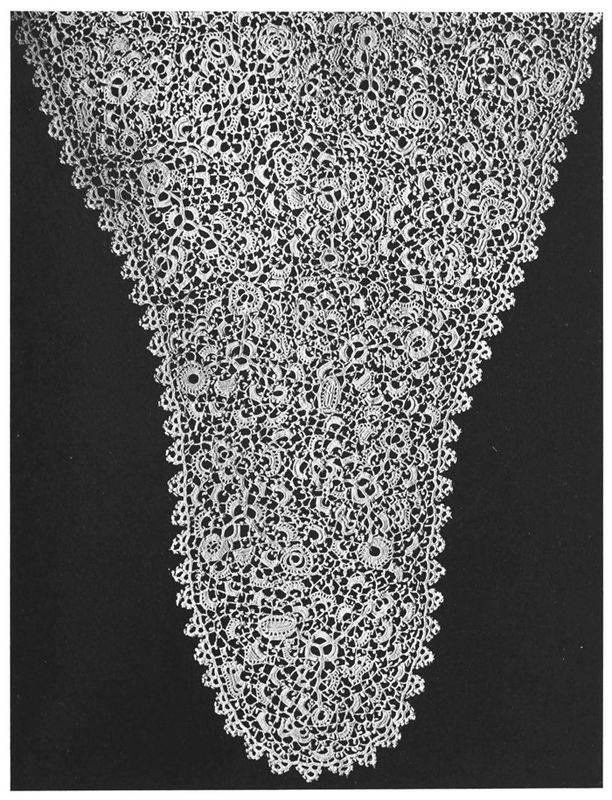
Plate 75.
Fichu for the head. About three-quarters size. Made by Sarah McCoon Vail, of Troy, New York, in 1830, soon after her marriage to Judge George Gould, Presiding Justice of the Court of Appeals of the State of New York. He was the son of Judge James Gould, of Litchfield, Connecticut, Assistant to Judge Tapping Reeve, who founded the first law school in the United States, at Litchfield. Mrs. Gould learned to make this lace at the school of Madame O’Kill in New York City. Given to the Litchfield Historical Society by Mrs. Gould’s granddaughter, Miss Natalie Lincoln.
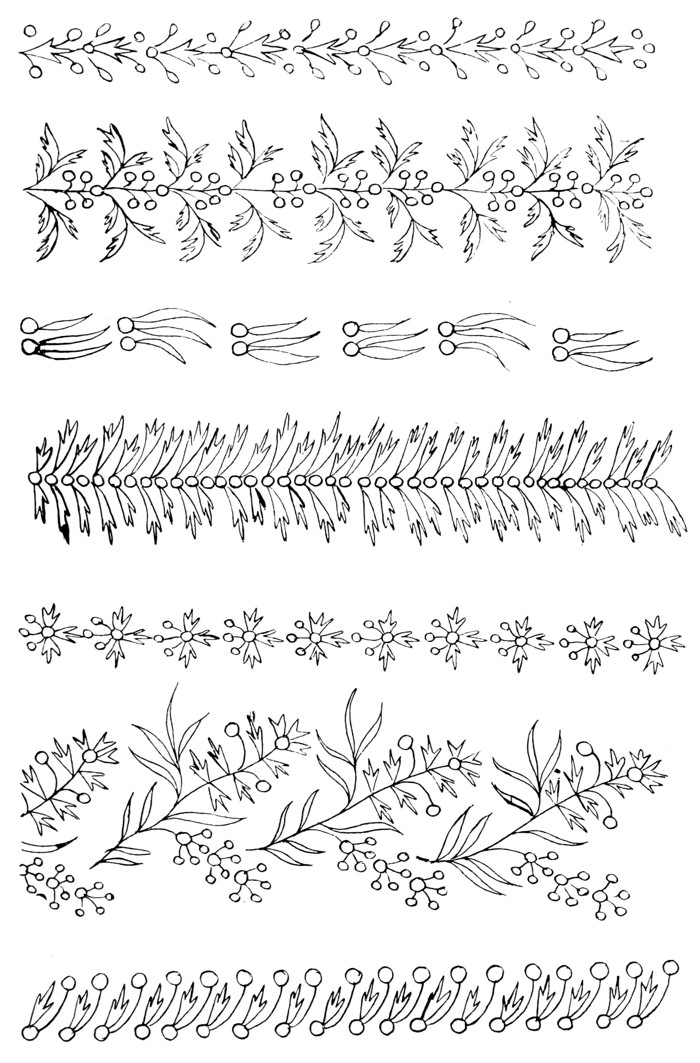
Plate 76.
A page of borders. From the pattern book of Caroline Canfield, daughter of Judge Judson Canfield and his wife, Mabel Ruggles, of Sharon, Connecticut, and sister of Elizabeth Hannah Canfield. (See Plates 33, 35, 51, 52, 54, and 55; also the description of Plate 81.) She married William Mackay, of Boston and New York, a direct descendant of William Mackay of the group concerned in the “Boston teaparty.” The designs were drawn in pencil and then traced over in ink. (See also Frontispiece and Plates 51, 52, and 77–81.) Owned by the Litchfield Historical Society. Patterns similar to those shown in Plates 76–78 were found also in the collection of Catherine Van Houten (Mrs. Ralph Doremus); see Plates 65–70.
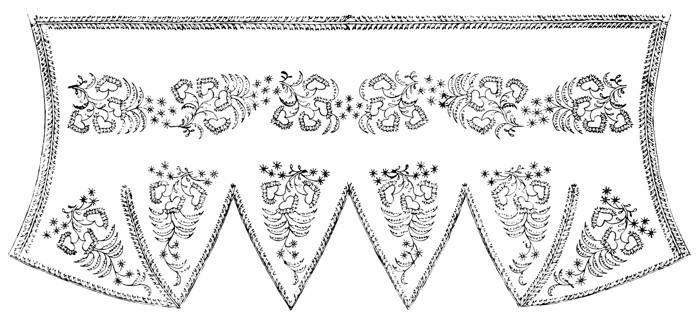
Plate 77.
Design for a cap. From the pattern book of Caroline Canfield. (See description of Plate 76.) Owned by the Litchfield Historical Society.
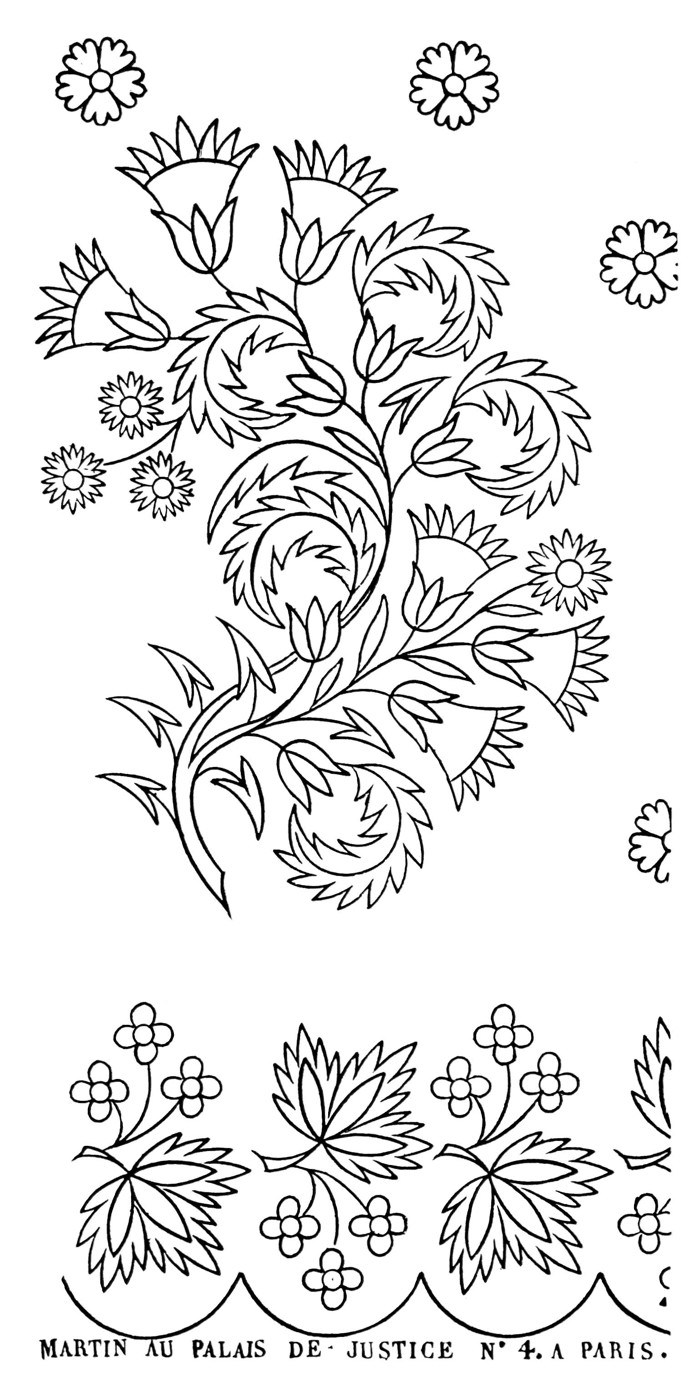
Plate 78.
Copy of a design from Paris, whence came much of the inspiration for early American work in lace. From the pattern book of Caroline Canfield. (See description of Plate 76.) Owned by the Litchfield Historical Society.
Text from image:
MARTIN AU PALAIS DE JUSTICE Nº 4. A PARIS.
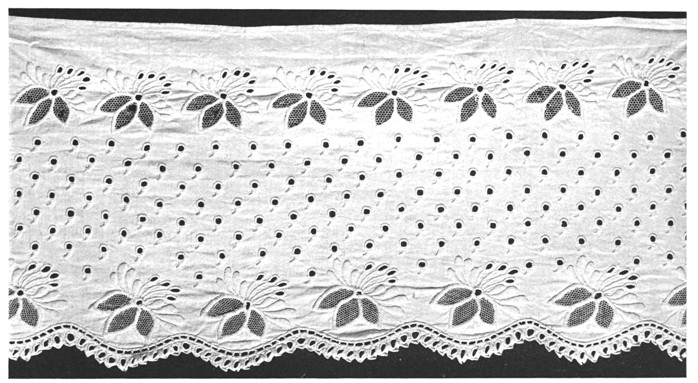
Plate 79.
Ruffle. Embroidered by Caroline Canfield for her wedding petticoat. It is 6¾ inches wide, 2½ yards long. (See description of Plate 76.) Owned by the Litchfield Historical Society.
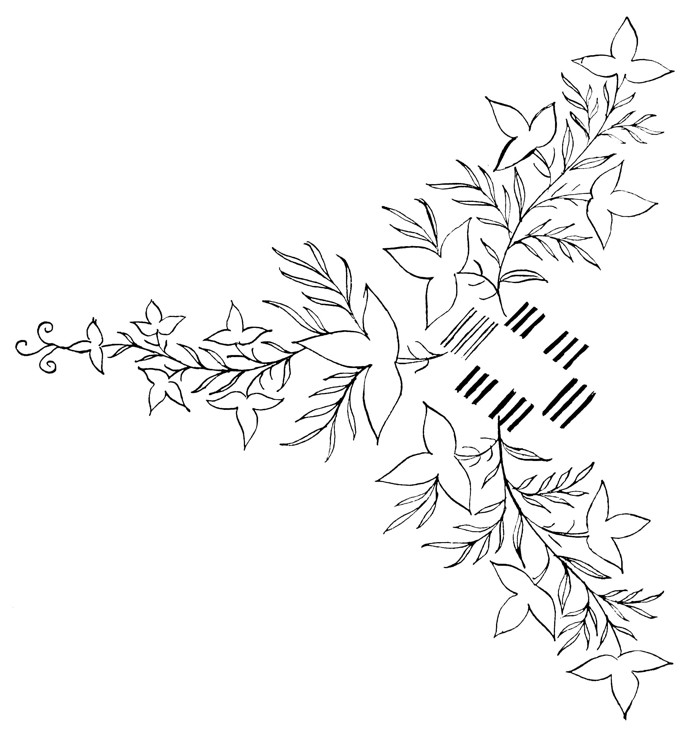
Plate 80.
Part of a design for a dress. Drawn by Caroline Canfield, and sent to India by her brother-in-law, George Mackay (he was supercargo on a sailing vessel that ran between the United States and India), to be embroidered there on India mull. (See also Plate 81.) Owned by the Litchfield Historical Society. (See description of Plate 76.)
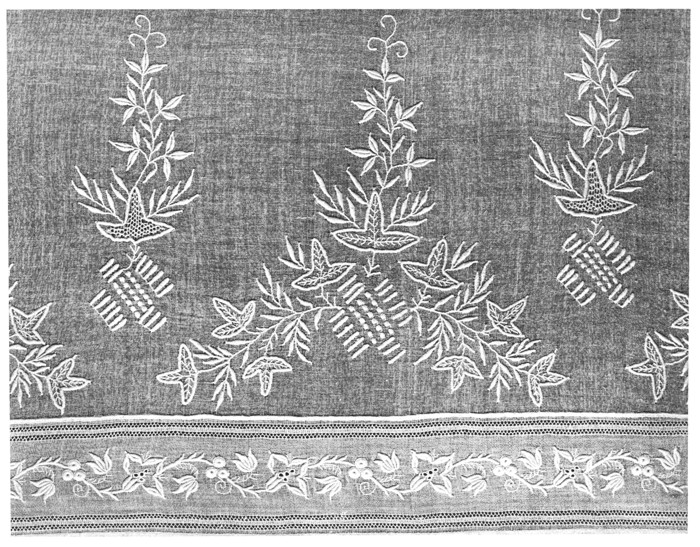
Plate 81.
From one of two dresses worked in India on India mull. After designs drawn by Caroline Canfield. (See description of Plate 80.) The dress shown here was worn by Caroline Canfield’s sister, Mrs. Frederick Augustus Tallmadge, at the inauguration ball of President Tyler, April 4, 1841. Later it was worn by Miss Frederica Pirrson when she married Frederick W. Tepper. The muslin insertion at the bottom is a later addition, of French design and make. Owned by the Litchfield Historical Society. (See description of Plate 76.)
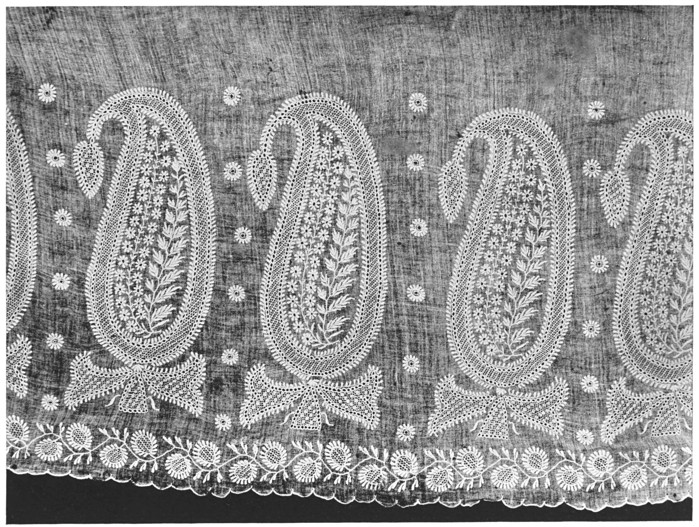
Plate 82.
White mull dress. Embroidered by Ruth Freeman Packard, daughter of the Reverend Asa Packard and Nancy Quincy, of Marlboro, Massachusetts, about 1818. Nancy Quincy was the daughter of Colonel Josiah Quincy (1708–1784), of Braintree, Massachusetts. Ruth Freeman Packard married the Reverend George Trask, of Framingham, Massachusetts. The embroidery is 14 inches deep and the width of the skirt 3 yards. It contains seventeen of the designs sometimes called palm leaves. The dress is now in the possession of Mrs. Trask’s daughter, Mrs. Ruth Quincy Powell, of Scranton, Pennsylvania.
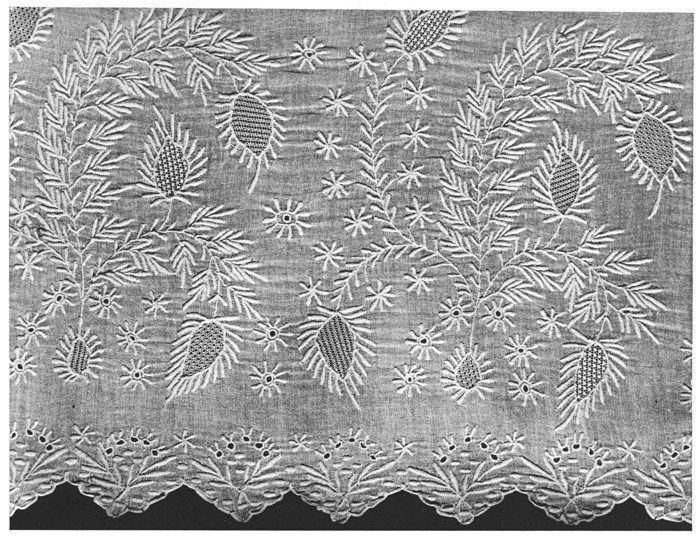
Plate 83.
India mull dress skirt, 2 yards wide, embroidered, with lace stitches introduced. Worked by Louisa Lewis about 1820, when she married Henry Phelps. They lived on the north side of the square in Litchfield, Connecticut. Owned by the Litchfield Historical Society; given by Mrs. Phelps’s daughter, Miss Mary Phelps. (See also Plates 53 and 84.)
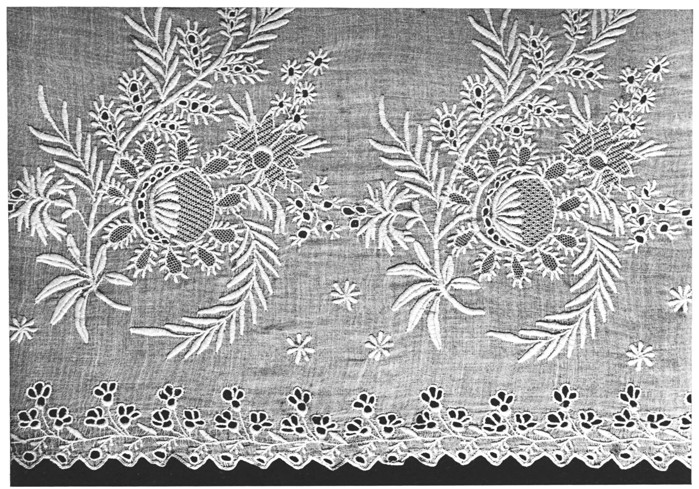
Plate 84.
A second skirt, similar to the preceding in work and design, on India mull, 2 yards and 6 inches wide. Worked by the same hand about the same date. Owned by the Litchfield Historical Society; given by Mrs. Phelps’s daughter, Miss Mary Phelps. (See also Plates 53 and 83.)
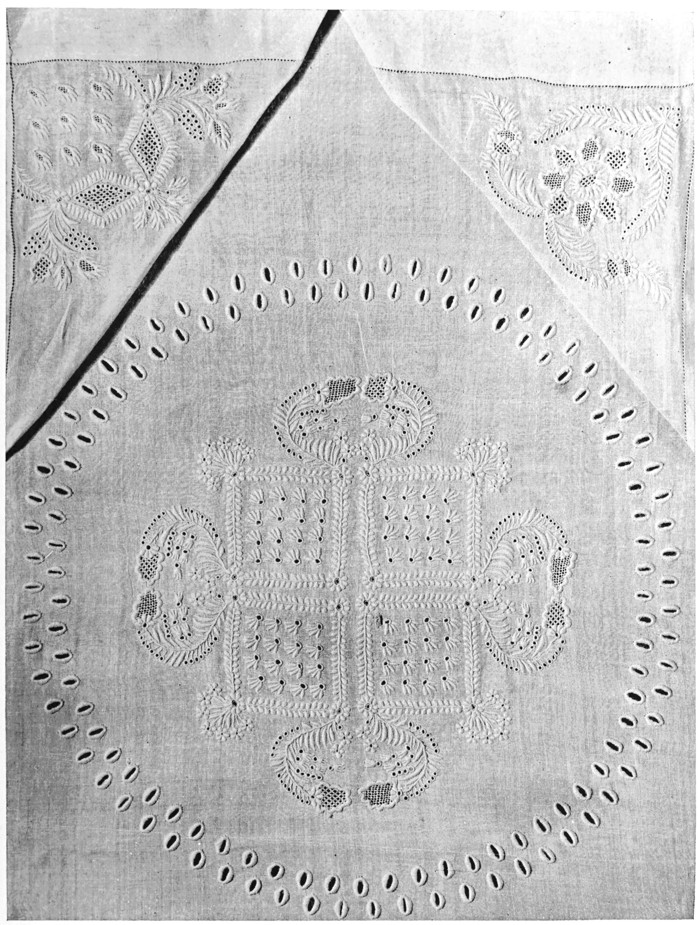
Plate 85.
Handkerchief, worked in the center with a large design and with similar designs on the four corners, with fine lace stitches introduced. Made by Mrs. Mitchell (Eliza Brock) for her sister, Frances Brock, for her wedding. Their home was on the island of Nantucket, Massachusetts, where Frances was married in 1833 to Thomas Dawes Eliot, a lawyer of New Bedford, Massachusetts. Owned by her daughter, Miss Edith Eliot.
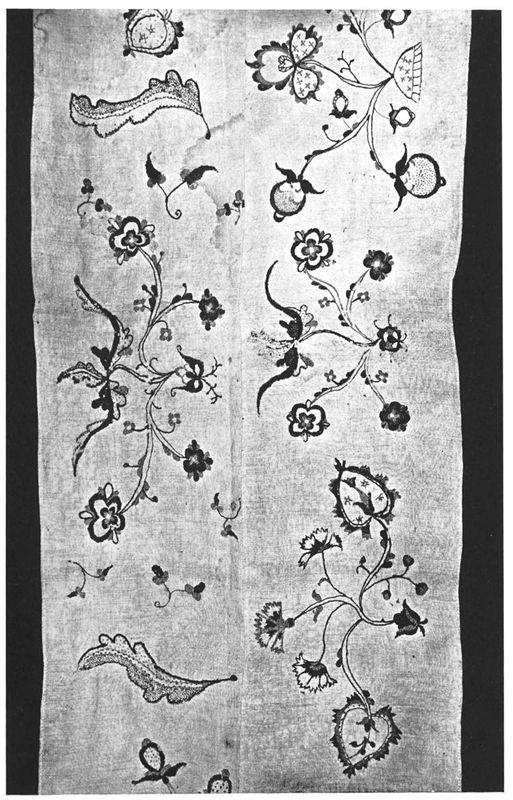
Plate 86.
Part of bed curtains. Made by Polly Cheney, of Litchfield, Connecticut, in 1740. She raised, spun, and wove the flax into linen and embroidered it with crewels of wool dyed by herself in various shades of blue; presumably from her own patterns, as designs were rare at that time in the United States. These strips are 21 inches wide and 40 inches long. Owned by the Litchfield Historical Society.
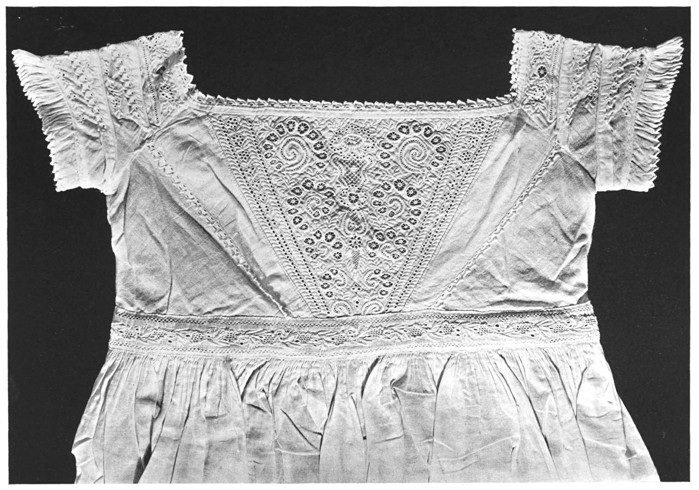
Plate 87.
Waist of infant’s dress. Worked about 1839 by Miss Elizabeth W. Davenport, daughter of John Alfred Davenport, for her niece, Elizabeth Davenport Wheeler. It was made when the family lived in either New York or Brooklyn, whence they moved to New Haven. Owned by the Litchfield Historical Society; given by Elizabeth Davenport Wheeler’s niece, Miss Emily Wheeler.
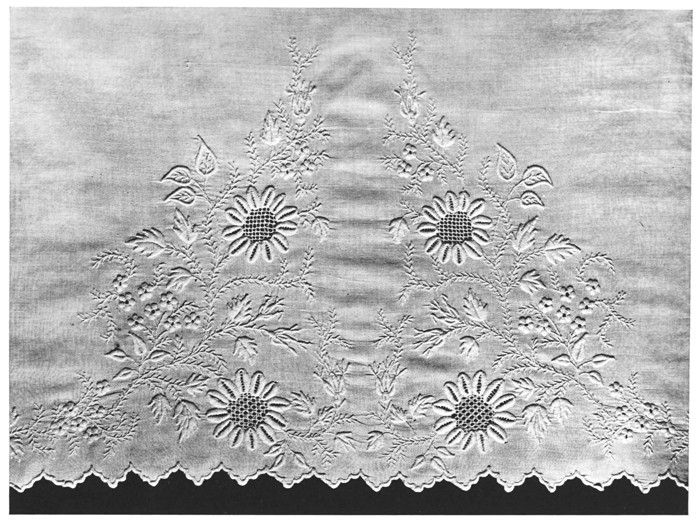
Plate 88.
Front of skirt of dress shown in Plate 87.
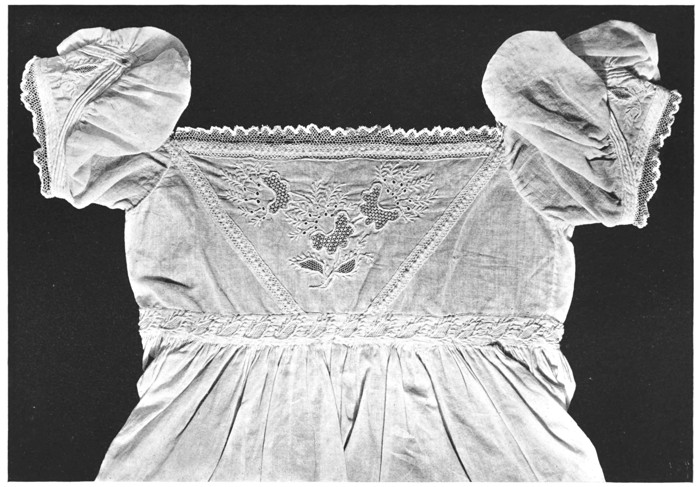
Plate 89.
Infant’s dress. Worked by Mary W. Peck (Mrs. Edward D. Mansfield), probably about 1831. Owned by the Litchfield Historical Society. See also Plates 30 and 31.
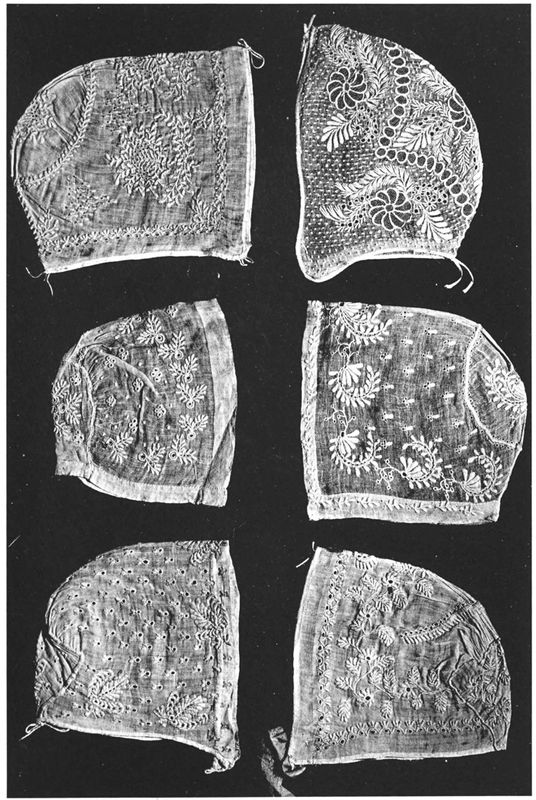
Plate 90.
Six infant’s caps. Made, embroidered, and worked with lace stitches by Mary Ann Laidlaw, wife of Dr. Henry Buel, of Litchfield, Connecticut, about 1860. Owned by her daughters, Mrs. Francis H. Blake and Miss Katharine L. Buel.
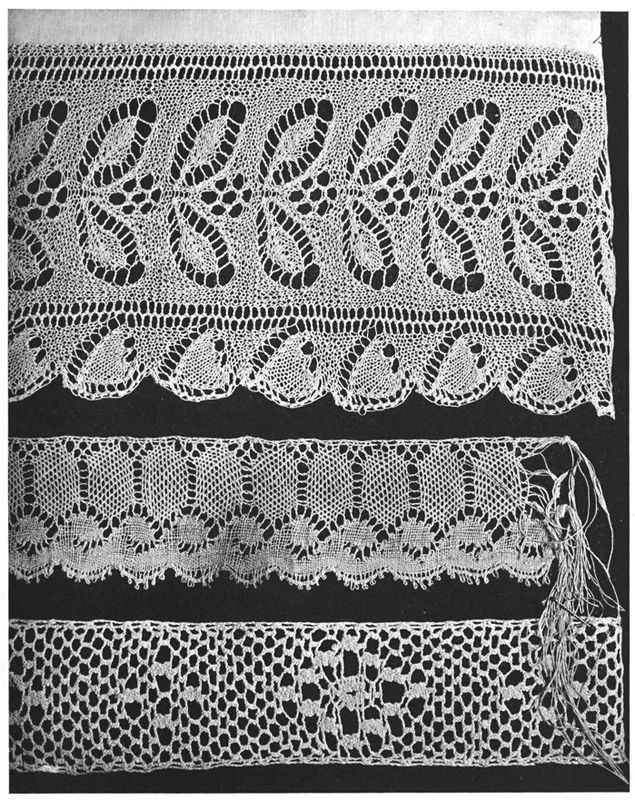
Plate 91.
Figure 1 (at top). Knitted lace from a pillow case. A great deal of this kind of lace has been made in the United States for trimming underwear and bed linen. This specimen was made by Mrs. Wilson Tingley White, born April 15, 1838. She married at nineteen and lived in Cumberland, Rhode Island, until her husband’s death in 1918. This piece of lace she made in 1909. It is owned by her daughter, Mrs. Charles William Follett, of North Attleborough, Massachusetts, at whose home Mrs. White died December 25, 1923.
Figure 2. Lace made on a pillow with bobbins by a California Indian girl. Given to the Litchfield Historical Society by Miss Edith Beach.
Figure 3. Insertion from one of a pair of pillow-biers (the early name of pillow-cases). Once owned by Sarah Chedsey, born 1670, daughter of John Chedsey, deacon of First Congregational Church of New Haven, Connecticut, 1675–1688. The pillow-cases are marked S. C. She probably made both lace and pillow-cases, but there is no further proof than that they bore her initials and were cherished and handed down carefully through a series of Sarahs, as follows:
Sarah Chedsey, who married Samuel Alling; Sarah Alling, who married David Punderson; David Punderson, who married Thankful Todd; Sarah Punderson, who married Zechariah Thompson; Sarah Thompson, who married General John Hubbard (See Plate 20, Figure 2); Sarah Thompson, who was a niece of Sarah Hubbard; Sarah Thompson, who was a niece of Sarah E. Thompson; Esther H. Thompson, who gave this lace to the Litchfield Historical Society.
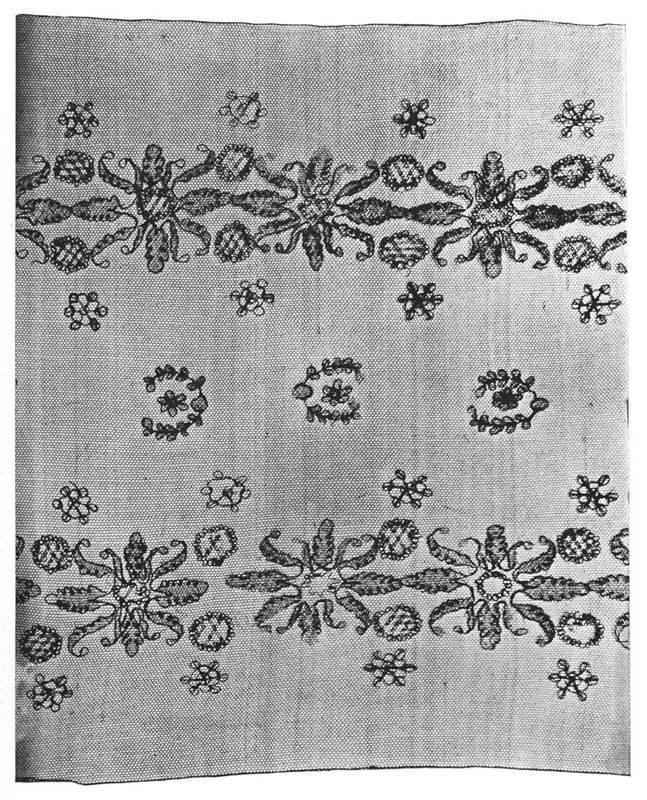
Plate 92.
Black lace scarf, 3 yards long. Worked by Pamela Parsons, born April 8, 1767, died July 5, 1813. She was the daughter of Zenas Parsons, of Springfield, Massachusetts, and great-great-granddaughter of Joseph Parsons, who came from England in Winthrop’s fleet, 1630, with Mr. Pyncheon. (See also Plate 46, Figure 2.) Owned by Mrs. Charles B. Curtis. (See descriptions of Plates 93–96.)
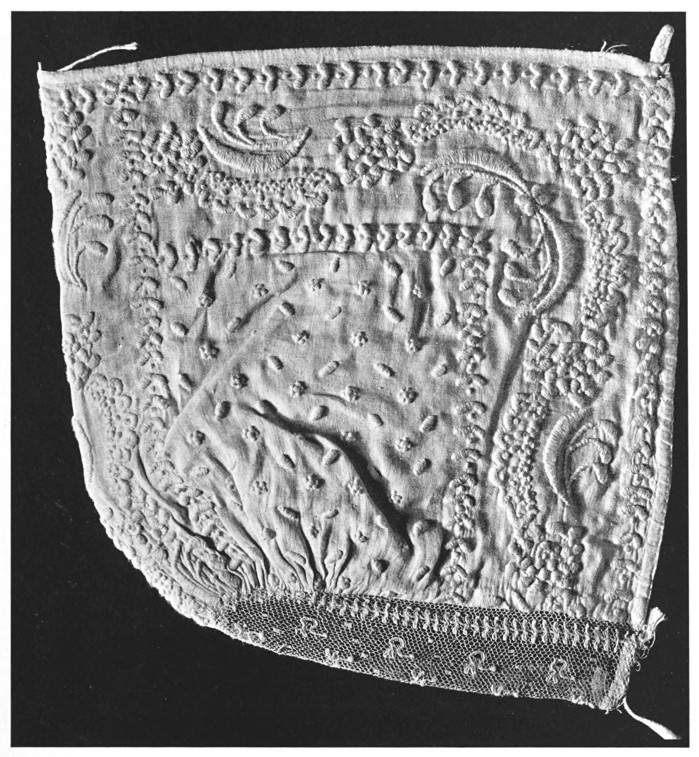
Plate 93.
Infant’s cap. Worked in 1815 by Isabella Woodbridge Sheldon, of Hartford, after she became the wife of George Lecky Cornell, of Red Hook, Long Island (where South Brooklyn now is), for her daughter Sarah. Owned by her granddaughter, Isabel Douglas Curtis (Mrs. Charles B. Curtis). Mrs. Cornell was a niece of Pamela Parsons. (See Plate 92.)
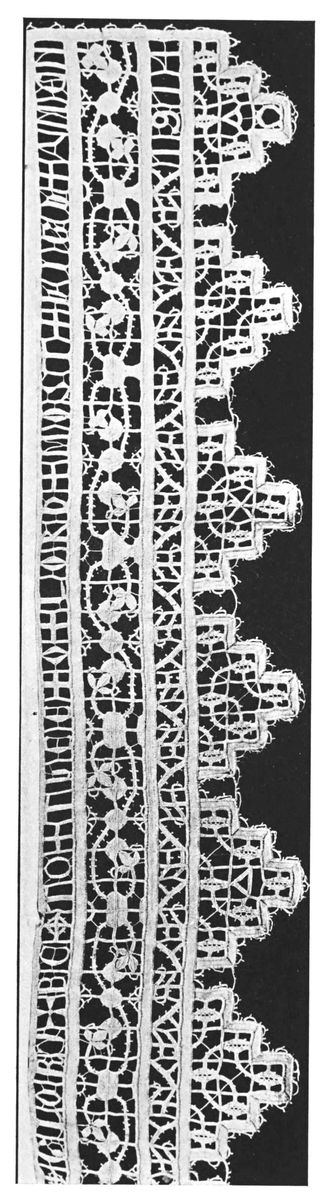
Plate 94.
Altar cloth of Greek design, 92 inches long. Worked by Isabel Douglas Curtis—Mrs. Charles B. Curtis, granddaughter of Isabella Woodbridge Sheldon (Mrs. George Lecky Cornell); see Plate 93—in 1911 for Christ Church, Rye, Westchester County, New York. It has on the top the words: “Holy, holy, holy,” etc. The center contains symbols, such as I H S, the crown of thorns, etc. Owned by the church named.
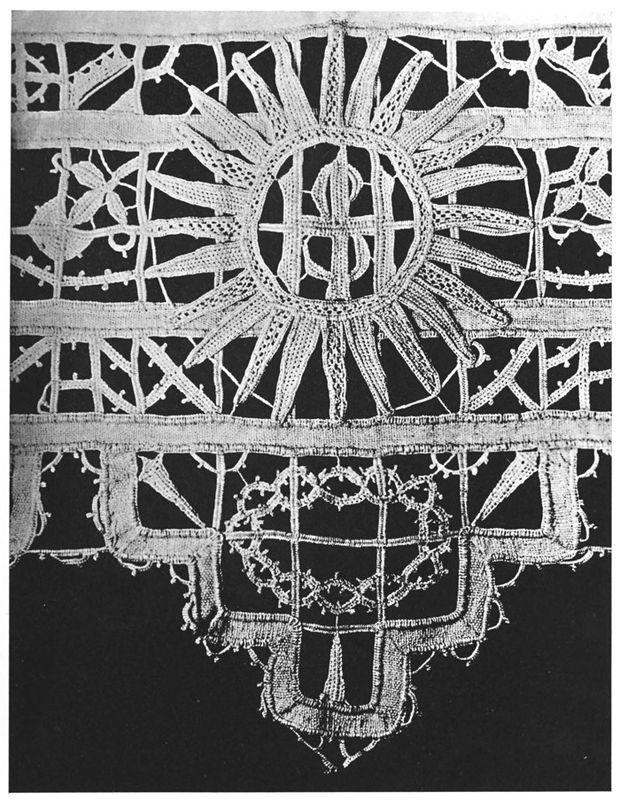
Plate 95.
Detail of altar cloth shown in Plate 94.
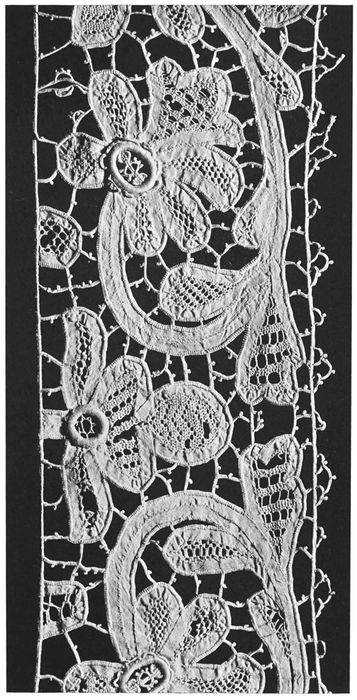
Plate 96.
Sample from tape lace. Made for window-curtains by Isabel Douglas Curtis (Mrs. Charles B. Curtis), of New York City, about 1895. Owned by the Litchfield Historical Society.
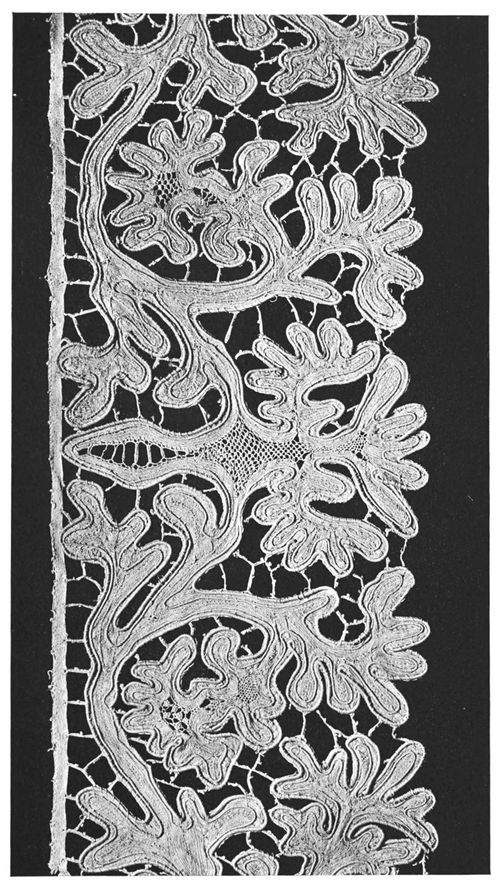
Plate 97.
Tape lace, 6 inches wide, 2 yards long. Made by Rachel Tracy Noyes, daughter of William Curtis Noyes and his first wife, Anne Tracy. She married Charles Edward Whitehead, of New York City. The lace was made about 1880. She died in 1900. Owned by the Litchfield Historical Society.
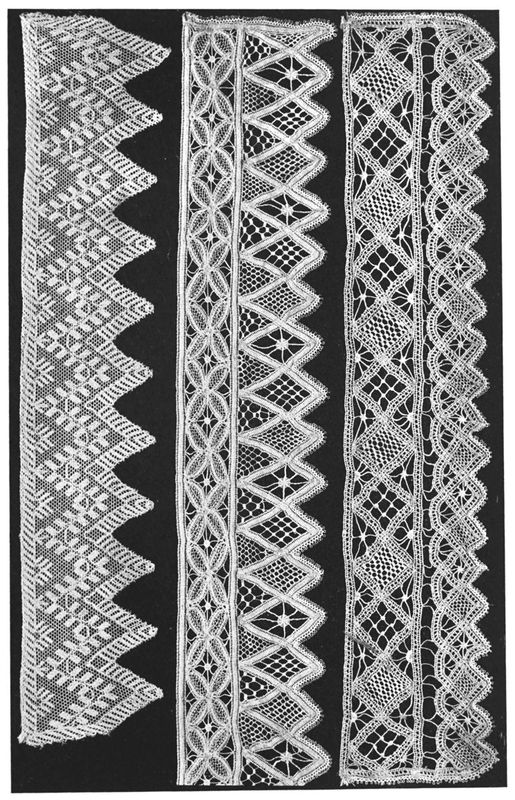
Plate 98.
Tape lace and darned net. Made 1881–1885 by Miss Esther Thompson, of Litchfield, Connecticut, when she was a teacher in Middletown, Connecticut. Owned by Miss Thompson.
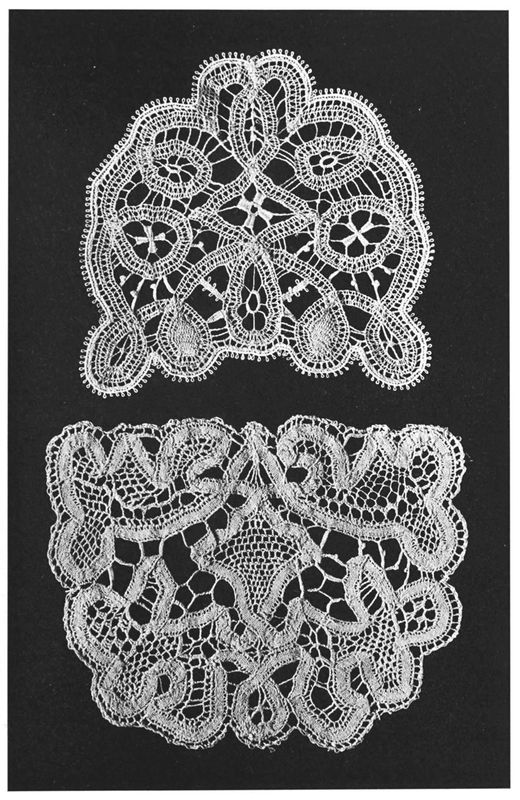
Plate 99.
Tape laces. Made by Mrs. Butterworth, a friend of Miss Esther Thompson. Owned by Miss Thompson.
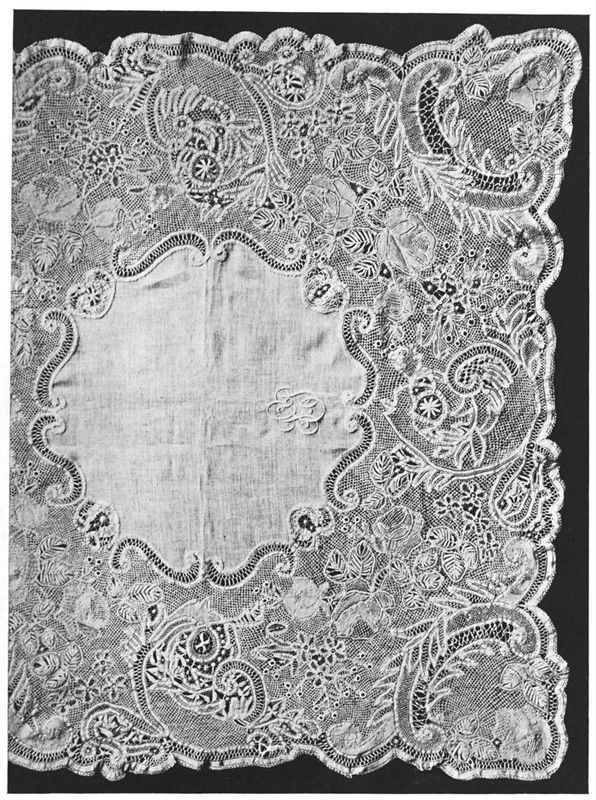
Plate 100.
Half-tone of photostat copy of photograph in the New York Public Library, of a table cover, 42 inches square. Made by Mrs. Hannah MacLaren Shepherd-Wolff. Three thousand hours were spent on this lace, which was finished in 1910 when the maker was eighty years old.
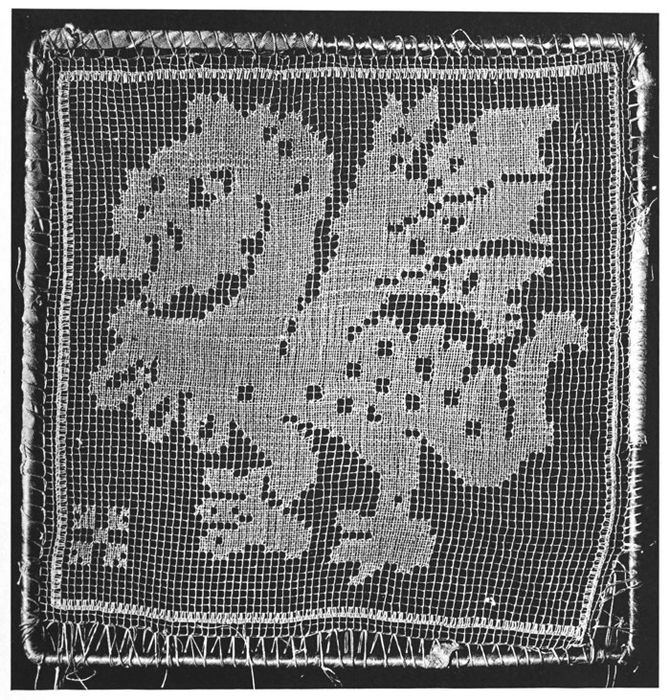
Plate 101.
“Lavoro a maglia quadra,” or “lacis,” darned netting, or filet, still in the frame. Made by Mrs. Edward Rowland (Sarah Belknap), of Waterbury, Connecticut, born June 27, 1837, for a lace exhibition at the Hartford Athenæum in February, 1907. Mrs. Rowland learned to make lace in Florence, Italy. Owned by Miss Edith Beach, of West Hartford, Connecticut.
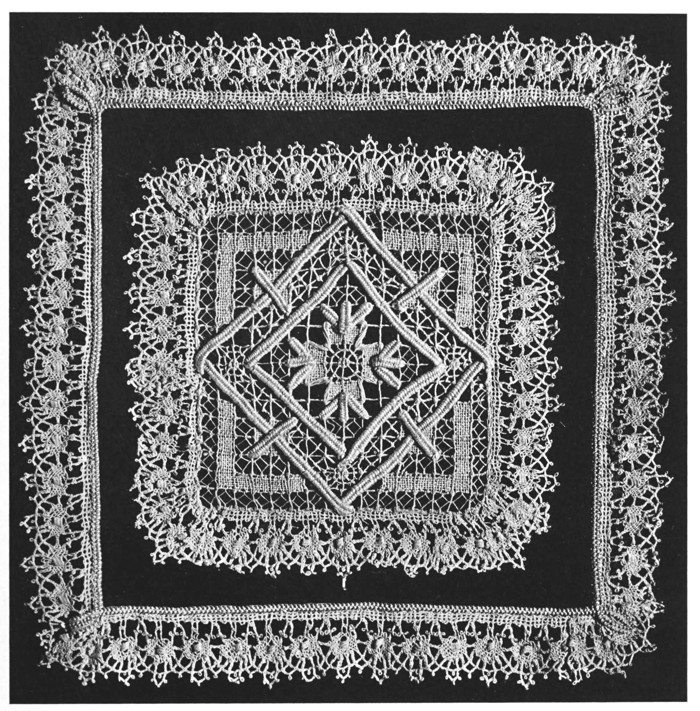
Plate 102.
The same kind of lace as that shown in Plate 101, sewed on satin and trimmed with pillow and bobbin lace. Made by Elsie Belknap, born in Hartford, Connecticut, November 4, 1863; married Mr. R. E. K. Whiting; died September 23, 1907. She was taught to make lace by Miss Edith Beach. Owned by Miss Edith Beach, of West Hartford, Connecticut.
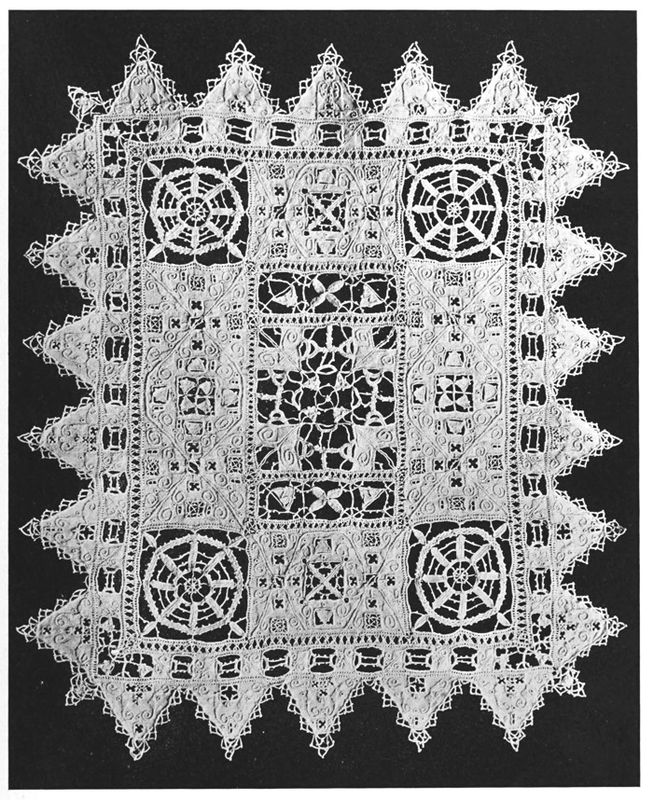
Plate 103.
Chalice-veil. Designed and embroidered from a number of pieces of sixteenth-century Italian cut-work—reticella and punto reale—by Miss Margaret Taylor Johnstone, of New York and Paris. Exhibited at the Société Nationale des Beaux Arts, and also at the Musée des Arts Décoratifs, in the early years of this century. It is signed M. T. J. in the border. Original photograph reduced one-third.
Some thirty years ago Miss Johnstone gathered together a little class of workers at the Society of Decorative Art in New York City and taught them these stitches. The work prospered, with the aid of designs found in various public and private collections, and continued for over a quarter of a century, when this association, which had been the mother-society of beautiful embroidery in New York, ceased to exist. Miss Johnstone also prepared the rearrangement of the Lace Collection in the Metropolitan Museum of Art, New York City, in 1906–1907, on lines suggested by her to the expert, Frau Kubasek, of Vienna, who was brought to New York by the Museum for this purpose. She brought with her a trunk of four hundred specimens of embroidery and lace collected by Miss Johnstone from friends in Paris and New York, and labelled and classified according to her own extended classification. These specimens were accepted for the Museum by the Director, Sir Caspar Purdon Clarke, whose love of decorative art was a benefit to the Museum. Since that time the collection of laces has so increased that it is probably surpassed only by that in the Victoria and Albert Museum, of London.
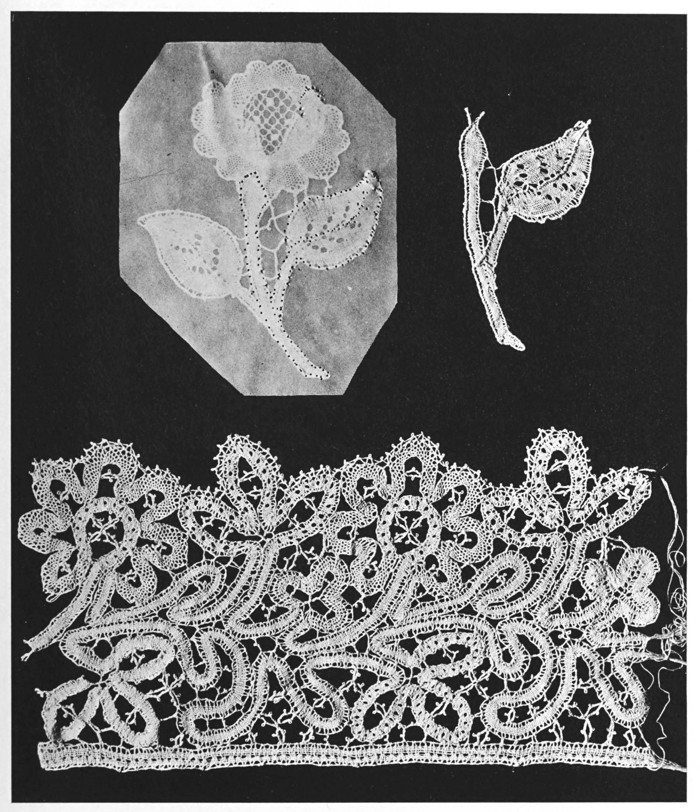
Plate 104.
Figure 1. Blue paper pattern for lace to be made on a pillow with thread on bobbins. Part of the design was worked and is shown in the small piece of lace beside the pattern. Made and owned by Miss Edith Beach, of West Hartford, Connecticut.
Figure 2. Lace made on a pillow with thread on bobbins. Although similar in appearance to tape lace, it is quite different, being entirely worked with linen thread on bobbins, on a pillow. Made and owned by Miss Edith Beach.
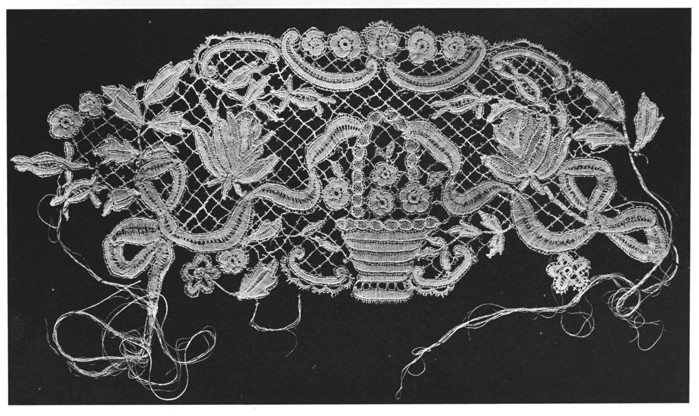
Plate 105.
Lace, unfinished, being made for a fan, on a pillow with thread on bobbins. The design is adapted for this purpose from one in The Art of Bobbin Lace , by Louisa A. Tebbs, Chapman and Hall, Ltd., London, 1908. Made and owned by Miss Edith Beach, of West Hartford, Connecticut.
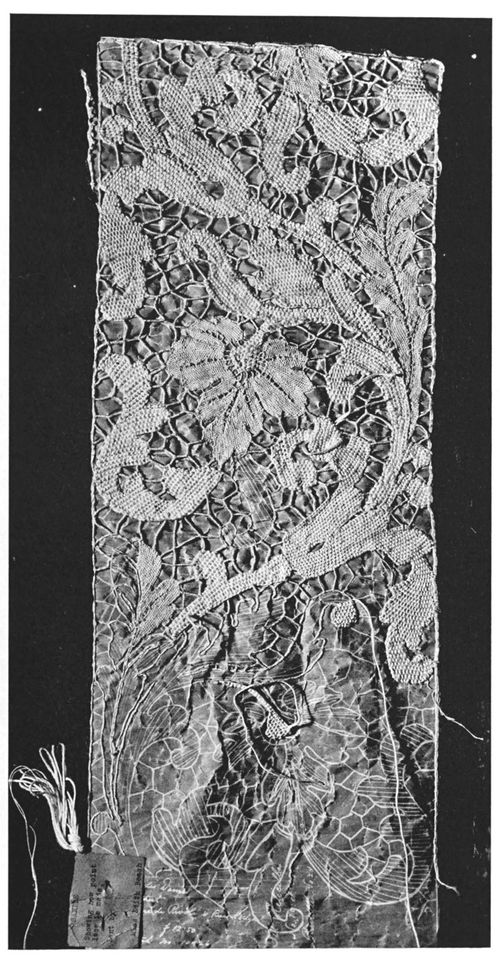
Plate 106.
Blue paper pattern for making Venetian point lace (needle-point), and the lace in process of making. It consists mainly of very fine, close buttonholing with a sewing needle. Owned by Miss Edith Beach, of West Hartford, Connecticut. These laces have been made since 1904 by Miss Beach. She was taught lace-making by her aunt, Sarah Belknap (Mrs. Edward Rowland); see Plate 101.
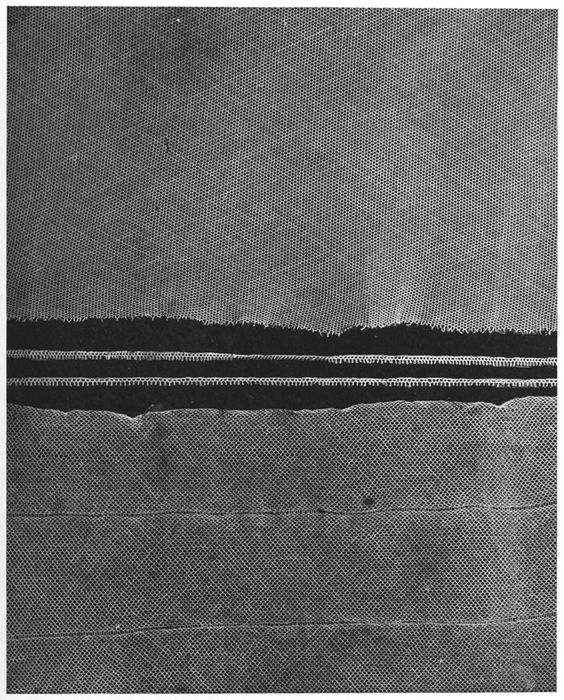
Plate 107.
Figure 1 (at top). Machine-made net in the piece.
Figure 2. The same kind of net with stitches dropped at regular intervals to serve as guides for cutting it into footing, or strips for embroidering or darning as trimming lace.
Between Figures 1 and 2 are shown samples of beading, or purling, to be sewn on the edge of the trimming lace.
(Plates 107–109 show net made by machine at the “lace shop” established and operated by Dean Walker in Medway, Massachusetts, between 1818 and 1827. See Introduction, pp. 4–5; also Plate 110 and caption. The originals shown are in the possession of Dean Walker’s granddaughter, Miss Sophia A. Walker, of New York City.)
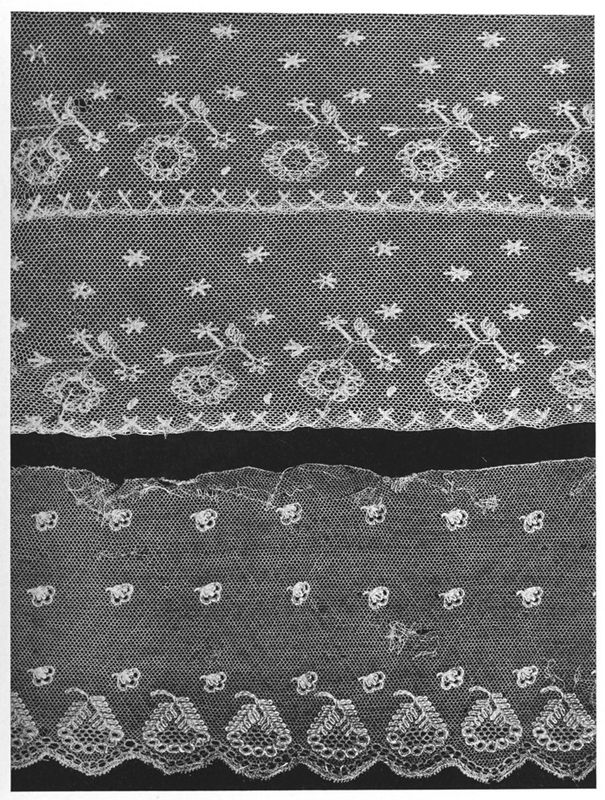
Plate 108.
Figure 1 (at top). Trimming lace on machine-made net. Darned by Clarissa Richardson, about 1830, on net made by Dean Walker at the “lace shop.” (See caption of Plate 107.) It consists of two pieces of straight-edge fagotted together.
Figure 2. Trimming lace on machine-made net. Darned by Julia Adams (Mrs. Horatio Mason) on net made at Dean Walker’s “lace shop.” Purling is added to the waved edge.
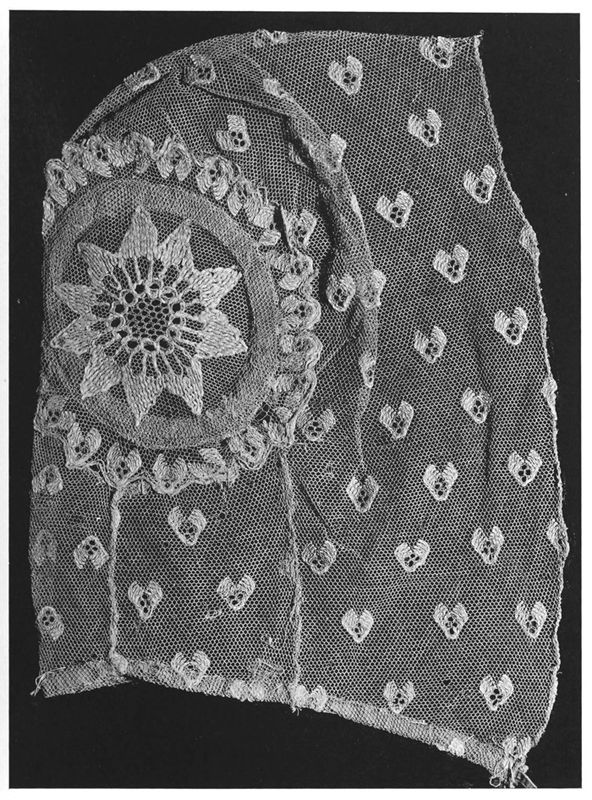
Plate 109.
Cap embroidered on machine-made net. Made about 1820 by Julia Adams (Mrs. Horatio Mason), the maternal grandmother of the present owner, Miss Sophia A. Walker, of New York City. (See caption of Plate 108, Figure 2.) The net was made by Dean Walker at the “lace shop” in Medway. The frill of the cap has been removed for another use.
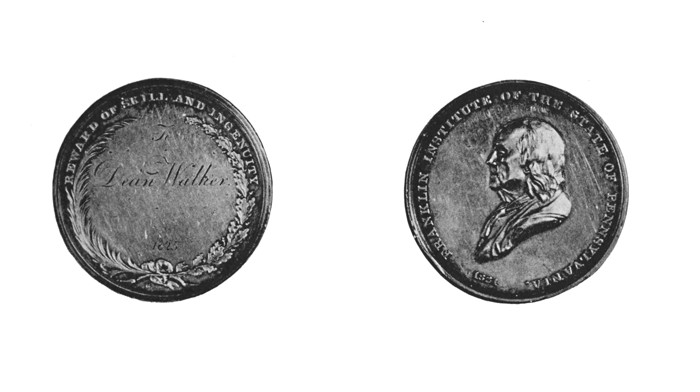
Plate 110.
Silver medal awarded to Dean Walker in 1825 by the Franklin Institute of the State of Pennsylvania, for the net made at his “lace shop” in Medway, Massachusetts. (See Introduction, pp. 4–5; also Plates 107–109 and captions.) Owned by William T. Walker, a great-grandson of Dean Walker.