Art. XI. Description of a New Species of Gnaphalium.
Reading edition
Art. XI. Description of a New Species of Gnaphalium, by Professor E. Ives.
To B. Silliman, Esq. M.D., &c.
The following description of a new species of Gnaphalium, accompanied with a drawing, has been in my possession for two years. If the subsequent observations will be of use to correct error, or solve doubts which may have existed concerning some species of gnaphalium, they are at your service.
E. IVES.
This plant was first observed by me, in company with Mr. C. Whitlow, in July, 1817, by the margin of a brook, a few rods north of Mr. E. Whitney's gun manufactory, near New-Haven. It is also found on the margin of the Housatonick, about thirty miles from Long Island sound, where it was observed by Dr. Alfred Monson, the last summer. Specimens of this plant were sent to Z. Collins, Esq. of Philadelphia, for the purpose of comparing it with the species of gnaphalium in Muhlenberg's herbarium, more particularly with the luteo-album and Pennsylvanicum, which I had not seen.
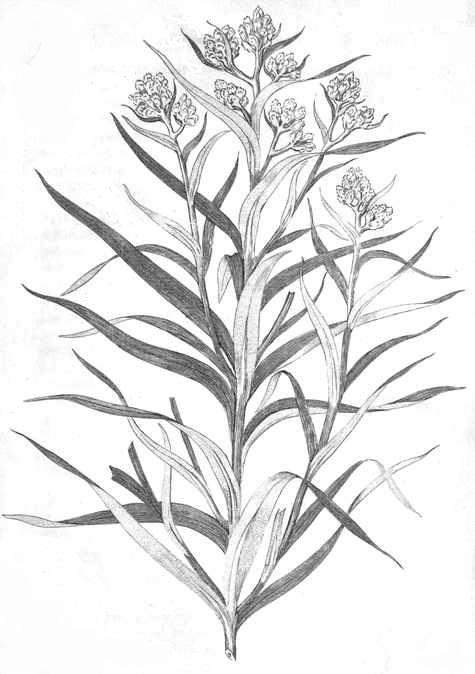
Gnaphalium decurrens.
I am indebted to the politeness of Mr. Collins, for the facts on this subject relative to Muhlenberg's herbarium. He observes, "your Gnaphalium is certainly not the luteo-album of Muhlenberg, which may not strictly be a native, but introduced. Yours most approaches G. polycephalum Mx. Still, from the decurrent leaves and other differential marks, it appears to me to be a new species. Muhlenberg's collection has it not."
As the luteo-album is said to grow in New-England, yet so far as my observation has extended it has not been found by any of the botanists, I am induced to believe that this opinion has arisen from some erroneous description of the plant which is the subject of this paper.
As the decurrent leaves of this Gnaphalium distinguish it so obviously from all the other American species of Gnaphalium, I propose to give it the specific name of decurrens.
Specific description of Gnaphalium Decurrens (large life everlasting.)
Leaves lanceolate, broad at base, acute, decurrent, somewhat scabrous above, tomentose beneath; stem leafy branched spreading, about three feet high.—See the plate.—The plate represents a section of the upper part of the plant.
FOSSIL ZOOLOGY, &c.
