A LIST OF EARLY AMERICAN BOOK-PLATES.
Reading edition
The following List of Early American Book-plates makes no claim to completeness: indeed it is earnestly hoped and believed that time will prove it to be quite incomplete: old plates new to collectors are continually coming to light, and there is every reason to expect their number to increase. We are persuaded that certain of the worthies of colonial times used book-plates, although no copies are now known, and that some future investigator will unearth these much-desired treasures.
Some plates will be found included which do not have a satisfactory description: this is due to their not being seen by the compiler of the List: correspondents at a distance cannot always send full details, and without them it is better to attempt little in the way of description. The aim has been to be accurate and as full as possible. There are hundreds of simple name-labels which have no place here, but all armorial examples which could be discovered are mentioned.
The plates are given in alphabetical order, and are numbered for convenience in reference. As far as possible, the first line of the description of each plate gives the exact wording of the original, with its spelling and abbreviations: the mottoes also, as well as the manner of signature, are given exactly as they appear on the original plate: wherever throughout this List italics are used, they denote the exact language employed upon the plate.
1. Anonymous.
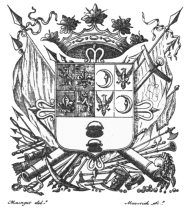
Armorial. A very beautiful plate with French arms: a crown above and military trophies behind the shield: French banners, cannon, quivers of arrows, anchor, horns, swords, drum, tomahawks, bugle, lances, etc. Signed, Maingot delt. Maverick, Sct.

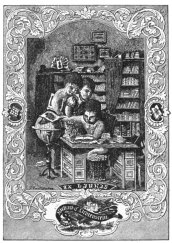
2. Abercrombie. James Abercrombie.
Armorial. Ribbon and Wreath. Two mottoes, Vive ut vivas, and Meus in arduis aequa. Of Philadelphia, and mentioned in Boswell’s “Life of Dr. Johnson.”
3. Adams. John Adams.
Armorial. The Boylston arms. The shield surrounded by a garter on which the motto is given,—Libertatem amicitiam retenebis et fidem. The whole design surrounded by thirteen stars. Second President of the United States.
4. Adams. John Quincy Adams.
Simply the name rudely engraved and surrounded by a narrow line. Probably the first of the J. Q. A. book-plates. Sixth President of the United States.
5. Adams. John Quincy Adams.
Armorial. Boylston arms. Ribbon and Wreath. Motto-ribbon empty.
6. Adams. John Quincy Adams.
Armorial. The Boylston arms; the shield enclosed within a garter, on which the motto appears,—Fidem—Libertatem—Amicitiam.
7. Adams. John Quincy Adams.
Armorial. The shield is quartered, and bears in the first quarter a curious specimen of home-made heraldry. The ancestors of the President bore no arms, and in their place appears a stag standing at gaze before a pine tree, while below in the water a fish, probably a cod, is swimming; the whole design surrounded with thirteen stars. This was his own invention. The other quarters bear the Smith, Quincy, and Boylston arms. The whole shield is surrounded by a garter bearing the motto Fidem, Libertatem, Amicitiam retinebis. From “Tacitus.”
8. Agar. Property, Lydia Agar. 1806.
Pictorial. An eagle bears a broad ribbon, on which the word property is given; an oval frame encloses what resembles a row of eggs.
9. Agnew. James Agnew, Esq.
Armorial. Chippendale. Motto, Consilio non impetu. Attributed to Maverick.
10. Aitkin. Robert Aitkin.
Simple name label: the printer of the “Aitkin Bible.” Philadelphia, 1782. The first American edition.
11. Albany. Albany Society Library. 1759.
A peculiar plate something in the shape of the figure 8, with intertwining foliations above and at the sides. The upper part of the frame is the larger, and contains a spirited illustration of an Indian in ambush aiming an arrow at a leaping fox. On the frame surrounding this is the motto, May concord prevail and the undertakeing prosper. In the lower and smaller part is depicted a prim man, bewigged and ruffled, with an open book in his hand; presumably a patron of the Library. Very little can be learned concerning this early Library. It was probably interrupted by the Revolution. Some of its books are in the New York State Library.
12. Allan. John Allan.
Pictorial. An open book, across the pages of which is printed the name of the owner. Behind all an anchor. This is the plate of the old book collector of New York City.
13. Allen. John Allen.
Armorial. Jacobean. Motto, Law & Right. This is believed to be the plate used by John Allen, an early bookseller of Boston. He published the “News-Letter.” From the general design and the crude engraving, it must be taken for early American work: circa 1720. Illustrated in “Curio,” page 15.
14. Allison. Joseph J. Allison.
Armorial. Chippendale. Hour-glass, books, globe, palette, and brushes, grouped above the escutcheon. Motto, Hinc labor et virtus. Of Philadelphia.
15. Alsop. Richard Alsop.
Armorial. Belongs to no particular style, although the ornamentation is of Chippendale tendency. Beneath the shield, at either side, stands a cupid holding out a bunch of arrows: the drawing of these figures is not above criticism: they seem to have one arm each, and but one wing also. A Connecticut poet. Born, 1761; died, 1815. One of the famous “Hartford Wits.”
16. Ambler. Armorial. Of Virginia.
17. American. American Academy of Arts and Sciences. MDCCLXX.
A very handsome plate, having a large curtain looped back by ribbons and cords, whereon to record the name of the giver of books to the library, and above this an oval vignette representing Minerva with shield and spear in hand, and helmet on her head, standing upon the sea-shore (of Massachusetts), watching a three-master which sails far away under a glaring sun and a heavy cloud: through a corn-field and then through the woods lies the path to the distant village whose roofs can be seen: on the sand about the goddess lie scattered the scientific and agricultural implements, the uses of which it was the function of the Academy to teach. The Academy was instituted in 1779. Very good engraving but not so good drawing. The work is attributed to Callender.
18. Anderson. Alexr. Anderson.
Armorial. Chippendale. Motto, Vigila. Signed, A. Anderson, Sculp. The original plate had only the last name engraved; the first name was added afterwards and evidently by a different hand. This plate is sometimes found with the name of his brother, John, written in before the family name, indicating perhaps that the plate was designed for the general use of the family. This is the plate of Dr. Anderson, the first engraver in wood in America.
19. Andover. Institutio Theologica Andover. Fundata MDCCCVII.
A severely plain pediment, raised upon Doric columns, bearing on the architrave the name. A blaze of glory above has in the centre the words, יהוה. Similar rays shine over the open Bible at the foot, on which is written, Ps. cxix, 169, and JOH. xvii, 17. On the base are the words, ΑΚΟΓΩΝΙ ΣΟΥ ΧΡΙΚΤΟΥ.
20. Andrew. John Andrew.
Pictorial. The implements of the engraver lie scattered upon the bench: the name is given in fac-simile of the autograph.
21. Andrews. Armorial. Of Virginia.
22. Andrews.—— Andrews. (First name obliterated.)
Pictorial. The scene is out of doors and the sun rises in full strength behind a long oval frame on which the name is engraved. A little patch of earth, two well-grown trees, and scant herbage complete the accessories. Signed, Callender Sc.
23. Andrews. Eliza Andrews.
Pictorial. Exactly the same as the succeeding, with the exception of the change in the name and the omission of the engraver’s signature.
24. Andrews. Henry Andrews.
Pictorial: representing Minerva, crowned, with spear and shield: the owl sits upon a convenient pedestal. The name of the owner is put upon the edge of the shield which the goddess rests upon the ground. Signed, S. Harris. Sc.
25. Antill. Edwad. Antill. Esqr., A.M.
Armorial. Chippendale. Motto, Probitas laudatur et alget. A New Jersey author. Illustrated in “Art Amateur,” April, 1894.
26. Apthorp. Apthorp.
Armorial. Chippendale. Motto-ribbon empty.
27. Apthorp. East Apthorp, A.M. Cambridge MDCCLXI.
Armorial. Late Jacobean. Motto, Nemo nisi Christus. Eminent Episcopal divine, born in Boston, 1733; educated at Cambridge, and died, 1816.
28. Apthorp. Jno. Apthorp.
Armorial. Chippendale. Motto, Fari quae sentiat. The same plate as the one mentioned above as having the motto-ribbon empty. In this example the name Jno. is written, and so is the motto.
29. Apthorp. Thomas Apthorp.
Armorial. Chippendale. Motto, Juste rem para. Flowers, and a huge bee in the decoration. Printed in blue ink. Born, 1741. Died in England.
30. Archdeacon. S. Archdeacon.
Armorial. Chippendale. Motto, Esse quam videri. Signed, W. S. A pretty design, with the caduceus of Mercury introduced in the ornamentation.
31. Archer. William Archer.
Armorial. Of Chesterfield County, Virginia.
32. Archer. William Archer, Powhatan. A plain label with the name within a type border.
33. Armistead. William Armistead.
Armorial. Of Virginia. Of Revolutionary fame.
34. Ashwell. Charles Ashwell of Grenada. Plain armorial.
35. Assheton. Ralph Assheton, M.D., Philadelphia.
Armorial. Chippendale. Motto, In Domino confido. Son of the Councillor; studied medicine in Edinburgh.
36. Assheton. Willm. Assheton Esqr. of Barbadoes.
Armorial. Chippendale. Very ornate. No motto. Began the practice of law in Penna., and was afterwards described as “of the Parish of St. Michael’s in Barbadoes, gentleman.” He was Provost-Marshal of Barbadoes.
37. Assheton. William Assheton Esq. of Gray’s Inn, Judge of the Court of Admiralty of Penn. 1718.
Arms, crest, and quarterings.
38. Atkinson. Theodore Atkinson.
Armorial. Chippendale. No motto. Signed, N. Hurd. Scp. This is the same design that was used in the Wentworth plate, but is much better in execution. The peculiar flow of water from the shell beneath the escutcheon is caught in a bowl: the only instance. Secretary of the colony of New Hampshire, 1741; Chief Justice, 1754; Major-General of militia, 1769; delegate to Congress at Albany, 1754.
39. Atkinson. William King Atkinson.
Armorial. Chippendale: a copy of the preceding design. Motto, Nil facimus non sponte Dei. Signed, Callender Sc. A noted lawyer of Portsmouth, N.H. (1764-1820). Changed his name from King to Atkinson out of respect to Judge Atkinson.
40. Atlee. Willm. Augs. Atlee Esqr. of Lancaster PENNSYLVANIA.
Armorial. Chippendale. Motto-ribbon empty; bears some marks of being unfinished. Judge of the Supreme Court of Pennsylvania, 1777-1791.
41. Atwood. Harry Atwood.
Armorial. Chippendale. Very ornate; architectural and landscape effects used. No motto.
42. Auchmuty. Richard Tylden Auchmuty. Plain armorial. Motto, Dum spiro spero. Signed, A & S.
43. Backhouse. W. Backhouse, M.A.
Armorial. Chippendale. Motto, Pax et amor.
44. Backus. Elijah Backus.
Armorial. Jacobean. No motto; name on motto-ribbon. Very crude workmanship.
45. Baldwin. D. Baldwin, Owner. An Engraved Label, the Words Being Within an Oval Wreath.
46. Baldwin. Jonathan Baldwin.
Armorial. Signed by Callender.
47. Baldwin. Luke Baldwin.
Armorial. Signed by Callender.
48. Ball. Flamen Ball.
Armorial. Ribbon and Wreath. Motto, Semper caveto. Signed, P. R. Maverick. Sct.
49. Ballord. Wm. Ballord’s.
Armorial. Plain. No Motto.
50. Baltimore. The Library Company of Baltimore. Simply the Name
Engraved Within an Oval Frame. Signed, S. Allardice Phi.
51. Bancker. Abraham Bancker.
Pictorial. An eagle bears aloft an oval frame which contains the large figure 4 always seen on the book-plates of this family. A ribbon flying from the beak of the eagle bears the motto, Sublimiora petamus; beneath, a three-masted vessel, with homing pennant streaming, passes half-submerged trees and a chain of mountain peaks. Signed, Maverick Sculp’.
52. Bancker. Charles N. Bancker.
Armorial in style, but showing no actual arms. The shield is occupied by a large figure 4, which is an old “merchant mark.” Chippendale. Puffy cupids are seated on either side of the frame with accessories which indicate the pursuit of science. Motto, Dieu Defend le Droit. Signed, Jones Sc. Of Philadelphia.
53. Bancker. Charles N. Bancker.
A Chippendale frame enclosing the figure 4, and showing the same motto as the above. Helmet, wreath and crest, the eagle’s wings erect, ppr. Not signed.
54. Bancker. Evert Bancker, Junr.
A smaller and older plate than the others of this name, and showing the same figure 4, with rather wild mantling, and crest.
55. Bancker. Gerard Bancker.
Chippendale. A cupid holding a globe converses with a companion, perhaps about commerce and ocean currents; behind them a pyramid rises, and two other cupids are consulting a plan. The figure 4 is again prominent in this plate. Signed, Dawkins Sculpsit.
56. Bancroft. George Bancroft.
Pictorial. A chubby cherub approaches, with a panel in his hands on which the words ΕΙΣ ΦΑΟΣ are given. Another plate, identical in all other details, gives the motto, Sursum corda. Historian of the United States.
57. Banister. John Banister.
Plain armorial. (arms of Banester of Easington, County York, according to Burke). No motto. Of Virginia. Revolutionary soldier. Died, 1787.
58. Barrell. Joseph Barrell.
An allegorical plate full of detail. In the centre is the shield with the arms, while above the crest sits Hope with her anchor. As indicative of Industry, a very trim female figure is presented, surrounded by signs of prosperity, such as the beehive, palette and brush, and square and dividers. In contrast to this a bare-footed, raggedly clad woman with a dead fish in her lap, snails on her shoulders, broken tools around her, and with every appearance of misery and squalor, is shown at the left. The contrast between Thrift and Indolence is continued in a second series of pictures below the shield. In these it is the begging tramp and the erect, well-clothed gentleman who depict the moral. Dilapidated shanties and well-built houses are also in contrast. Mottoes, Not always so—Indure but hope. A rich Boston merchant. A pioneer in the Northwest coast trade.
59. Barroll. William Barroll. Chestertown. 1795.
An engraved name label, with the all-seeing eye above the oval frame which encloses the name. The palm and holly are crossed beneath.
60. Barton. William Barton.
Armorial. Perhaps the plate of the capturer of Genl. Prescott (1777) in Narragansett Bay.
61. Bartram. John Bartram.
Armorial. Chippendale. Motto, Foy En Dieu. A second motto, J’avance. Celebrated Botanist of Pennsylvania.
62. Bathurst. Armorial. Of Virginia. See Burke’s “extinct Baronetage.”
63. Bay. William Bay. M.D.
Armorial. Ribbon and Wreath, Motto, Quo Fata Vocant. The heraldic drawing is poor and the charges are reversed. Born, Albany, 1773. Died, 1865.
64. Bayard. James A. Bayard.
The name well engraved within an oval wreath. The Delaware statesman, leader of the Federal party, and one of the negotiators of the Treaty of Ghent. Born, 1767; Died, 1815.
65. Bayard. Saml. Bayard.
Armorial. Chippendale. No motto. This is a very interesting specimen of the debased Chippendale. As decorative features the following are used: a large globe, quadrant, compass, sun-dial, beer-stein, and a little landscape. The branches of the frame are made to support these objects named. Jurist. Published books on law.
66. Bayley. Armorial. of the Eastern Shore, Va.
67. Beatty. J. Beatty. M.D.
Armorial. Pictorial. The shield rests against the bole of an oak, and while the arms on it (Arg. a beehive surrounded by bees) are not given in Burke, the crest appears in Fairbairn, with some changes. A globe, open book, scroll, caduceus, and cornucopia of fruit complete the accessories. Not a common type among American plates. John Beatty was born in Pennsylvania, 1749, and died in New Jersey in 1826. Rose to the rank of Colonel In the Revolutionary War, and was delegate to Congress, 1783-1785. Member of Federal Convention, and member of Congress. Illustrated in “curio,” page 114.
68. Beck. Charles Beck.
Armorial. Ribbon and Wreath. Signed, N. D. Sc. (nathaniel Dearborn). Of Cambridge, Mass. Scholar and Author.
69. Bedlow. William Bedlow.
Armorial. Monogram B L at foot of arms. Jacobean. Motto, My hope on high. Of Bedlow’s Island, New York.
70. Beete. Joseph Beete. Demerary. Plain Armorial. Motto, Fortuna perit, honestas manet.
71. Belcher. (Anonymous.)
Armorial. Jacobean. Motto, Loyal jusqu’à la Mort. This is the plate of the Colonial Governor of Massachusetts and New Hampshire, 1730-1741 (Jonathan Belcher). The arms are the same as borne on the plate of his son Jonathan, except that this plate shows a label for difference. There is also a shortening of the motto in the other plate.
72. Belcher. Jonathan Belcher E Societate Medij Templi.
Armorial. Jacobean. Very similar to the last. Motto, Loyal au mort. Son of the preceding; born in Boston, 1710. Graduate of Harvard, student at the Middle Temple, one of the first settlers of Halifax, N.S. Died there, 1776. Illustrated in “Curio,” page 113.
73. Belcher. William Belcher, Owner.
Literary. A shelf of books enclosed within an oval which bears the mottoes, With welcome use—but use with care. The wicked borrow,—but never return. Of New London, Conn., circa 1790.
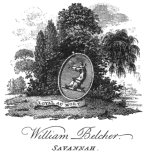
74. Belcher. William Belcher. Savannah.
Armorial. Pictorial. A very beautiful engraving. The shield rests upon the ground and is supported by the oak tree which spreads over it; willows and pines complete the little group of trees, and beyond a stretch of water is seen. The motto, Loyal au mort, is on the ribbon which flutters along the ground beside the shield.
75. Bel-chier. J. Bel-Chier.
Armorial. Jacobean. Motto, Loyal jusq’ a la mort. Printed in red ink.
76. Beresford. Richard Beresford, Charleston. 1772.
Armorial.
77. Betts. William Betts.
Armorial. Plain. Motto, Malo mori quam foedari. Signed, C. P. Harrison Del. Sct.
78. Beverley. Harry Beverley.
Armorial. Chippendale. No motto.
79. Beverly. Robert Beverly.
Armorial. Of Virginia. Historian.
80. Beverly. William Beverly.
Armorial. Signed, J. Kirk.
81. Blackley Absalom Blackley.
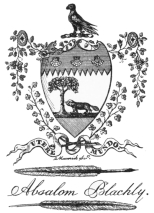
Armorial. Ribbon and wreath. Motto, Utere mundo. Signed, Maverick Scp. The name supported by two quills.
82. Blake. Willm. P. & L. Blake’s Circulating Library at the Boston Book Store.
An engraved label enclosed in an ornamental oval frame. Signed, S. Hill. Sc.
83. Blanc. William Blanc. Middle Temple. Dominica. Crest only. Motto on a garter enclosing the crest, Frangas non flectan.
84. Blatchford. Thomas W. Blatchford. Plain armorial. Motto, Providentia sumus. Signed, Wm. D. Smith sc.
85. Bleecker. Bleecker. Plain armorial. A festoon of cloth behind the shield.
86. Blenman. Jonathan Blenman, Attoray, Genl. & Judge of ye Admty. in Barbadoes.
A small plate, without motto, rather poorly engraved. A little ornamentation of Jacobean manner appears at either side, and the mantling is rather profuse, but well above the shield.
87. Bloomfield. Bloomfield.
Armorial. Chippendale. Rudely drawn books used in the frame. Motto, Pro aris et focis. Signed, J. Trenchard. Major Joseph Bloomfield was a soldier in the Revolution, Governor of New Jersey, Brigadier-General in War of 1812, member of Congress, 1817-21. Illustrated in the “Art Amateur,” April, 1894.
88. Bolling. Robt. Bolling Esq’r.
Armorial. Chippendale. Figures are used as supporters which would appear to symbolize the freedom of the Garden of Eden, and the learning of classic Greece. Motto-ribbon empty; no crest. Of Chellowe, Va. Illustrated in “Curio,” page 15.
89. Bonaparte. Jerome Napoleon Bonaparte. A plain label, with an ornamental type border. Nephew of Napoleon the Great. Born in England, 1805; died in Baltimore, Md., 1870.
90. Bond. T. Bond, Surgeon.
Armorial. Chippendale. Signed, W. H. Native of Maryland; 1712-1784. A distinguished physician and surgeon of Philadelphia.
91. Booth. Benjn. Booth. Crest only. Autograph in a wreath under the crest. Of New York, until the Revolution broke out.
92. Booth. George Booth.
Literary. A lighted candle and books in confusion are placed upon a table. The name is carved upon the edge of the table. On one of the book-covers appears the Booth crest. An etched plate.
93. Boston. Shakspeare Circulating Library, Charles Callender, No. 25 School Street, Boston.
A very curious old woodcut, with a large oval medallion of the famous writer for whom the library was named placed in the centre against a rough rock background; the masks of Comedy and Tragedy lie at the foot, and the hilts of foils can be made out; a garland of roses falls at the right hand, and the rays of the sun come over the top. This is a rough engraving, very black and indistinct.
94. Boston. Social Law Library. Boston.
The name appears on a curtain looped up and held by cord and tassel; above this a small oval encloses a view of four waterspouts, each from behind a rock; above this the circular frame encloses a hand bearing a lighted torch; on the frame is the motto, Vestra cura alitur, and the date 1804; a pile of books above for crest, with S.L.L. on the cover of one.
95. Boucher. Jonathan Boucher.
Armorial. Chippendale. Motto, Non vi sed voluntate. A Loyalist clergyman in Virginia, whose estates were confiscated, after which he returned to England whence he had come in 1754. Published a tract on the causes and consequences of the Revolution, and compiled a glossary of Provincial and Archæological Words, which was purchased of his family in 1831, for the proprietors of Webster’s Dictionary.
96. Boudinot. Boudinot.
Armorial. Ribbon and Wreath. Motto, Soli Deo gloria et honor. Elias Boudinot, born in 1740, in Philadelphia, of Huguenot extraction. Sided strongly with the colonies in the Revolution, and was President of Congress in 1782. A signer of the Treaty of Peace. Died, 1821. This plate is not signed, but it is the work of Maverick. Illustrated in “Curio,” page 111.
97. Bowdoin. Honble. James Bowdoin. Esqr. Plain armorial. Motto, Ut aquila versus coelum.
The same plate as the Bowdoin College, whose benefactor he was.
98. Bowdoin. Bowdoin College.
Plain armorial. The arms of the Hon. James Bowdoin are given with his motto, Ut aquila versus coelum. The sun in splendor shines above the crest, and the name of the college is engraved over it. This college was chartered in 1794, and then presented with eleven hundred pounds and one thousand acres of land, by Hon. James Bowdoin, son of the governor of the colony. By his will a further gift was made to the college.
99. Boylston. Boylston Medical Library.
Plain armorial. The arms of the Boylston family are given without ornamentation or motto. Signed, Annin & Smith. Ward Nicholas Boylston, a patron of medical science, gave to the medical school of Harvard College a valuable collection of anatomical and medical books and engravings, in the year 1800.
100. Boylston. Property of the Boylston Medical Library Cambridge.
Armorial. The arms of the Boylston family are given. Signed, Callender Sc.
101. Bozman. John Leeds Bozman. Esqr of the Middle Temple.
Armorial. Ribbon and Wreath. Motto, Sine virtute vani sunt honores. Lawyer, poet, and historian; born in Maryland in 1757, died in 1823. University of Penn., 1783. Completed his studies in London. His chief work is the “History of Maryland to the Restoration in 1660.” An “Historical and Philosophical Sketch of the Prime Causes of the Revolutionary War” was suppressed; in this Washington was praised and Franklin depreciated. This same copper has been used more recently with the following words added: on either side of the crest, “John Leeds Kerr of Talbot Co. Md. 15th Jan. 1780, 21st Feb. 1844;” at the bottom, under the name of Bozman, “The Maryland Historian, 25th Aug. 1757, 20th April, 1823.”
102. Brasher. Philip Brasher.
Armorial. Ribbon and Wreath. Motto, Beata Domus, Custodita Sic Cuja Deo Domino Est. The shield, with its motto-ribbon and flowery ornamentation, seems to be held up by the winged female who grasps the portcullis of the crest. Below the shield a patch of ground is strewn with books and writing material. A dwarfed weeping willow bends mournfully at the left. Signed on an unrolled sheet of paper, Maverick Scp. Was a prisoner in a sugar-house in New York during the Revolutionary War, which suggested the crest; he had no right to the arms.
103. Brazer. John Brazer. Plain armorial. Shaded mantling. Motto, Try. Of Salem, Mass.
104. Brearly. David Brearly.
Armorial. Ribbon and Wreath. Motto, Honor virtutis praemium. A large plate; attributed to Vallance. Jurist, of Trenton, N.J. A brave officer in the Revolution.
105. Bridgen. Charles Bridgen. Plain armorial. Motto, Probitate et industria.
This plate is not signed, but it is very probably the work of Maverick.
106. Brimage. William Brimage.
Plain armorial. Impaling Gilbert. Arms closely surrounded by a garter on which the name appears. Motto below, Deus dux certus. Of Virginia.
107. Brisbane. William Brisbane.
Armorial. Ribbon and Wreath. Motto, Dabit otia Deus.
108. Brooks. Benjamin S. Brooks.
Armorial. Ribbon and Wreath. Motto, Sustinere. Signed, A. D. (Amos Doolittle).
109. Brown. David Paul Brown.
Plain armorial. Motto, Patria cara, carior libertas. Signed, C. P. H. St. Lawyer, of Philadelphia.
110. Brown. The Property of Jacob Brown.
Pictorial. The interior of a library is depicted, within an oval frame which is ornamented above with a ribbon and a spray of holly; the name is given on the fluttering ends of the ribbon. The central portion of the library is occupied by a couch, covered with striped cloth, on which a youth, dressed in the height of the fashion, reclines; a book is laid upon the convenient corner of the table, and he is reading from this; behind him the shelves of books are seen partly covered by a curtain; through the window are seen the nodding pines; the carpet is adorned with thirteen stars. The following lines are given below the frame:—
Weigh well each thought, each sentence freely scan, In Reason’s balance try the works of man; Be bias’d not by those who praise or blame, Nor, Servile, Yield opinion to a Name.
Signed, Engrd. by P. R. Maverick 65 Liberty Street. As the name Jacob Brown is not engraved, but is printed by hand, it is quite likely that this plate was for promiscuous use; either to be filled up with the name of any who ordered it, or to be pasted in the books sold by some bookseller.
111. Brown. John Carter Brown. Crest only. Motto, Gaudeo.
112. Brown. Thomas Brown.
Armorial. Arms, ... on a chevron, between three leopards’ heads cabossed, or as many escallops.... Crest, an eagle’s head erased or. Motto, En espérance je vie. Signed by Hurd.
113. Browne. Peter A. Browne.
Literary. A plain table, with the scull and crossbones carved in two places upon it, supports several large volumes, on the side of one of which is the name of the owner. On the side of the table the motto is cut, Fiat Justitia. A wreath of laurel rests upon the books, and the all-seeing eye looks upon the scene from above. Signed, Engraved by James Akin. A prominent lawyer in Philadelphia, and the author of “Browne’s Reports.”
114. Brownson. Oliver Brownson’s Property.
An engraved label with the name curved over a peacock which is perched on a scroll.
115. Bruen. M. Bruen.
Plain armorial. Motto, Fides scutum. Matthias Bruen was a clergyman in New York City; ordained in London, 1819.
116. Bruff. The Property of J. G. Bruff, Portsmouth, Va. 183-. Pictorial. On this, a weeping elm supports a large shield on which the inscription is given; so large is the shield that only a little of the tree shows around the edge of the shield. A woodcut.
117. Buchanan. W. B. Buchanan.
Armorial. Motto, Clarior hinc honos.
118. Bull. Martin Bull.
Armorial. A plain armorial plate with the mantling extending down the side of the shield. Motto, Virtus basis vitae. This is the plate of one of the engravers of the old Farmington book-plate, Deacon Bull. See “Ex Libris Journal,” Vol. III, page 187.
119. Burke. James Henry Burke Esqr.
Armorial. Ribbon and Wreath. Motto, Sola salus servire Deo. Of Virginia.
120. Burnet. John Burnet. Attorney at Law New York.
Armorial. Jacobean frame; mantling. Motto, Virescit vulnere virtus. This plate is earlier than the succeeding one by Dawkins.
121. Burnet. John Burnet Esqr New York.
Armorial. Chippendale. The usual pastoral scene which Dawkins used is found here; the shepherdess, and the cupids making music on the flute, and bringing books for leisure moments. Motto, Virescit vulnere virtus. Signed, H. Dawkins Sculp. 1754. Illustrated in “Curio,” page 13.
122. Byam. Francisci Byam, ex Insula Antigua.
Armorial. Jacobean. Motto, Claris dextera factis. Rich mantling continued around the whole shield; the background shell-lined. Printed in brown ink.
123. Byrd. William Byrd of Westover in Virginia Esqr.
Armorial. Jacobean. A very interesting specimen of its class. The profuse mantling thrown high in the air, the shell-lined background, and the curtain upheld at the ends (on which the name and address are given) are prominent characteristics as pointed out by Warren. A rich abundance of fruit overflows from two cornucopiæ, and the motto-ribbon is twined in and out through the scrolls at the base. Motto, Nulla pallescere culpa. Colonel Byrd was a very distinguished Virginian: was born to an ample fortune, liberally educated, and became the patron of science and literature in his native state. President of the Council of the colony; author of the “Westover Manuscripts,” and of other essays. Born, 1674; died, 1744. Illustrated in “Curio,” page 14.
124. Cabell. Doct.r Geo. Cabell Richmond Virga.
Allegorical. In the centre of the design a flaming heart rests upon the shank of an anchor. A thin patch of ground, which grows a few trees, and looks like an island, upholds these emblems of hope. The motto is just above,—Spes mea in Deo. Above this again the all-seeing eye, wreathed in clouds, appears. The whole is enclosed in a design of Ribbon and Wreath arrangement. Evidently the work of Brooks, who engraved the plate of Dr. I. Dove of the same city.
125. Cabell. Samuel Jordan Cabell, of Soldier’s Joy.
Pictorial. The name is printed from type upon a large oval medallion; this is supported by the half-draped figure of Liberty holding the pole with the cap upon it, and an officer in the uniform of the Continental Army. The arms of the United States are above the medallion. The pictorial parts of this are cut in wood.
126. Cabot. William Cabot.
Armorial. Wild Chippendale. No motto. Of Massachusetts.
127. Cadena. M. V. C. (Mariano de la Cadena.)
Plain armorial. An ordinary square shield supported by a very peculiar frame. Motto, Fidem servat vinculaque sulvit. A Professor of Spanish in Columbia College.
128. Cadena. Don Mariano Valazquez de la Cadena. Plain armorial. No motto. Of New York City.
129. Cadena. Mariano Valazquez de la Cadena. Small, plain armorial. Of New York City.
130. Caillaud. John Caillaud. Esqr.
Armorial. Ribbon and Wreath. The frame enclosing the arm is oval in form and quite peculiar in construction; an eagle with a chaplet in his beak appears as a crest.
131. Callaway. Thomas Callaway. Plain armorial. Motto, Aliis quod ab aliis.
132. Callender. John Callender.
Armorial. Pictorial. The shield rests against a rock, mossgrown and over-topped by shrubs. Signed, Callender Sc. Of Massachusetts.
133. Calvert. Thos. Calvert.
Armorial. Chippendale. Motto-ribbon empty.
134. Campbell. Donald Campbell. Jamaica.
Armorial. The shield affixed to the mast of a lymphad. (The crest of this family of Campbells.) Motto, Fit via vi.
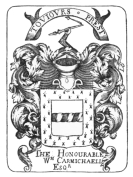
135. Carmichaell. The Honourable Wm Carmichaell Esqr.
Armorial. Early English. The very full mantling nearly surrounds the shield. Motto, Toujours prest. Diplomatist. Born in Maryland. Delegate to Congress, 1778-1780. Foreign minister. Illustrated in “Curio,” page 16.
136. Carroll. Charles Carroll.
Armorial. Chippendale. No motto. The last surviving signer of the Declaration. Died, 1832. This was the Charles Carroll who added “of Carrollton” after his signature to the Declaration, that no mistake might ever be made in recognizing him. Illustrated in “Book Lovers’ Almanac,” 1894. Duprat and Co., New York.
137. Carroll. Charles Carroll Barrister at Law.
Armorial. Jacobean. No motto. The same arms as the Charles Carroll.
138. Carroll. Charles Carroll of ye Inner Templer Esqr,
Second Son of Daniell Carroll of Litterlouna Esqr. in the Kings County in the Kingdom of Ireland.
Armorial. Early English. Elaborate mantling all about the shield. Motto-ribbon empty. Grandfather of Charles Carroll of Carrollton, the signer. Emigrated to Maryland about 1686.
139. Carroll. Ephm. Carroll.
Armorial. Ribbon and Wreath. Motto, In fide et in bello fortes.
140. Cary. Alpheus Cary. Jr.
Plain armorial. The shield surrounded by an oval frame of sun’s rays. Signed, A. Cary del. H. Morse Sc. Of Massachusetts.
141. Cary. Miles Cary.
Armorial. Chippendale. Motto, Sine Deo careo. Of Virginia.
142. Cary. Thomas Cary.
Armorial. Ribbon and Wreath. Motto, In medio tutissimus ibis. Signed, Callender Scp. Of Massachusetts.
143. Cay. Gabriel Cay.
Crest only. Name enclosed in Jacobean frame. No motto. Of Virginia.
144. Chalmers. Geo. Chalmers.
Armorial. Motto, Spero. A resident of Maryland; a stiff Loyalist; author of “Chalmers’ Annals.”
145. Chambers. Benjamin Chambers’s Book.
Armorial. False heraldry. Plain armorial plate with supporters, surrounded by a circular wreath. Motto, Spiro. Founder of Chambersburg, Penn.
146. Chambers. John Chambers Esqr.
Armorial. Arms not in Burke. Az. a chevron or. bet. three cockle shells of the last. Chippendale. Motto, Vincit veritas. Signed, E. Gallaudet Sculp. Chief Justice of New York, 1754.
147. Chandler. Gardiner Chandler.
Armorial. Chippendale. Motto-ribbon empty. Signed, P. Revere Sculp. Of Massachusetts.
148. Chandler. John Chandler Junr Esqr.
Armorial. Chippendale. A very handsome design in the best of Hurd’s styles. Has the characteristic flow of water from the large shell at the bottom. No motto. Signed, N. Hurd Sculp. Of Massachusetts.
149. Chandler. Rufus Chandler.
Armorial. Attributed to Hurd.
150. Chase. Sl. Chase.
Armorial. Chippendale. Motto, Ne cede malis. Signed, Boyd Sc. A signer of the Declaration from Maryland.
151. Chauncey. Chauncey.
Plain armorial. Motto, Gloria.
152. Chauncey. Charles Chauncey.
Plain armorial. Motto-ribbon empty.
153. Chauncey. Charles Chauncey M.D.
Plain armorial. Motto, Sublimis per ardua tendo. Two fierce lions couch upon the ends of the motto-ribbon, and the mantling envelopes the shield. The initials C. C., in cipher, are given between the two names.
154. Chauncey. J. St. Clair Chauncey.
Plain armorial. Motto, Gloria. An officer of the United States Navy.
155. Chawney. Armorial. Of Pennsylvania.
156. Chester. John Chester.
Plain armorial. On a ribbon tied above, By the name of Chester. No motto. Of Wethersfield, Conn. Colonel in the Continental Army; commander of the “elite corps”; was in the battle of Bunker Hill.
157. Child. Francis Child.
Armorial. Chippendale. Motto, Pro lege et rege. Signed, H. Dawkins. Sculpt. Very fine work.
158. Child. The Property of Isaac Child.
Under the name is the verse beginning—
If thou art borrowed by a friend, Right welcome shall he be, etc.
Signed, Sold by N. Dearborn & Son. Undoubtedly engraved by Dearborn.
159. Child. Isaac Child, Boston.
Literary. Four shelves of books. Probably by Dearborn.
160. Child. Thomas Child.
Armorial. Chippendale. Motto, Fari aude. Not signed, but evidently the work of Nathaniel Hurd. First Postmaster of Portland, Me.
161. Child. William Henry Child.
Armorial in form, but displaying no arms on the shield. Crest, two doves with olive branches in their mouths. The initials W. H. C., in cipher, occupy the shield. Ribbon and Wreath. No motto. Very similar in design to the plate of George Grote, the historian. Illustrated in “Art Amateur,” April, 1894.
162. Clark. D. Lawrence Clark.
Armorial. Ribbon and Wreath. Motto, Semper idem. Undoubtedly the arms are not genuine: the argent field of the shield is charged with a branch of holly, and the crest is the American eagle, with a star above its head.
163. Clark. John Clark. M.D.
Plain armorial. Motto, Semper idem. The arms are undoubtedly assumed; az. an oak branch ppr. Crest, an American eagle, with a star (mullet) above.
164. Clarke. Alfred Clarke.
Crest only. Motto, Soyez ferme. Of Cooperstown, N.Y.
165. Clarke. George Clarke.
Crest only. Motto, Soyez ferme. Signed, J. F. Morin. Sc. N.Y.
166. Clarke. Peter Clarke.
Armorial. Chippendale. Motto, Coronat virtus cultores suos. Printed in blue ink.
167. Clarkson. David Clarkson Gent.
Armorial. Jacobean. No motto. Of New York. Illustrated in “Curio,” page 66.
168. Clarkson. M. Clarkson.
Armorial, plain. No motto. Matthew Clarkson was for twenty-one years the President of the Bank of New York.
169. Cleborne. C. I. Cleborne. M. D.
Armorial. The shield canted to one side, surmounted by the helmet; it and the mantling is enclosed within a circular ribbon, on which the motto, Clibor ne sceame, is given. A second ribbon over the design bears the motto, Virtute invidiam vincas. Signed, Jarrett London.
170. Cleveland. Stephen Cleveland.
Pictorial. A very unusual plate: a full-rigged British man-of-war, with ten guns peering from the loop-holes, is hastening from the observer; the English ensign flies from the stern. A very spirited piece of work. It is said that his commission as Captain in our Navy just after the Declaration was the first one issued. Born in Connecticut, 1740, died in Massachusetts, 1801.
171. Clinton. De Witt Clinton.
Armorial. Ribbon and Wreath. Motto, Patria cara carior libertas. Signed, P. R. Maverick. sculpt. Governor of New York, 1817-1822, and 1824-1827. Illustrated in “Art Amateur,” February, 1894.
172. Cock. William Cock.
Armorial. Ribbon and Wreath. Motto, Quod fieri non vis alteri ne fueris. Signed, Maverick Sculpt. The tinctures in the crest—which looks like a leghorn—are indicated by the words, gules and or, engraved outside, and connected with the parts thus tinctured by dotted lines,—a new method. Of New York. Illustrated in “Art Amateur,” March, 1894.
173. Coffin. Coffin arms: name erased.
Armorial. Ribbon and Wreath. Motto, Post tenebras speramus lumen de lumine. Signed, J. Akin Sculp. The name N. W. Coffin is written upon the copy at hand. The arms are of the family of Sir Isaac Coffin, who was born in Boston, 1759.
174. Coffin. Hector Coffin.
Armorial. Ribbon and Wreath. Motto, Exstant recte factus praemia. Signed, J. Akin del. F. Kearny Sc. Of Boston.
175. Coffin. John Coffin. 1771.
Armorial. A frame of Jacobean tendencies. Motto-ribbon empty. Of Massachusetts.
176. Colden. Cadwallader D. Colden.
Plain armorial. Motto, Fais bien crains rien. Mayor of New York City in 1818. Friend and coadjutor of De Witt Clinton.
177. Columbia College. Columbia College Library New York.
Allegorical. The scene is out-of-doors; a throne placed on rising ground is occupied by the Goddess of Learning; the Shekinah blazes above and the rising sun peeps over the horizon. Three little nude beginners in learning stand before the Goddess, in whose hand an open book is extended bearing the motto, Λογια Ζὡνζα. From her mouth a scroll issues bearing in Hebrew the motto, אוריאר Let there be light. Beneath this scene is the reference I Pet. II i. 2 &c. The name of the library appears upon the circular frame which encloses the whole scene; the motto, In lumine tuo videbimus lumen, follows the inner line of the circle. Above, an urn is overfilled with the blossoms of knowledge, while the background of the whole is a brick wall. Signed, Anderson sculp.
178. Connecticut Theological Institute. Theol. Institute of Con. 1833. Presented by
Pictorial. The representation is of a pulpit with winding stairs on either side, and a very tall solemn-looking sounding-board behind it, partially hid by a curtain. The front panel of the pulpit has the following, ΚΗΡΥΣΣΟΜΕΝ ΧΡΙΣΤΟΝ ἙΣΤΑΥΡΩΜΕΝ.
179. Connecticut Theological Institute. Society of Inquiry. Theological Institute of Connecticut.
Three book shelves disclosed by a drawn curtain.
180. Connolly. Charles M. Connolly.
Armorial. Motto, En Dieu est tout. Signed, J. G. Bolen, 104 B’way.
181. Constable. William Constable.
Plain armorial. Motto, Post tot Naufragia portus. Of the early New York family that owned large estates near Utica, N.Y. This plate is circa 1783 and was engraved in New York. It is interesting as a specimen of twisted heraldry; the correct arms are “Quarterly, gu. and vaire, over all a bend or.” (Flamburgh. Co. York, descended from Robert De Lacy, second son of John De Lacy, Baron of Halton, and Constable of Chester). See Burke. In this plate the arms are “Quarterly vaire and gu. over all a bend sinister or.,” which are manifestly incorrect. It was not probably the purpose of the engraver to make this alteration, but not understanding heraldic drawing he drew the arms correctly on the copper, which reversed them in the print.
182. Cooley. Abial A. Cooley’s Property.
An elaborate plate of its kind, which is unusual; it is regular die-sinker’s work, and is printed in red ink. The word Property is on a ribbon which is arched over a peacock and a dove; scrolls abound in convenient places. The only copy seen is in a Boston imprint. 1742.
183. Cooper. Myles Cooper LL.D. Coll. Regis Nov. Ebor. in America. Praefes, et Coll. Reginae de Oxon. Socius &c.
Armorial. Chippendale. No motto. Second President of King’s College (now Columbia). His Loyalist inclinations resulted in a hasty flight from the college; he escaped to England, where he was an honored preacher. Illustrated in “Art Amateur,” April, 1894.
184. Courtenay. Henry Courtenay.
Armorial. Chippendale. No motto. Very similar in style to the Philip Dumaresque. Not signed, but undoubtedly by Hurd. Of Massachusetts.
185. Cox. Chris. C. Cox. A.M. M.D.
A name-label with the skull and crossed bones above the name. The motto, Lectorem delectando paritque monendo, is given below.
186. Cox. Chris. C. Cox. A.M. M.D. LL.D.
Armorial. Crest only. Motto, Fortiter et fideliter.
187. Cranch. Richd. Cranch. Braintree.
An engraved label. The name is within an oval frame, formed of oak and laurel leaves. This plate was engraved by William Bond of Falmouth (now Portland), in 1786. Richard Cranch was a brother-in-law of John Adams, and lived in Quincy, and also in the adjoining town of Braintree.
188. Craven. Craven.
Armorial. Motto, Verus in actione consistit. This is the plate of Lord William Craven, one of the Lords Proprietors of South Carolina.
189. Crookshank. Judge Crookshank.
Armorial. Chippendale. Motto, Lege et ratione.
190. Cunningham. James Cunningham, Junior.
Armorial. Jacobean. No motto. Printed in blue ink.
191. Cunyngham. Robert Cunyngham, of Cayou in ye Island of St. Christopher in America, Esqr.
An old armorial plate; no further information at hand.
192. Curwen. (Anonymous.)
Armorial. Jacobean. No motto. A crude piece of work. Of Salem, Mass.
193. Cushing. Jacob Cushing, His Book. 1746.
A plain printed label with border of ornamental type.
194. Cushman. Cushman.
Plain armorial. Motto, Habeo pro jus fasque. Signed, Pulini Inc. The famous actress, Charlotte Cushman.
195. Custis. Geo. Washg. Park Custis.
Armorial. Chippendale. No motto. The last of Washington’s family—builder of “Arlington.” Son of the following.
196. Custis. John Park Custis.
Armorial. Presumably assumed arms; arg. an eagle displayed ppr. Crest, an eagle’s head erased ppr. Chippendale. No motto. Son of Mrs. Washington by her first husband, Daniel Parke Custis. The engraver omitted the e from the middle name.
197. Cutting. James S. Cutting.
Armorial. Ribbon and Wreath. Motto, Postero ne credo. Signed, Maverick Sct. Of New York.
198. Cutting. William Cutting.
Armorial. Ribbon and Wreath. Motto, Carpe diem: postero ne crede. Signed, P. R. Maverick Sct. Of New York.
199. Cuyler. John Cuyler.
Armorial. Ribbon and Wreath. Motto-ribbon empty. Signed, Maverick Sculpt. Of New York.
200. Dana. Edmund Trowbridge Dana.
The same copper as the following plate, with slight alterations. In the upper left-hand corner the date A.D. 1569 is given. Presumably the date of the grant of arms. Son of R. H. Dana. Translator and editor of works on International Law.
201. Dana. Francis Dana.
Armorial. Chippendale. Motto, Cavendotutus. Signed, N. H. Scp. A handsome plate in Hurd’s best style. Statesman and jurist. Born, Charlestown, Mass., 1743; died in Cambridge, 1811.
202. Dana. Richard Henry Dana.
The same old copper again retouched. The date 1569 is in new type, and the name is changed to the present user. Poet and essayist.
203. Danforth. Danforth.
Armorial. Chippendale. Motto, Ubi plura offendar maculis nitent non ego paucis. Signed, N. H. Scp. At the upper left-hand corner, outside the design, the sun shines in full strength. Presumably the plate of Dr. Samuel Danforth of Boston. Born, 1740; died, 1827.
204. Dartmouth College. Library of Dartmouth College. Presented by Isaiah Thomas Esq A.D. 1819 in his Donation of 470 Volumes.
These words printed from type within a border of ornamental type disposed in an oval.
205. Dartmouth College. Social Friends Library.
A plain shield with thistles for decoration bears the number of the volume. Motto, Sol sapientiae nunquam occidet. The full sun above the shield.
206. Davenport. Armorial. Of Virginia.
207. Davidson. Henry Davidson.
Armorial. Ribbon and Wreath. Motto, Sapienter si sincere. A very neat plate. The wreath has not the proper twisted effect, but appears more like a row of eggs than an heraldic wreath.
208. Davis. Davis.
Plain armorial. Motto, Auspice Christo.
209. Day. John Day.
Plain armorial. Signed, J. Smithers. Sculp. Of Philadelphia.
210. Day. M. W. Day.
Pictorial. A collection of literary property is grouped in an open space where the rising sun shines strongly; the name is given upon a ribbon which floats above; from it depends a lamp; to the right, a book-case; to the left, a bust of Franklin, a large globe, books, ink-pot and quills; in front, an unrolled parchment which purports to be a list of books. The following motto:—
’Tis education forms the common mind, Just as the twig is bent, the tree’s inclined.
Signed, W. Chapin del & Sc.
211. Deane. John Deane.
Armorial. Ribbon and Wreath. No motto. Name on motto-ribbon.
212. De Blois. Lew’s. De Blois.
Armorial. Jacobean. No motto. Signed, Nathaniel Hurd Sculp. The mantling is well conceived but rudely engraved; the shell-lined background is here, and the curtain upheld at the corners, on which the name is given. The whole appearance of the plate shows it to be quite early, and among the first attempts of Hurd.
213. De Blois. N.J. De Blois.
Armorial. Jacobean, with handsome mantling. Motto, Je me fie en Dieu. “These arms are assumed by some members of the family of this name living in Newport, R.I. The first of the name in America was born in Fort George, N.Y., some time before the Revolution; his descendants in New York and Newport carried on a great hardware business with their parents in England, but when the troubles occurred they became Tories and left the country. Some of the wax seals on their old letters bear the impression of a Moor’s head, which may have been correct. Others had either the conceit or ignorance to assume the armorial bearings of the famous and noble family of Châtillon of France, which historical race became extinct in 1762. As, during the 14th century some members of the Châtillons were Comtes de Blois, this title, extinct in 1364, over 500 years ago, is most unwarrantably used as if it were the family name, and the Châtillon arms adopted in a most extraordinary way, reversing the ordinary way of acquiring arms; so audacious and arrogant is the assumption and so sublime the impudence it entitles the fact to a high place in the Curiosities of Heraldry.” (These notes are found accompanying the copy of the plate in the collection of the late Mr. James Eddy Mauran.) This plate is apparently copied from the one by Hurd, and as that is much earlier, it may be that the assumption of the arms was due to him instead of to the later users, who simply copied what appeared to be the legitimate plate and arms of an ancestor.
214. Dedham. Library of the “Young Men’s and Young Ladies’ Societies for the Study of the Sacred Scriptures.” Dedham, (Ms).
The above inscription is printed from type within an oval frame which is cut on wood; elongated cornucopiæ extend their blossoms above and around the central panel; above in a small frame a lute and some music books.
215. Denny. William Denny.
Armorial. Motto, Et mea messis erit. Governor of the Province of Pennsylvania.
216. De Peyster. Frederick De Peyster.
Armorial. A plain, heart-shaped shield supported by two eagles on palm branches, which are crossed under the shield and extend upwards on either side. No motto. Signed, P. R. Maverick Sct. Of New York. Illustrated in “Art Amateur,” February, 1894.
217. Derby. Martha Derby.
The name printed within a border of flowers and sprays. A group of musical instruments above.
218. Dering. Nicoll H. Dering.
Armorial. No motto. The Thomas Dering plate by Hurd, with the name altered.
219. Dering. Thomas Dering.
Armorial. Chippendale. No motto. Signed, N. Hurd Sculp 1749. This is the earliest plate by an American engraver which is both signed and dated. But one copy is known at this writing. Illustrated in “Curio,” page 14.
220. Dering. Thomas Dering.
Crest only, enclosed within a circular ring. The half-date 17— is given. Resembles the work of Hurd somewhat.
221. De Witt. Richard Varick De Witt.
A small pictorial plate, representing Minerva standing helmeted and with spear and shield in hand. On some copies of this plate the following additional inscription is found engraved, From his uncle Richard Varick.
222. Dexter. Samuel Dexter’s. MDCCLXXXV.
A printed label, with a border of ornamental type. Eminent lawyer and statesman. Secretary of War 1800, and Secretary of the Treasury, 1801.
223. Dill. John E. Dill. Boston.
A name-label in which the name is printed within a border made up of ornamental type, although it does not look so at first glance. The back of the design resembles a brick wall; the frame is made up of bouquets in holders, hearts, and an assortment of odds and ends.
224. Dinwiddie. Rob’t. Dinwiddie.
Armorial. Chippendale. Motto, Ubi libertas ibi patria. Lieutenant-Governor of Virginia, 1751-1758. See “Ex Libris Journal,” Vol. II, pages 89, 125.
225. Dolbeare. Benjamin Dolbeare of Boston in New England. Oxford. Printed at the Clarendon Printing House. October 6, 1739.
A very large printed label, with three rows of ornamental type border, between which the following is printed, “The Noble Art and Mystery of PRINTING was first Invented by JOHN GUTTENBERG of Mentz, a City of Germany in the YEAR 1440 and brought into ENGLAND by JOHN ISLIP of London in the year of our LORD 1471.” This is very like the plate of Martha Bartlett, illustrated in “The Book-plate Collectors’ Miscellany,” page 20. See note from Mr. Tuer in same, page 29. There was an Edward Dolbier in the Boston Tea-party, 16th December, 1773.
226. Dove. Doct. I. Dove. Richmond. Virga.
Armorial. Crest only. A dove ppr. holding an olive branch in her bill. Motto, Deus providebit. The design is completed by a festoon and crossed branches in Ribbon and Wreath style. Signed, Brooks Sculp. The Doct. Cabell plate was evidently the work of this same engraver.
227. Dove. Samuel E. Dove. Richmond. Va.
Pictorial. The dove with the olive branch in her bill flies past mountains with water at their foot. Motto, Ab initio Deus providebit, on a circular garter enclosing the picture.
228. Drayton. Drayton, South Carolina.
Armorial. Ribbon and Wreath. Motto, Non nobis solum.
229. Drayton. Jacob Drayton, South Carolina.
The same copper as the above with the first name added.
230. Drayton. Wm. Drayton, Middle Temple.
Armorial. Chippendale. Motto, Non nobis solum. A smaller plate than the preceding, with the same arms. The name and address are given in a bracket bordered with scrolls and foliations. A jurist of South Carolina and Florida.
231. Drayton. William Henry Drayton.
Armorial. Statesman. Born at Drayton Hall-on-the-Ashley, near Charleston, S.C., 1742; died, 1779.
232. Duane. James Duane. Esqr.
Armorial. Chippendale. Motto, Nulli praeda. Signed, H. D. fect. The usual pictorial elements of Dawkins’ style are here introduced. The prim shepherdess and attendant swain on one side of the shield, and a lonely young girl singing to herself by a fountain, to the music of her guitar; her home cannot be far away as she wears no hat and is in décolleté attire. Of New York. Statesman. Member of the Old Congress. Illustrated in “Art Amateur,” March, 1894.
233. Dudley. Joseph Dudley 1754.
Armorial. Early English. The mantling is very full, curling upwards as well as downward and completely envelopes the shield. It is the common type of denticulated mantling, but not so elegant as some examples. Motto, Nec gladio nec arcu. The name appears on the usual scroll beneath the shield. Of the family of the Governor of the colony of Massachusetts. This date, 1754, was added by Hurd, and is much later than the actual date of the plate.
234. Duer. E Libris Gul. Alex. Duer.
Plain armorial. Motto, Esse et videri. Of New York. Brother-in-law of Beverly Robinson. President of Columbia College from 1829 to 1842. Son of following.
235. Duer. Willm. Duer. Esq.
Armorial in form. Crest only. Ribbon and Wreath. Motto, Esse quam videri. Attributed to Maverick: the frame strongly resembles the Maturin Livingston. The name is on the shield. Born, 1747. Delegate to Continental Congress.
236. Dumaresque. Philip Dumaresque.
Armorial. Chippendale. No motto. Signed, N. Hurd. Sculp. One of the first officers of old Trinity Church in Boston.
237. Dummer. Jer. Dummer Anglus Americanus.
Armorial. Early English. No motto. In the diary of John Hull, the coiner of the early specie of Massachusetts, the following entry is found: “1659. 1st of 5th. I received into my house Jeremie Dummer and Samuel Paddy, to serve me as apprentices eight years.” In the “Heraldic Journal” we learn that Jeremiah Dummer was a goldsmith. Married in 1672 Hannah Atwater. He was the father of Governor William Dummer, and of Jeremiah Dummer the younger, the probable owner of this plate, who was Massachusetts agent in England, 1710-1721.
238. Duncan. James H. Duncan.
Armorial. Ribbon and Wreath. Motto, Disce pati. Very crude work.
239. Dunkin. Robert Henry Dunkin.
Armorial. Motto, Disce pati. Signed, I. H. (Hutt.) Of Philadelphia.
240. Dunning. Charles E. Dunning.
Armorial. Chippendale. Motto, Semper paratus. Foliage, roses and a griffin in the ornamentation.
241. Dunning. Charles S. Dunning.
Armorial. Impaling Wijnkoop. Chippendale. (Late.) Motto, Semper paratus. More elaborate design than the above.
242. Durand. John Durand. Esqr.
Armorial. Chippendale. Very fine. Presumably by the brother of Asher B. Durand, who was a fine engraver. A medallion beneath the shield shows cupids in a corn-field.
243. Duvall. E Bibliotheca Gabrielis Duvall. A.D. 1778.
The name printed from type within a woodcut border, in which thirteen stars form a patriotic allusion. Signed, T. S. (Sparrow.) Of Huguenot descent. Born in Maryland, 1752. Jurist and Federal officer.
244. Dyckman. Dyckman.
Armorial. Ribbon and Wreath. The crossed branches are under the shield, and its edge is embellished with close festooning. J. G. written before the name. Motto, Zyt bestindig. Illustrated in “Art Amateur,” April, 1894.
245. Dyckman. States Morris Dyckman.
Armorial. Ribbon and Wreath. Motto, Zyt bestendig.
246. East Windsor. Miscellaneous Literary Association, East Windsor.
Allegorical. Minerva in repose. A Greek mask near by.
247. Edwards. Bryan Edwards Esqr. Greenwich Park, Jamaica.
Armorial. Chippendale. Very ornate. Motto, Nosce te ipsum. Signed, Ashby Sculp, Russel Court, London. Historian, and wealthy merchant in Jamaica.
248. Edwards. Charles Edwards.
Plain armorial. Motto, The North against the World. Lawyer and author of New York. Born in 1797.
249. Edwards. Isaac Edwards. North Carolina.
Armorial.
250. Elam. Samuel Elam. Rhode Island.
Armorial. Pictorial. A bit of landscape is introduced, and the shield hangs from a ring around the bole of a shattered oak. A very pretty design and well engraved, reminding one somewhat of the book-plates by Bewick.
251. Eliot. William H. Eliot.
Armorial. Crest only, within an oval garter on which is given the motto, Non nobis solum.
252. Ellery. Benjamin Ellery.
Armorial. Chippendale. No motto. Of New York. The same plate is found bearing the name Harrison Ellery.
253. Elliott. Barnard Elliott.
Plain armorial. Colonel in the Revolution. Signed, P. R. Maverick.
254. Elliston. Robert Elliston Gent. Comptrolr. of his Majesties Customs of New York in America.
Armorial. Jacobean. A very handsome plate indeed, engraved in an excellent manner. The shield is set against a diapered background, and the ornamental moulding of the side is lined with shell-work; the shield rests upon an upturned shell, and two eagles have alighted upon the upper arms. The motto, Bono vince malum, is given upon a ribbon under the frame, and there is no curtain or scroll to receive the inscription, which is engraved plainly in three lines beneath all.
255. Elliston. Robert Elliston Gent. Comptrolr. of his Majestie’s Customs of New York in America.
This is very similar to the preceding, but is a trifle larger, and in some respects superior. As before, the shield is placed within the enfolding arms of a Jacobean frame, but the diapered pattern is succeeded by an all-over shell pattern, and a grinning canephoros head supports the shield. On a ribbon above the crest the date is given, M.DCC.XXV. The motto, Bono vince malum, as before, is on its ribbon under the frame. Again the usual curtain is omitted and the inscription is engraved in three lines below all, with a little more attention to grammatical marks, and in bolder type. The eagles have disappeared. The copy before me has the following in handwriting:—His gift to the library of St. Georges’ Ch: in ... Queens County province of New York. 1730. Illustrated in “Curio,” page 65.
256. Emerson. William Emerson.
Armorial. Ribbon and Wreath. The work looks very much like Callender’s. Motto, Fidem servabo. Father of Ralph Waldo Emerson.
257. Erasmus Hall. Erasmus Hall Library.
Allegorical. Signed, Maverick Sculpt New York. The plate is divided into two sections: the upper one is enclosed within a circular frame, and contains the allegorical picture. Diana is seen in the foreground directing the attention of a youth to the glories revealed upon the heights above them. Two temples are seen which bear dedications to Fame and to Virtue. Surrounded by clouds the angel of Fame is even now appearing above her sacred fane. The implements of study are at the foot of the youth, and under this scene are the words, FORTITER! ASCENDE. The lower part of the design is simply a wreath enclosing the name. The Erasmus Hall Library belonged to an Academy which was founded at Flatbush, L.I., in 1786.
258. Erving. William Erving. Esqr.
Plain armorial. Mottoes, Quo fata vocant, and Flourish in all weathers. Signed, Callender Sct. Undoubtedly of the Boston family of Loyalists.
259. Erving. (Anonymous.)
Plain armorial. Quartering, “Ar. an eagle displayed sa. within a border invected of the last.” The first and third quarters are the Irvine arms.
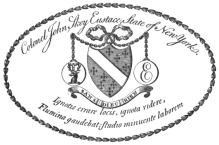
260. Eustace. Colonel John Skey Eustace, State of New York.
Armorial. Ribbon and Wreath. Motto, In hoc signo vinces. The arms are not correct, as one cross-crosslet is missing, and it is not certain that the crest which hangs in unusual style on a plate, from the festoon, belongs to this family. The crest is balanced by a plate on the other side of the shield, on which a letter E is engraved. The whole is contained within an elongated wreath. The name appears above the shield following the curve of the wreath, and at the bottom two additional lines in Latin serve as another motto, Ignotis errare locis, ignota videre, Flumina gaudebat: studio minuente laborem. A variant of the above,—the same copper altered,—gives this motto in place of In hoc signo vinces,—Sans Dieu rien. A Revolutionary officer whose bravery was recognized by Congress.
261. Evarts. Jeremiah Evarts.
A simple name-label with the motto under the name and a festoon of cloth above it. Motto, Nil sine magno vita labore dedit mortalibus. Father of the Senator.
262. Everdell. William Everdell.
Armorial in form, though no real arms are shown. Motto, Semper paratus. The four quarters of the shield are occupied with implements of the draughtsman’s art. Of New York.
263. Everett. Edward Everett.
Plain armorial. Motto, Patria veritas fides. Scholar and orator. Born, 1780; died, 1851.
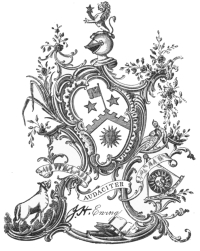
264. Ewing. Ewing. (John.)
Armorial. Chippendale. A very porky lamb, books, two cooing doves, and a quadrant are introduced into the framework. Motto, Audacter. A Philadelphia clergyman.
265. Fairfax. Bryan Fairfax.
Armorial. Motto, Fare fac. Eighth and last baron; friend of Washington.
266. Farmington. Library in the First Society in Farmington.
A large engraved label.
267. Farmington. This Book belongs to Monthly Library in Farmington.
Allegorical. Signed, M. Bull’s & T. Lee’s Sculp. A large plate in which the Laws and the names with the attendant flourishes take a good deal of the space. In the centre a shelf of books separates two groups of figures. At the right a very stiff youth, in the court costume of the period, with wig, ruffles, and buckled shoes, is seen under the guidance of a portly female figure who impersonates Wisdom.
She appears to be warning the youth of the dangers of pursuing the two sirens who beam at him across the shelf; or else they are meant to represent the sources of Knowledge, and the youth is being conducted to them. As Deacon Bull was not a great engraver we may be pardoned if we do not clearly understand his allegory. However, the LAWS of the Library are very plain, and are neatly engraved under the row of books mentioned.
1.Two pence pr day for retaining A Book more than a Month.
2.One penny for folding down a Leaf.
3.3/ for lending a book to a Nonproprietor.
4.Other Damages apprais’d by a Committee.
5.No person allowed a Book while indebted for a Fine.
Below these stringent rules the following verse is given:—
The Youth, who, led by WISDOM’S guiding Hand, Seeks VIRTUE’S Temple, and her Laws Reveres: He, he alone, in HONOUR’S Dome shall Stand, Crown’d with Rewards, & rais’d above his Peers.
The design is very ambitious, but is rather poor in execution.
268. Farmington. Village Library.
Library Interior. A young lady, very prim, and exceptionally neat and austere in her virtuous demeanor, sits upright in a chair beside a table, on which a few books are laid, and an ink-pot with the quill in it. An open case of books on the wall, a closed writing-desk under it, and a print of Washington complete the furniture of the room. Out of the window can be seen the inspiring sight of a steep hill, upon the summit of which the pillared Temple of Honor stands.
The following verse is given:—
Beauties in vain their pretty eyes may roll: Charms strike the sense, but merit wins the soul.
Also of Farmington, Conn.
269. Fauquier. Francis Fauquier. Esqr.
Armorial. Chippendale. No motto. Lieutenant-Governor of Virginia from 1758 to his death in 1768. Regarded by Jefferson as the ablest executive of Virginia. Illustrated in “Art Amateur,” May, 1894.
270. Fendall. Philip Richard Fendall.
Armorial. Arms very doubtful. Ribbon and Wreath. Motto, Esse quam videri.
271. Fenwick. Fenwick.
Armorial. Chippendale. Motto, Perit ut vivat. Signed, J. Smither. Sc. A plate showing fertility of design in the engraver, but not much skill with the burin.
272. Fish. Hamilton Fish. Stuyvesant Square New York.
Plain armorial. Mantling. Motto, Deus dabit. Governor of New York State, 1849-1851.
273. Fisher. Joshua Fisher.
Armorial. Ribbon and Wreath. No motto, name on motto-ribbon. Native of Delaware. A leading merchant of Philadelphia during the Revolution.
274. Fitzhugh. (Anonymous.)
Plain armorial. Motto, Pro patria semper. Of Virginia.
275. Fitzhugh. Willm. Fitzhugh Junr.
Armorial. Chippendale. Motto, Pro patria semper. Of Virginia.
276. Foot. Ebenezer Foot.
Armorial. Ribbon and Wreath. Signed, Maverick. Sct. Of New York.
277. Foote. Ebenezer Foote. Plain armorial. No motto.
278. Foote. Foote.
Plain armorial. No motto. The name John P. is written in before the family name on the copy at hand.
279. Forbes. Eli Forbes.
Armorial. Chippendale. Motto, Omni fortunae paratus. Signed, T. M. Furnass, St. This is the only specimen so far discovered of the work of this engraver, who was a nephew and pupil of Hurd. The owner was Chaplin in the army of the Revolution and a missionary to the Indians. (1800.)
280. Forman. Forman.
Armorial. Chippendale. Motto, Deo et amicitiae. An officer of the Revolutionary army. Had an estate named “Rose Hill,” in Maryland.
281. Foster.
A plate of this family name is owned in Boston, but no information concerning it can be obtained. It is said to be the work of Furnass.
282. Foster. Isaac Foster.
Armorial. Jacobean. Motto, Mille mali salutis habeo, species mille. Signed, N. Hurd. Scpt.
283. Fowler. C. Fowler.
Armorial. Ribbon and Wreath. No motto. Name on motto-ribbon. A small plate. Of Rhode Island.
284. Fownes. From the Library of the late Rev. Joseph Fownes, of Shrewsbury, 1790.
A printed label.
285. Foxcroft. John Foxcroft.
Armorial. Of Boston.
286. Francis. John Francis.
Plain armorial. Motto, Manet amicitia florebit que semper. Signed, Callender Sculp.
287. Franklin. John Franklin Boston New England.
Armorial. Jacobean. Motto, Exemplum adest ipse homo. Signed, J. Turner Sculp. The shield rests upon a very elaborately ornamented frame, the background of which is covered with a diaper pattern. As supporters, Artemis, the goddess of the moon, with spear and arrow in hands appears upon the left hand, and Apollo, likewise with spear, attends upon the right. Both are represented with the lower part of the figure diminishing into a vase, in the manner of the Termini. They stand upon an ornamental bracket which encloses a sketch of Diana sounding the hunter’s horn, while an attendant unleashes the hound. The points upon which the figures of Artemis and Apollo rest are supported by female busts in profile. The whole design is very ornate, and the plate is perhaps the rarest of our early Americans. John Franklin was the brother of Benjamin of greater fame.
288. Franklin Institute. Library of the Franklin Institute.
Portrait plate. A very fine portrait of Benjamin Franklin enclosed in a typical picture-frame of the day.
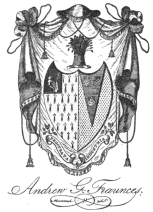
289. Fraunces. Andrew G. Fraunces.
Armorial. Mantle of estate. Motto, Procurator industria. Signed, in the flourishes under the owner’s name, Maverick Scp. An unusual style for Maverick.
290. Freeman. Nathaniel Freeman.
Armorial in form, but no arms displayed. The shield hangs upon a dwarfed tree, and has the initials N. F. in cipher upon it. A long ribbon trails on the ground and over the shield and tree, bearing the motto, וראת וחררו דאשיו דעת.
291. French. Jonathan French.
Armorial. Late Chippendale. Motto-ribbon empty. Of Massachusetts.
292. Gallatin. Gallatin.
Plain armorial. Motto, Persevere. This is the plate of Albert Gallatin (1761-1849), the statesman. He is said to have adopted this motto in place of the family motto.
293. Gallaudet. Gallaudet.
Plain armorial. Motto, Ut quiescas labora. Not signed, but engraved by Edward Gallaudet.
294. Gardiner. By the name of Gardiner.
Armorial. Chippendale. No motto, the name occupying the motto-ribbon. This is the plate of John-Lion, the seventh proprietor of Gardiner’s Island, who was born November 8, 1770, and who died November 22, 1816. The arms are the same as those of John Gardiner, but the tinctures differ; the bugle-horns are gules in this plate, and sable in the other. This plate is also found with the autograph of David, the eighth and last proprietor, under the will of Mary, the widow of Lion.
295. Gardiner. John Gardiner.
Armorial. Chippendale. Motto-ribbon empty. This is the plate of the fifth proprietor of Gardiner’s Island. Born, 1714; died, 1764.
296. Gardiner. John Gardiner of the Inner Temple.
Armorial. Chippendale. Motto, Pro patria mori. A witty and eloquent lawyer of Boston.
297. Gardiner. Samuel Gardiner.
Plain armorial. No motto. Of the Maine family.
298. Garnett. John Garnett.
Armorial. Chippendale. Motto-ribbon empty. No crest.
299. Georgetown College. Georgetown College.
Pictorial. An eagle just rising from the stump of a tree carries a ribbon floating in his beak, on which the legend, Presented to the P. Society Library. Motto above, Lex libertas salusque gentis.
300. Georgetown College. Collegium Georgiopolitanum, ad ripas Potamaci in Marylandia.
The American eagle displays the shield of our country on his breast; one talon is upon a globe, the other grasps a cross. The motto, Utraque unum, is given upon a ribbon which flutters from the beak of the eagle. Above, in a blaze of glory, an ancient lyre is seen. Branches of oak rise on either side of the design.
301. Ghiton. William R. Ghiton. 1718.
Armorial.
302. Gibbes. Edmund A. Gibbes.
Plain armorial. No motto. Of South Carolina.
303. Gibbes. James S. Gibbes.
Plain armorial. Motto, Amor vincit naturae. Of Charleston, S.C.
304. Gibbs. John Walters Gibbs.
Armorial. A very peculiar frame showing Jacobean, Chippendale, and Ribbon and Wreath features. No motto. Crude work.
305. Gibbs. John Walters Gibbs. Charleston. So. Carolina.
Armorial. Ribbon and Wreath. Motto, Beware my edge, in reference to the battle-axes of shield and crest. Signed, Abernethie Sculpt. The edge of the shield is close-trimmed with festooning, and tall vases rest upon the scrolls at the sides.
306. Gibs. James Gibs.
Armorial. Of New York. Signed by Maverick.
307. Giles. Daniel Giles.
Armorial. Ribbon and Wreath. Motto, Toujours le même.
308. Giles. James Giles.
Armorial. Military trophies with slight Ribbon and Wreath ornamentation. Motto, Libertas et patria mea. Signed, Maverick Sculp. Behind the shield a plentiful supply of munitions of war are arranged. The flags of the United States and of England, swords, pikes, lances, muskets, bayonets, cannon in the act of discharging, trumpets, drums, wormers, ramrods, cleaners, piles of cannon-balls, and kegs of powder are in the assortment.
309. Gilmer. Armorial. Of Virginia.
310. Gilpin. Henry D. Gilpin.
Pictorial. The arms are carved upon a large fragment of the adjacent ruins, and which lies at the base of a broken column. The ribbon under the shield bears the motto, Dictis factisque simplex. A large tree rises behind the broken column and cuts off the view, but a part of a castle is visible, and between it and the fore view a knight on horseback assisted by one on foot is chasing a wild boar, which is a plain reference to the charge on the shield. Signed, C. G. Childs. Attorney-General of the United States. 1840-1841.
311. Gilpin. Henry D. Gilpin.
A plate so nearly identical with the preceding as to be taken for it without close examination. This plate is not signed.
312. Gilpin. (Anonymous.)
The plate of John Gilpin, English Consul at Newport. Motto, Dictis factisque simplex.
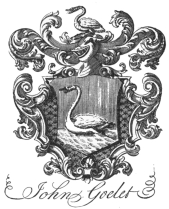
313. Goelet. John Goelet.
Armorial. Jacobean. A beautiful example. No motto. Not signed, but probably by Maverick.
314. Goodwin. George Goodwin.
Pictorial. A bracket of graceful design and ornamentation supports two substantial piles of books, between which ensconced in branches of flowers and holding a lyre in his hands, sits a pleasant-faced cupid. Attributed to Doolittle. Publisher of “The Courant,” Hartford, Conn.
315. Gorham. Joseph Gorham.
Armorial. Chippendale. Motto, Par espérance et activité nous surmontons. Signed, W. Smith Sculp. At the right hand, standing on the name scroll, is an Indian with his feet upon a snake which is stretched at full length. The savage is in civilized clothing, and carries a tomahawk in his folded arms; behind him the ends of bows, arrows, quiver, and tomahawk stand out from behind the shield. On the other side is a British regular with drawn sword in his folded arms; for a background he has a powder-horn, drum, lances, and the British flag.
316. Gourgas. J^N. J^S. J^H. Gourgas.
Armorial. Apparently of French make. No motto. Signed, P. L. In the New York Directory of 1837, the name of John J. J. Gourgas is given; a merchant. This plate is from the same copper as the Jean Louis Gourgas, which is a French plate seen in several collections.
317. Gracie. Robert Gracie.
Crest only. Motto, God grant grace. Signed, Lewis Sculp. In the New York Directory of 1826 as a merchant.
318. Graeme. Elizabeth Graeme.
Armorial. The arms are in a lozenge with Chippendale ornamentation of exceeding gracefulness. No motto. Of Philadelphia. An accomplished woman in literature.
319. Graham. Henry Hale Graham.
Armorial. Signed, J. Smither sc. Eminent lawyer of Chester, Penn.
320. Graham. John A. Graham. M.D.
Armorial. Ribbon and Wreath. Motto, Ne oublie.
321. Grant..... Grant. (First name erased.)
Plain armorial. Motto, Stand sure. Of Scottish descent.
322. Gray. Gray.
Armorial. Ribbon and Wreath. Motto, In Deo fides. Probably by Callender.
323. Green. Francis Green.
Armorial. Chippendale. Motto, Aestate hyeme que idem. A Boston merchant. Signed, N. Hurd Sculp.
324. Green. Garrett Greens’ Private Library. 809 Greenwich Street.
A printed label with the following motto, When we are deprived of friends we should look upon good books (they are true friends that will neither flatter nor dissemble:), and we should study to know ourselves. The borrower will please read and return this Book uninjured and without delay. Circa, 1822.
325. Green. John Green Jr. of Worcester.
A grotesque plate. The name is enclosed within a frame which is filled with mementoes of the dissecting room, and with various mottoes.
326. Greene. Benjamin Greene.
Armorial. Jacobean. Motto-ribbon empty. Signed, N. H. Scp. A very neat and pretty plate. A wealthy merchant of Boston; of a branch of the Rhode Island family.
327. Greene. Benjamin Greene. 1757.
The same copper as the above but with the date 1757 added beneath the name; this was probably placed there some time subsequent to the date of engraving, although very likely the correct date. Signature unchanged. Illustrated in “Art Amateur,” April, 1894.
328. Greene. B. D. Greene.
Armorial. Ribbon and Wreath. No motto. A small plate, very neat in appearance.
329. Greene. David Greene.
Armorial. Chippendale. Motto, Nec timeo nec sperno. Signed, Revere scp. Of Massachusetts.
330. Greene. Thomas Greene Junr.
Armorial. Jacobean. Motto, Study to know thyself. Signed, N. Hurd Scp. Very similar to the plate of Benjamin Greene.
331. Greenleaf. William Greenleaf.
Armorial. Signed, N. Hurd. Scp.
332. Greenough. The Property of David Stoddard Greenough.
A printed name label with borders of ornamental type. The motto, Return what thou borrowest, with the most sacred punctuality, and withhold it not, is printed between the borders. A woodcut pattern of festooning and sprays of flowers encloses the whole. Signed, William Greenough fecit.
333. Greenwood. Isaac Greenwood.
Pictorial. An anchor enclosed within a circular frame which bears the name; slight foliations within the frame. Resembles an old printer’s mark somewhat.
334. Griggs. A. Griggs Philadelphia.
Pictorial. In a position quite impossible to imagine outside of the picture, are three books thrown upon a huge rock, holding a scroll outspread, which hangs down over a rushing brook. Indeed, one corner of the scroll dips into the water; a few brushes and stunted or dead trees complete the landscape. This is a woodcut in the style of Anderson.
335. Guilford Library. Guilford Library.
Literary. Motto, Improve your hours for they never return. A shelf of books very similar to that in the plate of George Goodwin, has a cloth festoon looped above it; the motto is on a circle enclosing the winged hourglass; the scroll-work above this is made into the form of a face. This plate closely resembles that of the Stepney Society, in Wethersfield, which is by Doolittle, and leads to the conclusion that this is also his work. In 1737 the towns of Guilford, Saybrook, Killingsworth, and Lyme formed a Library Association. It was dissolved a little before 1800, and Guilford formed one by itself: at about the same time the young people of the town started a library, and these two were united in 1823 and formed the Union Library whose plate is noticed below.
336. Guilford. Union Library.
Pictorial. The American eagle, with shield, olive branch, bunch of arrows, and the ribbon with the motto, E pluribus unum, is printed from a woodcut; the motto, Improve your hours for they never return, is printed from type beneath.
337. Guinaud. Henry Guinaud.
Armorial. Chippendale. Motto, Sans venin. A bow and quiver of arrows and a Gainsborough hat with a stick thrust through it are seen in the ornamentation. The arms are peculiarly unpleasant, being a huge ten-legged scorpion printed very black. This is repeated in the crest. Of Baltimore.
338. Gurney. Henry Gurney. Esqr. Philadelphia.
Armorial. Ribbon and Wreath. Motto, Sperne successus alit.
339. Hale. Robert Hale Esqr of Beverly.
Armorial. Chippendale. No motto. Signed, N. Hurd Scp. Prominent man in Massachusetts; under Pepperell at Louisburg. From this family of Hales came Nathan Hale.
340. Hall. James Hall.
Armorial. Chippendale. No motto. Not signed, but attributed to Turner. Lawyer and author of Philadelphia.
341. Hall. Thomas Hall. 1787.
Armorial. Ribbon and Wreath. Believed to be the first postmaster under Washington, in Charleston, S.C.
342. Hall. William Hall.
Armorial. Arms, Quarterly 1st and 4th, Sable, three talbot’s heads erased argent, collared gules, 2nd and 3rd, Sable, three leopard’s heads jessant-de-lys, orgeant. Crest, a talbot’s head erased sable.
343. Hallowell. Robert Hallowell.
Armorial. Ribbon and Wreath. Motto-ribbon empty. This plate is not signed, but is probably the work of Callender. Comptroller of the Customs in Boston. A Loyalist whose home was mobbed. One of his sisters married Samuel Vaughn, whose plate impales the Hallowell arms.
344. Hamersley. J. W. Hamersley.
Plain armorial. Motto, Honore et amore. Signed, Faithorne. A New York lawyer.
345. Hamilton. William Hamilton.
Armorial. Ribbon and Wreath. No motto. Of Pennsylvania. A Loyalist. Nephew of Governor James Hamilton. His country seat was “The Woodlands,” now the Woodland Cemetery of Philadelphia.
346. Hanchett. John Hanchett.
Armorial. Ribbon and Wreath. No motto. Taken from a book containing the autograph of the owner, with the date, Aug. 28, 1768, and the residence given as Hartford.
347. Harris. Alexander Harris, Architect, Boston.
An engraved label.
348. Harison. Richard Harison. Esqr.
Armorial. Chippendale. Motto, Nec te quaesiveris extra. A large plate, very pretty in appearance, but strange in the tincture of the arms. Of New York.
349. Harrison. Rich’d. Harrison.
Crest only. Motto, Nec te quaesiveris extra. A lambrequin looped up with cord and fasteners above. Signed, Rollinson Sculpt. Presumably belonging to the same owner as the last.
350. Hartford. Hartford Library Company.
An engraved name-label; the name within an oval frame, with a festoon of roses about it, and sprays of palm crossed beneath. Now the Hartford Public Library.
351. Harvard. Sigill: Coll: Harvard: Cantab: Nov: Angl: 1650.
Armorial. Signed, N. Hurd Sculp. Motto, Christo et ecclesia. The design is in the form of a seal, and is enclosed within branches of holly. Above all a ribbon bears the words, Detur digniori, showing the use and purpose of the plate to have been for insertion in books presented as prizes to the students. This is the earliest of the Harvard plates.
352. Harvard. Sigill: Coll: Harvard: Cantab: Nov: Angl: 1650.
Armorial. The arms of the college enclosed within a double circle which bears the inscription. The motto, Christo et ecclesia, is just inside the border. The framework is embellished with a profusion of fruit and flowers; in the place of the crest, a pile of three books with the sun in splendor above them;
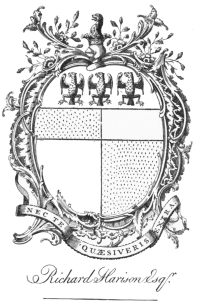
on each side of the books two slender vases standing upon an upward curl of the ornamentation hold bouquets; below this whole design a gorgeous curtain is spread out to contain the name of the giver of the book; this is backed by a frame whose edge only is seen; this is elaborately scrolled, and is finished at the bottom with the canephoros head and shell pattern; two globes at the uppermost part, on either side, complete the decoration. Signed, N. Hurd Boston. Several plates are known very similar to this, but having different names upon the curtain. One of them has simply the words Ex Dono, with the curtain left blank for the writing of the giver’s name. Others have the name of donors of quantities of books engraved upon the curtain; among these are, Hancock and Thorndike.
353. Harvard. Sigill: Coll: Harvard: Cantab: Nov: Angl: 1650.
A very close copy of the above in all particulars; indeed, a fac-simile of it. Signed, A. Bowen. On some of them appear the name of Shapleigh, and on others, Ex Dono Samuelis A. Eliot.
354. Harvard. Sigill: Coll: Harvard: Cantab: Nov: Angl: 1650.
This is again a copy in the main of the plate by Hurd, but is later than the last. The ornamentation is similar to that used by Hurd, but is changed in some particulars; the canephoros head is replaced by a bunch of grapes, the sun is missing above the pile of books, and all the work has lost in beauty of execution. Signed, Andrew Filner. This plate is used to record the gifts of many persons, among them being:—
Samuel Shapleigh.(Class of 1789.)
Joshua Green. M.D.(Class of 1818.)
Samuel Abbott Green. M.D.(Class of 1851.)
Jonathan Brown Bright.(1884.)
355. Harvard. Academiae Harvardianae Sigillum. 1638.
The arms of the college as usual, with the addition of the word Veritas upon the open books. This plate in its general design was suggested by the plate of Hurd, but is quite different in details. The curtain, simpler in make, is still here, and the shield is in the usual position, but the fruit and flowers are replaced by an august assemblage of the gods and goddesses who are the special patrons of learning. Signed, H. Billings del. C. G. Smith Sc.
356. Harvard College. Hasty Pudding Library.
Pictorial. Two Doric pillars uphold a large curtain which is looped at the top, and left plain in the centre for the writing in of donors’ names. Above this a circular frame encloses a picture of an iron pot, supposedly full of pudding, towards which two hands, one with a bowl in its clasp, and one holding a spoon, approach. The motto, Seges votis respondet, is given upon the frame. Directly under this is the date, 1808. Below the curtain a figure of the Sphynx is seen surrounded by books in curved shelves. The bases of the pillars bear the words, Concordia discors. Signed, Callender Sc. A Harvard College Society plate.
357. Harvard College. Porcellian Library.
A large and handsome curtain looped up with cord in large bow-knots is left as usual for the donors’ names; above it two small pillars with the Greek letters on their bases, Ὁμ Ἑλ; the pillars are joined by a chain which passes behind an oval medallion on which the clasped hands are shown; above this the circular frame bearing the name encloses the hog; the frame is ornamented with sprays of palm and roses, and a pile of three books, as so often in plates of Harvard College, form the crest. This plate is not signed, but it strongly resembles the work of Callender.
358. Harvard College. Porcellian Club. 1803.
Allegorical. Two stone pillars support a circular frame within which the hog is pictured. On the frame the name of the club is given; below hangs a poor curtain for the name of the donor of books; above are the arms surrounded by the grape-vine, and having books, a loving cup, lance, and foil grouped about. The motto across the face of the shield on a bend, Fide et Amicitia. Greek letters on the base of the pillars, Ὁμ Ἑλ.
359. Harvard College. Porcellian Library.
In this plate the curtain is suspended between two very tall amphoræ which rest upon books bearing the Greek letters Ὁμ Ἑλ upon their backs; behind the curtain two hogs disport themselves; the circular frame is above them and encloses the representation of a punch bowl, under which is the motto, Dum vivimus vivamus. Above all, the shield of arms with the motto on a bend, Fide et Amicitia, is graced by grape-vine branches, and the crossed lance and sword. Signed, F. Mitchell. Del.
360. Hawks. Francis L. Hawks.
Armorial. Motto, Never check. Clergyman and author. Left a large collection of books to the New York Historical Society, where they are kept in a room appropriated to their sole occupancy.
361. Hay. Mr. George Hay.
Armorial. Chippendale. Motto, Serva jugum. Jurist of Virginia. Prosecutor of Aaron Burr.
362. Hay. Peter Hay. M.D.
Armorial. Chippendale. Motto, Serva jugum.
363. Hay. William Robert Hay. M.A.
Plain armorial. No motto. Was a student at the Inner Temple, London, in 1781.
364. Hayne. Isaac Hayne.
Armorial. Revolutionary patriot. Born, 1745; hanged by the British in Charleston, S.C., 1742.
365. Hayne. Robert Hayne.
Armorial. Ribbon and Wreath. No motto.
366. Hays. Barrack Hays.
Landscape. The shield rests against a shattered tree. In the distance, hills and water. Signed, I. Hutt Sculp.
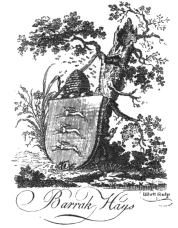
367. Hayward. Benjamin Hayward. Of Charleston, S.C.
368. Hayward. George Hayward.
Armorial. Ribbon and Wreath. No motto. Flags, cannon, a trumpet, and a lance form the background to the shield; the mantling runs down and joins the flowering branches which are crossed beneath the shield. Below the name which is on the motto-ribbon, hangs a small curtain, probably for the number of the volume.
369. Hayward. Sarah Hayward.
Armorial. The same copper as the above with the first name altered.
370. Hayward. Thomas Hayward.
Armorial. Chippendale. No motto. A signer of the Declaration from South Carolina.
371. Heath. John Heath. Boston.
An engraved label in which the sun rises above the name, which is enclosed in festoons and sprays.
372. Heming. Samuel Heming. de sancta Anna Parochia in Jamaica. Armigr.
Armorial. Chippendale. Motto, Aut nunquam tentes aut perfice. Very fine work.
373. Henderson. James Henderson, Williamsburg. Pictorial. Military. A woodcut very similar to the Timothy Newell.
374. Herbert. Herbert.
Armorial. Chippendale. Motto, Un loy, un roy, un foy. Not signed, but probably the work of Maverick.
375. Herman. Sum Ex Libris Frederici Hermani, Sapientia praestat divitiis. Printed label. Of Pennsylvania.
376. Hicks. Elias Hicks. Plain armorial. Behind the shield a sword is seen and on its belt the motto is given, Tout en bonne heure. Signed, P. Maverick. S. Distinguished Quaker preacher.
377. Hicks. Elias Hicks.
Armorial. Ribbon and Wreath. Motto, Judicemur agendo. Signed, Rollinson Sct.
378. Hicks. Whitehead Hicks. Esqr.
Chippendale. Motto, Pro lege et rege. Signed, H. Dawkins. Sculpt. At the left a cupid is playing a flute; to which accompaniment his companion sings from a sheet of music held in his hand. At the right, a female in a costume of extreme simplicity sits under a jutting rose branch, while awaiting a cupid who is seen struggling towards her with a large volume. Of the same Quaker family. Mayor of New York City, 1766-1776.
379. Hill. Marcus Samuel Hill.
Armorial. Ribbon and Wreath. Motto, Non sibi sed patriae.
380. Hill. Sam’l. Hill.
Literary. Within an oval formed by branches of palm and holly, two books with quill and ink-pot upon them. Probably the plate of the engraver.
381. Hoar. Richard Hoar.
Armorial. Jacobean. No motto. This plate is not signed, but it bears a strong resemblance to the work of Hurd.
382. Hoffman. Philip L. Hoffman. Esqr.
Armorial. Ribbon and Wreath. Motto, Carpe diem. Signed, Maverick Sculpt. New York. A bit of landscape introduced below the shield, as was often Maverick’s way; a stretch of water, trees, books, and writing materials complete the adjuncts. The name is signed on an open scroll; this lower part of the plate is very similar to the plate of Prosper Wetmore by the same engraver. Of New York.
383. Holladay. Armorial. Of Virginia.
384. Hollingsworth. Levi Hollingsworth. Armorial. Chippendale. No motto.
385. Holyoke. Edward Augustus Holyoke.
Armorial. Chippendale. Motto, Duce natura sequor. Not signed, but without doubt the work of Hurd. Eminent physician and surgeon of Massachusetts. Lived to a great age and performed an operation at the age of 92.
386. Holyoke. (Anonymous.)
Armorial. Ribbon and Wreath. Motto, Sacra quercus. This plate is presumably of the Holyoke family, as the motto is the family motto, the arms are meant to be the Holyoke arms, and the crest is correctly an oak-tree. The design and execution of this plate are poor.
387. Hooper. Swett Hooper. Pictorial. Over a vase full of flowers, two cupids bearing a scroll on which is the motto, The wicked borrow & return not.
388. Hooper. William Hooper.
Armorial. Chippendale. Motto, Haec etiam parentibus. Signed, N. H. Scp. Plate of the signer of the Declaration from North Carolina.
389. Hopkins. (Anonymous.) Plate of Reuben Hopkins.
Armorial. Ribbon and Wreath. Motto, Piety is peace. The frame which supports the shield rests upon two books; other books, a globe, and a telescope are among the decorations.
390. Hopkinson. Francis Hopkinson.
Armorial. Chippendale. Motto, Semper paratus. Signed, H. Dawkins Sculp. The frame is very like that of the Bushrod Washington plate in some respects. This type is not uncommon; the peculiar cant of the shield, the hissing griffin perched threateningly upon the corner of the frame, and the very form and arrangement of the flowers and spray are duplicated in several instances. Son of Thomas Hopkinson, the Councillor of Pennsylvania. A signer of the Declaration from New Jersey.
391. Hopkinson. Joseph Hopkinson.
Armorial. The same copper as the last, with the name changed. The first name, Francis, is not well removed and shows in the printing of the plate. Son of Francis. A distinguished lawyer. Author of “Hail Columbia.”
392. Horanian Society. Horanian Society Library.
Allegorical. The large shield displays a picture of the Madonna; the supporters are Diana and the Muse of History; the crest is a pile of three books with an owl perched upon them. A large pediment supports the shield and the figures, and on its face the name is given within an elliptical frame; festoons and a curtain of cloth hang about it, and the motto, Mutual Improvement, is given upon a ribbon which is draped across the top of the frame. Signed, P. R. Maverick Sct. No. 3 Crown Street. N.Y.
393. Horry. Dan Horry. Esqr.
Armorial. Chippendale. Motto, Toujours fidèle. Of South Carolina.
394. Horsmanden. Daniel Horsmanden. Esqr.
Armorial. Jacobean. Motto, De interior templo socius. Author of “Negro Plot of New York, 1741.” Published in 1810. Born, 1691; died, Flatbush, 1778. Illustrated in “Curio,” page 65.
395. Hubard. Armorial. Of Virginia.
396. Humphrey. Henry B. Humphrey.
Pictorial. A very graceful framework encloses several spaces which are occupied by decorative features. Above the name, Minerva, helmeted and robed, with shield and spear, is seated attended by the owl. Beneath her the motto appears on a curved portion of the frame, Inter folia fructus. Beneath this again is the name within an oval formed by two writhing snakes; at either side of this are female griffins, sejant. At the very lowest point of the design a grotesque canephoros head is seen. Of Boston.
397. Hunter. Archibald Hunter.
Armorial. Signed by Dawkins.
398. Hunter. John Hunter. Plain armorial. No motto. A small plate.
399. Hunter. His Excellency, Robert Hunter. Esqr.
Armorial. Jacobean. Motto, At re non impetu. In writing, the General and Chief General of Jamaica. Author of the famous letter on “Enthusiasm,” which was attributed to Shaftesbury and to Swift. Became Governor of Jamaica in 1728.
400. Hunter. William J. Hunter.
Armorial. Ribbon and Wreath. Motto, Sola bona quae honesta. Signed, Engrd. by P. R. Maverick 65 Liberty St. N. Y.
401. Hurd. Name of Hurd.
Armorial. The arms seem to be wholly imaginary, or at least borrowed from some other family. Arms, Az. a lion ramp. or. on a chief ar. a stork ppr. between two mullets sa. Crest, A bird sa. on a garb fess-ways ppr. No motto. The name occupies the ribbon. This plate is crude in appearance, and not unlike the work of Nathaniel Hurd; it may have been an early attempt of his for himself or some member of his family. The copy before me has written upon it, “Isaac Hurd’s presented to Barzillai Frost.”
402. Hyslop. By the name of Hyslop.
Armorial. Ribbon and Wreath. No motto, the name occupying the motto-ribbon.
403. Hyslop. Robt. Hyslop.
Armorial. Ribbon and Wreath. Motto, Vincit omnia veritas. A rude piece of engraving. The garland draped behind the shield is very stiff, and the oak branches at the sides are ungraceful.
404. Ingersoll. Jared Ingersoll Esqr. of New Haven Connecticut.
Armorial. Chippendale. Motto, Fama sed virtus non moriatur. Lawyer; born, 1749; died, 1822. Studied in the Middle Temple, London. Member of the Old Congress, 1780-1781. In 1812 was the Federal candidate for Vice-President of the United States. Author of a rare pamphlet on the Stamp Act, New Haven, 4to, 1766.
405. Inglis. Inglis. Plain armorial. Motto, In tenebris lucidor. Of New York.
406. Inglis. Alexr. Inglis.
Armorial. Chippendale. Motto, Lucidor in tenebris. The heraldry is mixed and the motto twisted. Of South Carolina.
407. Inglis. George Inglis. Petersburg.
A woodcut border with the name in type within it. The border is elaborate, with cornucopiæ of flowers at either side, and ornamental pieces in the corners. In the copy at hand the type is set in wrongly, so that the frame is bottom up.
408. Inglis. John Inglis.
Armorial. Chippendale. Motto, Recte faciendo securus. Of Pennsylvania.
409. Ingraham. (Anonymous.)
Armorial. Chippendale. Motto, Magnanimus esto. Name bracket empty.
410. Ingraham. Edward D. Ingraham.
Armorial. Chippendale. Motto, Magnanimus esto. It was said of him that if he wanted a book, he would prefer to buy it; if he could not buy, he would borrow (not to return), and if necessary would even steal it. A man of great learning and eccentricity. Lawyer of Philadelphia. Illustrated in “Art Amateur,” April, 1894.
411. Ingraham. Edwd. D. Ingraham. Crest only.
412. Ingraham. Edward D. Ingraham. Plain armorial. No motto.
413. Ingraham. Edward D. Ingraham. Crest only, enclosed in a garter on which the motto is given,—Magnanimus esto.
414. Innes. Colonel Innes. Plain armorial. Motto, Je recois pour donner. Of North Carolina.
415. Iredell. James Iredell.
Armorial. Chippendale. No motto; name on motto-ribbon. Jurist of North Carolina. Illustrated in “Art Amateur,” March, 1894.
416. Iselin. Helen Iselin. Plain armorial. Crude work; the mantling very scraggly. No motto.
417. Izard. R. S. Izard.
Armorial. Pictorial. The arms are carved on what bears strong resemblance to a gravestone; a draped female figure stands leaning upon the stone holding a book open, on which the motto, Hoc age, is given.
418. Jackson. James Jackson.
Armorial. Ribbon and Wreath. Motto, Bona quae honesta.
419. Jackson. Jonathan Jackson.
Armorial. Ribbon and Wreath. Motto, Bona quae honesta. Signed, N. H. Scp. A Massachusetts statesman. Member of Old Congress. Illustrated in “Art Amateur,” April, 1894.
420. Jackson. W. Jackson.
Ribbon and Wreath. A shield is suspended from a wall-pin under the crest, on which assumed arms are shown; in chief a group of thirteen stars surrounded by the word Independence; in base is a plough, indicative of the spirit of the owner. Motto, Meliora non opto. Perhaps the plate of Major William Jackson, a prominent patriot of the Revolution; held many offices.
421. Jamaica. The Bishop of Jamaica.
Armorial. Motto, Simplius sicut columbae. Signed, Griffiths & Weigalls 3 St James St Londn.
422. Jarvis. Jarvis.
Armorial. Pictorial. A very handsome and peculiar plate, in which the shield resembles a wind-filled sail; angry waves roll at the foot, and a part of a mast and sail are seen. The ornamentation at the sides takes the form of trees and sprays of holly, while roses appear at the sides. Motto, Adversis major par secundis.
423. Jarvis. Samuel Farmar Jarvis. D.D.
Armorial. Literary. Mottoes: Hora é sempre, and see Sola salus servire Deo. The shield rests against a pile of books, and above the cross and crown are seen in a blaze of glory. Son of Bishop Abraham Jarvis.
424. Jauncey. Jauncey.
Armorial. Ribbon and Wreath. Motto, Quo vocat virtus. The name William is written in on the copy at hand. He was a merchant in New York. His father was an eminent ship-captain.
425. Jay. John Jay. Plain armorial. Motto, Deo duce perseverandum. Statesman.
426. Jeffries. Dr. John Jeffries.
Plain armorial. No motto. It is said that he was the surgeon who recognized the body of Warren at the battle of Bunker Hill. This plate is not signed, but bears strong resemblance to the work of Callender.
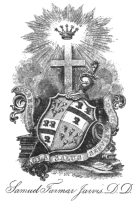
427. Jeffries. J. J.
Crest only. Plate of John Jeffries.
428. Jeffry. James Jeffry.
Armorial. Early Chippendale. Motto-ribbon empty. Same arms as the succeeding.
429. Jenkins. Robert Jenkins.
Armorial. Jacobean. Motto, Non reverter invitus. Signed, N. Hurd. Some copies are dated 1751 in mss. A very handsome plate in which the arms are placed against a diapered background, enclosed by ornamental scroll-work, set off at the bottom by a spirited scene in which a ship under full sail hastens from view. At the upper part of the frame two grotesque female faces peer at each other from across the space in which the crest is given. In the steeple of Christ Church, Boston, in which the lanterns of Paul Revere were hung, a chime of eight bells, made by Abel Rudhall of Gloucester, England, was placed in 1744; each bell bears an inscription; on the sixth we read that the subscriptions for these bells was completed by Robert Jenkins and John Gould, Church Wardens, Anno 1744.