Chapter II · (continued 2)
Reading edition
"All the German storm troops, including the guards, were in brand-new uniforms," said the correspondent of the New York Times. "They advanced in dense masses and never faltered until shattered by the machine-gun fire. The supporting waves advanced over the bodies of the dead and wounded. The German commanders were ruthless in the sacrifice of life, in the hope of overwhelming the defense by the sheer weight of numbers. * * * Still they came on, with most fanatical courage of sacrifice. When the first lines fell, their places were filled by others, and the British guns and machine-guns could not kill them fast enough." Two batteries of field artillery at Epehy, it is said, "fired steadily with open sights (that is, pointblank) at four hundred yards for four hours, into the German masses swarming over No Man's Land."
On the first day, some field batteries aided the Germans, but these were soon left behind in the advance over difficult and shell-torn ground, and the battle became one of rifle and machine-gun fire and hand-to-hand combat.
On the north the British 3rd army made a splendid resistance and held its ground well, but the 5th army farther south, which bore the principal brunt of the attack, under General Gough, was gradually forced to retreat, though in good order, in a northwesterly direction, towards Amiens. French troops were ordered from the southwest to reinforce the British in the vicinity of Noyon. There the French stemmed the tide of Germans, and the drive was soon turned northward, with Amiens as its evident objective.
ALLIED LINES BEGIN TO HOLD FIRM
The battle continued along these lines, with the British still slowly retiring, with their faces to the foe, until the 26th of March, the French stretching their lines farther and farther to the left to keep in touch with the British, and never failing to maintain connection between the two armies. The Germans' fond hope of cutting them apart was doomed to disappointment. French and British cavalry aided in keeping the line intact, and for the second time since the early days of the war the horsemen came into their own, doing valiant service in covering the retreat of the British and impeding the enemy's advance at many points where their aid proved invaluable.
On March 27 and 28, the situation began to improve. British reinforcements arrived at the points of greatest danger, and the defense stiffened, then held the lines firmly before Amiens, and at a distance from that threatened city sufficiently great to prevent its successful bombardment by all but the heaviest artillery of the enemy. The devastated and shell-torn condition of the terrain taken over by the Germans was unfavorable for bringing up the great guns to within striking distance. From that time on, the Allies were supremely confident of their ability to cope with any forces.
While the Allied armies, especially the British, lost heavily in men and guns during the Hun advance, many of the German divisions engaged in the drive were literally cut to pieces. The 88th division was reported by prisoners to be practically annihilated. The same prisoners, taken in counter-attacks, expressed the utmost surprise at the relatively small number of dead whom they had found in the British and French trenches as they advanced. They had been informed by their officers that the offensive would be over in eight days, and that a complete victory over the Allies would be won within three or four weeks.
GERMAN DRIVE IS HALTED
The eighth day of the German offensive, far from finding the Huns victorious, resulted in tremendous attacks by the Germans being stopped by the unbeatable British, while the French won a brilliant victory at the south of the line. Meanwhile the Germans had begun another attack in the Flanders sector, with the object of wresting from the British the control of Messines Ridge, which dominated the lowlands of Flanders and had been so gallantly won by the Canadians in the previous year. They gained a partial footing on the ridge, but the greater part of it was grimly held, and all efforts of the enemy to advance through Ypres towards the Channel ports were frustrated.
Another sector was added to the north end of the battle line on the eighth day, March 28, when the Germans attacked heavily on both sides of the River Scarpe toward Arras. Here some of the fiercest fighting of the offensive soon developed, but the ground gained by the Germans was insignificant. Daily, however, they claimed to have captured thousands of Allied troops and hundreds of guns; while, on the other hand, enormously long ambulance trains were reported passing through Belgium with the German wounded, the hospitals in northern France not having sufficient accommodation for the sufferers. On every battlefield of the 100-mile front—for the fighting now covered that enormous stretch of territory, in two sections, north of La Bassee and south of Arras—the German dead lay literally in heaps.
On March 29, the ninth day of the great battle in France, the German drive was practically halted, and both British and French reports noted a decrease of the fighting, enemy activity being manifested only by local attacks all along the front, which was being strengthened each day by the arrival of Allied reinforcements.
PARIS BOMBARDED AT LONG RANGE
Soon after the great offensive opened, the city of Paris was surprised by being bombarded from a distance of approximately 70 miles by a new German long-range gun, which was discovered by French airmen to be concealed in a concrete tunnel in a wood behind the German lines, A number of persons were killed and wounded by the nine-inch shells from this new weapon, 54 women being killed when a shell struck a church in the suburbs of the city on Good Friday. The Allied commanders refused to regard the long-range gun as of any great military importance except as a means of spreading terror among the civilian population,—and the population of Paris refused to be terrorized by such a method, exhibiting the same spirit as that of the people of England with regard to the futile aerial raids.
French estimates of the German losses for the first eleven days of the offensive placed them at between 275,000 and 300,000 men. The Germans claimed that during the same period they had captured 70,000 prisoners and 1,000 field guns.
ANOTHER ATTACK ON AMIENS
Having been foiled in an attempt on March 31 to break through the valley of the Oise, Paris ceased to be the German objective, and another offensive against Amiens was undertaken on April 4. By this time a French army had repaired the ragged line between the French on the south and the remainder of the British army of General Gough, whose enforced retirement had been conducted in good order. Though outnumbered two to one, the British and French repulsed the attack on Amiens with heavy losses to the Germans, who were effectually stopped at a distance of fifteen kilometers (nine miles) from that city. This ended the first phase of the great battle.
BATTLE RENEWED IN THE NORTH
The second phase of the battle which was expected to prove decisive began April 9 with an attack on the British, aided by Portuguese troops, on a front of fifteen miles, from La Bassee to Ypres. The center, held by three Portuguese divisions, was broken through, and on April 12 the situation seemed critical. Determined counterattacks by the British, however, and reinforcements by the French, stopped the Germans in the next few days, and this offensive, like that farther south in the valley of the Somme, gradually died out, leaving the Germans with gains of only a few square miles of devastated territory to show for their continued heavy losses. And the reserve forces of the Allies were still intact, the strategy of General Foch in this respect being universally applauded as correct under the circumstances.
SHELLS FIRED BY THE MILLION
In the beginning of the offensive which thus failed to accomplish its object, the most desperate means were employed by the Germans to break down resistance; In the first six hours of bombardment on March 21, when three great German armies were massed for the attack, under Generals Von Bulow, Von Marwitz, and Von Hutier, commanding from the north to south in the order named, it is estimated that at least 1,500,000 shells were fired by one single army—that opposed to General Gough's forces on the south, while the British 3rd army, under General Byng, to the north, was similarly assailed. Most of the shells contained gas and were designed to destroy the occupants of the trenches about to be stormed. Only the utmost individual valor and persistency of the thin British line, as it retired still fighting, prevented the desperate and over-confident foe from turning the gradual retreat into a decisive defeat. As it was, the Germans paid dearly for every yard of ground they gained, as their successive waves of troops swept over the zone of trenches and then engaged the groups of Allied forces in the open beyond.
All the German units were under orders to advance as far and as fast as possible, being provided with three days' rations and two days' water. After the first few days, the difficulty of bringing up supplies, with the expected objectives far from being gained, aided in slowing up and then halting their advance. Behind the German storm troops great numbers of reserves were assembled, to fill up the gaps torn in the ranks and restore the divisions to their normal strength as fast as they were depleted by the defense. The German tactics took no account of human life, but expended it in the most reckless manner, with appalling results throughout the drive. The Allies, on the other hand, sought at all times to conserve their forces by intrenching as fast as possible at every point during the period of their retirement. Their artillery was constantly in action, and aided greatly in checking the German. advance.
ALLIES CONTROL IN THE AIR
German aeroplanes played no great part in the advance, although they bombed the British and French rear nightly, and the air service of the Allies proved superior throughout the battle. For the first time in a great battle British and French airmen attacked the enemy infantry from low altitudes with their machine guns and bombs, and rendered invaluable assistance in damming the swelling tide of the Hun hordes. Having gained the mastery of the air, as they did prior to the British drive on the Somme in 1916, they retained it until the foe was halted. To a considerable extent they replaced the heavy guns of the Allies by their constant bombing and gun fire.
Between March 21 and March 31, the French and British pilots shot down more than 100 German planes, losing about one-third of that number in the air battles. After the first few clays there were practically no German machines in the air over the fighting front, as was the case on the Somme in 1916, but at the end of March the Hun planes began to reappear in mass formation patrols, sometimes consisting of as many as fifty planes in a group of patrols. Then followed a period of intense air fighting, of which a single day's record of the French may be cited as an example. On April 12, the Allied aviation report shows that French fighting scouts made 250 flights, fought 120 combats in the sky, shot down eight Germans and damaged 23 others, burned five enemy balloons, damaged five more, and bombarded German troops with 45 tons of explosives.
GERMANS FAIL IN THEIR OBJECT
The last part of the month of April was marked by a succession of minor attacks by the Germans along the entire front of the halted offensive, and by the development of counter-attacks by the Allies at various points where it was deemed necessary or advisable to strengthen their defensive positions, but up to May 1 the Germans were as far as ever from their main objectives in the west. Judged from the standpoint of their confident expectations, and the promises of success held out as an encouragement to their troops, the long-heralded and long-prepared spring offensive of 1918 was a failure. Their much-vaunted strength of numbers and of organization failed as completely to gain a decisive result as their initial drive on Paris in 1914. Though they threw into the fighting in March and April about 125 divisions, they failed to separate the French and British armies, which was a prime object of their strategy, and they sustained losses which, while not irreparable, must have greatly affected the morale of their men. "Remember Verdun!" said a famous French commander, commenting on the drive. "The Boche is making this tremendous effort and sustaining these losses to effect a complete rupture of our front, and if he does not do that he has failed."
BRITISH LOSSES MADE GOOD
On April 25 the British minister of munitions announced in the House of Commons that the losses of guns and ammunition sustained by Field Marshal Haig's forces in France and Flanders during the big German drive had been more than replaced. The losses were placed by Mr. Winston Spencer Churchill at nearly 1,000 guns, between 4,000 and 5,000 machine guns, and a quantity of ammunition "requiring from one to three weeks to manufacture." More than twice the number of guns lost or destroyed had been placed at the disposal of the British air and ground services, said the minister.
GERMANS START ANOTHER ATTACK
Another determined attack in the Somme region was begun by the Germans on April 24, after three weeks' further preparation. The enemy evidently had not abandoned hope of capturing Amiens, and, he again began hammering at the gateway to that city. The first onslaught was repulsed by the British, but on the following day, April 25, the enemy succeeded in gaining about a mile of ground. The combined British and French armies were covering the roads to Amiens, with reserves close at hand, and part of General Pershing's American forces were co-operating with the French. The utmost confidence prevailed that the united forces under General Foch, who was called by Marshal Joffre "the greatest strategist in Europe," would not only meet and defeat this renewed drive by the enemy, but that before long the tide of battle would turn strongly in favor of the Allies, whose reserve armies were held in leash by their supreme commander, awaiting the strategic hour to strike.
BOTTLING UP U-BOAT BASES
One of the most thrilling exploits of the war occurred on the night of April 22, 1918, when British naval forces performed an almost incredible feat, by entering the harbors of Ostend and Zeebrugge, German submarine bases, and practically bottling them up. French destroyers co-operated with the British in the daring undertaking.
At midnight, under cover of a remarkably developed smoke screen, furnished by the raiders themselves, five old British cruisers were run aground in the harbor channels, blown up, and abandoned by their crews. The ships were loaded with concrete. An old submarine, loaded with explosives, was also run under a bridge connecting the mole, or breakwater, at Zeebrugge with the shore, and there blown up, so as to prevent interruption of the raiders while they were doing their work alongside the mole.
Facing dangerous and unknown conditions of navigation, the harbor was rushed by British monitors and destroyers, under heavy fire from the shore batteries. A storming party of volunteers, sailors and marines, was landed under extreme difficulties from the cruiser Vindictive. This party boarded a German destroyer lying alongside the mole, defeated her crew, and sank the ship. The concrete-laden vessels were duly sunk with a view to blocking both harbors, and every gun on the mole at Zeebrugge was destroyed. The effects of the raid were not easily ascertainable. It was soon learned that the submarine base at Zeebrugge at least had been put out of business for a while. The gallantry and daring of the deed were generally recognized as fully in keeping with the best traditions of the British navy. The loss of life was quite heavy, but the British lost only one destroyer and two coastal motor boats, many of the raiders returning safely to the other side of the Channel. Even the men on the exploded submarine succeeded in escaping. The officer who planned the raid, however, was among the killed.
GERMAN ATTACK ON YPRES FAILS
On Monday, April 29, the German 4th army under General von Arnim, having gained possession of Mount Kemmel, a dominating position, began a general assault on the British hill positions on the Kemmel front, southwest of Ypres. The intention was to capture Ypres forthwith, by the overwhelming power of numbers, and the day's fighting was a crucial test of the holding power of the Allies in the Ypres salient. The result of the attack was a stunning defeat for the enemy, who was repulsed all along the line and suffered frightful losses.
In the words of a French general, "It was a great day for the Allies!" The repulse of the German attack was a real defeat, for it upset all the confident calculations of the enemy, who from the height of Mount Kemmel had seen, first Ypres, and then channel ports, within his grasp. It brought disappointment and disillusion to his troops, who had been urged on to their disastrous massed attacks by flamboyant promises of success. The effect was seen in a renewal of German peace propaganda, which all the Allies had learned by this time to disregard as unworthy of the slightest serious attention.
"Extraordinary nervousness and depression prevail in Germany, owing to the losses in the western offensive," said Reuter's correspondent at Amsterdam on April 29, quoting a German military writer, Capt. von Salzmann, who said: "Our losses have been enormous. The offensive in the west has arrived at a deadlock. The enemy is much stronger than our supreme command assumed. The region before Ypres is a great lake, and therefore impassable. The whole country between our Amiens front and Paris is mined and will be blown up should we attempt to pass."
The preliminary bombardment southwest of Ypres April 29 started in the early morning and took in the ten-mile front from Meteren, west of Bailleul, to Voormezeele, two miles south of Ypres. Infantry attacks in this area followed with great fury, and sanguinary fighting continued all day. The Germans at the outset advanced with fixed bayonets, but they came under such an intense machine-gun fire that most of them were never able to employ the steel. The French at Locre and the British at Voormezeele repulsed every attack, thrusting the enemy back whenever he gained a footing in advanced positions, and firmly holding every point around Ypres at the end of the day.
General von Arnim's losses were particularly staggering at Locre, where he used battalion after battalion in a vain attempt to hold the village, a key to Mount Rouge. The previous German capture of Mount Kemmel did the enemy little good, for the Allied artillery kept the crest of the hill so smothered with shell fire that it was impossible for the Huns to occupy it in force.
The attack, which was the fourth great battle of Ypres, was the biggest effort the Germans had made in the Flanders offensive, the enemy employing thirty fresh battalions of reserves, in addition to the large number of divisions in position at the beginning of the battle. The net result was a tremendous setback for the Germans, who paid an awful price. Next morning the battlefield in front of the defenders' positions was covered with the bodies of gray-uniformed men.
AMERICAN TROOPS IN ACTION
American units were in action in Picardy, east of Amiens, on April 28, having reinforced the British and French in that sector, to aid in keeping the foe from Amiens and Paris. Their baptism of fire in the direct line of the German offensive made their previous experiences pale into the insignificance of skirmishes. During the various engagements in which they participated in the last days of April and the first week of May they acquitted themselves with great credit.
After a preliminary bombardment of two hours, a heavy German attack was launched against the Americans in the afternoon of April 30 in the vicinity of Villers-Bretonneux, and was repulsed with heavy losses to the enemy, who left dead and wounded on the field, while the American losses were reported as "rather severe." There was hand-to-hand fighting all along the line, and the violent struggle lasted for a considerable time before the enemy was finally thrust back, leaving prisoners in the American hands. Their French comrades were full of praise for the marked bravery displayed throughout by the American troops, who were fighting at one of the most difficult points on the whole battle front.
U.S. TROOPS BUSHED TO PRANCE
As a result of the great German offensive movements and territorial gains in the spring of 1918, there was a tremendous increase in the military activities of the United States, particularly in rushing troops to Europe. After the selection of General Foch as generalissimo of the Allied forces, the American troops in the war zone were brigaded with the French and British all the way from the North Sea to Switzerland, and their numbers steadily increased.
In the United States the training of the new National Army, national guards, and officers in the numerous cantonments and training camps was intensified and hurried. As fast as the men were brought into condition they were shipped to France. At first much of the space on the transports was devoted to supplies and materials for the camps and depots in France, but as the situation became critical owing to successful enemy offensives, fewer supplies and more men were sent. Great Britain lent her ships and the number of transports was largely increased, so that each month of 1918 showed a greater movement of troops across the Atlantic.
The troop movement record for the spring and summer months of 1918 was a wonderful one, in view of the submarine menace. In April, 117, American troops were successfully transported; in May, 244,345; in June, 276,382, and in July 300,000, The month of August found more than 1,500,000 Americans in France, England and Italy. This immense number of men were carried over without the loss of a single eastbound American transport.
AN ARMY OF 5,000,000 PLANNED
On August 5, 1918, plans were announced for increasing the effective strength of the United States army to 5,000,000 forthwith, by an extension of the draft age limits and rapid intensive training. Official statements showed that the armed forces of the United States already amounted to a total of 3,074,572 men, including 2,570,780 in the army and 503,792 in the navy. The national army at this date contained 1,400,000 men, the regular army 525,741, the national guard 434,511 and the reserve corps 210,528. The regular navy had 219,158 men, the marine corps 58,463, the coast guard 6,605, and the reserve 219,566. On June of this year 744,865 men reaching the age of 21 since June 5, 1917, were registered for selective draft purposes.
DEFEATING THE SUBMARINE DANGER
Meanwhile giant strides were taken in the American program of shipbuilding to offset the ravages of submarine warfare. The U.S. Shipping Board was reorganized and galvanized into a high state of efficiency. Under the leadership of Charles M. Schwab, director-general of the Emergency Fleet Corporation, and Edward M. Hurley, chairman of the board, the work in the shipyards on the Atlantic and Pacific Coasts, and on the Great Lakes, was speeded up until ships were being built at the rate of 5,000,000 tons a year. In the first three weeks of July, 1918, twenty-three ships of 122,721 deadweight tons were completed, making a total of 223 new vessels built under the direction of the board up to that time, the aggregate tonnage being 1,415,022 tons. On July alone eighty-two vessels were launched, their splash being "heard around the world."
With the increased tonnage being put out by the British, French, and Italian shipyards, and the output of neutral countries friendly to the Allies, this practically put an end to the submarine peril. In addition the United States requisitioned seventy-seven Dutch ships with an aggregate tonnage of about 600,000, while arrangements were made with Sweden for about 400,000 tons of shipping and contracts were let for the building of a considerable number of ships in Japanese shipyards.
The knowledge that there were over a million American troops facing the enemy on the battle fronts in Europe came as a decided shock to the German army and people, who were forced to realize the failure of their submarine campaign.
AMERICANS PROVE THEIR METTLE
After the American forces in France had their first serious encounter with the Germans on April 20 at Seicheprey, a village near Renners forest, which they recovered from the enemy in a gallant counter-attack, the fighting was of a more or less local character throughout the rest of the month and in May, with varying fortunes.
On May 27 the Germans began another great offensive, taking the Chemin des Dames from the French and crossing the Aisne. On the following day they crossed the Vesle river at Fismes. But on this day also the Americans won their first notable victory, by capturing the village of Cantigny and taking 200 prisoners. The United States marines added to their laurels in this fight and held the position firmly against many subsequent counter-attacks.
Continuing their drive toward Paris, the Germans occupied Soissons on May 29, Fère-en-Tardenois May 30, and next day reached Chateau Thierry and other points on the Marne, where they were halted by the French.
In the early days of June several towns and villages fell to the Germans, but the French by counter-attacks recaptured Longpont, Corcy, and some other places. On June 6 American marines by a spirited attack gained two miles on a two and a half mile front, taking Hill 142 near Torcy and entering Torcy itself. The following day, with French aid, they completed the capture of Vilny, Belleau, and important heights nearby. In another battle northwest of Chateau Thierry the Americans advanced nearly two and a half miles on a six-mile front, taking about 300 prisoners.
These battles confirmed the impression that the American troops as fighters were equal to their allies.
ANOTHER ENEMY OFFENSIVE
On June 9 the Germans began the fourth phase of their offensive, planned by their high command to enforce peace. They attacked between Montdidier and the Oise, advancing about four miles and taking several villages. On the next day they claimed the capture of 8,000 French. The same day the American marines took the greater part of Belleau Wood. On June 11 they completed the capture of Belleau Wood, taking 300 prisoners, machine guns and mortars. The French at the same time defeated the Germans between Rubescourt and St. Maur, taking 1,000 prisoners. Other battles followed on the 12th and 13th, but on the 14th the latest German offensive was pronounced a costly failure.
From this time to the end of the month the fighting was of a less serious character, though the Americans in the Belleau and Vaux region gave the Germans no rest, attacking them continually and taking prisoners at will.
JULY 4 CELEBRATED ABROAD
America's Independence day, 1918, was officially celebrated in England, France, and Italy, as well as in the United States, making it a truly historic occasion. On that day Americans assisted the Australians in taking Hamel with many prisoners. On the 8th and 9th the French advanced in the region of Longpont and northwest of Compiègne, taking Castel and other strong points near the west bank of the Avre river. July 14, the French national holiday, was generally observed in America and by the American soldiers in France. Then, on July 15, the Germans began the fifth and disastrous last phase of the offensive which they started in the spring, on March 21.
STINGING DEFEAT FOR AUSTRIA
But Italy meanwhile had scored a great success against the Austrians. French and British regiments, with some Americans, were helping to hold the Italian line when, on June 15, the Austrians, driven by their German masters, began an offensive along a 100-mile front, crossing the Piave river in several places. For two days they continued violent attacks, penetrating to within 20 miles of Venice, at Capo Silo. Then the Italians, British, and French counter-attacked with great vigor and soon turned the Austrian offensive into a great rout, killing thousands, taking other thousands prisoner, and capturing a vast amount of war material, including many of the Austrian heavy-caliber guns. The entire Austrian, plan to advance into the rich Italian plains, where they hoped to find great stores of food for their hungry soldiers, resulted in miserable failure.
The defeat increased the discontent in Austria-Hungary and added to the bad feeling entertained towards Germany. Peace feelers were thrown out by Austrian statesmen, but the continued influence of German militarism prevented them from receiving serious attention by the Allies.
A WATERLOO FOR THE CROWN PRINCE
When the German divisions of the Crown Prince of Prussia began their last desperate offensive on July 15, they attacked from Chateau Thierry on the west to Massiges, along a 65-mile front, crossing the Marne at several places.
East and west of Reims the battle raged, with the Allies holding strongly everywhere and the Germans suffering heavy losses. The enemy aimed at Chalons and Epernay and hoped by turning the French flank at Reims to capture the cathedral city without a direct assault upon its formidable defenses. General Gouraud, the hero of Gallipoli, was in command of the French forces on the right, while General Mangin and General de Goutte held the left. Most of the Americans taking part in the battle were under the command of these noted generals, and strong Italian and British forces were with General Gouraud's army. The French constituted about 70 per cent of the Allies engaged.
GENERAL FOCH STRIKES
In a single day the German offensive was effectually blocked at the Marne. Despite the enemy's utmost efforts he could make no further advance.
Then Foch, the great French strategist and Allied generalissimo, struck the blow for which he had patiently bided his time!
Apparently having advance information of the German plans, or perhaps surmising them, General Foch had been preparing a surprise for the Crown Prince. In the forest of Villers-Cotterets on the German right flank, he had quietly massed large forces, including some of the best French regiments, together with the foreign legion, Moroccan and other crack troops, and many Americans. Everything possible had been done to keep these troop movements secret from the enemy.
On Thursday morning, July 18, 1918, a heavy attack was launched in force at the Germans under General von Boehm all along the line from Chateau Thierry on the Marne to the Aisne river northwest of Soissons.
The Germans were taken completely by surprise, and town after town was captured from them with comparatively slight resistance. When the first shock of surprise was over, their resistance stiffened, but the Allies continued to advance. Mounted cavalry were once more used to assist the infantry in the open, while tanks in large numbers were used to clear out enemy machine-gun nests.
The American troops, fighting side by side with the French, did their work in a manner to excite the admiration of their allies, and acquitted themselves like veterans. Thousands of prisoners were taken, with large numbers of heavy guns and great stores of ammunition, besides thousands of machine guns, many of which were turned against the enemy. The strategy of General Foch received world-wide applause. His master stroke met with immediate success.
By the 20th of July Soissons was threatened by the Allies. The Germans, finding themselves caught in a dangerous salient and attacked fiercely on both flanks, hurriedly retreated to the north bank of the Marne and were rapidly pressed back farther. Their condition was critical and the German Crown Prince was obliged to call for assistance from Crown Prince Rupprecht of Bavaria, commanding in the north. Taking advantage of this, the British and French in the north made frequent attacks, gaining ground and taking prisoners at numerous points.
For ten days the Allies continued their victorious progress on both sides of the Soissons-Reims salient, the Germans continuing to retire under strong pressure. They were forced back to the Oureq river, then to the Vesle, where they made a determined stand. Fère-en-Tardenois and Fismes fell into the hands of the victorious French and Americans, the latter gaining a notable victory in the occupation of Fismes over the vaunted Prussian guards, who had been brought up to endeavor to stay their progress. The first week of August saw most of the Reims salient wiped out by the German retreat, while rear-guard actions were being fought along the Vesle as the Germans sought defensive positions farther in the rear.
The prisoners captured by the Allies in their drive up to that time numbered more than 35,000 and more than 700 heavy guns also fell into their possession, with immense quantities of ammunition and stores. The Germans, however, succeeded in destroying many of the ammunition dumps and vast supplies which had been stored in the salient for their expected drive on Paris.
As they retired the Germans burned many of the occupied French villages, pursuing their usual policy. As many as forty fires were observed on the horizon at one time as the Allies advanced.
Soissons was retaken on August 2, and the valley of the Crise was crossed by the Allies, who dominated the plains in the German rear with their big guns.
The German losses in the great battle and retreat from the Marne were variously estimated at from 120,000 to 200,000. General von Boehm avoided a first-class disaster, but his defeat was a serious one and had far-reaching moral consequences among the enemy.
It was estimated that from the beginning of their offensive in March, the German armies lost more than 1,000,000 men in killed, wounded and prisoners. The Austrians in their ill-fated offensive of 1918 lost more than 250,000 men.
FOCH A MARSHAL OF FRANCE
On August 6 General Ferdinand Foch, commander-in-chief of the Allied forces, was elevated by the French council of ministers to the rank of a Marshal of France. In presenting his name Premier Clemenceau said:
"At the hour when the enemy, by a formidable offensive, counted on snatching the decision and imposing a German peace upon us, General Foch and his admirable troops vanquished him. Paris is not in danger, Soissons and Chateau Thierry have been reconquered, and more than villages have been delivered. The glorious Allied armies have thrown the enemy from the banks of the Marne to the Aisne."
AMERICANS AT FISMES
The American troops covered themselves with glory at many points in the Allied drive, notably in the hand-to-hand fighting in the streets of Fismes on August 4, when they captured that German base. The fighting was said to have been the bitterest of the whole war, the Prussian guards asking no quarter and being bayoneted or clubbed to death as they stood by their machine guns.
BRITISH VICTORY IN THE NORTH
On the Amiens front, in Picardy, the British Fourth Army, under General Rawlinson, and the French First Army, under General Debentry, stormed the German positions on August 8 on a front of over 20 miles, capturing 14,000 prisoners and 150 guns, and making an advance of over seven miles.
ALLIED GAINS IN PICARDY
Before the Germans had time to recover from the surprise of Marshal Foch's attack on the Marne, and while they were still retreating to the Vesle, the Allies delivered another heavy blow, this time on the Albert-Montdidier front in Picardy. Here the British and French suddenly attacked in force on the morning of August 8, stormed the enemy positions along a thirty-mile front and on the first day of the attack penetrated to a depth of seven miles.
For several days the enemy retreated, closely pursued by allied cavalry and tanks, which for the first time fought in a combination that proved irresistible. The tanks used were of a new small variety, known as "whippets," which rapidly wiped out the machine-gun nests with which the enemy sought to stem the tide of the victorious onrush. Some American troops fought with the British in their advance and gained high praise from the Allied commanders.
By August 15 the total number of prisoners captured by the British Fourth Army, under General Rawlinson, was 21,844. In the same period of one week the prisoners taken by the French First Army amounted to 8,500, making a total of 30,344 Germans captured in the operations of the Allied armies on the Montdidier-Albert front, besides 700 heavy guns, quantities of machine guns, and other important spoils of war.
North of the Somme, between Albert and Arras, the Germans continued to fall back to the old Hindenburg line, where there were strong defensive positions, with the British and French keeping in close touch with their retreat. On August 15 they had definitely given up the towns of Beaumont-Hamel, Serre, Bucquoy, and Puisieux-au-Mont, and at several points had crossed the Ancre river.
Field Marshal Haig announced that the proportion of German losses to those of the Allies in the Picardy offensive were greater than at any other period of the war. The total Allied casualties were not as large as the number of Germans taken prisoner.
JOY IN AMIENS AND PARIS
One important result of the British drive was that Amiens, the "dead city of Picardy," began to come to life again. Its population of 150,000, including 40,000 refugees, had fled before the German offensive in March, 1918, but the former inhabitants began to return when the menace of the invader disappeared, as the invader himself was chased back toward the Somme. A service of thanks to the Allied arms was held in the Great Cathedral of Notre Dame in Amiens, August 15. Despite the damage from German guns and bombs, the cathedral retained the title of the most beautiful in all France.
The city of Paris, at the same time, quietly celebrated the great change in the situation wrought in one short month. Just four weeks before, on July 18, the residents of Paris had been awakened by the sounds of such a cannonade as they never had heard before. It was General Mangin's counter-preparation against the great German attack which the enemy believed was to bring him to the gates of Paris. In the meantime the Germans, who were at the gates of Amiens, Reims, and Compiegne, had been soundly beaten and outgeneraled at every point, and the initiative had been forced from them by the military genius of Marshal Foch. The effect upon the Germans was apparent from the fact that General Hans von Boehm, the German "retreat specialist" had been appointed to the supreme command on the Somme front. The German withdrawal north of Albert was looked upon as the first application of his tactics. It was General von Boehm and his former command, the German Eighth Army, that stood the brunt of the Allied pressure in the Marne salient previous to the retreat of the Huns to the north of the Vesle river, where they were still standing in the middle of August.
BOLSHEVIKI EXECUTE EX-CZAR
Former Czar Nicholas of Russia was executed by the Bolsheviki in July, 1918, having been held as a prisoner since his dethronement.
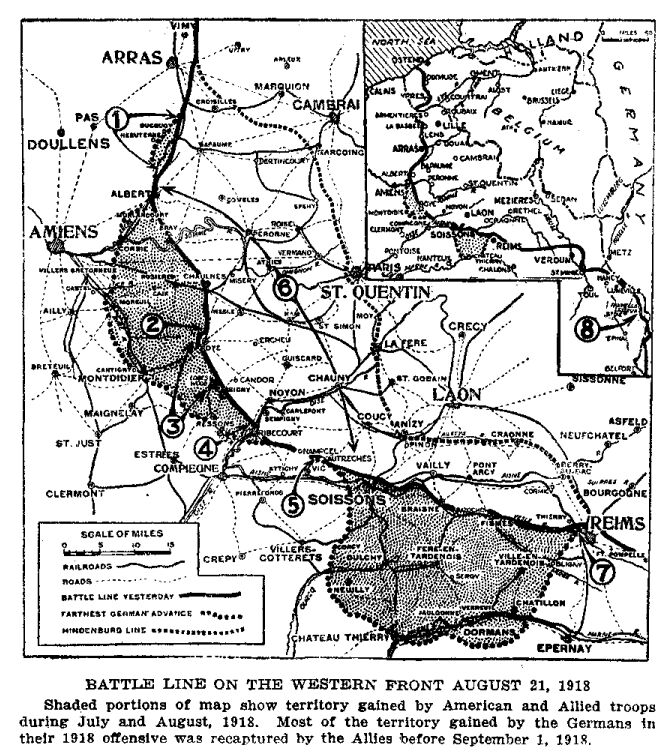
Shaded portions of map show territory gained by American and Allied troops during July and August, 1918. Most of the territory gained by the Germans in their 1918 offensive was recaptured by the Allies before September 1, 1918.