UNDER THE FLAG
Reading edition
"Louise!"
The little girl came to a halt suddenly and nearly dropped her book-satchel. Somebody had called her name—some startling, mysterious voice had called her!
She looked hurriedly about, but there was nobody in sight—nobody but a saucy squirrel perched upon a park bench, and a redbird flitting along the open between the enclosing hawthorns.
Which one had called?
"Louise!"
The little girl started back, too frightened to scream—it was the hawthorn!
But the next moment a boyish bullet-head appeared between parted boughs.
"Come here!" exclaimed its owner in suppressed excitement. "We've got something to tell you!"
Down went the book-satchel, but not in fear this time. Billy Hastings had called—called excitedly—and Billy was known to furnish nearly all the third-grade thrills there were. So the next moment Louise was stooping her way under the hawthorn boughs in answer to her playfellow's summons.
Billy was not alone in the green grotto in which Louise presently found herself, for nearly half the third-grade members were there. There was wide-eyed Tinsie Willis, with her little frilly skirts bristling with excitement, with Mamie Moore swallowing to keep back hysterical tears, and Sadie and Lallie Raiford, with their backs to each other for safe-keeping. And there were boys, a whole mob of boys!
The children were huddled together in suppressed excitement, and were whispering all at the same time. It was plain that something terrible, something menacing, had happened.
"You know that new boy that came to school this morning—?" began one.
"That 'Rudolph Kreisler'?" put in another.
"Sh-h-h!" interrupted a third wildly.
But Billy Hastings thrust his red, round face close to Louise's and announced in a blood-curdling whisper:
"Rudolph Kreisler is a German spy!"
Louise's legs crumpled under her, and she sat down in a heap.
Again they were all talking at the same time, and this time at her.
"He's got his trousers' pockets just full of something!" exclaimed Pete Laslie.
"And he's watching, watching!" put in another. "Didn't you see him sitting off there by himself looking at us while we played ball?"
"Spying!" hissed Luke Musgrove over Billy Hastings's shoulder.
The children started and looked about apprehensively. Luke's words always carried weight by reason of the fact that he had been two years in the third grade and ought to know what he was talking about if he didn't.
"Yes," chimed in Billy, coming close to Louise again and speaking in his most dramatic tone. "Just you dare to draw a deep breath, and he'll tell the Kaiser on you!"
Louise gasped—a short, a curtailed little gasp. Never till the Great War should be over would she breathe from her diaphragm again!
"Oh-o-o-o, Louise!" from round-eyed Tinsie Willis.
"What?"
"You've left your book-satchel out there in the path! Just suppose he were to come by and see it!"
There was a moment of consternation, of wild chattering, in which everybody poked his head out to see, but nobody would venture far enough to get the incriminating satchel.
Then Tommie Warren had an inspiration. Snatching a crooked-handle umbrella from Ella Vaiden, he flung himself flat on the grass and reached for the tell-tale satchel with the crook.
"It's a good thing Ella brought that umbrella!" exclaimed Tinsie. And all looked at Ella, who stood up very straight in spite of the low-dipping boughs. The next moment Louise had her beloved book-satchel hugged close to her pounding heart.
"Sh-h-h!" suddenly came from a self-constituted sentinel.
"What?"
"He's coming!"
The crowd in the bushes stood tiptoe and breathless as the German spy came down the hawthorn path.
He was a small lad—small for the third grade—with big blue eyes and a shock of tawny hair. The Kaiser had not equipped him very well, for there was a suggestion of poverty about his mended clothes. But, after all, maybe those carefully darned places at his knees were only a part of an adroit disguise. His pockets were bulging, and with knotty-looking somethings very suggestive of poorly concealed bombs. He was not whistling, as a perfectly good American would have been, but walked slowly and with his head down. It was very suspicious!
He passed.
"Let's get him now!" suggested Luke.
"Good!" exclaimed Billy. "Get some rocks!" And instantly all was excitement, the uncensored noise of which reached the little German and caused him to take to his heels.
In the confusion of the next few moments Louise scarcely realized what they were about. But when they tore out of the bushes, snatching up rocks as they went, and rushed after their flying prey, her heart stood still. He was such a little boy!
With the back of her hand pressed tight against the sobs that would not be stifled, and with tears raining down her cheeks, the little girl followed in the wake of the howling mob.
Then somebody rounded a hawthorn bush and came bang up against her. It was Jimmie Fisher, a big, red-headed rock of strength, who could carry lightly the heaviest book-satchels there were.
"What are you crying about?" he asked, after his first quick survey of her.
"They—they are killing Rudolph Kreisler!" sobbed Louise.
"No," assured Jimmie, "he'll get home free. He lives just across there. Are these your books?"
*****
The next day matters only grew worse.
The whole atmosphere of the third grade had become electric with suspicion of a certain little boy who, looking neither to right nor to left, kept his wistful blue eyes bent on the task before him. When Rudolph stood up at the singing of the Star-Spangled Banner, Luke growled out that he was "just pretending." And when, from his seat near the door, the German lad answered the knock of a visitor, Ella Vaiden whispered audibly:
"See that? He wants to see who's there!"
In recitation Rudolph answered the questions put to him with despicable German efficiency, but Luke missed with conspicuous patriotism and went noisily foot.
But through it all Louise was doing her own thinking. She was a loyal little citizen and loved her country with all her heart; but there flowed through her veins the blood of a long line of Americans who had been just and fair. The little girl was afraid of German spies—afraid for her country—and Rudolph Kreisler's pockets did bulge ominously. If Rudolph Kreisler was a German spy, why he would have to be dealt with, of course.
But if he wasn't——?
Louise wished with all her heart that Miss Barclay, the teacher, would suspect this terrible smothered tragedy that was being enacted within her class. Of course one's teacher, like one's mother, could solve every problem; and Miss Barclay in particular could command the storms of childhood to be still. If only Miss Barclay knew!
But in third-grade ethics it was "dishonorable" to "tattle," so Louise was compelled to hold her peace and think fast. There were recesses ahead in which covertly cruel things might happen, and an after-school walk through a lonely park from which a real little boy might not get home free. Something must be done.
At first recess the boys and girls were, as usual, separated in their play, but Louise—observing from afar—saw that the little German sat by himself on the steps, and watched the spirited ball-play of the others with keen alertness. Yes, it was very suspicious.
Big recess brought with it an unusual privilege that day. The third-grade boys and girls were to be allowed to mingle together and on the front lawn, in order to keep them from under the feet of certain workmen who were making excavations through the school-grounds.
This was all very thrilling, for it was from a tall staff on the front lawn that their beautiful new flag was floating, and to-day they would be able to see it close—to touch the pole with their very hands! Then, too, it would be so remarkable to play with boys.
Louise pondered it all as the third-grade girls filed down to their lunch-room. Rudolph Kreisler was not there, of course, but Rudolph would be with them among the other boys at play-time. She would then be able to watch him narrowly—to keep an eye on those bulging pockets.
All the other girls were chattering over their lunch, but Louise drank her milk and ate her sandwich in thoughtful silence.
Presently a hand was laid upon her heavy curls and she looked up with a start. The principal was smiling down at her.
"What are you thinking of, little tragedy queen?" he asked.
Louise blushed and tried vainly to reply.
The teacher serving the sandwiches answered the principal.
"Of 'the impossibility of all things,'" she said with a curious sidewise smile.
The principal put his hand under Louise's chin and, tilting her head back, looked deep into her eyes.
"You must run and play a great deal," he said, and passed on.
Then, when the last sandwich had gone the way of all good sandwiches, they repaired to the front lawn.
It was all so wonderful—so green and cool and stately-looking. And there, sure enough, was the great new flag, curling and uncurling in the fitful wind—'way up against the sky!
The boys were already out on the green when the little girls were marched down the steps and disbanded among them to enjoy the most unusual privilege of joining in their games. Then, all suddenly a great awkwardness came down upon the girls. How was one to play with boys at recess? Of course after school it came natural enough to mingle with them, but this was not "after school"! It was most embarrassing.
Louise found herself timid in the chaperoned recess-presence of Jimmie and Billy and Luke, and began to back away toward the steps.
"Look out!" shouted Billy suddenly.
Louise jumped to "look out." Behind her, on the bottom step, sat the German spy. She had nearly backed into him!
In the face of danger, embarrassment dropped away. The next moment Louise had fled back to her countrymen and was listening, excited, to their eager whispers.
"Rudolph Kreisler sits by himself—always by himself. Isn't that funny?"
"Just look at him now!"
"See him watching the flag?"
"Get that gleam in his eye? Look, quick!"
"Old rascal! He got home free yesterday—but just you wait!"
And so they stood apart from him and whispered.
The German spy dug his toes in the sand a little longer, then rose and moved a few steps farther up.
Then Ella Vaiden declared that they were wasting time, and proposed that they begin a game.
But nobody knew what to play.
"I'll tell you!" exclaimed Louise. "Let's play 'Under the Flag.'"
"What's that?" asked several.
"Why—why—" began Louise, inventing the game as she proceeded, "it's this way: you go stand under the flag and look up at it till the wind blows it out straight—and—and then you make a wish. If the flag floats wide till you have finished, your wish will come true."
All were interested at once, and the game began. The fitful, boisterous wind took an active part and the play became spirited.
Tinsie Willis was the first to come "under the flag," but she was so excited she forgot to wish till the broadly floating banner had wrapped itself about its staff and her opportunity was gone.
Then everybody began talking at once, and Mamie Moore piped up: "I'm going to wish for a pair of shiny-bug slippers!"
Louise was shocked, and quickly explained that when one wished under the flag it must be for something serious and from the very depths of one's heart.
"Sure," supported Jimmie of the red head. "You can wish for shiny-bug slippers under an umbrella!"
But Mamie couldn't then think of anything more serious than the need of gilt slippers, and was promptly ruled out till her imagination should come to her assistance.
Several boys took turns next, but they were so noisy and boisterous that they came near spoiling everything.
Then Flora Archer took her place. Flora was a thoughtful little girl who carried around in her eyes a deep, deep something people never understood. With her lips close to the flagpole, she whispered her message to it, and all the while the beautiful banner streamed out to its farthest length.
Flora came back without speaking, and the children looked at her in curious silence. But when the others were noisily choosing times again, Flora slipped her hand into Louise's and whispered:
"I wished for our soldiers to win in the war, but for them not to be cruel when they do."
"Yours, Louise!" exclaimed somebody.
And before Louise had time to examine the depths of her heart to see what it was she most desired, a half-dozen pair of friendly hands pushed her forward. It was no time to hold back—to spoil the game. Louise mounted the green knoll from which the great flagpole rose.
But she did not at once look up. Her glance had accidentally lighted on the lonely figure on the steps, and was resting there for a moment in startled contemplation.
He was such a little boy, and he seemed so—apart! But one must make no mistakes where one's country was involved. Were his blue eyes "gleaming" with vengeful purpose? Or were they only full—of shining tears?
"Look up! Look up!" the children called.
Louise threw back her head—threw it back so far that the familiar scene about her became lost to her view and she beheld nothing but the vision above. Amid the battling tree tops and against a threatening sky the flag of freedom streamed out in all its rippling glory—red for the courage of American hearts, white for the purity of purpose they should harbor, and blue for truth, like that higher, farther heaven above the gathering clouds. Now rippling, now curling, wreathing, snapping, and now—straight out, fronting the coming storm!
"Quick! Quick!" the children shouted, as Old Glory floated free.
Suddenly the child stretched up her hands. It was not a wish, but a prayer, that her young heart sent up to her country's flag.
"Help me to—play fair!" she whispered.
Louise saw her comrades only mistily when she came down the green knoll again toward them.
Then all became babel again.
"It's my time next!" exclaimed Luke Musgrove, shouldering forward.
"Who said so?" demanded another.
"I said so," answered the big boy rudely, and he strode to his place against the flagpole. "I wish," he began in a loud, strident voice, and without waiting for the wind to come hurtling across the green, "I wish to wring the neck of that German spy!"
All eyes were quickly turned from the flag to where a little wide-eyed boy shrank back in terror against the steps.
"Glory be!" shouted Billy Hastings. "Teacher's gone in—let's drag Rudolph under the flag!"
Instantly the flame of persecution swept them, and they started after the alien lad.
But at the foot of the steps somebody blocked the way. Louise Carey had flung herself between.
"It's not fair, and you shan't!" she cried.
The astonished mob wavered in indecision.
"'Not fair?'" echoed Luke with a jeer.
"No," stormed Louise. "We didn't ask him to come under the flag, and you shan't make him do it!"
"We'll see about that—" began Luke.
"That we will!" put in Jimmie Fisher, but it was not to Louise that he spoke. He was talking to Luke, and he planted himself protectingly in front of Louise and the little German, and faced the third-grade bully. Never before in her life had Louise realized how beautiful was a shock of bristling red hair.
The third-grade bully was growling now, but in a decidedly lower key.
"Now, then"—Jimmie was speaking to Louise this time—"you are bossing this game. Say what you want done with that—that—" and he looked at the frightened Rudolph.
Louise glanced up at the flag. It was floating now—broad and free enough to cover all who might come.
"I am going to invite Rudolph to come under our flag," she said.
The children gasped as Louise held out her hand to the little alien.
"Won't you come and be American with us?" she asked kindly.
The boy drew back a moment while his blue eyes searched her face for whatever hidden cruelty might lurk beneath its seeming sweetness. Then he smiled—a timid, but trusting smile—and rising, took her extended hand.
But Billy Hastings called jeeringly: "He's a sneak! He's just doing it to pretend!"
"He knows I'd drag him if he didn't come!" exclaimed another.
"Coward! Coward!" yelled Luke. "You're afraid to refuse!"
And then, all suddenly, something in the German lad flamed up. He snatched his hand from Louise's. He stood to his full height with blazing eyes, and cried:
"It's a lie!"
The sound of the school-bell broke the startled quiet which followed the alien's spirited revolt.
"Please," pleaded Louise, "don't mind them! You've time yet to come under the flag."
But Rudolph stood indignant, immovable.
"Get to your lines, children," and the principal's call-bell was heard tapping above on the porch.
A group of boys came suddenly together into a tight bunch.
"We'll fix him after school," Louise heard them threaten. And she knew that Rudolph heard it, too—knew by the sudden whiteness which swept over his face.
The next minute the boys and girls were drawn up in parallel lines ready to march into the schoolhouse. Louise was at the end of her line and Rudolph Kreisler was the last on the boys' row. They were opposite each other.
"Eyes front—march!" came the command, and the lines moved forward with one impulse.
"Eyes front!" But to save her life Louise could not help stealing a sidelong glance at Rudolph.
To her horror she saw the little alien slip quietly behind a rose-bush and drop out of sight into the bricked-up area which furnished window-space for the basement.
With a flash Louise remembered that those windows communicated directly with the engine-room, and that the engine-room was directly under the third grade.
"Pay attention, Louise," came from the porch, and Louise's startled, dark eyes were turned to the front again.
When the children were seated in their room it developed that Miss Barclay had been temporarily called away, and that a scared-looking girl from the teacher training-class was in charge of the third grade.
The new teacher did not miss Rudolph, but the children did, and there was smothered excitement in consequence.
Louise, who had not breathed a word of what she knew, sat grasping her desk with both hands. Rudolph Kreisler had refused to come under the flag! Of course they had taunted him, but the stark fact remained that he had refused. And then no human being had ever seen inside those bulging pockets. Rudolph Kreisler, bulging pockets and all, was in the engine-room, right under their feet!
And then a new fear suddenly laid its grip upon her heart. Suppose that German boy should do something to the flag! She tried to shift her position so that she could see out of the window, but found it impossible.
"Oh-o-o, teacher!" Louise jumped at the sound of excitement in the voice from behind her, but quieted somewhat when she realized that it was Tinsie Willis who spoke. "Louise has left her hat on the front lawn!"
"Louise, go and get your hat," said the substitute, looking all about the room to see which one of the many little girls might be the one reported.
Louise rose from her seat with fear and trembling and left the room.
But the first glimpse of the out-of-doors dispelled her great new fear—her flag was still there!
The stately lawn looked vast and awe-inspiring now that one had to face its darkly waving greens all alone, but Duty called. She had left her hat by the flagpole, and she now went timidly up to get it. She mounted the green knoll. She looked up.
To play fair—to play fair! And yet, one must be loyal. One couldn't let German spies go around with their pockets—Rudolph Kreisler was in the engine-room right now!
Louise's grandfather and his father's father had died for their country—would they know, 'way up yonder in heaven, if she of their own blood were to turn coward at the test?
It was too poignant a risk. Louise took hep young life in her hands. Down the green knoll and around the rose-bush, and she dropped into the brick area right by the window which opened from the engine-room. It was raised.
The little girl peeped in, with her heart swelling till she thought she would smother. There was black dust on the floor and black soot on the walls. And there in the centre rose the huge black demon engine. But no crouching enemy was to be seen anywhere—he was hiding, of course!
She slipped through the window, past the great silent engine, and came face to face with Rudolph Kreisler.
The die was cast now.
"Tell me," demanded Louise, choking with excitement and fear, "are you a—a German spy?"
"No," said the astonished boy, "no!"
"Well, what are you, then?" There was no backing down now; she was going to have it out with him.
"I wanted to be—American," he said, his lips threatening to quiver. "I—I thought I was." And he looked away.
One must know the truth when one's country was at stake. Louise drew a quick breath.
"Well, what are you doing with your pockets full of bombs, then?" she forced herself to bring out.
The little boy turned toward her again, and began slowly to draw out the contents of those suspicious pockets. A mitt, a top, two balls, a kite-string, a chicken-foot, a gopher, nails of various lengths, some tobacco tags, and a grimy stick of candy were laid one by one on the janitor's tool-bench, and the German spy stood with his pockets turned wrong side out.
But one must have the whole truth.
"What are you doing with balls and mitts when you sit on the steps all the time?" the little girl demanded, but with decidedly less asperity this time.
"I thought maybe they'd—let me play, sometime." Something rolled down his cheek and splashed on the front of his jacket.
"Won't they let you play?" choked Louise, blinking hard to clear her suddenly clouded vision.
The boy shook his head.
"Well, why doesn't your mamma come and scold the teacher about it?" she demanded in indignant sympathy.
"I haven't any mamma."
"Oh-o-o! Well, you have a papa, haven't you? Why doesn't he do something?"
"Father says those who are born here don't know how awful it is to have to choose——" then he stopped.
"Doesn't your father hate Germany?" the little girl asked.
"Why, no," said the boy.
"Does he love America?"
"Yes," said the boy.
"Well! Well!" exclaimed the little girl. Then—"Do you know, Rudolph, I'm sorry for your papa!"
But Rudolph did not answer this time. He merely turned aside till his face was hidden.
Suddenly a remembered something gripped Louise.
"Rudolph," she said, "if you are American, why did you refuse to come under the flag?"
"I—I was going to—but they called me a 'coward,' and said I was afraid to refuse," he answered huskily.
Louise found herself batting very heavy lashes again.
"I am so glad I came to you," she said, "because I never would have known that you are not a German spy if you hadn't told me!"
"Lou-i-i-se!"
The two started at the call—it was in Tinsie Willis's high-pitched voice. Evidently she had been sent to find the truant.
"Sh-h-h!" exclaimed Louise to Rudolph. "They are after me for staying out so long. I must go."
"Those steps yonder lead to the front hall," said the boy. "Go up that way."
"But you must come, too!" Louise exclaimed.
"I can't," replied the miserable child. "The boys are fixing to fight me. When school is over I'll slip out and go home."
"But why wait? Why don't you go now?" asked the little girl, a strange uneasiness coming over her.
"The police will get me if I go out on the street during school hours," answered he.
"Lou-i-i-se!"
"I'm going," whispered Louise to Rudolph, "but don't let the boys catch you! Miss Barclay has gone—and—and—don't let them catch you, Rudolph!"
The next moment she glided up the dark stairway and came out into the big hall.
Jimmie Fisher was emerging from the third-grade cloaking-room with his hat and books.
"Father's leaving for France with a hospital unit," he explained hurriedly, "and mother sent for me to tell him good-by." Then he darted away.
Miss Barclay gone! And Jimmie gone! Had God himself deserted the third grade?
*****
When Louise crept back into the schoolroom—ahead of Tinsie Willis, who was still searching for her—she found things very troublous indeed. The children were naughty and restless, and the substitute was—a substitute! The whole class had been told to stay in, and Louise was promptly included in the sentence as soon as her tardy little face appeared in the doorway.
But she did not cry or fling herself about, for she knew she had remained out of the room overtime. Of course it had been for a high purpose, but that she could not explain, so she merely assented courteously and slipped into her seat. Her grandfather and his father's father had laid down their lives for the right—if she did not succeed in living through that dreadful half-hour of punishment, she would be but another of her race to die for a high cause.
Matters grew worse, and now the wind and the sky took a hand. The great trees outside began to battle fiercely together, and the sky frowned, darker and darker.
Suddenly Louise—looking out of the window—saw Perkins, the janitor, hauling down the flag! Was the Houston Street School surrendering to the Germans?
For one unworthy moment Louise suspected Rudolph Kreisler again. But she instantly afterward reminded herself that he had told her with his own lips he wished to be American.
Then the heavens opened and the floods came. It was a terrible, terrible afternoon, but children and substitute managed somehow to live through it, and after so long a time the gong sounded for the dismissal of school.
The children of the other grades marched out. Tramp—tramp—it sounded terribly like a host in retreat!
Then quiet!—with the third-graders sitting silent in their seats, trying to calculate how many thousand years it would take for that long clock-hand to move half-way round the dial again.
Louise began wondering at just what point Rudolph Kreisler would steal out of his hiding and break for home. The rain had stopped, and she hoped and believed that the little German would make good his escape before the third grade had finished serving sentence.
Suddenly Luke, raising his hand, asked of the substitute:
"May I speak to Billy Hastings on business?"
The substitute was writing something and assented without looking up. Louise could not help hearing the hoarsely whispered "business."
"Connie Tipton," said Luke to Billy, "says that that German spy has been hiding in the basement but has slipped up-stairs—" The hoarse whisper dropped lower at this point and Louise could not catch the words which followed. She guessed darkly, however, and clung to her desk tighter and tighter.
At that fateful moment the substitute looked up and said:
"Children, the others have all gone, and it looks like rain again, so I am going to dismiss you. File out quietly—I don't wish to have to call you back."
She did not rise from her seat to marshal them out, taking care that the last one of them was out of sight of the schoolhouse before he slackened his pace. She merely dropped her eyes to her writing again and left them practically to their own devices.
The boys marched through the cloaking-room first, and they were ominously quiet about it.
Then the little girls rose and filed out. Louise led the girls' line, but though she followed swiftly in the wake of the boys, they had disappeared off the face of the earth when she reached the cloaking-room door which opened into the hall.
They had slipped off to hunt for Rudolph Kreisler, and Louise knew it. She hoped that Rudolph had left the building, but she was not sure.
Something must be done—but what?
Just then she caught from above the sound of tiptoeing and whispering.
It was dishonorable to "tattle," but it wasn't dishonorable to fly after a set of lawless boys and keep them from abusing an innocent would-be American. Louise deserted the head of her line and darted up the long stairs.
It was like a frightful nightmare—the stealthy, breathless chase which followed. She could not stop the boys in their mad search, could not command their attention a moment to explain. In and out they darted—fourth-grade, fifth-grade, sixth-grade, seventh! Every crack and cranny, every cloaking-room and teacher's desk was made to prove its innocence of sheltering the fugitive spy. The scampering boys were just finishing their search of the seventh grade when Louise found herself at the foot of the garret steps.
She stopped and surveyed their boxed-up secretiveness. What if Rudolph had gone up there?
From the sounds of disappointment now issuing from the seventh grade she knew that the last schoolroom to be searched had not yielded up the quarry. Yes, Rudolph must be in the garret, and of course the boys would pursue him there!
Then a sudden idea came to her. If she could but reach Rudolph first she might help him to climb out of the garret window.
Up the dark steps she flew, but, alas! there were flying feet to follow! The others had seen, and were coming after.
They caught up with her before she reached the top, and she and they burst into the long garret room together.
It was big with mystery—that long garret place—and weirdly frightening with its half-lights and whole shadows. For one moment the children stood at pause before its awesome silence.
No German spy was in sight.
Then the boys began searching hurriedly, and after a quick glance about the open and lighter space before them, went pushing their quest farther and farther into the distant dark of the wings and gables.
Louise stood where they had left her, with the feeling that the end of all things was at hand, and that there was no use to struggle further. Presently her mist-dimmed eyes were attracted to a pile of something over at a small window near where she stood. The janitor had thrown their beautiful flag across an old couch without taking the trouble to roll it properly.
The indignant little girl started toward the couch to straighten out and roll the flag when her ear caught a sound which caused her to pause a moment in dim speculation. There was a step below, a firm, a familiar step—but no, she must be mistaken!
She slipped over to the couch, but the next moment drew back and clapped her hand over her mouth to repress a startled scream. A little yellow-haired boy lay asleep upon the couch, with the big flag nearly covering him!
Louise leaned over him. Two shining drops still lay on his cheek. He had sobbed himself to sleep—he was such a little boy!
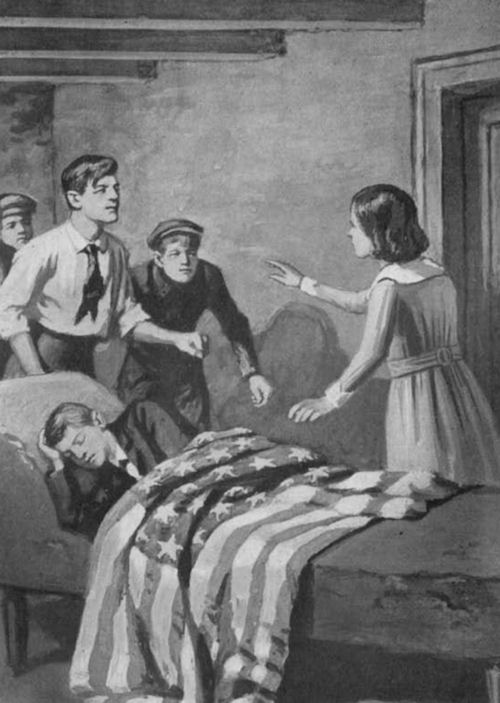
"You can't touch Rudolph!" she tried. "He's under the flag!"
A drift of damp air floated in from the window, and the sleeper shivered and moved as if to cuddle further under his shelter. Louise very gently drew the bunting folds closer about his neck. Somehow she knew that this was not desecration.
That steady step from below again and—nearer!
But just at that moment the boys came noisily back from the distant wings and gables.
"Hello, Louise! What are you doing there?" Luke Musgrove called.
Louise started up. She was between them and the sleeping boy, but she could not screen him from their astonished eyes.
"Gee, but there he is!" exclaimed Billy. "Let's——"
But the spirit of a long line of just and fair Americans was facing them. Louise Carey was descended from ancestors who had bought freedom and fair play with their blood, so in that hour—when she faced the unthinking lawless—there was a something in her eyes which brought them to a stand before her.
"You can't touch Rudolph!" she cried. "He's under the flag!"
A quiet fell upon them. They looked first at the sacred, sheltering flag of their country, and then at each other. And while they yet paused in awe there came to them the sound of a steady, familiar step on the garret stair. The next moment the door opened and there entered Miss Barclay—the teacher who, by her wisdom and her justice, could always command to stillness the tempests of their childish hearts.
AMERICA FIRST
Little Riego Yañez was a native of Mexico—of that unhappy part of Mexico which is constantly plundered by revolutionary bands who spend their time in fighting, and who win their supplies by robbing the more stable people of the republic.
Riego's father, Antonio Yañez, had suffered many times at the hands of the revolutionists. He was a saddler by trade, and also a small farmer, so the products of his industry were just what the warring bandits needed. But the warring bandits did not pay for what they needed. They merely took, and rode away!
So Antonio decided on a desperate step—he would emigrate to America.
But Riego's mother objected to removing to America. Mexico was rife with hatred and distrust of the "gringos," and many and dark were the stories told of the country north of the Great North River. Besides, Riego's elder brother, Pascual, an unruly lad of fifteen, was very bitterly opposed to the change.
So it was at length decided that Antonio should dare alone the dangers and hardships of America. If all was as the revolutionists said, he could escape back to Chihuahua. If, by happy chance, he should prosper in the new country, he would send for wife and children.
A year passed. The father's letters—few and short, for he had had little schooling—were chiefly concerned with begging them to come and see for themselves.
Then, one never-to-be-forgotten day, the mother and children packed into a hired wagon the tragic little which the bandits had left them, and set their faces toward the Rio Grande. They, too, were bound for that distrusted country which lay north of the northern edge of their world. The mother and the two girls were hopeful, but Pascual was silent and Riego afraid.
Not till the night came down did they reach the dark river which was to flow forever between the old life and the new. To little ten-year-old Riego this all-pervading darkness meant "America," for to his drowsy brain and anxious heart the black clouds above and the darkly rolling waters below seemed to typify the spirit of the land into which he was crossing.
Another moment, however, and he had given up the struggle to think it all out and fallen asleep with his head on his mother's lap.
The next morning Riego waked up in a better land.
He sat up on his cot and blinked his black eyes and stared about him at the cosey little room. A flood of light poured in at the one tiny window—Then the sun did shine in this land of the gringos!
This was very interesting. Riego hurried into his clothes and started out to see America.
His route of exploration led through a cheery kitchen, where he found his two sisters busy cooking breakfast, and smiling and chatting at their work. But Riego had no time to stop and question, for the green things in the little garden beyond were beckoning to him.
In another minute he was out among them. It was very green—this "America"—very green and very sunny, with rows upon rows of the most wonderful vegetables running out to meet the morning sun!
Soon Riego glimpsed his father and mother beyond a dividing fence at the side, and he ran at once to his father's arms. After the first long embrace Riego drew back, the better to see the father who had dared America alone for his children's sake.
Why—his brow was smoother than Riego remembered!—his eyes clearer!—Did one grow younger, happier, in America?
And now Riego's mother was calling his attention to the snow-white chickens which fluttered about them. There was a cow, too, Riego learned—a cow and a pony and pigs and pigeons—and all theirs!
Riego shouted for joy. But the next moment the joy died upon his lips, and he asked:
"The revolutionists, father? How long will they let us have these?"
"Riego," said his father, "there are no revolutionists in America. Here, if a man works, he receives a just reward, and he is allowed to keep in peace what he earns. Our only danger is from across the border."
Then Riego's mother told him that his father had a fine saddle-shop which the Americans never raided.
It was all very, very wonderful!—A man was paid well for working, and could keep in peace what he earned!—Was this what was meant by "America"?
Riego's father's saddle-shop was the front room of their little dwelling, and opened immediately upon a small street in the Mexican quarter of the village. It was a very interesting place, indeed, for the wide door and the hospitable bench just inside invited in many an entertaining visitor, besides the men who came to buy saddles or to have their harness repaired.
One of these visitors, Alonzo Lorente, was particularly interesting to Riego and his brother, though their father always became moodily quiet when the man came. Lorente was a big, dashing fellow, full of strange oaths and of dark insinuations. And somehow, whenever he entered, the air of the shop became electric with an indefinable excitement.
It did not take Riego long to see that, at such times, his father managed to keep him and Pascual so busy that they missed most of their hero's inspiriting talk. Riego was particularly unfortunate in this respect. He spent little of his time in the shop where his father and Pascual plied the saddler's trade, for it was his duty to help in the market-garden.
This deprivation of Lorente's society, however, had its compensations. It was Riego's especial work to peddle their vegetables at the khaki tents of the gringo soldiers a few miles away, and this was very entertaining and exciting in itself, for the soldiers were jolly and kind and said nice things to one.
And then, one rainy Saturday afternoon, when the peddling was all done, Riego sat in his father's shop and listened to Alonzo Lorente. And Alonzo Lorente startled him awake with the news that all was not well with the land of America. He spoke darkly of "gringos" and of "vengeance."
Pascual, Riego noticed, crept closer and closer to the big man, till his fingers forgot the leather they should have been stretching.
It was then that the unexpected happened. The father, usually so quiet and so busy, suddenly rose from his work-bench and came forward.
"Lorente," he said, and Pascual and Riego started at the iron in his tone, "Lorente, it is not the busy men who have quarrel with America. It is those who have time to do—much talking!"
There was a pause and dead silence, and then Lorente the magnificent turned on his heel with a growl and left the shop.
Then Antonio returned to his work-bench, with Riego following, but Pascual stole to the door and gazed at the receding Lorente till his father called him sharply to his duties.
One day the father did not open his shop at all. It was closed in honor of the great American festival, Riego heard him explain grimly to a follower of Lorente, who questioned. And Riego heard the follower of Lorente laugh scornfully as he strode away.
There being no work that day, Pascual and Riego set out together to explore the yet farther reaches of America.
But they had not gone far past the square where loomed the several American stores when they sighted a crowd in a grove of big trees, and heard voices shouting and hands clapping as if in great joy. A number of gringo soldiers were roving about. Two were coming leisurely toward them across the green.
Riego wanted to press forward to see and hear, but his brother jerked him by the sleeve, exclaiming:
"It is the Americans' great feast-day, the Fourth of July. Come away!"
"But father says we are Americans now. Why can't we go and hear what they are saying?" Riego's voice had risen in his eagerness.
The approaching soldiers stopped and looked at him, and Riego's heart stopped, too.
But the taller of the soldiers saluted him in fine fashion, and addressed to him words of courteous welcome:
"Don Pedro de Alvarado-Rain-in-the-Face-Sitting-Bull, for such as thou art is the picnic! Welcome to our city!"
Riego understood the gesture of invitation. He thanked the courtly soldier, and walked proudly forward, followed by his brother.
It was a gay scene, but quiet now, for someone was speaking. The starry banner of America fluttered everywhere, and smiling, white-faced señoritas and brown-clad soldiers were gathered here and there in listening groups. Under a tree, near the platform, sat musicians with shining silver horns and a big drum. A number of children were seated on the grass in front of the stand. Among them, Riego noticed, were many dark faces like his own.
Suddenly Riego's courage gave way and he started to retreat. But a sweet-faced señora took him by the hand and led him and Pascual to a place where they could see everything, whispering as they went:
"It is our day of freedom."
At first the boy was dazed by the strangeness of the scene, and his interest shifted. But the sound of a sweet, ringing voice soon compelled his attention and he turned quickly toward the platform.
Riego caught his breath. Who was it? What was it that was speaking to him?
In the centre of the platform stood a clear-eyed, white-faced goddess, with the flag of the new country draped around her slender form, and the sunlight of this day of freedom beating down upon her shining head. She was speaking, but in the difficult new tongue.
Riego could not take his eyes away, but he reached out his hand quickly to touch Pascual.
The sweet-faced señora leaned over him.
"America," she whispered in explanation.
America! Beautiful America! Riego crept forward, unconscious now of the crowd around. Oh, to understand America!
Then a strange thing happened. The beautiful goddess suddenly ceased speaking, and her face became clouded with thought. Her eyes were focussed on the eager boy who had crept forward and was standing spellbound before her—the most conspicuous of the group of dark-faced, bewildered children.
Riego did not know that everybody in that audience had suddenly leaned forward in dead silence.
After one tense moment the Beautiful One advanced to the edge of the platform and descended the steps till she stood almost among them.
And now this strange, new, better country was speaking to Riego in his own tongue!
"You didn't understand me, did you?" she asked in Spanish.
"Not then, my lady!—but now!" It was Riego who answered her, but the other dark faces were alight like his own now. The crowd was leaning forward again.
"Ah, that is all the trouble!" said the Beautiful One. "Our new people simply do not understand America! Do you wish me to tell you the story in Spanish?"
There were many who answered this time.
Then she told them in their own tongue of the great struggle for a new freedom and a new peace which had been waged upon this soil over a hundred years before. And the breathless children heard how this new ideal of freedom had passed all bounds of the country in which it was born, and thrilled all lands. They heard how the noble La Fayette of France, Steuben of Prussia, and Kosciuszko of Poland each had offered his all that America might be forever a refuge for the oppressed. They learned how the German De Kalb had laid down his life at Camden for the new faith, and how Count Pulaski had poured out the last drop of his Polish blood to make the world's great dream of freedom "come true."
Then the Beautiful One told the children how, throughout the more than one hundred years since the fight was won, the footsore and oppressed of many lands have found in America work and a just reward for working, the freedom to do anything which does not harm another, and the great gift of peace!
"And now," exclaimed the speaker, "which of you will promise with me to be loyal to America? Stand up!"
And they stood up—the dark children, the white-faced señoritas, the gringo soldiers, and all!—and repeated after the Beautiful One:
"I pledge allegiance to my flag and to the republic for which it stands, One nation, indivisible, with liberty and justice for all."
When Riego turned from the inspiring scene it was to see his brother Pascual walking away, and in close conversation with Alonzo Lorente.
*****
The days passed, but Riego still treasured in his heart his first vision of America. He knew now that the Beautiful One was only a charming señorita and daughter of the big captain who commanded at the American camp. But he liked to think of her as "America"—the beneficent goddess who had smoothed the furrows from his father's brow and crowned his faithful labors with reward.
And then, one momentous day, the Beautiful One stood in the shop-door, asking in Spanish if she might be allowed to enter. She was all in white this time—snow-white. To Riego's fond imagination she was still a shining goddess.
Riego's father welcomed the señorita and dusted the bench that she might sit and rest, for Riego had told him of the great American festival, and Antonio had learned much besides.
The señorita had come to speak to the father about his sons—and her smiling glance included both the sullen Pascual and Riego, who stood worshipfully by.
It seemed that the señorita—Miss Flora Arden was her name—was to teach a class of "newly made Americans," and again her glance included the boys. She wanted to teach them to speak the English language and to help them to a better understanding of America. The señorita believed that most of the trouble which the newly made Americans encountered was due to the fact that they did not know how to find and use the good gifts which their new country had to offer. And she was certain that most of the trouble they gave was because they brought old prejudices with them, and so did not open their hearts to America.
Riego understood the spirit of her proposal better than he did the words of her correct Spanish. His father listened throughout with thoughtful, grave attention.
There were no charges to be made for this teaching? Then what was the señorita to gain for so much effort?
"I?" said the señorita—she was standing now, ready to depart—"I gain a better country! My father is a soldier and serves his country by helping to keep the peace along this troubled border. If I had been a son I might have done as much. But I am only a daughter, Antonio! And yet"—and she put her arm over Riego's shoulders as she spoke—"if I help to make loyal even one of America's adopted sons, am not I, too, serving my country?"
The father's rare smile assented to her offer, even before his lips made the promise.
Riego followed the Beautiful One to the door.
Outside, Alonzo Lorente slouched against a lamp-post. The señorita looked into Lorente's face and recoiled slightly. Riego saw the recoil, and an unnamed fear suddenly laid its hand upon his heart.
*****
Pascual and Riego went to Miss Arden's class—Pascual sullen and uninterested, Riego breathlessly eager. But they had not attended many times—indeed, had just begun to glimpse something of the bigness and goodness of their new country—when the stroke fell that was to change their little world. The good father dropped at his work-bench, speechless and bewildered. The American doctor said he would be able to work again, but that his mind would never be quite the same.
Their wise father thus reduced to childishness, and their mother ignorant of the new conditions and the new tongue, the boys were left to plan for themselves.
Pascual left Miss Arden's class. He explained that he would now have to take charge of his father's shop; but he found time to make many trips across the dark Rio Grande and to talk much with Lorente, who now resumed his old practice of dropping in at the shop to chat. His younger brother, however, continued under the señorita's instruction.
Riego learned at Miss Arden's class that "freedom" gives one the right to do as he wishes only in so far as he does not wish to interfere with the rights of another.
"There is no 'freedom' except in loyal obedience to law," she told him one day. "America is a 'free' country because—though here are gathered people from all lands—they join together in making laws which are kind and impartial to all, and they stand together in support of the laws they make."
"But, señorita, Alonzo Lorente says—" began the boy, and stopped short.
"What does Alonzo Lorente say?" the señorita asked quickly.
"I—I promised not to tell," stammered the child.
There was the blue truth of heaven in the señorita's eyes as she looked into his own, and answered: "Riego, it is more than dishonest in Lorente to accept the blessings which America affords him and not be true to her. It is worse than traitorous in him to help spoil the peace of the country which is his refuge from oppression. If Alonzo Lorente likes the old way better than the new, he should go back to the old country. If he honestly wishes to change what he finds here, and thinks he can better things, he has one man's just share in deciding, for he is a naturalized citizen and can vote on any question. But Alonzo Lorente should speak out openly or else keep silent!"
Before Riego left that afternoon Miss Arden had him repeat with her:
"I pledge allegiance to my flag and to the republic for which it stands, One nation, indivisible, with liberty and justice for all."
But little Riego did not dream in how short a time would his loyalty to his new country be tested. One afternoon—his father was still lying unconscious—Riego was tending the shop alone, for Pascual had crossed the Rio Grande in the early morning and had not yet returned.
It was a dull, dull afternoon, for no patrons came, and the visitors merely glanced in and passed on. It was hot and still, so the sleepy Riego decided to rest. He found a cool spot behind a pile of boxes, and lay down and closed his eyes.
*****
When Riego opened his eyes again it was with a start. There were voices—smothered voices—some men were in the shop! Riego lay still and listened.
"We will attack the gringo camp to-night—just before dawn," a smothered voice was saying. "Alva has three hundred men and more. They can easily surprise and destroy these eighty Americans, and so can seize their horses and ammunition."
"But the patrol?" It was Pascual's voice that whispered the question. Riego's heart turned sick. He recognized the voice of Lorente in the terrifying reply:
"Pacheco and a picked few will knife the patrol at the ford, then Alva's men will cross, and approach the camp up the ravine."
"To-morrow morning?" Pascual's voice asked.
"Yes, just before dawn."
There were approaching steps on the street.
A customer entered. Riego heard Lorente departing—heard the customer inquire the price of a saddle, and go out.
It must be done now—now while Pascual was alone, and he could speak to him! The next moment Riego stood before his brother.
"I heard you!" he cried. "Pascual, they must not!"
But Pascual laid a fierce hand upon his breast and pinned him to the wall.
It was a terrible scene—that which followed—terrible in the tense quiet of its enactment—terrible in its outcome!
With Riego pinned against the wall where he needs must listen, Pascual poured forth such a torrent of abuse, of falsehood, against the "gringos" that at length the old hate blood leapt in the younger boy's veins and went beating through his brain.
The gringos were their enemies—enemies! The men who were coming down upon them with the dawn were of their own blood, of their native country! What if the invaders were "revolutionists"? Were they not Mexican? Talk of "loyalty"—one must be loyal to one's own!
When Pascual loosed his grip upon the slight form it was after he had stirred to the very dregs all that was passionate, all that was ignorant and prejudiced and violent, in the boy's nature.
That afternoon Riego did not report at Miss Arden's class, but long after class hour he was obliged to pass her house on the mission to deliver a mended harness to a farmer living near the American camp.
Miss Arden and her mother, Riego knew, were the only members of the big captain's family. They lived in a large house in the woods, half-way between the town and the camp. He knew also that the big captain stayed in camp.
As Riego emerged from the long stretch of lonely woods which separated Miss Arden's house from the town, and as he faced the other long stretch of woods which lay between him and the camp, the boy was struck by the isolation of the señorita's home.
He reflected, however, that Alva's men were to attack the gringo soldiers by way of the ford, and that the ford lay to the right yonder, far out of connection with the captain's house. He was glad—glad that Alva's men would not come that way!
Suddenly he spied the señorita herself. She was standing on the steps of her father's home. Riego's heart bounded within him at sight of her. He pulled down his hat and hoped to pass unrecognized, but the sweet, familiar voice called:
"Riego!"
He did not answer.
Then she ran down the steps to him, and put her gentle hands upon him, turning him to her against his will.
"What is the matter, Riego?" she asked.
No answer.
"You didn't come to class this afternoon."
No answer.
"I'm sorry," she said, after a moment of silence in which she looked searchingly into his face, "because we had an interesting lesson to-day. It was all about what one ought to do in case one should be forced to choose between the old land and the new."
The boy gave a swift, upward glance at her, then dropped his eyes to the ground again. Miss Arden continued, and her voice was very serious now:
"And we decided, Riego, that one ought to think out carefully which country was really the better, and be true to that, because there is a higher duty than that to party or country, and that is—to the principles of justice and freedom."
Riego's head sank lower. The Beautiful One took one of his brown hands into her own.
"And we said"—was she looking into the dark heart of him?—"that whichever way one chose, one should choose openly. Now this little brown hand could never——"
But the little brown hand was snatched away, and with a great sob the child fled into the woods.
When at last that night Riego did fall asleep he dreamed that his beautiful America came to him with her white arms held out in appeal, and that he slipped a dagger out of his bosom and stabbed her to the heart.
He started, awake, and sat up. It was black dark.
Had Alva struck already? Or was there yet time?
Ten feet away was Pascual's cot—he must not wake Pascual! As still as death he slipped out of his bed, pulled on his overalls that he had hung near, and crept out into the moonless night.
Riego could not think—it was all so desperate! He could only respond to the heart that was in him, and creep forward through the dark. But his feet knew the road that he took, though his brain was reeling. He was going straight to the one who had wakened the new loyalty in him—his beautiful America!
"I pledge allegiance to my flag and to the republic for which it stands," went surging through him as he struggled on.
Riego was not grandly heroic; he was only a frightened little boy, but determined now to do his loyal best for the country that had sheltered him from oppression. And so, though the treacherous sands might seek to drag him down, though the dark chaparral yonder might hide—any fearsome thing!—Riego went forward.
And now the house of the big captain loomed black before him. Riego stole up the front steps. He knew behind which of the long, closed windows the señorita slept, and he approached and tapped fearfully upon it.
It was a frightened voice that called: "Who is that?"
Riego was not conscious how he answered, but he knew that a wave of relief flowed over him when the blind of the long window opened and he was drawn into the dark room by a pair of familiar hands.
The blind was closed after him and a light was struck.
The señorita's eyes were disclosed big and startled; her face was as white as the long robe she wore.
"What is it, Riego?" she gasped.
"They are coming!" he whispered.
"Who?" she exclaimed, catching him by the shoulders, "Who?"
"Alva," the boy answered, "and three hundred with him. They are going to surprise—our soldiers—and kill them while they sleep!"
The señorita sprang to the telephone. She pulled down the lever many, many times, then she staggered back against the wall.
"They have cut the wires!" she cried. "Riego, you and I must take the warning!"
"To the camp?" the boy cried in dismay.
"Yes, there's no one within a mile of here that could take it but us!"
"But the Mexicans have spies over there," the boy moaned. "They will find us in the dark with their knives!"
She had flung on a long cloak, and was hurriedly fastening her shoes.
"Then you stay here and I'll go," she said.
"You?" cried the startled child—then—"It is dark out there, my lady; I'll go with you."
They extinguished the light and stole out together to the stable, but the horses were gone!
Desperate now, they started out afoot.
The treacherous sand again and the black dark! But they crept along together. Then suddenly the boy's courage gave way and he clung to the cloaked figure, sobbing:
"Señorita! Señorita! I am afraid!"
The señorita was trembling, too, and her voice broke as she whispered:
"You and I don't make very good heroes, do we?"
They had come to a standstill and were clinging together in the dark. Suddenly there was a sound of something approaching—-the velvet tread of an unshod pony in the sand!
The rider passed.
When they breathed again the señorita took him strongly by the shoulders.
"Riego," she whispered—and there was no break in her voice now—"we must separate. One of us must go straight to the ford and warn the patrol, the other to camp."
"But it is near the ford that Pacheco is hiding," the boy replied.
"I'll go to the ford," she said simply.
"No, my lady, I go—you take the news to camp." And before she could detain him the boy turned at a sharp angle and plunged into the deeper blackness of the chaparral.
*****
A long nightmare intervened between their parting and the time when the half-dead boy clung to the saddle of the patrol and whispered to him:
"Keep to the open, señor; there are men with knives in the chaparral! Help is coming!"
Then, somehow, everything was blotted out for Riego.
When consciousness came again to the boy, the cool air of the dawn was choked with dust clouds till he could not see ten feet before him and his ears were nearly bursting with the thunder-beat of frantic hoofs. Dim horses were rearing and plunging against the reddening dawn. There were shouts and cries and firing! Firing!
Who was losing? Who was winning?
Dear God, Alva's men were sweeping back across the Rio Grande!
One little frightened boy had saved the day for the country that had given him refuge from oppression.
But what was that? A call for help? Whose voice was that?
Riego plunged into the thick of the dust cloud toward the cry, and dropped by Pascual's side. How could he have known that his brother would ride that night with the invaders!
But Pascual was striving to speak. Riego leaned over him and caught the whisper:
"Lorente shot me down to get my horse and escape!"
And now the gringos were circling round the wounded one—they would beat out his brains with their guns! But—but—why, they were lifting him up, and tenderly! The Americans were lifting up his wounded brother!
*****
Many and bewildering were the things which happened to Riego in the next few hours. First, he and the all-but-dead Pascual were carried by the soldiers to the American camp. Then his brother was taken away from him and borne into a closed tent.
The soldiers gathered around Riego and patted him on the shoulder. They gave him many things—things to eat and coins and pocket-knives and tobacco-tags, all the while challenging him to smile—he whose captured brother was yonder!
Later the big captain sent for him and took him by the hand.
"Riego Yañez," he said, "I am proud to shake hands with an American hero!"
At length a tall soldier came to Riego and led him to the closed tent. But the tall soldier did not enter; he merely pushed the boy inside the tent and dropped the khaki flap.
Riego blinked his eyes. Somebody was lying stretched out on a cot, and somebody was fanning him—the Beautiful One and his brother! Riego crept toward her suddenly outstretched hands.
Then he leaned over Pascual. But Pascual's eyes were closed and on his face was a yellow pallor.
"The surgeon has taken out the ball," whispered the Beautiful One. "He will live, with good nursing, and I am on the job." She paused a moment, then asked, as she looked into his face with concern: "Aren't you happy, you tragic little soldier? Why don't you smile at the good news?"
"How—" began the child—and a strange, sick feeling swept over him—"how long before he will be well enough to be stood against a wall—and——"
"Why, you poor child!"—and the big tears sprang to the señorita's eyes—"your brother will not be stood against a wall and shot for treason—never—never! And he's not going to be shut up in prison, either!"
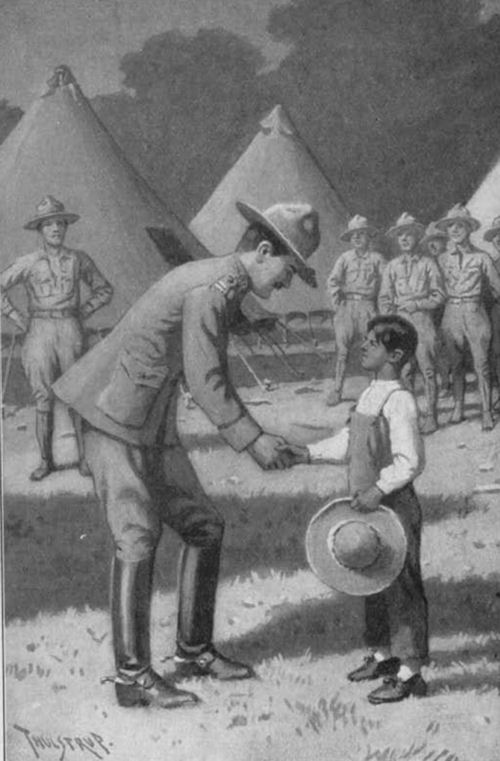
"Riego Yañez," he said. "I am proud to shake hands with an American hero!"
"But why, señorita? Why? The big captain knows that he was with Alva's men."
"He is young—just a boy," and the señorita laid a tender hand upon the head of the wounded lad. "He is the son of good parents and brother to—— Oh, you tragic little soldier, can't you guess who it is has saved your brother?"
"You, señorita?"
"Yourself, Riego. Because you have been heroically loyal they are to give your brother another chance. We Americans, Riego"—and her white hand closed upon his own to include him with her—"we Americans are going to nurse Pascual back to a better life and teach him how to be free!"
The sick lad stirred on his cot.
When the Beautiful One leaned over him in quick solicitude, he smiled.