Front matter (continued 6)
Reading edition
Our earliest printed works consist of these translations of French translations; and the historian of our poetry considered that this very circumstance, which originated in the general illiteracy of the times, was more favourable to our vernacular literature than would have been the publication of Roman writers in their original language. Had it not been for these French versions, Caxton could not have furnished any of his own. The multiplication of English copies multiplied English readers, and when at length there was a generation of readers, an English press induced many to turn authors who were only qualified to write in their native tongue.
Venerable shade of Caxton! the award of the tribunal of posterity is a severe decision, but an imprescriptible law! Men who appear at certain eras of society, however they be lauded for what they have done, are still liable to be censured for not doing what they ought to have done. Patriarch of the printing-press! who to thy last and dying day withdrew not thy hand from thy work, it is hard that thou shouldst be amenable to a law which thy faculties were not adequate to comprehend; surely thou mayst triumph, thou simple man! amid the echoes of thy “Caxtonians” rejoicing over thy Gothic leaves—but the historian of the human mind is not the historian of typography.
1 “State Papers of Henry the Eighth,” vol. i. 589.
2 We have Caxton’s own confession in his preface to “The Book of Æneydos,” or the Æneid of Virgil, where, in soliciting the late-created poet-laureat in the University of Oxford, John Skelton, to oversee his prose translation of the French translation, he notices the translations of Skelton of “The Epistles of Tully,” and the “History of Diodorus Siculus,” out of Latin into English, and as “one that had read Virgil, Ovid, Tully, and all the other noble poets and orators to me unknown.”

EARLY LIBRARIES.
There probably was a time when there existed no private libraries in the kingdom, nor any save the monastic; that of Oxford, at the close of the thirteenth century, consisted of “a few tracts kept in chests.” In that primeval age of book-collecting, shelves were not yet required. Royalty itself seems to have been destitute of a royal library. It appears, by one of our recently published records, that King John borrowed a volume from a rich abbey, and the king gave a receipt to Simon his Chancellor for “the book called Pliny,” which had been in the custody of the Abbot and Convent of Reading. “The Romance of the History of England,” with other volumes, have also royal receipts. The king had either deposited these volumes for security with the Abbot, or, what seems not improbable, had no established collection which could be deemed a library, and, as leisure or curiosity stimulated, commanded the loan of a volume.
The borrowing of a volume was a serious concern in those days, and heavy was the pledge or the bond required for the loan. One of the regulations of the library of the Abbey of Croyland, Ingulphus has given. It regards “the lending of their books, as well the smaller without pictures as the larger with pictures;” any loan is forbidden under no less a penalty than that of excommunication, which might possibly be a severer punishment than the gallows.
Long after this period, our English libraries are said to have been smaller than those on the Continent; and yet, one century and a half subsequently to the reign of John, the royal library of France, belonging to a monarch who loved literature, Jean le Bon, did not exceed ten volumes. In those days they had no idea of establishing a library; the few volumes which each monarch collected, at great cost, were always dispersed by gifts or bequests at their death; nothing passed to their successor but the missals, the heures, and the offices of their chapels. These monarchs of the thirteenth and fourteenth centuries, amid the prevailing ignorance of the age, had not advanced in their comprehension of the uses of a permanent library beyond their great predecessor of the ninth, for Charlemagne had ordered his books to be sold after his death, and the money given to the poor.
Yet among these early French kings there were several who were lovers of books, and were not insensible of the value of a studious intercourse, anxious to procure transcribers and translators. A curious fact has been recorded of St. Louis, that, during his crusade in the East, having learned that a Saracen prince employed scribes to copy the best writings of philosophy for the use of students, on his return to France he adopted the same practice, and caused the Scriptures and the works of the Fathers to be transcribed from copies found in different abbeys. These volumes were deposited in a secure apartment, to which the learned might have access; and he himself passed much of his time there, occupied in his favourite study, the writings of the Fathers.1
Charles le Sage, in 1373, had a considerable library, amounting to nine hundred volumes. He placed this collection in one of the towers of the Louvre, hence denominated the “Tour de la Librarie,” and entrusted it to the custody of his valet-de-chambre, Gilles Malet, constituting him his librarian.2 He was no common personage, for great as was the care and ingenuity required, he drew up an inventory with his own hand of this royal library. In that early age of book-collecting, volumes had not always titles to denote their subjects, or they contained several in one volume,3 hence they are described by their outsides, their size, and their shape, their coverings and their clasps. This library of Charles the Fifth shines in extreme splendour, with its many-coloured silks and velvets, azure and vermeil, green and yellow, and its cloths of silver and of gold, each volume being distinctly described by the colour and the material of its covering. This curious document of the fourteenth century still exists.4
This library passed through strange vicissitudes. The volumes in the succeeding reigns were seized on, or purchased at a conqueror’s price, by the Duke of Bedford, Regent of France. Some he gave to his brother Humphrey, the Duke of Gloucester, and they formed a part of the rich collection which that prince presented to Oxford, there finally to be destroyed by a fanatical English mob; others of the volumes found their way back to the Louvre, repurchased by the French at London. The glorious missal that bears the Regent’s name remains yet in this country, the property of a wealthy individual.5
Accident has preserved a few catalogues of libraries of noblemen in the fourteenth and fifteenth century, more pleasant than erudite. In the fourteenth century, the volumes consisted for the greater part of those romances of chivalry, which so long formed the favourite reading of the noble, the dame and the damoiselle, and all the lounging damoiseaux in the baronial castle.6
The private libraries of the fifteenth century were restricted to some French tomes of chivalry, or to “a merrie tale in Boccace;” and their science advanced not beyond “The Shepherd’s Calendar,” or “The Secrets of Albert the Great.” There was an intermixture of legendary lives of saints, and apocryphal adventures of “Notre Seigneur” in Egypt; with a volume or two of physic and surgery and astrology.
A few catalogues of our monastic libraries still remain, and these reflect an image of the studies of the middle ages. We find versions of the Scriptures in English and Latin—a Greek or Hebrew manuscript is not noted down; a commentator, a father, and some schoolmen; and a writer on the canon law, and the mediæval Christian poets who composed in Latin verse. A romance, an accidental classic, a chronicle and legends—such are the usual contents of these monastic catalogues. But though the subjects seem various, the number of volumes were exceedingly few. Some monasteries had not more than twenty books. In such little esteem were any writings in the vernacular idiom held, that the library of Glastonbury Abbey, probably the most extensive in England, in 1248, possessed no more than four books in English,7 on religious topics; and in the later days of Henry the Eighth, when Leland rummaged the monasteries, he did not find a greater number. The library of the monastery of Bretton, which, owing to its isolated site, was among the last dissolved, and which may have enlarged its stores with the spoils of other collections which the times offered, when it was dissolved in 1558, could only boast of having possessed one hundred and fifty distinct works.8
In this primitive state of book-collecting, a singular evidence of their bibliographical passion was sometimes apparent in the monastic libraries. Not deeming a written catalogue, which might not often be opened, sufficiently attractive to remind them of their lettered stores, they inscribed verses on their windows to indicate the books they possessed, and over these inscriptions they placed the portraits of the authors. Thus they could not look through their windows without being reminded of their volumes; and the very portraits of authors, illuminated by the light of heaven, might rouse the curiosity which many a barren title would repel.9
To us accustomed to reckon libraries by thousands, these scanty catalogues will appear a sad contraction of human knowledge. The monastic studies could not in any degree have advanced the national character; they could only have kept it stationary; and, excepting some scholastic logomachies, in which the people could have no concern, one monkish writer could hardly ever have differed from another.
The monastic libraries have been declared to have afforded the last asylums of literature in a barbarous era; and the preservation of ancient literature has been ascribed to the monks: but we must not accept a fortuitous occurrence as any evidence of their solicitude or their taste. In the dull scriptorium of the monk, if the ancient authors always obtained so secure a place, they slept in comparative safety, for they were not often disturbed by their first Gothic owners, who hardly ever allude to them. If ancient literature found a refuge in the monastic establishments, the polytheistical guests were not slightly contemned by their hosts, who cherished with a different taste a bastardised race of the Romans. The purer writers were not in request; for the later Latin verse-makers being Christians, the piety of the monks proved to be infinitely superior to their taste. Boethius was their great classic; while Prudentius, Sedulius, and Fortunius, carried the votes against Virgil, Horace, and even Ovid; though Ovid was in some favour for his marvellous Romance. The polytheism of the classical poets was looked on with horror, so literally did they construe the allegorical fables of the Latin muse. Even till a later day, when monkery itself was abolished, the same Gothic taste lingered among us in its aversion to the classical poets of antiquity, as the works of idolaters!
Had we not obtained our knowledge of the great ancients by other circumstances than by their accidental preservation by the monks, we should have lost a whole antiquity. The vellum was considered more precious than the genius of the author; and it has been acutely conjectured that the real cause of the minor writers of antiquity having come down to us entire, while we have to lament for ever the lacerations of the greater, has been owing to the scantiness of the parchment of a diminutive volume. They coveted the more voluminous authors to erase some immortal page of the lost decades of Livy, or the annals of Tacitus, to inscribe on it some dull homily or saintly legend. That the ancients were neglected by these guardians appears by the dungeon-darkness from which the Italian Poggio disinterred many of our ancient classics; and Leland, in his literary journey to survey the monastic libraries of England, often shook from the unknown author a whole century of dust and cobwebs. When libraries became one source of the pleasures of life, the lovers of books appear to have been curious in selecting their site for perfect seclusion and silence amid their noble residences, and also in their contrivances to arrange their volumes, so as to have them at instant command. One of these Gothic libraries, in an old castle belonging to the Percys, has been described by Leland with congenial delight. I shall transcribe his words, accommodating the reader with our modern orthography.
“One thing I liked extremely in one of the towers; that was a STUDY called PARADISE; where was a closet in the middle of eight squares latticed ‘abrate;’ and at the top of every square was a desk ledged to set books on, on coffers within them, and these seemed as joined hard to the top of the closet; and yet by pulling, one or all would come down breast-high in rabbets (or grooves), and serve for desks to lay books on.”
However clumsy this invention in “Paradise” may seem to us, it was not more so than the custom of chaining their books to the shelves, allowing a sufficient length of chain to reach the reading-desk—a mode which long prevailed when printing multiplied the cares of the librarian.
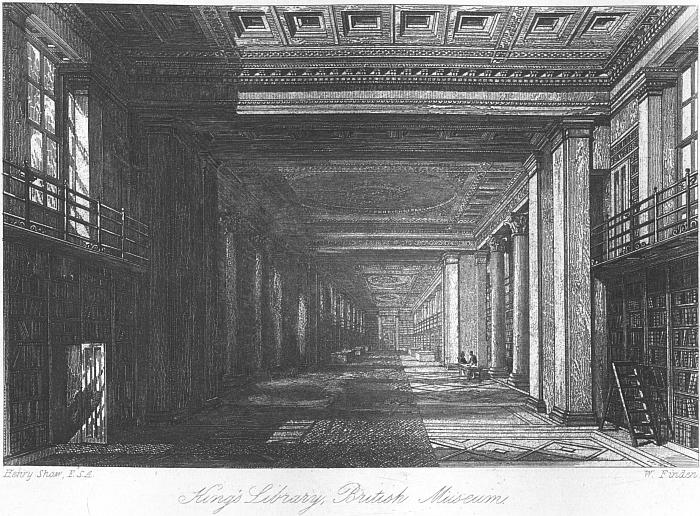
London, Frederick Warne & Co.
All these libraries, consisting of manuscripts, were necessarily limited in their numbers; their collectors had no choice, but gladly received what occurred to their hands; it was when books were multiplied by the press, that the minds of owners of libraries shaped them to their own fancies, and stamped their characters on these companions of their solitude.
We have a catalogue of the library of Mary Queen of Scots, as delivered up to her son James the Sixth, in 1578,10 very characteristic of her elegant studies; the volumes chiefly consist of French authors and French translations, a variety of chronicles, several romances, a few Italian writers, Petrarch, Boccaccio, and Ariosto, and her favourite poets, Alain Chartier, Ronsard, and Marot. This library forms a striking contrast with that of Elizabeth of England, which was visited in 1598 by Hentzner, the German traveller. The shelves at Whitehall displayed a more classical array; the collection consisted of Greek, Latin, as well as Italian and French books.
The dearness of parchment, and the slowness of the scribes, made manuscripts things only purchasable by princely munificence. It was the discovery of paper from rags, and the novel art of taking copies without penmen, which made books mere objects of commerce, and dispersed the treasures of the human mind free as air, and cheap as bread.
1 “Essai Historique sur la Bibliothèque du Roi,” par M. Le Prince.
2 This Gilles Malet, who was also the king’s reader, had great strength of character; he is thus described by Christine de Pise:—“Souverainement bien lisoit, et bien ponttoit, et entendens homs estoit;” “he read sovereignly well, with good punctuation, and was an understanding man.” She has recorded a personal anecdote of him. One day a fatal accident happened to his child, but such was the discipline of official duties, that he did not interrupt his attendance on the king at the usual hour of reading. The king having afterwards heard of the accident which had bereaved the father of his child, observed, “If the intrepidity of this man had not exceeded that which nature bestows upon ordinary men, his paternal emotion would not have allowed him to conceal his misfortune.”
3 The reader may form some idea of the discordant arrangement of a volume of manuscripts by the following entries:—“Un Livre qui commence de Genesis, et aussi traite des fais Julius Cesar, appelle Suetoine.” “Un Livre en François, en un volume, qui ce commence de Genesis, et traite du fait des Romains, de la vie des SS. Peres Hermites, et de Merlin.”
4 “Hist. de l’Académie Royale des Inscriptions,” tome i. 421, 12mo.
5 It has, within the last few years, been added to the British Museum.—Ed.
6 Dame was the lady of the knight; the Damoiselle, the wife of an esquire; Dameisel, or Damoiseau, was a youth of noble extraction, but who had not yet attained to knighthood.—Rocquefort, “Glossaire de la Langue Romane.”
7 Ritson’s “Dissertation on Romance and Minstrelsy,” lxxxi.
8 See an “Essay on English Monastic Libraries,” by that learned and ingenious antiquary, the Rev. Joseph Hunter.
9 Some of these extraordinary window-catalogues of the monastic library of St. Albans were found in the cloisters and presbytery of that monastery, and are preserved in the “Monasticon Anglicanum.”
10 Dibdin’s “Bibliographical Decameron,” iii. 245.
HENRY THE SEVENTH.
There was a state of transition in our literature, both classical and vernacular, which deserves our notice in the progress of the genius of the nation.
A prudent sovereign in the seventh Henry, amid factions rather joined together than cemented, gave a semblance of repose to a turbulent land, exhausted by its convulsions. A martial rudeness still lingered among the great; and we discover by a curious conversation which the learned Pace held with some of the gentry, with whom, perhaps, he had indiscreetly remonstrated, attempting to impress on their minds the advantages of study, that his advice was indignantly rejected. Such pursuits seemed to them unmanly, and intolerable impediments in the practice of those more active arts of life which alone were worthy of one of gentle blood; their fathers had been good knights without this idling toil of reading.
Henry the Seventh, when Earl of Richmond, during his exile in France from 1471 to 1485, had become a reader of French romances, an admirer of French players, and an amateur of their peculiar architecture. After his accession we trace these new tastes in our poetry, our drama, and in a novel species of architecture which Bishop Fox called Burgundian, and which is the origin of the Tudor style.1 A favourer of the histrionic art, he introduced a troop of French players. Wary in his pleasures as in his politics, this monarch was moderate in his patronage either of poets or players, but he was careful to encourage both. The queen participated in his tastes, and appears to have bestowed particular rewards on “players”, whose performances had afforded her unusual delight; and among the curious items of her majesty’s expenditure, we find that many of these players were foreigners—“a French player, an Italian poet, a Spanish tumbler, a Flemish tumbler, a Welshman for making a ryme, a maid that came out of Spain and danced before the queen.”
This monarch had suffered one of those royal marriages which are a tribute paid to the interests of the State. Henry had yielded with repugnance to a union with Elizabeth the Yorkist; the sullen Lancastrian long looked on his queen with the eyes of a factionist. Toward the latter years of his life this repugnance seems to have passed away, as this gentle consort largely participated in his tastes. It was probably in their sympathy that the personal prejudices of Henry melted away. This indeed was a triumph of the arts of imagination over the warped feelings of the individual; it marked the transition from barbaric arms to the amenities of literature, and the softening influence of the mimetic arts; it was the presage of the magnificence of his successor. The nation was benefited by these new tastes; the pacific reign made a revolution in our court, our manners, and our literature.
We may date from this period that happy intercourse which the learned English opened with the Continent, and more particularly with literary Italy; our learned travellers now appear in number. Colet, the founder of St. Paul’s School, not only passed over to Paris, but lingered in Italy, and returned home with the enthusiasm of classical antiquity. Grocyn, to acquire the true pronunciation of the Greek, which he first taught at Oxford, domesticated with Demetrius Chalcondyles and Angelo Politian, at Florence. Linacre, the projector of the College of Physicians, visited Rome and Florence. Lilly, the grammarian, we find at Rhodes and at Rome, and the learned Pace at Padua. We were thus early great literary travellers; and the happier Continentalists, who rarely move from their native homes, have often wondered at the restless condition of those whom they have sometimes reproached as being Insulaires; yet they may be reminded that we have done no more than the most ancient philosophers of antiquity. Our reproachers fortunately possessed the arts, and even the learning, which we were willing by travel and costs to acquire. “The Islanders” may have combined all the knowledge of all the world, a freedom and enlargement of the mind, which those, however more fortunately placed, can rarely possess, who restrict their locality and narrow their comprehension by their own home-bound limits.
The king, delighting in poetry, fostered an English muse in the learned rhyme of Stephen Hawes, who was admitted to his private chamber, for the pleasure which Henry experienced in listening to poetic recitation. It was probably the taste of his royal master which inspired this bard’s allegorical romance of chivalry, of love, and of science. This elaborate work is “The Pastime of Pleasure, or the History of Graunde Amour and la bell Pucell, containing the knowledge of the seven sciences and the course of man’s life.” At a time when sciences had no reality, they were constantly alluding to them; ignorance hardily imposed its erudition; and experimental philosophy only terminated in necromancy. The seven sciences of the accomplished gentleman were those so well known, comprised in the scholastic distich.
In the ideal hero “Graunde Amour,” is shadowed forth the education of a complete gentleman of that day. From the Tower of “Doctrine,” to the Castle of “Chivalry,” the way lies equally open, but the progress is diversified by many bye-paths, and a number of personified ideas or allegorical characters. These shadowy actors lead to shadowy places; but the abounding incidents relieve us among this troop of passionless creatures.
This fiction blends allegory with romance, and science with chivalry. At the early period of printing, it was probably the first volume which called in the graver’s art to heighten the inventions of the writer, and the accompanying wood-cuts are an evidence of the elegant taste of the author, although that morose critic of all poesy, honest Anthony à Wood, sarcastically concludes that these cuts were “to enable the reader to understand the story better.” This once courtly volume, our sage reports, “is now thought but worthy of a ballad-monger’s stall.”2 “The Pastime of Pleasure” was even despised by that great book-collector, General Lord Fairfax, who, on the copy he possessed, has left a memorandum “that it should be changed for a better book!” The fate of books vacillates with the fancies of book-lovers, and the improvements of a later age. In the days of Fairfax, the gloom of the civil wars annihilated their imaginations.
But the gorgeousness of this romance struck the Gothic fancy of the historian of our poetry, magic, chivalry, and allegory! In the circumstantial analysis of Warton, the reader may pursue his “course of man’s life” through the windings of the labyrinth. It seems as if the patience of the critic had sought a relief amid his prolonged chronicle of obscure versifiers, in a production of imagination, the only one which had appeared since Chaucer, and which, to the contemplative poetic antiquary, showed him the infant rudiments of the future Spenser.
This allegorical romance is imbued with Provençal fancy, and probably emulated the “Roman de la Rose,” which could not fail to be a favourite with the royal patron, among those French books which he loved. Fertile in invention, it is, however, of the old stock; fresh meads and delicious gardens,—ladies in arbours,—magical trials of armed knights on horses of steel, which, touched by a secret spring, could represent a tourney. We strike the shield at the castle-gate of chivalry, and we view the golden roof of the hall, lighted up by a carbuncle of prodigious size; we repose in chambers walled with silver, and enamelling many a story. There are many noble conceptions among the allegorical gentry. She, whom Graunde Amour first beheld was mounted on her palfrey, flying with the wind, encircled with tongues of fire, and her two milkwhite greyhounds, on whose golden collars are inscribed in diamond letters, Grace and Governance. She is Fame, her palfrey is Pegasus, and her burning tongues are the voice of Posterity! There are some grotesque incidents, as in other romances; a monster wildly created, the offspring of Disdain and Strangeness—a demon composed of the seven metals! We have also a dwarf who has to encounter a giant with seven heads; our subdolous David mounts on twelve steps cut in the rock; and to the surprise of the giant, he discovered in “the boy whom he had mocked,” his equal in stature, and his vanquisher, notwithstanding the inconceivable roar of his seven heads!
Warton transcribed a few lines to show this poet’s “harmonious versification and clear expression;” but this short specimen may convey an erroneous notion. Our verse was yet irregular, and its modulation was accidental rather than settled; the metrical lines of Hawes, for the greater part, must be read rhythmically, it was a barbarism that even later poets still retained. He also affected an ornate diction; and Latin and French terms cast an air of pedantry, more particularly when the euphony of his verse is marred by closing his lines with his elongated polysyllables; he probably imagined that the dimensions of his words necessarily lent a grandeur to his thoughts. With all these defects, Hawes often surpasses himself, and we may be surprised that, in a poem composed in the court of Henry the Seventh, about 1506, the poet should have left us such a minutely-finished picture of female beauty as he has given of La Pucelle; Hawes had been in Italy, and seems with an artist’s eye to have dwelt on some picture of Raphael, in his early manner, or of his master Perugino, in his hard but elaborate style.
Her shining hair, so properly she dresses, Aloft her forehead, with fayre golden tresses; Her forehead stepe, with fayre browés ybent; Her eyen gray; her nosé straight and fayre; In her white cheeks, the faire bloudé it went As among the white, the reddé to repayre; Her mouthe right small; her breathe sweet of ayre; Her lippes soft and ruddy as a rose; No hart alive but it would him appose. With a little pitte in her well-favoured chynne; Her necke long, as white as any lillye, With vaynés blewe, in which the bloude ranne in; Her pappés rounde, and thereto right pretýe; Her armés slender, and of goodly bodýe; Her fingers small, and thereto right longe, White as the milk, with blewé vaynes among; Her feet propér; she gartred well her hose; I never sawe so fayre a créatúre.
The reign of Henry the Seventh was a misty morning of our vernacular literature, but it was the sunrise; and though the road be rough, we discover a few names by which we may begin to count—as we find on our way a mile-stone, which, however rudely cut and worn out, serves to measure our distances.
1 Speed’s “History,” 995.
2 This forlorn volume of Anthony’s “Stalls” is now a gem placed in the caskets of black-letter. This poetic romance, by its excessive rarity,—the British Museum is without a copy,—has obtained most extraordinary prices among our collectors. A copy of the first edition at the Roxburgh sale reached 84l., which was sold at Sir M. M. Sykes’ for half the price; later editions, for a fourth. A copy was sold at Heber’s sale for 25l. It may, however, relieve the distress of some curious readers to be informed that it may now be obtained at the most ordinary cost of books. Mr. Southey, with excellent judgment, has preserved the romance in his valuable volume of “Specimens of our Ancient Poets,” from the time of Chaucer; it is to be regretted, however, that the text is not correctly printed, and that the poem has suffered mutilation—six thousand lines seem to have exhausted the patience of the modern typographer. [A more perfect and accurate edition, from that printed in 1555, was published by the Percy Society in 1845, under the editorship of Mr. Thos. Wright.]
FIRST SOURCES OF MODERN HISTORY.
Society must have considerably advanced ere it could have produced an historical record; and who could have furnished even the semblance but the most instructed class, in the enjoyment of uninterrupted leisure, among every people? History therefore remained long a consecrated thing in the hands of the priesthood, from the polytheistical era of the Roman Pontiffs who registered their annals, to the days that the history of Christian Europe became chronicled by the monastic orders.1 Had it not been for the monks, exclaimed our learned Marsham, we should not have had a history of England.
The monks provided those chronicles which have served both for the ecclesiastical and civil histories of every European people. In every abbey the most able of its inmates, or the abbot himself, was appointed to record every considerable transaction in the kingdom, and sometimes extended their views to foreign parts. All these were set down in a volume reserved for this purpose; and on the decease of every sovereign these memorials were laid before the general chapter, to draw out a sort of chronological history, occasionally with a random comment, as the humour of the scribe prompted, or the opinions of the whole monastery sanctioned.
Besides these meagre annals the monasteries had other books more curious than their record of public affairs. These were their Leiger-books, of which some have escaped among the few reliques of the universal dissolution of the monasteries. In these registers or diaries they entered all matters relating to their own monastery and its dependencies. As time never pressed on the monkish secretary, his notabilia runs on very miscellaneously. Here were descents of families, and tenures of estates; authorities of charters and of cartularies; curious customs of counties, cities, and great towns. Strange accidents were not uncommon then; and sometimes, between a miracle or a natural phenomenon, a fugitive anecdote stole in. The affairs of a monastery exhibited a moving picture of domestic life. These religious houses, whose gate opened to the wayfarer, and who were the distributors of useful commodities to the neighbouring poor—for in their larger establishments they included workmen of every class—did not, however, maintain their munificence untainted by mundane passions. Forged charters had often sealed their possessions, and supposititious grants of mortuary donations silently transferred the wealth of families. These lords of the soil, though easy landlords, still cast an “evil eye” on the lands of their neighbour. Even rival monasteries have fought in meadows for the ownership; the stratagems of war and the battle-array of two troops of cudgelling monks might have furnished some cantos to an epic, less comic perhaps than that of “The Rape of the Bucket.”
In the literary simplicity of the twelfth to the fourteenth century, while every great monastery had its historian, every chronicle derived its title from its locality; thus, among others, were the Glastonbury, the Peterborough, and the Abingdon Chronicles: and when Leland, so late as the reign of Henry the Eighth, in his search into monastic libraries, discovered one at St. Neot’s, he was at a loss to describe it otherwise than as “The Chronicle of St. Neot’s.” The famous Doomsday Book was originally known as “Liber de Winton,” or “The Winchester Book,” from its first place of custody. The same circumstance occurred among our neighbours, where Les grandes Chroniques de Saint Denys were so called from having been collected or compiled by the monks of that abbey. An abstract notion of history, or any critical discrimination of one chronicle from another, was not as yet familiar even to our scholars; and in the dearth of literature the classical models of antiquity were yet imperfectly contemplated.
It is not less curious to observe that, at a time when the literary celebrity of the monachal scribe could hardly pass the boundaries of the monastery, and the monk himself was restricted from travelling, bound by indissoluble chains, yet this lone man, as if eager to enjoy a literary reputation, however spurious, was not scrupulous in practising certain dishonest devices. Before the discovery of printing, the concealment of a manuscript for the purpose of appropriation was an artifice which, if we may decide by some rumours, more frequently occurred than has been detected. Plagiarism is the common sin of the monkish chronicler, to which he was often driven by repeating a mouldy tale a hundred times told; but his furtive pen extended to the capital crime of felony. I shall venture to give a pair of literary anecdotes of monkish writers.
Matthew of Paris, one of these chroniclers, is somewhat esteemed, and Matthew of Westminster is censured, for having copied in his “Flores Historiarum” the other Matthew; but we need not draw any invidious comparison between the two Matthews, since Matthew the first had himself transcribed the work of Roger the Prior of Wendover. The famous “Polychronicon,” which long served as a text-book for the encyclopædic knowledge of the fourteenth century, has two names attached to it, and one, however false, which can never be separated from the work, interwoven in its texture. This famed volume is ascribed to Ranulph, or Ralph Higden of St. Werberg’s Monastery, now the Cathedral of Chester. Ralph, that he might secure the tenure of this awful edifice of universal history for a thousand years, most subdolously contrived that the initial letter of every chapter, when put together, signified that Ralph, a monk of Chester, had compiled the work. Centuries did not contradict the assumption; but time, that blabber of more fatal secrets than those of authors, discovered in the same monastery that another brother Roger had laboured for the world their universal history in his “Polycratica Temporum.” On examination, the truth flashed! For lo! the peccant pen of Ralph had silently transmigrated the “Polycratica” into the “Polychronicon,” and had only laid a trap for posterity by his treacherous acrostics!2
These universal chroniclers usually opened, ab initio, with the Creation, dispersed at Babel reach home, and paused at the Norman Conquest. This was their usual first division; it was a long journey, but a beaten path. Whatever they found written was history to them, for they were without means of correcting their aptitude for credence. Their anachronisms often ludicrously give the lie to their legendary statements.
Most of these monastic writers composed in a debased Latinity of their own, bald and barbarous, but which had grown up with the age; their diction bears a rude sort of simplicity. Yet though they were not artists, there were occasions when they were inevitably graphic—when they detail like a witness in court. These writers have been lauded by the gratitude of antiquaries, and valued by philosophical historians. A living historian has observed of them, that “nothing can be more contemptible as compositions; nothing can be more satisfactory as authorities.” But it is necessary that we should be reminded of the partial knowledge and the partial passions of these sources of our earlier modern history. Lift the cowl from the historiographers in their cells recording those busy events in which they never were busied, characterising those eminent persons from whom they were far removed; William of Malmesbury, not one of the least estimable of these writers, confesses that he drew his knowledge from public rumours, or what the relaters of news brought to them.3 In some respects their history sinks to the level of one of our newspapers, and is as liable to be tinged with party feelings. The whole monastery had as limited notions of public affairs as they had of the kingdom itself, of which they knew but little out of their own county.
No monastic writer, as an historian, has descended to posterity for the eminence of his genius, for the same stamp of mind gave currency to their works. Woe to the sovereign who would have clipt their wings! then “tongues talked and pens wrote” monkish. There was a proverb among them, that “The giver is blessed, but he who taketh away is accursed.” None but themselves could appeal to Heaven, and for their crowned slaves they were not penurious of their beatitude. They knew to crouch as well as to thunder. They usually clung to the reigning party; and a new party or a change of dynasty was sure to change their chronicling pen. Hall, the chronicler of Henry the Eighth, at the first moment when it was allowable to speak distinctly concerning these monkish writers, observed, “These monastical persons, learned and unliterate, better fed than taught, took on them to write and register in the book of fame the arts, and doings, and politic governance of kings and princes.” It seems not to have occurred to the chronicler of Henry the Eighth that, had not those monks “taken on them to write and register,” we should have had no “Book of Fame.” It is a duty we owe to truth to penetrate into the mysteries of monkery, but the monks will always retain their right to receive their large claims on our admiration of their labours.
There was also another class of early chroniclers throughout Europe; men who filled the office of a sort of royal historiographer, who accompanied the king and the army in their progress, to note down the occurrences they deemed most honourable or important to the nation. But incidents written down by a monk in his cell, or by a diarist pacing the round with majesty, would be equally warped, by the views of the monastery in the one case, or by a flattering subservience to the higher power in the other.
In this manner the early history of Europe was written; the more ancient part was stuffed with fables; and when it might have become useful in recording passages and persons of the writer’s own times, we have a one-sided tale, wherein, while half is suppressed, the other is disguised by flattery or by satire. Such causes are well known to have corrupted these first origins of modern history, a history in which the commons and the people at large had very little concern, till the day arrived, in the progress of society, when chronicles were written by laymen in the vernacular idiom for their nation.
1 Archbishop Plegmund superintended the Saxon Annals to the year 891. The first Chronicles, those of Kent or Wessex, were regularly continued by the Archbishops of Canterbury, or by their directions, as far as 1000, or even 1070.—“The Rev. Dr. Ingram’s preface to the Saxon Chronicle.”
These were our earliest Chronicles; the Britons possibly never wrote any.
2 We have a remarkable instance among the Italian historians of this period. Giovanni Villani wrote about 1330; Muratori discovered that Villani had wholly transcribed the ancient portion of his history from an old Chronicle of Malespini, who wrote about 1230, without any acknowledgment whatever. Doubtless Villani imagined that an insulated manuscript, during a century’s oblivion, had little chance of ever being classed among the most ancient records of Italian history. Malespini’s “Chronicle,” like its brothers, was stuffed with fables; Villani was honest enough not to add to them, though not sufficiently so not silently to appropriate the whole chronicle—the only one Dante read.—“Tiraboschi,” v. 410, part 2nd.
3 We have an elegant modern version of this monk’s history by the Rev. J. Sharpe.
ARNOLDE’S CHRONICLE.
Very early in the sixteenth century appeared a volume which seems to have perplexed our literary historians by its mutable and undefinable character. It is a book without a title, and miscalled by the deceptive one of “Arnolde’s Chronicle, or the Customs of London;” but “the Customs” are not the manners of the people, but rather “the Customs” of the Custom-House, and it in no shape resembles, or pretends to be “a chronicle.” This erroneous title seems to have been injudiciously annexed to it by Hearne the antiquary, and should never have been retained. This anomalous work, of which there are three ancient editions, had the odd fate of all three being sent forth without a title and without a date; and our bibliographers cannot with any certainty ascertain the order or precedence of these editions. One edition was issued from the press of a Flemish printer at Antwerp, and possibly may be the earliest. The first printer, whether English or Flemish, was evidently at a loss to christen this monstrous miscellaneous babe, and ridiculously took up the title and subjects of the first articles which offered themselves, to designate more than a hundred of the most discrepant variety. The ancient editions appeared as “The names of the Baylyfs, Custos, Mayres, and Sherefs of the Cyte of London, with the Chartour and Lybartyes of the same Cyte, &c. &c., with other dyvers matters good and necessary for every Cytezen to understand and know;”—a humble title equally fallacious with the higher one of a “Chronicle,” for it has described many objects of considerable curiosity, more interesting than “mayors and sheriffs,” and even “the charter and liberties” of “the cyte.”
In conveying a notion of a jumble,1 though the things themselves are sufficiently grave, we cannot avoid a ludicrous association; yet this should not lessen the value of its information.
A considerable portion of this medley wholly relates to the municipal interests of the citizens of London—charters and grants, with a vast variety of forms or models of public and private instruments, chiefly of a commercial description. Parish ordinances mix with Acts of Parliament; and when we have conned the oath of the beadle of the ward, we are startled by Pope Nicholas’ Bull. We have the craft of grafting trees and altering of fruits, as well in colour as in taste, close to an oration of the messenger of “the Soudan of Babylon” to the Pope in 1488. Indeed, we have many more useful crafts, besides the altering of the flavour of fruits, and the oration of the Mahometan to the representative of St. Peter; for here are culinary receipts, to keep sturgeon, to make vinegar “shortly,” “percely to grow in an hour’s space,” and to make ypocras, straining the wine through a bag of spices—it was nothing more than our mulled wine; and further, are receipts to make ink, and compound gunpowder, to make soap, and to brew beer. Whether we may derive any fresh hints from our ancestor of the year 1500 exceeds my judgment; but to this eager transcriber posterity owes one of the most passionate poems in our language; for betwixt “the composition between the merchants of England and the town of Antwerp,” and “the reckoning to buy wares in Flanders,” first broke into light “A Ballade of the Notbrowne Mayde.” Thus, when an indiscriminating collector is at work, one cannot foresee what good fortune may not chance to be his lot.
Warton has truly characterised this work as “the most heterogeneous and multifarious miscellany that ever existed;” but he seems to me to have mistaken both the design of the collector, and the nature of the collection. Some supposed that the collector, Richard Arnolde, intended the volume to be an antiquarian repertory; but as the materials were recent, that idea cannot be admitted; and Warton censures the compiler, who, to make up a volume, printed together whatever he could amass of notices and papers of every sort and subject. The modern editor of “Arnolde’s Chronicle” was perplexed at the contents of what he calls “a strange book.”
The critical decision of Warton is much too searching for a volume in which the compiler never wrote a single line, and probably never entertained the remotest idea of the printer’s press. This book without a name is, in fact, nothing more than a simple collection made by an English merchant engaged in the Flemish trade. Nor was such a work peculiar to this artless collector; for in a time of rare publications, such men seemed to have formed for themselves a sort of library, of matters they deemed worthy of recollection, to which they could have easy recourse.2 By the internal evidence, Arnolde was no stranger at Antwerp, nor at Dordrecht. Antwerp was then a favourite residence of the English merchants; there the typographic art flourished, and the printers often printed English books; and as this collection was printed at Antwerp by Doesborowe, a Flemish printer, we might incline with Douco to infer that the Flemish was the first edition; for it seems not probable that a foreign printer would have selected an English volume of little interest to foreigners, to reprint; although we can imagine that from personal consideration, or by the accident of obtaining the manuscript, he might have been induced to be the first publisher. Whoever was the first printer, the collector himself seems to have been little concerned in the publication, by the suppression of his name, by the omission of a title, by not prefixing a preface, nor arranging in any way this curious medley of useful things, which he would familiarly turn to as his occasions needed, and—if we may compare a grave volume with the lightest—was of that class which ladies call their “scrap-books,” and assuredly not, according to its fallacious title, a CHRONICLE.
1 In Oldys’ “British Librarian” there is an accurate analysis of the work, in which every single article is enumerated.
2 A similar volume to Arnolde’s may be found in the “Harl. MSS.,” No. 2252.
THE FIRST PRINTED CHRONICLE.
The first chronicle in our vernacular prose, designed for the English people, was the earnest labour of one of themselves, a citizen and alderman, and sometime sheriff of London, Robert Fabyan. Here, for the first time, the spectacle of English affairs, accompanied by what he has called “A Concordance of Stories,” which included separate notices of French history contemporaneous with the periods he records, was opened for “the unlettered who understand no Laten.” Our chronicler, in the accustomed mode, fixes the periods of history by dates from Adam or from Brute. He opens with a superfluous abridgment of Geoffry of Monmouth—the “Polychronicon” is one of his favourite sources, but his authorities are multifarious. His French history is a small stream from “La Mere des Chroniques,” and other chronicles of his contemporary Gaguin, a royal historiographer who wandered in the same taste, but who, Fabyan had the sagacity to discover, carefully darkened all matters unpleasant to Frenchmen, but never “leaving anything out of his book that may sound to the advancement of the French nacyon.”
It was a rare occurrence in a layman, and moreover a merchant, to have cultivated the French and the Latin languages. Fabyan was not a learned man, for the age of men of learning had not yet arrived, though it was soon to come. At that early day of our typography, when our native annalists lay scattered in their manuscript seclusion, it was no ordinary delving which struck into the dispersed veins of the dim and dark mine of our history. So little in that day was the critical knowledge of our writers, that Fabyan has “quoted the same work under different appellations,” and some of our historical writers he seems not to have met with in his researches, for the chronicles of Robert of Gloucester and of Peter Langtoft, though but verse, would have contributed some freshness to his own. In seven unequal divisions, the chronicle closes with the days of the seventh Henry. These seven divisions were probably more fantastical than critical; the number was adopted to cheer the good man with “the seven joys of the Virgin,” which he sings forth in unmetrical metre, evidently participating in the rapturous termination of each of his own “seven joys.”
Our grave chronicler, arrayed in his civic dignities, seems to have provoked the sensitiveness of the poetical critic in Warton, and the caustic wit in Horace Walpole. “No sheriff,” exclaims Walpole, “was ever less qualified to write a history of England. He mentions the deaths of princes and revolutions of government with the same phlegm and brevity as he would speak of the appointment of churchwardens.”
We may suspect that our citizen and chronicler, however he might be familiar with the public acts of royalty, had no precise notions of the principles of their government. We cannot otherwise deem of an historical recorder whose political sagacity, in that famous interview between our Edward the Fourth and Louis the Eleventh, of which Comines has left us a lively scene, could not penetrate further than to the fashion of the French monarch’s dress. He tells us of “the nice and wanton disguised apparel that the King Louys wore upon him at the time of this meeting, I might make a long rehearsal, apparalled more like a minstrel than a prince.” Fabyan shared too in the hearty “John Bullism” of that day in a mortal jealousy of the Gaul, and even of his Sainte Ampoule. Though no man had a greater capacity of faith for miracles and saints on English ground, yet for those of his neighbours he had found authority that it was not necessary for his salvation to believe them, and has ventured to decide on one, that “they must be folys (fools) who believe it.” Had the Sainte Ampoule, however, been deposited in Westminster Abbey for our own coronations, instead of the Cathedral at Rheims for a French king, Fabyan had not doubted of the efficacy of every drop of the holy oil.
But the dotage of Fabyan did not particularly attach to him; and though his intellectual comprehension was restricted to the experience of an alderman, he might have been the little Machiavel of his wardmote—for he has thrown out a shrewd observation, which no doubt we owe to his own sagacity. In noticing the neglect of a mayor in repairing the walls which had been begun by his predecessor, he observes that this generally happens, for “one mayor will not finish that thing which another beginneth, for then they think, be the deed ever so good and profitable, that the honour thereof shall be ascribed to the beginner, and not to the finisher, which lack of charity and desire of vainglory causeth many good acts and deeds to die, and grow out of mind, to the great decay of the commonwealth of the city.” A profound observation, which might be extended to monarchs as well as mayors.
Indulging too often the civic curiosity of “a citizen and alderman,” Fabyan has been taunted for troubling posterity. “Fabyan,” says Warton, “is equally attentive to the succession of the mayors of London and the monarchs of England. He seems to have thought the dinners at Guildhall and the pageantries of the city companies more interesting transactions than our victories in France and our struggles for public liberty at home.”
This seems to be a random stricture. The alderman, indeed, has carefully registered the mayors and the sheriffs of London; and the scientific in “high and low prices” perhaps may be grateful that our pristine chronicler has also furnished the prices of wheat, oxen, sheep, and poultry—but we cannot find that he has commemorated the diversified forms these took on the solemn tables of the Guildhall, nor can we meet with the pasteboard pomps of city pageants, one only being recorded, on the return of Henry the Sixth from France.
Our modern critic, composing in the spirit of our day, alludes to “the struggle for public liberty”; but “public liberty” must have been a very ambiguous point with the honest citizen who had been a sad witness to the contests of two murderous families, who had long sought their mutual destruction, and long convulsed the whole land. We may account for the tempered indifference, and “the brief recitals” for which this simple citizen is reproached, who had lived through such changeful and ensanguined scenes, which had left their bleeding memories among the families of his contemporaries.
The faculties of Fabyan were more level with their objects when he had to chronicle the “tempestuous weathering of thunder and lightning,” with the ominous fall of a steeple, or “the image of our Lady” dashed down from its roof; or when he describes the two castles in the air, whence issued two armies, black and white, combating in the skies till the white vanished! Such portents lasted much later than the days of Fabyan, for honest Stowe records what had once ushered in St. James’s night, when the lightning and thunder coming in at the south window and bursting on the north, the bells of St. Michael were listened to with horror, ringing of themselves, while ugly shapes were dancing on the steeple. Their natural philosophy and their piety were long stationary, yet even then some were critical in their remarks; for when Fabyan recorded “flying dragons and fiery spirits in the air,” this was corrected by omitting “the fiery spirits,” but agreeing to “the flying dragons.” Fabyan, however, has preserved more picturesque and ingenious visions in some legends of saints or apparitions—still delightsome. These legends formed their “Works of Fiction,” and were more affecting than ours, for they were supernatural, and no one doubted their verity.
Our pristine chronicler, as we have seen, has received hard measure from the two eminent critics of the eighteenth century, who have censured as a history that which is none. Chronicles were written when the science of true history had yet no existence; a chronicle then in reality is but a part of history. Every fact dispersed in its insulated state refuses all combination; cause and effect lie remote and obscured from each other; disguised by their ostensible pretexts, the true motives of actions in the great actors of the drama of history cannot be found in the chronological chronicler. The real value of his diligence consists in copiousness and discrimination; qualities rather adverse to each other. Fabyan betrays the infirmities of the early chronicler, not yet practised even in the art of simple detail, without distinction of the importance or the insignificance of the matters he records: his eager pen reckoned the number without knowing to test the weight; to him all facts appeared of equal worth, for all alike had cost him the same toil; and thus he yields an abundance without copiousness. In raising the curiosity which he has not satisfied for us, his mighty tome shrinks into a narrow scope, and his imperfect narratives, brief and dry, offer only the skeletons of history. The mere antiquarian indeed prefers the chronicle to the history; the acquisition of a fact with him is the limit of his knowledge, and he is apt to dream that he possesses the superstructure when he is only at work on the foundations.
The Chronicle of Fabyan attracts our notice for a remarkable incident attending its publication. The Chronicle was finished in 1504, and remained in manuscript during the author’s life, who died in 1512. The first edition did not appear till 1516. The cause which delayed the printing of an important work, for such it was in that day, has not been disclosed; yet perhaps we might have been interested to have learned whether this protracted publication arose out of neglect difficult to comprehend, or from the printer, reluctant to risk the cost, or from any impediment from a higher quarter.
Be this as it may, we possess the writer’s genuine work, for the printer, Pynson, was faithful to his author. The rarity of this first edition Bale, on a loose rumour which no other literary historian has sanctioned, ascribes to its suppression by Cardinal Wolsey, who is represented in his fury to have condemned the volume to a public ignition, which no one appears to have witnessed, for its “dangerous exposition of the revenues of the clergy,” which is not found in the volume. Fabyan truly was ter Catholicus; he was of the old religion, dying in the odour of sanctity, and was spared the trial of the new. The alderman’s voluminous will is now for us at least as curious as anything in his chronicle.1 We here behold the play of the whole machinery of superstition, when men imagined that they secured the repose of their souls by feeing priests and bribing saints by countless masses. This funereal rite was then called “the month’s mind,” and which, at least for that short period, prolonged the memory of the departed. For this lugubrious performance were provided ponderous torches for the bearers, tapers for shrines, and huge candlesticks to be kept lighted at the altar. Three trentballs—that is, thirty masses thrice told—were to be chorused by the Grey Friars; six priests were to perform the high mass, chant the requiem, and recite the De Profundis and the Dirige; and for nine years, on his mortuary day, he charges his “tenement in Cornhill” to pay for an Obite! But not only friars and priests were to pray or to sing for the repose of the soul of Alderman Fabyan, all comers were invited to kneel around the tomb; and at times children were to be called in, who if they could not read a De Profundis from the Psalter, the innocents were to cry forth a Pater-Noster or an Ave! There was a purveyance of ribs of beef and mutton and ale, “stock-fish, if Lent,” and other recommendations for “the comers to the Dirige at night.” The Alderman, however, seems to have planned a kind of economy in his “month’s mind,” for not only was the repose of his soul in question, but also “the souls of all above written”—and these were a bead-roll of all the branches of Fabyan’s family.
The Chronicle of Fabyan was not long given to the world when it encountered the doom of a system at its termination, just before the beginnings of a coming one; that fatal period of a change in human affairs and human opinions, usually described as a state of transition. But in this particular instance, the change occurred preceded by no transitional approach; for within the small circuit of thirty years it seemed as if the events of whole centuries had been more miraculously compressed, than any in those “lives of the saints” whose legendary lore, provided the saints were English, Master Fabyan had loved to perpend. It was Henry the Eighth who turned all the sense of our chronicler into nonsense, all his honest faith into lying absurdities, all his exhortations to maintain “religious houses” into treasonable matters.
Successive editors of the editions of 1533, 43, and 55, surpassed each other in watchfulness, to rid themselves of the old song. Never was author so mutilated in parts, nor so wholly changed from himself; and when, as it sometimes happened, neither purgation nor castration availed the reforming critics, the author’s sides bore their marginal flagellations. The corrections or alterations were, however, dexterously performed, for the texture of the work betrayed no trace of the rents. The omission of a phrase saved a whole sentence, and the change of an adjective or two set right a whole character. It is true they swept away all his delightful legends, without sparing his woful metres of “the seven joys of the Blessed Virgin,” and his appreciation of some favourite relics. They disbanded all the saints, or treated them as they did “the holy virgin Edith,” of whom Fabyan has recorded that “many virtues be rehearsed,” which they delicately reduced to verses. His Holiness the Pope is simply “the Bishop of Rome;” and on one memorable occasion—the Papal interdiction of John—this “Bishop” is designated in the margin by the reformer as “that monstrous and wicked Beast.” The narrative of Becket cost our compurgators, as it has many others, much shifting, and more omissions. In the tale of the hardy and ambitious Archbishop murdered by knightly assassins, Fabyan said, “They martyred the blessed Archbishop;” our corrector of the press simply reads, “They slew the traitorous Bishop.” The omissions and the commissions in the Chronicle of Fabyan are often amusing and always instructive; but these could not have been detected but by a severe collation, which has been happily performed. When the antiquary Brand discovered that Fabyan had been “modernized” in later editions, his observation would seem to have extended no further than to the style: but the style of Fabyan is simple and clear even to modern readers: modernized truly it was, not however for phrases, but for notions—not for statements, but for omissions—not for words, but for things.
1 We are indebted to the zealous research of Sir Henry Ellis for the disinterment of this document as well as for the collations which appear in his edition.
HENRY THE EIGHTH; HIS LITERARY CHARACTER.
Peace and policy had diffused a halcyon calmness over the land, and the people now discerned the approach of another era. Henry the Eighth, who appears with such opposite countenances in the great gallery of history, gave the country more glorious promises of an accomplished sovereign than England had yet witnessed; and however he may appear differently before the calm eye of posterity, the passions of his own times secured his popularity even to his latter days. Youthful, with all its vigorous and generous temper, and not inferior in the majesty of his intellect any more than in that of his person—learned in his closet, yet enterprising in action—this sovereign impressed his own commanding character on the nation. Such a monarch gave wings to their genius. Long pent up in their unhappy island, they soon indulged in a visionary dominion in France, and in rapid victories in Scotland; insular England once more aspired to be admitted into the great European family of states; and Henry was the arbiter of Francis of France, and of Charles of Germany. The awakened spirit of the English people unconsciously was preparatory to the day which yet no one dreamed of. The minds of men were opening to wider views; and he who sate on the throne was one who would not be the last man in the kingdom to be mindless of its progress.
This lettered monarch himself professed authorship, and a sceptre was his pen. When he sent forth a volume which all Europe was to read, and was graced by a new title which all Europe was to own, who dared to controvert the crowned controversialist, or impugn the validity of that airy title? His majesty alone was allowed to confute himself.1 Trained from his early days in scholastic divinity, for he was designed to be an archbishop, the volume, however aided by others, was the native growth of his own mind. The king’s taste for this learning was studiously flattered by the great cardinal, who gently recommended to his restless master a perusal of the nineteen folios of Thomas Aquinas, possibly with the hope of fixing the royal fly in the repose of the cobwebs of the schoolmen. Such, indeed, were his habits of study, that he could interest himself in compiling a national Latin grammar, when the schools succeeded to the dissolved monasteries. The grammar was issued as an act of parliament; no other but the royal grammar was to be thumbed without incurring the peril of a premunire.2
It is to be regretted that we are supplied with but few literary anecdotes of this literary monarch. Some we may incidentally glean, and some may be deduced from inference. The age was not yet far enough advanced in civilization to enjoy that inquisitive leisure which leaves its memorials for a distant posterity in the court tattle of a Suetonius, or the secret history of a Procopius. It has, however, been recorded that certain acts of parliament and proclamations were corrected by the royal pen, and particularly the first draught of the act which empowered the king to erect bishoprics was written by his own hand; and he was the active editor of those monarchical pamphlets, as they may be classed, on religious topics, which were frequently required during his reign.
This learned monarch was unquestionably the first patron of our vernacular literature; he indulged in a literary intercourse with our earliest writers, and evinced a keen curiosity on any novelty in the infant productions of the English press. On frequent occasions he took a personal interest in the success, and even in the concoction, of literary productions. He fully entered into the noble designs of Sir Thomas Elyot to create a vernacular style, and critically discussed with him the propriety of the use of new words, “apt for the purpose.” And on one occasion, when Sir Thomas Elyot projected our first Latin dictionary, the king, in the presence of the courtiers, commended the design, and offered the author not only his royal counsel, but a supply of such books as the royal library possessed.
The king was not offended, as were some of the courtiers, with the freedom displayed by Elyot in some of his ethical works. Elyot tells us—“His grace not only took it in the better part, but with princely words, full of majesty, commended my diligence, simplicity, and courage, in that I spared no estate in the rebuking of vice.” The king, at the same time that he protected Elyot from his petty critics, rewarded the early efforts of another vernacular author, who had dedicated to him his first work in English prose, by a pension, which enabled the young student, Roger Ascham, to set off on his travels. A remarkable instance of Henry’s quick attention to the novelties of our literature appears by his critical conversation with the antiquary, Thynne, who had presented to him his new edition of Chaucer. His Majesty soon discovered the novelty of “The Pilgrim’s Tale,” a bitter satire on the pride and state of the clergy, which at the time was ascribed to Chaucer. The king pointing it out to the learned editor, observed, in these very words—“William Thynne! I doubt this will not be allowed, for I suspect the bishops will call thee in question for it.” The editor submitted, “If your grace be not offended, I hope to be protected by you.” The king “bade him go! and fear not!” It is evident that his majesty was “not offended” at a severe satire on the clergy. But even Henry the Eighth could not always change at will his political position—the minister in power may find means to counteract even the absolute king. A great stir was made in Wolsey’s parliament; it was even proposed that the works of Chaucer should be wholly suppressed—some good-humoured sprite rose in favour of the only poet in the nation, observing that all the world knew that Dan Chaucer had never written anything more than fables! The authority of Wolsey so far prevailed that “The Pilgrim’s Tale” was suppressed, and it seems that the haughty prelate would willingly have suppressed the editor in his own person. Thynne was an intimate acquaintance of Skelton, whose caustic rhymes of “Colin Clout” had been concocted at his country-house. Thynne, in this perilous adventure of publishing “The Pilgrim’s Tale,” was saved from the talons of the cardinal, for this monarch’s royal word was at all times sacred with him.
A literary anecdote of this monarch has been recently disclosed, which at least attests his ardour for information. When Henry wanted time, if not patience, to read a new work, he put copies into the hands of two opposite characters, and from the reports of these rival reviewers the king ventured to deduce his own results. This method of judging a work without meditating on it, was a new royal cut in the road of literature, to which we of late have been accustomed; but it seemed with Henry rather to have increased the vacillations of his opinions, than steadied the firmness of his decisions.
The court of Henry displayed a brilliant circle of literary noblemen, distinguished for their translations, and some by their songs and sonnets. Parker, Lord Morley, was a favourite for his numerous versions, some of which he dedicated to the king; the witty Wyat, who always sustained the anagram of his name, was a familiar companion; nor could Henry be insensible to the elegant effusions of Surrey, unless his political feelings indisposed his admiration. It was at the king’s command that Lord Berners translated the “Chronicles of Froissart,” and the volume is adorned by the royal arms. Sternhold, the memorable psalm-enditer, was a groom of the chamber, and a personal favourite with his master; and Henry appointed the illustrious Leland to search for and to preserve the antiquities of England, and invested him with the honourable title of “The King’s Antiquary.”
Scholars, too, stood around the royal table; and the company at the palace excelled that of any academy, as Erasmus has told us. Learning patronised by a despot became a fashionable accomplishment, and the model for the court was in the royal family themselves. It is from this period that we may date that race of learned ladies which continued through the long reign of our maiden queen. Yet, before the accession of Henry the Eighth, half a century had not elapsed when female literature was at so low an ebb that Sir Thomas More noticed as an extraordinary circumstance that Jane Shore could read and write. When Erasmus visited the English court, he curiously observed that “The course of human affairs was changed; the monks, famed in time passed for learning, are become ignorant, and WOMEN LOVE BOOKS.” Erasmus had witnessed at the court of Henry the Eighth the Princess Mary and Elizabeth, both of whom held an epistolary correspondence in Latin; the daughter of Sir Anthony Cook, and Lady Jane Grey, versed in Greek; and the Queen Catherine Parr, his fervent admirer for his paraphrase on the four gospels. Erasmus had frequented the house of the More’s, which he describes as a perfect musarum domicilium. The venerable Nicholas Udall, a contemporary, has also left us a picture of that day. “It is now a common thing to see young virgins so nouzeld (nursed) and trained in the study of letters, that they willingly set all other vain pastimes at nought—reading and writing, and with most earnest study, both early and late.” The pliable nobility of Henry the Eighth easily took the bend of the royal family, and among their daughters, doubtless, there were more learned women than are chronicled in Ballard’s “Memoirs.” Lady Jane Grey meditating on Plato was not so uncommon an incident as it appears to us in the insulated anecdote. The learning of that day must not be held as the pedantry of a later, for it was laying the foundations of every knowledge in the soil of England.
The king’s more elegant tastes diffused themselves among the finer arts at a time when they were yet strangers in this land; his father’s travelled taste had received a tincture of these arts when abroad, in Henry the Eighth they burst into existence with a more robust aptitude. He eagerly invited foreign artists to his court; but the patronage of an English monarch was not yet appreciated by some of the finest geniuses of Italy; we lay yet too far out of their observation and sympathies; and it is recorded of one of the Italian artists, a fiery spirit, who had visited England, that he designated us as quelle bestie Inglesi. Raphael and Titian could not be lured from their studios and their blue skies; but, fortunately, a northern genius, whose name is as immortal as their own, was domiciliated by the liberal monarch, the friend of Erasmus and of More—Hans Holbein.
Among the musicians of Henry we find French, Italians, and Germans; he was himself a musician, and composed several pieces which I believe are still retained in the service of the Royal Chapel.3 He had a taste for the gorgeous or grotesque amusements of the Continent, combining them with a display of the fine arts in their scenical effects. One memorable night of the Epiphany, the court was startled by a new glory, where the king and his companions appeared in a scene which the courtiers had never before witnessed. “It was a mask after the manner of Italy, a thing not seen afore in England,” saith the chronicler of Henry’s court-days. Once, to amaze a foreign embassy, and on a sudden to raise up a banqueting-house, the monarch set to work the right magicians; an architect, and a poet, and his master of the revels, were months inventing and labouring. The regal banqueting-house was adorned by the arts of picture and music, of sculpture and architecture; all was full of illusion and reality; the house itself was a pageant to exhibit a pageant. The magnificent prince was himself so pleased, that he anxiously stopped his visitors at the points of sight most favourable to catch the illusion of the perspective. A monarch of such fine tastes and gorgeous fancies would create the artists who are the true inventors.
1 The manuscript of Henry the Eighth reposes in the Vatican, witnessed by his own hand in this inscription:—“Anglorum Rex, Henricus Leoni X. ‘mittit hoc opus et fidei testem et amicitiæ.’”—I found this inscription in one of the notes of Selden to the “Polyolbion” of Drayton.
2 The famous Grammar of Lilly was the work of a learned association, in which it appears that both the king and the cardinal had the honour to co-operate. Sir Thomas Elyot has designated Henry “as the chief author.”—Preface to “The Castle of Health.”
3 Sir John Hawkins’ “History of Music,” vol. ii.
BOOKS OF THE PEOPLE.
The people of Europe, who had no other knowledge of languages than their own uncultivated dialects, seem to have possessed what, if we may so dignify it, we would call a fugitive literature of their own. It is obvious that the people could not be ignorant of the important transactions in their own land; transactions in which their fathers had been the spectators or the actors, the sons would perpetuate by their traditions; the names of their heroes had not died with them on the battle-field. Nor would the villain’s subjection to the feudal lord spoil the merriment of the land, nor dull the quip of natural facetiousness.
Before the people had national books they had national songs. Even at a period so obscure as the days of Charlemagne there were “most ancient songs, in which the acts and wars of the old kings were sung.” These songs which, the secretary of Charlemagne has informed us, were sedulously collected by the command of that great monarch, are described by the secretary, according to his classical taste, as barbara et antiquissima carmina; “barbarous,” because they were composed in the rude vernacular language; yet such was their lasting energy that they were, even in the eighth century, held to be “most ancient,” so long had they dwelt in the minds, of the people! The enlightened emperor had more largely comprehended their results in the vernacular idiom, on the genius of the nation, than had the more learned and diplomatic secretary. It was an ingenious conjecture, that, possibly, even these ancient songs may in some shape have come down to us in the elder northern and Teutonic romances, and the Danish, the Swedish, the Scottish, and the English popular ballads. The kindling narrative, and the fiery exploits which entranced the imagination of Charlemagne, mutilated or disguised, may have framed the incidents of a romance, or been gathered up in the snatches of old wives’ tales, and, finally, may have even lingered in the nursery.
Our miserable populace had poets for themselves, whose looser carols were the joy of the streets or the fields. Unfortunately we only learn that they had such artless effusions, for these songs have perished on the lips of the singers. The monks were too dull or too cunning to chronicle the outpourings of a people whom they despised, and which assuredly would have often girded them to the quick. A humorous satire of this kind has stolen down to us in that exquisite piece of drollery and grotesque invention, “The Land of Cokaigne.”1 They had historical ballads which were rehearsed to all listeners; and it was from these “old ballads, popular through succeeding times,” that William of Malmesbury tells us that “he learned more than from books written expressly for the information of posterity,” though he will not answer for their precise truth. They had also political ballads. A memorable one, free as a lampoon, made by one of the adherents of Simon de Montfort, Earl of Leicester, in the fugitive day of his victory in 1264, occasioned a statute against “slanderous reports or tales to cause discord betwixt king and people,” a spirit which by no means was put down by that enactment.2 This was a ballad sung to the people, as appears by the opening line,—
Sitteth all stille, and harkeneth to me!
This ballad strikingly contrasts with another of unnerving dejection, after the irreparable defeat of the party, and the death of the Earl of Leicester, which, it is remarkable, is written in French, having been probably addressed solely to that discomfited nobility who would sympathise with the lament.3
The people, or the inferior classes of society, who despised the courtly French then in vogue, formed such a multitude, that it was for them that Robert of Gloucester wrote his Chronicle, and that Robert of Brunne translated the Chronicle of Peter Langtoft, and a volume of recreative tales from the French. The people even then were eager readers, or, more properly, auditors; and this further appears in the naïveté of our rhymer’s prologue to this Chronicle. The monk tells us, that this story of England which he now shows in English, is not intended for the learned, but the illiterate; not for the clerk, but the layman;
Not for the lerid, but the lewed;4
and he describes the class, “they who take solace and mirth when they sit together in fellowship,” and deem it “wisdom for to witten” (to know)
The state of the land, and haf it written.
The Hermit of Hampole expressly wrote his theological poems for the people, for those who could understand only English.
At a period when we glean nothing from any literature of the people, we find that it had a positive existence; for two chronicles and a collection of tales and theological poems were furnished for them in their native idiom, by writers who unquestionably sought for celebrity. The people, too, had what in every age has been their peculiar property,—all the fragmentary wisdom of antiquity in those “Few words to the Wise,” so daily useful, or so apt in the contingencies of human life; proverbs and Æsopian fables, delightedly transmitted from father to son. The memories of the people were stored with short narratives; for a startling tale was not easily forgotten. They had songs of trades, appropriated to the different avocations of labourers. These were a solace to the solitary task-worker, or threw a cheering impulse when many were employed together. Such Hall aptly describes as
Sung to the wheel, and sung unto the payle.5
These songs are found among the people of every country; and these effusions were the true poetry of the heart, which kept alive their social feelings. The people had even the greater works brought down for them to a diminutive size; the lays of minstrelsy were usually fragments of the metrical chronicles, or a disjointed tale from some romance;6 such as the popular Fabliaux, which form the amusing collection of Le Grand.
These proverbs and these fables, these songs and these tales, all these were a library without books, till the day arrived when the people had books of their own, open to their comprehension, and responding to their sympathies. That this traditional literature was handed down from generation to generation appears from the circumstance, that hardly had the printing-press been in use when a multitude of “the people’s books” spread through Europe their rude instruction or their national humour. They were even rendered more attractive by the expressive woodcuts which palpably appealed to a sense which required no “cunning” to comprehend. Their piety and their terror were long excited by that variety of Satan and his devils, which were exhibited to their appalled imaginations—the the mouth of hell gaping wide, and the crowd of the damned driven in by the flaming pitchforks. “The Calendar of Shepherds,” originally a translation from the French, was a popular handbook, and rich were its contents—a perpetual almanac, the saints’ days, with the signs of the zodiac, a receptacle of domestic receipts, all the wisdom of proverbs, and all the mysteries of astrology, divinity, politics, and geography, mingled in verse and prose. It was the encyclopædia for the poor man, and even for some of his betters.
The courtly favourites of a former age descended from the oriel window to the cottage-lattice; perpetuated in our “chap-books,” sold on the stalls of fairs, and mixed with the wares of “the chapman,” they became the books of the people. “The Gestes” of Guy of Warwick and Sir Bevis of Hampton, and other fabulous heroes of chivalry, have been recognised in their humble disguise of the “Tom Thumb,” and “Tom Hickathrift,” and “Jack the Giant-Killer” of the people.
In France their “bibliothèque bleue,” books now in the shape of pamphlets, deriving their name from the colour of their wrappers, preserves the remains of the fugitive literature of the people; and in Italy to this day several of the old romances of chivalry are cut down to a single paul’s purchase, and delight the humble buyers.7 Guerin Meschino, of native origin, still retains his popularity. In Germany some patriotic antiquaries have delighted to collect this household literature of the illiterate. The Germans, who, more than any other nation, seem to have cherished the hallowed feelings of the homestead, have a term to designate this class of literature; they call these volumes Volksbücher, or “the people’s books.”
There existed a more intimate intercourse between the vernacular writers of Germany and our own than appears yet to have been investigated. “The Merry Jests of Howleglas,” most delectable to the people from their grossness and their humour, is of German origin; and it has been recently discovered that “The History of Friar Rush,” which perplexed the researches of Ritson, is a literal prose version of a German poem, printed in 1587.8 “Reynard the Fox”—a most amusing Æsopian history—an exquisite satire on the vices of the clergy, the devices of courtiers, and not sparing majesty itself—an intelligible manual of profound Machiavelism, displaying the trickery of circumventing and supplanting, and parrying off opponents by sleights of wit—was translated by Caxton from the Dutch.9
This political fiction has been traced in several languages to an earlier period than the thirteenth century. The learned Germans hold it to be a complete picture of the feudal manners; and Heineccius, one of the most able jurists, declares that it has often assisted him in clearing up the jurisprudence of Germany, and that for the genius of the writer the volume deserves to be ranked with the classics of antiquity. The writer probably had good reasons for concealing his name, but his intimacy with a Court-life is apparent. He has dexterously described the wiles of Reynard, whose cunning overreached his opponents; his wit, his learning, his humour, and knowledge of mankind, are of no ordinary degree; and this favourite satire contributed, no less than the works of Erasmus, of Rabelais, and of Boccaccio, to pave the way for the Reformation. It was among the earliest productions of the press in Germany and in England, and became so popular here that on the old altar-piece of Canterbury cathedral are several paintings taken from this pungent satire. The modern Italian poet, Casti, seems to have borrowed the plan of his famous political satire “Gl’ Animali Parlanti” from Reynard the Fox.
The Germans have occasionally borrowed from us, as we also from the Italian jest-books, many of our “tales and quick answers;” the facetiæ of Poggius and Domenichi, and others, have been a fertile source of our own.
All tales have wings, whether they come from the east or the north, and they soon become denizens wherever they alight. Thus it has happened that the tale which charmed the wandering Arab in his tent, or cheered the Northern peasant by his winter-fire, alike held on its journey toward England and Scotland. Dr. Leyden was surprised when he first perused the fabliaux of “The Poor Scholar,” “The Three Thieves,” and “The Sexton of Cluni,” to recognise the popular stories which he had often heard in infancy. He was then young in the poetical studies of the antiquary, or he would not have been at a loss to know whether the Scots drew their tales from the French, or the French from their Scottish intercourse; or whether they originated with the Celtic, or the Scandinavian, or sometimes even with the Orientalists.
The genealogy of many a tale, as well as the humours of native jesters, from the days of Henry the Eighth to those of Joe Miller, who, as somebody has observed, now, too, begins to be ancient, may be traced not only to France, to Spain, and to Italy, but to Greece and Rome, and at length to Persia and to India. Our most familiar stories have afforded instances. The tale of “Whittington and his Cat,” supposed to be indigenous to our country, was first narrated by Arlotto, in his “Novella delle Gatte,” in his “Facetie,” which were printed soon after his death, in 1483; the tale is told of a merchant of Genoa. We must, however, recollect that Arlotto had been a visitor at the Court of England. The other puss, though without her boots, may be seen in Straparola’s “Piacevoli Notti.” The familiar little Hunchback of the “Arabian Nights” has been a universal favourite; it may be found everywhere; in “The Seven Wise Masters,” in the “Gesta Romanorum,” and in Le Grand’s “Fabliaux.” The popular tale of Llywellyn’s greyhound, whose grave we still visit at Bethgelert, Sir William Jones discovered in Persian tradition, and it has given rise to a proverb, “As repentant as the man who killed his greyhound.” In “Les Maximes des Orientaux” of Galland, we find several of our popular tales.
“Bluebeard,” “Red-riding Hood,” and “Cinderella,” are tales told alike in the nurseries of England and France, Germany and Denmark; and the domestic warning to the Lady Bird, the chant of our earliest day, is sung by the nurse of Germany.10 All nations seem alike concerned in this copartnership of tale-telling; borrowing, adulterating, clipping, and even receiving back the identical coin which had circulated wherever it was found. Douce, one of whose favourite pursuits was tracing the origin and ramification of tales, to my knowledge could have afforded a large volume of this genealogy of romance; but that volume probably reposes for the regale of the next century, that literary antiquary being deterred by caustic reviewers from the publication of his useful researches.
The people, however, did not advance much in intelligence, even after the discovery of printing, for new works, which should have been designed for popular purposes, were still locked up in a language which none spoke and only the scholar read; and this, notwithstanding a noble example had been set by the Italians to the other nations of Europe. In the early days of our printing, the vernacular productions of the press were thrown out to amuse the children of society, fashioned as their toys. We have an abundance of poetical and prose facetiæ, all of which were solely adapted to the popular taste, and some of the writers of which were eminent persons. Few but have heard of “The Merry Tales of the Madmen of Gotham,” and of “Scogin’s Jests, full of witty mirth and pleasant shifts.” These facetious works are said to be “gathered” by Andrew Borde,11 a physician and humorist of a very original cast of mind, and who professedly wrote for “the Commonwealth,” that is, the people, many other works on graver topics, not less seasoned with drolleries. He was the first who composed medical treatises in the vernacular idiom. His “Breviarie of Health” is a medical dictionary, and held to be a “jewel” in his time, as Fuller records. In this alphabetical list of all diseases, his philosophy reaches to the diseases of the mind, whose cure he combines with that of the body, the medicine and the satire often pleasantly illustrating each other. From the “Dietarie of Health” the modern apostles of regimen might expand their own revelations; it contains many curious matters, not only on diet, but on the whole system of domestic economy, even to the building of a house, regulating a family, and choosing a good air to dwell in, &c. Another of his books, “The Introduction of Knowledge,” is a miscellany of great curiosity, describing the languages and manners of different countries; in it are specimens of the Cornish, Welsh, Irish, and Scotch languages, as also of the Turkish and Egyptian, and others, and the value of their coins. The apt yet concise discrimination of the national character of every people is true to the hour we are writing.
The writings of Borde incidentally preserve curious notices of the domestic life and of the customs and arts of that period. Whitaker, in his history of Whalley, has referred to his directions for the construction of great houses, in illustration of our domestic architecture. In all his little books much there is which the antiquary and the philosopher would not willingly pass by.
Andrew Borde was one of those eccentric geniuses who live in their own sphere, moving on principles which do not guide the routine of society. He was a Carthusian friar; his hair-shirt, however, could never mortify his unvarying facetiousness; but if he ever rambled in his wits, he was a wider rambler, even beyond the boundaries of Christendom, “a thousand or two and more myles;” an extraordinary feat in his day. He took his degree at Montpelier, was incorporated at Oxford, and admitted into the College of Physicians in London, and was among the physicians of Henry the Eighth. His facetious genius could not conceal the real learning and the practical knowledge which he derived from personal observation. Borde has received hard measure from our literary historians. This ingenious scholar has been branded by Warton as a mad physician. To close the story of one who was all his days so facetious, we find that this Momus of philosophers died in the Fleet. This was the fate of a great humorist, neither wanting in learning or genius.
It is said that such was his love of “the commonwealth,” that he sometimes addressed them from an open stage, in a sort of gratuitous lecture, as some amateurs of our own days have delighted to deliver; and from whence has been handed down to us the term of “Merry-Andrew.”
In the limited circles which then divided society, the taste for humour was very low. We had not yet reached to the witty humours of Shakspeare and Jonson. Sir Thomas More’s “Long Story,” in endless stanzas, which Johnson has strangely placed among the specimens of the English language, was held as a tale of “infinite conceit,” assuredly by the great author himself, who seems to have communicated this sort of taste to one of his family. Rastall, the learned printer, brother-in-law of More, and farther, the grave abbreviator of the statutes in English, issued from his press in 1525, “The Widow Edith’s Twelve Merrie Gestys.” She was a tricking widow, renowned for her “lying, weeping, and laughing,” an ancient mumper, who had triumphed over the whole state spiritual, and the temporality: travelling from town to town in the full practice of dupery and wheedling, to the admiration of her numerous victims. The arts of cheatery were long held to be facetious; most of the “Merrie Jests” consist of stultifying fools, or are sharping tricks, practised on the simple children of dupery. There is a stock of this base coinage. This taste for dupery was carried down to a much later period; for the “Merrie conceited jests of George Peele,” and of Tarleton, are chiefly tricks of sharpers.
“The Hye Way to the Spyttel Hous,” or as we should say, “the road to ruin,” exposes the mysteries and craft of the venerable brotherhood of mendicancy and imposture; their ingenious artifices to attract the eye, and their secret orgies concealed by midnight; all that flourishes now in St. Giles’s, flourished then in the Barbican. Not long after we have the first vocabulary of cant language of “The Fraternitye of Vacabondes:” whose honorary titles cannot be yet placed in Burke’s Extinct Peerage.
There were attacks on the fair sex in those days which were parried by their eulogies. We seem to have been early engaged in that battle of the sexes, where the perfections or the imperfections of the female character offered themes for a libel or a panegyric. From the days of Boccaccio, the Italians have usually paid their tribute to “illustrious women,” notwithstanding the free insinuations of some malicious novelists; that people preceded in the refinement of social life the tramontani. England and France, in their ruder circle of society, contracted a cynicism which appears in a variety of invectives and apologies for the beautiful sex.
One of the most popular attacks of this sort was “The School-house of Women,” a severe satire, published anonymously. One of the heaviest charges is their bitter sarcasm on the new dresses of their friends. The author, one Edward Gosynhyll, charmed, no doubt, by his successful onset, and proud in his victory, threw off the mask; mending his ambidextrous pen for “The Praise of all Women,” called “Mulierum Pean,” he acknowledged himself to be the writer of “The School-house.” Probably he thought he might now do so with impunity, as he was making the amende honorable. Whether this saved the trembling Orpheus from the rage of the Bacchantes, our scanty literary history tells not; but his defence is not considered as the least able among several elicited by his own attack.
“The Wife lapped in Morels’ Skins, or the Taming of a Shrew,” was the favourite tale of the Petruchios of those days, where a haughty dame is softened into a degrading obedience by the brutal command of her mate; a tale which some antiquaries still chuckle over, who have not been so venturous as this hero.12
All these books, written for the people, were at length consumed by the hands of their multitudinous readers; we learn, indeed, in Anthony à Wood’s time, that some had descended to the stalls; but at the present day some of these rare fugitive pieces may be unique. This sort of pamphlet, Burton, the anatomist of melancholy, was delighted to heap together: and the collection formed by such a keen relish of popular humours, he actually bequeathed to the Bodleian Library, where, if they are kept together, they would answer the design of the donor; otherwise, such domestic records of the humours and manners of the age, diffused among the general mass, would bear only the value of their rarity.
1 Mr. Ellis has preserved it entire, with notes which make it intelligible to any modern reader.
2 Percy’s “Reliques of Ancient English Poetry,” ii. 1.—“The liberty of abasing their kings and princes at pleasure, assumed by the good people of this realm, is a privilege of very long standing.”
3 The Political Songs of England have been recently given by Mr. Thomas Wright, to whom our literature owes many deep obligations. [In the series of volumes published by the Camden Society.]