Volume 1 / Part 2 — II.—The Complete Extant Correspondence between Wallace and Darwin
Reading edition
[1857—81]
"I hope it is a satisfaction to you to reflect—and very few things in my life have been more satisfactory to me—that we have never felt any jealousy towards each other, though in some senses rivals. I believe I can say this of myself with truth, and I am absolutely sure that it is true of you."—DARWIN to Wallace.
"To have thus inspired and retained this friendly feeling, notwithstanding our many differences of opinion, I feel to be one of the greatest honours of my life."—WALLACE to Darwin.
"I think the way he [Wallace] carries on controversy is perfectly beautiful, and in future histories of science the Wallace-Darwin episode will form one of the few bright points among rival claimants."—ERASMUS DARWIN to his niece, Henrietta Darwin, 1871.
The first eight letters from Darwin to Wallace were found amongst the latter's papers, carefully preserved in an envelope on the outside of which he had written the words reproduced on the next page. Neither Wallace's part of this correspondence, nor the original MS. of his essay "On the Tendency of Varieties to Depart Indefinitely from the Original Type," which he sent to Darwin from Ternate, has been discovered. But these eight letters from Darwin explain themselves and reveal the inner story of the independent discovery of the theory of Natural Selection.
With respect to the letters which follow the first eight, both sides of the correspondence, with few exceptions, have been brought together. Some of the letters have already appeared in "The Life and Letters of Charles Darwin" and "More Letters," others in "My Life," by A.R. Wallace, whilst many have not before been published.
Some of these letters, in themselves, have little more than ephemeral interest, and parts of other letters could have been [pg 129]eliminated, from the point of view of lightening this volume and of economising the reader's attention. But I decided, with the fullest approval of the Wallace and Darwin families, that the letters of these illustrious correspondents should be here presented as a whole, without mutilation.
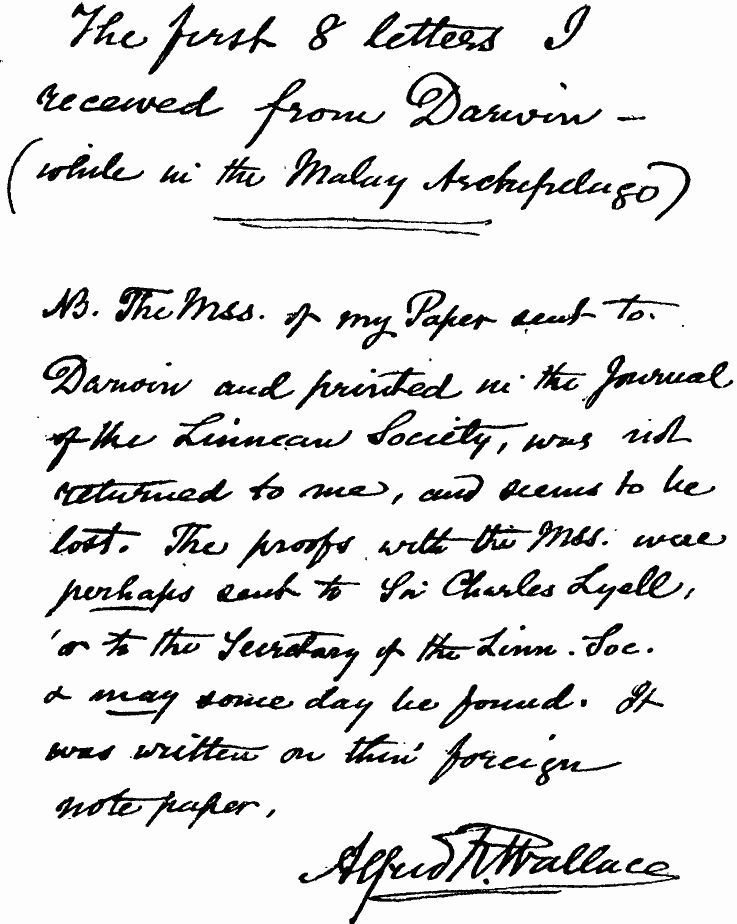
FACSIMILE OF INSCRIPTION BY WALLACE ON THE ENVELOPE IN WHICH HE KEPT THE FIRST EIGHT LETTERS HE RECEIVED FROM DARWIN.
Many of the notes of explanation to the Wallace letters have been gathered from his own writings, and are mainly in his own words, and in such cases the reader has the advantage of perusing letters annotated by their author, while most of the notes to the Darwin letters are by Sir F. Darwin.
LETTER I
C. DARWIN to A.R. WALLACE
Down, Bromley, Kent, May 1, 1857.
My dear Sir,—I am much obliged for your letter of Oct. 10th from Celebes, received a few days ago: in a laborious undertaking, sympathy is a valuable and real encouragement. By your letter, and even still more by your paper in the Annals,28 a year or more ago, I can plainly see that we have thought much alike and to a certain extent have come to similar conclusions. In regard to the paper in the Annals, I agree to the truth of almost every word of your paper; and I daresay that you will agree with me that it is very rare to find oneself agreeing pretty closely with any theoretical paper; for it is lamentable how each man draws his own different conclusions from the very same fact. This summer will make the twentieth year (!) since I opened my first note-book on the question how and in what way do species and varieties differ from each other. I am now preparing my work for publication, but I find the subject so very large, that though I have written [pg 130]many chapters, I do not suppose I shall go to press for two years.
I have never heard how long you intend staying in the Malay Archipelago; I wish I might profit by the publication of your Travels there before my work appears, for no doubt you will reap a large harvest of facts.
I have acted already in accordance with your advice of keeping domestic varieties, and those appearing in a state of nature, distinct; but I have sometimes doubted of the wisdom of this, and therefore I am glad to be backed by your opinion. I must confess, however, I rather doubt the truth of the now very prevalent doctrine of all our domestic animals having descended from several wild stocks; though I do not doubt that it is so in some cases. I think there is rather better evidence on the sterility of hybrid animals than you seem to admit: and in regard to plants, the collection of carefully recorded facts by Kölreuter and Gaertner (and Herbert) is enormous. I most entirely agree with you on the little effect of "climatic conditions" which one sees referred to ad nauseam in all books: I suppose some very little effect must be attributed to such influences, but I fully believe that they are very slight. It is really impossible to explain my views in the compass of a letter as to causes and means of variation in a state of nature; but I have slowly adopted a distinct and tangible idea—whether true or false others must judge; for the firmest conviction of the truth of a doctrine by its author seems, alas, not to be the slightest guarantee of truth.
I have been rather disappointed at my results in the poultry line; but if you should, after receiving this, stumble on any curious domestic breed, I should be very glad to have it; but I can plainly see that the result will not be at all worth the trouble which I have taken. The case is different with the domestic pigeons; from its study I have learned [pg 131]much. The Rajah has sent me some of his pigeons and fowls and cats' skins from the interior of Borneo and from Singapore. Can you tell me positively that black jaguars or leopards are believed generally or always to pair with black? I do not think colour of offspring good evidence. Is the case of parrots fed on fat of fish turning colour mentioned in your Travels? I remember a case of parrots with (I think) poison from some toad put into hollow whence primaries had been removed.
One of the subjects on which I have been experimenting, and which cost me much trouble, is the means of distribution of all organic beings found on oceanic islands; and any facts on this subject would be most gratefully received.
Land-molluscs are a great perplexity to me. This is a very dull letter, but I am a good deal out of health, and am writing this, not from my home, as dated, but from a water-cure establishment.
With most sincere good wishes for your success in every way, I remain, my dear Sir, yours sincerely,
CH. DARWIN.
LETTER II
C. DARWIN TO A.R. WALLACE
Down, Bromley, Kent. December 22, 1867.
My dear Sir,—I thank you for your letter of Sept. 27th. I am extremely glad to hear that you are attending to distribution in accordance with theoretical ideas. I am a firm believer that without speculation there is no good and original observation. Few travellers have attended to such points as you are now at work on; and indeed the whole subject of distribution of animals is dreadfully behind that of plants. You say that you have been somewhat [pg 132]surprised at no notice having been taken of your paper in the Annals. I cannot say that I am; for so very few naturalists care for anything beyond the mere description of species. But you must not suppose that your paper has not been attended to: two very good men, Sir C. Lyell, and Mr. E. Blyth at Calcutta, specially called my attention to it. Though agreeing with you on your conclusions in the paper, I believe I go much further than you; but it is too long a subject to enter on my speculative notions. I have not yet seen your paper on distribution of animals in the Aru Islands: I shall read it with the utmost interest; for I think that the most interesting quarter of the whole globe in respect to distribution; and I have long been very imperfectly trying to collect data from the Malay Archipelago. I shall be quite prepared to subscribe to your doctrine of subsidence: indeed from the quite independent evidence of the coral reefs I coloured my original map in my Coral volumes colours [sic] of the Aru Islands as one of subsidence, but got frightened and left it uncoloured. But I can see that you are inclined to go much further than I am in regard to the former connection of oceanic islands with continents. Ever since poor E. Forbes propounded this doctrine, it has been eagerly followed; and Hooker elaborately discusses the former connection of all the Antarctic islands and New Zealand and South America. About a year ago I discussed the subject much with Lyell and Hooker (for I shall have to treat of it) and wrote out my arguments in opposition; but you will be glad to hear that neither Lyell nor Hooker thought much of my arguments; nevertheless, for once in my life I dare withstand the almost preternatural sagacity of Lyell. You ask about land-shells on islands far distant from continents: Madeira has a few identical with those of Europe, and here the evidence is really good, as some of them are sub-fossil. In the Pacific [pg 133]islands there are cases of identity, which I cannot at present persuade myself to account for by introduction through man's agency; although Dr. Aug. Gould has conclusively shown that many land-shells have thus been distributed over the Pacific by man's agency. These cases of introduction are most plaguing. Have you not found it so in the Malay Archipelago? It has seemed to me, in the lists of mammals of Timor and other islands, that several in all probability have been naturalised.
Since writing before, I have experimented a little on some land-molluscs, and have found sea-water not quite so deadly as I anticipated. You ask whether I shall discuss Man: I think I shall avoid the whole subject, as so surrounded with prejudices, though I fully admit that it is the highest and most interesting problem for the naturalist. My work, on which I have now been at work more or less for twenty years, will not fix or settle anything; but I hope it will aid by giving a large collection of facts with one definite end. I get on very slowly, partly from ill-health, partly from being a very slow worker. I have got about half written; but I do not suppose I shall publish under a couple of years. I have now been three whole months on one chapter on hybridism!
I am astonished to see that you expect to remain out three or four years more: what a wonderful deal you will have seen; and what an interesting area, the grand Malay Archipelago and the richest parts of South America! I infinitely admire and honour your zeal and courage in the good cause of natural science; and you have my very sincere and cordial good wishes for success of all kinds; and may all your theories succeed, except that on oceanic islands, on which subject I will do battle to the death.—Pray believe me, my dear Sir, yours very sincerely,
C. DARWIN.
[pg 134]
LETTER III
C. DARWIN TO A.R. WALLACE
Down, Bromley, Kent. January 25, 1859.
My dear Sir,—I was extremely much pleased at receiving three days ago your letter to me and that to Dr. Hooker. Permit me to say how heartily I admire the spirit in which they are written. Though I had absolutely nothing whatever to do in leading Lyell and Hooker to what they thought a fair course of action, yet I naturally could not but feel anxious to hear what your impression would be. I owe indirectly much to you and them; for I almost think that Lyell would have proved right and I should never have completed my larger work, for I have found my abstract29 hard enough with my poor health; but now, thank God, I am in my last chapter but one. My abstract will make a small volume of 400 or 500 pages. Whenever published, I will of course send you a copy, and then you will see what I mean about the part which I believe selection has played with domestic productions. It is a very different part, as you suppose, from that played by "natural selection."
I sent off, by same address as this note, a copy of the Journal of the Linnean Society, and subsequently I have sent some half-dozen copies of the Paper. I have many other copies at your disposal; and I sent two to your friend Dr. Davies (?), author of works on men's skulls.
I am glad to hear that you have been attending to birds' nests; I have done so, though almost exclusively under one point of view, viz. to show that instincts vary, so that selection could work on and improve them. [pg 135]Few other instincts, so to speak, can be preserved in a museum.
Many thanks for your offer to look after horses' stripes; if there are any donkeys', pray add them.
I am delighted to hear that you have collected bees' combs; when next in London I will inquire of F. Smith and Mr. Saunders. This is an especial hobby of mine, and I think I can throw light on the subject. If you can collect duplicates at no very great expense, I should be glad of specimens for myself, with some bees of each kind. Young growing and irregular combs, and those which have not had pupæ, are most valuable for measurements and examination; their edges should be well protected against abrasion.
Everyone whom I have seen has thought your paper very well written and interesting. It puts my extracts (written in 1839, now just twenty years ago!), which I must say in apology were never for an instant intended for publication, in the shade.
You ask about Lyell's frame of mind. I think he is somewhat staggered, but does not give in, and speaks with horror often to me of what a thing it would be and what a job it would be for the next edition of the Principles if he were "perverted." But he is most candid and honest, and I think will end by being perverted. Dr. Hooker has become almost as heterodox as you or I—and I look at Hooker as by far the most capable judge in Europe.
Most cordially do I wish you health and entire success in all your pursuits; and God knows, if admirable zeal and energy deserve success, most amply do you deserve it. I look at my own career as nearly run out; if I can publish my abstract, and perhaps my greater work on the same subject, I shall look at my course as done.—Believe me, my dear Sir, yours very sincerely,
C. DARWIN.
[pg 136]
LETTER IV
C. DARWIN TO A.R. WALLACE
Down, Bromley, Kent. April 6, 1859.
My dear Mr. Wallace,—I this morning received your pleasant and friendly note of Nov. 30th. The first part of my MS.30 is in Murray's hands, to see if he likes to publish it. There is no Preface, but a short Introduction, which must be read by everyone who reads my book. The second paragraph in the Introduction31 I have had copied verbatim from my foul copy, and you will, I hope, think that I have fairly noticed your papers in the Linnean Transactions.32 You must remember that I am now publishing only an Abstract, and I give no references. I shall of course allude to your paper on Distribution;33 and I have added that I know from correspondence that your explanation of your law is the same as that which I offer. You are right, that I came to the conclusion that Selection was the principle of change from study of domesticated productions; and then reading Malthus I saw at once how to apply this principle. Geographical distribution and geographical relations of extinct to recent inhabitants of South America first led me to the subject. Especially the case of the Galapagos Islands.
I hope to go to press in early part of next month. It will be a small volume of about 500 pages or so. I will, of course, send you a copy.
I forget whether I told you that Hooker, who is our [pg 137]best British botanist, and perhaps the best in the world, is a full convert, and is now going immediately to publish his confession of faith; and I expect daily to see the proof-sheets. Huxley is changed and believes in mutation of species: whether a convert to us, I do not quite know. We shall live to see all the younger men converts. My neighbour and excellent naturalist, J. Lubbock, is an enthusiastic convert. I see by Natural History notices that you are doing great work in the Archipelago; and most heartily do I sympathise with you. For God's sake take care of your health. There have been few such noble labourers in the cause of natural science as you are. Farewell, with every good wish.—Yours sincerely,
C. DARWIN.
P.S.—You cannot tell how I admire your spirit, in the manner in which you have taken all that was done about publishing our papers. I had actually written a letter to you, stating that I would not publish anything before you had published. I had not sent that letter to the post when I received one from Lyell and Hooker, urging me to send some MS. to them, and allow them to act as they thought fair and honourably to both of us. I did so.
LETTER V
C. DARWIN TO A.R. WALLACE
Down, Bromley, Kent. August 9, 1859.
My dear Mr. Wallace,—I received your letter and memoir34 on the 7th, and will forward it to-morrow to the Linnean Society. But you will be aware that there is no meeting till beginning of November. Your paper seems to me admirable in matter, style and reasoning; and I thank you for [pg 138]allowing me to read it. Had I read it some months ago I should have profited by it for my forthcoming volume. But my two chapters on this subject are in type; and though not yet corrected, I am so wearied out and weak in health that I am fully resolved not to add one word, and merely improve style. So you will see that my views are nearly the same with yours, and you may rely on it that not one word shall be altered owing to my having read your ideas. Are you aware that Mr. W. Earl published several years ago the view of distribution of animals in the Malay Archipelago in relation to the depth of the sea between the islands? I was much struck with this, and have been in habit of noting all facts on distribution in the Archipelago and elsewhere in this relation. I have been led to conclude that there has been a good deal of naturalisation in the different Malay islands, and which I have thought to certain extent would account for anomalies. Timor has been my greatest puzzle. What do you say to the peculiar Felis there? I wish that you had visited Timor: it has been asserted that a fossil mastodon or elephant's tooth (I forget which) had been found there, which would be a grand fact. I was aware that Celebes was very peculiar; but the relation to Africa is quite new to me and marvellous, and almost passes belief. It is as anomalous as the relation of plants in South-West Australia to the Cape of Good Hope.
I differ wholly from you on colonisation of oceanic islands, but you will have everyone else on your side. I quite agree with respect to all islands not situated far in ocean. I quite agree on little occasional internavigation between lands when once pretty well stocked with inhabitants, but think this does not apply to rising and ill-stocked islands.
Are you aware that annually birds are blown to Madeira, to Azores (and to Bermuda from America). I wish I had given fuller abstract of my reasons for not believing in [pg 139]Forbes's great continental extensions; but it is too late, for I will alter nothing. I am worn out, and must have rest.
Owen, I do not doubt, will bitterly oppose us; but I regard that very little, as he is a poor reasoner and deeply considers the good opinion of the world, especially the aristocratic world.
Hooker is publishing a grand Introduction to the Flora of Australia, and goes the whole length. I have seen proofs of about half.—With every good wish, believe me yours very sincerely,
C. DARWIN.
Excuse this brief note, but I am far from well.
LETTER VI
C. DARWIN TO A.R. WALLACE
Ilkley. November 13, 1859.
My dear Sir,—I have told Murray to send you by post (if possible) a copy of my book, and I hope that you will receive it at nearly the same time with this note. (N.B.—I have got a bad finger, which makes me write extra badly.) If you are so inclined, I should very much like to hear your general impression of the book, as you have thought so profoundly on the subject and in so nearly the same channel with myself. I hope there will be some little new to you, but I fear not much. Remember, it is only an abstract, and very much condensed. God knows what the public will think. No one has read it, except Lyell, with whom I have had much correspondence. Hooker thinks him a complete convert, but he does not seem so in his letters to me. But he is evidently deeply interested in the subject. I do not think your share in the theory will be overlooked by the real judges, as Hooker, Lyell, Asa Gray, etc.
I have heard from Mr. Sclater that your paper on the [pg 140]Malay Archipelago has been read at the Linnean Society, and that he was extremely much interested by it.
I have not seen one naturalist for six or nine months owing to the state of my health, and therefore I really have no news to tell you. I am writing this at Ilkley Wells, where I have been with my family for the last six weeks, and shall stay for some few weeks longer. As yet I have profited very little. God knows when I shall have strength for my bigger book.
I sincerely hope that you keep your health: I suppose that you will be thinking of returning soon with your magnificent collection and still grander mental materials. You will be puzzled how to publish. The Royal Society Fund will be worth your consideration.—With every good wish, pray believe me yours very sincerely,
CHARLES DARWIN.
I think that I told you before that Hooker is a complete convert. If I can convert Huxley I shall be content.
LETTER VII
C. DARWIN TO A.R. WALLACE
Down, Bromley, Kent, S.E. March 7, 1860.
My dear Wallace,—The addresses which you have sent me are capital, especially that to the Rajah; and I have dispatched two sets of queries. I now enclose a copy to you, and should be very glad of any answers; you must not suppose the P.S. about memory has lately been inserted; please return these queries, as it is my standard copy. The subject is a curious one; I fancy I shall make a rather interesting appendix to my Essay on Man.
I fully admit the probability of "protective adaptation" having come into play with female butterflies as well as with female birds. I have a good many facts which [pg 141]make me believe in sexual selection as applied to man, but whether I shall convince anyone else is very doubtful.—Dear Wallace, yours very sincerely,
CH. DARWIN.
LETTER VIII
C. DARWIN TO A.R. WALLACE
Down, Bromley, Kent. May 18, 1860.
My dear Mr. Wallace,—I received this morning your letter from Amboyna dated Feb. 16th, containing some remarks and your too high approbation of my book. Your letter has pleased me very much, and I most completely agree with you on the parts which are strongest and which are weakest. The imperfection of the geological record is, as you say, the weakest of all; but yet I am pleased to find that there are almost more geological converts than of pursuers of other branches of natural science. I may mention Lyell, Ramsay, Jukes, Rogers, Keyerling, all good men and true. Pictet of Geneva is not a convert, but is evidently staggered (as I think is Bronn of Heidelberg), and he has written a perfectly fair review in the Bib. Universelle of Geneva. Old Bronn has translated my book, well done also into German, and his well-known name will give it circulation. I think geologists are more converted than simple naturalists because more accustomed to reasoning.
Before telling you about the progress of opinion on the subject, you must let me say how I admire the generous manner in which you speak of my book: most persons would in your position have felt bitter envy and jealousy. How nobly free you seem to be of this common failing of mankind. But you speak far too modestly of yourself; you would, if you had had my leisure, have done the work just as well, perhaps better, than I have done it. Talking of envy, you never read anything more envious and spiteful [pg 142](with numerous misrepresentations) than Owen is in the Edinburgh Review. I must give one instance; he throws doubts and sneers at my saying that the ovigerous frena of cirripedes have been converted into branchiæ, because I have not found them to be branchiæ; whereas he himself admits, before I wrote on cirripedes, without the least hesitation, that their organs are branchiæ. The attacks have been heavy and incessant of late. Sedgwick and Prof. Clarke attacked me savagely at the Cambridge Philosophical Society, but Henslow defended me well, though not a convert. Phillips has since attacked me in a lecture at Cambridge; Sir W. Jardine in the Edinburgh New Philosophical Journal, Wollaston in the Annals of Nat. History, A. Murray before the Royal Soc. of Edinburgh, Haughton at the Geological Society of Dublin, Dawson in the Canadian Nat. Magazine, and many others. But I am getting case-hardened, and all these attacks will make me only more determinedly fight. Agassiz sends me personal civil messages, but incessantly attacks me; but Asa Gray fights like a hero in defence. Lyell keeps as firm as a tower, and this autumn will publish on the Geological History of Man, and will then declare his conversion, which now is universally known. I hope that you have received Hooker's splendid essay. So far is bigotry carried that I can name three botanists who will not even read Hooker's essay!! Here is a curious thing: a Mr. Pat. Matthews, a Scotchman, published in 1830 a work on Naval Timber and Arboriculture, and in the appendix to this he gives most clearly but very briefly in half-dozen paragraphs our view of Natural Selection. It is a most complete case of anticipation. He published extracts in the Gardeners' Chronicle. I got the book, and have since published a letter acknowledging that I am fairly forestalled. Yesterday I heard from Lyell that a German, Dr. Schaffhausen, has sent him a [pg 143]pamphlet published some years ago, in which the same view is nearly anticipated, but I have not yet seen this pamphlet. My brother, who is a very sagacious man, always said, "You will find that someone will have been before you." I am at work at my larger work, which I shall publish in separate volumes. But for ill-health and swarms of letters I get on very, very slowly. I hope that I shall not have wearied you with these details.
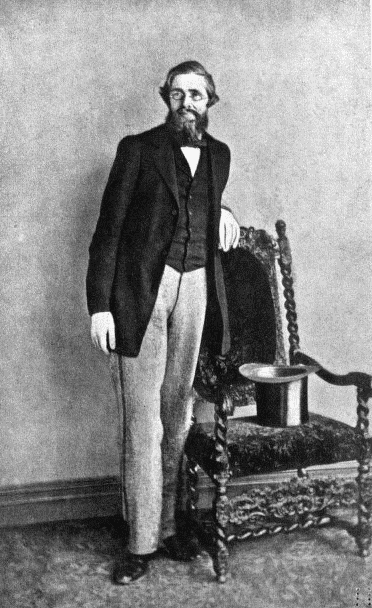
A.R. WALLACE SOON AFTER HIS RETURN FROM THE EAST
With sincere thanks for your letter, and with most deeply-felt wishes for your success in science and in every way, believe me your sincere well-wisher,
C. DARWIN.
Of the letters from Wallace to Darwin which have been preserved, the earliest is the following:
5 Westbourne Grove Terrace, W. April 7, 1862.
My dear Mr. Darwin,—I was much pleased to receive your note this morning. I have not yet begun work, but hope to be soon busy. As I am being doctored a little I do not think I shall be able to accept your kind invitation at present, but trust to be able to do so during the summer.
I beg you to accept a wild honeycomb from the island of Timor, not quite perfect but the best I could get. It is of a small size, but of characteristic form, and I think will be interesting to you. I was quite unable to get the honey out of it, so fear you will find it somewhat in a mess; but no doubt you will know how to clean it. I have told Stevens to send it to you.
Hoping your health is now quite restored and with best wishes, I remain, my dear Mr. Darwin, yours very sincerely,
ALFRED R. WALLACE.
5 Westbourne Grove Terrace, W. May 23, 1862.
My dear Mr. Darwin,—Many thanks for your most interesting book on the Orchids. I have read it through most [pg 144]attentively, and have really been quite as much staggered by the wonderful adaptations you show to exist in them as by the Eye in animals or any other complicated organs. I long to get into the country and have a look at some orchids guided by your new lights, but I have been now for ten days confined to my room with what is disagreeable though far from dangerous—boils.
I have been reading several of the Reviews on the "Origin," and it seems to me that you have assisted those who want to criticise you by your overstating the difficulties and objections. Several of them quote your own words as the strongest arguments against you.
I think you told me Owen wrote the article in the Quarterly. This seems to me hardly credible, as he speaks so much of Owen, quotes him as such a great authority, and I believe even calls him a profound philosopher, etc. etc. Would Owen thus speak of himself?
Trusting your health is good, I remain, my dear Mr. Darwin, yours very faithfully,
ALFRED R. WALLACE.
Down, Bromley, Kent, S.E. May 24, 1862.
My dear Mr. Wallace,—I write one line to thank you for your note and to say that the Bishop of Oxford35 wrote the Quarterly Review (paid £60), aided by Owen. In the Edinburgh Owen no doubt praised himself. Mr. Maw's Review in the Zoologist is one of the best, and staggered me in parts, for I did not see the sophistry of parts. I could lend you any which you might wish to see; but you would soon be tired. Hopkins and Pictet in France are two of the best.
I am glad you approve of my little Orchid book; but it has not been worth, I fear, the ten months it has cost me: it was a hobby-horse, and so beguiled me.
I am sorry to hear that you are suffering from boils; I [pg 145]have often had fearful crops: I hope that the doctors are right in saying that they are serviceable.
How puzzled you must be to know what to begin at. You will do grand work, I do not doubt.
My health is, and always will be, very poor: I am that miserable animal a regular valetudinarian.—Yours very sincerely,
C. DARWIN.
5 Westbourne Grove Terrace, W. August 8, 1862.
My dear Mr. Darwin,—I sincerely trust that your little boy is by this time convalescent, and that you are therefore enabled to follow your favourite investigations with a more tranquil mind.
I heard a remark the other day which may not perhaps be new to you, but seemed to me a fact, if true, in your favour. Mr. Ward (I think it was), a member of the Microscopical Society, mentioned as a fact noticed by himself with much surprise that "the muscular fibres of the whale were no larger than those of the bee!"—an excellent indication of community of origin.
While looking at the ostriches the other day at the Gardens, it occurred to me that they were a case of special difficulty, as, inhabiting an ancient continent, surrounded by numerous enemies, how did their wings ever become abortive, and if they did so before the birds had attained their present gigantic size, strength and speed, how could they in the transition have maintained their existence? I see Westwood in the Annals brings forward the same case, arguing that the ostriches should have acquired better wings within the historic period; but as they are now the swiftest of animals they evidently do not want their wings, which in their present state may serve some other trifling purpose in their economy such as fans, or balancers, which may have prevented their being reduced to such rudiments as in the [pg 146]cassowaries. The difficulty to me seems to be, how, if they once had flight, could they have lost it, surrounded by swift and powerful carnivora against whom it must have been the only defence?
This probably is all clear to you, but I think it is a point you might touch upon, as I think the objection will seem a strong one to most people.
In a day or two I go to Devonshire for a few weeks and hope to lay in a stock of health to enable me to stick to work at my collections during the winter. I begin to find that large collections involve a heavy amount of manual labour which is not very agreeable.
Present my compliments to Mrs. and Miss Darwin, and believe me yours very faithfully,
ALFRED R. WALLACE.
1 Carlton Terrace, Southampton. August 20, 1862.
My dear Mr. Wallace,—You will not be surprised that I have been slow in answering when I tell you that my poor boy36 became frightfully worse after you were at Down; and that during our journey to Bournemouth he had a slight relapse here and my wife took the scarlet fever rather severely. She is over the crisis. I have had a horrid time of it, and God only knows when we shall be all safe at home again—half my family are at Bournemouth.
I have given a piece of the comb from Timor to a Mr. Woodbury (who is working at the subject), and he is extremely interested by it (I was sure the specimen would be valuable) and has requested me to ascertain whether the bee (A. testacea) is domesticated when it makes its combs. Will you kindly inform me?
Your remarks on ostriches have interested me, and I have alluded to the case in the Third Edition. The difficulty does not seem to me so great as to you. Think of bustards, which [pg 147]inhabit wide open plains, and which so seldom take flight: a very little increase in size of body would make them incapable of flight. The idea of ostriches acquiring flight is worthy of Westwood; think of the food required in these inhabitants of the desert to work the pectoral muscles! In the rhea the wings seem of considerable service in the first start and in turning.37 ...
5 Westbourne Grove Terrace, W. September 30, 1862.
My dear Mr. Darwin,—Many thanks for the third edition of the "Origin," which I found here on my return from Devonshire on Saturday. I have not had time yet to read more than the Historical Sketch, which is very interesting, and shows that the time had quite come for your book.
I am now reading Herbert Spencer's "First Principles," which seems to me a truly great work, which goes to the root of everything.
I hope you will be well enough to come to Cambridge.
I remain, my dear Mr. Darwin, yours very faithfully,
ALFRED R. WALLACE.
5 Westbourne Grove Terrace, W. January 14 [1863?].
My dear Mr. Darwin,—I am very sorry indeed to hear you are still in weak health. Have you ever tried mountain air? A residence at 2,000 or 3,000 ft. elevation is very invigorating.
I trust your family are now all in good health, and that you may be spared any anxiety on that score for some time. If you come to town I shall hope to have the pleasure of seeing you.
I am now in much better health, but find sudden changes of weather affect me very much, bringing on ague and fever fits. I am now working a little, but having fresh collections [pg 148]still arriving from correspondents in the East, it is principally the drudgery of cleaning, packing, and arrangement.
On the opposite page I give all the information I can about the Timor fossils, so that you can send it entire to Dr. Falconer.
With best wishes for the speedy recovery of your health, I remain, my dear Mr. Darwin, yours very faithfully,
ALFRED R. WALLACE.
Down, Bromley, Kent, S.E. January 1, 1864.
Dear Wallace,—I am still unable to write otherwise than by dictation. In a letter received two or three weeks ago from Asa Gray he writes: "I read lately with gusto Wallace's exposé of the Dublin man on Bee cells, etc."38
Now though I cannot read at present, I much want to know where this is published, that I may procure a copy. Further on Asa Gray says (after speaking of Agassiz's paper on Glaciers in the Atlantic Magazine and his recent book entitled "Method of Study"): "Pray set Wallace upon these articles." So Asa Gray seems to think much of your powers of reviewing, and I mention this as it assuredly is laudari a laudato.
I hope you are hard at work, and if you are inclined to tell me I should much like to know what you are doing.
It will be many months, I fear, before I shall do anything.
Pray believe me yours very sincerely,
CH. DARWIN.
5 Westbourne Grove Terrace, W. January 2, 1864.
My dear Darwin,—Many thanks for your kind letter. I was afraid to write because I heard such sad accounts of your health, but I am glad to find that you can write, and [pg 149]I presume read, by deputy. My little article on Haughton's paper was published in the Annals of Natural History about August or September last, I think, but I have not a copy to refer to. I am sure it does not deserve Asa Gray's praises, for though the matter may be true enough, the manner I know is very inferior. It was written hastily, and when I read it in the Annals I was rather ashamed of it, as I knew so many could have done it so much better.
I will try and see Agassiz's paper and book. What I have hitherto seen of his on Glacial subjects seems very good, but in all his Natural History theories, he seems so utterly wrong and so totally blind to the plainest deduction from facts, and at the same time so vague and obscure in his language, that it would be a very long and wearisome task to answer him.
With regard to work, I am doing but little—I am afraid I have no good habit of systematic work. I have been gradually getting parts of my collections in order, but the obscurities of synonymy and descriptions, the difficulty of examining specimens, and my very limited library, make it wearisome work.
I have been lately getting the first groups of my butterflies in order, and they offer some most interesting facts in variation and distribution—in variation some very puzzling ones. Though I have very fine series of specimens, I find in many cases I want more; in fact if I could have afforded to have all my collections kept till my return I should, I think, have found it necessary to retain twice as many as I now have.
I am at last making a beginning of a small book on my Eastern journey, which, if I can persevere, I hope to have ready by next Christmas. I am a very bad hand at writing anything like narrative. I want something to argue on, and then I find it much easier to go ahead. I rather despair, therefore, of making so good a book as Bates's, though I [pg 150]think my subject is better. Like every other traveller, I suppose, I feel dreadfully the want of copious notes on common everyday objects, sights and sounds and incidents, which I imagined I could never forget but which I now find it impossible to recall with any accuracy.
I have just had a long and most interesting letter from my old companion Spruce. He says he has had a letter from you about Melastoma, but has not, he says, for three years seen a single melastomaceous plant! They are totally absent from the Pacific plains of tropical America, though so abundant on the Eastern plains. Poor fellow, he seems to be in a worse state than you are. Life has been a burden to him for three years owing to lung and heart disease, and rheumatism, brought on by exposure in high, hot, and cold damp valleys of the Andes. He went down to the dry climate of the Pacific coast to die more at ease, but the change improved him, and he thinks to come home, though he is sure he will not survive the first winter in England. He had never been able to get a copy of your book, though I am sure no one would have enjoyed or appreciated it more.
If you are able to bear reading, will you allow me to take the liberty of recommending you a book? The fact is I have been so astonished and delighted with the perusal of Spencer's works that I think it a duty to society to recommend them to all my friends who I think can appreciate them. The one I particularly refer to now is "Social Statics," a book which is by no means hard to read; it is even amusing, and owing to the wonderful clearness of its style may be read and understood by anyone. I think, therefore, as it is quite distinct from your special studies at present, you might consider it as "light literature," and I am pretty sure it would interest you more than a great deal of what is now considered very good. I am utterly astonished that so few people seem to read Spencer, and the utter ignorance [pg 151]there seems to be among politicians and political economists of the grand views and logical stability of his works. He appears to me as far ahead of John Stuart Mill as J.S.M. is of the rest of the world, and, I may add, as Darwin is of Agassiz. The range of his knowledge is no less than its accuracy. His nebular hypothesis in the last volume of his essays is the most masterly astronomical paper I have ever read, and in his forthcoming volume on Biology he is I understand going to show that there is something else besides Natural Selection at work in nature. So you must look out for a "foeman worthy of your steel"! But perhaps all this time you have read his books. If so, excuse me, and pray give me your opinion of him, as I have hitherto only met with one man (Huxley) who has read and appreciated him.
Allow me to say in conclusion how much I regret that unavoidable circumstances have caused me to see so little of you since my return home, and how earnestly I pray for the speedy restoration of your health.—Yours most sincerely,
ALFRED R. WALLACE.
Malvern Wells. Tuesday, March, 1864.
My dear Mr. Wallace,—Your kindness is neverfailing. I got worse and worse at home and was sick every day for two months; so came here, when I suddenly broke down and could do nothing; but I hope I am now very slowly recovering, but am very weak.
Sincere thanks about Melastoma: these flowers have baffled me, and I have caused several friends much useless labour; though, Heaven knows, I have thrown away time enough on them myself.
The gorse case is very valuable, and I will quote it, as I presume I may.
I was very glad to see in the Reader that you have been [pg 152]giving a grand paper (as I infer from remarks in discussion) on Geographical Distribution.
I am very weak, so will say no more.—Yours very sincerely,
C. DARWIN.
In Vol. I., p. 93, of the "Life and Letters of Charles Darwin," Darwin states the circumstances which led to his writing the "Descent of Man." He says that his collection of facts, begun in 1837 or 1838, was continued for many years without any definite idea of publishing on the subject. The letter to Wallace of May 28, 1864, in reply to the latter's of May 10, shows that in the period of ill-health and depression about 1864 he despaired of ever being able to do so.
5 Westbourne Grove Terrace, W. May 10, 1864.
My dear Darwin,—I was very much gratified to hear by your letter of a month back that you were a little better, and I have since heard occasionally through Huxley and Lubbock that you are not worse. I sincerely hope the summer weather and repose may do you real good.
The Borneo Cave exploration is to go on at present without a subscription. The new British consul who is going out to Sarawak this month will undertake to explore some of the caves nearest the town, and if anything of interest is obtained a good large sum can no doubt be raised for a thorough exploration of the whole country. Sir J. Brooke will give every assistance, and will supply men for the preliminary work.
I send you now my little contribution to the theory of the origin of man. I hope you will be able to agree with me. If you are able, I shall be glad to have your criticisms.
I was led to the subject by the necessity of explaining the vast mental and cranial differences between man and the apes combined with such small structural differences in other parts of the body, and also by an endeavour to account for the diversity of human races combined with [pg 153]man's almost perfect stability of form during all historical epochs.
It has given me a settled opinion on these subjects, if nobody can show a fallacy in the argument.
The Anthropologicals did not seem to appreciate it much, but we had a long discussion which appears almost verbatim in the Anthropological Review.39
As the Linnean Transactions will not be out till the end of the year I sent a pretty full abstract of the more interesting parts of my Papilionidæ paper40 to the Reader, which, as you say, is a splendid paper.
Trusting Mrs. Darwin and all your family are well, and that you are improving, believe me yours most sincerely,
ALFRED R. WALLACE.
Down, Bromley, Kent. May 28, 1864.
Dear Wallace,—I am so much better that I have just finished a paper for the Linnean Society; but as I am not yet at all strong I felt much disinclination to write, and therefore you must forgive me for not having sooner thanked you for your paper on Man received on the 11th. But first let me say that I have hardly ever in my life been more struck by any paper than that on variation, etc. etc., in the Reader. I feel sure that such papers will do more for the spreading of our views on the modification of species than any separate treatises on the single subject itself. It is really admirable; but you ought not in the Man paper to speak of the theory as mine; it is just as much yours as mine. One correspondent has already noticed to me your "high-minded" conduct on this head. [pg 154] But now for your Man paper, about which I should like to write more than I can. The great leading idea is quite new to me, viz. that during late ages the mind will have been modified more than the body; yet I had got as far as to see with you that the struggle between the races of man depended entirely on intellectual and moral qualities. The latter part of the paper I can designate only as grand and most eloquently done. I have shown your paper to two or three persons who have been here, and they have been equally struck with it.
I am not sure that I go with you on all minor points. When reading Sir G. Grey's account of the constant battles of Australian savages, I remember thinking that Natural Selection would come in, and likewise with the Esquimaux, with whom the art of fishing and managing canoes is said to be hereditary. I rather differ on the rank under the classificatory point of view which you assign to Man: I do not think any character simply in excess ought ever to be used for the higher division. Ants would not be separated from other hymenopterous insects, however high the instinct of the one and however low the instincts of the other.
With respect to the differences of race, a conjecture has occurred to me that much may be due to the correlation of complexion (and consequently hair) with constitution. Assume that a dusky individual best escaped miasma and you will readily see what I mean. I persuaded the Director-General of the Medical Department of the Army to send printed forms to the surgeons of all regiments in tropical countries to ascertain this point, but I daresay I shall never get any returns. Secondly, I suspect that a sort of sexual selection has been the most powerful means of changing the races of man. I can show that the different races have a widely different standard of beauty. Among savages the [pg 155]most powerful men will have the pick of the women, and they will generally leave the most descendants.
I have collected a few notes on Man, but I do not suppose I shall ever use them. Do you intend to follow out your views, and if so would you like at some future time to have my few references and notes?
I am sure I hardly know whether they are of any value, and they are at present in a state of chaos.
There is much more that I should like to write but I have not strength.—Believe me, dear Wallace, yours very sincerely,
CH. DARWIN.
Our aristocracy is handsomer? (more hideous according to a Chinese or negro) than the middle classes, from pick of women; but oh what a scheme is primogeniture for destroying Natural Selection! I fear my letter will be barely intelligible to you.
5 Westbourne Grove Terrace, W. May 29 [1864].
My dear Darwin,—You are always so ready to appreciate what others do, and especially to overestimate my desultory efforts, that I cannot be surprised at your very kind and flattering remarks on my papers. I am glad, however, that you have made a few critical observations, and am only sorry you were not well enough to make more, as that enables me to say a few words in explanation.
My great fault is haste. An idea strikes me, I think over it for a few days, and then write away with such illustrations as occur to me while going on. I therefore look at the subject almost solely from one point of view. Thus in my paper on Man41 I aim solely at showing that brutes are modified in a great variety of ways by Natural Selection, but that in none of these particular ways can man be modified, because of the superiority of his intellect. I therefore no doubt [pg 156]overlook a few smaller points in which Natural Selection may still act on men and brutes alike. Colour is one of them, and I have alluded to this in correlation to constitution in an abstract I have made at Sclater's request for the Natural History Review.42 At the same time, there is so much evidence of migrations and displacements of races of man, and so many cases of peoples of distinct physical characters inhabiting the same or similar regions, and also of races of uniform physical characters inhabiting widely dissimilar regions, that the external characteristics of the chief races of man must I think be older than his present geographical distribution, and the modifications produced by correlation to favourable variations of constitution be only a secondary cause of external modification.
I hope you may get the returns from the Army. They would be very interesting, but I do not expect the results would be favourable to your view.
With regard to the constant battles of savages leading to selection of physical superiority, I think it would be very imperfect, and subject to so many exceptions and irregularities that it could produce no definite result. For instance, the strongest and bravest men would lead, and expose themselves most, and would therefore be most subject to wounds and death. And the physical energy which led to any one tribe delighting in war might lead to its extermination by inducing quarrels with all surrounding tribes and leading them to combine against it. Again, superior cunning, stealth and swiftness of foot, or even better weapons, would often lead to victory as well as mere physical strength. Moreover this kind of more or less perpetual war goes on among all savage peoples. It could lead therefore to no differential characters, but merely to the keeping up of a certain average standard of bodily and [pg 157]mental health and vigour. So with selection of variations adapted to special habits of life, as fishing, paddling, riding, climbing, etc. etc., in different races: no doubt it must act to some extent, but will it be ever so rigid as to induce a definite physical modification, and can we imagine it to have had any part in producing the distinct races that now exist?
The sexual selection you allude to will also, I think, have been equally uncertain in its results. In the very lowest tribes there is rarely much polygamy, and women are more or less a matter of purchase. There is also little difference of social condition, and I think it rarely happens that any healthy and undeformed man remains without wife and children. I very much doubt the often-repeated assertion that our aristocracy are more beautiful than the middle classes. I allow that they present specimens of the highest kind of beauty, but I doubt the average. I have noticed in country places a greater average amount of good looks among the middle classes, and besides, we unavoidably combine in our idea of beauty, intellectual expression and refinement of manner, which often make the less appear the more beautiful. Mere physical beauty—that is, a healthy and regular development of the body and features approaching to the mean or type of European man—I believe is quite as frequent in one class of society as the other, and much more frequent in rural districts than in cities.
With regard to the rank of man in zoological classification, I fear I have not made myself intelligible. I never meant to adopt Owen's or any other such views, but only to point out that from one point of view he was right. I hold that a distinct family for man, as Huxley allows, is all that can possibly be given him zoologically. But at the same time, if my theory is true—that while the animals which surrounded him have been undergoing modification [pg 158]in all parts of their bodies to a generic or even family degree of difference, he has been changing almost wholly in the brain and head—then, in geological antiquity the species of man may be as old as many mammalian families, and the origin of the family man may date back to a period when some of the orders first originated.
As to the theory of Natural Selection itself, I shall always maintain it to be actually yours and yours only. You had worked it out in details I had never thought of, years before I had a ray of light on the subject, and my paper would never have convinced anybody or been noticed as more than an ingenious speculation, whereas your book has revolutionised the study of natural history, and carried away captive the best men of the present age. All the merit I claim is the having been the means of inducing you to write and publish at once.
I may possibly some day go a little more into this subject (of Man), and, if I do, will accept the kind offer of your notes. I am now, however, beginning to write the "Narrative of my Travels" which will occupy me a long time, as I hate writing narrative, and after Bates's brilliant success rather fear to fail. I shall introduce a few chapters on geographical distribution and other such topics.
Sir C. Lyell, while agreeing with my main argument on Man, thinks I am wrong in wanting to put him back into Miocene times, and thinks I do not appreciate the immense interval even to the later Pliocene. But I still maintain my view, which in fact is a logical result of my theory, for if man originated in later Pliocene times, when almost all mammalia were of closely allied species to those now living, and many even identical, then man has not been stationary in bodily structure while animals have been varying, and my theory will be proved to be all wrong. [pg 159] In Murchison's address to the Geographical Society just delivered he points out Africa, as being the oldest existing land. He says there is no evidence of its having been ever submerged during the tertiary epoch. Here, then, is evidently the place to find early man. I hope something good may be found in Borneo, and that then means may be found to explore the still more promising regions of tropical Africa, for we can expect nothing of man very early in Europe.
It has given me great pleasure to find that there are symptoms of improvement in your health. I hope you will not exert yourself too soon or write more than is quite agreeable to you. I think I made out every word of your letter though it was not always easy.—Believe me, my dear Darwin, yours very sincerely,
ALFRED R. WALLACE.
Down, Bromley, Kent, S.E. June 15, 1864.
Dear Wallace,—You must not suppose from my delay that I have not been much interested by your long letter. I write now merely to thank you, and just to say that probably you are right on all the points you touch on except, as I think, about sexual selection, which I will not give up.
My belief in it, however, is contingent on my general beliefs in sexual selection. It is an awful stretcher to believe that a peacock's tail was thus formed; but believing it, I believe in the same principle somewhat modified applied to man.
I doubt whether my notes would be of any use to you, and as far as I remember they are chiefly on sexual selection.
I am very glad to hear that you are on your Travels. I believe you will find it a very convenient vehicle for miscellaneous discussion. With your admirable powers of [pg 160]writing, I cannot doubt that you will make an excellent book.—Believe me, dear Wallace, yours sincerely,
CH. DARWIN.
P.S.—A great gun, Flourens, has written a little dull book against me; which pleases me much, for it is plain that our good work is spreading in France. He speaks of the engouement about this book, "so full of empty and presumptuous thoughts."
Down, Bromley, Kent, S.E. January 29, 1865.
My dear Wallace,—I must ease my mind by saying how much I admire the two papers you have sent me.
That on parrots43 contained most new matter to me, and interested me extremely; that in the Geographical Journal44 strikes me as an epitome of the whole theory of geographical distribution: the comparison of Borneo and New Guinea, the relation of the volcanic outbursts and the required subsidence, and the comparison of the supposed conversion of the Atlantic into a great archipelago, seemed to me the three best hits. They are both indeed excellent papers.—Believe me yours very sincerely,
CHARLES DARWIN.
Do try what hard work will do to banish painful thoughts.45
P.S.—During one of the later French voyages, a wild pig was killed and brought from the Aru Islands to Paris. Am I not right in inferring that this must have been introduced and run wild? If you have a clear opinion on this head, may I quote you?
[pg 161]
5 Westbourne Grove Terrace, W. January 31, [1865?].
Dear Darwin,—Many thanks for your kind letter. I send you now a few more papers. One on Man is not much in your line. The other three are bird lists, but in the introductory remarks are a few facts of distribution that may be of use to you, and as you have them already in the Zoological Proceedings, you can cut these up if you want "extracts."
I hope you do not very much want the Aru pig to be a domestic animal run wild, because I have no doubt myself it was the species peculiar to the New Guinea fauna (Sus papuensis, Less.), a very distinct form. I have no doubt it is this species, though I did not get it myself there, because I was told that on a small island near, called there Pulo babi (Pig Island), was a race of pigs (different from and larger than those of the large islands) which had originated from the wreck of a large ship near a century ago. The productions of the Aru Islands closely resemble those of New Guinea, more than half the species of birds being identical, as well as about half of the few known mammals.
I am beginning to work at some semi-mechanical work, drawing up catalogues of parts of my collection for publication.
I enclose my "carte." Have you a photograph of yourself of any kind you can send me? When you come to town next, may I beg the honour of a sitting for my brother-in-law, Mr. Sims, 73 Westbourne Grove?—Yours very sincerely,
ALFRED R. WALLACE.
P.S.—Your paper on Lythrum salicaria46 is most beautiful. What a wonderful plant it is! I long to hear your paper on Tendrils and hear what you have got out of them. My old friend Spruce, a good botanist and close observer, [pg 162]could probably supply you with some facts on that or other botanical subjects if you would write to him. He is now at Kew, but almost as ill as yourself.—A.R.W.
Down, Bromley, Kent, S.E. February 1, 1865.
My dear Wallace,—I am much obliged for your photograph, for I have lately set up a scientific album; and for the papers, which I will read before long. I enclose my own photo, taken by my son, and I have no other.
I fear it will be a long time before I shall be able to sit to a photographer, otherwise I should be happy to sit to Mr. Sims.
Thanks for information about the Aru pig, which will make me very cautious.
It is a perplexing case, for Nathusius says the skull of the Aru resembles that of the Chinese breed, and he thinks that Sus papuensis has been founded on a young skull; D. Blainville stating that an old skull from New Guinea resembles that of the wild pigs of Malabar, and these belong to the S. scrofa type, which is different from the Chinese domestic breed. The latter has not been found in a wild condition.—Believe me, dear Wallace, yours very sincerely,
CH. DARWIN.
9 St. Mark's Crescent, Regent's Park, N.W. Sept. 18, 1865.
Dear Darwin,—I should have written before to thank you for the copy of your paper on climbing plants, which I read with great interest; I can imagine how much pleasure the working out must have given you. I was afraid you were too ill to make it advisable that you should be bothered with letters.
I write now, in hopes you are better, to communicate a curious case of variation becoming at once hereditary, which was brought forward at the British Association. I send a [pg 163]note of it on the other side, but if you would like more exact particulars, with names and dates and a drawing of the bird, I am sure Mr. O'Callaghan would send them to you.
I hope to hear that you are better, and that your new book is really to come out next winter.—Believe me yours very faithfully,
ALFRED R. WALLACE.
NOTE.—Last spring Mr. O'Callaghan was told by a country boy that he had seen a blackbird with a topknot; on which Mr. O'C. very judiciously told him to watch it and communicate further with him. After a time the boy told him he had found a blackbird's nest, and had seen this crested bird near it and believed he belonged to it. He continued watching the nest till the young were hatched. After a time he told Mr. O'C. that two of the young birds seemed as if they would have topknots. He was told to get one of them as soon as it was fledged. However, he was too late, and they left the nest, but luckily he found them near and knocked one down with a stone, which Mr. O'C. had stuffed and exhibited. It has a fine crest, something like that of a Polish fowl, but larger in proportion to the bird, and very regular and well formed. The male must have been almost like the Umbrella bird in miniature, the crest is so large and expanded.—A.R.W.
Down, Bromley, Kent, S.E. September 22, 1865.
Dear Wallace,—I am much obliged for your extract; I never heard of such a case, though such a variation is perhaps the most likely of any to occur in a state of nature and be inherited, inasmuch as all domesticated birds present races with a tuft or with reversed feathers on their heads. I have sometimes thought that the progenitor of the whole class must have been a crested animal.
Do you make any progress with your Journal of travels? I am the more anxious that you should do so as I have lately read with much interest some papers by you on the ouran-outang, [pg 164]etc., in the Annals, of which I have lately been reading the latter volumes, I have always thought that Journals of this nature do considerable good by advancing the taste for natural history; I know in my own case that nothing ever stimulated my zeal so much as reading Humboldt's Personal Narrative. I have not yet received the last part of Linnean Transactions, but your paper47 at present will be rather beyond my strength, for though somewhat better I can as yet do hardly anything but lie on the sofa and be read aloud to. By the way, have you read Tylor and Lecky?48 Both these books have interested me much. I suppose you have read Lubbock?49 In the last chapter there is a note about you in which I most cordially concur.50 I see you were at the British Association, but I have heard nothing of it except what I have picked up in the Reader. I have heard a rumour that the Reader is sold to the Anthropological Society. If you do not begrudge the trouble of another note (for my sole channel of news through Hooker is closed by his illness), I should much like to hear whether the Reader is thus sold. I should be very sorry for it, as the paper would thus become sectional in its tendency. If you write, tell me what you are doing yourself.
The only news which I have about the "Origin" is that Fritz Müller published a few months ago a remarkable book51 in its favour, and secondly that a second French edition is just coming out.—Believe me, dear Wallace, yours very sincerely,
CH. DARWIN.
[pg 165]
9 St. Mark's Crescent, Regents Park. October 2, 1865.
Dear Darwin,—I was just leaving town for a few days when I received your letter, or should have replied at once.
The Reader has no doubt changed hands, and I am inclined to think for the better. It is purchased, I believe, by a gentleman who is a Fellow of the Anthropological Society, but I see no signs of its being made a special organ of that Society. The Editor (and, I believe, proprietor) is a Mr. Bendyshe, the most talented man in the Society, and, judging from his speaking, which I have often heard, I should say the articles on "Simeon and Simony," "Metropolitan Sewage," and "France and Mexico," are his, and these are in my opinion superior to anything that has been in the Reader for a long time; they have the point and brilliancy which are wanted to make leading articles readable and popular. The articles on Mill's Political Economy and on Mazzini are also first-rate. He has introduced also the plan of having two, and now three, important articles in each number—one political or social, one literary, and one scientific. Under the old regime they never had an editor above mediocrity, except Masson (? Musson); there was a want of unity among the proprietors as to the aims and objects of the journal; and there was a want of capital to secure the services of good writers. This seems to me to be now all changed for the better, and I only hope the rumour of that bête noire, the Anthropological Society, having anything to do with it may not cause our best men of science to withdraw their support and contributions.
I have read Tylor, and am reading Lecky. I found the former somewhat disconnected and unsatisfactory from the absence of any definite result or any decided opinion on most of the matters treated of.
Lecky I like much, though he is rather tedious and [pg 166]obscure at times. Most of what he says has been said so much more forcibly by Buckle, whose work I have read for the second time with increased admiration, although with a clear view of some of his errors. Nevertheless, his is I think unapproachably the grandest work of the present century, and the one most likely to liberalise opinion. Lubbock's book is very good, but his concluding chapter very weak. Why are men of science so dreadfully afraid to say what they think and believe?
In reply to your kind inquiries about myself, I can only say that I am ashamed of my laziness. I have done nothing lately but write a paper on Pigeons for the Ibis, and am drawing up a Catalogue of my Collection of Birds.
As to my "Travels," I cannot bring myself to undertake them yet, and perhaps never shall, unless I should be fortunate enough to get a wife who would incite me thereto and assist me therein—which is not likely.
I am glad to hear that the "Origin" is still working its revolutionary way on the Continent. Will Müller's book on it be translated?
I am glad to hear you are a little better. My poor friend Spruce is still worse than you are, and I fear now will not recover. He wants to write a book if he gets well enough.—With best wishes, believe me yours very faithfully,
ALFRED R. WALLACE.
Down, Bromley, Kent, S.E. January 22, 1866.
My dear Wallace,—I thank you for your paper on Pigeons,52 which interested me, as everything that you [pg 167]write does. Who would ever have dreamed that monkeys influenced the distribution of pigeons and parrots! But I have had a still higher satisfaction; for I finished yesterday your paper in the Linnean Transactions.53 It is admirably done. I cannot conceive that the most firm believer in Species could read it without being staggered. Such papers will make many more converts among naturalists than long-winded books such as I shall write if I have strength.
I have been particularly struck with your remarks on dimorphism; but I cannot quite understand one point (p. 22), and should be grateful for an explanation, for I want fully to understand you.54 How can one female form be selected and the intermediate forms die out, without also the other extreme form also dying out from not having the advantages of the first selected form? for, as I understand, both female forms occur on the same island. I quite agree with your distinction between dimorphic forms and varieties; but I doubt whether your criterion of dimorphic forms not [pg 168]producing intermediate offspring will suffice; for I know of a good many varieties, which must be so called, that will not blend or intermix, but produce offspring quite like either parent.
I have been particularly struck with your remarks on geological distribution in Celebes. It is impossible that anything could be better put, and [it] would give a cold shudder to the immutable naturalists.
And now I am going to ask a question which you will not like. How does your Journal get on? It will be a shame if you do not popularise your researches.
My health is so far improved that I am able to work one or two hours a day.—Believe me, dear Wallace, yours very sincerely,
CH. DARWIN.
9 St. Mark's Crescent, Regent's Park, N.W. February 4, 1866.
My dear Darwin,—I am very glad to hear you are a little better, and hope we shall soon have the pleasure of seeing your volume on "Variation under Domestication." I do not see the difficulty you seem to feel about two or more female forms of one species. The most common or typical female form must have certain characters or qualities which are sufficiently advantageous to it to enable it to maintain its existence; in general, such as vary much from it die out. But occasionally a variation may occur which has special advantageous characters of its own (such as mimicking a protected species), and then this variation will maintain itself by selection. In no less than three of my polymorphic species of Papilio, one of the female forms mimics the Polydorus group, which, like the Æneas group in America, seems to have some special protection. In two or three other cases one of the female forms is confined to a restricted locality, to the conditions of which it is probably specially adapted. In other cases one of the female forms resembles the male, [pg 169]and perhaps receives a protection from the abundance of the males, in the crowd of which it is passed over. I think these considerations render the production of two or three forms of female very conceivable. The physiological difficulty is to me greater, of how each of two forms of female produces offspring like the other female as well as like itself, but no intermediates?
If you "know varieties that will not blend or intermix, but produce offspring quite like either parents," is not that the very physiological test of a species which is wanting for the complete proof of the origin of species?
I have by no means given up the idea of writing my Travels, but I think I shall be able to do it better for the delay, as I can introduce chapters giving popular sketches of the subjects treated of in my various papers.
I hope, if things go as I wish this summer, to begin work at it next winter. But I feel myself incorrigibly lazy, and have no such system of collecting and arranging facts or of making the most of my materials as you and many of our hard-working naturalists possess in perfection.—With best wishes, believe me, dear Darwin, yours most sincerely,
ALFRED R. WALLACE.
Down, Bromley, S.E. Tuesday, February, 1866.
My dear Wallace,—After I had dispatched my last note, the simple explanation which you give had occurred to me, and seems satisfactory. I do not think you understand what I mean by the non-blending of certain varieties. It does not refer to fertility. An instance will explain. I crossed the Painted Lady and Purple sweet peas, which are very differently coloured varieties, and got, even out of the same pod, both varieties perfect, but none intermediate. Something of this kind, I should think, must occur at first with your butterflies and the three forms of Lythrum; though these [pg 170]cases are in appearance so wonderful, I do not know that they are really more so than every female in the world producing distinct male and female offspring.
I am heartily glad that you mean to go on preparing your Journal.—Believe me yours very sincerely,
CH. DARWIN.
Hurstpierpoint, Sussex. July 2, 1866.
My dear Darwin,—I have been so repeatedly struck by the utter inability of numbers of intelligent persons to see clearly, or at all, the self-acting and necessary effects of Natural Selection, that I am led to conclude that the term itself, and your mode of illustrating it, however clear and beautiful to many of us, are yet not the best adapted to impress it on the general naturalist public. The two last cases of this misunderstanding are (1) the article on "Darwin and his Teachings" in the last Quarterly Journal of Science, which, though very well written and on the whole appreciative, yet concludes with a charge of something like blindness, in your not seeing that Natural Selection requires the constant watching of an intelligent "chooser," like man's selection to which you so often compare it; and (2) in Janet's recent work on the "Materialism of the Present Day," reviewed in last Saturday's Reader, by an extract from which I see that he considers your weak point to be that you do not see that "thought and direction are essential to the action of Natural Selection." The same objection has been made a score of times by your chief opponents, and I have heard it as often stated myself in conversation. Now, I think this arises almost entirely from your choice of the term Natural Selection, and so constantly comparing it in its effects to man's selection, and also to your so frequently personifying nature as "selecting," as "preferring," as "seeking only the good [pg 171]of the species," etc., etc. To the few this is as clear as daylight, and beautifully suggestive, but to many it is evidently a stumbling-block. I wish, therefore, to suggest to you the possibility of entirely avoiding this source of misconception in your great work (if not now too late), and also in any future editions of the "Origin," and I think it may be done without difficulty and very effectually by adopting Spencer's term (which he generally uses in preference to Natural Selection), viz. "Survival of the Fittest." This term is the plain expression of the fact; "Natural Selection" is a metaphorical expression of it, and to a certain degree indirect and incorrect, since, even personifying Nature, she does not so much select special variations as exterminate the most unfavourable ones.
Combined with the enormous multiplying powers of all organisms, and the "struggle for existence," leading to the constant destruction of by far the largest proportion—facts which no one of your opponents, as far as I am aware, has denied or misunderstood—"the survival of the fittest," rather than of those which were less fit, could not possibly be denied or misunderstood. Neither would it be possible to say that to ensure the "survival of the fittest" any intelligent chooser was necessary, whereas when you say "Natural Selection" acts so as to choose those that are fittest it is misunderstood, and apparently always will be. Referring to your book, I find such expressions as "Man selects only for his own good; Nature only for that of the being which she tends." This, it seems, will always be misunderstood; but if you had said, "Man selects only for his own good; Nature, by the inevitable survival of the fittest, only for that of the being she tends," it would have been less liable to be so.
I find you use the term Natural Selection in two senses—(1) for the simple preservation of favourable and rejection [pg 172]of unfavourable variations, in which case it is equivalent to "survival of the fittest"; (2) for the effect or change produced by this preservation, as when you say, "To sum up the circumstances favourable or unfavourable to natural selection," and, again, "Isolation, also, is an important element in the process of natural selection": here it is not merely "survival of the fittest," but change produced by survival of the fittest, that is meant. On looking over your fourth chapter, I find that these alterations of terms can be in most cases easily made, while in some cases the addition of "or survival of the fittest" after "natural selection" would be best; and in others, less likely to be misunderstood, the original term might stand alone.
I could not venture to propose to any other person so great an alteration of terms, but you, I am sure, will give it an impartial consideration, and, if you really think the change will produce a better understanding of your work, will not hesitate to adopt it. It is evidently also necessary not to personify "nature" too much, though I am very apt to do it myself, since people will not understand that all such phrases are metaphors. Natural Selection is, when understood, so necessary and self-evident a principle that it is a pity it should be in any way obscured; and it therefore occurs to me that the free use of "survival of the fittest", which is a compact and accurate definition of it, would tend much to its being more widely accepted and prevent its being so much misrepresented and misunderstood.
There is another objection made by Janet which is also a very common one. It is that the chances are almost infinite against the particular kind of variation required being coincident with each change of external conditions, to enable an animal to become modified by Natural Selection [pg 173]in harmony with such changed conditions; especially when we consider that, to have produced the almost infinite modifications of organic beings, this coincidence must have taken place an almost infinite number of times.
Now it seems to me that you have yourself led to this objection being made by so often stating the case too strongly against yourself. For example, at the commencement of Chapter IV. you ask if it is "improbable that useful variations should sometimes occur in the course of thousands of generations"; and a little further on you say, "unless profitable variations do occur, natural selection can do nothing." Now, such expressions have given your opponents the advantage of assuming that favourable variations are rare accidents, or may even for long periods never occur at all, and thus Janet's argument would appear to many to have great force. I think it would be better to do away with all such qualifying expressions, and constantly maintain (what I certainly believe to be the fact) that variations of every kind are always occurring in every part of every species, and therefore that favourable variations are always ready when wanted. You have, I am sure, abundant materials to prove this, and it is, I believe, the grand fact that renders modification and adaptation to conditions almost always possible. I would put the burthen of proof on my opponents to show that any one organ, structure, or faculty does not vary, even during one generation, among all the individuals of a species; and also to show any mode or way in which any such organ, etc., does not vary. I would ask them to give any reason for supposing that any organ, etc., is ever absolutely identical at any one time in all the individuals of a species, and if not, then it is always varying, and there are always materials which, from the simple fact that the "fittest survive," will [pg 174]tend to the modification of the race into harmony with changed conditions.
I hope these remarks may be intelligible to you, and that you will be so kind as to let me know what you think of them.
I have not heard for some time how you are getting on. I hope you are still improving in health, and that you will be able now to get on with your great work, for which so many thousands are looking with interest.—With best wishes, believe me, my dear Darwin, yours very faithfully,
ALFRED R. WALLACE.
Down, Bromley, Kent, S.E. July 5, [1866].
My dear Wallace,—I have been much interested by your letter, which is as clear as daylight. I fully agree with all that you say on the advantages of H. Spencer's excellent expression of "the survival of the fittest." This, however, had not occurred to me till reading your letter. It is, however, a great objection to this term that it cannot be used as a substantive governing a verb; and that this is a real objection I infer from H. Spencer continually using the words "Natural Selection."
I formerly thought, probably in an exaggerated degree, that it was a great advantage to bring into connection natural and artificial selection; this indeed led me to use a term in common, and I still think it some advantage. I wish I had received your letter two months ago, for I would have worked in "the survival," etc., often in the new edition of the "Origin," which is now almost printed off, and of which I will, of course, send you a copy. I will use the term in my next book on Domestic Animals, etc., from which, by the way, I plainly see that you expect much too much. The term Natural Selection has now been so largely used abroad and at home that I doubt whether it [pg 175]could be given up, and with all its faults I should be sorry to see the attempt made. Whether it will be rejected must now depend on the "survival of the fittest."
As in time the term must grow intelligible, the objections to its use will grow weaker and weaker. I doubt whether the use of any term would have made the subject intelligible to some minds, clear as it is to others; for do we not see, even to the present day, Malthus on Population absurdly misunderstood? This reflection about Malthus has often comforted me when I have been vexed at the misstatement of my views.
As for M. Janet,55 he is a metaphysician, and such gentlemen are so acute that I think they often misunderstand common folk. Your criticism on the double sense in which I have used Natural Selection is new to me and unanswerable; but my blunder has done no harm, for I do not believe that anyone excepting you has ever observed it. Again, I agree that I have said too much about "favourable variations," but I am inclined to think you put the opposite side too strongly; if every part of every being varied, I do not think we should see the same end or object gained by such wonderfully diversified means.
I hope you are enjoying the country and are in good health, and are working hard at your Malay Archipelago book, for I will always put this wish in every note I write to you, like some good people always put in a text. My health keeps much the same, or rather improves, and I am able to work some hours daily.—With many thanks for your interesting letter, believe me, my dear Wallace, yours sincerely,
CH. DARWIN.
P.S.—I suppose you have read the last number of H. Spencer; I have been struck with astonishment at the [pg 176]prodigality of original thought in it. But how unfortunate it is that it seems scarcely ever possible to discriminate between the direct effect of external influences and the "survival of the fittest."
9 St. Mark's Crescent, Regent's Park, N.W. Nov. 19, 1866.
Dear Darwin,—Many thanks for the fourth edition of the "Origin," which I am glad to see grows so vigorously at each moult, although it undergoes no metamorphosis. How curious it is that Dr. Wells should so clearly have seen the principle of Natural Selection fifty years ago, and that it should have struck no one that it was a great principle of universal application in nature!
We are going to have a discussion on "Mimicry, as producing Abnormal Sexual Characters," at the Entomological to-night. I have a butterfly (Diadema) of which the female is metallic blue, the male dusky brown, contrary to the rule in all other species of the genus, and in almost all insects; but the explanation is easy—it mimics a metallic Euploea, and so gets a protection perhaps more efficient than its allies derive from their sombre colours, and which females require much more than males. I read a paper on this at the British Association. Have you the report published at Nottingham in a volume by Dr. Robertson? If so, you can tell me if my paper is printed in full.
I suppose you have read Agassiz's marvellous theory of the Great Amazonian glacier, 2,000 miles long! I presume that will be a little too much, even for you. I have been writing a little popular paper on "Glacial Theories" for the Quarterly Journal of Science of January next, in which I stick up for glaciers in North America and icebergs in the Amazon!
I was very glad to hear from Lubbock that your health is permanently improved. I hope therefore you will be [pg 177]able to give us a volume per annum of your magnum opus, with all the facts as you now have them, leaving additions to come in new editions.
I am working a little at another family of my butterflies, and find the usual interesting and puzzling cases of variation, but no such phenomena as in the Papilionidæ.—With best wishes, believe me, my dear Darwin, yours very faithfully,
ALFRED R. WALLACE.
6 Queen Anne Street, W. Monday, January, 1867.
My dear Wallace,—I return by this post the Journal.56 Your résumé of glacier action seems to me very good, and has interested my brother much, and as the subject is new to him he is a better judge. That is quite a new and perplexing point which you specify about the freshwater fishes during the glacial period.
I have also been very glad to see the article on Lyell, which seems to me to be done by some good man.
I forgot to say when with you—but I then indeed did not know so much as I do now—that the sexual, i.e. ornamental, differences in fishes, which differences are sometimes very great, offer a difficulty in the wide extension of the view that the female is not brightly coloured on account of the danger which she would incur in the propagation of the species.
I very much enjoyed my long conversation with you; and to-day we return home, and I to my horrid dull work of correcting proof-sheets.—Believe me, my dear Wallace, yours very sincerely,
CHARLES DARWIN.
P.S.—I had arranged to go and see your collection on Saturday evening, but my head suddenly failed after luncheon, and I was forced to lie down all the rest of the day.
[pg 178]
Down, Bromley, Kent, S.E. February 23, 1867.
Dear Wallace,—I much regretted that I was unable to call on you, but after Monday I was unable even to leave the house. On Monday evening I called on Bates and put a difficulty before him, which he could not answer, and, as on some former similar occasion, his first suggestion was, "You had better ask Wallace." My difficulty is, why are caterpillars sometimes so beautifully and artistically coloured? Seeing that many are coloured to escape danger, I can hardly attribute their bright colour in other cases to mere physical conditions. Bates says the most gaudy caterpillar he ever saw in Amazonia (of a Sphinx) was conspicuous at the distance of yards from its black and red colouring whilst feeding on large green leaves. If anyone objected to male butterflies having been made beautiful by sexual selection, and asked why should they not have been made beautiful as well as their caterpillars, what would you answer? I could not answer, but should maintain my ground. Will you think over this, and some time, either by letter or when we meet, tell me what you think? Also, I want to know whether your female mimetic butterfly is more beautiful and brighter than the male?
When next in London I must get you to show me your Kingfishers.
My health is a dreadful evil; I failed in half my engagements during this last visit to London.—Believe me, yours very sincerely,
C. DARWIN.
The answer to this letter is missing, but in Vol. II. of "My Life," p. 3, Wallace writes:
"On reading this letter I almost at once saw what seemed to be a very easy and probable explanation of the facts. I had then just been preparing for publication (in the Westminster Review) my rather elaborate paper on [pg 179]'Mimicry and Protective Colouring,' and the numerous cases in which specially showy and slow-flying butterflies were known to have a peculiar odour and taste which protected them from the attacks of insect-eating birds and other animals led me at once to suppose that the gaudily coloured caterpillars must have a similar protection. I had just ascertained from Mr. Jenner Weir that one of our common white moths (Spilosoma menthastri) would not be eaten by most of the small birds in his aviary, nor by young turkeys. Now, as a white moth is as conspicuous in the dusk as a coloured caterpillar in the daylight, this case seemed to me so much on a par with the other that I felt almost sure my explanation would turn out correct. I at once wrote to Mr. Darwin to this effect."
Down, Bromley, Kent, S.E. February 26, 1867.
My dear Wallace,—Bates was quite right, you are the man to apply to in a difficulty. I never heard anything more ingenious than your suggestion, and I hope you may be able to prove it true. That is a splendid fact about the white moths; it warms one's very blood to see a theory thus almost proved to be true.57 With respect to the beauty of male butterflies, I must as yet think that it is due to sexual selection; there is some evidence that dragonflies are attracted by bright colours; but what leads me to the above belief is so many male Orthoptera and Cicadas having musical instruments. This being the case, the analogy of birds makes me believe in sexual selection with respect to colour in insects. I wish I had strength and time to make some of the experiments suggested by you; but I thought butterflies would not pair in confinement; I am sure I have heard of some such difficulty. Many years ago I had a dragonfly painted with gorgeous colours, but I never had an opportunity of fairly trying it.