Chapter IX · (continued 2)
Reading edition
We were unable, however, at that time to give a definite physical conception of the aetherial vibrations, or of the relation of the various types of vibration to each other. Since, however, the development of the Aether from the electric and magnetic standpoint, which has led us up to the fact that the Aether possesses a circulating motion round the sun (Art. 91), the solution of the problem appears probable. I am of the opinion that the physical conception of the various vibrations to each other is now within the region of possibility, and in this article I wish to endeavour to give what seems to me to be a correct and philosophical explanation of this part of the electro-magnetic theory of light, the physical conception of which up to the present has not been generally understood.
The explanation may, or may not, be fully complete, but even if it be not perfectly correct, I am convinced that it will ultimately lead to a satisfactory physical explanation of this part of Maxwell's Theory of Light. In forming a conception as to the physical character of the vibrations in the electro-magnetic theory, we have to remember that there are three distinct vibrations, or motions, concerned in this theory.
1st. There is the direction of propagation.
2nd. There is the direction of the electric vibration which is at right angles to the direction of propagation.
3rd. There is the direction of the magnetic vibration or motion which is at right angles to both of the other two.
Now we have seen that the direction of propagation of any aetherial light ray, is that of a straight line from the sun corresponding to the radius vector (Art. 76). We have also seen that the front of a light wave is really that of a spherical shell (Art. 71).
We have also learned that the electric and the magnetic vibrations are in the wave front, so that these two vibrations, which are at right angles to each other, are to be found on the surface, so to speak, of each aetherial spherical shell, that surrounds the sun with ever-decreasing density, and ever-decreasing elasticity.
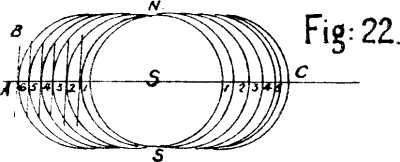
Let us try to picture the actual fact by an illustration. Let S be the sun, with concentric spherical aetherial shells surrounding it (Fig. 22). Then S A and S C will be rays of light being radiated out from the sun, and the magnetic and electric vibrations have to be both at right angles to the line of propagation and in the wave front; the wave front being represented by the circular lines showing the section of the concentric shells running north and south.
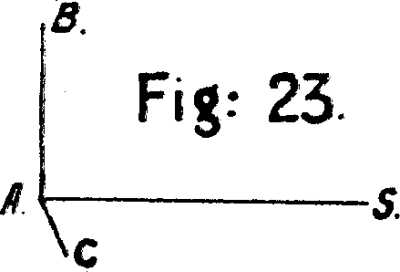
Now how can we picture these two motions at right angles to each other, and yet both at right angles to the line of propagation? First, let us take three straight lines and see how this may be done (Fig. 23).
Let A B, A S be two straight lines at right angles to each other, and A C another straight line at right angles to both. This can only be done by making A C perpendicular to the plane of the paper, and can be illustrated by supposing that it represents a pencil or pen placed upright on the paper, the point of the pencil being at point A. If this be done, then not only will A B and A C be at right angles to each other, but both will be at right angles to A S, which corresponds to the line of propagation.
Now refer to Fig. 22, and we shall see that the line A B and the boundary of the shell will practically correspond. So that
any section of a spherical wave front will always be at right angles to the ray of light. But we have learned from Art. 89 that these sections of the aetherial spherical shell are really identical with Faraday's Lines of Force, with the result that along any line which stretches from the North pole of the sun to the South pole, there will ever be an electric vibration, which is put into motion by the elasticity of the aetherial vortex atoms. So that on every side of the sun there is ever going on this electric vibration, along the lines of force which correspond to a section of the aetherial shell, the surface of which really constitutes the wave front.
Therefore it can readily be seen, that, as these lines are at right angles to the propagation of the ray of light, the electric vibration is at right angles to the lines of propagation, and is thus in accordance with the result demanded by Maxwell's theory.
We have now to give a physical conception of the magnetic vibration or motion of the Aether, and this has to be at right angles to both the electric vibration and the line of propagation.
In Art. 91 we have learned that the Aether possesses a rotatory motion, by which it rotates round the central body of the solar system, the sun. So that if we take any point, for example, in the path of the ray as S1, S2, S3, and S4, situated upon some definite equipotential surface or lines of force, and if we will imagine those lines to rotate round the sun, as the sun rotates on its axis, then in time the points will have described half the circle, and will come to the position on the right of the sun indicated by the same Nos. S1, S2, S3, S4. Thus there has been an aetherial motion at right angles to the electric motion, as the Aether circulates round the sun, because this motion may be represented as taking place from west to east of the sun, while the electric vibration takes place from north to south, or transverse to the line of propagation.
We have, however, learned that the Aether has an electro-magnetic basis, and therefore the rotation of the Aether gives rise to electro-magnetic currents; hence the motion west to east is really the motion of electro-magnetic currents which circulate round the sun. As these are at right angles to the line of propagation, and we have seen that they are at right angles to the electric vibration, it follows that all three are at right angles to each other, which is in accordance with the requirements as laid down by Maxwell.
We have considered these vibrations, first, from the view of the solar system as a whole in its relation to the universal Aether; but the same principle holds good if considered from the aetherial atomic standpoint. For if we take a line of force, composed as it is of aetherial vortex atoms, and suppose them to be rotating, we know that by that rotation there will be a tension due to that rotation, and Maxwell has shown this tension is due to magnetism, as in his standard work he says: “This magnetic force is the effect of the Centrifugal Force of the Vortices.“
So that by postulating a rotatory movement for the Aether around the sun, as we have done in Art. 92, we have not only solved the problem of all planetary and solar magnetism, but we have also solved the problem of the relative motion of the Aether and the earth, and also given for the first time (though it may be in an incomplete form) a physical explanation of that part of the electro-magnetic theory of light, which has hitherto been unexplained from the purely physical standpoint.
Such results, therefore, supported as they are by the direct experiment of Michelson and Morley of America, justify us in concluding that the conception of a rotating Aether is not only philosophically correct, but is in actual accord with experimental investigation and research, as indeed it ought to be.