Chapter XIX · FALLING STONES AND FALLING BODIES
Reading edition
I AM indebted to the editor of The Cornhill and the author of an article entitled “The Cup and the Lip” for permission to reprint portions of a paper containing much shrewd wisdom, several accounts of narrow escapes, and withal of a wittiness and freshness that brings to the reader a keen blast of Alpine air and the memory, if by chance he be a climber, of his own early days upon the mountains.
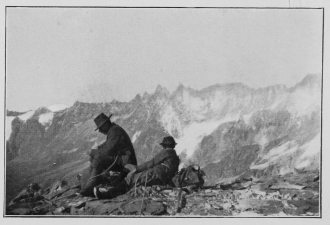
A hot day in summer on a mountain top.

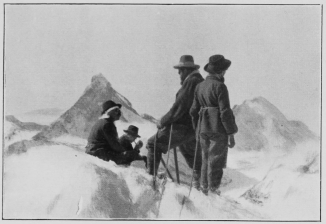
A summit near Saas.
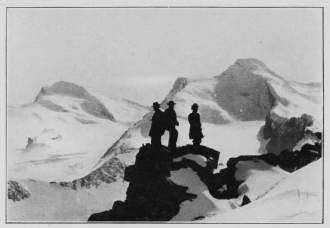
Luncheon on the way to the hut in winter.
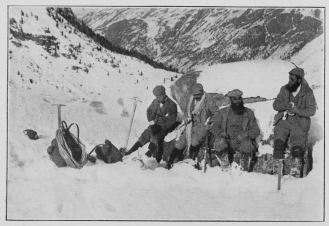
Luncheon in summer on the top of a glacier pass. To face p. 310.
The writer, after remarking that even in these days when the traveller, by the purchase of a few climbing requisites, is inclined to consider himself a mountaineer before he has ever set foot on a peak, goes on to say that, in reality, “for the most of us the craft is long to learn, the conquering hard. And in the experience of many there are two distinct phases. There is the time when, flushed with youth and victory, you seem to go on from strength to strength, faster from year to year, more confident in foot and hand, more scornful of the rope which you have seen so often used, not as a means of safety, but as an assistance to the progression of the weaker brethren, until one day your foot unaccountably finds the step too small, or the bit of rock comes away in your hand, or the outraged spirit of the mountains smites you suddenly with a stone, and all is changed. Henceforth every well-worn and half-despised precaution has a new meaning for you; it becomes a point of honour to walk circumspectly, to turn the rope round every helpful projection when the leader moves, and to mark and keep your distance; and you begin to catch a little of the wisdom of your fathers. It is not until the slip comes—as it comes to all—that you believe a slip is possible; and were it not for slips the continual advance of cup to lip might become in time monotonous and irksome, and mountaineering nothing but a more laborious and elaborate form of walking up a damp flight of stairs. But when it has come, and there has passed away the result of the consequent shock to your self-esteem, and to other even more sensitive portions of your person, there succeeds a new pride of achievement, and you will have the advantages of the converted sinner over the ninety-and-nine just persons whose knickerbockers are still unriven. Furthermore, you will have commenced the graduate stage of your mountaineering education. Unlucky, too, will you be if your experience has not given you something more than a juster estimate of your own moral and physical excellence; for your misfortune, if you have chosen your companions aright, will suddenly turn your grumbling hireling into a friend as gentle and as patient as a nurse, and disclose in those who were your friends qualities of calm and steadfastness never revealed in the fret of the valley; while, if you need wine and oil for your wounds, when you reach home again, you will find in the inn some English doctor, asking nothing better than to devote the best part of his holiday to the gratuitous healing of the stranger.
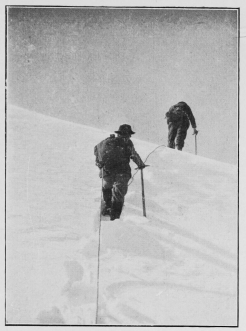
A tedious snow slope to ascend.
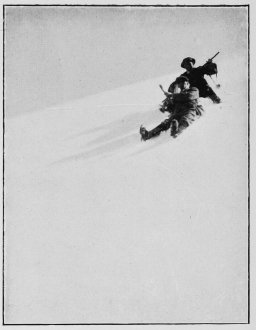
A sitting glissade and a quick descent.
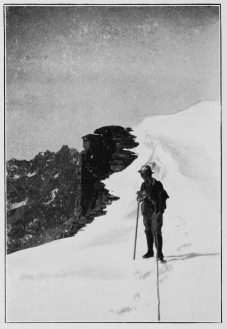
A glacier-capped summit.
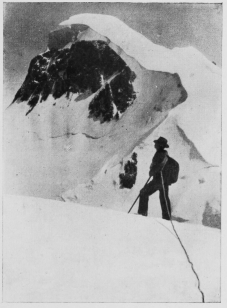
Italy to the left, Switzerland to the right. To face p. 312.
“The form of my own awakening was not such as to require wine or oil or consolation, and indeed, had I spoken of it at the time, would have scarcely escaped ridicule. We had reached the summit of our pass, and the guides and myself had decided that the steep wall of snow on the further side was an admirable place for a glissade. Accordingly, we went through the inevitable ritual of the summit, consumed as much sour bread and wine as we could, with unerring inaccuracy applied the wrong names to all the newly disclosed mountain-tops, adjusted the rope and prepared for the descent. Unfortunately, we omitted to explain the particular form of pleasure in which we were about to indulge to my companion, who was ignorant alike of mountaineering and the German tongue. The result was simple: the second guide, who was in front, set off with his feet together and his axe behind him; I followed in as correct an imitation of his attitude as I could induce my body to assume; but the novice stood still on the crest of the pass to ‘await in fitting silence the event,’ and the rope tightened. The jerk, after nearly cutting me in two, laid me on my back in the snow, and was then transmitted to the guide, who was also pulled off his feet and plunged head foremost down. Our combined weights drew after us both my companion and the chief guide, who was taken unawares, and both came crushing upon me. We rolled over and over, mutually pounding one another as we rolled; hats and spectacles and axes preceded us, and huge snowballs followed in our wake, until, breathless and humiliated, we had cleared the schrund, and came to an ignominious halt on the flat snow below.
“This was no very rude introduction to my climbing deficiencies, but before the end of the season I had felt fear at the pit of my stomach. We (that is A. T. and myself) had scrambled up an Austrian mountain, and, on our way down, had come to where the little glacier intervenes between the precipice and the little moraine heaps above the forest. The glacier would hardly deserve the name in any other part of the Alps, so small is it; but it makes up for what it lacks in size by its exceeding steepness; the hardness of its ice, and the ferocity (if one may attribute personal characteristics to Nature) of the rock walls which keep in its stream on either hand, hem it in so closely that I think it must be always in deep shadow, even in the middle of a June day.
“Here you must cross it very nearly on a level, and then skirt down its further side between ice and rock for a few feet before you come to a suitable place for the crossing of the big crevasse below you; and then a short slide down old avalanche débris shoots you deliciously into the sun again. The crossing of the glacier in the steps cut by the numerous parties who have passed on previous days is an extremely simple affair. But you must not hurry, for a slip could not be checked, and would probably finish in the before-mentioned crevasse. We started, however, in some fear; for a party ascending the mountains favoured us with continual showers of stones of all sizes, and the higher they climbed the more viciously came their artillery. Hence I was nervous and apt to go carelessly when we reached the middle of the ice, and here the noise began. I heard a strange, whizzing, whirring noise which sounded strangely familiar, accompanied by a physical shiver on my part and a curious knocking together of the knees; again and again it came, followed each time by a slight dull thud; and, looking at the rocks below us on each side, I saw a little white puff of dust rising at every concussion. Then I knew why the sound seemed familiar. I was reminded how, as a panting schoolboy, I had toiled up a long dusty road to a certain down with a rifle much too large for me, in the vain hope of shooting my third-class, and how, as we bruised our shoulders at the 200 yards’ range, another young gentleman firing at the 400 yards at the parallel range on the left, had mistaken his mark and fired across our heads at the target beyond us on the right. Everything was present: the indescribable whirring of the bullet, its horrible invisibility while it flew, and the grey little cloud as it flattened itself on the white paint of the target. The sensation was horrible, the tendency to hurry irresistible, and but for my companion I should have risked slip and crevasse and everything to get out of the line of fire. But my companion remained absolutely steady; while he poured forth curses in every language and every patois ever spoken in the Italian Tyrol, he still moved his feet as deliberately, improved the steps with as much care and minuteness as if he were a Chamonix guide conducting a Frenchman on the Mer de Glace. I know he felt the position as acutely as I did, for when, a week later, we had to cross the same place under a similar fire, and the third member of the party was sent on in front with a large rope to recut the steps, he turned to me with impressive simplicity, and said, ‘Adesso è quello in grande pericolo. If he is hit, we cannot save him.’ How long we took to cross I do not know. But when at last we reached the other bank we cast the rope off with one impulse, and, bending under the shelter of the rocks, ran where I had found climbing hard in the morning, jumped the bergschrund, fell and rolled down the snow under a final volley from the mountain, and lay long by the stream panting and safe.
“I suspect the danger here was far more apparent than real. My next adventure with a falling stone was more real than I like to think of. Four of us had been scrambling round the rocks beside the Ventina Glacier, and were returning to our camp to lunch. By bad luck, as it turned out, I reached level ground first, and, lying on my back amongst great boulders, watched with amusement the struggles of my companions who were about a hundred feet above me, apparently unable to get up or down. They were screaming to me, but the torrent drowned their voices, and I smoked my pipe in contentment. Suave mari magno. At last they moved, and with them the huge rock which they had been endeavouring to uphold and shouting to me to beware of. It crashed down towards me, but I determined to stop where I was. The roughness of the ground would have hindered my escape to any distance, and I calculated on stepping quickly aside when my enemy had declared himself for any particular path of attack. So I did, but the stone at that moment broke in pieces, and, quick as I was with desperation, one fragment was quicker still. It caught me, glancing as I turned between the shoulder and the elbow, only just touching me, as I suppose, for the bone was quite unhurt. Up I went into the air and down I came among the stones, with all the wind knocked out of me, large bruises all over me, not hurt, but very much frightened.
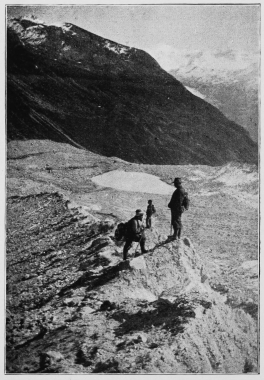
Unpleasant going over loose stones.
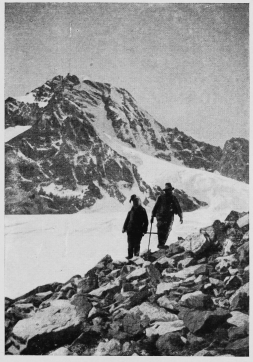
On the crest of an old moraine. To face p. 317.
“Such experiences as this leave no very lasting impression, and might just as easily happen were the party accompanied by the best of guides. But I hardly think that any guide would have been crack-brained enough to take part in two expeditions which taught me what it feels like to slip on rock and ice respectively. The first slip took place during the winter. With one companion I was climbing in a long and not very difficult gully on a Welsh mountain. The frost had just broken, and there was more water in the pitches than was quite pleasant. It was very cold water, and my hands, which had been frost-bitten the week before, were still swathed in bandages. Hence progress was very slow, and at last my friend took the lead to spare me. He was climbing over a big overhanging stone jammed between the walls of the gully and forming an excellent spout for the water, which was thus poured conveniently down his neck. I stood on the shelving floor of the gully in perfect safety, and watched the shower-bath, which was gradually exhausting him. He asked for his axe, and I, in a moment of madness, came near and handed it up; his legs, which were all I could then see of him, were kicking in the water about 5 feet above my head. What happened next I do not know, but I shall always maintain that, seeing an eligible blade of grass above him, he plunged the adze in and hauled with both hands. The blade resented such treatment, and came out. Anyhow he fell on my head, and we commenced a mad career down the way we had ascended, rather rolling than falling, striking our heads and backs against the rocks, and apparently destined for the stony valley upon which we had looked down between our legs for hours. People who have escaped drowning say that, in what was their struggle for life, their minds travelled back over their whole history. I know that my brain at this moment suddenly acquired an unusual strength. In a few seconds we were safe, but in those seconds there was time for centuries of regret. There was no fear; that was to come later. But I felt vividly that I was present as a spectator of my own suicide, and thought myself a feeble kind of fool. Had it been on the Dru or the Meije, I thought, it might have been worth it, but, half-drowned, to plunge a poor 40 feet over the next pitch on a hill not 3000 feet high, with a carriage road in sight, and a girl driving in the cows for milking in Nant Francon! We did not roll far, and stuck between the walls of the gully, where they narrowed. Then I arose and shook myself, unhurt. My companion made me light his pipe, which cheered me very much, and we each partook of an enormous mutton sandwich. Help was near, for another party of three was climbing in the next gully, and came to our shouts; one ran down to the farm for a hurdle, the rest began the descent. For hours we seemed to toil, for my companion, though with admirable fortitude he supported the pain of movement, had temporarily no power over his legs and the lower part of his body. I could do little, but the others worked like blacks, and just at dark we reached the farm and the ministrations of a Welsh doctor, who told my friend, quite erroneously, that there was nothing the matter with him, pointed out a swelling on my face as big as a pigeon’s egg, which, he said, would probably lead to erysipelas, and then departed into the darkness.
“A fall on ice has something in it more relentless, though, until the last catastrophe, less violent. We had all been victims to the flesh-pots of the valley, and were, perhaps, hardly fit for a long ice-slope, when we began to cut up the last few feet to gain the arête of our mountain. The incline seemed to me very steep, and, third on the rope, I was watching the leader at his labours, half pitying him for his exertions, half envying him his immunity from the ice fragments which he was sending down to me. Below me the fourth man had barely left the great flat rock on which we had breakfasted; there was no reason to think of danger; when to my horror I saw the leader cut a step, put out his foot slowly, and then very slowly and deliberately sway over and fall forwards and downwards against the ice. We were in a diagonal line, but almost immediately beneath one another, and he swung quietly round like a pendulum, his axe holding him to the slope, until he was immediately beneath the second man. Very slowly, as it seemed, the rope grew taut; the weight began to tug at his waist; and then he, too, slowly and reflectively in the most correct mountaineering attitude, as though he were embarking upon a well-considered journey, began to slide. Now was the time for me to put into practice years of patient training. I dug my toes in and stiffened my back, anchored myself to the ice, and waited for the strain. It was an unconscionable time coming, and, when it came, I still had time to think that I could bear it. Then the weight of 27 stone in a remorseless way quietly pulled me from my standpoint, as though my resistance were an impudence. Still, like the others, I held my axe against the ice and struggled like a cat on a polished floor, always seeing the big flat rock, and thinking of the bump with which we should bound from it, and begin our real career through the air; when suddenly the bump came and we all fell together in a heap on to the rock and the fourth man, who had stepped back upon it, my crampons running into his leg, and my axe, released from the pressure, going off through the air on the very journey which I had anticipated for us all. The others were for a fresh attack on the malicious mountain; but I was of milder mood, and very soon, torn and wiser, we were off on a slower but more convenient path to the valley than had seemed destined for us a few minutes before. But our cup was not yet full. Having no axe with which to check a slip, I was placed at the head of the line, and led slowly down, floundering a good deal for want of my usual support. The great couloir was seamed across with a gigantic crevasse, the angle of the slope being so sharp that the upper half overhung, and we had only crossed in the morning by standing on the lower lip, cutting hand-holes in the upper, and shoving up the leader from the shoulder of the second man: hence, in descending, our position was similar to that of a man on the mantel-shelf who should wish to climb down into the fire itself. We chose the obvious alternative of a jump to the curb, which was, I suppose, about 15 feet below us and made of steep ice with a deep and deceptive covering of snow. I jumped and slid away with this covering, to be arrested in my course by a rude jerk. I turned round indignant; but my companions were beyond my reproaches. One by one, full of snow, eloquent, and bruised, they issued slowly from the crevasse into which I had hurled them, and, heedless of the humour of the situation, gloomily urged me downwards.
“Some hours still passed before we reached our friendly Italian hut, left some days before for a raid into Swiss territory; there on the table were our provisions and shirts as we had left them, and a solemn array of bottles full of milk carried up during our absence by our shepherd friends; and there, on the pile, in stinging comment on our late proceedings, lay a slip of paper, the tribute of some Italian tourist, bearing the inscription ‘Omaggio ai bravi Inglesi ignoti.’ We felt very much ashamed.
“When the soup has been eaten and the pipes are lighted, and you sit down outside your hut for the last talk before bed, you will find your guides’ tongues suddenly acquire a new eloquence, and, if you are a novice at the craft, will be almost overwhelmed by the catalogue of misfortune which they will repeat to you. And so, too, upon us in the winter months comes the temptation to dwell on things done long ago and ill done, and, as we write of the sport for others, we give a false impression of peril and hardihood in things that were little more than matter for a moment’s laughter. I too must plead guilty to a well-meant desire to make your flesh creep.
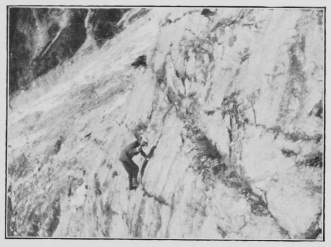
An awkward bit of climbing.
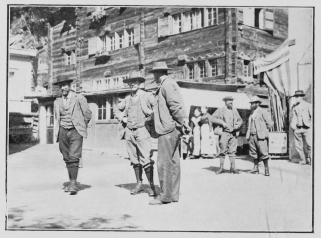
Guides at Zermatt.
A large party for a small hut.
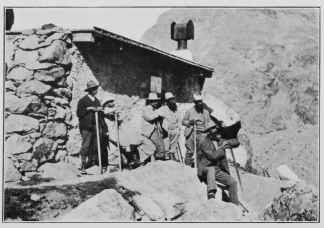
Au revoir. To face p. 322.
“Mountaineering by skilled mountaineers is about as dangerous as hunting in a fair country, and requires about as much pluck as to cross from the Temple to the Law Courts at midday. Difficult mountaineering is for the unskilled about as dangerous as riding a vicious horse in a steeplechase for a man who has never learnt to ride. But the tendency in those who speak or write of it for the outer world who are not mountaineers is to conceal a deficiency of charm of style by an attempt to slog in the melodramatic, and I plead guilty at once.
“So we think and write as though to us our passion for the hills were a fancy of the summer, a mere flirtation. Yet no one has lost the first bloom of his delight in Alpine adventure before the element of sternness has come to mar his memory and bind more closely his affections. You find the mildly Horatian presence of death somewhere near you, and that at a moment when, whatever your age and strength, and whatever your infirmities, you are at the full burst of youth; when Nature has been kindest she has been most capricious, and has flaunted her relentless savagery just when she has bent to kiss you. The weirdest rocks rise from Italian gardens, and the forms of hill seem oldest when you are most exultant—immortal age beside immortal youth. Yet is it not this, ‘the sense of tears,’ in things which are not mortal which must mark your Alpine paths with memories as heavy and as definite as those inscriptions which tell of obscure and sudden death on every hillside, and invite your prayers for the woodcutter and the shepherd? You too will have seen friends go out into the morning whom you have never welcomed home. There is a danger, sometimes encountered recklessly, sometimes ignorantly, but sometimes—hard as it may be to understand the mood—not in the mere spirit of the idle youth, but met with and overcome, or overcoming, in a resolution which knows no pleasure in conquest save when the essay is fierce, and is calmly willing to pay the penalty of failure. While for ourselves we enjoy the struggle none the less because we have taken every care that we shall win, they freely give all; and for such there is surely no law. While by every precept and example we impress the old rules of the craft on our companions and our successors, how can we find words of blame for those who have at least paid the extreme forfeit, and found ‘the sleep that is among the lonely hills’?
“The penalty for failure is death; not always exacted at the first slip, for Nature is merciful and ofttimes doth relent; but surely waiting for those who scorn the experience of others and slight her majesty in wilfulness, in ignorance, in the obstinate following of a fancy, in the vain pursuit of notoriety. The rules are known, and those who break them, and by precept and example tempt to break them those whom they should teach, wrong the sport which they profess to love.
“In this game as in any other, it should be a point of honour for us not to make the sport more difficult for others, and not to bring unnecessary sorrow upon the peasants, who help us to play it, and upon their families. It should be a point of honour to play the game, and, if disaster comes in playing it, we have at least, done our best.”