Chapter V
Reading edition
Description of my House at Jala-Jala—Storms, Gales, and Earthquakes—Reforming the Banditti—Card-playing—Tagal Cock-fighting—Skirmishes with Robbers—Courage of my Wife—Our Domestic Happiness—Visits from Europeans—Their Astonishment at our Civilisation—Visit to a Sick Friend at Manilla—Tour through the Provinces of the Ilocos and Pangasinan Indians—My Reception by the Tinguians—Their Appearance and Habits—Manners and Customs—Indian Fête at Laganguilan y Madalag—Horrible Ceremonies to Celebrate a Victory—Songs and Dances—Our Night-watch—We Explore our Cabin—Discovery of a Secret Well—Tomb of the Tinguian Indians.
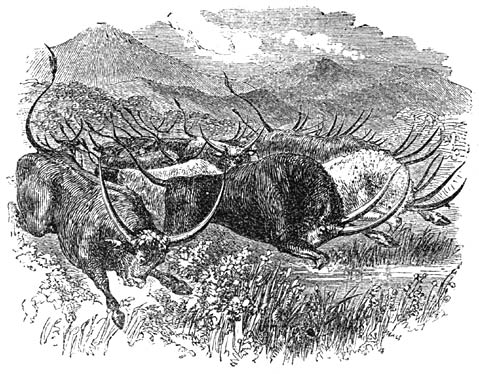
Herd of Wild Buffaloes.
I have not sought to enter upon those minute descriptions, too tedious generally for the reader; I only wished to give an idea of the various panoramas that were unfolded to our eyes whilst at Jala-Jala.
I now return to the details of my ordinary life.
As I had killed a wild buffalo when hunting, I had given sufficient proofs of my skill, and my Indians were devoted to me, because they had confidence in me. Nothing more now pre-occupied me, and I spent my time in superintending some necessary alterations. Shortly the woods and forests adjoining my domain were cut down, and replaced by extensive fields of indigo and rice. I stocked the hills with horned cattle, and a fine troop of horses with delicate limbs and haughty mien; I also succeeded in dispersing the banditti from Jala-Jala. I must say a great many of them abandoned their wandering sinful lives; I received them on my land, and made good husbandmen of them. How was it that I had collected such a number of recruits? In a strange manner, I will admit, and worthy of relating, as it will show how an Indian allows himself to be influenced and guided, when he has confidence in a man whom he looks upon as his superior. I frequently walked in the forests alone, with my gun under my arm. Suddenly a bandit would spring out, as if by enchantment, from behind a tree, armed from top to toe, and advance towards me.
“Master,” said he to me, putting one knee to the ground, “I will be an honest man; take me under your protection!”
I asked him his name; if he had been marked out by the high court of justice, I would answer him severely:
“Withdraw, and never present yourself again before me; I cannot forgive you, and if I meet you again, I must do my duty.”
If he was unknown to me, I would kindly say to him:
“Follow me.”
I would take him home, and then tell him to lay down his arms; and after having preached to him, and exhorted him to persist in his resolution, I would point out to him the spot in the village where he might build his cabin, and, in order to encourage him, I would advance him some money to support himself until he became transformed from a bandit into an agriculturist. I congratulated myself each day on having left an open door to repentance, since by my cares I restored to an honest and laborious life, people who had gone astray and been perverted. I endeavoured also to persuade the Indians to abandon their vicious wild customs, without being too severe towards them; to obtain much from them I knew it was necessary to give way a little. The Indians are passionately fond of cards and cock-fighting, as I have said before; therefore, in order not to debar them entirely from these pleasures, I allowed them to play at cards three times a year—the day of the village festival, upon my wife’s birthday, and upon my own. Woe to the one who was caught playing out of the times prescribed above; he was severely punished. As to the cock-fights, I allowed them on Sundays and holidays, after Divine service. For this purpose I had public arenas built. In these arenas, in presence of two judges, whose decrees were without appeal, the spectators laid heavy wagers. There is nothing more curious than to witness a cock-fight. The two proud animals, purposely chosen and trained for the day of the contest, come upon the battle-field armed with long, sharp, steel spurs. They bear themselves erect; their deportment is bold and warlike; they raise their heads, and beat their sides with their wings, the feathers of which spread in the form of the proud peacock’s fan. They pace the arena haughtily, raising their armed legs cautiously, and darting angry looks at each other, like two old warriors in armour ready to fight before the eyes of an assembled court. Their impatience is violent, their courage impetuous; shortly the two adversaries fall upon and attack each other with equal fury; the sharp weapons they wear inflict dreadful wounds, but these intrepid combatants appear not to feel the cruel effects. Blood flows; the champions only appear the more animated. The one that is getting weak raises his courage at the idea of victory; if he draw back, it is only to recruit his strength, to rush with more ardour than ever upon the enemy he wishes to subdue. At length when their fate is decided, when one of the heroes, covered with blood and wounds, falls a victim, or runs away, he is declared vanquished, and the battle is ended.
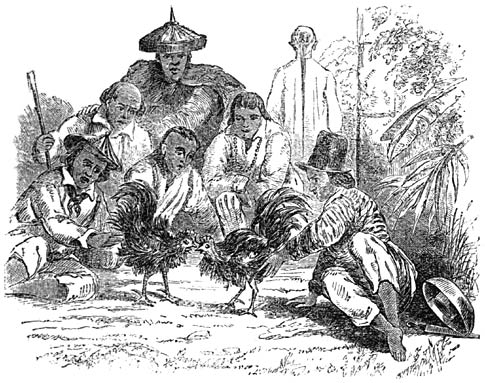
Tagal cock-fighting.
The Indians assist with a sort of ferocious joy at this amusement. Their attention is so captivated by it that they do not utter a word, but follow with particular care the most minute details of the conflict. Almost all of them train up a cock, and treat him for several years with comical tenderness, when one reflects that this animal, taken as much care of as a child, is destined by its master to perish the first day it fights. I also found that it was necessary to provide some amusement compatible with the tastes, manners, and habits of my former bandits, who had led for so long a space of time such a wandering vagabond life. For this purpose I allowed hunting on all parts of my estate, conditionally, however, that I should take beforehand, as tithe, a quarter of any stag or wild boar they should kill. I do not think that ever a sportsman—one of those men reclaimed from the paths of vice to those of virtue—failed in this engagement, or endeavoured to steal any game. I have often received seven or eight haunches of venison in a day, and those who brought them were delighted to be able to offer them to me.
The church I had laid the foundation of was progressing rapidly; the population of the township was daily increasing: and everything succeeded according to my wishes. I had still occasional difficulties with the hardened robbers who surrounded me; but I pursued them without intermission, for it was to my interest to remove them from the neighbourhood of my residence. Frequently they annoyed me by the alarms that they gave us. These resolute, determined men arrived in gangs to besiege our house. My guards surrounded me, and we occasionally fought skirmishes, which always terminated in our favour. Providence has unfathomable secrets. I was never struck by a ball from a bandit. I bear the scars of seventeen wounds; but these wounds were made with naked blades. It could be said of me, as in I know not which Scotch ballad: “Did not the Devil’s soldiers pass through the balls, instead of the balls passing through them.” Yet I have often been fired at; sometimes the barrel of a gun has been pointed at my chest, and that at a few paces from me. My clothes have been torn by the bullet, but my body has always escaped harm.
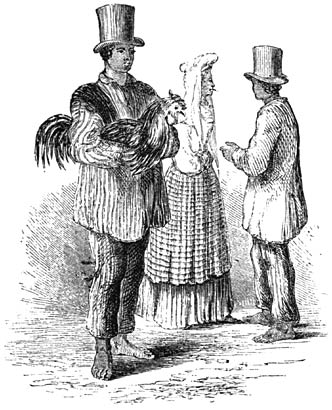
Tagal Indians.
One morning I was cautioned to put myself on my guard, because some banditti had met together at a few leagues from my house, and intended attacking it. Hearing this, I armed my people, and set out to meet the band that was coming to assail me, so as to anticipate their attack. At the place that had been indicated to me I found nobody, and passed the day in exploring the neighbourhood, in hopes of meeting the bandits, but my search was useless. Suddenly the thought struck me that a secret enemy had imposed upon me, and that, at the moment I was going to face imaginary danger, perhaps my house I had left would be suddenly attacked. I trembled—I shivered all over. I gallopped off, and reached home in the middle of the night. My fears were but too well-founded. I had fallen into a snare. I found my servants armed, watching, with my wife at their head. “What are you doing here?” I exclaimed, going up to her. “I am keeping watch,” she replied, with great presence of mind; “I was told that the advice given to you was false; that you would not find the robbers where you expected, and that, during your absence, they would come here.” This act of heroism proved to me what courage and energy God had given to a woman apparently so delicate. The banditti did not attack us: was there not some guardian angel watching over my dwelling?
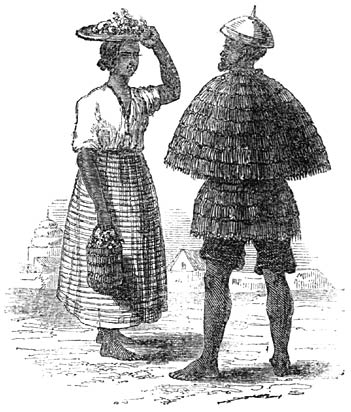
Ilocos Indians.
In order to utilise my time, I decided upon making a tour to the north into the provinces of Ilocos and Pangasinan. I had my reasons for so doing: I wished, if possible, to make an excursion to the Tinguians and Igorrots, wild populations, who were much talked of, but little known. I wished to study them myself. I took the precaution not to confide this idea to anybody, for then, indeed, people would not have known what name to give my folly. I made my preparations, and set out with my faithful lieutenant, Alila, who never left me, and who was justly styled Mabouti-Tao. We were mounted upon good horses, that carried us along like gazelles to Vigan, the chief town of the province of South Ilocos, where we left the animals. From there we took a guide, who conducted us on foot to the east, close to a small river called Abra (opening). This river is the only issue by which we could penetrate to the Tinguians. It winds around high mountains of basalt; its sides are steep; its bed is encumbered with immense blocks of rock, fallen from the sides of the mountains, which render it impossible to walk along its banks. To reach the Tinguians, it is necessary to have recourse to a slight skiff, that can easily pass through the current and the most shallow parts. My guide and my lieutenant soon contrived to make a small raft of bamboos; when it was finished we embarked, Alila and myself, our guide refusing to accompany us. After much trouble and fatigue, casting ourselves often into the water to draw our raft along, we at length got clear of the first range of mountains, and perceived, in a small plain, the first Tinguian village. When we reached there we got out, and went towards the huts we had distinguished in the distance. I allow it was acting rather foolishly to go and thus expose ourselves, in the midst of a colony of ferocious and cruel men whose language we did not know; but I relied upon my usual good fortune. I will add that I had taken divers objects with me to give as presents, trusting to meet some inhabitant speaking the Tagaloc language. I walked on, then, without troubling myself about what would become of us. In a few minutes we reached the nearest cabins, and the inhabitants gave us at first an unwelcome reception. Frightened at seeing us approach, they advanced towards us, armed with hatchets and spears; we waited for them without recoiling in the least. I spoke to them by signs, and showed them some necklaces of glass beads, to make them understand we were friendly disposed. They deliberated among themselves, and when they had held their consultation, they beckoned us to follow them. We obeyed. They led us to their chief, who was an old man. My generosity was greater towards him than it had been to his subjects. He appeared so delighted with my presents, that he immediately put us at our ease, by making us understand that we had nothing to fear, and that he took us under his special protection.
This pleasing reception encouraged us.
I then set about examining with attention the men, women, and children who surrounded us, and who seemed as much astonished as ourselves. My amazement was very great when I beheld tall men, slightly bronzed, with straight hair, regular features, aquiline noses, and really handsome, elegant women. Was I really among savages? I should rather have thought I was among the inhabitants of the south of France, had it not been for the costume and language. The only clothing the men wore was a sash, and a sort of a turban, made out of the bark of the fig tree. They were armed, as they always are, with a long spear, a small hatchet, and a shield. The women also wore a sash, and a small narrow apron that came down to their knees. Their heads were ornamented with pearls, coral beads, and pieces of gold, twisted among their hair; the upper parts of their hands were painted blue; their wrists adorned with interwoven bracelets, spangled with glass beads—these bracelets reached the elbow, and formed a kind of half-plaited sleeve. On this subject I learnt a remarkable fact. These interwoven bracelets squeeze the arm very much; they are put on when the women are quite young, and they prevent the development of the flesh to the advantage of the wrist and hand, which swell and become dreadfully big; this is a mark of beauty with the Tinguians, as a small foot is with the Chinese, and a small waist with the European ladies. I was quite astonished to find myself in the midst of this population, where there was no reason whatsoever to be alarmed. One thing only annoyed me; it was the odour that these people spread around them, which could be smelt even at a distance. However, the men and women are cleanly, for they are in the habit of bathing twice daily. I attributed the disagreeable smell to their sash and turban, which they never leave off, but allow to fall into rags. I remarked that the reception given me by the chief gained us the good-will of all the inhabitants, and I accepted, without hesitation, the hospitality proffered us. This was the only means of studying well the manners and customs of my new hosts.
The inhabitants of Palan hearing this news screamed with joy; it was quite a tumult when they heard that a fête would be given in commemoration of the success at Laganguilan y Madalag. All wished to be present—men, women, children; all desired to go to it. But the chiefs chose a certain number of warriors, some women, and a great many young girls: they made their preparations and set out. It was too favourable an opportunity for me not to avail myself of it, and I earnestly begged my hosts to allow me to accompany them. They consented, and the same night we set out on our journey, being in all thirty in number. The men wore their arms, which are composed of a hatchet, that they call aligua, a sharp-pointed spear of bamboo, and a shield; the women were muffled up in their finest ornaments. I remarked that these garments were cotton materials, of showy colours. We walked one behind another, according to the custom of the savages. We went through many villages, the inhabitants of which were also going to the fête; we crossed over mountains, forests, torrents, and at last, at break of day, we reached Laganguilan y Madalag. This small town was the scene of much rejoicing. On all sides the sound of the gong and tom-tom were heard. The first of these instruments is of a Chinese shape; the second is in the form of a sharp cone, covered over at the bottom with a deer’s skin.
Towards eleven o’clock, the chiefs of the town, followed by all the population, directed their steps towards the large shed. There everyone took his place on the ground, each party, headed by its chiefs, occupying a place marked out for it beforehand. In the middle of a circle formed by the chiefs of the warriors were large vessels, full of basi, a beverage made with the fermented juice of the sugar-cane; and four hideous heads of Guinans entirely disfigured—these were the trophies of the victory. When all the assistants had taken their places, a champion of Laganguilan y Madalag took one of the heads and presented it to the chiefs of the town, who showed it to all the assistants, making a long speech comprehending many praises for the conquerors. This discourse being over, the warrior took up the head, divided it with strokes of his hatchet, and took out the brains. During this operation, so unpleasant to witness, another champion got a second head, and handed it to the chiefs, the same speech was delivered, then he broke the skull to pieces in like manner, and took out the brains. The same was done with the four bleeding skulls of the subdued enemies. When the brains were taken out, the young girls pounded them with their hands into the vases containing the liquor of the fermented sugar-cane; they stirred the mixture round, and then the vases were taken to the chiefs, who dipped in their small osier goblets, through the fissures of which the liquid part ran out, and the solid part that remained at the bottom they drank with ecstatic sensuality. I felt quite sick at this scene, so entirely new to me. After the chieftains’ turn came the turn of the champions. The vases were presented to them, and each one sipped with delight this frightful drink, to the noise of wild songs. There was really something infernal in this sacrifice to victory.
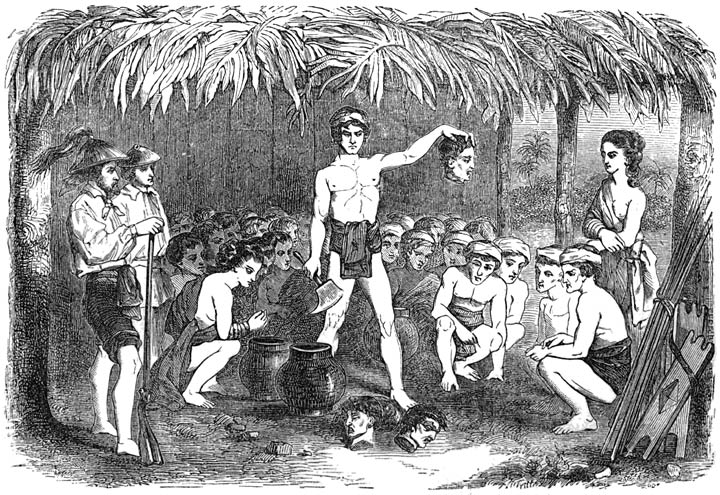
The Brain Feast of the Tinguian Indians.
Page 112.
We sat in a circle and these vases were carried round. I well understood that we were about undergoing a disgusting test. Alas! I had not long to wait for it. The warriors planted themselves before me, and presented me with the basi and the frightful cup. All eyes were fixed upon me. The invitation was so direct, to refuse it would perhaps be exposing myself to death! It is impossible to describe the interior conflict that passed within me. I would rather have preferred the carbine of a bandit five paces from my chest; or await, as I had already done, the impetuous attack of the wild buffalo. What a perplexity! I shall never forget that awful moment. It struck me with terror and disgust; however, I contained myself, nothing betraying my emotion. I imitated the savages, and, dipping the osier goblet into the drink, I approached it to my lips, and passed it to the unfortunate Alila, who could not avoid this infernal beverage. The sacrifice was complete; the libations were over, but not the songs. The basi is a very spirituous and inebriating liquor, and the assistants, who had partaken rather too freely of this horrible drink, sang louder to the noise of the tom-tom and the gong, while the champions divided the human skulls into small pieces destined to be sent as presents to all their friends. The distribution was made during the sitting, after which, the chiefs declared the ceremony over. They then danced. The savages divided themselves into two lines, and howling, as if they were furious madmen or terribly provoked, they jumped about, laying their right hand upon the shoulder of their partners, and changing places with them. These dances continued all day; at last night came on, each inhabitant retired with his family and some few guests to his aerial abode, and soon afterwards tranquillity was restored.
We cannot help feeling astonished, when we are in Europe—in a good bed, under a warm eider-down coverlet, the head luxuriously reclining upon good pillows—when we reflect on the singular homes of the savages in the woods. How often have I represented to myself these families—roosting eighty feet above ground, upon the tops of trees. However, I know that they sleep as quietly in those retreats, open to every wind, as I in my well-closed and quiet room. Are they not like the birds who repose at their sides upon the branches? Have they not Nature for a mother, that admirable guardian of all she has made, and do they not also close their eyelids under the tutelary looks of the Supreme Father of the universe?
My faithful Alila retired with me into one of the low-storied cabins to pass the night, as we had been in the habit of doing while staying with the Tinguians. For our better security we were accustomed to watch one another alternately; we never both slept at the same time. Without being timid, ought we not to be prudent? This night it was my turn to go to sleep the first. I went to bed, but the impressions of the day had been too strong: I felt no inclination to sleep. I therefore offered to relieve my lieutenant of his watch; the poor fellow was like myself—the heads of the Guinans kept dancing before his eyes. He beheld them pale, bloody, hideous; then torn, pounded, broken to pieces; then the shocking beverage of the brains, that he also so courageously swallowed, came back to his mind, and he suffered sufficiently to make him repent our visit. “Master,” said he to me, looking very much grieved, “why did we come among these devils? Ah! it would have been much better had we remained in our good country of Jala-Jala.” He was not perhaps in the wrong, but my desire to see extraordinary things gave me a courage and a will he did not partake of. I answered him thus: “Man must know all, and see all it is possible to see. As we cannot sleep, and that we are masters here, let us make a night visit; perhaps we shall find things that are unknown to us. Light the fire and follow me, Alila.” The poor lieutenant obeyed without answering a word. He rubbed two pieces of bamboo one against the other, and I heard him muttering between his teeth:
“Why, master, you are not content to see what is upon the earth, you must also see what is inside of it!”
This simple observation made me smile. He continued: “You wish to leave me alone here; and if the souls of the Guinans whose brains I have just drank come to fetch me, what will become of me? You will not be here to defend me!”
My lieutenant would not have been frightened at twenty banditti, he would have struggled against every one of them until death; but his legs trembled, his voice faltered, he was terrified at the idea of remaining alone in this cabin, exposed to the view of the spirit of a Guinan, which would come and ask him to restore his brains! Whilst he addressed me these complaints, I had leant my back against one side of the well, my knees were applied against the other, and down I went. I had already descended about four yards, when I felt some rubbish falling upon me. I raised my head, and saw Alila coming down too. The poor fellow would not remain alone. “Well done,” said I to him, “you are becoming curious too; you will be rewarded, believe me, for we shall see fine sights.” And I continued my under-ground research. After proceeding six or seven yards I reached the opening I had remarked from above, and stopped. I placed my light before me, and espied a corner, where sat the dried black corpse of a Tinguian in the same state as a mummy. I said nothing; I waited for my lieutenant, anxious as I was to enjoy his surprise. When he was aside of me: “Look, look,” I exclaimed; “what is that?” He was stupified. “Master,” said he at last, “I entreat of you to leave this place; let us get out of this cursed hole! Take me to fight against the Tinguians of the village—I am quite willing to do that—but do not remain among the dead! What should we do with our arms, if they suddenly appeared to ask us why we are here?” “Be quiet,” I answered him; “we shall go no farther.” I felt satisfied that this well was a tomb, and that lower down I should see some more Tinguians in a state of preservation. I respected the abode of the dead, and came up, to Alila’a great satisfaction. We put everything in its place, and returned to the upper story of the cabin. I soon fell asleep, but my lieutenant could not: the thoughts of the mummy and horrible beverage kept him awake.
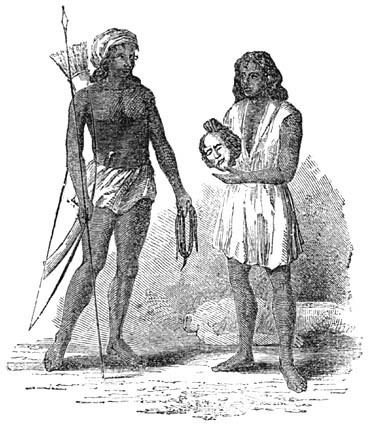
Guinan Indians.