ACROSS THE VATNA JÖKULL. (continued 2)
Reading edition
Evening came before we again started, and our road was through a deep loose sand, which was very trying and heavy to our feet, for beneath this was a layer of pure white ash of the consistency of flour—probably decomposed pumice. When this was mixed with sand, it seemed to be a good fertilizer, for wherever it occurred a patch of wild oats was the invariable result. Before we again reached the river, we found it cut directly through a cluster of low mountains, striking a field of very dark and almost vitreous lava. By midnight we sighted Grímstaðir to the S.E., upon the opposite side of the river, although at some considerable distance, and the ferry was beyond the farm, to the north of it. We followed closely down the bank of the river that we might not miss it, for there was no track to guide one across the Mývatns Örœfí, and it was a good three hours before we found the boat, which was a leaky concern, but by dint of bailing and rowing we eventually reached the opposite side. Five A.M. saw us arrived at Grímstaðir, much to the surprise of the occupants, who had not at all expected the intrusion of six men on foot at such an hour, and from such a quarter.
The bóndi having been roused, the whole establishment turned out to have a look at us. Grímstaðir was decidedly the best and most extensive farm I had seen in the island, except, perhaps, Breiðarbólstað in Rangarvallasýsla. The bóndi was a good type of the genuine old-fashioned Icelander, and everything in the place was cleanly and comfortable. He had passed all his life in the north of the island, and had not ever journeyed to Reykjavík.
There was a good-sized windmill in front of the farm, to grind the rye and wheat sold by the store-keepers; and this was a very great improvement upon the old stone handmill so generally used in other parts of the country, especially in the south. Windmills seem to be rather a characteristic of the north of Iceland. My first object was to procure coffee and a good meal; this having been secured, I proceeded to purchase four sheep, and give instructions for their death and disposal. One was destined for immediate use, the other three to be made into pemmican, their skins being dried for carriage to England.
What a glorious institution is a bed! What a happy thought it was of the man who first conceived the idea of taking off his clothes before turning into it! What luxury! a tub, hot water, soap, a sponge, a towel, clean sheets, an eiderdown quilt, a little tallow for my poor sore nose, and sleep! What sublimity of comfort! Well, I slept as only a well-worn traveller could sleep, till I was roused by the novel sound of a knock at the door of my room. “What’s the matter? Who’s there?” My watch said twelve o’clock.
It was the bóndi’s daughter, with coffee and a plate full of delicate little pancakes, each carefully rolled up with a few raisins inside, and nicely powdered over with white sugar. Forgive the weakness, good reader, but that little tray! Can I ever forget it or its contents, to say nothing of its comely bearer? Will I have any more? Oh yes, by all means. My mid-day meal became an interesting speculation, to say nothing of the comely bearer of it, through whom I ordered sheep’s fry, and ere long was greeted with its savoury smell.
Paul had gone to Reikjahlíð to try and hire a man and some horses to enable us to go to Öskjugjá (the volcano we had seen smoking), for my own horses had not yet arrived, but I learnt that it was almost impossible to obtain either horses or men, as all were engaged in gathering in the hay harvest.
In the afternoon two students arrived from the college at Reykjavík to spend their vacation in the north, and a merry evening we had of it with my men, who were in high spirits at having fairly reached the Norðurland by a route which had never before been trodden by the foot of man, since their island first rose above the waters of the North Atlantic—a feat that would immortalise their names in local Icelandic history!
We had then travelled from Núpstað in the south of the island to Grímstaðir in the north, a distance of about 270 miles, in sixteen days, twelve of which had been passed amongst the regions of perpetual snow. I must here remark that the pluck, perseverance, and obedience of the Icelanders who accompanied me are deserving of all praise; for without them I could never have crossed the Vatna Jökull. The next day was Sunday, and at breakfast I was informed that the bóndi would read a service in the baðstofa, an apartment for general use. This room was filled with little truck bedsteads, and somewhat reminded me of a hospital. All the household were gathered about, neat and orderly, sitting on the bedsteads, and the service consisted of singing, reading, and prayer.
One cannot help noticing the softening and harmonising influences of all forms of civilized religion when not clouded by fanaticism, more especially among those whose lives are spent in close contact with the ruder elements of the world.
The beautiful clear sunny weather continued, enabling us on the following day to obtain a good view of the distant hills of the Mývatn, across the arid waste of the Mývatns Örœfí, where occasional puffs of wind were raising small clouds of the light volcanic sand, carrying them high into the air. Sometimes, too, circular currents raised screw-shaped columns of sand, which now and then increased to rather formidable dimensions, and even crossed the Jökulsá, blinding the chance traveller, and scaring any stray sheep that might be cropping the tufts of scant herbage sprinkled at long intervals over the plain.
The volcano in the Dyngjufjöll was smoking away with greater ferocity than ever, and the dark columns which formed the centre of the great mushroom of vapour which still hung over these remarkable mountains showed that something heavier than steam was being ejected.
Paul returned in the evening with a man from Grœnavatn, named Thorlákur, who was to accompany me to the Ódáðahraun and the Dyngjufjöll, but my difficulty lay in not having sufficient horses, as Paul had found it impossible either to buy or hire more than two, and they belonged to Thorlákur; and as I could not afford to wait for my own, I was compelled to modify my plan of operations. Requiring a fresh supply of necessaries, I first despatched Paul to the stores at Vopnfjörðr, and then, with the rest of my men and Thorlákur, set out for the Ódáðahraun on foot, one horse carrying hay and the other provisions. Our first stage was to be the Grafalandá, where there was plenty of grass, and our next some point between the Dyngjufjöll mountains and the river Svartá, within easy reach of the baggage I had left behind. From here I determined to start with Thorlákur and Eyólfur, while the rest returned to the Grafalandá with everything we did not absolutely need, directing them in the meantime to fetch more provisions from Grímstaðir, and a sufficient number of my own horses (which doubtless by that time would have arrived) to carry us and our belongings from the Grafalandá to Mývatn.
In the evening two of the farm servants, who were refugees from some of the devastated farms in the Jökuldalr, recounted their experiences during the eruptions of last spring, which, however, by no means damped the ardour of my men.
The next day was spent in completing my preparations, and in the evening, we bade adieu to Paul and our good friends at Grímstaðir, after which we again turned our faces towards the mountains.
My supplies now consisted of 50 lbs. of pemmican, 25 lbs. of bread, 10 lbs. of butter, two large dried trout from Mývatn, and about half-a-gallon of corn brandy.
Having crossed the ferry, my attention was arrested by a small crater orgjà (chasm), as the natives called it, which had opened in the plain about two miles to the west; it was an ancient vent, named Hrossaberg, and many similar to it occur in the plain of the Mývatns Örœfí. The fissures which had erupted in the spring were of a like nature, and the heated lava from them we could just perceive farther to the west, looking like a black bank, while from it little clouds of steam were occasionally rising, and a thinnish, darker vapour overshadowed it; and even at the distance we stood from it pungent exhalations were perceptible. We continued on our way towards Herðubreið in a southerly direction, over a desert of sand and lava streams which had intersected and flowed over one another, but my foot still greatly inconvenienced me, though I had given it entire rest during my stay at Grímstaðir. At five A.M. we stopped for half-an-hour to let the horses refresh themselves at a patch of wild oats which here grew rather abundantly in patches, generally in shape and size rather resembling ordinary haycocks, so that in the distance they often made the plain appear as if it were covered with hay in cocks all ready for carting. The peculiarity of their form is doubtless due to the roots that protect the sand in which they grow, while the sand on the surface of the surrounding plain is being constantly swept away by the wind.
We were now in a line west of the hills of Grímsfjall, which are not marked upon Olsen’s map. We pursued our journey with the morning sun, and it is surprising what an effect the sunlight has upon one, to refresh, cheer, and revive one’s strength. I have often remarked (and others have told me they have done the same) that, when travelling all night, the sensation of weakness and weariness is most felt between the hours of one and three o’clock in the morning, but as soon as the sun appears there is a consciousness of refreshment almost as though one had slept.
We perceived a small quantity of steam, perhaps from a hot spring or a fissure in the lava, about seven miles to our west, but I could not spare time to inspect it.
We next reached the Grafalandá, which is a small river taking its rise north-west of Herðubreið, and flows north-east into the Jökulsá. This water no doubt comes from patches of snow upon the Dyngjufjöll, the Trölladýngjur mountains and Herðubreið, and as is generally the case around these mountains, loses itself in the sand and lava at their base to reappear as a stream when it can no longer find a subterranean passage. The banks of this stream were covered with dwarf birch and salix, but the larger wood was dead, and this would seem to show that the woods were more extensive and of a stronger growth in bygone years than at the present time. I have observed this in other parts of Iceland. There was also here an abundance of grass, making it an excellent halting place for anyone desirous of exploring the adjacent mountains. It was in this vicinity, tradition tells us, that the last of the Icelandic outlaws found a shelter, and, as late as a hundred years ago, one man, named Eyvindr, lived here for a considerable time, and a cave in the north of Herðubreið hill memorialises his handy-work, in the shape of a horse carved upon its roof or walls. He appears, however, to have been by no means of terrible character, and was in great favour with the country people.
We next moved on to the river Lindá, about four miles in advance, and three miles north-east of Herðubreið. Here there was good grass for the horses, and angelica grew abundantly, and the stems and roots of it were very acceptable and refreshing in a region so void of vegetable life as this. I wonder the inhabitants do not more cultivate it in their gardens, for I believe it would be quite possible for them to acquire a national fondness for it as a staple article of vegetable diet.
A short trudge over the lava brought us level with Herðubreið, and here we soon began to observe signs of the volcano in the Dyngjufjöll in the shape of the peculiar vitreous pumice I have before mentioned.
Weary, weary work for sore feet this pumice-deluged country. Many masses were four or five feet in circumference, but the majority varied from the size of a man’s hand to that of a wine cork. In many places it had drifted into huge beds, which was bad enough for us to travel over, but it was still worse for the poor horses, who seemed much fatigued with their journey. In ascending and descending these large cinder heaps, great quantities would often suddenly shift, leaving us deeper than our knees in dust and pumice. We were steering west of the course we had taken from the Vatna Jökull, and the pumice was thicker than we had yet found it; while occasionally we met with round white masses of lava glazed over upon the outside, but when broken they disclosed a highly vesicular nature in their interior. This stony shower must have been appalling, especially when accompanied by darkness, floods of scalding water, and mephitic vapours.
The dust occasioned by our progress was excessively trying to the eyes, and even penetrated our clothes. In many places floods of water had evidently flowed from the direction of the volcano. The pumice was rapidly decomposing under the action of the atmosphere, especially where it was wet, and a great deal of it appeared to have been ejected in a wet state, and had since absorbed a kind of wet earthy matter, which seemed materially to assist its decomposition. These floods of water from volcanoes which are neither glacial nor snow-capped mountains, can only be explained in two ways, either by supposing the water to have accumulated as a subterranean lake in the chimney of the volcano, or that it was previously entangled in the very elements of the matter ejected. We were now leaving the Vaðalda hills to the east, and we could see by what a tortuous course we had travelled by keeping so close to the river Jökulsá on our journey to Grímstaðir. At two A.M. we rested and gave the horses some hay, for they were very tired, and most of my men had scarcely recovered from their long march. After an hour’s rest, we again moved on; the men were suffering much from thirst, for Icelanders drink more water when on a walking expedition than any people I ever met with, which I suppose is because they are accustomed to consume a great quantity of milk when at home.
The pumice became finer and less deep as we advanced, and remembering it had fallen in the winter, I dug through it to reach the snow, which greatly relieved our thirst. We were now between the Vaðalda and the Dyngjufjöll mountains, and from the top of a lava field, almost buried beneath the pumice, we beheld the broad sand plain we had crossed upon our journey from the Vatna. I here noticed some rounded masses of lava, which were just the reverse of the bombs I had seen before, being harder and more compact in the centre than upon the exterior. The pumice now grew less and less, and a gentle slope brought us to the sand plain; so, having deposited our loads about one mile south-east of the Askja, and two west of the southern extremity of the Vaðalda, I despatched two men with the horses to seek the remainder of the belongings we had left a week before upon the sand, about four miles away to the S.S.E.
We then pitched by the side of three or four large shallow pools of water, formed by several small streams which here run from the Dyngjufjöll and lose themselves in the sand, re-appearing, as I have before described, as the Svartá, a few miles to the S.S.E.
The sand was very trying, for a westerly wind filled the air with clouds of a most irritating dust. It was some time before the men returned, when they informed me they had seen several sheep, looking plump and well, and had found some grass near the source of the Svartá, where they had given the horses a rest. Having taken a good meal, I sent three of my men on their return journey, for we had not sufficient hay to keep the horses any longer. I was now left with only Thorlákur and Eyólfur, so we pitched our tent in order that we might take a good sleep before setting out for the Dyngjufjöll. The wind had died away upon the plain, the sand no longer troubled us, the sun was shining warmly, so after our long journey we were rewarded by a most refreshing sleep. Seven P.M., however, saw us again on our legs. I had determined that the volcanoes of Öskjugjá must be north-west of our present position, and therefore decided to take a northern course along the E.S.E. face of the mountains, and take the first gill which should anyway lead in a westerly direction. I also arranged for five days’ provision to be taken with us, and the remainder to be cached upon the sand. Our whisky was now reduced to two small bottles full, for I had been compelled to be rather liberal with it the previous night. I therefore directed that a pint or more of water should be placed in the keg, and this we left in the cache to await our return.
Having crossed a few small streams to the north, which flowed into the pools by which we had encamped, the road became tolerably good, being formed of very fine pumice, sand, and mud that had evidently been cast up by the volcano in question. This, in all probability, had been showered down towards the termination of the eruption, when the pumice had been many times ejected and swallowed again by the volcano, thus reducing it to very small pieces, lapilli and mud,—while at the same time the eruption itself was waxing feeble. Our good road terminated after about three hours’ walking, and then we trod again upon a series of heaps of large and most execrable pumice. All night we continued our difficult progress, but no gill presented itself, up which we might turn towards the object of our search.
My position may be imagined by the reader supposing himself toiling over vast piles of rotten cinders, with 20 lbs. weight on his back, in wet skin socks, with villanously sore feet. The circumstances demanded a halt, for the sun was beginning to show itself in an arc of misty, crimson light, which grew broader and broader and more vivid with approaching day. To our left there arose crags to the height of over 1000 feet above us, their sides being draped with slopes of lava and shifting pumice. Around us were misshapen rocks and conical eminences, carrying our thoughts back to eruptions in bygone ages of the volcanic fires beneath. Here was a chasm, yawning widely where it had not been filled up with pumice, while many others cut deeply into the flanks of the surrounding mountains. These were probably the result of the earthquakes which had preceded the recent eruptions; while in the north of the volcano we were now ascending they were very numerous, but I did not observe any to the south of it. The wind was blowing from the east, and hitherto the volcano had not troubled us with its noisome smell; but as the heavy midnight clouds began to roll down the mountain sides, a pungent sulphurous odour reminded us that the dread power which had created the wilderness around was still alive, though somewhat feeble, in the heart of the mountains which seemed to scowl upon their nocturnal intruders. The snowy turban of Herðubreið, however, was glowing in the sunlight, and the bright face of the luminary broke through the eastern mists, showering beautifully upon the cinder-strewn country around us the heavenly gift of morning sunlight. “Já blessuð sólin,” exclaimed both my companions. “Aye, the blessed sun!” and we all for some minutes silently watched the approach of the tutelar spirit of Icelandic travellers. Who can wonder at the uneducated or the uncivilized worshipping the sun? Crude nature always regards what it cannot understand with superstitious fear, and sometimes with love and worship, and if we did not recognise in all a great Primeval Cause, we might worthily deify the sun; but it was useless to lay dreaming and it was too cold to lie still, and lying still would not get us up the mountain, for up the mountain we were fain to go. We had already gone too far to the north, and as there was no gill, we must needs climb straight up, and steer for the thickest steam and the foulest smell; in short, when our eyes failed, to follow our noses.
Toiling up the sides of the mountain, the mist thickened, while dense clouds settled around us as though they would draw us into the volcano; the smell grew sickening, and the pumice more muddy. What was falling, rain or sand? Neither; it was a kind of fatty loam, falling in coarse granules, the smells from which were most offensive, and it was very fortunate we were almost to windward of the volcano, or progress would have been impossible. My aneroid here marked 3500 feet, and as higher and higher we climbed the mist cleared a little, until we stood upon the top; while beneath us lay a pandemonium of steam and hideous sounds. Suddenly a fearful crash made us stand aghast; it seemed as if half the mountain had tumbled in upon the other side of this horrible valley, and for some time we could see nothing for the dense clouds of steam which seethed up before us, and the heavy rain of loam which was falling, while the most hideous shrieks, groans, booming and screaming sounds rose from all parts of this terrible depression, the bottom of which was now utterly obscured. Again and again came a crash and a roar from the opposite side, and also occasionally from the side we were standing upon. The sides of the crater were evidently falling in, and huge wide cracks, even where we stood, showed us that our position was not altogether a safe one; but the wind was clearing the clouds away, so, seating ourselves upon some large blocks of pumice, we lit our pipes and waited until we could obtain a better view. One thing was certain, this was evidently the volcano of the Öskjugjá which had wrought so much devastation in the Jökuldalr and its vicinity, and we were upon the eastern wall of its crater! Presently the clouds lifted in the distance, and as gap after gap, and space after space cleared, we could see the scorched and blasted country which stretched for many a league behind us. Mountain after mountain gradually shook off the clouds in which the night had enfolded them, and as the mist cleared toward the north we could distinguish a three-cornered plain, encircled except at one point, N.N.E., by semi-detached sections of volcanic mountains, some of which had broken out in ancient times, and by their insignificant lava streams had helped to swell the widely-extending lava stream of the Ódáðahraun.
The crater upon the eastern edge of which we stood was situated in its southern corner. This plain was the Askja (or oval wooden casket). It is about six miles long, and from three to four broad, and at this end was some 4000 feet above sea level. I believe it could be easily reached by a glen upon the N.E. side of the Dyngjufjöll. Presently, apparently about a mile away to the north, we could see the rim of the crater, at a great depth beneath us, and while we were looking at it, a great crack opened upon the margin, and a huge slice slipped with but little noise into the crater, deep down beyond the range of vision. The mist, however, somewhat cleared away, and then a shaft, like the mouth of a large coal-pit, was disclosed to the N.N.E. corner of the valley, but beyond the rim of the crater, from which a straight column of pitch-black vapour was issuing. Boom, boom, from its hoarse black throat, was succeeded in a few seconds by a heavy shower of the coarse earthy granules before mentioned; then a long line of chasms and holes burst to view in the dark floor of the crater, from which issued screaming noises, intermingled with inky vapour, patches of steaming ground, and gaping rifts and chasms. The sun now broke through, and almost simultaneously the clouds lifted from the valley, shaking off the Plutonic vapours which had chained them during the night, and, as if ashamed to own their temporary bondage in the presence of the lord of day, they slunk away to windward. By this time we could see the whole of the crater and its surroundings, except in places where the thick smoke and steam intervened. I felt it was well worth taking the journey from England to stand even for a moment and look into the abyss which opened at our feet, with its black pits and grim chasms all contributing to the general aggregate of steam, and loam, and stench, and horrid sound; while behind us stretched a wild waste of glen, desert, and mountain, a country moaning in ashes, and howling with desolation.
This crater, which perhaps we may be allowed to call Öskjugjá, or “the chasm of the oval casket,” is triangular in shape, and is about five miles in circumference, the base of the triangle being to the N.W., and about 1¼ English miles across. From this base, which was nearly at the level of the plain of Askja, a perpendicular wall of rock cut off all communication with the floor of the crater, which sloped gradually towards the centre, to the depth probably of four or five hundred feet below the plain above described; but I had no opportunity of measuring it, as I could not get down to the crater at any point, neither could I see nor hear the stones which I flung in strike the bottom, as they gave back no sound, on account of the soft mud into which they must have fallen; for the floor of the crater appeared to be covered with the same soft loam which was at intervals rained upon us.
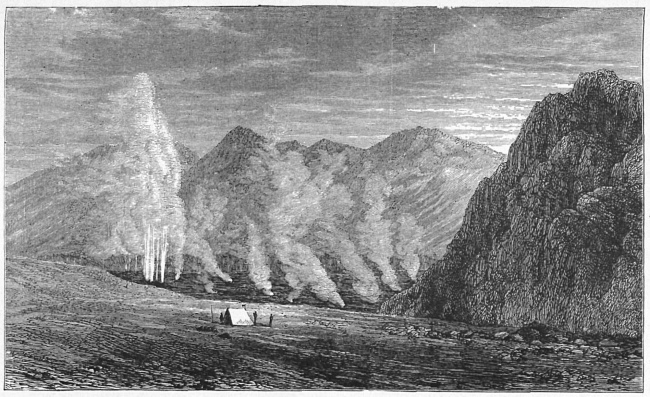
THE ÖSKJUGJÁ.
Page 88.
The eastern and western sides of the crater converged towards the south, being shut in by lofty mountains, which rose in some places to the height of 1000 feet above the plain of Askja; so that they appeared to be shorn of their inner faces by the violence of the eruption, which had left perpendicular cliffs of great height. The edges of the crater, too, were rapidly tumbling in, and had formed in several places steep slopes of pumice and débris, which it was quite possible to descend; all access to the floor of the crater, however, was prevented by an interior rim of precipice immediately at the bottom of these heights. How long this shape will remain unaltered is, however, a matter of great doubt, for during our stay there, sometimes scarcely a minute elapsed between the roar of the stony avalanches, which increased the din and gradually altered the form of the crater! Three principal lines of fissures, pits, and irregular openings diverged from the centre of the crater to the south-east and west respectively. These, together with black patches of steaming ground and several minor cracks, were all that remained of the huge chasm which at one time must have occupied this valley.
I now selected a spot where there had been a considerable fall in the wall of the crater, forming a slope of a much smaller angle than anywhere else, and exposed a stratum of the previous winter’s snow which enabled us to obtain sufficient water for our breakfast.
My men slept here while I posted up my diary, but I was presently disturbed by a peculiar rushing sound. I instinctively looked towards the crater, and there saw what at first sight seemed to be a fog-bow amongst the steam, but presently the increasing noise gave sufficient evidence of its true character. It was a huge column of water springing up from a fissure in the bottom of the crater, which, being ejected in a slanting direction, almost described an arc, rising to a much greater height than even the level of the spot we were encamped upon, was, of course, converted into spray long before it reached such an elevation, and falling with great violence upon the opposite edge of the valley, caused a great portion of the wall of the crater at that point to fall away with a prodigious noise, the concussion of which produced a series of avalanches in various other parts of the volcano. One could imagine, from the effect of such a comparatively small body of water, what a terrible scene must have presented itself when the mountain was in a state of general activity, and when the entire crater vomited a vast volume of pumice, mud, and water, and the whole valley beneath was a seething cauldron of fire and water! We next removed to the lee of a large rock of agglomerate, and having scooped a bed in the pumice, slept comfortably, with the tent spread over all of us like one large blanket.
Upon awaking I ascended the highest point in the wall of the crater, which was almost its southern extremity, and there I found its height by my aneroid to be about 4500 feet above sea level, the angles by my azimuth compass being from Herðubreið 40° west, Skjaldbreið 103° east. From this point the floor of the crater appeared more bent about and upheaved, while many of its gaping fissures seemed much wider than before, doubtless the result of the longitudinal view of them which the position commanded; in fact, each fissure seemed trying to excel its neighbour in making the most horrible noise, while emitting the most nauseous smell. I doubt if even Cologne, in all its former nastiness and “thousand well defined and separate stinks,” could have produced anything so utterly putrid and abominable as the effluvia which were wafted to the summit we were standing upon! At one point it seemed just possible for us to reach the floor of the crater, and as it would save us a considerable detour if we were able to cross it, we packed up and began again to descend a very precipitous slope of pumice. From thence we descended as far as 750 feet, and then found our way barred by the interior rim of precipice before spoken of. Hitherto we had been unable to see its full extent from the overhanging wall of the crater, but from this vantage-ground it seemed to be about 300 feet deep, while the floor appeared to be dark mud: many of the fissures must have been twenty or thirty feet across, and others at least a quarter of a mile in length. I tried to measure the precipice by flinging over a large lump of the heaviest pumice, but it gave no sound as it reached the bottom, for it was so light I could not fling it far enough to see where it struck, hence we were afraid to go to the extreme edge of the precipice on account of the loose and crumbling nature of the rocks. Nothing now remained for us but to climb back again. This was no easy matter, because of the great angle of the slope, so I was compelled to dig my sore toes into the pumice with all my might; and in one place, for a distance of some 200 feet, to dig steps with my ice axe. We reached the summit at last, very warm, but very glad to be at the top instead of at the bottom of those 750 feet, for had we slipped, we should in all probability have fallen to the bottom of the crater. At last we arrived at the plain of Askja by following along the top of cliffs upon the eastern side of the crater, and there we found everything covered with a dark brown loam, which was still falling thickly around us. I next inspected the pit I had noticed in the morning, which was situated by itself at the top of the precipice, and found it about a quarter of a mile in circumference. Upon looking into it, for a long time nothing could be seen but dense clouds of steam and loam which were rising from it with intermittent violence; but after a while a large portion of the margin slipped in, and stopping the steam for a few moments, enabled us to discern a black funnel-shaped pit tapering towards the bottom, from which huge volumes of steam were again beginning to rise; then came a sudden burst of hot steam, loam, and stench, which again compelled us to make a precipitate retreat. I next investigated every part of this side of the crater in order to see if I could by any means descend to the floor of it, but I found the interior precipice extended all round, and at every point prevented my doing so. We therefore camped but a short distance from the pit, that we might be the better able to watch the wonderful and varying manœuvres which from time to time were enacted.
The worst of our position now was, that it lacked both snow and water, but the loam made us a tolerably nice soft bed, and we slept soundly. Soon, however, a heavy fall of loam upon our tent awoke us, and our eccentric friend outside was uttering such fiendish noises, and giving off such a putrid stench, that we thought the better part of valour was to retreat; so we hastily packed up amid a copious shower of loam, our movements being quickened by the surmise that we might also be treated to a little pumice and hot water. Moreover, the stench was beginning to tell upon us, causing us to feel sick. We next proceeded along the N.N.W. side of the crater, as I wished to count the number of paces along it, in order that I might approximate the size, which I found to be about one and a quarter miles in length. The ground was now much fissured, and disclosed in many places the snow of the previous winter at the depth of six feet beneath the pumice, as well as a quantity of loam which had been flung out by the volcano. After breakfasting beside one of these fissures, at mid-day we turned our backs upon what I can imagine to be one of the most marvellous, and perhaps I may add, one of the most indescribable sights the world can anywhere present! On resuming our journey, we set our faces towards Skjaldbreið, alias Trölladyngjá, and the first part of our journey was across the little plain of Askja, over a lava stream, which here enters from the Ódáðahraun, and had run for some distance up hill. The loam which had been showered down by Öskjugjá had taken the edge off the lava, which was a great source of comfort, and soon we were glad to sight the broad black desert of the Ódáðahraun. There was the snowy mound of Skjaldbreið, spotted with black lava, with its curious tuft of rock at the top, somewhat similar to that on Herðubreið. Before us there was Kistufell, by which we had first descended into Norðurland, and behind all, the broad expanse of the Vatna Jökull, sweeping the horizon from east to west, where it appeared in the distance to be joined by Tungufell and Tindafells Jökull. From here, we could not see the Sprengi Sandr, which lay between them, but perceiving through my telescope a patch of snow upon the hills which almost joined Skjaldbreið upon the east, I determined to strike a line across the Ódáðahraun to it, that I might take another rest and relinquish all our loads before we ascended Skjaldbreið the next morning.
I may here remark that the Ódáðahraun is a desert of sand and lava, extending over an area of 1200 square miles, the greater part of which seems to have flowed from Skjaldbreið, so I think it must be one of the oldest lava flows in Iceland, for this volcano has not erupted since 1305. Some of the lava may, however, have flowed from the Dyngjufjöll, or, possibly, from fissures in the plain itself. I could, however, trace no distinct stream from the above-named mountains, nor has any one, I believe, travelled along the west side of them for the purpose of ascertaining. In several places the lava of the Ódáðahraun has run up hill. This, I believe, has been occasioned by the crust which flowed upon the surface of the lava stream, constituting a sort of pipe with the ground upon which the stream rested; and the air being thus excluded, the still liquid lava underneath has acted in the same way as water would when enclosed in a pipe, by finding its own level, or approximately so, according to its degree of fluidity. At any rate it took us five hours to cross the Ódáðahraun and reach the snow patch I had seen. There we rested, and early next morning, accompanied by Thorlákur, I set off for Skjaldbreið, leaving Eyólfur, who was very tired, in camp. We next followed an immense lava stream about half-way up the mountain, and during the early part of our walk I several times heard the muffled sound of water running beneath the lava. When about half-way up, we reached deep indurated snow, through which protruded the black hummocks and masses giving Skjaldbreið such a mottled appearance when I first saw it from the Dyngjufjöll mountains. Skjaldbreið is, however, nothing but a huge mound of basaltic lava, partially covered with snow, rising by a very gradual slope to about 4000 feet above sea level, and from it has evidently flowed the greater part of the Ódáðahraun, though, as all the neighbouring mountains seem to have erupted at some period or another, it is but fair to presume they have also helped to swell this vast wilderness of volcanic dregs; but I have been unable to trace any lava stream in the Ódáðahraun to any other source than Skjaldbreið. The summit of Skjaldbreið I found was thickly enveloped in clouds, so I stopped when within 300 feet of the top to look at the surrounding country. To our north lay the arid waste of the Ódáðahraun, the unearthly desolation of which I have never seen equalled. Truly, it may be said that it extends over but a small area when compared with many of the mighty deserts in other parts of the world, but there is a forbidding, yet fascinating grimness about this which is an especial characteristic of Icelandic scenery, and as this savage region extends as far as the eye can see, it produces none the less vivid impression upon the mind of the beholder, although one can refer to the map and find that it extends over only about 1500 square miles. When first gazing at a dreary Icelandic lava desert the sensations are something akin to those experienced when for the first time one sees a prairie immediately after the fire has swept across it; but although one is conscious that there may be a million instead of a thousand square miles of burnt, black, cindery country around, it does not impress one with its awful magnificence and grandeur of desolation as the Ódáðahraun does. To the north and east were the Dyngjufjöll mountains, with their volcanoes smoking away with renewed vigour in the cold morning air. A point further to the east was the long weary route we had just traversed, stretching away bleak and bare to where the grey pumice in the distance gave the country the appearance of lying in bright sunshine. To the south rose the Vatna Jökull, cold and gloomy, with its heights wrapped in fog and mist. Kverkfjall and Kistufell, however, were exceptionally clear; the former was smoking in three places, and a great quantity of sand and lava appeared to have proceeded from it. Between us and the Kverkfjall swept the broad tongue of glacier, reaching two-thirds of the way northward towards the Vaðalda hills, and from its extremity I counted five arms of the Jökulsá which issued from it, while the small stream from Kistufell was hidden by the intervening hills. We next continued our journey to the summit, and then found a small but perfectly formed crater, about 500 yards in circumference, but of no great depth, while in the centre rose a ridge of burnt lava, which gave the mountain the black tufted appearance I had noticed in the distance.
The latest eruptions, I should imagine, from the contour and disposition of the surrounding lava, have taken more the form of prodigious boilings over than of explosive outbursts, and it seems as if it had continued to burn tranquilly long after its last outburst. From here we descended a short distance upon the north-west side, in order to get below the fog, and obtain a view of the country to the west. The same dreary desolation presented itself—the pure white Jökull, with the black sand and the rugged lava fields were alike cold, silent, motionless, and dead! The mountains were a little different in form, but there was the same grand desolate wilderness, seeming ready to blast every living thing that dared to intrude on its enchanted solitude. We therefore returned to camp, and were not sorry to sit down to a good breakfast of pemmican, bread and butter, and water. The sun shone fiercely at midday, and the heat, radiated by the sand and lava, became so great that we rested till the cool of the evening, when we struck for the south-east end of the Dyngjufjöll, which we reached about midnight, but as a thick fog descended upon us, I steered close along the base of the mountains, preferring a little circuit to wandering about all night in uncertainty upon the plain. Our course from here was over an old lava stream, buried in light volcanic dust, which was very trying to travel over, for we sunk rather deeply into it, and had to stop every now and then to empty our shoes, which were constantly becoming filled with sand. At length we struck upon the pumice, which showed we were nearing the volcano of Öskjugjá; soon after we came to a small stream, and being all very thirsty, the water was highly appreciated. Seeing that the pumice increased, and fearing we should be getting too far to the east, I resolved to follow the course of the next stream, conjecturing that it would bring us down to the pools by which we had made our cache. It was a crooked way, but it brought us right at last; for as the mist dispersed we sighted the pools, and it was not long before we gladly lighted upon our cache. The first thing that came to hand was a box of Fry’s chocolate powder, so we all sat down upon our packs and with our broad knife blades began to operate upon the powdery treasure. Eating chocolate powder we found was thirsty work, so having emptied the box, we took a good drink of water, pitched the tent, and turned in.
We had hitherto been using stones for tent pegs, but here there were none to be had, and as we could not now avail ourselves of little screws of hay, as we had done when last camped upon the same spot, we took off our mocassins and buried them, with a string attached to each, at intervals round the tent; these answered the purpose of pegs very well, and as it is always necessary to bury untanned mocassins while resting, to prevent them from shrinking and becoming too hard to wear, we, by this device, managed to “kill two birds with one stone.” After a good sleep, I debated on the possibility of reaching the Kverkfjall, which I particularly wished to examine, but the Jökulsá and a long stretch of country lay between us, and as Thorlákur assured me if we did so we should have soon “to go on our naked feet,” it was a matter for grave consideration what was best to do. The lava had already played sad havoc with our foot-gear—we had each of us worn out four pairs of mocassins since we left Grímstaðir—and those which were doing duty as tent pegs were almost played out, while there were but two pairs remaining in our small stores, which was anything but encouraging. Moreover, we had a long way before us yet; so all things considered, I came to the conclusion that Kverkfjall was impracticable. I determined, therefore, to ascend the Dyngjufjöll again, and from the peak above us take a farewell look around, directing Eyólfur in the mean time to carry all our things to a small stream at the foot of the mountains, about two miles north of our present position, which could be easily done in two shifts. Accordingly, I began my climb accompanied by Thorlákur, but our progress was continually interrupted by deep “gjás,” or fissures, many of which were of great depth, probably several hundred feet. In some cases, however, we found bridges of snow and pumice, by which we were able to cross these chasms.
At this time the sun was wending its way westward across the snowy slopes of the Vatna, as we reached the top of this part of the Dyngjufjöll, and really language quite fails me when I attempt to describe the wildness of that view! Behind us was the volcano, from which vast volumes of dark smoke and steam were rising; the various mountains which studded the sterile wastes before us were all clothed in the same dull grey covering; the black sand of the Mývatns Örœfí was just visible to the north, and as far as the eye could see eastward, there stretched a series of mountains, valleys and wasted plains. During nearly two hours we might almost be said to have slept in the view before us; indeed, I was hardly conscious how the time had gone until the sun seemed to have slipped behind the Hofs Jökulls, giving their snows a golden outline, while my watch reminded me that it was nearly 11 P.M.
The atmosphere now turned very cold, the frost was already sparkling upon the surrounding rocks, a purple glow stole over the mountains, blending their softened outlines with the tinted sky, and we felt that a little brisk work would sensibly add to our comfort. Our descent afforded us some amusement, sliding down the steep beds of small pumice, which we did at a furious rate. It had taken us more than three hours to ascend the mountain, but less than one to come down it! We found Eyólfur where I had directed him to wait; making a good meal, we patched up our mocassins as well as we could by moonlight, and by a different route to that by which we came we struck a straight line for Herðubreið. Ultimately we reached Herðubreið with the sun, and I was not at all sorry to find myself on my way home; for increased inflammatory symptoms in my great toe showed that a liberal application of blue-stone and rest were absolutely indispensable to its cure. The weather by this time appeared very uncertain, for the heavens were spotted all over with masses of golden nimbus, drifting rapidly before a wind which was blowing above, though the atmosphere beneath was perfectly calm, which are invariably indications of storm in Iceland.
We were now clear of the pumice, and after a hard scramble over some very rough lava, part of which had flowed from an ancient volcano not marked upon the map, about eight miles S.S.E. of Herðubreið, part, apparently, from the Dyngjufjöll mountains, and some from Trölladýngjur (Troll’s bowers). Here we camped by a pool of water.
Herðubreið, whose trigonometrical height is 5447 feet, is a snow-covered cone, resting upon a perpendicular mass of rock, whose height equals about twice the diameter of the cone. Upon its south-east and west sides are tali of disintegrated and greatly weather-worn rocks, and bulging, misshapen masses of agglomerate. At every point except the S.E. and N.N.W. the sides are perfectly perpendicular, presenting walls of about 2000 feet from the base of the mountain to the commencement of the snow-covered cone; it is surrounded by a dry sandy foss, and choked in places with rounded débris, which had fallen from the agglomerate of which Herðubreið is principally composed.
Probably the most remarkable feature of this mountain is that no streams of water flow down its sides, while the base of most other Icelandic snow-capped mountains are generally watered with streams, which, as we have already seen, often disappear in sandy or cavernous ground; but here all the water which must result from the melting of the frozen accumulation upon the summit of Herðubreið seemed utterly lost, until it issued in springs such as those which form the source of the Lindá, at a considerable distance from the base of the mountain, or collects in pools such as Herðubreiðvatn.
The gulleys which had in many places worn the side of Herðubreið into the fantastic forms so peculiar to this formation (agglomerate), appear to be the result of rain and wind, and the only points from which the mountain is assailable are the S.S.E. and N.W. It was from the latter that Captain Burton attempted it in 1872, and that experienced traveller seems to regard it as the core of a much larger mountain; possibly such may be the case, but its shape is decidedly against its being a volcano of anything but the most ancient order. History tells us, however, that this mountain has erupted upon several occasions. The eccentricity of its form is sufficient to suggest any amount of speculations as to its origin and character, while nothing but a careful investigation of the mountain from the base to the apex could enable anyone to arrive at a satisfactory conclusion. The palagonitic agglomerate (which, as I have said, constitutes the greater part of the mountain), is of so friable a nature, and so rapid is the erosive influence of the Icelandic climate, while so disturbed and metamorphosed has the whole of the island been by volcanic agency, that one ceases to wonder at the eccentric shape and anomalous character of its mountains.
I much regretted being compelled to pass by Herðubreið without attempting to ascend it, but our foot gear was in tatters and my sore toe required immediate attention, so we camped in a large gulley of sand and lava, which extended a mile or more, gradually rising to the level of the plain towards the south. Here, while we were lying with the tent spread over us all, blanket fashion, and had just dropped off to sleep, we were suddenly awakened by such a blast of wind, and a deluge of the finest sand and pumice, that for the moment I didn’t know what it was. At first we started to our feet, only to get our eyes full of finely-powdered pumice, and as I tried to speak I got my mouth full. We saw all the smaller articles of our packs making the most speedy tracks for the more settled portions of the country. I tried to save my hat, but in so doing kicked my bad toe against a lava block, tangled my feet up in the tent rope, and fell down, the latter being about the most sensible thing I could do, for in a few moments the gust was past and I could look up.
Blind with the sand, and wild with the agony it was occasioning us, we all rushed for the water, and opened our eyes in it. While so doing there came another gust, which compelled us to wait upon our knees, keeping our heads in the shallow water until it was over; and then, soaked with sand and water, we made our way back to where our things had been. I say had been, for all were not there then; my broad-brimmed Danish hat, and half my small etceteras were gone, and, worst of all, my map and case, where were they? Four white spots upon a lava field a quarter of a mile away caused me to run—yes, run—bad toe and all! However, my painful and spasmodic effort was amply repaid by the recovery of Olsen’s map, which had been nicely mounted and packed up in a case by the bookbinder at Reykjavík; now, even the bookbinder would scarcely have recognised it. Its journey across the Vatna Jökull had not improved its “personnel,” but the short cut it had made through the neighbouring pool had in some places rendered it illegible. Fortunately the Vatna Jökull and its surroundings, with my various markings, were miraculously preserved, but its case I never saw again.
To return to camp. Everything that had been buried in the sand had been dug out, and just as we were about to start again another gust came sweeping down the gulley, half smothering us. We buried our faces in our mackintosh coats until it was past, when my companion Thorlákur remarked, “This is not fine;” to which I assented in the most emphatic language my stock of Icelandic would command. We now made very fair progress over the lava field, where, under an overhanging lava block, we bathed our eyes with sulphate of zinc and rose water, which had often been a great relief during my Icelandic journeys, and I advise all travellers who may follow in my wake by no means to omit taking so essential a medicament. We soon reached the grass at the source of the Lindá, which river rises from a single spring about two miles N.N.E. of Herðubreið. Here we took the rest we had been unable to obtain at our last halting-place, and by evening we reached the remainder of our party at the Grafalandá, where I was rejoiced to find our horses and a good supply of provisions, which had been sent with a kind note from the good people of Grímstaðir, who had sent us some pancakes, flat bread, coffee and milk, and the latter, though sour, was very acceptable. From Vopnafjörd I also had ordered some schnapps and chocolate; so that we made what seemed to us a right royal feed, and after a good wash, I enjoyed a night of sound rest in the sleeping bag, which had previously sheltered my men who had been waiting for us upon the banks of the Grafalandá.
At 5 A.M. the next morning we were on horseback, and away over the sand and the lava of Mývatns Örœfí, leaving the Vatna Jökull and the land of the outlaws behind us, enveloped in clouds of light grey dust which were blown up from the pumice by a S.E. wind. This dust, I must explain, was of the most irritating nature, resembling finely-powdered glass; our clothes got saturated with it, and I was already beginning to feel its effect in the severe abrasion of skin it was inflicting upon me. By 12 A.M. we were level with Grímstaðir, only much more to the west, and here we stopped to allow the horses to graze off the wild oats, for the heat of the sun was intense. After lunch we must all have taken a nap, for suddenly looking up, I found it was one o’clock, and the horses were nowhere in sight, and more than an hour elapsed before we recovered them. Having secured the vagrant animals, we made for the new lava, which was produced by the eruptions of last spring in the Mývatns Örœfí. Sulphurous and acid vapours had long announced its proximity, although the wind was unfavourable for their reaching so far. This lava stream, which is about fifteen miles long, and varies from one to three broad, has flowed almost entirely over ancient lava streams, most of which have flowed from an old crater situated in the vicinity, called Sveinagjá. The new lava extended to about an English mile to the north of the old road from Reykjahlíð to Grímstaðir.
At this particular point it is bordered by a rather fertile stretch of ground, where a few sheep managed to sustain a miserable existence on cinders and salix, though further to the north and east there are excellent pastures. The lava stream was basaltic, and presented the usual chaos of black crags, waves, and fanciful shapes, blisters, and heaps of clinker. It was intensely black, and still hot; thin, pungent choking fumes being emitted in all directions, while from various places puffs of steam were constantly bursting out. This stream, or rather, these two streams, which have since joined one another, I find have flowed from a long fissure in the plain, the course of which was marked by a line of conical mounds thrown up by the eruptions in the late spring; of these a fuller description will be found upon another page, and an account of the previous eruption in the Appendix.
We climbed a few hundred yards over the lava stream, but could not reach the mounds from which the lava had flowed, on account of the deleterious fumes exhaled from them. The fissures were lined with various sublimations, to the thickness in some places of half-an-inch. Amongst them chloride of ammonia was very prominent, but this was in a state of rapid deliquescence. It might have paid to collect it, for the quantity was considerable.
We next turned more than a mile out of our course, to a part where Thorlákur expected to find some water, for we were all very thirsty. Our road, however, was over old and viscous lava for some distance, and we came upon some coarse hillocky grass land, in a line north of the lava stream. Here we encountered a variety of fissures which had been formed by the earthquake, several of which, Thorlákur informed me, had cast out sand, stones, and a little lava. We found only dry pits at the place where Thorlákur had expected water, so nothing remained but to strike westward for Reykjahlíð. No doubt the various cracks and fissures so recently formed in the plain accounted for the absence of water.
The new lava obliges a traveller from Grímstaðir to Reykjahlíð to go three miles out of his way. We here crossed a depression of about thirty feet, extending over several square miles, caused by the late volcanic disturbances. In the vicinity of this depression the ground was upheaved and much fissured. Thorlákur informed me that the depression was formed shortly after the first eruption in the Mývatn Orœfí in the preceding spring. We were, however, soon amongst the hills of Mývatn, where we obtained some water, and before long ascended the Námufjall, whose dirty yellow, red and brown sides, had in some places the appearance of washed-out posters. Here the smell was filthy. In this locality the treasures of the Northern Sulphur Mining Company are situated, but as I was thinking more about my supper than the hidden wealth of the hills over which we were riding, I will say more about them presently.
A wadi near the summit which divides the Námufjall upon the south from the Dalfjall upon the west, brought us to the western side of the sulphur hills, where we first caught sight of the Lake of Mývatn, or Midge-water, upon the north end of which Reykjahlíð is situated. Lake Mývatn is seen to the best advantage at a distance, but it cannot lay claim to great beauty of appearance, although certainly both remarkable and interesting. Surrounded as it is with volcanic mountains, and rugged lava streams stretching along its shores, studded with misshapen little islands, it presents an eccentric and striking aspect. A short ride past spluttering and steaming solfataras brought us to the farm of Reykjahlíð, where we were hospitably received by the bóndi Pètur Jónsson, who was expecting our arrival.
Reykjahlíð is of the average better class of byre. The farm is a good one, and has been in the possession of the same family for 600 years. I was glad to find Paul and the rest of my belongings awaiting us, and anything but displeased to receive the information that an Englishman occupied the guest chamber. My compatriot I found to be Mr. G. Fitzroy Cole, who was making a survey of the neighbourhood for the Company purposing to work these northern sulphur mines. I also heard that a sulphur prospecting party, under the guidance of the well-known Captain Burton, had only just left for Húsavík, upon the sea coast. The guest chamber being thus occupied, I shared another room with Paul and Thorlákur, and in the morning I had the pleasure of making Mr. Cole’s acquaintance, sharing the guest room with him, and likewise a magnificent salmon.
The two days following I rested, as the weather was so unfavourable. I also paid off all my men excepting Paul and Olgi, and sent them home to the south. Mr. Cole in the meantime left, so I proceeded to investigate the sulphur mines for myself. These I found to be situated in the Námufjall, upon the eastern side of the Lake of Mývatn, and these collectively are designated the Hlíðar-Námur; they consist of a series of solfataras, which occur not only upon the Námufjall itself, but extend a considerable distance upon either base of the mountains. The Námufjall is composed of palagonitic agglomerate and lava, the solfataras being simply pools of calcareo-siliceous mud, formed by the decomposition of the lava and agglomerate. Upon the surface of these pools the sulphur sublimates in crusts varying from half-an-inch to several feet in thickness. The phenomena of solfataras are so well known that it is needless for me to dilate upon them in the abstract. However, I first examined the west side of the Námufjall, where I found both active and latent fumeroles, the former spluttering and fizzing, and tranquilly steaming, the latter in the form of cold accumulations of sulphur, siliceous clay and gypseous earth. I was able to follow the tracks of the sulphur exploring party, who had preceded me. They had dug into the sulphur crust upon the surface of the solfataras, and in some places had excavated the calcareo-siliceous clay, which hardens into a species of sinter. This clay likewise contains a percentage of sulphur; at all events the specimens I obtained varied from 5 to 40 per cent. In many places I found crusts of sulphur covered over with light débris, which a little digging showed to extend for a considerable distance. Roughly estimating it by stepping the length and breadth of the various conspicuous sulphur patches, and lumping the smaller ones together, gave about twenty sulphur-covered spots of twenty square yards, upon which the crust of pure sulphur averaged probably half a foot in thickness. On ascending the Námufjall by a deep gulley worn by the rain in the side of the mountain, we found this gulley to be cut through several feet of a friable arenaceous agglomerate, formed by atmospheric action on the disintegrated constituents of the rocks composing the Námufjall. Passing various patches of steaming sulphur, we reached the summit, where we found several solfataras which bear perhaps the thickest deposits of sulphur, though, in the aggregate I should hardly think they extend over so large an area as those upon the western side of the mountain. This mountain is capped by several castellated masses of basaltic lava, much weather-worn and decomposed by the acid vapours evolved from the surrounding solfataras, which upon the eastern slope are decidedly the most extensive to be met with, and I imagine they contain more pure sulphur than either the summit or the western side. Of course when speaking of the relative amount of sulphur, I allude to the exposed crusts, and there must be a great deal more sulphur than appears upon the surface.
Upon the east base were circular pools of bluish boiling slush, which emitted a fœtid smell somewhat resembling the effluvia which so disgusted us at the Öskjugjá. These pools boil with great but intermittent violence, sometimes splashing the scalding mud to the distance of four or five feet. They have surrounded themselves with walls of hardened mud a few feet in height, and from a breach in two of these walls I should imagine that these springs were occasionally subject to paroxysms of extraordinary violence. While approaching the most northern of these slush cauldrons, the earth on which I was walking gave way, and I slipped into a fissure up to my armpits; a violent burst of steam from beneath me was the immediate result, and I was glad to be extricated from this unenviable position by my companion Olgi. It was indeed fortunate the fissure was not filled with boiling slush, or I might have been scalded even more severely than was my travelling companion, the Rev. J. W——, in 1874, in the solfataras of Krísuvík, in the south of Iceland. This fissure had probably been formed by the earthquakes in the spring, and had at one time been filled with slush, which had hardened on the surface, and afterwards flowed away through some other channel, leaving a treacherous pitfall for any unlucky tourist who, like myself, should have a fancy to closely examine these slush pools.
On returning to the west side of the mountain, and on my way to Reykjahlíð, I took the liberty of scraping off all the sulphur from a small solfatara, which I piled in a heap by the side of it; for the grand question for the Sulphur Company to consider, to my mind, appears to be—how long does this sulphur take to accumulate? I trust Mr. Locke, the owner of these mines, will forgive me the trespass; but in a year’s time he will be able to form some idea of the rate of accumulation. I shall feel curious to know how soon the sulphur will again accumulate.
We next returned to Reykjahlíð and supped with the bóndi Pètur Jónsson, his son-in-law, Thorlákur, and Paul. The former seemed a little aggrieved at the sulphur business generally, and from what I could gather, it had from time immemorial been a sore point as to whether the sulphur mines belonged to his family or to the Danish Government. There could not be the slightest doubt about the matter, but I could scarcely wonder at the existence of such a feeling; for a family who had owned the neighbouring country for 600 years might naturally think the intervening mountains were their own fee simple. This feeling quite accounts for any brusquerie the Sulphur Prospecting Expedition may have met with. I can only bear testimony, that during my stay at Reykjahlíð I received the kindest attention, that I had the best of everything there was in the place, and that the charges were moderate. Old Pètur informed me that he was building a stone church in place of the old turf and wooden structure, which required repair. He had plenty of stone, but his chief difficulty was the want of lime; in fact, he had been obliged to import all he had hitherto used from Denmark, which of course was very expensive to him; so I advised him to try and burn the gypsum from the solfataras, and instructed him how to set about it, which piece of information seemed to rejoice his heart exceedingly.
The old church in question is the veritable building, with some additions and improvements, concerning the escape of which from destruction during the eruption of some craters to the S.W. of Krafla, in 1720, so much has been said and written. Suffice it to say, that the lava could not have reached the church unless it had previously filled up the Lake of Mývatn. My day’s work ended with making preparations for a visit to Dettifoss.
The morrow brought very unsatisfactory weather; it had snowed heavily in the night, and the mountains and ground were white, a piercing north-west wind was blowing, and it seemed as if we had suddenly jumped into mid-winter; however, by nine o’clock we were on horseback. As we journeyed on we were much amused and surprised to see hay-making going on in the middle of a snow storm; but still it was the fact that the good people of Reykjahlíð were busily engaged in the tún (home field) mowing grass, and piling that which had been cut a day or so previously into cocks, that it might receive as little injury as possible. Leaving Reykjahlíð behind, we crossed the rugged lava at the west base of the Námufjall, and ascended the winding path of the Námu-skarð which divides the Námufjall from the Dalfjall, and turning to the north pursued our way by the side of an ancient lava stream, covered with verdure, and thence bending sharply to the north-east we reached the little bothy of Skarðsel, a poor dilapidated hut of turf and lava blocks, which sheltered some of the servants from Reykjahlíð, who during the summer months tend the sheep in the neighbouring grass land. Here we took a good draught of milk, and leaving behind us a large piece of Mr. Cole’s salmon, some hard tack, chocolate and schnapps, to refresh us upon our return, we crossed the Sandbalnafjöll by means of a sandy pass, and reached the plain of the Mývatns Örœfí amid a blinding storm. Our route lay again over lava, covered with sand, which I was informed had been ejected by Krafla. On, on, N.N.E., the storm utterly defying our tattered mackintoshes. A little herbage had begun to make its appearance, and presently we were galloping over excellent sheep pastures, varied occasionally by barren stretches of sand and pebbles. Several times, however, we were stopped by fissures which had been very recently formed in the plain, probably by the volcanic action of the previous spring, but very insignificant in comparison with those we had previously met with in the Mývatns Örœfí. At last, after about six hours’ riding, we sighted the column of spray arising from the Dettifoss, and soon after we descended into what appeared to have been the bed of a large river, most likely an ancient bed of the Jökulsá, which may have been diverted to its present channel by an earthquake; while upon ascending its eastern bank, the dull roar of the Dettifoss reached us. Climbing over crags of basalt we rode to the edge of the river, where we dismounted upon a patch of excellent grass, and thence obtained a good view of the cataract, which is very imposing. The Jökulsá is here about 250 yards across, and roars along in a series of rapids, till its broken and foaming waters pour down a perpendicular wall of basalt at least 200 feet in height, into a chasm some hundred yards wide, seething and boiling in pent-up wrath, forming a “riotous confluence of water-courses, blanching and bellowing in the hollow of it,” until, released from this confinement, it softens, a few hundred yards further down, into a broad swift-flowing stream of milky water. The Dettifoss is by far the largest waterfall in Iceland, and, I believe, in Europe, being about the size of the Canadian Niagara Fall. The only view obtainable, however, is not calculated to impress the beholder with an adequate idea of its height, for one has to look down upon it, which is always a disadvantage: still, although the Dettifoss lacks the beauty of Niagara, it does not convey the impression of the thinness of the body of water, as does the Transatlantic cataract; for the grace and beauty of the latter are greatly enhanced by its surroundings of richly-wooded heights and the clearness of the water. Although Dettifoss is much smaller than the Falls of Niagara in their entirety, nevertheless, it is a grand and terrible spectacle, and is all the more striking on account of the diablerie of the wild scenery by which it is environed. There is an upper cascade, but of no great height, and it is scarcely worth naming beside Dettifoss; for one waterfall is so much like another, that, after having seen several of the largest, one rather tires of the similarity, unless there be some distinguishing peculiarity to enliven the interest.
When satiated with admiring the scenery at this part, we took a light meal, and commenced our return journey amid pouring rain. It was past midnight before we reached the west side of Mývatns Örœfí; and as the mist had somewhat lifted from the hills, I turned my horse’s head towards Krafla. Upon reaching the height of a few hundred feet the mist again beat down upon us; besides which the snow lay so thick in many places that it became very dangerous for the horses in the half-light and fog. We therefore abandoned Krafla for the moment, and taking the first gill which ran in a southerly direction, we descended to the little hut where we had left our salmon and reserve supply of provisions. The good folks were in bed, but one of the women immediately got up to assist us, and the other produced, first the bottle of schnapps, and then, one by one, the biscuits and the chocolate, from what appeared to be the only cupboard in the place, viz., from underneath the bedclothes. As the bed had three occupants, I was in terror lest my salmon had been stored in the same undesirable repository, but fortunately it had been put up outside. The biscuits and chocolate might have been none the worse for their safe storage, but they were unpleasantly warm, and I preferred to wait for the salmon, which with some good coffee, sheep’s milk, and schnapps, was not to be despised by a hungry traveller who had been exposed to the storm for nearly a score of hours.
We reached Reykjahlíð at five A.M., and I turned in for a short sleep, till breakfast at seven o’clock, and then we made our start for Krafla. Over the Námufjall again, by the Námu-skarð, a gill of solfataras, we passed the parti-coloured heaps, slopes, and accumulations, which reminded me of the refuse from some huge dye-works, and turned to the north along the east base of the Dalfjall, skirting a lava stream upon our right hand. Hereabout the aspect was much improved by (for Iceland) a luxuriant overgrowth of dwarf birch and salix. Crossing hence to the base of Sandbalnafjöll, we drew up for a minute at the little hut of Skarðsel for a draught of sheep’s milk. Pursuing our way over a lava field covered with alluvium, we hastened on towards Krafla. We hobbled our horses at the base of the high ground between Krafla and Leirhnúkur, and forthwith commenced the ascent, passing several solfataras of no great importance, their chief characteristic being the production of abominable smells. Soon after we reached comparatively level ground, which extended for some distance at the S.S.W. base of Krafla proper. Cheered by the sight of our horses making tracks for home, in spite of their hobbles, we now continued along the south-west margin of a crater-lake, which probably was more than two miles in circumference, its length equalling about twice its breadth, being surrounded by steep slopes of clay, disintegrated rock and fragmentary débris. There was a similar crater further to the N.N.W., of more circular form. Following along a neck of land between the two, we commenced the ascent of Krafla proper, which is a sub-conical mass of agglomerate, pierced to the summit and in many other places with intruded lava. The sides we found to be everywhere strewed with all kinds of volcanic débris, amongst which were numerous trachitic masses, some of which contained atoms of iron pyrites, and although these occurred very frequently in loose fragments and masses, I was unable to find any in situ. Half-an-hour’s hard climbing next brought us to the summit, which my aneroid shewed to be scarcely 3000 feet above Reykjahlíð, or a little under 4000 feet above sea level. On looking around we found upon the high ground to the west several pools of clear water, probably small crater lakes, as doubtless were the two depressions immediately beneath us to the south-west. My guide informed me that it was from the most northern of these that the last eruption of Krafla proceeded, and that the water in it used to be hot; he also told me a fact which was afterwards corroborated by his father, that Krafla had never been known to erupt lava, having cast out only ashes, pumice, sand and water; indeed, the aspect of these pit craters would lead one so to imagine it. I was also much surprised at not finding any obsidian, for I had heard so much of the obsidian of Krafla; but on further inquiry I ascertained that it is only found on the portion of the mountain known as the Hrafntinnuhryggr (the obsidian back), and there it only occurs in fragments—indeed, the only obsidian I have met with in situ in Iceland is at Mount Paul, in the middle of the Vatna Jökull.
The summit of Krafla commands a most extensive view. Looking south-west, over the hills beneath, with their dirty splotches of whitish yellow sulphur, the country looked wintry indeed after the snow storm of the previous day, while the eye as it wandered southward caught a fine view-range over the Hliðarfjall and Dalfjall, as well as over the straggling lake of Mývatn, where the scenery widened out over the Mývatnsveit towards the snow-capped Seljalandsfjall, standing out like an island in the commencement of the dark stony sea of the Ódáðahraun. In another direction, between the snow-covered hills upon the east side of the Skjálfandifljót and the smoking Dyngjufjöll, the view extended over the pitiless waste of the Ódáðahraun to the snowy mound of Skjaldbreið, while the broad white expanse of the Vatna seemed to join the sky, till, almost wearied with the strain upon the visual power, it seemed quite a relief to turn to the nearer and happier-looking spots of green which the volcano and the glaciers have spared to Iceland.
Further to the east are the Bláfjall, where the Fremri-Námur deposits of sulphur are situated, and the fire-scorched hills of Trölladýngjur, whose position on the map Captain Burton has corrected, and the lordly Herðubreið, whose snowy cap looked all the purer for the recent snow storm. To the east and north-east stretched the plain of the Mývatns Örœfí, with its black patch of new lava enshrouded in a dim mist. Bearing N.N.E. was a tall column, apparently of steam, upon which the sun was shining; it was the spray from the Dettifoss, varying in shape as the wind acted on it, and reflecting rainbow colours in the sunlight. To the north the prospect was between the Hágaunguhnúkur (high-going hills) and Jónstindr, over a level country to the hills of Theistareykjafjall, where a third large deposit of sulphur occurs. It was seven P.M. before we returned to Reykjahlíð, and in a few hours we bade adieu to old Pètur and started along the eastern side of Lake Mývatn, accompanied by Paul and Arngrimur, for the little lake of Grœnavatn. The road was a bad one, over a continuation of lava streams which had flowed into the Lake of Mývatn, forming the curious little islands that spotted its sedgy waters. We put to flight several of the duck tribe, which were enjoying themselves after the manner of ducks upon the margin of the lake, and reached Grœnavatn at three A.M.; this was very slow work, but the nature of the ground prevented our travelling at anything beyond a walking pace for the greater part of the way. One of the principal features of this ride was the numerous gates which had to be opened and shut; these marked the termination of the various holdings, and also prevented the sheep belonging to the different homesteads upon the side of the lake from straying; for very often, where the gates were situated, the lava prevented the passage even of sheep by any other way.
The occupants of the farm at Grœnavatn may be described as “a happy family.” The two sons of Pètur of Reykjahlíð, Jón and Arngrimur, had married the two sisters of my previous guide, Thorlákur, and he, by way of returning the compliment, had married one of their sisters. They were all living under the same roof with Thorlákur’s father, and together managed their thriving homestead.
About midday we started for the sulphur mines of Fremri-Námur, on the east and west slopes of the Bláfjall and Hvannfell. Proceeding in a S.S.E. direction we crossed the lava which occupies the entire eastern side of the valley of Mývatn, and began to ascend the hills at the base of the Bláfjall. We here inspected two small but perfectly-formed craters, both of which had discharged lava streams into the valley beneath. A little further up the hill to the north of the Bláfjall we came upon the tracks of the Sulphur Exploring Expedition, under the conduct of Capt. Burton, who had passed that way a few days previously. From this point the hills commanded a striking view of Mývatn, Krafla, and the neighbouring mountains, with a glimpse to the south-west of Arnarfells Jökull in the far distance. This we found was a difficult route for the horses, and it did not improve as we reached the lava which had flowed from the Fremri-Námur at the time of its latest eruption. This lava stream had flowed into a valley between the Bláfjall and the Hvannfell, destroying all herbage except a little “island of green,” which it almost encircled; this small patch of verdure is called Heilag (holy valley). Here, choosing a spot where there was the most grass, we rested and lunched. The grass, however, was not plentiful, the greater part being what is called kinder-grass (sheep’s grass), or a mixture of straggling birch and salix intermixed with coarse grass and herbage. The sheep eat this with avidity, but horses must be very hungry before they will feed upon it. As we were about to depart a heavy snow storm burst upon us. My guide had no waterproof, but I had a large oilskin that Mr. Kent, one of the sulphur explorers, had given to Paul; we therefore took shelter under the lee of a crag in the ancient lava stream underlying the grass-land, and improvised a roof with the oilskin and our whips. We were imprisoned for more than an hour; so violent was the storm that it was impossible to see many yards around us. Eventually it cleared up; we had almost succeeded in keeping ourselves dry, and I think our drenched and shivering horses were only too glad to resume their journey.
It was getting on towards night; the wind was blowing from the north-west, making our soaked saddles anything but pleasant, for so suddenly had the storm come on that we had not time to unsaddle our horses. We next followed the lava stream for some distance until we sighted the yellow depression which marked the commencement of the sulphur mines. As we decided that it would be more pleasant to travel on foot, and that by doing so we could make better progress, we fastened our horses each with his head tied to the tail of his companion, and steered for the light yellow patches, from which a few wreaths of steam were curling. A short climb brought us to the most regularly-formed crater I have seen in Iceland. This was an oval depression, with a circumference of about half-a-mile and nearly 150 feet deep, called the “Great Kettle;” it was formed of a scoriaceous basaltic lava. No lava stream had actually flowed from this crater, but it seemed as if it had been tapped by a fissure some distance westward, whence a great quantity of lava had flowed, although all traces of such fissure or opening were now obscured by lava. The principal sulphur mines are upon the north and east side of the mountain, extending upon the latter right away up to the edge of the crater, and breaking out even within the crater itself upon its eastern side. I followed in the track of the exploring party, as I had done at Hlíðar-Námur, and dug into several parts of the solfataras. The sulphur here, as at the above-named place, rests upon a bed of calcareo-siliceous clay, and is strewed in many places with pieces of gypsum and fragments of lava coated with various sublimations; in some parts I found the pure sulphur to be upwards of two feet in thickness, the average thickness being, perhaps, half-a-foot. These deposits are much more extensive than those of Reykjahlíð, and I believe I did not inspect the whole of them. Returning to the summit, the extensive view was anything but a cheering one. To the east lay the Mývatns Orœfí, with its black patches of new lava, the thin vapour which was rising from it making it dim and indistinct; further to the south we looked across the Trölladýngjur to Herðubreið, whose snowy cone was alone brightened by the sunlight, which had long forsaken the dark, shadowy waste of the Ódáðahraun; due south were the Dyngjufjöll mountains, and upon them the night clouds were brooding heavily. A strong wind was raising great clouds of dust upon the plain which lay to the east between us and the Jökulsá. A fresh storm was rapidly shutting out the twilight in the west, and an ominous gloom had settled upon the rocks around us. A hunt after our horses in a blinding storm would have been anything but pleasant in such an inhospitable region, so we returned with all haste to our poor trembling steeds. Then with our clothes stiffly frozen, and our saddles covered with ice, all night long we rode in the face of a blinding storm, at a snail’s pace, on account of the darkness.
By two A.M. we arrived at the foot of Bláfjall. The snow had turned into rain, and amid a thick woolly fog we made our way over the lava stream which lay between us and Grœnavatn. Our pace was of necessity very slow, and it was not until four A.M. that we reached the farm. Here we found materials for a hearty meal spread out for us by the good folks, who had long since retired to bed. After doing justice to the catering of our unconscious hosts, I posted up my diary and turned in. On awaking again next morning I took a swim in the lake, and breakfast preparatory to my departure with Paul for Húsavík, where I hoped to have the pleasure of falling in with the exploring party. Passing to the south of the Lake of Mývatn, we crossed the Laxá (salmon river), which takes its name from the abundance of salmon found in the more northerly portion of its waters, and considerable time was here taken up in drinking coffee with an old friend.
The river Laxá, I may here remark, rises in the west end of the lake, and after flowing out a short distance is joined by the Kráká. From Mývatn Lake to Grenjaðastaðir (which may be called the upper portion of the river) its waters abound with trout and char, but at that point a waterfall (the Brúarfoss) prevents the salmon ascending the river any further. From the Brúarfoss to the sea there is, however, some of the finest salmon and trout fishing in Iceland, as many an English sportsman can testify. The Laxá, I found, emptied itself into the sea at the Skjálfandifjörð, not very far from the store at Húsavík.
Crossing the Mývatns Sandr, the road lies through an undulating grazing country, and upon the high ground to the south of the little Lake of Laugarvatn we caught sight simultaneously of the steam from the hot springs of Reykir, to the north-east the Arctic ocean, which washes the northern shore of Iceland, and the mountains of Theistar-reykir, where a third series of sulphur mines is located.
On, on we sped, as fast as our horses could carry us, as the English steamer, for anything we knew, might be on the point of starting. The Mýrarkvísl, however, was reached in good time, and as I had stopped behind to give my horse a drink, leaving Paul to go on before me, upon crossing the river I was pleased to find him in conversation with Mr. Kent, who had been fishing. Great was my joy, too, on finding that the steamer had not gone, and that the exploring party was still at Húsavík. Soon after we proceeded to the farm of Laxámyri, which was the best farm I had seen in the country, and must have cost a great sum for an Icelander, as it was built by Danish workmen, with a wooden carving of a salmon and an eider duck over the front door to indicate the sources of the owner’s wealth. Here I made a good meal, and after half-an-hour’s nap we were off again, in company with Mr. Kent, for Húsavík, where I met with a most hospitable reception from the members of the Sulphur Prospecting Expedition, and Herra Guðmundson, the merchant.
The sulphur party, I found, were submitting to an enforced stay, for their steamer was a week behind the time she was expected to arrive. They were all lodged in the house of the sheriff, which happened to be vacant, and a merry time they were having, especially the sporting portion of their community, who, I have no doubt, for a long time will sing the praises of Laxá.
Besides the veteran traveller Capt. Burton, there was another member of the party known to fame, Mr. Baldwin, a companion of the late Dr. Livingstone in his travels in Central Africa, whose “Twelve Years of Sporting Experience in South Africa” presents a series of vivid pictures of sporting travel.
Húsavík is pleasantly situated at the foot of Húsavík-urfjall, upon the eastern side of the bay of Skjálfandi, and has a good harbour except when the wind is blowing from the north. The mountains of Víkna-fjöll upon the western side of the bay form a great addition to the scenery; they were covered with snow even at this season of the year.
Having so long followed in the wake of the exploring party, it was impossible for me not to speculate upon the prospects of “the North Iceland Sulphur Company,” and my lucubrations ran in the following strain:—There is certainly no lack of sulphur both at Hlíðar-Námur and at Fremri-Námur, and the report of the prospectors on the smaller solfataras of Theistareykir-Námur is a good one. The road between the sulphur mines and the sea is not of such an impracticable nature but that it would be quite possible to construct a road, or to sledge the sulphur down in the winter. If the company set about their work in the right way and keep their undertaking in the hands of some half-dozen capitalists, they will probably not only enrich themselves, but also add another valuable export to needy Iceland. If, however, the shares are sent into the Stock Exchange, the chances are the undertaking will be weighted with too much capital, and thus be at the mercy of cliques of speculators belonging to that body.
After spending a night with the travellers, whose hospitality and agreeable society added greatly to the pleasure of my stay at Húsavík, the merchant, Herra Guðmundson invited me to stay with him, and, as I needed rest, I accepted his kind invitation.
Nothing could exceed the kindness of my host, and I do not know how the sulphur expedition would have fared had it not been for his kindness and assistance. I was beyond measure sorry, on my return to England, to see a long article in a Scotch newspaper, from one member or some members of the party, disparaging almost everything at Húsavík, and making invidious remarks about the wine which Herra Guðmundson had supplied us with from his own cellar, and which we had all partaken of with him at his house. Several members of the expedition whom I have since had the pleasure of meeting agree with me that it is a matter to be thoroughly ashamed of. After a few days’ rest I left Húsavík to visit the remarkable cliffs of Ásberg, which Herra Guðmundson had informed me were equal to those of Thingvalla: his sister and nephew joined me, so that, with Paul, we made up quite a pleasant little party. Unfortunately, however, none of the other visitors were able to go with us, for they were afraid the steam ship might arrive, and not be able to wait their return. The road we took to Ásberg lay across a monotonous stretch of country (the Reikjahlíð), which for the greater part of the way was undulating high ground, covered with ancient lava, partly grown over with dwarf straggling birch and herbage. The track which leads across it is called Bláskógavegr, or the way of the Blue forest. Bláberrie bushes are apparently the largest trees one meets with here; they, however, were rather abundant, and in some instances grew almost to the height of the long straggling apologies for birch brush which were occasionally to be met with. If it had not been that we were a merry party, I should have felt the journey decidedly dull; but it was not, and ultimately we arrived at the small farm of Ás about midnight, a short distance to the west of the river Jökulsá, where we took coffee, bought a lamb, and, accompanied by the farmer, proceeded at sunrise to the cliffs of Ásberg. We found Ásberg to consist of a V-shaped valley some 300 feet deep, surrounded by perpendicular walls of basaltic lava to the east and west, while it opened out towards the north, inosculating an elongated cliff of basaltic lava, like a rocky island, towards the northern and widest part of the valley. This glen is a little more than a Danish mile in circumference, occurring towards the termination of an ancient lava stream, supposed by Capt. Burton and the geologist who accompanied his expedition to have been the work of pre-historic oceans, and that the walls of the valley are old sea cliffs—probably they are right.
The valley contains the finest wood I have seen in the island, consisting of a thick growth of birch and willow, in many places attaining to the height of thirty or forty feet.