Chapter III · (continued 2)
Reading edition
Four principal substances have been proposed for lowering the freezing- point of the water in an acetylene-holder seal; common salt (sodium chloride), calcium chloride (not chloride of lime), alcohol (methylated spirit), and glycerin. A 10 per cent. solution of common salt has a specific gravity of 1.0734, and does not solidify above -6° C. or 21.2° F.; a 15 per cent. solution has a density of 1.111, and freezes at -10° C. or 14° F. Common salt, however, is not to be recommended, as its solutions always corrode iron and steel vessels more or less quickly. Alcohol, in its English denatured form of methylated spirit, is still somewhat expensive to use, but it has the advantage of not increasing the viscosity of the water; so that a frost-proof mixture of alcohol and water will flow as readily through minute tubes choked with needle- valves, or through felt and the like, or along wicks, as will plain water. For this reason, and for the practically identical one that it is quite free from dirt or insoluble matter, diluted spirit is specially suitable for the protection of the water in cyclists' acetylene lamps, [Footnote: As will appear in Chapter XIII., there is usually no holder in a vehicular acetylene lamp, all the water being employed eventually for the purpose of decomposing the carbide. This does not affect the present question. Dilute alcohol does not attack calcium carbide so energetically as pure water, because it stands midway between pure water and pure alcohol, which is inert. The attack, however, of the carbide is as complete as that of pure water, and the slower speed thereof is a manifest advantage in any holderless apparatus.] where strict economy is less important than smooth working. For domestic and larger installations it is not indicated. As between calcium chloride and glycerin there is little to choose; the former will be somewhat cheaper, but the latter will not be prohibitively expensive if the high-grade pure glycerins of the pharmacist are avoided. The following tables show the amount of each substance which must be dissolved in water to obtain a liquid of definite solidifying point. The data relating to alcohol were obtained by Pictet, and those for calcium chloride by Pickering. The latter are materially different from figures given by other investigators, and perhaps it would be safer to make due allowance for this difference. In Germany the Acetylene Association advocates a 17 per cent. solution of calcium chloride, to which Frank ascribes a specific gravity of 1.134, and a freezing-point of -8° C. or 17.6° F.
Freezing-Points of Dilute Alcohol. _________________________________________________________ | | | | | Percentage of | Specific Gravity. | Freezing-point. | | Alcohol. | | | |_______________|___________________|_____________________| | | | | | | | | Degs. C. | Degs. F. | | 4.8 | 0.9916 | -2.0 | +28.4 | | 11.3 | 0.9824 | 5.0 | 23.0 | | 16.4 | 0.9761 | 7.5 | 18.5 | | 18.8 | 0.9732 | 9.4 | 15.1 | | 20.3 | 0.9712 | 10.6 | 12.9 | | 22.1 | 0.9689 | 12.2 | 10.0 | | 24.2 | 0.9662 | 14.0 | 6.8 | | 26.7 | 0.9627 | 16.0 | 3.2 | | 29.9 | 0.9578 | 18.9 | -2.0 | |_______________|___________________|__________|__________|
Freezing-Points of Dilute Glycerin. _________________________________________________________ | | | | | Percentage of | Specific Gravity. | Freezing-point. | | Glycerin. | | | |_______________|___________________|_____________________| | | | | | | | | Degs. C. | Degs. F. | | 10 | 1.024 | -1.0 | +30.2 | | 20 | 1.051 | 2.5 | 27.5 | | 30 | 1.075 | 6.0 | 21.2 | | 40 | 1.105 | 17.5 | 0.5 | | 50 | 1.127 | 31.3 | -24.3 | |_______________|___________________|__________|__________|
Freezing-Points of Calcium Chloride Solutions. _________________________________________________________ | | | | | Percentage of | Specific Gravity. | Freezing-point. | | CaCl_2. | | | |_______________|___________________|_____________________| | | | | | | | | Degs. C. | Degs. F. | | 6 | 1.05 | -3.0 | +26.6 | | 8 | 1.067 | 4.3 | 24.3 | | 10 | 1.985 | 5.9 | 21.4 | | 12 | 1.103 | 7.7 | 18.1 | | 14 | 1.121 | 9.8 | 14.4 | | 16 | 1.140 | 12.2 | 10.0 | | 18 | 1.159 | 15.2 | 4.6 | | 20 | 1.170 | 18.6 | -1.5 | |_______________|___________________|__________|__________|
Calcium chloride will probably be procured in the solid state, but it can be purchased as a concentrated solution, being sold under the name of "calcidum" [Footnote: This proprietary German article is a liquid which begins to solidify at -42° C. (-43.6° F.), and is completely solid at -56° C. (-69)° F.). Diluted with one-third its volume of water, it freezes between -20° and -28° C. (-4° and-l8.4° F.). The makers recommend that it should be mixed with an equal volume of water. Another material known as "Gefrierschutzflüssigkeit" and made by the Flörsheim chemical works, freezes at -35° C. (-3° F.). Diluted with one-quarter its volume of water, it solidifies at -18° C. (-0.4° F.); with equal parts of water it freezes at -12° C. (10.4° F.). A third product, called "calcidum oxychlorid," has been found by Caro and Saulmann to be an impure 35 per cent. solution of calcium chloride. Not one of these is suitable for addition to the water used in the generating chamber of an acetylene apparatus, the reasons for this having already been mentioned.] for the protection of gasholder seals. Glycerin itself resembles a strong solution of calcium chloride in being a viscid, oily-looking liquid; and both are so much heavier than water that they will not mix with further quantities unless they are thoroughly agitated therewith. Either may be poured through water, or have water floated upon it, without any appreciable admixture taking place; and therefore in first adding them to the seal great care must be taken that they are uniformly distributed throughout the liquid. If the whole contents of the seal cannot conveniently be run into an open vessel in which the mixing can be performed, the sealing water must be drawn off a little at a time and a corresponding quantity of the protective reagent added to it. Care must be taken also that motives of economy do not lead to excessive dilution of the reagent; the seal must be competent to remain liquid under the prolonged influence of the most severe frost ever known to occur in the neighbourhood where the plant is situated. If the holder is placed out of doors in an exposed spot where heavy rains may fall on the top of the bell, or where snow may collect there and melt, the water is apt to run down into the seal, diluting the upper layers until they lose the frost- resisting power they originally had. This danger may be prevented by erecting a sloping roof over the bell crown, or by stirring up the seal and adding more preservative whenever it has been diluted with rain water. Quite small holders would probably always be placed inside the generator-house, where their seals may be protected by the same means as are applied to the generator itself. It need hardly be said that all remarks about the dangers incidental to the freezing of holder seals and the methods for obviating them refer equally to every item in the acetylene plant which contains water or is fitted with a water-sealed cover; only the water which is actually used for decomposing the calcium carbide cannot be protected from frost by the addition of calcium chloride or glycerin--that water must be kept from falling to its natural freezing-point. From Mauricheau-Beaupré's experiments, referred to on page 106, it would appear that a further reason for avoiding an addition of calcium chloride to the water used for decomposing carbide should lie in the danger of causing a troublesome production of froth within the generator.
It will be convenient to digress here for the purpose of considering how the generators of an acetylene apparatus themselves should be protected from frost; but it may be said at the outset that it is impossible to lay down any fixed rules applicable to all cases, since local conditions, such as climate, available resources, dimensions, and exposed or protected position of the plant-house vary so largely in different situations. In all important installations every item of the plant, except the holder, will be collected in one or two rooms of a single building constructed of brick or other incombustible material. Assuming that long-continued frost reigns at times in the neighbourhood, the whole of such a building, with the exception of one apartment used as a carbide store only, is judiciously fitted with a heating arrangement like those employed in conservatories or hothouses; a system of pipes in which warm water is kept circulating being run round the walls of each chamber near the floor. The boiler, heated with coke, paraffin, or even acetylene, must naturally be placed in a separate room of the apparatus-house having no direct (indoor) communication with the rooms containing the generators, purifiers, &c. Instead of coils of pipe, "radiators" of the usual commercial patterns may be adopted; but the immediate source of heat should be steam, or preferably hot water, and not hot air or combustion products from the stove. In exposed situations, where the holder is out of doors, one branch of the flow-pipe should enter and travel round the seal as previously suggested. Most large country residences are already provided with suitable heating apparatus for warming the greenhouses, and part of the heat may be capable of diversion into the acetylene generator-shed if the latter is erected in a convenient spot. In fact, if any existing hot-water warming appliances are already at hand, and if they are powerful enough to do a little more work, it may be well to put the generator-building in such a position that it can be efficiently supplied with artificial warmth from those boilers; for any extra length of main necessary to lead the gas into the residence from a distant generator will cost less on the revenue account than the fuel required to feed a special heating arrangement. In smaller installations, especially such as are to be found in mild climates, it may be possible to render the apparatus-house sufficiently frost-proof without artificial heat by building it partly underground, fitting it with a double skylight in place of a window for the entrance of daylight, and banking up its walls all round with thick layers of earth. The house must have a door, however, which must open outwards and easily, so that no obstacle may prevent a hurried exit in emergencies. Such a door can hardly be made very thick or double without rendering it heavy and difficult to open; and the single door will be scarcely capable of protecting the interior if the frost is severe and prolonged. Ventilators, too, must be provided to allow of the escape of any gas that may accidentally issue from the plant during recharging, &c.; and some aperture in the roof will be required for the passage of the vent pipe or pipes, which, in certain types of apparatus, move upwards and downwards with the bell of the holder. These openings manifestly afford facilities for the entry of cold air, so that although this method of protecting generator-houses has proved efficient in many places, it can only be considered inferior to the plan of installing a proper heating arrangement. Occasionally, where local regulations do not forbid, the entire generator-house may be built as a "lean-to" against some brick wall which happens to be kept constantly warm, say by having a furnace or a large kitchen stove on its other side.
In less complicated installations, where there are only two distinct items in the plant to be protected from frost--generator and holder--or where generator and holder are combined into one piece of apparatus, other methods of warming become possible. As the reaction between calcium carbide and water evolves much heat, the most obvious way of preventing the plant from freezing is to economise that heat, i.e., to retain as much of it as is necessary within the apparatus. Such a process, clearly, is only available if the plant is suitable in external form, is practically self-contained, and comprises no isolated vessels containing an aqueous liquid. It is indicated, therefore, rather for carbide-to- water generators, or for water-to-carbide apparatus in which the carbide chambers are situated inside the main water reservoir--any apparatus, in fact, where much water is present and where it is all together in one receptacle. Moreover, the method of heat economy is suited for application to automatic generators rather than to those belonging to the opposite system, because automatic apparatus will be generating gas, and consequently evolving heat, every evening till late at night--just at the time when frost begins to be severe. A non-automatic generator will usually be at work only in the mornings, and its store of heat will accordingly be much more difficult to retain till nightfall. With the object of storing up the heat evolved in the generator, it must be covered with some material possessed of the lowest heat-conducting power possible; and the proper positions for that material in order of decreasing importance are the top, sides, and bottom of the plant. The generator may either be covered with a thick layer of straw, carpet, flannel, or the like, as is done in the protection of exposed water- pipes; or it may be provided with a jacket filled with some liquid. In view of the advisability of not having any organic or combustible material near the generator, the solid substances just mentioned may preferably be replaced by one of those partially inorganic compositions sold for "lagging" steam-pipes and engine-cylinders, such as "Fossil meal." Indeed, the exact nature of the lagging matters comparatively little, because the active substance in retaining the heat in the acetylene generator or the steam-pipe is the air entangled in the pores of the lagging; and therefore the value of any particular material depends mainly on its exhibiting a high degree of porosity. The idea of fitting a water jacket round an acetylene generator is not altogether good, but it may be greatly improved upon by putting into the jacket a strong solution of some cheap saline body which has the property of separating from its aqueous solution in the form of crystals containing water of crystallisation, and of evolving much heat in so separating. This method of storing much heat in a small space where a fire cannot be lighted is in common use on some railways, where passengers' foot-warmers are filled with a strong solution of sodium acetate. When sodium acetate is dissolved in water it manifestly exists in the liquid state, and it is presumably present in its anhydrous condition (i.e., not combined with water of crystallisation). The common crystals are solid, and contain 3 molecules of water of crystallisation--also clearly in the solid state. Now, the reaction
NaC_2H_3O_2 + 3H_2O = NaC_2H_3O_2.3H_2O
(anhydrous acetate) (crystals)
evolves 4.37 calories (Berthelot), or 1.46 calorie for each molecule of water; and whereas 1 kilo. of water only evolves 1 large calorie of heat as its temperature falls 1° C., 18 grammes of water (1 gramme-molecule) evolve l.46 large calorie when they enter into combination with anhydrous sodium acetate to assist in forming crystals--and this 1.46 calorie may either be permitted to warm the mass of crystals, or made to do useful work by raising the temperature of some adjacent substance. Sodium acetate crystals dissolve in 3.9 parts by weight of water at 6° C. (43° F.) or in 2.4 parts at 37° C. (99° F.). If, then, a jacket round an acetylene apparatus is filled with a warm solution of sodium acetate crystals in (say) 3 parts by weight of water, the liquid will crystallise when it reaches some temperature between 99° and 43° F.; but when the generator comes into action, the heat liberated will change the mass of crystals into a liquid without raising its sensible temperature to anything like the extent that would happen were the jacket full of simple water. Not being particularly warm to the touch, the liquefied product in the jacket will not lose much heat by radiation, &c., into the surrounding air; but when the water in the generator falls again (after evolution of acetylene ceases) the contents of the jacket will also cool, and finally will begin to crystallise once more, passing a large amount of low-temperature heat into the water of the generator, and safely maintaining it for long periods of time at a temperature suitable for the further evolution of gas. Like the liquid in the seal of an isolated gasholder, the liquid in such a jacket will last indefinitely; and therefore the cost of the sodium acetate in negligible.
Another method of keeping warm the water in any part of an acetylene installation consists in piling round the apparatus a heap of fresh stable manure, which, as is well known, emits much heat as it rots. Where horses are kept, such a process may be said to cost nothing. It has the advantage over methods of lagging or jacketing that the manure can be thrown over any pipe, water-seal, washing apparatus, &c., even if the plant is constructed in several separate items. Unfortunately the ammonia and the volatile organic compounds which are produced during the natural decomposition of stable manure tend seriously to corrode iron and steel, and therefore this method of protecting an apparatus from frost should only be employed temporarily in times of emergency.
CORROSION IN APPARATUS.--All natural water is a solution of oxygen and may be regarded also as a weak solution of the hypothetical carbonic acid. It therefore causes iron to rust more or less quickly; and since no paint is absolutely waterproof, especially if it has been applied to a surface already coated locally with spots of rust, iron and steel cannot be perfectly protected by its aid. More particularly at a few inches above and below the normal level of the water in a holder, therefore, the metal soon begins to exhibit symptoms of corrosion which may eventually proceed until the iron is eaten away or becomes porous. One method of prolonging the life of such apparatus is to give it fresh coats of paint periodically; but unless the old layers are removed where they have cracked or blistered, and the rust underneath is entirely scraped off (which is practically impossible), the new paint films will not last very long. Another more elegant process for preserving any metal like iron which is constantly exposed to the attack of a corrosive liquid, and which is readily applicable to acetylene holders and their tanks, depends on the principle of galvanic action. When two metals in good electrical contact are immersed in some liquid that is capable of attacking both, only that metal will be attacked which is the more electro-positive, or which (the same thing in other words) is the more readily attacked by the liquid, evolving the more heat during its dissolution. As long as this action is proceeding, as long, that is, as some of the more electro- positive material is present, the less electro-positive material will not suffer. All that has to be done, therefore, to protect the walls of an acetylene-holder tank and the sides of its bell is to hang in the seal, supported by a copper wire fastened to the tank walls by a trustworthy electrical joint (soldering or riveting it), a plate or rod of some more electro-positive metal, renewing that plate or rod before it is entirely eaten away. [Footnote: Contact between the bell and the rod may be established by means of a flexible metallic wire; or a separate rod might be used for the bell itself.] If the iron is bare or coated with lead (paint may be overlooked), the plate may be zinc; if the iron is galvanised, i.e., coated with zinc, the plate may be aluminium or an alloy of aluminium and zinc. The joint between the copper wire and the zinc or aluminium plate should naturally be above the water-level. The foregoing remarks should be read in conjunction with what was said in Chapter II., about the undesirability of employing a soft solder containing lead in the construction of an acetylene generator. Here it is proposed intentionally to set up a galvanic couple to prevent corrosion; there, with the same object in view, the avoidances of galvanic action is counselled. The reason for this difference is self-evident; here a foreign metal is brought into electrical contact with the apparatus in order that the latter may be made electro-negative; but when a joint is soldered with lead, the metal of the generator is unintentionally made electro-positive. Here the plant is protected by the preferential corrosion of a cheap and renewable rod; in the former case the plant is encouraged to rust by the unnecessary presence of an improperly selected metal.
OTHER ITEMS IN GENERATING PLANT.--It has been explained in Chapter II. that the reaction between calcium carbide and water is very tumultuous in character, and that it occurs with great rapidity. Clearly, therefore, the gas comes away from the generator in rushes, passing into the next item of the plant at great speed for a time, and then ceasing altogether. The methods necessarily adopted for purifying the crude gas are treated of in Chapter V.; but it is manifest now that no purifying material can prove efficient unless the acetylene passes through it at a uniform rate, and at one which is as slow as other conditions permit. For this reason the proper position of the holder in an acetylene installation is before the purifier, and immediately after the condenser or washer which adjoins the generator. By this method of design the holder is filled up irregularly, the gas passing into it sometimes at full speed, sometimes at an imperceptible rate; but if the holder is well balanced and guided this is a matter of no consequence. Out of the holder, on the other hand, the gas issues at a rate which is dependent upon the number and capacity of the burners in operation at any moment; and in ordinary conditions this rate is so much more uniform during the whole of an evening than the rate at which the gas is evolved from the carbide, that a purifier placed after the holder is given a far better opportunity of extracting the impurities from the acetylene than it would have were it situated before the holder, as is invariably the case on coal-gas works.
For many reasons, such as capacity for isolation when being recharged or repaired, it is highly desirable that each item in an acetylene plant shall be separated, or capable of separation, from its neighbours; and this observation applies with great force to the holder and the decomposing vessel of the generator. In all large plants each vessel should be fitted with a stopcock at its inlet and, if necessary, one at its outlet, being provided also with a by-pass so that it can be thrown out of action without interfering with the rest of the installation. In the best practice the more important vessels, such as the purifiers, will be in duplicate, so that unpurified gas need not be passed into the service while a solitary purifier is being charged afresh. In smaller plants, where less skilled labour will probably be bestowed on the apparatus, and where hand-worked cocks are likely to be neglected or misused, some more, automatic arrangement for isolating each item is desirable. There are two automatic devices which may be employed for the purposes in view, the non-return valve and the water-seal. The non-return valve is simply a mushroom or ball valve without handle, lifted off its seat by gas passing from underneath whenever the pressure of the gas exceeds the weight of the valve, but falling back on to its seat and closing the pipe when the pressure decreases or when pressure above is greater than that below. The apparatus works perfectly with a clean gas or liquid which is not corrosive; but having regard to the possible presence of tarry products, lime dust, or sludge, condensed water loaded with soluble impurities, &c., in the acetylene, a non-return valve is not the best device to adopt, for both it and the hand-worked cock or screw- down valve are liable to stick and give trouble. The best arrangement in all respects, especially between the generator and the holder, is a water-seal. A water-seal in made by leading the mouth of a pipe delivering gas under the level of water in a suitable receptacle, so that the issuing gas has to bubble through the liquid. Gas cannot pass backwards through the pipe until it has first driven so much liquid before it that the level in the seal has fallen below the pipe's mouth; and if the end of the pipe is vertical more pressure than can possibly be produced in the apparatus is necessary to effect this. Omitting the side tube b, one variety of water-seal is shown at D in Fig. 7 on page 103. The water being at the level l, gas enters at a and bubbles through it, escaping from the apparatus at c. It cannot return from c to a without driving the water out of the vessel till its level falls from f to g; and since the area of the vessel is much greater than that of the pipe, so great a fall in the vessel would involve a far greater rise in a. It is clear that such a device, besides acting as a non-return valve, also fulfils two other useful functions: it serves to collect and retain all the liquid matter that may be condensed in the pipe a from the spot at which it was originally level or was given a fall to the seal, as well as that condensing in c as far as the spot where c dips again; and it equally acts as a washer to the gas, especially if the orifice g of the gas-inlet pipe is not left with a plain mouth as represented in the figure, but terminates in a large number of small holes, the pipe being then preferably prolonged horizontally, with minute holes in it so as to distribute the gas throughout the entire vessel. Such an apparatus requires very little attention. It may with advantage be provided with the automatic arrangement for setting the water-level shown at d and e. d is a tunnel tube extending almost to the bottom of the vessel, and e is a curved run-off pipe of the form shown. The lower part of the upper curve in e is above the level f, being higher than f by a distance equal to that of the gas pressure in the pipes; and therefore when water is poured into the funnel it fills the vessel till the internal level reaches f, when the surplus overflows of itself. The operation thus not only adjusts the quantity of water present to the desired level so that a cannot become unsealed, but it also renews the liquid when it has become foul and nearly saturated with dissolved and condensed impurities from the acetylene. It would be a desirable refinement to give the bottom of the vessel a slope to the mouth of e, or to some other spot where a large-bore draw-off cock could be fitted for the purpose of extracting any sludge of lime, &c., that may collect. By having such a water-seal, or one simpler in construction, between the generator and the holder, the former may be safely opened at any time for repairs, inspection, or the insertion of a fresh charge of carbide while the holder is full of gas, and the delivery of acetylene to the burners at a specified pressure will not be interrupted. If a cock worked by hand were employed for the separation of the holder from the generator, and the attendant were to forget to close it, part or all of the acetylene in the holder would escape from the generator when it was opened or disconnected.
Especially when a combined washer and non-return valve follows immediately after a generator belonging to the shoot type, and the mouth of the shoot is open to the air in the plant-house, it is highly desirable that the washer shall be fitted with some arrangement of an automatic kind for preventing the water level rising much above its proper position. The liquid in a closed washer tends to rise as the apparatus remains in use, water vapour being condensed within it and liquid water, or froth of lime, being mechanically carried forward by the stream of acetylene coming from the decomposing chamber. In course of time, therefore, the vertical depth to which the gas-inlet pipe in the washer is sealed by the liquid increases; and it may well be that eventually the depth in question, plus the pressure thrown by the holder bell, may become greater than the pressure which can be set up inside the generator without danger of gas slipping under the lower edge of the shoot. Should this state of things arise, the acetylene can no longer force its way through the washer into the holder bell, but will escape from the mouth of the shoot; filling the apparatus-house with gas, and offering every opportunity for an explosion if the attendant disobeys orders and takes a naked light with him to inspect the plant.
It is indispensable that every acetylene apparatus shall be fitted with a safety-valve, or more correctly speaking a vent-pipe. The generator must have a vent-pipe in case the gas-main leading to the holder should become blocked at any time, and the acetylene which continues to be evolved in all water-to-carbide apparatus, even after the supply of water has been cut off be unable to pass away. Theoretically a non-automatic apparatus does not require a vent-pipe in its generator because all the gas enters the holder immediately, and is, or should be, unable to return through the intermediate water seal; practically such a safeguard is absolutely necessary for the reason given. The holder must have a safety-valve in case the cutting-off mechanism of the generator fails to act, and more gas passes into it than it can store. Manifestly the pressure of the gas in a water-sealed holder or in any generator fitted with a water-sealed lid cannot rise above that corresponding with the depth of water in the seal; for immediately the pressure, measured in inches of water, equals the depth of the sealing liquid, the seal will be blown out, and the gas will escape. Such an occurrence, however, as the blowing of a seal must never be possible in any item of an acetylene plant, more especially in those items that are under cover, for the danger that the issuing gas might be fired or might produce suffocation would be extremely great. Typical simple forms of vent-pipe suitable for acetylene apparatus are shown in Fig. 7. In each case the pipe marked "vent" is the so-called safety-valve; it is open at its base for the entry of gas, and open at its top for the escape of the acetylene into the atmosphere, such top being in all instances carried through the roof of the generator-house into the open air, and to a spot distant from any windows of that house or of the residence, where it can prove neither dangerous nor a nuisance by reason of its odour. At A is represented the vent-pipe of a displacement vessel, which may either be part of a displacement holder or of a generator working on the displacement principle. The vent-pipe is rigidly fixed to the apparatus. If gas is generated within the closed portion of the holder or passes through it, and if the pressure so set up remains less than that which is needed to move the water from the level l to the levels l' and l", the mouth of the pipe is under water, and acetylene cannot enter it; but immediately such an amount of gas is collected, or such pressure is produced that the interior level sinks below l", which is that of the mouth of the pipe, it becomes unsealed, and the surplus gas freely escapes. There are two minor points in connexion with this form of vent-pipe often overlooked. At the moment when the water arrives at l" in the closed half of the apparatus, its level in the interior of the vent-pipe stands at l', identical with that in the open hall of the apparatus (for the mouth of the vent-pipe and the water in the open hall of the apparatus are alike exposed to the pressure of the atmosphere only). When the water, then, descends just below l" there is an amount of water inside the pipe equal in height to the distance between l' and l"; and before the acetylene can escape, it must either force this water as a compact mass out of the upper mouth of the vent-pipe (which it is clearly not in a position to do), drive it out of the upper mouth a little at a time, or bubble through it till the water is gradually able to run downwards out of the pipe as its lower opening is more fully unsealed. In practice the acetylene partly bubbles through this water and partly drives it out of the mouth of the pipe; on some occasions temporarily yielding irregular pressures at the burners which cause them to jump, and always producing a gurgling noise in the vent- pipe which in calculated to alarm the attendant. If the pipe is too small in diameter, and especially if its lower orifice is cut off perfectly horizontal and constricted slightly, the water may refuse to escape from the bottom altogether, and the pipe will fail to perform its allotted task. It is better therefore to employ a wide tube, and to cut off its mouth obliquely, or to give its lower extremity the shape of an inverted funnel. At the half of the central divided drawing marked B (Fig. 7) is shown a precisely similar vent-pipe affixed to the bell of a rising holder, which behaves in an identical fashion when by the rising of the bell its lower end is lifted out of the water in the tank. The features described above as attendant, upon the act of unsealing of the displacement-holder vent-pipe occur here also, but to a less degree; for the water remaining in the pipe at the moment of unsealing is only that which corresponds with the vertical distance between l' and l", and in a rising holder this is only a height always equal to the pressure given by the bell. Nevertheless this form of vent-pipe produces a gurgling noise, and would be better for a trumpet-shaped mouth. A special feature of the pipe in B is that unless it is placed symmetrically about the centre of the bell its weight tends to throw the bell out of the vertical, and it may have to be supported at its upper part; conversely, if the pipe is arranged concentrically in the bell, it may be employed as part of the guiding arrangement of the bell itself. Manifestly, as the pipe must be long enough to extend through the roof of the generator-house, its weight materially increases the weight of the bell, and consequently the gas pressure in the service; this fact is not objectionable provided due allowance is made for it. So tall a vent-pipe, however, seriously raises the centre of gravity of the bell and may make it top-heavy. To work well the centre of gravity of a holder bell should be as low as possible, any necessary weighting being provided symmetrically about its circumference and close to its bottom edge. The whole length of an ascending vent-pipe need not be carried by the rising bell, because the lower portion, which must be supported by the bell, can be arranged to slide inside a wider length of pipe which is fixed to the roof of the generator-house at the point where it passes into the open air.
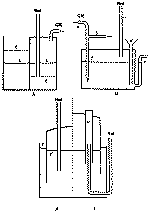
A refinement upon this vent-pipe is represented at C, where it is rigidly fastened to the tank of the holder, and has its internal aperture always above the level of the water in the apparatus. Rigidly fixed to the crown of the bell is a tube of wider diameter, h, which is closed at its upper end. h is always full of gas, and its mouth is normally beneath the level of the water in the seal; but when the bell rises to its highest permissible position, the mouth of h comes above the water, and communication is opened between the holder and the outer atmosphere. No water enters the vent-pipe from the holder, and therefore no gurgling or irregular pressure is produced. Another excellent arrangement of a vent-pipe, suggested by Klinger of Gumpoldskirchen, is shown at D, a drawing which has already been partly considered as a washer and water-seal. For the present purpose the main vessel and its various pipes are so dimensioned that the vertical height g to f is always appreciably greater than the gas pressure in the service or in the generator or gasholder to which it is connected. In these circumstances the gas entering at a depresses the water in the pipe below the level f to an extent equal to the pressure at which it enters that pipe--an extent normally less than the distance f to g; and therefore gas never passes into the body of the vessel, but travels away by the side tube b (which in former references to this drawing was supposed to be absent). If, however, the pressure at a exceeds that of the vertical height f to g, gas escapes at g through the water, and is then free to reach the atmosphere by means of the vent c. As before, d serves to charge the apparatus with water, and e to ensure a proper amount being added. Clearly no liquid can enter the vent-pipe in this device. Safety-valves such as are added to steam-boilers and the like, which consist of a weighted lever holding a conical valve down against its seat, are not required in acetylene apparatus, for the simpler hydraulic seals discussed above can always be fitted wherever they may be needed. It should be noticed that these vent-pipes only come into operation in emergencies, when they are required to act promptly. No economy is to be effected by making them small in diameter. For obvious reasons the vent-pipe of a holder should have a diameter equal to that of the gas-inlet tube, and the vent-pipe of a generator be equal in size to the gas-leading tube.
FROTHING IN GENERATORS.--A very annoying trouble which crops up every now and then during the evolution of acetylene consists in the production of large masses of froth within the generator. In the ordinary way, decomposition of carbide is accompanied by a species of effervescence, but the bubbles should break smartly and leave the surface of the liquid reasonably free from foam. Sometimes, however, the bubbles do not break, but a persistent "head" of considerable height is formed. Further production of gas only increases the thickness of the froth until it rises so high that it is carried forward through the gas-main into the next item of the plant. The froth disappears gradually in the pipes, but leaves in them a deposit of lime which sooner or later causes obstructions by accumulating at the angles and dips; while during its presence in the main the steady passage of gas to the holder is interrupted and the burners may even be made to jump. Manifestly the defect is chiefly, if not always, to be noticed in the working of carbide-to-water generators. The phenomenon has been examined by Mauricheau-Beaupré, who finds that frothing is not characteristic of pure carbide and that it cannot be attributed to any of the impurities normally present in commercial carbide. If, however, the carbide contains calcium chloride, frothing is liable to occur. A 0.1 per cent. solution of calcium chloride appears to yield some foam when carbide is decomposed in it, and a 1 per cent. solution to foam in a pronounced manner. In the absence of calcium chloride, the main cause of frothing seems to be the presence in the generator of new paint or tar. If a generator is taken into use before the paint in any part of it which becomes moistened by warm lime-water has had opportunity of drying thoroughly hard, frothing is certain to occur; and even if the carbide has been stored for only a short time in a tin or drum which has been freshly painted, a production of froth will follow when it is decomposed in water. The products of the polymerisation of acetylene also tend to produce frothing, but not to such an extent as the turpentine in paint and the lighter constituents of coal-tar. Carbide stored even temporarily in a newly painted tin froths on decomposition because it has absorbed among its pores some of the volatile matter given off by the paint during the process of desiccation.
THE "DRY" PROCESS OF GENERATION.--A process for generating acetylene, totally different in principle from those hitherto considered, has been introduced in this country. According to the original patents of G. J. Atkins, the process consisted in bringing small or powdered carbide into mechanical contact with some solid material containing water, the water being either mixed with the solid reagent or attached to it as water of crystallisation. Such reagents indeed were claimed as crude starch and the like, the idea being to recover a by-product of pecuniary value. Now the process seems to be known only in that particular form in which granulated carbide is treated with crystallised sodium carbonate, i.e., common washing soda. Assuming the carbide employed to be chemically pure and the reaction between it and the water of crystallisation contained in ordinary soda crystals to proceed quantitatively, the production of acetylene by the dry process should be represented by the following chemical equation:
5CaC_2 + Na_2CO_3.10H_2O = 5C_2H_2 + 5Ca(OH)_2 + Na_2CO_3.
On calculating out the molecular weights, it will be seen that 286 parts of washing soda should suffice for the decomposition of 320 parts of pure calcium carbide, or in round numbers 9 parts of soda should decompose 10 parts of carbide. In practice, however, it seems to be found that from 1 to 1.5 parts of soda are needed for every part of carbide.
The apparatus employed is a metal drum supported on a hollow horizontal spindle, one end of which is closed and carries a winch handle, and the other end of which serves to withdraw the gas generated in the plant. The drum is divided into three compartments by means of two vertical partitions so designed that when rotation proceeds in one particular direction portions of the two reagents stored in one end compartment pass into the centre compartment; whereas when rotation proceeds in the opposite direction, the material in the centre compartment is merely mixed together, partly by the revolution of the drum, partly with the assistance of a stationary agitator slung loosely from the central spindle. The other end compartment contains coke or sawdust or other dry material through which the gas passes for the removal of lime or other dust carried in suspension as it issues from the generating compartment. The gas then passes through perforations into the central spindle, one end of which is connected by a packed joint with a fixed pipe, which leads to a seal or washer containing petroleum. Approached from a theoretical standpoint, it will be seen that this method of generation entirely sacrifices the advantages otherwise accruing from the use of liquid water as a means for dissipating the heat of the chemical reaction, but on the other hand, inasmuch as the substances are both solid, the reaction presumably occurs more slowly than it would in the presence of liquid water; and moreover the fact that the water employed to act upon the carbide is in the solid state and also more or less combined with the rest of the sodium carbonate molecule, means that, per unit of weight, the water decomposed must render latent a larger amount of heat than it would were it liquid. Experiments made by one of the authors of this book tend to show that the gas evolved from carbide by the dry process contains rather less phosphorus than it might in other conditions of generation, and as a fact gas made by the dry process is ordinarily consumed without previous passage through any chemical purifying agent. It is obvious, however, that the use of the churn described above greatly increases the labour attached to the production of the gas; while it is not clear that the yield per unit weight of carbide decomposed should be as high as that obtained in wet generation. The inventor has claimed that his by-product should be valuable and saleable, apparently partly on the ground that it should contain caustic soda. Evidence, however, that a reaction between the calcium oxide or hydroxide and the sodium carbonate takes place in the prevailing conditions is not yet forthcoming, and the probabilities are that such decomposition would not occur unless the residue were largely diluted with water. [Footnote: The oldest process employed for manufacturing caustic soda consisted in mixing a solution of sodium carbonate with quick or slaked lime, and it has been well established that the causticisation of the soda will not proceed when the concentration of the liquid is greater than that corresponding with a specific gravity of about 1-10, i.e., when the liquid contains more than some 8 to 10 per cent, of sodium hydroxide.] Conversely there are some grounds for believing that the dry residue is less useful than an ordinary wet residue for horticultural purposes, and also for the production of whitewash. From a financial standpoint, the dry process suffers owing to the expense involved in the purchase of a second raw material, for which but little compensation can be discovered unless it is proved that the residue is intrinsically more valuable than common acetylene-lime and can be sold or used advantageously by the ordinary owner of an installation. The discarding of the chemical purifier at the present day is a move of which the advantage may well be overrated.
ARTIFICIAL LIGHTING OF GENERATOR SHEDS.--It has already been argued that all normal or abnormal operations in connexion with an acetylene generating plant should be carried out, if possible, by daylight; and it has been shown that on no account must a naked light ever be taken inside the house containing such a plant. It will occasionally happen, however, that the installation must be recharged or inspected after nightfall. In order to do this in safety, a double window, incapable of being opened, should be fitted in one wall of the house, as far as possible from the door, and in such a position that the light may fall on to all the necessary places. Outside this window may be suspended an ordinary hand- lantern burning oil or paraffin; or, preferably, round this window may be built a closed lantern into which some source of artificial light may be brought. If the acetylene plant has an isolated holder of considerable size, there is no reason at all why a connexion should not be made with the service-pipes, and an acetylene flame be used inside this lantern; but with generators of the automatic variety, an acetylene light is not so suitable, because of the fear that gas may not be available precisely at the moment when it is necessary to have light in the shed. It would, however, be a simple matter to erect an acetylene burner inside the lantern in such a way that when needed an oil-lamp or candle could be used instead. Artificial internal light of any kind is best avoided; the only kind permissible being an electric glow-lamp. If this is employed, it should be surrounded by a second bulb or gas-tight glass jacket, and preferably by a wire cage as well; the wires leading to it must be carefully insulated, and all switches or cut-outs (which may produce a spark) must be out of doors. The well-known Davy safety or miner's lamp is not a trustworthy instrument for use with acetylene because of (a) the low igniting-point of acetylene; (b) the high temperature of its flame; and (c) the enormous speed at which the explosive wave travels through a mixture of acetylene and air. For these reasons the metallic gauze of the Davy lamp is not so efficient a protector of the flame as it is in cases of coal-gas, methane, &c. Moreover, in practice, the Davy lamp gives a poor light, and unless in constant use is liable to be found out of order when required. It should, however, be added that modern forms of the safety lamp, in which the light is surrounded by a stout glass chimney and only sufficient gauze is used for the admission of fresh air and for the escape of the combustion products, appear quite satisfactory when employed in an atmosphere containing some free acetylene.