Note 43 — PART SECOND. NOTES ON THE ILLUMINATION OF LIGHTHOUSES, WITH SHORT NOTICES OF THEIR EARLY HISTORY.
Reading edition
This is easily understood by reference to the accompanying figure (No. 25.), in which AOB is a central section of a paraboloïdal mirror.
Fig. 25.
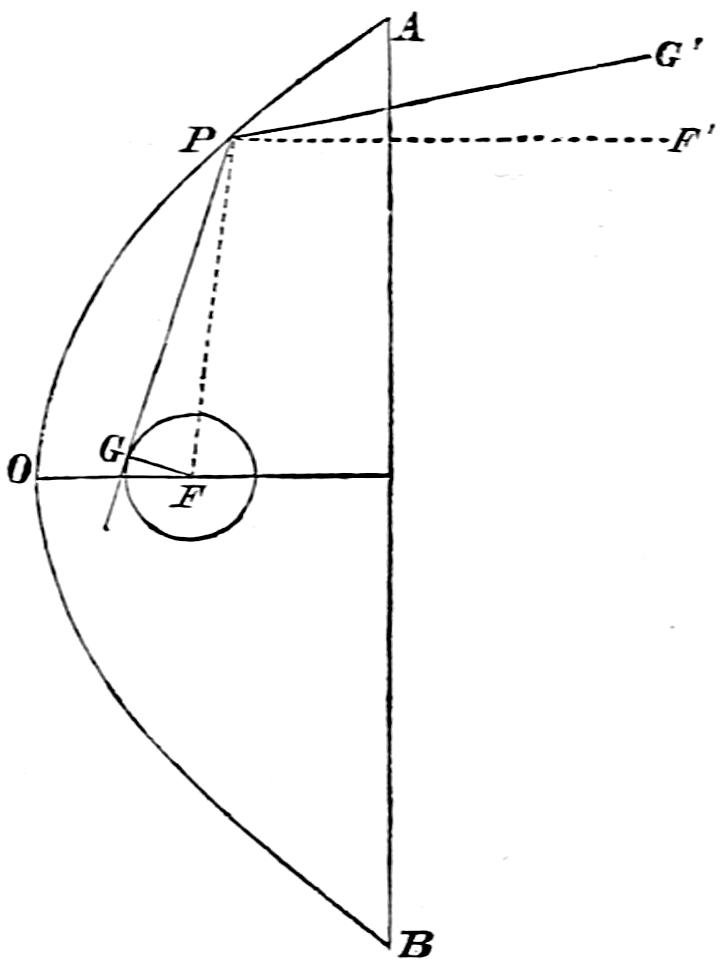
PF = distance from the focus F to a point in the curve P, and PG a tangent drawn from P to the surface of the flame at G;
FG = radius of the wick or flame;
and GPF = G′PF′ = divergence of one side of mirror, and consequently 2 GPF = the whole effective divergence of the mirror at that cross section.
Now sin GPF = GFPF or the sine of the divergence from each point = Radius of flame.Distance from focus to point of reflection.
Fig. 26.
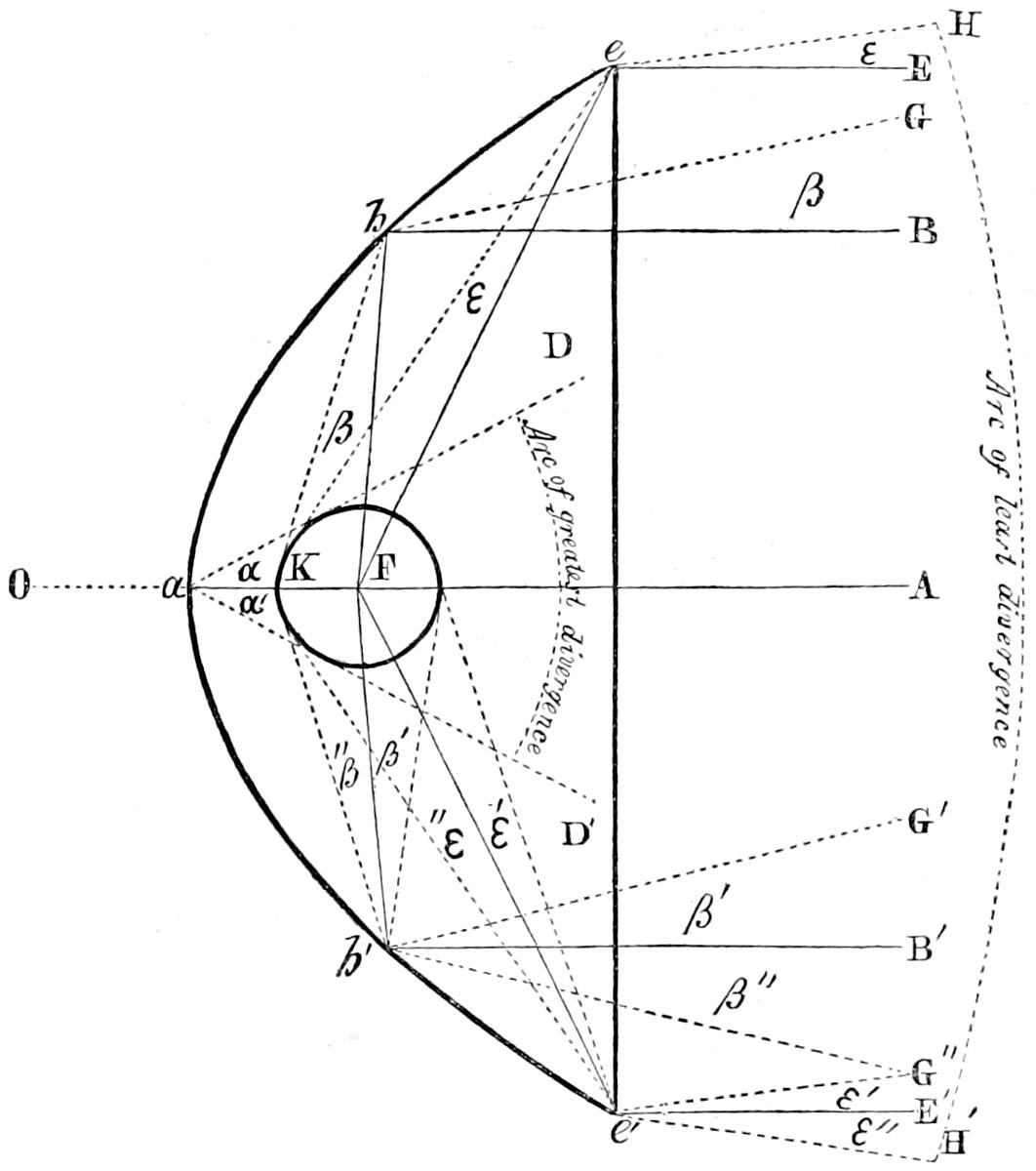
It is obvious that this quantity which varies inversely with the distance of the reflecting surface from the focus, is greatest at the vertex of the curve, and least at the sides or edges of the paraboloïd. The most useful part of the light, or that which conduces to the strongest part of the flash in a revolving light, is that which is derived from the cone of rays which is bounded by the limits of this minimum divergence; for the faint light which first reaches the eye of a distant observer, in the revolution of a reflector, is not that which is reflected by the sides or edges, as might at first be supposed, but proceeds from the centre. The light, in fact, gradually increases in power in proportion as additional rays of reflected light are brought to bear on the observer’s eye, until, last of all, the extreme edge of the mirror adds its effect. The light continues in its best state until the opposite limit of minimum divergence has been reached, when it begins gradually to decline, receding from the margin of the mirror towards the centre, and, having at length reached the limit of its maximum divergence, it finally disappears at the centre. The increase and decline of the power of a mirror in the course of its movement round the circle of the lantern, as seen by a distant observer, will, therefore, in all its different states, be measured by the areas of a series of circles described from its focus, with radii equal to the distance of the focus from the point of the mirror which reflects to the observer’s eye the extreme ray which can reach him in any given position of the mirror. This will be more easily understood by referring to the accompanying diagram, Fig. 26, in which e a e′ is the principal section of a paraboloïdal mirror, F its focus, αFA its axis, and FK the radius of the flame. If the reflector revolve round a vertical axis at O, an observer placed in front of it (at a distance so great that the subtense of the mirror’s width would be small enough to allow us safely to consider the lines drawn from e and e′ to his eye as parallel), would receive the first ray of light in the direction a D, as reflected at a, from a single point on the edge of the flame (where a tangent to the flame would pass through a); and conversely he would lose the last ray at D′, as reflected at a, from a single point on the opposite margin of the flame; and hence, as above, the greatest divergence is measured by the angle which the flame subtends at the vertex a of the mirror, being the sum of the angles α and α′. We shall next suppose the mirror to move a little, so that the observer may receive at G a ray of light from some other point in the flame which is reflected at b; while another ray from an opposite point reflected at b′ would be seen in the parallel direction b′ G′, thus indicating the boundary of a circular portion of the mirror b a b′, the whole of which would reflect light to the distant observer’s eye. Again, let us suppose a ray to come from another part of the flame, and be reflected at the mirror’s edge e into the direction e H, and another from the opposite side of the flame to be reflected at its opposite edge e′, into the direction e′ G″, and we obtain the full effect of the whole reflecting surface, which will continue unabated until the mirror in the course of its revolution shall reflect at e′ to the observer’s eye, a ray from a point in the margin of the flame (through which a tangent drawn from e′ to the flame would pass) in such a direction, that the angle which it makes with the axis of the mirror is equal to that subtended by the radius of the flame at the distance F e or F e′. After this the light would recede from the edges of the mirror in the same gradual manner, until it should vanish in the direction a D′, which is the opposite limit of the extreme divergence of the instrument. In the above explanation, I have confined myself simply to the effects of the outer ring of the flame, which is the source of divergence; but I need not remind the reader that every portion of the flame radiates light, which, being reflected, conduces to the effect. Some rays also are passing from the opposite sides of the flame through the true focus, so as to be normally reflected in lines parallel to its axis. The solid lines in the diagram shew the theoretical reflection of rays proceeding from F to b, b′, e, e′, where they are diverted into the directions b B, b′ B′, e E, and e′ E′; and by contrast with the dotted lines, serve to render more perceptible the path of the divergent rays which come from the edge of the flame. The Greek letters indicate the angles of divergence, and point out their relations to each other on either side of the mirror. The arcs of greatest and least divergence are marked in the diagram. This subject will be found treated less directly, but, certainly, more concisely and neatly, by Mr W. H. Barlow, in a paper on the Illumination of Lighthouses in the London Transactions for 1837, p. 218.