Note 68 — PART SECOND. NOTES ON THE ILLUMINATION OF LIGHTHOUSES, WITH SHORT NOTICES OF THEIR EARLY HISTORY. (continued 2)
Reading edition
The following steps will shew the mode of obtaining this expression: Suppose (fig. 74, on opposite page) F n to be a ray incident on the surface BC very near b or B (which, although exaggerated in the figure for more easy reference, are close together), and let this ray F n be refracted in the direction n O, and draw n n′ parallel to CA, the ray which is refracted at C, then will n′ n O = m . b FC = ²⁄₃ b FC. But the tangent AZ should make with the tangent b Z an angle equal ¹⁄₃ b FC, or one-half the inclination of the rays refracted at b and C, which are afterwards by the agency of those tangents, to be reflected in the directions parallel to b C and to each other. Hence we have AX b (which is the inclination of the normals to those tangents),
or AX b = BZ b = b FC 2 m = b FC 3 nearly.
Fig. 74.
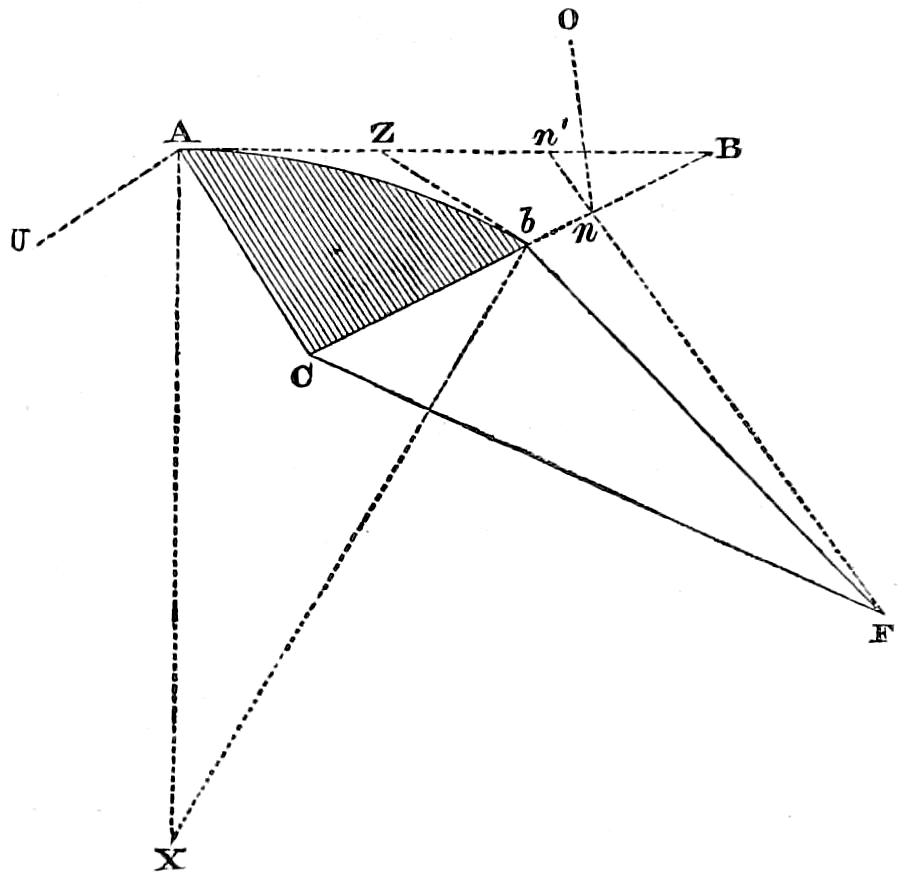
But putting AXB (fig. 73, p. 277) for AX b, and BFC for b FC, a supposition which may be safely made when the differences are so small, and founding upon the analogy
AX ∶ AB ∷ R ∶ tan AXB, we have BA = AX . tan AXB = AX . tan ¹⁄₃ BFC. Then
AB² = B β (B β + 2 AX)
= B β² + 2 B β . AX
and neglecting B β², which is very small, we have:
BA² = B β . 2 AX nearly,
hence B β = BA²2 AX
But as above AX = BAtan ¹⁄₃ BFC
and substituting this value of AX we obtain:
B β = BA² 2 BAtan ¹⁄₃ BFC
hence we have, as in the text,
B β = ¹⁄₂ BA . tan ¹⁄₃ BFC