Note 59 — PART SECOND. NOTES ON THE ILLUMINATION OF LIGHTHOUSES, WITH SHORT NOTICES OF THEIR EARLY HISTORY. (continued 2)
Reading edition
Testing Lenses. The tests generally applied for examining the lenses used in Lighthouses, is to find the position of the conjugate focus behind the lens, due to a given position of a lamp in front of it. This test depends on the following considerations:—Draw a line from an object O in front of a lens, to any point Q in the lens; and from A, the centre of the lens, draw AR parallel to OQ, and cutting a line RF r which passes through the principal focus F, at right angles to the axis of the lens; then join the points Q and R, and produce the line joining them: I, the image of O must be in that line. In the same way, draw a line from O to q, another point in the lens on the other side of its axis, and parallel to it draw A r from the centre of the lens, cutting the plane of the principal focus in r. Join q r, in which line the image will lie; and hence the intersection of OR and q r, in I, will be the point in which the image of O is formed, or will be the conjugate focus of the lens due to the distance OA. This mode will serve to give the distance of the conjugate focus of a lens (neglecting its thickness) for rays falling on its surface at any angle.
Fig. 61.
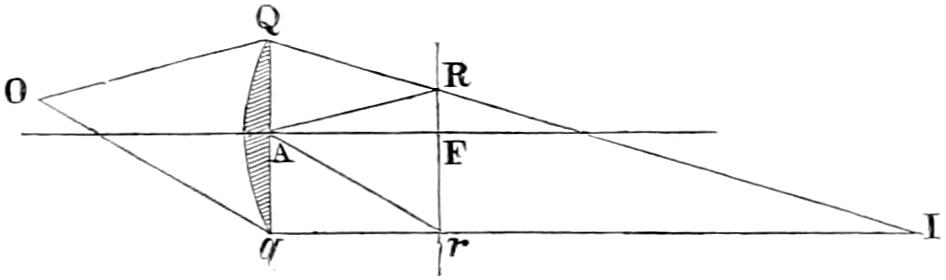
We shall suppose QA (fig. 61) to represent the half of a lens, and remembering the conditions described in reference to the last figure, we shall at once perceive the truth of the following analogy (fig. 62):—
Fig. 62.

OA ∶ AF ∷ AQ ∶ FR ∷ AI ∶ FI, and putting OA = δ, AI = φ′, and AF = φ, we have δ ∶ φ ∷ φ′ ∶ φ′ - φ, and, consequently, δ φ′ - δ φ = φ φ′; and hence the following equations, which express the relations subsisting between the principal focus of the lens and the distance of any object and its corresponding image:
1st, To find the principal focal distance of a lens from the measured position of its object and its image refracted through it, we have, φ = δ φ′ δ + φ′.
2d, For the distance of the object, when that of the image is known, we have, δ = φ φ′φ′ - φ.
3d, For the position of the image, when that of the object is known, we have, φ′ = δ φδ - φ.
Fig. 63.
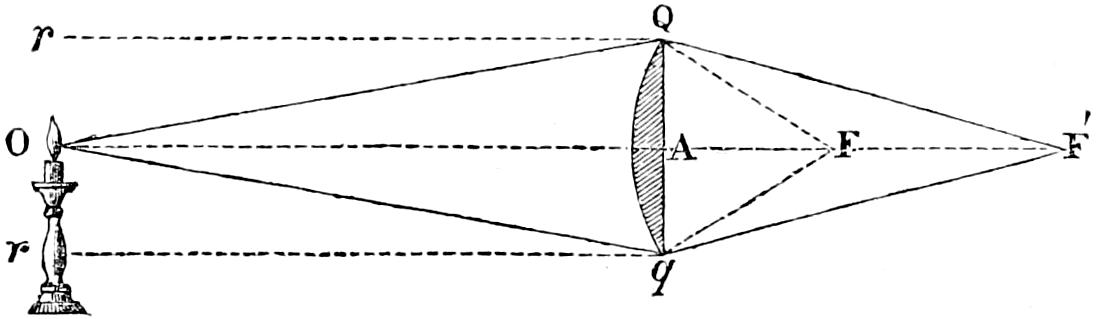
In testing lenses, of course, it is this last equation which we use, because the value of φ or the principal focus is always known, and is that whose accuracy we wish to try, while δ may be chosen within certain limits at will. I have found that the best mode of proceeding is the following:—In front of the lens Q q (see fig. 63) firmly fixed on a frame, place a lamp at O at the distance of about 50 yards. Calculate the value of φ′ due to 50 yards, which in this case is equal to AF′, OA being equal to δ; and move a screen of white paper backwards and forwards until you receive on it the smallest image that can be formed, which is at the point where the cones of converging and diverging rays meet. The image will always increase in size whether you approach nearer to the lens or recede farther from it, according as you pass from the converging into the diverging cone of rays, or vice versa; and hence the intermediate point is easily found by a very little practice. The distance from the centre of the lens to the face of the screen, which must be adjusted so as to be at right angles to a line joining the centre of the lens and the lamp, is then measured; and its agreement with the calculated length of φ′, is an indication of the accuracy of the workmanship of the lens. When the measured distance is greater than the calculated φ′, we know that the lens is too flat; and it is on this side the error generally falls. On the other hand, when φ′ is greater than the measured distance, we know that the lens has too great convexity. I have only to add, that an error of ¹⁄₆₀ on the value of φ′ may be safely admitted in Lighthouse lenses; but I have had many instruments made by M. François Soleil, whose error fell below ¹⁄₈₀ of φ′. Owing probably to the mode of grinding, the surfaces of all the lenses I have yet examined are somewhat too flat.