Note 58 — PART SECOND. NOTES ON THE ILLUMINATION OF LIGHTHOUSES, WITH SHORT NOTICES OF THEIR EARLY HISTORY. (continued 2)
Reading edition
The following steps will conduct us to this expression:
Fig. 60.
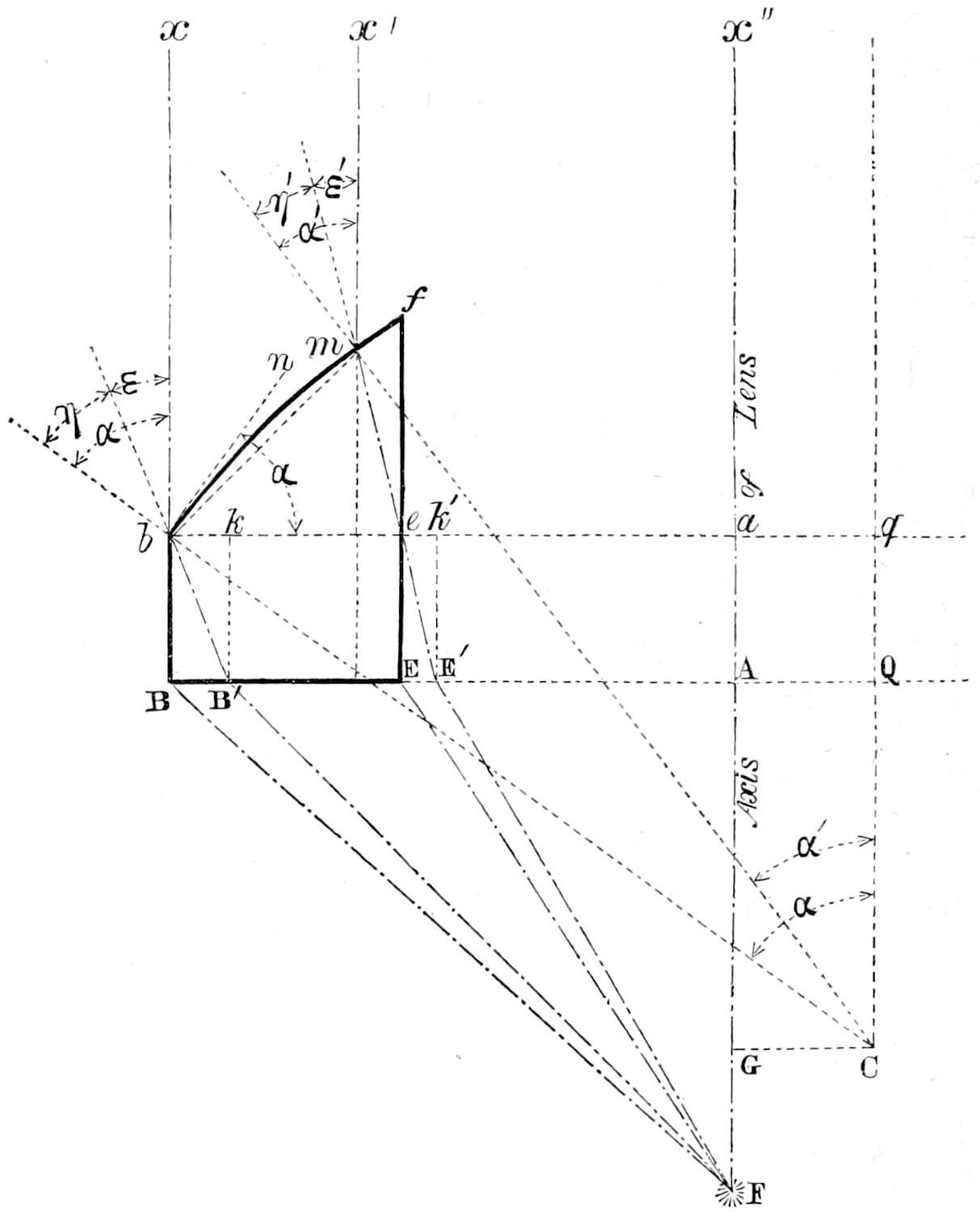
Let B b f E (fig. 60) represent the section of a zone by a plane passing through the axis of the lens AF, C the centre of curvature, F the radiant point, and FB′ b x, FE′m x′ the course of the extreme rays which are transmitted through the zone (and the latter of which passes from E′ to e through a portion of the zone or lens in contact with that under consideration). Then putting
AB = r₁; AB′ = r′₁; C b = ρ
AE = r₂; AE′ = r′₂; B b = t″; BE = r₁ - r₂ = l
ε = the first angle of refraction b B′ k
η = the second angle of refraction B′ b C
ε′ = the first angle of refraction e E k′
η′ = the second angle of refraction e m C
α = the angle of emergence b C q
α′ = the angle of emergence m C q
i′₁ = BFA; i′₂ = EFA; i₁ = B′FA; i₂ = E′FA
e₁ = B b B′; e₂ = E e E′.
Proceeding exactly as in the case of the central lens we shall have
tan i′₁ = BAAF = r₁φ; tan i′₂ = EAAF = r₂φ
sin e₁ = sin i′₁μ; sin e₂ = sin i′₂μ
r′₁ = r₁ - t″ sin e₁; r′₂ = r₂ - t″ sin e₂
tan i₁ = r′₁φ; tan i₂ = r′₂φ
sin ε = sin i₁μ; sin ε′ = sin i′₂μ
sin α = μ sin ε √μ² - 2 μ cos ε - 1; and sin α′ = μ sin ε′ √μ² - 2 μ cos ε′ + 1
Now, the angle b C m = α - α′ from which (since the triangle b m C is isosceles) b m C = 90° - ¹⁄₂ (α - α′); also, in the triangle b m e, the angle b m e = b m C - e m C = 90° - ¹⁄₂ (α - α′) - η and b e m = k′ e E′ = 90° - ε′
We have therefore in the triangle b m e
b m = b e sin b e m sin b m e = l cos ε′cos {η + ¹⁄₂ (α - α′)}
and in b m C
b C = b m sin b m C sin b C m = l cos ε′ cos ¹⁄₂ (α - α′) (cos (η + ¹⁄₂ (α - α′)) sin (α - α′)
= l cos ε′ cos ¹⁄₂ (α - α′) cos {η + ¹⁄₂ (α - α′)} 2 sin ¹⁄₂ (α - α′) cos ¹⁄₂ (α - α′)
from which, putting b C = ρ
ρ = l cos ε′ 2 cos {η + ¹⁄₂ (α - α′)} sin ¹⁄₂ (α - α′)