Note 57 — PART SECOND. NOTES ON THE ILLUMINATION OF LIGHTHOUSES, WITH SHORT NOTICES OF THEIR EARLY HISTORY. (continued 2)
Reading edition
The following steps lead to the formulæ given in the text. Let APQB (fig. 56) represent a section of the central lens by a plane passing through its axis AF; F the focus for incident rays; and FQPH the path of a ray refracted finally in the direction PH, parallel to the axis. Let C be the centre of curvature, then PC is a normal to the curve at P; and, producing PQ to meet the axis in G, we have G the focus of the rays, after refraction at the surface BQ.
Fig. 56.
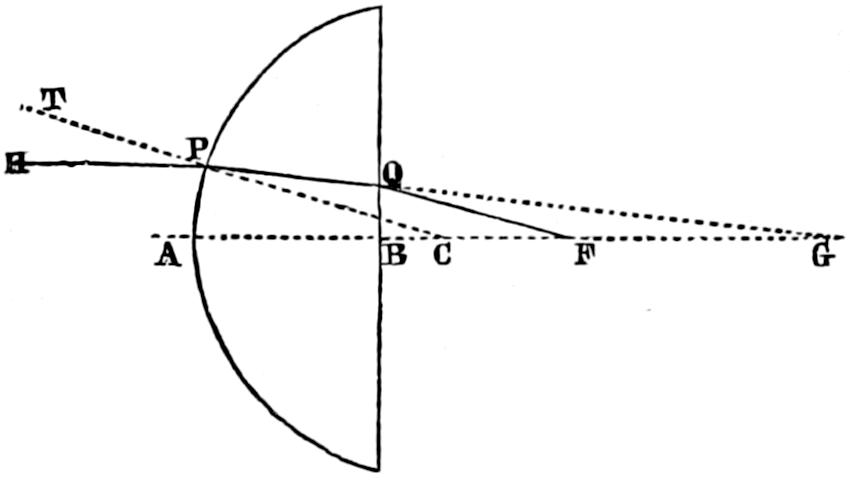
Then μ = sin PCGsin GPC = PGCG; and also μ = sin QFGsin QGF = QGQF
Now, as P approaches A, we have ultimately PG = AG, QG = BG, and QF = BF;
Therefore, putting AG = θ and AC = ρ′
μ = AGCG = θθ - ρ′; μ = BGBF = θ - t′φ,
from which μ θ - μ ρ′ = θ; and μ φ = θ - t′ and eliminating θ, we have μ² φ + μ ρ′ = μ φ + t′, whence, as above, ρ′ = (μ - 1)(φ + t′μ.)
But as this value of the radius of curvature, as already stated, is calculated for rays near the axis, it would produce a notable aberration for rays incident on the margin of the lens. In order, therefore, to avoid the effects of aberration as much as possible, a second radius of curvature must be calculated, so that rays incident on the margin of the lens may be refracted in a direction parallel to the axis. This second value of the radius is called ρ″ in the text, and is found as follows (referring to fig. 57):
Let FB′ b x be the course of a ray refracted in the direction b x parallel to the axis A x′. This ray meets the surface AB in the point B′, whose position may be found approximately by tracing the path of the ray FB, on the supposition that the surface of the refracting medium is produced in the directions AB, a′ b′.
Fig. 57.
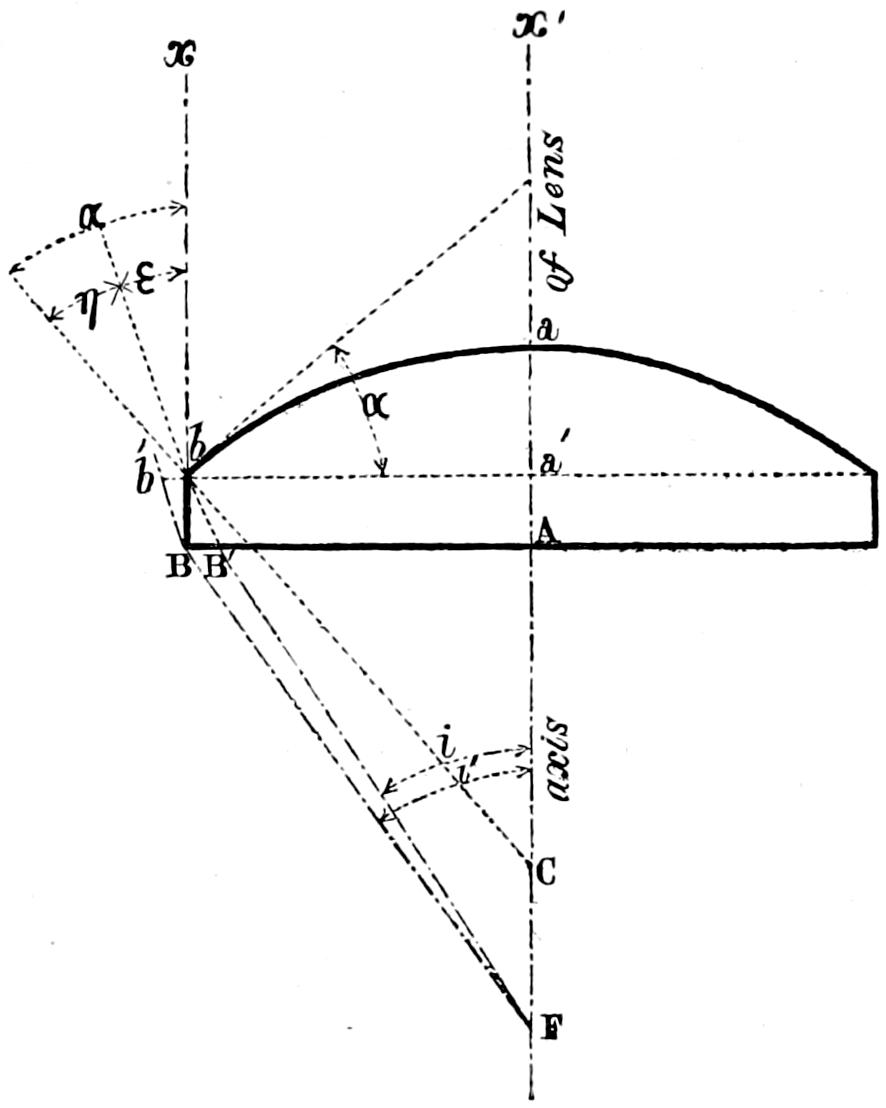
Let C be the centre of curvature (see fig. 57)
α = AC b the angle of emergence
η = B′ b C the second angle of refraction
ε = B b B′ the first angle of refraction
i = B′FA the first angle of incidence
i′ = BFA
e = b′ B b
AB = r
AB′ = r′
B b = t″ the thickness of the lens at the edge
AF = φ the focal distance.
Then tan i′ = rφ; sin e = sin i′μ whence b b′ = t″ tan e becomes known.
Now, since BB′ = b b′ nearly, AB′ = AB - b b′ or r′ = r - t″ tan e.
From this is obtained the angle of incidence i, and the first angle of refraction ε; for tan i = r′φ and sin ε = sin iμ.
Next B′ b C = B b C - B b B′ or η = α - ε and sin α = μ sin η = μ sin (α - ε)
from which, sin α cos ε - cos α sin ε = sin α μ
whence sin α (cos ε - 1 μ) = cos α sin ε; and
sin² α (cos² ε - 2 cos εμ + 1μ²) = cos² α sin² ε = (1 - sin² α) sin² ε = sin² ε - sin² α sin² ε
Then transposing we have
sin² α {(cos² ε + sin² ε) - 2 cos εμ + 1μ²} = sin² ε
and because (cos² ε + sin² ε) = 1 we have, by dividing,
sin² α = sin² ε {1 - 2 cos εμ + 1μ²} = μ² sin² ε μ² - 2 μ cos ε + 1
and sin α = μ sin ε √1 - 2 μ cos ε + μ²
Next, since b C = a′ b sin AC b = rsin α, putting C b = ρ″, and substituting we have ρ″ = rμ sin ε √μ² - 2 μ cos ε + 1 and, taking for the radius of curvature, the mean of ρ′ and ρ″ the values calculated for the central and marginal rays, we have finally ρ = ρ′ + ρ″ 2