Chapter VII · THE BIRDS OF VIRGIL.
Reading edition
It might naturally be supposed, that an Oxford tutor, who finds his vocation in the classics and his amusement in the birds, would be in the way of noticing what ancient authors have to say about their feathered friends and enemies. One Christmas vacation, when there was comparatively little to observe out-of-doors, I made a tour through the poems of Virgil, keeping a sharp look-out for all mention of birds, and compiled a complete collection of his ornithological passages. I chose a Latin poet because in Latin it happens to be easier to identify a genus or species than it is in Greek; and I chose Virgil partly because the ability to read and understand him is to me one of the things which make life most worth living, and partly because I know that there is no 211 other Latin poet who felt in the same degree the beauty and the mystery of animals.
I believe there are still people who think of Virgil as a court-poet, writing to order, and drawing conventional ideas of nature from Greek authors of an earlier age. This is, of course, absolutely untrue. Virgil’s connection with Augustus was accidental, and was probably no more to the poet’s taste than any other result of an education and an occasional residence in the huge city of Rome. If we compare what is known of his life with the general character of his poetry, we get a very different result.
The first sixteen years of his life were spent in his native country of Cisalpine Gaul, almost under the shadow of the Alps, three hundred miles away from Rome. His parents were ‘rustic,’ and he himself was brought up among the woods and rushy meads of Mantua and Cremona. “Doubtless there is many a reminiscence of his early years in the Georgics, where his love of the woods, in which he must have wandered as a boy, meets us in every page.”[49] In that day it is 212 probable enough that the great plain of the Po was still largely occupied by those dense forests, the destruction of which is said to be the chief cause of the floods to which the river is liable. Much land must also have been still undrained and marshy: and we can still trace in the neighbourhood of Mantua the remains of those ancient lake-dwellings which an ancient people had built there long before the Gauls, from whom our poet was perhaps descended, had taken possession of the plain. These woods and marshes, as well as the land which Roman settlers had tilled for vine or olive, must have been alive with birds in Virgil’s day. There would be all the birds of the woods, the pigeons and their enemies the owls and hawks; there would be cranes and storks in their yearly migrations, and all manner of water-fowl from the two rivers Po and Mincio, and from the Lacus Benacus (Lago di Garda) which is only about twenty miles distant. It would be strange indeed, if, even when following the tracks of a Greek poet, Virgil had not in his mind some of the familiar sights on the banks of Mincius.
213
But later in life he was at least as much in Southern as in Northern Italy. That the first three Georgics were written, or at least thought out, on the lovely bay of Naples, is certain from the lines at the end of the fourth Georgic:—
Illo Virgilium me tempore dulcis alebat Parthenope, studiis florentem ignobilis oti.[50]
Here were all the sea-birds, and the wild-fowl that haunt the sea; here, as we shall see, the summer visitors might land on their way from Africa. Here, from the sea and all its varying life, the poet’s mind would enrich itself with sights unknown to him in the flat-lands of the Padus, and grow to understand more fully day by day the impressions—often dull ones—which Nature had made on the poets who had sung before him. Rome he never loved, though he had a house there: perhaps he had seen enough of the huge city during the years given to the dreary rhetorical education of the day, after first leaving his home. 214 He loved Campania, and he loved Sicily[51]; at Tarentum also he is found, probably visiting the friendly and jovial Horace. The hill-country of the peninsula, and of the island that belongs to it, became a part of his poetical soul; and as he probably spent much of his time at his own Cisalpine farm, after he was restored to it by his patron’s kindly influence, he must have been constantly moving among all the phases of Italian landscape—in the plain, on the hills, by the sea.
Everything, then, in Virgil’s history, shows him a genuine poet of the country, and at the same time no one who really knows his poems can deny that they fully bear out the evidence of his life. It is true that he drew very largely on other poets, and could not “disengage himself from the antecedents of his art.” From Homer, Hesiod, Aratus, or Theocritus, for example, come nearly all the passages in his works in which birds are mentioned. But though they descend from these poets, and bear the features of their ancestors, 215 they are yet a new and living generation, not lifeless copies modelled by a mere imitator; and their beauty and their truth is not that of Greek, but of Italian poetry. Let any one compare the translations of Aratus by other Roman hands, by Cicero, Festus, and Germanicus, with Virgil’s first Georgic, and he will not fail to mark the difference between the mere translator and the poet who breathes into the work of his predecessors a new life and an immortal one. There is hardly to be found, in the whole of Virgil’s poems, a single allusion to the habits of birds or any other animals which is untrue to fact as we know it from Italian naturalists. Here and there, of course, there are delusions which were the common property of the age. If, for example, he tells us in the fourth Georgic that bees
oft weigh up tiny stones As light craft ballast in the tossing tide, Wherewith they poise them through the cloudy vast:
let us remember that the true history of bees has been matter of quite recent discovery. And we may note at the same time that Pliny, a professed naturalist, living at least a generation after Virgil, 216 has actually asserted that cranes, when flying against the wind, will take up stones with their feet, and stuff their long throats full of gravel, which they discharge when they alight safely on the ground![52]
Virgil mentions about twenty kinds of birds, most of them several times. These twenty kinds do not correspond so much to our species as to our genera; for the Greeks and Romans, I need hardly say, had only very rough-and-ready methods of classification, just as is the case with uneducated people at the present day. When they found birds tolerably like each other, they readily put them down as of the same kind, rarely marking minor differences. Thus corvus appears to stand for both crow and rook; picus stands for all the woodpeckers inhabiting Italy; by accipiter may be understood any kind of hawk. But in spite of this difficulty, it is sometimes possible to make out the particular species which is alluded to, partly by getting information as to those which 217 are found in Italy at the present day, partly by comparing Virgil with Pliny and other Roman writers, and where Virgil is using a Greek original, by trying to discover, chiefly through Aristotle’s admirable book on natural history, what bird is indicated by the Greek word translated, and whether that bird is an Italian bird as well as Greek, and therefore likely to be known to Virgil at first hand.
I am not going to trouble my readers with much of the uninteresting detail of an inquiry like this (in which indeed the game might seem to be hardly worth the candle), but merely to give them some idea of the bird-knowledge on which this greatest of Roman poets drew, whether at first or second-hand, for description or illustration; and in so doing to make clear to them, so far as I can, the particular kinds of birds which he had in his mind. I shall quote him in the original, but shall add translations in footnotes: in the Georgics, his poem of husbandry, I take advantage of a poet’s translation, that of my friend Mr. James Rhoades, which cannot easily be outdone either in exactness of scholarship or in beauty of diction; 218 and in the Aeneid I make use of Mr. Mackail’s prose translation, which I prefer on the whole to any poetical version I know. One passage from the Eclogues I have translated myself.
The first birds we find mentioned in the poems are the Pigeons, and we may as well begin with them as with any other. Meliboeus tells Tityrus that the farm to which he is returned after a long exile—the same farm which the poet himself lost and found again—shall yield him much true comfort and delight, even though he find it overgrown with reeds, and spoilt with the stones and mud of overflowing Mincius:—
Nec tamen interea raucae, tua cura, palumbes, Nec gemere aeria cessabit turtur ab ulmo.[53]
Here two distinct species are clearly meant by the words palumbes and turtur. About the latter of these there is no difficulty; from all that is told us of it we gather that it is the same bird which the French still call tourterelle and the Italians tortorella, and which we know as the Turtle-dove; 219 it is still found in small numbers passing the summer and breeding in Italy, and is most frequent in the sub-alpine region of which Virgil is here writing. But what bird is here meant by palumbes? Both this word and its near relative columba must be translated by pigeon, but can we distinguish them as different species? Here the commentaries and dictionaries give us no substantial help, and I may be pardoned for pausing a moment to consider a question of some interest to historical ornithologists.
There are at the present day three kinds of pigeons beside the turtle-dove just mentioned, which are found in Italy; they are the same three which we know in England as the Wood-pigeon or Ring-dove, the Stock-dove, and the Rock-dove or Blue-rock. Of these the last, which with us is the rarest, only found on certain parts of our coast, is by far the most abundant in Italy, and is the only one which habitually breeds there. The other two species pass over Italy in spring and autumn regularly, but seldom or never stay there; they go northwards in the spring from Africa and the East, and return again in the autumn after 220 breeding in cooler climes. But it is fairly certain that in ancient times two species of pigeons bred in Italy: (1) the bird meant by palumbes, of which Virgil makes the shepherd Damoetas say in the third Eclogue that he has “marked the place where they have gathered materials for nesting,”[54] and of which Pliny tells his readers that when they see this bird upon her nest they may know that midsummer is past (Pliny, Nat. Hist. xviii. 267); (2) the bird named columba, which word, though etymologically the same as palumbes, is used by Pliny, and also by the Roman agricultural writers, to represent a bird which is certainly to be distinguished from palumbes.[55] The columba was in fact the tame pigeon of the Romans: it was also their carrier-pigeon; for in the siege of Mutina, B.C. 43, the besieged general communicated with the relieving force by means of columbae, to the feet of which letters were attached (Plin. x. 110). The words may here and there be used loosely, and it is possible that attempts may have been made to domesticate the palumbes as well as 221 the columba; but in the vast majority of passages the columba is certainly either the domestic bird or a wild bird of the same species, while palumbes is some other kind of pigeon.
Even in Virgil the distinction is maintained; for while palumbes breeds in the elm in the first Eclogue, already quoted (which poem, it should be noted, is genuinely north-Italian, and independent of a Greek original), columba on the other hand has her nest in a rock, as the following well-known and beautiful passage will plainly show—
Qualis spelunca subito commota columba, Cui domus et dulces latebroso in pumice nidi, Fertur in arva volans, plausumque exterrita pennis Dat tecto ingentem, mox aere lapsa quieto Radit iter liquidum, celeres neque commovet alas.
And in the same fifth Aeneid, the bird which served as a target in the archery contest—a domestic bird, we may suppose—was a columba, not a palumbes.
Now it is a fact almost universally recognized by modern ornithologists that our domestic pigeon is in all its varieties descended from the wild Rock-dove; and thus when we find that the 222 Romans used columba to denote their domestic bird, and also a wild bird which made its nest in rocks, the conclusion is almost certain that by that word we are to understand our Blue-rock pigeon (Columba livia); and if this is so, by palumbes must be meant one of the other two Italian pigeons, the Wood-pigeon (Columba palumbus, Linn.) or the Stock-dove (Columba aenas, Linn.). Both species, as I have said, are now birds of passage in Italy, while the Blue-rock is resident; and Pliny tells us of the palumbes that it arrived every year in great numbers from the sea—he does not say at what season. Perhaps the Stock-dove[56] is the more likely of the two to have been the bird generally meant by palumbes; but it is quite possible that, like the unskilled of the present day, the Romans confounded the two species, and wrote of them as one.
But there is still a difficulty. The palumbes in the time of Virgil and Pliny seems to have bred in Italy; Pliny knew all about their breeding (x. 147 and 153), and Virgil makes Damoetas mark 223 the place where their nesting is going on. But it is now very rarely, if we may trust Italian naturalists, that either Ring-dove or Stock-dove passes a summer in Italy. Birds seek a cool climate for their breeding-places; probably because in very hot countries the food suitable to their nestlings will not be found in the breeding-season. Has the climate of Italy become hotter in the last two thousand years, discouraging these birds from lingering south of the Alps?
This is an old question which has been well thrashed out by the learned, and the general conclusion seems to be in the affirmative. The last eminent writer on the subject takes this view,[57] and his argument would receive a decided clinch if it could be proved that certain kinds of birds, which formerly bred in the country, do so no longer, and that this is not due to other causes, such as the well-known passion of the Italians for killing and eating all the birds on which they can lay their hands.
If we now turn to the first Georgic, in which, following the Greek poet Aratus with freedom 224 and discretion, Virgil has told us more of animal life than in all the rest of his poems, we find frequent mention of the long-legged and long-billed birds with which he must have been very familiar in his boyhood at Mantua. The first of these we meet with is the Crane (Latin grus). About the meaning of the word grus there can be no doubt; it would seem that the Crane was a bird accurately distinguished by the forefathers of our modern Aryan peoples even before they separated from each other. The Greek word γέρανος, the Latin grus, the German Kranich, and the Welsh garan are all identical, and point to a period when the bird was known by the same name to the whole race. Probably it was much more abundant both in Europe and Asia, at a time when the face of the country was covered by vast tracts of swamp and forest. Even now, at the period of migration, they swarm in the East; “the whooping and trumpeting of the crane,” says a great authority (Canon Tristram), “rings through the night air in spring, and the vast flocks we noticed passing north near Beersheba were a wonderful sight.”
225
Virgil mentions the Crane in two passages as doing damage to the crops: and this is fully borne out by modern accounts from Asia Minor and Scinde, quoted by Mr. Dresser in his Birds of Europe. The poet says of them (Georgic i. 118)—
Nec tamen haec cum sint hominumque boumque labores Versando terram experti, nihil improbus anser Strymoniaeque grues et amaris intuba fibris Officiunt aut umbra nocet.[58]
And in line 307 of the same book he tells the husbandman that the winter is the time to catch them:—
Tum gruibus pedicas, et retia ponere cervis Auritosque sequi lepores;[59]
a passage from which it might appear as if the Crane were snared as an article of food, not only as an enemy to the agriculturist. And indeed in Pliny’s time the epicure’s taste was all in favour 226 of cranes against storks; but when Virgil wrote, the reverse was the case. This little fact, so characteristic of the sway of fashion over the gourmand of that luxurious age, was recorded by Cornelius Nepos, and is quoted from him by Pliny (Nat. Hist. x. 60).
The Crane is now a bird of passage in Italy, and the Stork also; they appear in spring on their way to northern breeding-places, and in autumn reappear with their numbers reinforced by the young broods of the year. These habits seem to have been the same in Virgil’s day. In the passage just quoted (Georgic i. 120) it is evidently in the spring that the bird was hurtful to the crops, as the seed was to be sown in the spring (line 43, etc.).
On the other hand, in line 307, the Crane is to be snared in the winter; yet I can hardly believe that any number could have stayed in Italy during winter, if the climate was then colder than it is now. Moreover, Pliny speaks of the Crane as ‘aestatis advena,’ that is, a summer visitor, as opposed to the Stork, who was a winter visitor. But these Latin words ‘aestas’ and ‘hiems’ are 227 to be understood loosely for the whole warm season, and the whole cold or stormy season; and if cranes came on their passage northwards, when warm weather began, they must also have appeared, on their return journey, when cold weather was beginning; so that both crane and stork might equally be styled ‘aestatis advena,’ or ‘hiemis advena.’ Pliny was surely making one of his many blunders when he distinguished the two birds by these two expressions.
The migration of such great birds as these, unlike those of our tiny visitors to England, could hardly escape the notice even of men who knew nothing of scientific observation. Virgil has given us a momentary glimpse of the Crane’s migration in spring; he is following in the tracks of Homer, but as a Mantuan he must have seen the phenomenon himself also.
Clamorem ad sidera tollunt Dardanidae e muris; spes addita suscitat iras; Tela manu jaciunt; quales sub nubibus atris Strymoniae dant signa grues, atque aethera tranant Cum sonitu, fugiuntque Notos clamore secundo.[60]
228
Here, as they fly before a southern wind, they are on their way to the north in the spring. But in another passage he seems rather to be thinking of autumn; it is where he is telling the husbandman how to presage an approaching storm, such a storm as descends in autumn from the Alps upon the plains of Lombardy:—
Nunquam imprudentibus imber Obfuit; aut illum surgentem vallibus imis Aeriae fugere grues, aut bucula coelum Suspiciens patulis captavit naribus auras, Aut arguta lacus circumvolitavit hirundo.[61]
The general tenor of the whole passage of which these lines are a fragment, as well as their original in the Diosemeia of Aratus, points to the approach of ‘hiems,’ the stormy season, as the event indicated; the falling leaves dance in air, the feathers 229 of the moulting birds float on the water, but the swallow is not yet gone. The deep Alpine valleys seethe with swirling mist, which rises into gathering cloud, and soon becomes stormy rain beating upon the plains, as we may see it in any ‘Loamshire’ of our own, that lies below the stony hills of a wilder and wetter country-side. In this striking and truthful passage, Virgil has not followed his model too closely, but was evidently thinking of what he must often have witnessed himself.
The Stork is only mentioned by Virgil in a single passage—
Cum vere rubenti Candida venit avis longis invisa colubris.[62]
Doubtless the bird arrived in great numbers in spring on the Mantuan marshes, and found abundance of food there in the way of frogs and snakes. Its snake-eating propensity was considered so valuable in Thessaly, that the bird was preserved there by law, says Aristotle.[63] But did it remain to breed in Italy? It is remarkable 230 that both Aristotle and Pliny have very little to say of its habits, and hardly anything as to its breeding; and if the Stork had been a bird familiar to them, they could hardly have failed to give it a prominent place in their books. At the present time it seems to pass over Italy and Greece on its passage northwards, never staying to breed in the former country and rarely in the latter; yet this can hardly be owing to temperature, as it breeds freely in the parallel latitudes of Spain and Asia Minor.
As regards ancient Italy, however, the question seems to be set at rest by a very curious passage from the Satyricon of Petronius, which has been kindly pointed out to me by Mr. Robinson Ellis. It is remarkable not only for its Latin, but for its concise and admirable description of the characteristic ways of the Stork:—
Ciconia etiam grata, peregrina, hospita, Pietaticultrix, gracilipes, crotalistria, Avis exsul hiemis, titulus tepidi temporis, Nequitiae nidum in cacabo fecit meo.[64]
231
“A Stork too, that welcome guest from foreign lands, that devotee of filial duty, with its long thin legs and rattling bill, the bird that is banished by the winter and announces the coming of the warm season, has made his accursed nest in my boiler.” I am reminded also of a story, which has the authority both of Jornandes and Procopius, that at the siege of Aquileia in A.D. 452, Attila was encouraged to persist by the sight of a Stork and her young leaving the beleaguered city. “Such a domestic bird would never have abandoned her ancient seats unless those towers had been devoted to impending ruin and solitude.”[65] Here then we seem to have another example of a bird abandoning its ancient practice of breeding, occasionally at least, in Italy. If this is due to persecution, the persecutors have made a great mistake. The Stork does no harm to man, but rather rids his fields of vermin; the Crane, which belongs to a different order of birds, may do serious damage, as we have seen, to 232 cultivated land, like the ‘improbus anser,’ and other birds which Virgil in the first Georgic instructs the husbandman to catch with lime or net, or to frighten away from the fields.[66]
Let us now turn to the big black birds of the race of the Crows, which are always so difficult to distinguish from one another: for the Roman savant not less difficult than for our own unlearned. There are to be found in Italy at the present day the Raven, the Crow, the Rook, the Jackdaw, the Chough, and the Alpine Chough; all of these seem to be fairly common and resident in one or other part of the country, except our familiar friends the Crow and the Rook, the former of which is very rare, and the latter hardly more than a bird of passage. We cannot of course expect to find these accurately distinguished by the ancient Italians; and there is in fact still some uncertainty as to the identification of certain birds of this kind mentioned by Virgil.
The two commonest of these are the corvus and the cornix—words which undoubtedly represent two different species. The Roman augurs, who 233 were always busily engaged in observing birds (and it were to be wished that they had observed them to some better purpose), clearly distinguished corvus and cornix.[67] So also did Pliny,[68] in the following curious passage: “The corvus lays its eggs before midsummer, and is then in bad condition for sixty days, up to the ripening of the figs in autumn: but the cornix begins to be disordered after that time.” Virgil also uses the words for two distinct species; his cornix is solitary—
Tum cornix plena pluviam vocat improba voce Et sola in sicca secum spatiatur arena;[69]
while corvus is gregarious, as is shown in the following memorable description of Nature and of the birds taking heart after the storm has passed:—
Tum liquidas corvi presso ter gutture voces Aut quater ingeminant, et saepe cubilibus altis, Nescio qua praeter solitum dulcedine laeti, 234 Inter se in foliis strepitant; juvat imbribus actis, Progeniem parvam dulcesque revisere natos.[70]
That in these last beautiful lines corvus means a Rook, no Englishman is likely to deny; yet there are two difficulties to be put aside before we can make the assertion with entire confidence. The first is, that Virgil, here following Aratus, translated by corvus the Greek word κόραξ, which is not generally accepted as meaning a Rook. This is the word which the Greek historian Polybius uses for those naval machines invented by the Romans, in the first war with Carthage, for grappling with a hooked projecting beak the galleys of the enemy; and the rook’s bill is hardly so well suited to give a name to such an engine as that of the crow or raven,[71] which has the tip of the upper mandible sharply bent downwards, 235 like that of most flesh-eating birds. Still I must hold it probable that Aratus here used the word for the rook, as he makes it gregarious, and so, I think, did the Alexandrian scholar Theon, who wrote a commentary on his poem. The only other possibility is that he was thinking of the Alpine Chough, a bird which he might possibly have known, and one of thoroughly social habits. But that Virgil, though he too probably knew this bird, was not thinking of it when he wrote the lines just quoted, I feel tolerably sure; he would most likely have used the word graculus rather than corvus, which would seem never to have been applied, like monedula and graculus, to the smaller birds of the group, such as the Alpine Chough and the Jackdaw.
The second difficulty lies in the fact that the Rook is now only a bird of passage in Italy, never stopping to breed in the southern part of the peninsula, and very rarely in the northern; while Virgil speaks of the corvi in the last-quoted passage as loving to revisit their nests. But this difficulty has been overcome by the delightful discovery that the Rooks still stay and breed in 236 the sub-alpine neighbourhood where Virgil passed his early life.[72] As I have remarked about the pigeons and the stork, the climate may have been such as would induce some birds to stop south of the great Alpine barrier, which now find there no climate cool enough for breeding; and the Rook was perhaps a more regular resident and breeder then than he is now.
We may conclude then that Virgil’s corvus is our old friend the Rook, even if some Latin authors use the word equally for Rook, Crow, and Raven. Pliny for example tells us (N. H. x. 124) that the corvus can be taught to speak (fancy a bird talking Latin, that stiff and solemn speech!), that he eats flesh for the most part, and that he sometimes makes his nest in elevated buildings; feats which we are not used to associate with Rooks. In fact it is plain that Pliny, who was more of a learned book-reader than a careful observer of the minutiæ of nature, was not quite clear in his notions about the big black birds. But if we can be pretty sure about corvus, what is Virgil’s cornix, stalking on the shore in solitary 237 state, and uttering admonitory croaks from the hollow holm-oak? If we consult dictionaries we shall learn that cornix is the Crow or Rook, “a smaller bird than corvus.” Where did the dictionaries get this authority for making confusion worse confounded? If Virgil distinguished corvus and cornix, and if corvus is the rook, then cornix must be the crow or the raven, and in fact the word probably stands for both. I should incline on the whole to the raven, seeing that at the present day it is much the commoner bird of the two in Italy. Alpine choughs and jackdaws are not wont to stalk about alone; and though the larger chough (our Cornish chough) might do so, and is to be found in the mountain districts of Italy, he cannot well be the bird generally understood by cornix. Could a chough learn to talk with his long thin red bill? But Pliny knew of a talking cornix; “while I was engaged upon this book,” he says, “there was in Rome a cornix from the south-west of Spain, belonging to a Roman knight, which was of an amazingly pure black, and could say certain strings of words, to which it frequently added new ones.”
238
Swans are frequently mentioned by Virgil, as by other Latin and Greek poets. This splendid bird must have been much commoner then throughout Europe than it is now, and accordingly attracted much attention. It doubtless abounded in the swampy localities of the north of Italy, and at the mouths of the great rivers of Thrace and Asia Minor, as well as in the north of Europe, where it came to be woven into many a Teutonic fable. Homer has frequent and beautiful allusions to it; and the town of Clazomenae, at the mouth of the river Hermus, has a swan stamped upon its coins.
This Swan of the old poets is without any doubt the whooper (Cycnus musicus), whose voice and presence are still well known in Italy and Greece. Virgil had seen it at Mantua, on the watery plain of the Mincius:
Pascentem niveos herboso flumine cycnos.[73]
And in an admirable simile in the eleventh book of the Aeneid, he likens the stir and dissension in 239 the camp of Turnus, when the news suddenly arrives that Aeneas is marching upon them, to the loud calls of this bird:
Hic undique clamor Dissensu vario magnus se tollit ad auras: Haud secus atque alto in luco cum forte catervae Consedere avium, piscosove amne Padusae Dant sonitum rauci per stagna loquacia cycni.[74]
We now come to two birds mentioned in the same line of the third Georgic. The poet is telling the farmer to water his flocks in the cool evening of a hot day:
Cum frigidus aera vesper Temperat, et saltus reficit jam roscida luna, Litoraque alcyonen resonant, acalanthida dumi.[75]
The first of these birds is also mentioned in a line of the first Georgic, which is mainly taken from Aratus; but it is significant that Aratus does not mention the ‘alcyon’ either here or anywhere else.
240
Non tepidum ad solem pennas in littore pandunt Dilectae Thetidi alcyones.[76]
That the ‘alcyon’ of these two passages is to be identified with our Kingfisher, which is still an Italian bird, and the only one of its kind, I can have no reasonable doubt; for Pliny’s description of the bird is too exact to be mistaken. “It is,” he says, “a little larger than a sparrow, of a blue-green colour (colore cyaneo), red in the under parts, having some white feathers close to its neck, and a long thin bill.” This description, it is true, is copied almost word for word from Aristotle, the only exception being the allusion to the white feathers on the side of the neck, which are a well-known feature in the Kingfisher.[77] Whether both were thinking of the same bird it is impossible to decide; but that Pliny was describing 241 our Kingfisher, and believed Aristotle to have done so in the passage he copied, it is almost unreasonable to doubt.
It is, however, an open question whether the bird ordinarily known to the Greeks as ἀλκυὼν is to be identified with the Kingfisher. The greatest living authority on the birds of the Levant, Canon Tristram of Durham, tells me that he has convinced himself that it is not the Kingfisher, but the Tern or Sea-swallow: a rare coin of Eretria led him to this conclusion, on which a Tern is figured, sitting on the back of a cow.[78] And it must be allowed that the Greeks seem to have thought of their ἀλκυὼν as a sea bird no less than as a river bird. Aristotle remarks that it goes up rivers, but he seems to have thought of it mainly as a sea bird, and a well-known passage in the seventh Idyll of Theocritus appears to bear him out. But I am not here specially concerned with Greek ornithology, and what Virgil says of 242 the alcyon piping and pluming himself on the shore is perfectly consistent with the habits of the bird. I have myself seen it on the coast of Dorset, “pennas in littore pandens,” and taking flight over a bay full half a mile in width. A greater difficulty lies in the alleged vocal powers of the bird; they sing, Pliny tells us, in the reeds, and Virgil’s alcyon makes the shore echo with his voice. The Kingfisher, so far as I know, is a silent bird except when disturbed; he will then utter a shrill pipe as he flies away. But I am quite at a loss to explain his singing, except by supposing that this was one of several curious delusions that had gathered round a curious bird.[79]
The other bird mentioned in the lines last quoted is, and perhaps will remain, a puzzle. Mr. Rhoades makes it the Goldfinch, following the commentators, who themselves follow an old tradition which will not bear criticism, and in favour of which I can find nothing more convincing 243 than the argument that acantha[80] means in Greek a thorny or prickly tree, while the Goldfinch’s favourite food is the seed of the thistle. Let us notice, however, first, that it is not the way of the Goldfinch to sit in a thicket and sing, as Virgil describes the Acalanthis; it is a restless, lively, aërial bird, fond of singing on the wing, and by no means disposed to lurk under cover; and secondly, that the word ἄκανθα does not necessarily mean a thistle, but is equally applied to all kinds of thorny trees and shrubs,[81] such as the dumi in which Virgil makes the voice of the bird resound.
Where did Virgil get this Greek word acanthis[82] or acalanthis, which he thus appropriated to express some bird familiar to himself? Probably from a very beautiful passage in Theocritus’ seventh Idyll, where, lying on the vine-leaves, 244 Damoetas and Daphnis hear the birds singing, and the murmur of the bees:—
Ἄειδον κορυδοὶ καὶ ἀκανθίδες, ἔστενε τρυγών,
“the larks and the acanthides were singing, and the turtle-dove was moaning.” But what kind of bird was Theocritus himself thinking of? Here we must have recourse to Aristotle, who in his book on birds describes the bird known to the Greeks as acanthis as being “of poor colouring and habits, but having a clear shrill voice.”[83] This cannot possibly be the Goldfinch, the happiest and most brightly coloured of our smaller English birds; one too whose song would hardly be picked out to be described as λιγυρά, which word denotes a sustained high and shrill sound, and would not well express a twitter or a quiet warble. Sundevall, the Swedish scholar-naturalist, has pronounced this acanthis of Aristotle to be the linnet; a conclusion with which no one would be likely to agree who is fresh from a sight of that lively bird in its splendid summer plumage, or who knows its gentle twittering song. Let us remember that 245 Aristotle is of all naturalists, down to the time of Willoughby and Ray, the most exact and trustworthy, and that when he uses an adjective to describe a bird or its voice, he means something exact and definite, and is not talking loosely.
Before we try to come to a conclusion about the ἀκανθίς, let us note that Aristotle mentions another small bird, the ἀκανθυλλίς, which, from the name, we may guess to have been one of the same kind as the acanthis. This bird builds a nest which is round and made of flax, and has a small hole by way of entrance. Now let us observe that Italy and Greece are swarming for the greater part of the year with a variety of those small brown or dusky-coloured birds which naturalists roughly call ‘warblers’—birds for the most part apt to creep and lurk about in thickets or small trees, and having voices more or less shrill, which may very well indeed be called λιγυραί. In England we have some species of this order which are abundant in the summer; e.g. in Oxford, the chiff-chaff, willow-wren, sedge-warbler, and reed-warbler—the two former of which build spherical nests on the ground with 246 a small entrance-hole. These birds correspond with both of Aristotle’s birds in being κακόβιοι—i.e. leading a poor lurking life; κακόχροοι, as being all very sober-coloured and difficult to distinguish from one another, even by a modern expert; in having a clear, sustained, or sibilant song,[84] and lastly in building—some of them, that is—round nests with small holes for ingress and egress.
Now in Italy and Greece the number of species of these little birds is much larger than in England, and it is hardly possible that they could have escaped the notice of either poet or naturalist. It is with these that I think we are to identify the acanthis and acanthyllis of Aristotle, the acanthis of Theocritus, and the acalanthis of Virgil, with which we started this too lengthy discussion. Towards the evening of a hot summer day, when the flocks have to be watered, as he enjoins the shepherd, these little warblers would begin their song afresh, and sing, as does our own Sedge-warbler, 247 far on into the night. Neither Goldfinch nor Linnet would be likely to sing at that time in a thicket of thorn-bushes: those fairy creatures would be playing in the cool air, or seeking the water for a refreshing bath or draught.
There are several other passages in Virgil which invite both translation and discussion; but I must be content with giving one or two, and must dispense with lengthy remarks on them. Every Latin scholar knows the description, in the first Georgic, of the birds flying shorewards before the storm:—
Continuo, ventis surgentibus, aut freta ponti Incipiunt agitata tumescere et aridus altis Montibus audiri fragor, aut resonantia longe Litora misceri et nemorum increbrescere murmur. Jam sibi tum curvis male temperat unda carinis, Cum medio celeres revolant ex aequore mergi Clamoremque ferunt ad litora, cumque marinae In sicco ludunt fulicae, notasque paludes Deserit atque altam supra volat ardea nubem.[85]
248
The words mergi and fulicae in these lines have been the subject of much discussion among commentators. That Virgil meant by mergus some particular bird known to himself, there can be little doubt; for he has transferred to the mergus what Aratus (here his original) says of the Heron (ἐρωδιός). And rightly so; for the Heron never goes out to sea to fish, as it needs standing ground and is no swimmer. This mergus stands probably for the Gull in a generic sense; Virgil had doubtless seen them flying to the Campanian coast before a coming storm, and altered Aratus accordingly. The fulica marina is translated by Mr. Blackmore ‘sea-coot,’ which is correct but meaningless, and by Mr. Rhoades[86] ‘cormorant’; but in this case we have no means of determining the species of which the poet was thinking. He used 249 the word fulica, a coot, to help him out in naming a bird which was something like a coot, but a bird of the sea, and one for which he had no word ready, or none that would suit his metre.
Another beautiful passage is to be found in the twelfth book of the Aeneid; it is one in which our poet is evidently describing an everyday sight of an Italian spring and summer, and writing independently of an original:—
Nigra velut magnas domini cum divitis aedes Pervolat et pennis alta atria lustrat hirundo, Pabula parva legens, nidisque loquacibus escas; Et nunc porticibus vacuis, nunc humida circum Stagna sonat: similis medios Juturna per hostes Fertur equis, rapidoque volans obit omnia curru.[87]
Though it seems odd to compare to a swallow the fierce female warrior careering in her chariot, it should be noted that Juturna’s object is not to fight, but by constant rapidity of movement to keep Turnus and Aeneas from meeting each other. This simile is, I think, the most perfect 250 passage about the Swallow that I have ever met with in poetry.
The hirundo of the Romans had of course a generic sense, and included all the different species of Martin and Swallow. When Virgil writes (Georg. iv. 107) of the chattering hirundo which hangs its nest from the beams, he clearly means the House-martin; for the Swallow places his upon the rafters, while the Martin does exactly what Virgil describes. Both Aristotle and Pliny distinguish three or more species of these birds,—the Swallow, Sand-martin, Swift, and possibly the Crag-martin; and their habits seem to have been the same as at the present day.
I shall not trouble my readers with any of Virgil’s passages[88] about the Hawks and Eagles, in all of which he follows Homer more or less closely. Nor need we pause to dwell on the single passage in which he has mentioned the Nightingale; for, beautiful as it is, it is not only based on Homer, but is inferior in truth to Homer’s lines. The older poet sings truthfully of the Nightingale “sitting in the thick foliage 251 of the trees,” and “pouring a many-toned music with many a varied turn;” but Virgil has neither of these touches. Still his lines have a beauty of their own:—
Qualis populea moerens philomela sub umbra Amissos queritur foetus, quos durus arator Observans nido implumes detraxit; at illa Flet noctem, ramoque sedens miserabile carmen Integrat, et moestis late loca questibus implet.[89]
I will finish this chapter by quoting one more passage; in which I think we may see Virgil’s own observation of the habits of birds. It is a famous passage in the sixth Aeneid, where Aeneas has embarked with Charon to cross the Styx, and the ghosts collect upon the bank to beg for passage to the other side; they gather in numbers.
Quam multa in silvis autumni frigore primo Lapsa cadunt folia, aut ad terrain gurgite ab alto 252 Quam multae glomerantur aves, ubi frigidus annus, Trans pontum fugat, et terris immittit apricis.[90]
This passage is a very embarrassing one, and is not sufficiently cleared up by the commentators. The well-known lines which they quote from Homer (Iliad, iii. 3 foll.), though they may have suggested, are very far from explaining it. The ghosts are praying piteously for passage, and hold out their hands in entreaty, “with strong desire for the further shore:” and they are compared to birds driven on by cold weather, and seeking entrance to warmer lands. Ghosts and birds are alike uneasy; they long for relief in a home that is now their natural one. So far so good. But the birds are arriving from the sea (gurgite ab alto) in the autumn, and this must be a northern sea, and the coast on which they collect must be the threshold of a more genial climate. Where could Virgil have seen birds collecting on the shore from the North, on their way to the South?
253
Either we must have recourse to the impossible hypothesis that the poet was writing of what he did not understand, or we must recall the fact, which is told us in his life by Suetonius, that he spent a great part of his time in Campania and Sicily, where in an autumn walk by the sea he might have seen what he here refers to. The multitude of migrants from France, Holland, and England take a south-easterly course in their autumn migration, and alight on any resting-place they can find,—ships, islands, or wider sea-coasts like those of South Italy and Sicily. Here Virgil, we may be fairly sure, had seen them, and the longing of their hearts had entered into his, and borne fruit in a noble simile that is his, and not another’s. Their journey, when he saw them, was not ended; like the pale and longing ghosts, they had yet another sea to cross, before they could find a winter’s home in the secure sunshine of the south.
254
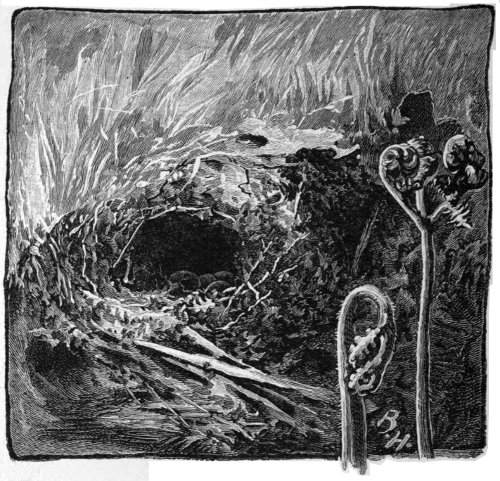
Willow-Warbler’s nest.—See p. 26.
255