W.H.G. Kingston (continued 5)
Reading edition
We found passing through the lakes the pleasantest part of the voyage. We might have been many days doing the distance, had we not had a favourable breeze. The wind changed directly after we reached Inverness, of which we were very glad, as it gave us some hopes of soon meeting the Dolphin, which we feared must have been detained off John o’ Groat’s House.
We made several trips down to Fort George, to look out for the Dolphin. At length one evening, having stood further down the Firth and looking into Cromarty, made classic by having been the scene of many of Hugh Miller’s rambles, we caught sight of a small white sail, shining brightly in the rays of the setting sun. Papa, taking the glass, looked steadily at her, and then, to our great satisfaction, declared his belief that she was the Dolphin. We immediately tacked towards her, and in a short time heard Uncle Tom’s cheerful hail across the water. We immediately hove-to, and the Dolphin doing the same, papa and I pulled on board her. They were in good spirits, although they had begun to think that they should never get round Duncansby Head, which is close to John o’ Groat’s House, until the wind drawing once more from the westward, they had reached Wick, the great resort of fishing vessels. After this they had a dead beat until they sighted Tarbet-ness Lighthouse, on the northern side of the Moray Firth. Their further adventures they kept for another day.
“I am glad to get back again to you,” exclaimed Dick; “it’s dull work sailing all alone. I confess that I sometimes thought you would never get through overland; for by no other way, it seems to me, could you have come, except along those little trout ponds I saw marked on the map.”
Dick was not a little astonished when we told him the size of the canal and its locks, and that a vessel very much larger than the Dolphin could have got through with equal ease.
We had brought an abundance of fresh provisions for both yachts, and were glad to find that Uncle Tom did not wish to go to Inverness; and we accordingly shaped our course for Kinnaird’s Head, not intending to touch at any place on the Scotch coast until we reached Aberdeen.
Chapter Ten.
Another Wreck.
As we sailed down the Moray Firth with a northerly wind, which enabled us to stand close in shore, the water being perfectly smooth, we passed numerous headlands, the names of which we learned from the chart. After the mountainous scenery amid which we had been sailing, the shore looked flat and uninteresting.
I had thus plenty of time to attend to little Nat, who was fast becoming very dear to all of us. We looked forward with regret to the time when he might be sent away to join his friends, should they be found. He had learned to walk the deck in true nautical style; and in his sailor’s suit, with his broad-brimmed straw hat, he looked every inch a young seaman. He was generally in capital spirits, apparently forgetting his loss; but if any allusion brought back to his remembrance his father, mother, or Aunt Fanny, his brothers and sisters, the tears sprang to his eyes, and he looked grave and sad.
Happily, however, a cheerful word brought him back to his usual mood, and he became as merry as ever.
“Do you know, Harry,” he said to me one day, “I intend to be a sailor. I should like to have just such a vessel as this, and cruise about the world that you tell me is round, though I cannot make it out; still, as you say so, I am sure it is.”
I pointed to the top-gallant sails of a vessel on which the sun was shining brightly,—“Now, watch that sail, and in a short time you will see her topsails, and then her courses, and then the hull. If the world was not round, we should see them all at once, just as clearly as we now see the top-gallant sails.”
As I spoke I took up a large ball of spun yarn, and placing a splinter on it, I advanced the piece of wood gradually until he saw the whole of it. “Now, this splinter represents that ship,” I said, pointing to it. “As we also are moving towards her, we shall soon see all her sails and her hull.”
Nat kept watching the ship with intense interest; and although summoned to luncheon, he begged that he might have something brought up to him, so that he could watch her hull come in sight. This in a short time happened, when he clapped his hands and shouted—
“Now I know that the world is round; but I thought it was so very big it could make no difference.”
“Well,” exclaimed Dick, who had been listening to my remark, “I never knew before how it was people guessed that the world was round. I saw ships’ sails popping up out of the ocean, but had not any idea how it was, and did not like to ask.”
“There you showed your want of wisdom,” observed papa; “you should have tried to think the matter out, or inquired.”
The wind continued to favour us, drawing gradually to the westward. We sighted a red light on Kinnaird’s Head, which, as we got more to the eastward, changed to a bright colour. Beyond it was Fraserburgh. By hauling our wind we were able to steer for Rathay Head. Near it we caught sight of Inverugie Castle. We gave a wide berth to the head, from which a dangerous reef of rocks run out; for though the ocean was tolerably calm, we could see the water breaking over them.
We were now hoping, as the wind was off shore, to stand due south for Aberdeen, which we were all anxious to see. We had sighted Slaines Castle, standing out solitary and grand on the very edge of the crag, when the wind suddenly backed round to the southward, and in a short time began to blow very hard. Dark clouds, which had been gathering thickly in the horizon to the south-east, came careering on over the blue sky. In spite of the heavy sea which was getting up, we held our course, standing away from the land, intending to tack again when we could to fetch Aberdeen. By the way the Dolphin was tumbling about I could readily understand how we must have appeared to her. Dick began to show signs of being far from happy, and Nat’s cheerfulness entirely left him. Papa sent him down below, and told him to turn in. Dick, however, braved it out, but grew more and more yellow and woebegone.
“This won’t do,” observed papa; “it’s fortunate that we have a port under our lee. Up helm, ease away the main sheet. We’ll let the Dolphin know that we are running for Peterhead.”
The Dolphin followed our example; and away we went, careering on before the fast-rising seas. Very glad we were that we had so fine a harbour to run for. The gale blew harder and harder, and the waves looked as if every instant they would engulf us; for we were now exposed to the whole roll of the German Ocean. On sailing in we were struck by the remarkable appearance of the flesh-coloured pinkish rocks, whose needle-shaped points rose up out of the water. We had, however, little time to notice them, ere rushing by we brought-up in the harbour of Peterhead. Most thankfully we dropped our anchor and furled our sails.
Peterhead appeared to be a bustling place. A number of merchant vessels, coasters, and fishing-boats were at anchor. As the days were long, we hoped the gale would blow itself out before the next morning. Directly we had dined we set off on foot to visit a curious cavern called the “Bullers of Buchan.” After walking for about two hours we found ourselves on the top of a cliff, from whence we looked down into an immense cauldron some fifty feet in diameter, open at the bottom to the sea, which was rushing in, and whirling round and round in foaming masses. We went round it, between the cauldron and the sea, where the ledge, with the foaming whirlpool on one side and the perpendicular cliffs on the other, was sufficiently narrow to make us feel the necessity of keeping our eyes open. On the west side, or the furthest from the ocean, we observed that the water rushed under an arch. A person told us that in fine weather a boat could pass under this arch, though at present one would have been immediately dashed to pieces. The whole cliff was completely perforated by caverns. “Buller,” I should have said, means the “boiler.” Having watched it until our ears were wellnigh deafened by the roar, and our eyes dizzy from gazing at the seething whirlpool, we hastened on to get a sight of Slaines Castle, which we had seen from the sea. As we viewed it from a distance, the walls appeared to be a continuation of the cliff on the summit of which it stands. It is a large quadrangular building, without a tree in the neighbourhood. It had a somewhat gloomy aspect under the dark sky when we saw it. The property belonged, till lately, to the Earl of Errol, whose nearest neighbour to the eastward was, as Dick said, “Hamlet’s Ghost,” or the Castle of Elsinore, which stands on the shores of the Skagerack.
We had spent a longer time in visiting the castle than we had intended, and had only got a short distance back when we were overtaken by the gloom of evening. The wind was blowing dead on shore, and a tremendous sea running. We were casting our eyes over the German Ocean, when we saw what we took to be a brig, with her mainmast gone, and several of her sails blown away, evidently steering for Peterhead. Unable to keep close to the wind, she was drifting every instant nearer and nearer the shore.
“I fear she’ll not weather that point,” observed papa; “and if she comes on shore, there’ll be little chance for any of her people, as no lifeboat could get near her.”
We had passed a Coastguard station a little way to the northward. Uncle Tom volunteered to hurry on, and I accompanied him—in case the people there should not have observed the brig—to give them notice of the danger she was in; that, should she strike, they might be ready to render assistance with their rocket apparatus.
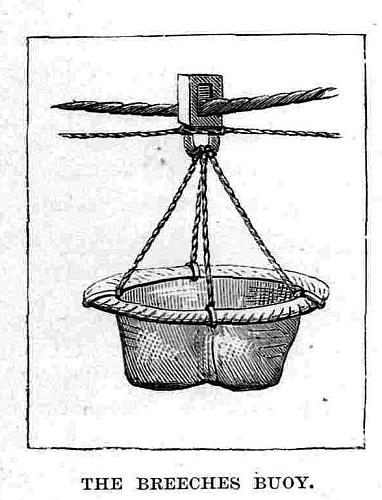
It was now quite dark, and we had great difficulty in making our way; there was a risk of finding ourselves at the edge of some chasm, down which we might fall. The distance seemed very long, and I thought we must have missed the Coastguard station, which was situated at the edge of the cliffs. At length, however, we saw a light gleaming from a window, and arrived at the wall which enclosed the house where the lieutenant and his men lived. We found them on the alert. Two had just gone off for some horses to drag the waggon in which the rocket apparatus was to be carried, as one of the men stationed to the southward had seen the brig and reported her danger.
In the waggon were already placed the rocket tube, with three rocket lines, several rockets, three spars to form a triangle, an anchor, lantern, spades, and pickaxes, some signal rockets, a rope ladder, and a sling life-buoy, with what are called “petticoat breeches” fastened to it, in which a person can be placed.
There were also a strong hawser and a whip or fine rope, by which the sling life-buoy was to be drawn backwards and forwards from the wreck to the shore. By the time these were got into the waggon a couple of horses had arrived, and a party of men immediately set off with the waggon.
The lieutenant conducted us back by the way we had come; as he knew every inch of the ground, we had no fear now of falling over the cliff. We had not gone far before we saw a rocket thrown up about a mile to the southward.
“It is as I feared,” said the lieutenant; “the brig has gone ashore, and that rocket, fired by one of my men, shows the spot where she has struck. There is no time to lose, for in all probability she will not hold together long.”
The signal made us hasten on even faster than before.
“There she is! there she is!” cried the lieutenant, just as we reached the summit of a cliff.
We could see the brig about a hundred fathoms off on the rocks, the sea making a fearful breach over her. There was light sufficient to enable us to see that the foremast was still standing.
We found that papa and the rest of our party had arrived at the spot, and were watching her, but of course utterly unable to afford any assistance. It would have been a sad thing to watch her, had we not known that we should soon have the means of saving the poor people. Scarcely a minute had passed when a shout gave us notice that the waggon had arrived. We all instantly hurried to her to assist. While the men handled the heavier articles, we carried the lighter ones. Each man knew exactly what he was to do. The lines, I should have said, were in boxes, two of which were carried to the cliff; the tube was then fixed, and the line fastened to it. It was an anxious moment. Would the line pass over the vessel? would the crew be able to secure it? I could not help fearing that the rocket might strike the vessel, and perhaps kill some one on board; but the lieutenant took very good care to avoid that, by giving the tube sufficient elevation.
“Now, lads, stand by!” he sang out.
The men tilted the box in which the line was secured, so that it might run out freely. The officer now fired; and the rocket, rising in the air, made a grand curve of light, which we watched with intense interest until we saw it fall completely over the vessel. We had now to ascertain whether the men on board had secured it. No signal came, and of course we could not venture to haul in on the line, lest we might draw it back.
“They probably have no blue light or gun on board, or any other means of making a signal,” observed the lieutenant.
Scarcely, however, had he spoken, before a faint light from a lantern was shown in the rigging.
“All right,” he exclaimed: “they have secured the line; make it fast to the warp.”
Upon this, one of the Coastguards, going a short distance from the rest of us, exhibited a lantern with a red light, and presently we found that the whip—or double line—with a tailed block was being hauled off by the men on the wreck.
We had now to wait again until once more the lantern was shown on board. This was a signal to the Coastguard to secure the end of the hawser to one part of the double line or whip, when all hands taking hold of the latter, we hauled off the hawser to the wreck. The tailed block had probably been secured to the mast; and as long as that held we had every hope of establishing a communication.
If we felt anxious, how much more so must the poor fellows on the brig, which might at any moment be knocked to pieces, and they be sent struggling hopelessly in the foaming seas! We knew from the length of the whip that we must haul out the hawser almost to its end. Soon after we had done so another signal was made, which implied that the men had secured it round the mast. We then immediately hauled away on the hawser until we had got it stretched and secured to the anchor, which had been imbedded in the earth some way back from the cliff. It was necessary, however, not to get it too taut, as the vessel was moved by the seas, and might either break it, or tear the anchor out of the ground. This done, the “buoy with the breeches” was secured to a block, adjusted to the hawser, and was immediately hauled off.
I should have said that a triangle, formed of three small spars, over which the hawser passed, was fixed in the ground nearest to the edge of the cliff; and now, to our infinite satisfaction, we had a perfect communication with the wreck. Still we had to watch for another signal, to give us notice that a person had been placed in it. Again the light appeared. We hauled away on the warp.
“Handsomely, handsomely!” sung out the lieutenant, as the men were hauling in rather fast on the line.
We eagerly watched; when at last through the gloom we saw the life-buoy appear, and discovered that a person was in it. With anxious haste the lieutenant and two of his men stepped forward, and grasping the buoy and its burden, gently lifted out the occupant.
“My arm is broken, sir; take care, please.”
We found that it was the mate of the vessel who spoke; he was the first sent on shore. We carried him up to the waggon, where he could be sheltered from the wind by the awning which covered it. While Uncle Tom remained with him, we hastened back to the cliff.
By this time another person had arrived—a young boy—who was also somewhat hurt. He was almost fainting from pain and terror; his state was such that he could only utter the words, “Make haste! make haste!”
There was good reason for this, for we could judge by the way the hawser was moved that the vessel was rolling more and more; and the men were compelled to slacken it out every now and then. It may be supposed no time was lost. Three men were now successfully brought on shore.
We were going to carry the boy to the waggon, but he intreated to remain. The first of the men who arrived told us the reason. He was the captain’s son. The captain himself would not leave the vessel until the last. Two of their number had been washed overboard, the captain alone now remained. We could hear the boy crying out every now and then, “Make haste! make haste!”
Once more the life-buoy was hauled off; every possible speed was made. I don’t think I ever before felt so intensely anxious; for I could sympathise with the poor boy whose father was still in fearful danger. Each moment it seemed as if the hawser would be carried away. Again the light was shown, and seemed to be advancing towards us. The Coastguard hauled away with all their might, helped by two of the rescued crew, while the lieutenant and the rest stood by ready to take hold of the captain. The light drew nearer and nearer. “Make haste! make haste!” again cried the boy. When at length he saw his father safe, in spite of his hurts, rising up from the ground, he rushed forward and threw his arms round his neck.
Scarcely had the captain’s feet touched the ground than the hawser slackened, a loud rending sound was borne to our ears by the wind, and we knew that some huge billow had dashed the brig to pieces. Indeed, I fancied I saw fragments tossing about in the seething waves which dashed up against the cliffs.
All felt that they had done their duty, and that the lives of their fellow-creatures had been saved by their promptitude, and the skill with which the operations had been carried out. The Coastguard men, having hauled in the hawser until the mast was brought close under the cliff, the rocket apparatus was returned to the waggon, in which also the mate and the captain’s son were placed, and we then all set off to the Coastguard station.
The lieutenant invited us to remain at his cottage until the morning. We gladly accepted his offer; and his wife, who was a very nice person, treated us in the kindest manner, and produced a variety of garments, which we put on while our wet clothes were drying. Uncle Tom had a lady’s cloak over his shoulders. Dick was dressed in an old uniform coat, and papa got into a pea-jacket.
The shipwrecked crew were looked after by the Coastguard men, and the lieutenant and his wife attended to the mate and the boy; while the master of the vessel had a room to himself, being completely knocked up, and as soon as he had had some supper went to bed, and happily was soon fast asleep.
Papa and the lieutenant found that they had many mutual acquaintances, and they sat spinning yarns before the fire—for, although summer, a fire was very pleasant—until late in the night. The lieutenant described to us the gallant way in which the lifeboats of two neighbouring stations had gone out on several occasions to rescue the crews of vessels either on the rocks or sandbanks at the mouth of the Moray Firth.
One hears but little of the wreck of coasters; but were it not for the assistance of lifeboats, in most instances the crews, consisting of three to six men, would be lost; as the vessels, being often old and rotten, quickly break up, and being low, the seas wash completely over them. Not long ago a boat was discovered by one of the Coastguard men on the beach; and on hurrying towards her, he found a poor fellow lying on the sand almost exhausted. On carrying him to a neighbouring fisherman’s cottage, he recovered; and he then stated that he belonged to a large barque which had gone on the sands; that he and twelve other men had taken to their boat, but that she had capsized, and that all hands, with the exception of himself, had been drowned; that he had swum on shore, though he could scarcely tell how he had managed to reach it. He said that there were four men still on board. On this the Coastguard men hastened to the nearest lifeboat station, when the boat was immediately manned and pushed off for the wreck, the position of which the seaman had described, though as it was night she could not be seen. Away the gallant crew pulled through tremendous seas, which were rolling in on the coast. Having gained an offing, they made sail, and steered for the wreck, which at length was discovered with two of her masts gone, while the crew were clinging to the rigging of the remaining mast, which threatened every instant to follow the others. The lifeboat, showing a light, indicated to the poor fellows on the wreck that help was near. After considerable difficulty they got up under her lee, and were able to heave a rope on board. Getting a stronger warp, they hauled up near enough to enable two of the men to jump on board. The third slipped, and fell into the water, running a fearful risk of being crushed; but, happily, he also was got into the boat. As is often the case, the cabin-boy was the last left. It was a trying thing to see the poor little fellow clinging to the rigging, but unable to help himself.
“We can’t let him perish!” cried one of the lifeboat men; and at the risk of his own life, the boat being hauled up to the wreck, he sprang into the rigging, and with his knife cut the lashings by which the poor boy was held. A crashing sound was heard, the weather shrouds and stays were giving way. In another instant the mast would fall, and not only the gallant fellow and his charge, but all in the lifeboat, would perish.
“Leap, man! leap!” shouted the crew, ready to shove off, and watching the tottering mast with anxious gaze; but even though they all knew the fearful risk they incurred by remaining, they would not desert their companion or the lad he had gone to save. The gallant boatman, seizing the boy in his arms, slid down the rigging and sprang from the chains into the boat, where he was caught by the outstretched arms of his companions. The next moment the boat was many fathoms from the wreck, when down came the mast on the very spot where she had been floating, the cap of her topmast almost striking her bow. Still the crew had a heavy struggle to reach the shore, for the gale came down with greater force than ever, and the hungry seas seemed ready to engulf her; but the shipwrecked men were landed in safety. Not until they met their companion did they learn that he and they were the sole survivors of the crew.
The lieutenant told the tale so graphically that I have tried to put it down in his own words. He related many other similar anecdotes; and it was not until the night was far spent that we dropped off to sleep in our chairs.
At daybreak, as the rain had ceased, and the wind had somewhat gone down, we started for Peterhead, papa promising to send a conveyance for the mate and the boy, that they might be carried to the hospital.
Peterhead is a substantial-looking seaport town, the houses being mostly built of granite from quarries near. It stands on the south side of the mouth of the river Ugie, and has two harbours, one on the north and the other on the south side of the peninsula. The latter, which is the oldest, was formed in the year 1773, from plans by Mr Smeaton, the great engineer of those days; and the north harbour in 1818, from those by Mr Telford. Piers run out from the shore, which is lined by fine quays.
We had to wait the whole day before proceeding on our voyage, so we had time to see a great deal of the town, and something of the neighbourhood. We paid a visit to the hospital, and were glad to find that the poor mate and the captain’s son were going on very well.
Next morning broke bright and beautiful, with a fine northerly breeze, which raised our spirits; and sailing out of the harbour, we stood towards Buchan Ness, on the summit of which stands a stone tower, with a light flashing from it at night, to show the approach to Peterhead. We sighted Slaines Castle, from which we steered a direct course for Aberdeen. About ten o’clock, the distance run being about thirty miles, we sighted the Girdlestone Lighthouse, on the southern side of the river Don, on which Aberdeen stands. Crossing the bar, we found ourselves in a wide bay. Several vessels and a number of boats were standing towards the spacious quays, backed by the fine granite-built houses of New Aberdeen.
On landing, we noticed the massive appearance imparted to the houses by the granite of which they are composed.
Our first visit was to Marischal College, the great seat of learning in the north, where Captain Dalgetty, that redoubted soldier of fortune, according to Scott, obtained his education. We went through the museum, library, and observatory, saw a good collection of paintings, and were especially struck by the handsome way in which the whole building is furnished.
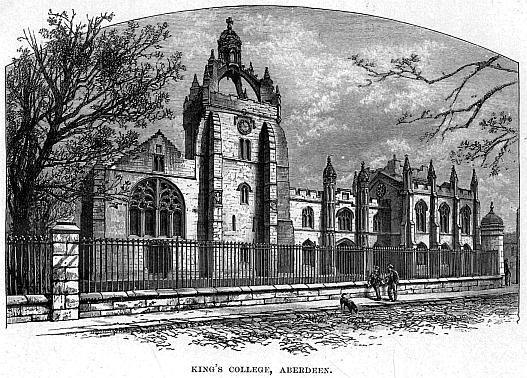
Hurrying on, however, to the old town, on the south bank of the Don, we visited the parish church of Old Machar, a grand and venerable building. The pillars in the transept have their capitals beautifully carved in oak. We then went to King’s College, a large quadrangular edifice, including the chapel, built of granite. The examination hall contains a collection of the portraits of the old Scottish kings and the early principals of the college,—a Bishop Elphinstone, the founder, being among them. We were amused by seeing the students, of whom there were between two and three hundred, walking about dressed in red gowns. They belong to all ranks of society, many labouring during the summer to obtain the means of educating themselves in the winter. We heard a pleasant anecdote of the late Duke of Gordon, who used to send out a carriage when he knew that the young men were on their way to college, in order to give them a lift for a stage or two. Many, we were told, had worked at the Caledonian Canal before thus arriving in the ducal carriage.
We saw many evidences of the prosperity of Aberdeen; and while we lay in the harbour two or three steamers came in and out; one on its way to the islands of Orkney and Shetland, and others to Leith and the Thames. Our few hours at Aberdeen were among the most interesting we spent on shore during our voyage.
Sailing again in the afternoon, with a fine northerly breeze, we passed the neat town of Stonehaven, about fifteen miles to the south, and soon afterwards the grand ruins of Dunnottar Castle, a large square tower rising from amid the ruins of other buildings on the very edge of the cliff. We could judge of its size by the extent of the remaining walls. It was here that the crown and sceptre of King Charles were kept during the Civil Wars. The castle was besieged, and the garrison was about to capitulate, when Mrs Ogilvie, the governor’s wife, put them in charge of Mrs Grainger, the wife of the minister of Kinneff, who had paid her a visit by permission of the Republican General Lambert. Mrs Ogilvie managed, with wonderful boldness, to smuggle out the crown, fastened under her cloak, while her servant hid the sceptre and sword in a bag of flax which she carried on her back. It was here, also, that many of the Covenanters were imprisoned, and, according to an ancient chronicler, Wallace put to death four thousand Englishmen, who had fled for safety into the church. The approaching night hid the gloomy walls from our view.
As we passed the towns of Montrose and Arbroath during the night, we saw nothing of them. The wind fell light when off the latter place, and then blew from the south-west, bringing up a thick fog, which shrouded the whole surface of the water. Papa being told of it, he went on deck, and Dick and I followed him; when he at once hauled the yacht on the wind, and stood off the coast. After running on for about an hour, the peculiar mournful sound of a bell reached us. As we stood on, it sounded every half-minute, louder and louder.
“Where does that come from?” inquired Dick.
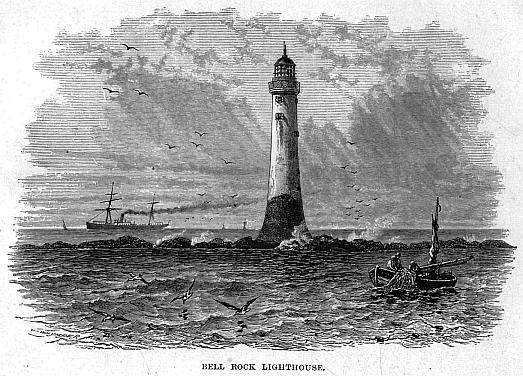
“From the Bell Rock,” answered Truck. “If it wasn’t for the fog we should see a light from the tall tower which now stands on the rock, bright and red alternately. Once upon a time there was no tower there; but there was a bell fixed on a buoy, and as the waves beat against it, it tolled without ceasing; but I have heard say that there was a pirate, who used to cruise in those seas, who cut the bell off; but not long after, when making for Dundee, during a dark night and a heavy gale, he ran his ship on it, and was lost with all his men—a judgment on him for his evil deeds.”
The wind dropping altogether, we lay becalmed, within the sound of the bell, until morning broke and the fog lifted, when we saw the tower just ahead of us. The centre part of the building was coloured white, and could scarcely be seen against the sky; but the lower part, which was dark, and the lantern, which was in shadow, were perfectly visible. We pulled towards it; and as we approached we saw the rocks on which the lighthouse stands rising ten feet or more above the water. Iron ladders were fixed for landing, and by a gun-metal ladder we were able to reach the entrance port. The head keeper came down and received us cordially. As in other lighthouses, the first story is used for storing coal; the second for water; the next for oil; and the next for bedrooms, with berths for six persons. Above it is the kitchen, and above that the sitting-room, in which we saw a bust of Stevenson, the engineer. The light is revolving, and has five reflectors, on each of which are two faces, one red and one white. The red colour is produced by chimneys of red glass. The keeper told us that four men belonged to the lighthouse, that they are all married, but that three only were on duty. As at the other lighthouses, birds are occasionally killed by flying against the glasses.
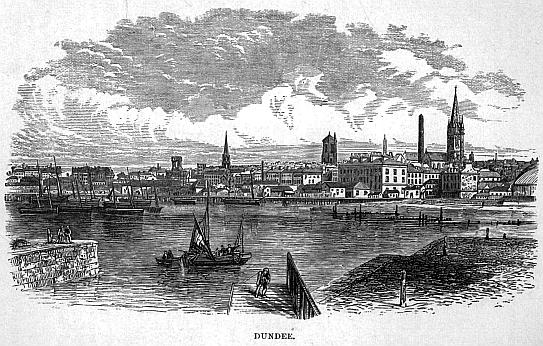
Soon after we left the Bell Rock, the wind freshening from the southward, we stood on for Dundee, from which it is about five and twenty miles distant. We passed through the narrow entrance of the Firth of Tay, with Broughty Castle on our right, beyond which we came off Dundee, standing on the northern shore, and rising on a gentle declivity from the water’s edge, towards a high hill called the Law. The estuary here is nearly two miles wide. A number of vessels were at anchor, while the docks seen beyond the quays were full of shipping. Dundee has a handsome appearance, with its broad streets and fine stone houses. About the centre of the town, we passed what looked like one enormous church, with a lofty tower at the western end; but we found that it consisted of four parish churches, which are built side by side, so as to form one edifice.
“I wish that all Christian communities could thus live in unity,” observed papa.
These churches were, as may be supposed, all Presbyterian. There are several others in the town. We were told that there were nearly ninety schools in Dundee, at which upwards of four thousand children are educated. One of the most interesting places which claimed our attention was the Watt Institution, established in honour of James Watt, for the instruction of young men in science. There are also nearly forty mills for spinning flax, weaving linen, sail-cloth, sacking, and cordage. On the quay stands a handsome arch, built after a Flemish model. Besides the patent slip and graving dock, there are three wet docks and two tidal harbours, while other improvements are being carried on; so that Dundee is a most flourishing place.
Not far off is Camperdown, once the residence of Lord Duncan, who called it after the famous victory he won over the Dutch; and a little distance further is Rossie Priory, belonging to the Kinnaird family.
As we were anxious to look into Saint Andrews, we sailed again next morning, in the hope that the wind would continue in the north, or at all events that we should be able to beat down thus far. It is situated on the south shore of Saint Andrew’s Bay, some little way outside the entrance to the Firth of Tay. The wind favoured us more than we expected; and a pilot-boat showing us the way, we stood into the harbour, passing close under the peninsula on which the town stands. Above us were the ruins of the cathedral and the chapel of Saint Rule, who was supposed to have founded the place, with several other buildings. Saint Andrews presented a very quiet aspect, forming a great contrast to the bustling town of Dundee; but I must say it is a far more picturesque place. Of course we visited the university, the most ancient in Scotland. It consists of the colleges of Saint Salvator, Saint Leonard, and Saint Mary. There is also a school called the Madras College, founded by Dr Bell, the originator of the Madras system of education. By means of these colleges, at which an almost free education can be obtained, young Scotchmen without means are able to enjoy advantages which they could not do in England. The town is certainly more alive than it was when Dr Johnson visited it in the last century; he declared that one of the streets was lost, and that in those that remained there was “the silence and solitude of inactive indigence and gloomy depopulation.” We thought it a very picturesque-looking place, and should have remained there longer had the wind not changed and induced us to put to sea.
Having passed round Fifeness, the eastern point of the peninsula, and opened the Isle of May lights—for there are two on the summit of the island—we stood across the Firth of Forth, intending to visit Edinburgh. The wind being light the whole night, we made no way.
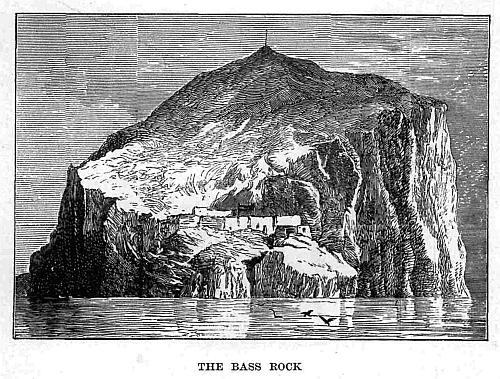
When morning broke, we were in sight of Fenton Law, which rose beyond North Berwick, and the Bass Rock, at no great distance off, standing high up above the blue sea. We passed close to it, and got a view of the almost inaccessible castle perched on its cliffs. It is now in ruins, but at one time was used as a state prison, in which several of the most distinguished Covenanters were confined. Wild flocks of sea-fowl rose above our heads from off the rock, and among others were numbers of gannets or Solan geese.
As we had lost so much time, and had still the whole English coast to run down, papa and Uncle Tom, after a consultation, agreed to give up their visit to Edinburgh, and to continue their cruise across to the southward.
Chapter Eleven.
The North-East Coast.
We got a view of North Berwick, which stands on the extreme northern point of Haddington; and about three miles to the eastward of it we came off the far-famed Tantallon Castle, in days of yore the stronghold of the Douglases. Of course, we got out Marmion, and read the description of this celebrated fortress, which by the extent of its ruins must have been of great size and strength.
“I said, Tantallon’s dizzy steep Hung o’er the margin of the deep. Many a rude tower and rampart there Repelled the insult of the air, Which, when the tempest vexed the sky, Half breeze, half spray, came whistling by. A parapet’s embattled row Did seaward round the castle go. Sometimes in dizzy steps descending, Sometimes in narrow circuit bending, Sometimes in platform broad extending, Its varying circle did combine Bulwark, and bartizan, and line, And bastion, tower, and vantage-coign. Above the booming ocean leant The far-projecting battlement; The billows burst, in ceaseless flow, Upon the precipice below.”
We passed the mouth of the river Tyne, south of which stands Dunbar. The next place of interest we came off was Fast Castle, of which two tall towers remain close to the cliffs,—in former days the stronghold of the Homes. It is supposed to be the original of Wolfs Crag in The Bride of Lammermoor. We looked through our glasses at the spot where the unhappy Master of Ravenswood sank with his steed into the treacherous quicksand.
About fifteen miles farther on, we passed the bluff promontory Saint Abb’s Head, and soon afterwards arrived off Berwick, which, I need hardly say, stands at the mouth of the Tweed, the river dividing England from Scotland. So close does the railway run to the cliffs, that we could hear the trains passing as clearly as if we were on shore, and could see them shooting by at a speed which made us jealous. As the wind was fair, we did not put into the Tweed, but stood close enough to Berwick to have a cursory view of it. As all the world knows, Berwick is not within any county, for although really in Berwickshire, it belongs to England. It is a county in itself. A portion is still surrounded by walls erected in the time of Elizabeth; and it is defended by several bastions, with batteries commanding the entrance to the harbour. We could see the remains of an ancient castle, which is now a heap of ruins, but above it stands the Bell Tower, still almost perfect. A number of vessels passed in and out of the harbour while we were off it, showing that the place has a good deal of trade. As we looked through our glasses, we saw a number of churches and public buildings. A long stone pier runs out on the north side of the Tweed, with a lighthouse at its end.
We now stood on towards Holy Island, a few miles south of Berwick, off the Northumbrian coast; and as we had still several hours of daylight, we hove-to off the island. Here, in the early days of Christianity, was a college of evangelists, who went forth to preach the simple gospel through the northern portions of the country, to its heathen kings, as well as to the people over whom they held sway. Ultimately, monasteries were built here, famous for the supposed piety of their inmates.
We pulled on shore to visit the ruins of the celebrated Abbey of Lindisfarne. If the pilgrim visitors arrived at low water, they could get across by following the sandbank which connects it with the mainland; but they had to make haste, to escape being caught by the flood.
Besides the monastery, there was a castle of great strength, which often resisted the invader’s hostile attacks; and heathen Danes had again and again been driven back to their ships by its stalwart garrison. Its glories, however, are departed. We could find only a few low walls, over which we could leap, and the remains of a staircase of eight or ten steps in a tower but little higher than the wall. A board warning off trespassers took away what little romance we had conjured up.
Returning on board, we again stood to the southward, sighting Bamborough Castle, elevated on a green mound above the village. Off it lies the Longstone Rock and the Farne Islands. The coast looked bleak and desolate, with here and there dark rocks running into the sea. The wind was very light as we came off the Longstone Lighthouse.
While the yachts hove-to, the boats were lowered, and we pulled up to it, in order to pay a visit to the scene of Grace Darling’s heroism. For upwards of fifty years the lighthouse was under the charge of William Darling, the father of Grace. We understood that the present head keeper was a member of the family. The tower stands on a rock, is painted red, and the light revolves every half-minute. We were much interested with the memorials of Grace Darling which embellished the sitting-room. The light-keeper on duty pointed out the various localities connected with the wreck of the Forfarshire.
Before daylight, on the 6th of September 1838, a furious gale blowing, Grace Darling, who acted as William Darling’s assistant and was on watch, heard, as she thought, the cries of people coming from the direction of some rocks a mile away. She awoke her father, and together they stood listening to the appeals for help; but in the dark, with the furious sea there was running, it was impossible to put off to their assistance. When day broke, however, the old man launched his boat, and was about to shove off, when, observing the state of the tide and weather, he hesitated to make the attempt. As the light increased, Grace, who had been anxiously watching the wreck, declared that she saw some people still clinging to it.
“We must save them!” she exclaimed; and seizing an oar, she stepped into the boat.
The old man, aroused by her example, followed her. Through the foaming seas, which threatened every moment to overwhelm the little coble, they pulled off to the wreck. The fore part of the vessel, to which nine people were clinging, alone remained; to reach them it was necessary to land on the lee side of the rock. This, after considerable difficulty, William Darling succeeded in doing, when immediately Grace rowed off in the coble, to prevent it being dashed to pieces. One by one, five of the crew and four passengers were drawn by the lighthouse-keeper off the wreck, and placed on the rock, from whence they were transferred to the boat, and conveyed, a few at a time, to the lighthouse.
Owing to the state of the weather, no communication could be held with the mainland for two days, during which time the nine shipwrecked persons were treated with the utmost kindness by Mr Darling and his daughter. The calm bravery of Grace, who was at that time only twenty-two years of age, excited the admiration of all who heard it. Testimonials and suitable presents, together with seven hundred pounds sterling raised by subscription, showed how highly the public appreciated her conduct. The Forfarshire steamer, of three hundred tons, had sailed the previous evening from Hull, bound for Dundee; but her boilers becoming defective, the engines could no longer work, and at three o’clock the following morning she struck on the Longstone, the outermost of the Farne Islands, between which the master was endeavouring to run the vessel. The mate, with seven seamen, lowered a boat, and were escaping, when one of the passengers leaped on board, others in vain attempting to follow his example. The nine occupants of this boat were the following morning picked up by a coaster and carried into Shields,—they, with those rescued by the Darlings, being the only persons who escaped out of sixty souls.
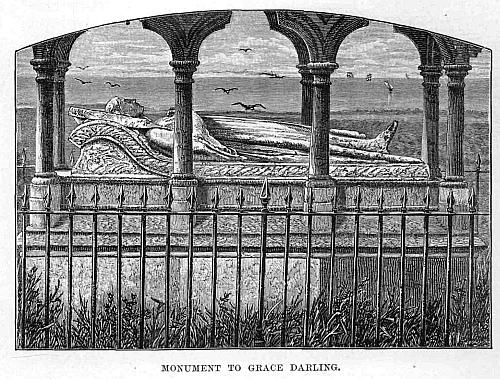
Four years after this heroic deed, Grace Darling lay upon her dying bed. The grief of the family was very great, for Grace was endeared to them all. “Do not mourn for me,” she said; “I am only exchanging this life for one far better. If I remained here, I should be subject to trouble and sickness; but in dying I go to be with Christ my Saviour.” Two beautiful memorials of Grace have been erected: one in Bamborough Churchyard, and the other in Saint Cuthbert’s Chapel, on the Farne Island. Our picture represents that in Bamborough Churchyard. Her sleeping figure lies under a Gothic canopy, backed by the blue waves, and within sight of the scene of her heroism.
“She is lying and sleeping now Under the verdant turf. Ah, there were breakers she might not ride! And her hair grew damp in that strong, dark tide, But not with the briny surf. “And out of her lonely grave She bids us this lesson prove, That the weakest may wipe some tears that flow, And the strongest power for good below Is the might of unselfish love.”
In 1860, the Iris, of Arbroath, struck on the rocks close to where the Forfarshire was lost. The wind was so terrific, and the sea ran so high, that the crew were afraid to take to their boat. They accordingly leaped into the water, and were washed on to the rock, though it was with the greatest difficulty that they managed to reach it. Here they remained twelve hours, the sea being so rough that no boat could come to them. Towards evening, the wind having slightly fallen, William Darling, who was then seventy-five years of age, and had been watching the wreck all day, put off with several hands from the lighthouse, and rescued the poor fellows from their perilous position.
We had a scramble over a portion of the Farne Islands, on which there are two lighthouses at a considerable distance from each other. There are three keepers belonging to the two, but only one remains on watch at a time; he has to attend to both lights, and has to walk from house to house. The keeper showed us a curious contrivance by which he can at once rouse the sleeping keeper without leaving his own post. It consists of a hand-bellows attached to a tube which rings a bell at the ear of the sleeper. He told us that occasionally blackbirds and thrushes are killed by striking against the lantern. We saw a number of rabbits running in and out of their burrows. There is an old chapel which has been restored and another building, converted into a dwelling-house for the clergyman, who at times comes across from Durham.
Nat, who had landed with us, was very anxious to keep a young cormorant which he had picked up. He took it under his arm, intending to carry off his prize; but the mother bird attacked him so furiously with its long beak, that it nearly put out one of his eyes, and succeeded in severely biting his lip. On this, Nat very naturally let go the youngster, which scuttled off, determined not to be caught again, and, taking to the water, swam away at a great rate. The odour produced by the birds was anything but pleasant. We saw a number of cormorants diving in search of prey, and they came up with eels in their mouths. One had caught a big eel, which it battered against the rock until it had killed it; but others gobbled down small eels without the slightest hesitation. The young birds were the oddest-looking creatures imaginable. Their covering was a hard black skin, with here and there black woolly down upon it. The old birds’ heads and necks were black, speckled with white feathers, while the upper part of the body was brown mingled with black. They had also white patches on their thighs, and yellow pouches under the throat edged with white. They were fully three feet long; so that, with their strong beaks, they were formidable antagonists.
The gulls were even more numerous than the cormorants. Though they kept out of our way, they did not appear otherwise to fear us. They looked very large on the wing, as their white feathers glanced in the rays of the setting sun; but they are not more than half the size of the cormorant. They act the useful part of scavengers on the coast, and eagerly pick up all the offal thrown on the shore.
We returned to the yachts, and once more made sail. We got a good view through our glasses of the old towers of Dunstanborough Castle. As the wind fell light, we pulled in to have a look at it, papa being anxious to do so, as he had visited it in his younger days. The weather-beaten ruin stands on the summit of a black cliff, rising sheer out of the ocean. Three towers, one square, and the others semicircular, remain, with the greater portion of the outer wall, enclosing several acres of green turf, over which, instead of mail-clad warriors, peaceable sheep now wander. The principal tower overlooks a deep gully or gap in the rocks, up which the sea, during easterly gales, rushes with tremendous force and terrific noise, lashed into masses of foam, which leap high over the crumbling walls. This gully is known by the significant name of the Rumble Churn. This ocean-circled fortress was erected—so say the chroniclers—in the fourteenth century, by Thomas, Earl of Lancaster. Many a tale of siege and border warfare its stones could tell; for the Cheviot hills—the boundary between Scotland and England—can be seen from the summit of its battlements. Having bravely held out for Queen Margaret of Anjou, it was completely dismantled in the reign of Edward the Fourth, and has ever since remained like a lion deprived of its claws, crouching over the ocean, a sad memento of its former power. Had it remained until gunpowder was in general use, it would probably have been entirely overthrown.
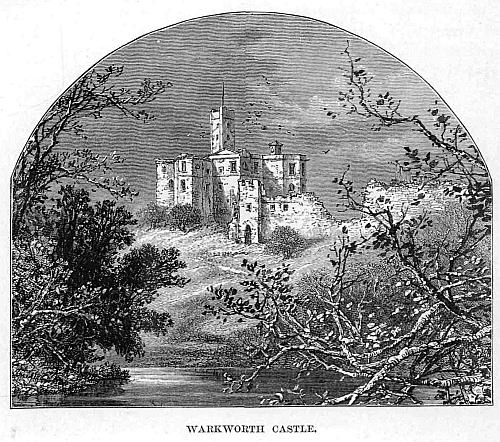
Papa described to us Warkworth Castle, which stands further south, above the banks of the Coquet river, on a high wood-covered hill. The greater portion of the ruins remain; indeed, the woodwork alone has disappeared, and the masonry is in so good a state of preservation, that the late Duke of Northumberland proposed to restore it, and make it his residence, instead of Alnwick Castle. Near it a hermit dwelt in a cavern: he became a hermit in consequence of having killed the brother of his betrothed, whom he mistook for a rival, after his return from the Crusades.
We sighted Coquet Island, with its square white lighthouse, from which a light burst forth as we approached. Near it were the castellated dwellings of the keepers, painted different colours. In its neighbourhood are dangerous rocks, and over each a red ray is shown, to warn vessels which might otherwise run upon them. We were now almost constantly in sight of some light, which enabled us to know our exact position. Dick and I turned in while Coquet Island light still shone brightly.
We expected the next morning to be off Hartlepool, at the mouth of the Tees; but when day broke we found ourselves in sight of a picturesque castle standing on a point of land, with a broad river flowing below it, and a town at its foot. When we asked Truck what it was, he answered:
“That’s Tynemouth, at the mouth of the Tyne; and the captain says he intends to run in there to have a look at the place. It’s as well worth seeing as any place we have been to. Beyond it you see North Shields, and South Shields on the southern bank; and higher up is Newcastle, where coals come from, as you’ve heard tell of.”
We laughed at Truck’s description. “If they don’t come from Newcastle, I don’t know where else they come from,” remarked Dick.
“A good many other places, young gentleman. There’s no small quantity shipped from Sunderland and Swansea; and also from some of the Scotch ports. If we go up to Newcastle, we shall see the curious way they are put on board the colliers.”
“But why haven’t we got further?” I asked, “Because we have had light winds, and the tides have been against us most of the night,” answered Truck.
As not only the tide, but the wind also was against us, papa, on coming on deck, agreed to run up the Tyne. Hauling our wind, we stood in for North Shields, passing close under the lighthouse, which stands amid the ruins of the castle.
North Shields was evidently an active commercial place. Shipbuilding was going on in the yards, and vessels were loading with coals, bound to all parts of the world, each with a number of keels, or oval boats, alongside, which had brought down the coal from the upper part of the river. On board the vessels cranes were at work lifting up tubs of coal from out of the keels, and depositing them in their holds. Of these keels I shall have more to say by-and-by. Steamers emitting black wreaths of smoke were coming and going,—some towing vessels out to sea, others taking them up the harbour; while several were conveying passengers. After breakfast we went on board one of the passenger vessels, for papa and Uncle Tom did not wish to carry the yachts higher up.
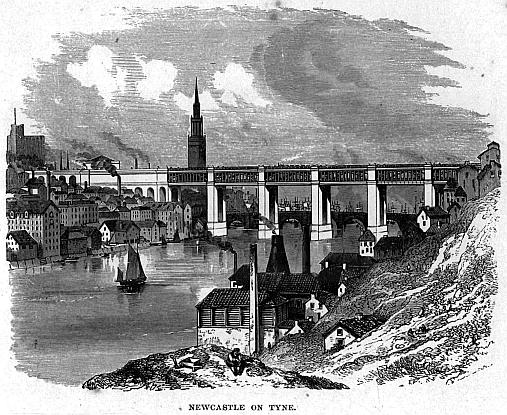
We had clear evidence that we were in a region of coal. The greater number of vessels we met were colliers, their crews begrimed with coal dust. “Everybody,” as Dick remarked, “had a coaly look.” People were heard conversing in a broad Northumbrian accent, with a burr in most of their words. They were broad-shouldered men, capable of doing any amount of hard work. We came in sight of a fine stone bridge with nine elliptical arches, which connects Newcastle with Gateshead, on the opposite bank. Above it is another magnificent bridge; it is double, the lower roadway, ninety feet above the river, being used for carriages and foot passengers, while the upper carries the railway. It has two piers at the margin of the river, and four others in the stream itself, besides smaller piers. It was curious to walk under it, and to hear the trains rumbling by overhead.
Newcastle stands on the north bank of the river. At first we thought it a very smoky town, but on emerging from the narrow old streets we reached some fine broad thoroughfares with large houses and magnificent public buildings. At the quays were a vast number of vessels, some of considerable size. Formerly coals used to be put on board vessels from the oval boats I have before mentioned, called keels, of which a considerable number are still employed. Each keel carries about twenty tons of coal, the larger masses being piled up in the vessel, but smaller coal is carried in tubs, each keel having about eight tubs. The keels are antique-looking craft, such as were probably used in the earliest days of our history. They are propelled by large oars. The keel man, commencing at the bow, presses the oar before him, until he reaches the after part of the boat; he then hurries back to the bow, and again puts down his oar. The keel men are a fine hardy race. Formerly they were spoken of as “bullies;” but this, among the colliers, means “brothers,” or is derived from “boolie,” that is, “beloved.” Though their manners are rough, their character is good, and they are remarkably friendly to each other. Being all “keel bullies” or “keel brothers,” they support an extensive establishment in Newcastle called the “Keelmen’s Hospital.” We met a whole fleet of these keels as we came up, working their way down with their “puys” or oars. A considerable quantity of coal is scattered over the sides when hoisting it on board, and this is brought back by the flood tide into shallow water, where a number of people are seen in their little cobles dredging for it.
The larger number of vessels are, however, loaded from the “straiths.” These are platforms placed over the river and connected with tramways, joined to the various pits. The waggons, each containing two and a half tons of coal, come down for many miles until they reach the “straith,” when they are brought to a stand. In the “straith” is a hatchway, which opens by machinery, through which the waggon descends with a man in it, who, when it arrives over the hold, unfastens a catch which secures the bottom of the waggon; this being made to turn upon hinges, like a trap door when opened, the whole of the coal is poured into the hold. Attached to the suspending machinery are two counterpoising weights, which being less heavy than the waggon laden with coal, do not impede its descent. The moment it is discharged of its coal it is drawn up again by these weights.
As we descended the river we were much amused by seeing these coal waggons running swiftly on the “straith,” stop a moment, then go down with the descending men; and having got rid of their coal with a loud rushing noise, rise up again, as if perfectly aware of what they were, about.
We returned in the afternoon to the yachts, and stood out to sea, hoping to obtain a slant of wind which might carry us further down the coast.
Having seen the largest coal-shipping place, we had no particular wish to visit Sunderland, the chief port of Durham. Beyond it is Seaham, which has of late years sprung into existence. The mines in the neighbourhood belonged to the late Marquis of Londonderry, who wisely formed a fine harbour here by constructing two piers running out from the land; and his heir has been richly rewarded by his enterprise.
Further south is the seaport of Hartlepool, jutting out into the sea, a short distance from the river Tees. It was once a place of great strength, and contained one of the most ancient monasteries in the kingdom. A portion of the walls which defended the old haven still remains; and the new harbour has been formed by a pier run out from the south side of the town. It will not, however, hold vessels of large tonnage. The inhabitants are mostly engaged in fishing.
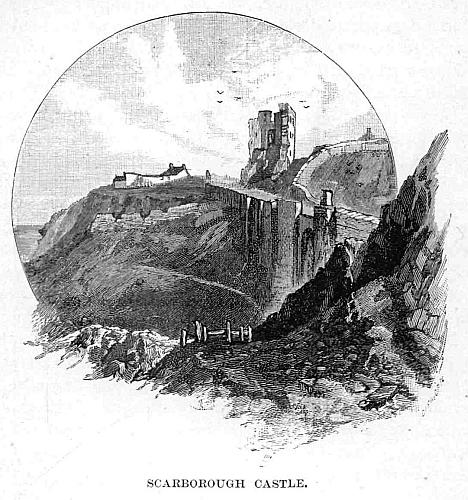
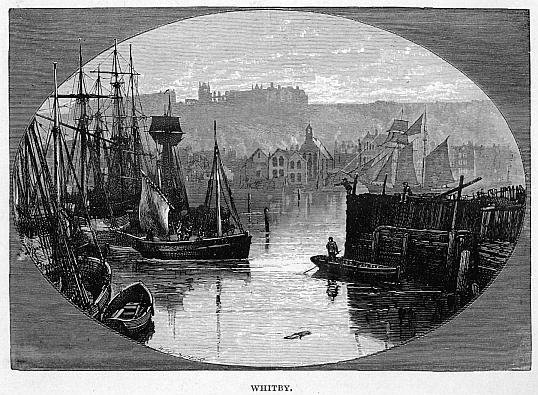
The next day we were in sight of the Yorkshire coast. Passing Whitby and Scarborough, after rounding Flamborough Head, opening up Bridlington Bay, we stood for Spurn Head, on the top of which are two lighthouses.
As we had still sufficient daylight, we ran up the Humber to visit Hull, which stands on its northern bank. A large number of coasters were at anchor before its extensive quays; it has also docks of great size. Numbers of steam-vessels were gliding in and out of the harbour. It is properly called Kingston-upon-Hull. It took its name when it was purchased by Edward the First, who, seeing the great natural advantages of its position, formed here a fortified town and port. There is nothing very attractive in the appearance of the place; but we were interested by a visit to a fine column on a square pedestal, erected to the memory of the great Wilberforce, whose statue adorns the summit. The town contains two colleges, several hospitals, and numerous other public institutions. We went on board the guardship stationed here, with some of the officers, with whom papa was acquainted, and were interested in hearing an account of the Coastguard system. Ships are stationed at different ports round the coast, and are called “Coastguard” or district ships, for Coastguard and Royal Naval Coast Volunteer duties. The English coast is divided into six districts; namely, the Hull district, which extends from Berwick to Cromer; the Harwich, from North Yarmouth to Ramsgate; the Newhaven district, from Folkestone, including Southampton Water, the Isle of Wight, and Lymington; the Falmouth and Weymouth district, including Bournemouth, Land’s End, and taking in Penzance and the Scilly Isles. The rest of the coast is divided between Milford and Liverpool. Scotland has two “Coastguard” districts, the east and the west coasts. Ireland has also two districts. The services on which the ships are employed are numerous. First, for the protection of the revenue; to keep up a reserve of seamen, and as a depôt for stores and clothing. The captain of the ship takes the duties of the old inspecting commanders, and the officers—of whom there are a large number appointed to each ship for that especial purpose—have command of the different stations. Each ship has four or five tenders attached to her, employed in protecting either the revenue or the fisheries. The ships generally go to sea for a month or so in the course of the year, and are kept ready to proceed to any part of the world. They do not keep up their usual complement of men, but when required the crew are drawn from the Coastguard. Besides these ships, there are six in England and two in Scotland, called “drill ships.” They, however, never go to sea. They are employed in receiving on board the Royal Naval Reserve Force,—seamen as well as officers,—who go through a periodical drill. The Royal Naval Coast Volunteers also drill on board these ships. These volunteers are seafaring men, and they rank with ordinary seamen, and not, like the men of the Naval Reserve, with able-bodied seamen.
Both the men of the Reserve and Coast Volunteers are expected to drill twenty-eight days in the year, either on board a district ship, a drill ship, or at the shore battery. By these means an efficient body of men is kept up, ready for immediate service in case of war. The men quarrel at times among themselves, the result frequently being a black eye; but they will never tell upon each other; and sometimes a very curious cause is assigned as the reason of having a black eye. A man once said “that he had slipped and kicked himself,” though how he managed to kick his own eye it is difficult to say! Another reason often given is, “that they have run up against a pump-handle,” The man-of-war hats are very unpopular, for they are particularly heavy. Good straw hats having lately been scarce, an armourer was found constructing one of tin; but that must have been not only heavier, but much hotter. The men usually make their own hats, and as usually manage to lose them. As soon as the hat is found, the man is placed before it, and compelled to look steadily at it for a certain time.
We got under weigh again in the afternoon of the next day, and stood down the Humber, until we came in sight once more of the Spurn lights. During the next night, while we were steering for the Dudgeon floating light-vessel, one of the men on the look-out shouted—
“A light on the starboard bow! Starboard the helm! Hard a starboard!” and I saw a screw steamer rapidly approaching us. Had the night been thick, and the look-out not been on the alert, we should certainly have been run down.
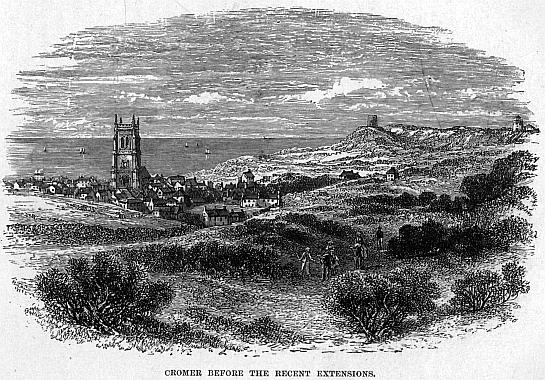
It was two hours before we sighted Dudgeon light, and from thence we steered for Cromer, which we knew by its having a bright light revolving every minute. Outside of it was the Hasborough floating light, and beyond that another light-vessel. We came off Cromer in the forenoon, when the vessels were hove-to; and we pulled in for the shore to visit some friends of Uncle Tom.
We landed among a number of fishing-boats, the place itself being a large and flourishing village, though there were a number of nice residences for people who visit it during the summer. In the middle rises a remarkably handsome church, its tower rising high above the surrounding buildings.
Along the coast are several round towers, which were built during the last war to defend the shore from invasion, though at present they would be of very little use. Papa was so pleased with the appearance of the place, that he said he should come there some summer with the rest of the family.
Leaving Cromer, we stood on for Great Yarmouth, inside a long line of sandbanks, which are known by the light-vessels stationed at their different ends.
Great Yarmouth is situated on the seashore, at the southern end of Norfolk. The river Yare follows a serpentine course, and falls into the sea at the village of Gorleston, a short distance from Yarmouth to the southward.
We waited until a pilot came on board to take us in, as the entrance is very narrow, between two long wooden piers, one projecting a considerable way into the sea. Further along the shore to the south rises a high sandy cliff, on the top of which we saw a good-sized vessel building. We asked the pilot how she could ever be launched, and he told us that she would be eased down the cliffs by ropes at high tide, when the water, rushing close up to the base, would float her.
We brought-up at some little distance from the entrance, opposite a line of neat-looking cottages, forming the village of Gorleston, and inhabited chiefly by pilots. As it was getting late, we settled not to go on shore until the following morning.
Chapter Twelve.
Yarmouth.
After an early breakfast, we landed on the north side of the river, and made our way over a level sandy plain towards a tall column which rose in the midst of it. The plain is called the Denes, and extends from the mouth of the river to the town. It is scantily covered with grass and sea plants, round which the sand collects in little hillocks.
We had to steer our way among a vast number of tanned nets spread out to dry. Here and there fishermen and their wives and daughters were employed in mending those which had received damage. There must have been acres upon acres of these nets. We soon reached the column, which we found was erected by the inhabitants of the county to the memory of Lord Nelson, who was a Norfolk man. At the top of each side of the pedestal were the names of the hero’s chief victories. At the summit is a ball, on which stands the figure of Britannia holding a trident and a laurel wreath. The keeper invited us to enter; and we ascended by a flight of two hundred and seventeen steps to a gallery at the top of the column, the total height being one hundred and forty-four feet. From the platform we got a good bird’s-eye view of the town below us, and the country as far as Norwich, and a wide extent of ocean.
“Have you been here long?” I asked the keeper.
“Not so long as the man who had charge before me,” he answered; “he came here when the column was first put up, and here he stayed for wellnigh forty years.”
“What was his name?” I enquired, finding that the old custos was more inclined to speak of his predecessor than himself.
“James Sharman. He was with Lord Nelson at Trafalgar. It was he who helped to carry the admiral from the upper deck to the cockpit. He came home in the Victory, and afterwards joined several other ships, until he bore up for Greenwich Hospital; but not liking to be shut up there, Sir Thomas Hardy—who, you mind, was Lord Nelson’s flag-captain—got him appointed to look after this column; and a good berth it is. He entered the navy as far back as 1799, and was afloat wellnigh twenty years. He came here, as near as I can remember, in 1819. He was as brave a seaman as ever stepped. I mind hearing of a gallant act of his, after he had been here about ten years. It was at the end of November; and the day was fast closing in, when the Hammond, a brig bound from Newcastle to London, drove on shore during a heavy gale, just a little way to the south of where we are standing. As she was heavily laden, and the water is shallow thereabout, she grounded more than a hundred fathoms from the beach. In a short time the wreck parted, and both her masts fell, carrying away, as was supposed, the whole of the crew. A short time after dark, however, one of the preventive men, named Smith, brought word to Sharman that he heard groans upon the wreck.
“‘The groans must come from some poor fellow, and we will do our best to save him,’ cried Sharman; ‘come along, Smith.’
“Taking a long rope, they hurried back to the beach.
“‘Now you hold on to the rope, and I’ll make the other end fast round my waist; and I’ll see what I can do,’ cried Sharman.
“Without a moment’s delay he plunged unto the surf, which three times carried him off his legs and sent him back on shore. Again he tried, and this time the sea drove him right against the wreck. The night was so dark that he had a hard matter to find out where the poor fellow was. At length he found a man clinging to the breastwork. The poor fellow told him that just before three men who had clung on until then had been washed away, and if he had come a few minutes sooner they might have been saved. As to swimming to shore, that he was certain was more than he could do. On this Sharman, taking the rope off himself, made it fast round the seaman’s waist, and shouted to Smith to haul in, while he himself trusted to his strong arms to hold onto the rope. They thus mercifully got safe to shore.”
A more appropriate spot than this could not have been fixed on for a monument to Nelson, who was born at Burnham Thorpe, of which his father, the Reverend Edmund Nelson, was rector. His mother was Catherine, daughter of Dr Suckling, Prebendary of Westminster, with one of whose sons, Captain Maurice Suckling, he first went to sea, on board the Raisonnable, of sixty-four guns. His education was obtained, first at the High School at Sanwich, and afterwards at North Walsham. After the misunderstanding with Spain had been settled, he left the Raisonnable, and was sent in a West Indian ship, commanded by a Captain Rathbone, who had been in the navy with his uncle. So great a dislike for the Royal Navy was instilled into him by the merchant seamen, that it was many weeks after he had joined the Triumph—to which on his return he had been appointed—before he became at all reconciled to remaining in it. How different might have been his lot had he not got over his prejudices though, wherever he might have been, he would have contrived to make his name known.
On leaving Nelson’s column, we proceeded along a road parallel with the river, having on our right the new barracks and on our left the Naval Hospital, which is placed in a fine airy situation, with the Denes in front and the sea beyond. It was here that Nelson, when the fleet came into Yarmouth, visited the poor wounded seamen, and going along the wards, spoke a kind word to each. It was by acts such as these that the admiral won the affection of his men, who used to say of him, “Our Nel is as brave as a lion, and as gentle as a lamb.”
We presently found ourselves on the quays, running for a mile along the bank of the river, and which are considered equal to any in the kingdom. Opposite to us, on the south shore, a modern town has sprung up; and we here saw a number of vessels building, the chief of them, judging from their size, intended for the deep-sea fishery.
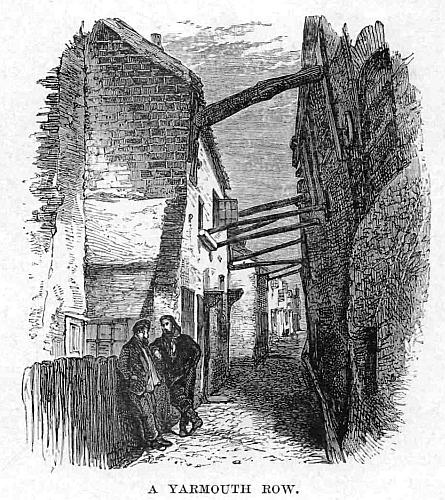
We had heard that Yarmouth was likened to a gridiron, and we now saw the reason. Comparatively few broad streets run north and south; they are, however, joined by one hundred and fifty or more narrow passages, called rows, which run east and west, like the bars of a gridiron. In many of them the houses project beyond their foundations, so that the inhabitants can almost shake hands with their opposite neighbours. Most of the rows are paved with pebbles brought up from the beach. Uncle Tom observed that the word “row” is probably derived from the French rue, a street. In many of them we observed curious pieces of old architecture. They are now numbered, but used to be called after the names of some of the principal inhabitants. One is called George and Dragon Row; and in it we noticed a somewhat tumbledown cottage, built in what is denominated the “herring-bone pattern;” the bones or frame being of wood placed in a zigzag fashion, filled up with masonry. Another row is Kitty Witches Row. One end is scarcely three feet wide. It is supposed that this row was inhabited by women, who used to go about at certain seasons of the year, dressed in fantastic fashions, to collect contributions. Yarmouth carts are formed probably after the model of the most ancient vehicles in the kingdom. They are long, narrow, and low, the wheels being placed under the seat, so as to occupy as little space as possible. The shafts are fastened to the axles, and two or three perpendicular pieces of wood—the hindermost being the longest—support the seat, on which a person can recline at his ease. It will thus be seen that wherever the horses can go, the cart can follow.
Passing a very fine Town Hall we reached the end of a remarkably handsome bridge, which unites Southtown to Yarmouth. We then turned to our right through some narrow roads; and having crossed a broad street, we found ourselves in an open space in front of the Church of Saint Nicholas, one of the largest parish churches in the kingdom. Turning back and passing the fine Fisherman’s Hospital, we entered the market-place, which occupies nearly three acres of land. About the centre of the market-place there are some smooth stones in the form of a cross, which mark the spot where the town cross once stood. It was formerly adorned with the pillory and stocks, but they have long disappeared. The freemen of the town have the right of selling here free, with one stall. At the north end of the market is an avenue of lime-trees, which adds to its pleasant foreign appearance. In the yard of the Fisherman’s Hospital we saw a figure of Charity; and the cupola above is adorned by a statue of the Apostle Peter, who, in former days, was looked upon as the patron of fishermen.
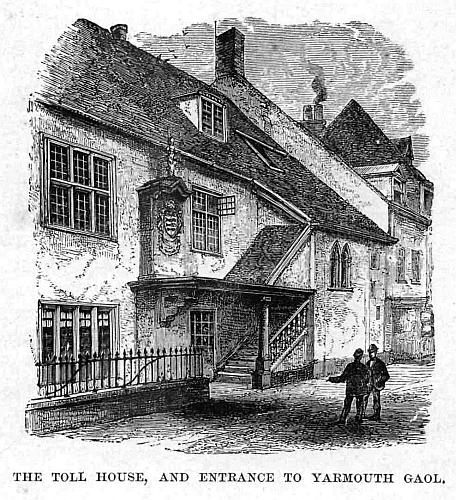
We went to see the Toll House and Gaol, which are the oldest buildings in the town. We entered a hall by an external staircase, leading to an Early English doorway, which has the tooth ornament on the jambs. Opposite to it is an enclosed Early English window, with cinquefoil heads and shafts in the jambs.
We were shown an ancient iron chest, called a hatch, in which the Corporation of Yarmouth kept their charters and valuable documents. Among the contents are the tallies or cleft sticks upon which the accounts were formerly kept, the stick being notched according to the amount of money advanced, one part being given to the creditor, and the other to the debtor. The same plan is used in the present day by the hop-pickers in Kent, the overseer having one stick, while the picker keeps the other, and notches it each time a basket is emptied. Beneath this Toll House is the ancient Gaol or House of Correction. Up to the present century this gaol was as defective as that of prisons generally. Under the ground is an apartment called the hold, with iron rings fixed to a heavy beam of wood crossing the floor. To this beam—in olden times—prisoners were wont to be chained. The sufferings of these unfortunate persons stirred up the heart of a Christian woman, Sarah Martin, residing in Yarmouth. Though compelled to support herself as a dressmaker, she devoted much of her time, as did John Howard and Elizabeth Fry, to visiting her suffering fellow-creatures. For twenty-four years she thus laboured, visiting day after day the prisoners and malefactors in the town gaol. There was no one on earth to reward her, no one to thank her; but she trusted in God, and gave Him the praise that she was thus able to labour in His service. By her instrumentality many who were looked upon as hardened wretches by their fellow-men were brought to the foot of the cross as penitent sinners. When she lay dying, a friend asked, “What shall I read?” her answer was one word, “Praise.” To the question, “Are there any clouds?” she answered, “None: He never hides His face; it is our sins which form the cloud between us and Him. He is all love, all light.” And when the hour of her departure was come, her exclamation was, “Thank God! thank God!”
We read this account of the humble dressmaker near the spot where she laboured, and from whence her spirit took its flight to be with Him whom she had served on earth.
Between the old walls and the sea a new town has sprung up, with fine terraces facing the water, and a battery at either end; running out from it, over a narrow part of the Dene, into the ocean are three piers. The one known as “the Jetty,” from its jutting out into the sea, is between the others. It is composed of strong oaken piles driven into the soil and braced together with wooden beams, further secured by iron fastenings. During heavy weather, at high tide, the sea breaks completely over the end, while at low-tide it is left almost completely dry. Of late it has been considerably extended. We walked to the end, to have a look at the town, with its towers and windmills rising from amid the smaller houses. Near the beach we visited the Fishermen’s Chapel, to which an Institute is attached, containing a library, reading-room, etcetera.
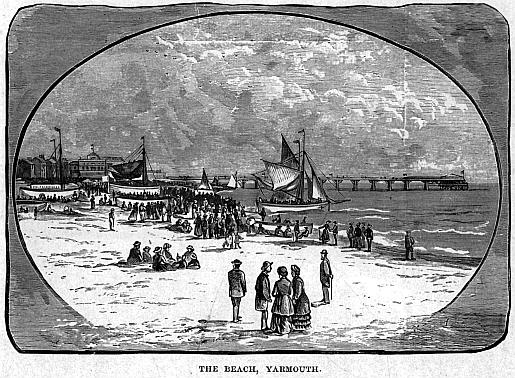
Along the shore are several high wooden structures with platforms on the top. They are built to enable the pilots or boatmen to take a survey of the roadstead and the sands beyond, that they may see any vessel requiring their assistance.
Near these structures were two or more handsome boats drawn up on the beach, which are called yawls. They can be launched when no ordinary boat can put to sea, and they are principally used for rendering assistance to vessels in distress. They are from fifty to seventy feet in length, and each carries from ten to twenty men.
An old boatman told us of a very disastrous accident which occurred some years ago to the Increase, to which a man named Samuel Brock belonged. A signal of distress was seen flying on board a Spanish brig in the offing, when the Increase, with a crew of ten men and a London pilot, put off to her assistance.
The yawl, having reached the brig, put three hands on board to navigate her into Yarmouth Harbour. She stood back for the shore. On passing the Newarp Floating Light, a signal was made requesting them to take a sick man on board, which they did, and then continued their cruise with a strong breeze, under three lugs. They were taking a snack of food, when, having imprudently trimmed the ballast to windward—a most dangerous practice—a tremendous squall took the sails aback, and in a moment capsized her. Brock being a good swimmer, struck out to get clear of his companions, his ears assailed by their cries, mingled with the hissing of water and the howling of the storm. After a moment or so he swam back to help an old man to get hold of a spar; he then himself got on the boat, and stood upon its side; but finding that she was gradually settling down, he again struck off. By this time he supposed that all his companions were lost; and he began to think of the awful position in which he was placed, the nearest land being fully six miles distant. He remembered that it was half-past six just before the boat went over, and that as it was now low water, the tide would be setting off the shore, making to the southward, and that, therefore, he must swim fifteen miles before the ebb would assist him. Just then, a rush horse-collar, which had served as a fender to the boat, floated by. He got hold of it, and putting his left arm through it, was supported until he had cut the waistband of his cloth trousers, which then fell off. He in a similar way got rid of his frock, his waistcoat, and neckcloth; but he dared not free himself from his oilskin trousers, fearing that his legs might become entangled. He now put the collar over his head, but although it assisted him in floating, it retarded his swimming, and he had to abandon it. He had gone some little distance, when he discovered one of his messmates swimming ahead of him. The wind having gone down, no cries were heard, and the moon shone calmly on the water. Ere long he beheld the last of his companions sink without struggle or cry. Should he give in also? Not for a moment would he yield to such a thought; and he prepared himself for the desperate struggle.
For some time Winterton Light, to the north of Yarmouth, served to direct his course; when the tide carried him out of sight of it, a star served to guide him. At length this was obscured by the clouds, from which flashes of lightning, with crackling peals of thunder, burst forth. Still he swam on, until again the moon shone forth. Having cut off his heavy boots, he swam more easily. And now Lowestoft Light came in sight, and he saw the checkered buoy of Saint Nicholas Gat, opposite his own door, but still four miles away from land. He had been five hours in the water. Here was something to hold on by; but he reflected that his limbs might become numbed from exposure to the night air, and that it would be more prudent to swim on. So abandoning the buoy, he steered for the land. Not long afterwards he heard a whizzing sound overhead. It was a huge gull which had made a dash at him, mistaking him for a corpse; a number followed, but by shouting and splashing he drove them off. He was now approaching Corton Sands, over which the sea was breaking, and he much doubted whether he could live through it; but in a short time he was driven over them into smooth water, and the wind and swell coming from the eastward, he regained his strength. Some distance to the southward, he saw a brig at anchor. He was in doubt whether he should make towards her or continue his course to the shore. There was a great deal of surf breaking on the beach, and he might not have strength to climb up out of its reach. Also, if he swam to the brig, he might fail to make himself heard by the crew. However, on reflection, he determined to make for the brig. He got within two hundred yards, but nearer it was impossible to get. He now sang out with all his might. Happily, his voice was heard by the watch, a boat was lowered, and at half-past one, having swum seven and a half hours, he was on board the Betsey, at anchor in Corton Roads, nearly fifteen miles from the spot where the yawl was capsized. On being lifted on deck he fainted; and it was not until long afterwards, by careful attention from the captain and crew, that he was brought round. He suffered great pain in several parts of his body, and it was with difficulty that he swallowed some warm beer. He was landed at Lowestoft, and five days afterwards was able to walk back to Yarmouth. We were shown the knife with which he was enabled to cut off his clothes and boots. A piece of silver was fixed to it, on which were engraved the names of the crew of the yawl, and the words, “Brock, aided by this knife, was saved, after being seven and a half hours in the sea. 6th October, 1835.”
It was a remarkable thing that for some time previous he had been without a knife, and only purchased this two days before. Nearly half the time he was exposed to the full sweep of the North Sea; the other half he was partly sheltered by the Newarp and Cross Sands.
Between this and Yarmouth Roads is another long sandbank, at the south end of which is the Nicholas Gat; then comes the Corton Sandbank, over the end of which he was driven. He was described to us as a strongly-built man of five feet five. Though Captain Webb and others have swum far greater distances, few Englishmen have ever performed such a feat as this under similar circumstances.
Afterwards we inspected the lifeboats, which are kept in houses built to shelter them from the weather. They belong to an institution called the Norfolk Association for Saving Life from Shipwreck, and are similar in construction to those already described. They are fitted to carriages to convey them along the beach or down to the harbour.
We went through a number of sheds where were some fine luggers, used for the herring and mackerel fishery. Their crews were getting them ready for sea. Each vessel is from forty to fifty tons burden, and carries a crew of ten men.
The herring usually arrives on the Norfolk coast about the last week in September, for the purpose of spawning, and they are then in the best condition to become the food of man. The name “herring” is derived from the German heer, an army, to which they are likened in consequence of the vast number which keep together. They are mostly caught at a considerable distance from the coast; but they do not always appear in the same place. Formerly it was supposed that they were migratory; but it is now believed that they keep within the deeper parts of the ocean until they rise nearer the surface in the autumn to deposit their eggs. For some years they have appeared near the surface as early as the last week in August. A herring seldom measures more than fourteen inches in length; but we were told that one was caught some years ago seventeen and a half inches in length, seven and a half in girth, and that it weighed thirteen ounces! Each lugger carries from sixty to a hundred nets; each net is about fifteen yards long, and is floated by corks placed a few feet apart. The united nets form what is called a train fleet, or drift of nets. The depth to which they are sunk is regulated by ropes seven or eight yards long, called seizings, of which there are two to each net. They are made fast to a stout warp, running along the whole of the train, which is upwards of a mile in length, and supported near the surface by kegs, called “bowls.” The warp is useful in taking the strain off the nets, and in preventing their loss, in case the nets should be fouled, or cut by a vessel passing over them. The meshes are about an inch square.
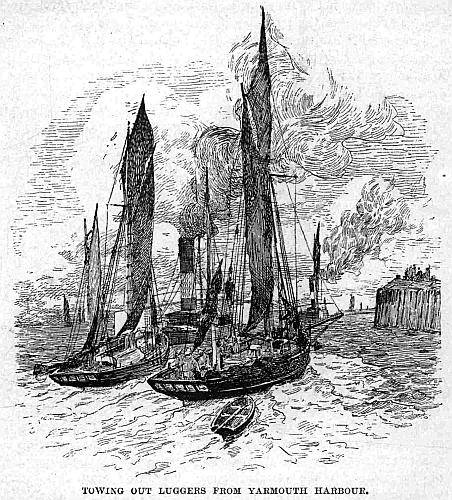
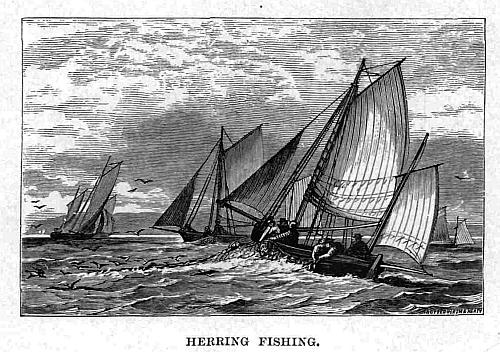
Drift fishing is carried on at night. The nets are “shot” a little before sunset, the vessel keeping before the wind, with only enough sail set to take her clear of the nets as they are thrown overboard. When all the nets are out, about fifteen more fathoms of warp are paid out; and by this the vessel is swung round, and then rides head to the wind, a small mizen being set to keep her in that position.
One of the masters of a lugger showed us the way the nets hang in the water; the whole train being extended in nearly a straight line, the big rope to which the corks are fastened being uppermost, and the body of the net hanging perpendicularly in the water, forming a wall of netting more than two thousand yards long and about eight yards deep. The strain from the vessel serves to keep the net extended, and the whole—vessel and nets together—drifts along with the tide.
During the day the fish keep near the bottom; but as night closes in, should the weather be fine, they swim nearer the surface, and attempting to swim through the barriers of net on each side of them, a large number become entangled or meshed, their gills preventing their return when once their heads have passed through the meshes.
After waiting two or three hours, the first net is hauled on board, when, if it is found that a number of fish have been caught, the whole of the net is hauled in by means of a capstan and the warp to which the nets are fastened. The fish are then shaken out, and the vessel beats up again to the spot from which the net was first shot, and the process is repeated.
Mackerel nets have larger meshes, being twenty-four or twenty-five to the yard. They are not so deep as the herring nets, but they are twice as long, often extending to a distance of nearly two miles and a half. Occasionally in one night a single boat has taken from twelve to fourteen lasts of herrings, each last numbering ten thousand fish; but of course the catch is uncertain. One boat, however, has been known to bring in the enormous quantity of twenty lasts. Some few years ago upwards of nine thousand lasts, or nearly one hundred and twenty millions of fish, were caught by the Yarmouth luggers. Several vessels bring in one hundred lasts each.
As is well-known, immediately the herring leaves the water it dies; hence the phrase, “dead as a herring.” To preserve the fish, salt is immediately thrown upon them in the boats; they are carried to the fish-house in open wicker baskets, called swills, where they are delivered over to a man called a “tower,” when they are placed on the salting floor. If they are to be used at home, they remain for only twenty-four hours; but if for the foreign markets, for several days. They are afterwards washed in fresh water, and strung up by splits passed through their gills, one tier below another, to about seven feet from the ground. Oak-wood fires are then kindled under them for fourteen days, if intended for the foreign market; but if for home use, only twenty-four hours. The first are called red-herrings, and the latter are known as bloaters. When sufficiently cured, they are packed in barrels, each containing about seven hundred fish. Between thirty and forty thousand barrels are sent to the Mediterranean, but a far larger quantity is used at home. Upwards of two hundred boats, carrying two thousand men, are employed in the herring fishery; but many more are engaged on shore in curing the fish.
Hearing that the deep-sea fishing was going on, papa and Uncle Tom agreed to accompany one of the cutters which was about to rejoin the fleet; and as we had seen more of Yarmouth than of most places we had visited, we returned on board to get ready to sail with our friend.
Before long the cutter appeared, and we stood out of the harbour after her. We sailed in company for two days, when on Sunday morning, shortly after breakfast, we made out the fleet, with most of the vessels near us hove-to, a steamer being among them, stationary, like the rest. In the distance were many other vessels, some standing towards the fleet, others sailing in different directions, and a few ships passing by. On getting near enough to distinguish their flags, we found that several of them carried the “Bethel” flag, a notice that service was to be held on board. Both the yachts therefore hove-to, and under the guidance of our friend we pulled on board one of the vessels. We were gladly received by the master, who was going to conduct the service. The crews of several other vessels having come on board, he invited us to join them, which we willingly did, although the space was somewhat confined. Several hymns were sung, the fine manly voices of the fishermen producing a good effect. A chapter of God’s Word was read, and a gospel address was given. After service, the men returned on board their vessels with books and tracts, which had been distributed among them.
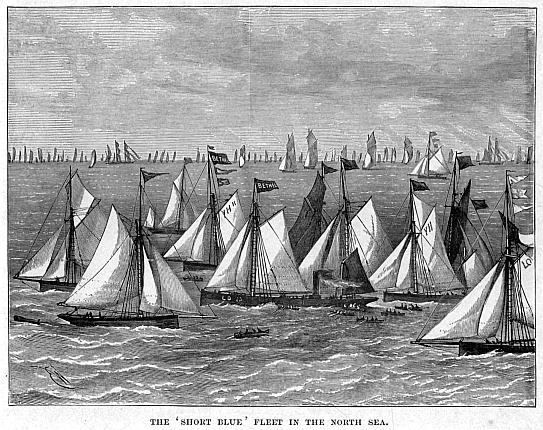
We remained until the following day, that we might see the fish caught. Our friend the skipper gave us a great deal of information about trawlers. The Yarmouth fleet consists of several hundred vessels, ranging from fifty to seventy tons. They have increased rapidly. Fifty years ago, there were none belonging to Great Yarmouth. They only form a small portion of English and Irish trawling vessels. Many hundred sail leave the Thames, the Humber, Scarborough, and Lowestoft, to fish in the North Sea; while several other places send out fifty or sixty vessels to the English or Irish Channels, manned by some thousands of fishermen. It is calculated that they supply the English markets daily with three or four hundred tons of fish.