NOTES TO LADY DE LANCEY’S NARRATIVE
Reading edition
Most of the following notes have been compiled by Mr T.W. Brogden, of the Middle Temple, to whom I take this opportunity of expressing my indebtedness for his assistance in the preparation of this volume, and for his kindness in seeing the book through the press, during my absence in Canada.
EDITOR.
Sir William and Lady De Lancey were amongst the guests invited to the Duchess of Richmond's famous ball that night. See Reminiscences of Lady de Ros, p. 127.
Colonel Basil Jackson has the following recollections of his experiences on the evening of the 15th June: "I was sauntering about the park towards seven o'clock on the evening of the 15th June, when a soldier of the Guards, attached to the Quartermaster-General's office, summoned me to attend Sir William De Lancey. He had received orders to concentrate the army towards the frontier, which until then had remained quiet in cantonments. I was employed, along with others, for about two hours in writing out 'routes' for the several divisions, foreign as well as British, which were despatched by orderly Hussars of the 3rd Regiment of the German Legion, steady fellows, who could be depended on for so important a service. To each was explained the rate at which he was to proceed, and the time when he was to arrive at his destination; he was directed also to bring back the cover of the letter which he carried, having the time of its arrival noted upon it by the officer to whom it was addressed.
"This business over, which occupied us till after nine, De Lancey put a packet into my hand directed to Colonel Cathcart—the present Earl—a thorough soldier, and highly esteemed by the Duke, who then filled, as he had previously done in Spain, the arduous post of Assistant Quartermaster-General to the whole of the cavalry.
"'I believe you can find your way in the dark by the cross roads to Ninove,' said Sir William, 'let this be delivered as soon as possible.'
"Proud of my commission, I was speedily in the saddle and threading my way, which I did without difficulty. My good nag rapidly cleared the fifteen miles, but ere reaching the above place, then the headquarters of the cavalry, I fell in with one or two orderly Dragoons speeding to out-quarters. I could also perceive lights flickering about in the villages adjacent to my route: indications which satisfied me that the German Hussar previously despatched from Brussels had accomplished his mission.
"Here let me stop for a moment to commend the practice in our service of having plenty of well-mounted staff officers ready to convey orders of moment at the utmost speed. On the portentous night in question, several, chiefly belonging to the Royal Staff Corps, a body attached to the Quartermaster-General's department, were employed in conveying duplicates of the instructions previously forwarded by Hussars, in order to guard against the possibility of mistake. The omission of such a precautionary measure at the Prussian headquarters, on the same evening, was attended with disastrous consequences, for Blücher's order for Bulow's corps to unite with the rest of his army, being entrusted to a corporal, probably wanting in intelligence, he did not deliver it in time, whereby that corps, 30,000 strong, failed to reach Ligny and share in the battle."[33]
Southey, the poet, says that the firing of the 16th was heard at Antwerp, but not that of the 18th. It is an extraordinary but indisputable fact that the firing at Waterloo was heard in England. The Kentish Gazette of Tuesday, 20th June 1815 (published therefore before any one in England, not even Nathan Rothschild himself, was aware that there had been a battle fought at Waterloo), contained the following piece of news from Ramsgate: "A heavy and incessant firing was heard from this coast on Sunday evening in the direction of Dunkirk." Dunkirk lies in nearly a straight line between Waterloo and the coast of Kent. What makes the matter still more extraordinary is the fact that Colville's Division, which, on the 18th, was posted in front of Hal, about ten miles to the west of the battlefield, never heard a sound of the firing, and did not know till midnight that any battle had taken place.
He fell not far from the Wellington Tree, and close to the famous chemin creux of Victor Hugo, in the immediate rear of which Ompteda's brigade of the King's German Legion was posted. The appearance of the spot is now entirely altered. The tree was cut down in 1818, and all the soil of the elevated ground on the south side of the chemin creux was carted away to make the Belgian Lion Mound about 1825. A steam tramway now runs by the place.
For a sketch of the celebrated tree, with Napoleon's guide, De Coster, in the foreground, see Captain Arthur Gore's Explanatory Notes on the Battle of Waterloo, 1817; and for another view of the ragged old tree as it appeared the day before it was cut down, see Illustrated London News, 27th November 1852.
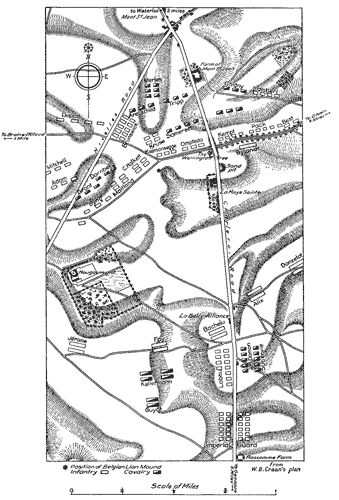
The map which faces page 110 is adapted from the plan of the battlefield of Waterloo, drawn in 1816, by W.B. Craan, Surveying Engineer of Brabant.
The troops are shown in the positions occupied by them at 11 o'clock, a.m., just before the opening of the battle.
On the map will be seen the position of the Wellington Tree, also the farm and village of Mont St Jean, to which village it is supposed Sir William De Lancey was carried, after he had received the fatal blow.
The village of Waterloo is outside the map, some two miles to the north.
[Enlarge]
"The Duke had no fixed station throughout the day, and did not remain at this tree for more than three or four minutes at any one time. He frequently rode to it to observe the advance of the columns of attack. A deep dip in the main road prevented his going beyond it without a detour to the rear. It was here also that, the Duke having galloped up with the staff and using his glass to observe the enemy's movements, poor Colonel De Lancey by his side was struck by a heavy shot which slanted off without breaking either his skin or even his coat, but all the ribs of the left side were separated from the back."—Siborne's Waterloo Correspondence, vol. i., p. 51.
Sir Walter Scott has the following interesting passage in the Seventh of his Paul's Letters to his Kinsfolk. After a reference to the British army taking up its position on the field of Waterloo the night before the battle, he thus continues: "The Duke had caused a plan of this and other military positions in the neighbourhood of Brussels, to be made some time before by Colonel Carmichael Smyth, the chief engineer. He now called for that sketch, and with the assistance of the regretted Sir William De Lancey and Colonel Smyth, made his dispositions for the momentous events of next day. The plan itself, a relique so precious, was rendered yet more so by being found in the breast of Sir William De Lancey's coat when he fell, and stained with the blood of that gallant officer. It is now in the careful preservation of Colonel Carmichael Smyth, by whom it was originally sketched."
For an account of Colonel Sir James Carmichael Smyth, Commanding Royal Engineer on the Staff of the Duke of Wellington, see Dictionary of National Biography, vol. liii., p. 185.
Major John Oldfield, Brigade-Major, R.E., gives the following particulars about this map, which is reproduced opposite page 565 of vol. i. of C.D. Yonge's Life of Field-Marshal the Duke of Wellington.
"Shortly after my chief—Colonel Smyth—had joined headquarters (this was on the 16th), he sent in to me, at Brussels, for the plan of the position of Waterloo, which had been previously reconnoitred. The several sketches of the officers had been put together, and one fair copy made for the Prince of Orange. A second had been commenced in the drawing-room for the Duke, but was not in a state to send; I therefore forwarded the original sketches of the officers.
"Morning of the 17th.—Upon my joining Colonel Smyth, he desired me to receive from Lieutenant Waters the plan of the position, which, according to his desire, I had sent to him from Brussels the preceding day, and of which I was told to take the greatest care. It had been lost in one of the charges of the French cavalry, and recovered. Lieutenant Waters, who had it in his cloak before his saddle (or in his sabretasche attached to his saddle, I forget which), was unhorsed in the mêlée and ridden over. Upon recovering himself, he found the cavalry had passed him, and his horse was nowhere to be seen. He felt alarmed for the loss of his plan. To look for his horse, he imagined, was in vain, and his only care was to avoid being taken prisoner, which he hoped to do by keeping well towards our right. The enemy being repulsed in his charge was returning by the left to the ground by which he had advanced. After proceeding about fifty yards, he was delighted to find his horse quietly destroying the vegetables in a garden near the farmhouse at Quatre Bras. He thus fortunately recovered his plan, and with it rejoined the Colonel. The retreat of the Prussians upon Wavre rendered it necessary for the Duke to make a corresponding movement, and upon the receipt of a communication from Blücher, he called Colonel Smyth and asked him for his plan of the position of Waterloo, which I immediately handed to him. The Duke then gave directions to Sir William De Lancey to put the army in position at Waterloo, forming them across the Nivelles and Charleroi chaussées."—Porter's History of the Corps of Royal Engineers, vol. i., p. 380. See also Ropes' Waterloo, p. 296.
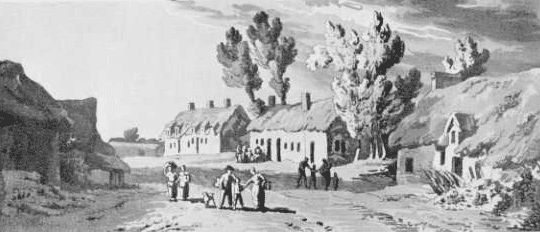
When Miss Waldie (afterwards Mrs Eaton—see Dictionary of National Biography, vol. lix., p. 26) went to Waterloo on the 15th July, she noticed the name of Sir William De Lancey written in chalk on the door of a cottage, where he had slept the night before the battle. (Waterloo Days, p. 125.) The sketch on the opposite page is reproduced from Sketches in Flanders and Holland, by Robert Hills, 1816, and shows the village of Mont St Jean, as it appeared a month after the battle. The figures in the foreground represent villagers returning from the battlefield with cuirasses, brass eagles, bullets, etc., which they had picked up.
The Village of Mont St Jean, 1815.
"Sacred to the memory of Alexander Hay, Esq., of Nunraw, Cornet in the 16th Light Dragoons, aged 18 years, who fell gloriously in the Memorable Battle of Waterloo, June 18, 1815.
"O dolor atque decus magnum ... Hæc te prima dies bello dedit, hæc eadem aufert.
"This tablet was placed here by his Brothers and Sisters."
The following is Dr Hume's account of his visit to the Duke the morning after the battle. "I came back from the field of Waterloo with Sir Alexander Gordon, whose leg I was obliged to amputate on the field late in the evening. He died rather unexpectedly in my arms about half-past three in the morning of the 19th. I was hesitating about disturbing the Duke, when Sir Charles Broke-Vere came. He wished to take his orders about the movement of the troops. I went upstairs and tapped gently at the door, when he told me to come in. He had as usual taken off his clothes, but had not washed himself. As I entered, he sat up in bed, his face covered with the dust and sweat of the previous day, and extended his hand to me, which I took and held in mine, whilst I told him of Gordon's death, and of such of the casualties as had come to my knowledge. He was much affected. I felt the tears dropping fast upon my hand, and looking towards him, saw them chasing one another in furrows over his dusty cheeks. He brushed them suddenly away with his left hand, and said to me in a voice tremulous with emotion, 'Well, thank God, I don't know what it is to lose a battle; but certainly nothing can be more painful than to gain one with the loss of so many of one's friends.'"—(Extract from a Lecture by Montague Gore, 1852.)
The following was the inscription on the gravestone which Lady De Lancey erected:—
“THIS STONE IS PLACED TO MARK WHERE THE BODY OF COL. SIR W. HOWE DE LANCEY, QUARTERMASTER-GENERAL, IS INTERRED. HE WAS WOUNDED AT THE BATTLE OF BELLE ALLIANCE (WATERLOO) ON THE 18TH JUNE 1815.”
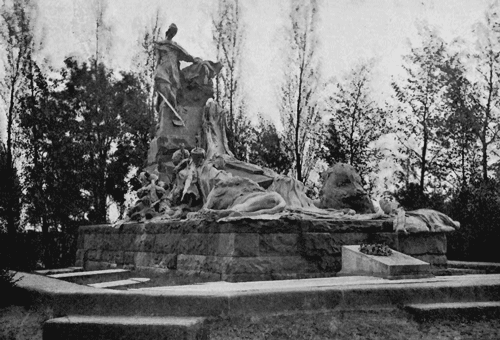
The Waterloo Memorial in Evere Cemetery.
On the other hand, the Abridged Narrative states as follows:—"I was married in March 1815. At that time Sir William De Lancey held an appointment on the Staff in Scotland. Peace appeared established, and I had no apprehension of the trials that awaited me. While we were spending the first week of our marriage at Dunglass, the accounts of the return of Bonaparte from Elba arrived, and Sir William was summoned to London, and soon after ordered to join the army at Brussels as Adjutant-Quartermaster-General." Napoleon landed in France on the 1st March, and in the London Evening Mail of the issue headed:—
"From Wednesday, March 8, to Friday, March 10, 1815," the following appears as a postscript:—
"London, "Friday Afternoon, March 10.
"Letters have been received at Dover of the most interesting import; they announce the flight of Buonaparte from the island of Elba, and his arrival at Frejus, the place at which he landed on his return from Egypt. We have seen the King of France's proclamation against him, dated the 6th instant, declaring him and his adherents traitors and rebels: of these he is said to have had at first only 1300, but to have directed his march immediately on Lyons. It was considered that he would make a dash at Paris. Now, however, the villain's fate is at issue."
This news probably reached Edinburgh by coach a week later, and may have been known at Dunglass on the following day, the 18th March.
It seems doubtful, therefore, whether Lady De Lancey did not make a mistake of a month in dating her marriage exactly three months before the 4th of July. She may possibly have been married in March.
The "Hundred Days" cover the period between Napoleon's first proclamation at Lyons on the 13th March and his abdication on the 22nd June.
It will therefore be seen that the married life of the De Lanceys, if it extended from the 4th March to the 26th June 1815, covered this period, with just thirteen days to spare.