APPENDIX. (continued 2)
Reading edition
“Directly over me, and in the very attitude in which he had groaned his last, an officer of the old guard was stretched: our faces were nearly touching, and his open eyes had fixed their glassy stare on mine. A sword-cut had divided his upper lip, and, exposing the teeth, gave to the dead man’s countenance a grin so horrible and ghastly, that I who had witnessed death in every form, was glad to avert my eyes. I made a desperate effort to shake him off; but a horse’s neck rested on my legs, and my feeble exertions were quite unequal to rid me of this double load.
“While suffering great inconvenience of position, I felt the cold intense, and thirst intolerable. No relief was attainable; the groans of the dying were unheard, and I sullenly submitted to my fate. But morning must soon break, and then probably I should be succoured. Could I but disengage myself from the dead man who pressed me almost to suffocation, I might endure pain, cold, and thirst. I made another effort, it failed; and, in despair, I laid my head upon the ground, moistened with my own blood and that of my departed enemy. Just then a voice immediately beside me, uttered a feeble supplication for some water. I turned my head, and saw a young ensign, whose leg had been shattered by the wheels of a gun, raise himself upon his elbow, and look across the field, in hope of discovering some one who would relieve him. Nor were his cries unheard: a man dressed in the dark uniform of a Prussian jäger, and armed with the short sword which rifle-troops carry, approached the sufferer; but, alas! he was not on the errand of mercy. Seizing the wounded man rudely, and deaf to his entreaties, he commenced his work of plunder. I heard the chinking of a purse, and a trinket, a watch, or locket, glittered in the moonlight, as he tore it from the bosom of the prostrate ensign.
“Oh! no, no, I cannot, will not part with that!” a low weak voice muttered; “it was my mother’s dying gift: I will never part with it!” A struggle ensued, but it was a short one: the ruffian, irritated at resistance, raised himself, and with a home-thrust silenced the poor youth for ever. Great God! that such a scene of death should be increased by the hand of murder!
“I grew sick; I feared to breathe: my death was to be the next, for he had quickly plundered the body of his victim, and turned to the dead guardsman who lay across my breast. Suddenly he stopped, listened, and gazed suspiciously around; then sank down behind, and stretched himself upon the field.
“My heart beat again. Two men came forward, and they too were plundering. But surely, all could not be so ruthless as the crouching wretch beside me! Nearer and nearer they approached; and, sounds of joy! they conversed in my native tongue. I listened with exquisite delight, and never did human voices appear so sweet as theirs. They were grenadiers of the line, and one of them wore a sergeant’s stripes. Without a moment’s hesitation I addressed them; and an appeal in their native language was not disregarded, I was promptly answered in kindly tones; and while one caught the defunct Frenchman by the collar and flung him aside, his comrade extricated my legs from the dead charger, and assisted me to rise up.
“I found myself in the centre of a heap of corpses; to take a second step without treading on a body was impossible; yet I scarce regarded the scene of slaughter: my eyes were riveted upon one corpse, that of the poor lad whom the crouching jäger had so brutally murdered.
“I stood up with difficulty; a faintness overpowered me: I staggered, and would have fallen, but the sergeant supported me, while his comrade held a canteen to my mouth. It contained brandy diluted with water, and, to one parched as I was, the draught was exquisitely grateful. My deliverers appeared anxious to move off, either to obtain fresh plunder, or secure that already acquired; and which, to judge from the size of their havresacs, must have been considerable. I begged them to assist me from the field; but they declined it, alleging that they must rejoin their regiment before day-break. At this moment my eyes encountered those of the jäger, who lay as motionless behind the dead horse as any of the corpses that surrounded him. If I remained, (and I could not walk without support,) the chances were immense that the villain would speedily remove one who had witnessed a deed of robbery and murder, and I made a fresh appeal to my worthy countrymen:
“Sergeant, I will reward you handsomely: do not desert me.”
“I cannot remain longer, sir: morning is breaking, and you will soon have relief enough,” was the reply.
“It will never reach me: there is one within three paces, who will not permit me to look upon another sun.”
“Both soldiers started.
“What do you mean?” exclaimed the sergeant eagerly.
“Mark you that Prussian sharp-shooter who skulks behind the horse?”
“What of him?” asked the grenadier.
“Yonder dead officer supplicated assistance from that scoundrel, and he answered him with curses, and commenced plundering him directly. I saw him take a purse, and tear away his epaulette. Some other article the poor fellow feebly attempted to retain; and the villain, before my eyes, stabbed him to the heart. Hearing your approach, he hid himself behind that charger: need I add, that there he lies until you leave this spot, and that I shall most probably be his next victim?”
“You shall not, by Heaven!” exclaimed the sergeant, as he drew his sword and stepped over the dead horse. The Prussian, who had no doubt watched the conference attentively, sprang upon his feet on the first movement of the grenadier; but his fate was sealed: before the sergeant’s comrade could unsheath his bayonet, the jäger was cut down, and the murderer rolled in the agonies of death beside the unfortunate youth whom but a few minutes before he had so ruthlessly slaughtered.
“The corpse was speedily plundered by the grenadiers, and the spoil of the rifleman, when united to their booty, made, as I suspect, a valuable addition.
“The moonlight was now yielding to the grey tint of early day, and the chief cause of my apprehensions being removed by the jäger’s death, I found leisure to scrutinize my deliverers.
“The first was a very powerful and athletic man, whose years might be set down at forty: his vigorous frame was perfectly unbroken, and his look bespoke a daring and unhesitating resolution. Indeed, his whole appearance was much above his rank; he seemed a war-worn, dissipated soldier: to him a field of battle was no novelty; and the perfect nonchalance with which he dispatched the Prussian, betrayed a recklessness regarding human life, rather befitting a bandit than a soldier.
“His companion, a very young man, was a fine strapping flanker, and in everything appeared to be wholly governed by the will of his comrade. He touched the dead, I thought, with some repugnance, and seemed of gentler heart and milkier disposition than might be expected in a midnight plunderer upon a battle field.
“See, the dawn breaks rapidly,” said the non-commissioned officer to the young grenadier: “we must be off, Macmanus.... We leave you safe, sir; yonder black sharp-shooter will never draw another trigger. Pick up a musket for the gentleman; we must not leave him without the means of keeping stragglers at a distance, should any come prowling here, before the fatigue-parties arrive to carry off the wounded. Here, sir, take another pull at the brandy-flask; nothing keeps up a sinking heart so well.”
“Thanks, my kind fellow, I owe you my life. Had you left me to yon black scoundrel, he would have served me as he did our comrade there. What are your names, your regiment? I shall take care to report your timely services to....”
The elder of the grenadiers laughed: “You are but a young soldier, sir, and this, as I suspect, your first field. I know you mean us kindly, but silence is the best service you can render us. We should have been with the advance near Genappe, instead of collecting lost property upon the plains of Waterloo. Well, we fought hard enough yesterday to allow us a right to share what no one claims, before the Flemish clowns come here by cock-crow. Adieu!” As he spoke, his companion handed me a musket, after trying the barrel with a ramrod, and ascertaining from flint and pan that it was both loaded and serviceable.
“Enough; I ask no questions. But here are a few guineas.”
“Which we do not require,” said the sergeant. “We have made a good night’s work, and your money, young sir, we neither want, nor take. If we have rendered you service, it was for the sake of the old country. It is hard to shut one’s ears, when the first language that we lisped in from the cradle asks pity in the field. Farewell, sir; morning a comes on apace.”
“And yet,” I replied, “I might perhaps at some time serve you. You know the fable: the Mouse once cut a net, and saved a Lion. I am indeed but a young soldier: but should I be able to be serviceable at any future period, ask for J—— B——, and he will remember the night of Waterloo.”
“Of all the fields that ever were seen, Waterloo presented perhaps the most bloody. The small space over which the action had been fought, rendered the scene indeed appalling: masses of dead appearing as it were piled on each other.”
The field of Waterloo is twelve miles and a quarter from Brussels; Quatre-Bras, twenty-one; and Ligny, twenty-eight miles: notwithstanding the great difference in the distances of those places, the firing at Ligny and Quatre-Bras was more distinctly heard at Brussels on the 16th, than that of Waterloo on the 18th.
Our detached force at Hall, which is about nine miles from Waterloo, heard nothing of the firing, nor did they know until the following morning, (the 19th,) how busily we had been engaged.

No. VII.
As a tribute of the Author’s respectful gratitude for the information he has obtained from many officers who have visited the field, and, with all the advantages of being on the spot, have discussed the leading questions which have been raised in the United Service Journal, and so many other publications, respecting the details of the battle, their names are subjoined:
GENERALS.
Lord John Hay. Sir Hussey Vivian. Sir A. Barnard. Sir H. Ross. Sir Colin Campbell. Sir Guy Campbell. Sir F. Adam. Alexander Macdonald.
J. B. Parker. D. Mercer. W. Mayne. T. Reynell. H. Murray. Thomas Hunter Blair. T. W. Robbins. J. S. Kennedy.
COLONELS.
Hon. Keppell. Sir W. Verner, Bart. Sir Henry Floyd, Bart. Sir G. Hoste. G. Gurwood. T. Wildman. Bussche. Vigouroux. Forbes. N. Norcliffe. Gilbourne. Lord Douro.
Grey. Calvert. Tinling. Parkinson. Wallace. Grove. Bruce. Kuhlman. Lord Grosvenor. Lord Wellesley. Hon. G. Cathcart. Brown.
MAJORS.
Turner. Tindale. Browne. Dawson. Jackson. Edward Macready. Belcher.
Fowler. Cox. Rice. Lloyd. Maddox. Ainsley. Hawley.
Two other officers of high rank, who served on the Duke’s staff, have given me information respecting some of the most important occurrences of the day, but not permission to publish their names, as they had previously refused this favour to several writers of distinction.
The following letters are submitted to the reader as offering satisfactory evidence of the Author’s competency to attempt a narration of the battle, and to act as guide to the visitors to the field, as well as of the authenticity of the spoils and relics, which any one may inspect at his residence, Mont-St.-Jean:
“Ems, July 23d, 1839.
“SERGEANT-MAJOR COTTON,
“I promised to write to you, but I have not had time to do so till now, since I saw you at Waterloo. You were desirous of having my testimony of the authenticity of the different articles collected from the field, that I saw in your house. I can have no hesitation in giving it generally. Many of the things I saw, I could speak to as having belonged to regiments of my own brigade.
“It is but just also to you to say, that the account you gave me of the various occurrences of the day, was, as far as I knew, extremely correct, and by no means exaggerated, and I give you full credit for the pains you have taken to collect the details. I sincerely hope, that from the occupation you have undertaken, you will derive the means of passing the remainder of your days in competence and comfort; and thus reap the reward of your intelligence, on a field where you had previously proved your courage.
“Your friend, “Hussey Vivian, lieutenant-general.”
“I have seen at various times, Sergeant-Major Cotton’s collection of spoils of the campaign of 1815, and I am of opinion that they are genuine relics, and such as may be relied on.
“Henry Floyd, Bart., colonel unattached, captain 10th hussars at Waterloo.
“Brussels, 1848.”
“Brussels, October 2d, 1845.
“SERGEANT-MAJOR COTTON,
“I received so much satisfaction from our walk over the field of Waterloo yesterday, that I am induced to leave with you the expression of it.
“Being anxious to satisfy myself regarding certain operations of the day, particularly the movements of the light brigade, (52d, 71st, 95th,) to which I belonged, I found your exact knowledge of the ground, and the numerous details you have collected, highly instructive and interesting.
“I am glad to learn that you intend publishing a memoir of the battle, and will not fail to become a purchaser as soon as it appears.
“Your sincere well-wisher, “Thomas Hunter Blair, colonel.”
“Namur, June 29th, 1846.
“SERGEANT-MAJOR COTTON,
“I have read your book ... with very great interest.... Thinking from our conversation on the field respecting the present condition of the ground on which Halkett’s brigade acted, that you would be pleased to know the opinion of even so undistinguished a member of that body as myself, respecting your explanation of the events of the battle thereabouts, ... I hesitate not to say that I was at once surprised and gratified to hear from you ... the best and most correct detail of the proceedings ... that I have either heard or read.... Further ... you made me far better acquainted with the details of what occurred at Hougoumont, and to its right, than I ever was before.
“Hoping you may long enjoy health to pursue the interesting occupation for which your soldierly qualities and intelligence so well fit you, I remain, etc.
“Edward Macready, major unattached; of the 30th, at Waterloo.”
The following document is to the Author, and probably it will be to not a few of his readers, deeply interesting: it is from the late lamented colonel Gurwood, whose labour in collecting and publishing the Wellington Dispatches, whilst it rendered an invaluable, perhaps an unrequited service to his country and to civilization, broke his health, and bore down his gallant spirit:
“70, Lowndes-square, London, June 18th, 1843.
“SERGEANT-MAJOR COTTON,
“I have had a set of the Dispatches of the Duke of Wellington packed up to be forwarded to you, which I shall endeavour to send you on the return of king Leopold to Brussels, to the care of sir G. H. Seymour, her Majesty’s minister, to whom I shall write to inform you when they arrive.
“The marquis of Anglesey has much enhanced the value of my present to you, in writing his name in the title page at my request, and he appeared much pleased at gratifying an old soldier of his regiment.
“Very faithfully yours, “J. Gurwood.”
A RELIC.
On the 15th of May 1846, colonel Macdonald, of the Royal artillery, visited the Author’s interesting collection at Mont-St.-Jean, of arms, etc., spoils of the Waterloo campaign. The gallant veteran recognized his own sword of a curious workmanship, that had been lost on the field, when he was wounded.
This precious relic the colonel left with the Author, giving him the following certificate:
“This sword I wore at the battle of Waterloo, and after I was wounded my servant left it on the field.
“Alexander Macdonald, colonel, “Royal horse artillery[113].
“Waterloo, May 15th, 1846.”
Amongst the kind presents which the Author has received from his countrymen, for his Waterloo Museum and library, at Mont-St.-Jean, he gratefully mentions the following:
“Selections from Dispatches, etc., of the Duke of Wellington, by colonel Gurwood;
“Presented by Lieutenant-Colonel N. Norcliffe, K. H., of Langton-Hall, Yorkshire, to his fellow soldier, Sergeant-Major Cotton, late of the 7th hussars.
“July 25th, 1842.”
“Blackheath, July 30th, 1846.
“SERGEANT-MAJOR COTTON,
“Alderman Moon rejoiced in being able to gratify the patriotic feelings of an old Waterloo hero, and at once offered to present you with a copy of his celebrated engraving of the Waterloo Banquet, which he trusts you will frame and place in your Museum.
“Francis Bennock.”
“Mr. Billen has much pleasure ... in sending Sergeant-Major Cotton an engraved portrait of the brave general Sir James Kempt, and further promises, should he have the honour to engrave any other officers who took part in that eventful day, to send an impression to Sergeant-Major Cotton.
“23, High-street, Camden-town, 6th September, 1842.”
Of the first edition of this work, the following notice appeared in a London journal:
“The author of the unpretending little volume before us is principal guide to the field of battle. This duty he is well qualified to perform from his intimate knowledge of the ground, near which he has resided during eleven years, and from his zealous endeavours to render himself master of facts, by studious research, and by communicating on the spot with military men of all ranks and nations.
“The qualifications that recommend sergeant-major Cotton as guide, have facilitated his efforts to put in print those events which he is daily required to narrate verbally; and it is but justice to say that he has accomplished his task lucidly, impartially, and in plain, straight-forward language, becoming his position and antecedents.
“He states in sober and graphic terms, how the tempest first gathered and suddenly burst forth in advance of Charleroi, next upon our allies at Ligny, and our own advance corps at Quatre-Bras; he informs us of the principal incidents that led to the grand crisis, as well as of the measures adopted by the British commander to stem the torrent. The author likewise gives an intelligible sketch of the limited tactical movements executed during the battle.
“Sergeant-major Cotton shows us how the lion-hearted Glengary, with Hepburn, Saltoun, and their indomitable brother guardsmen, immortalized Hougoumont. He carries us with Hamilton and his Grey squadrons into the thick of the onslaught, where the Household cavalry and Union brigades, the pride of English chivalry, hurled themselves upon their brave antagonists. He does not forget the ‘Up, guards, and make ready!’ or the resistless charge that followed; nor does he pass over in silence the unflinching valour with which Baring’s Hanoverians so long maintained their dangerous post. The author points out where the ardent Irish, thigh by thigh with heroic Highlanders, or knee by knee with stalworth English, bore down compactly upon advancing infantry, or with admirable coolness threw themselves into those impenetrable squares, wherein our devoted gunners found momentary shelter, when the field was swept by cuirassed hosts, more impetuous and daring than successful. We could willingly quote several interesting and graphic passages from sergeant-major Cotton’s clear and well-written narrative, from which we have risen with a more distinct acquaintance with the subject and scene, than we had hitherto derived from works of higher pretensions. But, as the whole volume merits perusal, we will content ourselves with expressing hopes that this Voice from Waterloo may find an echo in public favour, and that our veteran hussar’s pen may gain for him laurels more substantial than those already earned by his well-tried sabre.” (Morning Chronicle, 22d January, 1846.)
Extract from the Brussels Herald.
We have much pleasure in reprinting, from the Literary Gazette of last Saturday, the following notice of sergeant-major Cotton’s new work, A Voice from Waterloo:
“The author was in the fight in the 7th hussars. He has since resided for years at Mont-St.-Jean, where this volume is published; and he acts as a guide to visitors when they desire to inspect this famous battle field.
“Sergeant-major Cotton says, (page 201,) ‘Facts are stubborn things;’ and with the qualifications we have noticed, he is the very man to tell us all about it. And he has told us in a very circumstantial manner, separating details from masses, and altogether afforded us a better idea of this dreadful encounter than we have gathered from any other quarter. We had, by a curious coincidence, just arrived at this conclusion on reading his book, when we had an opportunity, in common with a number of leading artists and connoisseurs, of seeing Mr. Sidney Cooper’s Battle of Waterloo, painted for the approaching exhibition in Westminster-Hall. We were at once wonderfully struck with the apparent realization of the accounts which had just made such an impression on our minds. It seemed as if the artist had been present with the writer, and transferred in the most graphic and spirited manner to the canvass what he had committed with such particular effect to the paper. The chivalrous encounters, the almost single combats, the groups of cavalry slaughterings, the flight, the rally, the rush of riderless horses, the dying and the dead scattered among the trampled corn: all told the terrible tale of the last charge and effort of the French to retrieve the discomfiture of the day. Of these Mr. Cooper has made a stirring and splendid use. It is indeed a battle-piece, and upon the largest scale, such as never has been produced before by English painter, if by the greatest foreign master, in this style of art. The artist is sublime in the mysteries of moving human columns under the canopy of smoke, through which the spectator may easily imagine he hears the cannon boom. The whole is real, yet imaginative; and inspires at the same moment feelings of intense individual interest, and general awe. With regard to the author we need not add any other comment. Though he mentions that the Duke and Blücher met at La Belle-Alliance after the battle, we think he shows that this could not have been the case; and we have reason to believe that no such meeting ever took place[114].”
THE END.
FOOTNOTES:
SERGEANT-MAJOR COTTON’S
WATERLOO CABINET.
THIS INTERESTING MUSEUM CONTAINS
1. The following highly finished engravings: Napoleon, Wellington, Blücher; Wellington and Napoleon at Waterloo; the Waterloo Banquet; Sir James Kempt; Battle of Waterloo; Capture of an Eagle; the Prince of Orange wounded.
2. Medallion portraits of Napoleon, Wellington, Blücher, King of the Netherlands, Lords Hill and Anglesey, Sir Thomas Picton, Count Alten, Marshals Ney and Soult; General Cambronne, or “La garde meurt et ne se rend pas.”
3. General view of the Field, (oil;) View of Hougoumont.
4. Plans showing different periods of the Battles of Ligny, Quatre-Bras, Waterloo and Wavre; Map on which is indicated the distribution of the respective armies at the commencement of hostilities.
5. Autographs of the following Waterloo Commanders and Officers: Napoleon, Wellington, Field-Marshal the Marquis of Anglesey, Lord Somerset, Lord Love, Sir Edward Somerset, Major General Sir William Gomme, Marshal Grouchy; Generals Vivian, Harris, Sir E. Kerrison, Hunter Blair, and Macdonald; Colonels Sir Henry Floyd, Bart., Gurwood, Hon. G. Cathcart, and Muttlebury; Majors Kennedy, Macready, and Lindam, Captain J. Braman, etc.
6. The London Gazette of Thursday 22d June 1815, and the Times of the same date.
7. An interesting collection of Relics, warranted spoils of the Waterloo campaign, a part of which are labelled for sale at moderate prices, although not so cheap as the spurious articles with which the neighbourhood abounds.
The collection of relics is composed of arms, cuirasses, casques, caps, clothing, accoutrements, various military ornaments, trappings, gold and silver Crosses of the Legion of honour, Prussian Crosses and Medals, etc., etc.
The most interesting relic is the Sword, of General Alexander Macdonald, which he left on the field of battle when wounded, and recognized amongst the relics of the Waterloo Cabinet on revisiting the field in May 1846. The General’s certificate is attached to the Sword.
A pair of Napoleon’s silver spurs.
Several pieces of Napoleon’s kitchen utensils, marked with the Imperial crown, letter N, and “Tuileries,” or “Voyage.”
A Dragoon’s saddle-bags, with the stains of blood still visible, etc., etc., etc.

SERGEANT-MAJOR COTTON.
The celebrated Waterloo Guide and author of the sketch of the battle entitled: “A voice from Waterloo.”
Pause, stranger as you pass this hallowed spot, Where guardian angels hover round unseen! Reposing here brave Cotton sleeps, whose lot On earth has one of dauntless valour been. At Hugoument his bleaching ashes lie, And mingle with the dust beneath his grave; Whilst seraphs waft his loosened soul on high, To life eternal which awaits the brave. Bold, as a soldier, faithful, as a friend, To enemies forgiving and humane, He strove through life his country to defend, With character unsullied by a stain. When War’s rude thunders rent the loaded air, And clashing arms bespoke the dread dispute, When Heroes pressed the cannon’s front to dare, Each heart for Glory in the wild pursuit. Amongst them Cotton fought; and lived to tell To countless eager ears the mighty fray, In which his comrades and opponents fell, When victory to Britons gave the day. His mortal course he thus pursued by choice, And thus performed the labour from him due; ’Till lo! as recompense, from Heaven a voice Has called to bliss, the “Voice from Waterloo.”
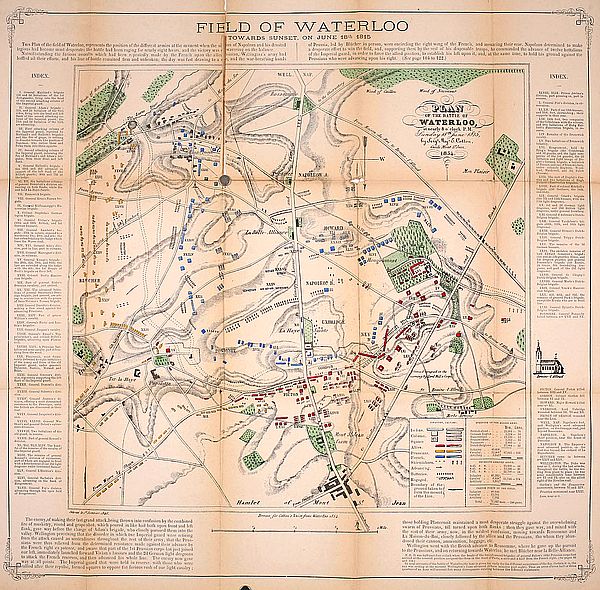
click here for larger image.
FIELD OF WATERLOO TOWARDS SUNSET, ON JUNE 13TH, 1815.