Part 3 — THE HIMALAYA CATHEDRAL
Reading edition
XXXIV ADELE SEES THE DELECTABLE MOUNTAINS
“On the mountains is freedom! The breath of decay Never sullies the fresh-flowing air.”
—Schiller.
THE next day the whole party were domiciled in a little stone structure one-story high, hung like an eyrie upon a cliff. The site overlooked great depths, and their domicile much like a tiny doll’s house perched upon a mantelpiece. Above and beyond were insurmountable heights, and only a narrow pony-path separated this little dwelling from the forest-clad valleys thousands of feet below. Within a few steps a remarkable view-point, a promontory jutting out in mid-air; and before them rose “The Five Points of Eternal Snow.”
Kunchingunga was no “Jungfrau,” but a matron, with her children and grandchildren clustered around her imperial throne.
Adele wandered off alone, and stood upon the promontory, looking forward. On a level with her eye and apparently not far off, soared a giant bird, poised in space, he being thousands of feet above the earth beneath him. Adele waved her handkerchief to attract his attention; the majestic areonaut merely changed the angle of his wings to bring his eye into better position, and refused to approach. A chilly current of air came over the crest of the mountain; Adele drew her wrap about her, and in so doing lost hold upon her kerchief—it floated off on the breeze. It was no sooner free from her hand, than the expert bird sweeping round in majestic curves upon the wings of the wind, picked it up in mid-air, and soon disappeared amid the foliage of the forest. This wild denizen of the woods, who could sustain himself at a perilous height in space, apparently had an instinctive fear of man, even of a young girl, yet no fear of man’s inanimate production, the handkerchief; and his penetrating eye had evidently grasped the situation from the distance of half a mile. Such was the clearness of the atmosphere, and such the acute vision of the bird.
Adele admired his quickness of sight, his natural cleverness, and his wild knowledge of the world, as he sailed away with what she had held in her hand an instant before. “I don’t mind the loss,” said she, “but I do dislike extremely to have things snatched away, first by the wind and then by that eagle. What the Doctor calls ‘the wild forces’ in nature, surely do require taming.”
She looked across the valley. The lower ranges rose above a belt of haze, the mountains above did not appear to rest upon any solid base, and the summits of eternal snows appeared as if in another world—a world where corruption had put on incorruption, the world of purity and whiteness. Seen through the rarefied air above, the apparent nearness of such stupendous masses, solid and firm yet resting upon an ethereal base, somewhat appalled Adele; and she drew her wrap closer about her as her eyes wandered from peak to peak extending in endless length on either side, yet all above and beyond the reach of man. She knew them to be the backbone of a continent, which (when seen from certain elevations, at the end of the rainy season when the southeast monsoon ceases to blow) was visible over an expanse of two hundred miles. She knew this range of peaks must be miles away as the bird flies, yet so wide was the angle between the horizon and those celestial summits, and so great the difference between her own level and that of the Eternal Pure Whiteness, that she felt their presence near, and herself in the presence of the sublime in nature. Her natural eye told her this, and gave her a new physical sensation which was exhilarating, uplifting and inspiring. And with this inspiration came a new incentive to spiritual perception, a tremendous stimulant to idealize. It was, indeed, what she saw—a Celestial Vision.
She caught her breath as she gazed afar; and a sense of wonder, aye, of adoration, welled up from within, and a comprehending love for the beautiful and for the sublime. These emotions, like a powerful impulse heavenward, filled her whole being, and words came—breathed rather than spoken—towards the One who ever dwells in nature, ever listens, and always hears. Forgetting self, unconscious that she was actually praying, she yet prayed. Such is the compelling force of the sublime in nature.
“Our Father who art!—art in Heaven!—Father in Heaven! where all is beautiful!
“And what is this? Oh, how beautiful! just where our Father has built His mansions. Look! those snows and glaciers reflect His Glory! I can see it! That blue canopy overhead, and those forests below, are like the Earth-Beautiful He made for us, and there is the roseate light of a Holy Place. God is there! Yes! I know it—I feel it! He is here, too! Yes! surely. He is here! How holy is this place!”
Then assured of the nearness of her Father Creator, she tried to grasp some idea of the meaning of His Presence to her; and unto her was granted a glimpse of the very highest possible conception of the facts visible in nature, of things as they are, for the study of both science and religion.
She stood in the presence of the loftiest mountains upon the globe; and what were they? What was this earth at her feet?—the world and all that is therein!
“The Lord is in His Holy Temple! The Lord! and His Temple! Holy! both Holy—God and His Temple. I can see that, too! He made it, and all that is therein. He said it was ‘good,’—it is—it must be Holy! It is His own.”
The word “Temple,” and what it implied, impressed itself upon her mind, as if it revealed some tremendous fact in nature which before she had not fully realized. She gazed right and left, up the cross-valleys, and into the forest depths; then finally towards the Celestial Summits bathed in that roseate light which symbolized so much to her personally since her earlier experience when her attention had been called to it by her earthly father. What before she had really seen but dimly, yet strong enough to be a constant aid to enlightenment, now became a living reality. It was verily a temple; and anew she began to idealize her surroundings.
“It is a Cathedral! this whole region! a mighty Cathedral! God’s own, built by Him here in these mountains, the Himalaya Cathedral!—the greatest upon Earth!” And while possessed by this vivid thought, there came a still small voice, as if from a sub-intelligence, whispering: “His service is here, His ritual.” She heard this but faintly; then, rejoicing in her idealization, she went straight on to picture the Cathedral.
“Look! there is the Nave, this great valley! and there is the crypt beneath, that sombre forest far below! There is plenty of room in that Nave for the congregation—free seats everywhere. I can see it filled with all sorts of people. There! there is some one now, in that tea-garden under those tree ferns, a party of them looking towards the blue sky. They wish to know what the weather is going to be like, wish to know what God intends it to be, for they are looking upwards; perhaps that is their way of worshiping! who knows?
“And there is the Transept! there is more than one, those valleys; they reach to the end of the earth. How curious that so many of these valleys lead directly up to the front, not so ‘crosswise’ as in other churches. I never saw a Cathedral so well arranged for approaching and hearing. Ah! there’s a Chapel in that transept! it looks more like a hut! some one within is burning incense—it comes out of the chimney! Well, we’ll call it incense, and that home is a chapel.”
And while she mused, a little group of natives crossed an open field and entered a clump of trees surrounded by shrubbery, a thicket. “Some other sort of worship,” she thought. “I wonder what they are going to do? I’ll wait and see.”
Numerous parties on ponies passed along the mountain roads, ascending and descending from different levels. “Why, this Cathedral has most extensive galleries, and how many real workers all on the move! Well, I rather like a gallery at times; one can sit up there and not feel too conspicuous, only worship.”
Then she noticed that the majority on ponies were going in one direction—northward. “Why are they going that way, I wonder?—why not towards the East as so many do in Cathedrals? No, I forgot; the Moslems turn towards Mecca no matter in what direction they may be from it; but here it is different. These people seem to be approaching and observing their ritual in a different manner and in a different direction. Everything here seems to draw one’s attention northward,” and she mused about this for some time, then:
“The pole star itself is hidden behind that mountain; we are too far south to see it, but I heard Father say it was in that direction. Yes, I remember it was very low in the heavens when I last saw it sparkling there. It is there now, always behind the crest of Kunchingunga. Even if these worshipers cannot see it, they see Kunchingunga, their Holy Mountain, pointing the same way—northward. Now, what does this mean?” and she mused again, but this time only for an instant.
“Oh! I can see why! I understand it!” she exclaimed. “In other directions, stars, as well as lesser things on earth, seem ever moving, revolving, changing; Kunchingunga and the North Star seem never to change. The North Star is towards the centre, all revolve around that fixed point; it is marvellous what a magnificent Clock there is to this Cathedral—the Great Clock in the Heavens, the Clock of Ages, ever revolving around the permanent fixed centre. But then again God is the only Permanent, Unchangeable; and to Him a thousand years are as one day—the Clock says so. Why, of course, in His Cathedral one must look northward; it is like looking towards Him, towards something fixed, that does not change. Oh, I shall always think of this Cathedral with Kunchingunga, its Great Clock, and the hidden star,” and she quoted from Bryant’s “Hymn to the North Star”:
“And thou dost see them rise, Star of the pole! and thou dost see them set. Alone in thy cold skies Thou keepest thy old unmoving station yet.”
“Yes, I understand it; in this Cathedral the worshiper should look towards the north, towards the visible centre as Nature and Science have made it appear to us. To consult that Clock one must look straight ahead, towards the Only One who is from the ever-existent past to the everlasting future—the Ancient of Days.”
This thought naturally led to her next and final impression on this memorable day in her spiritual life, alone with the sublime in nature.
“Where is it?” she thought. “Where should I look to find it? the Holy of Holies in this Cathedral,” and again she turned northward.
“That Celestial region!—it is very near it, yet not exactly of it. There! I can see the Choir, and almost hear the angels singing, but I cannot approach nearer—not yet. Oh! those Celestial summits!—the Delectable Mountains! Look! Oh, look!”
Now as a matter of fact in Adele’s history, a kind Providence did see fit to respond to her yearnings to appreciate this marvelous scenery. As to all who seek the beautiful, sublime and holy in nature she saw what she did see, and through it she perceived the invisible; through things seen she was in the presence of the unseen.
The sun’s rays falling upon the snow-fields and glaciers on the higher elevations were reflected upwards and on either side with intense brilliancy—prismatic colors of exquisite delicacy were diffused over the whole landscape; these and the various hues and shades bathed the whole of nature visible with a glory that could be seen. The human eye was satisfied, the artistic sense enraptured, and the holy spirit in man at rest in peace.
No “dim religious light” had this Cathedral, but a Glory, sublime, sacred; the Creator’s own handiwork, which man’s artistic efforts may often suggest but can never equal.
To Adele in her frame of mind, it was a veritable Shekinah.
“The Holy of Holies! white and glistening! It is too bright! too bright for me! I cannot see—the altar,—too bright!” and she covered her eyes. “Weak humanity cannot look upon His Face, and live.”
Not long after a voice was heard—a melodious voice, a young and cultivated voice, singing; one who strove to make her art holy—a means to spiritual ends; for it is in the spirit that is the real growth. It was Adele—Adele worshiping after her own fashion. She had prayed in her Cathedral, and now she lifted her voice in praise; the melody rose heavenward to mingle with the music she had heard spiritually—the Celestial Choir. She sang with her whole soul:
“Angels ever bright and fair, Take, oh, take me——”
None on earth heard her, so far as she knew.
None, indeed, but a poor unfortunate human being clothed in rags who sat at the door of her hut under the brow of the hill. Being out of sight, and dull of hearing, and a Taoist priestess withal, this poor soul, sincere and true in her faith, told her followers she had heard the Good Spirits talking in the air above her.
“In a strange language,” she said, “but clear and sweet. I knew it was the Good Spirits—and I called: ‘Buddha! Buddha! O Sakya! take me from existence! O Sakya Muni!’”
He who ever listens, heard them both.
XXXV HIMALAYA CATHEDRAL BY THE SUPREME ARCHITECT
ADELE’S idealization was correct. The inquisitive explorers found themselves face to face with nature in one of the Creator’s own Temples, where the good and true and the beautiful were embodied in a place made for worship by the Creator. A Cathedral whose architecture was appropriate and soul-stirring (æsthetic) even unto sublimity; and beyond man’s capacity to appreciate fully. A Cathedral whose vaulting was the heavens above, its floor the earth beneath, and its religious life as profound as the depths under the earth. And as the sequel proved, our travelers were also to find all types of worship there, existing even unto this day in this Temple of the Lord; from the early sacrifice to the latest enlightenment—the Divine Light of the World.
“Why so? Why all this? Upon what ground scientific, philosophical, moral and religious? Freedom obtained—Life in the open—the open life—physically, intellectually, spiritually. The Truth as each man saw it was able to make him free.”
The sense of the beautiful, the artistic sense, first asserted itself in this particular group of Nineteenth Century inquisitives. They were accustomed to temples made with hands in which art had striven to express the truth; here in this scene they found it rising through all gradations of beauty, and realized that in nature we have the mother source of truth and beauty in architecture. Of course, they first noticed and criticised as seeing with the eyes of their own civilization. What did they see? Lines as studied, yet free, as in any masterpiece of Greece or basilica of early Christianity, as full of aspiration, arching heavenward, as any Gothic work of later day. And not only this; they soon recognized other forms, outlines marked in character as a Hindoo Temple or Burmese Pagoda, peculiar as a Chinese Tower or Japanese Torii—pure and chaste as the Moslem Taj Mahal. They were astounded at the many forms, originally obtained direct from nature or suggested by natural forms, which had been subsequently conventionalized by art. Evidently all sorts and conditions of men had at one time or another sat at the feet of the Supreme Architect.
Then they observed more critically.
The growth stood upon basal lines, founded upon the earth itself, plain areas; then massive foundation rocks; terraces to suit the location; knolls to accentuate the demands of perspective; spurs to act as buttresses and bind together the rising masses; hills to invite one to ascend higher; mountains towering towards the realm of the unseen. The work suggesting solidity, firmness, and all the essentials for majesty dominating heavenward. The elementary design simple in form, simple in combination, simple even as a Chaldean or Egyptian monumental pyramid, Tomb, Library or Portal; as straight and as true as a Persepolis House of Prayer; as flat and as positive, and yet as significant and as symbolic as any Parsee devotee of old, or a Mason from the days of Solomon, would have chosen to signify Basic Truth in Religion or Simple Life in Morality—the simplicity of the Gospel of Architecture.
A palpable fact began to manifest itself, namely: that man never did learn anything worth knowing unless he came to nature to see and perceive, to observe how the lilies of the field were arrayed, and how the mountains towered heavenward to Our Father who Art, to Him who is Art—the Way, the Truth, the Beautiful; and this was not only visible to the eye, but the Cathedral was resonant—it spoke. There was heard the very Voice of the Creator Architect, the Mind of Nature; and the sound thereof echoed to the ends of the Earth. The great instruction had been given, learned practically, and practiced.
The motifs and details, conceived for application in working out the design, had come direct from the original source, the Artist-Mind of the Almighty, whose prolific unlimited power of artistic expression manifested knowledge of all form and substance; and this was impressed upon the beholder and heard by him, an unobtrusive still small voice whispering from that Spirit which had conceived it. Such manifestations in nature were exquisite to both eye and ear; one did not feel disposed to be loquacious about it, but only note and apply what had been done by the Trinity of Usefulness, Beauty and Adaptability. The Voice had said, “Follow me,” and men had tried to do so.
The style chosen was that which in time became the Parent of all styles subsequently born—born through man’s observance of natural forms, his environment, his mental endowments, and his intellectual appreciation; his virility to produce artistic work. The Supreme Architect had been unceasingly painstaking and exact; in human parlance, He had been sensitive, conscientious, profuse yet never wasteful of His virile powers; in fact, to the last degree jealous for what He knew to be the truth in art. Being the One who knows, He knew how, and would not otherwise. He would have naught unless it were equally good, true and beautiful, the three combined in one—a Trinity of Truth, like Himself, Himself in His Work.
The doctrine of the Trinity pervaded this Cathedral, as ever with truth physical, intellectual, spiritual.
To Professor Cultus and the Doctor after noting these things, it seemed really to imply much more; namely, as if the truth, the whole truth, and nothing but the truth, could only be expressed in terms of Three in One.
“I love to think of it,” said Adele, “it’s so helpful.”
Thus appeared the Himalaya Cathedral to these Nineteenth Century inquisitives. A place of worship—not the Lord’s barn, but his Temple, His Holy Dwelling Place, adequate, artistic and pure; worthy of humanity endowed by Heaven with the power to worship in Spirit and in Truth; worthy of its Master Architect.
XXXVI PROGRESS OF THE BUILDING
PROFESSOR CULTUS and the Doctor had many talks concerning the progress of this Himalaya Cathedral during construction, its “evolution,” as they expressed it; and geological records were found safely deposited for those who know how to read rocks. It appeared that the design had been originally conceived and sketched by the hand of the Master, and then worked out, or developed according to forms suitable to all climes, from the tropical in the valleys below to the arctic amid glaciers and domes of eternal snow. Pupils of the Master had embodied His ideas; His own assistants and workmen, the forces of Nature; born, brought up, educated in His own industrial and artistic schools; where His own master mind, masterful technique, and masterly spirit dominated—the Trinity of Mind, Matter, and Spirit.
There had never been a period during the work when the real progress had been arrested, nor had the original purpose of design ever been changed by alterations, extras, or further information on the subject.
In the beginning He had conceived it; the work commenced; it grew; it continues. In itself manifesting a clear distinct purpose, namely; a place in which to live, learn, and worship; thereby manifesting the Trinity existent and operative, in action, action, action; three as one. Within and without its needs and decorations have ever been growing and progressing, as the world grows older and the worshipers grow wiser. The purpose pointed clearly towards what the intellect of man designated as “perfection;” and of what the Holy Spirit in man dreamed of as “The Perfect Day.”
At various periods in time poor humanity standing aside like helpless children, had seen great commotions on the premises, apparent catastrophes, and seeming opposition to things as they should be. Humanity had actually seen the lightning “strike” and demolish; and there was marvelous unity in co-operation of labor when the lightning did strike. Nevertheless the real status of things was not thereby changed. Man imagined that the edifice itself would fall, and the world come to an end; a mass of débris to be blown away, much like nebulous mist or a comet’s tail is scattered and disappears in space. Man had seen such things with his “field-glasses;” similarly man presumed to know. He really knew just so much of the building and its eternal purpose as the present stage of progress permitted—no more, no less. Of many things he could be but a spectator; and when he manufactured his glasses for greater depths of penetration, he reduced his scope (field), and less and less grew the light upon his lens.
Thus far there had been no real catastrophe; it was merely the taking down of scaffolding amid a cloud of dust and rubbish. The scaffolding removed, the Temple stood behind safe and erect; its beauty more apparent than ever before. A new façade had been brought to light for the admiration of all who cultivated their inborn capacity for appreciation; both worshipers and non-worshipers alike.
It was during the crises of scaffold-demolishing, when there was much talk of what would happen when the world dissolved, that absurd disputes had arisen among the crowd of lookers-on. Non-worshipers, in their conceit, offered criticisms, although in fact they knew only “the little” that is vouchsafed to all mankind. Theological fanatics asserted themselves, saying with intensity:
“You have neglected your opportunities, and now it’s too late. You’ll be condemned.”
To which came, of course, the practical responsive application:
“Be condemned!—yourself!” Hence the sobriquet, “condemned,” popular in application to this day as a verb of intensity.
Such dogmatic assertions and petty recriminations were really absurd in this presence; disputes embodying mere words; since naught is condemned in nature where each day’s work is pronounced “good,” and where “there is no condemnation” to those who seek the Truth and follow in it; and where the Divine Voice of a man to his brother man has pronounced the dictum: “For this cause came I, the Truth, into this world, to save it.”
This Himalaya Cathedral stood in a region where the rain-fall was appalling. It was more sudden and more terrific than occurs elsewhere. Torrents, apparently devastating, passed that way, carrying all loose impedimenta before them, gathering fresh strength by momentum as they rushed headlong into the depths. Humanity stood aghast, wiseacres felt confident that nothing could withstand the force of these downpours. Having observed similar phenomena on a smaller scale, therefore these reasoners concluded it must, must forebode the worst, annihilation.
It was then that the voice in nature, resonant through the Cathedral, actually laughed them to scorn for their blindness.
From the beginning nature had abhorred the idea of annihilation, and would never permit a vacuum where she had built so beautiful a Temple. Truth destroys not, but fulfils; it is not destructive, but constructive. Annihilation, a vacuum, is an abstract conception without a concrete embodiment even in physics; and less still where the Mind of Nature and the Spirit that is Holy dominate.
The phenomena of apparent devastation in this Cathedral were but changes or transmutations of the forces employed by the Great Master Builder. A change from lightning to rain was simply a change of workmen, from those of one trade to those of another, neither more nor less; only the removal of that which had done its work, and now would interfere with the progress of the building, the Temple, its greater usefulness and its greater beauty. The torrents which seemed to devastate were in fact cleansing, purging, sweeping henceforth the accumulation within and around which had served its purpose, and in that form was no longer needed. Acting under natural laws, as recognized in geology, biology, natural history and botany, the Divine Administration had cleaned and purified that region. Cleanliness being a feature of godliness, even the odor of the unkempt, the unwashed, and the unclean, must be scrubbed out—the Cathedral to remain holy must be kept fresh, clean and pure; befitting those who would be pure, and thus able to pray and to praise.
And again was the Voice Divine of a man to his brother man heard resonant through the Cathedral arches:
“I came not to destroy, but to fulfil. Wash and be clean! Cleanse your hearts, and not your garments only.”
XXXVII PRIMATE OF THE CATHEDRAL—EX CATHEDRA
IT was during one of these cleansing periods, in years gone by, when the terrific rain-fall scoured out the useless and hideous from this Himalaya Cathedral, that a company of poor native Lepchas stood upon the hill-side watching. Comparatively safe in their own position they witnessed and heard the forces of nature at work.
Among them was one whom they accounted as a wise man, a Seer, who saw more in nature than most people can see; a prophet who had foresight founded on close observation of facts. Some of his neighbors would have designated him a Lama, others would have called him a Buddha, and some, more distant still, would have said a Medicine Man. Yet, all listened to his words of wisdom, repeating them, until they became in time the folk-lore of the land.
This Seer, who was so clear-sighted, stood for much, both historically and ecclesiastically; also in Wisdom Literature.
He, and no one else, was the venerable and venerated Primate of this Cathedral where a thousand years are as one day and one day as a thousand years. As Primate-Leader he received many visitations from distinguished ecclesiastics, men with other titles; notably a primitive nature-worshiper named Abel, whose parents, according to one form of record, were quasi-divinities in the Garden of Eden; and another named Tenno, himself also, according to another form of record, a semi-divinity, his mother a Goddess—father of a dynasty ruling upon earth to this day, the Mikado. There were also Holy Rishis of the Vedic Period with their descendants, Brahmins, Chief Yogis; also Buddhas, Grand Lamas, and Superior Men; Priests after the order of many things; Priests from Adab, “the oldest city in the world,” founded in the misty years of the fifth millennium B. C.; Priests of Bel at Nippur, 3800 B. C.; Priests of the Sun God from Sippar (Biblical Sepharain), 3750 B. C.; Priests from Lagash, the Sumerian Priest (King Gudea) who reigned 2800 B. C., fully 500 years before the days of Abraham; Priests from Assyria, 860 B. C.; Priests of the North and of the South, of the Highlands and of the Lowlands, and of the “Unknown,” after the order of Melchisedek. Also Priests of Isis, from Egypt; and the Great Priest of Ormuzd, Zoroaster, through whom the brightest light as to conscience over intellect enlightened the world for one thousand years—representing millions upon millions of worshipers born from the womb of ancient time. Also Wise Men of the East, Apostles, Elders, Deacons, Metropolitans, Popes and Archbishops; Archdeacons, Priests, and Fathers; Rectors, Pastors Emeritus, Ministers of the Word of God, Preachers of the Gospel of Salvation; and Evangelists who brought both the Word and the Bread of Life; of latter day experience; all filling offices acknowledged to be sacred, and some using words which sounded almost profane.
While he, the Himalaya Seer, was often clothed in rags, and fed upon the flesh of wild beasts, and upon edible locusts and excellent wild honey, and his loud ringing voice was as one crying in the wilderness, the others often officiated in robes of state. While he carried a staff in his hand, and had little change of raiment, they often bore relics they considered sacred, rings through their noses, and even iron bars thrust through their cheeks, and others bore a gilded shepherd’s crook so weighty in importance that it proved an incumbrance even unto themselves. While he, in hot weather, wore but a cloth about his loins, and a band across his forehead to absorb the sweat of his brow, bowing his head in reverence and fear when he saw the manifestations of Energy in the Supreme Force in nature; another manifested the life of asceticism and callousness to both heat and cold; another brought lotus leaves and meditated, trying to think of nothing at all—of absorption into nature; another brought the Sacred Fire and preached the higher light which did enlighten for a millennium of years: “O Ormuzd, Fountain of Light! thy Light is in all that shines;” another brought his artistic image and preached justification by faith in Ameda. Another brought his crude and immoral images, yet preached justification by faith in Krishna, and the enfranchisement of women; and another, a fearless man, a married priest as God had made them so from the beginning, who preached justification by faith in Him who had said, “I am the Light of the World; believest thou this? follow Me.”
And when he, the Seer, cried with a loud voice: “Repent! I say unto thee, Repent!” the others also preached as they had ability; using diverse institutions and rituals according to the spiritual needs of the times and places. Thus it was these who embodied the diverse manifestations of the Spirit that is Holy; their experience in history proving that intellectual effort only stimulates the craving of the soul, whereas religious consciousness is never satisfied except by spiritual growth.
Thus, there were many, very many, sincere preachers who appeared and labored conscientiously, each after his own belief, and officiated in this Cathedral, Nature’s own Temple; some proselyting, others not—only trusting to natural growth. And while all “took up collections,” yet, strange to say, one only possessed the ancient veritable title of Seer, the one in primitive costume, with primitive sincerity; the Venerable Primate who lived in the open “without money and no scrip,” and thus preserved his loud sonorous voice in nature; he who lived very close to his Creator-God, the Creator and Father of all.
What did this Seer see?
Standing in the presence of the storm, none realized his own helplessness more devoutly than this poor Himalaya Seer himself, following in the footsteps of his own primitive ancestry since the beginning of man’s appearance as a religious animal upon earth; hence known, in consequence, as a nature-worshiper. Calling his group of followers about him he spake to them as if in a trance, as if he saw what they could not see: the Evil Spirits, or spirits for evil, flying hither and thither over the land. While in this trance-like condition of religious rapture, he spoke of the wind, the rain, and the lightning as antagonistic personalities. He gesticulated, as if he saw them as such, wild and irresistible, in indiscriminate conflict with things as they are. Being himself human he could not conceive personality as otherwise than subject to human influences; therefore he called upon his fellow-worshipers to send up some sweet odor, to propitiate, to offer a sacrifice, to attract attention to something good and not evil—aye, to crowd out the evil by the good.
The people obeyed him. Then and there arose the good influence, and lo! a marvelous change took place in the heart-life of each primitive worshiper. The evil spirits in the storm ceased their warfare and dispersed—the tempest ceased, nature smiled, each heart was filled with peace. “Peace, be still! I say unto thee, peace, be still! My peace I give unto thee.”
When in due course of nature the heavens had again cleared, the Seer spake anew; but not now from a trance. He had no trances after it cleared off, and he stood in the bright sunlight of nature. No! He was as other men—no more, no less—in all ages. What he now saw was also different, and the tenor of his voice had changed.
He announced a message to be delivered.
His followers fell upon their faces before him.
He kept them waiting; in fact, being no longer in physical fear himself he began to lack his primitive simplicity. The sight of others bowing with their faces to the earth before him was not unpleasant. Weak human nature asserted itself; he posed, after his fashion. He kept the people waiting; and he flattered himself that this was due to his office as Seer, as if the office made the man, and not man the office.
The people waited; they had long since learned to wait, and to wait upon others. The Seer then raised his hands heavenward and spake; a message so ancient that its form now sounds archaic, from before Abraham, from Job, from primitive man; a poet of the Vedas of the South, or a historian of the Northern Sagas, might have said it each after his own fashion; it is recorded in the Holy Bible, the truth from the beginning.
the message of the seer.
“The God of thy fathers hath sent me.”
The people respected the speaker—messenger—apostle—the one sent.
“I know that my Bondsman, my Redeemer, liveth.”
The people were glad there was some one to call upon in time of trouble.
“Thou shalt not be afraid of destruction when it cometh, at destruction and famine thou shalt laugh. The Almighty shall deliver thee in six troubles; yea! in seven there shall no evil touch thee; therefore despise not thou the chastening of the Almighty. Thou shalt be hid from the scourge, even the scourge of the tongue; it shall not come nigh thee. I know that my Redeemer-Bondsman liveth! and that he shall stand at the latter day upon the earth.”
Such was the message, god-like, short and to the point; natural, personal, spiritual; the Trinity in Speech.
The first message of Truth Immortal signaled from the Fortress of the Primitive in nature; signaled from the “hills whence cometh our Help.”
This thrilling message was heard around the world, in all religions in some mysterious form or degree. A divine utterance, original, it has continued to resound through all the ages. It was the beginning of Hope, the assurance of Help, from “Our Father who art”—art “ever present.”
The primitive populace wondered at the wisdom of their Seer; his strange words which spoke of the God of their fathers, as if He would help them and would save them from destruction. They then, at first, thought little of that historical significance of the message which referred to His coming to the earth at a “latter day,” perhaps after they themselves had departed; they were interested only in the present. They wanted Him now; why would He not come at once?
The Seer satisfied them, explaining by application of the message sent to them each individually. He did it in his own way. The Seer had seen according to his capacity then and there; he continued to preach as he had ability.
“The Good Spirit is here. I heard Him above the wind and storm. I saw Him when He took me to the seventh-heaven where I did see more than I do now. But He is here!—the thunderings and lightnings were the noise of His horn (trumpet), and the light of His Countenance?—the dust you saw was the mountain smoking under Him.”
The people trembled with dread of what their Seer had seen.
“I saw the Evil Spirits driven before Him, as the torrent drives the wild beasts from the forest; and when He made a scourge of small cords He drove them from his Temple as sheep and oxen are driven. Some had disguised themselves as those who sold doves—they fled at His approach. Deceivers offered Him money, to tempt—He overthrew their tables, tore their shams (hypocrisy) to shreds, and banished them from His sight. And they cried: Peace! peace! and there was no peace.”
The populace thought of demons let loose, and of a “hell upon earth.” The Seer instantly thrust home his vivid thoughts:
“You, yourselves, saw how He cleared the sky! You, yourselves, know how His rains and storms cleaned out the dirt and sickness. You saw it! You saw it yourselves! You sent up the sweet odor! You made the sacrifice! See how you were answered, your prayers answered.”
And a great shout went up: “We did! We saw it! a miracle! when the sun shone again.”
And then the Seer closed with a statement so terrible, that none in reason, among them, could doubt the truth depicted:
“These are they—these evil ones—who fell into deserted graves; graves that men walk over them and are not aware of them.”
The hearers shivered with abhorrence—the direful thought! deserted graves! terrible consequence of disrespect to ancestors, frightful neglect of ancestral veneration, abhorrent disrespect to that source from which they had received their being, as the Great Good Spirit had granted them life.
Thus ended the Seer’s message, and his own application of it. Such was the imagery he used, such the emotion he endeavored to portray and to excite. And yet, with all his flights, from the Divine Message to the human application, this Primitive Primate of Nature’s Cathedral had been profound. He had touched upon the three great facts in things as they are, and reasonably shall be:
“Dependence, Right Living, Eternal Security.”
Or, to employ another category of later date in Asia:
“Thought, Being, Joy.” (Hindoo formula for Brahm.)
Or another, philosophic:
“Science, Morality, Religion.”
Or as Christianity teaches:
“Faith, Hope, Love.”
And when seen as “The Light of the World”:
“The Almighty, the Saviour, the Holy Spirit of Truth, Immanuel.”
“The Soul of Man is the candle of the Lord.”
—Phillips Brooks.
XXXVIII INTERMEZZO—THE VOICE IN NATURE
Cathedral Orchestra and Organ. Chorus, with Divine Solos. O Man! Blessed is thine inquisitiveness—to learn and to know: Cursed is thine inquisition of others. O Man! Blessed is thy longing—to look upwards and beyond: Cursed is thy willingness to sink downwards; Where vice brings vileness in its train. O Man! Blessed is thine altruism—to help others: Cursed is thy selfishness, to bury thy talent of help. Blessed are they who hunger and thirst after righteousness—for they shall be filled. Blessed are they who seek the Truth—for they shall know. Blessed are they who follow the Way—for they shall attain. Seek and ye shall find. Knock!—it shall be opened. I have the words— The Words of Eternal Life. Arise! O Soul! I say to thee, Come forth! The Truth hath made thee free. Arise! O Soul! and stretch thy wings; Thy better portion seek. Arise! and soar! towards greater things, Enlightenment—and Peace. Peace and Rest—Rest in Peace. I am the Resurrection—and the Life.
THIS triple comprehensive chorus from nature, with its Divine Solos, was heard by both Professor Cultus and the Doctor with profound feeling and a deep sense of responsibility. They had never heard an inner voice (solo) blending with sounds in nature (chorus) quite like this. And a veritable intermezzo in their experience, a recitative of the wonderful harmonious truths in nature accompanying the pure melody of Christ’s words; and corroborated by others who knew Him, personally. All so true when sung in concert of harmony and rhythm; the sacred music of this sphere.
It seemed as if the Voices sang of truth ever present, ever active, with men at work or a man at rest. All who entered the Door of Truth in experience had the Words of Eternal Life spoken unto them; and the words implied action, greater light, intelligence, and peace; rest from trouble, in an immortal active existence—a life immortal:
“Activity for all our powers, and power for all our activities.”[1]
Such was the deep impression made in the Himalaya Cathedral upon the elder members of the party. Being elderly they saw things that way. How about the younger members? Youth does not see things in nature as elders do; youth has much to learn yet; and old heads rarely grow on young shoulders.
Adele had insisted upon going to a greater height up the mountains. She longed to reach some high summit. She wished to lose nothing of the lofty that could be reached; and neither Paul nor the Doctor failed to second her motion.
XXXIX ON A PINNACLE IN NATURE
FROM the time that this region of the Himalayas first impressed itself as a Cathedral upon the mind of Adele, an idealist, she invariably spoke of the various natural beauties of the locality as parts of the Grand Edifice.
“This Cathedral has magnificent proportions. I must explore it, and go all over it, from crypt to dome, visit the baptistry, and, as the Doctor says, ‘mount upon a pinnacle;’” then musingly: “I should like to attend a service.”
“All right,” said Doctor Wise, the liberal, “we can have a service of some sort, even if we are obliged to read prayers ourselves.”
“It would be better to have the natives officiate—one of the local bishops,” said Adele.
“He would not have Apostolic succession,” said Paul, of Non-conformist proclivities.
“Apostolic, nevertheless,” remarked Professor Cultus, who habitually looked at things from a literary point of view. “He would consider himself sent by some one—that makes him apostolic. He would have been ‘called’ to preach, or to write, or to do something, fundamentally apostolic, if he is a true man.”
“I should like to see a primitive cassock or stole,” said Miss Winchester, who was inclined to ritualism, “and a real old-time monk with his beads and a rope around his waist.”
“You shall,” said the Doctor, “and we will investigate to see whether the clergy face towards the East.”
“Not here,” said Adele promptly; “they would not if they knew.”
“Why not?” exclaimed Miss Winchester.
“Because they must look up.”
“Oh, of course.”
“Northward, I mean—up north.”
“What has that got to do with it?”
“It’s towards the centre of things—the pole star in the heavens.”
“Dear me!” said Miss Winchester, “you’re so ‘broad’, you’ll flatten out, become thin. I don’t like my bread buttered too thin; but tell me, Adele, why here, in this place?”
“This Cathedral is so constructed.”
Miss Winchester said she had not before observed it in that light.
“Which way shall we start?” inquired Paul.
“For a good view, down the nave,” said Adele. “Let’s ask a verger to show us around.”
The verger presented himself in the person of a Bhootan peasant astride of a Manchu pony, and leading others saddled for members of the party.
“I’m not accustomed to attending church on horseback,” remarked Miss Winchester. “But I rather like the idea.”
“Our ancestors did; often two on the same pony,” laughed Paul. “That’s why I like it; heredity, I suppose.”
“It strikes me it was a case of go-as-you-please with our primitive ancestors,” said the Doctor, jovial. “That’s why we all like it.”
“If you mean liberty in worship,” whispered Adele, “that’s why it suits me.”
“That’s about it,” thought the Doctor.
This was as they ascended Mt. Senshal towards Tiger Head. The valley below was filled with cloud-billows which the cool morning air still kept intact, the atmosphere above more clear and transparent. As they and the sun rose higher and higher the cloud-billows became vapor, and the mist twirled amid the foliage of the forest, or was dissolved and disappeared in the general atmosphere.
The Bhootan verger took them to a lofty crest from which they could look down the vista of the valley, and before them the nave of the Cathedral. Verdant hills lifted their heads on either side, making a sky-line as lofty as many in the Alps; yet here they were merely spurs of the mighty range beyond.
A pause. Adele stood gazing through the Nave; and there was the congregation, a world-full, at her feet.
Some one suggested to Paul that he ask her to sing. The request seemed injudicious just then and there, but some people have no sixth sense. Paul drew up his pony near hers while she was still absorbed in the prospect. It certainly was inopportune, but he ventured:
“If my voice would carry, I should try to sing. How do you feel about it, Adele?”
She shook her head.
“No? you don’t feel like singing! That’s not like you!”
“I like it too much, that’s why.”
“Oh, is that it?”
“Not here—I could not.”
“Where?”
“Perhaps—perhaps in the choir, when they have service.”
Evidently she had her own ideas about sentiments appropriate in this Cathedral. There was a place and time for all things. This was not the time nor place to make herself prominent, not even with the divine art; rather the time for meditation upon the infinite grandeur of the scene.
And the verger took them to other points of view, even as far as Tongloo (altitude 10,000 feet), and Sunkukphoo (altitude 12,000 feet), consuming several days for these journeys. Over hill and dale they went, from the Forest Bungalow mounting to Goom Rock; passing by the pools (porkri) on to the Manay Bhunjun (temple); up zigzags to a way-station hut. They passed through bamboo groves, and were off and on their ponies as the route became too steep for riding. The view at Tongloo was comprehensive and superb. Then they continued on by descending, before surmounting another range; past waterfalls, towards the base of Pionothumna Hills (S. E.); to rise again rapidly by endless zigzags, seventeen at one time alone, towards the Kala Porkri, a loftier point than they had yet reached; then more zigzags, much puffing and blowing, through pines; then across the country, the open upon a high level; and finally up and up, terrific pull, higher and higher, by what Adele called the Himalaya Ladder, as extended as Jacob’s, twenty-five zigzags in succession, a steep climb and hard work, requiring an extra pair of wings, and double-bellows lungs—to the summit at Sunkukphoo.
“Out on the roof!” exclaimed Miss Winchester.
“Among the flying buttresses,” thought the Professor.
“On a pinnacle of the Temple!” exclaimed the Doctor.
“All the world beneath us,” said Paul in admiration.
“All but those Delectable Mountains,” thought Adele, glancing at once towards the snowy peaks which still towered above them at an elevation of some twenty-nine thousand feet.
They stood in the presence of mountains five and a half miles high, with comparatively little intervening; in the presence of some of the highest summits upon the globe, and themselves literally on a pinnacle.[2]
The sublimity of the Himalayas, now enhanced by greater proximity of the beholder, presented a more pictorial effect than heretofore: the grouping of the Trio of Mountains a composition from the Artistic Mind of Nature; an inspiration full of aspiration, for the earth itself seemed inspired by a desire to ascend. Such was the first impression.
Attention was at once focused upon the Three Eternal Peaks, rather than the extended Snowy Range which on either side disappeared in the dim distance; and the forms and arrangement of the landscape seemed almost ideal. Imagination might have conjured up such a tableau, but its realization and potency in spiritual influences would hardly have been expected as reasonable—the constant ascension of jagged glacial ever-pointing summits (material substance) towards the Celestial unseen realm of azure blue. Yet, there it was—an actuality—fixing itself in the mind’s eye and on the physical retina, to be remembered ever afterwards.
In the centre rose the Majesty of the Mountains, the Majestic Father Peak, clad in Nature’s robes of State Existence; simple in outline, exquisite in texture, the dignified sweep of lines and folds, draperies and half-hidden illusive forms seemingly mysterious which characterized the vestments of Nature’s Royal Presence—robes of state flowing from the heavens above to the earth beneath.
Through the crystal atmosphere one could distinguish Celestial Valleys, and ravines set amid rugged crags and mountain “needles” of stone attenuated to an extent greater than any Cathedral spire ever constructed by man: and in and about the deeper recesses were local mists and hazy atmosphere, as if to hinder or prevent too inquisitive curiosity as to the hidden depths within. Curious and admirable indeed was this seemingly mysterious element in Nature; yet, verily not so, not mysterious, but only secrets yet to be explored and divulged by scientific research.
Although the tourists had thus ascended heavenward somewhat differently from Jacob’s angels with wings, rather upon winged ponies following the legendary hero upon his white horse; yet when they arrived, the after-effects were quite according to ordinary experience.
Miss Winchester was the first to illustrate her human nature under such conditions. The altitude affected her peculiarly, not as it did the others.
“No wonder,” said she, “that some people are tempted to jump off when they find themselves on high places!—the exhilaration is intense. There is a fascination in the depth, it draws one; it makes me feel as if I could sail off in space, like the birds.”
“Be careful,” thought the Doctor, moving near her to steady her nerves, if necessary.
“It is as if I should spread my arms—and leap!” cried she. “I could sail on the air like the eagle; there is no thought of danger.”
“No danger! no danger!” instantly shouted the Bhootan pony driver, noticing her actions which spoke quite as loud as her words. “No danger! my horses are sure-footed. No danger with me! The Good Spirits take care of all I bring, and will not let them dash their foot against the stones;” and he continued to praise his sure-footed ponies as able to carry anyone with safety. Miss Winchester concluded to dismount, nevertheless, and the Doctor assisted her.
Adele began to feel nervous; the atmosphere being rarefied, and she more sensitive than the others, it told upon her physically, and at the same time affected her spiritually. She was glad that Paul kept his pony next hers.
“What is it? are you tired?” asked Paul, noting her pallor.
“No! it’s so really high; we’re so high I don’t feel easy—it’s not natural; it takes my breath away.”
“Oh, then you feel the effect of the thin air; open your mouth wide and get the air on both sides of your ear-drums. The pressure will then be even; you’ll feel better.” Adele did so and felt more at ease.
“How resourceful you are, Paul—so practical; that pressure was becoming too much for me—I felt faint.” Then after looking around for some time and observing other things, she remarked with considerable energy, yet serious:
“These pinnacle views are too much!”
“What is it now?” asked Paul.
“Why—look before you—those are mountains beneath us, yet they look flat.”
“Yes, they do.”
“They are neither picturesque nor artistic, when you look down upon them.”
“Then don’t look at them, my dear! Look at me.”
Adele smiled, but continued in her mood.
“Paul! from above, those mountains are not true to nature, they are not mountains at all.”
“From your point of view, no.”
“From here, the world is all out of drawing, it does not give you a true idea of itself.”
“It certainly doesn’t look very round,” remarked Paul; “it’s rather concave, with the horizon as high up as we are.”
“No, the idea is not true,” continued Adele; “seen from here, one might think our journey had been over a flat country—easy to walk over—but you know it wasn’t.”
Paul laughed. “No, it wasn’t, my saddle tells me so—it was a hard road to travel. But the view! that’s all right; Adele, it is the grandest we have seen. I never expect to see anything finer.”
“It’s too grand for me—it overwhelms.”
“How, Adele?”
“I’m deceived, in so many ways; deceived as to distance and heights, and I can’t tell what I’m looking at. There now—over there, is a large bare place, I suppose, but it looks like a small field; and just the reverse, there is a clump of foliage, it may be a jungle with tigers, although from here it looks so harmless.”
“Oh, but you must use your common sense and gumption, and not be misled by experiences.”
“Indeed! Well, what do you call that?”
“Where?”
“That thing over there—what is it?” pointing with her whip.
Paul looked. Far away an irregular cloud-like something stood out clearly as if raised above the surface of the earth; it gleamed or glistened faintly in the distance, but being irregular in form, light in color, and doubtless lifted up because it appeared so, Paul pronounced it to be a cloud drifting between the lower hills.
“No, Mr. Common Sense with gumption, it is a lake—the pony man just told me so; the reflection makes it stand up above the forest. I don’t think much of common sense that mistakes a mud-puddle for a cloud, do you?”
“Then we won’t photograph it, for cloud effects,” said Paul, feeling less sure of himself.
“Paul, these high places give a sort of false perspective. I don’t know how to describe it, but it takes too much common sense to get correct impressions. I don’t like to be deceived, especially about things so intensely interesting; or when I’m doing my best to see, and I don’t see the real thing in return.”
“Well, keep your head level; if I had been on the lower level I wouldn’t have been mistaken about that lake.”
“That’s just it,” said Adele. “No ifs are allowed on pinnacles,” and on the instant her pony gave a lurch which threatened to unseat her. She pulled him up sharply, and in so doing was thrown forward, into a most uncomfortable position, on the pommel of her saddle. Bracing up she tugged at the reins, drawing them tighter than was necessary, which only made the animal more restive. Paul patted the beast on the neck, and held him until the guide approached.
The Bhootanese came up, swearing outrageously in his native lingo; declaring that the very devil was in the beast. He had bragged about his sure-footed ponies, but had not mentioned that they, too, when in unaccustomed places and particularly on elevations where the air was thin, were apt to become restless, and were then given to shyings and backings and misbehaviors quite foreign to them when on a lower level. The pony was anxious to get down and return home; the beast knew what was best for him. His Bhootanese master, enraged at the animal for behaving so, swore until the air was full of Himalaya imps, Bhootanese blue-devils, Nepaulese demons, and a varied assortment of ejaculatory grunts, both human and equine, all summoned for the occasion. Even in Occidental parlance it might be said that the Devil and his imps had been summoned to meet there on the pinnacle.
Fortunately this assortment of demon-devils were of native production; therefore not recognizable by the rest of the party; although not unknown to the ponies, who soon quieted down.
Miss Winchester, completely surrounded by the ejaculations, of course secured a choice assortment for literary purposes; she and the demons seemed to have it all their own way for the time being.
Adele was so preoccupied with keeping her seat in the saddle that she was conscious of neither imps nor sounds, but after peace was restored she turned to Paul:
“That man swore, didn’t he?”
“Yes, like a trooper.”
“Well, tell him the Bad Spirit will catch him if he does that sort of thing.”
“Then, perhaps, he’ll set the Old Boy on us.”
“I would like to see what the Bhootanese Old Boy is like, if he doesn’t scare my pony.”
“What would you do if you’d see him?”
“Tell him to keep his eye on his servant here—this mule! But we’ll have no more trouble now, this pony only needs watching.”
“You held on first-rate.”
“Yes, but I didn’t come up here to watch a mule; I came for something better.”
“Let me rub his nose,” said Paul, leaning over, making friends with the pony.
Adele, who was indeed rather shaken up and agitated by the incident, continued to feel nervous. She finally spoke:
“Would you like to know, Paul, how this really makes me feel—this being so high up in the world?”
“Yes; I’d like to know how being elevated above the level of ordinary experience affects you.”
“Well! sitting on a pinnacle, as the Doctor calls it, is a fraud.”
“You really think so!”
“Yes, it is deluding; it demands more than I can manage; it takes entirely too much time trying to hold on.”
“What do you propose to do about it?”
“Why, get down—to our own level—soon as possible.”
There had come into their experience one phase of the great Asiatic lesson to humanity, namely; to be content in the position, humble or exalted, to which they had been born. The things seen had actually embodied things unseen.
XL A GLIMPSE OF TAOISM
AFTER the exhilarating ascent and sudden descent from Sunkukphoo, Adele expressed a desire to see the valleys. “We’ve been on the roof garden, amid the flying buttresses; let us visit the cloisters, and see the crypt.”
The Bhootan verger led the way along the pony-path in front of their Peek-o’-Tip-Bungalow, to the left—the descent was rapid. The mountains closed in upon them. Rhododendrons as lofty as oaks shaded them from the outer world. A strikingly beautiful region of another type, where blossoms fringed the trees against the azure blue; and what was still more beautiful, there were bouquets of scarlet appearing against the snow-fields and glaciers.
“What striking contrasts!” exclaimed Paul, “yet the effect is not overdone; it’s quite natural.”
“Nothing seems overdone in this Cathedral,” said Adele, not dreaming what she was about to encounter. Miss Winchester helped her out. “I must make a sketch of these wonderful contrasts; it will suggest a superb color-scheme for an embroidered altar cloth. I wish I knew one of the monks or ecclesiastics in charge here; we could ask him to show us the vestments in the Sacristy.”
Miss Winchester’s wish for a monk was soon gratified. A turn in the road brought them face to face with a Taoist Temple; a row of so-called young monks sat upon the ground before the door. The Lamas wore masks, as well as parti-colored garments, and they carried long, slender bell trumpets, which they kindly tooted to the accompaniment of cracked drums. The colors of their vestments and costume in general were æsthetic as a patchwork quilt from the revolutionary period of Sally Ross—only far more ancient.
Mrs. Cultus and Miss Winchester, both Colonial Dames, were at once sentimentally affected by the color schemes and the designs of these very old historical vestments. It was impossible to be “moved” by their artistic excellence, so their historical value became at once more important to notice. As to the masks, they were supposed to represent demons, being in design diabolical, no doubt very true to the life; and the trumpets shrill.
Adele and the Doctor had little appreciation for the crude colors, or the terrific din. The latter, finding himself an unwilling listener to a “Rhapsodie Lamanesque” on drums, searched for something to stuff in his ears to soften the sound; he would have been willing to put his fist in the bell of the leading trumpet, but such things were inopportune. The effect was startling in the extreme; so very abrupt after the exquisite tone-color contrasts they had just been admiring. In fact, even their Manchu ponies halted, and wagged their ears to shake off the sound. Adele’s animal turned one ear backward and the other forward in astonishment.
Adele gave a new twist to the old line: “Where every prospect pleases and only the music is vile.”
Miss Winchester’s churchly expectations received a severe shock, for in this Cathedral monks were grotesque; but still they were monks, although the ideal peaceful life of a monk did not appear.
Curiosity got the better of Paul; he was off his pony and confabbing with the Lamas before the others had recovered from their amazement. A Lama took off his mask to allow his own voice to be heard more distinctly. He was a young fellow and rather good-looking, although shaven with a tonsure; and quite as healthy in appearance as many a monk who advocated asceticism. In fact, he seemed to be enjoying the racket and also the masquerade. They were all of them, the Lamas, not unlike a party of children playing at “theatre” in a nursery.
“Come,” said Paul, “we are invited to enter—it is one of your chapels, Adele.”
The Taoist Temple was an unpretentious, one-storied structure, of small dimensions, with projecting eaves. To the heathen inquisitives who accepted this invitation, it proved to be a curio shop without and within. Under the eaves were set vertically, into the front and side walls, cylinders about two feet high and a foot in diameter each, a double row, each cylinder held in position by a vertical spindle through the middle. The double rows extended around these three sides of the building.
The Chief Lama entered by the central door, the foreign heathen following him. Passing around the interior, he gave each cylinder a smart spank with the flat of his hand, causing it to revolve rapidly on its vertical spindle. In a moment all were in motion, and the whole house buzzing. The cylinders were reeling off prayers by machinery at a rapid rate; and the Lama, holding his simple rosary made of beans, stood ready to accelerate any particular cylinder which lagged behind.
There could be no doubt as to the exact intention, the sincerity and consequent efficacy of such prayers, simply because the proper wording for a prayer was printed upon a slip of paper carefully wrapped around the spindle inside the cylinder. Even if one’s thoughts did wander, the printed matter did not—the machine did the rest. All the worshipers had to do was to obey orders to attend service, and whirl the machine; the Lamas would take care of these wheels both inside and out, and would also give any stranger within their gates a little wheel for hand use, to take home with him, if he chose to pay for it.
Mrs. Cultus, who was still far from strong, no sooner entered the Temple than she found herself surrounded by buzzing wheels on three sides of the room; the fourth side occupied by what she called a “cabinet of curios.” So many rotary prayers, whirling simultaneously, were very confusing, especially as some of the wheels prayed in one direction and some others in just the opposite. Mrs. Cultus soon grasped the situation, however.
“I must have one. They are the most convenient things I ever saw. I did not know these Taoists had such Yankee notions in this line.”
An innocent (sic) Lama promptly offered to sell her a small wheel, which, upon her return, she discovered had been especially adapted to heathen requirements. The thoughtful Lama had removed some of his own prayers and had substituted items for which he knew the Christians were constantly praying. He had inserted slips cut from advertisements in the bazaar.
“Wanted, to rent—a bungalow! Wanted, bachelor’s quarters with good drainage! Wanted, a good ayah (nurse);” and he had also kindly left those petitions which all humanity should offer, of course:
“Wanted, a baby; boy preferred. Girls need not apply.”
It was lucky that Mrs. Cultus did not discover the tenor of these new prayers until later, or she might have felt constrained to preach a heathen sermon herself to the innocent Lamas in that chapel. At this time, however, she held the wheel in her hand, twirling it, innocently praying (according to the service interpretation) for what would have surprised her greatly had her prayers been answered.
The Lama felt well pleased. The heathens were doing as they were told. In time they would make good Taoists.
Miss Winchester also took much interest in this service, but with a tinge of the missionary spirit which had escaped Mrs. Cultus.
“It is curious, isn’t it?” said she. “I feel like spinning round and round, myself—not alone, like those dancing dervishes we saw at Cairo; I want a partner. But I can’t decide which wheel to choose—curious, isn’t it?”
“I would not have believed it,” said Adele, “if I had not seen it. It affects my eyes in exactly the same way that my ears are affected when a congregation repeat the same words over and over again without thinking what they are saying.”
“It is very monotonous,” said Paul. “I suppose the Lamas use wheels to save talking—possibly to save preaching; it does save the sermon, yet brings people to church.”
“It must amuse them, too,” said Adele; “they are only children, you know.”
“But grown-up children,” remarked the Doctor.
“Yes, and that reminds me; I’ve heard before of folk condemned for much speaking without thinking, and for sounding trumpets in the synagogue and streets; we’ve certainly found it here by the roadside.”
The scene thus far had been antipathetic to Adele, to both her artistic and to her religious sense; still her sympathy for the poor Taoists was excited. The real missionary spirit arose within her; but what could she do? It seemed preposterous to attempt or to say anything just then; she turned toward Doctor Wise.
The Doctor was standing near a very old woman who had just entered, a poor creature in rags and tatters, her face smeared with dried blood and other red pigments, a veritable hag in outer appearance, bowed down with hard work and suffering. Even the Lamas made way for her, however, for she was known to be a very devout old creature, who spent much time in the Temple, who almost lived there; in fact, she was a sort of priestess among them, the very priestess who had heard Adele singing on the heights above her, and had said it was the Good Spirits talking in the air.
The poor old soul had come to her customary holy place, and was now evidently surprised to find it invaded by such a coterie of strangers. Her attitude of intense curiosity soon changed to an obsequious inclination of the body—the poor creature was doing her very best to meet the case, to welcome them to her temple.
Adele felt drawn to her because she was so hideous to behold—so sure is it that extremes will meet if truth is in each. Both being sincere, each after her own fashion, the poor Taoist quickly appreciated when one of her own sex came nearer to her; and an experience altogether truthful followed.
The eyes of the priestess surveyed Adele from hat to shoes; and womanly instinct once gratified, her eyes brightened. Adele smiled responsively; utterly forgetful that she herself was indeed beautiful, her heart went straight forward in visible sympathy with the poor creature before her.
The light in those old Taoist eyes became still brighter—it was wonderful this time—with that Asiatic fire which characterizes the religious enthusiast. An idea had evidently struck the priestess; what was it?
Turning from Adele she hobbled across the room, each step an effort, to where stood an enormous prayer-wheel over six feet high, the most important wheel in the Temple. Squatting on the floor beside it, she fumbled under it as if trying to find something.
It was Adele’s turn to be curious.
The priestess, now fired by religious zeal, drew from underneath an iron bar bent at one end, not unlike a heavy poker. She adjusted it underneath to a crank on the wheel, and began tugging and struggling.
Paul exclaimed at once: “She’s trying to start that immense machine!”
“It looks so,” said Adele quietly.
“To pray with that is hard work.”
“She is not conscious of the effort.”
“Well, I should be.”
“I never knew before what it meant,” said Adele.
“What?”
“Why, to pray with all your strength—don’t you see?”
“Yes.”
“She has a motive to give her strength; I see it in her eyes.”
“Possibly! but don’t tell me you can detect motives in people’s eyes.”
“I can; she is a woman, you are not.”
“I give it up,” said Paul. “You have the advantage of me in feminine insight; what is her motive?”
“To pray for us,” said Adele seriously. “I feel sure of it; the good old soul, she looks it and acts it; she’s going to pray.”
“By machinery?”
“It is for us, I tell you, Paul; I don’t care if she doesn’t say a word; she’s doing it for us!—don’t you see her?”
“Oh!”
“Watch, and pray yourself, and you will see.”
Paul watched, but he couldn’t pray, not just then, so he whispered: “Taoists and Buddhists don’t pray, anyhow—they only mutter.”
“Well, no matter, nor mutter either,” said Adele. “It’s the way they get at it. She is not beautiful, but she has something better—she can——”
“Use machinery,” muttered Paul, the incorrigible. “No, Adele, she is not handsome——”
“No, but she is good and true, poor old woman. If I had to make the choice, I would rather have her prayerful spirit than even beauty.”
Paul looked at the lovely girl to whom he was betrothed, and thought her an enthusiast quite equal to the old woman; then upon second thought:
“Adele!”
“Well?”
“I suppose you are right, but I’m glad you don’t look like her.”
While they watched, the poor priestess was still tugging at her wheel; she had but little strength and it was so heavy. None of her people offered to help.
Adele’s interest increased, until a glow came into her eyes also; seizing Paul by the arm, she whispered:
“It’s—it’s too much for her, Paul; see! she cannot move it. You must help—no, I;” and the next instant Adele was beside the Taoist on the floor; each helping the other to turn the wheel, each trying to pray according to her own previous experience. Adele said afterwards it took about all the strength she had.
Between them, the wheel began to turn slowly, very slowly; the dead weight, the inertia, the figurative indifference to be overcome was typical of mundane matters generally, forming a heavy impediment to be overcome in spiritual relationship. But the wheel did move, the momentum increased, it gained force, and was soon revolving at a good rate of speed by the sole effort of the poor, weak, but sincere Taoist.
Adele slipped aside, and stood listening to the low musical hum of the large machine instead of the sharp buzzing of the smaller wheels she had heard before. Her musical ear at once noticed the profound difference in the tone; it sounded solemn—aye, sweet and peaceful; if continued it would be a veritable lullaby dominated by spiritual significance; it would be truly musical, spiritual music; all the greater harmonies condensed in one solemn tone; a single spiritual tone. The greatest orchestra of man could do no more.
Could it be possible that this wild priestess was also affected by the sacred solemn sound? Do even the crude forms of religion have such subtle distinctions of feeling? Do they not, as well as we, hear the solemn sounds in nature? Why not? Nature’s tones are full of significance. And who would “know” this better than those who worship in the forest where the trees bow their heads and the leaves rustle; or by the stream where zephyrs blow and the birds warble; or before the majestic mountains when the rushing mighty wind blows its diapason, and the avalanche gives the basal note at the end? Such are the nocturnes, the largos, aye, the symphonic sounds in nature. Does not a “nature-worshiper” hear them? They have been from the beginning, are now, and ever shall be.
Strange, oh, passing strange, the low tone of this mighty wheel now sounded much like nature’s tones in harmony with one at her devotions.
“I have heard the Taoist organ,” thought Adele, “its sacred solemn sound.”
But for this solemn music, there was silence in the Temple while the Taoist muttered.
So long as the strangers remained in that Cathedral chapel the huge wheel continued to revolve—emblem of perpetual prayer—praying without ceasing. The priestess who thus prayed had much to say—to repeat—being old, and with little time left in which to say her prayers. She kept on, oblivious to all surroundings, absorbed in contemplation of the unseen; for with all humanity there is nothing so real as the unseen. She kept on oblivious to all the outer world who might be gazing with curiosity; she remained crouched on the floor of the Temple, simply muttering, over and over again, some mystic phrase or the name of Buddha, which none of the strangers could understand.
When the party left she was still praying after her fashion. As they mounted their ponies and journeyed out into the great world, she was still meditating on the best she knew, as the Good Spirit had taught her. As they descended the ravine, Adele could still hear the hum of the wheels; and above all the low solemn tone was profoundly significant. It now came to her from above, through the tree-tops; it blended with the rustling of the leaves, and was lost in the sough of the forest.
XLI PROCESSIONAL BEFORE THE VEIL
ATMOSPHERIC changes were varied and rapid in the vicinity of the Himalaya “Five Peaks of Eternal Snow.” Clear days were by no means constant around Darjeeling. There were periods when “the view towards the chancel,” as Adele called it, was obstructed; days when the clouds hung low, even resting upon the forests in the ravines beneath. Yet the forms of the trees were not always hid, they appeared as darker lines of delicate tracery against the lighter background.
At such times Adele idealized with much refinement of vision. “Those trees are the rood-screen; I can see through into the chancel when it is clear; but to-day the chancel is misty, the clouds hang like a veil. It is astonishing how much is hidden by fog and mist in nature; that veil hides a great deal.”
The Doctor also was very appreciative of such atmospheric changes, since they often resulted in superb effects, cloud scenery, sunbursts never to be forgotten for their magnificence.
It thus happened while they were all assembled on a Saturday evening discussing projects for the morrow, that Adele and the Doctor each felt the impulse to rise early on the same morning to watch some of the atmospheric changes which made beautiful the dawn.
The Doctor remembered having seen remarkable effects at Banff in the Rockies; and Adele recalled having met Tartarin de Tarascon on the Righi pretty early in the morning; no doubt there might be some greater things than these to be found among the Himalayas. Why it was, that only these two of the party should have been so moved, and upon the same particular morning, and without saying anything about it previously, the Doctor could never quite understand; unless on the general principle that if people will follow their natural inclinations to see the best in life they need not be surprised to find others doing the same thing at the same time. When they discussed it subsequently, Adele accounted for it in her own way.
“I so often dislike to make the necessary effort. That sort of effort is very trying, when to see something extra which I know can be seen I must force myself. Getting up early, for instance; I don’t like getting up early as a general thing, but I just forced myself to do so on that morning.”
Thus it happened to be the first day of the week very early in the morning that she and the Doctor found themselves abroad when it was yet somewhat dark. Adele was the first to appear upon the scene; she was standing in the road opposite Peek-o’-Tip when the Doctor came out of the bungalow. Neither one was in the mood for conversation, and the morning air was fresh. After the first agreeable surprise Adele put her arm in his and they moved off together briskly. She was in sympathy with him also, as with Paul, but the mutual feeling manifested itself very differently. The cloud hung low.
“The sun will drink up the mist,” remarked the Doctor in peasant parlance.
“I hope so, but I never can tell. Let us go to Observatory Hill; that’s the best place.” She seemed to take it as a matter of course that they each had the same object in view.
“Your Cathedral is gloomy,” said the Doctor, looking around.
“One can’t see the chancel.”
“No.”
“It’s the veil,” said Adele, thoughtful.
“What did you say?”
“The cloud-curtains, the veil of the Temple is down.”
After walking some distance they entered a grove; of course it became still darker because they entered the grove. What they did not notice was that the clouds, instead of dispersing, were becoming more dense. They only remembered that the path led upwards towards higher ground in the open.
At one point on the way Adele stopped, and looked into a dark glen where she said she heard running water. The Doctor pushed aside bushes that stood in the way, and they were sprinkled by the moisture that had condensed on the bushes. If there had been more light they would have seen the diamond drops upon the scarlet blossoms; but these were hidden in the shadows at the mouth of the glen.
Before them was an exquisite cascade falling over rocks; coming down the mountain it was tossed upon either side of a heavy stone which had been rolled there in past ages by natural forces, and now stood with white foam enveloping its rugged sides.
This unexpected gem of natural scenery compelled them to halt and admire.
“What a surprise, how beautiful!” exclaimed Adele.
“Yes, even in this dull light.”
“The water looks like delicate cambric.”
“Why, so it does—draped round the stone; the rocks are sombre and solemn. You know it is said that some animals, wild and savage, like to find such places as this to nestle down and take their last long sleep.”
“I think I know why, too,” said Adele.
“Ah!”
“It is the music of the waterfall perhaps, and the movement too. The water is so much alive, it’s living water.”
“All life seeks life,” said the Doctor. “Some sort of companionship; even a hermit likes the life in his glen. It’s not uncheerful here, after all, is it—even if it seems gloomy?”
“No, listen; the waterfall is singing. I could catch the rhythm, and perhaps a cadence, in a short time if I were to try; it seems to say something.”
“What does it say, to you?”
“Oh, ’tis ‘the water of life repeating,’” said Adele, quoting one of her favorite lines. “I cannot tell you exactly what it says in words, but the music in it is hopeful; I love to listen to it.”
“So do I,” said the Doctor. “Would you like a drink?”
“Indeed, I would; just for remembrance, to say we have been here together. Let us take a drink in remembrance.”
They both drank from a cup made of leaves—both of the same cup—“the water of life,” as Adele called it; and as they drank a bird flew down from its nest, perched itself on a rock near the cascade above them, and drank also; a little bird with a red breast. They did not see the bird, emblem of suffering unto death for others, and only took a drop or two themselves, for verily the realities of life made the glen damp and cold, yet the thought symbolized by the bird was ever with them and the moment precious.
“I should like to drink that water always,” said Adele.
“Always is a long time.”
“Well, I did not mean exactly that—until——”
The Doctor waited.
“Well, if I must tell you, until the resurrection.”
“I trust we may,” said he solemnly.
They understood each other perfectly, and after a pause, while the robin sang a morning hymn, they continued their walk.
Drops of rain began to fall upon the tree-tops. Adele and the Doctor caught the sound.
“Only a little condensation,” said he, “a draught of cooler air has passed over. We will be out of it in a few minutes.”
Adele felt chilly, but would not say so. She drew her hooded-wrap about her, and felt quite safe with the Doctor.
“A Lepcha shanty is just beyond here,” said he, “if it comes to the worst we can find shelter.”
“And plenty of dirt,” thought Adele. “No doubt, lots of insects, especially on a damp day.”
The patter of rain increased, a very wet drop fell upon her cheek, several big drops struck the Doctor full in the face. Having no umbrellas they hurried along instinctively, then broke into a trot—then ran to escape as best they could. When crossing an open space between the woods and the hut the rain fell in torrents.
“You will be drenched through and through,” said the Doctor.
“I don’t mind it at all. It’s only on the outside, anyhow, and I’m warmly clad; still it’s a little chilly—let’s hurry,” and off she started, the Doctor after her, on a bee-line for the shelter. Panting, they rushed up to the shanty.
The hut was almost full—full of Lepchas—men, women and children, unkempt specimens of humanity whose clothes when once on seemed seldom to be taken off until they fell off. The Lepchas had also taken refuge from the storm, and were all wet and bedraggled, like themselves.
“A sweet party, truly!” thought the Doctor, and so it was. Poor natives lying round like drowned rats—the Americans in exterior appeared not much better; all but Adele’s cheeks which glowed after the exercise of running.
She pulled back her hood, and a ripple of smiles played over her countenance—the Lepchas laughed too. Then as if they were all friends together, she asked: “Can you take us in—take us in?” and began shaking the rain from her garments at the outer stone. It must have been her cheerful manner that induced one of the women to make room next herself on a seat; the Lepcha men were more stolid, but all began to move when the strangers entered.
The Doctor soon detected a goat in the shanty—there was no doubt about it—and concluded to escape as soon as possible. But there they were—caught; caught as in a net of circumstances. Little did he or Adele know to what the circumstances would lead, but he said afterwards that it reminded him of St. Paul’s experience at Joppa with a sheet-net full of common things, four-footed beasts and fowls, unclean things in general; which later on proved not so unclean as he had at first thought; only in this case Adele and he were inside the net with the rest.
Some of the Lepchas knew a few words of English, but the more ancient universal language of signs and grunts proved to be more useful. Adele patted a chicken, and a Lepcha damsel patted the young goat, a kid. Both chicken and kid seemed of special value to the natives. Adele could not conjecture the reason. When the rain ceased and they all stepped outside she was further enlightened. Neither the wet Lepchas nor the bedraggled Christians desired to remain in that stuffy hut, both hurried to seek the fresh air and to reach the open; the whole crowd in fact, kid and chicken included. And out they scrambled, pell-mell, with a unanimity of action as natural as it was prompt. The natives formed a little group in the open, looking around to satisfy themselves that the clouds were dispersing. Through rifts in the mist near them came the clearer morning light, to all, from whatever part of the earth they had come, a foretaste of the brightest of days.
The natives gathered together, a little company, their leader carrying the kid, a boy following with the fowl, others straggling by twos and threes, yet now all of sober countenance.
Adele and the Doctor looked after them; there was evidently some purpose in the manner of those natives as they proceeded up the hill towards its crest, to the very place of observation they themselves had selected for the best view, and where they were going when they had been arrested by the shower. More than mere curiosity, a fellow-feeling, now suggested that they all go together; so, regardless of their wet and soiled garments, Adele and the Doctor soon found themselves willingly tramping up that hill along with the ragged natives. The leader looked askance at first, but when he noticed Adele beside one of his women, and the Doctor with his men, he made the best of it, accepted the situation, and kept ahead carrying the kid.
The path wound upwards, the ascent growing more steep. None could see far ahead when the processional commenced. Not until their march was well under way, not until the very last stage of the climb, not until near approach to the place they sought, not in fact until their own forms arose above the near foreground, did they witness the Glory in nature which was, and is, and is to be.
And as they surmounted the crest of the hill, so did the Celestial scenery beyond become visible to their mortal eyes, rising before them a sublime transformation scene—an ascension of truth beautiful in nature.
To Adele and the Doctor, a veritable transfiguration of the earth as they might imagine it glorified on the morning of a Resurrection.
The mighty summits, the eternal peaks, on this first day of the week, shone forth in the purer atmosphere of greater altitude, magnificent in proportions as a work in Creation, impressive in their glorious grandeur, refulgent as with the sacred glow of a physical rebirth.
The clouds were moving aside, as a curtain is withdrawn; and from the depths below, the valley and ravine, from forest and waterfall, rose the mist. That which covers, screens, or conceals in nature, like the fog, was passing away; that which is more permanent, ascending heavenward to form clouds; ascending as incense ascends; incense symbolic from ages past of the prayers of humanity.
The Holy of Holies of the Himalaya Cathedral was open before them.
The Veil of the Temple had been rent in twain.
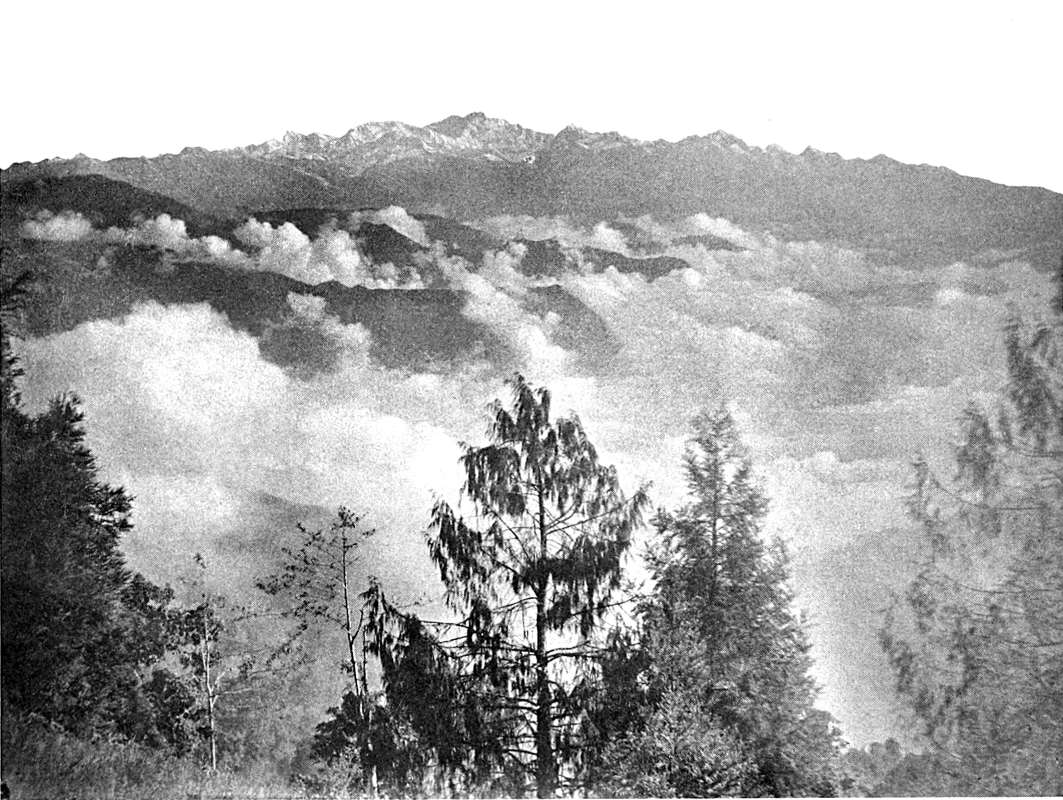
As Incense Ascends—Symbolic, from Ages Past, of the Prayers of Humanity. The Kunchingunga Snowy Range. Elevation, 28,156 feet. Scene from Observatory Hill, Darjeeling.
XLII ON HOLY GROUND
AS the impressive scene unfolded, the Cathedral becoming more sublimely beautiful each moment, Adele watched the wonderful play of light—the refulgence. She was also profoundly impressed by the magnificent proportions of the picture then being illuminated before her very eyes by the Creator; and felt the breath of life come and go with emotion.
“It is the Glorious Beauty of Holiness,” she murmured, and then, kept silence before Him.
Now, next to Adele stood the native woman; and before them both was unrolled the same scene. To this Himalaya worshiper, Lepcha, Bhootanese, Nepaulese, Thibetan, or whatever tribe she might have been born, the effect was not the same as upon Adele. Familiarity with such sunrises in the mountains had dulled what little appreciation she might ever have had; but her religion had told her something which Adele did not know. From untold generations her people had been taught to regard that place as sacred. She had been brought there as a child, and now she was leading her own children there; and told the little ones: “The place whereon thou standest is holy ground.” She had also her own ideas as to why it was sacred; and that very morning had come to the holy ground to show the children why it was holy; but Adele knew nothing of all this.
Worldly wisdom might have judged this woman and Adele to be in no way alike, yet, here in this presence, where the holiness of beauty and the beauty of holiness were both in evidence, there was really a fundamental similarity.
Adele drew near the Doctor; he, too, had been keeping silent in the Holy Place.
“The Veil has been taken away,” said she.
“H’m, yes.”
“It is the most impressive sight I ever beheld.”
“Why so?”
“It is as a chancel should be.”
“Of course, the most beautiful portion of a cathedral.”
“Beauty is not all, I feel more than I see; the beauty is sacred here; the sacred feeling comes first, and then—oh, it is so beautiful!”
“It must be a Holy Place if it affects you that way.”
“Yes, a place for prayer, it seems natural to pray here; here one thinks upwards, and looks upwards.”
“Then the effect is spiritual as well as artistic.”
“Oh, don’t analyze! I don’t wish to reason at all,” said Adele. “For me it’s perfect. I’m satisfied. Just let me rest here, let me go and sit down, and be a part of it.”
She seated herself at the foot of a tree.
It would have been sacrilege to disturb her at that moment—a violation of sacred things in her experience. So, on the instant, thought the Doctor.
After a little reflection, the Doctor said to himself that this was not the time for Adele to “loaf and invite her soul.” He feared lest she was carrying her idealization entirely too far. Even the best in the world, if carried to excess, leads one into danger; and spiritual excesses are especially dangerous, either to youth or old age.
To sit at the feet of Nature, to admire and enjoy the Creator’s work, was one thing; to be so absorbed in Nature’s moods, and to become such a slave to emotion that all else is forgotten, would be quite another thing. Adele seemed to have forgotten the Lepchas, and himself, and even her own self; and to be totally absorbed in adoration of the scenery.
The Doctor had many times seen pious worshipers in certain phases of Hindooism, Buddhism, and Christianity, indulge in that sort of thing; but never in Shintoism or any really old form of faith which brought one close to nature, through nature’s activities and manifestations unidealized; where nature spoke for herself and mankind was silent before her. He suspected this excess of idealization, this becoming “a part of it,” as Adele had wished for, might become really a weakness in her character, and might lead her into danger. Such a frame of mind would certainly be fascinating to Adele, she was so made, she was constitutionally an idealist; but certainly it was not mentally healthful in relation to her duty to others; not a thing to be rooted out, but to be controlled lest the result should prove injurious.
The Doctor determined to break in upon her mood in some way. He recalled her last remark, that she was perfectly satisfied with her Cathedral, and only wished to rest and be a part of it.
“Adele, you said this Cathedral was complete.”
“It is to me.”
“Not if it is a cathedral as usually understood.”
“What do you mean?”
“You have idealized what we now see as the chancel?”
“Certainly, the place where the service is conducted.”
“May I ask what is the central feature in the service to which you and I are accustomed?”
“To administer; no doubt.”
“To administer; certainly—but what?”
She thought very seriously, trying to find suitable words. She was not accustomed to this sort of stand-up-and-deliver catechism; but finally she spoke:
“Some might say to administer the sacrifice; but I do not see how this can be possible. It is not a fact in nature; I cannot consider it true.”
“May I ask, why not?”
“You can never kill the truth; and Christ is not dead, but living; they are the same no matter how you think about it—Christ and the Truth.”
“But Truth was sacrificed in Him.”
“Never!” she cried. “That is an impossibility in nature. It only seems sacrificed; it never really is.”
“But He was sacrificed.”
“His great sacrifice of Himself for Truth’s sake was really His whole life work, and it was Perfection,” said Adele.
“His life, as well as His death,” acquiesced the Doctor, solemnly.
“Yes, a perfect work.”
“Well then, Adele, no other idealized sacrifice in administering could make the service more complete, nor the atonement more adequate than it is.”
The atonement!
Yes. The at-one-ment—the Saving of the World—the Salvation of Mankind by the Truth.
And as they conversed thus, upon the Lepcha Holy Ground, the Doctor concluded that Adele’s meditations had not led her astray; but he felt constrained to say something further which had been on his mind from the first.
“Adele, with us the ministration is usually at the chancel rail.”
“Yes, or what corresponds to it.”
“Where from?”
“The altar; why do you ask?”
“Have you seen any altar in this Cathedral?”
Adele looked around in different directions, continually reverting to the chancel region she had idealized, as if it ought to be there. Surely there must be an altar in nature, or something she could idealize as such; for so many religions professed to have altars, from the earliest times down to the present day. She began to fear lest her imagery as to the Cathedral had failed her in a vital point. Once before she had thought she could discover some form or shape in the higher altitudes which might suggest an altar; in every case the light had been so dazzling, or what she tried to see was so vague, that her ideal had never been satisfied in its most vital need; and now with the chancel itself open, the veil rent, she saw nothing to suggest an altar. Where was it? Had it been there? If so, then what had become of it—the altar?
XLIII SACRIFICE
ADELE was still sitting at the foot of the tree; some said it was a bo-tree; others did not have knowledge enough to tell what kind of a tree it was. She did not think of this at all, as she sat dreaming upon the magnificent spectacle before her. In her mind she was seeking for an answer to the Doctor’s inquiry; then her eyes, while searching for some object which might be idealized in some degree as an altar, were drawn to the immediate foreground, away from the chancel, to something in her own vicinity, quite near herself.