A TREATISE
Charles Caldwell translation
ON
FRACTURES, DISLOCATIONS, &c.
MEMOIR I.
ON THE FRACTURE OF THE CONDYLES OF THE LOWER JAW.
§ I.
1. The lower jaw, a kind of moveable hammer, destined, to use the words of a certain physiologist, to triturate the aliments against the almost immoveable anvil of the upper jaw, is more exposed to the action of external bodies, and consequently to fractures, than most of the other bones of the face. But all parts of it are not alike subject to such accidents. Common in its body, but less frequent in its branches or sides, fractures sometimes occur in the two processes in which its branches terminate. One of these processes, concealed by the zygoma, embosomed in the temporal muscle, and covered by the masseter, is less liable to fractures than the other, which serves as the centre of the motions performed by the bone, and is protected externally only by the parotid gland.
§ II.
2. A fracture of the condyle may sometimes arise from a counter-stroke, as when, in consequence of some external force being applied from before backwards, and from below upwards against the chin, this process is driven against the projecting rim of the glenoid cavity; at other times it may be the effect of an immediate or direct stroke, as when a body in motion strikes with force against the region of the joint, and does violence to that portion of the bone.
3. But in whatever manner the fracture may be produced, it generally occurs in the slender part of the bone which supports the condyle, below the insertion of the pterygoideus externus. It is characterized by a pain more or less acute, necessarily accompanying the motions of the jaw; by a difficulty more or less considerable, in the performance of these motions; by a crepitation, oftentimes distinct, when, in consequence of the angle of the jaw being pushed forward, or the jaw itself alternately depressed and elevated, the separated surfaces rub against each other; by an inequality of surface sometimes perceptible directly over the fractured condyle; by the ease with which, on being pushed forward, it may be forced into the depression beneath the zygoma; and by its remaining stationary, during the movements of the lower jaw, from which it is separated. These signs, though generally characteristic, are subject to an uncertainty proportioned to the swelling that occurs in the part.
4. In this accident a displacement is almost always produced by muscular action. The pterygoideus externus, being attached to the condyle, draws it forward and upward, towards the external wing of the pterygoid apophysis, its fixed point of insertion. On the other hand, the body of the bone is left behind, being held by the masseter and external pterygoid muscles, the course of which is opposed to a displacement in the same direction; so that there always exists a separation, more or less perceptible, between the two fragments of bone.
5. Hence, if proper means be not used to restore the contact between the broken ends of the bone, the following consequences will be likely to occur: 1st. Their reunion will be tedious, because in every bone this process is, in point of rapidity, inversely proportioned to the separation of the divided surfaces: 2dly, This reunion may even entirely fail to take place, if the bone be subject to the slightest movements, as I have witnessed in a particular case, where the condyle, not being reunited to the other part, exfoliated, and was in part discharged through the external integuments: 3dly, Under such circumstances, the callus produced in the process of healing, being situated near to the joint, and rendered irregular and deformed by the separation of the parts, is apt to impede muscular action, and do a permanent injury to the functions of the jaw.
§ III.
6. As the whole apparatus in this case consists in a passive resistance to the active powers employed in producing a displacement, it follows from what has been said (4), that the bandage intended to prevent this displacement, and by that means to guard against the accidents specified above (5), ought, either effectually to bring back to its natural situation, the condyle which is drawn forward, or pull in this last direction (that is, forward) the body of the bone which is still retained in its usual position, in order that it may thus be brought into contact with the condyle.
The first of these measures is impracticable, in consequence of the situation of the condyles, which are too deeply enveloped by the surrounding parts, and offer a hold too small to be acted on. The second, therefore, remains to be adopted, and is the more easily executed, in as much as the angle of the jaw, from its projecting and being but slightly covered by the integuments, may without difficulty be directed from behind forward by a proper force.
7. The fingers of the surgeon temporarily supply this force, at the time of reduction; but it is necessary that it should be permanently kept up by means of the apparatus. This end is attained, in the following manner:
Place behind the angle of the jaw, which must be first pushed forward, thick compresses, to fill up the hollow under the ear, and form an eminence higher than the surface of the surrounding parts; pass over these compresses, in an oblique manner, the bandage commonly used in lateral fractures of the bone, the application of which must in this case commence on the sound side.
These compresses, being more projecting than the surrounding surface, will necessarily sustain a greater pressure, because the compression made by a bandage is in proportion to the projection of the part on which it is applied. Hence, being firmly supported, they will retain the body of the bone in a line with the displaced condyle (4).
8. In addition to this mode of applying the bandage, it is necessary that the fractured bone should be kept in a state of perfect rest. The internal pterygoid and masseter muscles, tending by their contractile efforts to draw the angle of the jaw backwards, sometimes overcome the resistance of the apparatus, and, by producing a second displacement, give rise to the accidents formerly mentioned (5).
Let the lower jaw be now brought into perfect contact with the upper one, and not separated from it during the first few days after the injury, except so far as may be necessary for the admission of nourishing broths. Should a tooth have been lost, the space which it occupied will furnish, without disturbing the bone, an opening for the conveyance of nourishment to the patient. Let talking, laughing, and every thing that might produce a separation between the body of the bone and the condyle, be carefully avoided. The further treatment of the accident should be such as is generally applicable to all fractures of bones, and need not be at present particularly detailed.
The following cases, reported by citizen Giraud, second surgeon to the Hotel-Dieu, will confirm the advantages of this mode of treatment.
Case I. Margaret Bessonet, aged thirty-four, was admitted into the hospital on the 10th of May, 1791. On the preceding day she had received a violent fall on her chin: a severe pain, and a preternatural mobility in the left side of the jaw, had been the immediate consequences of the accident: from these symptoms, taken in conjunction with those formerly mentioned (3), Desault discovered that a fracture of the condyle existed, which he reduced and supported in the usual manner (7).
After being somewhat uneasy during the first few days, the patient became reconciled to the action of the bandage, which, by inattention, had been two or three times disturbed and put out of order, but which, by being carefully reapplied, and aided by the necessary precautions (8), restored to the bone its natural form and solidity, by the thirtieth day, and on the thirty-sixth the patient was discharged perfectly cured. The only inconvenience she experienced, was a slight difficulty in the motions of the jaw, an effect naturally resulting from the long continued inactivity of the muscles, but which was soon removed by means of exercise.
Case II. Claudius Laurat, aged twenty-seven, fell as he was carrying a heavy burden. In his fall his chin struck with violence against a beam that lay in his way. In an instant he experienced a sharp pain in his right temple, and found it almost impossible to move his jaw. Two hours afterwards a considerable swelling appeared in the part, extending from the angle of the jaw above the ear. The patient was admitted into the Hotel-Dieu, where the circumstances of the fall and the symptoms that followed, gave satisfactory evidence of a fracture of the condyle. It was reduced and supported as in the preceding case. On the day following, the swelling was removed, doubtless by means of the compression which had been made on it; the other symptoms (3), hitherto scarcely perceptible, became more obvious; the bandage was reapplied, and the disease terminated, in about twenty-nine days, in the same manner with that of case 1.
MEMOIR II.
ON THE FRACTURE OF THE CLAVICLE.
§ I.
1. Man enjoys an advantage which nature has bestowed on but few of the quadrupeds, namely, a power of moving his upper extremities in every direction. The clavicle being a kind of arch placed between the breast and shoulder, forms a centre, moveable indeed but solid, for these motions, a part of which can no longer be performed, when this arch, in consequence of being broken, ceases to afford them a point of support. Hence it follows, that the fracture of this bone may be said to reduce the individual who sustains it, when considered in relation to its functions, to a level with that numerous division of animals that are destitute of clavicles.
2. Few diseases of the kind are more frequently met with than this. The natural curve of the clavicle, its situation immediately under the skin, the want of a support to its middle part, the great proportion of spongy substance which enters into its composition, the projection of the shoulder exposing it to the action of external bodies; all these circumstances concur in rendering the accident frequent, particularly among that class of men subject, from their occupations, to violent exertions of the upper extremities.
Here then, more than in the generality of fractures, we should feel an interest in the advancement of the art of surgery; and yet, having hitherto employed in it but feeble means, our efforts have been attended with imperfect success. Hippocrates has observed, that some degree of deformity almost always accompanies the reunion of a fractured clavicle; all writers since his time have made the same remark; experience has confirmed the truth of it, and as much time has been spent in hypothetical speculations to explain the accident, as in serious inquiries how to prevent it. At length Desault proved that a feeble and unskilful mode of treatment was the sole cause of a want of success, and that, by being more correct and judicious, art might be as successful here, as in other fractures. In order to give a correct view of his practice in this disease, I will examine the causes, varieties, and signs of a fracture of the clavicle; the accidents of which it is susceptible; the mode and the causes of the displacement of the broken ends of the bone; the indications that arise out of those causes, and the manner of answering these indications as well during, as after, the reduction.
§ II.
OF THE CAUSES AND VARIETIES.
3. The action of external bodies is almost the only known cause of this fracture, whether these bodies strike the shoulder with violence, or the shoulder be forcibly driven against them. But this action is not in every case the same; its application is most frequently mediate or indirect, but is sometimes immediate or direct.
In the first case there is a true counter-stroke, the ordinary effect, either of a severe blow on the point of the shoulder, which is the most common occurrence; or, as happens less frequently, of a fall on the arm when it is extended for the purpose of guarding the body from the force of the accident. Under these circumstances, being pressed between the sternum, which makes resistance, and the body which acts on its extremity, the clavicle is bent in that direction which is most natural to it; but, not being sufficiently flexible, it gives way generally in the place where its curvature is the greatest. Thus the ribs are broken, when the sternum, by being violently driven backward, forces them to bend in the centre beyond their natural flexibility.
In the second case, the fracture occurs at the spot where the stroke is given. Here the momentum or quantity of force applied on the bone, surpassing the solidity which the bone possesses, its continuity is necessarily destroyed.
4. But in whatever way the fracture is produced, it is either oblique or transverse, single or double, in the middle or towards the extremities of the bone, simple or compound.
An oblique fracture is most frequently the effect of a counter-stroke; a transverse fracture is the more common result of the immediate action of external bodies; a counter-stroke seldom produces any thing but a simple fracture; while compound fractures are generally owing to a direct stroke. The one produces a solution of continuity in the middle of the bone, or thereabout; because in that part the curvature is most considerable. The other is almost always the cause of this solution, when it occurs at the extremities. To the latter alone, is a double division to be attributed. The reason of these differences is already so plain, that it would be a waste of time to dwell on an explanation of them.
§ III.
OF THE SIGNS.
5. The several phenomena that attend a fracture of the clavicle, taken together, leave in general but little doubt as to its existence, particularly when the fracture is oblique. As is the case in most other instances of the kind, so here, an acute pain is felt at the instant of the stroke; sometimes a cracking of the bone is distinctly heard by the person injured; on every occasion, it becomes suddenly impracticable to perform circular or rotatory motions with the arm; motions from before backwards can still be executed, but are difficult and painful, and, as I have already observed (1), the individual injured is reduced to the class of animals destitute of clavicles.
Oftentimes the shoulder of the injured side, being more or less depressed, loses its level with the other. It is also evidently drawn forward and inward. The distance between the acromion and sternum, on the affected side, is found on comparison, to be evidently less than on the opposite side. In almost every case, that portion of the fractured bone, which adheres to the sternum, forms a visible protuberance above and on the inside of the shoulder.
6. In the mean time the pain continues. The painful drawing or dragging occasioned by the weight of the arm forces the patient, for the purpose of relieving it, to bend his body towards the side affected, and incline his head in the same direction. This forms a peculiar attitude, which of itself was frequently sufficient to disclose to Desault the nature of the disease. We have oftentimes witnessed him establishing the truth of this diagnostic, by merely looking at patients entering the amphitheatre, who had been brought thither for the reduction of such fractures.
By this position, the pains are generally relieved, because the arm finds some degree of support; but should the patient wish to change his position, or perform any particular motions, the pains return almost as acutely as at first.
7. If to these signs, which are almost all of them founded in reason, we add those that are still more palpable to the senses, such as the mobility of the two broken ends of the bone; the crepitation produced by their friction against each other; the depression felt at the point of fracture, by passing the fingers over the upper surface of the bone; and the facility of restoring to it its natural form and direction, by moving the shoulder upwards, outwards, and backwards; it will be difficult to be mistaken respecting the nature of this fracture. This is perhaps more particularly the case, when the fracture is oblique, as this kind offers the most striking diagnosis, and cannot be involved in uncertainty, unless when a considerable swelling occurs in the parts around the fracture. But, even then, as the circumspection of the practitioner will necessarily direct his attention to this circumstance, the obscurity of the signs will have no unfavourable influence on the cure.
8. When the fracture is transverse, there is sometimes more difficulty attending the diagnosis. The corresponding inequalities of the divided surfaces may mutually penetrate each other and interlock, and thus prevent a displacement. Does any uncertainty on this score exist? Placing your fingers on the two extremities of the bone, order an assistant to move the arm in every direction, and the motions will be communicated to the clavicle; but, if a fracture exist, they will be most perceptible in the fragment adjoining the shoulder, and will separate it from that attached to the sternum. This method will seldom deceive us, is easily employed, and subjects the patient to but a momentary pain.
§ IV.
OF ACCIDENTS.
9. We do not generally find fractures of the clavicle accompanied by such accidents as the anatomical relations of the parts might lead us to apprehend. The external force being all expended in fracturing the bone, extends but feebly to the brachial plexus, which would be much injured by the shock, were the bone to yield, without breaking, to the action of external bodies striking against it. Hence, without doubt, would arise serious affections, as may be fairly inferred from the analogy of blows on the head and vertebral column, and as is indeed confirmed by certain cases reported by Desault.
Case I. Two bricklayers were brought to the Hotel-Dieu, who had met with similar accidents. A piece of timber, thrown from a building, in which they were engaged, had struck them, the one on the external part of the left clavicle, the other about the middle of the right. A considerable wound pointed out in each the place on which the blow had been received. But the former, having escaped a fracture, experienced nothing but an acute pain, while the second had the bone broken in two places.
The customary apparatus was applied to the latter, and the treatment which we shall presently describe, being pursued, the result was that complete success which never failed to crown the attentions of Desault. In the other patient a considerable swelling made its appearance the day after the accident. On the third day a numbness and partial loss of the power of motion occurred in the arm of the affected side. Soon afterwards an insensibility came on, and by the seventh day, the paralysis of the arm was complete. It was not till after a tedious treatment, an account of which would be foreign from my present subject, that the limb recovered in part its original strength.
From whatever cause the fracture of the clavicle in this latter patient was prevented, it is evident, that the whole of the force employed to produce the fracture in the other, acted here on the brachial plexus, and gave rise, by means of concussion, to the accidents which followed.
10. The axillary artery, though running near to the clavicle, in common with the brachial nerves, experiences, notwithstanding, less frequently than they do, injurious effects from the fracture of this bone. I know not of any instance where a puncture from the broken ends of the clavicle has produced in this artery a false aneurism. To conclude, like all other fractures, that of which we are now treating, may be connected with wounds, splinters, &c. But in general, as Hippocrates remarks, the fracture of the clavicle assumes in common cases a mild aspect.
§ V.
OF DISPLACEMENT.
11. Most of the symptoms formerly mentioned (5 and 6) as accompanying a fracture of the clavicle, are evidently the result of a displacement of its broken ends. Yet this phenomenon, taken notice of by all authors, and considered by them as a necessary effect of the disease, does not occur in every case (8). There are instances, in cases of transverse fractures, where the extremity attached to the shoulder, has retained its natural position. Three examples of this kind occurred in the Hotel-Dieu in the course of the year 1787.
12. Instances have also been known, in which the sternal fragment, when fractured obliquely upwards, has supported the end of the humeral in such a manner as to prevent any derangement. Desault was accustomed to relate several cases, where similar occurrences took place; but, in general, this state of things is rare, in comparison with that in which the fragments lose their natural level.
Almost always, then, there is more or less of a perceptible overlapping (chevauchement) produced, either, by the elevation (a circumstance which is very rare) of the external fragment over the internal; or, (as commonly occurs) by the depression of the former beneath the latter.
13. Of the first of these modes of displacement (a mode but rarely mentioned by authors) a few examples are to be found among the observations of Desault, one of which he has recorded in his journal. Hippocrates speaks of the phenomenon as a thing that was familiar to him.
14. The second kind of displacement, that which we constantly find in practice, and which the laws of muscular action render almost inevitable, takes place in such a manner that the shoulder appears to obey the impulse of two powers, one of which draws it downwards, and along with it the external fragment of the clavicle, which is displaced by this power in the direction of its transverse diameter, or thickness. The other power approximates the shoulder to the breast, and draws it forward, carrying along with it the same fragment, which is by this means displaced in a longitudinal direction.
That we may the better understand them and their effects, let us, in our minds, separate these two powers, although they are perfectly simultaneous in their action. A knowledge of them will lead us to a knowledge of the resistances which ought to be opposed to them. But let us first remark, that the humeral fragment, being drawn downward and inward, takes sometimes such a direction, that its internal extremity passes backward under the sternal fragment, its external end continuing to point forward: this disposition can be understood from its natural direction.
15. The first of these powers, namely, that which depresses the point of the shoulder, appears to have escaped the notice of the ancient physicians of Greece, who attributed the apparent depression of this part, to the elevation of the sternal fragment, and, accordingly, endeavoured by making compression on the latter, to restore it to a level with the other. Hippocrates, more judicious than those who had preceded him, demonstrated that their doctrine, false in its principles, was still more dangerous in its consequences, and that the sternal fragment being immoveable, lost its relative position with respect to the humeral, only because the latter was depressed by the weight of the arm. This doctrine of the father of physic is satisfactorily proved, by a comparison of the sound shoulder with the diseased one, and has since been admitted by all practitioners. Indeed, the mere recollection that one of the uses of the clavicle is to support the shoulder at that level necessary for the performance of its functions, is alone sufficient to convince us, that, in case of its ceasing to fulfil that office, the shoulder must obey the laws of its own gravity, increased by that of the hand and arm.
16. The illustrious Petit, and with him Duverney, in acknowledging this cause of displacement, have added to it as another the action of the deltoid muscle on the external end of the bone; in this action, the end of the clavicle is the moveable point, while the humerus affords the fixed point. But how can we admit this cause, when the humeral fragment, in passing under the sternal, moves in a backward direction? So far is the deltoid muscle from drawing the bone downward, that here the bone rather draws the muscle in part backward, and yet, in such a case, the displacement is as perceptible as in any other. Besides, when the sternal fragment, broken obliquely upwards, supports the humeral and prevents a displacement, why does not the deltoid produce this displacement?
It is then in the weight of the arm and shoulder alone, that we must look for the passive power, which depresses them, and which produces a displacement in the direction of the transverse diameter or thickness of the clavicle.
17. A second power, highly active, co-operates with this. I allude to the permanent contraction of the muscles, that extend from the breast to the clavicle and shoulder: from this cause arises the displacement in the longitudinal direction of the bone.
The pectoralis major, the pectoralis minor, the subclavius, the serratus major, and the trapezius, unite their efforts in producing this displacement. These muscles are, in certain respects, antagonists to each other, but they all unite in drawing the shoulder forward and inward. None of them appears to act with more effect than the pectoralis major. To this, in particular, is to be attributed the displacement in a forward direction.
Except in the instances stated above, the action of the muscles is not immediate. They act only secondarily on the external fragment, which, being stedfastly attached to the scapula and humerus, is obedient to the motions impressed by the muscles on these two bones; motions which, in a sound state, the clavicle has a power of controlling.
18. To the weight of the lower extremity (15 and 16), and the spontaneous action of the muscles (17) must be added, as another cause of displacement, the motions which are communicated to the arm by external bodies, and which, being imparted ultimately to the clavicle, derange the fragments, by separating them, approximating them, or making them overlap each other, according to the direction in which they act.
19. When a fracture occurs at the extremity next the shoulder, no displacement of the fragments in general takes place. This circumstance is attributed to the action of the trapezius, which draws each fragment upwards with equal force. However this may be, it is doubtless to such cases that we must refer the complete cures, obtained without any retentive apparatus, by Gasparetti, Brown, and other writers. Hence also, without doubt, arise the difficulties experienced by certain practitioners, such as Duverney, with respect to the diagnosis of this disease. These fractures may be mistaken for fractures of the acromion, being situated so immediately in its vicinity.
§ VI.
OF THE REDUCTION.
20. On looking into the causes of that displacement (15...18), so common in fractures of the clavicle, it appears that in almost every case, the external extremity of the humeral fragment is drawn, by a double power, downward, inward, and forward. Hence it follows, 1st. That the resistance opposed to this power, by the means used for the purpose of reduction, and the retentive apparatus subsequently employed, ought to be directed upward, backward, and outward, these directions being the reverse of those in which the powers of displacement act: 2dly. That, in as much as these powers, viz. the weight of the parts and the action of the muscles, are in constant operation, and, besides, as the motions of the arm are continually disturbing the fragments of the bone, the apparatus ought to be equally constant in its action, and should keep up, without any remission, the effect produced, at first, by the means of reduction. This principle is applicable to every case, and ought to be the standard of comparison, for determining the advantages or disadvantages of different bandages, and processes for the reduction of fractures of the clavicle.
21. But we are not to suppose, that these processes have heretofore manifested an exact application of this rule. Hippocrates directed to press the arm close to the ribs, and at the same time to push it upwards, in such a manner, as to make the shoulder appear as sharp and pointed as possible. Hence his precept, to lay the patient down on his back, the back being supported by some projecting body, and then to press the shoulders backward; hence again, when the humeral fragment is drawn inward, his advice to press the elbow close to the breast. This twofold expedient was attended with great difficulties, even under the direction of the father of medicine. Celsus only copied Hippocrates, adding nothing whatever to his mode of practice. Paul of Egina, more judicious in this case, conceived, that for the purpose of forcing the shoulder outward, and rendering it, agreeably to the idea of Hippocrates, very projecting and sharp, it would be advisable to place the fulcrum or point of support, not in the middle of the back, but under the arm-pit. A woollen ball was employed by him for this purpose, a practice which would, at once, have carried the art near to perfection, if, after being employed to reduce the fragments, this process had been continued for the purpose of retaining them in apposition.
22. No new method distinguished the surgery of the Arabians. It is necessary to come down to the time of Guy of Chauliac, before we meet with the method which is almost universally adopted at present, and which consists in placing between the shoulders, the knee of an assistant, whose hands are to be employed in drawing them forcibly backwards. But it is evident that this is only doing, while the patient is in an erect position, what Hippocrates did, after having laid him with his back on a projecting body. Here, then, the art seems to have degenerated, after the time of Paul of Egina: and, indeed, on comparing this process with the general principles already established (20), it will be immediately perceived, that the powers of replacement do not here act in an opposite direction to those of displacement.
Hence the difficulties of reduction, the time spent in the operation, and the sufferings by which it was sure to be accompanied. The fragments were brought together, it is true; but it was only by varying the movements, and changing their direction, that the point of contact was ultimately found.
23. Desault conceived, in the year 1768, that to reduce, in the most effectual manner, a fracture of the clavicle, it was necessary not only to push the shoulder backward and upward, as was commonly done, but, above all, to force it outward, and that the power destined to draw it in this latter direction, ought to act horizontally, according to the course of the clavicle, in the same way, as, in an oblique fracture of the thigh or leg, the extension for replacing the fragments is made in the direction of the bone.
24. As the union of the humerus to the clavicle, by means of the scapula, communicates to the one the movements of the other, it is easy, by placing the ball used by Paul of Egina, under the arm-pit, to convert the arm into a lever of the first kind.2
The lower extremity of the arm being then pressed towards the body, the upper end is separated from it, and becomes, with regard to the clavicle, what the efforts of an assistant who makes the extension, in a fracture of the leg, are to the foot of the patient.
The mode of reduction being established, it was necessary, in the next place, to invent a bandage, calculated to retain the broken ends of the bone in contact. Desault thought it practicable to unite these two points of treatment, in the same process, that is to say, to reduce, and at the same time to retain the fracture. Here the art is indebted to him for an improvement, which, I will venture to say, carries it near to perfection. To judge of this, it will be necessary only to take a hasty survey of the different kinds of apparatus proposed by different writers.
§ VII.
OF THE MEANS OF RETAINING A REDUCTION.
25. Here all authors seem to have been directed by the same principle. This is to keep the shoulder of the affected side, 1st, drawn forcibly backwards, 2dly, approximated towards the shoulder of the sound side. Such was the practice of the Greek physicians, whom we have seen in common with Hippocrates, Celsus, and Paul of Egina, employing a kind of bandage, varied in its form, according to the displacement it was intended to remedy.
Above all others, we find an application of this principle, in the figure of 8 bandage, a particular form, which was employed in practice by Albulasis, an Arabian, and afterwards by his countrymen, as well as by Lanfranc, Guy of Chauliac, and their contemporaries. The use of this bandage was continued by Pare and his successors, and has been lately modified by several authors, such as Heister, Petit, Brunninghausen, &c.
26. But under whatever form it shows itself, its action is always the same, and always insufficient. On comparing its effect with the general principle, on which every apparatus for the clavicle should be constructed (20), we perceive, that it by no means answers the threefold indication, of retaining the shoulder backward, outward, and upward.
27. In relation to carrying the shoulder backward it loses half of its effect, because, its force being decomposed (so to speak) by the obliquity of its direction, is divided into two channels. One of these runs parallel to the shoulder and acts to no purpose, while the other, being perpendicular to it, is alone effective; hence it must act with a force equal to 10, in order to produce an effect equal to 5.
28. The indication, to draw the humeral fragment outward, far from being fulfilled, is here diametrically counteracted. The scapula, being approximated to that of the opposite side, draws the humeral fragment towards the trunk, making it underlap the internal one, and, in this respect, the figure of 8 bandage acts posteriorly in precisely the same manner, during the treatment, that the contractions of the muscles did anteriorly before the reduction.
29. Should the shoulder be supported, at such an elevation, as might have a constant tendency to destroy the influence of its own gravity? this is evidently prevented by the very oblique direction of the turns of the bandage. Suspending the arm in a sling, is the only way, in which that end can be attained. But does this mode always possess sufficient firmness and stability? The arm, not being here sufficiently fixed, may be constantly in motion, which, by deranging its situation, must communicate very troublesome and injurious movements to the fragments of the clavicle. One of the principal faults of all bandages consists, in not preventing these movements, by restraining the movements of the arm.
To the other disadvantages of this mode, need I add that of its making, by the turns of the bandage, an undue compression on the projecting edges of the arm-pit, and producing thereon troublesome and painful excoriations?
30. From the want of a mutual correspondence and fitness between the indications already enumerated (20), and the manner in which the figure of 8 bandage acts, it is evident that the former can never be satisfactorily fulfilled by the latter. Hence we may judge, what improvement the art has received from the iron cross of Heister, the compress of Petit, drawn transversely over the oblique turns of the bandage, the waistcoat which Brasdor fastened round the thorax of his patients, and the leathern apparatus, lately proposed by a German practitioner. These means, though diversified in their form, are similar in their effect, and, being nothing but modifications of the figure of 8 bandage, possess, like it, the radical fault of not offering a resistance directly opposed to the two-fold power, arising from the muscular action and the gravitation of the shoulder.
As to what remains, it will be sufficient to show the insufficiency of the process of reduction (22), by means of the knee placed between the shoulders, in order to demonstrate the existence of a like insufficiency in all those forms of apparatus, which, as Brasdor remarks, have for their object a continuance, during the treatment, of the effect produced by that process.
31. On the other hand, those indications will be fulfilled with exactness, by such a form of apparatus as will render permanent the action of the means of reduction which were employed by Paul of Egina, by certain Arabian physicians, and by Pare; which have been renewed by Desault, and tend to draw the shoulder upward, backward, and outward (23 and 24).
Pecceti appears, in the last century, to have had a faint view of the proper indication on this subject, when, under the article of fractures, he advises the ball to be suffered to remain under the arm during the treatment of the injury. But the figure of 8 bandage, united to this expedient, counterbalances its effect, rendering it of no avail, and Pecceti was therefore no more successful than others, in obtaining a cure of the fracture, unaccompanied by deformity.
32. An overlapping more or less perceptible never failed to accompany the consolidation or knitting of the bone, and here, as in many other cases, practitioners laboured to explain what they knew not how to prevent. The impracticability of surrounding the part, as in other fractures, with a circular bandage, appeared to Heister, Petit, and Duverney, to be the cause of this deformity. They supposed that to be a superabundant callus, which was nothing but a displacement of the fragments. These visionary hypotheses ceased to exist, as soon as this displacement was prevented by a proper apparatus.
Desault sought for this form of apparatus, as well as for his other bandages, in the multiplied application of means already known, without inventing new ones. Bandages and compresses, easy to be procured, and already rendered familiar to surgeons by daily use, served him for the construction of his apparatus, for which several machines had been already proposed.
33. The pieces of which this apparatus is composed, are,
1st. Three rollers, three inches broad; the two first, six, and the other eight, ells long, each one rolled up separately.
2dly. A bolster or pad (a, b, Fig. 1), made in the form of a wedge, out of pieces of old linen. Its length should be equal to that of the humerus, its breadth four or five inches, and its thickness at the base (a), about three inches.
3dly. Two or three long compresses.
4thly. A small sling for the arm, (Fig. 5).
5thly. A piece of linen large enough to cover the whole bandage.
Every thing being properly arranged, the following is the mode of applying the apparatus, which of itself reduces the fracture.
34. The patient being placed in a standing position, or, if his case render that impracticable, on a seat without a back, an assistant elevates the arm of the affected side, and supports it at nearly a right angle with the body (Fig. 2), while the surgeon places under the arm-pit the head of the bolster, which descends along the side of the thorax, and which another assistant, situated at the patient’s sound side, holds by the two upper corners.
35. The surgeon now takes one of the first rollers, applies the end of it on the middle of the bolster, fixes it there by two circular turns round the body, and passes a turn obliquely (a a) along the fore part of the thorax, ascending to the sound shoulder: the roller then descends behind, passes under the arm, and returning in front of the thorax, makes a circular turn and a half, horizontally. Having reached the hind part of the thorax, it reascends obliquely by the cast (b), as it had done before, and passes over, before, and under, the sound shoulder; having thus crossed the turn (a a), the roller again passes across the hind part of the thorax, and finishes by circular turns, which completely cover the bolster. A pin is now to be fixed in the place of crossing of the roller on the sound shoulder, to prevent the turn (a) from slipping downward.
The application of this first roller is intended for no other purpose, than firmly to fix the bolster which is held up by the two oblique turns before and behind, and secured against the body, by the subsequent circular turns.
36. The bolster being fixed, the surgeon applying one hand to its external surface, pushes it upwards, and, with the other, taking hold of the elbow, after having half-bent the fore arm, lowers the arm, till it is laid along the bolster. He then presses its lower extremity forcibly against the side of the thorax, pushing it upwards at the same time, and directing its upper extremity a little backwards.
The application of the bandage constitutes a part of the process of reduction. The humerus, now converted into a lever of the first kind, is drawn at its upper end from the shoulder, in proportion as its lower end, is approximated to the thorax. The scapulary fragment being drawn along with it, and directed at the same time upward and backward, comes into contact with the sternal fragment, and in an instant the deformity of the part disappears.
37. The arm being thus situated, is given in charge to an assistant, who retains it in the same position in which he received it from the surgeon, by pressing on it with one hand, and with the other supporting the fore arm half bent, and placed horizontally across the breast.
The second roller is next to be applied. The end of this is carried under the arm-pit of the sound side. It is then brought across the breast, over the superior part of the diseased arm, and extends across the thorax behind till it passes under the arm-pit. Two circular turns cover the first. The roller must then ascend to the lower part of the shoulder, by oblique turns (c. c. Fig. 3), each of which must be overlapped by the succeeding one, to the extent of about the third part of its breadth. It is necessary that these turns be applied in such a way, as to bind but very gently above, and to increase in tightness, as they descend nearer to the lower extremity of the humerus.
The use of this second roller is, to supply the place of the hand of the assistant, in pressing the arm against the side of the thorax; its effect evidently is to draw the upper extremity of the arm outwards, and, as it is already directed backwards, to retain it in that position. The compression of the circular turns on the arm, being thus gradually augmented, becomes, on the one hand, more efficacious, because it acts on a greater surface, and on the other, less troublesome, because, being more divided, it is less felt at the lower extremity of the arm, where it bears with most force.
38. A third indication remains still to be fulfilled, namely, to retain the shoulder in its elevated position, and, by that means, to assist in the extension of the fragments, which already has some effect in preventing a depression.
To fulfil this indication, an assistant sustains the elbow in its elevated position, with one hand, and, with the other, supports the patient’s hand before his breast, while the surgeon fills with lint the hollow spaces around the clavicle. He then applies on the clavicle, at the place where it is fractured, the two long compresses, wet with vegeto-mineral water, or some other cooling liquid. Taking now the last roller, he fixes the end of it under the sound shoulder; from thence he brings it obliquely across the breast, over the long compresses, and carries it down behind the shoulder along the posterior part of the arm, till it passes under the elbow. From this point, he again carries it obliquely upwards across the breast to the arm-pit, then across the back, over the compresses, and brings it down again before the shoulder, along the front of the humerus till it again reaches the elbow. From thence the roller again ascends obliquely behind the thorax, passing under the arm-pit, where the first cast of the roller is covered, and from whence it again starts, to run the same course we have just described. This constitutes a second round, which covers in part the first, and forms a kind of double triangle (e, f, d), situated before the breast, and over the circular turns of the other rollers (c. c. Fig. 4). The remaining part of the roller, brought from behind forward, is employed in circular turns over the arm, and round the thorax, for the purpose of preventing the displacement of the first part. To make it the more secure, it is fastened with pins at its different places of crossing.
The sling (Fig. 4) is next passed under the hand, and fastened above to the ascending turns (d), and not to the circular (c c), which the weight of the hand would be likely to draw downward.
39. It is only necessary to examine the course of this third roller, to see, that, united to the sling, it is well calculated to support the external fragment, which the weight of the shoulder has a tendency to depress, on a level with the internal one. It supplies the place of the assistant, who raises the elbow and supports the hand of the patient, in like manner as the second roller performs the office of the assistant, who presses the lower part of the humerus against the side of the thorax.
On the other hand, the circular turns, by which the application of the third roller is finished, being directed from before backward, push in the same direction the arm and shoulder, which have been already carried that way, by the process of reduction, and thus retain them in their proper places.
Hence may be inferred the truth of the proposition, which we have been endeavouring to demonstrate; namely, that the bandage of Desault, constructed according to the general principle formerly established (20), for fractures of the body of the clavicle, is calculated to retain the external extremity of the humeral fragment upward, outward, and backward.
40. The casts of the rollers, thus surrounding the thorax, however well they may be secured, are yet liable to be displaced, particularly when the patient is in bed. This inconvenience may be avoided, by surrounding the whole with a piece of linen, leaving nothing uncovered, but the sound arm, which is at liberty to perform its usual motions.
The arm of the diseased side, being thus fixed in such a manner, as to constitute a whole or entire body with the thorax, follows its movements, without producing any displacement. It is thus, that by the apparatus for a continued extension of the thigh, the fragments of the os femoris, forming an immoveable whole with the pelvis, cannot change their situation, even in following the motions of the trunk.
Hence arises, in fractures of the clavicle, this advantage, that the patient is not obliged to keep his bed, but is able even to attend to his business, during the progress of the cure.
41. I will not dwell on the numerous objections urged by different authors against the bandage which has just been described. What answer, indeed, can be given to those writers, who fancy that they behold the patient in the greatest danger of immediate suffocation; who dread an approaching mortification of the arm of the diseased side; who allege, contrary to the rules of the art, that there is no impression made immediately on the clavicle, but on a neighbouring bone; who, &c. &c.? Twenty times in a year, has experience answered those objections, in the Hotel-Dieu; and there is not a pupil of Desault, who has not, as well in this, as in many other cases, seen that objections, plausible, indeed, when considered in the closet, or at a distance from a sick room, dwindle to nothing at the bed-side of the patient.
42. In those cases (which, as Hippocrates remarks, very rarely occur) where the external fragment projects over the internal one (12), the bandage must be somewhat varied, although the two principal indications, of drawing the shoulder backward and outward, must still, as in other cases, be fulfilled. The only additional circumstance, therefore, necessary to be attended to here, is, not to elevate the shoulder, by pushing it upwards. This may be easily avoided, 1st, by omitting to raise the elbow, when applying the bandage; 2dly, by drawing the third roller a little tighter than usual.3
The fragments, being reduced to the same level, and brought into apposition, by this two-fold attention, will unite as in ordinary cases.
If the fracture exist at the end of the clavicle next to the humerus, the difficulty of their being displaced renders the application of the bandage less necessary. Prudence, however, demands that it be not altogether neglected.
§ VIII.
OF THE TREATMENT DURING THE FORMATION OF THE CALLUS.
The regimen to be pursued during the reunion of the clavicle, varies according to circumstances. It is impracticable to lay down general rules, applicable to all affections of this kind. Here, however, much more than in other cases, if the division of the bone be simple, and no unfortunate accident occur, it is always unnecessary to restrain the patient from his usual course of life, beyond the second or third day. But, though internal means are for the most part omitted in the treatment, the apparatus is a subject on which too much attention cannot be bestowed. With whatever degree of exactness it may be at first applied, it will soon become loose, and oppose a diminished resistance to the weight of the shoulder, and the action of the muscles. Hence, unless it be frequently examined, the fragments will be displaced. The following case furnishes a detail of the treatment subsequent to the reduction, to which, in ordinary cases, Desault had recourse.
Case III. Mary Adel, aged thirty, as she was crossing a path covered with ice, in the severe winter of 1788, fell on the point of her left shoulder, and fractured the clavicle about the middle. Being brought to the Hotel-Dieu a few hours after the accident, she was dressed in the manner just described, and, as the fracture was simple, it was judged sufficient to make a slight diminution in the quantity of her aliment, during the two or three first days. The dressing was moistened every morning, with vegeto-mineral water, at the place corresponding to the fracture.
On the fourth day the piece of linen that surrounded the bandage was removed, for the purpose of examining the state of the parts. Every thing was found in its proper situation, and the covering was replaced till the seventh day, when the rollers appeared to be somewhat relaxed. The apparatus was taken off, and reapplied as at first, the compresses being carefully moistened with vegeto-mineral water, at the part lying over the fracture. After the third day the patient was permitted to return to her usual regimen. The third roller being a little deranged on the tenth day, it was taken off, and reapplied as at first, together with the sling. The fragments were examined and found in perfect contact. The patient was up during the whole day, walked about the house, and experienced no other inconvenience than that of not being able to use the left arm.
On the thirteenth day, the bandage was again reapplied, and allowed to remain till the sixteenth, when the patient having disturbed it, it was once more changed. At this period, the fragments, already firmly united, exhibited scarcely a vestige of the division they had sustained.
The reunion was complete by the twentieth day, when all the pieces of apparatus were dispensed with, except the bolster and the second roller, which were also removed two days afterwards, as they were found to be no longer necessary.
The continued inactivity of the limb, during the treatment, had occasioned a stiffness in the shoulder. This was gradually done away by making the patient move her arm in all directions, twice a day, each time, for the space of an hour.
On the twenty-ninth day she left the hospital, carrying with her nothing to remind her of the injury she had sustained. She was free from that uneasiness which is the consequence of a tedious and ill-managed treatment, during which the exercise of the limb has been neglected.
§ IX.
OF COMPLICATIONS.
44. We are in possession of but few observations particularly relative to the different complications, that may accompany fractures of the clavicle. The treatment, in such cases, varied according to circumstances, must be accommodated to the indications common to all fractures of this kind.
When splinters, displaced in different directions, whether adhering to the bone or not, irritate the soft parts, and, having passed through the integuments, appear without, most practitioners advise to remove them and cut off such parts as project beyond the fractured end of the bone, previously to reduction. This direction is founded on the severe pains which, in such cases, accompany the common treatment of the injury, and which the figure of 8 bandage always augments, by drawing the shoulder inward, and consequently pressing the soft parts against the projecting parts of the fragment, or the points of the splinters. But if the splinters, adhering as yet to each other and to the bone, by means of the periosteum, have not assumed the nature of foreign bodies, (that is, if they be not actually dead) it is always proper to replace them. It is here only that we meet with an occasion for that part of the process, of reduction denominated conformation,4 which is never requisite in other cases.
A fragment which has penetrated the soft parts, but has not been long exposed to the air, disappears, and is replaced by extension, provided it be properly directed. Being retained afterwards in a state of constant extension, it can neither be displaced, nor cause pain by irritating the parts, which is the inevitable result of the figure of 8 bandage.
In cases of this kind, it is useful to protect the shoulder with a small splint, which may support the turns of the bandage, and prevent their pressure on the splinters, or the broken ends, which they might otherwise disturb. These precautions are alike indispensable when the fracture is double.
Case IV. Francis Ricord, twenty-five years of age, was received in the month of July, 1790, into the Hotel-Dieu of Paris. On the preceding day, a piece of timber having fallen from a considerable height on his right shoulder, had broken the clavicle of that side into several pieces. Severe pains, which occurred at the moment of the accident, had continued throughout the night, and were still sensibly felt. The slightest motion of the part augmented them to such a degree, as to extort from the patient piercing cries.
The point of the shoulder being very much depressed, was also drawn perceptibly forward and inward; and a large echymosis, without any external wound, occupied its whole extent.
Desault being satisfied that the several fragments were all connected together, and that none of them was separated from the periosteum, placed, as in ordinary cases, the bolster under the arm, completed the reduction, and applied a splint along the course of the clavicle, after having, with his hands, brought the fractured pieces into contact. Confident, then, that the form of the part was perfectly restored, he applied the bandage, which was moistened with vegeto-mineral water, twice or thrice a day.
At the moment of reduction the pains ceased, and were felt no more till the fifth day, when the bandage being a little relaxed, admitted of a slight displacement of the fragments. This displacement was removed, and the pains along with it, by the reapplication of the apparatus.
During the six first days a very strict diet was enjoined. This, however, was dispensed with by degrees, till, on the thirteenth day, the patient returned to his usual regimen. On the seventeenth day, there remained nothing of the echymosis, but a yellow tinge, the customary consequence, of such an accident. The precautions inculcated in the preceding case, were employed also in this, and the patient was discharged perfectly cured, on the forty-second day from the time of his admission. Nor had he experienced, during his treatment, those severe and long continued pains, which, under a different management, so frequently accompany this kind of fracture.
EXPLANATION OF THE FIRST PLATE.
Fig. 1. A bolster made in the form of a wedge, intended to be placed between the arm and the side of the thorax.
a. Its base, which should fit the hollow of the arm-pit.
b. Its summit reversed, against which the elbow is to be applied.
Fig. 2. The first roller applied for the purpose of fixing the bolster against the side of the thorax.
a a. Oblique casts before, passing over the opposite shoulder, in order to hold it up.
b. Oblique casts from behind, crossing the first ones on the shoulder.
d d. Circular casts round the trunk, covering the bolster, which they fix laterally.
Fig. 3. The second roller, applied to fix the arm against the bolster.
a & b. Portions of the oblique casts of the first roller, left uncovered by this one.
c c. Turns of the second roller, covering those of the first, loose above, and tighter below, for the purpose of drawing the superior extremity of the humerus outwards.
d. Their passage over the side opposite to the bolster.
Fig. 4. The third roller intended to keep the point of the shoulder raised.
a a & b. Oblique casts of the first roller, remaining uncovered.
c c. Turns of the second, seen through the opening of those of the third.
d. Oblique casts of the third, ascending from the arm-pit over the shoulder of the diseased side, to descend again behind, along the arm, and pass under the elbow.
f k. A continuation of the preceding casts, reascending under the sound arm-pit, and from thence behind the thorax, over the diseased shoulder.
e. A continuation of the same casts, descending on the fore side of the arm, passing under the elbow, and ascending again under the arm-pit of the sound side.
g. The remainder of the roller, intended to be employed in circular turns, in order to secure the casts e, and prevent them from slipping outward.
Fig. 5. A sling which should be fastened to the oblique cast d (Fig. 4), to support the hand.
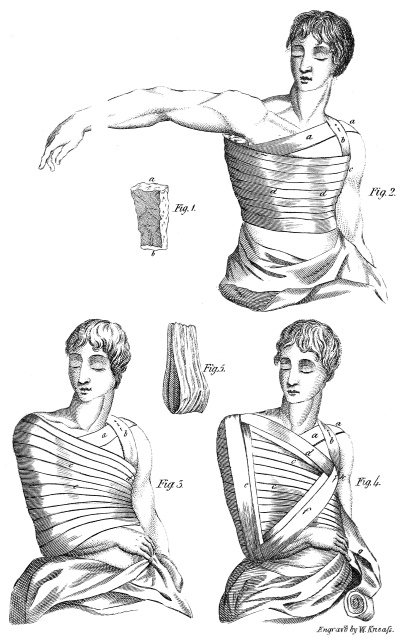
Pl. 1 Engrav'd by W. Kneafs.
MEMOIR III.
ON THE LUXATION OF THE CLAVICLE.
§ I.
1. The clavicle, which forms a moveable abutment for the shoulder, and receives and sets bounds to most of the movements of that part, and of the arm, exhibits at its extremities, two articulations, essentially different from each other in their form, dispositions, and uses. These differences give rise to differences equally essential with regard to the dislocations to which they are subject.
2. On the sternal extremity, a small surface, convex from above downwards, and concave from before backwards, is fitted, by means of an intervening cartilage, to a much smaller surface of the sternum, concave and convex in opposite directions.
One capsule, two ligaments, viz. the interclavicular and costo-clavicular ligaments,5 and the anterior portion of the sterno-cleido-mastoideus muscle, strengthen the connexion of these two surfaces, and tend, on one hand, to prevent their luxation, while, on the other, this luxation is favoured and facilitated by the following circumstances: 1st, the disproportion between the dimensions of the two articulating surfaces; 2dly, the mobility of the joint; and 3dly, by this joint’s constituting a kind of centre for the motions of the arm.
3. On the humeral side, an elliptical surface, slightly convex, and inclined downwards, is immediately joined to a corresponding surface of the acromion, elliptical also, a little concave and directed upwards. Hence two kinds of inclined plains, which would be very liable to dislocations, by sliding easily over each other, were they not firmly secured by a capsule, by accessory fibres, by the intersection of those of the deltoid and trapezius muscles, and, above all, by two ligaments, the rhomboid and the conoid.6
Having laid down these preliminary considerations, let us proceed to examine, in particular, each kind of luxation to which the clavicle is subject.
LUXATION OF THE STERNAL EXTREMITY.
§ II.
OF THE CAUSES AND DIFFERENT KINDS OF DISPLACEMENT.
4. The sternal articulation of the clavicle experiences different changes, according to the different movements of this bone. If these movements be in a backward direction, the articulating surface is turned forward, straining the anterior part of the capsule, the corresponding ligament, and the extremity of the sterno-cleido-mastoideus muscle. If, on the other hand, they be in a forward direction, the posterior ligament, and the adjacent portion of the capsule are overstretched. In motions directed upwards, the costo-clavicular ligament, and the external and inferior part of the capsule, and in those directed downwards, the inter-clavicular ligament, and the internal portion of the capsule, experience a similar degree of tension.
5. Hence it follows, 1st. That the natural movements of the shoulder may be regarded as predisposing causes of luxation, because at the part where tension is excessive, the ligaments are disposed to give way, and suffer the sternal extremity to escape: 2dly. That the efficient causes will be, all external forces acting on the clavicle in such a way as to increase its motions beyond their natural degree, and beyond the resistance which the ligaments are capable of making. Thus a fall on the point of the shoulder, forcing it suddenly backward and inward, produces a luxation forward. But, in general, as the strength of the articular ligaments is superior to the resistance of the clavicle itself, a fracture takes place more frequently than a luxation, in the proportion of nearly six to one.
Though falls on the point of the shoulder are oftentimes productive of luxation of the clavicle, they are not the exclusive causes of that accident. Desault has seen the sternal extremity forced from its cavity by the knee being pushed violently against the middle of the back, while the shoulders were drawn at the same time backwards.
Case I. A porter dislocated his clavicle in the following manner. He was carrying a very heavy burden, suspended from his shoulders by cords that passed under each arm-pit. Being desirous of resting himself by the way, he placed on a block the burden he carried, which slipping backward, drew his shoulders in the same direction, and at the instant of his attempting to retain it and prevent it from falling, produced a luxation of the clavicle.
7. It follows from what has been said respecting the different states of the articulation, during its various motions (4), that the clavicle is not equally liable to be luxated in every direction. Inclining naturally backward, but a very slight degree of motion in that direction is necessary, to effect a luxation forward. To produce a luxation backward or inward, it is necessary, on the other hand, that the humeral extremity of the bone should make a sweep at least three times the extent of that required in the preceding case. Besides, motions in this direction are accompanied with pain, particularly if they be made by force. Luxation downward is prevented, on the one hand, by the cartilage of the first rib, which presents to the bone an insurmountable barrier. On the other hand, to produce this kind of luxation, it would be necessary for the external extremity of the clavicle to be forced upwards, an occurrence very seldom occasioned by falls. Luxation upward, or over the superior edge of the sternum, must be the effect of a stroke, which, by depressing the point of the shoulder, and forcing it at the same time forward, presses the sternal extremity against the internal and superior part of the capsule, which, being thus lacerated, suffers a luxation to take place. But such a derangement of the articulating surfaces is very rarely produced by falls. Whence it follows, that of the different kinds of luxation of the clavicle, that in a downward direction is altogether impracticable. Those backward and upward, though possible, occur but rarely in practice; while that in a forward direction, on the contrary, is not an unfrequent accident. This tends to confirm the observations of practitioners, and particularly of Desault, whose immense collection on the subject furnishes examples of the last kind of luxation only.
8. In these luxations, there is for the most part, a rupture of the capsular ligament, and an escape of the bone through the opening. But sometimes the ligament is only preternaturally distended, and then the luxation is incomplete.
§ III.
OF THE SIGNS.
9. But whatever may be the causes or kind of the luxation, its diagnosis is always easy. If it be forward, the direction of the stroke which the shoulder has received, furnishes, at first, some ground of suspicion. The accident is certainly known by the appearance of a hard and unnatural protuberance in front of the sternum, and behind the extremity of the sterno-cleido-mastoideus muscle, by the existence of a sensible depression or hollow at the joint, and by the situation of the shoulder, which is pushed further backward, and is less projecting and more approximated to the trunk, than in its natural state. Add to these, a difficulty in performing motions in a forward direction, which, when somewhat forced, reduce, in proportion as they are accomplished, the size of the protuberance formed by the displaced end. The head is always inclined towards the side where the luxation exists; an attitude which relieves the painful drawing or tension produced in the sterno-mastoideus muscle, by the humeral extremity pushing it forward.
10. A protuberance over the superior edge of the sternum, a difficulty in raising the shoulder, the pain which results from attempting such a motion, the diminution of the protuberance which it occasions, the absence of the sternal extremity from its natural cavity, the approximation of the shoulder to the thorax, and its depression and diminished projection, compared to its usual state, afford evidence of a luxation upwards.
11. A luxation inward or backward, would be characterized by a projection of the shoulder exteriorly, by a difficulty in performing motions in a backward direction, by the alarming effects, which, as Petit remarks, the compression of the trachea would doubtless produce, and by a depression or hollow at the joint, more perceptible here than in the two preceding cases.
12. These appearances will be more or less striking, accordingly as the membranes, lacerated or only distended, offer a greater or less resistance.
§ IV.
OF THE REDUCTION.
13. To reduce a luxation, is, in general, to make the bone re-enter its cavity, by retracing, or returning along, the same route which it followed in escaping from it. Now, in a forward luxation, the displacement is from behind forward, in an upward one from below upward, in an inward or backward one from before backward, but, in each of the three, it is more particularly from without inward. In the first case, therefore it is backward, in the second, forward, in the third downward, but, in each of the three, more particularly outward, that the powers for producing extension must be directed.
14. Hence the method generally employed by most practitioners, recommended by almost every author who has written on the subject, adopted by Petit, Duverney, Heister, &c. and which consists in placing the knee between the shoulders of the patient, as a point of resistance, by the aid of which the shoulders may be drawn backward, fulfils only half of the indication of cure; because at the time that the humeral extremity is drawn backward, it is not directed sufficiently outward.
Hence a difficulty of replacing the bone sometimes occurs, a difficulty always removed, when, pursuant to the method employed by Desault in fractures of the clavicle (see Desault’s method), the arm is made to serve as a lever of the first kind, to carry backward and outward, the head of the bone, which is displaced in the opposite directions, when the luxation is forward. This method possesses the advantage, not only of giving the powers of extension a proper direction, but also of increasing them to a degree even beyond what is necessary for effecting a reduction, by removing them further from the resisting force. Hence it is unnecessary to adopt any particular measures for restoring and preserving the form of the part, as the extension is alone sufficient for that purpose.
These principles, evidently applicable in effecting a reduction, are still more strikingly so in the means destined for retaining it. Let us apply what I have just said, to a case of dislocation in a forward direction. It will be easy to transfer it afterwards to the other kinds of luxation.
§ V.
OF THE MEANS OF RETAINING A REDUCTION.
15. Few luxations are so speedily reduced, but few are more easily displaced again, than that of the clavicle. This disposition is the reverse of that of most other luxations, which are reduced indeed with difficulty, but seldom afterwards suffer a displacement. The cause of this we find, 1st, in the extreme mobility of the clavicle, to which all the motions of the arm are communicated; 2dly, in this further consideration, that most of the muscles, which have their insertion towards the shoulder, tend to draw this bone inward, when the ligaments, in consequence of being either broken or distended, as happens in this accident, do not offer a sufficient resistance.
16. From this two-fold cause of displacement, arises a two-fold indication in the arrangement and application of the apparatus. These are, 1st, to render the clavicle immoveable, by restraining every kind of motion in the shoulder and arm; 2dly, to retain the extremity of the clavicle outward, a direction opposed to that in which it has a tendency to be displaced. But if to those indications we compare the forms of apparatus hitherto used, we will readily perceive that they are insufficient to fulfil them.
17. The figure of 8 bandage, so generally in use, and all the various modifications, under which it has been revived, without being improved, fix the clavicle in the very direction most favourable to a displacement, and even do it in the very manner in which that accident is sometimes brought about; as maybe seen in the history of the case of the porter (6). This bandage does not, under any of its modifications, prevent the motions of the shoulder, because it does not restrain those of the arm, which remains free and unencumbered. Far from constituting an antagonist power to, it even co-operates with, that which has produced the displacement. (For further light on this subject, see what has been already said on the fracture of the clavicle, pages 22 and 25.)
Bell, in condemning the figure of 8 bandage, not so much because of its action being insufficient, as because of its obstructing respiration, proposes, as a substitute for it, a kind of machine analogous to the iron cross of Heister, which, being fixed by straps passing under the arm-pit, and round the neck and body, is intended to retain the parts firm and immoveable. But the motions of the arm not being restrained, nor the action of the muscles of the shoulder opposed by an antagonizing power, places this piece of apparatus in the same class with those, which, from not being devised and constructed on a proper view and conception of the causes of displacement, have no affinity to rational practice.
18. The apparatus for a continued extension, invented by Desault, for fractures of the clavicle, fulfil here all those indications in which the others fail.
By this, 1st. The aim, being firmly fixed against the side, by means of the roller (c c Fig. 3), can communicate no motion either to the shoulder, or the clavicle. 2dly. The shoulder itself, being forcibly drawn outward, with the upper extremity of the humerus, by the action of the kind of lever into which this bone is converted, and to which the bolster (a b Fig. 1) serves as a fulcrum, cannot, by its movements, derange the luxated bone. 3dly. The sternal extremity, being drawn both by the muscles which tend to displace it inwardly, and by the bandage which acts on it in an opposite direction, remains fixed between those two antagonizing forces, which thus destroy each other. Hence the apparatus of Desault, when accurately applied, offers to both of these powers of displacement, a resistance perfectly calculated to combat them.
20. We must, however, admit that this apparatus partakes of one inconvenience, common indeed to all bandages, but which is perhaps more particularly applicable to this in consequence of the numerous casts of the rollers that form it, namely, the great facility with which it becomes relaxed. Hence one cause of displacement, which the most exact and scrupulous attention cannot at all times prevent.
Case. Desault had, for a long time, the care of a patient, whose luxation, having been neglected for four days, was reduced on the fifth, by a surgeon, who, for the purpose of retaining it, employed a bandage of a particular kind. An hour afterwards, a motion of the shoulder backward, displaced the luxated extremity: a new reduction was the consequence; on the day following, another displacement, and so on in succession, for ten days, at the expiration of which, Desault being consulted, applied to the part the bandage formerly described.
On being examined the next day, the apparatus was found in a favourable state. On the day following, a slight displacement rendered necessary a new application of the bandage, which, this time, continued longer than before. But, about the expiration of the third day, the projection of the bone was again considerable. Finally, the patient recovered, with a very perceptible protuberance in front of the sternum, and a difficulty of motion, great at first, but less afterwards, and which exercise succeeded ultimately in removing.
21. The application of the apparatus differs from that intended for a fracture of the clavicle, only in this, that it is of service to place on the luxated extremity, graduated compresses,7 calculated to make pressure backward and outward, and which are to be secured by the turns of the roller (b Fig. 4).
A second precaution, not less essential, is, to push the humeral extremity of the clavicle, a little forward, and fix it in that direction, in order that the sternal being directed backward, may be removed from the place8 through which it has a tendency to escape.
22. Desault almost always obtained complete success by this process, and by the most accurate attention to prevent the relaxation of the bandage. In the mean time, a stiffness, more or less considerable, always remains in the joint for a long time after the reduction, and it is not unfrequently a month or two before the part recovers its usual facility of motion.
The following cases, collected by Brochier, confirm the doctrine for which I have been contending.
Case II. A man luxated the clavicle by falling on the point of his shoulder, and forcing it backward. He was immediately brought to the Hotel-Dieu, where Desault demonstrated to his pupils, that the head of the bone, carried in front of the sternum, was removed nearly an inch from its natural cavity, the ligaments of which were no doubt lacerated.
Here, as in the fracture of the clavicle, the application of the bandage answered the purpose of reduction, and removed the protuberance formed by the extremity of the bone.
The patient, being strong and vigorous, and having received besides a violent contusion, was bled twice, and confined to a low diet. On the following day, no derangement; on the fourth day, a slight displacement of the bone, the rollers a little relaxed, bandage applied anew. Eighth day, no sensible displacement. Eleventh day, some swelling around the joint; compresses, wet with vegeto-mineral water, ordered to be frequently renewed. Twentieth day, the swelling almost gone, and no disposition to a displacement; the apparatus was removed; motions at first difficult, and contracted. Twenty-ninth day, more free and easy. Thirty-fourth day, returned to their natural state.
Case III. Mary Rivert luxated her clavicle, on the seventh day of January 1789. Being brought some time afterwards, to the Hotel-Dieu, she was treated in the same manner as the foregoing patient, and with the same result, except that a very slight protuberance remained at the extremity of the bone, and the confined state of the motions continued a little longer. Desault related, in his lectures, other instances of cures being performed without the least remaining deformity.
After all, even supposing the method just proposed, to possess no other advantage, than that of diminishing the protuberance of the bone, which, under other modes of treatment, is almost inevitable, and by that means preventing the motions of the part from being confined, it would still, without doubt, be a great step towards the perfection of the art.
23. Should a luxation backwards occur, the same process of reduction should be adopted, with this difference, that the extension ought to be made forward and outward; and the same apparatus should be applied for retaining the parts, except that the humeral extremity ought to be directed a little backward, in order that the sternal extremity, being carried forward, may be removed from the place of laceration in the capsule.
In like manner, should the bone be luxated upwards, it would be necessary to draw the arm outwards, and elevate slightly the point of the shoulder, for the purpose of depressing the sternal extremity.
LUXATION OF THE HUMERAL EXTREMITY.
§ V.
OF THE KINDS OF LUXATION.
24. Luxations of the humeral extremity of the clavicle, take place, according to Petit, in two ways, 1st, under, and 2dly, over the acromion. If we attend to the disposition of the articulating surfaces, the superior of which rests obliquely on the inferior; if we examine, in particular, the relative position of the corocoid apophysis with respect to the clavicle, it will be difficult to conceive how the first kind of luxation can occur, without being accompanied by a fracture. Yet some facts added by Desault to the doctrine of Petit, on this point, seem to demonstrate the possibility of the clavicle sliding under the acromion. As to luxations forward and backward, the mobility of the shoulder, the facility with which it yields to motions impressed on it in these two directions, and the want of a resisting power, make the two bones that compose it, move together, still preserving their relative position.
The luxation upward, then, is that which ought chiefly to occupy the attention of the practitioner. Yet even this is less frequent than the luxation of the sternal extremity, on account of the very great strength of the retaining ligaments, which, when this luxation occurs, must be, if not lacerated, at least very much distended.
§ VI.
OF THE MECHANISM AND THE APPEARANCES.
25. A fall on the point of the shoulder is the most frequent cause of this luxation. The two articulating surfaces, representing an inclined plain, slide along each other, in such a manner, that that which belongs to the acromion is pushed inward, while that of the clavicle is directed outward. The capsule being stretched, gives way, and then the displacement is manifested by a preternatural protuberance over the acromion; by a stiffness in the motion of the shoulder; by the direction of this part, which is evidently drawn inward and downward; by the inclination of the head of the patient to the side affected; by a bending of the body; and by severe pains in the luxated part. These characters are essentially distinct, and ought to have prevented the error of Galen, who mistook a case of this kind for a luxation of the os humeri downward. Hippocrates and Ambrose Pare have foreseen the possibility of this mistake and even warned young practitioners to be on their guard against it. But, as citizen Sabattier judiciously observes, the position of the head of the humerus, under the arm, in a luxation of that bone, will remove all uncertainty respecting the nature of the injury.
§ VII.
OF THE REDUCTION AND THE MEANS OF RETAINING IT.
26. The reduction, in this case, is generally attended with but little difficulty. The acromion being drawn outward, by the upper end of the os humeri, which, by means of a fulcrum placed under the armpit, is made to act as a lever of the first kind, is restored, without much trouble, to its natural contact with the corresponding surface of the clavicle. But, it soon becomes deranged again, unless it be retained in its place by a proper apparatus. Now, on what principle ought this apparatus to be constructed? To prevent the displacement, which generally occurs from without inwards, it ought evidently to act from within outwards. Whence it follows, that the rollers in the figure of 8 bandage, recommended in this case by all writers, instead of preventing, actually favour the displacement (17), because they act in the same direction with, and therefore assist, the powers that produce it.
27. Here, in like manner as in the preceding case, the bandage of Desault fulfils with precision the indications of cure, because, by it, the point of the shoulder is, particularly, drawn outward; and if, in certain cases, a slight projection of the humeral extremity still remains, it is to be attributed to the inefficacy of the means of execution, and not to the principles on which they are founded.
MEMOIR IV.
ON FRACTURES OF THE ACROMION, AND OF THE LOWER ANGLE OF THE SCAPULA.
§ I.
FRACTURE OF THE ACROMION.
1. There is no part of the scapula more liable to fractures than the acromion. Being but slightly covered by the soft parts, this insulated kind of appendix has not, in all positions of the humerus, a solid point of support. A strong muscular force oftentimes acts on it with great energy. Being large in front, it presents in that direction a considerable surface to receive the action of external bodies. Whence it follows, that if it is not oftentimes broken, this is to be attributed, not so much to its natural disposition, as to the position which it generally assumes in falls.
2. The fracture, which is almost always transverse, is sometimes at the summit, and sometimes at the base of this apophysis, and is usually produced by a violent shock from a body falling on the shoulder, by a blow received on that part, &c.
3. But in whatever place it occurs, it greatly resembles a fracture of the humeral extremity of the clavicle, of which the acromion appears like a continuation. There is accordingly a strong analogy between the phenomena, the consequences, and the modes of treating these two kinds of fractures.
4. This accident is characterized, 1st, By a severe pain experienced by the patient, at the place of the fracture. This pain is increased by the elevation of the arm, which, generally hangs motionless down along the side. 2dly, If the humerus be removed from the trunk, the hand being at the same time placed on the acromion, the extremity of this apophysis is felt sinking downward, creating thereby an evident depression in the part. 3dly, Generally, the two fragments lose, of their own accord, their relative position; and unless the precaution about to be mentioned be used, their displacement becomes manifest, being produced by the weight of the arm, and the contractions of the deltoid muscle. 4thly, The head is inclined to the affected side.
§ II.
OF THE REDUCTION.
5. Two different processes have been long in use for the reduction of fractures of the acromion. One consists in elevating the arm almost to a right angle with the body, in order, as Heister remarks, to throw the deltoid muscle into a state of relaxation, and then to be able, with the fingers, to place the fragments in their natural situation. In the other mode, the humerus is suffered to retain the position it has assumed, that is, to hang down the side; the surgeon then taking hold of the elbow, pushes it vertically from below upwards, in such a manner, that the head of the bone, pressing against the acromion, elevates and replaces it.
6. Petit seems to have adopted indiscriminately these two methods, one of which, however, is greatly superior to the other. Indeed, it is evident, that if the humerus be removed from the trunk, its head will necessarily sink down in the glenoid cavity. Being thus separated from the fractured apophysis, it leaves beneath it a hollow or vacancy, into which the fragment will be pushed, should it be in any measure, compressed by the casts of the roller, during the application of the bandage.
7. On the other hand, if the arm still fixed against the side, be pushed upwards, it will afford to the acromion a solid point of support, which, during the application of the apparatus, will prevent its displacement downwards. This consideration is unquestionably of moment, during the process of reduction; but ought more particularly, to command the attention of the practitioner, in the choice of means destined to maintain the reduction.
§ III.
OF THE MEANS FOR MAINTAINING THE REDUCTION.
8. As the displacement is most likely to occur downwards, particularly in motions of the arm, it is necessary that a continued resistance be opposed to this tendency. But this resistance should be made by the head of the humerus, which, if properly directed, will represent, during the treatment, a kind of splint, which art ought to render fixt and immoveable lest, being contiguous to the divided surfaces, it might derange, by its motions, the work of nature in effecting their reunion. Hence it follows, that the precise and immediate intention of the whole apparatus destined to support fractures of the acromion apophysis, is, 1st, to keep the head of the humerus constantly elevated or pushed upwards: 2dly, carefully to prevent all motions of the arm and shoulder.
9. If the means, heretofore employed in this fracture, be examined, it will be perceived that they by no means fulfil this twofold indication.
A compress placed immediately over the fracture; a roller passed round this to secure it; a ball or bolster9 put into the hand; the fore-arm supported in a sling; such is the apparatus recommended by Petit. In addition to this, Duverney judiciously advises to keep the sling elevated, for the purpose of keeping the head of the humerus applied under the fractured pieces. He employed also the spica-bandage which has been equally recommended by Heister.
10. But, in the employment of these means, the arm, not being confined against the trunk, can move with ease, and derange the fragments, and, therefore, the second indication is not fulfilled. Will even the first be fulfilled? By no means. The sling, being soon deranged, by the movements of the arm, which are oftentimes involuntary, suffers it to sink down again, and then the fragments, being no longer supported, are displaced. Hence the difficulties attending the treatment, difficulties which have not escaped the notice of authors, and which Heister thus expresses: “Nemo ita curari solet, ut brachium postea, liberi sursum attollere queat,” an observation, which the celebrated Cheselden made before him, in describing the scapula.
11. These inconveniences will be avoided, by fixing the arm, as recommended by Desault, firmly against the trunk, by converting, so to speak, the arm and the trunk into one single and solid piece, in such a manner, that the humerus having no other motions but those in common to it and the thorax, may not be able to communicate any others to the fragments, which are supported by its head. This advantage can be easily obtained, by means of the bandage, already described, for fractures of the clavicle, modified agreeably to the circumstances of the case, in which it is to act.
12. A bolster or pad of an equal thickness in all its parts, is placed under the arm. The arm is then to be pressed down on this, in like manner as in the bandage for the clavicle. The fractured apophysis is now to be covered by two compresses; one extending from the clavicle to the spinous processes of the vertebræ, while the other, lying over this, and running in a contrary direction, crosses it at the place of the fracture. The whole is then to be secured by a roller, which, starting from the arm-pit of the sound side, pursues nearly the same course with that destined, in fractures of the clavicle, to retain the shoulder upwards. (See what has been said on this subject, when treating of the structure of the bandage.)
13. By this mean, the two-fold indication of keeping the humerus immoveable, and directed upwards (8), is evidently fulfilled, as I have already proven at full length, when treating of fractures of the clavicle; and a reunion, without deformity, may be looked for, of which we have an instance in the following case, recorded by Derrecagaix.
Case I. Nicholas Gay, aged twenty-nine, was struck, in passing under a decayed building, by a stone, which, having become loosened, fell on the point of his shoulder. In an instant he experienced severe pain, and a difficulty of moving his arm, particularly upwards. Soon afterwards there occurred a swelling of the shoulder, and a large echymosis at the place where the blow was received. The pain, not so acute during a state of rest, was increased by the motions of the arm, and even by leaning the head towards the opposite side, which latter circumstance was, no doubt, owing to the contraction of the trapezius muscle.
A surgeon being called, judged it sufficient to make use of discutient applications, to which the swelling and the echymosis appeared to yield in the course of a few days. On a more accurate examination, a fracture was discovered, supposed to be in the external part of the clavicle, and for which the patient was sent to the Hotel-Dieu.
The fracture was discovered to be in the middle of the acromion, which it divided transversely. The bandage already mentioned (12) was applied, and, from the first day, the patient was left to his usual regimen. Fifth day, a renewal of the apparatus which had become relaxed: seventh day, a fresh displacement, in consequence of an unguarded motion: a fresh application of the bandage, which continued in its place till the sixteenth day, when it was replaced anew: thirty-second day, reunion complete; a stiffness in the motions of the part, which exercise removed by degrees, and of which the patient felt no remains after the forty-eighth day.
FRACTURE OF THE LOWER ANGLE OF THE SCAPULA.
§ IV.
OF THE SIGNS OR APPEARANCES AND DISPLACEMENT.
14. Next to the acromion, the lower angle of the scapula is that portion of the bone most liable to be fractured. The usual causes of it are, falls on the side, or blows received on the part. It is characterized by a displacement which is always perceptible. On the one hand, the fleshy portion of the serratus-major, which is attached to the inferior fragment, draws it directly forward, while it is drawn upward by the teres-major, and some of the fibres of the latissimus dorsi. On the other hand, the body of the bone itself remains behind, being held by the rhomboid muscles. Hence arises a separation, which renders it difficult to mistake the fracture. Should any doubts still remain, let the shoulder be drawn backwards and the scapula along with it: let the fingers be, at the same time, placed on the lower angle, to ascertain whether or not it follows the motions of the bone; if it does, there is no division: but if, on the contrary, it remains stationary, the existence of the fracture is evident.
§ V.
OF THE REDUCTION, AND THE MEANS OF RETAINING IT.
15. Here, as in all other fractures, the means of reduction must be founded on the causes of displacement. To effect the replacement, therefore, it is necessary, either to push backward and downward, the angle which is displaced in a contrary direction, in order that it may be brought into contact with the body of the bone, or else to draw the body of the bone forward and upward, that it may meet the displaced angle. It is thus, that in a fracture of the condyle, the body of the jaw, is drawn into contact with the fragment.
16. But the first mode of reduction is difficult, and the means of maintaining it impracticable. It is necessary, therefore to have recourse to the second, which is the more easily executed, as the scapula follows the movements of the arm, and as, by drawing this limb forward, and the elbow of it outward, that bone is removed from the spinous processes of the vertebræ, and directed in such a manner, as to be brought into contact with its inferior fragment. This situation possesses another advantage, as it throws into a state of relaxation the muscles which tend to displace the lower fragment.
Hence it follows, 1st, That here, in like manner as in fractures of the clavicle, it is not on the fractured bone, that the force must act, but on the humerus. 2dly, That the humerus ought to be, during the whole treatment, immoveably fixed, because its motions, being communicated to the scapula, must soon derange the contact necessary to a reunion.
18. On these principles were founded the apparatus of Desault, and his process of reduction, which consisted, 1st, in drawing the arm forward, and separating the elbow a little from the thorax; 2dly, in fixing the fore-arm at an angle sufficiently acute, to direct the hand to the point of the opposite shoulder; and 3dly, to bring afterwards into proper apposition and form, the fragments already approximated to each other by the first movements.
19. To retain this reduction, the arm and fore-arm must be permanently fixed in the above position. This object is attained in the following manner, 1st, A bolster in form of a wedge, being placed between the arm and the side, its apex situated in the arm-pit, affords the double advantage of keeping the elbow at a distance from the thorax, and of rendering the position of the arm less fatiguing by serving as a point of support to it. 2dly, Compresses wet with some discutient liquid, are applied on the part corresponding to the fracture. 3dly, The whole is now to be secured by a roller, seven or eight yards long. The first turns of this roller, must secure the hand of the affected side on the sound shoulder to which it had been applied, during the reduction, and running afterwards from before backwards, pass over the place of the fracture, for the purpose of retaining the compresses on it. The wedge-formed bolster is to be secured on the thorax, by circular turns around it. Then, passing under the sound arm-pit, after having made these circular turns, the roller must be brought behind again, conducted obliquely over the shoulder of the diseased side, along the anterior part of the arm, under the elbow, and behind the thorax, where it is carried obliquely, in order to pass again under the sound arm-pit. From this place it ascends again anteriorly over the affected shoulder, redescends along the posterior part of the arm, repasses under the elbow, returns under the arm-pit, and terminates finally in circular turns round the trunk, and arm together. Hence it may be observed, that, in the first turns of the roller, this bandage greatly resembles the third roller applied in the fracture of the clavicle, to retain the point of the shoulder upward and backward (Fig. 4. plate I.)