A TREASURY OF HEROES AND HEROINES (continued 5)
Reading edition
But we cannot go into stories of George's boyhood, of the time when he cut down the cherry tree and faced his father's wrath rather than tell a lie, or the time when he accidentally killed a high spirited horse when breaking it to the bridle. He finished his schooling when he was sixteen years old, and would have gone into the British navy if his mother had consented. She did not, however, so George studied surveying; and was soon earning considerable sums from this occupation.
He made an excellent surveyor, and his skilful work and unusual character soon attracted general attention. He was well versed in military tactics also, and was made a Major in the Virginia militia before he was twenty. This gave added zest for his military studies and he set to work to learn strategy under a fierce old Dutch army officer named Jacob Van Braam. Together they studied maps and fought out battles with pins and bits of wood until far into the night. George was also busied with the care of the Washington estate at Mount Vernon, which was left to him on the death of his half brother, Lawrence Washington in 1752. Mount Vernon carried with it about five hundred slaves and dependents, and the young man had his time fully occupied in riding over its broad acres and managing its affairs.
When George was twenty-one years old a difficult task was assigned to him that not only proved that he had really entered the estate of manhood, but also that he was trusted beyond his years. Governor Dinwiddie of Virginia sent him on a dangerous trip into the wilderness to warn off the French from English ground and to gain the friendship of the wild Indians that lived there. The race for land between the French and English settlers was growing keener and more bitter every day, and both countries claimed the land that lay between the Allegheny and the Mississippi rivers. Finally the Governor of Virginia picked young Washington to go to Venango and warn the French that they were trespassing,—and also to make ceremonial visits to the Indians to ensure their friendship to the English in case of war with the French.
To succeed would require shrewdness, good sense, courage and physical strength—for a long journey through virgin forests would have to be made and many dangers encountered. Washington took with him a guide and pioneer named Christopher Gist, and Jacob Van Braam went also to act as interpreter.
The journey over six hundred miles of desolate wilderness, across swollen streams, through forest, swamp and over rugged mountain, was performed so speedily that it would be hard for strong men to duplicate it to-day, traveling over good roads. Washington sat beside the council fires of the Indians, and delivered the Governor's message to the French. He also noted the best points for fortifications against the encroaching French, and reported them on his return. The journey had been a complete success and since others had tried it and failed, Washington's fame was established throughout Virginia.
The French had received him with sly courtesy and sought to ply his company with wine and brandy rather than to come to any agreement with him. It was plain that they meant mischief, and Governor Dinwiddie decided to send a force of soldiers to build a fort at the juncture between the Allegheny and the Monongahela rivers, one of the places that Washington had noted down for its good strategic qualities. Colonel Joshua Fry was placed in command of about three hundred troops, and Washington was sent with him as his lieutenant.
On the march Colonel Fry died, and Washington was left in sole command of the troops. Spies and Indian scouts in the employ of the French had reported the expedition and the French had promptly marched against the Virginian soldiers with greatly superior numbers. Washington got news of this act on their part, and hastily threw up fortifications on a plain called Great Meadows. He called this stronghold Fort Necessity. The French soon came up and surrounded the fort, and the bark of the rifles reechoed through the woods and from the hills.
Washington and his men fought with the utmost bravery, but when he saw that the struggle was hopeless and that they would all be killed or captured if the fight continued, he made terms with the French, allowing his men to retire with all their arms and equipment, on condition that they did not make any further attempt to occupy the country for a stipulated time. The French success was not the fault of Washington who displayed great coolness and secured the maximum advantage for himself and his men. He was warmly commended by the Governor for his action in this fight and had a higher reputation than ever among all who knew the circumstances.
Soon after this Washington engaged in another expedition that was far more disastrous. The English Government put Major General Edward Braddock in command of a force of English regular soldiers to gain control of the disputed Ohio Valley, and Washington was appointed as aide on General Braddock's staff.
Braddock in his way was a good soldier, a hard bitten, dyed in the wool, regular army officer with a great contempt for the Virginia militia, and an over confident belief that the British soldier was invincible. He believed absolutely that the methods of war that were used on European battlefields would overwhelm anything in America, and he liked to see his redcoats with their boots polished and their buttons furbished, marching in solid platoon formation, turning and wheeling with the mathematical regularity of a machine. His men were drilled and disciplined until they were automatons, for Braddock was a martinet. Their ranks ran true, their equipment was in the pink of soldierly condition; the sunlight glittered from their bayonets, you could see your face in their leather accouterments, and Braddock proudly marched them into the American woods as though they were parading on the Strand in London. When Washington warned him of the dangers of ambush, urging that an advance guard and scouts be thrown out, Braddock turned scornfully away, believing that a volley or two from his brave regulars would soon drive off any foes that might fall upon him, and he said bluntly that when he desired advice from his subordinates he would ask for it.
As his men were marching in close formation, their red coats blazing against the dark green of the forest, shifting figures were seen in the trees ahead, a French officer suddenly appeared cheering them on to the attack, and with shouts and yells an unseen enemy shot down the Britishers from the protection of fallen trees, from behind rocks and stumps, and from the concealment of forest branches.
The redcoats fell by scores and were thrown into hopeless confusion. They were not used to fighting a hidden foe, and were appalled by the death in their midst as well as by the wild cries and war whoops that echoed from the forest. Braddock, waving his sword, ordered his platoons to wheel and advance in solid formation into the woods—and the platoons were wiped out like sheep in a slaughter pit as they tried to obey the hopeless order. But the despised Virginia militia, experienced in Indian fighting, spread out in open order at the head of the column and kept the enemy in check, while Braddock with hopeless bravery attempted to rally his men. It was in vain. The dismal cries and yells continued. The bullets sang overhead like a swarm of wasps, British officers dropped at the shots of invisible sharpshooters, who picked them off easily on account of their conspicuous uniforms. Braddock himself, as brave a man as ever lived, had four horses killed under him and then received a mortal wound. Washington, whose advice had been laughed at, took command of the Virginians and covered the headlong rout of the British regulars, who threw away their rifles and ran blindly into the woods. How Washington escaped alive is nothing less than a miracle. Like Braddock, he had several horses killed under him, and four bullets pierced his uniform. He seemed everywhere at once and showed the most conspicuous bravery, but all he could do was to save the lives of the flying Britishers. With whoops of victory the Indians scalped the wounded, dressed themselves in the red coats of the slain and showed their hideous painted faces beneath the cocked hats of British officers. And the French, who held the fort that Braddock had intended to capture, fired their cannon in rejoicing at a victory that forever killed the prestige of British arms in the New World. For hitherto the British soldier had been thought invincible, and this exhibition of crass stupidity and bungling gave the colonials a different opinion of British arms. The British were brave it is true, but they could not adjust themselves to meet the enemy on their own ground,—and in all history the Briton has shown himself clumsy in the guerilla warfare of the type that won the Revolution for the Americans.
A few years after this tragic affair Washington married Martha Parke Custis, a young widow with two children. Washington's love affair with Martha Custis was not the first in his life. He had paid attention to other young beauties and had shown himself a true Virginian in his hearty appreciation of the ladies.
With his marriage there commenced the home life at Mount Vernon that has become so famous in history, and the hospitality for which George and Martha Washington have ever been famous. Washington was fond of the good things of life, and his great house at Mount Vernon was filled with visitors, with whom he hunted and passed his leisure hours in many delightful ways. But his eye for business was no less keen on account of his pleasures, and eventually he came to be looked on as the leading man in the affairs of the colony. His commanding appearance, his wonderful self-control and his military prestige, coupled with the dignity and gravity of his manner, made him as prominent among men as he had been among boys.
The attitude toward "provincials" that brought about Braddock's fatal error because he could not listen to advice, was destined now to bring to England the loss of her valuable colonies in America. The English looked down on the Americans and patronized them because they did not understand them. They regarded the American Colonies too much in the light of a supply house to enrich the Crown and the Mother Country, and too little as the home of a brave and self-reliant people who came of the most sterling English stock themselves. The colonists bitterly resented the unjust laws that compelled them to ship their produce to British ports and to engage in no form of industry that might cripple British enterprise. And when the British Government imposed taxes on the colonists that were not imposed on British subjects in England, indignation rose to white heat, and riots and hot speeches broke out everywhere, particularly in New England.
The "stamp act," which compelled the colonists to transact all their legal business on paper bearing the stamp of the British Government, and sold only by British agents, awoke the wrath of Virginia as well as of New England. The cry of "no taxation without representation" rang from Georgia to Massachusetts. The oratory of Patrick Henry added fuel to the righteous indignation in every American's breast, and when the British in response to public feeling removed all unwarranted taxes except one—the tax on tea, a party of young men dressed as Indians sacked the cargo of a British vessel in Boston, and poured the chests of tea into the harbor.
Parliament retaliated. Penalties were imposed on Massachusetts. The Virginian House of Burgesses was forbidden to meet by the King's order, and meeting in spite of this order it called for a General Congress of all the Colonies to decide what measures were to be taken to defend the rights of the American provinces.
Washington, as one of Virginia's leading men, naturally was among those who represented the colony at this congress, which met in Carpenter's Hall in Philadelphia. He was listened to with respect and attention, and was considered to have the sanest viewpoint and the widest fund of information of any delegate there. The question of armed revolt against England was still in the background, but Washington was in favor of a resort to arms only after all other measures had failed and as a last resort. He was ready and willing to fight if fighting must come, however, and we have his statement when he heard of how the people of Boston were laboring under unjust British measures, "I will raise a thousand men," said Washington, "subsist them at my own expense and march with them, at their head, for the relief of Boston."
At last it was seen that no other way to escape slavery existed than to fight. And Washington was one of the first to devote his life and fortune to the Revolutionary cause.
When the American Congress met on June 15, 1775, Washington was chosen as Commander in Chief of the new continental army. The flame of revolution had run through the colonies. The British had killed and been killed by militiamen at Lexington, and had fallen back before the hail of lead from the squirrel rifles of angry farmers at the bridge at Concord. From stonewalls, fences, trees and haylofts, the Americans had picked off the British redcoats as they retreated back to Boston, and had proved themselves to be foemen that could not be despised. The battles of Bunker Hill and Dorchester Heights followed. Bloody war was begun.
No better man for command of the American army could possibly have been chosen than Washington, and very probably no other could have brought the revolution to a successful end. His firm and great nature were known to all, and with this he possessed great military skill and a thorough knowledge of the country where he would have to fight.
But his heart may well have sunk when he took command, for no worse scene of confusion and inefficiency can be imagined than that of the American army when it was first mustered together. Washington, on July 3rd, 1775, took command at Cambridge, Massachusetts, of about sixteen thousand raw recruits, badly fed, badly quartered, with no uniforms to speak of, little equipment and a rebellious disregard of all discipline that was increased by the fact that they were fighting against the unjust discipline of the British Government. The American forces had no organization, and the work fell upon Washington, as Commander in Chief, not only of fighting an enemy far superior in numbers and composed of well-disciplined and well-equipped veterans, but of organizing his own army almost in the course of battle, and manufacturing the material for victory after the gage had been cast and the conflict entered.
But the resolute will and the firm hand brought order out of chaos, and the British were astonished to see the effectiveness of the rough and ready troops that opposed them. The city of Boston was besieged so firmly that the British at last decided to evacuate the town, sailing away in their warships, headed for New York. Washington by forced marches attempted to reach that city first and foil their attempt to land there, but the American army was not large enough for this design, and American and British forces faced each other on Long Island where a battle was fought near the present site of Brooklyn on August 27th, 1776. The country was now prepared for a grim struggle and the temper of the revolutionists was shown by the glorious Declaration of Independence which was made on July 4th of that year.
But spirit and determination are not proof against cold steel and solid ranks of veteran soldiers, and Washington's little army was beaten by the British in the Battle of Long Island, sustaining heavy losses in dead and wounded. The Americans retreated and then halted and when night fell only a short distance separated the two armies. The situation of the Americans was critical in the extreme, and it was absolutely necessary to cross the East River before the sadly harried and beaten ranks of the patriot army were attacked again by the victorious Britishers. Almost within the sound of the voices of the enemy Washington succeeded in drawing away his army and carrying them in boats to New York City, without a single foe suspecting his design.
The British followed and there was fighting on Manhattan Island. Slowly the little force of patriots was driven back, now sadly decreased in numbers, for the ending of enlistments as well as defeat were playing havoc with Washington's forces. In November he was obliged to cross the Hudson River and retreat into New Jersey with only six thousand men left to him, and still later with a force still smaller and the British close on his heels, he crossed the Delaware River and sought refuge in Pennsylvania. By this time the British had gained such successes and the Americans had undergone so many reverses and privations that it seemed as if no power on earth could bring victory to the American arms.
The British found they could not cross into Pennsylvania, for Washington had taken care to remove all the boats to the other side of the Delaware River. They temporarily gave over the pursuit of the Americans, whom they thought were hopelessly beaten, and went into winter quarters, where they enjoyed themselves immensely and kept an easy and a comfortable camp.
But Washington was already planning a raid against the German mercenaries called Hessians who were stationed in the town of Trenton. He planned to return across the Delaware and fall upon the Hessians by night in a surprise attack. He tried to secure the cooperation of General Gates, one of his subordinates, but Gates feigned sickness and went to Philadelphia to attempt Washington's overthrow on the day before Washington's attack was to be launched. Disaffection among his generals was now added to Washington's other troubles, and Gates, in jealousy, was planning to go before Congress and secure an independent command for himself.
On Christmas night, 1776, the little American army embarked on its perilous venture, and prepared to cross the Delaware River which was now so full of floating ice as to make the passage of boats dangerous in the extreme. It was black as pitch and a high wind blew, as the American soldiers with aching backs toiled at the oars and the poles and so cold that men froze to death. Hours were consumed in the passage, and by the time the Americans were in position to attack, day was breaking.
Nevertheless the project seemed likely to succeed. The Hessians were off their guard and were sleeping soundly. Scattered shots rang out and were succeeded by the rattle of musketry as the Americans, yelling like Indians charged upon the silent town. The Hessian bugles blew "to arms" and the dazed soldiers rushed out of their billets, but instead of rallying and fighting Washington they fled toward Princeton, leaving more than a thousand prisoners in Washington's hands, as well as large numbers of killed and wounded.
Lord Cornwallis was hurriedly sent to oppose Washington, and went to bed at Trenton within sight of the American camp fires. The British general was confident of success and boasted that he would certainly "bag the fox in the morning." That night, however, Washington silently withdrew his army as he had done on Long Island and in a series of brilliant maneuvers defeated the British again not far from Princeton. His skill and generalship were so great that with a half starved and discouraged remnant of a defeated army he twice defeated the flower of the British force, and brought new hope and strength to the struggling colonies. He had done more than this, for his military success was now closely watched in Europe. And Cornwallis was soon so hard pressed that he withdrew his troops to New York and in the end the Americans once more had complete control of the state of New Jersey.
In the year 1778, and largely due to the great qualities of Benjamin Franklin, who was one of America's commissioners in France, a treaty was signed with the French providing that if France went to war with England, there should be an alliance between the French and American Governments, and neither should cease fighting without the permission of the other—moreover that both were to continue the struggle until the independence of the United States of America was gained.
This treaty was not only due to Washington's successes but to a victory won by General Gates against General Burgoyne, who, after the battle of Saratoga, was forced to withdraw his army from the conflict and place himself and his officers on parole to bear arms no more against America. But there followed a renewal of the bitterness of defeat, for the Americans were beaten at Brandywine, the British took Philadelphia, and another reverse befell the American arms at Germantown. It seemed that in spite of the former American successes and the French treaty, the British would be victorious after all, for the winter had been a terrible one, and the worn American army was almost destitute of food and clothing.
Washington had camped at a place called Valley Forge which has since become symbolic of hardship and suffering. It is said that detachments of American soldiers could be traced by the blood in the snow from their wounded and bare feet, for there were no shoes to clothe them with and there was very little food or fuel. And in addition to the physical hardship and the gloom of failure, Washington had to contend with a conspiracy that was directed against him by some of his most trusted officers, who desired to place General Gates in supreme command of the American Army. This conspiracy was called the Conway Cabal, because the chief plotter was an Irishman named General Thomas Conway. But the result of this base attempt was added power and glory for Washington, for Congress was fortunately unaffected by the representations that were made.
In the following year, 1778, in spite of that terrible winter, the fighting opened with the Americans in better condition than previously and with their numbers strengthened with new recruits that Congress had secured for them. The American cause had also been strengthened by the voluntary services of a number of foreign officers, who energetically drilled the American recruits and taught the revolutionary army the science of war as it was fought by the greatest military countries. Among these men was the Marquis de Lafayette, a gallant young French nobleman, and also Baron de Kalb and Von Steuben.
Washington gradually drew nearer to New York, from which he had been driven so soon after the Battle of Long Island, and that winter he camped in the highlands of the Hudson and established his troops so as to defend New England from any offensive campaign the British might make, and for a year he contented himself with playing a waiting game, keeping a firm grip on the Hudson Highlands and strengthening his army as greatly as possible.
Victory now was near, for the French came actively into the war to the succor of the Americans. The French King, Louis the Sixteenth, sent Count Rochambeau to command an expedition in America, and the year 1781 saw the trained and seasoned soldiers of France fighting side by side with the American troops. In this year too a great advantage was given to Washington's troops by the fact that a large French fleet under the Count de Grasse compelled the British vessels to keep to the ports, while Washington with the French laid siege to Yorktown, which was held by Lord Cornwallis. Washington himself fired the first cannon as the siege began, and a whirlwind of iron and red hot shot was poured upon the British works and shipping from French and American guns. The British resisted stubbornly, but they were cut off and their position was hopeless. And on October Nineteenth, with the American and French troops drawn up to receive them, the British marched out and surrendered.
This was really the end of the war. The news that Cornwallis and at least sixteen thousand men had been captured was received with wild rejoicing all through the former colonies, and with amazement and gloom in England, where it was plainly seen that the valuable colonies were lost forever. In the month of November, 1783, the British left New York never to return, after the signing of the peace treaty at Paris in January of the same year. The war was over, the patriots had conquered, and a new and mighty nation was in its infancy.
At this time it would without doubt have been easy for Washington to make himself the head of the new country, and even to have become its King and permanent ruler. The army worshipped the ground he walked on, and he actually received a letter from one of his officers in which it was suggested that he be named as King of the new state. But Washington with his characteristic greatness refused to advance his own fortunes at the expense of the liberty of his countrymen, and he wrote an angry letter indignantly rejecting any such title or position, declaring that nothing in his long and trying service had justified his fellows in regarding him as an ambitious self-seeker.
His work was done, or so he considered it, and he proposed to return to private life. And in Fraunces' Tavern in New York the great commander bade farewell to the officers who had so gallantly served him and had been his brothers in arms on so many hard fought fields.
It is said that on this occasion Washington's customary self-control almost deserted him, as he spoke his words of parting to his fellow officers. "With a heart full of love and gratitude," said he, "I now take leave of you, most devoutly wishing that your latter days may be as prosperous and happy as your former ones have been glorious and honorable. I cannot come to each of you to take my leave," he continued, "but shall be obliged if each of you will come and take me by the hand."
But Washington's work was not over. He had counseled all the Governors of the separate States to form a Federal Government as quickly as possible, and while he had resigned as head of the army, he continued, as a private citizen, to watch public matters with the utmost care and attention. In 1787 Washington presided over the famous convention which met in Philadelphia to draft the Constitution of the United States, and largely in accordance with his ideas, which strongly influenced the minds of all those present, the Government of the United States was formed. The perfection of the form of government, as entered into by so many separate and widely different States, seemed to Washington, as he afterward said in a letter to Lafayette, "little short of a miracle."
It remained for the new country to choose its first President. Washington was elected without a dissenting voice, and took the reins of government into his hands on April 30, 1789. He did not desire the Presidency, and would have greatly preferred to remain quietly at Mount Vernon, "an honest man on his own farm," engaged in his private affairs. But he felt that it was his duty to answer so spontaneous and general a call from his fellow citizens, and in the office of chief executive he showed the same firm and wise spirit that had distinguished him as commander of the army. His Cabinet contained the most famous and brilliant men of the day, and the people throughout the country felt themselves safe with such a president at the helm.
When his administration ended he was called upon to take a second term, and in this he had great difficulty in keeping the new republic out of the turmoil of European politics. France had by this time thrown off her rulers, organized a revolution and gone to war with England; and Washington was called on from every part of the country to go to the aid of his former ally against the former foe. He saw, however, that war at that time would be fatal for America, and might well result in the loss of all that had been gained in the bitter years of the Revolution. He firmly refused to enter the war although his decision cost him much of his popularity. A commercial treaty was then entered upon with England.
While Washington was President, the states of Kentucky and Tennessee were added to the original thirteen that formed the Union, and many important financial and legal matters were concluded. With a sure hand the great patriot guided the new country through the dangers that beset it and at times threatened to swallow it whole, and in the year 1797 he turned over to John Adams who was to succeed him in the presidential chair a welded nation, destined for a mighty future.
For the next three years Washington's life at Mount Vernon was quiet and happy, and he busied himself in the affairs of his estate and in the dignified hospitality for which he and Martha Washington were so justly renowned. On December 12, 1799, after a horseback ride through the snow, he became ill with laryngitis and two days later he breathed his last.
Throughout the United States he was mourned as a father,—indeed he had already gained the title of "the father of his country." And it was by the father of a famous general who was destined to lead the southern cause in the Civil War some sixty years later that Washington was said to be "first in war, first in peace, first in the hearts of his countrymen," a phrase that has since become familiar to hundreds of millions of people throughout the world, and has so aptly described America's mightiest son.
CHAPTER XIX
JOHN PAUL JONES
For those of you who have had opportunity to see the mighty fleet of steel battleships and destroyers that compose the navy of the United States, it is hard to remember that this fleet was born in the shape of a few wooden sailing ships. And it is almost equally hard to believe that Paul Jones, who commanded one of the first American war vessels, and became the greatest naval hero that this country has ever known, was the son of a poor, Scotch gardener, who worked for a country squire in Kirkcudbrightshire, Scotland.
In 1747 Paul Jones was born, but his name was then John Paul. His uncle, like his father, was a gardener, and worked on the estate of the Earl of Selkirk on St. Mary's Isle, where John Paul used to visit him and go fishing in small boats that he obtained from a little seaport near at hand. Many sailors came to this port, and they made friends with the alert boy who was always asking them questions about ships and seamanship; and the result of their friendship was that at a very early age John Paul was a handy sailor and determined to follow a seafaring life.
Whether or no he ran away from school is not known. At any rate, when he was only twelve years old, he became the apprentice of a merchant who did a considerable trade with Virginia, and he actually sailed for that colony, where his brother had preceded him and was living the life of a Southern planter. John Paul stayed with his brother at Fredericksburg for a time, but when he was nineteen years old he sailed for Jamaica as first mate of a vessel engaged in the slave trade, which was then very active,—for a great deal of money was to be gained from selling the African negroes to Southern planters, and slaves were constantly being taken from their native country and carried to America to work beneath the lash.
But this clean-cut young sailor did not like the slave trade, and after two years, disgusted with the sordid traffic, he left his vessel in Jamaica and became a passenger on a brigantine that was sailing for Scotland, in fact, for his home town. On his way home, by a strange chance, both the captain and mate died, and as an expert navigator was needed, John Paul guided the ship into port. When this fact was made known to her owners they paid their debt by taking him into their employ, and on the next voyage to Jamaica the ship sailed under John Paul's command.
Then there occurred to the young Scotch sailing master a series of misfortunes that changed the course of his career and was indirectly responsible for his casting his lot with the future republic of the United States. To maintain discipline aboard his vessel it became necessary for him to have the ship's carpenter flogged. Many weeks later this man died, and his friends unjustly attributed his death to the flogging he had received, and laid it to the captain's door. John Paul was able to prove that he was not to blame in the affair, but in the meantime he had quitted his vessel and found it hard to get another one. As soon as he finally obtained a new vessel, a mutiny took place when his ship was in the West Indies, and John Paul, in his efforts to quell the mutineers, was assaulted and obliged to kill one of them with his sword in defending himself. Fearing, perhaps, that this second mishap on the heels of the first might make things go hard with him when he was brought to trial, he fled from the West Indies and for a time disappeared completely.
He was next heard from in the American Colonies, bearing the name of John Paul Jones. When the American Revolution took place, he hastened to offer his services to the Government of the United States, and the Naval Committee of Congress called on him for information and advice. When a few vessels were gathered together and a list of naval officers prepared, Paul Jones obtained his commission as Senior Lieutenant on the flagship of the tiny fleet, which was named Alfred. And when the commander in chief came over the side, Paul Jones with his own hands hoisted the American flag for the first time over an American man of war. The flag was very different from the modern stars and stripes; it was of yellow silk, in the center of which was a pine tree with a rattlesnake coiled at its roots, and the motto: "don't tread on me."
After the Americans made an attack on New Providence where several boats were captured, Paul Jones was promoted to the rank of Captain as a reward for his excellent services and given command of the Providence, on whose quarter deck he sailed for the West Indies to prey upon British shipping. His knowledge of the waters was so thorough and his skill as a naval officer of such high quality that in forty-seven days he captured no less than sixteen vessels.
Congress was delighted at his exploits. In reward he was given the command of his old ship, the Alfred, and in her he sailed northward along the coast of Nova Scotia until he entered the Gut of Canso. In the neighborhood of this deep strait that runs between Nova Scotia proper and the Island of Cape Breton, Paul Jones captured twelve fishing vessels. Having placed prize crews on his new ships he triumphantly returned to the United States.
His fame now was widely established among the revolting colonies. By order of Congress he was transferred to the sloop, Ranger, with orders to cruise about the coast of England and destroy shipping. Paul Jones planned to do more than this; he intended actually to attack English seaports and burn the shipping in the harbors, feeling convinced that he could inflict greater losses on the enemy in this manner. And as he had enjoyed the honor of raising the American flag for the first time over an American war vessel, he now had the added honor of being the first naval officer to sail under the stars and stripes, which flew for the first time in naval history above the Ranger.
After visiting France, where he delivered messages from the American Government to the American Commissioners in Paris, one of whom was Benjamin Franklin, Paul Jones decided to attack the town of Whitehaven, which had been well known to him as a boy. In the depth of night the Ranger stole into the entrance of the harbor and dropped anchor. Then two boats put off from her with muffled oars, Paul Jones in command of one and his lieutenant, whose name was Wallingford, in charge of the other.
Jones ordered Wallingford to set fire to the shipping on the north side of the town, while he himself with his men should advance upon the nearby fort and spike the guns. As the fort was an old one and had a small garrison, the intrepid commander had but little trouble in capturing it, particularly as none of the British dreamed of a raid and small wonder, for their shores had been safe from the invader since the time of William the Conqueror.
The garrison was completely surprised and gave in without a struggle. Jones and his followers quickly spiked the guns of the fort and taking their prisoners with them hastened back to the boats. When they arrived a great disappointment confronted them, for Lieutenant Wallingford had failed to fire the shipping as ordered. He gave the excuse that the lanterns that had been brought with them for the purpose had been blown out by the wind, but he had made no attempt to secure firebrands from any other quarter. So Jones himself with some of his followers took live coals from a nearby house and with the aid of a tar barrel succeeded in setting fire to one of the ships that was tied to the wharf.
By this time it was early morning. Ordering his little band back into their boats, Jones himself with drawn pistol stood off the curious and frightened throng of people that had gathered around him. When the flames arose to such an extent that it had become impossible to save the ill-fated ship, and not till then, did the plucky commander seek refuge. As he rowed away with his men the British rushed to the forts to seek vengeance, where they found that the guns were spiked, and by the time they had unearthed one or two old cannon the Americans were well out of harm's way.
All England rang with the story, and the rage and consternation of the British people is hard to describe. After having held themselves safe from invasion for hundreds of years and boasting proudly that they governed every sea, they liked it but ill that their peace should be disturbed by a nation which was considered by them to be no more than an insignificant group of revolting farmers. And the moral effect of the bold raid by Jones exceeded by far any material advantage that he gained.
While England was still buzzing like a hornet's nest as a result of this exploit, Jones performed another deed that was even bolder than the attack on Whitehaven. This was no less than a raid on the estate of the Earl of Selkirk, where his uncle had worked as a gardener, and where Jones himself had spent a part of his boyhood. His purpose was to carry off the Earl as a prisoner of war, and, holding him as a hostage, to effect the exchange of certain American prisoners who were being cruelly treated in British prisons. But ill luck still pursued him. Upon arriving at the Earl's estate he found that Selkirk himself was away from home and that his mission was fruitless. On the insistence of his men he took the silver plate that belonged to the Earl, but touched nothing else on the estate. When the plate came up for sale and the sailors were to receive their share of the prize money Jones bought the plate himself and returned it to the Earl with a courteous letter, explaining that only the exigencies of war and similar conduct of the British on American territory had compelled him to take such a course.
With the captured plate safe in his vessel, Paul Jones then attacked the twenty-gun British sloop of war, Drake, and after a severe combat succeeded in making her his prize. With the British cruisers in search of him everywhere he took the captured vessel into the French harbor of Brest, where he underwent heartbreaking delays in obtaining money to pay his men. Then the Ranger was taken from him, as the French Government and the American Commissioners in Paris desired him to be placed in command of a French vessel.
At last Paul Jones was given charge of an old merchantman named Duras whose name he was allowed to change to suit his own pleasure. In deference to Benjamin Franklin who had always been his close friend Jones called his new craft the Bonhomme Richard, in honor of Benjamin Franklin's famous nickname of "Poor Richard." The Bonhomme Richard was refitted and made to approach a ship of war as closely as possible, and in August, 1779, Jones sailed in her on what was destined to be his most famous cruise.
The French had placed some other ships at his disposal to the extent that they were to accompany the Bonhomme Richard, but were independent of her command, being under French naval officers. This peculiar state of affairs greatly reduced the efficiency of the little squadron, whose vessels were the Pallas, the Vengeance, the Cerf and the Alliance.
The crew of the Bonhomme Richard, which was the only American vessel of the little fleet,—and the only one that accomplished any signal success—was composed of such a motley assortment of the offscourings of the dockyards that even Jones' stout heart sank when he saw his men assembled together. Among the men that were supposed to be sailors were many French peasants who had never even seen a vessel and English prisoners that he had to keep in order by the armed force of his more loyal men. The fact that he was able to mold this variegated mass of undisciplined humanity into a staunch crew capable of winning one of the most famous naval battles of history is a proof of his genius for leadership.
The lack of unity in command soon began to show the inevitable ill results. The Cerf became separated from the squadron and returned to France. The Alliance, under the infamous Captain Landais, who had been dishonorably discharged from the French navy, refused to cooperate with Jones and soon disappeared on some unknown errand.
As the remaining three vessels were cruising near Flamborough Head, they sighted a large convoy of British merchant vessels which were guarded by two warships—the Serapis, a frigate with nearly twice the number of guns as the Bonhomme Richard, and the Countess of Scarborough which was also a large war vessel. They sighted the convoy well on in the afternoon and closed with it at about sunset. People on shore who had recognized the fact that Jones' ships were a hostile squadron crowded the heights to see the sea fight which they knew was not far off.
As the sun was going down the Serapis approached the Bonhomme Richard and hailed her with the cry, "What ship is that?"
"I don't hear you," answered Jones, who was maneuvering his vessel so as to rake the decks of his opponent with his opening broadside, and when the Serapis hailed again the Bonhomme Richard opened fire with all the guns she could bring to bear upon her.
It was a severe blow, but the Serapis was not slow in responding. And almost at the first broadside from the English the American ship was severely crippled. Two of the old cannon of the Bonhomme Richard had exploded at the first shot, killing and wounding many and tearing a large hole in the hull of the ship. But although he was in a serious predicament Jones continued to fight with vigor. Broadside after broadside was poured in and both vessels sailed slowly abreast of each other enveloped in a cloud of dense white smoke that hid the scene from the wondering folk on shore.
The best chance for the weaker vessel was to close with its opponent and Jones maneuvered until he had an opportunity to make the Bonhomme Richard fast to the Serapis. The jibboom of the Britisher had swung over the deck of the Richard and Jones with his own hands made it fast to the mizzenmast of his ship. The two ships were now locked in a death grip, and so close that when the guns were loaded the cannoneers had to lean into the ports of the enemy vessel to drive the ramrods home.
The big British frigate had the advantage. With heavier batteries than the American ship she was able to silence Jones' guns one after one. Several attempts were made by Jones to board his enemy but without success. He was a beaten man. As his batteries were put out of commission, the men came to the main deck and manned the remaining guns, or formed boarding parties there. From the tops of the Bonhomme Richard a continuous and accurate fire was poured on the decks of the Serapis and many a British sailor lost his life as a result of the accuracy of the French sharpshooters who were engaged there.
By this time the desperate conditions below decks on the Bonhomme Richard were almost indescribable. Water was pouring into the hold. Great breaches were made in the hull and the ship was several times set on fire. But Jones fought on. One of his petty officers, thinking him dead, raised a cry for quarter, which was heard on the British ship.
"Have you surrendered?" called Captain Pearson, the British commander.
Jones had knocked down the quartermaster with the butt of his pistol and climbed into the rigging of his ship so the British and his own men could hear his answer more clearly:
"I have not yet begun to fight," he shouted, and a cheer broke out on the deck of the American.
"I HAVE NOT YET BEGUN TO FIGHT," SHOUTED PAUL JONES
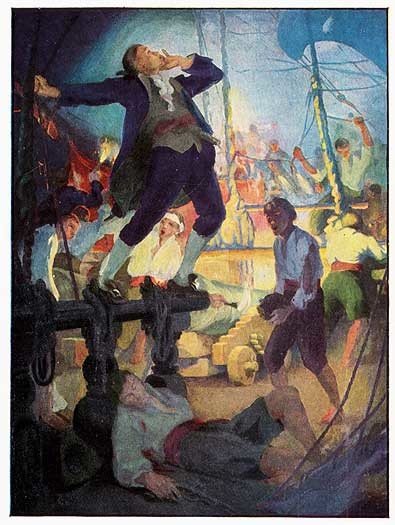
Just then the Alliance under Captain Landais came up, and Jones believed that the battle was won. But the Alliance instead of firing on the Serapis discharged a broadside at the Bonhomme Richard. In spite of shouts and warnings, Landais continued his dastardly work and many Americans and Frenchmen were killed or wounded by his fire. Then his craft sailed away and was seen no more until after the battle.
It was now known aboard the Serapis what a desperate state of affairs existed on Jones' ship, and the English believed that a few more broadsides would bring them victory. But their hopes were suddenly dashed. An American sailor had crawled along the yardarm of the Richard to the mast of the Serapis and had dropped a hand grenade. The grenade plunged through a hatchway and fell upon some loose powder and a row of charges for the cannon that had been placed on deck. The roar of a terrific explosion followed, and Englishmen, screaming for quarter, could be seen running through the smoke and flame of their own vessel with every vestige of clothing burned from their bodies. The battle was won by the Americans.
Captain Pearson walked aft and struck his colors. American officers boarded the Serapis, and Pearson and his lieutenants were ordered to report to Jones on the Bonhomme Richard. There Captain Pearson surrendered his sword and was placed in confinement by Jones.
The Bonhomme Richard had been so severely damaged in the fight that she was in a sinking condition and it was plain to see that she would not remain above the waves much longer. So, transferring every man to the Serapis, Jones sailed for a Dutch port, accompanied by his other vessels. The Countess of Scarborough had been captured after about an hour's fight, and Jones had more than five hundred British prisoners in his charge, including two captains and a number of lesser officers.
Although many difficulties and dangers still beset him, Jones' fame was now assured. England and France rang with his victory, and while the English drew cartoons of him as a bloody pirate, strutting on a quarter deck that was lined with the bodies of his victims, the French king, Louis the Sixteenth, presented him with a gold mounted sword and the cross of the Order of Military Merit. Congress passed a resolution commending him for his gallantry and he received a complimentary letter from General Washington.
When the war with England ended and the United States had secured their independence, Paul Jones entered the service of the Russian Empire under Catherine the Great with the rank of Rear Admiral. He gave the new country of his adoption the greatest service in their war with the Turks, many of whose vessels Jones sunk or destroyed. But he was disgusted with Russian intrigue, resigned his commission and returned to Paris.
All this time he had remained an American citizen. He considered this the greatest honor of any that had come to him—that he could call himself a citizen of the Republic for which he had fought so often and so well against such great odds. But his health had been failing him and he died in Paris on July 18, 1792. He was given a public funeral by the French National Assembly.
For a long time his body remained in France. At length, however, its resting place was discovered by General Horace Porter, U.S.A., and all that remained of Paul Jones was brought back in state to America on a great steel ship the like of which he had never seen. He was given a national funeral at Annapolis and his body was entombed in the beautiful Chapel of the Naval Academy, which institution Jones himself had urged Congress to found. It is a fitting resting place for America's greatest naval hero,—for while we have many distinguished and noble sailors, there is no name that has the ring of Paul Jones.
CHAPTER XX
MOLLY PITCHER
In the days of the American Revolution a young woman lived as a servant in Carlisle, Pennsylvania, with the family of General Irving, a retired British officer, who had fought in the French and Indian War and had seen a great deal of service. This young woman was named Molly Ludwig Hays, and was the wife of a barber who had been well known in the village. He had won her hand with difficulty for Molly was a belle throughout the countryside. She was not only handsome, but as strong as a man, able to carry a heavy meal-sack on her shoulder; and one of the hardest workers that the town knew. She washed and scrubbed and scoured and baked from morning till night, and seemed to revel in the hard work that gave the needed exercise to her strong muscles.
Throughout her life Molly Hays had admired soldiers, and more than once she expressed herself in no undecided terms to the effect that she wished she were a man so that she could bear arms and wear a uniform, and be a soldier herself.
When she was still a very young woman the American Revolution for freedom from Great Britain broke out. All the country was aflame, and rang with the stories of what happened at Lexington and Bunker Hill. Man after man from the village took his powder horn and musket and went off to enlist for the war, and Molly grew more and more restless as she saw them go.
At last her husband came to her, somewhat sheepishly, for he disliked to tell her the intention he had in his heart; but at length he made her understand that just because he was married was no reason why he should remain at home with the women; and he, too, intended to enlist that very day.
Molly consented with the utmost enthusiasm. She told him that she would be proud to be the wife of a soldier, since she could not be one herself, and bade him farewell with the admonishment to do his part bravely and to bear himself like the man she knew him to be. And she stood at the door of their home waving good-by to him with a cheerful face that gave no hint of her aching heart.
When her husband had departed Molly returned to the Irving household where she worked as well as she had before her marriage, trying to find relief in the heavy labor from the pain of having lost her husband and the aching desire to go and do her part beside him even though she were a woman. Fate, thought Molly, had made a sad mistake, in making her a woman, for she knew that in spite of her petticoats she could soldier as well as the men,—and if she had only been a man she believed she could have risen to an important position in the army.
The tide of the struggle wavered and battles with the red coats were fought and won. It was hard to get the newspapers in those times and news of the armies and their doings was often weeks behind the actual events. Molly hoped and waited, but for weeks at a time she went without word from her husband and did not know whether he were alive or dead.
One day a messenger called for her at the Irving household. He had a letter from John Hays for Molly, and it not only told her that he was alive and well, but was in camp not far off from her former home in Trenton, New Jersey, where her aged parents were still living. The letter ended by telling her to come to Trenton and live with her parents, for he would be able without doubt to get leave from his command and see her often.
Soon the war itself was being fought in the neighborhood of her home. The Americans attacked the British near Princeton killing and capturing a large number. Then Washington with his small force withdrew from that region before reenforcements could be brought against him.
And now Molly found that there was something that she could do—namely, go and care for the wounded who were still lying where they had fallen on the field of battle. The British General Cornwallis and his men were approaching, but that did not worry her a whit, and she went to and fro upon the battlefield carrying water for parched throats and binding wounds until the British soldiers were actually upon her.
Then Molly saw a cannon pointed in the direction of the British, and to her surprise it was loaded and there was a fuse still smoldering and lying near at hand. She studied the cannon carefully and it seemed to be aimed right at a group of the enemy that was approaching. The brave girl dropped the pail of water that she had been carrying, picked up the fuse and applied it to the touch hole. With a loud roar the charge was fired and the cannon leaped backward on its wheels.
At this the British halted in amazement. They had believed that the Americans were far away, and here this gun gave warning that they were still near at hand, or at any rate had left a strong rear guard with artillery to delay them in their pursuit. Hastily they crossed over the field and surrounded the gun which was deserted. Molly had left and had taken with her a wounded American soldier whom she carried on her shoulder.
THE CANNON BALLS FIRED BY MOLLY PITCHER FELL SQUARELY IN THE BRITISH LINES
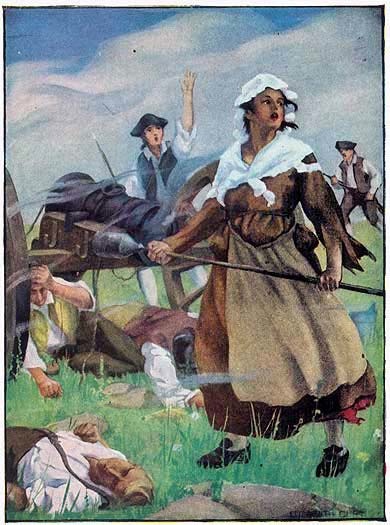
The British had seen her go, but it had not occurred to them that a woman had fired the shot that caused so much disturbance among them and aided the retreating Americans so greatly by delaying their pursuers. If they had realized that Molly herself was the cannoneer, she would have had but little chance of mercy at their hands, and would at once have faced a firing squad or been hung to the nearest tree. As it was they thought she was only some country girl who had perhaps lost some relative in the recent battle and was carrying his dead body back to her home. And so they paid no attention to her.
Molly, however, by firing this shot had materially aided General Washington, for any delay of the British, even a slight one, gave a great advantage to the Americans who were hurrying from superior numbers to put themselves in a good tactical position as soon as they could.
On a hot day of July in the following summer it chanced that Washington's forces were again not far away from Molly's home, and she took a difficult journey on the chance of seeing her husband. Her first step in soldiering had been taken when she fired the cannon at the British in the preceding year. A far greater adventure lay before her, for she fell in with the American soldiers just as they commenced the severe battle of Monmouth.
This battle had considerable importance, as a comparatively large number of troops were engaged in it. General Washington was in command of the Americans and the English were led by Sir Henry Clinton. The English had been retreating from Philadelphia, across New Jersey, followed by Washington, and the American general had decided to launch an attack on the left wing of the retreating forces and General Lee was ordered by Washington to attack the English on the flank and hold them in battle until he himself could come up with the bulk of the American Army.
General Lee, however, proved to be a poor man for this task and his indecision and semi-cowardice left Washington exposed to the brunt of the enemy's attack before he was prepared to meet it and against the intentions of the American commander. The situation was saved by General Greene, who saw what had happened, changed his own plans and diverted the attack of the British to his own position from which he poured in a heavy artillery fire that caused them terrible losses.
John Hays was one of the cannoneers of Greene's artillery and he worked all day loading and firing his piece. It was a terribly hot day and many men in both the British and the American armies fell exhausted and even died from the heat of the sun.
All this time Molly Hays had been caring for the wounded and carrying water to the thirsty gunners, using for the purpose the bucket that was attached to her husband's cannon for cleaning purposes. Tirelessly she continued her efforts to care for the wounded and comfort the fighting soldiers, heedless of the bullets that came her way or of the general turmoil of battle. As the day wore on the men would greet her coming with: "Here comes Molly with her pitcher!" And gradually this was changed to "Here comes Molly Pitcher." And this was the name that history has adopted in regard to the brave woman for whom it was so used.
At last John Hays succumbed to the heat and fell unconscious beside his gun. The sun had proved too much for him.
Molly stopped carrying water to care for her husband. She bathed his head and moved him into the shade, returning to her duties just in time to hear General Knox give orders that the cannon be removed, because he had no other gunner cool enough and skilful enough to work it in its present exposed position. At this Molly sprang forward crying out:
"Leave the gun where it is. I can fire it. I am a gunner's wife and know how to load and fire a cannon. I'll take the place that my brave husband has left!" And running to the gun Molly commenced to load and fire so determinedly and skilfully that a gasp of amazement ran through the men that saw her.
For many weary hours she toiled at the gun, until the British were driven back and the battle was claimed as an American victory. And then the young woman found herself the darling of all the soldiers in the army, for word of her actions ran like wildfire through the ranks and cheers reechoed wherever she went. Before she left her cannon General Greene himself came over to where she stood and grasping her hand thanked her in the name of the American Army.
This was not all the triumph she received, however, for word was soon brought to her that General Washington himself wished to see her. She was in her ragged grimy clothes in which she had fought and succored the wounded through the whole of that hot day, and she now put on a soldier's coat in which to meet the General.
Washington praised her highly and before a large number of his officers and men, and more cheering reechoed through the ranks when he gave her the brevet rank of Captain in the American Army.
And not only the Americans did her honor, but the French as well, for the Marquis de Lafayette with his own hand presented her with a purse of golden crowns.
In this strange way Molly Hays' desire to be a soldier came true, and the name of Molly Pitcher, as she was ever after called, became one of the great names of American History.
After the war was ended she lived with her husband until he died, and later she married again. But in her whole life the battle of Monmouth stood out as the great day on which she realized her ambition and helped the American forces in battle.
CHAPTER XXI
NAPOLEON BONAPARTE
There are only two names in history that are as great as conquerors and statesmen as that of Julius Cæsar of whom you have read in the present book. One of these two men was Alexander the Great, who lived hundreds of years before the birth of Christ; the other was Napoleon Buonaparte, later called Bonaparte and then Napoleon, who lived and died a hundred years ago.
Greater than Cæsar, greater than Alexander is the name of Napoleon. While Cæsar was of noble birth and had all the advantages of position and authority in his favor, and while Alexander was a king and born to rule, Napoleon Buonaparte sprang from the humblest beginnings and had nothing to help him make his way except his own genius. While Alexander was little but a wonderful soldier, Napoleon Buonaparte was both a mighty soldier and a great statesman, and not only did he place himself upon a throne, but he made all the members of his family kings and princes.
He was born on the island of Corsica in 1769, and was the fourth child and the youngest son of Charles Buonaparte who lived in the town of Ajaccio and was as poor as his neighbors, which, as he lived in Corsica, means that he was very poor indeed. Charles Buonaparte was an ardent Corsican patriot and often plotted how Corsica could win her freedom from France, but nevertheless he held a French office and was willing to send his sons to French schools.
It was not long before Napoleon showed his family that he had the stubborn nature and iron will that would make him a great soldier. Before he was ten years old he dominated his brothers and sisters and made them do as he said. He was afraid of nothing, and showed himself a natural leader among the children with whom he lived. As soon as he was old enough to talk he desired to be a soldier, and when he was ten years old he was taken by his father to a military school in France.
For five years Napoleon remained at this school at Brienne mastering the military art. As he was gloomy and silent and did not make friends easily, he was the butt of ridicule and bore ill natured jokes from the other young students there, but in spite of this, all were a little afraid of him and did not dare to provoke him too far.
When Napoleon was sixteen years old, his military education was considered to be finished and he was given the commission of a second lieutenant in an artillery regiment. In all these years he had only seen his father once. But Charles Buonaparte either had realized the greatness of his own son, or had one of those flashes of prophesy that sometimes come to dying men, for on his deathbed he cried out, asking for the son, Napoleon, whose sword, he said, was to shake the earth and who was to make himself the master of all Europe.
It was not many years after the young officer had joined his regiment that he had a chance to distinguish himself. This was at the siege of a town called Toulon. All France was in upheaval at that time, for the people had revolted against their rulers and had overthrown their king and their nobility. Their king, Louis the Sixteenth perished on the public scaffold under the knife of the guillotine, and the French revolutionists had carried on such a reign of terror that all Europe was in turmoil and the hand of almost every other nation in the world was against the French. Even a number of the French themselves were opposed to their own government and had placed the town of Toulon at the disposal of the English and their allies.
It was this town that the French army was endeavoring to take, and a long and unsuccessful siege had been carried on, for Toulon was strongly defended. Until Napoleon Buonaparte came, the French accomplished little. But Napoleon soon changed the look of the siege. Young as he was he had command of all the artillery that was being used against the town, and his military genius soon made itself felt, for he gave his orders with lightning rapidity and saw that they were carried out with a skill that amazed the other officers. Due to his efforts and the skilful arrangement of the cannon at his disposal, the most important strong points of the town fell into French hands, the British fleet, which was cooperating with the besieged, was driven off, and Toulon was captured.
But this piece of work did not bring Napoleon any immediate or great reward; in fact it was not long before he was out of favor with the Revolutionary Government and his commission as an officer taken from him. He had formed a friendship with the brother of Robespierre, a revolutionary leader who came under the displeasure of the Republic. And when Napoleon was offered a command of infantry, he refused to accept it, and thus found himself outside the profession that he had chosen.
However, his skill at Toulon was soon to give him the opportunity he sought, for one of the members of the Revolutionary Government had noticed his ability and resolved to call upon him in a time of need. This time soon came, for rioting and bloodshed broke out in Paris, and the people sought to overthrow the Government. Then Napoleon was called on to protect the Palace of the Tuileries where the offices of the French Government were located.
Here Napoleon showed the stuff he was made of. Although he was given the appointment late in the day, the next morning saw cannon trained on all the avenues approaching the Tuileries, and the cannoneers standing like statues with lighted matches ready to fire upon the slightest provocation. When the Parisian mob armed with clubs, pistols and old muskets advanced to storm the palace Napoleon waited until some shots had been fired and then gave a sharp command. With a roar of cannon a storm of death swept down the avenues, and the people scattered like chaff, leaving many dead and wounded behind them.
The Government had been saved due to the prompt action of the young artillery officer and was properly grateful. Napoleon was given an important command. He received a general's rank and was put in charge of the Army of the Interior. It was at this time that he met a beautiful widow named Josephine de Beauharnais with whom he promptly fell in love. Through Barras, the official who had brought him into prominence, the match was arranged and Napoleon was married to Josephine.
But the young officer had already started upon his career of greatness, and did not have much time to celebrate his nuptials. While on leave and even when engaged in other duties he had found opportunity to study the situation in Italy, where many forces hostile to the French Republic were gathered. He had even formed a plan by which the French could invade Italy, and it was now suggested to the Directors of the French Government that he himself be allowed to put this plan into execution. They consented, and hurrying to the south of France only two days after his wedding, Napoleon took charge of a French army of about fifty thousand ragged and ill-fed soldiers. His men had not been paid for months and there was practically no discipline among them. They were sick and discouraged, worn out with fighting the battles of the Revolutionary party without reward. But when Napoleon appeared among them, their spirits rose as though by magic, for the young commander knew how to appeal to their imagination and to awaken their fighting instinct.
"Soldiers," he said to them, "you are half starved and half naked: the government owes you much, but can do nothing for you. I am about to lead you into the most fertile valleys of the world; there you will find flourishing cities and teeming provinces; there you will reap honor, glory and riches. Soldiers of the Army of Italy, will you lack courage?"
In Italy were the Austrians and the Sardinians against whom Napoleon was to fight. He did not attempt to cross the Alps, as the great general Hannibal had done in ancient times; instead of this he skirted the Alps and fell upon the enemy so rapidly that they were not prepared to meet him. With a series of brilliant marches and maneuvers he divided the forces of his enemy and compelled the Sardinians to sign an armistice, although the French Government had given him no authority to take so much power into his own hands. He then drove back the Austrians and defeated them in the battle of Lodi, where he carried a standard with his own hands and rallied his troops in the face of a withering fire.
The Austrians were completely defeated and numbered their dead by thousands. And so delighted were the French soldiers by their success that they gave to the name of their young commander the title of "the little corporal."
Napoleon, however, did not let the grass grow under his heels, for in war he believed that victory almost always came to the commander who struck first. Time was everything, he declared, and advancing swiftly he laid siege to the town of Mantua, defeated several armies that were sent to relieve it and brought all Italy under his control.
And now the Directors of the French Government learned that the young general they had placed in command of the Army of Italy was made of very different material from the average general who obeyed their orders. Napoleon treated them haughtily, and made demands rather than requests from them. He had already exceeded his powers many times and had treated with the rulers and the commanders of the enemies he had beaten as though he himself were the ruler of France. Indeed his soldiers talked frequently of making him such and declared that they would rather have a general like Napoleon as their king and be his subjects, than to be governed by a group of civilian clerks who knew nothing of war and had to rely on others to carry out their wishes. It may be sure that Napoleon did not discourage this feeling among his soldiers, for he designed to make himself the ruler of France. The time had not yet come, however, for him to reveal his intentions openly, although it is true they were but thinly disguised.
After he had negotiated with Austria for peace and arranged the armistice with Sardinia, Napoleon returned to Paris, carrying with him many priceless paintings and works of art taken from the states that he had conquered. These were placed in the galleries of the Louvre in Paris, which at once became the most wonderful picture galleries in the world.
But the Directors of the French Government were afraid of the young conqueror who was acclaimed by the people wherever he went, and desiring to get rid of him they readily gave their consent to a plan that Napoleon himself suggested. This was that since France was still at war with England and not strong enough to invade that country, Napoleon should strike at her by taking an army to conquer Egypt, and thus do injury to England's trade with her eastern possessions in India, by opening a road to invade that far country which was the source of England's power.
Preparations for the expedition were conducted with great secrecy in Toulon, the same town that he had captured a few years before, and in May, 1798, Napoleon set sail with a large fleet that contained about thirty-five thousand of his best soldiers and his most clever and trustworthy officers.
On landing in Egypt he lost no time, but quickly captured Alexandria and marched into the desert.
The Mamelukes who fought against Napoleon, although undisciplined and savage, were nevertheless brave fighters. Their cavalry was far famed for its bravery and skill at horsemanship, as well as for rich trappings and costly equipment.
Bravely the Mamelukes charged against the French, and time after time they recoiled from the squares of glittering bayonets on which riders and horses were impaled. But at last they weakened, and the French charged in their turn and from an unexpected quarter. The battle was over. Napoleon's keen eye had seen that the artillery of the Mamelukes had no wheels and was moved with difficulty and he arranged his men accordingly.
But while Napoleon succeeded on land he had been cut off from returning to France, for the English admiral, Lord Nelson, had defeated the French fleet. Napoleon fought and won battles against the Turks, but his force was too small and the odds against him were too great for him to succeed in an Eastern campaign, cut off as he was by the English. And while he was in this difficult situation word was brought to him that war had broken out again in Italy and all his work there had been undone. It was imperative, if he wished to hold his power in France, that he should make his way to Paris without delay.
So Napoleon left his men in the charge of one of his generals, and with only a few followers embarked at Alexandria. His ship eluded the English fleet which was cruising the Mediterranean Sea, and he made his way to Paris with all speed.
France at this time was governed by a Directory and a Council of Five Hundred. This was one of the forms of revolutionary government that had been adopted after the French had dethroned and slain their king.
Napoleon believed that the time had come for him to seize the chief position in the French Government, but he did not dare as yet openly to have himself proclaimed as King. With his brother Lucien, and his advisor Talleyrand—although Napoleon did not accept advice as a rule, but was guided by his own bold, brilliant ideas,—he overthrew the Council of Five Hundred and abolished the Directory. Then he established what was called the Provisional Government which was headed by a group of three men who were called Consuls. Naturally Napoleon was the first and most important of these, and took care to see that the bulk of the power wielded by the consuls should remain in his hands. Clever, bold and brilliant, stopping at nothing, with the solid backing of the army and a brain greater than any that has been known on this earth in hundreds of years, it seemed as though this superman could accomplish anything he desired.
After he had attained his ends in Paris he went again into the field to meet his enemies. There was no immediate fear that France would be invaded, for while the Austrians had won victories in Italy and freed that country from French control, for which they substituted their own, a French general named Massena had won a victory in Switzerland that had shaken the grip of his enemies. It was necessary, however, that Italy be invaded a second time. And this time Napoleon made his plans to cross the Alps as Hannibal had done two thousand years before.
With his supplies on pack mules, with cannon wheels carried by his soldiers and the men themselves drawing the cannon on rude sleds improvised from tree trunks, the indomitable commander crossed the mighty mountain range that stood in his way, and suddenly appeared on the Italian plains in a part of the country where the Austrians had not dreamed that he would arrive. Before they were able to collect and rearrange their forces, Napoleon struck and defeated them in the battle of Marengo, where his men fought against odds of three to one. Other battles followed, and French generals invaded Austria. There remained nothing for the Austrians to do but sue for peace. England soon followed her example and France was at peace with the world.
Then Napoleon busied himself with internal matters and set about reorganizing the French Government and framing a code of laws that might be used thereafter by the country that he had made his own. This was called the "Code Napoleon" and it is largely used to-day in France, for Napoleon's genius as a lawmaker and a ruler was almost as great as his power of generalship. He did not know such a word as failure but succeeded in everything he put his hand to. While whole libraries have been written about him there seem to be three main reasons for his gigantic successes. The first is that he was a natural genius, with far superior mental power to any other man of his time; the second is that he had wonderful ability to work hard, and the third is that he knew how to draw to himself the loyalty and affection of the ablest men of his day and make their achievements further stepping stones to his own successes. He had studied his trade of soldiering since he was old enough to talk. He had worked at it constantly and toiled so incessantly that he seldom slept more than three or four hours a night. Moreover, in the troubled times in which Napoleon appeared on the international stage, France was ripe for just such leadership and indomitable will power as he was able to supply. Fortune favored his efforts as much as he favored himself.
The peace that had come to Europe did not last long. In the treaties that had been framed Napoleon had taken care to include affairs that would furnish him with new excuses to make war whenever he desired. And now he went to war again with England and made plans for invading that country, which he hated above all others.
He had become so powerful by this time that he desired to wear the crown of France. Accordingly he made arrangements for a brilliant coronation and invited Pope Pius the Eighth to place the crown upon his head. As there was still much hatred in France of the word King, Napoleon decided to assume the title of Emperor.
On December 2, 1804, before a most brilliant assembly of people, Napoleon and Josephine were crowned. When the Pope approached to place the crown on Napoleon's head he rose quickly, took the crown from the Pope's hand and placed it on his head himself, while a gasp of astonishment ran through the audience. He then removed it and placed it on the head of Josephine who sat on the throne beside him.
As the crown touched Napoleon's brow Paris reechoed to the thunder of guns and to deafening cheers and cries of "Long live the Emperor!" Grim old soldiers, who had followed him in many bitter campaigns, embraced each other and got drunk in the wineshops. There was a wild time of revel and celebration. The French people forgot the Revolution in which thousands had died just to prevent the rule of kings. They thought of nothing but their new ruler who had made France the mistress of the world and was to lead his armies to even greater victories. And it seemed that Napoleon would need more victories to keep his power. Through the tireless efforts of the English statesman, Pitt, Russia and Austria had joined England against him. Other countries were secretly in league with these allies, and war was again to shake the entire world.
As we have said Napoleon had planned to invade England and so certain was he of success that he had a monument erected celebrating the future invasion. But to secure the results and to transport his army safely into England it was necessary for Napoleon to have mastery of the English Channel, which was controlled by British warships under Lord Nelson, who, as you remember, had cut off and defeated Napoleon at sea when he was engaged in the invasion of Egypt. And while arrangements were completed for carrying a large French army from Boulogne to the English shores, a mishap befell Napoleon that forever prevented him from realizing his dream of British invasion. The French fleet under Admiral Villeneuve met Lord Nelson off Trafalgar and was utterly defeated. Napoleon's chance to invade England was gone forever.
With his genius, however, for changing failure into success Napoleon had already turned his designs elsewhere. With the splendid army with which he contemplated the humiliation of England, he now marched against Austria.
After defeating the Austrians in several engagements Napoleon met the combined Russian and Austrian forces at Austerlitz on the anniversary of the day on which he had been crowned as Emperor. And Fortune, which had crowned him then in Paris, now crowned his genius on the battlefield by the greatest of all his victories. After prodigious slaughter the Russians and Austrians were completely routed, losing thousands of prisoners. The treaty of Pressburg followed, in which the Austrian Emperor, Francis the First, was compelled to give up large slices of territory to France, and the Russians as quickly as possible withdrew into their own country.
But this was only the beginning of the wars that Napoleon thence-forward was engaged in. The kingdom of Prussia declared war against France, and Napoleon marched against the Prussians and defeated them at the battle of Jena.
Russia, however, was ready to make peace with France, for after Jena Napoleon turned his attention to the Russians and defeated them at Friedland. Then the Czar of Russia and Napoleon met on a raft which was anchored in the middle of the river Niemen and swore eternal friendship.
This was called the Treaty of Tilsit. As England was now the only great nation that continued to be the enemy of France, Napoleon had made arrangements in this treaty that were designed to cripple England's trade and do as much damage to her as was possible. Moreover, the conqueror had decided that henceforth there were to be no neutral nations. Either the other countries must aid him in his trade war against England and in other ways should he desire, or take the consequences of braving his anger. With this policy in his mind Portugal was invaded and the royal family was driven from the country to South America where they sought refuge in the country of Brazil. Spain had sided with France against Portugal, but Napoleon then humiliated and dominated Spain. He used a far greater number of men than was necessary for his Portuguese invasion, and turned them against the Spaniards, many of whose most important forts had been taken by the French soldiers through treachery as well as by stratagem. When the conquest of Spain was ended Napoleon placed his brother, Joseph, on the Spanish throne.
Austria, however, was preparing for another struggle against Napoleon. Though continually defeated by the French, the Austrians lost no chance of turning on them or taking any opportunity that might bring success against the victorious soldiers of Napoleon. But this only brought upon the Austrians the further defeat of Wagram and the loss of additional territory to Napoleon.
But now fortune began to go against the brilliant soldier who had seldom lost a battle and practically never had been defeated. The Russians did not like the alliance with France that had been imposed upon them at Tilsit and in spite of the Czar's vows of friendship were ready to turn against Napoleon on the first opportunity. In fact the Czar had become directly angered at Napoleon for the following reason.
Although Napoleon had made himself Emperor there was no heir to the French throne. As it seemed that Josephine would remain childless, Napoleon conceived the plan of divorcing her and marrying some high born lady whose alliance with him would strengthen the bonds between her country and that of the French. He had negotiated with the Russian Czar for the hand of a Russian princess, but before the arrangements had been completed he married an Austrian duchess named Marie Louise.
This turned Russia into the scale against Napoleon, who had already dealt with the Russians in a high handed manner. So the Czar entered into a close alliance with England against the conqueror.
Then Napoleon made the greatest mistake of all his brilliant career. With all Europe in unrest against him, he nevertheless conceived the plan of invading Russia and raised a great army for this purpose. Russia was and is one of the most difficult countries in all Europe in which to carry on a military invasion. The country is so cold and barren and the distances are so great that any invading army has great difficulty in transporting its supplies and marching the required distances. Napoleon had almost always relied for his supplies on the countries he had conquered and believed that it was always possible for large armies to subsist on forage and the supplies of the conquered inhabitants. To a large extent he used this policy in his invasion of Russia and it brought about his downfall. With an army of four hundred thousand men he entered Russia and advanced into the interior. The Russians constantly retreated before him and laid waste everything in his path. Towns were burned, crops were destroyed and cattle were driven away, as Napoleon led his forces toward the ancient and historic city of Moscow.
When the French had advanced a long distance into Russia, the Russian general named Kutusoff offered them battle in a place called Borodino. It was a stubborn and bloody conflict, and more lives were lost both by the Russians and by the French than in any previous battle Napoleon had engaged in. The Russians then continued to retreat and Napoleon entered Moscow on the Fourteenth of September, 1812.
Here the French believed that they would find respite from the hardships that they had encountered, and sufficient food and grain to feed their army. But their hopes were short lived, and in Moscow a great disaster befell them. Flames broke out in the city on the first night of their occupation, and were extinguished with difficulty. On the next night fires were kindled by hidden Russians in a hundred different places, and at last the city was a sea of flames in which no man could live. Napoleon had gained nothing by his invasion except to conquer a devastated country, and now, with winter coming on, he was compelled to retreat again toward the Russian frontier.
The plight of the French army had become fearful. Without food and with insufficient clothing they were compelled to face the rigors of a Russian winter. As they retreated the Russians followed them and bands of wild Cossacks harassed their rear and their flanks, cutting off and killing any stragglers. Even the Russian peasants took part in the pursuit, and slew the exhausted French with their flails and cudgels. Thousands of soldiers froze to death. In crossing the Beresina River thousands more drowned. When they approached the frontier Napoleon left the pitiful remnant of his shattered army to Marshal Ney, one of the bravest of his generals, while he himself in a swift sleigh hastened to Paris to raise another army before all Europe knew of what had happened—for as soon as they did know they would take up arms against him, thinking that in his weakened condition they could overthrow his power. Of the four hundred thousand that entered Russia only twenty thousand returned. More than a third of a million brave men had left their bones on the chill snows and iron earth of the land they sought to humble.
Uprisings, alliances and campaigns by the hitherto beaten nations followed. Napoleon won the battle of Lutzen, but the English Duke of Wellington defeated the French at Vittoria. At last in the great battle of Leipzig in October, 1813, the French were routed.
In the following year the Allies made ready to crush Napoleon. He was now on the defensive with enemies hemming him in on every side, and although he fought a brilliant campaign it was hopeless. On April 11, 1814, Napoleon was compelled to resign the crown, and obliged to go into exile; and the island of Elba in the Mediterranean Sea was chosen as the place for him to end his days.
For the last time before his exile, Napoleon addressed his soldiers in farewell, and the tears ran down the rough cheeks of the veterans as they bade good-by to the man who had so often led them to victory. And then Napoleon passed through southern France on his way to Elba amid the hisses and execrations of his people, who had already forgotten the victories he had won for France and thought now only of their misery and the dear ones they had lost on the barren snow fields of Russia.
Instead of Napoleon the brother of the former king, Louis the Sixteenth, was placed on the throne of France—an old, fat, wheezy man of no particular ability. It seemed as if the great conqueror were downed at last.
But Napoleon intended differently. As he stayed at Elba surrounded by a little court and with the title of Emperor which the Allies had allowed him to keep, he kept looking toward the coast of France and plotting how to return. It is more than probable that his life was in danger at Elba. At all events he found the life intolerable, and desired once again to play the leading part in European affairs.
In the meantime the French people grew weary of fat old Louis the Eighteenth, whose name of "Louis Dix Huit" was changed by the French as a joke into "Louis Des Huitres," or Louis of the Oysters, so fond was the old gourmand of his shellfish. They began to sigh for Napoleon and look forward to the spring when they hoped he might be able to escape from his island of confinement and rejoin his soldiers in Paris. And this very thing soon happened.
Napoleon made a successful plan to escape from Elba and was concealed on a ship bound for France. And on the short trip back to the French coast he gave a striking example of his remarkable coolness and the certainty in which he held his future fortune. A passing vessel hailed his ship, asking, among other things, what was the latest news of the Emperor. Napoleon, who was too far off to be recognized, laughingly took the speaking trumpet from the captain's hand and shouted back: "The Emperor is very well." And both vessels passed on their way.
Landing with a few followers near Cannes in southern France, Napoleon hastened northward with the small army that he had been allowed to keep at Elba. An army had been sent against him by the French, but Napoleon had no intention of fighting it. Instead he advanced alone upon his former soldiers, many of whom recognized him and rejoiced at a sight of their former leader. When he drew near Napoleon threw back his coat and shouted that if any man desired to kill his Emperor now was his opportunity. Instead of killing him the soldiers crowded around him with cries of joy. The whole army went over to his cause, and Marshal Ney, who had been sent against him and who had sworn that he would bring Napoleon back in an iron cage, could not withstand the sight of his old general and threw his lot once more with the Imperial eagles. With a force that increased at every mile Napoleon marched toward Paris, while Louis the Eighteenth hastily gathered up his luggage and fled into Belgium.
As soon as the Allies learned of Napoleon's escape they hastened to make war against him. But Napoleon did not wait for them. With a splendid army at his heels he marched to the north to meet his foes.
Fate was too strong for him, however. On June 16th, 1815, he fought the battle of Ligny in which he defeated the Prussians, but two days later he engaged in one of the most famous struggles of all history—the battle of Waterloo.
Here Napoleon was pitted against the English under Lord Wellington and the Prussians under Blucher. All day the struggle went on with success in the balance and time after time it seemed as if nothing could save the English army from the furious charges of Napoleon's cuirassiers and heavy dragoons. Blucher had been separated from Wellington before the battle opened, and due to muddy roads he was late in arriving with the reenforcements that were necessary for an English victory. When he did appear, however, the battle was won for the Allies. The French broke and scattered in headlong rout and were followed throughout the night by the ruthless Prussians, who cut them down without mercy. The splendid army that Napoleon had gathered was no more.