Front matter
Reading edition
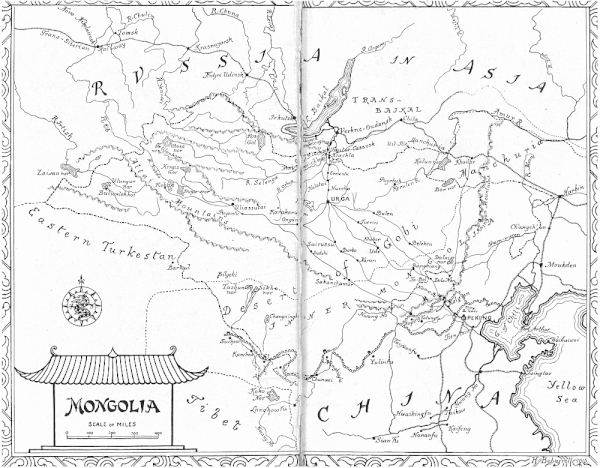
Mongolia
(click image to enlarge)
A TOUR IN MONGOLIA
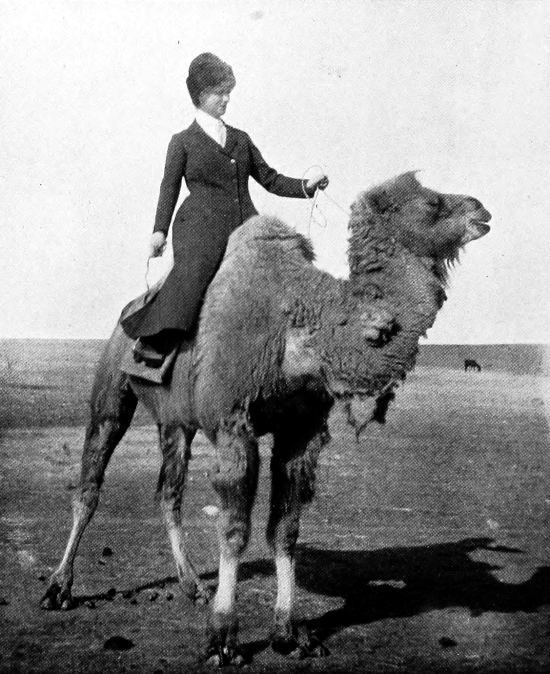
THE AUTHOR
A TOUR IN MONGOLIA
BY BEATRIX BULSTRODE (Mrs. EDWARD MANICO GULL)
WITH AN INTRODUCTION BEARING ON THE POLITICAL ASPECT OF THAT COUNTRY BY
DAVID FRASER (“TIMES” CORRESPONDENT IN PEKING)
ILLUSTRATED BY THE AUTHOR’S PHOTOGRAPHS AND A MAP
METHUEN & CO. LTD. 36 ESSEX STREET W.C. LONDON
First Published in 1920
DEDICATED, BY PERMISSION, TO
The Right Honourable Sir JOHN NEWELL JORDAN
G.C.I.E., K.C.B., K.C.M.G.
H.B.M. Minister in China
INTRODUCTION
MRS. GULL (Mrs. Bulstrode as she then was) had the fortune, not to mention the pluck, to be in Urga at a time when history was being made for Mongolia. I well remember the perturbation in British official circles in Peking when this adventurous lady, at a time when the Chinese were fighting the Mongols, sought a passport to take her through the opposing lines, and so to the desired destination. Needless to say the passport was not forthcoming, whereupon Mrs. Gull, without papers, went off by herself, and succeeded in making a considerable journey which brought her perilously close to the unsettled region in which guerilla warfare was proceeding.
Her experiences in Inner Mongolia made it plain that getting through to Urga meant a detour so long, expensive, and risky as not to be worth while. Accordingly, she and her sporting companion, Mr. E. M. Gull, a fire-eater in the pursuit of political developments, went round the back way by train and reached Urga from Siberia, no small adventure, considering the state of Mongolia at the time. What they saw Mrs. Gull describes in her own taking manner, and I need not say more about her book than that it is full of enlightenment as regards the character of both people and country. Mongolia is one of the few remaining great backwaters of the world, neglected because so remote from the sea and the civilisation arising out of marine communication. Nevertheless, through Mongolia, at no distant date, must be constructed that line which will link China with the Siberia Railway, and constitute part of the great trunk route joining Europe with the Far East.
If those of us who dwell in the Far East are not very far out in our calculations, the Pacific is to be one of the great spheres of economic development in the future. In China there is illimitable scope for such development, and it is obvious that the question of the control of the quickest route between China and the West is one of much importance to all interested. Mongolia, moreover, is not all Gobi desert, nor is the Gobi a desert except in an unimportant degree. It is, in fact, a monster plateau, huge areas of which are capable of cultivation. At present, its pastoral inhabitants are like the Arabs of Mesopotamia, roaming the land with flocks and herds, but the land is a land of much promise. Its mineral wealth has hardly been examined at all, though gold and coal are known to exist. But, when we recollect the known mineral wealth of the whole of the mountainous region of the southern confines of Siberia, we realise that there is a corresponding region over the Mongolian border which is, in fact, part of the same mountain system. If the one is minerally wealthy, there is every reason to suppose that the other is similarly so. In thinking of the Mongolia of the future, then, it is only reasonable to suppose that, when penetrated by communications, it will develop out of all recognition, as compared with its present state.
Mrs. Gull is particularly instructive in her analysis of Mongol character. The Mongol is simple, happy, good-natured, intensely lazy, and apparently entirely lacking in practical qualities. His very disposition is the cause of his past and present troubles. He is, in short, not fitted to compete with the outside world. Therefore, he has become the sport of other peoples, and the destiny of his land is being decided for him by foreigners. To begin at the beginning of recent developments, it is necessary to go back only to 1911. The Japanese defeat of the Russians had set the Chinese thinking, and, suffering much from foreign pressure at home, they thought to assert themselves in distant lands. They initiated a forward policy on the Burmah frontier that gave us trouble for some years, culminating in the Pienma incident. They invaded Thibet and occupied Llassa, establishing a degree of control over their vassal which they had never claimed before. They next turned their attention to Mongolia, where, as suzerain, they maintained only a few residents with trifling escorts. They planned to occupy Urga with a large force, and actually built huge barracks there. Meanwhile, Chinese colonists had been pressing into Inner Mongolia, buying land from the nomads and establishing great cultivated areas. Chinese bankers had been lending money at usurious rates to the simple Princes. All trade was in the hands of the Chinese. The Mongols became alive to the fact that China was acquiring a strangle-hold over them. They saw what had happened to their cousins of Thibet, and they became alarmed for their freedom, the overwhelming passion of the nomad. Russia, sore at the Japanese defeat, also, at this time, began to think of a future in which an arisen China might prove a danger, as Japan had proved dangerous. Chinese designs upon Mongolia might presage a threat against her at some far-off time. Accordingly it became Russian policy to block China in Mongolia, and, if possible, to set up Mongolia as a buffer State. To that end, Russian agents commenced a propaganda against the Chinese, emphasising the danger of absorption by China. Then arose a pro-Russian party in Urga, urging alliance with Russia as a protection against China.
Then occurred the Revolution in China. The Manchus were dethroned. Then followed the expulsion of the Chinese from Thibet, and the declaration of independence by the Thibetans. Egged on by the Russians, the Mongols did likewise, justifying the breaking of the ancient connection by declaring that their allegiance had been to the Manchus, and that, as there was no more a Manchu dynasty in China, they no longer owed anything to China. Russia promptly recognised the new State, and signed political and commercial treaties with it. The Chinese refused to accept the fait accompli, and immediately made war upon Mongolia. Fighting was proceeding when Mrs. Gull was in Inner Mongolia, and later on at Urga. To make a long story short, the Chinese troops utterly failed to make any impression upon their opponents. Internal difficulties forced the Chinese to relinquish the struggle, and in 1919 was signed the tri-partite Kiachta Convention. This document recognised and confirmed the treaties made with Russia, gave Mongolia autonomy and a guarantee against the intrusion of Chinese troops and colonists into Mongolia. The effect of the Convention was to give Russia exactly what she wanted—a buffer State.
It is necessary now to jump to the date when Japanese troops, in agreement with the Allies, entered Siberia. The Japanese found it convenient to maintain at Chita, in Transbaikalia, the Cossack adventurer Semenov, a man with Buriat (or Mongol) blood in him. Admiral Kolchak dismissed Semenov from the command of the Trans-Baikal Division for malpractices, but the Japanese refused to allow his removal by force. Semenov, some months ago, inaugurated a pan-Mongol movement for the creation of a Mongol State, which should include the Mongols of Barga (a region of North Manchuria), the Buriats of Transbaikalia and Mongolia. The Hut’ukt’u, the Living Buddha of Mongolia, was invited to join, and, after consultation with the Princes, refused. Semenov next threatened invasion. It is difficult to know how much reality there is in Semenov’s movement, but it is still to the fore, and we are warned that developments from it may yet be expected. At any rate, it is established that the Japanese have been, and still are, closely associated with Semenov, and the assumption is that they are perfectly cognisant of the activities of their protégé.
Returning to Urga, we find the Mongolians dissatisfied with the Russians, for a variety of reasons. They had done nothing for the economic development of the country, nor had they helped to organise an effective military force. Russia, as a protector, having vanished, the Mongols were helpless, and they were genuinely alarmed by the threats of Semenov. They appealed to the Chinese for military assistance, and in the twinkling of an eye, as it were, 4000 Chinese troops were in Urga, commanded by a General Hsu Shu-cheng, the most aggressive of those militarists who have done so much to involve China in political and financial trouble. It is instructive to note that the forces commanded by Hsu were equipped with Japanese money, and that Hsu himself is regarded throughout China as being entirely in the hands of the Japanese. It will, therefore, be perceived that the Mongols were frightened into calling in Chinese troops by the actions of one protégé of Japan, and that the assistance, when it came, proved to be an army under another Japanese protégé! The unfortunate Mongols were soon to be enlightened as to the meaning of these manœuvres. A pro-Chinese party, since the collapse of Russia, had been urging a return to the Chinese fold, and proposed a petition to China cancelling autonomy and asking for re-instatement. The Hut’ukt’u and a majority of Princes and Lamas were opposed to this step. General Hsu Shu-cheng, on arrival at Urga, immediately pressed for signature of the petition, and, on refusal, delivered an ultimatum, threatening deportation to China of the Hut’ukt’u and the Premier if his demands were not complied with. He further threatened the Mongols with Japanese troops from Transbaikalia, which threat the Japanese officially denied in Peking had been made with authority. The Mongols, however, were browbeaten into submission; the Government signed the petition, and the President of China has since issued a Mandate denouncing the Kiachta Convention and other relative treaties, and granting the prayer of the Mongols to become again subject to China. Autonomous Mongolia, therefore, is no more. The Chinese plan military occupation on a large scale, and will shortly send three more brigades into Mongolia. If the Chinese were more successful in the administration of their own country, it might be said that the Mongols would be better off under Chinese rule than their own; for, as Mrs. Gull says, there can be no doubt that the Mongols are closely akin to their southern neighbours. But the question seems to be rather whether Japan is not to be the predominant power in Mongolia in the future. She openly claims predominance in China, and, for the time being, is predominant. Through China she may yet acquire control over Mongolia, or may arrive at the same result by basing action in Siberia. She has plainly told the powers seeking to form the banking Consortium for China that she wishes Manchuria and Mongolia to be excluded from its operations, thereby indicating her desire for an exclusive position in Mongolia. Most significant is the announcement just published in the local press, and confirmed by other indications, that the Chinese Government propose the immediate extension of the Peking-Suiyuan Railway to Urga. The Chinese Government has no money for such an enterprise, and no possibility of getting it except by a foreign loan. This, above all, is a scheme that should be financed by the Consortium, yet it seems far more than likely that the railway will be built with Japanese money. And whoso builds the railway will assuredly be the master.
DAVID FRASER
Peking, January, 1920
A word of explanation as to the tardy appearance of this book in relation to the date of its completion seems necessary. It will suffice to say that the manuscript reached the publishers within a day or two of the declaration of war. The Introduction by Mr. David Fraser, “Times” correspondent in Peking, is designed to give a bird’s-eye yet comprehensive impression from the date of the visit to Urga up to the present time of the political relations existing between Mongolia and China.
B. M. G.
LIST OF ILLUSTRATIONS
Map of Mongolia Inside front cover
The Author Frontispiece
FACING PAGE
The Author on a Peking Cart at the Starting-point 14
The Great North Gate at Kalgan leading straight into Mongolia 14
A Bird Fancier, Kalgan 28
Servants in the Courtyard 28
With Dobdun, ready to start 34
Crossing the Han-o-pa Pass 34
A Camel Caravan 58
The Lama in embryo and his little Sister gathering Argol 58
Carrying Mails 60
A Well by the Wayside 60
He drew Reins to take Stock of the Foreigner 60
Methuselah and his Daughter-in-law 70
One of the largest Camel Caravans I had ever seen 70
A Mongol Bride 72
A typical Chakhar 74
Two or three hundred Lamas squatting on the ground in the sunny forecourt of a Temple 78
Hankarawa 78
A Pastoral Scene 98
Troitze-Casavsk 114
Our Buriat Hostess 114
The Jamschik and his Tarantass 114
A Russian Samson separated the Combatants 128
The Lama and his Maiden 128
A Mongol and his Family on the Plains near Urga posed for my benefit 142
He invited us to inspect his Caravan 144
The Summit of the Altai Berg 144
The Great White Temple, Urga 152
The Horse and Camel Market, Urga 152
A beautiful Temple at Mai-mai-ch’eng 158
A Mongol Princess in her Official Robes, accompanied by her two Ladies 158
Bogdo’s Bodyguard 176
Little Lama Boys play “Tag” round the Barriers 176
Church and State: Mongol Prince and High Lama 180
The great State Umbrella of Silken Embroidery 182
In an ecstasy of worship the Monks prostrate themselves near the threshold of the Sanctuary 182
The Meeting of the Archers: they ranged themselves in couples at the stances 184
Scoring the Hits at the Butts 184
A Mask at the Dance of the Gods 186
A Mongol Princess wearing a Headdress of Gold 186
A Mongol Gladiator 190
A Wrestling Bout 192
Young Lamas 192
Prisoners at Urga, shut up for the remainder of their lives in Iron-bound Coffins 196
(Reproduced by permission of the Illustrated London News)
A Tomb in Urga: Dagobas erected over Priests’ Graves 206
Southern Soldiers 206
A Mongol Orton 226
Continuing the Journey on Ox-carts, drawn by Ponies 226
A remarkable One-year-old Boy 228
THE TALE OF A TOUR IN MONGOLIA
CHAPTER I
“What is outside the world, daddy?” “Space, my child.” “But what is outside space then?”
THE fascination of the unknown, a deep love of the picturesque, and inherent desire to revert awhile to the primitive—these were probably some of the factors that made a little tour in Mongolia so essentially desirable to me at a period when, instead of turning my face homewards, I merely felt the compelling desire for more. The remark, “Such a pity you did not come here before the old order of things passed away,” had assailed my ears like minute-guns throughout my eighteen months in China, and here in Mongolia was at last an opportunity of meeting with mediævalism untouched.
The most delightful, and by far the most interesting, expedition that lures the traveller for a couple of days from the gaiety of life in Peking, is that which leads him out to the Ming tombs and a little farther on to meditate upon change and decay from the summit of the Great Wall. The Great Wall may well have been the ultimate goal of all his wanderings in China, a goal indeed at which to pause and reflect upon all he has learned and seen through the months spent in journeying up from the turbulent south to the heart of China in the north. But even so it is a little disappointing upon arriving at the Nank’ou Pass to be informed that this, impressive though it be, is merely a relatively modern branch of the Great Wall itself, added no less than 1700 years later to the original construction. To see the real Great Wall then, the wall that has withstood the ravages both of Huns and Tartars, the wall that played a not unimportant part in warfare two centuries before the Christian era—this furnished me at least with an excuse to get away to Kalgan; and in a visit to Kalgan, the starting-point for the historic caravans which penetrate the desert, across which prior to the existence of the Trans-Siberian railway all merchandise passed to the north, I foresaw the germ which might, with a little luck, blossom out into a little expedition across the frontier.
At Dr. Morrison’s hospitable board, to which drift inevitably those travellers who want something more than the social round and the sights provided for the globe trotter in Peking, I was fortunate in meeting a couple of Norwegian missionaries who were good enough to make arrangements for me to stay in their compound at Kalgan. The husband, after many years’ work, had abandoned the hope of converting the Mongols to Christianity, and had placed his unique knowledge of the people and of their country—doubtless in return for a handsome salary (on paper)—at the disposal of the new Chinese Government. In common with every one else to whom I mentioned my project of travelling in Mongolia, these good people did their best to put me off, but finally, seeing that I intended to carry out my idea willy-nilly, they helped me in making my plans, engaged the Chinese who accompanied me, and lent me the various accessories of camp life, etc., in the most generous manner possible.
For some weeks past threatenings and rumours of war had been dribbling in from various points on the Mongolian frontier. Mongol soldiers (converted robber bands) in ridiculously small numbers, but effectual, as having been armed and trained by “the Urga government,” which to all intents and purposes is another name for Russian officers, were said to be marching south, “plundering everywhere and killing Chinese and Mongols without distinction”.
The Chinese in Peking were doubtless growing uneasy, and the following paragraph which appeared about this time in the “Peking Daily News,” a Chinese-owned newspaper with an European circulation, suggests that the authorities were somewhat late in the field with their honours and encouragements for those Mongols who even now were perhaps flirting with presents of roubles from a more northern source. Already the storm was brewing past control:—
“The Bureau of Mongolian and Tibetan affairs (in Peking) reports that a petition from the Shang Chia Hut’ukt’u has been received, stating that the Shang Chodba has supported the Republican cause and requesting that he be rewarded.
“As Pa-yen-chi-erh-ko-la, the Shang Chodba and Dassak Da Lama, has been loyal to the Republic and is highly commendable, he is hereby permitted to sit on a Green Cart and to use Yellow Reins, as an encouragement.”
No very highly imaginative mind is surely necessary to conjure up a scene of wonderful picturesqueness from the foregoing. To see a beaming “Da (or great) Lama” seated upon the shafts of his new Green Cart and driving a hefty white mule with his lately acquired Yellow Reins, feeling tremendously encouraged thereby in his loyalty to China, the recently established republic of Mongolia’s suzerain—it was worth while, coûte que coûte!
Peking, so far as I was concerned, had more than come up to its reputation for kindness and hospitality. I had certainly put the former to the test during a short but sharp bout of illness I had encountered there, when I can only say that my room presented the appearance of a conservatory and that rarely an hour passed without some friendly “chit” of enquiry and sympathy. All the same, it had been much borne in upon me that any deviation from the narrow path to the golf links, or from the delightful picnics held in one or other of the recognised show places within hail of the Legation quarter, was looked upon with cold disfavour. Few things seem to cause a certain type of mind more annoyance than that one should care to travel on lines other than those parallel with their own.
The less, I felt, that I discussed my projected plans the better. Therefore, informing merely a couple of friends who happened to be dining with me the previous evening—and who, by the way, did not in the least believe me—that I was off in the morning to Kalgan for a few days, I set forth for the Shih Chi Men station (the terminus of the Peking-Kalgan railway) at the break of one glorious day of April in 1913.
Two ’ricshas were necessary for myself and a very modest amount of luggage, and to each ’ricsha two coolies, for the Shih Chi Men is at the extreme north-west of Peking, to gain which one has to travel diagonally across the Tartar city, skirting the rose-coloured walls of the Forbidden City through which at that time the traffic was not allowed to penetrate. The road is bad and exceedingly dusty, and being the sole European upon arriving at the station, I had the inevitable uproar with my coolies as regards payment. One of the untoward influences that we Westerns seem to have exerted upon the Chinese coolie class is that they will always try to bully anyone who is at a disadvantage—a condition of affairs I never once experienced up country, off the beaten track, where I met with nothing but chivalry. The quartet followed me, shouting and yelling, on to the platform—I having taken good care not to pay them until my belongings were safely out of their hands—only to be buffeted and finally kicked out by the station officials.
The journey from Peking to Kalgan has many points of interest, and I decided to break it half-way in order to pay a second visit to the tombs of the Emperors of the Ming dynasty, stopping overnight at the quaint little half-westernised hotel kept by a Chinaman at the foot of the Nank’ou Pass. There was not much choice as to the means of covering the eleven or twelve miles between Nank’ou and the tombs, and I decided in favour of the solitary pony instead of the unattractive looking mules, or the chair of the indolent which is carried on poles by four coolies. I had confidently expected to make the expedition in peaceful solitude; but not a bit of it. A pock-marked mafu, or groom, insisted upon accompanying me on foot, and it was soon evident that he set the pace not I. It was some little time too before I discovered the reason of the pony’s reluctance to trot except when we came to a strip of grass—he had four very tender feet, and my way lay across extremely rough country, along the boulder—strewn beds of mountain streams and rocky little paths bordering the planted fields.
The beautiful pail’ou of five arches was the first indication that we were nearing our destination, but even then there were two or three miles along the uneven and loosely flagged avenue of huge symbolical stone men and beasts, camels, horses, and lions standing in silent attendance on the spirits of the departed rulers. The tombs, temples in effect, whose golden roofs rise out from among deep green cypresses and masses of white blossom, are enclosed in many courtyards by high rose-coloured walls pierced by magnificent gateways.
To the chief of these gateways I rode, followed by my mafu, and offering the customary fee of twenty cents, I proposed to enter. Seeing that I was alone, the doorkeeper, an unusually tall man even for Chihli, began a bullying argument for more money. Not wanting to waste time, I compounded finally upon something like three times the proper sum, and he opened the great doors and admitted me into the courtyard. Here amidst the most dreamily beautiful surroundings of pure white marble terraces, weathered memorial archways, steps carved in low relief and the mellowed rose-coloured walls always for background, I felt very much at peace with the world as I sat and rested in the crook of a blossom-covered tree after my hot and wearisome ride.
Greatly refreshed by the beauty and stately solitude of the scene (to say nothing of a delicate little lunch which had been so thoughtfully provided for me by my excellent host of the Ching Erh hotel), I now felt inspired to explore further, and walked over the grass to the entrance of the chief temple. Dropping from the clouds (or, what seemed more likely, appearing from the nether regions) I was again confronted by the same burly janitor who rather threateningly barred my way and demanded more money. I had now not even the support of my pony boy. I had no intention of being baulked of the whole object of my long ride, neither did I mean to be bullied into paying the rascal all over again. Seeing that I was not inclined to give in, the man began to lock up the great doors, which usually stood open, when, turning as though I were going away, I made a sudden move, pushed past him, and was inside the temple. He was very angry and for the moment nonplussed, swore at me volubly, casting aspersions doubtless upon my ancestry in true Celestial style. Quite unexpectedly, however, he stopped, and before I had time to realise his intention, he slammed to the door and turned the key in the lock.
I made a desperate effort to escape, but I was too late. I was now in pitch darkness and as to when or whether he, my gaoler, intended to let me out, I did not know. I could hear him walking off and clanking his great keys triumphantly as he went down the flagged path. I was far too angry to be in the least frightened, and of all things, I had no intention of letting the ruffian think that he had scored. Recovering a little from my surprise, I groped my way about among the dusty gods and devils, thinking that probably there would be some other exit, and finally came upon a low door at the back of the high altar. This gave way to my pushing, and opened on to a narrow staircase up which I stumbled, eventually finding my way out on to the top of the open flat roof of the first story of the temple. Here at least I could see where I was. Moreover, I was in the open air, and I could solace myself with the truly lovely view of the surrounding temples and the thickly wooded country side.
Not a soul was to be seen. The wretch evidently meant me to stay there until I thought better of my sins. For an hour or two I wandered about my prison, spending part of the time in speculating as to whether my gymnastic ability would enable me, with the help of friendly branches, to scale forty feet or so of rough wall and thus to escape. I decided, however, that to risk a broken limb was not worth while, and that to spend a night in a temple after all would not kill me. There would probably be other visitors turning up next day.
By this time the afternoon was drawing in, and the wonderful colouring around me was rendered even more beautiful by the golden haze from the setting sun, when I observed three figures walking among the trees in the garden below. They were evidently in angry altercation. These were my mafu, the burly ruffian (who was gesticulating wildly), and a well-dressed and dignified Chinese gentleman. Without losing a moment, I scrambled hastily down the dark staircase again, and arrived in the temple just as a flood of light was admitted by the door being flung open.
To my astonishment, my unknown friend in need addressed me in pidgin English, “Mississee mafu talkee my one bad man shutee up Mississee. Chlist! (I am afraid that he believed this to be quite a polite expression of amazement) Chlist! What bad man!” The “bad man” was grinning nervously while all this was going on, and in order to show him unmistakably what my opinion was of his behaviour, I gave him a resounding smack on the head as he released me. Even then he had the impudence to ask me for a “cumshaw” (tip), and in order that he might not lose face among the little crowd which had collected at the outer gateway, he only laughed as he rubbed his head and listened to a tremendous dressing-down delivered by the three of us. I decided as I rode back to Nank’ou in the twilight that I would report the matter to my Legation in Peking, but later on I thought better of it. They might have said, “I told you so!”
Starting early next morning, I continued my journey to Kalgan, the line—the only one in China constructed, financed, and managed by the Chinese—following the course of the Nank’ou Pass, tunnelling below the Great Wall a few miles farther on. Travelling second class, from the viewpoint of mixing with the people rather than from economical motives, the difference in the price of tickets being a mere couple of dollars, I had for my sole European companion an old Swedish missionary who told me that our fellow-travellers were consumed with curiosity about me. They assumed, to begin with, that my husband must be luxuriating in the first-class portion of the train, and that among the English it was the custom to treat the wives as inferiors. Then, seeing the missionary and myself in conversation, they jumped to the conclusion that I was wife of the latter, and that I very properly only spoke to him when he addressed me. Finally, on this being denied, they settled down to the idea, on seeing me take a large volume from my bag and read it (J. O. P. Bland’s absorbingly interesting “Events in China” by the way) that I was a great scholar, and that as such, I of course preferred the simple life. That an ordinary Englishwoman should travel second class needed an explanation in their eyes.
A wealthy young man, he who had asked most of the questions, entertained me greatly during the journey. His clothes were very beautiful, a long silk-damask lavender coat, fur-lined, surmounted by a handsome riding coat in plum-coloured broché. His great treasure seemed, however, to be a large silver watch, which he kept pulling out in the hope that I might be looking at him. Its going capacity must have been precarious for he always listened to it, and after looking carefully all round it, he generally smelt it as well. It was here that I really learned to appreciate the practical use of the two-inch thumb-nail which one frequently sees adorning the hands of the upper-class Chinese. My friend of the lavender coat had purchased a roast duck from an itinerant vendor at a wayside station, and commanded my admiration by the dexterity with which he cut up and ate it, his thumb-nail alone serving him as a carver. He was hungry, and he finished that bird at a sitting.
The scenery on the way up was unexciting until a tempestuous sunset lighted up the rugged mountains, making their snow-covered peaks appear like flaming watch-towers until the sun went down, and with a snap it all suddenly changed. Even in this cold weather we met hundreds of coolies travelling down in open trucks, many of them equipped with motor goggles, which the dust storms of this part of the world render an absolute necessity.
We were two hours late at Kalgan, having taken nine hours on the way (one can hardly expect a sudden transformation as regards punctuality to result from a change of government in China), and I spent a somewhat weary time in the dimly lighted carriage wondering what on earth I should do if the missionaries failed to meet me at the station. Knowing that he would be of no use should I manage to get away to Mongolia, I had taken no “boy” with me, and I doubted very seriously that my few words of Chinese would carry me far in this frontier town, which, I had heard, would be a babel of tongues, and where among 75,000 inhabitants the European population, Russian and German traders all told, did not number more than about forty or fifty.
However, no sooner had I landed on the platform at Kalgan than a cheery voice, unmistakably American, hailed me in a friendly manner.
After giving the required information concerning myself and my business to the courteous Chinese policeman, who, notebook in hand, awaited the train for such purpose, the pleasant young missionary, guessing that I was both tired and hungry, and not in the least put out on account of waiting over two hours on the platform for my train to come in, bundled me and my belongings into a Peking cart. The latter taking up most of the room inside, I sat cross-legged on the shaft, the Chinese driver sitting hard against my back on the opposite side; my host walked alongside of us.
There had been the one rain of the season on the previous day and what under normal conditions had been a foot or so of dust, was now morass, and we passed through slush that reached to the axles of our wheels. “Tuck up your feet,” sang out the missionary as he took an unanticipated plunge into deep water from the pseudo-sidewalk; but I was prepared. This, strange to say, was my first experience of riding in a Peking cart, society in the capital having long ago voted them out-of-date and even in cold weather preferring the ’ricsha. True, I found their appearance of comfort somewhat of a delusion but their picturesque trimness I had always greatly admired. These strong, springless carts of light wood have solid axles, the ends being inlaid with a device in metal, and upon these the wheels revolve directly. The pale blue linen covers, with little windows made of black gauze on either side, all outlined with black velvet, present an attractive and cleanly appearance, as does also the heavy white leather harness with bright brass or silver buckles and ornaments, which embellishes the handsome black mule, who, at first sight, looks almost too powerful for his job.
Our road lay across the river Yang through the heart of the city now, at nearly 10 o’clock, dark and silent as the grave—silent that is, save for the creaks and excruciating grindings of the wheels as the great boulders sent the cart high up on one side only to slither down into the slush on the other, the mule coming to a standstill from time to time in order to let things right themselves. The main street of Kalgan is scarcely a credit to the community. After half an hour or so of strenuous effort to keep my seat, we turned abruptly out of a narrow alley into the compound of the mission at which I was to board, and were welcomed by my hostess, a pretty girl in her early twenties, at the door of one of the two bungalows.
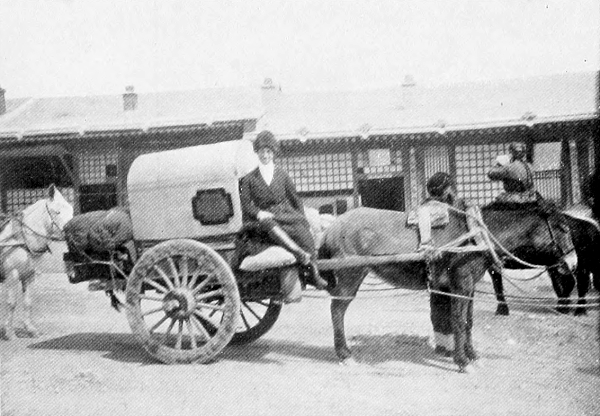
THE AUTHOR ON A PEKING CART AT THE STARTING POINT
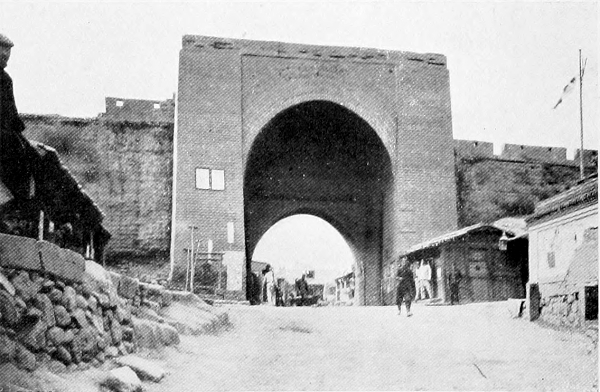
THE GREAT NORTH GATE AT KALGAN LEADING STRAIGHT OUT INTO MONGOLIA