LINES
Reading edition
DEFINITION OF LINES
56. Taking any dot and drawing it out in any direction, or in a series or sequence of directions, it becomes a line. The line may be drawn in any tone, in any value, color or color-intensity. In order that the line may be seen, the tone of it must differ from the ground-tone upon which it is drawn. The line being distinctly visible, the question of tone need not be raised at this point of our discussion. We will study the line, first, as a line, not as an effect of light.
The line may be drawn long or short, broad or narrow. As the line increases in breadth, however, it becomes an area. We will disregard for the present all consideration of width-measures in the line and confine our attention to the possible changes of direction in it, and to possible changes in its length.
We can draw the line in one direction from beginning to end, in which case it will be straight. If, in drawing the line, we change its direction, we can do this abruptly, in which case the line becomes angular, or we can do it gradually, in which case it becomes curved. Lines may be straight, angular, or curved. They may have two of these characteristics or all three of them. The shapes of lines are of infinite variety.
CHANGES OF DIRECTION IN LINES
Angles
57. Regarding the line which is drawn as a way or path upon which we move and proceed, we must decide, if we change our direction, whether we will turn to the right or to the left, and whether we will turn abruptly or gradually. If we change our direction abruptly we must decide how much of a change of direction we will make. Is it to be a turn of 30° or 60° or 90° or 135°? How much of a turn shall it be?
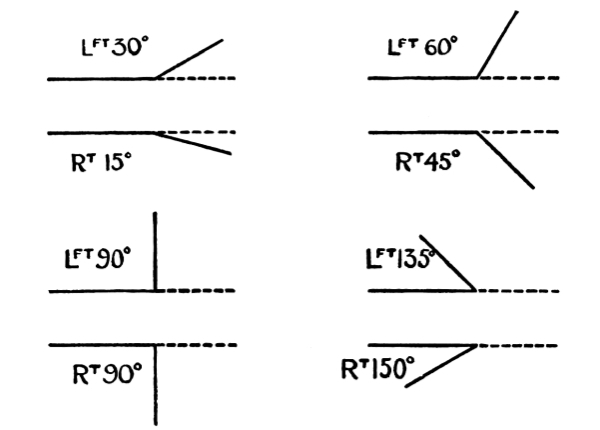
Fig. 58
The above illustrations are easy to understand and require no explanation. An abrupt change of 180° means, of course, returning upon the line just drawn.
Curves
58. In turning, not abruptly but gradually, changing the direction at every point, that is to say in making a curve, the question is, how much of a turn to make in a given distance, through how many degrees of the circle to turn in one inch (1″), in half an inch (½″), in two inches (2″). In estimating the relation of arcs, as distances, to angles of curvature, the angles of the arcs, the reader will find it convenient to refer to what I may call an Arc-Meter. The principle of this meter is shown in the following diagram:—
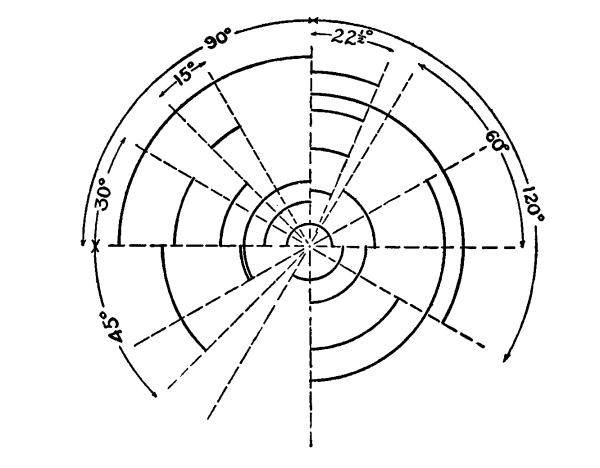
Fig. 59
If we wish to turn 30° in ½″, we take the angle of 30° and look within it for an arc of ½″. The arc of the right length and the right angle being found, it can be drawn free-hand or mechanically, by tracing or by the dividers. Using this meter, we are able to draw any curve or combination of curves, approximately; and we are able to describe and define a line, in its curvatures, so accurately that it can be produced according to the definition. Owing, however, to the difficulty of measuring the length of circular arcs accurately, we may find it simpler to define the circular arc by the length of its radius and the angle through which the radius passes when the arc is drawn.
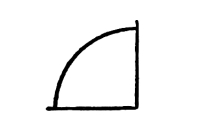
Fig. 60
Here, for example, is a certain circular arc. It is perhaps best defined and described as the arc of a half inch radius and an angle of ninety degrees, or in writing, more briefly, rad. ½″ 90°. Regarding every curved line either as a circular arc or made up of a series of circular arcs, the curve may be defined and described by naming the arc or arcs of which it is composed, in the order in which they are to be drawn, and the attitude of the curve may be determined by starting from a certain tangent drawn in a certain direction. The direction of the tangent being given, the first arc takes the direction of the tangent, turning to the right of it or to the left.
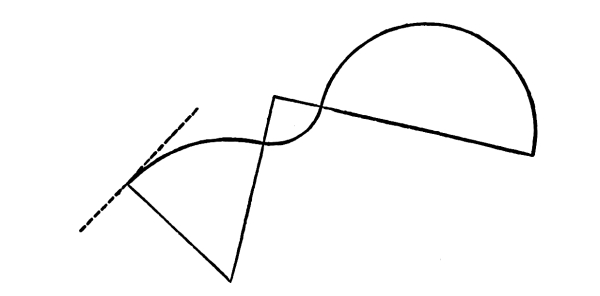
Fig. 61
Here is a curve which is composed of four circular arcs to be drawn in the following order:—
Tangent up-right 45°, arc right radius 1″ 60°, arc left radius ⅓″ 90°, arc right radius ¾″ 180°.
Two arcs will often come together at an angle. The definition of the angle must be given in that case. It is, of course, the angle made by tangents of the arcs. Describing the first arc and the direction (right or left so many degrees) which the tangent of the second arc takes from the tangent of the first arc; then describing the second arc and stating whether it turns from its tangent to the right or to the left, we shall be able to describe, not only our curves, but any angles which may occur in them.
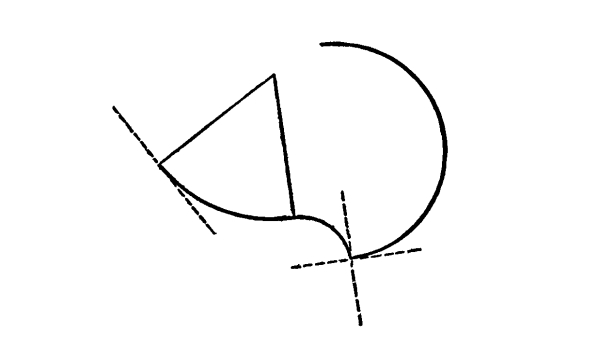
Fig. 62
Here is a curve which, so far as the arcs are concerned, of which it is composed, resembles the curve of Fig. 61; but in this case the third arc makes an angle with the second. That angle has to be defined. Drawing the tangents, it appears to be a right angle. The definition of the line given in Fig. 62 will read as follows:—
Tangent down right 45°, arc left radius 1″ 60°, arc right radius ⅓″ 90°, tangent left 90°, arc left ¾″ 180°.
59. In this way, regarding all curves as circular arcs or composed of circular arcs, we shall be able to define any line we see, or any line which we wish to produce, so far as changes of direction are concerned. For the purposes of this discussion, I shall consider all curves as composed of circular arcs.
There are many curves, of course, which are not circular in character, nor composed, strictly speaking, of circular arcs. The Spirals are in no part circular. Elliptical curves are in no part circular. All curves may, nevertheless, be approximately drawn as compositions of circular arcs. The approximation to curves which are not circular may be easily carried beyond any power of discrimination which we have in the sense of vision. The method of curve-definition, which I have described, though it may not be strictly mathematical, will be found satisfactory for all purposes of Pure Design. It is very important that we should be able to analyze our lines upon a single general principle; to discover whether they are illustrations of Order. We must know whether any given line, being orderly, is orderly in the sense of Harmony, Balance, or Rhythm. It is equally important, if we wish to produce an orderly as distinguished from a disorderly line, that we should have some general principle to follow in doing it, that we should be able to produce forms of Harmony or Balance or Rhythm in a line, if we wish to do so.
DIFFERENCES OF SCALE IN LINES
60. Having drawn a line of a certain shape, either straight or angular or curved, or partly angular, partly curved, we may change the measure of the line, in its length, without changing its shape. That is to say, we may draw the line longer or shorter, keeping all changes of direction, such as they are, in the same positions, relatively. In that way the same shape may be drawn larger or smaller. That is what we mean when we speak of a change of scale or of measure which is not a change of shape.
DIFFERENCES OF ATTRACTION IN LINES
61. A line attracts attention in the measure of the tone-contrast which it makes with the ground-tone upon which it is drawn. It attracts attention, also, according to its length, which is an extension of the tone-contrast. It attracts more attention the longer it is, provided it lies, all of it, well within the field of vision. It attracts attention also in the measure of its concentration.
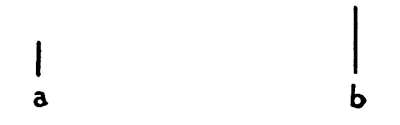
Fig. 63
Line “a” would attract less attention than it does if the tone-contrast, black on a ground of white paper, were diminished, if the line were gray, not black. In line “b” there is twice the extension of tone-contrast there is in “a.” For that reason “b” is more attractive. If, however, “a” were black and “b” were gray, “a” might be more attractive than “b,” because of the greater tone-contrast.
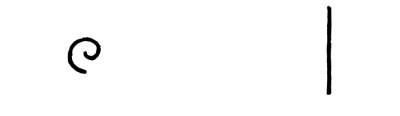
Fig. 64
In this illustration the curved line is more attractive than the straight line because it is more concentrated, therefore more definite. The extent of tone-contrast is the same, the lines being of the same length.
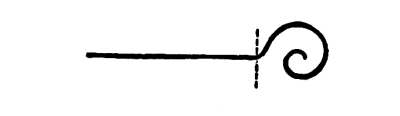
Fig. 65
In this line there is no doubt as to the greater attraction of the twisted end, on account of the greater concentration it exhibits. The extent of tone-contrast is the same at both ends. The force of attraction in the twisted end of the line would be diminished if the twisted end were made gray instead of black. The pull of concentration at one end might, conceivably, be perfectly neutralized by the pull of a greater tone-contrast at the other.
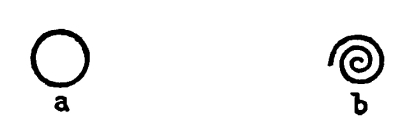
Fig. 66
In “b” we have a greater extension of tone-contrast in a given space. The space becomes more attractive in consequence.
This might not be the case, however, if the greater extension of tone-contrast in one case were neutralized by an increase of tone-contrast in the other.
THE ORDER OF HARMONY IN LINES
62. Harmony of Direction means no change of direction.

Fig. 67
In this case we have a Harmony of Direction in the line, because it does not change its direction.
63. Harmony of Angles. We may have Harmony in the repetition of a certain relation of directions, as in an angle.

Fig. 68
The angle up 45° and down 45° is here repeated seven times.
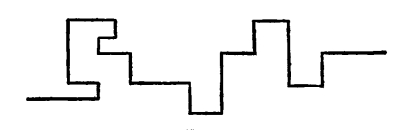
Fig. 69
In this case we have a great many angles in the line, but they are all right angles, so we have a Harmony of Angles.
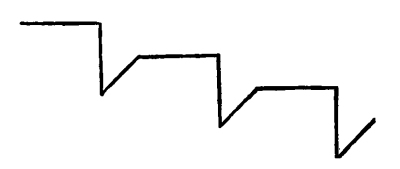
Fig. 70
In this case we have Harmony in the repetition of a certain relation of angles, that is to say, in the repetition of a certain form of angularity.
64. Equality of lengths or measures between the angles of a line means a Harmony of Measures.
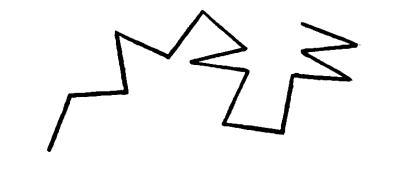
Fig. 71
In this case, for example, we have no Harmony of Angles, but a Harmony of Measures in the legs of the angles, as they are called.
65. We have a Harmony of Curvature in a line when it is composed wholly of arcs of the same radius and the same angle.
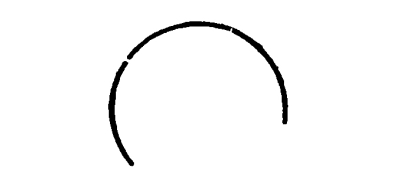
Fig. 72
This is a case of Harmony of Curvature. There is no change of direction here, in the sequence of corresponding arcs.
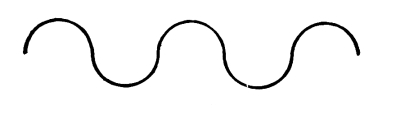
Fig. 73
Here, again, we have a Harmony of Curvature. In this case, however, there is a regular alternation of directions in the sequence of corresponding arcs. In this regular alternation, which is the repetition of a certain relation of directions, there is a Harmony of Directions.
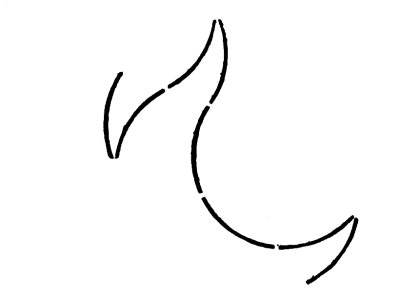
Fig. 74
In this case the changes of direction are abrupt (angular) as well as gradual. There is no regular alternation, but the harmony of corresponding arcs repeated will be appreciated, nevertheless.
66. Arcs produced by the same radius are in harmony to that extent, having the radius in common.
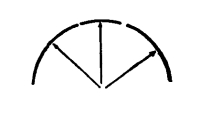
Fig. 75
This is an example of a harmony of arcs produced by radii of the same length. The arcs vary in length.
67. Arcs of the same angle-measure produced by different radii are in Harmony to the extent that they have an angle-measure in common.
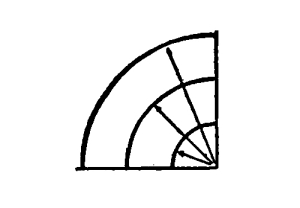
Fig. 76
This is an example.
Arcs having the same length but varying in both radius and angle may be felt to be in Measure-Harmony. It is doubtful, however, whether lines of the same length but of very different curvatures will be felt to correspond. If the correspondence of lengths is not felt, visually, it has no interest or value from the point of view of Pure Design.
68. Any line may be continued in a repetition or repetitions of its shape, whatever the shape is, producing what I call a Linear Progression. In the repetitions we have Shape-Harmony.
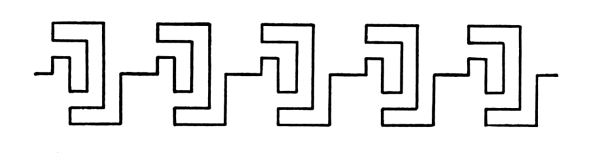
Fig. 77
This is an example of Linear Progression. The character of the progression is determined by the shape-motive which is repeated in it.
69. The repetition of a certain shape-motive in a line is not, necessarily, a repetition in the same measure or scale. A repetition of the same shape in the same measure means Measure and Shape-Harmony in the progression. A repetition of the same shape in different measures means Shape-Harmony without Measure-Harmony.
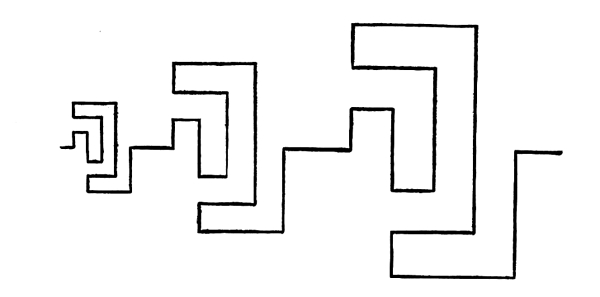
Fig. 78
Here we have the repetition of a certain shape in a line, in a progression of measures. That gives us Shape-Harmony and a Harmony of Proportions, without Measure-Harmony.
70. In the repetition of a certain shape-motive in the line, the line may change its direction abruptly or gradually, continuously or alternately, producing a Linear Progression with changes of direction.
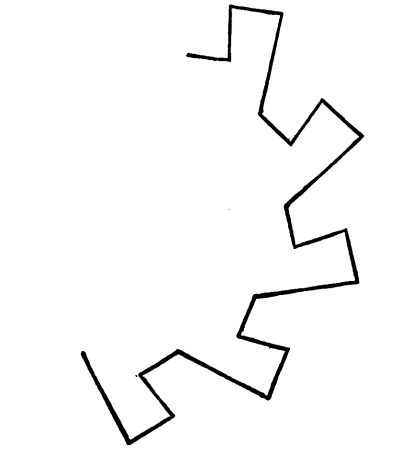
Fig. 79
In Fig. 79 there is a certain change of direction as we pass from one repetition to the next. In the repetition of the same change of direction, of the same angle of divergence, we have Harmony. If the angles of divergence varied we should have no such Harmony, though we might have Harmony in the repetition of a certain relation of divergences. Any repetition of a certain change or changes of direction in a linear progression gives a Harmony of Directions in the progression.
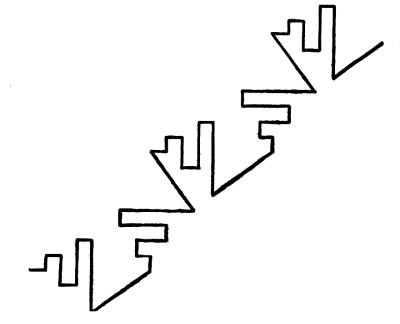
Fig. 80
In this case there is a regular alternation of directions in the repeats. The repeats are drawn first to the right, then up, and the relation of these two directions is then repeated.
71. By inverting the motive of any progression, in single or in double inversion, and repeating the motive together with its inversion, we are able to vary the character of the progression indefinitely.
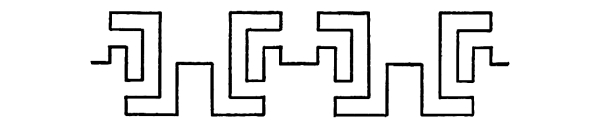
Fig. 81
In this case we have a single inversion of the motive and a repetition of the motive with its inversion. Compare this progression with the one in Fig. 77, where the same motive is repeated without inversion.
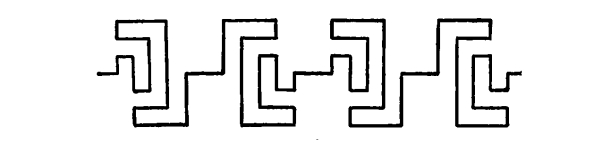
Fig. 82
Here we have the same motive with a double inversion, the motive with its double inversion being repeated. The inversion gives us Shape-Harmony without Harmony of Attitudes. We have Harmony, however, in a repetition of the relation of two attitudes. These double inversions are more interesting from the point of view of Balance than of Harmony.
THE ORDER OF BALANCE IN LINES
72. We have Balance in a line when one half of it is the single or double inversion of the other half; that is, when there is an equal opposition and consequent equilibrium of attractions in the line. When the axis of the inversion is vertical the balance is symmetrical.

Fig. 83
There is Balance in this line because half of it is the single inversion of the other half. The balance is symmetrical because the axis is vertical. The balance, although symmetrical, is not likely to be appreciated, however, because the eye is sure to move along a line upon which there is no better reason for not moving than is found in slight terminal contrasts. The eye is not held at the center when there is nothing to hold the eye on the center. Mark the center in any way and the eye will go to it at once. A mark or accent may be put at the center, or accents, corresponding and equal, may be put at equal distances from the center in opposite directions. The eye will then be held at the center by the force of equal and opposite attractions.
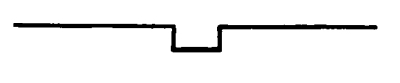
Fig. 84
In this case the eye is held at the balance-center of the line by a change of character at that point.
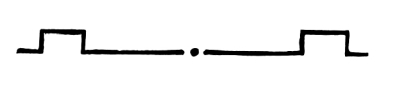
Fig. 85
In this case the changes of character are at equal distances, in opposite directions, from the center. The center is marked by a break. The axis being vertical, the balance is a symmetrical one.
73. The appreciation of Balance in a line depends very much upon the attitude in which it is drawn.
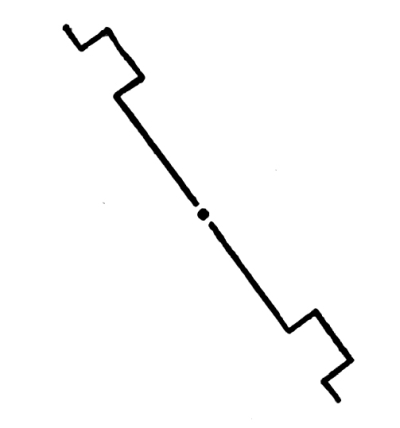
Fig. 86
In this case the balance in the line itself is just as good as it is in Fig. 85; but the axis of the balance being diagonal, the balance is less distinctly felt. The balance is unsatisfactory because the attitude of the line is one which suggests a falling down to the left. It is the instability of the line which is felt, more than the balance in it.
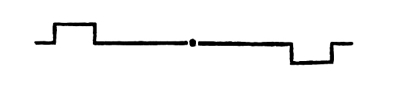
Fig. 87
In this case of double inversion, also, we have balance. The balance is more distinctly felt than it was in Fig. 86. The attitude is one of stability. This balance is neither axial nor symmetrical, but central.
74. A line balances, in a sense, when its inclinations are balanced.
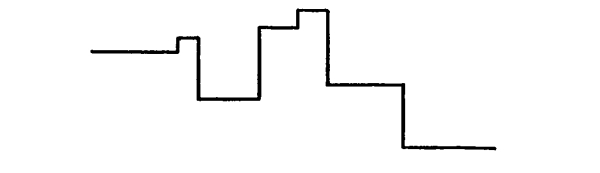
Fig. 88
This line may be said to be in balance, as it has no inclinations, either to the right or to the left, to suggest instability. The verticals and the horizontals, being stable, look after themselves perfectly well.
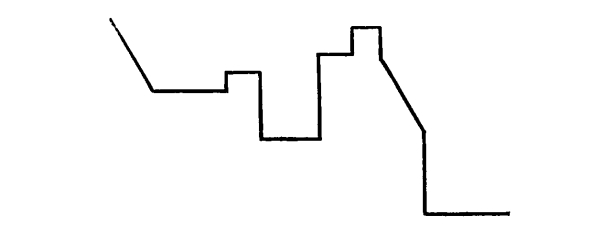
Fig. 89
This line has two unbalanced inclinations to the left. It is, therefore, less satisfactory than the line in Fig. 88, from the point of view of Balance.
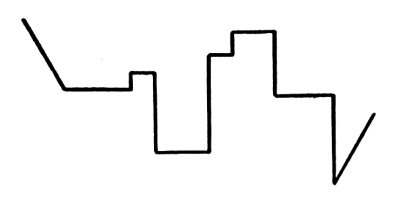
Fig. 90
The two inclinations in this line counteract one another. One inclination toward the left is balanced by a corresponding inclination toward the right.
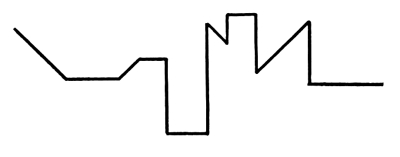
Fig. 92
In this case, also, there is no inclination toward the left which is not balanced by a corresponding inclination toward the right.
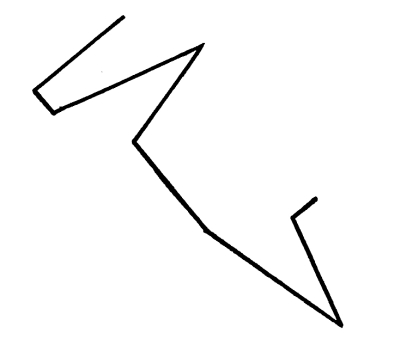
Fig. 92
In this line, which is composed wholly of inclinations to the right or left, every inclination is balanced, and the line is, therefore, orderly in the sense of Balance; more so, certainly, than it would be if the inclinations were not counteracted. This is the problem of balancing the directions or inclinations of a line.
75. A line having no balance or symmetry in itself may become balanced. The line may be regarded as if it were a series of dots close together. The line is then a relation of positions indicated by dots. It is a composition of attractions corresponding and equal. It is only necessary, then, to find what I have called the center of equilibrium, the balance-center of the attractions, and to indicate that center by a symmetrical inclosure. The line will then become balanced.
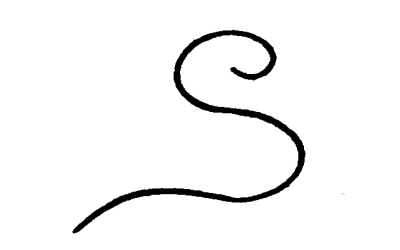
Fig. 93
Here is a line. To find the center of its attractions it may be considered as if it were a line of dots, like this:—
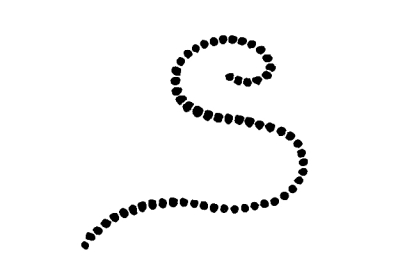
Fig. 94
The principle according to which we find the balance-center is stated on page 23. The balance-center being found, it must be indicated unmistakably. This may be done by means of any symmetrical inclosure which will draw the eye to the center and hold it there.
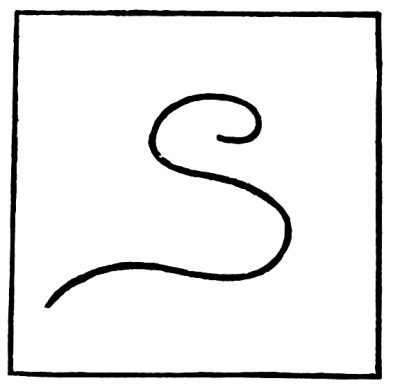
Fig. 95
In this case the balance-center is indicated by a rectangular inclosure. This rectangle is not, however, in harmony of character with the line inclosed by it, which is curved.
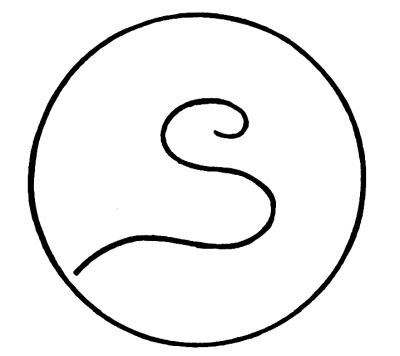
Fig. 96
In this case the balance-center is indicated by a circle, which, being a curve, is in harmony of character with the inclosed line, which is also a curve. I shall call this Occult Balance to distinguish it from the unmistakable Balance of Symmetry and other comparatively obvious forms of Balance, including the balance of double inversions. As I have said, on page 24, the symmetrical framing must be sufficiently attractive to hold the eye steadily at the center, otherwise it does not serve its purpose.
THE ORDER OF RHYTHM IN LINES
76. The eye, not being held on a vertical axis or on a balance-center, readily follows any suggestion of movement.
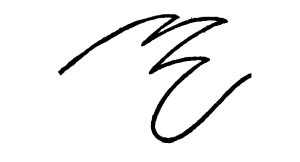
Fig. 97
In this case there is no intimation of any vertical axis or balance-center. The figure is consequently unstable. There is a sense of movement to the right. This is due, not only to the inclinations to the right, but to the convergences in that direction.
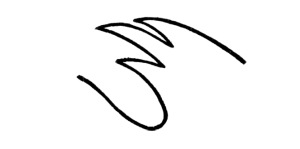
Fig. 98
In this case the movement is unmistakably to the left. In such cases we have movement, but no Rhythm.
77. Rhythm requires, not only movement, but the order of regular and marked intervals.
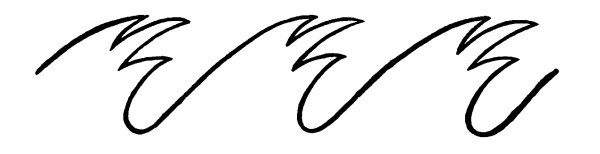
Fig. 99
In Fig. 99 we have a line, a linear progression, which gives us the feeling of movement, unmistakably. The movement, which in the motive itself is not rhythmical, becomes rhythmical in its repetition at regular, and in this case equal, intervals. The intervals are marked by the repetitions.
78. It is a question of some interest to decide how many repetitions are required in a Rhythm. In answer to this question I should say three as a rule. A single repetition shows us only one interval, and we do not know whether the succeeding intervals are to be equal or progressive, arithmetically progressive or geometrically progressive. The rhythm is not defined until this question is decided, as it will be by two more repetitions. The measures of the rhythm might take the form of a repeated relation of measures; a repetition, for example, of the measures two, seven, four. In that case the relation of the three measures would have to be repeated at least three times before the character of the rhythm could be appreciated.
79. Any contrariety of movement in the motive is extended, of course, to its repetitions.
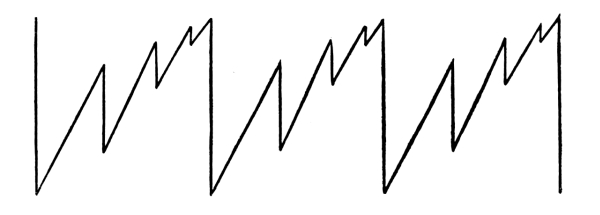
Fig. 100
In this case, for example, there are convergences and, consequently, movements both up and down. This contrariety of movements is felt through the whole series of repetitions. Other things being equal, I believe the eye moves up more readily than down, so that convergences downward have less effect upon us than corresponding convergences upward.
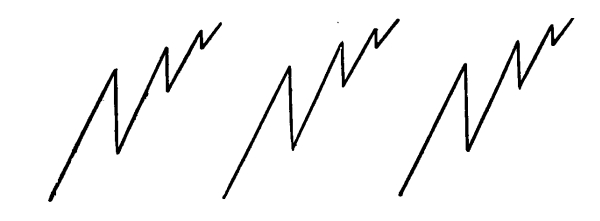
Fig. 101
In this case, by omitting the long vertical line I have diminished the amount of convergence downward. In that way I have given predominance to the upward movement. Instead of altogether omitting the long vertical line, I might have changed its tone from black to gray. That would cause an approximate instead of complete disappearance. It should be remembered that in all these cases the habit of reading comes in to facilitate the movements to the right. It is easier for the eye to move to the right than in any other direction, other things being equal. The movement back to the beginning of another line, which is of course inevitable in reading, produces comparatively little impression upon us, no more than the turning of the page. The habit of reading to the right happens to be our habit. The habit is not universal.
80. Reading repetitions and alternations to the right, always, I, for a long time, regarded such repetitions and alternations as rhythmical, until Professor Mowll raised the question whether it is necessary to read all alternations to the right when there is nothing in the alternations themselves to suggest a movement in one direction rather than another. Why not read them to the left as well as to the right? We at once decided that the movement in a Rhythm must be determined by the character of the Rhythm itself, not by any habit of reading, or any other habit, on our part. It was in that way that we came to regard repetitions and alternations as illustrations of Harmony rather than of Rhythm. Rhythm comes into the Harmony of a Repeated Relation when the relation is one which causes the eye to move in one direction rather than another, and when the movement is carried on from repetition to repetition, from measure to measure.
81. The repetition of a motive at equal intervals, when there is no movement in the motive, gives us no feeling of Rhythm.
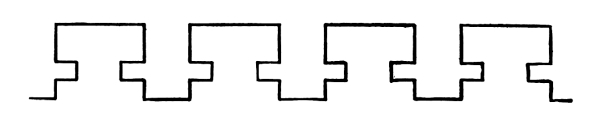
Fig. 102
In this case, for example, we have a repetition in the line of a certain symmetrical shape. As there is no movement in the shape repeated, there is no Rhythm in the repetition. There is nothing to draw the eye in one direction rather than another. The attractions at one end of the line correspond with the attractions at the other.
82. The feeling of Rhythm may be induced by a regular diminution of measure or scale in the repetitions of the motive and in the intervals in which the repetitions take place.
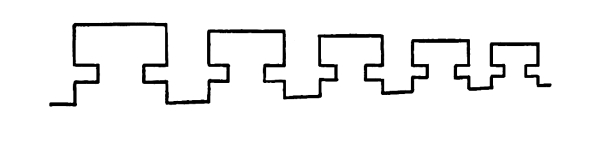
Fig. 103
In this case the shape repeated is still symmetrical, but it is repeated with a gradual diminution of scale and of intervals, by which we are given a feeling of rhythmic movement. The change of scale and of intervals, to induce a sense of rhythmic motion, must be regular. To be regular the change must be in the terms of one or the other of the regular progressions; the arithmetical progression, which proceeds by a certain addition, or the geometrical, which proceeds by a certain multiplication. The question may arise in this case (Fig. 103) whether the movement of the Rhythm is to the right or to the left. I feel, myself, that the movement is to the right. In diminishing the scale of the motive and of the intervals we have, hardly at all, diminished the extent of the tone-contrast in a given angle of vision. See Fig. 41, p. 27, showing the increase of attractions from one visual angle to another. At the same time we come at the right end of the progression to two or more repetitions in the space of one. We have, therefore, established the attraction of a crowding together at the right end of the series. See the passage (p. 43) on the attractiveness of a line. The force of the crowding together of attractions is, I feel, sufficient to cause a movement to the right. It must be remembered, however, that the greater facility of reading to the right is added here to the pull of a greater crowding together of attractions in the same direction, so the movement of the Rhythm in that direction may not be very strong after all. If the direction of any Rhythm is doubtful, the Rhythm itself is doubtful.
83. The feeling of Rhythm may be induced, as I have said, by a gradual increase of the number of attractions from measure to measure, an increase of the extent of tone-contrast.
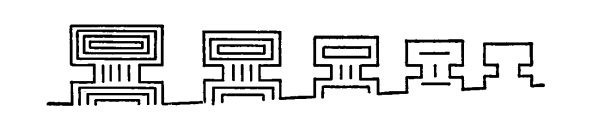
Fig. 104
Increasing the extent of tone-contrast and the number of attractions in the measures of the Rhythm in Fig. 103, we are able to force the eye to follow the series in the direction contrary to the habit of reading, that is to say from right to left.
A decrease in the forces of attraction in connection with a decrease of scale is familiar to us all in the phenomena of perspective. The gradual disappearance of objects in aerial perspective does away with the attraction of a greater crowding together of objects in the distance.
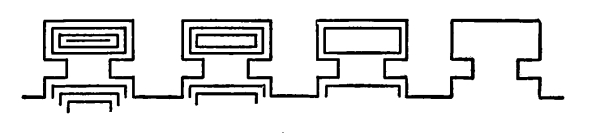
Fig. 105
In this case the diminution of scale has been given up and there is no longer any crowding together. There is no chance of this rhythm being read from left to right except by an effort of the will. The increase of attractions toward the left is much more than sufficient to counteract the habit of reading.
84. The force of a gradual coming together of attractions, inducing movement in the direction of such coming together, is noticeable in spiral shapes.
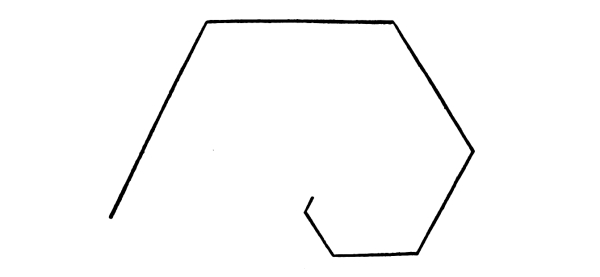
Fig. 106
In this case we have a series of straight lines with a constant and equal change of direction to the right, combined with a regular diminution of measures in the length of the lines, this in the terms of an arithmetical progression. The movement is in the direction of concentration and it is distinctly marked in its measures. The movement is therefore rhythmical.
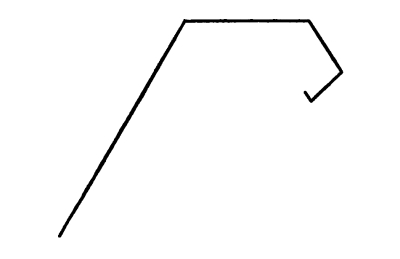
Fig. 107
In this case we have a series of straight lines with a constant change of direction to the right; but in this case the changes of measure in the lines are in the terms of a geometrical progression. The direction is the same, the pull of concentration perhaps stronger.
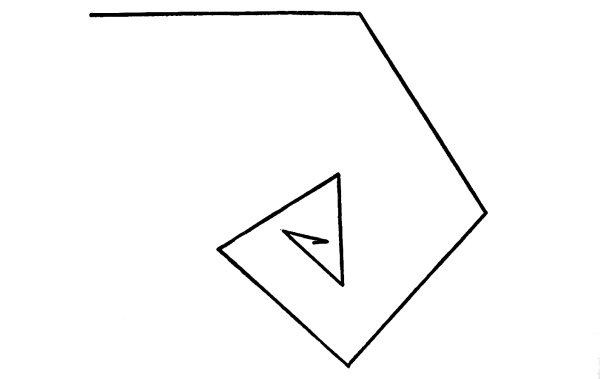
Fig. 108
In this Rhythm there is an arithmetical gradation of measures in the changes of direction, both in the length of the legs and in the measure of the angles. The pull of concentration is, in this case, very much increased. It is evident that the legs may vary arithmetically and the angles geometrically; or the angles arithmetically and the legs geometrically.
85. If, in the place of the straight lines, which form the legs, in any of the examples given, are substituted lines which in themselves induce movement, the feeling of Rhythm may be still further increased, provided the directions of movement are consistent.
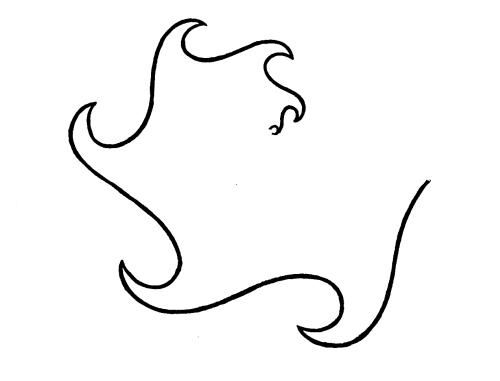
Fig. 109
In this case the movement is in the direction of increasing concentration and in the direction of the convergences.
If the movement of the convergences be contrary to the movement of concentration, there will be in the figure a contrary motion which may diminish or even entirely prevent the feeling of Rhythm. If the movement in one direction or the other predominates, we may still get the feeling of Rhythm, in spite of the drawback of the other and contrary movement.
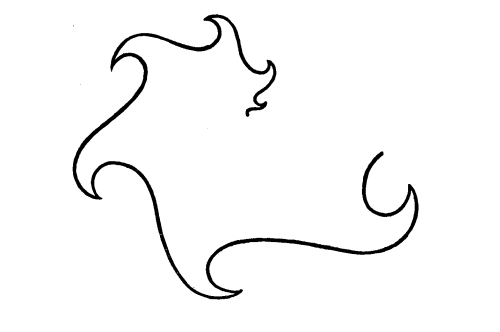
Fig. 110
In this case the linear convergences substituted for the straight lines are contrary to the direction of increasing concentration. The movement is doubtful.
86. Corresponding rhythms, set in contrary motion, give us the feeling of Balance rather than of Rhythm. The balance in such cases is a balance of movements.

Fig. 111
This is an example of corresponding and opposed rhythms producing the feeling, not of Rhythm, but of Balance.
ATTITUDES
LINES IN DIFFERENT ATTITUDES
87. Any line or linear progression may be turned upon a center, and so made to take an indefinite number and variety of attitudes. It may be inverted upon an axis, and the inversion may be turned upon a center producing another series of attitudes which, except in the case of axial symmetry in the line, will be different from those of the first series.
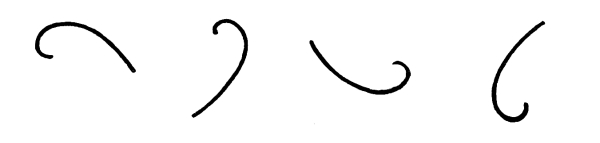
Fig. 112
In this case the line changes its attitude.
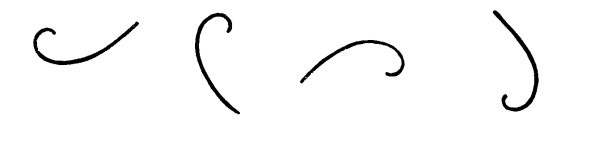
Fig. 113
In this case I have inverted the line, and turning the inversion upon a center I get a different set of attitudes.
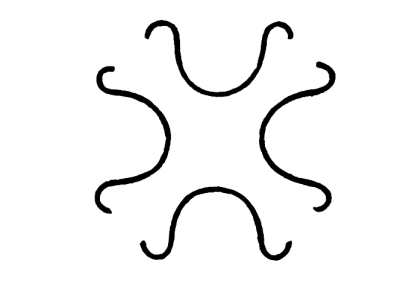
Fig. 114
In this case, which is a case of axial symmetry in the line, the inversion gives us no additional attitudes.
THE ORDER OF HARMONY IN THE ATTITUDES OF LINES
88. When any line or linear progression is repeated, without change of attitude, we have a Harmony of Attitudes.
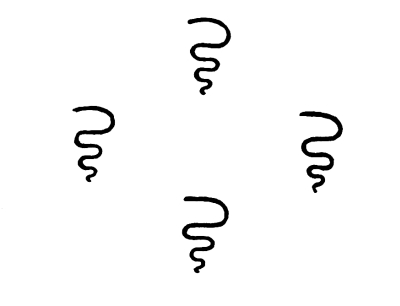
Fig. 115
This is an illustration of Harmony of Attitudes. It is also an illustration of Interval-Harmony.
89. We have a Harmony of Attitudes, also, in the repetition of any relation of two or more attitudes, the relation of attitudes being repeated without change of attitude.
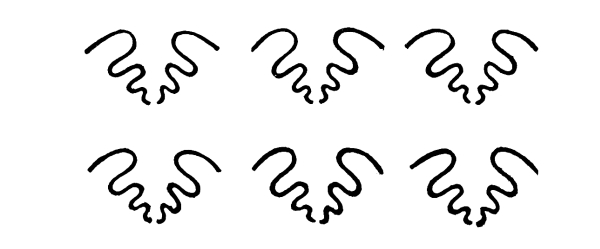
Fig. 116
We have here a Harmony of Attitudes due to the repetition of a certain relation of attitudes, without change of attitude.
THE ORDER OF BALANCE IN THE ATTITUDES OF LINES
90. When a line or linear progression is inverted upon any axis or center, and we see the original line and its inversion side by side, we have a Balance of Attitudes.
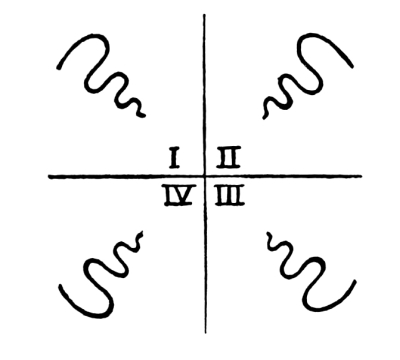
Fig. 117
The relation of attitudes I, II, of III, IV, and of I, II, III, IV, is that of Symmetrical Balance on a vertical axis. The relation of attitudes I, IV, and of II, III, is a relation of Balance but not of Symmetrical Balance. This is true, also, of the relation of I, III and of II, IV. Double inversions are never symmetrical, but they are illustrations of Balance. The balance of double inversions is central, not axial. These statements are all repetitions of statements previously made about positions.
THE ORDER OF RHYTHM IN THE ATTITUDES OF LINES
91. It often happens that a line repeated in different attitudes gives us the sense of movement. It does this when the grouping of the repetitions suggests instability. The movement is rhythmical when it exhibits a regularity of changes in the attitudes and in the intervals of the changes.
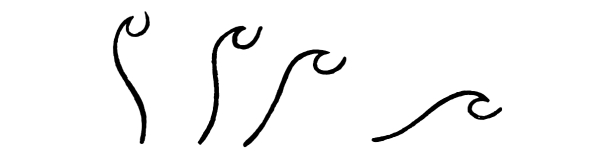
Fig. 118
In this case we have a movement to the right, but no Rhythm, the intervals being irregular.
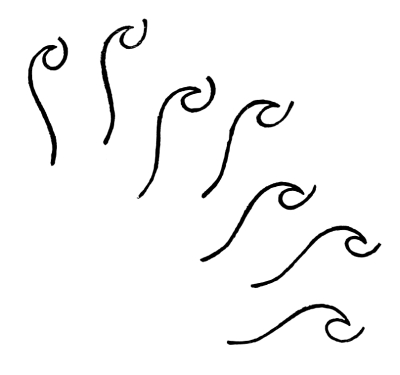
Fig. 119
In this case the changes of attitude and the intervals of the changes being regular, the movement becomes rhythmical. The direction of the rhythm is clearly down-to-the-right.
92. In the repetition of any line we have a Harmony, due to the repetition. If the line is repeated in the same attitude, we have a Harmony of Attitudes. If it is repeated in the same intervals, we have a Harmony of Intervals. We have Harmony, also, in the repetition of any relation of attitudes or of intervals.
We have not yet considered the arrangement or composition of two or more lines of different measures and of different shapes.
THE COMPOSITION OF LINES
93. By the Composition of Lines I mean putting two or more lines together, in juxtaposition, in contact or interlacing. Our object in the composition of lines, so far as Pure Design is concerned, is to achieve Order, if possible Beauty, in the several modes of Harmony, Balance, and Rhythm.
HARMONY IN THE COMPOSITION OF LINES
94. We have Harmony in line-compositions when the lines which are put together correspond in all respects or in some respects, when they correspond in attitudes, and when there is a correspondence of distances or intervals.
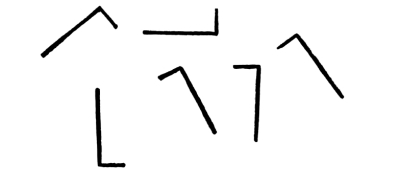
Fig. 120
In this case the lines of the composition correspond in tone, measure, and shape, but not in attitude; and there is no correspondence in distances or intervals.
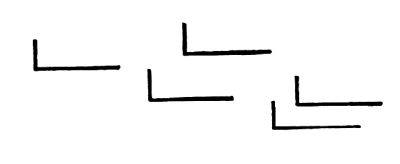
Fig. 121
In this case the attitudes correspond, as they did not in Fig. 120. There is still no correspondence of intervals.
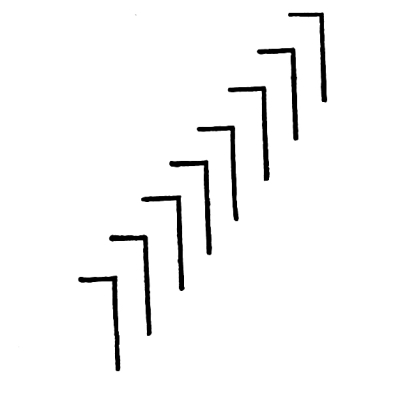
Fig. 122
Here we have the correspondence of intervals which we did not have either in Fig. 120 or in Fig. 121. There is not only a Harmony of Attitudes and of Intervals, in this case, but the Harmony of a repetition in one direction, Direction-Harmony. In all these cases we have the repetition of a certain angle, a right angle, and of a certain measure-relation between the legs of the angle, giving Measure and Shape-Harmony.
95. The repetition in any composition of a certain relation of measures, or of a certain proportion of measures, gives Measure-Harmony to the composition. The repetition of the relation one to three in the legs of the angle, in the illustrations just given, gives to the compositions the Harmony of a Recurring Ratio. By a proportion I mean an equality between ratios, when they are numerically different. The relation of one to three is a ratio. The relation of one to three and three to nine is a proportion. We may have in any composition the Harmony of a Repeated Ratio, as in Figs. 120, 121, 122, or we may have a Harmony of Proportions, as in the composition which follows.
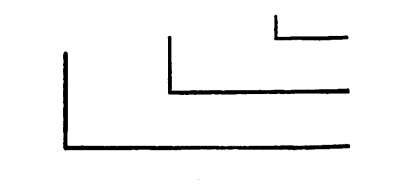
Fig. 123
96. To be in Harmony lines are not necessarily similar in all respects. As I have just shown, lines may be in Shape-Harmony, without being in any Measure-Harmony. Lines are approximately in harmony when they correspond in certain particulars, though they differ in others. The more points of resemblance between them, the greater the harmony. When they correspond in all respects we have, of course, a perfect harmony.
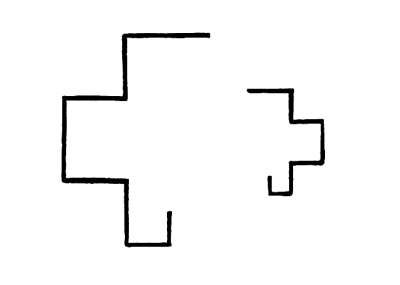
Fig. 124
This is a case of Shape-Harmony without Measure-Harmony and without Harmony of Attitudes.
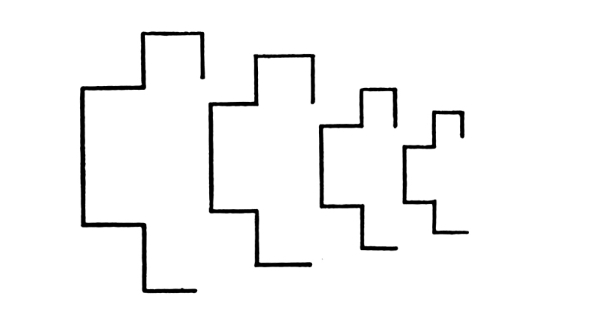
Fig. 125
In this case we have a Harmony of Shapes and of Attitudes, without Measure-Harmony or Harmony of Intervals. This is a good illustration of a Harmony of Proportions.
Straight lines are in Harmony of Straightness because they are all straight, however much they differ in tone or measure. They are in Harmony of Measure when they have the same measure of length. The measures of width, also, may agree or disagree. In every agreement we have Harmony.
Angular lines are in Harmony when they have one or more angles in common. The recurrence of a certain angle in different parts of a composition brings Harmony into the composition. Designers are very apt to use different angles when there is no good reason for doing so, when the repetition of one would be more orderly.
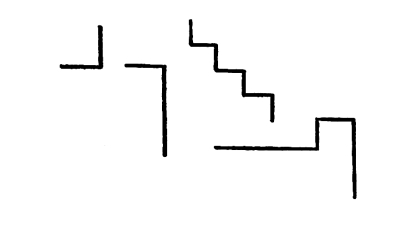
Fig. 126
The four lines in this composition have right angles in common. To that extent the lines are in Harmony. There is also a Harmony in the correspondence of tones and of width-measures in the lines. Considerable Harmony of Attitudes occurs in the form of parallelisms.
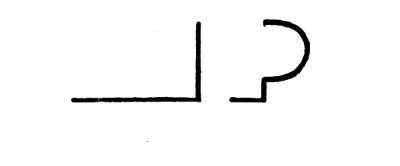
Fig. 127
These two lines have simply one angle in common, a right angle, and the angle has the same attitude in both cases. They differ in other respects.
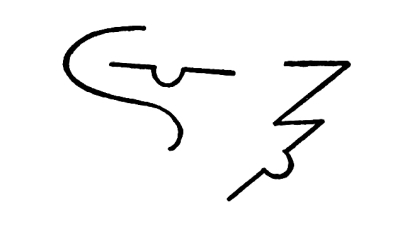
Fig. 128
In these three lines the only element making for Harmony, except the same tone and the same width, is found in the presence in each line of a certain small arc of a circle. Straightness occurs in two of the lines but not in the third. There is a Harmony, therefore, between two of the lines from which the third is excluded. There is, also, a Harmony of Attitude in these two lines, in certain parallelisms.
BALANCE IN THE COMPOSITION OF LINES
97. Lines balance when in opposite attitudes. We get Balance in all inversions, whether single or double.
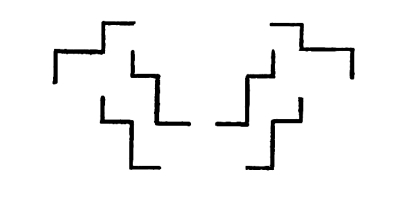
Fig. 129
Here similar lines are drawn in opposite attitudes and we get Measure and Shape-Balance. In the above case the axis of balance is vertical. The balance is, therefore, symmetrical. Symmetrical Balance is obtained by the single inversion of any line or lines on a vertical axis. Double inversion gives a Balance of Measures and Shapes on a center. We have no Symmetry in double inversions. All this has been explained.
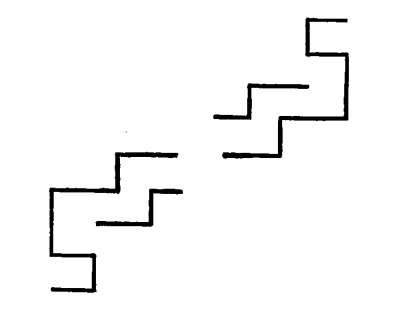
Fig. 130
We have Measure and Shape-Balance on a center in this case. It is a case of double inversion. It is interesting to turn these double inversions on their centers, and to observe the very different effects they produce in different attitudes.
98. Shapes in order to balance satisfactorily must be drawn in the same measure, as in Fig. 131 which follows.
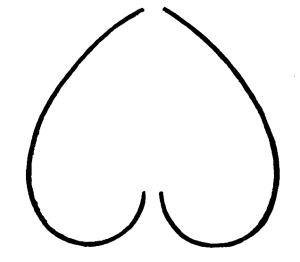
Fig. 131
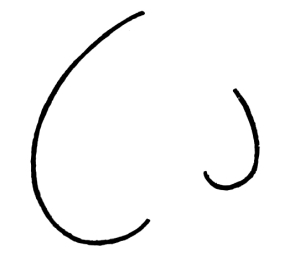
Fig. 132
Here, in Fig. 132, we have Shape-Harmony without Measure-Harmony. It might be argued that we have in this case an illustration of Shape-Balance without Measure-Balance. Theoretically that is so, but Shape-Balance without Measure-Balance is never satisfactory. If we want the lines in Fig. 132 to balance we must find the balance-center between them, and then indicate that center by a symmetrical inclosure. We shall then have a Measure-Balance (occult) without Shape-Balance.
99. When measures correspond but shapes differ the balance-center may be suggested by a symmetrical inclosure or framing. When that is done the measures become balanced.
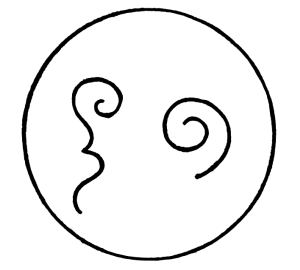
Fig. 133
Here we have Measure-Harmony and a Measure-Balance without Shape-Harmony or Shape-Balance. The two lines have different shapes but the same measures, lengths and widths corresponding. The balance-center is found for each line. See pp. 54, 55. Between the two centers is found the center, upon which the two lines will balance. This center is then suggested by a symmetrical inclosure. The balancing measures in such cases may, of course, be turned upon their centers, and the axis connecting their centers may be turned in any direction or attitude, with no loss of equilibrium, so far as the measures are concerned.
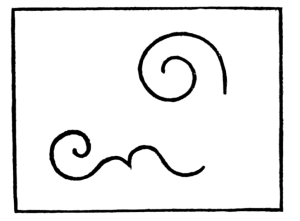
Fig. 134
The Balance of Measures here is just as good as it is in Fig. 133. The attitudes are changed but not the relation of the three balance-centers. The change of shape in the inclosure makes no difference.
100. Measure-Balance without Shape-Harmony or Shape-Balance is satisfactory only when the balance-center is unmistakably indicated or suggested, as in the examples which I have given.
101. There is another form of Balance which is to be inferred from what I have said, on page 18, of the Balance of Directions, but it needs to be particularly considered and more fully illustrated. I mean a Balance in which directions or inclinations to the right are counteracted by corresponding or equivalent directions or inclinations to the left. The idea in its simplest and most obvious form is illustrated in Fig. 22, on page 18. In that case the lines of inclination correspond. They do not necessarily correspond except in the extent of contrast, which may be distributed in various ways.
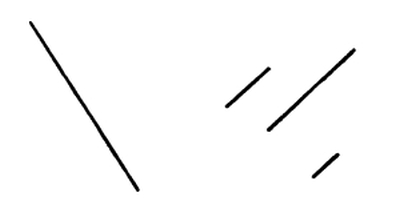
Fig. 135
The balance of inclinations in this case is just as good as the balance in Fig. 22. There is no symmetry as in Fig. 22. Three lines balance against one. The three lines, however, show the same extent of contrast as the one. So far as the inclinations are concerned they will balance in any arrangement which lies well within the field of vision. The eye must be able to appreciate the fact that a disposition to fall to the right is counteracted by a corresponding or equivalent disposition to fall to the left.
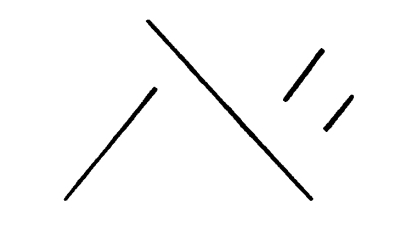
Fig. 136
This arrangement of the inclining lines is just as good as the arrangement in Fig. 135. The inclinations may be distributed in any way, provided they counteract one another properly.
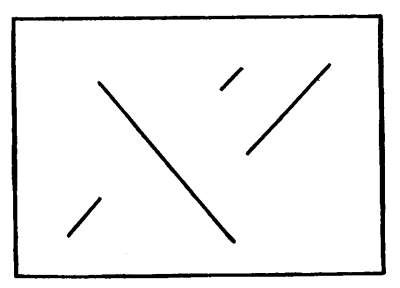
Fig. 137
In this case I have again changed the composition, and having suggested the balance-center of the lines, as attractions, by a symmetrical inclosure, I have added Measure-Balance (occult) to Inclination-Balance. The Order in Fig. 137 is greater than the Order in Figs. 135 and 136. In Fig. 137 two forms of Balance are illustrated, in the other cases only one. The value of any composition lies in the number of orderly connections which it shows.
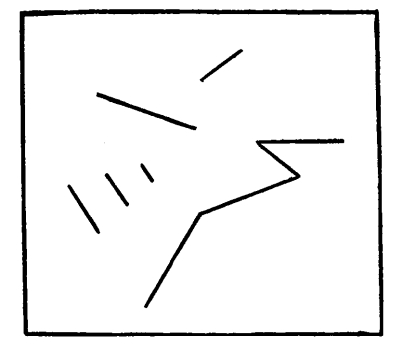
Fig. 138
In this case I have taken a long angular line and added a sufficient number and extent of opposite inclinations to make a balance of inclinations. The horizontal part of the long line is stable, so it needs no counteraction, but the other parts incline in various degrees, to the left or to the right. Each inclining part requires, therefore, either a corresponding line in a balancing direction, or two or more lines of equivalent extension in that direction. In one case I have set three lines to balance one, but they equal the one in length, that is to say, in the extent of contrast. We have in Fig. 138 an illustration of occult Measure-Balance and the Balance of Inclinations. I have illustrated the idea of Inclination-Balance by very simple examples. I have not considered the inclinations of curves, nor have I gone, at all, into the more difficult problem of balancing averages of inclination, when the average of two or more different inclinations of different extents of contrast has to be counteracted. In Tone-Relations the inclinations are of tone-contrasts, and a short inclination with a strong contrast may balance a long inclination with a slight one, or several inclinations of slight contrasts may serve to balance one of a strong contrast. The force of any inclining line may be increased by increasing the tone-contrast with the ground-tone. In tone-relations the problem becomes complicated and difficult. The whole subject of Inclination-Balance is one of great interest and worthy of a separate treatise.
RHYTHM IN THE COMPOSITION OF LINES
102. We will first consider the Measure-Rhythms which result from a gradual increase of scale, an increase in the extent of the contrasts. The intervals must, in such Rhythms, be regular and marked. They may be equal; they may alternate, or they may be regularly progressive.
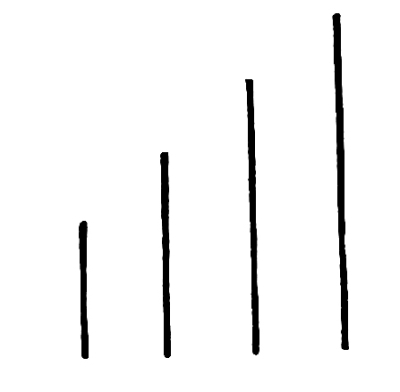
Fig. 139
In this case I feel that the direction of the Rhythm is up-to-the-right owing to the gradual increase of length and consequently of the extent of contrast in the lines, in that direction.
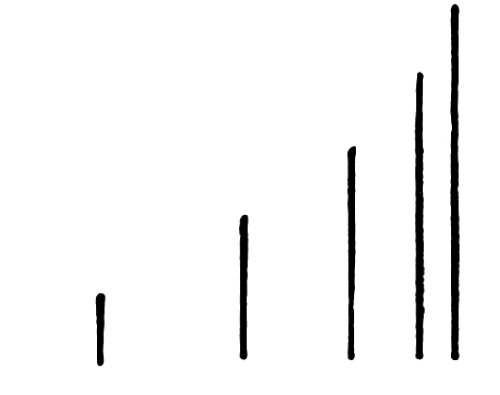
Fig. 140
In this case I have, by means of regularly diminishing intervals, added the force of a crowding together of contrasting edges to the force of a gradual extension of them. The movement is still more strongly up-to-the-right.
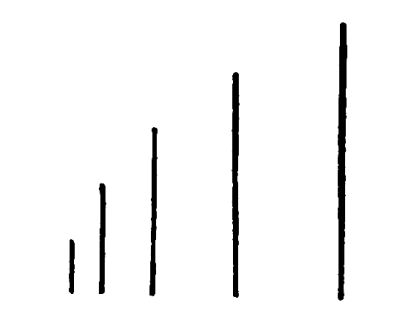
Fig. 141
In this case a greater extension of contrasts pulls one way and a greater crowding of contrasts the other. I think that crowding has the best of it. The movement, though much retarded, is, I feel, down-to-the-left rather than up-to-the-right, in spite of the fact that the greater facility of reading to the right is added to the force of extended contrasts.
103. Substituting unstable for stable attitudes in the examples just given, we are able to add the movement suggested by instability of attitude to the movement caused by a gradual extension of contrasts.
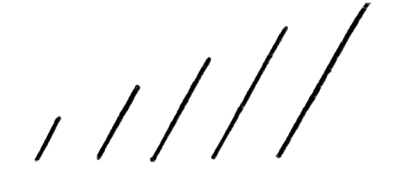
Fig. 142
The movement up-to-the-right in Fig. 139 is here connected with an inclination of all the lines down-to-the-right.
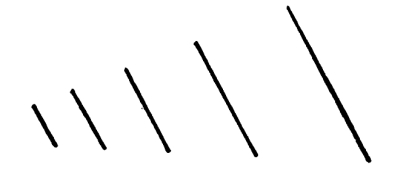
Fig. 143
Here the falling of the lines down-to-the-left counteracts the movement in the opposite direction which is caused by the extension of contrasting edges in that direction. A crowding together of the lines, due to the diminution of intervals toward the left, adds force to the movement in that direction.
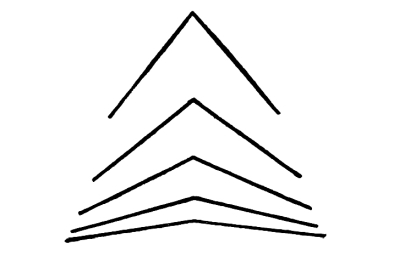
Fig. 144
In this case a movement up is caused by convergences, a movement down by crowding. The convergences are all up, the crowding down. I think that the convergences have it. I think the movement is, on the whole, up. The intervals of the crowding down diminish arithmetically.
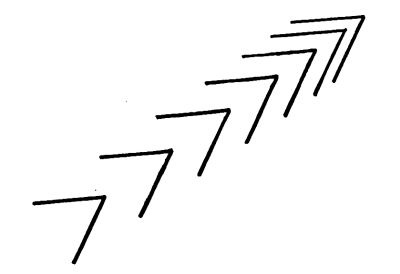
Fig. 145
The convergences and the crowding of attractions are, here, both up-to-the-right. The Rhythm is much stronger than it was in Fig. 144. The intervals are those of an arithmetical progression.
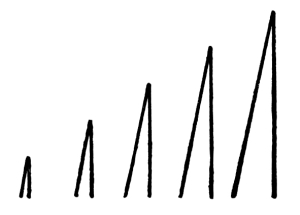
Fig. 146
The movement here is up-to-the-right, because of convergences in that direction and an extension of contrasts in that direction.
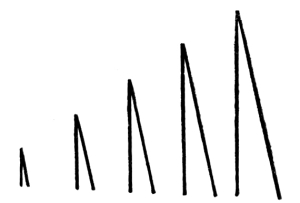
Fig. 147
In this case the two movements part company. One leads the eye up-to-the-left, the other leads it up-to-the-right. The movement as a whole is approximately up. As the direction of the intervals is horizontal, not vertical, this is a case of movement without Rhythm. The movement will become rhythmic only in a vertical repetition. That is to say, the direction or directions of the movement in any Rhythm and the direction or directions of its repetitions must coincide. In Fig. 139, the movement is up-to-the-right, and the intervals may be taken in the same direction, but in Fig. 147 the movement is up. The intervals cannot be taken in that direction. It is, therefore, impossible to get any feeling of Rhythm from the composition. We shall get the feeling of Rhythm only when we repeat the movement in the direction of the movement, which is up.
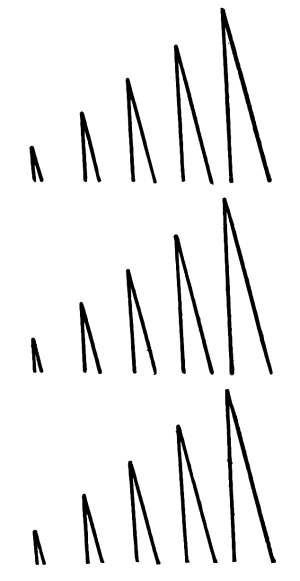
Fig. 148
Here we have a vertical repetition of the composition given in Fig. 147. The result is an upward movement in regular and marked intervals, answering to our understanding of Rhythm.
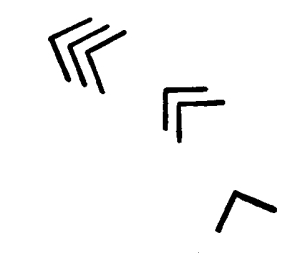
Fig. 149
In this case we have a curved movement. The lines being spaced at regular intervals, the movement is in regular and marked measures. Its direction is due to an increase in the number of attractions, to crowding, and to convergences. The movement is, accordingly, rhythmical.
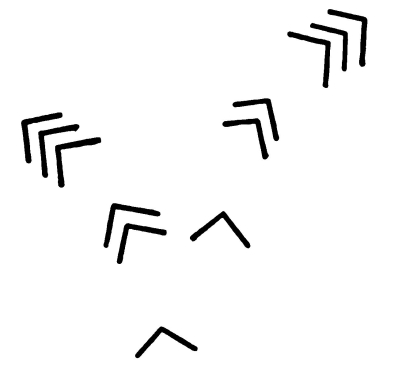
Fig. 150
The movement of Fig. 149 is here partly destroyed by an inversion and opposition of attitudes and directions. The movement is, on the whole, up, but it can hardly be described as rhythmical, because it has no repetition upwards, as it has in the next illustration, Fig. 151. Before proceeding, however, to the consideration of Fig. 151, I want to call the attention of the reader to the fact that we have in Fig. 150 a type of Balance to which I have not particularly referred. It is a case of unsymmetrical balance on a vertical axis. The balancing shapes and movements correspond. They incline in opposite directions. They diverge equally from the vertical axis. The inclinations balance. At the same time the composition does not answer to our understanding of Symmetry. It is not a case of right and left balance on the vertical axis. The shapes and movements are not right and left and opposite. One of the shapes is set higher than the other. The balance is on the vertical. It is obvious, but it is not symmetrical. It is a form of Balance which has many and very interesting possibilities.
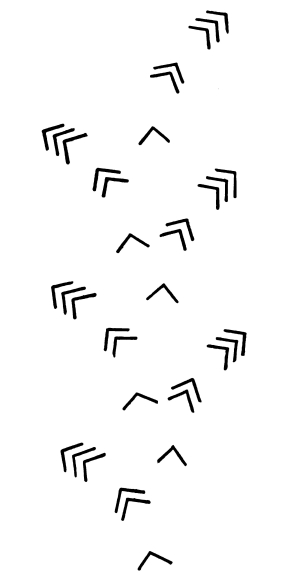
Fig. 151
The repetition, in this case, of somewhat contrary movements, a repetition at equal intervals on a vertical axis, gives us more Balance than Rhythm. We feel, however, a general upward movement through the repetitions and, as this movement is regular, it must be described as rhythmical.
The feeling of upward movement in Fig. 151 is, no doubt, partly due to the suggestion of upward growth in certain forms of vegetation. The suggestion is inevitable. So far as the movement is caused by this association of ideas it is a matter, not of sensation, but of perception. The consideration of such associations of ideas does not belong, properly, to Pure Design, where we are dealing with sense-impressions, exclusively.
104. Rhythm is not inconsistent with Balance. It is only necessary to get movements which have the same or nearly the same direction and which are rhythmical in character to balance on the same axis and we have a reconciliation of the two principles.
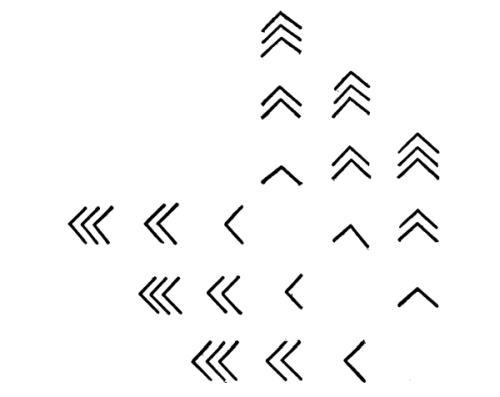
Fig. 152
Here we have a Rhythm, of somewhat contrary movements, with Balance,—Balance on a diagonal axis. The Balance is not satisfactory. The Balance of Inclinations is felt more than the Balance of Shapes.
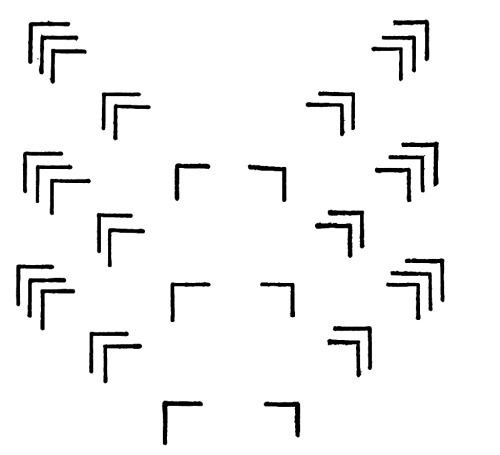
Fig. 153
In this case we have the combination of a Rhythm of somewhat contrary, but on the whole upward, movements with Symmetry.
If the diverging movements of Fig. 153 should be made still more diverging, so that they become approximately contrary and opposite, the feeling of a general upward movement will disappear. The three movements to the right will balance the three movements to the left, and we shall have an illustration of Symmetrical Balance, with no Rhythm in the composition as a whole. It is doubtful whether the balance of contrary and opposite movements is satisfactory. Our eyes are drawn in opposite directions, away from the axis of balance, instead of being drawn toward it. Our appreciation of the balance must, therefore, be diminished. Contrary and opposite movements neutralize one another, so we have neither rest nor movement in the balance of contrary motions.
By bringing the divergences of movement together, gradually, we shall be able to increase, considerably, the upward movement shown in Fig. 153. At the same time, the suggestion of an upward growth of vegetation becomes stronger. The increase of movement will be partly explained by this association of ideas.
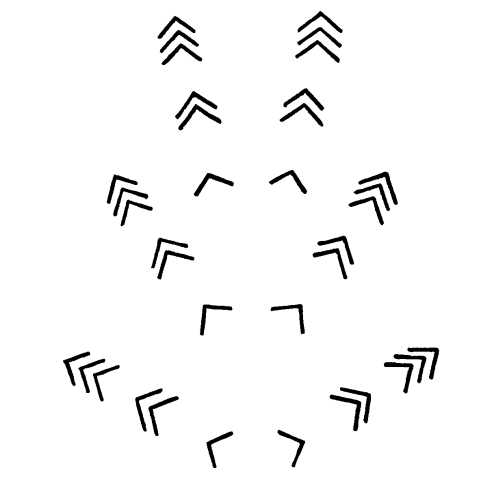
Fig. 154
Here all the movements are pulled together into one direction. The Rhythm is easier and more rapid. The Balance is just as good. The movement in this case is no doubt facilitated by the suggestion of upward growth. It is impossible to estimate the force which is added by such suggestions and associations.
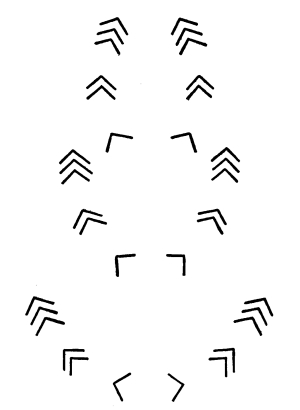
Fig. 155
Here the movements come together in another way.
The number and variety of these illustrations might, of course, be indefinitely increased. Those which I have given will, I think, serve to define the principal modes of line-composition, when the lines are such as we choose to draw.
THE COMPOSITION OF VARIOUS LINES
105. In most of the examples I have given I have used repetitions of the same line or similar lines. When the lines which are put together are not in harmony, when they are drawn, as they may be, without any regard to the exigencies of orderly composition, the problem becomes one of doing the best we can with our terms. We try for the greatest possible number of orderly connections, connections making for Harmony, Balance, and Rhythm. We arrange the lines, so far as possible, in the same directions, giving them similar attitudes, getting, in details, as much Harmony of Direction and of Attitudes as possible, and establishing as much Harmony of Intervals as possible between the lines. By spacing and placing we try to get differences of character as far as possible into regular alternations or gradations in which there will be a suggestion either of Harmony or of Rhythm. A suggestion of Symmetry is sometimes possible. Occult Balance is possible in all cases, as it depends, not upon the terms balanced, but upon the indication of a center of attractions by a symmetrical framing of them.
Let us take seven lines, with a variety of shape-character, with as little Shape-Harmony as possible, and let us try to put these lines together in an orderly way.
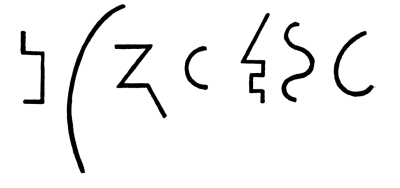
Fig. 156
With these lines, which show little or no harmony of character, which agree only in tone and in width-measure, lines which would not be selected certainly as suitable material for orderly compositions, I will make three compositions, getting as much Order into each one as I can, just to illustrate what I mean. I shall not be able to achieve a great deal of Order, but enough, probably, to satisfy the reader that the effort has been worth while.
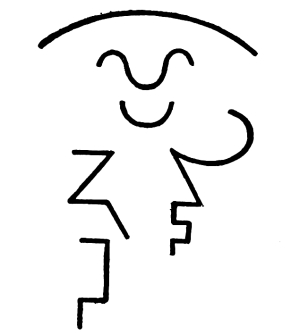
Fig. 157
In this case I have achieved the suggestion of a Symmetrical Balance on a vertical axis with some Harmony of Directions and of Attitudes and some Interval-Harmony.
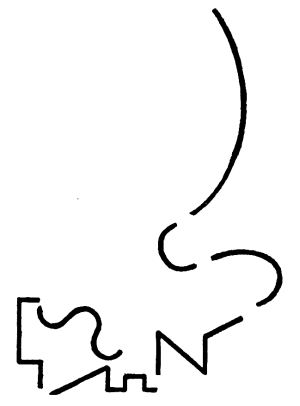
Fig. 158
In this case, also, I have achieved a suggestion of Order, if not Order itself. Consider the comparative disorder in Fig. 156, where no arrangement has been attempted.
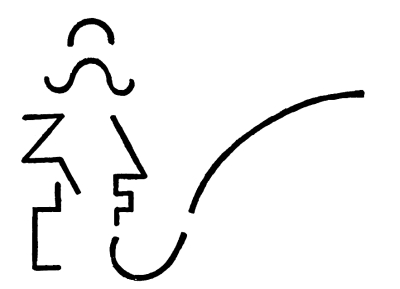
Fig. 159
Here is another arrangement of the same terms. Fortunately, in all of these cases, the lines agree in tone and in width-measure. That means considerable order to begin with.
This problem of taking any terms and making the best possible arrangement of them is a most interesting problem, and the ability to solve it has a practical value. We have the problem to solve in every-day life; when we have to arrange, as well as we can, in the best possible order, all the useful and indispensable articles we have in our houses. To achieve a consistency and unity of effect with a great number and variety of objects is never easy. It is often very difficult. It is particularly difficult when we have no two objects alike, no correspondence, no likeness, to make Harmony. With the possibility of repetitions and inversions the problem becomes comparatively easy. With repetitions and inversions we have the possibility, not only of Harmony, but of Balance and Rhythm. With inversions we have the possibility, not only of Balance, but of Symmetrical Balance, and when we have that we are not at all likely to think whether the terms of which the symmetry is composed are in harmony or not. We feel the Order of Symmetry and we are satisfied.
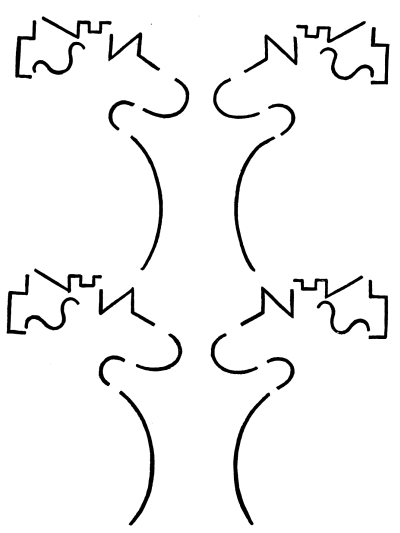
Fig. 160
In this design I repeat an inversion of the arrangement in Fig. 158. The result is a symmetry, and no one is likely to ask whether the elements of which it is composed are harmonious or not. By inversions, single and double, it is possible to achieve the Order of Balance, in all cases.
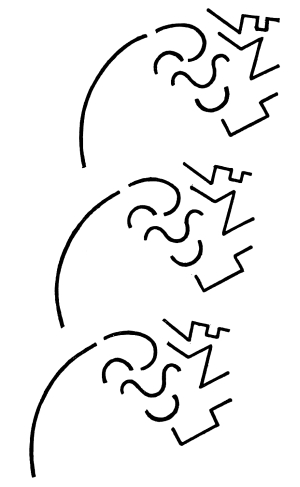
Fig. 161
For this design I have made another arrangement of my seven lines. The arrangement suggests movement. In repeating the arrangement at regular and equal intervals, without change of attitude, I produce the effect of Rhythm. Without resorting to inversion, it is difficult to make even an approximation to Symmetry with such terms (see Fig. 157), but there is little or no difficulty in making a consistent or fairly consistent movement out of them, which, being repeated at regular intervals, without change of attitude, or with a gradual change of attitude, will produce the effect of Rhythm.
Up to this point I have spoken of the composition of lines in juxtaposition, that is to say, the lines have been placed near together so as to be seen together. I have not spoken of the possibilities of Contact and Interlacing. The lines in any composition may touch one another or cross one another. The result will be a composition of connected lines. In certain cases the lines will become the outlines of areas. I will defer the illustration of contacts and interlacings until I come to consider the composition of outlines.