Order LAGOMORPHA—Hares, Rabbits and Pikas (continued 2)
Reading edition
Marginal records (A. H. Howell, 1936:327).—Labrador: Hopedale; Makkovik. Newfoundland: Saint Johns; type locality; Mt. St. Gregory.
Lepus arcticus groenlandicus Rhoads.
1896. Lepus groenlandicus Rhoads, Amer. Nat., 30:254(=237 of March issue), author's separates (preprints) issued February 20, type from Robertson Bay, NW Greenland.
1934. [Lepus arcticus] groenlandicus, Nelson, Proc. Biol. Soc. Washington, 47:83, March 8.
1912. Boreolepus groenlandicus, Barrett-Hamilton, Hist. British Mammals, pt. 12, p. 298, October.
1930. Lepus variabilis hyperboreus Pedersen, Medd. om Grönland, 77:363, no type or type locality designated but name applied to hares of east Greenland in the general vicinity of Scoresby Sound (preoccupied by Lepus hyperboreas Pallas, Zoogeographica Rosso Asiatica, 1:152, 1831, a species of Ochotona).
1934. Lepus arcticus persimilis Nelson, Proc. Biol. Soc. Washington, 47:84, March 8, type from S side Clavering Island, east Greenland.
Marginal records.—Greenland (A. H. Howell, 1936:331): Cape Alexander; on east coast to Francis Joseph Fiord; on west coast to Nugsuak Peninsula; Disko Island; Holsteinsborg.
Lepus arcticus labradorius Miller.
1899. Lepus labradorius Miller, Proc. Biol. Soc. Washington, 13:39, May 29, type from Fort Chimo, Ungava, Canada.
1924. Lepus arcticus labradorius, G. M. Allen and Copeland, Jour. Mamm., 5:12, February 9.
1902. Lepus arcticus canus Preble, N. Amer. Fauna, 22:59, October 31, type from Hubbart Point, W coast Hudson Bay, Keewatin.
Marginal records (A. H. Howell, 1936:323).—Franklin: Pangnirtung Fiord; Nunata, Kingua Fiord; Cumberland Sound, Blacklead Island; Weddell Harbor, Frobisher Bay. Labrador: Ramah; Solomons Island, near Davis Inlet. Quebec: type locality; Great Whale River, Hudson Bay; Belcher Islands. Manitoba: Fort Churchill; Hubbart Point. Keewatin: Cape Fullerton; Southampton Island. Franklin: Cape Dorset; Camp Kungovik, W coast Baffin Island, 65° 35´ N lat.; Nettilling Fiord.
Lepus arcticus monstrabilis Nelson.
1934. Lepus arcticus monstrabilis Nelson, Proc. Biol. Soc. Washington, 47:85, March 8, type from Buchanan Bay, Ellesmere Island.
Marginal records.—Franklin (A. H. Howell, 1936:329): Cape Sheridan; Craig Harbor; Dundas Harbor, Devon Island.
Lepus arcticus porsildi Nelson.
1934. Lepus arcticus porsildi Nelson, Proc. Biol. Soc. Washington, 47:83, March 8, type from near Julianehaab, 61° 20´ N lat., Greenland.
Marginal records.—Greenland (A. H. Howell, 1936:332): Sukkertoppen; Neria, 61° 36´ N lat.; 60° 42´ N lat.
Lepus townsendii White-tailed Jack Rabbit
Total length, 565-655; tail, 66-112; hind foot, 145-172; ear from notch (dry), 96-113. Upper parts grayish brown; tail all white or with dusky or buffy mid-dorsal stripe which does not extend onto back; white in winter in northern parts of its range. Two adult males weighed 2945 and 2494 grams (Orr, 1940:43) and there are 3 to 6 young in a litter.
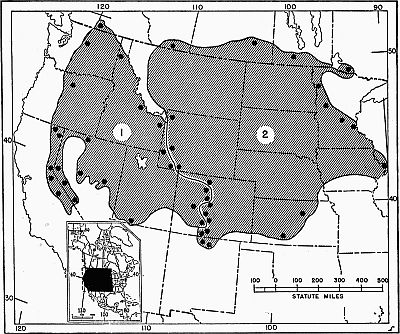
Fig. 46. Distribution of Lepus townsendii.
Lepus townsendii townsendii
Lepus townsendii campanius
Lepus townsendii campanius Hollister.
1837. Lepus campestris Bachman, Jour. Acad. Nat. Sci. Philadelphia, 7:349, not of Meyer, 1790; type locality plains of the Saskatchewan, probably near Carlton House.
1915. Lepus townsendii campanius Hollister, Proc. Biol. Soc. Washington, 28:70, March 12.
Marginal records (Nelson, 1909:78, unless otherwise noted).—Saskatchewan: Indian Head (Nelson, 1909:77). Manitoba: Carberry (ibid.). Ontario: Rainy River (Anderson, 1947:100). Minnesota (Swanson, Surber and Roberts, 1945:97): Polk County; Otter Tail County; Sherburne County: Washington County. Illinois: Blanding, 6 mi. WNW Hanover (Hoffmeister, 1948:1). Kansas: Red Fork, 60 mi. W Fort Riley; Greensburg (Brown, 1940:387). New Mexico: "near" Taos (V. Bailey, 1932:47); Hopewell. Colorado: Antonito; Fort Garland; Villa Grove; Salida; Como; Denver; Mt. Whitely, 25 mi. N Kremmling. Wyoming: Spring Creek; Big Piney; head Glenn Creek, Yellowstone Nat'l Park. Alberta: Great Plains region (Anderson, 1947:99).
Lepus townsendii townsendii Bachman.
1839. Lepus townsendii Bachman, Jour. Acad. Nat. Sci. Philadelphia, 8(pt. 1):90, pl. 2, type from Fort Walla Walla, near present town of Wallula, Walla Walla County, Washington.
1904. Lepus campestris sierrae Merriam, Proc. Biol. Soc. Washington, 17:132, July 14, type from 7800 ft., Hope Valley, Alpine County, California. Regarded as inseparable from L. t. townsendii by Orr, Occas. Papers, California Acad. Sci., 19:42, May 25, 1940.
Marginal records (Nelson, 1909:82, unless otherwise noted).—British Columbia: Fairview, Okanagan Valley. Idaho: Rathdrum Prairie (Rust, 1946:322); Lemhi River; Teton Basin. Wyoming: Hamsfork; Henrys Fork. Colorado: Hot Sulphur Springs; Mt. Baldy; Crested Butte; Mill City. Utah: Kanab. Nevada (Hall, 1946:600): Hamilton; Desatoya Mts.; Santa Rosa Mts. California: Parker Creek, 6300 ft., Warner Mts. Nevada (Hall, 1946:600): 8600 ft., 3 mi. S Mt. Rose; 8900 ft., Lapon Canyon, Mt. Grant; Mt. Magruder. California (Orr, 1940:43): Tuolumne Meadows; Woodfords; Tahoe City; 4700 ft., Steele Meadows. Oregon: Antelope. Washington: Manson (Dalquest, 1948:382).
Lepus californicus Black-tailed Jack Rabbit
Total length, 465-630; tail, 50-112; hind foot, 112-145; ear from notch (dry), 99-131. Upper parts gray to blackish; tail with black mid-dorsal stripe extending onto back; never all white in winter. On the tableland of Mexico and in the southwestern United States where this species occurs together with the white-sided jack rabbits, L. californicus can be recognized by the terminal black patch on the outside of each ear and by the less extensive area of white on the flank. To the eastward, in Tamaulipas, where only the black-tailed jack rabbit occurs, it too, has extensively white flanks and some individuals lack the terminal black patch on the ear.
A certain means for distinguishing the skulls of the black-tailed jack rabbit from those of all of the white-sided jack rabbits has not yet been found. The same is true of the skulls of the white-tailed jack rabbit and the black-tailed jack rabbit in the Great Basin region of Nevada. The skulls, at least of adults, of these two species, in the region east of the Rocky Mountains can be readily distinguished by the pattern of infolding of the enamel on the front of the first upper incisor teeth; L. townsendii has a simple groove on the anterior face of the tooth and L. californicus, east of the Rocky Mountains, has a bifurcation, or even trifurcation, of the infold that can readily be seen by examining the occlusal surface of the incisor.
In Arizona, Vorhies and Taylor (1933:478) found the weight of 23 adult males to average 5.1 (4.4-6.1) lbs. In that state, 70 pregnant females averaged 2.24 (1-6) young per litter and the authors (op. cit.) thought that a female had three or four litters each year.
Lepus californicus altamirae Nelson.
1904. Lepus merriami altamirae Nelson, Proc. Biol. Soc. Washington, 17:109, May 18, type from Alta Mira, Tamaulipas. Known from type locality only.
1951. Lepus californicus altamirae, Hall, Univ. Kansas Publ., Mus. Nat. Hist., 5:45, October 1, 1951.
Lepus californicus asellus Miller.
1899. Lepus asellus Miller, Proc. Acad. Nat. Sci., Philadelphia, p. 380, September 29, type from San Luis Potosí, San Luis Potosí.
1909. Lepus californicus asellus, Nelson, N. Amer. Fauna, 29:150, August 31.
Marginal records (Nelson, 1909:151).—Coahuila: Jaral. Nuevo Leon: Miquihuana. San Luis Potosí: Río Verde. Aguascalientes: Chicalote. Zacatecas: Valparaiso.
Lepus californicus bennettii Gray.
1844. Lepus bennettii Gray, Zoology Voy. Sulphur, p. 35, pl. 14, type from San Diego, San Diego County, California.
1909. Lepus californicus bennetti, Nelson, N. Amer. Fauna, 29:136, August 31.
Marginal records.—California: Mt. Piños (Orr, 1940:73); Arroyo Seco, Pasadena (Orr, 1940:74); San Felipe Valley (ibid.); Jacumba (Nelson, 1909:137), Baja California: San Quintín (Nelson, 1909:137). Northward along coast at least to California: Montalvo (Orr, 1940:73).
Lepus californicus californicus Gray.
1837. Lepus californica Gray, Charlesworth's Mag. Nat. Hist., 1:586, type from "St. Antoine," California (probably on coastal slope of mts. near the Mission of San Antonio, Jolon, Monterey County).
1926. Lepus californicus vigilax Dice, Occas. Papers Mus. Zool., Univ. Michigan, 166:11, February 11, type from Balls Ferry, Shasta County, California.
Marginal records.—Oregon (Nelson, 1909:132): Drain; Grants Pass. California (Orr, 1940:68-69): Callahan, Scott River; 3300 ft, Lymans, NW of Lyonsville; Dry Creek, Oroville-Chico Road; Snelling; Hernandez; Morro; Carmel Point; Bolinas Bay; Freestone; Sherwood; Ferndale; 3 mi. W Arcata. Oregon: Rogue River Valley (Nelson, 1909:132).
Lepus californicus curti Hall.
1951. Lepus californicus curti Hall, Univ. Kansas Publ., Mus. Nat. Hist., 5:42, October 1, 1951, type from 88 mi. S and 10 mi. W Matamoros, Tamaulipas. Known from type locality only.
Fig. 47. Distribution of Lepus californicus and Lepus insularis.
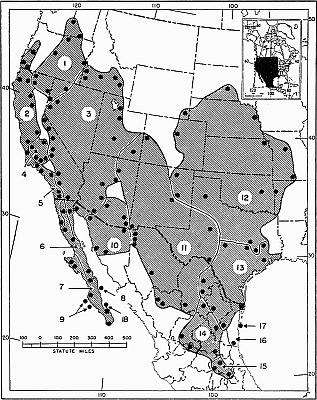
L. c. wallawalla
L. c. californicus
L. c. deserticola
L. c. richardsonii
L. c. bennettii
L. c. martirensis
L. c. xanti
L. c. sheldoni
L. c. magdalenae
L. c. eremicus
L. c. texianus
L. c. melanotis
L. c. merriami
L. c. asellus
L. c. festinus
L. c. altamirae
L. c. curti
L. insularis
Lepus californicus deserticola Mearns.
1896. Lepus texianus deserticola Mearns, Proc. U. S. Nat. Mus., 18:564, June 24, type from western edge Colorado Desert, at base of Coast Range Mts., Imperial County, California.
1909. Lepus californicus deserticola, Nelson, N. Amer. Fauna, 29:137, August 31.
1932. Lepus californicus depressus Hall and Whitlow, Proc. Biol. Soc. Washington, 45:71, April 2, type from 1/2 mi. S. Pocatello, Bannock County, Idaho. (Regarded as inseparable from L. c. deserticola by Davis, The Recent Mammals of Idaho, p. 359, April 5, 1939.)
Marginal records (Nelson, 1909:140, unless otherwise noted).—Idaho (Davis, 1939:360): Boise River; Sawtooth Nat'l Forest; Arco; Blackfoot. Utah: Ogden; Provo; Loa. Arizona: San Francisco Mtn.; Fort Whipple; Phoenix; Rancho Bonito, Abra Valley (Huey, 1942:362). Sonora: El Doctor. Baja California: Calamahue; Esperanza Canyon. California (Orr, 1940-76): Coyote Wells; Kenworthy; Victorville; Farrington Ranch; 5 mi. SW Lone Pine; 10,000 ft., head Silver Canyon; Mono Mills; 5600 ft., near Woodfords. Nevada (Hall, 1946:606): Sutcliffe; 3/4 mi. S Sulphur. Idaho: 6 mi. S Murphy (Davis, 1939:360).
Lepus californicus eremicus J. A. Allen.
1894. Lepus texianus eremicus J. A. Allen, Bull. Amer. Mus. Nat. Hist., 6:347, December 7, type from Fairbank, Cochise County, Arizona.
1909. Lepus californicus eremicus, Nelson, N. Amer. Fauna, 29:140, August 31.
Marginal records (Nelson, 1909:141, unless otherwise noted).—Arizona: Casa Grande; Fort Bowie; 2 mi. E Portal (Cahalane, 1939:435). Chihuahua: San Bernardino Ranch (possibly Nelson should have placed this in Sonora); Colonia Garcia. Sonora: Hermosillo; La Libertad (Burt, 1938:68); Agua Dulce (of Sonora, not of Arizona).
Lepus californicus festinus Nelson.
1904. Lepus festinus Nelson, Proc. Biol. Soc. Washington, 17:108, May 18, type from Irolo, Hidalgo.
1909. Lepus californicus festinus Nelson, N. Amer. Fauna, 29:151, August 31.
Marginal records (Nelson, 1909:152).—Hidalgo: Zimapan; Tulancingo; type locality; Queretaro: Tequisquiapam.
Lepus californicus magdalenae Nelson.
1907. Lepus californicus magdalenae Nelson, Proc. Biol. Soc. Washington, 20:81, July 22, type from Magdalena Island, Baja California.
Marginal records.—Baja California (Nelson, 1909:155): type locality; Margarita Island.
Lepus californicus martirensis Stowell.
1895. Lepus martirensis Stowell, Proc. California Acad. Sci., 5(ser. 2):51, May 28, type specimen from the San Pedro Mártir Mountains of Baja California.
Marginal records.—Baja California (Nelson, 1909:154): La Huerta; Calamahue; San Bruno; Rancho San José; San Simon.
Lepus californicus melanotis Mearns.
1890. Lepus melanotis Mearns, Bull. Amer. Mus. Nat. Hist., 2:297, February 21, type from Independence, Montgomery County, Kansas.
1909. Lepus californicus melanotis, Nelson, N. Amer. Fauna, 29:146, August 31.
Marginal records.—South Dakota: Lyman Co. (Over and Churchill, 1945:48). Nebraska: Oakland (12399 KU). Kansas: near Doniphan Lake (Linsdale, 1928:146). Missouri: Saline Co. (Enders, 1932:120); 5 mi. E Rockbridge (Leopold and Hall, 1945:145). Arkansas: "about" 2 mi. S Evansville (Dellinger and Black, 1940:190). Oklahoma: 3 mi. E Wainwright (Blair, 1939:128). Texas: Brazos County (Petersen, 1946:166); Golinda (Nelson, 1909:148); Washburn (ibid.). New Mexico: Santa Rosa (ibid.); vicinity of Cimarron (Hill, 1942:82). Colorado: Semper (Nelson, 1909:148). Wyoming: 3 mi. W Meriden along Horse Cr. (15926 KU).
Lepus californicus merriami Mearns.
1896. Lepus merriami Mearns, Preliminary diagnoses of new mammals from the Mexican border of the United States, p. 2, March 25, (Reprint: Proc. U. S. Nat. Mus., 18:444, May 23, 1896) type from Fort Clark, Kinney County, Texas.
Marginal records (Nelson, 1909:150, unless otherwise noted).—Texas: Mason; Lott; Antioch; Houston. Tamaulipas: Matamoros; Tamaulipeca, San Carlos Mts. (Dice, 1937:255). Nuevo Leon: Santa Catariña. Coahuila: Monclova; Sabinas.
Lepus californicus richardsonii Bachman.
1839. Lepus richardsonii Bachman, Jour. Acad. Nat. Sci. Philadelphia, 8(pt. 1):88, type from California (exact locality unknown, but probably on interior slope of mts. near Jolon, Monterey County).
1909. Lepus californicus richardsoni, Nelson, N. Amer. Fauna, 29:133, August 31.
1904. Lepus tularensis Merriam, Proc. Biol. Soc. Washington, 17:136, July 14, type from Alila, Tulare County, California.
Marginal records.—California (Orr, 1940:71): Minkler; Thompson Valley, Walker Basin; Kern Lake Basin; Carrizo Plains, 7 mi. SE Simmler; 2 mi. E Bryson; Jolon.
Lepus californicus sheldoni Burt.
1933. Lepus californicus sheldoni Burt, Proc. Biol. Soc. Washington, 46:37, February 20, type from Carmen Island [(lat. 26° N, long. 111° 12´ W) Gulf of Calif.], Baja California. Known from type locality only.
Lepus californicus texianus Waterhouse.
1848. Lepus texianus Waterhouse, Nat. Hist. Mamm., 2:136, type locality unknown, but probably in western Texas.
1909. Lepus californicus texianus, Nelson, N. Amer. Fauna, 29:142, August 31.
1896. Lepus texianus griseus Mearns, Proc. U. S. Nat. Mus., 18:562, June 24, type from Fort Hancock, El Paso County, Texas.
1903. Lepus (Macrotolagus) texianus micropus J. A. Allen, Bull. Amer. Mus. Nat. Hist., 19:605, November 12, type from Río del Bocas, NW Durango.
Marginal records (Nelson, 1909:146, unless otherwise noted).—Colorado: between Grand Junction and the Utah boundary (Cary, 1911:158). New Mexico: Roswell (Nelson, 1909:145). Texas (Nelson, 1909:145). Colorado: Comstock. Coahuila: 8 mi. SE San Pedro de los Colonias, 3700 ft. (40206 KU). Durango: Río Sestín; Río del Bocas. Chihuahua: Santa Rosalia; Pacheco; San Luis Mts. New Mexico (Nelson, 1909:145): Guadalupe Ranch. Arizona: Painted Desert. Utah: Abajo (Blue Mts.) (Barnes, 1927:149).
Lepus californicus wallawalla Merriam.
1904. Lepus texianus wallawalla Merriam, Proc. Biol. Soc. Washington, 17:137, July 14, type from Touchet, Plains of the Columbia, Walla Walla County, Washington.
1909. Lepus californicus wallawalla, Nelson, N. Amer. Fauna, 29:132, August 31.
Marginal records.—Washington: Moses Coulee (Dalquest, 1948:386); Touchet (Nelson, 1909:133). Oregon: Ontario (Nelson, 1909:133). Nevada (Hall, 1946:606): 4100 ft., Quinn River Crossing; 4200 ft., 4-1/2 mi. W Flanigan. California (Orr, 1940:79): 5000 ft., 7 mi. E Ravendale; 3600 ft., 1 mi. SE Weed; Hornbrook. Oregon (Nelson, 1909:133): Hay Creek; Willow Junction.
Lepus californicus xanti Thomas.
1898. Lepus californicus xanti Thomas, Ann. and Mag. Nat. Hist., 1(ser. 7):45, January, type from Santa Anita, Baja California.
Marginal records.—Baja California (Nelson, 1909:156): Southern part of the Peninsula. Santa Clara Mts., southward around range of L. c. martirensis to and down east coast; La Paz; Cape St. Lucas; San Jorgé; 20 mi. W San Ignacio.
Lepus insularis Bryant Black Jack Rabbit
1891. Lepus insularis Bryant, Proc. California Acad. Sci., 3(ser. 2):92, April 23, type from Espiritu Santo Island, Gulf of California, Baja California. Known from Espiritu Santo Island only.
1895. Lepus edwardsi St. Loup, Bull. Mus. Hist. Nat., Paris, 1:5, type from Espiritu Santo Island, Gulf of California, Baja California.
Total length, 574; tail, 96; hind foot, 121; ear from notch (dry), 105. This insular species, clearly a close relative of Lepus californicus of the adjacent peninsula of Baja California, is mainly glossy black on the upper parts but grizzled and suffused on sides of back and body, and in some specimens on head, with dark buffy or reddish brown; underparts dark cinnamon buffy or dusky brown; ears and sides of head grayish dusky; jugals heavier than in Lepus californicus of the adjacent peninsula of Baja California.
Lepus callotis Wagler White-sided Jack Rabbit
1830. Lepus callotis Wagler, Nat. Syst. der Amphibien, p. 23, type from southern end of Mexican Tableland.
1830. Lepus mexicanus Lichtenstein, Abhandl. k. Akad. Wiss., Berlin., p. 101, type from México (southern end of Mexican Tableland).
1833. Lepus nigracaudatus Bennett, Proc. Zool. Soc. London, p. 41, type from "that part of California which adjoins to Mexico" (probably southwestern part of Mexican Tableland).
Marginal records (Nelson, 1909:124).—Durango: Durango (city of). San Luis Potosí: Arenal. Hidalgo: Tulancingo. Oaxaca: Oaxaca (city of); Tlapancingo. Jalisco: Atenquiqui; Reyes.
Total length, 560; tail, 71; length of hind foot, 133; ear from notch (dry), 117. Upper parts dark, slightly pinkish, buff heavily washed with black; backs of ears mainly white without terminal patch of black; flanks white; rump iron gray.
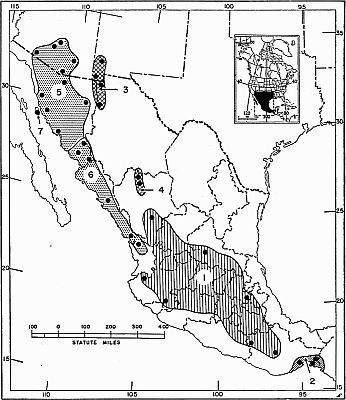
Fig. 48. Distribution of the White-sided Jack Rabbits.
Guide to kinds:
Lepus callotis
Lepus flavigularis
Lepus gaillardi gaillardi
Lepus gaillardi battyi
Lepus alleni alleni
Lepus alleni palitans
Lepus alleni tiburonensis
Lepus flavigularis Wagner Tehuantepec Jack Rabbit
1844. Lepus callotis var [gamma] flavigularis Wagner, Schreber's Säugthiere, Suppl., 4:106, type from México (probably near Tehuantepec City, Oaxaca).
1909. Lepus flavigularis, Nelson, N. Amer. Fauna, 29:125, August 31.
Marginal records.—Oaxaca (Nelson, 1909:126): Santa Efigenia; San Mateo del Mar; Huilotepec.
Total length, 595; tail, 77; hind foot, 133; ear from notch (dry), 112. Upper parts bright ochraceous buff strongly washed with black; ears entirely buff; nape with black stripe extending back from base of each ear and median stripe of buff; flanks and underparts of body white; rump iron gray; tympanic bullae smaller than in any other Lepus of México.
Lepus gaillardi Gaillard Jack Rabbit
Total length, 450-536; tail, 59-80; hind foot, 124-133; ear from notch (dry), 110-112. Coloration essentially as in Lepus callotis except that nape is plain buff, without a trace of black, and upper parts paler, more vinaceous buff.
Lepus gaillardi battyi J. A. Allen.
1903. Lepus (Microtolagus [sic]) gaillardi battyi J. A. Allen, Bull. Amer. Mus. Nat. Hist., 19:607, November 12, type from Rancho Santuario, northwestern Durango.
Marginal records.—Durango (Nelson, 1909:122): Río Campo; type locality.
Lepus gaillardi gaillardi Mearns.
1896. Lepus gaillardi Mearns, Proc. U. S. Nat. Mus., 18:560, June 24, type from West Fork of Playas Valley, near monument No. 63, Mexican boundary line, Grant County, New Mexico.
Marginal records.—New Mexico: Animas Valley (V. Bailey, 1932:53). Chihuahua (Nelson, 1909:121): Whitewater; Colonia Juarez. New Mexico; type locality.
Lepus alleni Antelope Jack Rabbit
Total length, 553-670; tail, 48-76; hind foot, 127-150, ear from notch, in flesh, 138-173. Top and sides of head creamy buff, slightly washed on top with black; tail white except for mid-dorsal line of black extending onto rump; sides of shoulders, flanks, sides of abdomen, rump, and outside of hind legs uniform iron gray. The average weight of 61 adult males from Arizona was 8.2 lbs. In that state 124 pregnant females had an average of 1.93 young (1-5) and Vorhies and Taylor (1933:580) thought that a female had three or four litters per year.
Lepus alleni alleni Mearns.
1890. Lepus alleni Mearns, Bull. Amer. Mus. Nat. Hist., 2:294, February 21, type from Rillito, on the Southern Pacific Railroad, Pima County, Arizona.
Marginal records.—Arizona: Queen Creek (Vorhies and Taylor, 1933:480); Cascabel (ibid.); Calabasas (Nelson, 1909:118). Sonora (Burt, 1938): Cerro Blanco (p. 67); Oputo (p. 66); Batamotal (p. 66); La Libertad Ranch (p. 67); Picu Pass (p. 67). Arizona: 2 mi. W Quitovaquita (Huey, 1942:362); Casa Grande (Nelson, 1909:118).
Lepus alleni palitans Bangs.
1900. Lepus (Macrotolagus) alleni palitans Bangs, Proc. New England Zool. Club, 1:85, February 23, type from Aguacaliente, about 40 mi. SE Mazatlan, Sinaloa.
Marginal records.—Sonora: near San Bernardo on Río Mayo on Sonora side of Sonora-Chihuahua boundary (Burt and Hooper, 1941:7): Alamos (Nelson, 1909:119); Guirocoba (Burt, 1938:68). Nayarit: Acaponeta (Nelson, 1909:119). Sinaloa (Nelson, 1909:119): Esquinapa; Rosario; Culiacán. Sonora: "near" Navajoa (Burt, 1938:68).
Lepus alleni tiburonensis Townsend.
1912. Lepus alleni tiburonensis Townsend, Bull. Amer. Mus. Nat. Hist., 31:120, June 14, type from Tiburon Island, Gulf of California, Sonora. Known from Tiburon Island only.
Lepus europaeus European Hare
Total length, 640-700; tail, 70-100; hind foot, 130-150; ear from notch (dry), 79-100; weight, 3000 to 5000 grams. Upper parts tawny, mixed with blackish hairs on back; underparts white including underside of tail; upper side of tail and terminal patch at distal end of outside of ears black; upper side of feet tawny like sides (not white or whitish). This is an introduced species.
Lepus europaeus europaeus Pallas.
1778. Lepus europaeus Pallas, Nov. Spec. Quadr. Glir. Ord., p. 30. Type locality, Burgundy, France. (Introduced and established in Ontario and parts of the northern United States; slowly spreading in southern Ontario north of Lake Erie (St. Thomas and Woodstock), west and north of Lake Ontario (Toronto) to Goodrich on east side of Lake Huron. See Anderson, Canadian Field-Naturalist, 37:75-76, April, 1923; Anderson, Nat. Mus. Canada Bull., 102:100, January 24, 1947; Burt, Mammals of Michigan, p. 247, 1946.)
Lepus europaeus hybridus Desmarest.
1822. Lepus hybridus Desmarest, Encyclopedie methodique (Zoologie) Mammalogie, pt. 1, p. 349 (Name based on "Russac" of Pallas, Nov. Spec. Quadr. Glir. Ord., p. 5, 1778), type locality central Russia.
1912. Lepus europaeus hybridus, Miller, Cat. Mamm., western Europe, Publ., British Mus. (Nat. Hist.), p. 508, November 23, 1912.
Range.—Introduced and established in New York and Connecticut (see Goodwin, Connecticut Geol. and Nat. Hist. Survey, Bull. 53:159-162, 1935).
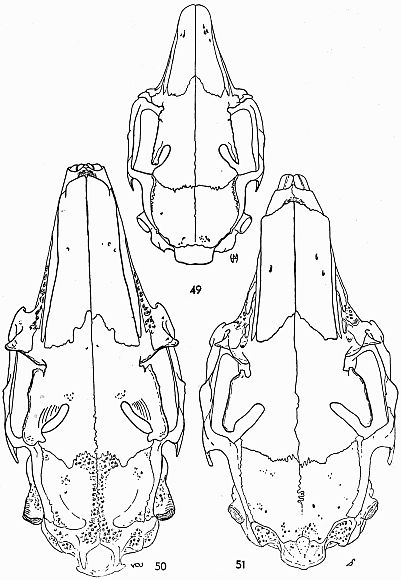
Figs. 49-51. Dorsal views of skulls of hares. All × 1.
Fig. 49. Lepus americanus tahoensis, 1/2 mi. S Tahoe Tavern, Lake Tahoe, Placer County, California. No. 37522 MVZ, ♂.
Fig. 50. Lepus alleni alleni, Santa Rita Mountains, 30 mi. S Tucson, Pima County, Arizona. No. 8621 KU, ♂.
Fig. 51. Lepus arcticus groenlandicus, Cape Alexander, Greenland. No. 114850 USNM, ♂.
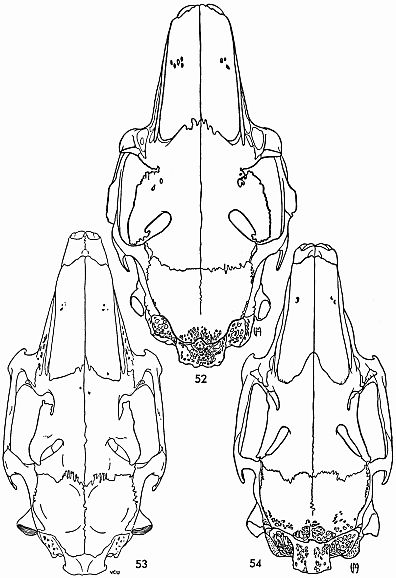
Figs. 52-54. Dorsal views of skulls of hares. All × 1.
Fig. 52. Lepus townsendii townsendii, north end Ruby Valley, east base Ruby Mountains, Elko County, Nevada. No. 4686, coll. of Ralph Ellis, ♀.
Fig. 53. Lepus callotis, 3-1/2 mi. S Tecolotlán, Jalisco. No. 31842 KU, ♀.
Fig. 54. Lepus californicus deserticola, 4 mi. W Fallon, Churchill County, Nevada. No. 900061 MVZ, ♂.
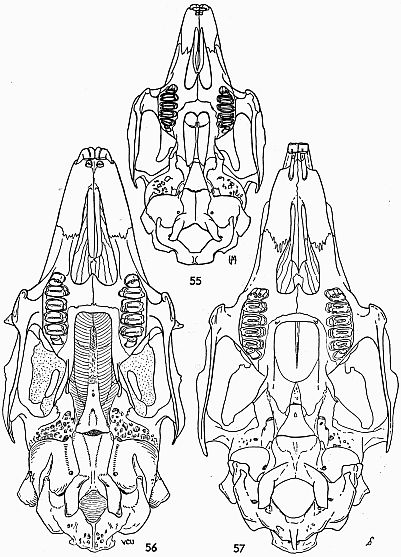
Figs. 55-57. Ventral views of skulls of hares. All × 1. Different views of these skulls are shown in
figs. 49-51
.
Fig. 55. Lepus americanus tahoensis.
Fig. 56. Lepus alleni alleni.
Fig. 57. Lepus arcticus groenlandicus.
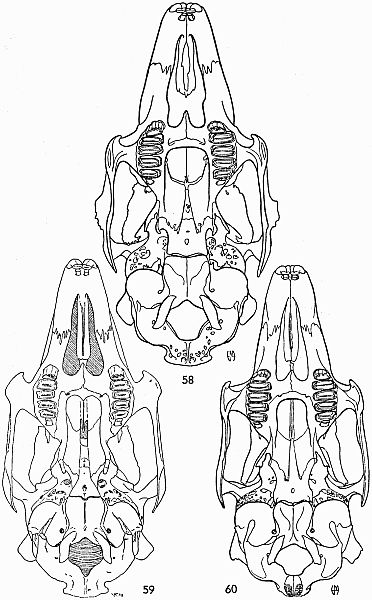
Figs. 58-60. Ventral views of skulls of hares. All × 1. Different views of these skulls are shown in
figs. 49-51
.
Fig. 58. Lepus townsendii townsendii.
Fig. 59. Lepus callotis.
Fig. 60. Lepus californicus deserticola.
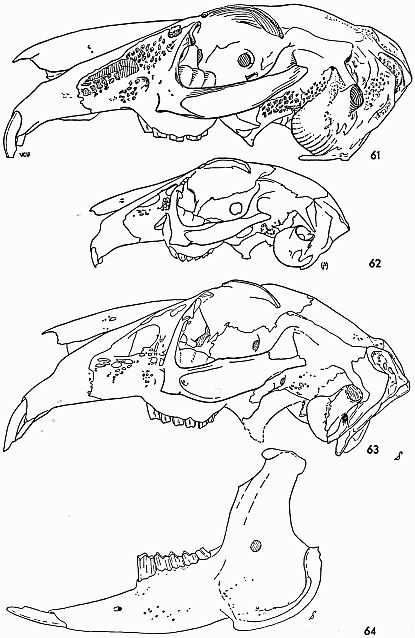
Figs. 61-64. Lateral views of skulls (one lower jaw) of hares.
All × 1.
Different views of these skulls are shown in
figs. 49-51
.
Fig. 61. Lepus alleni alleni.
Fig. 62. Lepus americanus tahoensis.
Figs. 63-64. Lepus arcticus groenlandicus.
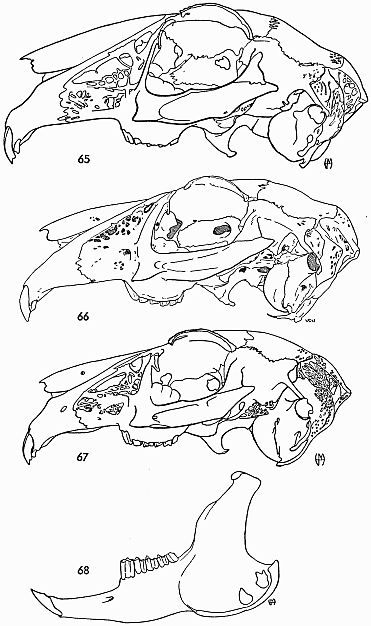
Figs. 65-68. Lateral views of skulls (one lower jaw) of hares. All × 1. Different views of these skulls are shown in
figs. 52-54
.
Fig. 65. Lepus townsendii townsendii.
Fig. 66. Lepus callotis.
Figs. 67-68. Lepus californicus deserticola.