Front matter
Reading edition
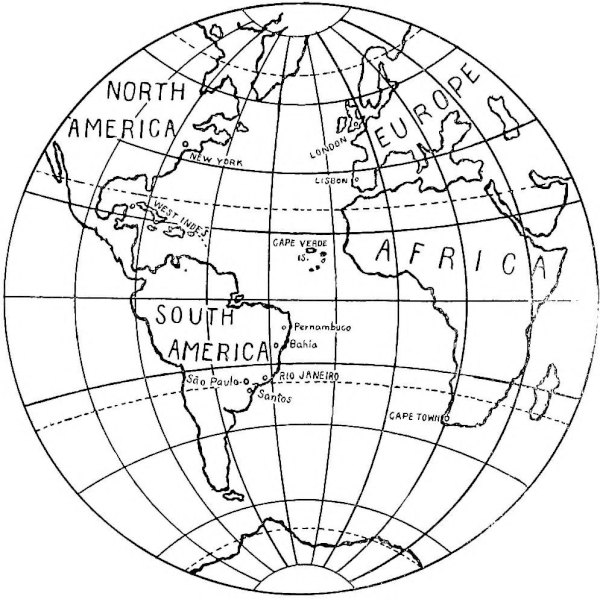
MAP OF TWO HEMISPHERES.
A SUMMER JOURNEY TO BRAZIL
By Alice R. Humphrey
“To the general American public Brazil is a terra incognita. Less is known of it than of Asia, Africa, the distant islands of the sea, or even of the North Pole.”
“I asked no other thing, No other was denied. I offered Being for it; The mighty merchant smiled. Brazil? He twirled a button, Without a glance my way: ‘But, madam, is there nothing else That we can show to-day?’” Emily Dickinson.

NEW YORK
BONNELL, SILVER & CO.
LONDON: 4 TRAFALGAR SQUARE
1900
Copyright, 1900, by
Bonnell, Silver & Co.
All rights reserved
Press of E. Scott Co., New York
CONTENTS.
PAGE
New York to Lisbon 1
Two Weeks in Tropical Seas 11
Pernambuco 20
Two Beautiful Bays 26
Petropolis 40
Santos and Some Brazilians 51
Consular Service at Santos 65
The City of São Paulo 72
Homeward Bound 96
Appendix.
An American System of Schools 102
Religious Instruction in Schools 112
Facts about Brazil 118
The Samaritan Hospital 122
Brazilian Naval Revolt Ended by U. S. Protection of her own Merchant Ships 124
Roman Catholic Church in Brazil as a State Church and as Related to Protestantism 141
1864 and 1900 147
John T. Mackenzie 148
ILLUSTRATIONS.
PAGE
Map of Two Hemispheres 1
Place du Commerce, Lisbon 6
Harbor, St. Vincent, Cape Verd Islands 14
Cable Station, St. Vincent 16
Reef, Pernambuco 20
President of Brazil.—Wife of President 32
Docks and Arsenal, Rio de Janeiro 34
Petropolis 40
Alley of Palms 48
Map of the State of São Paulo 50
Railway Station, Santos 52
Hotel and Park, Guaruja 62
Mackenzie College 68
Government Normal School Building 82
Coffee Picking 95
Coffee Washing 98
Coffee Drying 106
Blacks of Bahia 120
PREFACE
Experiences indicated in these pages are not merely incidental and exceptional but prove by repeated journeys to be really characteristic.
We first visited the Empire of Brazil when Dom Pedro was at his best; then in the critical period following the revolution; last when the era of discord had culminated and the first civilian President was peacefully elected. The short but severe apprenticeship in self government transformed a Latin Empire into a settled Republic in eight years. Now for three years the rapid advance in things which pertain to “life, liberty and the pursuit of happiness,” has been so quiet and steady as to pass unnoticed.
The eleven years’ history of this sister Republic is full of hope for Porto Rico, Cuba and the Philippines. The New York Evening Post, June 26th, 1900, says: “Under republican institutions individual effort has been stimulated and rapid development has gone forward in the wilds of the Amazon as it has in the coast regions of Brazil.” But nearly six years of military government were necessary before it was practicable to elect a civilian President.
The English expectation of a collapse of a Brazilian Republic was not given up until about 1896.
Great Britain’s equipment for ruling other nations is so far in advance of the United States that any thought of our copying her methods is as absurd as it would be to expect England to set up a self-governing Republic. The St. James Gazette of June 26th, 1900 expresses the opinion that China is “teaching America the impossibility of a great trading nation avoiding Imperialism,” and adds “America’s experience will teach her that it is not the desire to grab distant lands, but unavoidable destiny that drives Great Britain ever forward. Washington has no choice but to protect the imperilled American citizens and having once interfered in China to protect her interests she will never be able to shake from her shoes the dust of the Celestial Empire.” When Edwin H. Conger was Minister to Brazil the United States in protecting American shipping ended the Brazilian Republic’s most serious revolt. But the United States interference in Brazilian affairs went no further.
Little as the United States has otherwise done for Brazil the expressed feeling is “Our greatest wish is to model the new Brazilian Republic according to the Constitution of the United States and to develop and consolidate our friendship and commercial relations with that incomparable Nation.”
H. M. H.
PLAINFIELD, N. J.
AUGUST, 1900.
A SUMMER JOURNEY TO BRAZIL.