Part 4 — PART IV THE METHOD OF STRINGING A TURKISH, PERSIAN OR INDIAN BOW.
Reading edition
In these days no person I have ever heard of can string a strong Turkish bow—diminutive as this weapon is—without much personal assistance, or else by mechanical means, yet formerly the Turkish archer unaided could do so with ease.
This he achieved by a combination of leg and manual power. (Figs. 6 and 7, p. 110.)
With the longer reflex bows, the Chinese for instance, this operation is comparatively easy, as the hand can reach one end of the bow and draw it inwards for the loop of the bow-string to be slipped into the nock.
The Turkish bow, being so short, necessitates a great effort of strength on the part of the archer to bend it between his legs and, at the same time, stoop down to fit the bow-string. From constant practice, the Turk of former days knew exactly how and when to apply the muscular force of leg and arm necessary to string his bow—a performance that no modern archer could accomplish with a bow of any strength.
Leg and manual force combined is the only possible method of stringing a strong reflex bow, unless mechanical power is utilised: it was the hereditary custom of the Orientals. In the operation, there is always the risk of twisting the limbs of the bow, from a lack of the great strength of wrist required to hold them straight during the stringing. If the limbs of the bow are given the slightest lateral twist as they are being bent, the horn parts are certain to splinter, and the bow is then useless and damaged beyond repair.45
The difficulty of reversing and stringing a very stiff bow with such a reflex curve that its ends nearly meet before it is bent may be imagined.
De Busbecq tells us that some of the Turkish bows were so strong that if a coin was placed under the bow-string at one end of the bow, as it was being strung, no one but a trained archer could bend the bow sufficiently to set free the coin so that it fell to the ground.
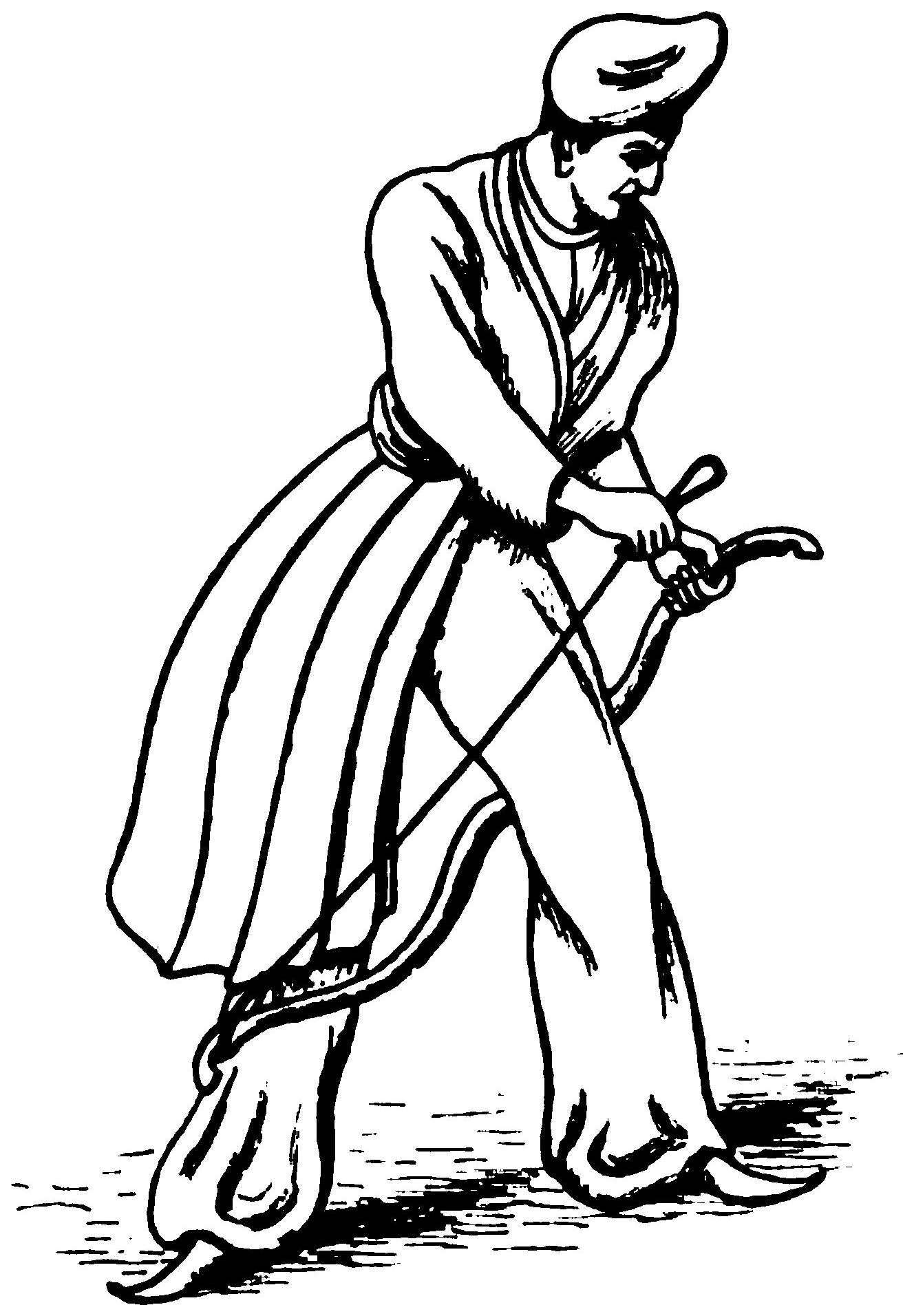
Fig. 6.
Fig. 6 shows an Oriental reflex bow being gradually reversed preparatory to fitting on its bow-string.
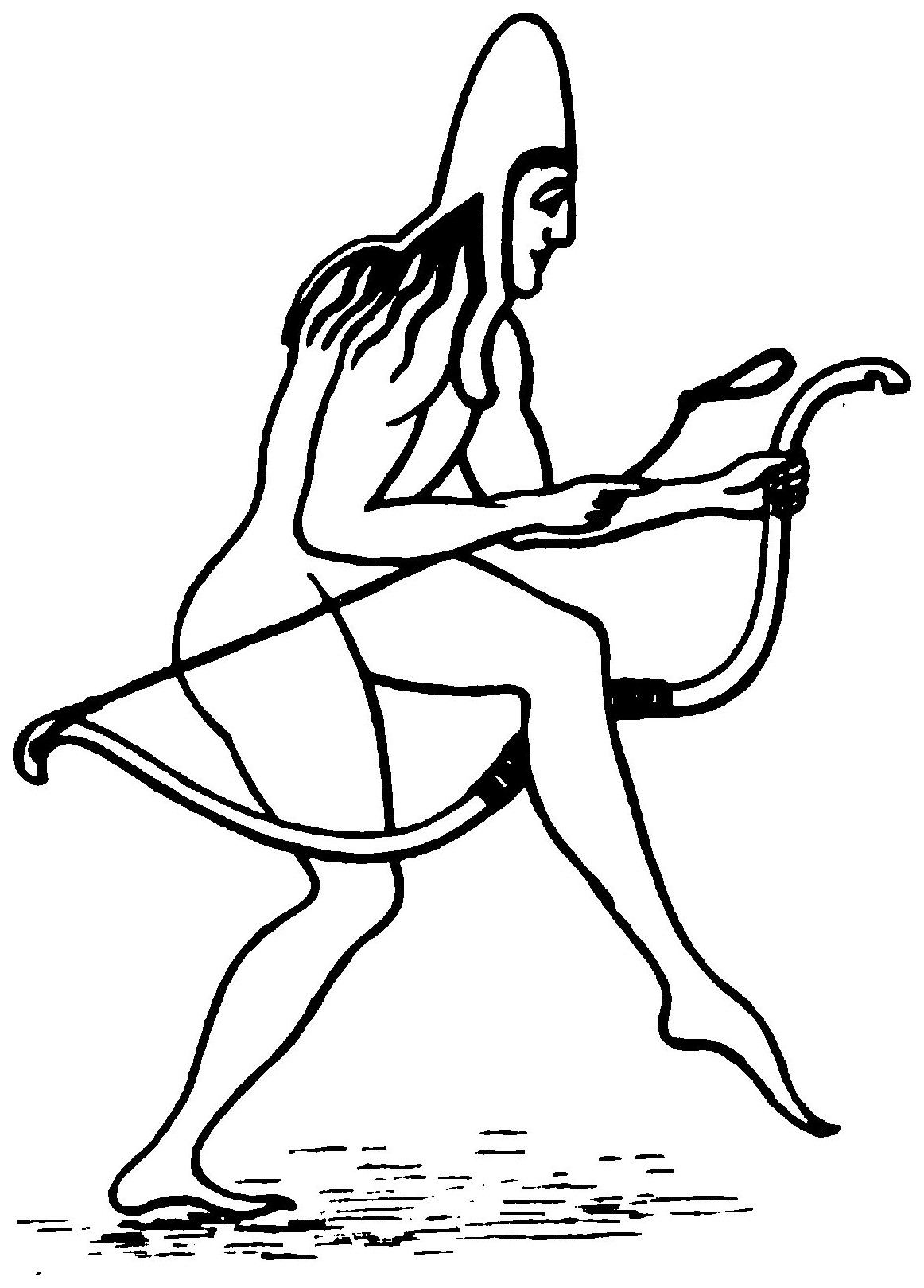
Fig. 7.
Fig. 7 shows a similar bow when reversed sufficiently to fit its bow-string.
Though this illustration is from an ancient Greek vase, it will be noticed that in it the power of the leg and arm is applied in precisely the same way as in the more modern example given.