b. An Association against the Stamp Act in a Virginia County, 1766 (continued 2)
Reading edition
WE, his majesty's most loyal subjects, the delegates of the several colonies of New-Hampshire, Massachusetts-Bay, Rhode-Island, Connecticut, New-York, New-Jersey, Pennsylvania, the three lower counties of Newcastle, Kent and Sussex on Delaware,[127] Maryland, Virginia, North-Carolina, and South-Carolina, deputed to represent them in a continental Congress, held in the city of Philadelphia, on the fifth day of September, 1774, avowing our Allegiance to his majesty, our affection and regard for our fellow-subjects in Great Britain and elsewhere, affected with the deepest anxiety, and most alarming apprehensions, at those grievances and distresses with which his majesty's American subjects are oppressed; and having taken under our most serious deliberation the state of the whole continent, find, that the present unhappy situation of our affairs is occasioned by a ruinous system of colony administration, adopted by the British ministry about the year 1763, evidently calculated for inslaving these colonies, and, with them, the British Empire. In prosecution of which system, various acts of parliament have been passed, for raising a revenue in America, for depriving the American subjects, in many instances, of the constitutional trial by jury, exposing their lives to danger, by directing a new and illegal trial beyond the seas, for crimes alleged to have been committed in America: And in prosecution of the same system, several late, cruel, and oppressive acts have been passed, respecting the town of Boston and the Massachusetts-Bay, and also an act for extending the province of Quebec, so as to border on the western frontiers of these colonies, establishing an arbitrary government therein, and discouraging the settlement of British subjects in that wide extended country; thus, by the influence of civil principles and ancient prejudices, to dispose the inhabitants to act with hostility against the free Protestant colonies, whenever a wicked ministry shall chuse so to direct them.
To obtain redress of these grievances, which threaten destruction to the lives, liberty, and property of his majesty's subjects, in North-America, we are of opinion, that a non-importation, non-consumption, and non-exportation agreement, faithfully adhered to, will prove the most speedy, effectual, and peaceable measure: And, therefore, we do, for ourselves, and the inhabitants of the several colonies, whom we represent, firmly agree and associate, under the sacred ties of virtue, honour and love of our country, as follows:
First, That from and after the first day of December next, we will not import, into British America, from Great-Britain or Ireland, any goods, wares, or merchandize whatsoever, or from any other place, any such goods, wares, or merchandize, as shall have been exported from Great-Britain or Ireland; nor will we, after that day, import any East-India tea from any part of the world; nor any molasses, syrups, paneles, coffee, or pimento, from the British plantations or from Dominica; nor wines from Madeira, or the Western Islands; nor foreign indigo.
Second, We will neither import nor purchase, any slave imported after the first day of December next; after which time, we will wholly discontinue the slave trade, and will neither be concerned in it ourselves, nor will we hire our vessels, nor sell our commodities or manufactures to those who are concerned in it.
Third, As a non-consumption agreement, strictly adhered to, will be an effectual security for the observation of the non-importation, we, as above, solemnly agree and associate, that from this day, we will not purchase or use any tea, imported on account of the East-India company, or any on which a duty hath been or shall be paid; and from and after the first day of March next, we will not purchase or use any East-India tea whatever; nor will we, nor shall any person for or under us, purchase or use any of those goods, wares, or merchandize, we have agreed not to import, which we shall know, or have cause to suspect, were imported after the first day of December, except such as come under the rules and directions of the tenth article hereafter mentioned.
Fourth, The earnest desire we have not to injure our fellow-subjects in Great-Britain, Ireland, or the West-Indies, induces us to suspend a non-exportation, until the tenth day of September, 1775; at which time, if the said acts and parts of acts of the British parliament herein after mentioned, are not repealed, we will not directly or indirectly, export any merchandize or commodity whatsoever to Great-Britain, Ireland, or the West-Indies, except rice to Europe.
Fifth, Such as are merchants, and use the British and Irish trade, will give orders, as soon as possible, to their factors, agents and correspondents, in Great-Britain and Ireland, not to ship any goods to them, on any pretence whatsoever, as they cannot be received in America; and if any merchant, residing in Great-Britain or Ireland, shall directly or indirectly ship any goods, wares or merchandize, for America, in order to break the said non-importation agreement, or in any manner contravene the same, on such unworthy conduct being well attested, it ought to be made public; and, on the same being so done, we will not, from thenceforth, have any commercial connexion with such merchant.
Sixth, That such as are owners of vessels will give positive orders to their captains, or masters, not to receive on board their vessels any goods prohibited by the said non-importation agreement, on pain of immediate dismission from their service.
Seventh, We will use our utmost endeavours to improve the breed of sheep, and increase their number to the greatest extent; and to that end, we will kill them as seldom as may be, especially those of the most profitable kind; nor will we export any to the West-Indies or elsewhere; and those of us, who are or may become overstocked with, or can conveniently spare any sheep, will dispose of them to our neighbours, especially to the poorer sort, on moderate terms.
Eighth, We will, in our several stations, encourage frugality, œconomy, and industry, and promote agriculture, arts and the manufactures of this country, especially that of wool; and will discountenance and discourage every species of extravagance and dissipation, especially all horse-racing, and all kinds of gaming, cock-fighting, exhibitions of shews, plays, and other expensive diversions and entertainments; and on the death of any relation or friend, none of us, or any of our families, will go into any further mourning-dress than a black crape or ribbon on the arm or hat, for gentlemen, and a black ribbon and necklace for ladies, and we will discontinue the giving of gloves and scarves at funerals.
Ninth, Such as are venders of goods or merchandize will not take advantage of the scarcity of goods that may be occasioned by this association, but will sell the same at the rates we have been respectively accustomed to do, for twelve months last past.—And if any vender of goods or merchandize shall sell such goods on higher terms, or shall, in any manner, or by any device whatsoever, violate or depart from this agreement, no person ought, nor will any of us deal with any such person, or his or her factor or agent, at any time thereafter, for any commodity whatever.
Tenth, In case any merchant, trader, or other person, shall import any goods or merchandize, after the first day of December, and before the first day of February next, the same ought forthwith, at the election of the owner, to be either re-shipped or delivered up to the committee of the county or town, wherein they shall be imported, to be stored at the risque of the importer, until the non-importation agreement shall cease, or be sold under the direction of the committee aforesaid; and in the last-mentioned case, the owner or owners of such goods shall be reimbursed out of the sales, the first cost and charges, the profit, if any, to be applied towards relieving and employing such poor inhabitants of the town of Boston, as are immediate sufferers by the Boston port-bill; and a particular account of all goods so returned, stored, or sold, to be inserted in the public papers; and if any goods or merchandizes shall be imported after the said first day of February, the same ought forthwith to be sent back again, without breaking any of the packages thereof.
Eleventh, That a committee be chosen in every county, city, and town, by those who are qualified to vote for representatives in the legislature, whose business it shall be attentively to observe the conduct of all persons touching this association; and when it shall be made to appear, to the satisfaction of a majority of any such committee, that any person within the limits of their appointment has violated this association, that such majority do forthwith cause the truth of the case to be published in the gazette; to the end, that all such foes to the rights of British-America may be publicly known, and universally contemned as the enemies of American liberty; and thenceforth we respectively will break off all dealings with him or her.
Twelfth, That the committee of correspondence, in the respective colonies, do frequently inspect the entries of their custom-houses, and inform each other, from time to time, of the true state thereof, and of every other material circumstance that may occur relative to this association.
Thirteenth, That all manufactures of this country be sold at reasonable prices, so that no undue advantage be taken of a future scarcity of goods.
Fourteenth, And we do further agree and resolve, that we will have no trade, commerce, dealings or intercourse whatsoever, with any colony or province, in North-America, which shall not accede to, or which shall hereafter violate this association, but will hold them as unworthy of the rights of freemen, and as inimical to the liberties of their country.
And we do solemnly bind ourselves and our constituents, under the ties aforesaid, to adhere to this association, until such parts of the several acts of parliament, passed since the close of the last war, as impose or continue duties on tea, wine, molasses, syrups, paneles, coffee, sugar, pimento, indigo, foreign paper, glass, and painters colours, imported into America, and extend the powers of the admiralty courts beyond their ancient limits, deprive the American subject of trial by jury, authorise the judge's certificate to indemnify the prosecutor from damages, that he might otherwise be liable to, from a trial by his peers, require oppressive security from a claimant of ships or goods seized, before he shall be allowed to defend his property, are repealed.—And until that part of the act of the 12. G. 3. ch. 24. entitled, "An act for the better securing his majesty's dockyards, magazines, ships, ammunition, and stores," by which any persons charged with committing any of the offences therein described, in America, may be tried in any shire or county within the realm, is repealed—and until the four acts, passed the last session of parliament, viz. that for stopping the port and blocking up the harbour of Boston—that for altering the charter and government of the Massachusetts-Bay—and that which is entitled, "An act for the better administration of justice, etc."—and that "For extending the limits of Quebec, etc." are repealed. And we recommend it to the provincial conventions, and to the committees in the respective colonies, to establish such farther regulations as they may think proper, for carrying into execution this association.
131. Prince William County (Virginia) Committee, Approval of the Association
Force, American Archives, Fourth Series, I, 1034.
In consequence of the eleventh Resolution of the Continental Congress, the Freeholders of the County of Prince William, being convened at the house of William Reno on Monday, the 9th day of December, 1774, proceeded to elect the following gentlemen as a Committee for the said County: [25 names].
[Notice of the organization of the Committee by election of its chairman and clerk—and then a series of six resolutions adopted by it. Four of them are given below.]
Resolved, That the thanks of the Committee are due to the Deputies of this Colony, for their wise, firm, and patriotick conduct in the late Continental Congress.
Resolved, That whenever there appears ... cause to suspect that any Merchant ... of this County has violated the Association ... by raising the price of his Goods, such Trader be called upon to show his day-books and invoices, to clear up such suspicion; and that, in case of refusal, he be deemed guilty ... and subject to the penalties in such case provided....
Resolved, That all publick Balls and Entertainments be discountenanced in this county from this time, as contrary to the sentiments of the Continental Congress....
Resolved, That no person in this County ought to purchase more Goods in one year than he has been accustomed to do ... that the poor ... may not be distressed by wealthy designing men.
By order— Evan Williams, Clerk.
132. Virginia County "Conventions" become De Facto Governments
Force, American Archives, Fourth Series, I, 1145.
For the occasion for the "second conventions" in the various colonies in the winter of 1774-5, cf. American History and Government, § 143.
The Virginia Convention of August 1-6, 1774, had appointed delegates to the Continental Congress to be held in September at Philadelphia, and adjourned after authorizing its chairman to call another convention when necessary. It was only an informal conference.
In December, a Second Maryland Convention virtually became a de facto government, arming the province for defense against England. This example was followed promptly in single counties in Virginia,—first in George Washington's County.
[Extracts from the Proceedings of the Committee of Fairfax County, on the 17th of January 1775.]
George Washington, Esquire, Chairman,
Robert H. Harrison, Clerk:
Resolved, That the defenceless state of this County renders it indispensably neccessary that a quantity of Ammunition should be immediately provided; and as the same will be for the common benefit, protection, and defence of the inhabitants thereof, it is but just and reasonable that the expenses incurred in procuring the same should be defrayed by a general and equal contribution. It is therefore recommended that the sum of three Shillings per poll, for the purpose aforesaid, be paid by and for every tithable person in this County, to the Sheriff, or such other Collector as may be appointed, who is to render the same to this Committee, with a list of the names of such persons as shall refuse to pay the same, if any such there be.
Resolved, That this Committee do concur in opinion with the Provincial Committee of the Province of Maryland, that a well regulated Militia, composed of gentlemen freeholders, and other freemen, is the natural strength and only stable security of a free Government, and that such Militia will relieve our mother country from any expense in our protection and defence, will obviate the pretence of a necessity for taxing us on that account, and render it unnecessary to keep Standing Armies among us—ever dangerous to liberty; and therefore it is recommended to such of the inhabitants of this County as are from sixteen to fifty years of age, to form themselves into Companies of sixty-eight men; to choose a Captain, two Lieutenants, an Ensign, four Sergeants, four Corporals, and one Drummer, for each Company; that they provide themselves with good Firelocks, and use their utmost endeavours to make themselves masters of the Military Exercise, published by order of his Majesty in 1764, and recommended by the Provincial Congress of the Massachusetts Bay, on the 29th of October last.
133. Virginia Provincial Conventions become Governments
(March-July, 1775)
a. County Instructions to Delegates
Force, American Archives, Fourth Series, II, 3.
Instructions from the Freeholders of Cumberland County Virginia.
To John Mayo and William Fleming, Gentlemen [Delegates of Cumberland County to the Second Virginia Convention, to be held in March, 1775.]
We, the Freeholders of Cumberland County, having elected you to represent us in a Provincial Convention,[128] to be held in the Town of Richmond, on Monday, the 20th of this instant, and being convinced that the safety and happiness of British America depend upon the unanimity, firmness and joint efforts of all the Colonies, we expect you will, on your parts, let your measures be as much for the common safety as the peculiar interests of this Colony will permit, and that you, in particular, comply with the recommendation of the Continental Congress, in appointing Delegates to meet in the City of Philadelphia, in May next.
The means of Constitutional legislation in this Colony being now interrupted, and entirely precarious, and being convinced that some rule is necessary for speedily putting the Colony in a state of defence, we, in an especial manner, recommend this matter to your consideration in Convention; and you may depend that any general tax, by that body imposed, for such purposes, will be cheerfully submitted to, and paid by the inhabitants of this County.[129]
b. The Second Virginia Convention (March 20-27, 1775) arms the Colony for War
Force, American Archives, Fourth Series, II, 165-172.
At a Convention of Delegates for the Counties and Corporations in the Colony of Virginia, at the Town of Richmond, in the County of Henrico, on Monday, the 20th of March, 1775. [Present: 120 names.]...
The Honourable Peyton Randolph, Esquire, was unanimously elected President of this Convention, and Mr. John Tazewell, Clerk thereof.
The President then recommended it to the Convention to proceed in the deliberation and discussion of the several important matters which should come before them, with that prudence, decency, and order which had distinguished their conduct on all former occasions; and laid before the Convention the proceedings of the Continental Congress....
Resolved, That this Convention will observe, in their debates, the same rules and orders as are established in the House of Burgesses in this Colony.
Adjourned till to-morrow 10 o'clock.
March 21. ... Resolved unanimously, That this Convention doth entirely and cordially approve the Proceedings and Resolutions of the American Continental Congress [the "First Continental Congress"], and that they consider this whole Continent as under the highest obligations to that very respectable body, for the wisdom of their counsels, and their unremitted endeavours to maintain and preserve inviolate the just rights and liberties of His Majesty's dutiful and loyal subjects in America.
Resolved unanimously, That the warmest thanks of this Convention, and all the inhabitants of this Colony, whom they represent, are particularly due, and that this just tribute of applause be presented, to the Honourable Peyton Randolph Esquire, Richard Henry Lee, George Washington, Patrick Henry, Junior, Richard Bland, Benjamin Harrison, and Edmund Pendleton, Esquires, the worthy Delegates deputed by a former Convention to represent this Colony in General Congress, for their cheerful undertaking, and faithful discharge of the very important trust reposed in them.
Adjourned till to-morrow 10 o'clock.
March 22. ... Resolved, That a well regulated Militia, composed of Gentlemen and Yeomen, is the natural strength, and only security of a free Government; that such a Militia in this Colony would for ever render it unnecessary for the Mother Country to keep among us, for the purpose of our defence, any Standing Army of mercenary forces, always subversive of the quiet, and dangerous to the liberties of the people, and would obviate the pretext of taxing us for their support.
That the establishment of such Militia is at this time peculiarly necessary, by the state of our laws for the protection and defence of the Country, some of which have already expired, and others will shortly do so; and that the known remissness of Government, in calling us together in a legislative capacity renders it too insecure, in this time of danger and distress to rely, that opportunity will be given of renewing them in General Assembly, or making any provision to secure our inestimable rights and liberties from those farther violations with which they are threatened.
Resolved therefore, That this Colony be immediately put into a posture of defence; and that Patrick Henry, Richard Henry Lee, Robert Carter Nicholas, Benjamin Harrison, Lemuel Riddick, George Washington, Adam Stephen, Andrew Lewis, William Christian, Edmund Pendleton, Thomas Jefferson, and Isaac Zane, Esquires, be a Committee to prepare a plan for the embodying, arming, and disciplining such a number of men as may be sufficient for that purpose.
Adjourned till to-morrow 10 o'clock....
Saturday, March 25, 1775. ... Resolved, As the opinion of this Convention, that, on account of the unhappy disputes between Great Britain and the Colonies, and the unsettled state of this Country, the lawyers, suitors, and witnesses ought not to attend the prosecution or defence of civil suits at the next General Court; and it is recommended to the several Courts of Justice not to proceed to the hearing or determination of suits on their dockets, except attachments; nor to give judgments but in the case of Sheriffs or other collectors for Money or Tobacco received by them; in other cases, where such judgment shall be voluntarily confessed; or upon such amicable proceedings as may become necessary for the settlement, division, or distribution of estates. And, during this suspension of the administration of justice, it is earnestly recommended to the people to observe a peaceable and orderly behaviour; to all creditors to be as indulgent to their debtors as may be; to all debtors to pay as far as they are able; and where differences may arise which cannot be adjusted between the parties, that they refer the decision thereof to judicious neighbours, and abide by their determination.
The Convention then took into their consideration, according to the order of yesterday, the plan for embodying, arming and disciplining the Militia; which, being read, and amended, was unanimously agreed to, as follows:
The committee are further of opinion that, as from the expiration of the above-mentioned latter laws, and various other causes, the legal and necessary disciplining the Militia has been much neglected, and a proper provision of Arms and Ammunition has not been made, to the evident danger of the community in case of invasion or insurrection, it be recommended to the inhabitants of the several Counties of this Colony that they form one or more volunteer Companies of Infantry and Troops of Horse, in each County, and to be in constant training and readiness to act on any emergency.
That, in order to make a further and more ample provision of Amunition, it be recommended to the Committees of the several Counties, that they collect from their Constituents, in such manner as shall be most agreeable to them, so much money as will be sufficient to purchase half a pound of Gunpowder, one pound of Lead, necessary Flints and Cartridge Paper, and dispose thereof, when procured, in such place or places of safety as they may think best; and it is earnestly recommended to each individual to pay such proportion of the money necessary for these purposes as by the respective Committees shall be judged requisite.
That as it may happen that some Counties, from their situation, may not be apprized of the most certain and speedy method of procuring the articles before-mentioned, one General Committee should be appointed, whose business it should be to procure, for such Counties as may make application to them, such articles, and so much thereof as the moneys wherewith they shall furnish the said Committee with purchase, after deducting the charges of transportation, and other necessary expenses.
Resolved, That Robert Carter Nicholas, Thomas Nelson, and Thomas Whiting, Esquires, or any two of them, be a Committee for the purpose afore-mentioned.
... Resolved, That Robert Carter Nicholas, Richard Bland, James Mercer, Edmund Pendleton, Archibald Cary, Charles Carter of Stafford, Benjamin Harrison, Richard Henry Lee, Josias Clapham, George Washington, Patrick Henry, James Holt, and Thomas Newton, Esquires, be a Committee to prepare a plan for the encouragement of Arts and Manufactures in this Colony.
The Convention then proceeded to the election of Delegates by ballot, to represent this Colony in General Congress, to be held at the City of Philadelphia, on the 10th day of May next; when the Honourable Peyton Randolph, Esquire, George Washington, Patrick Henry, Richard Henry Lee, Edmund Pendleton, Benjamin Harrison, and Richard Bland, Esquires, were chosen for that purpose.
Resolved, That Robert Carter Nicholas, Esquire, be desired to lay before the Convention, on Monday next, an account of the Money received from the several Counties and Corporations in this Colony, for the use of the Delegates sent to represent this Colony in General Congress.
Adjourned till Monday, 10 o'clock.
March 27 ... Resolved unanimously, That from and after the first day of May next, no person or persons whatever ought to use, in his or their families, unless in case of necessity, and on no account to sell to butchers, or kill for market, any Sheep under four years old; and where there is necessity for using any mutton in his, her, or their families, it is recommended to kill such only as are least profitable to be kept.
Resolved unanimously, That the setting up and promoting Woollen, Cotton, and Linen Manufactures ought to be encouraged in as many different branches as possible, especially Coating, Flannel, Blankets, Rugs, or Coverlids, Hosiery, and coarse Cloths, both broad and narrow.
Resolved unanimously, As Salt is a daily and indispensable necessary of life, and the making of it amongst ourselves must be deemed a valuable acquisition, it is therefore recommended that the utmost endeavours be used to establish Salt Works, and that proper encouragement be given to Mr. James Tait, who hath made proposals, and offered a scheme to the publick, for so desirable a purpose.
Resolved unanimously, That Saltpetre and Sulphur, being articles of great and necessary use, the making, collecting, and refining them to the utmost extent, be recommended, the Convention being of opinion that it may be done to great advantage.
Resolved unanimously, That the making of Gunpowder be recommended.
Resolved unanimously, That the manufacturing of iron into Nails and Wire, and other necessary articles, be recommended.
Resolved unanimously, That the making of Steel ought to be largely encouraged, as there will be a great demand for this article.
Resolved unanimously, That the making of different kinds of Paper ought to be encouraged; and as the success of this branch depends on a supply of old Linen and Woollen Rags, the inhabitants of this Colony are desired, in their respective families, to preserve these articles.
Resolved unanimously, That whereas Wool Combs, Cotton and Wool Cards, Hemp and Flax Heckles, have been for some time made to advantage in some of the neighbouring Colonies, and are necessary for carrying on Linen and Woollen Manufactures, the establishing such Manufactures be recommended.
Resolved unanimously, That the erecting Fulling Mills and mills for breaking, swingling, and softening Hemp and Flax, and also the making Grindstones be recommended.
Resolved unanimously, That the brewing Malt Liquors in this Colony would tend to render the consumption of foreign Liquors less necessary. It is therefore recommended that proper attention be given to the cultivation of Hops and Barley.
Resolved unanimously, That it be recommended to all the inhabitants of this Colony, that they use, as the Convention engageth to do, our own Manufactures, and those of other Colonies, in preference to all others.
The Members of the Convention then, in order to encourage Mr. James Tait, who is about to erect Salt Works, undertook, for their respective Counties, to pay the sum of Ten Pounds to Robert Carter Nicholas, Esquire, for the use of the said James Tait, on or before the 10th day of May next.
Resolved, That this Convention doth consider the delegation of its members as now at an end; and that it is recommended to the People of this Colony to choose Delegates to represent them in Convention for one year, as soon as they conveniently can.
Peyton Randolph, President. John Tazewell, Clerk of the Convention.
c. [The Third Virginia Convention, pursuant to the call in the closing recommendation of the Second, met July 17, 1775, and adopted the forms of a legislative body, giving bills three readings, etc. The first resolution read. ...
"That this Convention will observe, in their debates and proceedings, the same Rules and Orders as are established in the House of Burgesses of this Colony." Cf. with the corresponding Resolution of the Second Convention above; note significance of the two additional words. That significance is brought out clearly in the postscript of a letter from George Mason to a friend, August 22:
"P. S. Every ordinance goes thro' all the Formalities of a Bill in the House of Burgesses, has three Readings, etc. before it is passed, and in every respect wears the Face of Law,—Resolves, as recommendations, being no longer trusted to. ..." (Virginia Calendar of State Papers, I, 269.)
Thus the Third Convention was a "government" in style as well as in fact. It held two busy sessions; and, in January, 1776, though its "year" was not up, it adjourned, to give place to a new Convention freshly instructed from the people.]
FOOTNOTES:
XXIII. INDEPENDENCE
Cf. American History and Government (§§ 146-150) for additional comment and narrative, and suggestions as to bibliography, on each of the following numbers, 134-139. Many short extracts are there given from documents which, on that account, are not reproduced here,—notably from Paine's Common Sense.
134. Virginia County Instructions for Independence, April 23, 1776
Force, American Archives, Fourth Series, V, 1034-1035.
The following instructions from a county meeting of Charlotte County, Virginia, to delegates for the next Virginia Convention [to meet May 6] show that that body was at least partially authorized to take its momentous action of adopting a State constitution and of instructing the Virginia delegates at Philadelphia to move for independence. Note that the King, to whom all earlier documents had professed loyalty, is here coupled with the ministry and parliament. Other counties gave similar instruction. Cf. Force, V, 1046.
To Paul Carrington, and Thomas Read, Esq's.:
Gentlemen: When we consider the despotick plan adopted by the King, Ministry and Parliament of Great Britain, insidiously pursued for these twelve years past, to enslave America; when we consider that they have turned a deaf ear to the repeated petitions and remonstrances of this and our sister Colonies, and that they have been equally inattentive to the rights of freemen and the British Constitution; and when we consider that they have for some time been endeavouring to enforce their arbitrary mandates by fire and sword, and likewise encouraging, by every means in their power, our savage neighbours, and our more savage domestics, to spill the blood of our wives and children; and to crown the whole, they have added insult to their injustice and cruelty, by repeatedly pretending to hold out the olive branch of peace in such a way as teacheth us that they are determined to persist in their hellish designs, and that nothing is intended for us but the most abject slavery....
Therefore despairing of any redress of our grievances from the King and Parliament of Great Britain, and all hopes of a reconciliation between her and the United Colonies being now at an end, and being concious that their treatment has been such as loyal subjects did not deserve, and to which as freemen, we are determined not to submit; by the unanimous approbation and direction of the whole freeholders, and all the other inhabitants of this County, we advise and instruct you, cheerfully to concur and give your best assistance in our Convention, to push to the utmost a war offensive and defensive until you are certified that such proposals of peace are made to our General Congress as shall by them be judged just and friendly. And because the advantages of a trade will better enable us to pay the taxes, and procure the necessaries for carrying on a war, and in our present circumstances this cannot be had without a Declaration of Independence; therefore, if no such proposals of peace shall be made, we judge it to be a dictate of the first law of nature, to continue to oppose every attempt on our lives and properties; and we give it you in charge, to use your best endeavours that the Delegates which are sent to the General Congress be instructed immediately to cast off the British yoke, and to enter into a commercial alliance with any nation or nations friendly to our cause. And as King George the Third of Great Britain etc., has manifested deliberate enmity towards us, and under the character of a parent persists in behaving as a tyrant, that they, in our behalf renounce allegiance to him for ever; and that, taking God of Heaven to be our King, and depending upon His protection and assistance, they plan out that form of Government which may the more effectually secure to us the enjoyment of our civil and religious rights and privileges, to the latest posterity. ...
Ordered, That the above Resolves be published in the Virginian Gazette.
By order: William Jameson, Clerk.
135. Instructions for Independence in the Virginia Convention (and Resolutions for an Independent State Government), May 15, 1776[130]
Force, American Archives, Fourth Series, VI, 461-462.
The Fourth Virginia Convention met May 6, elected on the recommendation of the preceding Convention (see No. 133 c, close). On the 9th the Convention voted to go next day into Committee of the Whole to consider the state of the colony (which meant to take up the matter of independence and a State government). Military needs, however, delayed the consideration until the 14th. On that day and the 15th, the questions were debated, and, on the 15th, the Committee rose and reported to the Convention the resolutions below, which were unanimously adopted. For a more detailed story, see American History and Government, § 148; but it should be seen here clearly that the Convention instructed its delegates in the Continental Congress to secure a general declaration of Independence for all the colonies, and that, at the same time, it began the work of a permanent independent constitution for Virginia.
[The first half of the document is a preamble stating the grievances of the colonies.] ... In this state of extreme danger, we have no alternative left but an abject submission to the will of those overbearing tyrants or a total separation from the crown and government of Great Britain, uniting and exerting the strength of all America for defence, and forming alliances with foreign powers for commerce and aid in war: Wherefore, appealing to the Searcher of Hearts for the sincerity of former declarations expressing our desire to preserve the connection with that nation, and that we are driven from that inclination by their wicked councils and the eternal laws of self-preservation;
Resolved, unanimously, That the delegates appointed to represent this colony in General Congress be instructed to propose to that respectable body to declare the United Colonies free and independent States, absolved from all allegiance to or dependence upon the Crown or parliament of Great Britain; and that they give the assent of this colony to such declaration, and to whatever measures may be thought proper and necessary by the Congress for forming foreign alliances and a confederation of the colonies, at such time, and in such manner, as to them shall seem best: Provided that the power of forming government for, and the regulation of, the internal concerns of each colony, be left to the respective colonial legislatures.
Resolved unanimously, That a committee be appointed to prepare a Declaration of Rights and such a plan of government as will be most likely to maintain peace and order in this colony, and secure substantial and equal liberty to the people.
136. The Virginia Bill of Rights, June 12, 1776
Poore, Charters and Constitutions, II, 1908-1909. Cf. No. 135 for history. This bill of rights was reported by a committee to the Virginia Convention on May 27, and adopted unanimously on June 12. It was the model, often followed closely, for similar bills in other states. See comment at close.
A declaration of rights made by the representatives of the good people of Virginia, assembled in full and free convention; which rights do pertain to them and their posterity, as the basis and foundation of government.
Section 1. That all men are by nature equally free and independent, and have certain inherent rights, of which, when they enter into a state of society, they cannot, by any compact, deprive or divest their posterity; namely, the enjoyment of life and liberty, with the means of acquiring and possessing property, and pursuing and obtaining happiness and safety.
Section 2. That all power is vested in, and consequently derived from, the people; that magistrates are their trustees and servants, and at all times amenable to them.
Section 3. That government is, or ought to be, instituted for the common benefit, protection, and security of the people, nation, or community; of all the various modes and forms of government, that is best which is capable of producing the greatest degree of happiness and safety, and is most effectually secured against the danger of maladministration; and that, when any government shall be found inadequate or contrary to these purposes, a majority of the community hath an indubitable, inalienable, and indefeasible right to reform, alter, or abolish it in such manner as shall be judged most conducive to the public weal.
Section 4. That no man, or set of men, are entitled to exclusive or separate emoluments or privileges from the community, but in consideration of public services; which, not being descendible, neither ought the offices of magistrate, legislator, or judge to be hereditary.
Section 5. That the legislative and executive powers of the State should be separate and distinct from the judiciary; and that the members of the two first may be restrained from oppression, by feeling and participating in the burdens of the people, they should, at fixed periods, be reduced to a private station, return into that body from which they were originally taken, and the vacancies be supplied by frequent, certain, and regular elections, in which all, or any part of the former members to be again eligible, or ineligible, as the laws shall direct.
Section 6. That elections of members to serve as representatives of the people, in assembly, ought to be free; and that all men, having sufficient evidence of permanent common interest with, and attachment to, the community, have the right of suffrage, and cannot be taxed or deprived of their property for public uses, without their own consent, or that of their representatives so elected, nor bound by any law to which they have not, in like manner, assented, for the public good.[131]
Section 7. That all power of suspending laws, or the execution of laws, by any authority, without consent of the representatives of the people, is injurious to their rights, and ought not to be exercised.
Section 8. That in all capital or criminal prosecutions a man hath a right to demand the cause and nature of his accusation, to be confronted with the accusers and witnesses, to call for evidence in his favor, and to a speedy trial by an impartial jury of twelve men of his vicinage, without whose unanimous consent he cannot be found guilty; nor can he be compelled to give evidence against himself; that no man be deprived of his liberty, except by the law of the land or the judgment of his peers.
Section 9. That excessive bail ought not to be required, nor excessive fines imposed, nor cruel and unusual punishments inflicted.
Section 10. That general warrants, whereby an officer or messenger may be commanded to search suspected places without evidence of a fact committed, or to seize any person or persons not named, or whose offence is not particularly described and supported by evidence, are grievous and oppressive, and ought not to be granted.
Section 11. That in controversies respecting property, and in suits between man and man, the ancient trial by jury is preferable to any other, and ought to be held sacred.
Section 12. That the freedom of the press is one of the great bulwarks of liberty, and can never be restrained but by despotic governments.
Section 13. That a well-regulated militia, composed of the body of the people, trained to arms, is the proper, natural, and safe defence of a free State; that standing armies, in time of peace, should be avoided, as dangerous to liberty; and that in all cases the military should be under strict subordination to, and governed by, the civil power.
Section 14. That the people have a right to uniform government; and, therefore, that no government separate from, or independent of the government of Virginia, ought to be erected or established within the limits thereof.
Section 15. That no free government, or the blessings of liberty, can be preserved to any people, but by a firm adherence to justice, moderation, temperance, frugality, and virtue, and by frequent recurrence to fundamental principles.
Section 16. That religion, or the duty which we owe to our Creator, and the manner of discharging it, can be directed only by reason and conviction, not by force or violence; and therefore all men are equally entitled to the free exercise of religion, according to the dictates of conscience; and that it is the mutual duty of all to practise Christian forbearance, love and charity towards each other.
[The failure of historians to give due credit to this bill of rights is remarkable. I call attention to two illustrations.
(1) Cushing's Transition from Provincial to Commonwealth Government in Massachusetts (Columbia University Studies, VII, 1896) states incorrectly (p. 246, note 1) that the constitution of Virginia contained no preamble (cf. No. 137 below): and, on page 247 and notes, it quotes precedents from the Maryland bill of rights instead of from the Virginia document from which the Maryland statement was taken; while page 248, in referring to "others [than Massachusetts that] realized keenly the vital importance of a clear and abiding statement of the immunities and privileges of man in civil society," adds the note: "A Declaration of Rights was adopted by Delaware, Maryland, New Hampshire (1784), North Carolina, Pennsylvania, Vermont, and Virginia" (!) The order of statement is ingeniously misleading. All the others named drew mainly from the one named last.
(2) Merriam's History of American Political Theories (1902) contains several such misleading statements. On page 49, to illustrate the fact that some State constitutions (as well as the Declaration of Independence) asserted the doctrine of "inalienable rights," including "life, liberty, and the pursuit of happiness," reference is made in detail to the New Hampshire bill of rights (eight years later than the Declaration), but not at all to the Virginia bill of rights, which preceded the Continental Declaration. So, too, especially on page 153, a footnote is inserted expressly to show how the idea of "frequent recurrence to fundamental principles" was often expressed in Revolutionary State constitutions, as follows: "Massachusetts (1780), Art. 18; Pennsylvania (1776), Art. 14; New Hampshire, Art. 38; North Carolina, Art. 21; Vermont, Art. 16." Would it not have been well to recognize in such a list the State in whose constitution the phrase was first used?]
137. The First Declaration of Independence by a State
Preamble to the Virginia Constitution, June 29, 1776
The Virginia constitution, adopted on June 29, 1776, consisted of three parts: (1) a declaration of independence; (2) the bill of rights; (3) the frame of government. The original intention (No. 135, close) had been to include the last two only, and to leave the declaration of independence to Congress. But on June 24, when the convention had nearly completed its consideration of the constitution, it received from Jefferson a draft of a constitution prefaced by a declaration of independence. Of the adoption of this preface, Jefferson wrote in 1825:
"I was then at Philadelphia ... knowing that the Convention of Virginia was engaged in forming a plan of government, I turned my mind to the same subject, and drew a sketch ... of a Constitution with a preamble, which I sent to Mr. Pendleton, president of the Convention ... He informed me ... that he received it on the day on which the Committee of the Whole had reported to the House the plan they had agreed to; and that it had been so long in hand, so disputed inch by inch ... that they were worried with the contentions it had produced, and could not, from mere lassitude, have been induced to open the instrument again; but that, being pleased with the Preamble to mine, they adopted it in the House, by way of amendment to the report of the committee [June 29]; and thus my Preamble was tacked to the work of George Mason, ... The Preamble was prior in composition to the Declaration [of July 4]."[132]
Whereas George Guelf, king of Great Britain ... and heretofore entrusted with the exercise of the kingly office in this government [Virginia], hath endeavored to pervert the same into a detestable and insupportable tyranny:
by putting his negative on laws the most wholesome and necessary for the public good;
by ... [21 indictments follow—similar to the charges in the Declaration soon after adopted at Philadelphia] by which several acts of mis-rule the said George Guelf has forfeited the kingly office, and has rendered it necessary for the preservation of the people that he should be immediately deposed from the same....
Be it therefore enacted by the authority of the people that the said George Guelf be, and he hereby is deposed from the kingly office within this government, and absolutely divested of all its rights, powers, and prerogatives: and that he and his descendants, and all persons acting by or through him, and all other persons whatsoever, shall be and forever remain incapable of the same: and that the said office shall henceforth cease, and never more either in name or substance be reestablished within this colony.
138. Revolutionary State Governments
a. Recommendation of Congress, May 15, 1776
Journals of Congress (Ford edition), V, 357 ff.
IN CONGRESS, May 15, 1776.
Whereas, his Britannic majesty, in conjunction with the lords and commons of Great Britain, has, by a late act of parliament, excluded the inhabitants of these united colonies from the protection of his crown—And whereas no answer whatever to the humble petitions of the colonies for redress of grievances and reconciliation with Great Britain, has been, or is likely to be given, but the whole force of that kingdom, aided by foreign mercenaries, is to be exerted for the destruction of the good people of these colonies—and whereas it appears absolutely irreconcilable to reason and good conscience, for the people of these colonies NOW to take the oaths and affirmations necessary for the support of any government under the crown of Great Britain; and it is necessary that the exercise of every kind of authority under the said crown should be totally suppressed, and all the powers of government exerted under the authority of the people of the colonies, for the preservation of internal peace, virtue, and good order, as well as for the defence of their lives, liberties and properties, against the hostile invasions and cruel depredations of their enemies—Therefore,
Resolved, That it be recommended to the respective assemblies, and conventions, of the united colonies, where no government sufficient to the exigencies of their affairs has been heretofore established, to adopt such government as shall, in the opinion of the representatives of the people, best conduce to the happiness and safety of their constituents in particular, and America in general.
b. John Adams' Comment upon the Bearing of that Action (a above) upon Independence
Letters of John Adams to His Wife, I, 109-111. Adams had been the special champion of the action finally recommended by Congress as above. On the following Sunday, he wrote as follows of that memorable action, and of the earlier action in South Carolina in adopting a temporary government of its own.
John Adams to Abigail Adams
Philadelphia, May 17, 1776.
I have this morning heard Mr. Duffield, upon the signs of the times. ... He concluded, that the course of events indicated strongly the design of Providence, that we should be separated from Great Britain, etc....
Is it not a saying of Moses, "who am I, that I should go in and out before this great people?" When I consider the great events which are passed, and those greater which are rapidly advancing, and that I may have been instrumental in touching some springs, and turning some small wheels, which have had and will have such effects, I feel an awe upon my mind, which is not easily described. Great Britain has at last driven America to the last step, a complete separation from her; a total absolute independence, not only of her Parliament, but of her crown, for such is the amount of the resolve of the 15th. Confederation among ourselves, or alliances with foreign nations, are not necessary to a perfect separation from Britain. That is effected by extinguishing all authority under the crown, Parliament, and nation, as the resolution for instituting governments has done, to all intents and purposes. Confederation will be necessary for our internal concord, and alliances may be so for our external defence.
I have reasons to believe that no colony, which shall assume a government under the people, will give it up. There is something very unnatural and odious in a government a thousand leagues off. A whole government of our own choice, managed by persons whom we love, revere, and can confide in, has charms in it, for which men will fight. Two young gentlemen from South Carolina in this city, who were in Charlestown when their new constitution was promulgated, and when their new Governor and Council and Assembly walked out in procession, attended by the guards, company of cadets, light horse, etc., told me, that they were beheld by the people with transports and tears of joy. The people gazed at them with a kind of rapture. They both told me, that the reflection, that these were gentlemen whom they all loved, esteemed and revered, gentlemen of their own choice, whom they could trust, and whom they could displace, if any of them should behave amiss, affected them so, that they could not help crying. They say, their people will never give up this government. ...
139. Instructions by "State" Conventions against Independence (January-May, 1776)
Proceedings of the Conventions of Maryland in 1774, 1775, and 1776, pages 82-84, 140-142, 176.
Similar instructions were given in Pennsylvania and New Jersey.
(1) In Convention, January 12th,
To the honorable Matthew Tilgham, Esq., Thomas Jefferson, Jr., Robert Goldsborough, William Paca, Samuel Chase, Thomas Stone, Robert Alexander, and John Rogers, Esquires.
The convention taking into their most serious consideration the present state of the unhappy dispute between Great Britain and the united colonies, think it proper to deliver you their sentiments, and to instruct you in certain points, relative to your conduct in congress, as representatives of this province.
The experience we and our ancestors have had of the mildness and equity of the English constitution, under which we have grown up to and enjoyed a state of felicity, not exceeded among any people we know of, until the grounds of the present controversy were laid by the ministry and parliament of Great Britain, has most strongly endeared to us that form of government from whence these blessings have been derived, and makes us ardently wish for a reconciliation with the mother country, upon terms that may insure to these colonies an equal and permanent freedom.
To this constitution we are attached, not merely by habit, but by principle, being in our judgments persuaded [that] it is of all known systems best calculated to secure the liberty of the subject, to guard against despotism on the one hand, and licentiousness on the other.
Impressed with these sentiments, we warmly recommend to you, to keep constantly in your view the avowed end and purpose for which these colonies originally associated,—the redress of American grievances and [the] securing the rights of the colonists.
We further instruct you, that you do not without the previous knowledge and approbation of the convention of this province, assent to any proposition to declare these colonies independent of the crown of Great Britain, nor to any proposition for making or entering into alliance with any foreign power, nor to any union or confederation of these colonies, which may necessarily lead to a separation from the mother country, unless in your judgments of any four of you, or of a majority of the whole of you, if all shall be then attending in congress, it shall be thought absolutely necessary for the preservation of the liberties of the united colonies; and should a majority of the colonies in congress, against such your judgment, resolve to declare these colonies independent of the crown of Great Britain, or to make or enter into alliance with any foreign power, or into any union or confederation of these colonies, which may necessarily lead to a separation from the mother country, then we instruct you immediately to call the convention of this province, and repair thereto with such proposition and resolve, and lay the same before the said convention, for their consideration, and this convention will not hold this province bound by such majority in congress, until the representative body of the province in convention assent thereto.
Desirous as we are of peace with Great Britain upon safe and honourable terms, we wish you nevertheless, and instruct you to join with the other colonies in such military operations as may be judged proper and necessary for the common defence, until such a peace can be happily obtained.
[May 15, came the recommendation of Congress for extinguishing all authority under the British crown and the setting up of state governments (No. 138a above), and also the instructions of the Virginia Convention for Independence and Confederation. The response in Maryland was merely a repetition of her previous instructions, in the passage given below. Note the jealous disposition to deny authority to Congress and to resent the wording of its recommendations.]
(2) Tuesday, May 21, 1776
The convention took into their consideration the report from the committee appointed to report on the resolution of congress of the 15th instant, and thereupon came to the following resolutions.
Resolved unanimously, That the people of this province have the sole and exclusive right of regulating the internal government and police of this province.
Resolved unanimously, That this province has hitherto exerted itself, and will upon all occasions continue to exert itself, with cheerfulness and alacrity, in the common cause, agreeable to the faith pledged in the union of the colonies: and if it shall appear to this province necessary to enter into a further compact for the preservation of the constitutional rights of America, this province will enter into such further engagement for that purpose.
Resolved unanimously, That this convention, by a resolution of the 15th day of this instant, hath made sufficient provision to prevent a necessity for any person within this province now taking the oaths for the support of government under the crown of Great Britain, and that it is the opinion of this convention, that it is not necessary that the exercise of every kind of authority under the said crown should be now totally suppressed in this province, and all the powers of government exerted under the authority of the people.
Resolved unanimously, That as this convention is firmly persuaded that a re-union with Great Britain on constitutional principles would most effectually secure the rights and liberties, and increase the strength and promote the happiness of the whole empire, objects which this province hath ever had in view, the said deputies are bound and directed to govern themselves by the instructions given to them by this convention in its session of December[133] last, in the same manner as if the said instructions were particularly repeated.
[These instructions continued in force until revoked on June 28 as follows:]
(3) Resolved unanimously, That the instructions given by the convention of December last (and renewed by the convention in May) to the deputies of this colony in Congress be recalled, and the restrictions therein contained removed; and that the deputies of this colony attending in Congress ... be authorized and empowered to concur with the other[134] united colonies, or a majority of them, in declaring the united colonies free and independent states, in forming such further compact and confederation between them, in making foreign alliances, and in adopting such other measures as shall be judged necessary for securing the liberties of America; and this colony will hold itself bound[135] by the resolutions of a majority of the united colonies in the premises: provided the sole and exclusive right of regulating the internal government and police of this colony be reserved to the people thereof.
140. Motion in Congress for Independence
Journals of Congress, V, 425. In obedience to the instructions from the Virginia Convention, Richard Henry Lee, on June 7, moved in Congress the following resolutions. After delays, to permit certain delegates to secure permission for their colonial assemblies, the resolution was finally adopted July 2, by the vote of all colonies but New York. For further detail, cf. American History and Government, § 150.
That these united colonies are, and of right ought to be, free and independent States; that they are absolved from all allegiance to the British Crown; and that all political connection between them and the State of Great Britain is, and ought to be, totally dissolved.
That it is expedient forthwith to take the most effectual measures for forming foreign alliances.
That a plan of confederation be prepared and transmitted to the respective colonies for their consideration.
141. The Continental Declaration of Independence
While the debate was proceeding on Lee's resolutions (No. 140), to save time, in case those resolutions should be adopted, Congress appointed a committee (Thomas Jefferson, John Adams, Benjamin Franklin, Roger Sherman, and R. R. Livingston) to draft a full "Declaration of Independence." Jefferson, the member from the colony which had moved the resolution,[136] was naturally made chairman and drew the document, which with slight modification was presented to Congress on June 28. After the adoption of the resolutions on July 2, this formal Declaration was taken up by Congress, considered on the 2d, 3d, and 4th of July, and passed. August 2, a copy, engrossed on parchment, was signed by the members of Congress there present. Other signatures were added later until all thirteen States were represented. The following capitalization, paragraphing, and punctuation follow the original parchment.
In Congress, July 4, 1776
The Unanimous Declaration of the Thirteen United States of America
When in the Course of human events, it becomes necessary for one people to dissolve the political bands which have connected them with another, and to assume among the powers of the earth, the separate and equal station to which the Laws of Nature and of Nature's God entitle them, a decent respect to the opinions of mankind requires that they should declare the causes which impel them to the separation.—We hold these truths to be self-evident, that all men are created equal, that they are endowed by their Creator with certain unalienable Rights, that among these are Life, Liberty and the pursuit of Happiness.—That to secure these rights, Governments are instituted among Men, deriving their just powers from the consent of the governed.—That whenever any Form of Government becomes destructive of these ends, it is the Right of the People to alter or to abolish it, and to institute new Government, laying its foundation on such principles and organizing its powers in such forms, as to them shall seem most likely to effect their Safety and Happiness. Prudence, indeed, will dictate that Governments long established should not be changed for light and transient causes; and accordingly all experience hath shewn, that mankind are more disposed to suffer, while evils are sufferable, than to right themselves by abolishing the forms to which they are accustomed. But when a long train of abuses and usurpations, pursuing invariably the same Object evinces a design to reduce them under absolute Despotism, it is their right, it is their duty, to throw off such Government, and to provide new Guards for their future security.—Such has been the patient sufferance of these Colonies; and such is now the necessity which constrains them to alter their former Systems of Government. The history of the present King of Great Britain is a history of repeated injuries and usurpations, all having in direct object the establishment of an absolute Tyranny over these States. To prove this, let Facts be submitted to a candid world.—He has refused his Assent to Laws, the most wholesome and necessary for the public good.—He has forbidden his Governors to pass Laws of immediate and pressing importance, unless suspended in their operation till his Assent should be obtained; and when so suspended, he has utterly neglected to attend to them.—He has refused to pass other Laws for the accommodation of large districts of people, unless those people would relinquish the right of Representation in the Legislature, a right inestimable to them and formidable to tyrants only.—He has called together legislative bodies at places unusual, uncomfortable, and distant from the depository of their Public Records, for the sole purpose of fatiguing them into compliance with his measures.—He has dissolved Representative Houses repeatedly, for opposing with manly firmness his invasions on the rights of the people.—He has refused for a long time, after such dissolutions, to cause others to be elected; whereby the Legislative Powers, incapable of Annihilation, have returned to the People at large for their exercise; the State remaining in the mean time exposed to all the dangers of invasion from without, and convulsions within.—He has endeavoured to prevent the population of these States; for that purpose obstructing the Laws for Naturalization of Foreigners; refusing to pass others to encourage their migration hither, and raising the conditions of new Appropriations of Lands.—He has obstructed the Administration of Justice, by refusing his Assent to Laws for establishing Judiciary Powers.—He has made Judges dependent on his will alone, for the tenure of their offices, and the amount and payment of their salaries.—He has erected a multitude of New Offices, and sent hither swarms of Officers to harass our People, and eat out their substance.—He has kept among us, in times of peace, Standing Armies without the Consent of our legislature.—He has affected to render the Military independent of and superior to the Civil Power.—He has combined with others to subject us to a jurisdiction foreign to our constitution, and unacknowledged by our laws; giving his Assent to their acts of pretended legislation:—For quartering large bodies of armed troops among us:—For protecting them, by a mock Trial, from Punishment for any Murders which they should commit on the Inhabitants of these States:—For cutting off our Trade with all parts of the world:—For imposing taxes on us without our Consent:—For depriving us in many cases, of the benefits of Trial by Jury:—For transporting us beyond Seas to be tried for pretended offence:—For abolishing the free System of English Laws in a neighbouring Province, establishing therein an Arbitrary government, and enlarging its Boundaries so as to render it at once an example and fit instrument for introducing the same absolute rule into these Colonies:—For taking away our Charters, abolishing our most valuable Laws, and altering fundamentally the Forms of our Governments:—For suspending our own Legislature, and declaring themselves invested with Power to legislate for us in all cases whatsoever.—He has abdicated Government here, by declaring us out of his Protection and waging War against us.—He has plundered our seas, ravaged our Coasts, burnt our towns, and destroyed the lives of our people.—He is at this time transporting large armies of foreign mercenaries to compleat the works of death, desolation and tyranny, already begun with circumstances of Cruelty & perfidy scarcely paralleled in the most barbarous ages, and totally unworthy the Head of a civilized nation.—He has constrained our fellow Citizens taken Captive on the high Seas to bear Arms against their Country, to become executioners of their friends and Brethren, or to fall themselves by their Hands.—He has excited domestic insurrections amongst us, and has endeavoured to bring on the inhabitants of our frontiers, the merciless Indian Savages, whose known rule of warfare, is an undistinguished destruction of all ages, sexes and conditions. In every stage of these Oppressions We have Petitioned for Redress in the most humble terms: Our repeated Petitions have been answered only by repeated injury. A Prince, whose character is thus marked by every act which may define a Tyrant, is unfit to be the ruler of a free people. Nor have We been wanting in attentions to our British brethren. We have warned them from time to time of attempts by their legislature to extend an unwarrantable jurisdiction over us. We have reminded them of the circumstances of our emigration and settlement here. We have appealed to their native justice and magnanimity, and we have conjured them by the ties of common kindred to disavow these usurpations, which would inevitably interrupt our connections and correspondence. They too have been deaf to the voice of justice and of consanguinity. We must, therefore, acquiesce in the necessity, which denounces our Separation, and hold them, as we hold the rest of mankind, Enemies in War, in Peace Friends.—
We, therefore, the Representatives of the united States of America, in General Congress, Assembled, appealing to the Supreme Judge of the world for the rectitude of our intentions, do, in the Name, and by Authority of the good People of these Colonies, solemnly publish and declare, That these United Colonies are, and of Right ought to be, free and Independent States; that they are Absolved from all Allegiance to the British Crown, and that all political connection between them and the State of Great Britain, is and ought to be totally dissolved; and that as Free and Independent States, they have full Power to levy War, conclude Peace, contract Alliances, establish Commerce, and to do all other Acts and Things which Independent States may of right do.—And for the support of this Declaration, with a firm reliance on the protection of divine Providence, we mutually pledge to each other our Lives, our Fortunes and our sacred Honor.
JOHN HANCOCK.
[Signatures of the other representatives of the thirteen States.]
142. Anti-Social Tendencies of the Pre-Revolutionary Measures
a. Closing of the Courts
From "Passages from an Autobiography" in John Adams' Works (II, 420-421).
The passage illustrates one of the forces that drove many of the respectable classes into Tory ranks.
An event of the most trifling nature in appearance, and fit only to excite laughter in other times, struck me into a profound reverie, if not a fit of melancholy. I met a man who had sometimes been my client, and sometimes I had been against him. He, though a common horse-jockey, was sometimes in the right, and I had commonly been successful in his favor in our courts of law. He was always in the law, and had been sued in many actions at almost every court. As soon as he saw me, he came up to me, and his first salutation to me was, "Oh! Mr. Adams, what great things have you and your colleagues done for us! We can never be grateful enough to you. There are no courts of justice now in this Province and I hope there never will be another." Is this the object for which I have been contending? said I to myself, for I rode along without any answer to this wretch. Are these the sentiments of such people, and how many of them are there in the country? Half the nation, for what I know; for half the nation are debtors, if not more, and these have been, in all countries, the sentiments of debtors. If the power of the country should get into such hands, and there is great danger that it will, to what purpose have we sacrificed our time, health and every thing else? Surely we must guard against this spirit and these principles, or we shall repent of all our conduct. However, the good sense and integrity of the majority of the great body of the people came into my thoughts, for my relief, and the last resource was after all in a good Providence.
b. Mob Violence, to enforce the "Association"
From an anonymous parody, expressing the loyalist's dilemma, in Moore's Diary of the American Revolution, I, 169.
To sign, or not to sign!—That is the question: Whether 'twere better for an honest man To sign—and so be safe; or to resolve, Betide what will, against 'associations' And, by retreating, shun them. To fly—I reck Not where—and by that flight to 'scape Feathers and tar, and thousand other ills That Loyalty is heir to. 'Tis a consummation Devoutly to be wished. To fly—to want— To want—perchance to starve! Ay there's the rub!
c. Correspondence between a Tory and a Committee
Niles' Principles and Acts of the Revolution, 260-261.
I acknowledge to have wrote a piece, and did not sign it, since said to be an extract of a letter from Kent county, on Delaware, published in Humphreys' Ledger, No. 3. It was not dated from any place, and is some altered from the original. I folded it up and directed the same to J. F. and Sons. I had no intention to have it published; and further, I let them know the author thought best it should not be published; nor did I think they would.—I am sincerely sorry I ever wrote it, as also for its being published, and hope I shall be excused for this, my first breach in this way, and I intend it shall be the last.
R. H.
To the committee of correspondence for Kent county, on Delaware. May 2d, 1775.
Sir.—The president of the committee of correspondence, by and with the advice of such other of the members of that committee as he was able to collect and consult, this day laid before the committee of inspection for this county, your letter wherein you confess yourself to be the author of the Kentish letter (commonly so called) published in 3d No. of Humphreys' Ledger.
The committee took the same into consideration, and have unanimously resolved that it is unsatisfactory, and you are requested to attend the committee at their next meeting on Tuesday the 9th inst. at French Battell's, in Dover and render such satisfaction to the committee, as will enable them to clear the good people of this county from the aspersions of that letter, and justify them in the eyes of the public.
Signed by order of the committee.
To R. H.
Gentlemen.—With sorrow and contrition for my weakness and folly, I confess myself the author of the letter, from which an extract was published in the 3d No. of Humphreys' Ledger, said to be from Kent county, on Delaware; but at the same time to declare it was published without my consent, and not without some alterations.
I am now convinced that the political sentiments therein contained, were founded on the grossest error; more especially that malignant insinuation, that "if the king's standard were now erected, nine out of ten would repair to it," could not have been suggested, but from the deepest infatuation. True indeed it is, the people of this county have ever shewn a zealous attachment to his majesty's person and government, and whenever he raised his standard in a just cause, were ready to flock to it: but let the severe account I now render to an injured people, witness to the world, that none are more ready to oppose tyranny or to be first in the cause of liberty, than the inhabitants of Kent county.
Conscious that I can render no satisfaction adequate to the injury I have done my country, I can only beg the forgiveness of my countrymen, upon those principles of humanity, which may induce them to consider the frailty of human nature—and I do profess and promise, that I will never again oppose those laudable measures, necessarily adopted by my countrymen, for the preservation of American freedom: but will cooperate with them to the utmost of my abilities, in their virtuous struggle for liberty (so far as is consistent with my religious principles).
R. H.
Resolved unanimously, that the committee do think the above recantation fully satisfactory.
THO'S. NIXON, Jr. Clerk.
May 9th, 1775.
143. An Oath of Allegiance to a New State, 1777
A facsimile from Scharf and Westcott's History of Philadelphia, I, 338.
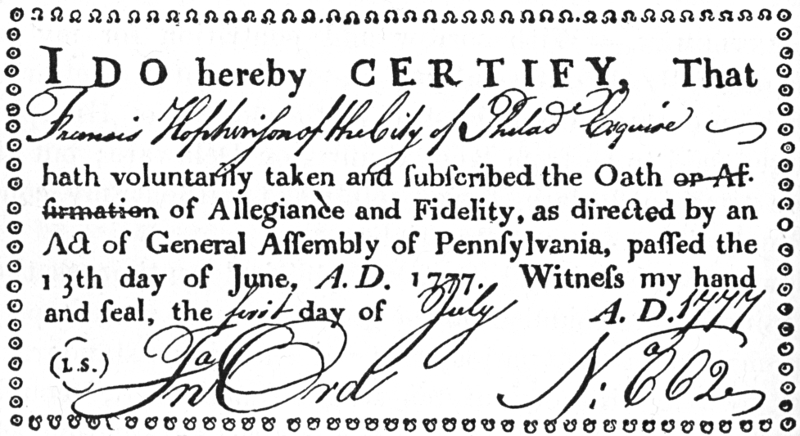
Oath of Allegiance A.D. 1777. PRINTED BY JOHN DUNLAP.
144. A Loyalist's Suggestion of the Danger to American Liberty in the French Alliance, 1779
Tyler's Literary History of the Revolution, II, 75-76. The extracts come from a keen pamphlet by a Tory, with the style of a "diary" of the year 1789—ten years later than the publication, to intimate what would then be the condition in America under French rule.
Boston, November 10, 1789.—His Excellency, Count Tyran, has this day published, by authority from his majesty, a proclamation for the suppression of heresy and establishment of the inquisition in this town, which has already begun its functions in many other places of the continent under his majesty's dominion.
The use of the Bible in the vulgar tongue is strictly prohibited, on pain of being punished by discretion of the inquisition.
November 11.—The Catholic religion is not only outwardly professed, but has made the utmost progress among all ranks of people here, owing, in a great measure, to the unwearied labors of the Dominican and Franciscan friars, who omit no opportunity of scattering the seeds of religion, and converting the wives and daughters of heretics. We hear that the building formerly called the Old South Meeting, is fitting up for a cathedral, and that several other old meeting-houses are soon to be repaired for convents.
November 12.—This day being Sunday, the famous Samuel Adams read his recantation of heresy, after which he was present at mass, and we hear he will soon receive priest's orders to qualify him for a member of the American Sorbonne....
The king has been pleased to order that five thousand of the inhabitants of Massachusetts Bay should be drafted to supply his garrisons in the West Indies; the officers for them are already arrived from France.
New York, November 15.—The edict for prohibiting the use of the English language, and establishing that of the French in all law proceedings, will take place on the 20th instant. At the same time, the ordinance for abolishing trials by juries, and introducing the imperial law, will begin to take effect....
November 17.—A criminal of importance, who has been long imprisoned in the New Bastille, was this day privately beheaded. He commanded the American forces against Great Britain for a considerable time, but was confined by order of the government on suspicion of possessing a dangerous influence in a country newly conquered, and not thoroughly settled.[137]...
The king has been pleased to parcel out a great part of the lands in America to noblemen of distinction, who will grant them again to the peasantry upon leases at will, with the reservation of proper rents and services.
His majesty has been graciously pleased to order that none of the natives of America shall keep any firearms in their possession, upon pain of being sentenced to the galleys....
November 22.—We hear from Williamsburg, in Virginia, that some commotions took place there when the new capitation tax was first executed. But the regiment of Bretagne, being stationed in that neighborhood, speedily suppressed them by firing upon the populace, and killing fifty on the spot. It is hoped that this example will prevent any future insurrection in that part of the country.
November 23.—His majesty has directed his viceroy to send five hundred sons of the principal inhabitants of America, to be educated in France, where the utmost care will be taken to imbue them with a regard for the Catholic faith, and a due sense of subordination to government.
145. How the Revolution set free Social Forces
David Ramsey's History of the American Revolution (1789), II, 315 ff. Dr. Ramsey was a citizen of South Carolina.
When the war began, the Americans were a mass of husbandmen, merchants, mechanics, and fishermen; but the necessities of the country gave a spring to the active powers of the inhabitants, and set them on thinking, speaking, and acting, in a line far beyond that to which they had been accustomed. The difference between nations is not so much owing to nature, as to education and circumstances. While the Americans were guided by the leading strings of the mother country, they had no scope nor encouragement for exertion. All the departments of government were established and executed for them, but not by them. In the years 1775 and 1776, the country, being suddenly thrown into a situation that needed the abilities of all its sons, these generally took their places, each according to the bent of his inclination. As they severally pursued their objects with ardor, a vast expansion of the human mind speedily followed. This displayed itself in a variety of ways. It was found that the talents for great stations did not differ in kind, but only in degree, from those which were necessary for the proper discharge of the ordinary business of civil society....