INDEX.
Reading edition
A.
Accensi, 123.
Accius, L., 275.
Achæan League, 107;
in alliance with Philip V., 108.
Achæan War, 138.
Ædiles, 117.
Adolphus, brother of Alaric, 341.
Ælius Saturninus, 297.
Ælius Sejanus, 297;
his death, 299.
Æmilianus, 324.
Æmilius Lepidus, M., military road made by, 114.
Æmilius Paullus, L., ends the war in Illyria, 79;
slain in the battle of Cannæ, 88.
Æmilius Paullus, L. (son), defeats Perseus, 135.
Æneas, legend of, 8.
Æquians, 58.
Ætolian League, 107;
forms alliance with Rome, 108;
but is obliged to make peace with Philip V., 108;
chief town Ambracia taken by the Romans, 111;
compelled to sue for peace, and the League crushed, 111.
Afranius, L., Consul, 224.
Afranius, L. (poet), 274.
Africa, invaded by the Romans, 72;
under Augustus, 287.
Agrarian Law of Sp. Cassius, 31;
law introduced by Ti. Gracchus, 150, 151;
extended by C. Gracchus, 157;
law introduced by Cæsar, 225.
Agricola, Julius, legate to Britain, 303;
his forced retirement, 305.
Agrigentum besieged and taken, 70.
Agrippa, M., Octavian's general, drives L. Antonius and Fulvia out of Rome, 263;
defeats them at Perusia, 263;
constructs the Julius Portus, 265;
defeats fleet of Sextus Pompey, 266.
Agrippa, M. Vipsanius, 286.
Agrippa, Postumus, 293;
assassination of, 295.
Agrippina, 298;
put to death by Tiberius, 299.
Alaric ravages Greece, 339;
besieges Rome, 340;
sacks the city, 341.
Alba Longa, foundation of, 8;
destruction of, 14.
Alban Lake, legend of the, 43.
Alesia surrenders to Cæsar, 234.
Alexander Severus, Emperor, 322.
Alexandria, 288;
trade between, and the Indies, 288.
Allemanni threaten Rome, 324;
defeated by Aurelian, 325.
Allobroges, embassadors of the, 220.
Alps, Hannibal's passage of, note on, 90.
Ambitus, 128.
Ancus Marcius, succeeds Tullus Hostilius, 14;
conquers several Latin cities, and removes inhabitants to Rome, 14;
institutes the Fetiales, 15;
founds a colony at Ostia, 15;
fortifies the Janiculum, 15;
constructs the Pons Sublicius, 15;
his reign and death, 15.
Andriscus, 137.
Antiochus, king of Syria, proposes to Philip V. to partition Egypt between them, 108;
receives Hannibal as a fugitive, 110;
is persuaded to invade Greece, 110;
is defeated at Thermopylæ, and returns to Syria, 111;
invades the kingdom of Pergamus, but is defeated near Magnesia, 111;
is compelled to cede all his dominions in Asia Minor, to pay fines, and surrender Hannibal, 111;
peace concluded, and affairs of Asia settled, 112.
Antiochus Asiaticus deposed, 212.
Antepilani, 122.
Antoninus, M. Aurelius, Emperor, 314;
death of, 316.
Antoninus, M. Commodus, Emperor, 316.
Antoninus Pius, Emperor, 313.
Antonius, C., 219, 220, 221.
Antonius, M. (orator), assassinated, 185.
Antony (Marcus Antonius), Consul with Cæsar, 249;
offers the diadem to Cæsar, 249;
takes possession of Cæsar's papers and treasures, 252;
pronounces the funeral oration over the body of Cæsar, 253;
master of Rome, 253;
attacked by Cicero in his Philippies, 254;
retires to Cisalpine Gaul, and besieges Mutina, 254;
declared a public enemy, 254;
defeats Pansa, 255;
is defeated by Hirtius, 255;
received in Farther Gaul by Lepidus, 255;
forms Triumvirate with Octavian and Lepidus, 256;
defeats Cassius at Philippi, 261;
licentious conduct in Asia Minor, and meeting with Cleopatra, 262, 263;
follows her to Alexandria, 263;
Fulvia, his wife, and L. Antonius, his brother, rise against him, 263;
his troops defeated in Syria, 264;
meets his wife and brother at Athens, 264;
his wife dies, 264;
forms an alliance with Sextus Pompey, 264;
marries Octavia, sister of Octavian, 264;
returns to the East with Octavia, 265;
his success in Syria, 265;
makes another treaty with Octavian, 266;
renews his union with Cleopatra, 267;
is defeated in Parthia, 267;
returns to Alexandria, 267;
is defeated by Octavian in the battle of Actium, 268, 269;
is again defeated at Alexandria, 269;
stabs himself, 269.
Apollonia, besieged by Philip V. of Macedon, 107.
Appellatio, 121.
Appius Claudius, 38, 40.
Appius Claudius Cæcus, 66;
his son, 69.
Appuleius, 349.
Apulia, 4.
Aquæ Sextæ, battle at, 171.
Aquillius, M'., Consul, suppresses the Second Servile War in Sicily, 172;
is defeated, and made prisoner by Mithridates, 188.
Arabia Felix invaded by Trajan, 308.
Arabia Petræa made a Roman province, 308.
Arcadius, son of Theodosius, 339;
his cruelties, 341.
Archelaus defeated at Chæronea, 188;
and again at Orchomenos, 189.
Archimedes, 93, 94.
Ariobarzanes expelled from Cappadocia, 187;
restored, 183;
again expelled, 188;
restored to his kingdom, 213.
Ariovistus defeated by Cæsar, 280.
Aristobulus surrenders to Pompey, 212, 213.
Armenia, Pompey in, 212.
Arminius, 291.
Army, Roman, constitution of, 122.
Artaxata, submission of Mithridates at, 212.
As (weight), 19.
Ascanius, legend of, 8.
Asculum, revolt at, 178.
Astures conquered by Augustus, 291.
Atellanæ Fabulæ, 275.
Athenio, leader of slaves in Sicily, 172;
defeated and slain by Catulus, 172.
Athens, 107;
declares against Rome, 188.
Attalus Philometor, 147.
Attila invades Italy, 348.
Augurs, 18, 57.
Augusta Emerita (Merida) founded by Augustus, 291.
Aurelian, Emperor, 325.
Ausonius, 346.
Autronius Pætus, P., 218.
Avidius Cassius defeats the Parthians, 315.
B.
Babylon captured by Trajan, 308.
Balearic Slingers, 124.
Barcochab, 312.
Belgic War, 230.
Bibulus, M., 216, 225.
Boadicea, 302.
Boii finally conquered and slaughtered, 114.
Bononia (Bologna), colony at, 114.
Bosporus, Cimmerian, 211.
Brennus, 45, 46, 47.
Brigantium taken by Cæsar, 224.
Bruttii, 4.
Britain, first invasion by Cæsar, 231;
second invasion, 232.
Brutus, D., put to death at Aquileia, 256.
Brutus, L. Junius, 23-25;
his death, 26.
Brutus, M. Junius, Prætor, conspires with Cassius and others to assassinate Cæsar, 249;
retires to Macedonia, 253;
goes to Athens, and collects an army, 257, 255;
plunders Lycia, 258;
crosses over into Thrace, 258;
defeated by Octavian at Philippi, 261;
slays himself, 261.
C.
Cæcilius, Q., 274.
Cæsar Augusta (Saragossa) founded by Augustus, 291.
Cæsar, Augustus, his conduct of the empire, 286;
extent of his empire, 289;
his government, 289;
decree against celibacy, 289;
his protection, the Prætorian Guard, 290;
army, navy, and revenues, 290;
plots against his life, 290;
his military enterprises, 291;
domestic misfortunes, 291-293;
his death, 293;
personal appearance, 294.
Cæsar, Caius Caligula, 293;
succeeds Tiberius, 299;
death of, 300.
Cæsar, Caius Julius, early life, 214, 215;
Quæstor, 215;
Ædile, 216;
restores statues and trophies of Marius, 216;
Proprætor in Spain, 224;
his conquests there, 224;
Consul, 225;
forms cabal with Pompey and Crasus (1st Triumvirate), 225;
carries Agrarian Law, 225;
supports Pompey, and gives him his only daughter Julia in marriage, 225;
divorces his wife, 226;
obtains command in Gaul, 226;
1st campaign in Gaul, 229;
2nd, 230;
3rd, 230;
4th, 231;
5th, 232;
6th, 232;
7th, 233;
8th, 234;
rivalry of Pompey, 237-8-9;
returns to Italy, 240;
quarters at Ravenna, 240;
ordered to disband his army, 240;
refuses, and crosses the Rubicon, 241;
enters Rome, 242;
conquers his opponents in Spain, 242;
short Dictatorship, 243;
crosses to Greece to encounter Pompey, 243-4;
total defeat of Pompey in the battle of Pharsalia, 245;
Dictator, 246;
pursues Pompey into Egypt, 246;
supports Cleopatra, 246;
conquers Pharnaces in Syria, 240;
returns to Rome, 246;
defeats Pompeian army in Africa, 247;
death of Cato at Utica, 247;
master of the Roman world, and Dictator for ten years, 247;
his Triumph, 247;
his clemency and reforms, 247-8-9;
Imperator and Dictator for life, 249;
appoints Octavius his heir, 249;
conspiracy against him, 249-50;
assassination, 250;
character, 250-1;
his character as a writer, 283.
Cæsar, L.. Julius, Consul, 179;
in Social War, 179;
proposes Lex Julia, 179.
Cæsar, Lucius, 293.
Cæsar, Tiberius Claudius, succeeds Caligula, 300;
enters Britain, 301.
Cæsar, Vespasianus, 301;
emperor, 302;
death, 303.
Cæsar, A. Vitellius, Emperor, 302.
Calabria, 4.
Calphurnius, 346.
Calpurnian Law, 157.
Camillus, M. Furius, 43, 44, 47, 48, 52.
Campagna, 3.
Campania, 4.
Cannæ, immense Roman army defeated at, by Hannibal, 88.
Cantabri, conquered by Augustus, 291.
Cantabrians, 114, 144-5.
Canuleia Lex, 41.
Capito, C. Ateius, 350.
Capitolium, 23.
Capua, opens its gates to Hannibal, 89;
retaken by the Romans, 96.
Caracalla, Emperor, 321;
assassinated, 322.
Caractacus, 301.
Carbo, Cn. Papirius, Consul, joins Cinnæ, 190.
Carinus, 326.
Carthage, 68;
capture and destruction of, 142;
rebuilt by the Romans, 142;
capital of the Vandal kingdom, 142;
finally destroyed by the Arabs, 142.
Carthaginians, their navy, 70;
defeated by the Roman navy, 71, 72.
Carus, Emperor, 326.
Catilina, L. Sergius, early life, 218;
crimes, 218;
conspiracy, 219;
accused by Cicero, 219;
leaves Rome, 220;
collects troops, 221;
defeated and slain, 221.
Cassius Longinus, C., fights under Crassus in Mesopotamia, 237;
conducts the retreat to Syria, 237;
originates the conspiracy against Cæsar, 249;
retires into Syria, 253;
defeats Dolabella in Syria, 258;
plunders Rhodes, 258;
marches with Brutus into Thrace, 258;
defeated by Antony at Philippi, 261;
his death, 261.
Cato, M. Porcius, in Spain, 114;
Quæstor, Prætor, Consul, 129;
Censor, 132;
his reforms, 132;
his prejudices, 132, 133;
his severity and avarice, 133.
Cato, M. Porcius, advocates the death of the Catilinarian conspirators, 221;
his death at Utica, 247;
his character as a writer, 283.
Catullus, Valerius, 276.
Catulus, Q. Lutatius, combined with Marius in the overthrow of the Cimbri, 171;
his death by order of Marius, 185.
Catulus, Q. Lutatius (son), hails Cicero as "Father of his Country," 221.
Caudine Forks, battle at, 57, 58.
Celsus, A. Cornelius, 350.
Celtiberians, tribes of, 114;
war with, 145.
Censors, 118.
Census, 118.
Centuriones, 122.
Cethegus, C. Cornelius, 219, 220.
Chosroes, king of the Parthians, 310.
Cicero, M, Tullius, early life, studies, and success as an orator, 216;
Quæstor, 217;
prosecutes Verres, 217;
his speech for Sex. Roscius of Ameria, 216;
studies at Athens and in Asia Minor, 216;
Quæstor in Sicily, under Sex. Peducæus, at Lilybæum, 217;
Ædile, Prætor, 217;
Consul, 219;
opposes agrarian law of Rullus, 219;
denounces Catiline, 219;
arrests conspirators, 220;
third oration, 220;
his popularity, 221;
hostility of Clodius, 227;
his banishment, 227;
his return to Rome, 228;
joins the party of Cæsar's assassins, 252;
his Philippics against Antony, 254;
stimulates the Senate against Antony and Octavian, 255;
is included in the list of proscriptions, 257;
his death, 257;
his character as a writer, 282.
Cimbri, 169;
they enter and ravage Spain, 170;
enter Italy, destroyed by Marius and Catulus, 171.
Cincinnatus and the Æquians, 34.
Cincius Alimentus, L., 282.
Cinna, L., Consul, 184;
conflict with Octavius, 185;
associated with Marius, 185;
their massacres in Rome, 185;
murdered by his army, 190.
Cinna, grandson of Pompey, 290.
Circus Maximus, 17.
Cisalpine Gaul, a Roman province, 114.
Cives Romani, 66.
Claudianus, Claudius, 345.
Claudius, M. Aurelius, Emperor, 325.
Cleopatra, Queen of Egypt, meets M. Antony at Tarsus, 262-3;
attracts him to Alexandria, 263;
is deserted for Octavia, 265;
again attracts Antony, who returns with her to Alexandria, 267;
war declared against her by the Senate, 268;
defeated with Antony at Actium, 268;
deceives Antony, but fails to deceive Octavian, 269;
kills herself, 269.
Clients, 12.
Clodius Albinus, 319.
Clodius Pulcher, P., profligate conduct of, 226;
tribune, 227;
procures the banishment of Cicero, 227;
killed by Milo, 238.
Clusium besieged, 45.
Cocceius Nerva, 293, 299;
emperor, 306.
Cohorts, 123.
Collatia, Collatinus, 16.
Colonies, Roman, 43.
Colosseum, the, 303.
Columella, 350.
Comitia Centuriata, 20, 120.
Comitia Curiata, 12, 20, 120.
Comitia Tributa, 18, 20, 121.
Constantine proclaimed Augustus, 330;
emperor, 331;
removes the capital to Constantinople, 332;
his character, 335.
Constantius, 328;
emperor, 329.
Consuls, duties of, 118.
Corfinium, new republic at, 178.
Corinth captured, and burnt, 138.
Coriolanus, C. Marcius, 32;
banished from Rome, 32;
invades Rome at the head of a Volscian army, 32;
spares the city, 33;
his death, 33.
Cornelia, mother of the Gracchi, 149, 160.
Cornelia, daughter of Cinna, married to Cæsar, 214;
her death, 215.
Corneliæ Leges, 186.
Cornelii, slaves so called, 195.
Cornelius Fronto, 314.
Corsica and Sardinia formed into a Roman province, 77.
Corsica, revolt in, 115.
Cotta, C. Aurelius, lawyer, 216.
Cotta, L. Aurelius, 218.
Cotta, M. Aurelius, defeated by Mithridates, 206.
Crassus, P. Licinius, 147.
Crassus, M. Licinius, Prætor, appointed to command the army against the Gladiators, 202;
defeats and slays Spartacus, 203;
Consul with Pompey, 203;
forms 1st Triumvirate with Cæsar and Pompey, 225;
meets Cæsar and Pompey at Luca, 236;
second Consulship with Pompey, 236;
his command in Syria, 236;
crosses the Euphrates, 237;
defeated and killed, 237.
Cremona besieged, 113.
Cretan Archers (Sagittarii), 124.
Ctesiphon captured by Trajan, 308.
Curiæ, 12.
Curiatii, 18.
Curius, M'., defeats Pyrrhus, 65.
Curtius, M., legend of, 53.
Curules Magistratus, 117.
D.
Dacia made a Roman province, 308.
Dacians cross the Danube, 305.
Decebalus, 305;
demands tribute, 307;
his defeat, 308.
Decemvirate, 36;
Decemviri appointed, 37;
their tyranny, 37;
the Twelve Tables, 38;
Decemviri continue in office, 38;
they assassinate Licinius Dentatus, 38;
Virginia slain by her father to save her from the Decemvir Appius Claudius, 39;
resignation of the Decemvirs, 39;
and election of 10 Tribunes, 40.
Decius Mus, P., self-sacrifice, 55;
and of his son, 59.
Decuriones, 123.
Deiotarus, tetrarch of Galatia, 213.
Delatores, 297, 303.
Demetrius of Pharos, 79.
Dictator, 28 (note), 51.
Dictatorship, 118;
revived by Sulla, 194
Didius Julianus, Emperor, 319.
Diocletian, Emperor, 327;
selects Maximian for his colleague, 328;
defeats the Persians, 329.
Dolabella, Cn., accused of extortion, 215;
puts an end to his life, 258.
Domitian, reign of, 305.
Drama, Roman, 272.
Drusus. M. Livius, 158, 159.
Drusus, 291;
sent to Germany, 295;
receives the tribunitian power, 297;
poisoned by his wife, 208.
Drusus, M. Livius, son of the opponent of C. Gracchus, elected a Tribune, endeavours to obtain the Roman franchise for the Allies, 176;
assassinated, 176.
E.
Eburones, revolt of the, 232.
Egypt, condition of, 107;
under Augustus, 288.
Elagabalus, Emperor, 322.
Enna (Servile War), 146-7
Ennius, Q., 273.
Equestrian Order, 158.
Etruria, 2.
Etruscans, their name, language, origin, and portions of Italy occupied by them, 5, 6;
wars with the, 43;
defeated, 58;
in league with the Umbrians, 59;
defeated at Lake Vadimo, 60.
Eumenes, king of Pergamus, obtains Mysia, Lydia, and part of Curia, 112.
Eunus (Servile War), 146, 147.
Eutropius, 343.
F.
Fabia Gens and the Veientines, 33.
Fabius, lieutenant, defeated by Mithridates, 208.
Fabius Maximus, Q., appointed Dictator, and to the command-in-chief against Hannibal, 87;
styled the Cunctator, or "Lingerer," 87;
obtains Tarentum, 96.
Fabius Pictor, Q., 282.
Fabius Sanga, Q., 220.
Falerii surrenders to the Romans, 44.
Faustina, wife of Antoninus Pius, 315.
Fescennine songs, 276.
Fetiales, 15.
Fidenæ taken and destroyed, 43.
Fimbria defeated, slays himself, 183.
Flaccus, Aldus Persius, 315.
Flamens, 13.
Flamininus, L., act of cruelty of, 127.
Flamininus, T. Quinctius, appointed to the command against Philip V., whose army is defeated in the battle of Cynoscephalæ, 103;
proclaims the independence of Greece, 109;
withdraws the Roman garrisons from all the towns of Greece, and returns to Italy, 109.
Flaminius, C., defeats the Insubres, 79;
is defeated by Hannibal near Lake Trasimenus, and slain, 86.
Florian, Emperor, 326.
Florus, L. Annæus, 347.
Fossa Mariana, 170.
Frentani, 3.
Fulvia (mistress of Q. Curius), 219.
Fulvia, wife of M. Antony, conspires against him, 263;
is driven out of Home, and defeated at Perusia, 263;
dies at Sicyon, 264.
Fulvius Nobilior, M., besieges and captures the town of Ambracia, 111.
G.
Gabii, 25
Gabinius, A., Tribune, 210.
Gaius, 350.
Galatia, 106.
Galatians attacked by Cn. Manlius Vulso, defeated in two battles, and compelled to sue for peace, 112.
Galba, Ser. Sulpicius, his treachery, 144;
succeeds Nero, 302.
Galerius, 328:
emperor, 329.
Gallia Cisalpina, 2.
Gallæcians, 114.
Gallienus, Emperor, 325.
Gallus, Emperor, 324.
Gaul, Cæsar's wars in, 229-234;
under Augustus, 287;
insurrection in, 297.
Gauls in Italy, 6:
(Insubres) conquered, 79.
Gellius, Aulus, 350.
Gentes, Roman, 12.
Germanicus, adopted by Tiberius, 293;
quells a mutiny on the Rhine, 296;
his German campaigns, 296;
his death, 296.
Geta, son of Septimius, killed by Caracalla, 321.
Glabrio, M. Acilius, 209.
Glaucia, fellow-demagogue of Saturninus, pelted to death with tiles by the mob, 175.
Gordian, Emperor, 324.
Goths (Senones) besiege Clusium, 45;
march against Rome, 46;
battle of the Allia, 46;
Rome destroyed, 46;
the Capitol besieged, 46;
Capitol saved, 47;
Goths repulsed and destroyed, 47;
invade the Empire, 324
Gracchi, 148-160.
Gracchus, Caius Sempronius (the Tribune), returns from Sardinia, 157;
elected Tribune, 157;
his legal reforms, 157, 158;
opposed by M. Livius Drusus, 159;
murdered, 160.
Gracchus, Tib. Sempronius (father of the Tribunes), subdues Spain, 115.
Gracchus, Tib. Sempronius (the Tribune), Quæstor in Spain, 145;
at the siege of Carthage, 149;
elected Tribune, 150;
introduces Agrarian Law, 150, 151;
his murder, 152.
Græcia, Magna, 6, 60.
Greece under Augustus, 288.
Greek colonies in Italy, 6.
H.
Hadrian, Emperor, 309;
journey through his provinces, 310;
his Edictum Perpetuum, 311;
builds a villa at Tibur, 312.
Hamilcar, a Carthaginian officer, excites Gauls and Ligurians against Romans, 113.
Hamilcar Barca, 75;
relieves Lilybæum and Drepanum, 76;
conquests in Spain, 80;
death, 80.
Hannibal elected to succeed Hasdrubal, 80;
first campaigns in Spain, 80;
besieges and takes Saguntum, 80, 81;
crosses the Iberus and the Pyrenees with a large army, 83;
reaches the Rhone, 83;
crosses the Alps, 83;
encamps in the plains of the Po, among the Insubres, 84;
reduces the Taurinians, 84;
defeats the army of Scipio near the Ticinus, 84;
defeats combined army of Scipio and Longus near the Trebia, 84;
marches through Liguria to the Arno, 86;
defeats C. Flaminius at Lake Trasimenus, 86;
eludes Q. Fabius and defeats Minucius, 87;
annihilates an immense Roman army at Cannæ, 88;
marches into Samnium and Campania, and obtains Capua, 89;
his rapid marches, 92;
campaigns of B.C. 215-213, 92, 93;
obtains Tarentum, 93;
marches up to the walls of Rome, but is unable to take the city, 95;
loses Capua, 96;
loses Salapia, 96;
destroys the army of Cn. Fulvius at Herdonea, 96;
loses Tarentum, 96;
is recalled from Italy, 104;
defeated by Scipio near Zama, 104;
is protected by Antiochus, after whose defeat at Magnesia he escapes, and is received by Prusias, king of Bithynia, 111;
is demanded by Rome, takes poison, and dies, 131, 132.
Hanno, in command of Carthaginian fleet, defeated by Lutatius Catulus, 76.
Hasdrubal succeeds Hamilcar, 80;
founds New Carthage, 80;
assassinated, 80.
Hasdrubal, brother of Hannibal, marches from Spain into Italy, 97;
is defeated on the Metaurus, and slain, 98.
Hastati, 122, 123.
Helvetii defeated by Cæsar, 229.
Hernicans, 59.
Herodes Atticus, 314.
Hiero, king of Syracuse, 69;
besieges Messana, 70;
is defeated by the Romans, and makes peace, 70;
his death, 93.
Hirtius, A., Consul, defeats Antony at Mutina, but is slain, 255.
Hispania Citerior and Ulterior, 114.
Honorius, son of Theodosius, 339.
Horatii, 13.
Horatius Flaccus, Q. (poet), 278.
Hortensia, Lex, 51.
Hortensius, Q. (orator), 210, 211, 216, 217.
Hostilianus, Emperor, 324.
Hostilius Mancinus, C., defeated by the Celtiberians, 145.
Huns appear on the Danube, 338;
cross the river, 342.
Hyrcanus favored by Pompey, 212, 213.
I.
Iapygians, 5.
Ignobiles, 128 (note).
Illyria and Illyrians, 78-9.
Illyrian Wars, 78, 79.
Istria subdued, 115.
Italia, 7.
Italians proper, 5.
Italicus, C. Silius, 344.
Italy, geography of, 1;
fertility, 5;
early inhabitants, 5;
struggles in Central Italy, 59;
under Augustus, 286, 287.
Iulus, or Ascanius, 8.
J.
Janiculum fortified, 15.
Janus, temple of, 13;
closed for the 2d time, 78;
for the 3d time, 270.
Jerusalem besieged and taken by Pompey, 212.
Jesus Christ, birth of, 293.
Jugurtha, under Scipio in Spain, 146;
early life, 162;
bribes the Senators, 163;
defeats Adherbal, and puts him to death, 163;
war declared against him, but comes to Rome under safe-conduct, 164;
murders Massiva, and is ordered to quit Italy, 164;
defeated by Metellus, 166;
and by Marius, 167;
who takes him prisoner, and conveys him to Rome, where he is starved in prison, 167-8.
Julia, aunt of Cæsar, married to Marius, 214;
her death, 215.
Julia, daughter of Cæsar, married to Pompey, 225.
Julia, daughter of Augustus, 292.
Julia, Lex, 179-80.
Julian, Emperor, 337.
Jus Imaginum, 128 (note).
Justin Martyr, 315.
Juvenalis, Decimus Junius, 345.
K.
Kings of Rome, 9-28.
L.
Labeo, Q. Antistius, 350.
Labienus (Tribune), 219.
Laberius, Dec., 275.
Latin War, 54;
battle at the foot of Vesuvius, 55;
self-sacrifice of P. Decius Mus, 55;
defeat of the Latins, 55.
Latins, 5.
Latium, 3;
incorporated with the Republic of Rome, 56.
Legends of early Roman history, 8.
Leges and Plebiscita, 121.
Legiones, 19, 122.
Lentulus Sura, P. Cornelius, 219, 220, 231.
Lepidus, 290.
Lepidus, M., Consul, opposes the public funeral of Sulla, 195-6;
proposes the repeal of Sulla's laws, 199;
collects an army and marches upon Rome, 199;
is defeated near the Mulvian Bridge, retires to Sardinia, and dies, 199, 200.
Lepidus, M., Master of the Horse, 249;
forms Triumvirate with Octavian and Antony, 255;
in Africa, 264.
Licinian Rogations and Laws, 49, 150.
Licinius colleague with Constantine, 331.
Lictors (note), 25.
Liguria, 2;
Ligurians, 113.
Lilybæum, sieges of, 64, 74, 75.
Livius Andronicus, M., 272.
Livius, Titus, 284.
Lucan, 301;
his poetry, 344.
Lucania and Lucanians, 4.
Lucanians, 6.
Luceres, 12.
Lucilius, C., 276.
Lucretius Carus, T. (poet), 276.
Lucullus, L. Licinius, opposes and defeats Mithridates in Bithynia and Pontus, 206-7;
sends Appius Claudius to Tigranes, 207;
his reforms in Asia, 207-8;
defeats Tigranes at Tigranocerta and at Artaxata, 208;
recalled, and superseded by Pompey, 209.
Ludi Magni, 117.
Lusitania, invaded by Ser. Sulpicius Galba, 143;
tribes of, subdued by Cæsar, 224.
Lusitanians, 114, 144-5.
M.
Macedonia, kingdom of, 107;
under Augustus, 289.
Macedonian War, 135.
Macrinus, Emperor, 322;
defeated by Elagabalus, 322.
Macrobius, 350.
Mæcenas, C. Cilnius, 286.
Mælius, Sp., slain, 42.
Magister Equitum, 28 (note).
Magna Græcia, 6, 60.
Mamertini, 69.
Manilian Law, Cicero's address in favor of, 217.
Manilius, C., Tribune, 210.
Manipuli, 122.
Manlius, M., saves the Capitol, 47;
patron of the poor, 48;
his fate, 49.
Manlius Torquatus, L., 218, 220.
Manlius Torquatus, T., legend of, 48;
and of his son, 55.
Manlius Vulso, Cn., defeats the Galatians, and afterward, in conjunction with commissioners, concludes a peace with Antiochus, and settles the affairs of Asia, 111, 112.
Marcellinus, Ammianus, 348.
Marcellus, 292.
Marcellus, M., Consul, arrives in Sicily, 93;
takes Leontini, 93;
invests Syracuse, where he is baffled by Archimedes, 93,
but finally captures it, 94;
takes Salapia, 96;
defeated and slain in Lucania, 97.
Marcius, C., Coriolanus, 32.
Marcomanni defeat Verus, 315.
Marius, C., early life, 161;
in Spain with Scipio, 146, 162;
elected Tribune, 162;
sends the Consul Metellus to prison, 162;
elected Prætor, 162;
marries Julia, sister of C. Julius Cæsar the elder, 162;
accompanies Metellus to Africa, 164;
returns to Rome, and is elected Consul, with command in Numidia, 166;
repulses a combined attack of Jugurtha and Bocchus, 167;
attaches Bocchus to the Romans, and takes Jugurtha prisoner, both by the agency of his Quæstor Sulla, 167;
elected Consul during his absence, and returns to Rome, leading Jugurtha in triumph, 168;
reorganizes the army, 170;
elected Consul a third and fourth time, 170;
defeats and destroys the Cimbri, Teutones, and Ambrones, 171;
elected Consul a fifth time, and has a Triumph, 171;
enters into a compact with Saturninus and Glaucia, 173;
and is elected Consul a sixth time, 173, 174;
loses reputation, and sets sail for Cappadocia and Galatia, 175;
in the Social War, 179;
is surpassed by Sulla, 180;
intrigues to obtain the command against Mithridates, 181;
is opposed by Sulla, who enters Rome with his army, and Marius makes his escape, 183;
his sufferings, risks, and return to Rome with Cinna, 185;
his conquests, and the massacres in Rome, 185;
in conjunction with Cinna elects himself Consul for the seventh time, 185;
his death, 185.
Marius, the younger, defeated by Sulla, 192;
orders his opponents to be put to death, 192;
embarks for Africa, 192;
puts an end to his own life, 193.
Marrucini, 3.
Marsi, 3.
Marsic or Social War, 178-80.
Martialis, M. Valerius, 346.
Masinissa, enters into treaty with Scipio, 101;
assists Scipio, 103;
aids Scipio to defeat Hasdrubal and Syphax, 103;
marries, and soon afterward kills Sophonisba, 103-4.
Massilia, 287.
Maximin, Emperor, 323.
Maximus, Valerius, 346.
Mediterranean Sea infested with pirates, 209.
Memmius, C., murdered, 174.
Menapii defeated by Cæsar, 231.
Menenius Agrippa, fable told by, 31.
Mesopotamia added to the Roman empire, 329.
Messala, M. Valerius, 286.
Messana, 69.
Metellus Celer, 221.
Metellus, L., defeats the Carthaginians at Panormus, 73.
Metellus (Macedonicus), Q., 145.
Metellus (Numidicus), Q. Cæcilius, Consul, conducts the war in Africa against Jugurtha, 166;
superseded by Marius, 166.
Metellus, Q., Consul, 224.
Military Tribunes appointed, 41.
Mimes, 275.
Mithridates V., king of Pontus, assassinated, 186.
Mithridates VI., king of Pontus, early life, 186;
conquests and alliances, 187-8;
orders a massacre of Romans and Italians in the cities of Asia, 188;
defeated by L. Valerius Flaccus and by Sulla, 188-9;
obtains peace on hard conditions, 189;
defeats Murena on the Halys, 205;
makes peace with Rome, and evacuates Cappadocia, 205;
renews the war with Rome, 206;
overruns Bithynia, and defeats Cotta, 200;
retreats before Lucullus into Pontus, 207;
defeated by Lucullus at Cabira, and takes refuge in Armenia, 207;
defeats Fabius and Triarius, 208;
unites with Tigranes, when they overrun Pontus and Cappadocia, 209;
is defeated by Pompey, 211;
escapes into the Cimmerian Bosporos, 211;
conspiracy of his son Pharnaces, 213;
his death, 213.
Mithridatic Wars: First, 183-9;
Second, 205;
Third, 205-13.
Moorish Dartmen, 124.
Morini defeated by Cæsar, 231.
Mucius Scævola, C., 27.
Mulvian bridge, battle of the, 199.
Murena, L., invades Cappadocia and Pontus, 205;
is opposed by Mithridates, and defeated, 205.
N.
Nævius, Cn., 273.
Naples, Bay of, 4.
Nasica, Scipio, 152.
Navius, Attus, 17.
Navy, Carthaginian, 70, 71, 72.
Navy, Roman, 70, 71, 72, 73.
Neapolis attacked, 56.
Nepos, Cornelius, 284.
Nero and Livius, Consuls, defeat Hasdrubal, 97, 98.
Nero, 301;
death of, 302.
Nervii defeated by Cæsar, 230.
Nicomedes III, driven out of Bithynia, 187;
restored, 188;
again expelled, 188;
dies, leaving his dominions to the Roman people, 200.
Nobiles, 127 (note).
Nobility, 127-8.
Nomen Latinum, 66.
Nonius, A., murder of, 174.
Norbanus, C., Consul, defeated by Sulla, 191.
Novus Homo, 128 (note).
Numa Pompilius elected to succeed Romulus, 12;
his reign and institutions, 12.
Numantine War, disastrous till conducted by Scipio, 145,
who captures and destroys Numantia, 146.
Numerian, 326.
Numidia, political condition of and war in, 162-8.
Numitor, 9.
O.
Octavian (C. Julius Cæsar Octavianus), appointed heir to Cæsar, 249;
comes to Rome, and claims the inheritance, 254;
collects an army, 254;
elected Consul, 255;
forms Triumvirate with Antony and Lepidus, 256;
proscriptions, 256-7;
defeats Brutus at Philippi, 261;
returns to Rome, 263;
reconciliation with Antony, 264;
his fleet destroyed by Sextus Pompey, 265;
renews the Triumvirate, 266;
subdues the Dalmatians, 267;
rupture with Antony, 267;
defeats Antony and Cleopatra at Actium, 268;
his Triumph, 270;
Imperator for life, Princeps, Augustus, Pontifex Maximus, 270;
end of the Republic, 270.
Octavius. See Octavian.
Octavius, Cn., conflict with Cinna, 185;
slain, 185.
Oppian Law repealed, 130.
Orosius, 348.
Ostia founded, 15.
Ostrogoths obtain permission to cross the Danube, 338.
Otho, Salvius, 302.
Ovid banished, 203.
Ovidius Naso, P. (poet), 281.
P.
Pacuvius, M., 275.
Palæopolis taken, 56.
Palladius, 350.
Palmyra, fall of, 325.
Pannonia, mutiny in, 296.
Panormus, defeat there of Carthaginians, 73.
Pansa, C. Vibius, Consul, defeated by Antony, and slain, 255.
Papinianus, 350.
Papius Mutilus, C., 179;
defeated by Sulla, 180.
Paterculus, Velleius, 346.
Patres Majorum and Minorum Gentium, 17.
Patricians, 12;
struggles between them and the Plebeians, 29;
ascendency of the Patricians, 29.
See Plebeians.
Patronus, 12.
Paulus, 350.
Peligni, 3.
Pergamus, 106;
made a province, 147.
Perperna, M., re-enforces Sertorius in Spain, 200;
becomes jealous of Sertorius, and assassinates him, 202;
is defeated by Pompey, 202.
Perseus succeeds Philip as king of Macedon, 134;
defeated by L. Æmilius Paullus, 135;
death, 136.
Persius, 345.
Pertinax, Emperor, 318.
Pescennius Niger, 319.
Petreius, M., 221.
Petronius Arbiter, 348.
Phædrus, 346.
Pharnaces, conspiracy of, against Mithridates, 213;
confirmed in position of the kingdom of the Bosporus, 213.
Philip, Emperor, 324.
Philip V., king of Macedon, enters into a treaty with Hannibal, 107;
appears in the Adriatic with a fleet, and lays siege to Oricus and Apollonia, 107;
takes Oricus, but is driven from Apollonia, and burns his fleet, 107;
in alliance with the Achæans, and at peace with the Ætolians and Romans, 108;
assists Hannibal at Zama, 108;
attacks the Rhodians and Attalus, king of Pergamus, 108;
treats with Antiochus for the partition of Egypt, 108;
besieges Athens, which is relieved by a Roman fleet, 108;
sues for peace after his defeat in the battle of Cynoscephalæ, 109;
refuses to take part with Antiochus against the Romans, 110;
his death, 134.
Phœnicians, 68.
Phalanx, 122.
Phraates, king of the Parthians, 291.
Picenum, 2.
Piracy in the Mediterranean suppressed by Pompey, 310.
Piso, Cn. Calpurnius, 218.
Placentia taken and destroyed, 118.
Plautia Papiria, Lex, 180.
Plautus, T. Maccius, 273.
Plebiscita, 40, 51;
and Leges, 121.
Plebs, Plebeians, origin of the, 14;
sufferings of the, 30;
Ager Publicus, 30;
secession of Plebeians to the Sacred Mount, 31;
institution of Tribunes of the Plebs, 31;
Agrarian Law introduced by Sp. Cassius, 31.
Pliny, Secundus Major, 349.
Pœni, 68 (note).
Pollio, Asinius, 286.
Pomœrium, 9, 20.
Pompædius Silo, Q., 178.
Pompeiopolis, 210.
Pompeius Strabo, Cn., in Social War, 180.
Pompey (Cn. Pompeius Magnus), early life and career, 200-1;
receives the surname of Magnus, 201;
sent to Spain as Proconsul against Sertorius, 201;
failures and successes, 201;
defeats Perperna, 202;
concludes the war, 202;
elected Consul, with Crassus, 203;
restores the Tribunitian power, 203;
suppresses piracy in the Mediterranean, 210;
supersedes Lucullus in the East, 211;
defeats Mithridates in Lesser Armenia, 211;
receives the submission of Tigranes, 212;
his conquests in Syria and Palestine, 212-13;
returns to Italy, 213;
his Triumph, 223;
Senate refuses to sanction his measures in Asia, 224,
but afterward ratifies them, 225;
forms cabal with Cæsar and Crassus (first Triumvirate), 225;
marries Cæsar's daughter Julia, 225;
meets Cæsar and Crassus at Luca, 236;
Consul with Crassus, 236;
obtains government of Spain, 236;
his new theatre at Rome opened, 236;
his wife Julia dies, 237;
elected sole Consul, 238;
becomes hostile to Cæsar, 239;
measures in opposition to Cæsar, 239-40;
invested by the Senate with command of the army, 240;
retreats before Cæsar, 242;
embarks for Greece, 242;
besieged by Cæsar at Dyrrhachium, 244;
forces Cæsar to retreat, 244;
defeated by Cæsar at Pharsalia, 245;
flies to Egypt, 245;
slain there, 245.
Pompey, Sextus, in alliance with M. Antony, 264;
master of the sea, 264;
forms alliance with Octavian and Antony, 264;
rupture of the alliance, 265;
defeats Octavian's fleet, 265;
his own fleet defeated by M. Agrippa, 266;
is taken prisoner, and put to death at Miletus, 266.
Pontiffs, 12, 51.
Pontine Marshes, 4.
Pontius, C., defeats the Romans, 57, 58;
is defeated and put to death, 59.
Pontius, the Samnite, 193.
Pontus, 106;
kingdom of, 186;
made a Roman province, 212.
Porcius Cato, M. See Cato.
Populus Romanus, 14.
Porsena, Lars, marches against Rome in aid of Tarquin, 26;
bridge defended by Horatius Cocles, 26;
C. Mucius Scævola, 27;
Clœlia swims across the Tiber, 27;
Porsena withdraws his army, 27;
war with the Latins, 28;
battle of the Lake Regillus, 28;
death of Tarquinius Superbus, 28.
Præneste surrenders, 193.
Prætor Peregrinus, 117.
Prætors, afterward called Consuls, 25.
Prætors and Prætorship, 51, 117.
Principes, 122.
Privernum, conquest of, 56.
Probus, Emperor, 326.
Proconsuls, 118.
Propertius, Sextus Aurelius (poet), 280.
Proprætors, 118.
Proscriptio, what it was, 193.
Provinces, Roman, 147.
Provocatio, 121 (note).
Prusias, king of Bithynia, shelters Hannibal, 131.
Publilian Law, 31 (note), 36.
Publilian Laws, 51.
Publicani, 119 (note).
Pulcheria, 351.
Punic War, First, 68-76;
Second, 82-105.
Pyrrhus, king of Epirus, assists the Tarentines, 62;
defeats the Romans near Heraclea, 62;
sends Cineas to negotiate a peace, 63;
terms rejected, 63;
takes Præneste, 63;
winter quarters, at Tarentum, 63;
embassy of Fabricius, 63;
proposal to poison Pyrrhus, 64;
releases Roman prisoners without ransom, 64;
crosses over into Sicily, 64;
is repulsed at Lilybæum, 64;
returns to Italy, 64;
seizes the treasures of the temple of Proserpine at Locri, 65;
his remorse, 65;
is defeated at Beneventum, 65;
returns to Greece, and is slain, 65.
Q.
Quæstio Perpetua, 197.
Quæstor; and Quæstorship, 4, 117.
Quintilianus, M. Fabius, 348.
Quintius, P., speech of Cicero for, 216.
Quirites, 11 (note).
R.
Rabirius, C., 219.
Ramnes, 12.
Rasena, 5.
Regillus, Lake, battle of, 28.
Regulus, M. Atilius, defeats the Carthaginians, 72;
is defeated by Xanthippus, 73.
Regulus, M. Atilius, sent, as prisoner, with an embassy, to Rome, 73, 74;
advises the Senate to reject the terms, 74;
returns, and is put to death, 74.
Remus and Romulus, 9;
Remus slain, 10.
Repetundæ, 128 (note).
Republic established at Rome, 25;
end of, 270.
Rhea Silvia, legend of, 8.
Rhodes, 107;
school of rhetoric at, 215.
Rogatio and Lex, 49 (note).
Roma Quadrata, 9.
Roman Literature, sketch of, 272-285;
Poetry: Saturnian Metre and the Drama, 272;
M. Livius Andronicus, 272, 273;
Cn. Nævius, 273;
Q. Ennius, 273;
T. Maccius Plautus, 273;
P. Terentius Afer, 274;
Q. Cæcilius, L. Afranius, 274;
M. Pacuvius, 275;
L. Accius, 275;
Atellanæ Fabulæ, Mimes, 275;
Dec. Laberius, P. Syrus, 275;
Fescennine Songs, 276;
Satires, 276;
C. Lucilius, 276;
T. Lucretius Carus, 276;
Valerius Catullus, 276;
P. Virgilius Maro, 277;
Q. Horatius Flaccus, 278;
Albius Tibullus, 280;
Sextus Aurelius Propertius, 280;
P. Ovidius Naso, 281.
Prose Writers—Q. Fabius Pictor, 282;
L. Cincius Alimentus, 282;
M. Porcius Cato, 282;
M. Tullius Cicero, 282;
M. Terentius Varro, 283;
C. Julius Cæsar, 283;
C. Sallustius Crispus, 284;
Cornelius Nepos, 284;
Titus Livius, 284.
Rome, situation and first inhabitants, 7;
legends and early history, 8;
first four kings, 9-15;
last three kings, 16-28;
foundation of, 9;
destroyed by the Goths (Senones) under Brennus, 47;
rebuilt, 48;
pestilence at, 62;
sacked by Alaric, 341.
Romulus, birth of, 9;
slays Remus, 10;
rape of Sabine virgins, 10;
war with Sabines, 10;
reigns conjointly with Titus Tatius, 11;
succeeds T. Tatius as ruler of the Sabines, and thus becomes solo ruler, 11;
his death, 11;
institutions, 12.
Romulus Augustus, 343.
Rorarii, 123.
Rufinus, 339.
Rufus, Q. Curtius, 347.
Rullus (Tribune), 219.
Rupilius, P., captures Tauromenium and Enna, and ends the First Servile War, 147.
Rutilius Rufus found guilty and banished, 175.
Rutilius Lupus, P., Consul, 179;
defeated and slain, 179.
S.
Sabellians, 3.
Sabine virgins, rape of, 10.
Sabini, 3, 11 (note).
Sacred Mount, first secession to, 31;
second secession, 39.
Sacrovir, 297.
Saguntum captured, 81.
Salii, priests of Mars, 13.
Sallustius Crispus, C., 284.
Salvius, leader of the slaves in Sicily, 172;
assumes the surname of Tryphon, 172.
Salvus Julianus, 350.
Samnites, history, 53;
tribes, 53;
conquer Campania and Lucania, 53;
attack the Sidicini and Campanians, 53;
enter into war with the Romans, 54;
are defeated at Mount Gaurus, 54;
peace 54;
second of Great War with the Romans, 57;
quarrel between Q. Fabius Maximus and L. Papirius Cursor, 57;
Samnite general, C. Pontius, defeats the Romans at the Caudine Forks, 57, 58;
treaty rejected by the Romans, 58;
successes of the Romans, and peace, 58;
third war, 59;
battle of Sentinum, 59;
defeat, and peace, 59.
Samnium and Samnites, 4.
Sapor, king of Persia, 336.
Sardinia obtained from Carthage, and formed into a Roman province, 77;
revolt in, 115;
Prætor for, 118.
Satires, Roman, 276.
Saturnian Metre, 272.
Saturninus elected Tribune, 174;
brings in an Agrarian Law, 174;
murders Memmius, 174;
is declared a public enemy, 174;
pelted to death with tiles by the mob, 175.
Scipio, Cneius, in Spain, 95;
slain there, 95.
Scipio, P. Cornelius, marches to oppose Hannibal, 83;
killed in Spain, 95.
Scipio Africanus Major, P. Cornelius, his early life, 99;
elected Proconsul, and goes to Spain, 100;
captures New Carthage, 100;
defeats Hasdrubal, 101;
master of nearly all Spain, by a victory (place uncertain), 101;
crosses over to Africa, 101;
quells insurrection and mutiny in Spain, 101;
captures Gades, 102;
returns to Rome, and is elected Consul, 102;
passes over to Sicily, and thence to Africa, 103;
besieges Utica, 103;
is opposed by Hasdrubal and Syphax, whom he defeats, 103;
defeats Hannibal near Zama, 104;
returns to Rome, 105;
prosecuted, 131;
retires from Rome, 131;
death, 131.
Scipio Africanus Minor, 140;
captures and destroys Carthage, 142;
sent to Spain, 145;
opposes Ti. Gracchus, 153;
found dead in his room, 153.
Scipio, L. Cornelius (Asiaticus) appointed to the command against Antiochus, who had invaded the kingdom of Pergamus, 111;
defeats Antiochus near Magnesia, and returns to Rome, 111;
prosecution of, 130.
Scipio Nasica, P. Cornelius, subdues the Boii, 114.
Sempronian Laws, 157.
Senate, 12, 119.
Senators bribed by Jugurtha found guilty by a commission, 164.
Senatus Consultum, 120.
Seneca, 301;
his writings, 349.
Seneca, M. Annæus, 348.
Senones, 45.
Septimius Severus, Emperor, 320;
penetrates to the interior of Scotland, 321.
Sertorius Macro, 299.
Sertorius, Q., in Spain, 200;
defeats Q. Metellus, 200;
is opposed to Pompey, 201;
assassinated by Perperna, 202.
Servile War at Carthage, 77.
Servile War in Sicily, First, 146-7;
Second, suppressed by M. Aquillius, 172.
Servilius, Q., murdered, 178.
Servius Tullius, succeeds Tarquinius Priscus, 18;
reforms the constitution, and divides the territory, 18;
increases the city, and surrounds it with a wall, 20;
forms an alliance with the Latins, 20;
his death, 22;
his two daughters, 22.
Seven hills of Rome, 20 (note).
Sextius, L., first Plebeian Consul, 50.
Sicily invaded by the Romans, 69-71;
made subject to the Romans, except Syracuse, 76;
Prætor for, 118;
under Augustus, 287.
Sicinius Dentatus slain, 38.
Sidicini, 53.
Silanus, 297.
Slaves under the Romans, 146.
Social War, or Marsic War, 178-180.
Socii, or Allies, 66;
troops furnished by, 123.
Sociorum Præfecti, 123.
Soli, afterward Pompeiopolis, occupied by pirates, 210.
Spain in two provinces, 114;
Prætors for, 118;
under Augustus, 287.
Spanish Wars, 143-146.
Sparta, 107.
Spartacus, a gladiator, excites an insurrection of slaves, 202;
devastates Italy with a large army of slaves, 203;
defeated by Crassus, 203;
slain in battle, 203.
Spolia opima won by A. Cornelius Cossus, 43.
Statius, P. Papinius, 344.
Stilicho, 339.
St. Chrysostom, 311.
Suffetes, 68.
Sulla, C. Cornelius, early life and character, 167;
Quæstor with Marius in Africa, 168;
gains over Bocchus, and entraps and makes a prisoner of Jugurtha, 167;
in Social War, 180;
Consul, 181;
rivalry with Marius, 182;
enters Rome with his army, and takes possession of the city, 183;
leaves Rome for the East, 184;
plunders Athens, 188;
victory at Orchomenus, 189;
makes peace with Mithridates, 189;
overcomes Fimbria, 189;
defeats the younger Marius, and enters Rome, 192;
battle with the Samnites and Lucanians for the possession of Rome, 192;
Allies defeated, 193;
elected Dictator, 193;
his massacres and proscriptions, 194;
elected Consul, 194;
his Triumph, and assumed title of Felix, 194;
his military colonies, 194, 195;
his reforms, 194, 195;
resignation of Dictatorship, retirement, and death, 195;
his legislation, 190-193.
Sulpicius Rufus, P., sells himself to Marius, 182;
put to death, 183.
Supplicatio, 125.
Synorium, fortress of, 211.
Syphax, at war with Carthage, 95;
is visited by Scipio, but, falling in love with Sophonisba, daughter of Hasdrubal, becomes an ally of the Carthaginians, 101;
defeated by Scipio and Masinissa, and flies into Numidia, 103;
is pursued and taken prisoner by Lælius and Masinissa, 103.
Syracuse captured by Marcellus, 94.
Syria, condition of, 106;
made a Roman province, 212.
Syrus, P., 275.
T.
Tacitus, Emperor, 326.
Tacitus, the historian, 346.
Tarentum, 60, 62;
captured, 65.
Tarpeia, 10.
Tarquinius Priscus, Lucius, his birth and descent, 16;
elected 5th king of Rome, 16;
defeats the Sabines and captures Collatia, 16;
takes also many Latin towns, and becomes ruler of all Latium, 16;
constructs the cloacæ, 16;
lays out the Circus Maximus, and institutes the games of the Circus, 17;
increases the Senate, the Equites, and the Vestal Virgins, 17;
appoints Servius Tullius his successor, 18;
his reign and death, 18.
Tarquinius Superbus, Lucius, succeeds Servius Tullius, 22;
his tyranny, 22;
alliance with the Latins, 22;
war with the Volscians, 23;
founds the temple named the Capitolium, 23;
purchases the three Sybilline books, 23;
attacks and captures Gabii, 23;
sends to consult the oracle at Delphi, 23;
besieges Ardea, 24;
Lucretia ravished by Sextus Tarquinius, 24;
death of Lucretia, 25;
is expelled from Rome with his sons, 25;
attempts to regain the throne, 25;
his Etruscan allies defeated, 26;
dies at Cumæ, 28.
Terentius Afer, P., 274.
Teutones and Ambrones enter France, in march for Italy, 170;
defeated and destroyed by Marius, 171.
Theodosius, Emperor, 339.
Thurii, 60.
Tiberius, 201;
divorced from his wife, 292;
succeeds Augustus, 295;
retires to Capreæ, 298;
death, 299.
Tibullus, Albius (poet), 280.
Tigranes, king of Armenia, receives his father-in-law Mithridates, 207;
defeated by Lucullus at Tigranocerta, 208;
acts in concert with Mithridates, 209;
submits to Pompey, 212.
Tigranes the younger revolts against his father, 212.
Tities, 12.
Titus takes Jerusalem, 303;
emperor, 304.
Trajanus Decius, Emperor, 324.
Trajanus, M. Ulpius, Emperor, 307;
conflict with the Dacians, 308;
leads an army into Assyria, 308;
death, 309.
Trasimenus, Lake, Roman army destroyed at, 86.
Triarii, 123.
Triarius defeated by Mithridates, 208.
Tribes, Assembly of the, 121.
Tribunes, 31, 117, 121.
Tribuneship degraded by Sulla's laws, 197.
Tribuni Militum, 123.
Tributum, a property-tax, 121.
Triumph, the general's, 124.
Triumvirate, First, 225;
Second, 256.
Triumviri visit Greece to inquire into the laws, 37.
Tullianum (dungeon), 221.
Tullus Hostilius elected to succeed Numa, 13;
battle of the Horatii and Curiatii, 13;
conquers the Albans, 14;
conquers the Etruscans, 14;
punishes Mettius Fuffetius, 14;
destroys Alba Longa, and removes inhabitants to Rome, 14;
his reign and death, 14.
Turmæ, 123.
Twelve Tables, 38.
U.
Ulphilas, 338.
Ulpianus, 350.
Umbria, 2.
Umbrians in league with the Etruscans, 59.
Umbro-Sabellians, 5.
V.
Vadimo, Lake, defeat of Gauls and Etruscans there, 60.
Valentinian, Emperor, 338.
Valentinian III., 342.
Valerian and Horatian Laws, 40.
Valerian, Emperor, 324.
Valerius, Corvus, M., legend of, 48.
Valerius Publicola, 26.
Vandals invited into Africa, 342;
plunder Rome, 342.
Varro, M. Terentius, 283.
Varus, 291.
Vectigalia, 121.
Veii besieged, 43;
Alban Lake, 43;
city captured, 44.
Velites, 123.
Veneti defeated by Cæsar, 231.
Ventidius, Tribune and Consul, 265;
his successful wars against the Parthians, 265.
Vercingetorix defeated and taken prisoner, 234.
Verus, L., 314, 315.
Vestal Virgins, 13, 17.
Vestini, 3.
Veto of the Tribunes, 31, 121.
Vettius, L., accuses Cæsar, 222;
is thrown into prison, 222.
Vexillarius, 122.
Via Æmilia, Appia, Flaminina, 114, 119.
Victor, Aurelius, 347.
Viriathus, 144;
assassinated, 145.
Virgilius Maro, P., 277.
Vologeses III., king of the Parthians, 314.
Volturcius, T., 220.
W.
Wallia, 341.
X.
Xanthippus, 72, 73.
Z.
Zenobia, queen of Palmyra, 325.
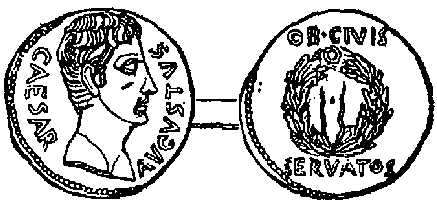
Coin of Augustus.