A SET OF ROGUES. (continued 5)
Reading edition
Nor has this day done much to allay my apprehension. For at the Court all is still at sixes and sevens, none of a very cheerful spirit, but all mighty anxious, save Moll, who throughout has kept a high, bold spirit. And she does declare they will work all night, but everything shall be in its place before her lover comes to-morrow. And, truly, I pray they may, but do think they will not. For such a mighty business as this should have been begun a full month back. But she will not endure me in the house (though God knows I am as willing as any to help), saying that I do hinder all, and damp their spirit for work with my gloomy countenance, which is no more than the truth, I fear. The sky very overcast, with wind in the south and the air very muggy, mild, and close, so that I do apprehend our geese will be all stinking before they are eat. And if it pour of rain on Christmas day how will the ox be roast, and what sort of company can we expect? This puts me to another taking for dread of a new fiasco.
December 23. Going to the Court about midday, I was dumbfounded to find no sign of the disorder that prevailed there yesterday, but all swept and garnished, and Moll in a brave new gown seated at her fireside, reading a book with the utmost tranquillity,--though I suspect she did assume something in this to increase my astonishment. She was largely diverted by my amazement, and made very light of her achievement; but she admitted that all had worked till daybreak, and she had slept but two hours since. Nevertheless, no one could have looked fresher and brighter than she, so healthy and vigorous are her natural parts. About one comes Mr. Godwin to cap her happiness and give fresh glory to her beauty. And sure a handsomer or better mated couple never was, Mr. Godwin's shapely figure being now set off to advantage by a very noble clothing, as becoming his condition. With him came also by the morning stage Don Sanchez, mighty fine in a new head, of the latest mode, and a figured silk coat and waistcoat. And seeing the brave show they made at table, I was much humbled to think I had gone to no expense in this particular. But I was yet more mortified when Don Sanchez presents Moll with a handsome set of jewels for a wedding gift, to see that I had nothing in the world to offer her, having as yet taken not a penny of her money, save for the use of others and my bare necessities. Moll, however, was too full of happiness to note this omission on my part; she could think of no one now but her dear husband, and I counted for nothing.
However, this little chagrin was no more than a little cloud on a summer's day, which harms no one and is quickly dispelled by generous heat; and the tender affection of these two for each other did impart a glow of happiness to my heart. 'Tis strange to think how all things to-night look bright and hopeful, which yesterday were gloomy and awesome. Even the weather hath changed to keep in harmony with our condition. A fresh wind sprang up from the north this morning, and to-night every star shines out sharp and clear through the frosty air, promising well for to-morrow and our Christmas feast. And smelling of the geese, I do now find them all as sweet as nuts, which contents me mightily, and so I shall go to bed this night blessing God for all things.
December 24. Now this blessed day hath ended, and Moll is sure and safely bound to Mr. Godwin in wedlock, thanks to Providence. Woke at daybreak and joyed to find all white without and covered with rime, sparkling like diamonds as the sun rose red and jolly above the firs; and so I thought our dear Moll's life must sparkle as she looked out on this, which is like to be the brightest, happiest day of her life. Dressed in my best with great care, and put on the favour of white ribbons given me by Moll's woman last night, and so very well pleased with my looks, to the Court, where Moll is still a-dressing, but Mr. Godwin and Don Sanchez, nobly arrayed, conversing before the fire. And here a great bowpot on the table (which Mr. Godwin had made to come from London this morning) of the most wondrous flowers I have ever seen at this time of the year, so that I could not believe them real at first, but they are indeed living; and Mr. Godwin tells me they are raised in houses of glass very artificially heated. Presently comes in Moll with her maids, she looking like any pearl, in a shining gown of white satin decked with rich lace, the collar of diamonds glittering about her white throat, her face suffused with happy blushes and past everything for sprightly beauty. Mr. Godwin offers his bowpot and takes her into his arms, and there for a moment she lay with closed eyes and a pallor spreading over her cheek as if this joy were more than her heart could bear; but recovering quickly, she was again all lively smiles and radiance.
Then comes a letter, brought by the night carrier, from her father (a most dirty, ill-written scrawl signed Robert Evans with his mark), praying he may be excused, as his masts are to be stepped o' Wednesday, and he must take the occasion of a ketch leaving Dartford for Falmouth this day, and at the same time begging her acceptance of a canister of China tea (which is, I learn, become a fashionable dish in London) as a marriage offering. Soon after this a maid runs in to say the church bells are a-ringing; so out we go into the crisp, fresh air, with not a damp place to soil Moll's pretty shoes--she and Mr. Godwin first, her maids next, carrying her train, and the Don and I closing the procession, very stately. In the churchyard stand two rows of village maids with baskets to strew rosemary and sweet herbs in our path, and within the church a brave show of gentlefolks, friends and neighbours, to honour the wedding.
But here was I put to a most horrid quaking the moment I passed the door, to perceive old Simon standing foremost in the throng about the altar, in his leather cap (which he would not remove for clerk or sexton, but threatened them, as I am told, with the law if they lay a finger on him). And seeing him there, I must needs conclude that he intended to do us an ill turn, for his face wore the most wicked, cruel, malicious look that ever thirst of vengeance could impart. Indeed, I expected nothing less than that he would forbid the marriage on such grounds as we had too good reason to fear; and with this dread I regarded Moll, who also could not fail to see him. Her face whitened as she looked at him, but her step never faltered, and this peril seemed but to fortify her courage and resolution; and indeed I do think by her high bearing and the defiance in her eye as she held her lover's arm that she was fully prepared to make good answer if he challenged her right to marry Mr. Godwin. But (the Lord be thanked!) he did not put her to this trial, only he stood there like a thing of evil omen to mar the joy of this day with fearful foreboding.
I can say nothing about the ceremony, for all my attention was fixed upon this hideous Simon, and I had no relief until 'twas safely ended and Moll's friends pressed forward to kiss the bride and offer their good wishes; nor did I feel really at ease until we were back again at the Court, and seated to a fine dinner, with all the friends who would join us, whereof there were as many as could sit comfortably to the long table. This feast was very joyous and merry, and except that the parson would be facetious over his bottle, nothing unseemingly or immodest was said. So we stayed at table in exceeding good fellowship till the candles were lit, and then the parson, being very drunk, we made a pretext of carrying him home to break up our company and leave the happy couple to their joy.
December 26. Down betimes yesterday morning to find the sky still clear, the air brisk and dry, and ample promise of a fair day. To the Court, and there perceive the great ox spitted on a stout fir pole, and the fire just kindling; John the gardener setting up the barrels of beer, and a famous crowd of boys and beggars already standing before the gates. And there they might have stayed till their dinner was cooked, ere I had let them in, but Moll coming down from the house with her husband, and seeing this shivering crew, their pinched cheeks yellow and their noses blue with cold, and so famished with hunger they could scarce find strength to cry, "God bless you, merry gentlefolks!" she would have them taste at once some of that happiness with which her heart was overflowing, and so did with her own hands unbolt the gates and set them wide, bidding the halting wretches come in and warm themselves. Not content with this, she sends up to the house for loaves and gives every one a hunch of bread and a mug of ale to stay his empty stomach. And Lord, 'twas a pleasure to see these poor folks' joy--how they spread their hands out to the flames; how they cockered up the fire here and there to brown their ox equally, with all hands now and then to turn him on the spit; how they would set their bread to catch the dropping gravy; and how they would lift their noses to catch the savoury whiffs that came from the roasting beef.
This is all very well, thinks I, but how about our geese and turkeys? will our tenants come, or shall we find that Simon hath spoilt their appetite, and so be left with nought but starved beggars for our company? However, before four o'clock an end was put to these doubts, for some in waggons, others on horse, with their wives or sweethearts on pillions behind, clasping their men tight, and the rest afoot, all came that were asked by me, and more, and pretty jolly already with ale on the road, and a great store of mistletoe amongst them for their further merriment. And what pleased me as much as anything was to find all mighty civil to Moll--nearly all offering her a Christmas box of fresh eggs, honey, and such homely produce, which she received with the most pretty, winning grace, that went home to every heart, so that the hardest faces were softened with a glow of contentment and admiration. Then down we sat to table, Moll at one end and her husband beside her; Don Sanchez and I at t'other; and all the rest packed as close as sprats in a barrel; but every lad squeezing closer to his lass to make room for his neighbour, we found room for all and not a sour look anywhere. Dear heart! what appetites they had, yet would waste nothing, but picked every one his bone properly clean (which did satisfy me nothing was amiss with our geese), and great cheering when the puddings and flapdragons came in all aflame, and all as merry as grigs--flinging of lighted plums at each other, but most mannerly not to fling any at Moll or us. Then more shouting for joy when the bowls of wassail and posset come in, and all standing to give three times three for their new mistress and her husband. Hearing of which, the beggars without (now tired of dancing about the embers) troop up to the door and give three times three as well, and end with crying joy and long life to the wedded pair. When this tumult was ended and the door shut, Mr. Godwin gave a short oration, thanking our tenants for their company and good wishes; and then he told them how his dear wife and he, wishing others to share their joy and remember this day, had resolved to forgive every tenant one-half of his quarter's rent. "And so, Mr. Hopkins," says he, addressing me, "you will think of this to-morrow."
At first I was disposed to begrudge this munificence--thinking of my accounts and the bills I should have to pay ere rent day came again; but on second thoughts it rejoiced me much as being a counterblast to anything Simon could do against us. For no tenant, thinks I, will be fool enough to withold payment when he may get his quittance to-morrow for half its value. And herein was I not mistaking; for to-day every tenant hath paid with a cheerful countenance. So that this is very good business, and I am not in any way astonished to find that our subtle Spaniard was at the bottom of it, for indeed it was Don Sanchez who (knowing my fears on this head and thinking them well-grounded) suggested this act of generosity to Moll, which she, in her fulness of heart, seized on at once. (Truly, I believe she would give the clothes off her back, no matter what it cost her, to any one in need, so reckless is she in love and pity.)
December 27. Don Sanchez took leave of us this day, he setting forth for Spain to-morrow, with the hope to reach his friends there, for their great feast of the New Year. And we are all mighty sorry to lose him; for not only hath he been a rare good friend to us, but also he is a most seemly gentleman (to keep us in countenance), and a very good staunch and reliable companion. But this comprises not all our loss, he having, as I confess, more wit in his little finger than we in all our bodies, and being ever ready with an expedient in the hour of need; and I know not why, but I look on his going as a sign of coming evil; nor am I greatly comforted by his telling me privily that when we want him he shall be found by a letter sent to the Albego Puerto del Sole, Toledo, in Spain. And I pray Heaven we have no occasion to write to him.
To-night at supper I find Moll all cock-a-hoop with a new delight, by reason of her dear husband offering to take her to London for a month to visit the theatres and other diversions, which put me to a new quirk for fear Moll should be known by any of our former playhouse companions. But this I now perceive is a very absurd fear; for no one in the world who had seen Moll three years ago--a half-starved, long-legged, raw child--could recognise her now, a beautiful, well-proportioned young woman in her fine clothes; and so my mind is at ease on this head. When Moll was retired, Mr. Godwin asked if I could let him have a few hundreds upon his account, and I answered very willingly he shall. And now setting aside enough to pay all bills and furnish our wants till next quarter day, I am resolved to give him every farthing left of the rents paid yesterday, and shall be most hearty glad to be rid of it, for this money do seem to scar my hands every time I touch it; nor can I look at it but my heart is wrung with pity for those poor tenants who paid so gleefully yesterday, for surely their quittances will hold good for no more than spoilt paper if ever our roguery is discovered.
December 28. This day Moll and Mr. Godwin set out for London, all smiles and gladness, and Moll did make me promise to visit them there, and share their pleasures. But if I have no more appetite for gaiety than I feel at this moment, I shall do better to stay here and mind my business; though I do expect to find little pleasure in that, and must abide by a month of very dull, gloomy days.
CHAPTER XXVII.
Of the great change in Moll, and the likely explanation thereof.
A week before the promised month was up, Moll and her husband came back to the Court, and lest I should imagine that her pleasures had been curtailed by his caprice, she was at great pains to convince me that he had yielded to her insistence in this matter, declaring she was sick of theatres, ridottos, masquerades, and sight-seeing, and had sighed to be home ere she had been in London a week. This surprised me exceedingly, knowing how passionate fond she had ever been of the playhouse and diversions of any kind, and remembering how eager she was to go to town with her husband; and I perceived there was more significance in the present distaste for diversion than she would have known. And I observed further (when the joy of return and ordering her household subsided) that she herself had changed in these past three weeks, more than was to be expected in so short a time. For, though she seemed to love her husband more than ever she had loved him as her lover, and could not be happy two minutes out of his company, 'twas not that glad, joyous love of the earlier days, but a yearning, clinging passion, that made me sad to see, for I could not look upon the strained, anxious tenderness in her young face without bethinking me of my poor sister, as she knelt praying by her babe's cot for God to spare its frail life.
Yet her husband never looked more hearty and strong, and every look and word of his bespoke increasing love. The change in her was not unperceived by him, and often he would look down into her wistful, craving eyes as if he would ask of her, "What is it, love? tell me all." And she, as understanding this appeal, would answer nothing, but only shake her head, still gazing into his kind eyes as if she would have him believe she had nought to tell.
These things made me very thoughtful and urgent to find some satisfactory explanation. To be sure, thinks I, marriage is but the beginning of a woman's real life, and so one may not reasonably expect her to be what she was as a thoughtless child. And 'tis no less natural that a young wife should love to be alone with her husband, rather than in the midst of people who must distract his thoughts from her; as also it is right and proper she should wish to be in her own home, directing her domestic affairs and tending to her husband--showing him withal she is a good and thoughtful housewife. But why these pensive tristful looks, now she hath her heart's desire? Then, finding I must seek some better explanation of her case, I bethought me she must have had a very hard, difficult task in London to conceal from one, who was now a part of herself, her knowledge of so many things it was unbefitting she should reveal. At the playhouse she must feign astonishment at all she saw, as having never visited one before, and keep constant guard upon herself lest some word slipped her lips to reveal her acquaintance with the players and their art. At the ridotto she must equally feign ignorance of modish dancing--she whose nimble feet had tripped to every measure since she could stand alone. There was scarcely a subject on which she would dare to speak without deliberation, and she must check her old habit of singing and be silent, lest she fall by hazard to humming some known tune. Truly, under such continuous strain (which none but such a trained actress could maintain for a single day) her spirit must have wearied. And if this part was hard to play in public, where we are all, I take it, actors of some sort and on the alert to sustain the character we would have our own, how much more difficult must it be in private when we drop our disguise and lay our hearts open to those we love! And here, as it seemed to me, I did hit rightly at the true cause of her present secret distress; for at home as abroad she must still be acting a part, weighing her words, guarding her acts--for ever to be hiding of something from her dearest friend--ever denying him that confidence he appealed for--ever keeping a cruel, biting bond upon the most generous impulse of her heart, closing that heart when it was bursting to open to her dear mate.
Soon after their return Mr. Godwin set to work painting the head of a Sybil, which the Lord of Hatfield House had commanded, on the recommendation of Sir Peter Lely, taking Anne Fitch for his model, and she sitting in that room of the Court house he had prepared for his workshop. Here he would be at it every day, as long as there was light for his purpose, Moll, near at hand, watching him, ready to chat or hold her peace, according to his inclination--just as she had done when he was a-painting of the ceiling, only that now her regard was more intent upon him than his work, and when he turned to look at her, 'twas with interchange of undisguised love in their fond eyes. She ever had a piece of work or a book in her lap, but she made not half a dozen stitches or turned a single page in the whole day, for he was the sole occupation of her mind; the living book, ever yielding her sweet thoughts.
This persevering, patient toil on his part did at first engender in my mind suspicion that some doubting thoughts urged him to assume his independence against any accident that might befall the estate; but now I believe 'twas nothing but a love of work and of his art, and that his mind was free from any taint of misgiving, as regards his wife's honesty. 'Tis likely enough, that spite her caution, many a word and sign escaped Moll, which an enemy would have quickly seized on to prove her culpable; but we do never see the faults of those we love (or, seeing them, have ready at a moment excuse to prove them no faults at all), and at this time Mr. Godwin's heart was so full of love, there was no place for other feeling. Venom from a rose had seemed to him more possible than evil, from one so natural, sweet, and beautiful as Moll.
CHAPTER XXVIII.
Moll plays us a mad prank for the last time in her life.
About once in a fortnight I contrived to go to London for a couple of days on some pretext of business, and best part of this time I spent with Dawson. And the first visit I paid him after the return of Moll and her husband, telling him of their complete happiness, Moll's increasing womanly beauty, and the prosperous aspect of our affairs (for I had that day positive assurance our seal would be obtained within a month), I concluded by asking if his mast might not now be stepped, and he be in a position to come to Chislehurst and see her as he had before.
"No, Kit, thanking ye kindly," says he, after fighting it out with himself in silence a minute or two, "better not. I am getting in a manner used to this solitude, and bar two or three days a week when I feel a bit hangdog and hipped a-thinking there's not much in this world for an old fellow to live for when he's lost his child, I am pretty well content. It would only undo me. If you had a child--your own flesh and blood--part of your life--a child that had been to you what my sweet Moll hath been to me, you would comprehend better how I feel. To pretend indifference when you're longing to hug her to your heart, to talk of fair weather and foul when you're thinking of old times, and then to bow and scrape and go away without a single desire of your aching heart satisfied,--'tis more than a man with a spark of warmth in his soul can bear." And then he proceeded to give a dozen other reasons for declining the tempting bait,--the sum of all proving to my conviction that he was dying to see Moll, and I feared he would soon be doing by stealth that which it were much safer he should do openly.
About a week after this I got a letter from him, asking me to come again as soon as I might, he having cut his hand with a chisel, "so that I cannot work my lathe, and having nothing to occupy my mind, do plague myself beyond endurance."
Much concerned for my old friend, I lose no time in repairing to Greenwich, where I find him sitting idle before his lathe, with an arm hanging in a handkerchief, and his face very yellow; but this, I think, was of drinking too much ale. And here he fell speedily discoursing of Moll, saying he could not sleep of nights for thinking of the pranks she used to play us, our merry vagabond life together in Spain ere we got to Elche, etc., and how he missed her now more than ever he did before. After that, as I anticipated, he came in a shuffling, roundabout way (as one ashamed to own his weakness) to hinting at seeing Moll by stealth, declaring he would rather see her for two minutes now and again peering through a bush, though she should never cast a glance his way, than have her treat him as if she were not his child and ceased to feel any love for him. But seeing the peril of such ways, I would by no means consent to his hanging about the Court like a thief, and told him plainly that unless he would undo us all and ruin Moll, he must come openly as before or not at all.
Without further demur he consents to be guided by me, and then, very eagerly, asks when it will be proper for him to come; and we agree that if he come in a week's time, there will be no thought in anybody's mind of our having conspired to this end.
As the fates would have it, Mr. Godwin finished his painting on the Saturday following (the most wonderful piece of its kind I ever saw, or any one else, in my belief), and being justly proud of his work and anxious Sir Peter Lely should see it soon, he resolved he would carry it to Hatfield on Monday. Moll, who was prouder of her husband's piece than if it were of her own doing, was not less eager it should be seen; yet the thought that she must lose him for four days (for this journey could not well be accomplished in less time) cast down her spirits exceedingly. 'Twas painful to see her efforts to be cheerful despite of herself. And, seeing how incapable she was of concealing her real feeling from him whom she would cheer, she at length confessed to him her trouble. "I would have you go, and yet I'd have you stay, love," says she.
"'Tis but a little while we shall be parted," says he.
"A little while?" says she, trembling and wringing one hand within the other. "It seems to me as if we were parting for ever."
"Why, then," returns he, laughing, "we will not part at all. You shall come with me, chuck. What should prevent you?"
She starts with joy at this, then looks at him incredulous for a moment, and so her countenance falling again, she shakes her head as thinking, I take it, that if it were advisable she should go with him, he would have proposed it before.
"No," says she, "'twas an idle fancy, and I'll not yield to it. I shall become a burden, rather than a helpmate, if you cannot stir from home without me. Nay," adds she, when he would override this objection, "you must not tempt me to be weak, but rather aid me to do that which I feel right."
And she would not be persuaded from this resolution, but bore herself most bravely, even to the moment when she and her husband clasped each for the last time in a farewell embrace.
She stood where he had left her for some moments after he was gone. Suddenly she ran a few paces with parted lips and outstretched hands, as if she would call him back; then, as sharply she halts, clasping her hands, and so presently turns back, looking across her shoulder, with such terror in her white face, that I do think her strong imagination figured some accusing spirits, threatening the end of all her joys.
I followed her into the house, but there I learnt from Mrs. Butterby that her mistress was gone to her own chamber.
As I was sitting in my office in the afternoon, Jack Dawson came to me in his seaman's dress, his hand still wrapped up, but his face more healthful for his long ride and cheerful thoughts.
"Why, this could not have fallen out better," says I, when we had exchanged greetings; "for Moll is all alone, and down in the dumps by reason of her husband having left her this morning on business, that will hold him absent for three or four days. We will go up presently and have supper with her."
"No, Kit," says he, very resolutely, "I'll not. I am resolved I won't go there till to-morrow, for this is no hour to be a-calling on ladies, and her husband being away 'twill look as if we had ordered it of purpose. Besides, if Moll's in trouble, how am I to pretend I know nothing of the matter and care less, and this Mother Butterby and a parcel of sly, observant servants about to surprise one at any moment? Say no more--'tis useless--for I won't be persuaded against my judgment."
"As you will," says I.
"There's another reason, if other's needed," says he, "and that's this plaguey thirst of mine, which seizes me when I'm doleful or joyful, with a force there's no resisting. And chiefly it seizes me in the later part of the day; therefore, I'd have you take me to the Court to-morrow morning betimes, ere it's at its worst. My throat's like any limekiln for dryness now; so do pray, Kit, fasten the door snug, and give me a mug of ale."
This ended our discussion; but, as it was necessary I should give some reason for not supping with Moll, I left Dawson with a bottle, and went up to the house to find Moll. There I learnt that she was still in her chamber, and sleeping, as Mrs. Butterby believed; so I bade the good woman tell her mistress when she awoke that Captain Evans had come to spend the night with me, and he would call to pay her his devoirs the next morning.
Here, that nothing may be unaccounted for in the sequence of events, I must depart from my train of present observation to speak from after-knowledge.
I have said that when Moll started forward, as if to overtake her husband, she suddenly stopped as if confronted by some menacing spectre. And this indeed was the case; for at that moment there appeared to her heated imagination (for no living soul was there) a little, bent old woman, clothed in a single white garment of Moorish fashion, and Moll knew that she was Mrs. Godwin (though seeing her now for the first time), come from Barbary to claim her own, and separate Moll from the husband she had won by fraud.
She stood there (says Moll) within her gates, with raised hand and a most bitter, unforgiving look upon her wasted face, barring the way by which Moll might regain her husband; and as the poor wife halted, trembling in dreadful awe, the old woman advanced with the sure foot of right and justice. What reproach she had to make, what malediction to pronounce, Moll dared not stay to hear, but turning her back fled to the house, where, gaining her chamber, she locked the door, and flung herself upon her husband's bed; and in this last dear refuge, shutting her eyes, clasping her ears, as if by dulling her senses to escape the phantom, she lay in a convulsion of terror for the mere dread that such a thing might be.
Then, at the thought that she might never again be enfolded here in her husband's arms, an agony of grief succeeded her fit of maddening fear, and she wept till her mind grew calm from sheer exhaustion. And so, little by little, as her courage revived, she began to reason with herself as how 'twas the least likely thing in the world that if Mrs. Godwin were in England, she should come to the Court unattended and in her Moorish clothes; and then, seeing the folly of abandoning herself to a foolish fancy, she rose, washed the tears from her face, and set herself to find some occupation to distract her thoughts. And what employment is nearer to her thoughts or dearer to her heart than making things straight for her husband; so she goes into the next room where he worked, and falls to washing his brushes, cleaning his paint-board, and putting all things in order against his return, that he may lose no time in setting to work at another picture. And at dinner time, finding her face still disfigured with her late emotions and ashamed of her late folly, she bids her maid bring a snack to her room, under the pretence that she feels unwell. This meal she eats, still working in her husband's room; for one improvement prompting another, she finds plenty to do there: now bethinking her that the hangings of her own private room (being handsomer) will look better on these walls, whereas t'others are more fit for hers, where they are less seen; that this corner looks naked, and will look better for her little French table standing there, with a china image atop, and so forth. Thus, then, did she devote her time till sundown, whereabouts Mrs. Butterby raps at her door to know if she will have a cup of warm caudle to comfort her, at the same time telling her that Mr. Hopkins will not sup with her, as he has Captain Evans for his guest at the lodge.
And now Moll, by that natural succession of extremes which seems to be a governing law of nature (as the flow the ebb, the calm the storm, day the night, etc.), was not less elated than she had been depressed in the early part of the day,--but still, I take it, in a nervous, excitable condition. And hearing her father, whom she has not seen so long, is here, a thousand mad projects enter her lively imagination. So, when Mrs. Butterby, after the refusal of her warm caudle, proposes she shall bring Madam a tray of victuals, that she may pick something in bed, Moll, stifling a merry thought, asks, in a feeble voice, what there is in the larder.
"Why, Madam," says Mrs. Butterby, from the outside, "there's the partridges you did not eat at breakfast, there's a cold pigeon pasty and a nice fresh ham, and a lovely hasty pudding I made with my own hands, in the pot."
"Bring 'em all," says Moll, in the same aching voice; "and I'll pick what tempts me."
Therewith, she silently slips the bolt back, whips on her nightgown, and whips into bed.
Presently, up comes Mrs. Butterby, carrying a wax candle, followed by a couple of maids charged with all the provisions Moll had commanded. Having permission to enter, the good woman sets down her candle, puts on her glasses, and, coming to the bedside, says she can see very well by her poor looks, that her dear mistress has got a disorder of the biliaries on her, and prays Heaven it may not turn to something worse.
"Nay," says Moll, very faintly, "I shall be well again when I am relieved of this headache, and if I can only fall asleep,--as I feel disposed to,--you will see me to-morrow morning in my usual health. I shan't attempt to rise this evening" ("For mercy's sake, don't," cries Mrs. Butterby), "and so, I pray you, order that no one shall come near my room to disturb me" ("I'll see that no one so much as sets a foot on your stair, Madam, poor dear!" says t'other), "and you will see that all is closed carefully. And so good-night, mother, and good-night to you, Jane and Betsy--oh, my poor head!"
With a whispered "Good-night, dear madam," Mrs. Butterby and the maids leave the room a-tiptoe, closing the door behind them as if 'twere of gingerbread; and no sooner are they gone than Moll, big with her mad design, nips out of bed, strips off her nightgown, and finding nothing more convenient for her purpose, puts the ham, pasty, and partridges in a clean pillow-slip. This done, she puts on her cloak and hood, and having with great caution set the door open and seen all safe and quiet below, she takes up her bag of victuals, blows out the candle, and as silent as any mouse makes her way to the little private staircase at the end of the stairs. And now, with less fear of encountering Mrs. Godwin than Black Bogey, she feels her way down the dark, narrow staircase, reaches the lower door, unbolts it, and steps out on the path at the back of the house.
There is still a faint twilight, and this enables her to find her way to the wicket gate opposite Anne Fitch's cottage. Not a soul is to be seen; and so, with her hood drawn well over her head, she speeds on, and in five minutes reaches my house. Here finding the door fastened, she gives a couple of knocks, and on my opening she asks meekly in a feigned voice, which for the life of me I should not have known for hers, if I am minded to buy a couple of partridges a friend has sent and she has no use for.
"Partridges!" cries Dawson, from within. "Have 'em, Kit, for your bread and cheese is mighty every-day fare."
"Let me see 'em, good woman," says I.
"Yes, sir," answers she, meekly, putting her pillow-slip in my hand, which perplexed me vastly by its weight and bulk.
"They seem to be pretty big birds by the feel of 'em," says I. "You can come in and shut the door after you."
Moll shuts the door and shoots the bolt, then tripping behind me into the light she casts back her hood and flings her arms round her father's neck with a peal of joyful laughter.
"What!" cries I. "Why, what can have brought you here?"
"Why, I knew you'd have nothing to give my poor old dad but mouldy cheese, so I've brought you a brace of partridges, if you please, sir," says she, concluding in her feigned voice, as she emptied the ham, pasty, and partridges all higgledy-piggledy out of the slip on to the table.
"But, Mrs. Godwin--" says I, in alarm.
"Oh, call me Moll," cries she, wildly. "Let me be myself for this one night."
CHAPTER XXIX.
Of the subtile means whereby Simon leads Mr. Godwin to doubt his wife.
Again must I draw upon matter of after-knowledge to show you how all things came to pass on this fatal night.
When Mr. Godwin reached London, he went to Sir Peter Lely's house in Lincoln's Inn, to know if he was still at Hatfield, and there learning he was gone hence to Hampton, and no one answering for certainty when he would return, Mr. Godwin, seeing that he might linger in London for days to no purpose, and bethinking him how pale and sorrowful his dear wife was when they parted, concludes to leave his picture at Sir Peter Lely's and post back to Chislehurst, counting to give his wife a happy surprise.
About eight o'clock he reaches the Court, to find all shut and barred by the prudent housekeeper, who, on letting him in (with many exclamations of joy and wonder), falls presently to sighing and shaking her head, as she tells how her mistress has lain abed since dinner, and is sick of the biliaries.
In great concern, Mr. Godwin takes the candle from Mrs. Butterby's hand, and hastes up to his wife's room. Opening the door softly, he enters, to find the bed tumbled, indeed, but empty. He calls her in a soft voice, going into the next room, and, getting no reply, nor finding her there, he calls again, more loudly, and there is no response. Then, as he stands irresolute and amazed, he hears a knock at the door below, and concluding that 'tis his wife, who has had occasion to go out, seeking fresh air for her comfort maybe, he runs swiftly down and opens, ere a servant can answer the call. And there he is faced, not by sweet Moll, but the jaundiced, wicked old Simon, gasping and panting for breath.
"Dost thee know," says he, fetching his breath at every other word, "dost thee know where the woman thy wife is?"
"Where is she?" cries Mr. Godwin, in quick alarm, thinking by this fellow's sweating haste that some accident had befallen his dear wife.
"I will show thee where she is; aye, and what she is," gasps the old man, and then, clasping his hands, he adds, "Verily, the Lord hath heard my prayers and delivered mine enemies into my hand."
Mr. Godwin, who had stepped aside to catch up his hat from the table, where he had flung it on entering, stopped short, hearing this fervent note of praise, and turning about, with misgivings of Simon's purpose, cries:
"What are your enemies to me?"
"Everything," cries Simon. "Mine enemies are thine, for as they have cheated me so have they cheated thee."
"Enough of this," cries Mr. Godwin. "Tell me where my wife is, and be done with it."
"I say I will show thee where she is and what she is."
"Tell me where she is," cries Mr. Godwin, with passion.
"That is my secret, and too precious to throw away."
"I comprehend you, now," says Mr. Godwin, bethinking him of the fellow's greed. "You shall be paid. Tell me where she is and name your price."
"The price is this," returns the other, "thy promise to be secret, to catch them in this trap, and give no opening for escape. Oh, I know them; they are as serpents, that slip through a man's fingers and turn to bite. They shall not serve me so again. Promise--"
"Nothing. Think you I'm of your own base kind, to deal with you in treachery? You had my answer before, when you would poison my mind, rascal. But," adds he, with fury, "you shall tell me where my wife is."
"I would tear the tongue from my throat ere it should undo the work of Providence. If they escape the present vengeance of Heaven, thee shalt answer for it, not I. Yet I will give thee a clue to find this woman who hath fooled thee. Seek her where there are thieves and drunkards to mock at thy simplicity, to jeer at their easy gull, for I say again thy wife never was in Barbary, but playing the farded, wanton--"
The patience with which Mr. Godwin had harkened to this tirade, doubting by his passion that Simon was stark mad, gave way before this vile aspersion on his wife, and clutching the old man by the throat he flung him across the threshold and shut the door upon him. But where was his wife? That question was still uppermost in his thoughts. His sole misgiving was that accident had befallen her, and that somewhere in the house he should find her lying cold and insensible.
With this terror in his mind, he ran again upstairs. On the landing he was met by Mrs. Butterby, who (prudent soul), at the first hint of misconduct on her mistress's part, had bundled the gaping servants up to their rooms.
"Mercy on us, dear master!" says she. "Where can our dear lady be? For a surety she hath not left the house, for I locked all up, as she bade me when we carried up her supper, and had the key in my pocket when you knocked. 'See the house safe,' says she, poor soul, with a voice could scarce be heared, 'and let no one disturb me, for I do feel most heavy with sleep.'"
Mr. Godwin passed into his wife's room and then into the next, looking about him in distraction.
"Lord! here's the sweet thing's nightgown," exclaims Mrs. Butterby, from the next room, whither she had followed Mr. Godwin. "But dear heart o' me, where's the ham gone?"
Mr. Godwin, entering from the next room, looked at her as doubting whether he or all the world had taken leave of their wits.
"And the pigeon pasty?" added Mrs. Butterby, regarding the table laid out beside her mistress's bed.
"And the cold partridge," adds she, in redoubled astonishment. "Why, here's nought left but my pudding, and that as cold as a stone."
Mr. Godwin, with the candle flaring in his hand, passed hastily by her, too wrought by fear to regard either the ludicrous or incomprehensible side of Mrs. Butterby's consternation; and so, going down the corridor away from the stairs, he comes to the door of the little back stairs, standing wide open, and seeming to bid him descend. He goes quickly down, yet trembling with fear that he may find her at the bottom, broken by a fall; but all he discovers is the bolt drawn and the door ajar. As he pushes it open a gust of wind blows out the light, and here he stood in the darkness, eager to be doing, yet knowing not which way to turn or how to act.
Clearly, his wife had gone out by this door, and so far this gave support to Simon's statement that he knew where she was; and with this a flame was kindled within him that seemed to sear his very soul. If Simon spoke truth in one particular, why should he lie in others? Why had his wife refused to go with him to Hatfield? Why had she bid no one come near her room? Why had she gone forth by this secret stair, alone? Then, cursing himself for the unnamed suspicion that could thus, though but for a moment, disfigure the fair image that he worshipped, he asked himself why his wife should not be free to follow a caprice. But where was she? Ever that question surged upwards in the tumult of his thoughts. Where should he seek her? Suddenly it struck him that I might help him to find her, and acting instantly upon this hope he made his way in breathless haste to the road, and so towards my lodge.
Ere he has gone a hundred yards, Simon steps out of the shadow, and stands before him like a shade in the dimness.
"I crave thy pardon, Master," says he, humbly. "I spoke like a fool in my passion."
"If you will have my pardon, tell me where to find my wife; if not, stand aside," answers Mr. Godwin.
"Wilt thee hear me speak for two minutes if I promise to tell thee where she is and suffer thee to find her how thee willst. 'Twill save thee time."
"Speak," says Mr. Godwin.
"Thy wife is there," says Simon, under his breath, pointing towards my house. "She is revelling with Hopkins and Captain Evans,--men that she did tramp the country with as vagabond players, ere the Spaniard taught them more profitable wickedness. Knock at the door,--which thee mayst be sure is fast,--and while one holds thee in parley the rest will set the room in order, and find a plausible tale to hoodwink thee afresh. Be guided by me, and thee shalt enter the house unknown to them, as I did an hour since, and there thee shalt know, of thine own senses, how thy wife doth profit by thy blindness. If this truth be not proved, if thee canst then say that I have lied from malice, envy, and evil purpose, this knife," says he, showing a blade in his hand, "this knife will I thrust into my own heart, though I stand the next instant before the Eternal Judge, my hands wet with my own blood, to answer for my crime."
"Have you finished?" asks Mr. Godwin.
"No, not yet; I hold thee to thy promise," returns Simon, with eager haste. "Why do men lie? for their own profit. What profit have I in lying, when I pray thee to put my word to the proof and not take it on trust, with the certainty of punishment even if the proof be doubtful. Thee believest this woman is what she pretends to be; what does that show?--your simplicity, not hers. How would women trick their husbands without such skill to blind them by a pretence of love and virtue?"
"Say no more," cries Mr. Godwin, hoarsely, "or I may strangle you before you pass trial. Go your devilish way, I'll follow."
"Now God be praised for this!" cries Simon. "Softly, softly!" adds he, creeping in the shade of the bank towards the house.
But ere he has gone a dozen paces Mr. Godwin repents him again, with shame in his heart, and stopping, says:
"I'll go no further."
"Then thee doubtest my word no longer," whispers Simon, quickly. "'Tis fear that makest thee halt,--the fear of finding thy wife a wanton and a trickster."
"No, no, by God!"
"If that be so, then art thee bound to prove her innocent, that I may not say to all the world, thee mightest have put her honour to the test and dared not--choosing rather to cheat thyself and be cheated by her, than know thyself dishonoured. If thee dost truly love this woman and believe her guiltless, then for her honour must thee put me--not her--to this trial."
"No madman could reason like this," says Mr. Godwin. "I accept this trial, and Heaven forgive me if I do wrong."
CHAPTER XXX.
How we are discovered and utterly undone.
"What!" cries Dawson, catching his daughter in his arms and hugging her to his breast, when the first shock of surprise was past. "My own sweet Moll--come hither to warm her old father's heart?"
"And my own," says she, tenderly, "which I fear hath grown a little wanting in love for ye since I have been mated. But, though my dear Dick draws so deeply from my well of affection, there is still somewhere down here" (clapping her hand upon her heart) "a source that first sprang for you and can never dry."
"Aye, and 'tis a proof," says he, "your coming here where we may speak and act without restraint, though it be but for five minutes."
"Five minutes!" cries she, springing up with her natural vivacity, "why, I'll not leave you before the morning, unless you weary of me." And then with infinite relish and sly humour, she told of her device for leaving the Court without suspicion.
I do confess I was at first greatly alarmed for the safe issue of this escapade; but she assuring me 'twas a dirty night, and she had passed no one on the road, I felt a little reassured. To be sure, thinks I, Mr. Godwin by some accident may return, but finding her gone, and hearing Captain Evans keeps me to my house, he must conclude she has come hither, and think no harm of her for that neither--seeing we are old friends and sobered with years, for 'tis the most natural thing in the world that, feeling lonely and dejected for the loss of her husband, she should seek such harmless diversion as may be had in our society.
However, for the sake of appearances I thought it would be wise to get this provision of ham and birds out of sight, for fear of misadventure, and also I took instant precaution to turn the key in my street door. Being but two men, and neither of us over-nice in the formalities, I had set a cheese, a loaf, and a bottle betwixt us on the bare table of my office room, for each to serve himself as he would; but I now proposed that, having a lady in our company, we should pay more regard to the decencies by going upstairs to my parlour, and there laying a tablecloth and napkins for our repast.
"Aye, certainly!" cries Moll, who had grown mighty fastidious in these particulars since she had been mistress of Hurst Court; "this dirty table would spoil the best appetite in the world."
So I carried a faggot and some apple logs upstairs, and soon had a brave fire leaping up the chimney, by which time Moll and her father, with abundant mirth, had set forth our victuals on a clean white cloth, and to each of us a clean plate, knife, and fork, most proper. Then, all things being to our hand, we sat down and made a most hearty meal of Mrs. Butterby's good cheer, and all three of us as merry as grigs, with not a shadow of misgiving.
There had seemed something piteous to me in that appeal of Moll's, that she might be herself for this night; and indeed I marvelled now how she could have so trained her natural disposition to an artificial manner, and did no longer wonder at the look of fatigue and weariness in her face on her return to London. For the old reckless, careless, daredevil spirit was still alive in her, as I could plainly see now that she abandoned herself entirely to the free sway of impulse; the old twinkle of mirth and mischief was in her eyes; she was no longer a fine lady, but a merry vagabond again, and when she laughed 'twas with her hands clasping her sides, her head thrown back, and all her white teeth gleaming in the light.
"Now," says I, when at length our meal was finished, "I will clear the table."
"Hoop!" cries she, catching up the corners of the tablecloth, and flinging them over the fragments; "'tis done. Let us draw round the fire, and tell old tales. Here's a pipe, dear dad; I love the smell of tobacco; and you" (to me) "do fetch me a pipkin, that I may brew a good drink to keep our tongues going."
About the time this drink was brewed, Simon, leading Mr. Godwin by a circuitous way, came through the garden to the back of the house, where was a door, which I had never opened for lack of a key to fit the lock. This key was now in Simon's hand, and putting it with infinite care into the hole, he softly turned it in the wards. Then, with the like precaution, he lifts the latch and gently thrusts the door open, listening at every inch to catch the sounds within. At length 'tis opened wide; and so, turning his face to Mr. Godwin, who waits behind, sick with mingled shame and creeping dread, he beckons him to follow.
Above, Dawson was singing at the top of his voice, a sea-song he had learnt of a mariner at the inn he frequented at Greenwich, with a troll at the end, taken up by Moll and me. And to hear his wife's voice bearing part in this rude song, made Mr. Godwin's heart to sink within him. Under cover of this noise, Simon mounted the stairs without hesitation, Mr. Godwin following at his heels, in a kind of sick bewilderment. 'Twas pitch dark up there, and Simon, stretching forth his hands to know if Mr. Godwin was by, touched his hand, which was deadly cold and quivering; for here at the door he was seized with a sweating faintness, which so sapped his vigour that he was forced to hold by the wall to save himself from falling.
"Art thee ready?" asks Simon; but he can get no answer, for Mr. Godwin's energies, quickened by a word from within like a jaded beast by the sting of a whip, is straining his ears to catch what is passing within. And what hears he?--The song is ended, and Dawson cries:
"You han't lost your old knack of catching a tune, Moll. Come hither, wench, and sit upon my knee, for I do love ye more than ever. Give me a buss, chuck; this fine husband of thine shall not have all thy sweetness to himself."
At this moment, Simon, having lifted the latch under his thumb, pushes wide open the door, and there through the thick cloud of tobacco smoke Mr. Godwin sees the table in disorder, the white cloth flung back over the remnants of our repast and stained with a patch of liquor from an overturned mug, a smutty pipkin set upon the board beside a dish of tobacco, and a broken pipe--me sitting o' one side the hearth heavy and drowsy with too much good cheer, and on t'other side his young wife, sitting on Dawson's knee, with one arm about his neck, and he in his uncouth seaman's garb, with a pipe in one hand, the other about Moll's waist, a-kissing her yielded cheek. With a cry of fury, like any wild beast, he springs forward and clutches at a knife that lies ready to his hand upon the board, and this cry is answered with a shriek from Moll as she starts to her feet.
"Who is this drunken villain?" he cries, stretching the knife in his hand towards Dawson.
And Moll, flinging herself betwixt the knife and Dawson, with fear for his life, and yet with some dignity in her voice and gesture, answers swiftly:
"This drunken villain is my father."
CHAPTER XXXI.
Moll's conscience is quickened by grief and humiliation beyond the ordinary.
"Stand aside, Moll," cries Dawson, stepping to the fore, and facing Mr. Godwin. "This is my crime, and I will answer for it with my blood. Here is my breast" (tearing open his jerkin). "Strike, for I alone have done you wrong, this child of mine being but an instrument to my purpose."
Mr. Godwin's hand fell by his side, and the knife slipped from his fingers.
"Speak," says he, thickly, after a moment of horrible silence broken only by the sound of the knife striking the floor. "If this is your daughter,--if she has lied to me,--what in God's name is the truth? Who are you, I ask?"
"John Dawson, a player," answers he, seeing the time is past for lying.
Mr. Godwin makes no response, but turns his eyes upon Moll, who stands before him with bowed head and clasped hands, wrung to her innermost fibre with shame, remorse, and awful dread, and for a terrible space I heard nothing but the deep, painful breathing of this poor, overwrought man.
"You are my wife," says he, at length. "Follow me," and with that he turns about and goes from the room. Then Moll, without a look at us, without a word, her face ghastly pale and drawn with agony, with faltering steps, obeys, catching at table and chair, as she passes, for support.
Dawson made a step forward, as if he would have overtaken her; but I withheld him, shaking my head, and himself seeing 'twas in vain, he dropped into a chair, and, spreading his arms upon the table, hides his face in them with a groan of despair.
Moll totters down the dark stairs, and finds her husband standing in the doorway, his figure revealed against the patch of grey light beyond, for the moon was risen, though veiled by a thick pall of cloud. He sees, as she comes to his side, that she has neither cloak nor hood to protect her from the winter wind, and in silence he takes off his own cloak and lays it on her shoulder. At this act of mercy a ray of hope animates Moll's numbed soul, and she catches at her husband's hand to press it to her lips, yet can find never a word to express her gratitude. But his hand is cold as ice, and he draws it away from her firmly, with obvious repugnance. There was no love in this little act of giving her his cloak; 'twas but the outcome of that chivalry in gentlemen which doth exact lenience even to an enemy.
So he goes on his way, she following like a whipped dog at his heels, till they reach the Court gates, and these being fast locked, on a little further, to the wicket gate. And there, as Mr. Godwin is about to enter, there confronts him Peter, that sturdy Puritan hireling of old Simon's.
"Thee canst not enter here, friend," says he, in his canting voice, as he sets his foot against the gate.
"Know you who I am?" asks Mr. Godwin.
"Yea, friend; and I know who thy woman is also. I am bidden by friend Simon, the true and faithful steward of Mistress Godwin in Barbary, to defend her house and lands against robbers and evil-doers of every kind, and without respect of their degree; and, with the Lord's help," adds he, showing a stout cudgel, "that will I do, friend."
"'Tis true, fellow," returns Mr. Godwin. "I have no right to enter here."
And then, turning about, he stands irresolute, as not knowing whither he shall go to find shelter for his wife. For very shame, he does not take her to the village inn, to be questioned by gaping servants and landlord, who, ere long, must catch the flying news of her shameful condition and overthrow. A faint light in the lattice of Anne Fitch's cottage catches his eye, and he crosses to her door, still humbly followed by poor Moll. There he finds the thumb-piece gone from the latch, to him a well-known sign that Mother Fitch has gone out a-nursing; so, pulling the hidden string he wots of, he lifts the latch within, and the door opens to his hand. A rush is burning in a cup of oil upon the table, casting a feeble glimmer round the empty room. He closes the door when Moll has entered, sets a chair before the hearth, and rakes the embers together to give her warmth.
"Forgive me, oh, forgive me!" cries Moll, casting herself at his feet as he turns, and clasping his knees to her stricken heart.
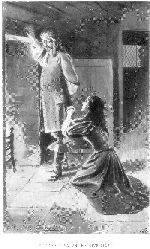
"Forgive you!" says he, bitterly. "Forgive you for dragging me down to the level of rogues and thieves, for making me party to this vile conspiracy of plunder. A conspiracy that, if it bring me not beneath the lash of Justice, must blast my name and fame for ever. You know not what you ask. As well might you bid me take you back to finish the night in drunken riot with those others of our gang."
"Oh, no, not now! not now!" cries Moll, in agony. "Do but say that some day long hence, you will forgive me. Give me that hope, for I cannot live without it."
"That hope's my fear!" says he. "I have known men who, by mere contact with depravity, have so dulled their sense of shame that they could make light of sins that once appalled them. Who knows but that one day I may forgive you, chat easily upon this villany, maybe, regret I went no further in it."
"Oh, God forbid that shall be of my doing!" cries Moll, springing to her feet. "Broken as I am, I'll not accept forgiveness on such terms. Think you I'm like those plague-stricken wretches who, of wanton wickedness, ran from their beds to infect the clean with their foul ill? Not I."
"I spoke in heat," says Mr. Godwin, quickly. "I repent even now what I said."
"Am I so steeped in infamy," continues she, "that I am past all cure? Think," adds she, piteously, "I am not eighteen yet. I was but a child a year ago, with no more judgment of right and wrong than a savage creature. Until I loved you, I think I scarcely knew the meaning of conscience. The knowledge came when I yearned to keep no secret from you. I do remember the first struggle to do right. 'Twas on the little bridge; and there I balanced awhile, 'twixt cheating you and robbing myself. And then, for fear you would not marry me, I dared not own the truth. Oh, had I thought you'd only keep me for your mistress, I'd have told you I was not your cousin. Little as this is, there's surely hope in't. Is it more impossible that you, a strong man, should lift me, than that I, a weak girl,--no more than that,--should drag you down?"
"I did not weigh my words."
"Yet, they were true," says she. "'Tis bred in my body--part of my nature, this spirit of evil, and 'twill exist as long as I. For, even now, I do feel that I would do this wickedness again, and worse, to win you once more."
"My poor wife," says he, touched with pity; and holding forth his arms, she goes to them and lays her cheek against his breast, and there stands crying very silently with mingled thoughts--now of the room she had prepared with such delight against his return, of her little table in the corner, with the chiney image atop, and other trifles with which she had dreamed to give him pleasure--all lost! No more would she sit by his side there watching, with wonder and pride, the growth of beauty 'neath his dexterous hand; and then she feels that 'tis compassion, not love, that hath opened his arms to her, that she hath killed his respect for her, and with it his love. And so, stifling the sobs that rise in her throat, she weeps on, till her tears trickling from her cheek fall upon his hand.
The icy barrier of resentment is melted by the first warm tear,--this silent testimony of her smothered grief,--and bursting from the bonds of reason, he yields to the passionate impulse of his heart, and clasping this poor sorrowing wife to his breast, he seeks to kiss away the tears from her cheek, and soothe her with gentle words. She responds to his passion, kiss for kiss, as she clasps her hands about his head; but still her tears flow on, for with her readier wit she perceives that this is but the transport of passion on his side, and not the untaxed outcome of enduring love, proving again the truth of his unmeditated prophecy; for how can he stand who yields so quickly to the first assault, and if he cannot stand, how can he raise her? Surely and more surely, little by little, they must sink together to some lower depth, and one day, thinks she, repeating his words, "We may chat easily upon this villany and regret we went no further in it."
Mr. Godwin leads her to the adjoining chamber, which had been his, and says:
"Lie down, love. To-morrow we shall see things clearer, and think more reasonably."
"Yes," says she, in return, "more reasonably," and with that she does his bidding; and he returns to sit before the embers and meditate. And here he stays, striving in vain to bring the tumult of his thoughts to some coherent shape, until from sheer exhaustion he falls into a kind of lethargy of sleep.
Meanwhile, Moll, lying in the dark, had been thinking also, but (as women will at such times) with clearer perception, so that her ideas forming in logical sequence, and growing more clear and decisive (as an argument becomes more lively and conclusive by successful reasoning) served to stimulate her intellect and excite her activity. And the end of it was that she rose quickly from her bed and looked into the next room, where she saw her husband sitting, with his chin upon his breast and his hands folded upon his knee before the dead fire. Then wrapping his cloak about her, she steals toward the outer door; but passing him she must needs pause at his back to staunch her tears a moment, and look down upon him for the last time. The light shines in his brown hair, and she bending down till her lips touch a stray curl, they part silently, and she breathes upon him from her very soul, a mute "Fare thee well, dear love."
But she will wait no longer, fearing her courage may give way, and the next minute she is out in the night, softly drawing the door to that separates these two for ever.
CHAPTER XXXII.
How we fought a most bloody battle with Simon, the constable, and others.
For some time we spoke never a word, Dawson and I,--he with his head lying on his arm, I seated in a chair with my hands hanging down by my side, quite stunned by the blow that had fallen upon us. At length, raising his head, his eyes puffed, and his face bedaubed with tears, he says:
"Han't you a word of comfort, Kit, for a broken-hearted man?"
I stammered a few words that had more sound than sense; but indeed I needed consolation myself, seeing my own responsibility for bringing this misfortune upon Moll, and being most heartily ashamed of my roguery now 'twas discovered.
"You don't think he'll be too hard on poor Moll, tell me that, Kit?"
"Aye, he'll forgive her," says I, "sooner than us, or we ourselves."
"And you don't think he'll be for ever a-casting it in her teeth that her father's a--a drunken vagabond, eh?"
"Nay; I believe he is too good a man for that."
"Then," says he, standing up, "I'll go and tell him the whole story, and you shall come with me to bear me out."
"To-morrow will be time enough," says I, flinching from this office; "'tis late now."
"No matter for that. Time enough to sleep when we've settled this business. We'll not leave poor Moll to bear all the punishment of our getting. Mr. Godwin shall know what an innocent, simple child she was when we pushed her into this knavery, and how we dared not tell her of our purpose lest she should draw back. He shall know how she was ever an obedient, docile, artless girl, yielding always to my guidance; and you can stretch a point, Kit, to say you have ever known me for a headstrong, masterful sort of a fellow, who would take denial from none, but must have my own way in all things. I'll take all the blame on my own shoulders, as I should have done at first, but I was so staggered by this fall."
"Well," says I, "if you will have it so--"
"I will," says he, stoutly. "And now give me a bucket of water that I may souse my head, and wear a brave look. I would have him think the worst of me that he may feel the kinder to poor Moll. And I'll make what atonement I can," adds he, as I led him into my bed-chamber. "If he desire it, I will promise never to see Moll again; nay, I will offer to take the king's bounty, and go a-sailoring; and so, betwixt sickness and the Dutch, there'll be an end of Jack Dawson in a very short space."
When he had ducked his head in a bowl of water, and got our cloaks from the room below, we went to the door, and there, to my dismay, I found the lock fast and the key which I had left in its socket gone.
"What's amiss, Kit?" asks Dawson, perceiving my consternation.
"The key, the key!" says I, holding the candle here and there to seek it on the floor, then, giving up my search as it struck me that Mr. Godwin and Moll could not have left the house had the door been locked on the inside; "I do believe we are locked in and made prisoners," says I.
"Why, sure, this is not Mr. Godwin's doing!" cries he.
"'Tis Simon," says I, with conviction, seeing him again in my mind, standing behind Mr. Godwin, with wicked triumph in his face.
"Is there no other door but this one?" asks Dawson.
"There is one at the back, but I have never yet opened that, for lack of a key." And now setting one thing against another, and recalling how I had before found the door open, when I felt sure I had locked it fast, the truth appeared to me; namely, that Simon had that key and did get in the back way, going out by the front on that former occasion in haste upon some sudden alarm.
"Is there never a window we can slip through?" asks Jack.
"Only those above stairs; the lower are all barred."
"A fig for his bars. Does he think we have neither hands nor wits to be hindered by this silly woman's trick?"
"'Tis no silly trick. He's not the man to do an idle thing. There's mischief in this."
"What mischief can he do us more than he has done?--for I see his hand in our misfortune. What mischief, I say?--out with it, man, for your looks betray a fear of something worse."
"Faith, Jack, I dread he has gone to fetch help and will lodge us in gaol for this business."
"Gaol!" cries he, in a passion of desperation. "Why, this will undo Moll for ever. Her husband can never forgive her putting such shame upon him. Rouse yourself, man, from your stupor. Get me something in the shape of a hammer, for God's sake, that we may burst our way from this accursed trap."
I bethought me of an axe for splitting wood, that lay in the kitchen, and fetching it quickly, I put it in his hand. Bidding me stand aside, he let fly at the door like a madman. The splinters flew, but the door held good; and when he stayed a moment to take a new grip on his axe, I heard a clamour of voices outside--Simon's, higher than the rest, crying, "My new door, that cost me seven and eightpence!"
"The lock, the lock!" says I. "Strike that off."
Down came the axe, striking a spark of fire from the lock, which fell with a clatter at the next blow; but ere we had time to open the door, Simon and his party, entering by the back door, forced us to turn for our defence. Perceiving Dawson armed with an axe, however, these fellows paused, and the leader, whom I recognised for the constable of our parish, carrying a staff in one hand and a lanthorn in t'other, cried to us in the king's name to surrender ourselves.
"Take us, if you can," cries Dawson; "and the Lord have mercy on the first who comes within my reach!"
Deftly enough, old Simon, snatching the fellow's cap who stood next him, flings it at the candle that stands flaring on the floor, and justles the constable's lanthorn from his hand, so that in a moment we were all in darkness. Taking us at this disadvantage (for Dawson dared not lay about him with his axe, for fear of hitting me by misadventure), the rascals closed at once; and a most bloody, desperate fight ensued. For, after the first onslaught, in which Dawson (dropping his axe, as being useless at such close quarters) and I grappled each our man, the rest, knowing not friend from foe in the obscurity, and urged on by fear, fell upon each other,--this one striking out at the first he met, and that giving as good as he had taken,--and so all fell a-mauling and belabouring with such lust of vengeance that presently the whole place was of an uproar with the din of cursing, howling, and hard blows. For my own lot I had old Simon to deal with, as I knew at once by the cold, greasy feel of his leathern jerkin, he being enraged to make me his prisoner for the ill I had done him. Hooking his horny fingers about my throat, he clung to me like any wildcat; but stumbling, shortly, over two who were rolling on the floor, we went down both with a crack, and with such violence that he, being undermost, was stunned by the fall. Then, my blood boiling at this treatment, I got astride of him, and roasted his ribs royally, and with more force than ever I had conceived myself to be possessed of. And, growing beside myself with this passion of war, I do think I should have pounded him into a pulp, but that two other combatants, falling across me with their whole weight, knocked all the wind out of my body, oppressing me so grievously, that 'twas as much as I could do to draw myself out of the fray, and get a gasp of breath again.
About this time the uproar began to subside, for those who had got the worst of the battle thought it advisable to sneak out of the house for safety, and those who had fared better, fearing a reverse of fortune, counted they had done enough for this bout, and so also withdrew.
"Are you living, Kit?" asks Dawson, then.
"Aye," says I, as valiantly as you please, "and ready to fight another half-dozen such rascals," but pulling the broken door open, all the same, to get out the easier, in case they returned.
"Why, then, let's go," says he, "unless any is minded to have us stay."
No one responding to this challenge, we made ado to find a couple of hats and cloaks for our use and sallied out.
"Which way do we turn?" asks Dawson, as we come into the road.
"Whither would you go, Jack?"
"Why, to warn Moll of her danger, to be sure."
I apprehended no danger to her, and believed her husband would defend her in any case better than we could, but Dawson would have it we should warn them, and so we turned towards the Court. And now upon examination we found we had come very well out of this fight; for save that the wound in Dawson's hand had been opened afresh, we were neither much the worse.
"But let us set our best foot foremost, Jack," says I, "for I do think we have done more mischief to-night than any we have before, and I shall not be greatly surprised if we are called to account for the death of old Simon or some of his hirelings."
"I know not how that may be," says he, "but I must answer for knocking of somebody's teeth out."
CHAPTER XXXIII.
We take Moll to Greenwich; but no great happiness for her there.
In the midst of our heroics I was greatly scared by perceiving a cloaked figure coming hurriedly towards us in the dim light.
"'Tis another, come to succour his friends," whispers I. "Let us step into this hedge."
"Too late," returns he. "Put on a bold face, 'tis only one."
With a swaggering gait and looking straight before us, we had passed the figure, when a voice calls "Father!" and there turning, we find that 'tis poor Moll in her husband's cloak.
"Where is thy husband, child?" asks Dawson, as he recovers from his astonishment, taking Moll by the hand.
"I have no husband, father," answers she, piteously.
"Why, sure he hath not turned you out of doors?"
"No, he'd not do that," says she, "were I ten times more wicked than I am."
"What folly then is this?" asks her father.
"'Tis no folly. I have left him of my own free will, and shall never go back to him. For he's no more my husband than that house is mine" (pointing to the Court), "Both were got by the same means, and both are lost."
Then briefly she told how they had been turned from the gate by Peter, and how Mr. Godwin was now as poor and homeless as we. And this news throwing us into a silence with new bewilderment, she asks us simply whither we are going.
"My poor Moll!" is all the answer Dawson can make, and that in a broken, trembling voice.
"'Tis no good to cry," says she, dashing aside her tears that had sprung at this word of loving sympathy, and forcing herself to a more cheerful tone. "Why, let us think that we are just awake from a long sleep to find ourselves no worse off than when we fell a-dreaming. Nay, not so ill," adds she, "for you have a home near London. Take me there, dear."
"With all my heart, chuck," answers her father, eagerly. "There, at least, I can give you a shelter till your husband can offer better."
She would not dispute this point (though I perceived clearly her mind was resolved fully never to claim her right to Mr. Godwin's roof), but only begged we should hasten on our way, saying she felt chilled; and in passing Mother Fitch's cottage she constrained us to silence and caution; then when we were safely past she would have us run, still feigning to be cold, but in truth (as I think) to avoid being overtaken by Mr. Godwin, fearing, maybe, that he would overrule her will. This way we sped till Moll was fain to stop with a little cry of pain, and clapping her hand to her heart, being fairly spent and out of breath. Then we took her betwixt us, lending her our arms for support, and falling into a more regular pace made good progress. We trudged on till we reached Croydon without any accident, save that at one point, Moll's step faltering and she with a faint sob weighing heavily upon our arms, we stopped, as thinking her strength overtaxed, and then glancing about me I perceived we were upon that little bridge where we had overtaken Mr. Godwin and he had offered to make Moll his wife. Then I knew 'twas not fatigue that weighed her down, and gauging her feelings by my own remorse, I pitied this poor wife even more than I blamed myself; for had she revealed herself to him at that time, though he might have shrunk from marriage, he must have loved her still, and so she had been spared this shame and hopeless sorrow.
At Croydon we overtook a carrier on his way to London for the Saturday market, who for a couple of shillings gave us a place in his waggon with some good bundles of hay for a seat, and here was rest for our tired bodies (though little for our tormented minds) till we reached Marsh End, where we were set down; and so, the ground being hard with frost, across the Marsh to Greenwich about daybreak. Having the key of his workshop with him, Dawson took us into his lodgings without disturbing the other inmates of the house (who might well have marvelled to see us enter at this hour with a woman in a man's cloak, and no covering but a handkerchief to her head), and Moll taking his bed, we disposed ourselves on some shavings in his shop to get a little sleep.
Dawson was already risen when I awoke, and going into his little parlour, I found him mighty busy setting the place in order, which was in a sad bachelor's pickle, to be sure--all littered up with odds and ends of turning, unwashed plates, broken victuals, etc., just as he had left it.
"She's asleep," says he, in a whisper. "And I'd have this room like a little palace against she comes into it, so do you lend me a hand, Kit, and make no more noise than you can help. The kitchen's through that door; carry everything in there, and what's of no use fling out of the window into the road."
Setting to with a will, we got the parlour and kitchen neat and proper, plates washed, tiles wiped, pots and pans hung up, furniture furbished up, and everything in its place in no time; then leaving me to light a fire in the parlour, Dawson goes forth a-marketing, with a basket on his arm, in high glee. And truly to see the pleasure in his face later on, making a mess of bread and milk in one pipkin and cooking eggs in another (for now we heard Moll stirring in her chamber), one would have thought that this was an occasion for rejoicing rather than grief, and this was due not to want of kind feeling, but to the fond, simple nature of him, he being manly enough in some ways, but a very child in others. He did never see further than his nose (as one says), and because it gave him joy to have Moll beside him once more, he must needs think hopefully, that she will quickly recover from this reverse of fortune, and that all will come right again.
Our dear Moll did nothing to damp his hopes, but played her part bravely and well to spare him the anguish of remorse that secretly wrung her own heart. She met us with a cheerful countenance, admired the neatness of the parlour, the glowing fire, ate her share of porridge, and finding the eggs cooked hard, declared she could not abide them soft. Then she would see her father work his lathe (to his great delight), and begged he would make her some cups for eggs, as being more to our present fashion than eating them from one's hand.
"Why," says he, "there's an old bed-post in the corner that will serve me to a nicety. But first I must see our landlord and engage a room for Kit and me; for I take it, my dear," adds he, "you will be content to stay with us here."
"Yes," answers she, "'tis a most cheerful view of the river from the windows."
She tucked up her skirt and sleeves to busy herself in household matters, and when I would have relieved her of this office, she begged me to go and bear her father company, saying with a piteous look in her eyes that we must leave her some occupation or she should weary. She was pale, there were dark lines beneath her eyes, and she was silent; but I saw no outward sign of grief till the afternoon, when, coming from Jack's shop unexpected, I spied her sitting by the window, with her face in her hands, bowed over a piece of cloth we had bought in the morning, which she was about to fashion into a plain gown, as being more suitable to her condition than the rich dress in which she had left the Court.
"Poor soul!" thinks I; "here is a sad awaking from thy dream of riches and joy."
Upon a seasonable occasion I told Dawson we must soon begin to think of doing something for a livelihood--a matter which was as remote from his consideration as the day of wrath.
"Why, Kit," says he, "I've as good as fifty pounds yet in a hole at the chimney back."
"Aye, but when that's gone--" says I.
"That's a good way hence, Kit, but there never was such a man as you for going forth to meet troubles half way. However, I warrant I shall find some jobs of carpentry to keep us from begging our bread when the pinch comes."
Not content to wait for this pinch, I resolved I would go into the city and enquire there if the booksellers could give me any employment --thinking I might very well write some good sermons on honesty, now I had learnt the folly of roguery. Hearing of my purpose the morning I was about to go, Moll takes me aside and asks me in a quavering voice if I knew where Mr. Godwin might be found. This question staggered me a moment, for her husband's name had not been spoken by any of us since the catastrophe, and it came into my mind now that she designed to return to him, and I stammered out some foolish hint at Hurst Court.
"No, he is not there," says he, "but I thought maybe that Sir Peter Lely--"
"Aye," says I; "he will most likely know where Mr. Godwin may be found."
"Can you tell me where Sir Peter lives?"
"No; but I can learn easily when I am in the city."
"If you can, write the address and send him this," says she, drawing a letter from her breast. She had writ her husband's name on it, and now she pressed her lips to it twice, and putting the warm letter in my hand, she turned away, her poor mouth twitching with smothered grief. I knew then that there was no thought in her mind of seeing her husband again.
I carried the letter with me to the city, wondering what was in it. I know not now, yet I think it contained but a few words of explanation and farewell, with some prayer, maybe, that she might be forgiven and forgotten.
Learning where Sir Peter Lely lived, I myself went to his house, and he not being at home, I asked his servant if Mr. Godwin did sometimes come there.
"Why, yes, sir, he was here but yesterday," answers he. "Indeed, never a day passes but he calls to ask if any one hath sought him."
"In that case," says I, slipping a piece in his ready hand, and fetching out Moll's letter, "you will give him this when he comes next."
"That I will, sir, and without fail. But if you would see him, sir, he bids me say he is ever at his lodging in Holborn, from five in the evening to eight in the morning."
"'Twill answer all ends if you give him that letter. He is in good health, I hope."
"Well, sir, he is and he isn't, as you may say," answers he, dropping into a familiar, confidential tone after casting his eye over me to be sure I was no great person. "He ails nothing, to be sure, for I hear he is ever afoot from morn till even a-searching hither and thither; but a more downhearted, rueful looking gentleman for his age I never see. 'Twixt you and me, sir, I think he hath lost his sweetheart, seeing I am charged, with Sir Peter's permission, to follow and not lose sight of any lady who may chance to call here for him."
I walked back to Greenwich across the fields, debating in my mind whether I should tell Moll of her husband's distress or not, so perplexed with conflicting arguments that I had come to no decision when I reached home.
Moll spying me coming, from her window in the front of the house, met me at the door, in her cloak and hood, and begged I would take her a little turn over the heath.
"What have you to tell me?" asks she, pressing my arm as we walked on.
"I have given your letter to Sir Peter Lely's servant, who promises to deliver it faithfully to your husband."
"Well," says she, after a little pause of silence, "that is not all."
"You will be glad to know that he is well in health," says I, and then I stop again, all hanging in a hedge for not knowing whether it were wiser to speak or hold my tongue.
"There is something else. I see it in your face. Hide nothing from me for love's sake," says she, piteously. Whereupon, my heart getting the better of my head (which, to be sure, was no great achievement), I told all as I have set it down here.
"My dear, dear love! my darling Dick!" says she, in the end. And then she would have it told all over again, with a thousand questions, to draw forth more; and these being exhausted, she asks why I would have concealed so much from her, and if I did fear she would seek him.
"Nay, my dear," says I; "'tis t'other way about. For if your husband does forgive you, and yearns but to take you back into his arms, it would be an unnatural, cruel thing to keep you apart. Therefore, to confess the whole truth, I did meditate going to him and showing how we and not you are to blame in this matter, and then telling him where he might find you, if on reflection he felt that he could honestly hold you guiltless. But ere I do that (as I see now), I must know if you are willing to this accommodation; for if you are not, then are our wounds all opened afresh to no purpose, but to retard their healing."
She made no reply nor any comment for a long time, nor did I seek to bias her judgment by a single word (doubting my wisdom). But I perceived by the quivering of her arm within mine that a terrible conflict 'twixt passion and principle was convulsing every fibre of her being. At the top of the hill above Greenwich she stopped, and, throwing back her hood, let the keen wind blow upon her face, as she gazed over the grey flats beyond the river. And the air seeming to give her strength and a clearer perception, she says, presently:
"Accommodation!" (And she repeats this unlucky word of mine twice or thrice, as if she liked it less each time.) "That means we shall agree to let bygones be bygones, and do our best to get along together for the rest of our lives as easily as we may."
"That's it, my dear," says I, cheerfully.
"Hush up the past," continues she, in the same calculating tone; "conceal it from the world, if possible. Invent some new lie to deceive the curious, and hoodwink our decent friends. Chuckle at our success, and come in time" (here she paused a moment) "to 'chat so lightly of our past knavery, that we could wish we had gone farther in the business.'" Then turning about to me, she asks: "If you were writing the story of my life for a play, would you end it thus?"