L.T. Meade (continued 2)
Reading edition
Light as my footfall was, however, it was heard, for a high-pitched, querulous, weak voice said instantly:—
“Is that you, Jack? Is that really you at last?”
“No,” I replied to the voice, “I am not Jack, but I am the next best thing, I am Jack’s sister. I have brought you a great many messages from him. Now lie quite still, until I light a candle, and then I will tell you everything.”
The figure in the bed gave utterance to a queer kind of astonished groan, but no further sound of any kind came from the lips. I fumbled in my basket until I found the pound of candles; I lit one at the expiring embers in the socket, found two showy candlesticks on the mantelpiece, filled both, and lighted them, and then, going over to the bed, bent down to take a good look at my sister.
I saw a small dark face; two big beautiful eyes looked up at me; a weak little peevish mouth trembled; the lips were drawn down; I saw that tears, and perhaps hysterics, were close at hand. I touched the girl’s forehead with my hand, it was damp from weakness, but there was no fever.
“Before I tell you any of my story I must make you comfortable, Hetty,” I said.
“Hetty?” she whispered, in a kind of terror. “How do you know anything about me?”
“Jack has told me, of course; it’s all right, I assure you. He is prevented coming to-night, so I am going to be your nurse. Oh, yes, I will talk to you presently, but not yet, not until you have had some food, and I have made you comfortable.”
I now observed that the girl’s face was ghastly pale. Yes, the fever was gone, but she was in almost the last extremity of weakness. I rushed again to my basket, took out the tin of Brand’s jelly, opened it, and gave her a spoonful. It acted as a stimulant at once, and I felt that I might leave her while I ran down-stairs to interview the landlady.
Oh, the wonders that a purse full of money can effect! With the chink of that gold I softened Mrs Ashton’s obdurate heart. Jack’s wife became “Poor dear!” and an object of the deepest interest in her eyes. She bundled up-stairs herself, to re-light the fire in the miserable attic. She supplied me with unlimited warm water, clean towels, and clean sheets, and when I asked her if she could roast a fowl, and send it up hot in about an hour’s time, she readily promised to do what I required.
In her absence I affected wonders in the attic room. I made it cheerful with fire-light and candle-light. I opened the window and let in some purer air. Having fed my patient, I proceeded to comb out her beautiful curly dark hair. I then washed her face and hands, and made the bed over again with the clean sheets.
When the landlady brought up the fowl nicely done to a turn, we were both ready for it. The good food, the care, the cheerful light, the purer atmosphere had already done wonders for Hetty. She lost the nervous, frightened manner which at first had made it almost distressing to speak to her. Her eyes shone; the colour dawned faintly in her white cheeks, and when I fed her with tender bits of chicken, she even smiled up into my face with a world of love and gratitude in her eyes.
“You are good to me, miss,” she whispered.
“You must not call me miss, my name is Rosamund. I am your husband’s sister.”
But this allusion made her blush painfully, and she drew once more into her shell.
When Hetty and I had finished our chicken, I set what was left carefully away, and putting out one of the candles sat down by the bedside, and told my new sister that she must go to sleep.
“But you, miss?—oh! I beg your pardon,”—she stopped, confusion in her tone.
“Never mind,” I said, soothingly. I saw this was not the time to commence her education. “Go to sleep,” I said, and bending forward I touched her forehead lightly with my lips. Her eyes looked full back into mine. I had never seen such a wealth of love in any eyes. The lids fell languidly over them. She obeyed me with a happy, satisfied sigh.
Chapter Five.
Lady Ursula.
Hetty slept fairly well. I sat broad awake by her bedside. I was too young, too fresh, too strong to be exhausted by this evening’s excitement and hurry. I was not tired enough to drop asleep in the hard chair by my sister’s bedside. My pulses were beating high. I sat all through the long night, excited, anxious, full of a thousand forebodings and troubles. I gave my patient Brand’s jelly and grapes when she woke in the night, and early in the morning I boiled an egg, made some crisp toast, and a teapot of fragrant tea, and gave Hetty her breakfast. Afterwards I washed and dressed her; I combed out her hair, and tied it into a soft mass. I straightened the bed, and made it look as tidy as such a miserable bed could be, and then putting some grapes within reach, and the flowers on a little table, where she could look at them, I ran down-stairs to interview the landlady.
“I am glad to tell you,” I said, “that my sister seems much better this morning.”
“Oh, ay, miss, I’m sure I’m pleased to hear it.” The landlady was all beams and curtsies. “I always said, pore dear, that it was care she wanted—and all I could I give her, as Mr Gray can testify; but when a woman has got to ’arn her living ’ard, she has no power to spend much time a-cookin’, and a-cleanin’, and a-nursin’, and a-messin’. It’s always a-nursin’ and a-messin’ with the sick, and I han’t got the time, so I’m glad you has come in, miss.”
“Yes, but I must go away for some hours,” I said, “and I want my sister to be taken all possible care of in my absence. Will you do that for me, Mrs Ashton? I will come back as early in the afternoon as I can.”
“To be sure I will, my dear.”
“Here is a piece of paper on which I have written what she is to eat, and how often she is to be fed.”
“Well, dear, I’ll do my ’umble best. I’m not good at readin’ and writin’, but Mary Ann in the kitchen can spell out what you has writ down, miss, I make no doubt.”
I left the paper in Mrs Ashton’s hands, and went back again to Hetty.
“Hetty,” I said, “I must go away for a few hours. Mrs Ashton will take all possible care of you.” I stopped, distressed by the piteous, helpless expression on her face.
“Mrs Ashton doesn’t take any care of me,” said Hetty. “She leaves me all day long, and never, never comes near the room. Yesterday the fire went out, and I got so hungry, so dreadfully hungry. Then the hunger went off, and I felt only cold and very faint. I thought perhaps I was dying. Don’t leave me with Mrs Ashton, miss.”
“You must call me Rosamund, Hetty. Now listen. Don’t tremble, dear. I am obliged to leave you. I have a mother and father, and—and—brothers. Your Jack is one of my brothers. I will come back again as soon as ever I can; and when I come I shall probably bring you a message from Jack.”
“Won’t Jack come to see me himself to-day?”
“I’m afraid not. Jack does not forget you, Hetty, but the fact is, he is ill. He has a bad headache, and has to be nursed.”
“Oh,” she said gently, and without any of the alarm I had anticipated. “Sometimes his head aches fearfully, I know; I have seen it. I have sat up all night nursing his headache. Who is taking care of him now?”
“His mother and mine, the tenderest and best of human beings.”
I felt a break in my voice as I said this. I knew my mother was no longer first in Jack’s affections. I felt an unreasonable and ridiculous sense of jealousy on my mother’s account.
“Good-bye, Hetty,” I said hastily; “I will bring you news of Jack; and try and believe one thing—the Mrs Ashton of yesterday and the Mrs Ashton of to-day are two distinctly different people. You will be taken care of, my dear, and remember I expect to see you looking quite bright and well this evening.”
Then I ran down-stairs and out of the house. It was still too early to go to Madame Leroy’s, but the comfortable chink of gold in my purse enabled me to spend my time profitably. I laid in fresh provisions both for Hetty and for Jack. At twelve o’clock exactly I arrived at Madame Leroy’s. To my surprise Susan herself opened the door for me. I think she must have been waiting on the mat inside, for the moment I rang, the door was pulled open, and Susan said breathlessly:
“Oh, come in, Miss Rosamund, come up-stairs.”
“Where is my ring, Susan?” I said, resisting her impetuous push. “Give me back my ring at once and let me go. I have really a great deal to do, and have not time to wait to chat with you.”
“It isn’t me, miss, as wants to keep you, it’s Madame Leroy herself.”
“Madame Leroy? What do you mean?”
“And I haven’t got the ring, miss. When I asked Madagie for it this morning, she said, ‘When the young person calls, show her up to my private room at once.’ She said ‘young person,’ miss, meaning no offence, but the moment she claps her eyes on you she’ll know you are a lady born.”
“I don’t care what she calls me, Susan; if I must see her, I must, I suppose. Show me to her room at once.”
Susan ran on before me, past the first floor, and the second, and on to the third floor of the great house; where she paused, and knocked deliberately at a certain door which wanted paint, and was altogether very shabby.
“Come in,” said a voice, and I found myself in the presence of Madame Leroy.
I suppose this great artiste, as she would term herself, had a certain figure, manner, eye, tone which were capable of not only inspiring awe, but of tickling vanity, of whetting desire, of ministering to the weakest passions of the silliest of her sex. I may as well own at once that her arts were thrown away on me.
She was a handsome dark-eyed woman, full in figure, tall in stature, and with what would be called a commanding presence. I was only a slip of a girl, badly dressed, and with no presence whatever. Nevertheless, I could not fear the fashionable and pompous being.
“Will you kindly return me my ring, Madame Leroy?” I said brusquely.
Madame favoured me with a sweeping curtsey.
“I presume I am addressing Miss Lindley?” she said. “Pray take a seat, Miss Lindley—I am pleased to make your acquaintance.”
The moment she spoke I perceived that she was not French. She was an English or an Irish woman, probably the latter. Her name was doubtless an assumed one. I did not take the chair she proffered me.
“I have come for my ring,” I said, in a voice which I really managed to make very firm and business-like. “I brought it to you last night, and you very kindly paid me five pounds for the loan of it. I want it back now. Your servant said that if I called at twelve o’clock I should have the ring back.”
“I wish you would take a chair, Miss Lindley; I want particularly to speak to you about the ring. I am pleased to be able to impart to you some good news. I—” Madame Leroy paused, and slightly smacked her lips. “I have found a purchaser for your ruby ring, Miss Lindley.”
I felt my cheeks turning very red.
“You are kind,” I replied; “I dare say you mean to be good to me when you say you have a purchaser for the ring. But I don’t want to sell it.”
“Not want to sell it!” Madame Leroy looked me all over from the crown of my hat to the tips of my shabby boots. Then putting on her pince-nez she scrutinised my face. I knew perfectly well the thoughts that were filling her mind. She was saying to herself:—“You are a poor specimen of humanity, but if I, the great artiste, had the dressing of you, I might make you at least presentable. The idea of a chit like you presuming to refuse to sell a trinket!”
“I don’t want to sell my ring,” I said. “But it is possible that I may lend it to you another evening. Even that I am not sure about. Give it back to me now, please.”
I held out my hand. Madame Leroy drew back.
“I am very sorry,” she said, reddening; “the fact is, I have not got the ring.”
“Not got my ring?”
“No. Lady Ursula Redmayne borrowed the ring last night. She sent me a messenger this morning with a letter, and no ring. Shall I read you her letter?”
“I do not care to hear it,” I said. “It is no matter to me what Lady Ursula Redmayne writes to you. I want my ring.”
“Well, miss,”—Madame Leroy’s tone was now decidedly angry,—“seeing how very anxious you were last night for the immediate loan of five pounds, you have a mighty independent way with you. Lady Ursula Redmayne, indeed! I can tell you it isn’t every one as has the privilege of getting letters from Lady Ursula.”
While Madame Leroy was speaking I had a great many flashes of thought. Her first words recalled me to myself. A girl who had come in desperation to hire out a family trinket for what she could get for it, was surely inconsistent when she disdained even the suggestion of a future patron. Lady Ursula, whoever she was, would buy the ring. Of course she must not have it, I must be a great deal harder pressed before I could consent to part with my Talisman, my “Open Sesame” into the Land of Romance. But I knew that I did want money. I wanted twenty pounds before Monday, if I would help Jack—I wanted further money if I would continue to assist his wife.
All these thoughts, as I say, flashed through me, and by the time Madame Leroy had finished speaking, I had quite altered my tone.
“I am sorry to appear rude,” I said. “I know you were very kind to help me last night. Will you please tell me what Lady Ursula says about my ring?”
“Candidly, my dear, she wants to buy it from you. Here is her letter. She says:—
”‘Dear Madame Leroy,—You must get me that lovely ruby ring at any price. I refuse to part from it. Name a price, and I will send you a cheque.’
“There’s a chance for you,” said Madame Leroy, flinging down her letter. “You can’t say I have not been a good friend to you after that letter. Name any price in reason for that old ring, and you shall have it—my commission being twenty per cent.”
“But I don’t wish to sell the ring, Madame Leroy.”
“I am sorry, Miss Lindley, I am afraid you have no help for yourself. Lady Ursula Redmayne intends to buy it.”
This was not at all the right kind of thing to say to me. I was very proud, and all my pride flashed into my face.
“You think because I am poor, and Lady Ursula is rich, that she is to have my property?” I said. “You must send a messenger for the ring at once. I will wait here until he returns.”
Poor Madame Leroy looked absolutely stupefied.
“I never met such a queer young lady,” she said. “How can I send a message of that sort? Why, it will offend my best, my very best customer. If you have no pity on yourself, Miss Lindley, you ought to have some on me.”
“What can I do for you, Madame Leroy? I cannot sell the ring.”
“Well, you might go yourself to Lady Ursula. She is eccentric. She might take a fancy to you. You might go to her, and explain your motives, which are more than I can understand. And above all things you might exonerate me; you might explain to her that I did my best to get the ring for her.”
“I could certainly do that.”
“Will you?”
“I will go to Lady Ursula, if it does not take up too much of my time.”
“She lives in Grosvenor Street, not five minutes’ drive from here. You shall go in a hansom at my expense at once.”
Chapter Six.
The Aristocrat.
The house in Grosvenor Street was the most splendid mansion I had ever seen. It was Cousin Geoffrey’s house over again, only there were no cobwebs, no neglect, no dirt anywhere. The household machinery was perfect, and well oiled. I suppose I ought to have felt timid when those ponderous doors were thrown open, and a powdered footman stared at me in the insolent manner which seems specially to belong to these servitors of the great. I had no feeling of abasement, however. The lady, be she young or old, who resided in this palace, wanted a boon from me; I required nothing at her hands except my own property back again.
I said to the footman:
“Is Lady Ursula Redmayne at home?”
He replied in the affirmative.
“I wish to see her,” I continued. “Will you have the goodness to let Lady Ursula know at once that I have called at the request of Madame Leroy to speak to her on the subject of a ring.”
A sudden flash of intelligence and interest swept over the man’s impassive features. Then he resumed his wooden style, and flinging the door yet wider open invited me to enter.
I was shown into a small room to the left of the great entrance hall, and had to consume my own impatience for the next ten minutes as best I might. At the end of that time the servant returned.
“Come this way, madam,” he said.
He ushered me up a flight of stairs, down another flight of stairs, along a dimly-lighted gallery hung with many Rembrandts and Gainsboroughs, and suddenly opening a door ushered me into a kind of rose-coloured bower. There was a subtle warmth and perfume about the room, and the coloured light gave me for a moment a giddy and unnerved feeling.
“Miss Lindley, your Ladyship,” announced the man. The door was softly closed, indeed it seemed to vanish into a wall of tapestry.
The rose-coloured light had for an instant confused my sight, and I did not see the girl, no older than myself, who was lying back in an easy-chair, and pulling the silken ears of a toy-terrier.
When the man left the room she sprang up, flung the dog on the ground, who gave a squeaking bark of indignation, and came to meet me as if I were a dear old friend.
“Sit down, Miss Lindley. How good of dear old Madame to send you to me! And so you are the owner of that heavenly ring?”
Lady Ursula was very pretty. Her voice was like a flute; her dress was perfection; her manner almost caressing. But even there, in that rose-coloured bower, I recognised her imperiousness, and I felt that if she were crossed her sweet tones would vanish, and I should be permitted to gaze at a new side of her character.
“You have come about the ring,” she said. “Now, what do you want for it? It is a treasure, but you won’t be too extravagant in your demands, will you?”
“I won’t be extravagant at all, Lady Ursula,” I cried. “I have no demand to make, except to ask you to let me have my property back.”
“The ring back? The ruby ring? Oh, my dear good creature you don’t understand. I wrote to Madame Leroy offering to buy it. I will give you a cheque for it, Miss Lindley—or gold, if you prefer it. You shall have a price for the ring. Your own price, if it is not beyond reason. Now do you understand?”
“I understand perfectly,” I replied—I am afraid my tone was nettled—I certainly felt very angry. “I understand,” I said. “You want me to sell the ring—I don’t intend to sell it. It was a legacy left to me by a cousin, and I—I won’t part with it.”
I said these words so decidedly that the fine young lady, who all her life had lived luxuriously, and, perhaps, now for the first time in her existence had her whim refused, stared at me in amazement. Her brows became contracted. Her pleasant, kindly, but insufferably condescending manner changed to one more natural although less amiable. Lady Ursula ceased to be the aristocrat, and became the woman.
“You won’t sell your ring?” she said. “But you did much the same last night. Last night you took money for the ring left to you by your—your cousin. I wore the ruby ring, and I paid you money for the loan.”
“I know you did,” I answered. “I wanted money last night. I was in despair for money. I heard through one of her apprentices that Madame Leroy now and then hired out jewels to some of her rich customers. You wore the ring and paid me for it. Now I want it back. I am in a hurry, so please let me have it at once.” I stood up as I spoke. Lady Ursula did not stir.
“Sit down,” she said. “No, not on that stiff little ottoman, but on the sofa, close to me. Now we can talk cosily. This seems an exciting story, Miss Lindley, and you have an exciting way of putting things. Fancy you, wanting money so badly as to have to hire out your ring. I always knew there were creatures in the world who would do anything to secure money, but I had not an idea that ladies were put to these straits.”
“You know very little indeed about the lives of some ladies,” I answered. “The need of money comes to some who are ladies, and it presses them sore.”
“It must be awfully interesting and exciting,” responded Lady Ursula.
“It is both. At the same time it is cruel; it stabs horribly.”
“Ah.”
Lady Ursula looked me all over from head to foot.
“Then you don’t want money to-day,” she said suddenly.
“Yes, I do.”
“As badly as you did last night?”
“I think so. Yes, I believe I want it quite as badly.”
“Then you will sell your ring; if the want of money stabs and is cruel, you will take what opportunity offers. For the sake of a sentiment you won’t refuse to enrich yourself, and remove the pain which you speak of as so bitter.”
“I won’t sell my ring,” I said. “I am sorry to disoblige you, Lady Ursula, but the question is not one which leaves any room for consideration. I want my ring back. Will you give it to me, please?”
I really don’t know how aristocratic girls are brought up. I suppose they have a totally different training from girls who live in cottages, and are very poor. There is compensation in all things, and no doubt if self-denial is a virtue the cottage girl has a chance of acquiring it which is denied to the maid who inhabits the palace.
If I never performed any other mission, I shall always feel that I was the first person who did for Lady Ursula Redmayne the inestimable service of saying “No” to a strong desire.
It took this beautiful young woman several moments to realise that she absolutely could not have her way; that the humble and poor cottage girl would not part with her legitimate property.
When Lady Ursula realised this, which she did after a considerable and fatiguing discussion, she sat silent for a moment or two. Then she jumped up and looked out of the window. She pulled aside the soft rose-coloured silk curtains to take this peep into the outer world. Her eager dark eyes looked down the street and up the street. For all her languor she was now fully alive and even quick in her movements. With a pettish action she let the rose curtains cover the window again, and going to the fireplace pressed the button of an electric bell.
In a moment an elderly woman dressed in black silk, with a book-muslin apron, and a white cap with long streamers of lace, appeared.
“Nurse,” said Lady Ursula, “please give orders that I am not at home to any callers this morning.”
“I will attend to the matter, my lady,” answered the nurse. “But if Captain Valentine calls?”
“I am not at home—I make no exception.”
The nurse respectfully withdrew, and the door, which opened into the tapestry, was noiselessly closed.
“Now,” said Lady Ursula, turning to me, “I am going to confide in you, Miss Lindley.”
I felt quite cross. I was dying to be home with mother and Jack, and wondering if my poor new sister Hetty was being starved by Mrs Ashton.
Lady Ursula looked at me with an expression which seemed to say—
“Now you are having an honour conferred on you.”
In reply to it, I rose to my feet, and I think some of the crossness in my heart got into my face.
“Thank you,” I said, “but I have only a moment to give you. My brother is dangerously ill at home, and I must go back as soon as possible.”
Lady Ursula slightly raised her delicate brows.
I think she scarcely heard what I said about my brother.
“Do sit down,” she said, “I won’t keep you a moment. What a queer girl you are! but very refreshing to meet. Now do sit down. You can’t go, you know, until you get your ring. Miss Lindley, I must confide my story to you. I am engaged.”
I bowed my head very slightly.
“To Captain Rupert Valentine. He is in the Guards. Would you like to see his photograph?”
I murmured something. Lady Ursula stretched out her hand to a table which stood near, took up a morocco case, which she opened, and showed me the dark, slightly supercilious face of a handsome man of about thirty.
“Don’t you admire his expression?” she said. “Isn’t it firm? Doesn’t he look like the sort of hero a girl would be proud to obey?”
“That depends on the girl,” I answered.
“Good gracious, there isn’t a girl in the kingdom who would not be proud to be engaged to Rupert Valentine.”
“I hope you will be very happy, Lady Ursula.”
“There is not the least doubt on that point. We are to be married immediately after Christmas. Now comes the real point of my confidence. Rupert gave me an engagement ring exactly like yours, so like, that only the closest observer could detect a difference. The ring belonged to his mother, and he valued it above all other earthly things.”
“Yes,” I said; I was really interested at last.
“Yesterday I lost the ring. I don’t know how. I was out driving, and I may have pulled it off with my glove when I was shopping. I went to Madame Leroy’s among other places. When I came back my ruby ring was gone. I cannot conceive how it vanished. I went very nearly mad on the spot, I really did. I dared not face Rupert, and tell him his engagement ring was lost. All search was made for its recovery, but in vain. Nurse took the carriage round, and went from shop to shop to try and get some trace of it. In the end she visited Madame Leroy. I was to meet Rupert at a friend’s house last night. While nurse was at Madame Leroy’s your ring was brought in. Imagine her astonishment and rapture! Here was a mode of deliverance for me in case my own ring was never recovered. I wore your ruby ring last night, Miss Lindley, and Captain Valentine noticed it, and said that beautiful as he had always known his mother’s rubies to be, he had never seen them flash as they did on my finger last night. How relieved I felt, and how certain that you would let me buy the ring from you. You will, now that I have confided my trouble to you, won’t you?”
“I am sorry,” I said, “but I must repeat the words I have used already so often. I cannot part with the ruby ring. It was left to me by an old cousin of mine, and when I received it I was particularly requested never to part with it. I am sorry for you, Lady Ursula, but I must ask you to give me my ring, and let me go.”
Lady Ursula put her hands behind her.
“You are a cruel, selfish girl,” she said angrily.
“No, Lady Ursula, I am not cruel. The world, which has been so gentle to you, has blown many hard rough winds on my face, but they have never made me cruel. And as to being selfish, why should I part with my one ewe-lamb?”
“Oh, dear!” said Lady Ursula.
She rose from her seat, and began to pace up and down the room. I noticed that she was a tall, largely-made girl, and could be as vigorous and energetic as any one when she chose. She clenched her dainty hands now and spoke with passion. “I repeat that you are cruel and selfish,” she said. “I know that you can plead your cause well; for I suppose you are clever, and have doubtless been educated at one of those detestable High Schools. But let me tell you that however you argue the point you are actuated by cruel motives. What can that ring matter to you? and if I don’t get it, most likely my engagement will be broken off. Thus, you see, you will have ruined my life.”
“Lady Ursula,” I said, “it is you now who are cruel. I have my own reasons for wishing to retain my own trinket, and surely the only right and honourable thing for you to do is to tell Captain Valentine of your loss. If he is the least worthy of your affection, he will, of course, overlook what was only an unfortunate accident.”
“No, he never will—he never, never will. You don’t know what he thought of that ring. I’d rather never see him again than tell him that his mother’s ruby ring was lost.”
“Well, I am truly sorry for you. But I don’t see my way to helping you.”
“Listen. Hire me the ring for a week—only for a week, and I will give you thirty pounds.”
I must admit that this proposal staggered me. I thought of Jack, and the stolen twenty pounds. I thought of Monday morning, when the discovery of the theft would be made known. I thought of the agony, the dishonour; I saw my mother’s face as it would look when the news was brought to her that her son was a thief. Yes, thirty pounds could do much good just then; it would save Jack, and it would give me funds to attend to Hetty’s wants.
Lady Ursula saw the hesitation in my face.
“Give me one week’s grace,” she said. “My own ruby ring may be found before the week is up.”
She opened a little exquisitely inlaid secretary, and began to pull out of a secret drawer notes and gold. She made a pile of them on the table—four five-pound notes, ten sovereigns. The yellow of the sovereigns seemed to mix with the rose-coloured tone of the room. I gazed at them as if they fascinated me. I half held out my hand to close over them, and then drew it back again.
“You will take the money—you want it, I know you do,” said Lady Ursula.
“But even if I do you will be no better off at the end of a week. In fact, you will be worse off, for you will have been all that time deliberately deceiving the man you intend to marry.”
“Oh, don’t begin to lecture me! Let the end of the week take care of itself! Here are thirty pounds! Give me the ring for a week!”
“I shall do very wrong.”
“Do wrong then! Take your money! You are looking greedily at it! Take it, you long for it!”
“I do long for it,” I answered. “If I take it, Lady Ursula, it will avert such a storm as girls like you can never even picture. It will save—Oh, have you a mother, Lady Ursula?”
“Of course I have. I don’t see her very often. She is at Cannes now.”
“If I take the money,” I said, “it will be only for a week, remember.”
“Very well. Of course you will take it. Out with your purse. Nay, though, you shall have a new purse, and one of mine. What do you say to this, made of red Russian leather? Here go the notes, and here the gold. Pop the purse into your pocket. Now, don’t you feel nice? We have both got what we want, and we can both be happy for a week.”
“I will come back in a week,” I said. I felt so mean when that thirty pounds lay in my pocket that I could scarcely raise my eyes. For the first time the difference of rank between Lady Ursula and myself oppressed me. For the first time I was conscious of my shabby dress, my rough boots, my worn gloves. “Good-bye, Lady Ursula,” I said.
“Good-bye, good-bye! I cannot tell you how grateful I am! You are not cruel, you are not selfish. By the way, what is your name?”
“Lindley.”
“Your Christian name?”
“I am called Rosamund.”
“How pretty! Good-bye, Rosamund!”
Chapter Seven.
Mr Chillingfleet.
I left the house, and took the next train home. Jack was very ill indeed. His fever had taken an acute form. My mother looked miserable about him. Even the doctor was anxious.
“I am so glad you have come back, Rose,” said my mother; “you had scarlet fever when you were a little child, so there is no fear for you, and it will be a great comfort having you in the house.”
I did not make any immediate response to this speech of my mother’s. I had Hetty under my charge, and could not stay, and yet how queer my mother would think my absence just then. I wondered if I dared confide to her Jack’s secret. It was told me in great confidence, but still—While I was hesitating, my mother began to speak again.
“Jack has been delirious all the morning. In his delirium he has spoken constantly of a girl called Hetty. Do we know any one of the name, Rose?”
“I know some one of the name,” I responded.
“You!—But what friend have you that I am not acquainted with? I don’t believe there is a single girl called Hetty in this place.”
“I know a girl of the name,” I repeated. “She does not live here. She is a girl who is ill at present, and in—in great trouble, and I think I ought to go and nurse her. She is without the friend who should be with her, and it is right for me to take his place.”
“What do you mean, Rosamund? Right for you to go away, and nurse a complete stranger, when your own brother is so ill?”
“But he has you, and Jane Fleming. Jack won’t suffer for lack of nursing, and the girl has no one.”
“I have old-fashioned ideas,” said my mother. A pink flush covered her face. I had never seen her more disturbed. “I have old-fashioned ideas, and they tell me that charity begins at home.”
At this moment Jane Fleming softly opened the door and came in. She certainly was a model nurse; so quiet, so self-contained, so capable.
“Mr Jack is awake, and conscious,” she said. “He fancied he heard your voice, Miss Rose, and he wants to see you at once.”
I glanced at my mother. She was standing with that bewildered expression on her face which mothers wear when their children are absolutely beyond their control. I made my resolution on the spur of the moment.
“Come with me to Jack, mother,” I said.
I took her hand, and we went softly up-stairs to the attic bedroom. Jack’s great big feverish eyes lighted up with expectancy when he saw me; but when he perceived that my mother accompanied me, their expression changed to one of annoyance. I went up to him at once, and took his hand.
“Hetty is better,” I said, “she has had an excellent night and is doing well. Mother dear, please come here. I shall go back to Hetty, Jack, and take all possible care of her, and nurse her, and make her strong and well again, if you will tell our mother who she is.”
“Yes,” said Jack, at once. “Yes, oh yes; she is my wife.”
My mother uttered an exclamation.
“Tell mother all about her, Jack,” I continued. “I will leave you both together for five minutes, then I will return.”
I slipped out of the room, took Jane aside, and gave her a sovereign.
“Jane,” I said, “you are to make the beef-tea yourself, and you are always to have a supply, fresh and very strong, in the house. Whenever my mother seems tired or fagged you are to give her a cup of beef-tea, and see that she drinks it.”
“Bless you, Miss Rose, of course I will.”
“Buy anything else that is necessary,” I said. “I am going away immediately, but shall be back on Monday afternoon.”
My five minutes were up by this time, and I stole into Jack’s sick-room. He was stretched flat out in bed; his cheeks were wet as if tears had touched them, and one great muscular arm was flung round my mother’s neck. She was kneeling by him, and holding his hand.
The moment I entered she looked round at me.
“My dear love,” she said, “you are perfectly right; Hetty must not be left a moment longer than can be helped. Hush, Jack, you need have no anxiety for your wife. I—I will go to see her myself if it is necessary.”
“No, mother, you must stay with me. You are so pretty and so gentle, and your hand is so soft. Hetty’s hands aren’t as soft as yours.”
Here he began to wander again. My mother followed me out of the room, the tears streaming down her cheeks.
“Oh, Rose,” she said, “the poor, poor boy. And you thought, both of you, to hide it from your mother?”
“No, mother, I longed for you to know; I am sure that telling you his story has given Jack the greatest relief. And weren’t you a bit angry with him, mother?”
“Angry, Rosamund? Was this a time to be angry? and do mothers as a rule turn away from repentant sons?”
“Not mothers such as you,” I replied. “Mothers worthy of the name would never do such a thing,” she replied. “Why, Rosamund, a mother—I say it in all reverence—stands something in the place of God. When we are truly repentant we never feel nearer to God, and so a boy is never truly nearer to his mother than when he has done something wrong, and is sorry for it. Come up-stairs with me at once, I must help you to make your preparations. You have not an hour to lose in going to Jack’s Hetty.” My mother was so excited, so enthusiastic, that she would scarcely give me breathing-time to put my things together.
“You must not delay,” she kept on saying. “You have told me how careless the landlady is, and that poor child has had no one to do anything for her since early morning. Rose, dear, how is she off for little comforts, and clothes and those sort of things?”
“I should say, very badly off, mother. Hetty is as poor as poor can be.”
“I have one or two night-dresses,” began my mother.
“Now, mother, you are not going to deprive yourself.”
“Don’t talk of it in that light, Rose. Hetty is my daughter, remember.”
I felt a fierce pang of jealousy at this. My mother left the room, and presently returned with a neatly-made-up parcel.
“You will find some small necessaries for the poor child here,” she said. “And now go, my darling, and God bless you. One word first, however. How are you off for money, Rose?”
“I have plenty, mother. Don’t worry yourself on that point.”
“I have a little pearl ring up-stairs, which I could sell, if necessary.”
The tears rushed to my eyes when my mother said this. The pearl ring was her sole adornment, and she had worn it on Sunday ever since we were children.
“You shall never sell your dear ring,” I said.
I rushed up to her, kissed her frantically, and left the house.
Hetty and I spent a quiet Sunday together. She was much better, and she looked very pretty in the warm, softly-coloured dressing-jacket which mother had sent her. She told me her little story, which was simple as story could be. She had no parents, nor any near relatives living. Even a distant cousin, who had paid for her education, had died two years previously. She thought herself very lucky when she secured the post of English teacher at Miss West’s Select Seminary for young ladies. She made Jack’s acquaintance early in the spring; no one else had ever been specially kind to her, and when he asked her to marry him, she said “Yes,” in a burst of delight and gratitude.
“I didn’t know he was so grand as he has turned out to be, miss,” said Hetty, in conclusion.
“Now, Hetty, what did I say about miss?”
“It seems so queer and forward to say Rose,” she answered. “I never had any one to love until Jack married me. Oh, don’t I love him just, and don’t I love you—Rose!”
“I know you do,” I said, “and when you see my mother you will love her. We will try to be good to you, poor little Hetty, and you will try to learn to be a real lady for my mother’s sake.”
“And for Jack’s sake,” she answered, an eager flush coming into her cheeks.
“Yes,” I replied.
“Will you show me how to be a lady, Rose?”
“Oh, Hetty, no one can show you. You must find out the way yourself. You will, too, if you are in earnest, and if you love my mother as she deserves to be loved. Hetty, my mother is the gentlest of women, and yet no queen could be more dignified, more ladylike.”
“Would she frighten me awfully?” whispered Hetty.
“Oh, you poor child! There, I won’t talk any more. Wait until you see her!”
Hetty was rather under than over educated for her station; but there was a certain sweetness, and even refined charm about her, which gave me a sense of almost pain as I looked at her. Was Jack worthy of this passionate, loving heart?
Sunday passed peacefully, but I did not forget what lay before me on Monday morning. The real crucial turn in Jack’s affairs would come then.
I went early to town, and saw Mr Chillingfleet, the head of Jack’s firm, about eleven o’clock. Jack had told me that twelve was the hour when the money was generally collected and sent to the bank. I don’t know how I managed to inveigle a young clerk to coax Mr Chillingfleet to see me, but I did, and at eleven o’clock I stood before him.
I looked into his face. I knew that a great deal hung upon that interview; I knew that my mother’s future happiness in life, that all poor Hetty’s bliss or undoing depended on what sort of face Mr Chillingfleet possessed. I was a good reader of physiognomy, and I studied his with an eager flash.
It was a firm face: the lips thin, the chin both long and square, the check-bones high; the eyes, however, were kind, honest, straightforward. I looked into Mr Chillingfleet’s eyes, and took courage.
“You want to see me, young lady?” said the chief of the great house.
“I do, sir,” I said, “I have come about my brother Jack.”
“Young Lindley—you are young Lindley’s sister? I am sorry he is ill.”
Mr Chillingfleet’s tone was kind, but not enthusiastic. The young clerk’s services were evidently not greatly missed.
“I have a story to tell you,” I said. And then I began to speak.
My tone was eager, but I saw at once that I did not make a deep impression. Mr Chillingfleet was only languidly attentive. I could read his face, and I was absolutely certain that the thought expressed on it was the earnest hope that my story would be brief. I felt certain that he considered me a worry, that he felt it truly unreasonable of the sisters of sick clerks to come to worry him before noon on Monday morning.
He was a true gentleman, however, and as such could not bring himself to be rude to a woman.
“I can give you ten minutes,” he said, in a courteous tone.
All this time I had been toying with my subject. I now looked in agony at a boy clerk who was perched on a high stool by a desk at the other end of the room.
“If I could see you by yourself,” I said, almost in a whisper.
“Dawson, you can go,” said Mr Chillingfleet.
The boy glided off the high stool, and vanished. The moment the door was shut I took out my purse, and removing four five-pound notes, laid them on the desk beside the chief of the great house.
“Good gracious, young lady, what do you mean by that?” said Mr Chillingfleet.
“Those four five-pound notes are yours,” I said. “I have brought them back to you.”
“Miss Lindley, you must explain yourself.”
Mr Chillingfleet’s tone was no longer languid in its interest.
Then I gulped down a great lump in my throat, and told the story. It does not matter how I told it. I cannot recall the words I used. I don’t know whether I spoke eloquently or badly. I know I did not cry, but I am firmly convinced that my face was ashy pale, for it felt so queer and stiff and cold.
At last I had finished. The story of the young clerk’s temptation and disgrace was known to his chief. Now I waited for the fiat to go forth. Suppose Mr Chillingfleet refused to receive back the twenty pounds I brought him? Suppose he thought it good for the interests of business that the young thief—the wicked, brazen young thief—should be made an example of?
I gazed into the kind and honourable eyes. I watched with agony the firm, the hard, the almost cruel mouth.
“Oh, sir,” I said, suddenly, “take back the money! Jack’s mother is alive, and perhaps your mother, too, lives, sir. Take back the money, and be merciful, for her sake.”
Mr Chillingfleet shut his eyes twice, very quickly. Then he spoke.
“You must not try to come over me with sentiment,” he said. “This is not the time. A principle is involved, and I must be guided by a sense of duty. I am particularly busy at this moment, but I will give you my decision before you go. Can you wait for half an hour?”
“Yes, sir.”
Mr Chillingfleet sounded an office gong by his side.
“Dawson,” he said, when the boy appeared, “show this lady into the waiting-room.”
The boy preceded me into a dismal little back room, furnished me with a copy of the day’s Times, and left me. I could not read a word. I felt more and more hopeless as the moments went by.
It was nearly one o’clock before I was summoned back into Mr Chillingfleet’s presence.
“Sit down,” he said, in a much more kind tone than he had used when I left him. “You are a good girl, Miss Lindley,” he began. “You have acted in a very straightforward and honourable manner. Your mother must be a good woman, for she has brought up a worthy daughter. However, to the point. I will accept the notes you have just brought me in lieu of those stolen by your brother. I will not prosecute him for theft.”
“Oh, sir, God bless you?”
“Stay, you must hear me out. I don’t forgive absolutely; I should not think it right. Lindley has proved himself unworthy of trust, and he no longer holds a situation in this house. He may redeem his character some day, but the uphill path will be difficult for him, for the simple reason that I shall find it impossible to give him a recommendation which will enable him to obtain another situation.”
“Oh, sir—Mr Chillingfleet—his young wife!”
“Precisely so, Miss Lindley, but society must be protected. When a man does something which destroys his character, he must bear the consequences. There, I am sorry for you, but I can do no more. I must be just. Good-morning.”
Mr Chillingfleet touched my fingers, bowed to me, and I withdrew.
I pulled my veil down over my face; I did not look to right or left as I walked out of the office.
Chapter Eight.
I cannot part with my Ring.
Jack was going on well, and I spent most of the time with his wife. One day a letter from home was forwarded to me. I opened it, and saw to my astonishment that the signature was Albert Chillingfleet.
“My dear Miss Lindley,” the good man wrote, “your face has made a tolerably strong impression on me. I wish you were a lad; I would give you a berth in my business-house directly. But in the case of your brother, justice must be done, you know. He ought never to be a clerk in a business-house again. Still, there are other openings. When he has quite recovered, ask him to call to see me at my private address—Princes’ Gate. I am generally disengaged and at home between nine and ten in the evening. I enclose a trifle for that young wife. “Yours sincerely,— “Albert Chillingfleet.”
The trifle was a ten-pound note. My fingers trembled as I unfolded it. I looked across the room at Hetty. She was better now, and was able to spend a certain portion of each day on a sofa which the landlady had brought into the room for her.
Hetty’s face wore the bright, innocent expression of a child. Her illness seemed to have brought back a kind of pathetic lost youth to her. She was young, undoubtedly, in years, very young, but I felt convinced that before she had been so ill she had not worn this child-expression—her lips could not have been so reposeful in the old days, nor her eyes so unanxious.
She was lying now gazing calmly out of the window. Her hands were folded on her lap. The knitting she had been trying to accomplish had tumbled unheeded to the floor. When the bank-note rustled in my hand Hetty turned and looked at me. I got up and gave it to her.
“This is for you,” I said. “I have had a letter from a friend of ours, and he has sent you this.”
“Oh!” she exclaimed. She clasped the note in both her hands. “Ten pounds!” she repeated. “Rosamund,” she continued, “I never had so much money as this in all my life before.”
“Well, make good use of it, dear child,” I said. “Put it away safely now. You’ll be sure to want it.”
“But ought not I to thank your friend?”
“I’ll do that for you. I’ll be sure to say something very pretty.”
Hetty looked at the ten-pound note as if she loved it. Then she stretched out her hand, and proffered it back to me.
“You had better have it, Rosamund. You buy everything that we want. Take it, and spend it, won’t you? You must need it very badly.”
“No, no, no! This is your own nest-egg, and no one else shall touch it. See, I will put it into your purse; I know where your little empty purse is, Hetty. I will put this nice crisp note into it. Is it not jolly to have so much laid by?”
“Yes,” said Hetty, “I feel delightfully rich.” She closed her eyes, smiling, wearied, happy. In the sleep which followed she smiled again, more than once. She was thinking of Jack, and of the good things she could buy for him out of this purse of Fortunatus.
On the following day I was to go back to Lady Ursula to receive my ruby ring. As I sat and worked by Hetty’s side, I planned how I would take the little excursion in the morning, bring back the ring, and amuse my sister in the afternoon by telling her the story of it.
I carried out the early part of this programme exactly as I had mapped it before my eyes on this peaceful afternoon. The next morning found me at an early hour ringing the ponderous bell under the heavy portico of the great house in Grosvenor Street. The liveried footman once more put in his appearance, and I was taken once again to Lady Ursula’s pretty rose-coloured bower.
It was empty when I entered.
“Her ladyship will be with you in a minute or two,” said the man, as he closed the door behind the tapestry.
I sat back in an easy-chair, and waited. It was very nice to wait in this pretty room. I felt quite easy in my mind, and not at all anxious. Circumstances had improved for me during the last fortnight. Hetty was getting well. Jack was better. Exposure and disgrace were averted. In short, the heavy pressure of expectant calamity was withdrawn, and life smiled at me with its every-day face. I thought how glad I should be to have my little ring again—my pretty romantic treasure should be more prized than ever. Nothing should induce me to part with it again.
As I lay back and reflected peacefully, footsteps approached. The tapestry was pushed aside, and a man entered.
He was tall, with a dark complexion. His appearance was aristocratic. I glanced at him, and recognised him in a flash. I knew him by his likeness to the excellent photograph Lady Ursula possessed—he was her lover.
I was seated rather in the shadow. At first when he came in he did not notice me. He went straight up to Lady Ursula’s table, and laid a small morocco case on it. He took up a photograph of the young lady, looked at it steadily—a half smile played round his somewhat austere mouth, his eyes softened. He held the photograph close to his lips, but he did not kiss it; with an almost reverent gesture he replaced it, then turned to leave the room. As he did so he caught sight of me. I had been looking on with a very red face. It was now Captain Valentine’s turn to get red. He grew scarlet; he looked intensely angry. I saw at a glance that he was the last man who could bear to be caught in a sentimental attitude, he was the last man who could bear even a shade of ridicule.
He bowed very stiffly to me and vanished.
The next instant Lady Ursula came in.
“Oh, here you are, Rosamund!” she said; “how do you do?”
“I am very well,” I answered. I did not want Lady Ursula to call me Rosamund. She sat down on the sofa with her hands crossed idly in her lap. Her face was full of interrogation; it said as plainly as face could:
“Now, what do you want, Rosamund? Have the goodness to say it, whatever it is, and go away.”
The look in her eyes was replied to steadily by mine. Then I said calmly: “I have come for my ring.”
When I said this Lady Ursula dropped her mask. War to the knife gleamed in her bright eyes.
“Oh! the ring,” she said; “well, you can’t have it, so there!”
At that instant Captain Valentine hastily re-entered the room. With a brief apology to me he turned to Lady Ursula and spoke:
“Here is your ring,” he said, taking up the morocco case, touching a spring and opening it. “I have had the central ruby properly fastened in; there is no fear of your losing it now.”
He was leaving the room again when an impulse, which I could not overcome, made me rush forward and lay my hand on the table.
“Don’t, Rosamund, I beseech of you,” said Lady Ursula.
There was entreaty, almost anguish in her bright blue eyes. I paused, the words arrested on my lips.
Captain Valentine stared from one to another of us with a puzzled, amazed glance. Lady Ursula slipped her hand through his arm. She led him towards the door. They passed out together; the door was a little ajar, and I heard him murmur something. Her gentle caressing reply reached my ears:
“My love, there is not the smallest fear, she is only a very excitable, eccentric young person, but I shall soon get rid of her.”
Those words decided me. Lady Ursula was coming back. I had not a second to lose. I was determined that she should see how the excitable, eccentric young person could act. I opened the morocco case, took the ring out, and slipped it on my finger.
The moment she returned to her table I held up my hand, and let her see the glittering treasure. She gave a cry of sharp pain.
“Oh, Rosamund, you are not really going to be so cruel!”
“I am very sorry,” I answered, “but I must have my ring. This is not a case of cruelty. It is simply a case of my requiring my own property back. Under great pressure I lent it to you for a week. Now I must have it back. Good-bye.”
“But, Rosamund, Rosamund!” She caught hold of my dress. “I gave you thirty pounds for the ring last week. You found the money useful; you know you did.”
“Yes,” I said. I blushed as the memory of all that that money meant rushed over me. With some of that thirty pounds I had saved Jack and our family honour. The money had been undoubtedly useful, but I held the glittering ring on my finger, and I loved it better than gold.
“I will give you forty pounds this week,” said Lady Ursula.
“No, no, I cannot accept it,” I replied. I walked towards the door.
“Fifty pounds,” she said, following me. “Oh, Rosamund, Rosamund, you are not going to be so cruel!”
“I must have my ring,” I said. “You have many treasures, and this is my one ewe-lamb. Why should you seek to deprive me of it?”
“Rosamund, please sit down.” She took my hand.
“Come and sit by me on the sofa, dear Rosamund. You know why I want this ruby ring; Captain Valentine knows nothing of the terrible loss I have sustained. If he hears of it—if he knows that his ring is gone, he will break off his engagement.”
“Then I have only one thing to say, Lady Ursula,” I replied; “if that is the nature of the man you are about to marry, you had better find it out before marriage than afterwards. Do you think I would marry a man who loved a trinket more than me? No! I am a poor girl, but I should be too proud for that. Lady Ursula, take your courage in your hands, and tell Captain Valentine the truth. He is not what you think; even I know better than that.”
“You don’t. You don’t know him a bit.”
“I know what a brave and good man ought to be; surely you could marry no one else.”
Lady Ursula got up and stamped her foot.
“Child,” she said, “you sit there and dare to argue with me. You are the cruellest creature I ever came across, the cruellest, the hardest. I hate you! I wish I had never met you.”
Her voice rose high in its petulance and passion. Once more the door was opened, and Captain Rupert Valentine came in.
“What is the matter?” he asked in some alarm. His indignant eyes flashed angry fire at me; I am sure he considered me a young person deprived of the use of her intellect, who was seeking to terrify Lady Ursula, perhaps even to lay violent hands on her.
His glance stung me to the quick. “There is nothing the matter,” I said, taking the words out of Lady Ursula’s mouth. “Lady Ursula Redmayne and I are unfortunate enough to differ on a certain point, but there is really nothing the matter. May I wish you good-morning now, Lady Ursula?”
I bowed to the young lady, bestowed upon the gentleman the faintest possible shade of acknowledgment, and covering the precious ruby ring with a terribly worn silk glove, walked towards the door.
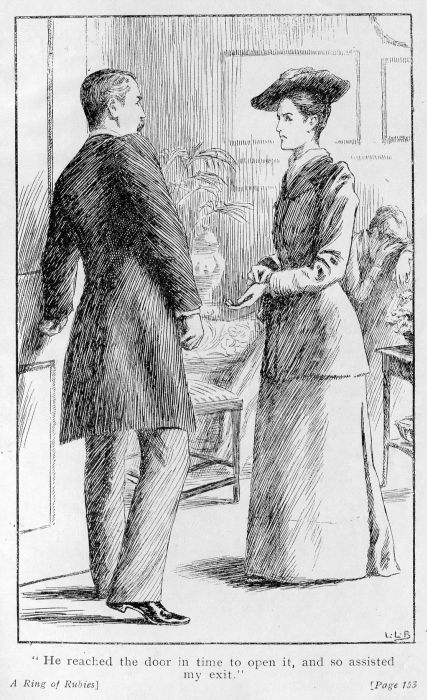
Lady Ursula flung herself back on the sofa, and covered her face with her hands. Captain Valentine seemed to struggle for a moment with his desire to comfort her, and his sense of what his duties as a gentleman required. Finally the latter feeling triumphed, and he reached the door in time to open it, and so assisted my exit.
A moment later I was in the street. I was absolutely outside that detestable mansion, with the beloved little ring pressed in my warm hand.
I felt an almost childish sense of triumph and exultation; the possession of a large sum of money could not have gratified me to anything like the same extent as did this recovery of my rightful legacy. I felt enormously rich; I felt giddy with delight; it seemed to me impossible to walk, I must ride; the owner of such a ruby ring could not pace with draggled skirts those muddy streets. I hailed a hansom and desired the man to drive me to Mr Gray’s chambers. I did not exactly know what I wanted to say to the old lawyer, but I was possessed by a sudden intense desire to see him, and I knew when I got into his presence I should have something special to talk about.
Mr Gray had rooms in Bloomsbury, not a great way off from Cousin Geoffrey’s old house. He was in, and almost immediately on my arrival I was ushered into his presence.
“Miss Lindley!” he said. He came up and shook hands with me warmly. “Pray sit down,” he added. “Sit here, near the fire. What a cold, miserable day we are having. You are all quite well at home, I hope; how is your mother?”
“My mother is well, thank you, Mr Gray. My brother Jack has been ill, but he is better now.”
“I am glad of that,” replied Mr Gray. “And now, can I do anything for you, Miss Rosamund? You know I shall be delighted.”
When Mr Gray said this I suddenly knew what I had come to see him for.
“I want to go over Cousin Geoffrey’s house,” I said. “Have you the key, and if so, will you entrust it to me? I will promise not to injure anything.”
The moment I made this request Mr Gray’s face brightened, and an almost eager look came into his eyes.
“Have you any—any particular reason for wishing to see the house?” he asked.
“Oh, no,” I replied. “No very special reason. Just a desire, to see the old place once again.”
The lawyer had deep-set and piercing eyes. They darted a quick glance at me. He sighed impatiently.
“My late client was very eccentric,” said Mr Gray. “Eccentric in life, more eccentric, perhaps, with regard to his last will and testament. Miss Lindley—you have no—no clue for instance—with regard to the heirs?”
“Oh no,” I answered. “How could I possibly have?”
“It is my opinion,” said Mr Gray, with another short, almost angry sigh, “that the heirs in question will never be found. I told my client so. I said as much repeatedly. All that fine fortune will go to endow the hospitals. Well, well, he would not listen to me.”
“May I have the key?” I inquired in a gentle voice.
“Oh, of course, of course! But stay, you won’t want it. You don’t suppose a valuable house like that is left without caretakers. Two policemen take care of it, and one of them is always on the premises. I will give you my card, and whichever of them is in will show you over the place.”
“Oh, please, may I not go over it by myself.”
“Well, child, well! I don’t suppose it makes much matter what you do. I’ll have to write a special letter to Dawson or Drake, whichever of them happens to be in. I’ll write the letter, and you shall take it, and then you can moon about the old place as much as you please. By the way, my dear Miss Rosamund, I hope you have got my client’s valuable ring safe?” For answer I pulled off my shabby silk glove, and flashed the gem in the old lawyer’s face.
“Good gracious, you don’t mean to say you wear that valuable ring every day?”
“Not every day—by any means.”
“But it is very unsafe to wear a ring like that on your finger when you are out alone. My dear child, you have not the faintest idea what that centre ruby is worth.”
“I have some little idea,” I said.
“You had much better leave it at home. Look at it constantly of course, but leave it in a safe place at home.”
“Oh no, I like to wear it on my finger.”
“Well, well!” The lawyer sighed, then sat down and wrote his letter.
Chapter Nine.
A Telegram.
I took the letter in my hand, and walked to Cousin Geoffrey’s house. Drake was the name of the policeman who replied to my summons. He read the contents of Mr Gray’s letter with almost lightning speed, then moved aside to let me pass in.
“You would rather I did not show you round, Miss Lindley?” said Drake.
“Yes,” I answered, “I know the old house, I have been here before; I should just like to walk quietly over it by myself.”
“Very well, miss; but you’ll allow the wife to prepare you a cup of tea? We can get it quite handy, in the housekeeper’s room next the kitchen, if so be as you object to taking it in the kitchen itself, miss.”
“I don’t object at all,” I answered. “Thank you very much, Mr Drake, I should like to have a cup of tea, and I would prefer having it in the kitchen.”
A pleased smile stole slowly over the man’s face. He walked down-stairs in the deliberate fashion of a person who has remarkably little to do, and I commenced my tour of investigation. I said to myself—“Drake need not hurry with that tea; I shall not want it for some time.” It was delightful to me to be alone in this treasure-house. I could explore, I could examine, I could pause, I could think. The furniture, the carpets, the curtains were all full of story, and alive with associations. I walked from room to room. My mother, had she been with me, could have put speech into all these rare treasures, could have hung a lovely legend or charm over each of those antiquated chairs and tables. Her stories would have been founded on fact, but I, too, helped perhaps by my magical ruby ring, could weave romances as I walked along.
The rooms of the house had one peculiarity, which I had not noticed the last time I walked over it. Set into a panel of the door of each was a kind of sliding slab, which could be pushed aside with the finger, and which, when opened, revealed a name. I found that each room in the house had its own special name. This discovery excited me very much. It was not discernible to the ordinary visitor, for the little white slab was well hidden in the heavy oak door. But a touch, the twist of a button would reveal it. I wondered when Cousin Geoffrey had perpetrated this strange freak. I imagined the queer pleasure he took in naming the different apartments of his lonely mansion.
After I had made this little discovery I ceased to take such a deep interest in the furniture. My desire was, if possible, to read the title of each chamber. I thought what a delightful story I would have to tell my mother by and by. I knew that she was unacquainted with this vagary of her kinsman’s.
I began at the attics, and turning slab after slab concealed so cleverly in the doors, read the names rapidly off. Some were commonplace, some fantastic; most of the rooms were called after the colour of the decoration, or the style of the furniture. Thus there was the Oak room, the Walnut room, the Blue room, the Gray room, the Rose room; there were also the North room and the South room. At last I reached the beautiful octagon room which contained the painted windows, and which had so excited my mother’s emotions.
The title of this room gave me a good deal to ponder over. It was called the Chamber of Myths. I stayed for a long time here. I examined all the furniture. I studied the subjects of the painted windows. I stood on the raised dais, and leant against the old four-poster, and pressed my hand against the moth-eaten counterpane. How dusty, and dreary, and haunty it looked!
The light was fading fast, now, and the room displeased me. I left the Chamber of Myths in a hurry, and went down to the kitchen to have tea with Drake and his wife. I said nothing to them about the discovery I had made, but when I left the house I was firmly convinced that Cousin Geoffrey’s eccentricity must have bordered on madness. What did he mean by the “Chamber of Myths”? What were the myths? Perhaps my mother could tell me. I would question her the first moment I had an opportunity.
It was rather late when I went back to Hetty. I thought how pleased she would be to see the ruby ring, how pretty she would look when she opened her eyes wide to gaze at it. How charmed and bewildered she would be if I let her wear it for a moment on her slim third finger. Hetty had lovely little hands. Her wedding finger would look dainty, circled with this ruby ring. I too had small hands, but I could only get it on my smallest finger.
The moment I got in Hetty pointed with excitement to a telegram which lay upon the little table at her side.
“It has been here for two hours, Rose,” she said. “Do open it quickly. I am so anxious to know what is in it. Perhaps it is about Jack. Perhaps he is worse.”
“You poor little thing,” I replied. “Why did you not open the envelope yourself, if you are so upset with nervous terrors? Now let me see what this precious yellow envelope contains.”
“Well?” said Hetty.
I was reading the telegram to myself. My face showed heightened colour and annoyance.
“Well?” she said again. “Do speak, please, Rose.”
“It is nothing about Jack,” I said then.
“Nothing at all?”
“Nothing at all; the telegram is from my home, but it is about—about another matter.”
This was the other matter—these were the contents of the telegram.
“Lady Ursula Redmayne and Captain Rupert Valentine have just been here, asking to see you. Will call at your lodgings in Putney, to-morrow, before eleven. Lady U. in great distress. Gave your address under pressure.”
This long telegram from my mother showed most reckless extravagance. I could imagine how Lady Ursula had worked upon her feelings.
“But I am not going to give you up, little ring,” I said, kissing it.
Chapter Ten.
Relations.
I parried Hetty’s curious remarks with regard to the telegram, putting her off at first with vague replies, then speaking decidedly.
“I have had a message from my mother, dear Hetty,” I said; “nothing at all about Jack, nothing that will interest you.”
“Oh, of course, Rosamund—” Hetty’s pale face flushed vividly. She took up some knitting she was trying to get through, a sock for Jack, of course. I saw her poor little fingers trembling. She was the most sensitive little creature. A touch, a word, sent her into herself. She felt so unsure of her position, so unsure of everything, except that she had a great hungry wealth of love to give away to those who would receive it of her.
As I saw her making these futile, pathetic little attempts to get on with her knitting, I felt some of the experiences one might feel if one had set one’s foot on a little wild-flower and crushed it. I watched her timid, downcast eyes for a moment, then I spoke.
“After all, Hetty,” I said, “I should not be in the least surprised if the contents of my mother’s telegram interested you amazingly. I don’t see why you shouldn’t know. It is a most exciting story. We’ll have tea together, and then I’ll tell it to you.”
Hetty’s little face came quickly out of the shadow in which it had looked so pathetic. She was all smiles and sunshine once more. She even laughed with glee when I arranged our evening meal. Her impatience to know the mystery was absolutely childish, but I was determined not to be cross with her, nor to blame her in any way again.
After we had finished eating, I drew a chair up to her sofa, and began my story. I told everything from the beginning—I mean from the time of my visit to Cousin Geoffrey. Really, Hetty was a most delightful listener; she was all sympathy, her interest was absorbing, she interrupted the narrative with no questions, but her beautiful eyes spoke volumes for her. They expressed wonder, sorrow, joy. I had quite a pleasant time as I told my little romance. I could not have desired a prettier sight than Hetty’s eyes with the soul looking out of them as they gazed at me.
What a benefit to the possessor those speaking eyes are! In some cases I could imagine them to be the best of all good fairies’ gifts, for what can they not do? Wheedle, coax, command, subdue. Hetty was not a particularly brilliant personage in any way. She was a very loving, dear, true little creature, but she was neither clever, nor particularly heroic. Yet with her eyes she could command a kingdom. Now some people speak of me as clever, and I know I have plenty of presence of mind, but I can do nothing at all with my eyes.
Well, Hetty heard the story, and then she examined the ring, and then we had a long consultation over Lady Ursula’s visit of the morrow.
“Won’t you write and tell her not to come?” said Hetty.
“Oh dear, no,” I said, “I am not afraid of Lady Ursula Redmayne,—she can come if she wishes to.”
Hetty sighed.
“You are courageous, Rose,” she answered. The next morning my brother’s wife took upon herself to show great anxiety with regard to my wardrobe.
“I want you to look beautiful,” she said. “Don’t you think you might wear your hair not quite—not quite so flat on your forehead?”
I laughed.
“Oh, my dear,” I answered, “you are not going to induce me to adopt a fringe. That would be quite the last come-down to my pride. I have not got wavy, fuzzy hair like you, Hetty, and I am not beautiful, so nothing can make me look it.”
“But your face is very beautiful to me,” said Hetty, looking at me with a great glow of love beaming over hers. “It is full of strength, and I think you have such a sweet expression, Rose, and you look so dignified. Sometimes I think you are grand.”
“Oh, hush, hush, you foolish child!” I said.
“Well, but do fasten that little pink bow at your throat, and do puff up your hair a little, to show your nice forehead. Now isn’t that a great improvement?”
She made me kneel by her while she tried to manipulate my heavy, thick, straight hair. My private opinion is that I never looked more uncouth, but Hetty was pleased, so where was the use of worrying her?
I heard a carriage stop in the street below, and flew to the window to look out.
“They arrive,” I said, “my foes arrive! Now I go forth to conquer! Farewell, Hetty.”
“Oh, I shall be so excited to know what is going to happen!” called Hetty after me.
I blew a kiss to her and ran down-stairs. I had arranged with Mrs Ashton to give me the use of a private sitting-room for the all-important interview. It was a truly dingy apartment—a back parlour in every sense of that odious-sounding word. It was here I had for the first time the pleasure of seeing Lady Ursula Redmayne without any rose-coloured glamour thrown over her. Unsupported by the background which her luxurious boudoir in Grosvenor Street afforded, she looked what she was, a most ordinary young woman.
Ordinary—yes,—I made up my mind on the spot that Lady Ursula was not at all good-looking. But she was something else. She appeared better, far better in my eyes. At that moment she looked what she was, an every-day, happy, healthy English girl. Yes, a happy girl, and her happiness took all her little affectations away.
“Oh, here you are, my benefactress?” she said, rushing up and kissing me. “May I introduce Captain Valentine? I don’t think I did it properly yesterday. Now, Rupert, let’s sit one at each side of her, and tell her everything, and get her to tell us everything.”
I was very much astonished, and I showed my astonishment in my face.
“Would you not rather speak to Miss Lindley alone, Ursula?” said Captain Valentine. “I can go out for a walk, or to—to buy something—I might return in a quarter of an hour.”
“No, Rupert, you will sit on that chair, just there, please, and listen.”
Captain Valentine sat down at the imperious bidding of Lady Ursula’s voice. I was sure he must have a sensitive nature, he got red so often. His whole face was scarlet now.
“Now I will begin,” said Lady Ursula. She turned towards me. “You know, Rosamund, you treated me very badly yesterday—very badly, and very shabbily, and very cruelly. Oh, my dear, I’m not going to reproach you now—it all turned out for the best, as the good little books say. Listen, Rosamund, please, to my story. After you left us yesterday, I told Rupert that I was distracted, that something had happened which I could not possibly tell him, but that I must instantly go to my dressmaker, and that it would be best for me to go alone. ‘By no means,’ answered Rupert, ‘I will accompany you.’ ‘Oh, don’t,’ I said. ‘I am determined,’ he replied. So the carriage was ordered, and we drove to Madame Leroy’s together. When I got there, I said, ‘I shall be some little time engaged.’ ‘Very well,’ Rupert answered, ‘I will wait for you in the carriage.’ ‘Oh, don’t,’ I said again. But he shook his head.
“I saw Madame Leroy, and got your home address from her, Rosamund. I wanted to follow you home, and I wanted Rupert not to come. He did not mind me; he would come. We took the train, and reached your pretty cottage in the country. We were shown into the drawing-room, and presently your mother came into the room. The moment I saw her I burst out crying. Somehow her face made me feel that I was the most miserable girl in the world, and that I was just about to lose everything, and that Rupert never, never had been half so dear to me. Your mother behaved perfectly to me; she took me out of the room, and said nice, kind, comforting sort of words, and soon I stopped crying, and told her that I wanted to see you, and she gave me your present address, and said she would send you a telegram. She was very sorry for me, but she wasn’t curious; she was too much of a lady to be curious, only she was just so sweet that the mere fact of my being in trouble made her kind to me.
“Rupert and I came away. We went back again to Grosvenor Street, and I felt more sure than ever that all must be up between us. I could not help it, Rosamund—when I got into the house I began to cry again. Then Rupert spoke—oh, dear, I can’t tell you how—but somehow I suddenly lost all my terror, and I told him the whole story from the beginning. You dreadful, but dear little benefactress, I took your advice. And what was the consequence? Rupert did just say one word of reproof. He said, ‘Don’t you suppose, Ursula, that I care more for you than for a ruby ring?’ So, of course, after that it was all right, and I have never, never been half so happy before in all my life.”
Captain Valentine, who had fidgeted on his chair, and seemed more or less on thorns during the recital of Lady Ursula’s story, now jumped up, and went over to the window to look out. He had only a view of Mrs Ashton’s back-yard, and surely the sight could not have been inspiriting. Lady Ursula, whose eyes were full of tears, bent forward to kiss me. I put my two arms around her neck and gave her a hug. I could not help it. I forgot all about her title and her grandeur—she was just a girl, like any other girl, to me at that moment.
“Now I have something to say,” she continued in a changed voice. “Neither Rupert nor I want your ruby ring, but we are very curious to see it again, for Rupert has a story to tell you about it.”
“A story to tell me about my own ring,” I inquired.
“Well, yes,” said Captain Valentine, returning, and speaking slowly. “It so happened that during the week, when Ursula lived in such terror of me, that she was obliged to hire a ring to prevent my righteous vengeance falling on her head,”—he laughed merrily as he spoke, and Lady Ursula gave his hand a vicious pinch,—“during that week,” he continued, “I noticed that the central ruby of the ring was a little loose. I took it to my jeweller’s to have it more firmly riveted. I therefore had full opportunity of carefully examining your ring, Miss Lindley, and I can declare that it is in every particular precisely similar to the one Lady Ursula has lost.”
“Similar, perhaps, but a different ring,” I retorted.
“Precisely, a different ring, but one of a pair. I think I can tell you some of the early history of your own ring, Miss Lindley.”
“Please, Rosamund, admit that you are very much excited and thrilled with interest,” interrupted Lady Ursula.
“I am interested, undoubtedly,” I replied. “Please tell me the story, Captain Valentine.”
“My great-great-grandmother,” he began at once, “came from the West Indies, and brought with her, amongst much valuable gold, some rubies of great price. Two of the largest and most precious of the rubies were set in rings of very curious workmanship. I believe the rest of the gems, with the exception of a few smaller rubies which were used in perfecting the rings, were sold to meet a financial difficulty in our family. These rings were given by my great-grandmother to her sons, with the request that they should be handed down as heirlooms, and worn as betrothal rings by the girls who should marry their direct descendants. The rings were made in a very unique fashion, and had a certain spring which could open at the back, and contain hair or some other tiny relic. Do you mind fetching your ruby ring and letting me look at it once again, Miss Lindley?”
“I will fetch it of course,” I replied.
I ran off at once, my heart beating fast with wonder and curiosity.
Hetty’s eyes devoured my face when I rushed into our bedroom.
“I am having a delightful time,” I said, “everything is going on splendidly.”
“Oh, do, do tell me?” said Hetty, sitting up on her sofa, and letting her work tumble to the ground.
“Yes, presently I will; but my visitors have not gone yet.”
“Haven’t they? They are staying a long time.”
“Yes, and they will probably remain a little longer. I have come now to fetch the ring.”
“Oh, Rosamund, you have not given way? You are not going to part with the ring?”
“Not a bit of it,” I answered, as I unlocked my small bag, and taking the ring from its hiding-place slipped it on my finger. “Goodbye for the present, Hetty,” I said; “think of all pleasant and improbable things till I return to you.”
I flew down-stairs to the two who were now my friends. Lady Ursula made me seat myself next to her on the sofa, and Captain Valentine, taking the ring from me, turned it round and round in the light. How that central ruby did flash—how blinding and bewildering were the rays which it shot from the depths of its heart. I had an uncomfortable feeling, as if the costly gem was going to mesmerise me.
Suddenly I uttered an exclamation. By some deft movement, done so quickly that I could not follow it, Captain Valentine had touched a spring, and the ring had altered. The massive gold of the setting moved aside like tiny doors; the central ruby shot up a fiercer ray of almost triumph; it revolved slowly from its position, and left the inner mechanism or skeleton of the ring bare to view.
“There,” said Captain Valentine, “behold the most cunning device ever invented for holding a few threads of hair, or any other invaluable treasure. Yes, this ring is the companion one to yours, Ursula. No doubt on the subject, no doubt whatever, for it was my great-grandmother, or her double, who invented this unique little hiding-place in the back of a ring.”
“But this hiding-place, this secret treasure-house contains no hair, no delightful discovery of any kind,” said Lady Ursula.
“That is true; the space is empty,” said Captain Valentine. “Nevertheless, I identify the ring.” He touched the secret spring again. The central ruby seemed to flash a wicked intelligent look into my eyes; the embossed gold doors revolved back into their places; the magnificent middle ruby resumed its position as keeper of the doors, and the little ring looked as it had done before.
Captain Valentine handed the ruby ring back to me.
“You must explain to me the secret of those magical doors,” I said to him. “Where did you touch the spring which set that clever, enchanting little machinery in motion?”
He took the ring again in his hand, and began to explain the cunning little secret to me.
“Do you see that nick in the side of the gold?” he said. “Just at the left of the serpent’s eye. Press it: not too hard. A light touch is sufficient—a heavy one might break the delicate machinery.”
“I see,” I answered, “thank you. No, I won’t disturb my rubies again now. It might break the charm if I got my ring to tell its secrets too often.”
“Rosamund,” said Lady Ursula, suddenly, “it strikes me that you and Rupert must be some kind of relations; that is, if that ring were left to you by a relation.”
“My mother’s cousin left me the ring,” I said.
“Your mother’s cousin?” said Captain Valentine. “Do you mind giving me some particulars? It is interesting to trace relationships; in this case especially so.”
I mentioned Cousin Geoffrey’s name, and then added:
“My mother can tell you all about him. I only saw him once in my whole life; but my mother and I attended his funeral, and afterwards I found he had left me this ring.”
Captain Valentine uttered an exclamation.
“So old Geoffrey Rutherford was your cousin?” he said. “Of course I knew him,—he was also my cousin,—the queerest and the richest old man of my acquaintance.”
“Were you at the funeral?” I asked suddenly.
“No; why do you ask?”
“I thought all the relations were,” I answered, demurely.
Captain Valentine smiled.
“Ah,” he said, “a good many people had expectations from poor old Geoffrey. Who did he leave his wealth to, by the way?”
“I don’t know,” I replied.
“You don’t know? But wasn’t the will read after the funeral?”
“Something was read. I don’t think it was a will; and the only thing given away was my ruby ring.”
“Just like Geoffrey,” exclaimed Captain Valentine. “Then I presume all the wealth of his miserly old life went to endow a hospital.”
“Even though you are a relation, you must not abuse Cousin Geoffrey,” I said. “His wealth has not gone to endow any hospital, but is waiting.”
“Waiting—for whom?”
“For the heir.”
Lady Ursula suddenly broke in. “The longer I know you, Rosamund,” she said, “the more mysterious you grow. Who in the world is the heir? Why is not the wealth divided? Is not that poor relation,” she pointed with a comical finger at Captain Valentine, “to share in any of the spoil?”
“I don’t know,” I replied. “You had better go and ask Mr Gray; he will tell you everything.”
Chapter Eleven.
A Bear’s Hug.
About a fortnight after the events mentioned in the last chapter, my quiet time in the queer little lodgings at Putney came to an end. Jack was declared free from infection, Hetty was quite well again, and with some difficulty we managed to get them both admitted to a Convalescent Home at Broadstairs.
It was quite affecting to see the meeting between Jack and Hetty. Jack’s illness had both improved and refined him. He was always the best-looking of the family, and he really looked quite handsome as he took that little confiding gentle wife of his into his arms and kissed her three or four times. Poor Jack,—he kissed me too with a fervour he had never hitherto shown. He murmured something I could not quite catch about never being able to show sufficient gratitude to me, and then he and Hetty went away.
I saw them off from the railway station. The last glimpse I got of Hetty, she was sitting very close to her husband, and looking into his face. That poor young face of his looked worn and anxious enough, but Hetty knew nothing of the anxiety, and nothing of Jack’s fall from the paths of honour;—to her he was a prince—the first of men.
I sighed as I left the railway station. “Poor Jack!” I said to myself, “the path that lies before him will not be too easy to climb. Fancy having a little wife like Hetty to look after and support, and no means whatever to earn money for either of them. His character and chance of success practically gone. What is to be done with them both after their fortnight at Broadstairs is over?”
I returned home that afternoon to my dear mother. It was mid-winter and bitterly cold. Christmas was come and gone, we were well into January; snow rested on the ground, and as I entered the cottage, I saw by the look of the sky that more was likely to fall.
My mother welcomed me with just that degree of warmth which seemed to me the perfection of greeting. It consisted of very little in the way of embraces, scarcely anything in the shape of endearing words, but the expression in my mother’s eyes told me all I wanted to know. She was very, very happy to have me back again; and as to me, I felt for the time being rested and satisfied. Why not? I was with the human being I loved best on earth.
We had tea together, and then my mother began to speak.
“You saw Jack off, poor fellow?”
“Yes, mother,” I answered; “I saw Jack and Hetty off.”
“Oh, Hetty,” repeated my mother, with the faintest perceptible toss of her head. She had been very good about Hetty at first, but to have her coupled with Jack in this cool and easy manner gave her something of a shock.
“Mother,” I said with enthusiasm, “Jack had no right to marry any girl secretly, but as he did so we cannot be too thankful that he has taken this sweet little creature. She is as good as gold, mother, and as innocent as a little flower, and she thinks Jack perfection.”
“My dear,” said my mother, “that’s the right way; that’s as it should be. Though every one, I fear,” she added with a sigh, “cannot live up to it.”
“Hetty will,” I said quickly, for I did not want my mother to have time to make unhappy comparisons even in her heart.
“She has got an excellent husband,” proceeded my mother. “Rose, I did not know there was half as much in Jack as I find there is. He surprised me wonderfully during his illness; he really is a very fine fellow.”
I was silent.
“It was a great comfort to be alone with him,” proceeded my mother; “I got really to know my boy at last. Yes, his wife is a lucky woman. I trust she will prove worthy of him.” This time I was spared making any further remarks, for my father’s latch-key was heard in the front-door. The next moment he and George entered the little drawing-room together. “Bitterly cold night,” said my father, walking up to the fire, and monopolising the whole of it. “A sharp frost has set in already. Ha! is that you, Rosamund? Home again? How do you do? My dear,” turning to his wife, “did you register the thermometer as I told you to do this afternoon?”