A profitable instruction of the perfite ordering of Bees
Reading edition
Transcriber's note:
The final four chapters of the second Treatise, "Certaine husbandly coniectures of dearth and plentie for euer," are absent. No known copy of this edition is complete. Entries in the Table of Contents referring to them have been removed.
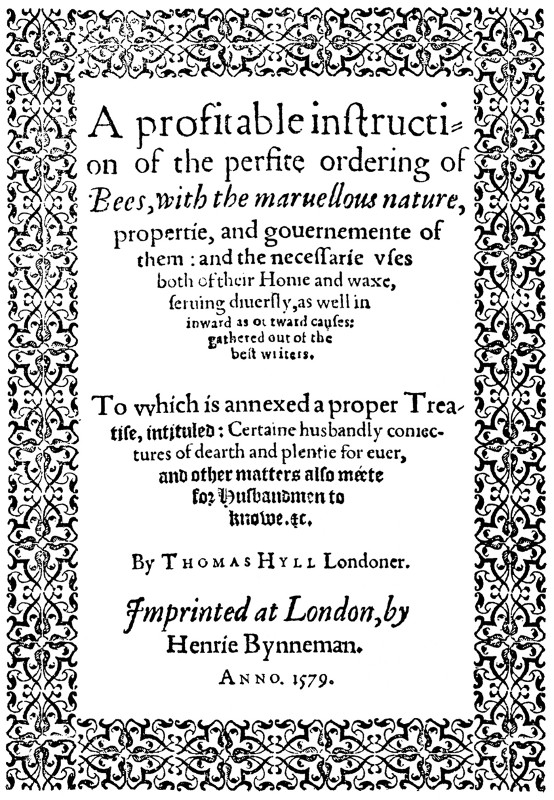
A profitable instruction
of the perfite ordering of
Bees, with the maruellous nature,
propertie, and gouernemente of
them: and the necessarie vses
both of their Honie and waxe,
seruing diuersly, as well in
inward as outward causes:
gathered out of the
best writers.
To which is annexed a proper Treatise,
intituled: Certaine husbandly coniectures
of dearth and plentie for euer,
and other matters also méete
for Husbandmen to
knowe. &c.
By Thomas Hyll Londoner.
Imprinted at London, by
Henrie Bynneman.
Anno. 1579.
The Authors out of the
which this Treatise is
gathered.
C. Plinius.
Aristotle.
Albertus.
M. Cato.
Iunius Columella.
M. Varro.
Palladius Rutilius.
Theophrastus.
Guilhelmus de Conchis.
Galen.
Paule Aegineta.
Cornelius Agrippa.
Hieronimus Cardanus.
And sundrie others.
To the worshipfull maister M.
Gentleman, Thomas Hill wisheth all
health and felicitie.
As it hath beene, and is yet (worshipfull Sir) a trade commonly vsed among most men, to choose out from a greate number, some one, vnder whose name and title they may publishe their workes: Euen so I (following the steps of the learned, though in all other poyntes most inferiour) hauing finished this little treatise of Bees, and casting with my selfe to whome I mighte presente it, founde my selfe much bounden vnto your worship, both for your gentlenesse which I haue of late tasted, and also for youre friendship which I finde alwayes readie towards me. And therefore hauing none other wayes to recompence the least parte of youre curtesie and gentlenesse, thought it best to gratifie youre worship with such a simple gifte as mine abilitie will suffer me to bestow on such a friend. And although Sir this Treatise is farre dissonant from youre studyes, yet considering your earnest desire to knowledge and learning, and agayne pondering the pleasantnesse of the matter, thoughte this might be made a recreation for your grauer studyes. For when your mind shall bee searching for profound reasons, and oppressed with deepe cogitations, then taking and reading this little Pamphlet, it will bring a forgetfulnesse vnto your former weerynesse, and cause a newe delighte vnto your mind: For heerein may you see, first the maruellous gouernement of the Bees, through the onely instincte of nature, as in theyr obedience to their King, and other officers, in punishing the ydle loyterers, in cherishing the true labourers in theyr manner of fighting, with suche like a greate many, as it is wonderfull to reade, and almost vncredible to beleeue: secondly, the liuely effectes and commodities that arise of theyr Honie and Waxe. And lastly, howe profitable they are for common wealth, and howe necessarie for mans vse, I mighte heerespeake muche in the prayse of the Bee, which all I will omitte, seeyng onely myne intente is to shewe my selfe myndfull of your good turnes and benefites, desiring you to take this in good parte, whyche proceedeth from a well willing minde. And I am sorie that at this presente I had none other matter more worthy to haue gratified your worship withall: but that whiche wanteth in power, aboundeth in good will. Thus troubling your worship no longer, I commit you to the keeping of the Almightie, praying him to increase in you all vertue and godlynesse, and to grant you the long yeares of Nestor.
Yours most bounden
Thomas Hill.
The Preface into the instruction
of Bees.
Although (gentle Reader) I haue not given thee anye labour of mine owne, but rather haue collected the sayings and writings of manye aunciente authours, yet I trust they shall be well accepted of thee without offence. For as he that setteth forth vnto the view & reading of all men such knowledge, as by his long study & experience he hath gotten, is worthy to haue his due reward of commendation: euen so he is not to be discommended, who painfully reuoluing the bookes and volumes of many and diuers ancient writers, reduceth them into one little Treatise, for the commoditie and profyte of the simple and vnlearned sorte, for whose onely sakes I haue trauelled in the translation of this worthy matter, touching the right vsage and handling of Bees: a thing very rare, and seldome seene in the Englishe tongue, and yet verie profitable for a common wealth, and commonlye vsed among the poore husbandmen, though not in euery poynt as they ought to be, yet according to theyr knowledge and experience. But I, to the intente that a further learning mighte be added to their skill, haue so trauelled therein, that I trust their knowledge shal be increased, & such as haue no knowledge at all, may be instructed without any other teaching. I haue ioyned this little Treatise vnto my booke of Gardening, for that most men do ioyne them both togither, as when they place their Bees in their Gardens, whereas they may with lesse paine and easilier, gather of the sweete smelling flowers, their Honie, and Waxe. And for all these my paynes gentle Reader, I craue nought else of thee, but to giue me that which of dutie in a maner I ought to haue, for if thou doest receyue any commoditie or fruite eyther by this, or by my other Treatise hereto annexed, whiche hathe to name the Husbandly coniectures, with sundry rules of Phisicke, then giue me the reward of thy good report, and friendly accepting of these two Treatises, and if not, yet accept mine endeuours in good part, which be meant to do thee good. And thus leauing (gentle reader) to trouble thee farther, I commit thee to God, who giue thee the furtherance of knowledge, both in these and all other needefull artes.
(∵)

A necessarie Table setting forth the
contents of these two Treatises.
These treated of in the first Treatise.
Why Bees are named to be crested or parted betweene, or as it were ringed or rather pleighted: what worke the swarme new gathered in the Hiue firste taketh in hande: and whether they may liue after their stings be gone. Cap.j.
Who first taught the preparation and increasing of Bees, and found out the vse of honie. cap.ij.
How Bees do naturally ingender. cap.iij.
Of the vnperfit Bees, which men properly name drone Bees. cap.iiij.
Whether the Bees draw breath, or haue any bloud in them. cap.v.
Of the great vtilitie and profit of the Bees vnto mans vse. cap.vj.
Of the care and diligence of the Bees. cap.vij.
Of the maruellous gouernement of the King of honie Bees, and of the obedience which they vse to hym. cap.viij.
What kind of Bees be best, and rather to be chosen. cap.ix.
Where the Hiues of Bees ought especially to be placed. cap.x.
What things Bees do chiefly abhorre, and greatly hate. cap.xj.
By what signes men may knowe when the honie Bees are diseased, and how men may cure them. cap.xij.
What maner of person the keper of the Bees ought to be. cap.xiij.
By what meanes the swarme come forth, may be preserued from flying away. cap.xiiij.
Of the Bees new settled in a swarme togither, and taken and recouered againe. cap.xv.
Which are the best and fittest hyues for the honie Bees. cap.xvj.
Of the cleanlinesse and sweetenesse of the keeper of Bees, and howe hiues ought to be fenced about, and prepared within. cap.xvij.
How Bees lacking honie may be fed in that present neede. cap.xviij.
How the dead Bees may be restored to life againe. cap.xix.
Of the battell that Bees sometime haue within themselues. cap.xx.
How Bees lost, may be recouered and found againe. cap.xxj.
That the Bees sting no person comming neere to their hiues. cap.xxij.
When and how the hiues ought to be gelded. cap.xxiij.
What the honie is, and how from the hiues the same may be prepared to vse. cap.xxiiij.
Which honie is accounted best. cap.xxv.
Of the venomous honie, and of the wonderful hony of Creta. cap.xxvj.
Of the miraculous worthinesse of honie. cap.xxvij.
How profitable the vse of honie is in medicine. cap.xxviij.
Of the drinke of hony whiche they call the Mulse water, or sweete water of the Romaines. cap.xxix.
Of the drinke Oenomel, which is made of pure wine & hony. cap.xxx.
Of the singular water of hony gotten by order of distillation. cap.xxxj.
Another maner of distilling the hony more at large taught. cap.xxxij.
The maner of distilling a water of hony named the Quintessence. cap.xxxiij.
The maner of drawing and making waxe of the combes. cap.xxxiiij.
What waxe is best allowed, &c. cap.xxxv.
Of the great commoditie and benefite of waxe in medicines. cap.xxxvj.
Of that whiche is a stay of the combes, and made for a defence of Bees. cap.xxxvij.
How to make waxe white. cap.xxxviij.
How to make red waxe. cap.xxxix.
How to draw a profitable oyle out of waxe for sundry vses. cap.xl.
Another way of drawing the oyle of waxe most noble, and dothe maruellously help the cold goute, the sciaticke, the swelling of the legges, and all other griefes of a colde cause. cap.xlj.
These described in the other Treatise.
Certaine Husbandly coniectures of dearth & plenty for euer. cap.j.
An euerlasting Prognostication of the state and condition of euery yeare, by the only calends of Ianuary, written by the ancient & learned Leopol. Aust. & other for the commodity of the wise husbandmen. cap.ij.
How to foreknow the state of the yeare by the only rising of the dog starre, out of the husbandrie of Diophanes. cap.iij.
Other profitabl instructions, right necessary for husbandmen to know. cap.iiij.
¶ The firste Treatise setteth foorthe the strange gouernment, propertie, and benifite of the Bees, with the commoditie of their Hony and Waxe, whiche serue vnto many good vses, as well in outward as inwarde causes applied, gathered out of Plinie, Albertus, Varro, Columella, Palladius, Aristotle, Theophrastus, Cardanus, Guilielmus de Conchis, Agrippa, and diuers other singular Authours.
¶ Why Bees are named to be creasted or parted betweene, or as it were ringed, or rather pleighted. What work the swarme newe gathered in the Hiue, first taketh in hande, and whether they maye liue after their stings bee gone. Cap.first.
Plinie nameth Bées Cleft beasts, bicause of the diuision or parting betwéene of the head & shoulders: and Aristotle nameth them plighted or ringed, in that their bodies are diuided with plightes and rings. And most men know, that the Bées haue neyther sinews, bones, fleshe, gristle, backe-bone, nor fat, but are only created of a certaine mixture, being a meane betwéen these, and hauing a very few intrailes. And againe, no man néedeth to doubte, but that the Bées be a kinde of beasts, greatly to be set by for mans vse, & for mans prouision, are nourished of the aire, passing throughe the diuided places, which they by great diligence and care preserue from being stopped, for as soone as they be stopped, they shortly after die, like as the same we may learne, when anye happeneth to fall or light into Oyle, which straight way after die, throughe the Oyle stopping then their powers. They haue and fly with foure wings, that they maye the better carrye in their bellies the stings of reuengement. For when two of them striue togither in flight, then do they hold and kéep their stings in their mouths by a gréedy desire, or for eagernesse sake. Now after the seauen starres named Vergiliæ, be once risen in sight aboue our horizon, then do they hyde them in their proper holes, so that they go seldome after abroade, vntill the Beanes doe bud, and if they happen to beginne at any tyme to flye abroade when as a fayre daye moueth them forwarde, then slacke they no suche dayes afterwarde, but occupy themselues. And firste they prepare and make their combes, which they fashion into apt houses, or rather celles of waxe, after this they haue yong, and then beginne they to gather hony. They liue also the longer by hauing their stings, for that once gone, or taken away, they dye forthwith through the lacke of their intrailes, whiche they lose togither with their stings.
¶ Who first taught the preparation and increasing of Bees, and founde oute the vse of Honny. Cap.ij.
The reporte goeth, that one Aristomachus first founde out and taught the increasing of Bées, whome Plinie writeth to be so earnest in the same, that setting apart al other affayres, he only studied night & day how he might best intreate and vse Bées, according to their kinde. But others ascribe this inuention to one Thassius, who (as they saye) deserued no lesse commendation, both for his diligence and skill among Bées: but this he specially followed in the fielde, and that farre from the Towne. And of this the common people (as by a nickname) no more named him Thassius, but Agrius, for his wilde or rather straunge life, whiche he then led in the fielde, Whome Plinie also affyrmeth to haue written a Booke of the increasing and multiplying of Bées. And Columella ascribeth this inuention, to the inhabitaunts of the hill (named Hymetus) being in the Countrey of Attica, for there (saieth he,) was one Ericthonius, who taught (as men write) the true and perfect ordering of them. Plinie againe ascribeth the inuention of Hony to one Aristeus a man of Athens. Diodorus Siculus in the sixte Booke of hys workes, writeth, that Curetes, a people of Creta, did firste finde out the Hony, Macrobius ascribeth the same to one Saturnus. Others to the Thessalians. And many to Melissus, an auntient King of Creta, others to Nassus Liber Pater, thus writing, that Liber hath obtayned the renowne for finding out of Honnye.
¶ How Bees do naturally engender. Cap.iij.
Firste the Bées procéede of Bées, by the actuall doing togyther, after whiche they lay egges, sitting vppon them, as the Hens do on their egs. And when they haue sit on them for the space of .xlv. daies, then do they hatch their yong ones, whiche yong (at the first) come forth, much like to white Worms, except the King, who onely as he is hatched, hath wings. At the firste time, one of them hatcheth fiue young togither, the nexte time fewer, and so fewer & fewer, vntill she commeth to one at a time, bicause the abundaunce whiche is in them, dothe in the continuaunce of time weaken. In the time of their sitting they make muche noise to gette them heate withall. And aboute the sides of the combes, be sometimes greater Bées bred, which men for their sound & noise do properly name Trumpeters, and they also haue whole hornes, of which come the bastarde Bées. There be also other Bées bigger in body, muche-like to the Kings, but they be ydle, and haue no sting, bicause of the heauinesse of their body. All which kindes, Guilielmus de Conchis didde obserue in the Hyues of a certaine Consull of Rome, whiche properly were made of verye thinne and cleare horne. Some write, that Bées are also engendred and bredde monstrously, and that contrary to Nature, without the mutuall coniunction, if that a whole calfe be buried in the earth, and there lye rotting whiles the wind blow out of the Weste, for by that meanes, as writeth Maro, doth the same bréede Bées. And not vnlike to this doeth Cornelius Agrippa in his firste Booke de Occulta Philosophia, and Hiero. Cardanus in hys ninth booke of Subtilties write, that of a rotten horse do waspes procéede: of an Asse, Humble bées: of a Mule, hornettes: of the haire of a woman (hauing then hir motherly courses) Serpents: and of Creuisses (the shelles plucked off,) Scorpions.
¶ Of the vnperfect Bees, which men properly name Drone Bees. Cap.iiij.
The Drone Bées (as writeth Plinie) are vnperfect Bées, without sting, and the least weary, yet be they verye heauy of body, and slow in doing their businesse. They also doe the seruices and trauells of the true Bées, although the right and perfect Bées doe rule and gouerne them, yea and put them formost in their laboures, so that if they happen to be slow in their doings, then doe the right Bées punish them without pitie. Also these doe helpe the right Bées, so well in their workes as in their bréeding, for that the multitude of them, cause the more heat and warmeth togither. And howe muche the greater the multitude of them shall be, and so muche more will the increase come of the swarme. When the hony waxeth ripe, then are the Drone Bées driuen forth, and the kinde also of these are onely séene abroade in the Spring time.
¶ Whether the Bees drawe breath, or haue any bloud in them. Cap.v.
Now some affyrme, that the clouen beasts draw no breth, in that they haue not the fan of the hart, which is the lights or lungs, for as they write, nothing without them can breath. But Aristotle writeth, that the same is possible among Bées, hauing the sting (although they haue no bladder) to breath by their sting. And the Bées haue no bloude, bicause they haue neither hart nor lungs: yet Plinie affirmeth, that nothing done by nature may be thought or iudged incredible: for the same is fully persuaded in wise men, that the Bées haue a certain liuely moisture, like as the Cuttle in the Sea, which hath a kinde of ynke in it, and is as the iuyce of it, with the whiche the Diers (at this day) do make their Purple colour.
¶ Of the great vtilitie and profite of the Bees vnto mans vse. Cap.vj.
A great profite ariseth by Bées, if they be set in a conuenient and fit place, and that both carefully & wisely guided, as Plinie writeth in his xj. booke, where he willeth, that of al other clouen beastes, the Bées to bee principallye cherished, bicause to mans vse they gather a subtile and wholsome iuyce, beyng very swéete, and besides they frame by a maruelous skill and cunning, theyr cotages of waxe vnto mans vse, that no workman (be he neuer so ingenious) can do the like. The profite also comming by them in a short time, if the weather hindereth not, is so greate, that they increase in a shorte time into manye swarmes, which swarmes againe increase others, so that the firste swarmes increased, they especially thrust forth from them in the moneth of May, or Iune, by whych meanes they cause a great increase of them. As Varro affirmeth the same of two head Gentlemen in Spaine, which only by the means of their Bées, gayned yerely ten thousand pound (but I rather thinke fiue thousand pounde, which also is very muche) yet here is to be noted, that the swarmes of syxe yeares olde, doe seldome encrease after other swarmes of themselues, although in waxe they giue a great yéelde and gayne to the owners.
¶ Of the great care and diligence of the Bees. Cap.vij.
First certain Bées as the skilfull practisers do write, stand in the day time at the mouthes of the Hyues, diligently loking to their businesse, like warders placed at the gates of a Castel, that they maye so defend in safegarde whom they will within. In the night time they setle themselues to rest vnto the morning, vntil one of them by humming twice or thrice about, doeth so styrre them forward to flye out after the other. For if they happen to kéepe themselues in the morning within the Hyues, then doth the same declare a tempest to insue that daye. But being a cleare and fayre morning, then do they flye forth and returne againe to their Hiues, laden with the substaunce of the floures on their legges, for their businesse, and this especiallye doe the yonger Bées, so that the other Bées besides do eyther carrye the water in their bils, or on the soft mossinesse of the whole bodie. The elder Bées remayning still within, do also folow their businesse, as in diligently laying vp, and aptly dressing the same, as they wold dispose their kindely foode. Such as be sluggish & not labouring they diligently note, which for their sluggishnes, they bitterly punish to death.
And flying abroade in a mightye winde, they maruelouslye stay and guyde themselues, by waying their bodyes down with little stones, caryed in their legges. They at the euening comming to rest, do make lesse and lesse noyse in the hyue, vntill one of them flyeth about, which by a like order as he moued them forewarde in the morning, euen so by the same noyse and humming doth he procure them to take their rest, and to be all silent within the hiue. If the Bées happen to scatter in their flying abroade, then do they call and gather them togither into a swarme, by the helpe of making a shrill sounde, eyther with pan or bason, or other loude cymball. They also followe their king whether soeuer he taketh his flight, who beyng wearie, and not further able to flie, they carrye hym betwéene them.
Wherfore that the king may not often attempte forth with the swarme, for feare of loosing them, the skilful practisers wil, the wings of the kings be broken off. Whiche féeling himselfe thus depriued of his wings, will not after attempt to flye forth of his boundes, but remayning still within, will so cause the other Bées to abide continually with him, not leauing the Hiue at any time after. They also haue counsels priuily and rulers among them.
And Aristotle declareth the Bées to be the clenlyest amongst all other beastes, bycause in flying abroad, they shed then their dung from them, leaste anye sauour or stincke of their dung be felte in their cotages or hoales. If these want honny at anye time, then doe they eyther kill, or driue quite away the drone Bées.
¶ Of the maruellous gouernement of the kings of honny Bees, and of the obedience which they vse to him. Cap.viij.
Nature hath not onlye committed hir lawes to bookes, the which men may lerne by, but hath especially set forth conditions and properties, as for an example of the lyke, by the bées, whose kings for doubt of reuenging, haue by the prouidence of nature no stings. Whereby is to be vnderstanded, that the kings ruling in power, thorough the lacke of their stings maye be by that meanes the slower to hurt, and offer reuengemente. Yet some affirme the kings to haue stings, but they suppose them not to vse their stings. And of this Plinie maketh a doubt whether the king be armed as the other bées, or lacketh a sting. Which Columella putteth out of doubt, writing of the king that he hath no sting, vnlesse any perhappes thinketh that big head as it were, whiche the king carrieth in his belly, to be his sting, with the which at no time they vse to sting or hurt anye. This king only do Bées reuerence, and honor him in such sort, that any of them is obedient and very ready at his bidding, to do whatsoeuer he assigneth them vnto. Also this obedience and seruice whiche they vse to their king, they do not the same for feare of punishment, but onely of a loue which they owe vnto him. Yet they punish one another in such sorte, that after their stings be lost, they dye forthwith. Aristotle writeth of two maner of kings, the one as he affirmeth to be red, which he iudgeth the better, the other king black of colour, which he confesseth to be lesser of body, yet howsoeuer the kings be, they are notwithstanding far bigger of body, than the honny bées, & haue a brighter and goodlier head then the other Bées, yet shorter wings. So that their king created among them, goeth not any time forth of the hiue, without the whole swarm folow him. The king flying forth of the hiue at anye time, the other folow him, in such sort, that eche couet to flie next him, & ioyeth to be séen of the king in office, and whersoeuer the king settleth him or resteth, there be other Bées placed like strong holds or castels about him. About the king also be placed certaine rulers, which wayte vpon him by a dayly aucthoritie, If anye happeneth, as writeth Plinie, to breake of the kings right wing, then from the king will not the swarme after departe, as the like was rehearsed afore. Besides these, the Bées haue a maruelous order among them, if their king happen to die, for then they shal bitterly mourne for their king deade, and for the lacke of another, as such whiche cannot be guided and ruled without a king among them, and of this they be in continuall mourning. So that for the time, they carry no foode into theyr Hyues, nor flye not forth, but with a sadde bewailyng and humming, after theyr King, they heape thicke togyther aboute the deade body, and vnlesse another King increaseth by little and lyttle among them, they dye for hunger. Theyr king laboureth not, but as the other flye foorthe, hee in the meane tyme as an exhorter moueth and encourageth forwarde euerye one to hys worke, by his flying aboute in the Hiue.
¶ What kinde of Bees are beste, and rather to be chosen. Cap.ix.
In this point, & for true knowledge of these, doth M. Varro discribe those Bées to be best, which be small of body, and diuerse and round, bycause they be earnest in labour, and make a thinne honny, and better endure labour, and gather their honny on hilles, but the worser Bées gather their honny of the garden floures onlye, whiche be somewhat long of bodye, lyke to waspes. Virgil doth especially commend the small Bées, beyng somwhat long, light, and clenly in their businesse, and glistering to golde. So that the greater and rounder Bée, is discommended of all writers. Although the fierce Bées are very ill, yet is their yrefulnesse, a note of the better Bées, whiche may easily be appeased, by the daylye haunting among them, for if the kepers do often handle the Hyues, then do they become gentle in a short time.
The Bées also endure if they be diligently loked vnto, for the space of ten yeares, and beyonde this age no swarme can passe, althoughe the kéepers supplye the Hyues yearelye with yong Bées, in the steade of the olde deade, for in the tenth yere, in a manner, of the generall death of them, the vniuersall kinde of the whole Hyue is then consumed. And therefore, that thys maye not happen throughe all the Hyues in that place you must alwayes increase your Hyues with yong Bées, which diligently Hyue in the springtime, or beginning of Sommer, when as the swarmes be first and newe thrust forth of the Hiues, and so maye the number of your Hiues be encreased. Agayne some wryte, that in the Countrey of Pontus, the beste Bées bée white, bycause they gyue theyr yéelde of Honnye twyce in a moneth. And Gulihelmus de couchis affirmeth the beste Bées to be aboute Thermodoon in Capadocia, abyding in the Earthe, for that these doe buylde and make a tryple yéelde of waxe, and giue also aboundaunce of Honny.
The foresayde Varro, affirmeth those Bées to be in healthe, which often kepe and be in a swarme togither, that be clenly & can do their businesse and worke alike, and that quicke & light in the same, beyng neyther hearie nor foule of body, or appearing dustie, such also which be not ouerleane of body, and that out of any of their cotages no dead bées be carried thence, & forth of their Hiues. For all these notes do declare suche like Bées, to be both euill and vnprofytable. Palladius declareth, that the best Bées may be knowen by the fulnesse or emptinesse of their vessels, for if the Hiues be full, then those Bées doth he best commende, if the Hiues be nothing so full stuffed, those Bées doeth he greatly dissalowe. And he also praiseth those Bées, whiche excelleth or passeth others in the loudnesse of humming, or do abound in the great haunte of the swarme, not broughte to the Hiues from farre places, so that there maye be such agrement, that they be not after feared awaye, with the newnesse of the aire and place.
¶ Where the Hiues of Bees ought especially to be placed. Cap.x.
Aristotle willeth the Hiues of Bées in the winter time to be placed in a warme place, and in the hotte season of Sommer, in a colde place. Palladius Rutilius in his firste Booke of husbandrie teacheth that the fittest place for bées, is that, whiche is in a Garden, not farre or rather neare to the owners house, which by that meanes suffereth not the windes, nor the accesse of théeues or beastes.
Which also nourisheth Trées growing on the Northside of the place, the better to defend the cold ayre from them, & cleare springs or faire riuer water running by. Columella willeth the Hiues to be set open toward the south, far from noyse, & haunte of people and beastes, neyther in a hote nor colde place, for eyther of these do molest and harme the bées. Also that the hyues stande in the bottome of a valley, or if not so possible, then placed neare to the valley, the better and easier for the Bées to bring their foode gathered to their hiues, and in anye case farre from stincking puddels, ditches, dung-heapes, and such like filthy stinckes, which greatly annoye and endamage the bées beyng neare hande to their hiues, M. Varro writing in his second booke vnto a huswife of the countrey, willeth hir also to set the Hiues close to hir house, and vnder some shed, & that far from the noyse of formes, whiche is mente from a groue or wood, leaste through the woodde or groue neare hande, the same may giue a sounding noyse, like to that whiche men commonlye name the Eccho, whiche sounde in verye déede the Bées do greatly hate. Virgil willeth bushie trées to be planted and stand right before their hiues, like as the Peare trée is, the Peach trée, the Oake trée, many kyndes of Apple trées, the birche trée, Holy trée, the Iuy trée also, not allowed for his goodnesse, but bycause the same giueth out muche honny, and al other trées which beare no bitter floures. And he willeth these plantes and hearbes to grow neare hande, as the Rosemary, the red and damaske Rose, the white Lillie, the Violets, the Flouredeluce, the Organye, the Time, the running Time, the Sauery, swéete Maiorome, the Saffron floure, which coloureth the honny and maketh it smel swéete, the beane floures, the French beane floures, the Mellylot floures, the hearbe Baulme, the white Poppie floures, the Bitonie floures, the Borage and Buglosse floures, and manye other swéete and wholesome floures, not here named. But the Boxe trée, the Masticke trée, the dogge or Gatten trée, or as some suppose the long and high Chéeri trée they greatly hate, for that tasting of the floures of anye of these, they die forthwyth. Maro wylleth standing waters, to be neare to their hiues, & so shallow, that smal stones thrown into them, may appeare aboue the water, & serue in stéede of bridges for their often recourse to them, & that they may aptly stretch their wings abroad on the stones, at the heate of the sun. The standings for hiues ought to be thrée foote distant from the ground, & wittily stopped about with red clay, least vermine, and Myse créepe into the hiues, and spoyle the honny combes. The Hiues also oughte to be set a little asunder the one from the other, least by loking into them, you shake one another by cleauing togither, and so disquiet the bées nexte to, which feare al manner of shaking least the same throw not downe their weake workes of waxe. And the mouthes of the hiues ought to stand somwhat stiper than the back part, leaste rain beating in, might not lightly run out again by their entry or hole. For remedy of the which, some make a couer ouer theyr hole the better to kéepe off the weather & raine. And no manner of heate so much harmeth them, as doth the bitter cold, & for this the faces of hiues ought to be toward the winter rising of the sun, that the Bées may so receiue the warme comfort, in the morning comming forth, & be the liuelier, for colde doth cause them to be sluggish, and for that cause their holes ought to be very narrow, that as little colde as is possible, may enter into them, and so narrowe made, that the Bées within may receiue the encrease but of one Bée at once, For by that meanes can neither the Béetil, butterflie, nor great moath enter, to annoye them. Besides for their often recourse home, Maro willeth to make two or thrée commings into the hiue, somewhat distant asunder.
¶ What things Bees doe chiefly abhorre, or greatly hate. Cap.xj.
To bées, is that (named the Eccho) vngratefull or much displeasing, which as Plinie writeth, doth greatly fear them, through the straunge sounde rebounding againe, and the miste also doth muche molest and trouble them, besides the spinner through hir web hanging downe before the Hiue, and the sluggishe butterflie (which Plinie nameth dishonorable) that is two wayes pestiferous, as the one, when he spoyleth the waxe, and dungeth within the Hiue, and the other, breading Magottes or little wormes within the combes. They greatly hate oyle, like as all the kindes of the other Bées doe, and a stinking sauoure, which euidently appeareth by that kind of herbe named Mugworte, that they especially hate, bycause the same is of a strange stincke to them. The hornettes also of the like sorte creast, but bazer of kynde, they greatlye feare, for that to the Hornets the Hony Bées are a speciall foode. Also they be meate to swallows, to sparrowes, and to all other small byrdes.
The frogs besides, they do greatly feare, which only lye in waite for them, both in Marishes, running springs, shallowe waters, and little ditches, and the like doe the Toades lye in wayte for the Bées, whiche destroye manye of them. And the shéepe doe greately trouble the Honnye Bées, if so be they happen to fall or lighte into the Wooll of theyr backes, out of whyche, they cannot easylye wynde or gette themselues againe.
And if any happeneth to boyle or seathe Riuer Creauisses, or sea Crabbes neare to the Hiues, and that the Bées féele the sauour therof, they die forthwith.
¶ By what signes men may know, when the hony Bees are diseased, and how men may cure them. Cap.xij.
This is a speciall argument and note, that the Bées, are diseased, if that they fly scattering in the swarme, if they kéep not their proper colour, but be (as it were) of a strange and contrarie colour: if they also are ouer leane, if they appeare dustie and hairy, and that out of their cottages bée dead Bées carryed thence. When al these notes and signes are espied in the Bées, it is then highe time to séeke remedye for them, leaste helpe (by longer running) be sought too late. Therfore Palladius willeth to minister the kernels of Pomegranats, brused and mixed with swéete and pleasaunt Wine, and the same powred into the chanels or gutters of halfe canes, set nere to the mouths of hiues, or honny, with Rose leaues well beaten togither, and so ministred to them, or the berries of the Saruice trée brused, and mixed with Honny: for lacke of these helpes, a man may make a smoake of drie Oxe or Cowe dung, whiche smoake muche delyghteth and comforteth them, so that the same be often vsed vnto Haruest.
But if throughe the Maggots or little wormes of the Butter-flyes the Bées be diseased, Rutilius then iudgeth it beste, to set a brasen Candlesticke, or suche like vessell, with lighte burning in it at Euening, within the hyue, that to the same light (the Butter-flyes gathering, and flying about) may so fall down into it, and be destroyed.
Aristomachus writeth, that the diseased Bées maye bée couered in this maner, if that all the corrupt combe within the hiue be taken forth, and freshe foode anewe put in of the whole, and the hiue after smoaked within. Also he affyrmeth, that Rosemarie sodden with water and honny togither, and beyng colde, poured into halfe canes or Elder stickes, made hollow like gutters, and the same set by the mouthes of the hiues, for the Bées to drinke on, doth recouer the Bées again. Hyginius affirmeth that eyther the Oxe or mans vrine set in like manner (as aboue saide) by the mouths of the hyues, doth also recouer the diseased Bées. Nowe all these, and suche like muste the kéeper of the Bées doe, whiche is bothe sober and chaste, and féedeth not vppon sowre or tarte meates, nor filthy or strong of sauour, nor any salt meates.
¶ What manner of person, the keeper of Bees ought to be. Cap.xiij.
The Bées for that they muche abhorre all filthye stinkes and smells, Palladius willeth the kéeper of them to eschewe dilligently al strong and yll smelling sauoures, one also that delighteth to be chaste of body, and frée from filthinesse, among these not breathing sowrely, or of a stinking breath, not sweating, nor sauouring of sweat, not one besides of wicked conditions, or suche a person as standing among the flight of the Bées, doth not earnestly moue and procure them to fly to him, or as one stinged endeuoreth to defend himselfe from them, but rather as a flatterer among his acquaintance, and children, hath learned to entreate, and please the Bées by a more gentle manner. He also whiche mindeth to haue also in a readinesse the hiues vnto his vse, in which he may receiue forthwith the rude youth of the swarmes put forth, which if they be not diligently preserued, they flye quite awaye at the full heate of Sunne. But how these hiues ought aptly to be prepared, shall hereafter bée taught in the sixtéenth Chapiter.
If the Dorre Bées, or Bées without sting, be ouer manye in the Hiue, and that you woulde gladly ridde them forth, then do on this manner: first take and plucke off the wings of one of those Dorre Bées, which lay or put within the Hiue, and incontinent the Honny Bées espying the same, will fal vppon the other Dorre Bées, and both kill and driue them quite away.
¶ By what subtil meanes, the swarmes come forth, may be preserued from flying quite awaye. Cap.xiiij.
Palladivs in his second Booke writeth, that the swarms of the honny Bées fly awaye especiallye in the moneth of Iune. But with vs the same oftner happeneth in the moneth of May, as hathe bin noted by sundrye, diuerse times, especially if the yong Bées be sounde and hartie within the Hyues. Therefore the kéeper muste diligently looke to the Hyues, and at no time be absent, especially when the young Bées increase and abound in the Hyues, for if they be not then carefully looked vnto, and stayed by the diligence of the kéeper, they al fly quite away. For such is the nature and propertie of the Bées, that as soone as the swarms of the yong Bées, are bred with the Kings, and that they be strong & able to flye away, then as disdayning the swarms of the olde Bées, they séeke the more gouernment. For that they be suche liuing things, that delight to rule alone, not séeking ayde and counsell of the elder Bées: and therefore do the newe kings flye forth, with the young swarmes following them, which for a day or two before their flying away, remaine heaping togither before the mouths of the Hyues, & right vnder the Hiues, so that by their comming forth, and heaping in suche order, they properly shewe the desire of a newe place, and be as yet contented to remaine thereabout, if so be the kéeper prouide for them a place and an apt Hiue. But if they haue no kéeper to looke diligently to them, then as it were by an iniurie repulsed, they after séeke a newe place. That this may not happen, let then the warye and diligent kéeper, looke circumspectlye to the Hyues in the Spring time, aboute the eight houre of the daye, (when as the swarmes are not yet flowen away,) that he maye the diligenter marke and sée the flying oute and comming in of the yong Bées.
Now the readinesse of the Bées in flying away, is known two waies, as the first is, when for certaine daies before, in a maner at the setting of the Sun, they plentifully or abundantly gather on a heape righte before the mouthe of the Hyue, like vnto greate clusters of Grapes, and doe hang togither on heapes one vpon another.
The other note is, that when they be minded within thrée daies after to flye awaye, they make as meruellous noise and sturring too and fro within the hiues at euening, as Souldiours at the Alarme within a Castell, whiche you maye easilye knowe, (this readinesse of them) if that you lay your eare to ech hiue. And when some of the Bées are flowen awaye, then doe those waite for the others, vntill the whole swarme be come togither. That the Bées fly not awaye, Plinie teacheth in the .xj. Booke of his Naturall Historie, that the hiues ought to be annointed about with the iuyce of the herb named Balme. Also other affyrme, that the swarme to settle and stay againe through the onely throwing of fine duste on them, if so be the same be throwen on light, and that ouer the bées. Some beside affirme, that the Bées will not flye awaye, if that the dung of the first calfe of any Cowe, be smeared about the mouths of the hiues. Plinie writeth, that by the only binding of the fresh white Vine (running in hedges) rounde about the bodies of the Hyues, it stayeth the swarme from flying away.
¶ Of the Bees newe settled in a swarme togyther, and taken or recouered agayne. Cap.xv.
When the Bées are nowe in a tumulte in the ayre, by throwing fine earth on high ouer the Bées, or ringing a basen or kettle, they be with the shrill sound made astonied, that they maye the sooner settle downe neare to the kéeper, whiche if the same happen to be on the branch of a trée, or on a graft or yong set, then with a very sharpe sawe, gently sawe that off, and laye it on the grounde, and spéedily set a Hiue on the same prepared for the purpose. For by that meanes (without doubte) will the whole swarme flye vp to the toppe and head of the Hiue. Yet it often happeneth, that they doe not wholy cleaue on a heape to the braunch of a trée, but to the stocke or body of the trée, whych by that meanes muste néedes be cutte by a greater force, so that not able to be recouered by this meanes, the swarme muste be quickly swéepte off, either with the hand, or with a Gose wing, that they may so fall togither into the hiue. If the swarme happen to be clustred togither on the top of a trée, so high, that they cannot be climed vnto, to take them downe, then after the shaking of them into the Hiue (turned vppe) either with a pole or high forke, the hiue must spéedily be turned down to the earth. And if they be not thus taken or recouered, yet if the King shal be still in the Hiue, then doth the swarme fly in againe, if he remayneth not, then wil none of the swarme abide in the hiue, but flye forthwith vnto the former place. Wherfore, that they may be moued to abide, you muste then sprinckle the hiue with water and hony togither, and couer the same within with the gréene Nettle, or rather the gréene Fennell, or some such swéete herbe, annointed a little with Hony, and after set at the Euening in their proper place. For the hiue in the day time, after the recouering thus of the Bées, may not be stirred vntil the Euening, that the Bées so quietly resting all that night, may in the morning leisurely go forth. But for thrée daies togither in a manner, muste the kéeper dayly looke, whether the swarme kéepeth belowe in the Hiue, for if it doth, then are the Bées purposed to flye awaye. And if none of al these remedies, may yet moue the Bées to stay and tarry in the hiue, then be-smoke the hiue with flaxe, and they will after enter in and abide in the hiue. Which so staying in the hiues, set at the Euening in his proper place. Here learne a farther instruction, that if the swarme of Bées cannot be gathered and recouered togither all at one time then may you gather the swarme at two or more times togither, and alwaies put eche part gathered vnder the hiue. If it happeneth that you haue gotten the King, with a part of the swarme, then will all the others soone come to hiue (without further trauaile) of their owne accorde. If the Bées also be entred into the hollowe of a trée, then to the hole, whiche they vse to go in and out at, as their proper doore, sette a prepared hiue, and beneath their hole, neare to the roote and bottome of the hollow (as you can gesse) boare another bigge hole, that ye may wel put in a smoke of Brimstone to them, whiche may so cause all the Bées to fly out at their hole into the Hiue, set ouer the mouth of it. For no better deuise or inuention can be had in this matter, than by such a smoake made. If the same hollowe trée be so thinne, that it may easily be sawed asunder, then with a sharpe sawe lette that hollowe parte be cutte asunder, bothe aboue and beneath, and after couering it with a cleane shéete, carrie the swarme home, which at euening couer with a newe Hiue sprinckled with water and honny mixed togither. For so they will tarrye the willinglier, being all shaken forth of the body of the trée, and couered with the Hiue. Besides the hearbe Mugworte (whiche the Bées by a naturall hatred do abhorre) doth chase them with the onely smell from place to place.
¶ Which are the best and fittest Hiues for the Honny Bees. Cap.xvj.
Palladivs writeth, that the best Hiues be those, which are made of the barkes and light corke of trées, bicause they be neither too colde in the Winter time, nor too hote in the Sommer. And of this, those Hiues whiche be wroughte and made of the small Osier or Willow trée, or of the Vine stickes knit togither, or Canes cleft in the middes (whiche be of like condition to the barke) wroughte close togither, and stopped close aboute wyth flockes and clay, tempered togither with water and salte, may aptly serue, if you will. But if neither of those fashioned Hiues like you, then may you make the Hiues of the woodde of a hollowe trée, or of light bourdes made square, and stowpyng somewhat afore. The worste Hiues be those, which be made of turfes or earth, bycause they be ouer hote in the Sommer, and ouer colde in the Winter. There be other two kinds of hiues, as the one made of drie hard Cow dung, and the other of tiles. Of whiche the one doth Celsus rightly condemne, bycause the same is so lightly burned, and the other he alloweth, althoughe he dissembleth the speciall commoditie of it, bycause the same, if néede requireth, cannot easily be remoued and carried into an other place. And among these, I suppose oure forme of Hiues here in Englande, are not altogither to be disallowed, although they be in like daunger, to be easily burned, as the other Hiues aboue taughte, in that they be made with strawe. But to be briefe, for a greate swarme you ought to haue in a readinesse a greate hiue, and for a small swarme a little Hiue. And the Hiue also oughte to be a foote and a halfe, or two foote high, and in breadth aboue two foote and a halfe, or somewhat larger. Hauing besides two very small and narrowe holes, somewhat asunder, and so little ought the mouths to be, that neyther Béetle, Butterflie, gret Moth, Humble Bées, Euet nor Mouse may enter in, to spoile the Honny combes. Some suppose, or rather affyrme of experience, that the Bées are delighted with this closenesse, in that they more ioy to do their works and businesse in the darke, than otherwise.
¶ Of the clenlinesse and sweetenesse of the keeper of Bees, and howe Hiues ought to be fenced aboute, and prepared within. Cap.xvij.
The kéeper of Bées which mindeth to handle and looke into hiues, ought the day before to refraine the veneriall acte, not a person fearefull, nor comming to the hiue with vnwashed handes and face. And one that oughte to refraine in a manner from all smelling meates, poudered meates, fryed meates, and all other meats that doe stinke, like as the Léekes, the Onions, the Garlike, and suche like, whiche the Bées greatlye abhorre. Besides, to be then swéete of body, and clenly in apparell, minding to come to their hiues, for in all clenlinesse and swéetnesse the Bées are muche delighted. Nowe thus prepared & in a readinesse, open the hiues first of the Bées, about the .viij. or .x. day of Aprill, being then a cleare & warme day, & purge the hiues of all such filth which be gathered in them all the winter before, like as Spiders webs, which oughte especially to be wiped awaye, bicause they corrupt the combes, not with hands, but with a goose wing, the same ought to be done. After that, the Hiue oughte to be smoaked with Oxe or Cowe dung, for in that (as it were, by an affinitie of the kinde) do the Bées greatly delight. The little wormes also, whiche some name Maggots, that bréede in the combes, throughe the blowing of the Butterflies, and also the Butter-flyes ought to be killed and purged oute of the hiue. If the combes happen to fall throughe infection or corruption in them, then make a smoake with the drie dung and marowe of an Oxe or Cowe mixed togither, that the sauour may go vppe to them, whiche for that time will cure the weake combes, strengthen the Bées, & cause them to worke the lustier afterward. And from the beginning of May, vnto the last of Iune, the hiues ought then to be diligently looked vnto, that the yong swarmes flye not away. Also from the tenth of Iune, vnto the tenth of August, the hiues ought to be opened now & then, & to be smoked with such like as afore is taught. Whiche althoughe it be grieuous for the time to Bées, yet the same is very profitable, and strengthneth them. And from the beginyng of the Dog dayes, vnto the eightéenth of September, ought the Bées to be carefully looked vnto and defended, from the violence of the Hornet Bées, which often awaite before the mouthes of the Hiues, to set vppon and eate the Honny Bées. Nowe the kéeper in a fayre sunny daye, ought to clense the Hiues of al maner annoyances as before is taught, and diligently to stop the chincks, or clefts about, sauing the mouthes of the Hiues, with Oxe dung & clay mixed togither. And this ought to be done, for two or thrée daies before the change of the Moone, the better to defend the Butter flye and others, from créeping in. The Hyues besides ought to haue two bigge stickes cleane scraped, and running a crosse from side to side, and sprinckled rounde about within, and swéete and pleasant wine, or else the stickes to be harde rubbed ouer, with the gréene braunches of the Fennell or other swéete smelling herbs, or with a little hony & leaues of the Pere-trée, togither, or with the branches of the herb Time flouring, or Sanerie, or Maiorame, or the hearbe Balme, and Honny togither. Some annoint the stickes and hiue within, with the swéete creame of the newe Cowe milke, or with Water and Honnye sodden togither, and that sprinckled aboute within the Hyue, that the Bées maye be the rather and sooner moued to tarrie and dwell stil in the Hiues.
¶ How Bees lacking honnie may be fedde in that present neede. Cap.xviij.
Bycause the boysterousnesse of the ayre doth sometimes constraine the Bées to abyde in their hiues, and that they may not only féede of Honny, but at the rysing of the constellation (named Vergiliæ) they maye be fed and cherished, and the same done in this manner without greate cost. As firste, if you take the number of ten figges, séething them in sixe pintes of fayre conduite or spring water, vnto a pynte wasted, whych after set the one side of the hiue within, laying many smal stickes a crosse ouer the Lycour, that those may serue in stead of bridgs, the apter for them to drinke of the Licour, without drowning in the same. Others wyll to séeth Honny and water togither, & the same to be poured into dishes set at the one side of the Hiue, in the whiche they will to put fine carded wooll, that the Bées maye the better drincke now and then, and be not cloyed with too much drinking of the licour, by lighting into it. Others take figs & raisons beating them togither, and after boyling them in the swéete lycour named Cuyte, they poure into dishes, couering the same with Oaten strawes a crosse. Others also will to take a little Hony, putting into the same a fewe Oate cornes, that the Bées lighting on them, maye so kepe their wings from wetting in the licour. Now all these meanes may well suffise to cherish and féed the bées in the Winter time, lacking then foode, beyng set neare to the mouthes of the Hiues. So that if a longer hunger oppresseth them, then with the hiues fast by the entring in, set little gutters made of halfe canes, or greate elder stickes cleft, into which poure of the swéete licours aboue taught, for by that meanes may they be wel recouered and strengthned in the déepe of Winter, when their foode fayleth them. Some wil to put fresh birdes cleane drawne, or the fleshe of a Henne finely shred into hiues, for the Bées to féede and sucke vpon in the déepe of Winter, & the fine feathers also they will put into the Hiue, that they may giue then a warmth to the Bées lying in them. And others also will to put the meate of rosted Chickens into their Hiues, to féede and sucke vppon, and not the boanes withall, least the sauour of the bones after the meate eaten off, might annoy the bées by lying still in the hiues, in that they so greatly abhorre all sowre and stinking sauors. Also these kinds of flesh ordered (as aboue sayde) may well serue the Bées in another drie Sommer, when as the most floures are then faded or quite gone away. Here note, that in the Spring and Sommer time, the bée-hiues ought to be loked vnto thrice in the moneth, gently smoking the Bées, to clense the Hiues of al maner filth, and to swéepe forth the wormes. Also Menecrates willeth the kéeper of Bées, to kill the king blacke of colour, whiche by hys malice disquieteth the other king, and corrupteth the Hiue, in that he flieth out alone, or with a company of the bées folowing. So by that meanes (as Virgil writeth) shall the battel of Bées be stayed. Palladius writeth, that the swarmes be increased in the moneth of May, and that in the outmost sides of the combes be the drone Bées bred, which ought to be killed, in that those do muche disquiet the rest of the swarme. The Butterflies also do abounde, which he willeth diligently to kill, for their greate annoyaunce to the honny Bées.
About the beginning of Nouember ought the Hyues then to be cleared of their filth, so that al the Winter following they may neyther be remoued nor opened. And this may not be done but in a warme sunny daye, the combes maye not be touched with hands, but with the feathers of a stiffe goose wing, or such bigge foule. After that to stoppe the chinkes round about wyth Oxe dung and clay finely laboured togither, and to lay strawe thicke ouer the toppes of the Hiues, the better to defende the Bées from the cold and tempestes.
¶ How the dead Bees may be restored to life againe. Cap.xix.
The kéeper of bées ought to foresée and take héede, that the Bées perysh not through ouer great heate, or ouer mighty cold. If at any time by a sodaine showre in the séeking for foode, Bées happen to be beaten downe, or nipped wyth a sodaine colde (which seldome so commeth to passe that the Honny bées are so deceyued,) that harmed with the droppes, they lye grouelyng and flatte on the earth, as dead in a manner, then gather the Bées togyther, putting them into some vessel for the nonce, which after set in a warm chamber or Parloure, & couer warm ymbers, being somewhat more than hote, on the Bées, whiche gently shake with the ashes, but in suche sorte that you touche them not wyth your hande. And setting the Bées in the sunne, and neare to their hiues, they will after recouer, and flie again into their cotages.
¶ Of the battel that Bees sometime haue among themselues. Cap.xx.
Vergill writeth, that the Bées sometimes minding to fighte, do hastily brust out of the Hiues, and as it were in ciuill battels among themselues, do fight lyke strangers one against the other, & smite eagerly in their fight one at an other. If so be one hyue hath especially two kings bred vp in the same, whych very well may be knowne, when as the bées clustered and heaped togither, doe represente or represse as it were the forme of two beardes hangyng downe. Now theyr readinesse to fight is knowen, when in the ayre is heard a greate sounde and noyse among the Bées lyke to the manner of Trumpets, whiles they fiercely and cruelly fighte togither among themselues, & in this battell they glitter with the wings, sharpen the stings with their beakes, beare forth their breastes, and about the king they gather and swarme. So that they shoute wyth great noyse, flying and dashing togither, and that in heapes and rounde companies mixed or ioyned togither, and greate is the noyse made among them. And to be shorte, in this strong and eager battell, many of them fal headlong downe, and that thicker then haile stones to the ground.
The kings themselues in the meane time flying in the middel frontes, doe fight with a fierce courage within themselues, and they also are séene to flie hither and thither among thicke heapes and swarmes of the Bées, (like as valiaunte Capytaines are wont to do in the time of a battell) with their glistering wings and beakes, beating downe of the swarmes, here & there and on eche side of them, of both partes. So that of themselues not giuyng ouer this eager battell, untill the one part be forced to turne the backe to the other, and flye away with expedition. Therfore that this doubtful battel in the meane time may be ceased and quieted betwene them, the wise practisers wyll that the kéeper of Bées, do staye and appease this broyle of them, by the casting of fine earth ouer the Bées, whiles they be thus fighting, which (as the wise affirme) of experience doth forthewith pacifie the great stomackes and courages of both partes. But if this auayleth not, then with honny and water sodden togither, or raysons in like order, or with any other swéete licour sprinckled on them, is their furie appeased, whiche doth as it were with the pleasaunt swéetenesse, quiet the irefulnesse of the warriours, and wyth the same in this controuersie they are maruelously appeased. If neyther of these remedies do yet preuaile, then let the keper marke diligentlye those Bées whyche fyghte in the fronte, and bee moste eager Capytaines, that hee maye kill them with expedition, for by that meanes, and with the other remedies aboue taughte, maye the battels and fight of the wariours be throughly ceased.
Now after the Bées are thus quieted, and the swarme setled rounde on some gréene bowe nexte hande, then marke whether the whole swarme hangeth downe like a cluster of grapes, whiche so séeing, declareth there to bee eyther one king or two, by good agréement reconciled, whiche let alone on such wise, vntil they flye backe vnto their proper home. But if the swarme shal be deuided into two or many round clusters, then iudge that there be yet manye Captaynes lefte, and that their yre is not ceased: and in those partes, where you especially sée the bées to cluster moste thicke and rounde togyther, there diligently séeke out the Captaynes. Yet annoynt your hand before with the iuyce of the hearbe Baulme, that touching or handling the Bées, they flye not hither and thither, after which put in your fingers gently, and seuering the Bées asunder, seke diligently among them, vntil you finde out the author and procurer of the battell, whiche you oughte likewise to kill. Vergill writeth, that the kings sometimes fly forth for a vaine delight, to sport them flying in the aire, which you may easily stay and let, if that you pluck of the kings wings, that he cannot afterward flye.
¶ How Bees, may be recouered and founde againe. Cap.xxj.
If it so happeneth that bées are flowen away, & that you be in doubte whether they be lodged neare hande, or farre off, Palladius doth instructe and teache many goodly wayes to finde them againe. First he teacheth to take red leade, or red Oker infused in water, or any other colour, stayning, and to carry the same wyth you in a little shallow dishe. Vnto suche a spring or running water as the honny bées haunte, especially in the moneth of Aprill. And there sitting downe, awayte the comming of the Bées to drinke, which after they be come, and there drinkyng, stayne in the meane whiles such bées, with your rush coloured redde at the ende, as you may well retche with the same, sitting yet stil, and watching the comming againe of those Bées marked to drinke, whiche if they shortlye returne, then is it an euidente note and token, that their lodging and cottages be neare hande, but if those Bées are long before they returne and come againe to the place, then maye you suppose and iudge them to be farre off, and the distaunce you may gesse, according to their long tarrying and soone comming againe. That you maye easily finde the place where the Bées lodge, whether the same bee farre or neare hand, Palladius teacheth the same wittily in this manner.
Firste he willeth to take one whole ioynt of a bigge cane or Elder sticke stopped at the one end, and the other end left open, to annoynt within, with a little honny, whiche laye neare to that spring or running water, that the Bées daylye haunte vnto.
When Bées resort to the same, and that certayne be entred within the quil through the sauor thereof, then stop the hole with your thumb, letting one of the Bées afterward to flye forth, whiche dylygently marke, and follow that way it flyeth, for it wyll shewe you part of the way to their home. And after you can sée the same no further, then quicklye set forth another bée, whose flight in like manner marke, and followe after, for that it maye also shewe parte of the way vnto their home. And so let flie the bées by one and one, vntil they bring you vnto the place of the swarme. Nowe if the same place be déepe in the earthe, then with a smoake made eyther of drye flaxe or Brimstone, driue the Bées out, and when the swarme is come forthe, then ring on a bason or shrill panne, for being by and by feared with the shryll sounde of the same, the swarme eyther lighteth on a yong trée, or on the opener bowe of a bigge trée, which so founde out, couer ouer with a hiue prepared for the nonce. But if the swarm be placed in the hollowe of a trée, and hauing bowes, or in the stocke of the same trée, then with a verye sharpe sawe (if the meanes of the same will giue leaue) cutte it asunder. And in such sort, that the parte emptie aboue the bées be first cut, and the parte beneath it which it séemeth the Bées to be lodged, to be like cut asunder, and the stocke thus cut asunder, at both the endes, couer with a faire shéete, leaste any large cliftes appeare after the cutting, whiche also annoynt with honnye, for the better staying in of the bées, and after carrye the same home, which place by your other hiues making smal holes in the same, for theyr flying in and out (as afore was taught) in the ordering of the other hiues. But it behoueth the diligent sercher, to chose the morning times for the finding out of Bées, wherby you may haue the space & libertie of the day before you, to finde out the resort of Bées. For by loking late after them, it falleth out so, that although the Bées are neare hande, yet bycause they haue then done their busie and careful laboure, they flye no longer abrode to séeke foode, nor yet resorte to drinke.
Throughe whiche it so commeth to passe, that the searcher after Bées knoweth not then howe neare, or far off, the swarm is from the spring or running water. Some take the iuyce of the hearb Baulme in the Spring time, and annoint the same round about the hiue, whereby the sauour of the iuyce maye cleaue and abide on the vessell, whiche afterwarde being fayre within, sprinckle aboute with a little honny, setting the same hiue downe neare to the woodde or groue of trées fast by that spring or water running by it, and after the same be filled with a swarme, carry it gently home. Yet doeth not this like, but in such places where the swarmes of Bées do abounde, for that oftentimes it so hapneth, that vnlesse the hiues be dailye watched, that the goers by do take them away. But to lose sundrie hiues, gretly hindreth not, so that you may in the mean whiles enioy one or two of them full.
Nowe hitherto hathe béene sufficientlye taughte, suche remedies and helpes, as necessarily serue, to the taking, and recouering of Bées loste, and otherwise to finde oute straunge swarmes.
¶ That the Bees sting no person, comming neare their Hiues. Cap.xxij.
Plinie in his twentith book writeth, that the hearb Sperage, brused and mixed with oyle, and annoynted with the same, doth defende the person from being stinged, by comming nygh to their hiues. And in his .xxviij. booke he also wryteth, that if any happeneth to be stinged by a Scorpion, that he shall neuer after be stinged of any Bée, but yet being stinged, he teacheth to drinke the iuyce of Hearbe-grace and Rue mixed with wine, and to lay the leaues also in plaister forme on the stinged places. In the 21. booke he writeth the like, that bées stings are by nature venomous, against the which he teacheth to take & vse the iuyce of Mallowes, or the iuyce of Iuie leaues, and to annoint eyther of the two, on the stinged places, as a souerain remedy. And in the 23. booke, he teacheth wyne for a remedy, as boyled with bay leaues, and after drunke. In the 24. booke he teacheth to take a drop of that molten, whiche the honny Bées make at the entrye of the Hiue, to be a like remedy, as of the water Bezoar to be vsed against venemous bittes. Auicen in his seconde rule teacheth, that the decoction of the March Mallowes wyth vineger or wine, and the same anoynted on the stinged places, to be a perfit remedie.
Whiche also in his fourth rule affirmeth, that the Honnye Bée hath like dispositions to the waspe, sauing that they leaue their stings behinde them: wherfore for remedie of the wasps, you may vse those which we haue afore taught againste the stings of Bées.
¶ When and howe, the Hiues ought to be gelded. Cap.xxiij.
Palladius Rutilius in his first booke teacheth, that the hiues of Bées ought not to be gelded, before you consider and sée whether they be rype, vnto the comming of the true Honny, whyche in a manner (as hee teacheth) commeth to vse in the moneth of Iune, or as others affirme, in the ende of Auguste, vnto the midle of September.
Now there be certaine notes and tokens, by whyche we trye and fynde out the ripenesse of them, whiche be these, firste if the hiues be ful, then do the Honny Bées drive forth the ydle drone Bées out of the Hiues, and there is also hearde within a small or shrill humming of the Bées for that the emptie cottages of the combs, as they were hollow buildings, do receiue a sound & noise, procured then bigger, so that when there is hearde a big & hoarse sound of the humming of them, then is it not yet méet to geld the combs. Varro writeth, that it is then time to geld hiues, when as you see within, that the Bées hang clustring round, & that the holes of the hony combes be couered ouer, as it were with thin caules, for then be they full of honny. Now the day of gelding the hiues ought to be done timely in the morning, when as the Bées are astonied throughe the colde aire, and not done in the heate of the day, when they be procured to fly forth of the hiues, and being then very angry, to sting those persons which come to the hiues. The maner of gelding the hiues is on this wise, first stop the holes of the hiues, that the Bées passe not forth, with grasse or some other hearbe, after that putte vnder fine linnen ragges, or strawe, making a little smoake with the same, whiche smoake so flying vppe, causeth the Bées after to breake & leaue their clustering togither.
After these, with two instruments or tooles of yron, made for the only purpose, of a foote and a halfe long, or rather somewhat longer made, of whiche the one ought to be a long knife, and broade of either side the edge, with a hafte, and hauing a crooked file on the one end. The other at the beginning plaine, and very sharpe, whereby with this the combes may the readier and quicklier be cutte downe, with that other instrument scraped cleane, and whatsouer filth falleth off, drawne awaye, and throwne aside. But where the hiue of the hinder parte, or parte behinde, shall haue no voide place emptie, then make a smoake (as Varro commaundeth) with Galbanum and drie Oxe dung, which ought to be made in a earthen fuming pan, filled with quicke coles, or a pan of earth with a narrow mouth, and a handle like to it. So that the one part oughte to be sharper or narrower vpwarde, by whiche the smoake may passe by the little holes, and the other parte where the coles are, broader, and with a large mouth of the one side of it, by which the person may blowe the coles: Nowe suche a pot when it is set within the hiue, and the smoake stirred vp to the Bées, whiche by and by not quieted with the sauour, flie vnto the foreparte of the hiue, & sometimes flie quite oute of the hiue, wherby any may looke into the Hiue without harme, in a maner, to the person. If there happen to be two swarmes in one hiue, then are there also two kindes or formes of honny combes. For euerye company of Bées in agréement togither, doth fashion & frame the waxe, as liketh them best. But all the honny combes being hollowe wrought, and a little cleauing to the sides of the hiue, do hang, whereby they may not touch the floure or bourde, for that otherwise it causeth the swarmes to flye quite away. Yet the forme of their waxe is such, as the condition of their cottages is. For that some Bées doe make both square and rounde spaces, and some long, so that eche frameth, as it were certain formes in the combes, according to his kinde. So that the hony combs, are not founde alwaies alike in fashion, but these combes of what forme soeuer they be, are not to be taken all out of the hiues. For in the beginning of Haruest, whiles the fieldes yet flourishe, take a fift parte of the combes, but after, when Winter is at hande, then leaue a thirde parte behinde.
Palladius willeth the hiues to be gelded in the moneth of October, and that a third part be left behind. Yet consider, that if there be store, to take the more: if but a meane, then the halfe part of that leave for the winter time: if the cottages appeare but halfe full then take nothing away. But Varro teacheth, that a third part of the combes maye be taken away, & the other parte left for the winter, although the combes be ful of honny. If you fear (saith he) a sharp winter to follow, then take nothing at al: & of the same mind is the learned Vergil in this. But the expert practisers of our time in such matters, do affirme, that the honny ought to be taken awaye but once in the yeare, & this in the end of the moneth of August, vnto the middle of September. But the waxe being corrupt, then, both before and at any time maye be taken forth of the hiues. Also as touching the honny which the Bées giue, whether you maye take awaye either little or much, must be considered according to the finalnesse or plentifulnesse of the hony being in the hiue. And according to the smalnesse or greatnesse also of the swarm to be nourished, so that aboue the fourth part of the combes may not be taken from any hiue. Yet this order may not be vsed alike in countries, bicause a man must consider the dealing with the hiues, according to the multitude of floures, & plentifulnesse of foode for the Bées. If the waxie combes hanging down do run into a length, then with the same yron toole which is made like to a knife, being oftentimes dipped in water, that the waxe cleaue not to it, nor that the combs remaining may be harmed, & the hiue holden on the one side cut the combs away. After this, put both your armes into the hiue, gathering togither, and taking forth the combs. But if the combes hang ouerthwart in the hiue, then must you vse your scraping yron, that the combes of the further side thruste togither, may so be cut away. Also the old & corrupt combs are to be taken forth, the whole and full of hony to be especially left. And if there be any yong Bées in them, those kéepe or preserue to increase the swarm in that hiue. After that, carry al the store of the hony combes into one place, whereas you mind to make the hony, & stop diligently the sides and edges of the hiues round about, that none of the Bées may enter in, which for the hony and waxe taken away, do eagerly séeke after, and finding the same, do vtterly consume the same if they may.
Therfore, of the former matters must a smoake be made, & that (at the entry) or mouth of the hiues, that the Bées assaying to fly in, may through the smoke be driuen to flye backe again. Now after the hiues be gelded, and that anye shall haue ouerthwart or crossed combes at the entrance of the hiue, those then shall be so conuerted, that the parts behind maye be emptied & left void for another time. So that when they shal be next gelded the old combs rather than the new are to be taken forth, & the waxe renewed, for that the older the waxie combes are, so muche the worser they be.
If it happeneth, that the hiue be so made, that the same may not be remoued out of the place then ought you to geld first the hinder parte, and after the foreparte: and this especiallye ought to be done afore fiue a clocke in the morning, and after nine of the clocke at night, or in the nexte morrowe. Nowe the Bées when they knowe this, all come to fill the emptie place, so that after they haue repaired and filled the same, and fulfilled all the reste aboute it, then flye they to the forepart, and do worke in like order. By whiche we may euidently learne, that they haue filled the same empty place also, by their abiding stil there. Besides these, as the great plentie of honny, doeth cause sluggishnesse in the Bées, euen so doeth the much abatement, and excéeding taking awaye of their honny, bothe dull the quickenesse and diligence of them, and cause them also to bée sluggishe.
¶ What the honny is, and howe from the hiues the same maye be prepared to vse. Cap.xxiiij.
As we firste gather the honny from the combes, so do we the waxe for the comforte of the light, and other commoditie besides. Nowe what the honny is, and howe the same taken from hiues, maye be prepared to vse, shall hereafter bée taughte.
Firste the learned Isidore writeth, the honny to be of the deawe of some lyquide matter, and affyrmeth also the same to be founde sometimes in the leaues of the greate Canes. To whiche in a manner doth Publius Maro agrée in this verse, writing, that hitherto the heauenlye giftes are of the Aereall honny. Others teach the honny in India and Arabia, to be like to salte gathered there on the leaues of trées. Others do doubt whether the honny be a sweat from heauen, or a certaine spittle of the starres, or a iuyce of the aire purging it selfe. But whatsoeuer substance the same is, yet is it a moste swéete, subtill, and healthfull iuyce, Plinie witnesseth, which at the first gathering of it, is as a cleare water, but after the boyling a while, and purging of it selfe, as the newe wine (after the pressing forth) is wonte to do, doth by the twenty day after come to a perfect thickenesse of honny, throughe the often repeating and working of it in the hote dayes, from the beginning of May and vnto the middle of Iune.
Nowe the honny is gathered in this maner: first, before the honny be pressed out of the combes, must those corrupt combes hauing red filth, and hauing yong in them (if any such be there) be pressed oute, bicause they bothe procure an euill taste, and with that iuyce corrupt the hony. The combs brused togither, ought to be put into a cleane presse, being yet warme, and new gathered out of the Hyues the same day, whiche lette lye there, vntil the hony by little and little be run forth, or rather for the more expedition, pressed forthe with a heauy waighte, and the same which is then come forth, is very faire rawe hony. After that the honny with the waxe muste be boyled togither, as hereafter shall be taught.
Nowe when the combes be thus brused togither, and the yong Bées killed and cast forth, then must you make youre hony in this maner. As first in the Moneth of September or October, take the heauier and older hiues, which are of two or thrée yeares olde, and not hauing bred swarmes in the Sommer before: and that ouer smoke and flame of strawe, drie flaxe, or yellowe Brimstone, the hiue a little whiles be holden, that the Bées may so flie vppe to the toppe of the hiue, or else suche remaining below burne their wings.
After that, turne downe the head of the hiue on the ground, and with a sharpe knife cutte the crossed stickes asunder in the Hiue, or plucke them forth with your hand. For by that meanes are the combes wel brused togither, and the Bées either killed with the fall of them, or else flye away. After this putte all the combes on a heape, being gathered oute of the hiues here and there into a presse, leaning somewhat on the one side, but some put the combs into a wine basket made of smal willow or Osier stickes finely knitte and wroughte togither, that hanged vppe in a darke place, the Honny maye runne thoroughe by little and little from it. After that the honny hathe thus runne forthe into a cleane earthen panne or boll standing vnder it, then the same after poure into an earthen potte, or pottes, being as yet rawe honny, but clearer and better than the other licour of the hony. Which for certaine daies let stand open, that the swéete licor may throughly coole, and the same in the mean whiles often skimme or purge with a spoone. Nowe after this, the fine péeces or crummes of the combes, which yet remaine in the bagge of wicker, or wine basket, or presse, putte into an earthen potte, panne, or kettle, ouer a verye softe fire, that the same may heate without boyling, and alwayes kéepe youre hande in the vessell, to stirre still aboute hither and thither the honny and waxe, and to open also the waxe by péece meale vntill the honny and not the waxe, shall be throughlye molten. When the honny through the heate, beginneth a little to pricke the hande, then poure all the whole Masse or substaunce into a strayner, and putting the same in a presse made for the onelye purpose, wring it harde about, yet it maketh no great matter, if that same be not so earnestly wringed or pressed out, that none of the Honny remaine yet with the Waxe, séeing that the Honny and Waxe haue effects in some causes alike. Now this Honny whiche is thus runne forth, is named the Sodden Honny, whyche oughte in like manner to be poured into earthen pots, and to stande open for certaine dayes, skimming it dayly with a spoone, vntill it be throughe colde. The nobler or worthier Honny is that which runneth oute in a manner of the owne accorde, before the second pressing out of the combs. And mixe not of this seconde Honny with the firste, but kéepe them diligentlye aparte, leaste by mixing the firste to the seconde, you make the beste (being the firste) the worser. After all this thus handled, the same whiche yet remaineth in the strainer, wash diligently with Conduit or faire Spring water, that you may so haue the Mulse or hony water, of which being sodden and diligently skimmed (as of this hereafter shall be further taught) is the Mulse made, that serueth to manye good vses.
¶ Which Honny is accompted best. Cap.xxv.
Certaine Countries doe excell in the perfecte goodnesse of Honny, like as the famous Attica of Gréece, which for the excellencie of the Honny is hadde in great reputation throughout the world. Hybla also & Hymetus being hilles of the same Countrie, which the deceiuers applie to Honny, that the same maye both be named Hymetus and Hybleus Honny. Creta, Cyprus and Affrica, as in goodnesse they are notable or worthy, so the abundant or maruellous plentie of the Honny is there commended. Also the newnesse of Honny is likewise commended, as the auntientnesse of wines, but the Spring and Sommer Honny, especially if the vessell or hiue stande in a valley or bottome, and doeth excell in the waight of hande. But the honny gathered of bitter hearbes is counted vnprofitable, as the same Honny which the Bées gather in the country of Pontus, where the Bées onely gather their honny of the Wormewoode. The white in all Countries is better estéemed than the blacke, but the beste honny is that whiche is very cleare, of a golden colour, of a moste pleasaunt and swéete taste, cleauyng somewhat to the fingers in the handlyng, and but little stiffening or waxing hard togither. And that the honny in the pouring forth, doth straightway breake here and there, and squirteth or sprinckleth (sodainely as it were) sundrie droppes abroad, which being on thys wise, Plinie teacheth to be the triall and sure note of a good and profitable honny.
¶ Of the venomous Honie, and of the wonderfull Honye of Creta. Cap.xxvj.
It so much forceth to vnderstande and know, what maner of foode the same is, with the which the Bées do liue, as the poysoned hony also, that may be gathered by them, whether it be euill or venomous. For the Honny of Heraclea in the Countrey of Pontus, hath bin for certaine yeares, very dangerous, especially throughe a certaine hearbe growing white, whiche also vexeth their cattell by eating thereof, named of the dwellers there, Aegellothron. But by these notes is that Honnye founde out and tried to be venomous, as firste, that the same is not thicke at all, the colour brighter or more glistering, and hath a strong sauour, mouing forthwith often snéesing, and is also waightier. Also such persons, as taste somewhat thereof, doe couet to lie or fall hastily on the earth, séeking for coldenesse, and be all on a sweate, so that in sodaine daungers, muste some spéedy helpes or remedies be ministred, like as the olde Mulse of the best hony, and herb Grace, or other like confections, be often ministred to suche persons. There is also another kind of venomous hony, in the border of the country of Pontus, that for the madnesse which it engendereth, is named of the people Neonomenon: the same hony is supposed to be gathered of the floure Rhododendros, whiche groweth plentie there in the wooddes. Plinie writeth of a maruellous honny to be in Creta, for that in Carina being a hill of that Countrey, he affirmeth a honny to be gathered, whiche the flies will not touch, and supposed also to be a singular Honny, for the composition of euery medicine.
¶ Of the miraculous worthiness of Honny. Cap.xxvij.
Most men in Italy prepare and make their medicines which they purpose to kéepe long, with honny, so that honny preserueth euery thing from putrifying, which you would haue in safety, and to continue for a season, through his clamminesse. And of this, auntient men did enbalme bodyes of the deade, which they would haue preserued, and to continue sound without corrupting many yeres, with hony only, and the same they also smeared within the tombes or sepulchres of the deade, for the longer kéeping of bodyes. The self same writeth the learned Papinius of the body of Alexander, which was likewise embaulmed with Hony. And not vnlike to this writeth Plinie, in the xxij. booke, and xxiiij. Chapter of his Histories, of sundrye dead bodyes also embaulmed with hony. Which in another place also of his Histories writeth by Claudius Cæsar, that brought a monster out of Egipt into his countrey, whiche was also embaulmed with Honny. Ahanæus also writeth, that bodies subiect to sickenesses, maye both be kept frée from sicknesses, and from corrupting a long time, through the often smearing and annoynting of Honny ouer all the bodie. As the like wryters report, that the Isle of Corsica, or Corse do, whiche liue a long time.
The Macrobians being a people in Affricke, named also Mœrein, doe liue a long time, as certaine authours write, bycause with the meate of Honny, whyche is plentie with them, they dayly be fed, and vse continually. Some affirme that Democritus which recreated by Honny, with the only breath and sauour of the Honnye made hote, liued (as they write) vnto a hundred nine yeares. Aristoxenus writeth, that the table of Pythagoras was dayly furnished with only breade and honny, and yet liued vnto the fourescore and ten yeres of the Philosopher Heraclides. The Honnye also is founde to auayle against surfettes, and of this accompted amongst the medicines putting awaye drunkennesse. And of this it is no maruel, that suche throughlye skilfull in Phisicke, when anye be ouercloyed or filled with Wine, do counsell firste to emptie their stomackes by vomityng, and after against the force of the fume euaporating of the remnaunt of the Wine yet remayning, they giue to them Honny spreade on breade, as it were by putting backe the euill, that is maye so remedie and putte awaye the grosse fume.
¶ How profitable the vse of Honny is in medicines. Cap.xxviij.
Firste the white Honye is to be vsed in cooling Medicines, but the yealowe in heating medicines: also the nature and propertie of honny, is to clense and open, and to expel humors. Therefore it is profitably applyed in filthy vlcers, being boyled and annoynted vpon. It closeth also loose and gaping fleshe, through his wholenesse. Also with Liquid Alume & honny sodden togither, are Ringwormes, and cornes or swelling of the féete healed, by annoynting therewith. Against the vncertaine soundings and noyse of the eares, and grieuous pains of them, the hony grounded with that salte digged out of the earth, and dropped warme into the eares: the selfe same killeth both nits and lyce, by only annointing the heade therwith. Also the hony purgeth the eyes dimme of sight, healeth the swellings, and other defaultes and griefes of the iawes, the swellings and kernels vnder the iawes, neare to the throte, after the preparing to vse, the same be gargelled in the throate, and the mouth washed therewith. The honie eaten causeth vryne, helpeth the cough (being cleane skimmed before) and the byte of a Snake or Adder. The hony also helpeth those which haue drunke vnwares the iuyce of blacke Poppie, so that againste the same euill and daunger they drinke rosed honny warme. Also the same drunke helpeth the malice and daunger of Mushromes eaten, and the byte of a madde dogge, or otherwise melting in the mouth, after the forme of an Eclegma. Yet all the sortes of rawe Honny be windie and swell the bodie, mouing a rumbling or noyse in the belly, procuring the cough, easily conuerted into euil humors, stopping the liuer and the milt through the clamminesse, and hurtfull to chollericke bodies, if so be the honny before (as Dioscorides writeth) be not throughly skimmed and clensed as the same ought to be. The honny also boyled both better nourishe than the rawe, yet lesse mouing the belly to solublenesse, and to the stoole. And the honny of it selfe, or mixed with others, helpeth the sore in the lungs, and all other diseases of the lungs. The honny is rightly ministered to such as haue the impostume in the lungs and the pluresie. And the hony in which dead Bées are, is applyed to the venemous honny. The hony drunke with wine helpeth the corruptions which are engendered of the meate fishes. But to colde and moyste bodies the honny is more profitable, therfore verie fitte for olde persons, as Galen affirmeth. And to persons being twentie yeares of age, and of an vntemperate hotenesse, or others hote of qualitie, the honny to them is hurtefull, bycause it is soone conuerted into choller in them. Democritus was on a time asked, by what meanes men might both continue in perfite health, and liue vnto very old yeares, to which he thus answered: if so be men annoint their bodies outwarde with Oyle, and apply their bodies inwarde with honny. Further honny profiteth weake persons, being applyed as the Mulse water, of which shal after be taught in the next chapter. To persons cold of nature, the honie may aptly be ministred in hote broth, but to hote persons ministred in warme brothe, the honie is not rightly giuen. The honny mixed with Camphora, & lying to settle thrée dayes before, with the which annointing the face, doth spéedily clense the spots in the face: the self same doth the honie, mixed with the gall of an Oxe. The pure white honie clenseth the breast, softneth Impostumes, being as well without, as within the bodie. The hony also mundifyeth, openeth the stoppings of the Liuer and Mylte, helpeth dropsie bodies, and strengthneth weake members. The Aromaticke honny much auayleth in sundrie diseases, being thus prepared, as the pure redde Rose leaues finely clipped, and after boyled in pure white honnie, being often and diligentlye skymmed. For such a Honnye doeth comforte and mundifye, dissolueth in the clensing the clammy swellings, digesteth the fleumaticke and grosse humors, and drunke also with colde water, it bindeth the bellie, but ministred with warm water it looseth the bellie.
¶ Of the drinke of Honny which they cal the Mulse water, or sweete water of the Romaines. Cap.xxix.