A. H. SAYCE, LL.D.
Reading edition
PROFESSOR OF ASSYRIOLOGY, OXFORD AUTHOR OF 'FRESH LIGHT FROM THE ANCIENT MONUMENTS' 'ASSYRIA, ITS PRINCES, PRIESTS, AND PEOPLE,' ETC.
WITH SEVEN ILLUSTRATIONS
THE RELIGIOUS TRACT SOCIETY 56 PATERNOSTER ROW AND 65 ST. PAUL'S CHURCHYARD
First Edition, September, 1894.
CONTENTS
PAGE
CHAPTER I
THE COUNTRY AND ITS PEOPLE
Geography—Population and Language—The Chaldaeans—The Kassi— Natural Products—Canals—Architecture—Asphalt and Naphtha— Character of the Babylonians and Assyrians 7
CHAPTER II
THE DISCOVERY AND DECIPHERMENT OF THE INSCRIPTIONS
The Site of Babylon—The Site of Nineveh—Excavations—The Decipherment of the Inscriptions—The Decipherment tested— Sumerian—Vannic—Other Languages—The origin of the Cuneiform Syllabary—Simplification of the Syllabary 18
CHAPTER III
BABYLONIAN AND ASSYRIAN HISTORY
Different States in Babylonia—The first Empire—The monuments of Tello—Chronology—The United Monarchy—The rise of Assyria— Babylon a sacred city—Tiglath-pileser I—The First Assyrian Empire—The Second Assyrian Empire—The Babylonian Empire—Cyrus and the Fall of Babylon—Belshazzar—Decay of Babylon 42
CHAPTER IV
RELIGION
The religions of Babylonia and Assyria—Differences between Babylonian and Assyrian religion—Sumerian religion Shamanistic— Two centres of Babylonian religion—Semitic influence—The goddess Istar—Bel-Merodach—Other deities—Sacred books and ritual—The Priests—The Temples—Astro-theology—Sacrifices and offerings—The Sabbath—Monotheistic tendency—The future life—Cosmology 80
CHAPTER V
BABYLONIAN AND ASSYRIAN LITERATURE
Aids to the reading of the texts—The libraries—Varieties of literature—The texts autotypes—Astronomy—Mathematics—Medicine and law—History and mythology—The Chaldaean epic and the Deluge—Epic of the Creation 95
CHAPTER VI
SOCIAL LIFE
The Contract-tablets—Married Life—Burial—Slavery—Lowness of Wages—Property—Taxes—Prices—Usury—The Army—Navy—The Bureaucracy 109
APPENDIX
Assyrian Measures of Length—Measures of Capacity—Measures of Weight and Coinage—The Months of the Year 118
Babylonian Kings—Assyrian Kings—High Priests of Assur—Kings of Assyria 120
Synchronisms between Assyrian and Biblical History 125
The Principal Deities of Babylonia and Assyria 126
A PRIMER OF ASSYRIOLOGY
CHAPTER I
THE COUNTRY AND ITS PEOPLE
Geography.—The civilizations of Babylonia and Assyria grew up on the banks of the Tigris and Euphrates. The Tigris was called Idikna and Idikla in the Sumerian or primitive language of Babylonia, from which the Semites formed the name Idiklat, by means of the feminine suffix -t. In later times the name was shortened into Diklat, and finally assimilated by the Persians to the word Tigra, which in their language signified 'an arrow.' It is from Tigra that the classical name Tigris is derived. In Genesis (ii. 14), however, the ancient name Idikla, there written Hiddekel, is still preserved. The Euphrates was called Pura-nun, or 'great water,' in Sumerian, and was frequently known as simply the Pura or 'Water,' just as the Nile is known to-day to the modern Egyptians as simply 'the Sea.' Hence it is often spoken of in the Bible as 'the River,' without the addition of any other name. From Pura came the Semitic Purat, with the Semitic suffix -t; and Purat, the Perath of the Old Testament, was changed by the Persians into Ufratu, with a play upon their own word u 'good.' The Persian Ufratu is the Greek Euphrates.
The alluvial plain of Babylonia was the gift of the two great rivers. In the early days of Babylonian civilization they both flowed into the Persian Gulf. But salt marshes already existed at their mouths, and as time went on the marshes extended further and further to the south. What had once been sea became dry land, the silt brought down by the rivers forming an ever-increasing delta in the north of the Gulf. To-day the two rivers flow into one channel, and the point where they unite is eighty miles distant from the present line of coast. The marshes are called 'the country of Marratu' or 'the salt-sea' in the inscriptions, a name which reappears as Merathaim in Jer. 1. 21.
One of the oldest of Babylonian cities was Eridu, 'the good city,' which was originally built on the shore of the Persian Gulf, though Abu-Shahrein, which now marks its site, is far inland, the sea having retreated from it for a distance of 100 miles. In early times, however, it was the chief Babylonian port, and through its intercourse with foreign countries it exercised a great influence on the culture and religion of Babylonia. Further to the north, but on the western side of the Euphrates, was Ur, the birth-place of Abraham, whose ruins are now called Mugheir or Muqayyar; and still further to the north, but on the opposite side of the river, were Larsa (probably the Ellasar of Gen. xiv. 1) now Senkereh, and Uruk or Erech (Gen. x. 10) the modern Warka. Considerably to the north of these again came Nipur (now Niffer), which played a leading part in the history of Babylonian religion. Nipur stood at the spot where the Tigris and Euphrates tended to approach one another, and northward, in the narrowest part of the territory which lay between them, were the important cities of Babel or Babylon, Kutha, and Sippara. Babylon, called Bab-ili, 'the gate of God,' on the monuments, lay on both sides of the Euphrates, its south-western suburb being Borsippa. The great temple of Bel-Merodach, called Ê-Saggila, rose within it; that of Nebo, the prophet and interpreter of Merodach, being at Borsippa. Ê-Zida, the temple of Nebo, is now known as the Birs-i-Nimrûd. Kutha (now Tell-Ibrahim), to the north of Babylon, was surrounded by vast cemeteries, which were under the protection of its patron-god Nergal. Sippara, still further to the north, was a double city, one part of it, the present Abu-Habba, being termed 'Sippara of the Sun-god,' while the other half was 'Sippara of the goddess Anunit.' It is in consequence of this double character that the Old Testament speaks of it as Sepharvaim 'the two Sipparas.'
Northward of Sippara the Tigris and Euphrates again trend apart from one another and enclose the great plateau of Mesopotamia. To the east of the Tigris come the mountains of Elam, 'the highlands,' and to the north of them the Kurdish ranges, which were known to the primitive Babylonians under the name of Guti or Gutium. At the foot of these ranges, and northward of the Lower or Little Zab, the kingdom of Assyria arose. It took its name from its original capital of Assur, now Kalah-Sherghat, on the western bank of the Tigris, not far to the north of the junction of the latter river with the Lower Zab. The supremacy of Assur afterwards passed to Calah and Nineveh, which lay northward between the Tigris and the Upper or Greater Zab. Calah (now Nimrûd) was close to the junction of the two rivers; Nineveh (now Kouyunjik and Nebi Yunus opposite Mosul) was built along the bank of the Tigris, the stream of the Khoser flowing through the middle of it. Some miles to the north, under the shelter of the hills, Sargon built a palace which he called Dur-Sargon (the modern Khorsabad), and between Nineveh and Calah lay Res-eni 'the head of the Spring,' the Resen of Gen. x. 12.
Population and Language.—Babylonia already had a long history behind it when the kingdom of Assyria first arose. The main bulk of the Assyrian population was Semitic, and the common language of the country was Semitic also. But it was otherwise in Babylonia. Here the pioneers of civilization, the builders of the great cities, the inventors of the cuneiform system of writing, of astronomy, of mathematics, and of other arts and sciences, belonged to a non-Semitic race and spoke an agglutinative language. It is in this language that the earliest records of the country are written and that the older clay-books were compiled. For want of a better name scholars have called the language and people to whom it belonged Accadian or Sumerian, or even Accado-Sumerian. Accad and Sumer were the names given to the northern and southern divisions of Babylonia respectively, and as it was in Sumer that the old race and language lingered the longest, 'Sumerian' would appear to be the best title to apply to them. Indeed it is possible that the city of Agade or Accad, from which the district of Accad seems to have derived its name, was of Semitic foundation. In any case the Semitic element in Accad was from very early times stronger than that in Sumer, and consequently the Sumerian dialect spoken in the north was more largely affected by Semitic influence and the resulting phonetic decay than was the dialect spoken in the south. Sumerian was agglutinative, like the languages of the modern Finns or Turks, the relations of grammar being expressed by suffixes (or prefixes) which retain an independent meaning of their own. Thus dingir is 'god,' dingir-ene 'gods,' dingir-ene-ku 'to the gods;' mu-ru 'I built,' mu-na-ru 'I built it.'
The Semitic dialects of Babylonia and Assyria differed very slightly from one another, and they are therefore called by the common name of Assyrian. We can trace the history of Assyrian by means of contemporaneous monuments for nearly 4,000 years, beginning with the records of Sargon of Accad (b.c. 3800) and ending with documents of the Parthian epoch. Assyrian belongs to the northern group of Semitic languages, being more closely related to Hebrew and Aramaic than it is to Arabic or Ethiopic.
The Chaldaeans.—When the Semites first obtained political power in Babylonia we do not know. The earliest Semitic empire known to us is that of Sargon of Accad. Babylon did not become the capital of a united kingdom till much later, Khammurabi (b.c. 2350) being apparently the first who made it so. Strictly speaking, it is only after this event that the name of 'Babylonia' is applicable to the whole country. In the Old Testament the Babylonians are called Kasdim, a word of uncertain origin. It is rendered 'Chaldaeans' in the Authorized Version; the classical Chaldaeans, however, took their name from the Kaldâ, a tribe settled in the salt-marshes, of whom we first hear in an inscription of the twelfth century b.c. One of their princes was Merodach-baladan (Isaiah xxxix) who made himself master of all Babylonia. It is probable that Nebuchadrezzar was also of Kaldâ descent. After the time of Merodach-baladan the Kaldâ formed so integral a part of the population as to give their name to the whole of it in the writings of the Greeks and Romans, and after the fall of Babylonia, when Babylonian astrologers and fortune-tellers made their way to the west, 'Chaldaean' became synonymous with 'diviner.'
The Kassi.—Another element in the Babylonian population consisted of the Kassi (the Kossaeans or Kissians of the Greeks), who came from the mountains of Elam. They spoke originally a non-Semitic language, and gave a dynasty of kings to Babylonia which lasted 576 years and nine months. The dynasty was reigning in the century before the Exodus when the cuneiform tablets of Tel el-Amarna were written, and we learn from them that the Babylonians were at that time called Kassi (or Kasi) in Canaan.
Natural Products.—The soil of Babylonia was exceedingly fertile. It was the natural home of the wheat which still grows wild in the neighbourhood of Anah. Herodotus tells us that 'the leaf of the wheat and barley is as much as four fingers in width, and the stalks of the millet and sesame are so tall that no one who has never been in that country would believe me were I to mention their height.' It was calculated that grain produced on an average a return of two hundred for one on the seed sown, the return in favourable seasons being as much as three hundred. The chief tree of the country was the palm. Prices were frequently calculated in corn and dates, and the dates among other uses served to make wine. Though vines seem to have been grown, most of the grape-wine drunk in the country was imported from abroad.
Canals.—The whole country was intersected by canals, and carefully irrigated by means of machines. The canals thus regulated the supply of water and enabled it to be carried beyond the reach of the rivers. The two principal canals were called the Nahar-Malcha or Royal River and the Pallacopas (Pallukat in the inscriptions).
Architecture.—Babylonia was devoid of stone, which had to be brought from the mountains of Elam or elsewhere. In this respect it offered a striking contrast to Assyria, where good stone was plentiful. To this absence of stone may be traced some of the peculiarities of its early culture. It caused clay to become the common writing material of the country, the cuneiform characters being impressed with a stylus upon the tablet while the clay was still moist. It further obliged every building to be of brick. This led to a great development of columnar architecture, the wooden columns which supported the roof being subsequently imitated in brick. The use of brick further led to the use of stucco and painting. The walls of the Chaldaean houses, as we learn from Ezekiel (xxiii. 14), were decorated with 'images portrayed with vermilion,' unlike those of the Assyrian palaces which were lined with slabs of sculptured alabaster. Assyrian art was, however, borrowed from that of Babylonia; hence the colouration of the Assyrian bas-reliefs on stone; hence also the great mounds on which the Assyrian palaces were built. Such mounds were needful in the flat country of Babylonia where inundations were frequent; in Assyria they were not required.
Asphalt and Naphtha.—Besides clay, Babylonia also furnishes asphalt and naphtha. According to Poseidonios the naphtha was partly white, partly black, the latter being that which was used for lamps. Naphtha is still found near Hit, 130 miles to the north of Babylon.
Character of the Babylonians and Assyrians.—The contrast between the physical characteristics of Babylonia and Assyria was paralleled by a contrast between the characters of their inhabitants. The population of Babylonia was pre-eminently agricultural and peaceable, that of Assyria pre-eminently military. Babylonia was the land of letters; in Assyria the power to read and write was mainly confined to the scribes. Both Babylonians and Assyrians, however, were keen traders and merchants, but while 'the cry of the Chaldaeans was in their ships,' the Assyrians had no taste for the sea. The Babylonians seem to have been a gentler people, more pious and superstitious; the Assyrians, on the other hand, had a genius for organization and administrative work. Such differences may be traced as much to a difference in the conditions under which they lived as to a difference in race.
CHAPTER II
THE DISCOVERY AND DECIPHERMENT OF THE INSCRIPTIONS
The Site of Babylon.—The site of Babylon was never forgotten. In the twelfth century, Benjamin of Tudela describes the ruins of Nebuchadrezzar's palace which he saw there, and in 1573 the English traveller Eldred visited the spot, and found the Tower of Babel in the Birs-i-Nimrûd, which he states to be a mile in circumference and about as high as St. Paul's Cathedral. Other travellers have left notices of the ruins. But the first to explore them scientifically was Rich, the Resident of the East India Company at Bagdad, who surveyed and made a map of them. His work on the site of the old city was published in 1811. But it was not until 1850 that the first excavations were made by Sir A. H. Layard, which were followed in 1851-4 by the French expedition under Fresnel, Thomas, and Oppert. The fruit of the expedition was an elaborate memoir by Oppert, which marks an epoch in the history of cuneiform decipherment, and determined the ancient topography of Babylon. The excavations were resumed by Sir H. Rawlinson in 1854, who discovered the architectural records of Nebuchadrezzar, at the same time that other ancient sites of Babylonian civilization were being excavated by Loftus and Taylor. At a much later period (in 1879 and 1882) the work of excavation was again taken up by Mr. Hormuzd Rassam, who discovered the site of Sippara, and disinterred the ancient temple there of the Sun-god. Equally important were the discoveries made by the French consul, M. de Sarzec, in 1877-81 at Tello (the ancient Lagas) in southern Chaldaea. Monuments of the early Sumerian period of Babylonian history were brought to light, including seated statues and bas-reliefs, which are now in the Museum of the Louvre.
The Site of Nineveh.—The identification of Nineveh was less easy than that of Babylon. Its site was lost, although the natives of the district had not altogether forgotten the name of Nunia, and Niebuhr in the last century, believed that it marked the site of the Assyrian capital [1]. But its real discovery was due to Rich. Shortly before his visit to Mosul a bas-relief had been found on the opposite side of the Tigris, which the Mohammedans had destroyed as being the work of the 'infidels.' His examination of the mounds from which it had come led to the discovery of walls and cuneiform inscriptions, which left no doubt in his mind that the site was that of Nineveh. He accordingly drew up a map of the ruins, which he sent to Europe along with his collection of Babylonian and Assyrian antiquities. A single case, three feet in diameter, was sufficient for their accommodation in the British Museum.
Excavations.—These antiquities, however, inspired the French savant, Mohl, with the conviction that if excavations were undertaken at the place where they had been found, important results would follow. Accordingly, he induced Botta, who had been sent as French Consul to Mosul in 1842, to commence digging there the following year. Botta was led by a native to the mound of Khorsabad, and his labours were soon rewarded by the discovery of Assyrian sculptures covered with cuneiform writing. The French government granted funds for the continuation of the work, and before 1845 the palace of Sargon was laid bare.
Meanwhile Layard had arrived on the spot, and with the help of funds principally supplied by Sir Stratford Canning, had opened trenches in the mound of Nimrûd (the ancient Calah). The spoils of the palaces he found here were transported to England in 1847. Among them was the famous Black Obelisk, on which mention is made of Jehu of Israel. At Kouyunjik also, among the ruins of the palaces of Sennacherib and Assur-bani-pal, excavations had been begun. But it was only after the return of Sir A. H. Layard to Mosul in 1849, with a grant from the British Museum, that a systematic exploration of this mound took place. Assisted by Mr. Hormuzd Rassam, he discovered here the libraries of clay books from which most of our knowledge of Assyria and Babylonia is derived. Excavations were further undertaken at Kalah Sherghat (the ancient Assur), where the records of Tiglath-pileser I were disinterred, in the ruined palaces of Sennacherib and Esar-haddon at Nebi Yunus, at Arban on the Khabour (the ancient Sidikan), and at several other places. When the work was closed in 1852, a new world of art and literature had been revealed. Nothing further was done till the beginning of 1873, when George Smith was sent to Nineveh by the proprietors of the Daily Telegraph in order to search for the missing portions of the Deluge-tablet, and a year later he was again sent out to excavate by the British Museum. After his death, near Aleppo, in 1876, the excavations were entrusted to Mr. Hormuzd Rassam, who, in 1878, discovered the bronze gates of Balawât, and three years later the site of Sippara in Babylonia, as well as a library in the temple of its Sun-god. A similar library has since been discovered (in 1891) by the American expedition in the mounds of Niffer, where monuments of Sargon of Accad (b.c. 3800) have been brought to light.
The Decipherment of the Inscriptions.—The decipherment of the cuneiform texts has been one of the scientific triumphs of the present century. The key was given by the inscriptions on the ruined palaces and tombs of ancient Persia. Travellers at an early date had noticed these inscriptions at Persepolis and elsewhere, and while some compared the forms of the characters composing them to arrows, others considered them to be wedges, cunei in Latin. The latter comparison was the origin of the term 'cuneiform,' ordinarily applied to them. We find it already used by Hyde in his Historia Religionis veterum Persarum, which was published at Oxford in 1700 [2].
The Italian traveller, Pietro della Valle, in 1621, was the first who made the characters known in Europe by printing a few of them; at the same time he put forward the correct suggestion that the inscriptions were to be read from left to right. A more important collection of signs, however, was published in 1693, in one of the early volumes (No. 201) of the Philosophical Transactions of the Royal Society from the papers of Mr. Flower, who had been specially charged by the East India Company with the duty of investigating the antiquities of Persia. But it was not till the middle of the eighteenth century that Cornelius van Bruyn (1714) and Carsten Niebuhr (1774-8), the father of the historian, first copied and published the inscriptions in anything like a complete and accurate manner. Niebuhr further pointed out that they comprised three different systems of cuneiform writing, which in the case of every text followed one another in a regular order. The first system of writing was the simplest, as it consisted of only forty-two different characters, whereas the number of characters in the second and third systems was very large.
With Niebuhr's publication the work of decipherment became possible. In 1798, Professor Tychsen, of Rostock, discovered that in the first system an oblique wedge was used to divide the words from one another, and in 1802 the Danish Bishop, Münter, starting from this basis, showed that the language possessed suffixes, pointed out that certain characters denoted vowels, and even divined the word for 'king,' as well as the value of two letters, one of them being a. He also maintained that while the first system of writing was alphabetic, the second was syllabic, and the third ideographic, and that as the inscriptions were found in Persia and on the buildings of the Achaemenian kings, the text which always comes first must represent the language of ancient Persia, which he identified, though erroneously, with Zend.
It is, however, to George Frederick Grotefend, of Hanover, that the discovery of the key which has unlocked the secrets of cuneiform literature is really due. On September 4, 1802, he read before the Royal Society of Göttingen a Memoir, in which he announced his discovery of the names of certain Achaemenian kings in the cuneiform inscriptions, and explained the method by which he had arrived at his results. By a curious coincidence it was at the same meeting of the Society that Heyne described the first efforts that had been made towards deciphering the Egyptian hieroglyphics. Grotefend first showed convincingly that the inscriptions must be read from left to right, a portion of a word which ends a line on the right side in one of the texts beginning the next line on the left side in a duplicate copy of it. He next pointed out that the analogy of the Sassanian inscriptions, which had just been deciphered by de Sacy, indicated that the Persepolitan texts must commence with the names of the kings who had erected the monuments, followed by their titles, and that a comparison of the texts one with another made it pretty evident that such was actually the case. In this way he succeeded in finding (like Münter before him) the word for 'king,' and in addition to this the royal names preceding it. Those on the Persepolitan monuments represented a father and a son, though in certain cases the father added his own father's name, but without the royal titles. Thanks to the classical writers, it was known that the monuments were of Achaemenian origin, and the names of the Achaemenian kings had also been preserved. It only remained to fit them to the characters in the cuneiform texts. Hystaspes, Darius, and Xerxes alone suited, since Cyrus was too short and Artaxerxes too long; moreover, the letters a, r, and sh, in the names of Darius and Xerxes appeared in their right places if these names were adopted. So, too, did a and sh in the name of Hystaspes. Such a coincidence was sufficient to prove that Grotefend was right in his guess that the words in question represented proper names, for guess it was, though founded on strong probability and scientific induction. He had noticed that two of the names (those of Darius and Xerxes) occurred separately on two particular groups of monuments, whereas the word which followed them was always the same. It was natural to conclude that the latter word denoted 'king,' while those which preceded it were proper names.
The alphabet Grotefend had constructed out of the proper names enabled him to read the word for 'king,' and thus to show its near affinity to the corresponding word in Zend. But he was a classical scholar rather than an orientalist, better known by his Latin grammar than by his knowledge of Eastern languages, and consequently as soon as his pioneering work of decipherment was accomplished, he lacked the philological knowledge which would have allowed him to continue it. Moreover, he was hampered by the false theory that the language of the inscriptions was identical with Zend. The next step of importance was taken by Rask in 1826, who discovered the termination of the genitive plural and the true reading of the title 'Achaemenian.' Rask was followed in 1836 by the great Zendic scholar Burnouf at Paris, and by Lassen at Bonn. Burnouf demonstrated that the language of the Achaemenian texts was not Zend, but a sister dialect spoken in western Persia, and his discovery of the names of the satrapies, in one of the inscriptions copied by Niebuhr, enabled him and Lassen simultaneously almost to complete what we may henceforth call the Old Persian alphabet. A few corrections in it were subsequently made by Beer, Jacquet, Holzmann, and Lassen himself.
Meanwhile a young English officer in the East India Company's service, now Sir Henry Rawlinson, had been working in Persia unassisted, and at a distance from libraries, upon the Old Persian texts. He knew that Grotefend had discovered in them the names of the early Achaemenian monarchs, and with this clue he set himself to construct an alphabet and interpret the inscriptions. He soon found means of providing himself with fuller materials for the work of decipherment than those at the disposal of scholars in Europe, by copying the great inscription which Darius had caused to be engraved on the sacred rock of Bagistana or Behistun in commemoration of his accession to the throne of Persia, and re-conquest of the empire of Cyrus. The task of copying the inscription—by far the longest Persian one known—was an arduous one, and not unattended with danger, and it occupied several years. Rawlinson first saw the inscription in 1835; it was not till 1839 that the whole of it was copied. A few years later he revised it again, but his memoir upon it and upon the other Old Persian texts was not ready for publication till 1845. In the following year the text was published by the Royal Asiatic Society, and the translation and commentary followed in 1849. Dr. Hincks, of Dublin, had already (in 1846) given the last touch to the decipherment of the Old Persian alphabet by the discovery that the consonants composing it contained inherent vowels.
As we have seen, Niebuhr had perceived that the Persepolitan inscriptions were in three different systems of writing. But it was only after the decipherment of the Persian texts that it was found that the three systems of writing embodied three separate languages, and belonged to three separate countries. As in modern Turkey a governor has to issue an edict in agglutinative Turkish, Semitic Arabic, and Aryan Persian, so too in ancient Persia a king who wished to be understood by all his subjects had to appeal to them in the Aryan language of Persian itself, in the Semitic language of Babylonia and Assyria, and in the agglutinative language of Susiania or Elam. When the second and third systems of writing came to be read it was discovered that the second contained the script and language of Elam—sometimes, but incorrectly, called Scythian, Medic or Protomedic, sometimes, more properly, Amardian or Neo-Susian—while the third was Babylonian. The three capitals of the empire, Persepolis, Susa and Babylon, were thus each of them represented.
The number of characters used in Amardian, though large, was limited, and accordingly, with the help of the proper names occurring in the Old Persian texts, a syllabary, or list of characters each expressing a syllable, was soon formed and the work of translation commenced. Westergaard, the Dane, who had already travelled in Persia, and there copied the inscription on the tomb of Darius at Naksh-i-Rustem, led the way in 1845. He was followed by Hincks, de Saulcy, and above all Edwin Norris, the learned Secretary of the Royal Asiatic Society, who published in 1853 the Amardian (or as he called it the 'Scythic') version of the Behistun inscription, with an elaborate translation, commentary, and vocabulary. Further progress, in the study of the language was made by Oppert, whose book Le Peuple et la Langue des Mèdes (1879) is a monument of systematic research. Sayce's decipherment of the inscriptions of Mal-Amir, south-east of Susa, in 1884 (in the Proceedings of the Sixth Oriental Congress), showed that we must look to that part of Susiania for the origin of the Amardian syllabary and dialect. The language was, in fact, one of the agglutinative dialects spoken in Elam, the native language of Susa itself being closely related to it. Unfortunately, however, there is no known language with which the dialects of ancient Elam can be compared, and consequently our knowledge of them hardly extends beyond the help afforded by the trilingual Persian texts.
The decipherment of the third system of writing long seemed to baffle the inquirer. The characters were multitudinous, some of them were plainly ideographs, denoting ideas and not letters or syllables, while the same character did not always appear to have the same value. Moreover, the belief that the characters must represent alphabetic letters long stood in the way of the decipherer. Grotefend had already observed that they resembled in form the characters found on some of the antiquities which came from Babylonia, but it was not till after the excavation of Nineveh that any serious effort was made to decipher them. Botta and Layard, at the very outset, pointed out that the script used in Assyria was the same as that of the third Achaemenian system, and thus attracted fresh attention to the latter. Löwenstern was the first to attack the problem in 1845. His first essays, however, were unsuccessful, like those of de Saulcy in 1847, and his second publication (in 1847) did little more than establish the fact that the same name might be written with different signs. In the same year de Longpérier correctly deciphered the words and ideographs denoting 'palace,' 'king,' 'great,' and the like, though without being able to read phonetically any one of them. But in 1848 Botta published the numerous inscriptions he had discovered at Khorsabad, at the same time subjecting them to a careful analysis. He divided them into words, wherever it was possible, noting the variations in writing the same word, and drawing up a list of 642 classified characters. He further proved that the terminations or suffixes of words in the Assyrian texts agreed with those of the third Achaemenian system, an indication that the language was the same as well as the script. Finally he made it clear that the script contained not only phonetic characters, but also ideographs, and he correctly determined many of these ideographs, including that which denotes plurality. All that was now needed was to discover the phonetic equivalents of the characters.
This was done half a year later by de Saulcy, who analyzed the Babylonian transcript of the Achaemenian inscription at Elwend, and gave phonetic values to 120 characters. He was, however, still under the belief that they represented letters instead of syllables, and was consequently obliged to admit the existence of 'homophones.' The fact that they really represented syllables,—ba, bi, be, bu, &c.—was discovered by Dr. Hincks immediately afterwards (1847 and 1850). Hincks also discovered the name of Nebuchadrezzar in the Babylonian inscriptions, and by the further discovery that an inscription brought from Babylon by Sir Robert Ker-Porter, which was written in the complicated characters of early Babylonia, was a duplicate of one in the 'Neo-Babylonian' characters of the Achaemenian era, he made it possible to read the oldest forms of Babylonian script. From this time forward the work of decipherment went on apace. The Semitic character of the Assyro-Babylonian language, which had been guessed at by Löwenstern, was now put beyond question, and the well-known laws of Semitic grammar came to the help of the student in reading the text. In 1851 Rawlinson published the Babylonian text of the Behistun inscription, and in his commentary upon it announced to a wondering and incredulous world the existence in Assyrian of 'polyphones.' If the method of decipherment were right, it was necessary to assume that the same character could have more than one phonetic value. The cause of this extraordinary fact—which, however, is paralleled in Old Egyptian as well as in Japanese—was soon made clear by Oppert, Hincks, and Rawlinson himself. The Assyrian syllabary, which had originally been a collection of pictorial hieroglyphs, was not the invention of the Semitic Babylonians, but of an earlier people who spoke an agglutinative language, and to whom the name of Accadians or Sumerians was given. When the script was adopted by the Semites, the Sumerian words denoting the objects or ideas for which the characters stood became phonetic values; thus du 'to go' and gub 'to stand' became the phonetic values of the character which had originally been a picture of a human leg.
The interpretation of the Assyrian and Babylonian texts now advanced rapidly, in spite of the smallness of the body of students, and the incredulity of Orientalists, especially in Germany. In 1847 Rawlinson was able to give a fairly complete account of the several varieties of cuneiform writing, and in 1850 he published a translation of the long inscription of Shalmaneser II on the Black Obelisk of Nimrûd. The translation is on the whole marvellously correct, and proves conclusively the soundness of the method on which it was based. The proper names, however, were still but imperfectly read, and it was not till Hincks discovered the names of Jehu and Omri in the inscription (in 1851) that the age of it could be fixed. Shortly afterwards Hincks deciphered the names of Hezekiah and Jerusalem in the texts of Sennacherib, as well as the name of Sennacherib himself, and thus showed that Longpérier had been right in his conjecture that the king of the Khorsabad monuments was Sargon. The foundation of Assyrian grammar was next laid by Hincks in 1855 in a series of remarkable articles on the Assyrian verb, to which the progress of discovery has since added little that is important. A complete and systematic grammar itself was first written by Dr. Oppert in 1860, and eight years afterwards M. Ménant analyzed his results and tested their correctness.
The Decipherment tested.—Orientalists, however, still looked askance at the new science which threatened to dwarf the older Semitic learning. The Council of the Royal Asiatic Society, accordingly, determined to subject it to a conclusive test. Copies of the annals of Tiglath-pileser I, which had been found at Kalah Sherghat, were sent to Rawlinson, Hincks, Fox Talbot, and Oppert; they were asked to translate them independently of one another, and send the translations under seal by a given date to the Secretary of the Society. When the translations were opened they were found to be in substantial agreement. This was in 1857, a year which we may therefore regard as closing the first epoch of decipherment.
Sumerian.—The decipherment of the Assyrian texts brought with it the decipherment of the Sumerian texts. The library of Nineveh was stocked with tablets intended to facilitate the study of the old language of Chaldaea. Among them are grammars, vocabularies, and reading-books, as well as interlinear or parallel translations of Sumerian texts in the Semitic language of Babylon and Assyria. Oppert in his Expédition scientifique en Mésopotamie led the way to the use of them in 1859, and the outlines of Sumerian grammar were first sketched by Sayce in 1870, followed by Lenormant in 1873. Since then the labours of Lenormant, Haupt (who demonstrated the existence of two Accado-Sumerian dialects), Hommel, Amiaud, Ball and others, have given us an extensive knowledge of the primitive language of Babylonia.
Vannic.—Northward of Assyria, in Ararat, the modern Armenia, the cuneiform script of Nineveh had been borrowed in the ninth century b.c. As the characters of the script continued to preserve their Assyrian values there was no difficulty in transliterating them, and as early as 1852 Hincks read the names of the kings they had been employed to write, and even used them in determining the values of the characters found at Nineveh. The majority of the inscriptions, which had been copied by Schulz at the cost of his life in 1829, and published in France in 1840, were met with in the neighbourhood of Van; hence the term 'Vannic' which is usually applied to them. The language in which they are written was however utterly unknown, and bore no obvious relationship to any with which we are acquainted; consequently though the texts could be transliterated they could not be translated. More than one attempt was made to decipher them, but to no purpose, until 1882 when Guyard pointed out that the formula with which many of them end corresponds with the imprecation often attached to the Assyrian inscriptions, and Sayce, following up this clue, with the help of the ideographs borrowed from Assyria, finally succeeded in solving the problem. A bilingual text (Assyrian and Vannic), recently discovered by M. de Morgan in the pass of Kelishin in Kurdistan, has verified the correctness of his results, which have been further modified or extended by D. H. Müller, Belck, and Lehmann.
Other Languages.—Yet two more languages written in the cuneiform syllabary have lately been revealed by the cuneiform tablets found at Tel el-Amarna in Upper Egypt. One was the language of Mitanni, the Aram-Naharaim of the Old Testament, in which there is a long letter from the king of Mitanni to the Egyptian Pharaoh. The other language, which is quite distinct from that of Mitanni, was spoken at Arzawa in northern Syria. Both languages are still undeciphered [3].
The origin of the Cuneiform Syllabary.—As we have seen, the pictorial origin of the cuneiform characters was perceived in the early days of Assyrian decipherment, as well as the cause of their polyphony. Their wedge-like forms were due to the use of clay as a writing material. The impression made by the stylus upon it resembled a wedge; curved lines became angles, and after a time the original picture passed into a conventional form. In the course of centuries the characters grew more and more simplified by the omission of unnecessary wedges, the least complicated being those of the official hand of Assyria, and the later Babylonian or Persepolitan script. It must not be supposed, however, that when the system of writing ceased to be pictorial it was already complete. Down to a comparatively late period new characters were invented or old characters combined in a new way, while new phonetic and ideographic values were assigned to the characters which already existed. Though the syllabary is essentially of Sumerian origin there is much in it which is traceable to a Semitic source. Many of the values given to the characters as well as many of their ideographic meanings are Semitic. Moreover the Sumerians and Semites lived in contact with one another long after the adoption of Sumerian culture by the Semitic nomads; consequently not only did the Semites borrow Sumerian words, the Sumerians borrowed Semitic words, more especially in the northern part of the country. The early date at which some of these were borrowed is shown by their having undergone the phonetic changes which distinguished the northern Accado-Sumerian dialect from the southern. False etymologizing also has given rise to new values just as it has given rise to new spellings in English. The Semitic scribes of a later day were as fond of deriving Semitic words from Sumerian as our own etymologists used to be of deriving Teutonic words from Latin, Greek, or Hebrew. Thus the purely Semitic sabattu 'Sabbath,' from sabâtu 'to rest,' is derived from the two Sumerian words sa 'heart' and bat 'to complete,' and interpreted to mean 'a day of rest for the heart.'
Simplification of the Syllabary.—The script used at Susa before the overthrow of the kingdom of Elam was the same as the archaic script of Babylonia. But the Amardian syllabary was a selected one. Not only were the forms of the characters simplified, a comparatively small number of them was employed to each of which one value only was assigned. In the Vannic texts also polyphony was similarly avoided. Characters expressing open syllables like ba and ab were chosen, to which a few more denoting closed syllables and ideographs were added; but in no case was a character allowed to possess more than one value. Large use was further made of the vowels, the syllable ba, for example, being written ba-a, so that the syllabary tended to become an alphabet. This step was taken in Old Persian, where the forms of the letters were often so simplified as to lose all resemblance to their primitive forms. Apart from its alphabet of thirty-six letters Old Persian retained only one syllabic character (t[r.]) and a few ideographs.
The pictorial origin of the syllabary has proved of important assistance in reading the texts. Certain of the ideographs were used as 'determinatives' for indicating the generic character of the word to which they are prefixed or affixed. Thus there is a determinative to denote that the word which follows is the name of a 'city,' and another which shows that the preceding word is a plural. In this way a glance at an Assyrian, an Amardian, or a Vannic text will enable us at once to distinguish the names of men, women, towns, countries, animals, trees, metals, stones, and the like. It is a help which we look for in vain in Phoenician or Hebrew inscriptions.
CHAPTER III
BABYLONIAN AND ASSYRIAN HISTORY
Different States in Babylonia.—More than one kingdom originally existed in Babylonia. Not only were there separate kingdoms in Accad and Sumer, or northern and southern Chaldaea, many of the great cities also once formed separate states. The excavations at Tello, for instance, have revealed the existence of a dynasty which had its seat there, and the ancestral kingdom of Sargon of Accad does not seem to have extended beyond the territory of its chief city. The smaller states were, however, absorbed by the larger ones, and a time came when the whole of Babylonia was united into a single monarchy, whose ruler assumed the imperial title of 'king of Sumer and Accad.' As in Egypt, therefore, a recollection of the original dual character of the kingdom was preserved in the title of its kings.
It is probable that the various states of Babylonia were more than once brought into temporary union before the final unification of the monarchy took place. Sargon of Accad, for instance, seems to have claimed supremacy over the rest of Chaldaea, and the dynasties which subsequently arose at Urand other places adopted the imperial title, although the country was not finally united under a single head until the reign of Khammurabi. It was to this early period that the maritime trade and civilizing influence of Eridu chiefly belongs.
The first Empire.—Sargon of Accad founded the earliest Semitic empire of which we know. According to Nabonidos he lived more than 3,200 years before the time of the last Babylonian king, that is to say about 3800 b.c. His father, Itti-Bel, had no royal title, and legend gathered around his birth. His uncle, it was said, ruled in the mountains, and his mother concealed her child in an ark of rushes, daubed with pitch, which she entrusted to the waters of the Euphrates. Here he was found by a peasant, who brought him up as his own son. But the goddess Istar loved the peasant lad, and the time at last came when he was able to declare his true character and ascend the throne of his fathers.
A copy has been preserved of the historical annals of Sargon and his son Naram-Sin, which must have been compiled in the reign of the latter, as they break off in the middle of it. We learn from them that Sargon not only established his rule over Babylonia and the adjoining districts, he also defeated the Elamites, and made four expeditions into Syria, 'the land of the Amorites.' The last of these expeditions occupied three years, and ended with the erection of images of the Chaldaean king on the shores of the Mediterranean, and with the conquest of the countries 'of the sea of the setting sun,' which he united 'into a single empire.' His last campaign was against the Aram-Naharaim of Scripture in north-western Mesopotamia. Babylon is already mentioned as one of his seats of power; his capital, however, was at Agade or Accad, where on one occasion he was unsuccessfully besieged by his revolted subjects. Here, too, he founded a famous library, for which the standard work on astronomy and astrology was compiled in seventy-two books. A translation of it into Greek was made in later days by the Chaldaean historian Bêrôssos.
Sargon's son and successor Naram-Sin continued his father's victorious career, and Palestine being already secured behind him, marched into the land of Magan, by which name Midian and the Sinaitic peninsula were known, and captured its king. A record of the conquest was engraved on an alabaster vase discovered by the French Expedition to Babylonia, but unfortunately lost in the Tigris. Naram-Sin, like one or two other Babylonian monarchs of the same early epoch, received divine honours.
The monuments of Tello.—The oldest monuments found at Tello in southern Chaldaea belong to the age of Sargon and Naram-Sin. But whereas the court of Sargon was Semitic, that of the kings of Tello was Sumerian. At a later date Tello lost its independence, and its rulers became merely patesis or high-priests. One of these was Gudea, whose statue may be seen in the Louvre. In his time building-materials were brought to Chaldaea from all parts of Western Asia; thus cedar beams were imported from Mount Amanus, and diorite from the land of Magan. It was out of this diorite that the statues were cut. Another of the patesis of Tello was the vassal of Dungi, king of Ur, whose father had built or restored the great temple of the Moon-god in that city, and had claimed sovereignty over the whole of Babylonia.
Chronology.—These early sovereigns are known to us by the bricks and other objects which they have left behind, but we cannot arrange them in a chronological order. Chronology begins with what is called by the native historians 'the dynasty of Babylon.' From this time forward the tablets have preserved the names of the Babylonian kings divided into dynasties, together with the length of each reign as well as of each dynasty. The sixth king of the dynasty of Babylon was Khammurabi, who reigned fifty-five years (b.c. 2356-2301) [4], and whose reign marks an epoch in Babylonian history.
The United Monarchy.—When Khammurabi ascended the throne, Babylonia was either wholly or in part under Elamite suzerainty. That portion of it of which Larsa was the capital was governed by Eri-Aku (probably the Arioch of Genesis), who was a son of the Elamite prince Kudur-Mabug. Kudur-Mabug was not himself king, but as he has the title of 'father of the land of the Amorites' he must have held rule in Syria. Khammurabi succeeded in overthrowing Eri-Aku and his Elamite allies and in making himself sole king of Babylonia. Babylon, his capital, thus became, and remained, the capital of the united kingdom. It was soon the scene of a great literary revival. The older literature of the country was re-edited, new authors arose, and the court of Khammurabi revived the literary glories of that of Sargon. As his great-grandson still calls himself 'king of the land of the Amorites' we may infer that the conquests in Syria were not lost.
The rise of Assyria.—The dynasty of Khammurabi was followed by one which came from Tello, whose kings bear Sumerian names. Then Babylonia was conquered by Kassite princes who ruled over it for 576 years and nine months (b.c. 1806-1229). While the Kassite dynasty was reigning, a new kingdom arose in the north, that of Assyria. The high-priests of the city of Assur became kings, the first of whom seems to have been Bel-Kapkapu. The kingdom rapidly grew in power, and although Babylonia exacted tribute from it, its kings began to ally themselves by marriage with the rulers of the southern monarchy. In the fifteenth century b.c. Assuryuballidh of Assyria, like his contemporary Burna-buryas of Babylonia, sent letters and presents to the Egyptian Pharaoh and begged in return for Egyptian gold, and a century later the city of Calah was built (or restored) by Shalmaneser I. His son Tiglath-Uras in the sixth year of his reign marched against Babylonia, captured Babylon and governed it for seven years. He was then driven out of the country and subsequently murdered by his own son. The Kassite dynasty, however, did not last long after the Assyrian invasion. The Assyrian king had entered Babylon in b.c. 1291, and in b.c. 1229 the dynasty came to an end.
Babylon a sacred city.—From this time forward for many centuries Assyria, and not Babylonia, occupies the chief place in the history of western Asia. It needed a Nebuchadrezzar to make Babylonia once more a conquering power. But Babylon itself remained the sacred city of the cultured nations of Asia. Its old prestige and hallowed associations clung to it, and it became what Rome was to mediaeval Europe. An Assyrian king, however powerful he might be, could not claim the imperial title until he had 'taken the hands of Bel' and thereby been adopted as a son by the god of Babylon. Indeed it was only in this way that usurpers like Tiglath-pileser III and Sargon obtained any recognition of their legitimate right to the throne. The sanction of religion remained with Babylon, though the sword had passed to Assyria.
Tiglath-pileser I.—One of the most famous of the early Assyrian conquerors was Tiglath-pileser I (b.c. 1100). He carried his arms in all directions. Eastward he chastised the Kurds, northward he penetrated into the mountains of Armenia and engraved his image at the sources of the Tigris; and in the west he overthrew the Moschians, the Meshech of the Bible, ravaging the land of Komagênê, laying Malatiyeh under tribute, threatening the Hittites in their stronghold at Carchemish, and making his way to the shores of the Mediterranean. Here he sailed over the sea in a ship of Arvad, and received presents from the terrified Pharaoh of Egypt which comprised a crocodile and a hippopotamus. Southward he invaded Babylonia, and though repulsed in his first attack he avenged himself by subsequently over-running the country and capturing Babylon. He was also mighty in the hunting-field as well as in war, and in the neighbourhood of Harran boasts of having slain the wild elephants which then existed there. His own capital Assur he adorned with the spoils of his victories and restored its temples.
The First Assyrian Empire.—We have to pass over an interval of two centuries before we find another Assyrian monarch who emulated the distant campaigns of Tiglath-pileser. Assur-natsir-pal (b.c. 883-858) was the first of a line of conquerors who may be regarded as the founders of the first Assyrian empire. From henceforth, too, Assyrian chronology is accurately fixed. The Assyrians counted time by means of certain officers called limmi, who were changed from year to year. The name of a particular limmu consequently indicated the year during which he had held office. Lists of the limmi have been preserved which begin with the reign of Assur-natsir-pal's father and carry us down to that of Assur-bani-pal. As the annals not only of Tiglath-pileser I, but also of an older king, the father of Shalmaneser I, are dated in the years of office of certain limmi it is clear that the institution went back to an early period, and that lists of the older limmi may yet be recovered, carrying us, it may be, to the very foundation of the Assyrian kingdom.
Calah, instead of Assur, had become the royal residence, and from Calah accordingly the Assyrian armies marched forth year after year to conquer and spoil. The fastnesses of the Kurdish mountains were explored, and the Kurdish tribes compelled to pay tribute to the Assyrian king. The cities of Armenia south of Lake Van were ravaged in repeated campaigns, one effect of which seems to have been the introduction of Assyrian culture and writing, and the rise of the Vannic monarchy. The merchant princes of Carchemish bought off the Assyrian attack with rich gifts, but the states on either bank of the Euphrates were overrun, and Assur-natsir-pal made his way across Amanus to the Gulf of Antioch, and across Lebanon to the Mediterranean. Here he received the tribute of the Phoenician cities, among them being Tyre and Sidon. In imitation of Tiglath-pileser I he hunted in northern Mesopotamia, but the elephant had disappeared from the region, and he had to content himself with the wild bull.
Assur-natsir-pal was succeeded by his son Shalmaneser II, whose reign ended in b.c. 823. His long reign was a series of military campaigns. Countries previously untrodden by Assyrian feet were subdued or ravaged with fire and sword. Assyrian armies made their way through the passes of Kurdistan as far as Lake Urumiyeh and the land of the Minni. The newly-founded kingdom of Ararat was shaken, the Tibareni (called Tubal in Scripture) paid tribute, and Tarsus in Cilicia was compelled to open its gates. The passage of the Euphrates was secured by the capture of the Hittite fortress of Pethor at the junction of the Euphrates and the Sajur, and the whole weight of the Assyrian power was hurled against Syria. The Phoenician cities made their peace with the invader by offering gifts; so too did Jehu (Yahua) of Samaria, whose ambassadors are represented on the Black Obelisk. Hamath and Damascus, more especially the latter, had to bear the brunt of the Assyrian attack. In b.c. 853, thirteen years before the embassy of Jehu, Israel and Assyria had already met in the battle-field. A league had been formed by Hamath, Arvad, Ammon, and other states under the leadership of Hadadezer of Damascus—the Ben-hadad of the Old Testament—to resist the Assyrians, and one of the most important of the allies was 'Ahab of Israel,' who brought into the field 2,000 chariots and 10,000 men. But the confederacy was shattered at the battle of Qarqar, though Shalmaneser's own losses were too serious to allow him to follow up the attack. In b.c. 847 Hadadezer and his allies were again defeated, but without any result on the Assyrian side. Seven years later Hazael appears in the place of Hadadezer. Shalmaneser drove him from his camp into Damascus, where he 'shut him up,' taking from him 1,121 chariots and devastating the country as far as the Hauran. It was on this occasion that Jehu offered homage to the conqueror. Shalmaneser had already overrun Babylonia and sacrificed to the gods in Babylon, Borsippa, and Cutha. The Babylonian king was put to death, and the Assyrian troops penetrated into the salt-marshes of the Kaldâ in the extreme south. For a time, therefore, the larger part of western Asia lay at the feet of 'the great king.'
A time came, however, when Shalmaneser could no longer lead his armies in person, but had to entrust them to the Tartan or commander-in-chief. His own son Assur-dain-pal rebelled against him, and led the chief cities of his kingdom, including Nineveh and Assur, into revolt (b.c. 827). The revolt lasted for more than six years, and during its continuance the old king was succeeded by his son Samsi-Rimmon who eventually suppressed the insurrection. Assur-dain-pal seems to have been the original Sardanapallos of the Greeks. The campaigns of Samsi-Rimmon were principally directed against the Kurds and Medes, but towards the end of his reign he invaded Babylonia and defeated its king, Merodach-balásu-iqbi, the Greek Belesys. His successor Rimmon-nirari III (b.c. 810-781) claims to have overcome Media and Kurdistan, Tyre, Sidon, Samaria, and Palastu, 'the land of the Philistines,' under which title the Jews would be included. But his chief exploit was the conquest of Damascus, whose king Marih opened its gates to him and became an Assyrian vassal.
The older Assyrian dynasty, however, was fast coming to an end. In b.c. 753 its last representative, Assur-nirari, mounted the throne. Insurrection had already broken out at the beginning of his predecessor's reign, and pestilence had been added to insurrection. The old capital Assur had led the revolt, a solar eclipse on June 15, b.c. 763 coinciding with its outbreak. The northern provinces had followed the lead of Assur, and though the revolt was crushed for a while, the flame of discontent still smouldered beneath the surface. The greater part of Assur-nirari's short reign was passed in inaction, but in b.c. 746 Calah rebelled, and on the 13th of Iyyar in the following year Pulu or Pul, who took the name of Tiglath-pileser III, after that of the great conqueror of the older dynasty, was proclaimed king. With him begins the history of the second Assyrian empire.
The Second Assyrian Empire.—With the second Assyrian empire a new political idea entered the world. Most of the campaigns made by the earlier Assyrian kings were mere raids, the object of which was booty and captives. It is true that in some cases cities and districts were annexed to the Assyrian kingdom and Assyrian colonists were planted in distant localities. But this was the exception, not the rule. The conquests made in one year by the Assyrian armies had to be made over again in the next. The campaigns of Tiglath-pileser III and his successors had a different object in view. They aimed at bringing the whole civilized world under the rule of 'the great king.' A great political organization was to be built up, which should bring the wealth of Western Asia into the imperial treasury of Nineveh and divert the trade of Phoenicia and Babylon into Assyrian hands. Trade interests had much to do with the wars of the New Empire.
Accordingly, while the frontiers of the kingdom were secured from the wild tribes on the east and north, expedition after expedition was sent westward and southward which pushed steadily forward the Assyrian domination. Satraps and colonists followed in the wake of the generals; and the amount of annual tribute to be paid by each province was defined and rigorously exacted from its governor. The latter was appointed by the king, and held his office at the royal pleasure. At his side were military officers, and under him a body of officials who were responsible to the governor as he was to the king.
The New Empire was thus governed by a vast bureaucracy, at the head of which stood the king. But the bureaucracy was military as well as civil, and the military and civil elements formed a check one upon the other. The military element was, however, predominant, the result of the fact that the empire itself was based on conquest.
The army was carefully trained, well disciplined, and well armed. It thus soon became an irresistible weapon in the hands of a competent master. Before Tiglath-pileser's reign was half over there was no force in western Asia which was capable of resisting it in open fight.
Tiglath-pileser reigned eighteen years (b.c. 745-727), and his organizing abilities proved to be as great as his military skill. An invasion of Babylonia first tested the strength of his army, and resulted in the subjection of the Aramaean tribes in that country to Assyrian rule. Then followed an expedition into Kurdistan. The Medes were massacred, and the Assyrian army pushed its way far eastward to Bikni, 'the mountain of the rising sun.' Next Tiglath-pileser turned to the north-west. Here he was met by a powerful confederacy, at the head of which was the king of Ararat. But the forces of the northern nations were cut to pieces in Komagene, and Arpad, which had become the centre of a hostile Syrian league, was captured after a siege of three years. The league had included Hamath and Azariah of Judah, and Hamath was consequently annexed to the Assyrian empire. The princes of the West hastened to offer homage to the conqueror, among them being Rezon of Damascus and Menahem of Samaria (b.c. 738). Tiglath-pileser was now free to march against Ararat, which had extended its power at the expense of Assyria in the later days of the old dynasty. The country was ravaged up to the gates of its capital, and the Vannic kingdom received a blow from which it never recovered. The Assyrian army next turned eastward to the southern shores of the Caspian, and made its way through Medic and other districts which neither before nor since were trodden by Assyrian feet. The exploit struck terror into the Kurdish tribes, and secured the Assyrian lowlands from their attack.
Meanwhile Ahaz of Judah had been threatened by Rezon of Damascus and Pekah of Israel, and he now appealed to the Assyrian king for help. Tiglath-pileser, nothing loth, marched against the assailants. Rezon was blockaded in his capital, while Samaria, Ammon, Moab, and Philistia were overrun (b.c. 734). Two years later (b.c. 732), Damascus was taken and sacked, Rezon put to death and his kingdom placed under an Assyrian prefect. Pekah, too, had been murdered, and Tiglath-pileser had appointed Hosea king in his place. About the same time Tyre was compelled to purchase peace by the payment of 150 talents.
With his empire consolidated in the west, and the road to the Mediterranean open to Assyrian trade, Tiglath-pileser was now free to legitimize his right to the throne by occupying Babylon and there becoming the adopted son of Bel. It was in b.c. 731 that the Babylonian campaign began; in b.c. 729 Tiglath-pileser, under his original name of Pul, 'took the hands of Bel,' and two years later, in the month of December, he died. He had introduced into history the idea of imperial centralization.
On his death the crown was seized by Ululâ, who took the name of Shalmaneser IV. His reign lasted only five years, and when he died (December, b.c. 722) he was pressing the siege of Samaria. The capture of the city and its annexation to Assyria were the work of Sargon. The upper and military classes, amounting in all to 27,280 persons, were carried into captivity; but only fifty chariots were found in the city.
Sargon was a usurper like his two predecessors, but, more fortunate than they, he succeeded in founding a dynasty. He was one of the best generals that Assyria ever produced, and under him the extension and organization of the empire went on apace. The death of Shalmaneser, however, had been the signal for revolt in Babylonia as well as in the west. Merodach-baladan, a Chaldaean from the sea-marshes, had seized Babylon in conjunction with the Elamites, and there reigned as legitimate monarch for twelve years. One of the first tasks of Sargon was to drive the Elamite forces from the Assyrian frontier. Hamath moreover rose in insurrection; but this too was speedily crushed. So also was a league between the Philistines and the Egyptians; the battle of Raphia decided, once for all, the question of Assyrian supremacy in Palestine.
Sargon now had to face a more formidable coalition, that of the northern nations under Ursa of Ararat. The struggle lasted for six years and ended with the complete victory of the Assyrians. Carchemish, the Hittite stronghold on the Euphrates, fell in b.c. 717, leaving the road clear to the west and thus uniting Assyria with its rising empire on the shores of the Mediterranean. In the following year the Minni (to the east of Ararat) were overthrown, and two years later Ursa and his allies were utterly defeated. The fortress of Muzazir near Lake Urumiyeh was captured, thus extending the Assyrian frontier far to the east, and Ursa, in despair, committed suicide. Media was completely subdued in b.c. 713, and Ellip, where Ekbatana afterwards stood, became the vassal of Nineveh. In b.c. 711 a league was formed between Merodach-baladan and the nations of southern Syria to resist the common foe, and to this league Egypt promised assistance. But before the confederates were ready to act, Sargon had fallen upon them separately. Ashdod, the centre of the Palestinian confederacy, was besieged and taken (Isaiah xxi), and its ruler, a certain 'Greek,' who had been raised to power by the anti-Assyrian party, fled in vain for refuge to the Arabian desert, while Judah, Edom, and Moab were compelled to pay tribute. In b.c. 709 Merodach-baladan was driven out of Babylonia into his ancestral kingdom of Bit-Yagna. Sargon entered Babylon and there 'took the hands of Bel.' Henceforward he ruled by divine right as well as by the right of the sword.
It was by the sword, however, that he perished, being murdered by a soldier in b.c. 705. His son Sennacherib succeeded to the crown on the 12th of Ab (July). Sennacherib was a different man from his father; boastfulness and vanity took the place of military skill, perhaps also of courage. There seems to have been some resemblance between his character and that of Xerxes.
Babylonia was the new king's first object of attack. Merodach-baladan, who had re-entered Babylon on the news of Sargon's death, was driven back to the marshes, and Bel-ibni, an Assyrian vassal, appointed king in his place. The next campaign was against the Kassi or Kossaeans, some of whom were forced to descend from their mountain fastnesses and placed under an Assyrian governor. From the Kossaean mountains the Assyrian army marched into Ellip which was wasted with fire and sword. Then, in b.c. 701, came the campaign against Palestine where Hezekiah of Judah, in reliance upon Egypt, had revolted from his Assyrian lord. Elulaeus of Sidon fled to Cyprus, and Phoenicia, Ammon, Moab, and Edom submitted to the Assyrians. Sennacherib thereupon proceeded against the Philistines. A new king was set over Ashkelon, and Hezekiah was compelled to restore to Ekron its former prince whom he had imprisoned in Jerusalem on account of his faithfulness to Assyria. The priests and nobles of Ekron who had abetted Hezekiah were impaled on stakes.
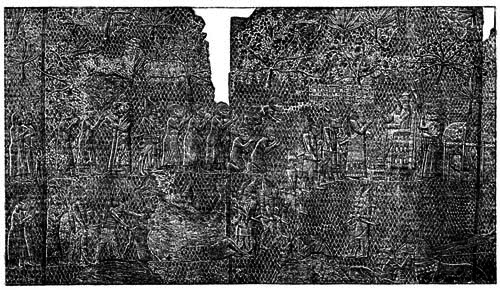
Capture of Lachish by Sennacherib.
Tirhakah, the Ethiopian king of Egypt, and the king of Melukh (the Arabian desert), who had come to the assistance of the Jewish prince, were defeated at Eltekeh, and Hezekiah vainly endeavoured to buy off the vengeance of his offended suzerain by rich and numerous presents, including 30 talents of gold and 800 talents of silver. The surrender of Jerusalem alone would content Sennacherib, who accordingly devastated Judah, destroying its cities and carrying into captivity 200,150 of its inhabitants. Jerusalem itself was blockaded, Hezekiah being shut up in it 'like a bird in a cage.' Then, however, came the catastrophe which obliged Sennacherib to retire without punishing his rebellious vassal, and of which, of course, nothing is said in the inscriptions. But there is no further record of a campaign in the West. In the following year Sennacherib was in Babylonia, where he drove Merodach-baladan out of the marshes and obliged the Chaldaean prince and his subjects to fly in ships across the Persian Gulf to the opposite coast of Elam. Assur-nadin-suma, the son of Sennacherib, was now made king of Babylon. Six years later he was carried off to Elam and a new king, Nergal-yusezib, appointed in his place by the Elamite monarch. This was in return for an unprovoked assault made by Sennacherib on the Chaldaean colony in Elam, to which he had crossed in boats made by Tyrian workmen, and whose inhabitants he sent captive to Assyria.
For a time Elam was all-powerful in Babylonia, though Nergal-yusezib had been defeated and captured in battle by the Assyrians. But in b.c. 691 Sennacherib descended with the full might of Assyria upon the country. The Babylonians had sent the treasures of the temple of Bel to the Elamite monarch, begging his help. The Babylonian and Elamite forces met the army of Assyria at Khalule, and a hard-fought battle was the result. The slaughter was great on both sides, and Sennacherib claims a complete victory, though the Babylonian Chronicle—a cuneiform document compiled from a Babylonian point of view—implies that such was not altogether the case. At all events about two years were needed for the subjugation of Babylonia. In b.c. 689 Babylon was taken, its houses and temples destroyed, the images of its gods broken in pieces, and the ruins of the city thrown into the Arakhtu, the canal of Babylon. For some years Babylon lay desolate, and as there was no longer a temple or image of Bel to legitimize the rule of the Assyrian conqueror, Babylonia remained 'without kings.'
On the 20th day of Tebet or December, b.c. 681, Sennacherib was murdered by two of his sons who seem to have been jealous of their brother Esar-haddon. Esar-haddon had been given the new name of Assur-etil-mukin-abla ('Assur the hero is the establisher of my son'), perhaps because he had been destined for the throne, and at the time of his father's murder he was commanding the Assyrian army in a war against Ararat. For forty-two days the conspirators held the capital; then they were compelled to fly to Erimenas of Ararat and seek his help against their brother. The decisive battle was fought on the 12th of Iyyar (April) near Malatiyeh in Kappadokia; the veterans of Assyria won the day, and at the close of it saluted Esar-haddon as king. He returned to Nineveh and on the 8th of Sivan (May) formally ascended the throne.
Esar-haddon was great in counsel as well as in war, and knew how to conciliate as well as how to conquer. At the outset of his reign he restored Babylon, rebuilt its temples, brought back its gods and people, and made it one of his royal residences. For twelve years he was king alike of Babylonia and Assyria.
A revolt of Sidon, which was easily put down, next occupied his attention. Then came a more formidable event. The Gimirrâ, called Gomer in Genesis, Kimmerians by the Greeks, suddenly appeared out of the north and menaced the civilized world. Esar-haddon met them on the frontier of his empire, defeated their chieftain, the 'Manda' or nomad Teuspa, and drove his hordes westward into Asia Minor. It now became necessary to secure the Assyrian frontier on the south. The Assyrian king accordingly marched into the very heart of Arabia, through burning and waterless deserts, and struck terror into the Arabian tribes. The march must have been one of the most remarkable ever made.
Esar-haddon was at last free to complete the policy of Tiglath-pileser III by conquering the ancient kingdom of Egypt. Palestine gave no more trouble; Manasseh of Judah was already an obedient vassal of the Assyrian king. In b.c. 674 'the Assyrians marched into Egypt.' But two more campaigns were needed for its subjection. In b.c. 670 Esar-haddon drove the Egyptian forces before him in fifteen days (from the 3rd to the 18th of Tammuz or June) all the way from the frontier to Memphis, thrice defeating them with heavy loss and wounding Tirhakah their king. Three days later Memphis fell, and Tirhakah fled to Ethiopia, leaving Egypt to the conqueror. Egypt revolted two years afterwards (b.c. 668), and while on the march to reduce it Esar-haddon fell ill, and died on the 10th of Marchesvan or October. Assur-bani-pal, who had already been named as his successor, became king of Assyria, his brother Saul-suma-yukin taking Babylonia as his share. The king of Babylonia, however, was required to admit the supremacy of the Assyrian monarch.
The Egyptian revolt was quickly suppressed and the country was again divided into twenty satrapies, each satrapy being placed under a native prince. But the arrangement answered badly. The satraps quarrelled with one another, intrigued with Tirhakah, and rebelled against Assur-bani-pal. Time after time Assyrian armies had to be sent to reconquer the land. Once Necho, the satrap of Sais, was brought in chains to Nineveh, there, however, to be pardoned and restored to his city. Twice Thebes was captured, once after it had been made for a time the seat of Tirhakah's government, a second time after the defeat of Urdaman (Rud-Amon), the step-son and successor of Tirhakah. On this occasion the city was utterly destroyed. Its temples and palaces were overthrown, its statues mutilated, and an immense spoil carried away to Nineveh. Among the spoil were two obelisks, over seventy tons in weight. The destruction of Thebes is alluded to by the prophet Nahum (iii. 8).
Assur-bani-pal, the Sardanapallos of the Greeks, was the 'Grand Monarque' of Assyria, and a generous patron of literature and learning. But he lacked the warlike instincts of his fathers, and preferred to remain at home while his generals fought in the field. His long wars drained the country of its fighting-men and prepared the way for its downfall. They were waged mainly with Elam, the only civilized country of Western Asia which still preserved its independence, and lasted for several years. At last, however, Elam fell; its capital Shushan was sacked and burned, and a desolated country was added to the Assyrian dominions.
The fame of Assur-bani-pal spread far and wide. Ambassadors came to his court from Ararat, as well as from Gyges of Lydia. At first no interpreter could be found for the latter. Gyges wanted help against the Kimmerians, which, however, 'the great king' does not seem to have afforded. The tribute of Gyges was accordingly withdrawn after a time, and he took part in the great rebellion which now shook the Assyrian empire to its foundations.
Saul-suma-yukin put himself at its head, and proclaimed the independence of Babylonia. Psammetikhos, the son of Necho of Sais, imitated his example in Egypt, and with the assistance of Gyges put down the rival satraps, shook off the Assyrian yoke and founded the Twenty-sixth dynasty. Saul-suma-yukin was less fortunate. After a desperate struggle he was captured and put to death by his brother, and Babylonia was once more reduced to servitude. Punishment was also taken upon the tribes of northern Arabia who had joined the rebels.
But the empire was terribly weakened. Egypt was lost to it for ever, and though Elam was added instead, it proved to be a barren possession. When Tuktamme the 'Manda' appeared upon the scene he was resisted with difficulty. The empire was tottering to its fall.
Of its closing days we know but little from the monuments. Among the successors of Assur-bani-pal were Assur-etil-ilani-yukin (who still claimed rule in Babylonia), and Sin-sar-iskun. The latter has sometimes been identified with Sarakos, said by the Greek writer Abydênos to have been the last king of Assyria [5]. At all events the fall and destruction of Nineveh may be placed in b.c. 606.
The Babylonian Empire.—On its ruins rose the Babylonian empire of Nebuchadrezzar, the son of Nabopolassar. The battle of Carchemish placed him in possession of Syria, which the Egyptians had occupied after the fall of Nineveh. The battle was scarcely over when Nebuchadrezzar was recalled to Babylon by the death of his father (b.c. 605). Unlike the Assyrian kings, he cared but little about recording his successes in war. His inscriptions are occupied with the account of his building operations, of his gifts to the gods, and of his devotion to Bel-Merodach. Under him Babylon became one of the most splendid cities in the world. Its palaces, its temples, its hanging gardens and its walls were alike on a vast and magnificent scale. The temples were roofed with cedar of Lebanon, overlaid with gold and silver, and the ramparts of the royal house were finished in fifteen days. The suburb of Borsippa was included within the fortifications of the city, which were so strong as to be practicably impregnable. At the same time the other cities of Babylonia were not forgotten, and their temples were enlarged and beautified.
In b.c. 568 Nebuchadrezzar marched into Egypt, defeated the Pharaoh Amasis and occupied a part at least of the Delta. 'Phut of the Ionians' is mentioned in connexion with this campaign. It is the only military expedition mentioned in the texts we possess; even the monuments of Nebuchadrezzar found in Syria (at the mouth of the Nahr el-Kelb near Beyrout and in the Wadi Brissa near the ancient Riblah) are silent about his wars.
He was a great organizer, a great builder, and above all a man of genuine piety, which breathes through all his inscriptions. When he died, b.c. 562, he was succeeded by his son Evil-Merodach, who reigned only two years. Then the throne was usurped by a certain Nergal-sharezer (the son of Bel-zakir-iskun) who had married the daughter of Nebuchadrezzar. Nergal-sharezer built himself a new palace and died b.c. 556. He was followed by his infant son who reigned only three months, when he was murdered and the throne seized by Nabonidos (Nabu-nahid), the son of Nebo-balasu-iqbi, who was not related to the royal family. Nabonidos was a man of some energy, but he offended a powerful party in Babylonia by attempting to do what Hezekiah had done in Jerusalem—centralize the religious worship of the country and therewith the political power in the capital. Nabonidos was also an antiquarian and caused excavations to be made in the different temples of Babylonia in order to discover the records of their founders.
We are now well acquainted with the history of Nabonidos and the fall of his empire, thanks to three cuneiform documents which have been found in Babylonia. One is an inscription of Nabonidos himself; another an edict issued by Cyrus shortly after his conquest of the country; and the third the annals of the reign of Nabonidos, compiled the year after his overthrow. The empire of Nabonidos, we learn, extended as far westward as Gaza, but the 'Manda' or 'Nomads' of whom Astyages (Istuvegu) was king had devastated part of Western Asia and had destroyed the temple of the Moon-god at Harran. It was not until Cyrus, 'the little servant' of Astyages, had overthrown the Manda that Nabonidos was able to enter Harran and rebuild the ruined shrine.
Cyrus and the Fall of Babylon.—Cyrus, like his fathers, was king of Anzan in Elam, not of Persia. Anzan had been first occupied, it would appear, by his great-grandfather Teispes the Achaemenian. The conquest of Astyages and of his capital Ekbatana took place in b.c. 549, and a year or two later Cyrus obtained possession of Persia. In b.c. 538 the population in the south of Babylonia revolted, and Cyrus entered the country, where he was assisted by the native party which was hostile to Nabonidos. The Babylonian army was stationed in northern Babylonia, but it was utterly defeated at Opis in the month of Tammuz or June, and on the 14th of the month Sippara opened its gates to the conqueror. Gobryas, the governor of Kurdistan, was then sent by Cyrus against Babylon, which also opened its gates 'without fighting,' and Nabonidos, who had concealed himself, was taken prisoner. Gobryas placed the temple of Bel under a guard, and the daily services there proceeded as usual. The contract-tablets show that there was equally little cessation of business among the mercantile classes. But it was not until the 3rd of Marchesvan (October) that Cyrus himself arrived in Babylon and proclaimed a general amnesty, which was communicated by Gobryas to 'all the province of Babylon' of which he had been made governor. Shortly afterwards the wife of Nabonidos died; lamentation was made for her throughout Babylonia, and Kambyses, the son of Cyrus, conducted her funeral in one of the Babylonian temples.
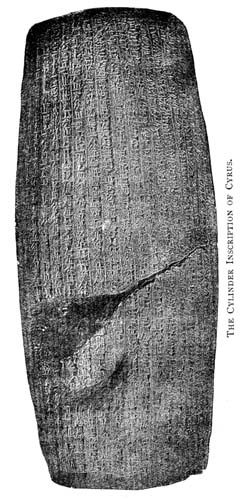
The Cylinder Inscription of Cyrus.
Meanwhile Cyrus had assumed the title of 'King of Babylon,' thus claiming to be the legitimate descendant of the ancient Babylonian kings. He announced himself as the devoted worshipper of Bel and Nebo, who by the command of Merodach had overthrown the sacrilegious usurper Nabonidos, and he and his son accordingly offered sacrifices to ten times the usual amount in the Babylonian temples, and restored the images of the gods to their ancient shrines. At the same time he allowed the foreign populations who had been deported to Babylonia to return to their homes along with the statues of their gods. Among these foreign populations, as we know from the Old Testament, were the Jews.
Belshazzar.—One of the sons of Nabonidos was Belshazzar, who is mentioned in the contract-tablets as well as by his father. He seems to have been 'the king's son' who commanded the Babylonian army in its camp near Sippara. If so, it would appear that he had died or been slain before the final invasion of Babylonia by Cyrus, since no reference is made to him on that occasion, and the pretenders who afterwards rose against Darius in Babylonia called themselves not Belshazzar but 'Nebuchadrezzar, the son of Nabonidos.'
Decay of Babylon.—It was after the death of Kambyses and of the Pseudo-Smerdis that these revolts took place in b.c. 521 and 515(?). The first was a serious one, and was suppressed only after two engagements in the field and a siege of Babylon. The second revolt also needed a long siege for its suppression, and at its conclusion Darius partially destroyed the walls of the city. But in the reign of Xerxes, during the absence of the king in Greece, Babylon revolted again under a certain Samas-erba, who reigned for about a year. On the fall of this champion of Babylonian independence, the temple of Bel, the rallying-place of Babylonian nationality, was in part destroyed. From this time forward the only kings mentioned in the cuneiform tablets are foreigners, Persians, Greeks, and Parthians. The last dated tablet at present known to us is almost as late as the Christian era. It is an astrological text which is dated in the 168th year of Seleucus and the 232nd year of Arsakes, that is to say in b.c. 80.
CHAPTER IV
RELIGION
The religions of Babylonia and Assyria.—The religion of Assyria was borrowed from that of Babylonia. The deities worshipped in the two countries were the same, as also were the ritual and the religious beliefs of the people. Almost the only difference observable in the religion of the two kingdoms was that whereas Bel-Merodach was the supreme god of Babylon, Assur, the impersonation of the old capital, was the supreme god of Assyria.
Differences between Babylonian and Assyrian religion.—But the different characters of the two populations were reflected in their religious conceptions. The Assyrians were a nation of warriors, the Babylonians of traders, agriculturists, and scribes. Assur is accordingly 'a man of war'; it was in reliance upon him that the Assyrian armies marched into foreign lands, and compelled their inhabitants to acknowledge him. Not to believe in Assur was a crime, since Assur represented Assyria. Assur, too, admitted no rival at his side: wifeless and childless he stood alone. Once or twice, indeed, an Assyrian scribe ascribes to him a wife or a child, but this is in imitation of Babylonian usage and the belief never took root in Assyria.
Bel-Merodach, on the contrary, was a god of mercy. He is 'the merciful one' who hearkens to those that call upon him and who 'raises the dead to life' through trust in his power. Belat, or Beltis, 'the lady,' stood at his side, a reflection of himself, and the gods were his children who recognized him as their father and creator.
Sumerian religion Shamanistic.—Babylonian religion was a compound of Sumerian and Semitic elements. Sumerian religion had originally been 'Shamanistic' in character. That is to say it had no conception of deities or priests in the usual sense of the words. Each object or force of nature was believed to have its zi or 'life' like men and beasts; the zi was a sort of vital principle which caused the arrow to fly, the knife to wound, or the stars to move through the heaven. A personality was given to it, and it thus became what we may term a spirit. With these spirits, accordingly, the sky and earth were peopled; they were in fact as multitudinous as the objects and forces of nature to which they owed their birth. Necessarily the greater number of them were harmful, if not always at any rate at certain times and in certain places. Magical charms alone could protect man from their malevolence or bring down their blessing upon him, and these magical charms and ceremonies were known only to a particular class of persons. To such sorcerer-priests the name of 'shamans' has been assigned, the form of religion represented by them being termed 'Shamanistic.'
Two centres of Babylonian religion.—In prehistoric times two great religious centres existed in Babylonia, from which two divergent streams of religious influence flowed over the country. One of these was Nipur in the north, the other Eridu in the south. Nipur was the seat of Shamanism, and its patron deity in later days still retained the title of Mul-lil or El-lil, 'the lord of the ghost-world.' Eridu, on the other hand, was brought by its trade and situation into contact with foreign culture. It thus became the source of a higher and more spiritual form of faith. The spirit of the water, who had been its special object of adoration, became the culture-god Ea, the lord of the abyss, who is called Oannes in the Greek history of Bêrôssos and was believed to have been the author of Babylonian culture. To him its laws, its arts, and its sciences were alike traced back. Through his wisdom his son Asari-mulu-dugga, 'Asari who benefits mankind,' was enabled to cure the diseases and troubles of men, and teach them how to avoid evil. His teachings were embodied in writing, and so a sacred book grew up, half Bible, half Ritual, which contained hymns to the gods as well as rubrics for the performance of the ceremonies accompanying their recitation.
Under the influence of Eridu the religion of Babylonia ceased to be so purely Shamanistic as it once had been. Certain of the spirits tended to take rank above their fellows and thus to pass into gods. How long this process of development lasted we do not know.
Semitic Influence.—But a time came when the Semites entered the country and were brought into close contact, hostile or peaceable, with its Sumerian inhabitants. The result was a fusion of Sumerian and Semitic religious ideas. An official religion came into existence which consisted of a Semitic form of faith grafted upon a Sumerian root.
The religion of the Semite was essentially different from that of the Sumerian. The primary object of his worship was the Baal, Bel, or 'Lord,' who revealed himself in the sun. Each tribe and each locality had its own Baal; when the tribes coalesced or when the same tribe occupied more than one locality the various Baals were regarded as so many forms of the supreme God.
Each Baal was the father of a family. At his side stood his wife, a colourless reflection of himself, as the wife was of the husband in the Semitic family on earth. Like the father of the family on earth, Baal too in heaven had his children.
Where the religions of the Semite and the Sumerian met and combined, the Sumerian spirits who had emerged above the rest like Ea of Eridu or El-lil of Nipur, were assimilated to the Semitic Baalim. El-lil, in fact, was known throughout the Semitic period as Bel of Nipur. Wherever it was possible a solar character was given to them; in other cases the general characteristics of the Semitic deity were attached to the old Sumerian divinity. The great body of the spirits which had fallen into the background was grouped together as the 300 spirits of heaven (Igigi) and the 600 spirits of earth (Anunnaki).
The goddess Istar.—In one instance, however, it was the Semite rather than the Sumerian who was affected by the contact between the two forms of faith. The spirit of the evening star became the goddess Istar, who retained her independent position by the side of the male deities. While the other goddesses were absorbed in the persons of their divine consorts like the wife in the Semitic family, Istar, having no consort, remained like the wife in the Sumerian family on a footing of equality with the man. When the name and worship of Istar were passed on to the Semitic peoples of the West, the anomaly led to more than one change in her character. In southern Arabia and Moab she was identified with a male deity; in Canaan her name received the feminine suffix -th (Ashtoreth), and she thus became in large measure an ordinary Semitic goddess.
Bel-Merodach.—After the rise of Babylon as the capital of the kingdom, its patron-god Merodach became the supreme Baal or Bel of Babylonia. He had already been identified with Asari-mulu-dugga, the son of Ea, and the attributes of the latter were accordingly transferred to the new Bel. It was to him that the great temple of Ê-Saggil was erected in Babylon, while the interpreter of his will to men, Nebo, the divine 'prophet,' had his temple Ê-Zida in the neighbouring suburb of Borsippa. At Nipur a god whose name has been variously read Uras, Nin-ip, Bar and Adar, but the true pronunciation of which is still unknown, stood in much the same relation to El-lil that Nebo did to Merodach. He was, however, regarded as a solar warrior instead of as a prophet.
Other deities.—Nergal was worshipped in Kutha and its cemeteries; Samas, 'the Sun,' at Sippara; Sin, 'the Moon,' at Ur and Harran; Anu, 'the Sky,' at Erech, where he was associated with Istar. Along with Ea and Bel of Nipur, Anu formed a triad which represented in the official religion the three elementary deities of the sea, the earth, and the heavens. The sea, however, was rather the primordial 'deep' out of which all things arose than the sea of the actual world, while 'the heaven of Anu' was beyond the visible sky, and Bel was the prince of the air and the underworld.
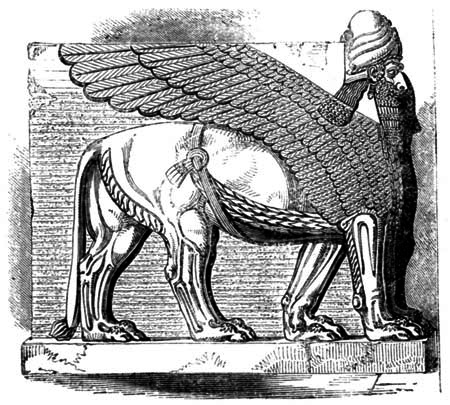
Winged Bull or House-Guardian.
Sacred books and ritual.—Along with the growth of the official religion went the growth and completion of the Chaldaean Bible and Prayer-book. The festivals of the gods were numerous; the ceremonies to be performed by the priests were more numerous still. The ceremonies were usually accompanied by the recitation of one or more hymns; these hymns were written in Sumerian, which had now become the sacred language of Chaldaea just as Latin is the sacred language of the Roman Church, and since Sumerian was no longer understood by the majority of the people they were provided with interlinear translations into Semitic Babylonian. From time to time the pronunciation of the old Sumerian words was indicated, for just as it was needful that the inspired words should be handed down without the slightest alteration, so also was it needful that they should be pronounced aright. An error even in pronunciation was supposed to invalidate the ceremony. Among the hymns is a collection of penitential psalms of which the following lines will give some idea:—
'O lord, my sins are many, my transgressions are great! O my god, my sins are many, my transgressions are great! O my goddess, my sins are many, my transgressions are great!
The lord in the wrath of his heart has regarded me; God in the fierceness of his heart has revealed himself to me. The goddess has been violent against me, and has put me to grief.
I sought for help and none took my hand; I wept and none stood at my side; I cried aloud and there was none that heard me. To my god, the merciful one, I turn myself, I utter my prayer.
O my god, seven times seven are my transgressions: forgive my sins!'
The Priests.—The existence of a hierarchy of gods, of a Bible, and of a Prayer-book implies the existence of a priesthood. The sorcerer of prehistoric times became the priest of later Babylonia. The priests were distinguished into several classes. At the head came the High-priest who was often the monarch; in Assyria indeed this was commonly the case. Subordinate to him were other high-priests, and under them again the 'anointers' (who cleansed the sacred vessels of the sanctuary), the priests of Istar and the 'elders.' By the side of them stood the 'prophets' (asipi) under a 'chief.' The prophets could predict the future and were consulted on matters of state. We hear of armies being accompanied by them into the field, and when Assur-bani-pal suppressed the revolt of the Babylonians 'by the command of the prophets,' he says, 'I purified their shrines and cleansed their chief places of prayer. The angry gods and wrathful goddesses I soothed with supplications and penitential psalms. I restored and established in peace their daily sacrifices which they had discontinued.'
The Temples.—The temples were provided with towers which served for the observation of the stars, and stood within large courts. In the shrine was a 'mercy-seat' whereon the god 'seated himself' on certain occasions. At Balawât near Nineveh the mercy-seat had the form of a coffer or ark, in which two written tables of stone were placed. In front of it stood the altar approached by steps. In the court was a 'sea' or large basin of water, which like that of Solomon was, in one case at all events, supported on bulls of bronze. The images of the gods were almost invariably of human form.
Astro-theology.—The prominence given to the study of astronomy had much to do with giving Babylonian religion an astral character. The stars were worshipped; Istar herself was originally the evening star, and most of the principal deities were identified with the planets and chief fixed stars. The importance of the stars for the regulation of the calendar, moreover, kept them constantly before the eyes of the priests. But whether Babylonian astrotheology was not really primitive or whether it went back to the pre-Semitic period we do not yet know.
Sacrifices and offerings.—Sacrifices were offered to the stars, as to the other divinities. Besides the sacrifices, offerings were also made of meal, dates, oil, and wine. The sacrifices and offerings must have been numerous since in the larger temples there was not only 'the daily sacrifice' but also constant services both by day and night. On the great festivals, moreover, there were services of a special character, as also when days of thanksgiving or humiliation were ordained. The sacrifices and offerings were provided partly by endowments, partly by voluntary gifts (sometimes called kurbanni, the Hebrew korban), partly by obligatory contributions, the most important of which were the 'tithes.'