Part 1 — FACTS WORTH MENTIONING.
Reading edition
FACTS WORTH KNOWING.
The Poisonous Effects of cyanide of potassium upon sores, may be obviated by immediately applying some of the positive developing solution, described at page 62. By this means much annoyance may be avoided to persons afflicted with chapped or sore hands.
Bending Glass Rods or tubes can be easily done by subjecting them to the blaze of a spirit lamp—the same as that used for gilding the daguerreotype. First hold the rod just above the blaze, then gradually allow it to descend into it, imparting to the rod a rotatory motion with the finger and thumb: this will soon cause a softening of the glass, when it may be bent to any desired shape. If the ends are to be bent to form hooks, another small piece of glass, or any warm metal, may be placed upon the end, in the blaze of the lamp, and as soon as thoroughly softened, it can be pressed or bent to form the hook. By filing around a glass tube or rod, it may be easily and safely broken at the desired point, by giving it a sudden jerk between both hands, holding it close to the encircled part.
Cementing Glass may be readily accomplished by placing the two ends together in the blaze of the lamp, and holding them there until they attain a sufficient degree of heat to slightly fuse: when cool, the ends will be found perfectly united.
The Background best adapted to positives is unbleached muslin, such, as is sold for sheeting, and can be found in almost any dry goods' store: it should be from two to three yards wide. A clouded appearance is given to the background by merely marking it with charcoal, forming streaks or "waves" resembling clouds. These come out black, or dark, in the positive, and give a variegated appearance. The roughness of the marking does not matter, since the background is generally a little out of the focus of the lenses. Trees and other designs may be represented in this matter.
Positive Collodion Pictures may be whitened by the use of bichloride of mercury, thirty grains to one ounce of water. After the picture has been developed, fixed and washed, by the process given in the preceding pages, the solution of bichloride of mercury may be poured over the surface of the image: it almost immediately presents a series of interesting changes in color. The surface at first blackens but for a few minutes, when it begins to get lighter, and gradually brightens to a pure white, inclining to a blue. It should then be thoroughly washed and dried, as usual.
Instantaneous Pictures may be taken by employing the iodide of iron in the collodion. The best method with which I am acquainted, is to have a saturated solution of iodide of iron in alcohol, and drop one or two drops into an ounce of the collodion (which has been previously iodized) used in taking positives. This can be used at once, as soon as mixed. No more of this collodion should be prepared than is wanted for immediate use, as it will keep good for only a few hours. The saturated solution of iodide of iron can be kept on hand ready for use at all times. There should be an excess of the iodide in the alcohol. The same accelerating effect is produced with the negative collodion prepared in this way.
Plain Collodion may be iodized as soon as dissolved: this will save time in settling. It is a fact that some cotton is more readily dissolved when the bromo-iodizing is present: but by the addition of this, I have often taken up considerable quantities of the gummy sediment remaining in the bottom of bottles.
Prepared Glass may be preserved clean and free from dust by keeping in boxes such as those used for keeping daguerreotype plates. By taking out every other partition between the grooves, the glass can be readily put in.
Collodion Vials and Bottles, after having collodion in them once, should be rinsed with alcohol and ether (in the same proportions as employed for dissolving the cotton), before using them a second time for that purpose. Penuriousness in this respect would be bad policy.
Coating Large Glasses.—A convenient method of doing this is represented in the following illustration:
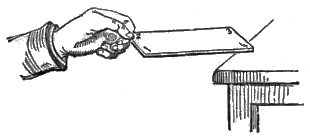
The glass is held by one corner, 2; the other corner, 4, is rested on a table or bench, and the collodion poured on, so that the excess may be poured off at 1.
Black Stains upon the hands, caused by nitrate of silver, may be removed by moistening them and rubbing with a lump of cyanuret of potassium. This salt is poisonous, if used to a great extent [See page 139]. Another safer, but more expensive plan, however, is to take a saturated solution of iodide of potassium in water, and then wash with nitric acid diluted with two parts water.
Stains upon White Linen can be removed by washing with a saturated solution of iodide of potassium containing a little iodine; then wash with water, and soak in a saturated solution of hyposulphite of soda until the yellow iodide of silver is dissolved.
The hands should always be washed after fixing a positive or negative picture, before again touching a glass to be coated, or the dipper; this precaution is necessary, lest any of the iron salt, or the hyposulphite, should get into the silvering solution and spoil it.
In taking Collodion Pictures, it is always advisable for the sitter to be arranged before the glass is taken from the bath: this will save time and there will be less liability of the collodion drying.
A Good Negative may be known by its possessing the following characteristics:—By transmitted light the figure is bright, and appears to stand out from the glass; the dark shadows are clear, without any misty deposit of metallic silver; the high lights black almost to complete opacity.
A Glass Coated with Collodion, if kept too long before immersion in the bath, will not be equally sensitive over its surface; the parts most dry being the least sensitive.
Glass Pans, for Scales, can be procured by every one at trifling expense: Take a watch crystal, and place in the common metal pan; balance this with lead, or any weight: this can easily be kept clean, and is the most advisable for weighing all deliquescent salts, and chemicals employed in the collodion process.
Caution.—Persons engaged in making collodion, and using ether and alcohol, must bear in mind that these chemicals are very inflammable; hence extreme caution is necessary to avoid exposing them to the flame of a lamp or candle. I have known of several serious accidents, of recent date, all of which were caused by the imprudence of the experimenter in the particular above mentioned.
Wipe the Plate-holder every time before the glass is put into it: this will prevent spots, which might otherwise occur from the presence of nitrate of silver solution which drained from the plate previously used. These spots are of an opaque yellowish tinge, and in shape resemble the stain which would be occasioned by a splash of water.
Glass jar Positives.—A good white or light-green glass will answer for the collodion coating. Glass which contains air-spots can be used, if it be placed in such a manner as to let the light of the image come over them, as the spots cannot be seen through the opaque surface. Only the best white glass should be used for covering the picture. Some operators use the convex glass, which is very clear, and answers the purpose.
The Nitrate of Silver Bath should be kept covered, except when in use.
If a Glass be Immersed too soon, streaks and waves will be occasioned. These will be seen at the end of the plate which is least dry: the coating is also more liable to peel off. It should be borne in mind, however, that the peeling of collodion is not always attributable to this cause.
Diffused Light in the Developing Room.—In proportion as the sensitiveness of the plates increases, greater care must be exercised in thoroughly excluding all rays of white light. With opalescent films, neutral, this cause of fogging is more common than any other.
Tn the case of a portrait, if the features have an unnaturally black and gloomy appearance, the dark portions of the drapery, &c., being invisible, the picture has been underexposed in the camera.
CHAPTER VII.
HELIO PROCESS.[F]
An Entire Process for Producing Collodion Positives and Negatives with one Bath, and in much less time than by any other known Process.—By Helio.—Photographic Patents.
Boston, Oct., 1856.
S. D. Humphrey.
Sir,—As Humphrey's Journal is the only truly progressive and independent Photographic publication in America, I feel it the duty of every one to aid its Editor in furthering the interest of the amateur and practitioner of the art; and, suiting the action to the word, I present the following Process as being worthy of confidence, and having, in my hands, proved eminently satisfactory. I am surprised to see that Operators and men respectably connected with the practice of the Art should so far fall beneath the station of true artists as to advertise to catch each other, or the verdant ones, by offering this or that little improvement all "printed complete for five dollars." As an amateur, and having the good of the science I love at heart, I now contribute my mite for the benefit of all interested; and, following the glorious example of G. B. C. (who I hope we shall soon hear from again,) in your last, I say—God speed!
I shall endeavor to be as minute and concise as possible, so as to enable any one to adopt and successfully use my processes.
Preparation of Soluble Cotton.—I put into a Wedgewood mortar, twelve ounces, by weight, of dry and finely pulverized nitrate of potash (I use Dupont's refined), and add to it twelve ounces, by measure, of good commercial sulphuric acid; I mix these well together by the use of a glass rod and pestle, so that it forms a paste; I then add, in small quantities at a time, about 325 grains of good coarse cotton (this is according to your process), and knead the mass well for from three to five minutes; and then cover the mortar with a piece of glass, and let it stand for twenty or thirty minutes, by which time it will have been sufficiently acted upon. Then the cotton is to be plunged into a quantity of clean water and thoroughly washed in a number of changes of water, so that when it is squeezed between the folds of blue litmus-paper it will not redden it; this indicates that the acid has been washed out; I then place the cotton in a clean strong towel and wring out all the water I can, then put it into alcohol, then wring it again, and adopt your plan of not letting it become thoroughly dry.
The cotton being now ready for use, I dissolve it in the following mixture, in a bottle of proper size:—
Sulphuric ether 10 ounces.
Alcohol, 95 per cent. 5 ounces.
Soluble cotton, enough to make it about as thick as cream.
The above should be well shaken, and then allowed to stand for one or two days to settle. This constitutes my Plain Collodion, and should be poured off into another bottle, leaving the sediment behind.
Iodizing.—For this purpose I employ the following preparation:—
A.—Iodide of Silver.—Dissolve fifty grains of nitrate of silver, crystals, in two ounces of pure water, and forty grains of iodide of ammonium in two ounces of pure water; then pour the two together, shaking the mixture well; let it settle, which it will do in a few minutes; then pour off the water carefully, leaving behind all the yellow iodide of silver; pour again a fresh quantity of water over the precipitate, and continue this washing for at least six changes of water; then drain off the water as close as possible and pour on two ounces of alcohol, which, when drained off, will leave the powder sufficiently clean for the purpose.
B.—I now dissolve forty grains of bromide of ammonium and one hundred grains of iodide of ammonium in two ounces of 95 per cent, alcohol, and then add the iodide of silver (preparation A), and shake the whole well together, giving a saturated solution. This is to be filtered through cotton or paper, when it will be ready for use.
C.—To sixteen ounces of Plain Collodion add from eight to twelve drops of tincture of iodine (50 grains of dry iodine dissolved in half an oz. of alcohol) and 14 grains or drops of fluoride of ammonium; shake the mixture well; then add all of the solution B; shake it again and thoroughly; after this has stood for twenty-four hours it can be used, but will be found better after it has been prepared one week.
Nitrate of Silver Solution.
Pure rain or distilled water 64 ounces.
Nitrate of silver (in crystals) 4¼ ounces.
Clean pure white sugar 75 grains.
Six grains of iodide of ammonium dissolved in half a drachm of alcohol.
The above, thoroughly mixed and allowed to stand for a few hours, should be filtered through a new clean sponge, asbestos, or Swedish filtering paper, and then a few drops of nitric acid, chemically pure, should be added, just enough to redden blue litmus-paper; then it is ready for use, and will improve by age.
Developing Solution.—This formula has proved very satisfactory in my hands, and I hope will be equally so with all who give it a trial:—
Water 1 pint.
Boracic acid ¾ ounce.
Protosulphate of iron ¾ ounce.
Pulverized nitre ½ ounce
Three drops of oil of cinnamon dissolved in two ounces of alcohol.
Dissolve and filter, and it is ready for use. It is better to make this developer fresh every other day.
Dissolving off the Iodide of Silver.—Water, about half a pint; cyanide of potassium, enough to clear the impression in about thirty seconds—say a quarter of an ounce.
Fixing the Impression.—I use the article well known to every good photographer as Humphrey's Collodion Gilding, and it serves the purpose better than anything that I I know of.
Black Varnish.—I generally purchase this from the dealer; but I have made an article which answered the purpose well, by dissolving pulverized asphaltum in spirits of turpentine. Any of the black varnishes can be improved by the addition of a little bees'-wax to it. It is less liable to crack and gives an improved gloss.
Negative and Printing Processes.—Being myself an amateur, and desiring to study economy and convenience, my attention has been given to the test of numerous plans for avoiding the necessity of two baths and silvering solutions and I feel confident that the amateur will find the following, in connection with the foregoing Positive Process, the best adapted to his wants.
The same bath and solution is used for the negative as for the positive process; and the time of exposure in the camera should be prolonged a few seconds. I have produced beautiful negatives, in-doors, in four seconds, and, out-doors, instantaneously. The manipulation, bath, and developing solution are precisely the same as those used in the positive process.
Fixing the Negative.—Place the following mixture in a well-stoppered bottle:
Pure Water 6 ounces.
Aqua-ammonia, concentrated 1 ounce.
This solution should be poured on the negative and allowed to remain for about twenty seconds. It should be borne in mind, that the developing solution (same as for positives) should be well washed off the glass before the fixing solution is poured over; after it has remained on the glass for the time given (20 seconds), the negative can be washed with clean water and dried; it is then ready for printing. The iodide of silver is not, as in other processes, dissolved off, but remains on the glass.
It sometimes happens that the negative is not sufficiently intense; this result can be obtained by pouring over the plate the following solution, which should remain for about three-fourths of a minute:
Water 8 ounces.
Nitrate of silver 28 grains.
Alcohol 1 ounce.
Loaf sugar 1/3 ounce
After this solution is used, I pour over the impression the developing solution, and then wash well with water. This re-developing may be repeated two or three times, and almost any desired intensity obtained.
Printing Process—Salting the Paper.—Boil the following mixture in an earthen vessel until it becomes transparent:—
Distilled water 12 ounces
Muriate of ammonia 240 grains.
Arrowroot 112 grains.
After this has been sufficiently boiled, it should be strained through clean linen or cotton cloth (free from soap or other substances), and, when cool, it is ready for coating the paper, which is done by dipping a new clean sponge into it and rubbing it over one side of the paper, giving it a uniform coating; but as it is not desirable to have too much on the paper, it should be rubbed with a clean sponge until nearly dry; it can then be hung up by the corner until thoroughly dry, when it can be put into a portfolio and kept for exciting for use.
Silvering Solution.—This solution may be prepared in the light, but must be used in a dark room:—
Distilled water 1 pint.
Nitrate of silver 3¾ ounces.
Dissolve and pour into an earthen or gutta-percha dish. Take the paper (cut to the proper size) and float it on this solution for about three minutes; care must be observed that there are no air-bubbles between the solution and the paper, for this would cause spots. It now can be hung up to dry, and as soon as dry it may be used. Let me here repeat, that this operation must be conducted in a dark room.
Fixing and Toning Bath.—I find that a better effect is produced if the positive be a little over-printed before being acted upon by the following mixture:—
Distilled water 8 ounces.
Chloride of sodium 240 grains.
This solution should be put into a flat dish and the print placed on it, face down, for from one and a-half to three minutes, when it should be taken off and put into the following solution, and allowed to remain there from three quarters of an hour to two hours:—
Distilled water 18 ounces.
Hyposulphite of soda 3 ounces.
Nitrate of silver 60 grains.
The following method should be observed in preparing this last mixture, viz.:—dissolve the three ounces of hyposulphite of soda in sixteen ounces of the water and the sixty grains of nitrate of silver in the remaining two ounces; then pour the nitrate of silver solution into that containing the hyposulphite of soda, stirring the mixture continually until all is well mixed.
After the print has remained in the toning solution for the specified time, it should be taken out and well washed in several changes of clean water, and dried and mounted in any of the usual ways.
With a few general remarks I will close this, perhaps, too long communication. It should be a point in the practice of every one who desires success in any process, to maintain a strict observance to cleanliness; this is one point in which most persons fail, and it cannot be too strongly impressed upon the minds of manipulators. It should be understood that the foregoing process is complete in itself, and is not to be confounded with any other method. The collodion is adapted for the nitrate of silver bath, and the bath for the collodion; and no one should use other preparations of collodion and silvering solution, except they do so with the full expectation that it will be at the loss of either or both of the preparations employed.
Allow me, through the columns of your invaluable Journal, to say to those who may read the foregoing process, that if they find (as I have) my process to prove profitable to them, I shall consider myself amply repaid if they will, through the same medium, contribute to our stock of information by giving an account of their experiments. I feel quite confident that some of the amateurs, with whose reputation I am already acquainted, and of whose private works in photography America has cause to feel proud,—could furnish interesting, useful and valuable information upon this subject. Such men, for instance, as G. B. C, of Md. (who has already made a good beginning), G. W. D., of the same place, and Mr. G. G., of Pa. Friends and co-laborers, shall we hear from you? I pause for a reply!
I look with interest upon every stroke of the pen from your able correspondent G. M., of Washington, whose specimens of photographic engraving you recently had the kindness to show me. I assure you, it did not a little astonish me to witness the surprising truthfulness with which the details were presented.
Helio.