PRELIMINARY CHAPTER.
Reading edition
INSTRUMENTS AND GENERAL DIRECTIONS.
The Post-mortem Case, as prepared by the instrument makers, will be found to contain, usually, the following instruments:

1. A set of ordinary dissecting scalpels, four or five in number, and of graduated sizes, including one heavy cartilage knife.

2. A brain knife with a long blade, for slicing the brain.
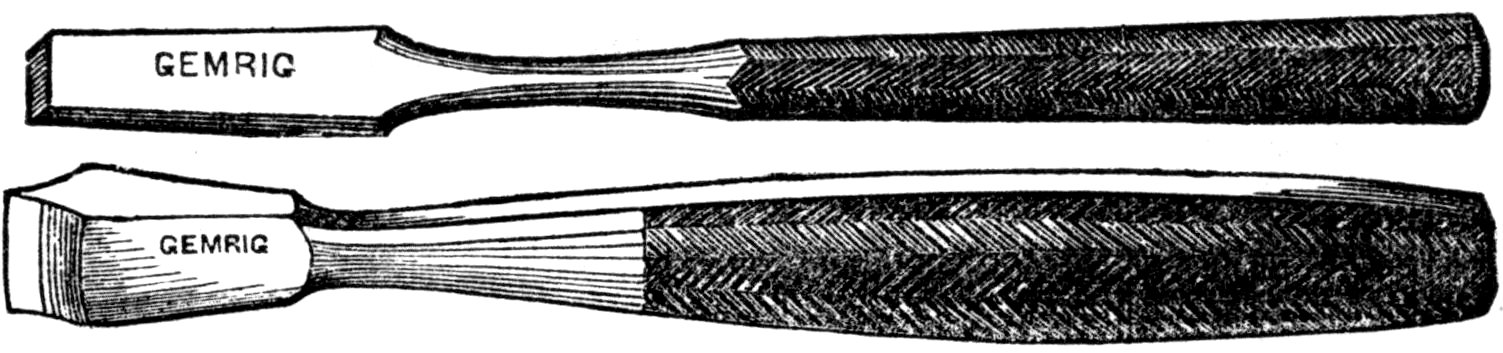
3. Chisels, of one or both the accompanying forms, for use in opening the head or spine.
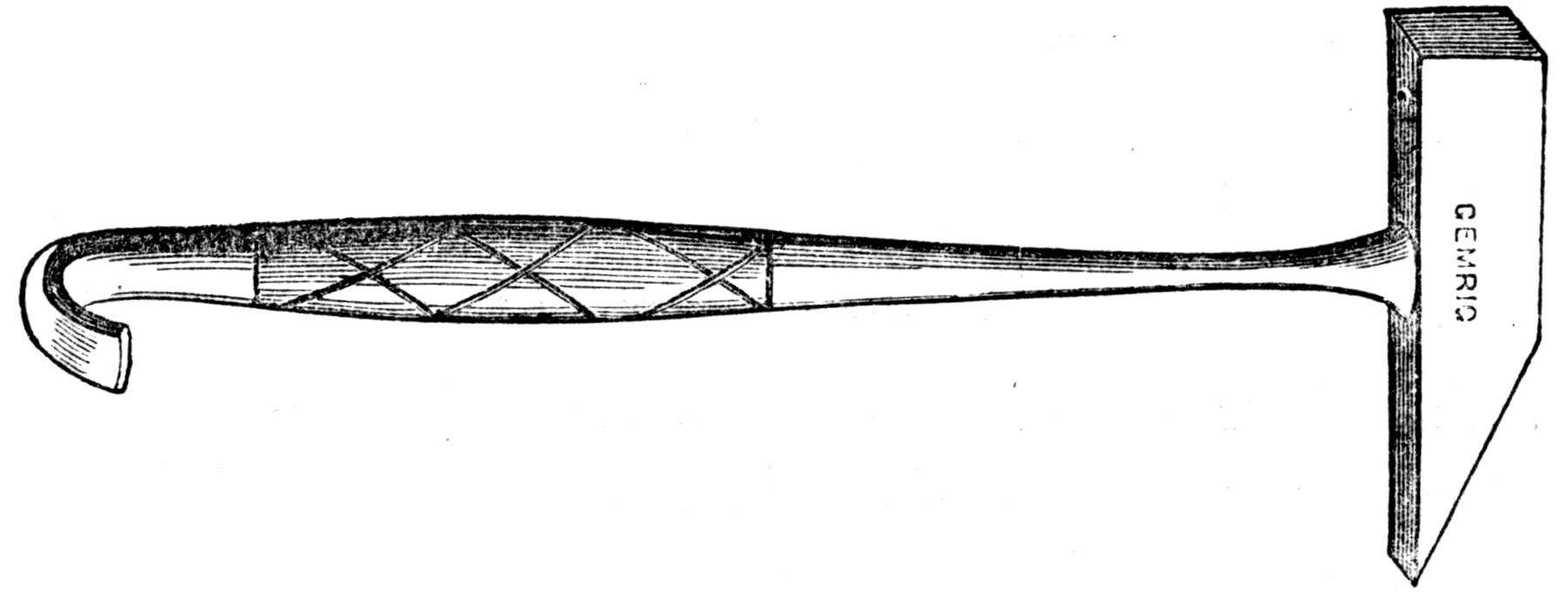
4. An iron mallet or hammer, with a hook on the end of the handle for tearing off the culvarium.
22
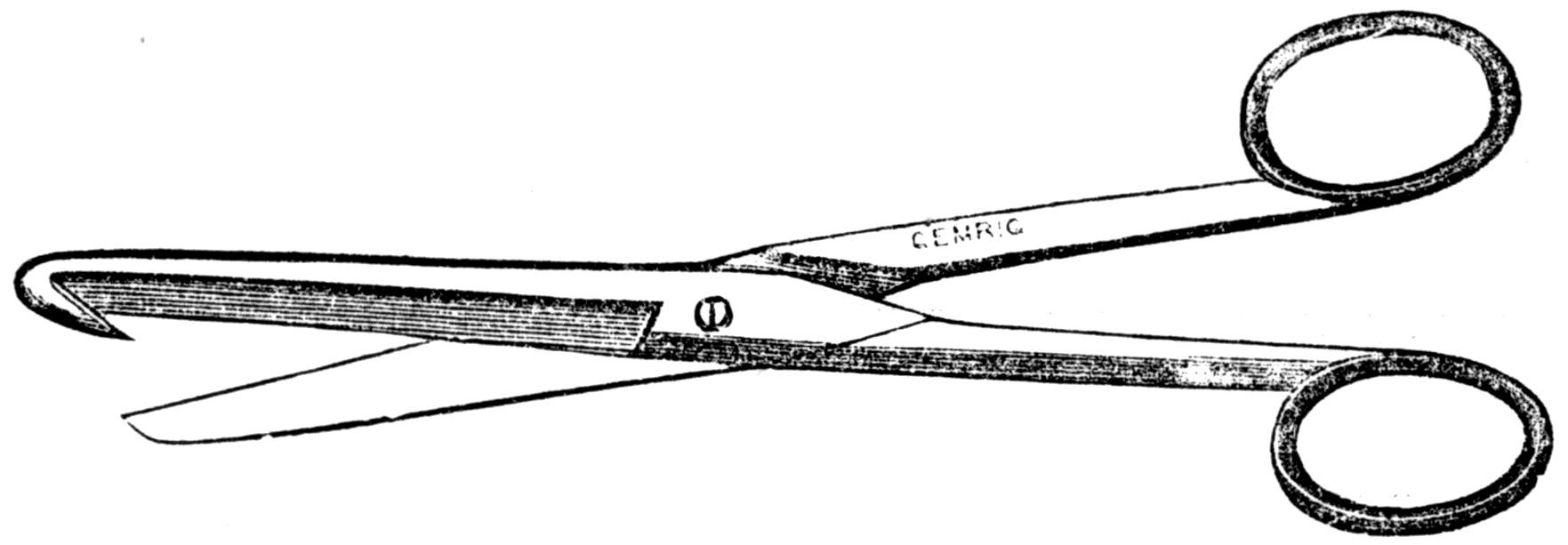
5. An enterotome, or scissors with blunt, hooked point, for splitting open the intestinal canal.

6. A saw with movable back; this arrangement permitting of a deeper cut, in dividing large bones.
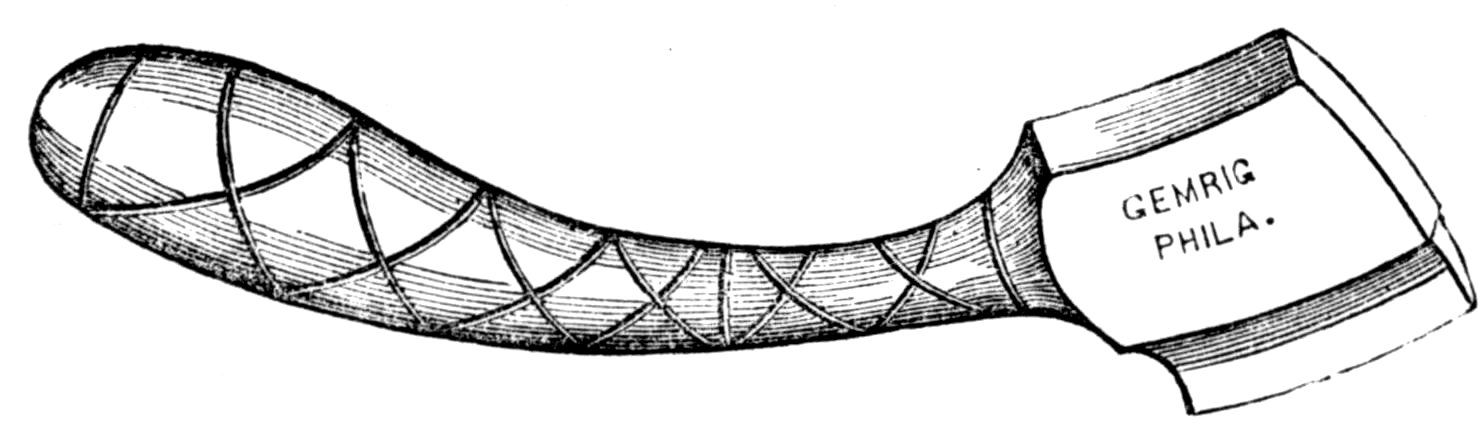
7. The rachitome, a chisel-like instrument, to be used with the hammer in opening the spinal canal.
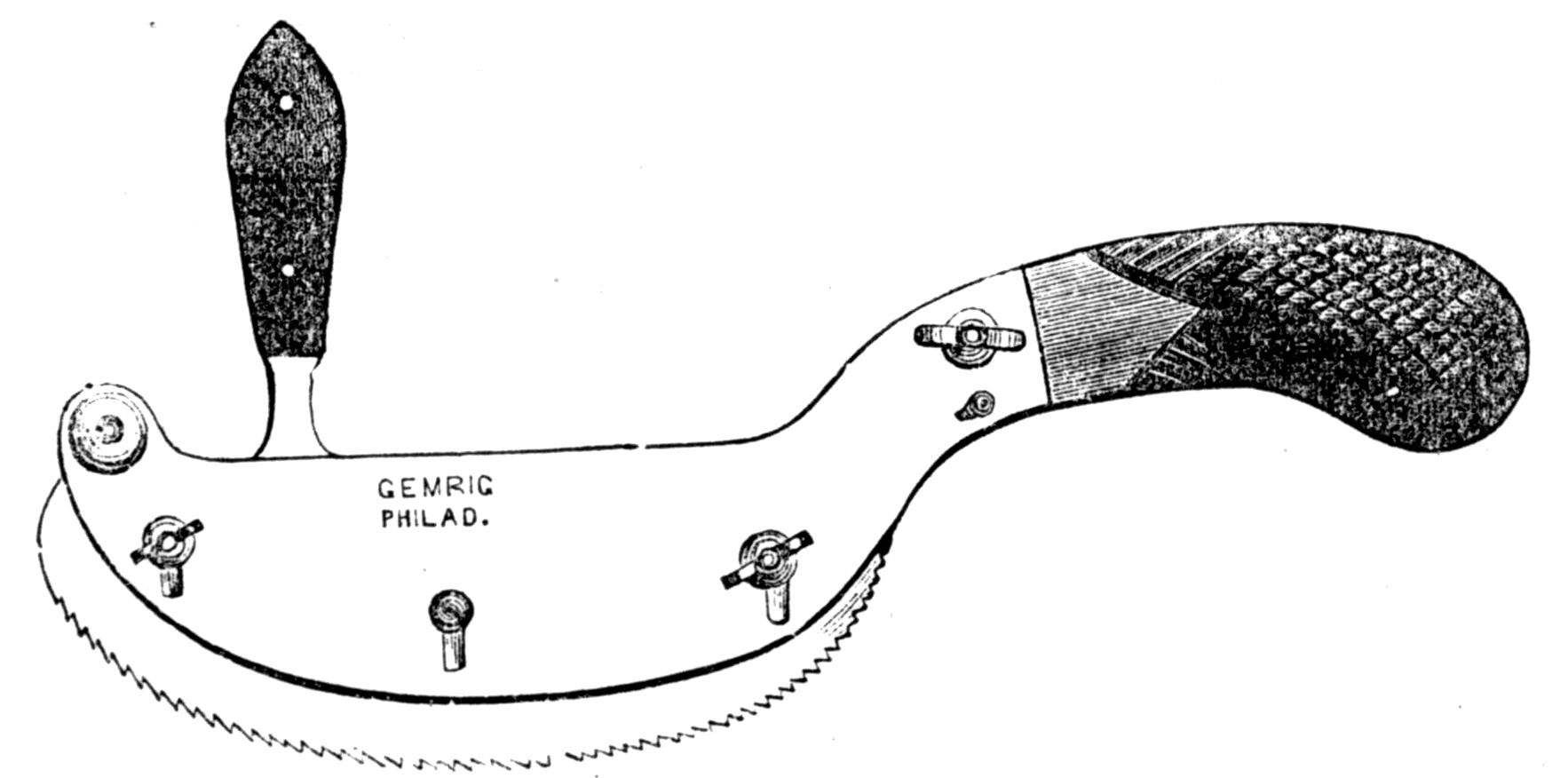
8. The double saw, used for dividing the laminæ of the vertebræ. A side view of the instrument being given in the cut, one blade only is seen. The two are attached to one handle, placed parallel with one another, and about one and one-fourth inches apart. After the soft tissues have been 23removed, this saw is used by passing the spinous processes between the two blades, and thus dividing both laminæ at once.
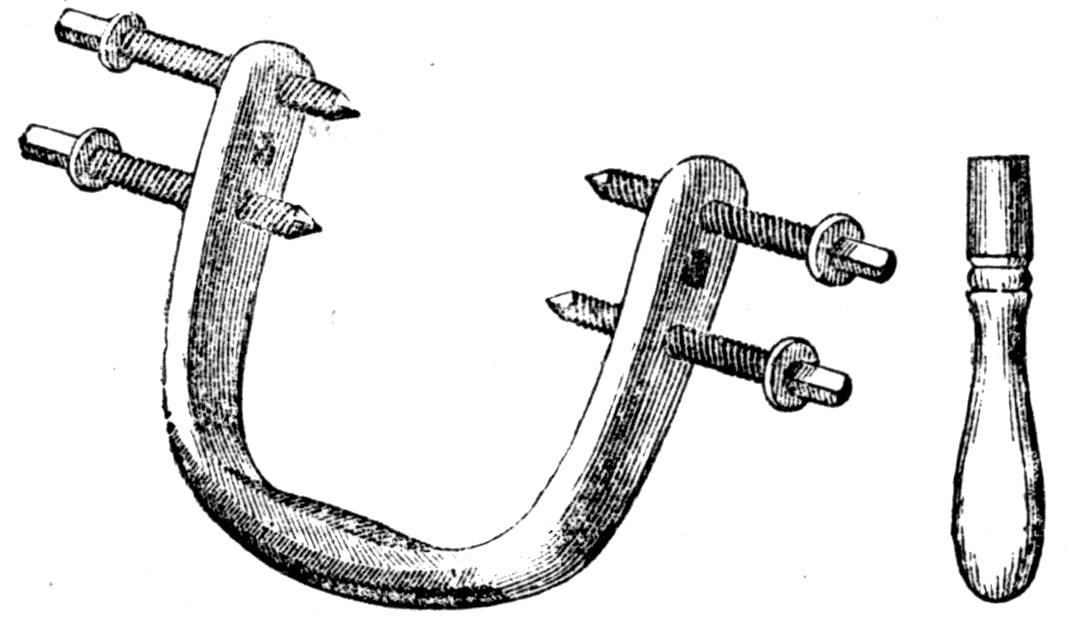
9. A skull clamp, for steadying the head while removing the calvarium. After the removal of the scalp, this instrument may be employed, and be of much service for the above object. It is applied by placing the open end of the instrument over the crown of the head, turning down the screws, and thus fastening it just above the line of division of the bone. The arched end of the instrument now serves as a handle for turning or steadying the head.
10. Rib-shears, for dividing the ribs where that operation is found desirable.
11. A tube for inflating the lungs, and an ordinary blowpipe.
12. Dissecting forceps, tenacula in handle and with chain, grooved director, and assorted needles, straight and curved.
While a post-mortem case with all of the above instruments is very convenient, and important even, where there is frequent occasion for its use, still its absence should never deter the physician from making an examination where the ordinary dissecting case may be had; and with the country physician generally, this case is all that is absolutely essential, as a common carpenter’s saw and chisel may at any time be found, in cases where the head is to be opened; while for opening the chest and abdomen, the dissecting case contains everything that is essential.
24Instruments used in post-mortem examinations should never be employed for operating upon the living, without first being repolished by the instrument maker, and the handles disinfected by careful cleaning in a solution of permanganate of potash.
PRELIMINARY PREPARATIONS.
The Preliminary Preparations at the place of the operation should consist in providing a sponge for absorbing fluids; newspapers and old cloths for filling cavities or wrapping up any morbid specimen that it may be desirable to preserve; a couple of quarts of clean sawdust or wheaten bran for throwing into the cavities before closing them up, and thus absorbing any excess of fluids; stout thread or twine for tying intestines and closing the cavities; lard or sweet oil for oiling the hands; a couple of empty slopbuckets for receiving the fluids, bloody water, &c., and plenty of water, hot and cold, with towels and soap. If the floor of the room is carpeted, to protect it from accident, a piece of old carpet, or quilt, or oilcloth should be spread alongside the table or box where the examination is made. Care should be observed to have all these matters provided before the operation is commenced, when the door should be fastened, that there may be no intrusion, by accident or otherwise.
In preparing the body for examination, if the head is to be opened and the body is in an ice-box, it will be absolutely necessary that it be removed. Placing the cover of the box on the floor, the body may be lifted out and placed on the same, when both may be again placed on the top of the box or on a table, for the examination. If only the chest and abdomen are to be examined, it will hardly be necessary to lift the body from the box. In all cases, the sheet in which the body is placed, with the underclothing, (the latter having 25been split down the centre,) should be carefully turned aside, and care observed during the operation to avoid as much as possible soiling them with blood-stains.
Precautionary Measures. That there is a certain amount of danger from absorption of virus in case of cuts or scratches received while conducting a post-mortem examination, cannot be denied; yet this danger is by no means common to every case. In the great majority of instances, probably no mischief whatever would follow such an accident, the danger being confined almost wholly to cases of peritoneal inflammation, erysipelas, and certain malignant forms of disease. In all cases, however, it will be well to look for any scratch, cut, or abraded point on the hands or fingers, and first touching them with nitrate of silver, cover them finally with collodian. Smearing the hands well with lard or olive oil will also aid much in preventing absorption.
Should an accidental cut be received during the operation, it will be prudent, in all cases, to wash the hands at once, squeeze and suck the part, to favor bleeding, and, finally, touch with a crystal of nitrate of silver. Punctures with a needle or slight scratches which do not bleed are, probably, more dangerous than a free cut; hence, in cases of suspected danger, when a puncture has been received, it would be safer to make a free incision with a knife, thus inducing bleeding, which will favor the washing out of any virus, and finally, use the caustic.
Time for Making the Examination. As a rule, post-mortem examinations should be made as soon after death as a due regard to the feelings of friends will permit, say within twelve to twenty-four hours; a longer delay would give time for such decomposition as not only to make the examination extremely disagreeable, but, from change of structure in tissues and organs, much less satisfactory. In cold weather, however, or where the body has been placed 26in ice soon after death, as is the custom in most cities, the examination may be postponed to any convenient time before the burial.
Notes. In all important cases, notes should be taken down by an assistant, on the spot, as dictated by the operator; heading these by the name and age of the patient and a brief sketch of the disease. In medico-legal cases, this is to be conducted with particular care, as will be pointed out hereafter.
Consent of Friends. Much difficulty will sometimes be met in obtaining the consent of friends for a post-mortem examination, the idea of the mutilation of the body of the deceased striking many with particular dread. With a little tact and management, however, consent may, in the majority of instances, be obtained. Instead of speaking to a single member of the family and leaving him or her to bring the subject before others, in all doubtful cases it will be better for the physician to see all the interested parties himself, either together or separately, and endeavor to interest them in the case, by pointing out the peculiar character of the disease, the satisfaction which the friends will themselves derive from a verification of the diagnosis of their physician, while, when too late, they may regret having withheld their consent; also the scientific interest which attaches to the case, and the benefit which will no doubt accrue to medical science through a post-mortem examination, and the possibility that the lives of others may depend upon a knowledge of the true state of this case. These, with like considerations, adapted with ready tact to the class of persons to be persuaded, will, in the majority of instances, be enough to overcome all scruples, especially when joined to the assurance that the examination will be so conducted as to leave no visible trace of the operation with which to embitter the remembrance of the well-known countenance.
27