Volume 1 — CHAPTER IV. COLONISATION OF VIRGINIA.
Reading edition
At the commencement of the seventeenth century a considerable revolution had taken place in the objects of American enterprise and discovery. As the greatness and the immense resources of the new world opened before the European mind, the grasp of mind itself and of human interests widened in proportion. The vain hope of the new passage to the East Indies, which prompted Columbus and others to sail first westward, was now becoming a secondary motive. To this had succeeded the desire for the acquisition of gold, a rabid appetite, whether a more bitter curse to the aborigines or the European it is hard to say; the islands and equatorial regions had also ministered to the luxury and indulgence of the conqueror by all their affluence of tropical productions. Selfishness and aggrandisement had prevailed; but gradually, as morning will succeed to night, a nobler and better purpose had begun to operate, and these new-found realms were regarded as a wide field on which to found states and establish Christian colonies; they had already become the refuge of the oppressed, they might be still more so: they had already given an impulse to commercial enterprise, they would do so still more.
England, of all European nations, was perhaps most fitted to profit by this enlarged sphere of operation. She had even then, apparently, an excess of population, and “the timid character of king James having thrown out of employment the gallant men who had served under Elizabeth, both by sea and land, no other choice was left to them but either to engage in the quarrels of other nations, or incur the hazards of seeking a new world.” The expeditions sent out by the intelligence of Sir Walter Raleigh, had turned the public mind 40to Virginia. Gosnold, a bold seaman, whose ship first sailed directly across the Atlantic, and who entertained the highest opinion of the capabilities of the New World for colonisation, had long endeavoured to persuade his friends to make trial of it for that purpose. Schemes of this kind were revolving in the minds of various people at the same time. Sir Ferdinand Gorges, who had learned much regarding America from George Weymouth, entertained the most favourable ideas on the subject; Sir John Popham, the lord chief justice of England; the assignees of Sir Walter Raleigh, and Richard Hakluyt, the historian of maritime adventure, all favoured the establishment of a colony in the New World.
Gosnold at length induced three persons to engage with him in the enterprise, Edward Maria Wingfield, a merchant of the west of England, Robert Hunt, a clergyman, and the brave and energetic John Smith, a man of singular perseverance, indomitable courage, and possessed of every quality necessary for the successful adventurer. These, assisted by the influence of Popham and Gorges, succeeded, in 1606, in obtaining from James I. a patent for the establishment of a colony in Virginia.
The English monarch claimed the whole of that portion of North America lying between the 34th and 45th degrees of north latitude, from Cape Fear on the coast of North Carolina to Halifax in Nova Scotia. This territory was now divided into two portions, North Virginia, extending from the 41st to the 45th degree, and South Virginia, from the 34th to the 38th degree.
The first was granted to a company of “knights, gentlemen and merchants of the west of England, incorporated as the Plymouth Company;” the second to a company of “noblemen, gentlemen and merchants, mostly resident in London,” and which was called the London Company. The intermediate district, included in neither patent, was open to both companies, yet neither were permitted to extend their settlement within a hundred miles of the other.
The conditions of the charter were homage and rent, the rent being one-fifth of the net produce of gold and silver, and of copper one-fifteenth. The supreme government was vested in a council residing in England; local government alone was permitted to the colonists themselves. The members of the supreme council were nominated 41by the king, and even over the colonial councils the king preserved a control, being able to nominate and remove according to his royal pleasure. In all respects the king was the supreme head; the legislative and executive power lay in his hands; the colonists had no power of self-government. This first charter granted to an English-American colony was merely a simple charter for commercial purposes. The English government cherished through the whole scheme the hope of a considerable revenue from its colonies in Virginia; a duty to be levied on vessels trading to the harbours was to be applied to the use of the colony for one and twenty years, after which time it should lapse to the king. The code of laws also for the colony was drawn up by the king; religion was strictly enjoined to be according to the teachings of the English church; no emigrant might withdraw his allegiance from the king nor dissent from the royal creed. Dangerous tumults and seditions were punishable by death, as well as murder, manslaughter, and adultery. All civil causes involving corporal punishment, fine or imprisonment, were to be determined by the president and council, who were appointed by the king. There was not an element of popular liberty in the whole stipulated form of government. It was, however, worthy of the peddling, narrow policy and kingcraft of the British Solomon. The only element of enlightenment which it contained was the injunction of kindness to the savage, and the employment of all proper means for his conversion.
The Plymouth company, on receiving their grant, despatched a vessel of discovery, which, however, was taken by the Spaniards. A second went out, and returning, made the most favourable report of the country; the following year, therefore, 1607, a hundred colonists were despatched under the command of George Popham. They landed at the mouth of Kennebec River, west of the Penobscot, and about one hundred and thirty miles north-east of where Boston now stands. Here they erected a few rude huts, threw up slight fortifications, and built a storehouse. The settlement was called St. George. They had landed in the autumn, and the winter was intensely severe; their sufferings were extreme, not only from the severity of the climate and the season, but from want of provisions, their storehouse having been destroyed by fire. Their president also 42died; and in the following year, disheartened by so disastrous a beginning, they returned to England. This terminated the efforts of the Plymouth company.
The London company despatched a little squadron of three ships, on the 19th of December, 1606, one hundred and nine years after the discovery of this northern portion of the New World by Cabot. The largest vessel did not exceed one hundred tons burden; and the number of colonists was one hundred and five men. England was as yet new to the subject of colonisation, and the party sent out were injudiciously selected; out of the hundred and five persons emigrating to a wilderness where were no homes and no cultivated land, there were only twelve labourers, very few mechanics, and only four carpenters, the rest were gentlemen of fortune, persons with no occupation, many of them of dissolute habits, who had joined the expedition in the hope of gain. Neither were there any men with families. King James had also commanded the names and instructions of the future councillors of the government to be sealed up in a tin box, to be opened only on their arrival in Virginia; none, therefore, on the voyage were possessed of authority—envy and jealousy arose among them, which produced dissension. Besides this, the voyage was long and tedious, owing to Newport, the commander, adhering to the old route by the Canaries and West India islands. The voyage was as long as a slow voyage to Australia in these days. The intention of the colonists had been to establish themselves at the old settlement of Raleigh, but a severe storm fortunately prevented the execution of this design, and drove them into the magnificent Bay of Chesapeake. The headlands at the entrance of the bay were named Cape Henry and Cape Charles, after the sons of the king, which appellation they still retain; and the ships soon afterwards coming into deep water “put the emigrants,” says Smith’s narrative, “into good comfort,” and that name was bestowed on the northern point of a broad river near the estuary of which they lay. The emigrants were greatly pleased by the aspect of the country around them. “Heaven and earth,” says Smith, “seemed never to have agreed better to frame a place for man’s commodious and delightful habitation.” They entered the noble river, which they called after King James, and spent seventeen days in exploring the banks, during which time they 43encountered a company of hostile natives, and two of their number were wounded. With another tribe of Indians they smoked the calumet of peace. A fine situation, fifty miles above the mouth of the river, was selected for their settlement, the place receiving the name of Jamestown. Here was formed the first permanent English settlement in the New World.
The important sealed-box was opened, and the names of Wingfield, Newport, Gosnold, Smith, and three others, were found nominated to the council. But the dissensions and jealousies which had broken out on the voyage here assumed a more determined aspect. Smith, almost the only man amongst them of superior character and powers of mind, had become an object of jealousy to his fellows, and the council having elected Wingfield as their president, proceeded to exclude Smith from their council, under pretence of his harbouring a design to murder the council, and establish himself as king of Virginia. Smith, however, who had a sincere friend in Robert Hunt, the clergyman, insisted on trial by jury, which he had a right to demand, and was not only acquitted, but restored to his station.
Whilst timber was being felled, wherewith to freight the ships for their homeward voyage, Newport, Smith, and some others, ascended the river to the falls, and were well received by Powhatan, the great Indian chieftain, called “the emperor of the country,” whose residence, a village of twelve wigwams, was near the present city of Richmond, the capital of the present State of Virginia. Powhatan, “a tall, sour, and athletic man, about sixty years old,” was from the first disposed to favour the English. When his people murmured at the intrusion of the strangers, he replied, “they hurt you not; they take but a little waste land.” Powhatan evidently did not possess the prophetic gift of the wise Indians who, twenty years before, on the very same shores, foretold that “there were more of the English generation yet to come, to kill theirs and take their places!”
Newport set sail for England in June, carrying with him a favourable report; but scarcely was he gone, when a change came over the aspect of all things. Disease broke out among the settlers; their provisions were not abundant, the water was bad: the glorious country around them, in the beauty of which they had at first rejoiced, became an appalling wilderness; the rank luxuriance of the 44soil needed clearance before new harvests could be expected, but the colonists were unused to and disinclined for labour; discontent gave place to despair; distress of mind added to disease of body, and within a fortnight after the departure of the ships, it is related that scarcely ten men out of the whole number were able to stand; the fortifications could scarcely be completed, and no ground tilled. The fort by autumn was filled with the groans of the sick, whose outcries night and day for six weeks rent the hearts of those who could afford no relief. Frequently three or four died in a night. Fifty had perished before the close of the autumn, and among these the brave and excellent Bartholomew Gosnold, the projector of the enterprise, and one of the few whose influence had preserved some degree of concord in the council.
To add to the misery of the time, Wingfield, their president, a selfish, unprincipled man, was found to have appropriated the best stores to his own use, himself living luxuriously, whilst the others were starving. On his detection, he attempted to escape to the West Indies, in a bark which had been left for the use of the colonists, but was prevented and expelled from the council. A new president was appointed, but one wholly inadequate to the exigencies of the colony, and by a sort of law of necessity, rather than by general consent, the management of all fell into the hands of Smith, the only man whose wisdom and energy were sufficient to retrieve their desperate affairs.
Smith was possessed of a spirit of heroic daring. He had set out on brave adventures when a boy, and though not yet thirty, had been a champion in the service of humanity and Christianity. In his youth he had fought for the independence of the Batavian republic, in the wars of the Low Countries. He had travelled through France, had visited Egypt, and returned by Italy. Again, eager for action and glory, he had fought against the followers of Mahomet on the borders of Hungary, and during these combats had distinguished himself, both with the Christians and infidels, by his magnanimity and bravery. His extraordinary courage had attracted the notice and gained for him the favour of the unfortunate Sigismund Bathori, Prince of Transylvania. At length, being overcome in a sudden skirmish among the wild valleys of Wallachia, he was left on the field of battle severely wounded. Being now taken 45captive he was sold as a slave in Constantinople. But here his romantic fortune by no means deserted him. A Turkish lady had compassion on his youth and sufferings, and wishing to befriend him sent him to a fortress in the Crimea. The intentions of his protectress were, however, defeated for some time; he fell into the hands of a savage taskmaster, whom however he killed, and then seizing a horse, gallopped away to freedom on the confines of Russia. Here again, the kindness of woman aided him in his extreme need; and thence, travelling across the country to Transylvania, he bade farewell to his brothers in arms, resolving to return “to his own country.” On his way home, however, tidings of civil war in northern Africa drew his steps aside, and he had many a perilous adventure in the realms of Morocco.
Reaching England, he heard of the projected colonisation of North America, a scheme so entirely consonant with his nature, that he entered into it at once, with all the energy and enthusiasm of his character. And now here he was, as we have seen, in the autumn of 1607, the sole hope and support of the infant colony of Virginia, which, without his integrity and force of character, his cheerful temperament and sagacity, must have miserably perished.
Smith was equal to the difficulties of his position; his was a mind fruitful in resources, and his high principle rendered him not only strict in the fulfilment of his own arduous duties, but enabled him to enforce the fulfilment of duty in others. Under the former governors the natives had become unfriendly, he, on the contrary, conciliated them; “he was more anxious,” says the record of the colony, “to gather provisions than to find gold;” and before the winter commenced, the Indians brought in voluntary supplies. The colonists also, influenced by his spirit, now laboured earnestly to complete their fortifications and erect huts for the winter.
As soon as the new spirit of activity and hope had given a brighter aspect to the affairs of the colony, Smith set out to accomplish one of the strictly-enjoined purposes of the colonists; that, namely, of seeking for a communication with the South Sea, by ascending some river which flowed from the north-west. A little above Jamestown, a river called Chickahominy, and which flowed into the James river, seemed to answer this purpose, it being supposed that the continent 46of America was narrow, and that some river unquestionably would be found to serve as a connexion between the two seas. Smith, who was not as ignorant as his employers, and who entertained no expectation of reaching the Pacific Ocean by any such means, nevertheless was well pleased, having left the colony in a comparative state of comfort and prosperity, with abundant provisions for the winter, to diversify his life by new adventures. Advancing therefore up the river Chickahominy, accompanied by two Englishmen and two Indian guides, as far as was practicable by boat, he struck into the interior with a single Indian guide, leaving the boat under the guardianship of the two Englishmen. Scarcely, however, had he set forth when the English, disregarding some of his injunctions, were attacked and killed by the Indians, and he himself suddenly assailed by a large party. Binding his Indian guide to his arm as a buckler, he fought manfully, killing three of his assailants; unfortunately, however, in stepping backwards, he found himself on the edge of a morass; his feet sank, and he was taken prisoner. Accustomed to the views and sentiments of savage hordes in his captivity in southern Russia, he now availed himself of that knowledge, and acted in accordance with it. He neither begged for his life from the Indians, nor appeared cast down. They carried him away captive, but his self-possession never forsook him; marching through the forest he took out his pocket-compass and explained to them its use, and then from the globe-like figure of that instrument, as he himself relates, instructed them regarding the roundness of the earth, and how “the sun did chase the night about the earth continually.” His captivity among this tribe of Indians was a more wonderful and interesting event than any other preserved in their traditions. He wrote to the colony at Jamestown, and his letter increased the wonder of the savages at the miraculous power which existed within him; he seemed to them to convey a magical intelligence to the paper. His fame spread through all the kindred tribes, and he was conveyed as an object of curiosity from the Indian settlements on the Chickahominy, to those on the Rappahannock and the Potomac, and so on to the residence of Opechancanough at Pamunky. Here, for three days, the Indian priests or sorcerers practised incantations and mystical ceremonies to ascertain the designs and character of their extraordinary prisoner. He remained perfectly calm, as if regardless of his fate or assured of his safety. The Indians were amazed and confounded; they had never, unless among their bravest men, seen a courage and equanimity equal to this, they treated him with hospitality and reverence, as if to propitiate the superior powers that dwelt within him.
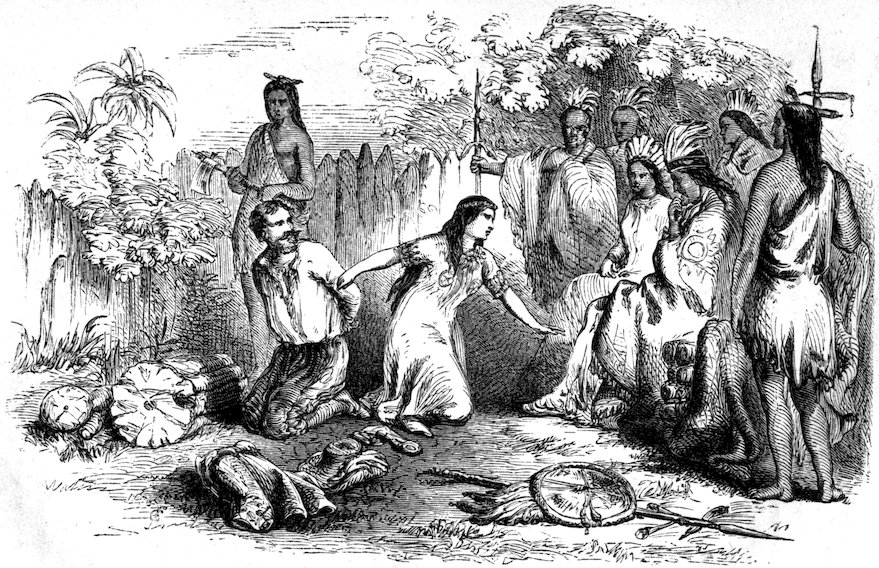
POCAHONTAS INTERCEDING FOR JOHN SMITH.
47The decision of his fate was referred to Powhatan, then residing at some little distance, and thither he was removed. The grim warriors of the forest, arrayed in all the pomp of savage attire, received him in solemn council. They deliberated and consulted among themselves, and feeling him to be a superior, as well as overcome by their fears, doomed him to death. His execution, however, was not immediate, and in the meantime he employed himself in making hatchets and stringing beads, which he gave to Pocahontas, the daughter of Powhatan, a girl of ten or twelve years of age, who for beauty of countenance and spirit, combined with gentleness, so far excelled all the maidens of her people that she was called “the nonpareil of the country.” At length the day of his doom was fixed; he was to die by the blows of the hatchet; the hour was come; he knelt on the place of execution, and already the uplifted hatchet was raised, but at the same moment Pocahontas, obeying an impulse of mercy, sprang to his side, threw her arms round his neck, and laying her head upon his, interposed herself between him and death. Her devotion and entreaties spared his life. The Indians, whom his superiority had so long awed, now resolved to make of him a friend and adopt him into their nation. They offered him every temptation which lay in their power to induce him to join them in attacking the white men who had settled at Jamestown. His firmness in resisting their offers inspired them with still higher respect, and they dismissed him with promises of friendship. His captivity was of great advantage to the colony; he not only had become acquainted with the country considerably inland, but with the Indian language and character, and was the means of establishing a friendly intercourse between the English colony and the tribes of Powhatan.
Returned to the colony, he found its numbers reduced to forty, and all disheartened and disunited, and the ablest among them so wearied by the hardships of colonial life that they were about to 48desert in the pinnace. Smith, at the hazard of his life, prevented this; by reason and firmness he once more established order, and the wants of the colony were relieved by the generous Pocahontas, who not satisfied with having saved the great chief from death, came now every few days with her companions, to bring baskets of corn for him and his people.
Newport was re-despatched, almost immediately on his return to the colony, with supplies and one hundred and thirty fresh emigrants in two vessels. The hope of the old colonists, which had revived at the sight of their new associates, soon died away again; for this reinforcement was only a repetition of the old disastrous elements. The new-comers were vagabond gentlemen, refiners of gold, goldsmiths, and jewellers. Smith, for the first time, was almost disheartened himself. They would neither build nor cultivate, but fancying that they should discover grains of gold in the micacious sands of a stream near Jamestown, they set to work, and, as Smith himself records, “there was now no talk, no hope, no work, but dig gold, wash gold, refine gold, load gold.” The whole colony was mad about gold; and Newport having remained fourteen weeks in harbour, idling away his time and consuming with his crew the provisions of the colony, which were already considerably diminished by the accidental burning of the storehouse, sailed away, having laden his ship with the glittering earth, and, contrary to the assertions of Smith, believing that he was conveying home vast treasures. Wingfield and some of his partisans sailed with him. The other ship was, by the strenuous advice of Smith, laden with cedar, skins and furs, and furnished the first valuable remittance from Virginia to the mother-country.
Disgusted at the folly of the colonists, upon whom his better reason had no influence, Smith left them for awhile to their own devices, and with a few companions made two voyages during the summer months in an open boat to explore the Bay of Chesapeake and its affluents: and in this manner he accomplished about three thousand miles. He surveyed the Bay of Chesapeake to the Susquehanna. He was the first to make known to the English the fame of the Mohawks, who dwelt upon the great water, and had many boats and many men, and who, according to the feebler Algonquin tribes, made war upon the whole world. He discovered and explored the 49Patapsco, and probably entered the harbour of Baltimore. He entered the mighty Potomac, which at its outlet is seven miles broad, which he ascended beyond the present Mount Vernon and Washington, as far as its falls above Georgetown. Nor did he content himself with merely exploring rivers; he penetrated into the country, and established friendly relationships with various tribes of powerful Indians, many of them in perpetual warfare one with another. On his second expedition he brought back with him to Jamestown a cargo of corn. He prepared an account of his voyage, with descriptions of the country and the natives, accompanied by a map, which remains extant to this time, and which is singularly correct.
Shortly after his return, Smith was made president of the colony. Subordination and industry now began to prevail. The first corn of their own planting was reaped. Again Newport arrived with fresh emigrants, two of whom were women. There came also a few Poles and Germans to teach the art of making pitch, tar, potash and glass. The company in London wrote by this vessel in a very angry strain. They were greatly dissatisfied that their heavy outlays produced no return, for, of course, the shining earth which Newport carried back with him on his voyage was found to be utterly worthless. They now required a lump of gold; the positive discovery of a direct passage to the South Sea, or some of the lost company planted on Roanoke! “If,” said they, “the colonists do not send back valuable commodities to defray the expenses of the voyage, amounting to £2,000, they shall henceforth be left to manage for themselves, as banished men.”
Smith very justly wrote back, “I entreat you send me but thirty carpenters, husbandmen, gardeners, fishermen, blacksmiths, masons, and diggers up of the roots of trees, well provided, rather than a thousand of such as we now have.”
But for the wisdom and efficiency of this brave man, the colony must have perished. Making the best of such as he had, the gentlemen, whom necessity had taught the use of the axe, were employed in cutting down timber to freight his ship. He obliged them to work six hours a day; “he who will not work, shall not eat” was his law. Jamestown, by the close of autumn, assumed a more habitable appearance, but as yet only between thirty and forty acres 50of land had been brought into cultivation. Food was still so scanty that they were obliged to seek for supplies from the Indians. Smith went himself to Powhatan for this purpose, but found the old chief unfriendly; nay, a scheme was even laid to take his life, and again he was saved by Pocahontas, who came through a midnight storm to warn him of his danger. Newport was despatched with a cargo of timber, and specimens of tar, pitch, and potash, prepared by the Germans.
The corporate company in London boasted of the success of the enterprise, spite of their angry letter and threats to the colony itself, and powerful men became its adherents; among these was Cecil, the inveterate enemy of Raleigh, who had first called public attention to the colonisation of these very shores, and who now, at this time, was a prisoner in the Tower of London. This body having thus become more important at home, without any knowledge or sanction of the colony itself, entirely changed its constitution. The territory was also extended by a grant of all lands on the sea-coast, within the limits of two hundred miles north, and two hundred miles south of old Point Comfort.
A new charter was obtained, which transferred the power formerly vested in the king to the company. The shareholders at home were now the legislators. A governor, in whom was vested uncontrolled power, was to be appointed by them. The lives, liberties, fortunes of the colonists were to be all placed in the hands of this one man; to the colonists themselves not a single privilege was conceded.
Lord De la Ware was appointed governor, with a lieutenant-governor, admiral, vice-admiral, high-marshal, and other officers, with high-sounding titles under him, all of whom were appointed for life. A general enthusiasm was awakened at home towards this Virginian colony, and 500 emigrants offered themselves and were accepted. Lord De la Ware, not being able immediately to take possession of his new government, Newport, now admiral, set sail in June, 1609, with a fleet of nine vessels, Sir Thomas Gates and Sir George Somers being sent out to administer the government till Lord De la Ware’s arrival. The admiral and the two deputy-governors sailing in the same vessel, disagreed on the important subject of precedence, and in a violent storm off the Bermudas were 51stranded on the rocks, and one vessel being lost, seven only reached Virginia.
Smith found himself now in a difficult position. The old charter under which he held authority was at an end; there was now, in the absence of the stranded vessel, which had on board all the officials, no one in the colony who could legally assume the government. The new emigrants were, if possible, worse than any who had hitherto arrived. “Dissolute gallants,” says the chronicle, “packed off to escape worse destinies at home, broken tradesmen, rakes and libertines, men fitter to breed a riot than form a colony.” “It was not the will of God,” says Bancroft beautifully, “that the new state should be formed of these materials—that such men should be the fathers of a progeny born on the American soil, who were one day to assert American liberties by their eloquence, and defend it by their valour.”
Smith, however, with his incomparable power of organisation and rule, contrived for some little time to bring these turbulent elements under control, and by devising new expeditions and settlements to give them employment. At last the explosion of a bag of gunpowder in his boat deprived the colony of his valuable services. He was severely injured; and as the colony furnished no surgical aid, he was compelled to return to England to seek it in one of the latelyarrived vessels, after having delegated his authority to Percy, brother of the Earl of Northumberland. He left about 500 persons in Virginia, well supplied with arms, provisions, and goods for Indian traffic. There were about sixty dwelling-houses in the town, besides a fort, a church, and a storehouse; there was a good stock of goats, of hogs, sheep, and poultry, together with a few horses; with about forty acres of land brought into cultivation. He had weathered the storm of the early days of the colony; in all the difficulties of his situation he had exhibited a courage and perseverance, a coolness of judgment, a patience and wisdom, which have scarcely ever been equalled. “He was,” says the historian, “accustomed to lead, not to send his men into danger; he would suffer rather than borrow, starve rather than not pay. He had nothing counterfeit in his nature; but was open, honest, and sincere.” We have dwelt long on the deeds and character of this brave, true man, because it is ever a pleasure to find such an one.
52No sooner was Smith gone than subordination, and industry were at an end. The colonists abandoned themselves to idleness and indulgence; the store of provisions was consumed. Percy, to whom Smith had delegated his authority, had not the power to enforce it; no one regarded him. The unoffending Indians being attacked and murdered by the settlers, now became hostile, and refused to contribute any further supplies. The horrors of absolute famine faced them; a company of thirty seized a small vessel belonging to the colony, and sailed away as pirates. In the traditions of Virginia this horrible season of winter, famine, and crime, is known as the starving time. By the spring of the following year, of the 490 persons whom Smith had left in health and comparative comfort, only sixty remained, and these so reduced and dispirited that a few days longer would have terminated their sufferings.
This terrible time, like the flood in the days of Noah, was one of the wise judgments of God, sent to sweep away those who were unfit to live. It was not the will of God that the state should be formed of such base materials; we repeat the words, as true.
A few days would have ended the lives of the remnant that was left, but help came within the time. The ship that had been wrecked on the Bermudas arrived without loss of life. For nine months the shipwrecked men had remained on an uninhabited but fertile island, where they had been well sustained. From the wreck of their own ship and timber which they felled, they constructed two vessels, and in these safely reached their destination. They came expecting to be received by a prosperous and happy colony; far different was the scene which presented itself—the extremity of distress, death by starvation even for themselves if they remained, was that which they found. Gates resolved at once to sail for Newfoundland, and seek safety among the fishermen there. Four pinnaces lay in the river belonging to the colonists, and in these they all determined to embark; the colonists were anxious to leave for ever the scene of their misery, determining, as a last act, to burn the town in which they had suffered so much; this, however, Gates, who was the last to leave the shore, prevented. They fell down the stream with the tide, and “none,” says the chronicle, “dropped a tear, for none had enjoyed there one day of happiness.” As they approached the mouth 53of the stream, a boat was seen advancing towards them. It was the long-boat of Lord De la Ware, now put off to land from one of the three ships with which he had come from England, bringing new colonists and provisions! The hand of God surely was in this. The disheartened fugitives bore up the helm, and with a favouring wind entered once more the harbour of Jamestown. It was well for them now that there were houses left to receive them.
It was on the 11th of June, and with solemn services of thanksgiving to Heaven, the restored colonists took possession of their former place. A deep sense of the infinite mercies of God now, for the first time, impressed its character upon the colony. The remnant of the original colonists who had been saved from famine, the remnant of the former emigrants who had been saved from shipwreck, were now restored and provided for as by a miracle, whilst they, the new-comers, who had expected joy and prosperity, and found instead misery and want, were evidently the angels of God’s providence. This was an occasion which could not but deeply impress all. “It is,” said they, “the arm of the Lord of Hosts, who would have his people pass the Red Sea and the wilderness before they could possess the promised land.”
After solemn religious service, Lord De la Ware read his commission. A consultation was held for the good of the colony; government was organised with mildness but decision. The terrible crisis through which the colony had passed, like the effect of severe fever on the human frame, had left it at first weak perhaps, but renovated as by a new principle of life; the disease—the moral disease—was gone from the colony. The colonists now performed, with obedience and alacrity, their duties in truth and piety, assembling every morning before commencing the labours of the day in the little church, which was kept neatly trimmed with the wild flowers of the country, after which they returned home and received their allowance of food. Labour went on with cheerfulness; the houses were made warm and home-like. Comfort and prosperity returned to the colony.
In the dawn of this better day the health of the excellent Lord De la Ware declined. His mild virtues had been as efficient in the milder elements now composing the colony, as the higher character 54of Smith had been on its more turbulent elements; and his loss at this time was very great. He returned to England within less than a year of his arrival, leaving Percy, as Smith had done before him, as his deputy. The colony now consisted of 200 men, and the departure of their beloved governor cast a gloom on all hearts.
Fortunately Sir Thomas Dale, a worthy and experienced soldier in the Low Countries, had been already despatched from England with supplies; and he arriving in the colony very soon after Lord De la Ware’s departure, assumed the government, which he administered well, though with severity, and more according to martial than civil law. Dale, nevertheless, was a judicious governor; he saw the wants of the colony, and he strenuously endeavoured to remedy them. As regarded the small number and ill-provided condition of the colonists, he wrote home entreating that these things should be cared for, assuring the company that their purses and their endeavours would never open nor travel in a more meritorious enterprise. “Take four of the best kingdoms of Christendom,” says he, “and put all together, they may in no way compare with this country, either for commodities or goodness of soil.” And Lord De la Ware in England testified to the same effect. In consequence of these representations, really efficient aid came. Sir Thomas Gates, now appointed governor, conducted six ships to Virginia, with 300 emigrants, 100 head of cattle, and other liberal supplies. And as “to oblige quickly is to oblige twice,” this aid was doubly welcome, because it was promptly given. Dale wrote his letter in May, and on the last day of August Sir Thomas Gates and his ships were seen advancing towards Jamestown. The colonists, who least of all expected so ready a response to their wishes, seeing what appeared a large fleet advancing, dreaded that an enemy might be at hand. This was a new terror, a new misfortune. As the fleet approached, however, they perceived, with unspeakable joy, that they were friends.
Sir Thomas Gates assumed his government with an act of solemn thanksgiving; and so deep was the sentiment of gratitude in the hearts of the colonists for this real, and, as it seemed, generous aid, that for a long time the morning and evening prayer of the colonists was, “Lord, bless England, our sweet native country!”
55The colony now numbered 700. New settlements were formed, one situated up the river, called Henrico, after Prince Henry; and here, on the frontiers of the Indians, Alexander Whitaker, the “Apostle of Virginia,” preached the word of God to the natives. But perhaps the most efficient change which occurred in the colony had reference to the now established law of private property. To each man was allotted a few acres of land for a garden and orchard. Hitherto the land had all been worked in common, and the produce deposited in public stores. The excellent results of the new arrangement were soon apparent in the increased industry of all. To this shortly followed larger assignments of land, and before long the mode of common labour in the common field, to fill the public stores, was wholly abandoned. From this time the sanctity of private property, at least as regarded the colonists, was recognised. The colonists themselves still made free with the possessions of the Indians; as regarded them, might, which was strong in their hands, was right, as is too often the case where the civilised man deals with the savage.
In March, 1612, a new charter was obtained by the London company for Virginia, which produced an important change in the constitution of the colony, and through which the first seed of democracy was introduced into the government of Anglo-America. Hitherto, as we have seen, all power had been vested in the council, which under the first charter was appointed by the king; now the control of the company’s affairs was removed from the council, and placed in the hands of the stockholders themselves, who were empowered to convene meetings for the transaction of the lesser business, whilst a great and general court was held once a quarter for important business. This charter also allowed the company to raise money by means of lotteries; but this liberty, after a few years, was withdrawn as a public evil.
The powers of the company were increased by the new charter, and the affairs of the colony assumed an aspect of stable prosperity. As in the days of Smith, the Indians entered into treaties of alliance, nay, even went beyond it, declaring themselves tributaries of the English.
A marriage now took place in the colony, which forms an important 56event in its annals, and the details of which we must give somewhat at length. Captain Argall, an adventurer, who had come to Virginia in a trading ship, being on one occasion sent up the Potomac to trade for corn, fell in with the young Indian girl, Pocahontas, who had at that time been absent from the colony of Jamestown for two years. Aided by a chief of the district, whom Argall had bribed with a brass kettle, Pocahontas was induced to go on board his ship, when he carried her off to Jamestown. Powhatan demanded the restoration of his daughter, which Argall refused without ransom. The naturally indignant chief prepared for war, when a deliverer appeared for the young Indian girl in the person of John Rolfe, an honest and discreet young Englishman. I will give the narrative in the words of Bancroft. “Rolfe was an amiable enthusiast, who had emigrated to the forests of Virginia, daily, hourly, and as it were in his very sleep, hearing a voice crying in his ears that he should strive to make Pocahontas a Christian. With the solicitude of a troubled soul, he reflected on the true end of his being. ‘The Holy Spirit,’ such are his own expressions, ‘demanded of me why I was created? and conscience whispered, that, rising above the censure of the low-minded, I should lead the blind in the right paths.’ After a great struggle of mind, and daily and believing prayers, he resolved to labour for the conversion of the unregenerated maiden, and winning the favour of Pocahontas herself, he desired her in marriage. Quick of comprehension, the Indian girl received instruction readily, and soon, in the little church of Jamestown, which rested on rough pine columns, fresh from the forest, and was in a style of rugged architecture as wild, if not as frail, as an Indian wigwam, she stood before the font which had been hollowed from the trunk of a tree, and, renouncing her country’s idolatry, professed the faith of Jesus Christ, and was baptized.” The gaining of this one soul, the first-fruits of Virginian conversion, was followed by her nuptials with Rolfe. In April, 1613, to the joy of Sir Thomas Dale, with the approbation of her father and her friends, Opachisco, her uncle, gave the bride away; and she stammered before the altar her marriage-vows according to the rites of the English church.
Every historian of Virginia commemorates the marriage of Rolfe 57to the Indian Pocahontas with approbation. In the year 1616, the Indian wife, instructed in the English language, and bearing the English name of Rebecca, the very first Christian of her nation, in company with Dale, who had resigned his office of governor, sailed with her husband for England. The daughter of the wilderness possessed the mild elements of female loveliness, rendered still more beautiful by the child-like simplicity with which her education in the savannahs of the New World had invested her. In London she had the pleasure of meeting with her old friend, John Smith, and by him she was recommended to the notice of the Queen. She was caressed at court, and admired in the city. Nevertheless, so absurd were the prevailing notions at that time regarding royalty in England, that Rolfe narrowly escaped being called to account, because he, a commoner, had married a princess!
“As a wife and a young mother, Pocahontas was exemplary; she had been able to contrast the magnificence of European life with the freedom of the western forest, and now, as she was preparing to return to America, at the age of twenty-two, she fell a victim to the English climate, saved, as by the hand of mercy, from beholding the extermination of the tribes whence she sprung; leaving a spotless name, and surviving in memory under the form of perpetual youth.” The Bollands and the Randolphs, two of the most distinguished families of Virginia, are proud to trace their descent from this marriage.
The portrait of Pocahontas, which is still preserved among her descendants, represents her in the costume which was worn by the higher class of English in the time of Elizabeth; but the stiff Indian plaits of hair which hang down her cheeks from beneath her head-dress betray her descent. The countenance has an affecting expression of child-like goodness and innocence, and the eyes have a melancholy charm. The portrait was taken in 1616, and bears the inscription, Matoakeals. Rebecca potentiss. Princ. Powhatan Imp. Virginæ.
The consequence of this alliance was peace with the Indians, not alone with the Powhatans, but with the powerful Chickahominies. The Indians wished the two nations to blend in one, and proposed more general intermarriage, but the English, who despised the 58Indians as savages, and abhorred them as heathens, would not promote such union, and by degrees the old animosities were revived.
The same year that Pocahontas was married, her bold abductor, Captain Samuel Argall, who had the spirit of a pirate, sailing up the eastern coast in an armed vessel, discovered that the French had established a little settlement called St. Savieur, near Penobscot, on Mount Desert Island. At once he cannonaded the intrenchments and speedily gained possession. The poor settlers clung to the cross in the middle of the village, while their houses, and their ship lying peacefully in harbour, were pillaged; some of the colonists he sent off to France, others he carried to Jamestown, and among these one of their Jesuit priests, the other being killed.
The colonists of Virginia, jealous of any French settlement on their coasts, despatched Argall again to the north, with the Jesuit prisoner as his pilot; and on this expedition he dispersed the settlement at Port Royal; the place itself, he burned, and the settlers took shelter in the woods. On his return, he entered the harbour now called New York, and compelled the Dutch settlement on the island of Manhattan to acknowledge the English supremacy, and this, although England was then at peace with France and Holland. No sooner, however, was Argall gone, than the French returned to Port Royal, and the Dutch hoisted again their flag on Manhattan.
The prosperity and the anticipated glories of Virginia were now themes of exultation in England; and the theatre, which had formerly made the colony a subject of derision, rang with its praises, and lauded King James as the patron of colonies.
In 1614, Sir Thomas Gates left the colony, appointing Sir Thomas Dale his successor. A few words must now be said regarding the land-law of Virginia. The original grant had allowed all persons coming to Virginia, or sending others, one hundred acres of land for each person so arriving in the colony. This allowance was now reduced to fifty, and so it remained as long as Virginia was a British colony; two shillings for each hundred acres being paid annually as quit-rent. Such emigrants as were sent out at the expense of the company were its servants, bound by indenture to labour for the company, receiving three acres of land each, and being allowed one 59month’s service for themselves, with a small allowance of two bushels of corn from the public store; the rest of their labour belonged to their employers. This class gradually wore out. Others were tenants of the company, and paid two barrels and a half of corn as an annual contribution to the public store, and gave one month’s labour in the twelve to the public service; but this, however, neither in seed time nor harvest. Other lands were granted as rewards of real or pretended merit, none, however, to exceed two thousand acres to one person. And here it may be mentioned, that to John Smith, the greatest benefactor of the infant colony, not a single acre of land was ever awarded, and he, whose unselfishness was only equal to his merit, never demanded it. To the governor was appointed a plantation to be cultivated for him by the company’s servants; and the other colonial officers were remunerated in the same manner. Twelve pounds ten shillings paid into the company’s treasury, gave a title also to one hundred acres, with a reserved claim for as much more.
Such were the earliest land-laws of Virginia; and imperfect and unequal as they were, they yet enabled the cultivator to become the proprietor of the soil. The cultivation of corn in a few years had become so great, that the colonists, from buyers of corn, had become sellers to the Indians. Tobacco also was cultivated with great success; potash, soap, glass, tar, all gave place now to tobacco. Seeking for gold was happily at an end; fields and gardens, nay, even the public squares and streets of Jamestown, grew tobacco. Tobacco, which was the life of Virginian industry, became its staple produce and finally its currency.
In the midst of all this growing prosperity, the discontents of the colony were justly raised by evils incident to their position under a corporate body, through whom interested parties obtained posts for which they were wholly unfitted, without the colony having a voice in the appointment. Hence, in 1616, Sir Thomas Dale, an able though stern governor, having returned to England, leaving George Yeardley deputy-governor, the notorious Captain Samuel Argall, through the influence of Lord Rich, afterwards Earl of Warwick, was sent out, not only as deputy-governor, but admiral. A more unfit man could not have been selected. Martial law was again the law of the colony. The return of Lord De la Ware was petitioned 60for, and that excellent man embarked to resume his office, but died on the voyage. Unlimited power was in the rapacious hands of Argall; the labour of the colonists was enforced for his benefit; even life itself was insecure against his capricious passions. The colony appealed to the company on behalf of an innocent man, who for merely speaking freely against his tyranny, was condemned by him to death. Fortunately for the colony, Argall had also defrauded the company; he was therefore deposed, and George Yeardley, a mild and popular man, was appointed captain-general; Argall in the meantime, disappeared from the colony, having fled with the fruits of his peculation to the West Indies, and thence to England, where, strange to say, his partisans, of whom he had many in the company, prevented his being called to account.
Under the administration of Yeardley, who was now knighted, the colony prospered greatly; martial law was abolished; the planters were released from further service to the colony, and the first colonial assembly ever held in Virginia took place at Jamestown, in June, 1619. The exactions and abuses of Argall had led to the concession of law and justice by the company. A great step was gained. This was the dawn of legislative liberty in America. “The colonists, now become willing to regard Virginia as their future home,” says the old chronicler, “fell to building houses and planting corn.”
Fortunately, also, the treasurer of the company in London, Sir Edwin Sandys, a man of great judgment and firmness, investigated the affairs of the colony, and carried out the reform of many abuses. It was now twelve years since the foundation of Jamestown, yet the colony consisted but of six hundred persons, men, women, and children; and in this present year of 1620, Sir Edward Sandys sent out twelve hundred and sixty-one persons. The character of his emigration is also worthy of consideration. Hitherto but few persons going to the colony had done so with the intention of settling; their purpose had been to make money and then return home; few women, therefore, had ventured across the ocean;—now, however, everything was changed for the better; Virginia offered a desirable home for families, therefore “ninety agreeable young women, of incorrupt lives,” through the influence of Sandys, were sent out at the expense of the company, sure of a cordial welcome in the colony, but only to be married to men well able to support them, and who would willingly pay the cost of their passage. This adventure answered so well in every respect, that the next year sixty more “maids of virtuous education, young, handsome, and well recommended,” went out; and so great was the demand for them, that their price rose from one hundred and twenty pounds weight of tobacco, to one hundred and fifty each; and so much was the worth of a man increased by his being married, that the company gave employment by preference to men with wives. The result of this new element in the colony was great, but not more so than was natural. Now commenced the existence of domestic life, and with it virtuous sentiments and habits of thrift. Within three years, so greatly had emigration increased under these circumstances, that 3,500 persons landed in the colony, amongst whom were many Puritan refugees.
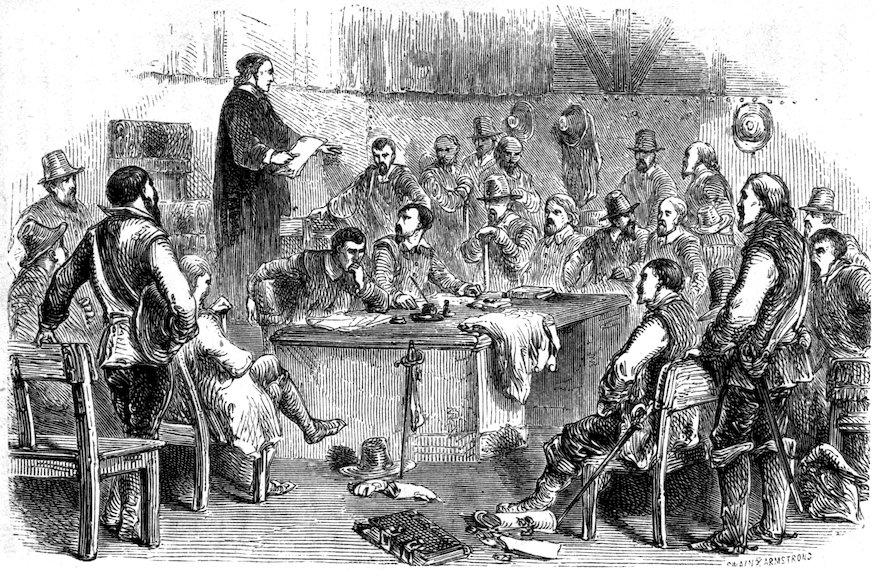
FIRST MEETING OF THE ASSEMBLY IN VIRGINIA.
61In 1621, Sir George Yeardley was succeeded as governor by Sir Edward Wyatt, who carried out with him a written constitution, ratifying in the main the form of government established by Yeardley. The form of constitution prescribed was similar to that of England, and remained to be the model of all other Anglo-American governments. Its purport was declared to be “the greatest comfort and benefit to the people, and the prevention of injustice, grievances, and oppression.” A more sound basis than this for any government could not have been devised. A governor and permanent council were to be appointed by the company; a general assembly was to meet yearly, consisting of the members of the council, and delegates chosen by the people as their representatives, two for each borough, the colony being divided into eleven boroughs. All enactments of the General Assembly, however, required, to become valid, the ratification of the company in England. It was further ordained—and this gave the greatest satisfaction perhaps of all—that after the government of the colony had once become established, no orders of the company in London should be valid unless ratified by the General Assembly of the colony. The courts of justice were to be constituted according to the laws and mode of trial established in England.
Representative government and trial by jury were established in America; and the colonists, no longer depending on a commercial 62corporation, now became enfranchised citizens. “Henceforth,” says Bancroft, “the supreme power was held to reside in the hands of the colonial parliament, and of the king, as king of Virginia. This ordinance was the basis on which Virginia erected the superstructure of her liberties. Its influences were wide and enduring, and can be traced through all following years of the history of the colony. It constituted, in its infancy, a university of freemen; and succeeding generations learned to cherish institutions which were as old as the first period of the prosperity of their fathers. The privileges which were now conceded could never be wrested from the Virginians, and as new colonies arose at the south, their proprietaries could hope to win emigrants only by bestowing franchises as large as those enjoyed by their older rival.”
In the month of August, 1620, fourteen months before the sitting of the first representative assembly in Virginia, about four months before the landing of the pilgrim fathers in America, a century after the last hereditary serfdom had been abolished in England, and six years after the commons of France had petitioned for the emancipation of every serf in any fief, a Dutch man-of-war entered James River, bringing in twenty negroes for sale. The necessity for labourers seems to have been the first cause of the introduction of negro slaves into Virginia, and the Dutch were for many years the principal slave traders. The cultivation of silk and of the vine had been introduced, but scarcity of labourers caused these branches of cultivation to languish; cotton, on the other hand, soon engaged attention. In 1621, the first seeds were sown as an experiment, and their “plentiful coming up” promised the most successful results.
Wyatt found the colony in a high degree of prosperity. The English had extended their plantations considerably inland, along the banks of the James River and the Potomac; wherever rich ground invited, there they established themselves, no longer fearing the solitude of the forest, because they no longer dreaded the power of the Indians. The Indians were regarded with contempt or pity; a single mastiff would put many to flight; seven hundred armed savages had on one occasion been routed by fifteen armed men; no care was taken to conciliate their good will, although in many cases their condition was improved by the introduction of some of the arts 63of civilised life. Their simple, child-like state may be exhibited by one small circumstance. A house had been built for the great chief Opechancanough, successor of Powhatan, according to the English style, and so delighted was he with the lock on the door, that he locked and unlocked it a hundred times a day, and regarded it as a triumph of skill.
So peaceful were all things, and so amicable appeared the relationship with the natives, on the arrival of Wyatt, that the emigrants needed fire-arms apparently merely for the destruction of game; and the old law of the colony which had made it death to teach an Indian the use of fire-arms, was now so much disregarded, that the Indians were employed by the whites as their huntsmen. Enmity, however, was not extinct in the heart of the savage. Powhatan, the father of Pocahontas, the firm friend of the English, was dead, and his younger brother, his successor, entertained different sentiments towards the strangers, whose rapidly increasing numbers and widely extending settlements might justly awake the fear and the jealousy of the primeval possessors of the soil. A deep plan of extermination was laid. In open battle the Indian knew that he had no chance, but by cunning and guile he could accomplish much. A general attack was determined on by the Indians, but all preparations concealed by impenetrable secrecy. The Indians appeared as amicably disposed as heretofore. They visited the settlements of the English, borrowed their boats, sat at their tables, and made professions of friendship; “sooner,” said they, “shall the sky fall than our friendship be broken by us!” and this on the very morning of the day which was to destroy the whole race.
At mid-day on the 22nd of March, at one and the same moment, the Indians fell upon the whole white population scattered in distant villages, one hundred and forty miles along each side of the river! No suspicion of such an intention had been excited;—men, women, and children, the missionary who had taught them and laboured among them with unwearying kindness; those from whom the Indian never received anything but benefits, all were murdered, with every appalling circumstance of Indian barbarity, and so great was their fury, that they even attacked the dead, as if to murder them anew.
64In one hour three hundred and forty-seven persons were destroyed. And the whole of Virginia might have slept in one bloody grave, had not a converted Indian, the night before the massacre, revealed the plot to an Englishman, to whom he was much attached, and whose life he wished to save. By this means Jamestown and the nearer settlements were fully prepared. The larger portion of the colony was saved, but so universal was the terror which this bloody massacre occasioned, that all public works were interrupted, and the more remote settlements abandoned. The cultivation of the land was almost at once given up, and of the eighty flourishing, happy settlements which had so lately existed, now there remained but eight. Some of the colonists fled in their terror to England, and sickness broke out amongst those who remained.
The colonists rose up for vengeance, and in England so great was the sympathy and compassion excited, that new supplies and arms were immediately sent out; King James, for his part, ordering a quantity of arms which had been thrown into the Tower as good for nothing to be sent over, as they might be useful against the Indians! The city of London and many private persons generously contributed aid; and the brave John Smith, then in London, volunteered his services to defend the colonists and chastise the Indians; but the company declared it had no funds, and he was not rich enough to go out at his own cost.
A deep cloud rested on Virginia, which nothing but vengeance on the Indians would dispel. The Indians, not having fully accomplished their scheme, and now justly dreading a tenfold retaliation, fled far into the forest. But their land was seized upon, their open fields and villages, all planted on the pleasantest and most fertile sites, were soon in secure possession of the English. To pursue the natives to the fastnesses of the wilderness was impossible, therefore the English in their turn practised guile. They assumed an aspect of forgiveness; the savages, by degrees losing their fear, ventured forth again, and even approaching their old haunts, resettled themselves in the neighbourhood of their enemies. The aspect of peace and forbearance was, however, only vengeance deferred.
In July of the following year, the Indians were attacked by an army under commissioned officers; a similar attack was repeated the 65next year, and for several years, it being now a colonial principle that no peace should be concluded with the Indians.
Meantime great changes as regarded the relationships of the colony to the mother-country were taking place. The colony of Virginia had not been a lucrative enterprise for the London company; the shares at the present time were as unproductive stock of little value; the holders were numerous, and the meetings of the company in London had, instead of being mere meetings of business, become scenes of political debate, in which the supporters of liberty were arrayed against the supporters of royal prerogative. Liberal opinions here found free play. The king was displeased by this freedom of debate. Gondemar, the Spanish envoy, warned James that “these Virginian courts were only a seminary to a seditious parliament.” James, who abhorred freedom of opinion, determined to nip it in the bud, by putting an end to the hot-bed which fostered it. His first endeavour was to control the election of officers by overawing their assemblies; and failing of that, he determined to sequestrate their patent, and recover to himself the authority which he had conceded to the company. Commissioners in the interest of the king were appointed to examine into the affairs of the corporation, although former charges against them had been satisfactorily answered, the records were seized; the deputy-treasurer imprisoned, and private letters from Virginia intercepted and examined. Smith was examined, and his straightforward, honest answers exposed the bad management of the company, and showed that the withdrawal of the charter would be a boon to the colony. This surprised all; commissioners, who had been appointed to examine the affairs of the corporation and the colony itself, reported in favour of a change. The king did not hesitate; the London company was dissolved, and Virginia once more became a royal government, as under its first charter.
Whilst these things were going on in England, the Virginians were not indifferent. When the commissioners arrived in the colony, the prayer of the colonists was that the governors might not have absolute power; that the liberty of popular assemblies might not be retrenched, “for nothing,” said they, “can conduce more to public satisfaction and public utility, than the free discussion of our own affairs.” That this subject might be efficiently urged, an agent was 66sent for that purpose to England, a tax of four pounds weight of the best tobacco being levied on each male above the age of sixteen, and who had been a twelvemonth in the colony, to defray the expenses. But this agent unfortunately died on his voyage.
The spirit of liberty, however, had taken deep root on the Virginian soil. Intimidation and promised advantage could not induce the colony to pray for a repeal of the charter under which their first constitutional liberty had been granted. On the contrary, the assembly met, and laid down laws for itself. The governor said, “they shall not lay any taxes or impositions on the colony, its lands or commodities, other way than by the authority of the General Assembly, to be levied and employed as the said assembly shall appoint.” Virginia, the Old Dominion, as it is called, was the first to set an example of just and wise legislation as regarded the use of the public money. Others imitated the example in due time. Various governors had endeavoured by penal enactments to compel the culture of corn; now it was said, “for the encouragement of men to plant store of corn, the price shall not be stinted, but it shall be free for any man to sell it as dear as he can.” Through the whole of this disturbed period the Virginians showed themselves admirably capable of popular government, proving how truly, with the aid of free discussion, men become good legislators in their own concerns; wise legislation being the enacting of proper laws at proper times, and no criterion being so nearly infallible as the fair representation of the interests to be affected. Among the laws which were at this time framed, and which reflect the manners and spirit of the age, we may mention the following. It was enacted “that there should be a room or house set apart in every plantation for the worship of God, sequestered and set apart for that purpose only;” also a place of burial “sequestered and paled in.” Absence from public worship without allowable excuse, was punished by the fine of a pound weight of tobacco, or fifty pounds weight, if absence continued a month. Divine service was according to the canons of the English church. The 22nd of March was added to the church festivals, in commemoration of the escape from the Indian massacre. Any minister absent from his parish above two months annually forfeited half his salary. The falsely disparaging of a minister rendered the offender liable to 67a fine of five hundred pounds weight of tobacco, and publicly to ask pardon of the minister. Ministers’ salaries were to be paid out of the first-gathered and best tobacco and corn. Drunkenness and swearing were punishable offences. Three sufficient men were to be sworn in each parish to see that every man cultivated corn sufficient for his family. Every settler was to fence in a garden for himself of one acre, for the planting of vines, roots, herbs, and mulberry trees. Weights and measures were to be sealed. Every house was to be palisadoed for defence, and people were not to go out in such numbers as might leave their houses undefended and liable to attack. Delinquent persons of quality, not fit to undergo corporal punishment, might be imprisoned at discretion, or fined by the monthly courts. “At the beginning of July, the inhabitants of every plantation were to fall upon their neighbouring savages, as they did last year.” Every person wounded in this service was to be cured at the public expense, and if permanently lamed would have maintenance for life suitable to his quality.
The London company was at an end. “It had,” says Bancroft, “fulfilled its high destinies; it had confirmed the colonisation of Virginia, and had conceded a liberal form of government to Englishmen in America. It could accomplish no more.”
The term of five years was fixed as that of the period of representative government. Sir Thomas Wyatt was confirmed in office for that term; and the king himself was about to frame a code of fundamental laws for the colony, when death fortunately put an end to his attempt.
Charles I. succeeded his father, March 27, 1625. As regarded Virginia, he had no more interest in it than as the country producing tobacco, and from which he hoped to derive a large revenue. His first act with reference to the colony was an endeavour to obtain for himself the sole monopoly of this trade. As to its constitutions and political rights, he did not trouble himself about them, and they became established by his very indifference.
In 1626, Wyatt having returned to Europe, Sir George Yeardley was appointed his successor. The colony prospered; in 1627, one thousand emigrants arrived in the country. The following year 68Yeardley died, leaving behind him a memory cherished by the colony as the first governor who had convened a representative assembly.
Again, the king offered to contract for the whole crop of tobacco, desiring that an assembly might be called to consider his proposal. The assembly returned a firm negative to the royal monopolist.
On the death of Yeardley, John Harvey, who had been for several years a member of the council, and an extremely unpopular man, was nominated governor by the king; but as he was not then in the colony, some time elapsed before he appeared to assume his authority.
It was at this period that Lord Baltimore visited Virginia. He fled hither as a persecuted man, and was hospitably received; nor must it be forgotten that, as regarded the pilgrims of Plymouth rock, they were invited to leave that sterile and inhospitable region, and plant themselves in the milder regions of Delaware Bay. Puritanism was evidently at that time not persecuted in Virginia, though “needless novelties” in worship had been prohibited by law for some years.
In the autumn of 1629, Harvey, the new governor, arrived. He was unwelcome from various causes; he belonged to the faction to which Virginia ascribed her earliest sorrows; he had rendered himself extremely unpopular as a member of the council; besides which, it had been well pleasing to the colony that King James, on assuming supreme authority, had entrusted the government to impartial agents; but now the appointment of Harvey indicated a change of policy. His arrival among them was naturally cause neither of satisfaction nor of rejoicing, nor does he appear to have conciliated their favour. The older historians charge him with arbitrary and tyrannical conduct; yet it may be questionable whether he was quite deserving of the ill-will with which he was regarded, as the revised code of laws, which was published with consent of the governor and the council, neither abrogated nor abridged any of the civil rights of the colonists.
His administration, however, was disturbed by disputes respecting land-titles under the royal grants, and principally in consequence of the grant of Maryland to Lord Baltimore, which caused the first European blood to be shed by Europeans on the banks of the Chesapeake. 69Harvey not seconding the claims of Virginia against the royal grant, was considered by the colonists to have betrayed their interests; and full of indignation against him, they “thrust him out of his government,” says the old chronicle, and “appointed Captain John West governor in his stead till the king’s pleasure should be known.” Harvey consented to go to England to meet his accusers there, but, as might have been expected, no accusations would be received there against the man who had been merely acting according to royal instructions. The commission of accusation could not even obtain a hearing. Harvey returned to occupy his former post, and remained in office till 1639, when Sir Francis Wyatt succeeded him. Two years afterwards, Sir William Berkeley was appointed governor. The civil condition of Virginia was greatly improved; the laws and customs of England still further introduced; cruel punishments were abolished; old controversies adjusted; a more equitable system of taxation was introduced; taxes being assessed not in proportion to numbers, but “to men’s abilities and estates;” the rights of property and the freedom of industry were secured, so that Virginia enjoyed all the civil liberties which a more free form of government could have conferred. The Virginians seem early to have understood the true elements of political economy. In a petition addressed to England, in 1642, they asserted the necessity of the freedom of trade, “for freedom of trade,” say they, “is the blood and life of a commonwealth.” And as regarded self-government, they argued with the force of truth, “there is more likelihood that such as are acquainted with the clime and its accidents may, upon better grounds, prescribe our advantages, than such as sit at the helm in England.”
Spite of the liberality which had been exhibited in the colony towards diversities of religious opinion, which had led the excellent Whitaker to say, “let neither surplice nor subscription be spoken of here;” which had caused an invitation to the pilgrims of New Hampshire to remove within the precincts of Virginia; a spirit of intolerance was now manifested by the legislative assembly, and it was ordained that “no minister preach or teach except in conformity to the Church of England.” Whilst puritanism and republicanism were working together for the downfall of monarchy in England, Virginia 70showed the strongest attachment to the cause of episcopacy and royalty.
The hostility of the settlers against the natives remained year by year unabated. Twenty-one years after the massacre, it was enacted in the assembly that no terms of peace should be entertained with the Indians. Now, therefore, the Indians, hearing that troubles and dissensions were arising in England, resolved once more on a general massacre, hoping, that by destroying the corn-fields and cattle, they might cause any remnant who remained to perish by famine. The eighteenth of April was fixed upon as the fatal day; the attack commenced on the border frontiers; but the Indians themselves, filled as it were by a consciousness of their own weakness and dread of the consequences, had scarcely begun to shed blood when they fled. The number of victims was again about three hundred. The colonists roused themselves at once, and war commenced again vigorously against the Indians. The aged Opechancanough, the successor of Powhatan, was soon taken prisoner, and with his death peace was secured to the English.
This fierce warrior, and implacable enemy of the whites, was now nearly one hundred years of age, and his once stately form was wasted with the fatigues of war and bent with the weight of years. Unable to walk, says the historian of Virginia, he was carried from place to place by his followers. His flesh was almost wasted away from his bones, and his eyelids were so powerless, that he could only see when they were lifted by his followers.
After a long and rapid march, Sir William Berkeley, with a party of horse, surprised the aged warrior at some distance from his residence, and took him prisoner to Jamestown, where he was exhibited as an object of curiosity and of triumph to the victor. The old monarch of the forest, retaining a spirit unbroken by the decrepitude of the body, bore his calamities of fortune with a proud though melancholy mien. Hearing footsteps in the room where he lay, he requested his eyelids to be raised, when perceiving a crowd of spectators, he called for the governor, and upon his appearance said with calm dignity, “Had it been my fortune to have taken Sir William Berkeley prisoner, I would have scorned to have made a show of him.”
71About a fortnight after the noble old chiefs capture, one of his guards, from private revenge, shot him in the back, and after languishing for some time of his wound, the old man died.
The Indians were completely subdued, and a cession of land was the terms on which peace was granted to the original possessors of the soil. The red man began to pass away from the precincts of the white. Within a short period, comparatively speaking, but few memorials of their former existence remained, saving the euphonious or sonorous names of rivers and mountains, the great imperishable features of nature, which thus became their monuments.
Whilst civil war and political convulsions were agitating England to the very centre of her being, peace and prosperity, security and quiet, equal laws and general contentment, were at home in Virginia. The population of the colony amounted to twenty thousand, and was still increasing; the houses were filled with children, as the ports were with ships and emigrants. At Christmas, 1648, two ships from London traded with Virginia, two from Bristol, twelve from Holland, and seven from New England.
The Virginians adhered faithfully to the royal cause, nor would they, after the execution of the monarch, recognise the Commonwealth, but still acknowledged Charles II. to be monarch, while yet a fugitive. Virginia soon became filled with cavaliers, fugitives like their sovereign. “Men of consideration among the nobility, gentry, and clergy, struck with horror and despair at the execution of the king, and desiring no reconciliation with the unrelenting rebels, made their way to the shores of the Chesapeake, where every house was for them a hostelry, and every planter a friend.” In the hospitable homes of Virginia they often met to talk over their own and their country’s sorrows, and to nourish loyalty and hope.
The Parliament, extremely displeased that this colony should thus become the asylum and nursery of monarchical principles, sent, in 1652, a naval force to reduce them to submission. Already, in 1650, foreign ships had been forbidden to trade with the contumacious colony, and in 1651 the celebrated Navigation Act was passed, which, having for its object the protection of British shipping, and the acquisition to England of the trade of the world, greatly shackled and restricted the commercial prosperity of her colonies.
72In March, 1652, the republican party in the mother-country determined on obtaining the concession of obedience from Virginia. Commissioners chosen from among the planters themselves were empowered to act as pacificators with their country, the submission of which, if their efforts failed, would be enforced by the severities of war. It was the reconciliation of parent and child; the offended parent assumed an attitude of displeasure and resentment; obedient submission was that which was demanded, and which, if needful, would be enforced by violence; yet, would but the child submit, the parent would concede much; and the child, seeing the parent in earnest, yielded at once, and obtained the offered concession. No sooner, therefore, had the war-frigate of the Commonwealth anchored in the Chesapeake, than all thoughts of resistance were laid aside. The colonists, however loyal might be their inclinations, were more disposed to establish the freedom of their own institutions than to assume a hostile attitude against the mother-country, even on behalf of an exiled monarch.
There is something noble in the position which Virginia now assumed. It was not to force that she surrendered, but by “a voluntary deed and mutual compact; and in return she obtained, that her people should possess all the liberties of free-born people of England; should manage their business as formerly in their own assembly, and should have as free-trade as the people of England. No taxes nor customs were to be levied except by her own representatives, no forts erected nor garrisons maintained but by her consent.”
These conditions, so favourable to liberty, worthy to be granted by the champions of political and civil liberty in England, were a cause of great satisfaction to Virginia; and so earnest was the spirit of her submission and her desire to establish an amicable understanding with the mother-country, that Richard Bennett, one of the commissioners of the Parliament, a merchant and a Roundhead, was unanimously elected governor in the place of Sir William Berkeley.
The spirit of democratic liberty, like a strong young tree, grew with every change of season. Hitherto the governor and the council had sat in the General Assembly; the propriety of this was now questioned, and only retained by a concession which made the house of burgesses, a convention of the people, virtually possessed of supreme 73authority. Nor were these privileges at all interfered with by Cromwell. When Bennett two years afterwards retired from office, Edward Diggs, a steadfast Commonwealth’s man, was elected his successor, and after him the “worthy old Samuel Matthews, a planter of forty years, a most deserving republican, who kept a good house, lived bravely, and was a true lover of Virginia.” Under his governorship a single instance of the determined spirit of democracy occurred which still more strengthened and established it. The governor and his council having come to issue with the burgesses on a question of prerogative, the governor yielded, reserving a right of appeal to Cromwell. The members of the Assembly, fearing through this an infringement of their liberty, asserted their own sovereign authority, and deposed the governor and council; re-electing Matthews, however, and investing him “with all the just rights and privileges as governor and captain-general of Virginia,” and Matthews submitted, as Virginia herself had done in her quarrel with England, that by submission he might conquer. He acknowledged the right of the burgesses to depose and re-elect; took the oath; and thus was popular liberty still further strengthened in the Old Dominion—an example to all other newer states.
In March, 1660, the very time when the resignation of Richard Cromwell left England without a ruler, good old Samuel Matthews died, and Virginia was in the same predicament. But the burgesses of Virginia, unlike the people of England, stood fast by democratic principles, and, enacting that the supreme power should still reside in the General Assembly until there should arrive from England a commission, which the Assembly itself should adjudge to be lawful, proceeded to elect Sir William Berkeley as their governor; and he in his turn acknowledged the validity of this act of the Assembly by assuming office, “for I am,” said he, “but a servant of the Assembly.”
Virginia, in this case, however, it must be observed, recognised covertly another authority higher than that of her own Assembly, retaining, amid her spirit of democracy, a firm sentiment of loyalty. She hoped at this time for the restoration of the Stuarts.
Virginia was composed of separate boroughs, and the government organised on the basis of universal suffrage. Every freeman was possessed of a vote. On an attempt to limit the right of voting to 74householders, it was declared to be “hard and unagreeable to reason that every person shall pay equal taxes and yet have no vote in the elections.”
During the Commonwealth, Virginia not only enjoyed the utmost political liberty, but unlimited freedom of commerce also, while her own internal state was that of peace and prosperity. “Tobacco, the great staple product of the country, was the medium of exchange. Theft was hardly known, and the spirit and administration of the criminal law was mild and merciful; the cultivation of land was carried on very successfully; and as regarded commerce, the navigation laws were a mere dead letter. Virginia even traded with the Dutch during the period when the Protector and Holland were desperately contesting the sovereignty of the seas. The Virginians were the early advocates of free trade, and invited the Dutch and all foreigners to trade with them on the payment of no higher duty than that which was levied on such English vessels as were bound for a foreign port.” Proposals of peace were discussed between New Netherlands, the Dutch colony on the North American shore, and Virginia. During this period, also, considerable advance was made in religious liberty, although the Quakers were banished from the colony.
At the period of the Restoration, Virginia possessed, among the privileges which she had won for herself, freedom of commerce with the whole world, and the universal elective franchise. The population amounted now to 30,000, and it was esteemed an honour to be a born Virginian. Numbers of the emigrants of late years had been, as we have seen, royalist officers, men of family and education, and these, though they still retained their loyalty, offered no impediment to the free exercise of independent principles in Virginia, and finally the newly-adopted country superseded the old, and the interests and liberties of Virginia became to them dearer even than the monarchical principles of which they had been the supporters in England, and for their adherence to which they had been exiles.
“God Almighty,” says their statute-book of this time, “hath vouchsafed myriads of children to this colony.” Young Virginians were growing up throughout the length and breadth of the land. Virginia was becoming the home of patriots.
“Labour,” adds Bancroft, summing up the advantages and prosperity 75of the colony, “was valuable; land was cheap; competence promptly followed industry. There was no need of a scramble; abundance gushed from the earth for all. It was the best poor man’s country in the world. Yet, as the shadow-side of this bright picture, it must be conceded that plenty encouraged indolence; everything was imported from England. The chief branch of industry, for the purpose of exchanges, was tobacco planting, and the spirit of invention was enfeebled by the uniformity of pursuit.”
76