CONTENTS.
Reading edition
PAGE.
LIST OF ILLUSTRATIONS4
CHRONOLOGICAL CHART OF GREATEST COMPOSERS11
CHRONOLOGICAL CHART OF ITALIAN COMPOSERS12
CHRONOLOGICAL CHART OF PRINCIPAL GERMAN COMPOSERS13
CHRONOLOGICAL CHART OF PIANISTS AND COMPOSERS FOR PIANO14
INTRODUCTION15-23
Music defined — general idea of musical progress — conditions of fine art — qualities of satisfactory art-forms — periods in musical history — difference between ancient and modern music.
BOOK FIRST — MUSIC OF THE ANCIENT WORLD.
CHAPTER I — MUSIC AMONG THE ANCIENT EGYPTIANS27-39
Sources of information — antiquity of their development — instruments — uses of music — their ideas about music and education — "Song of the Harper" — kindergarten.
CHAPTER II — MUSIC AMONG THE HEBREWS AND ASSYRIANS40-47
Music among the Hebrews — Jubal — kinnor — ugabh — musicians in the temple service — psaltery — flute — larger harp — Miriam — liturgy of the temple — musical ideal in Hebrew mind — music among the Assyrians — types of instruments.
CHAPTER III — MUSIC AMONG THE ANCIENT GREEKS48-69
Importance of this development — extent of the time — date of Homeric poems — epoch of Æschylus — extracts from Homer — Hesiod — patriotic applications of music — choral song — festivals — lyric drama — début of Æschylus, Sophocles and Euripides — nature of the classic drama — orchestic — Socrates — Aristoxenus — problems of Aristotle — Greek theory of music — Pythagoras and ratios of simple consonances — devotional use of music — Greek scales — Claudius Ptolemy — Didymus — the lyre and cithara — magadis — flute — æsthetic importance — Plato on the noble harmonies — loyalty to the true — Greek musical alphabet — notation — Ode from Pindar.
CHAPTER IV — MUSIC IN INDIA, CHINA AND JAPAN70-77
Early beginning — use of the bow — national instruments — the vina — theory — ravanastron — music exclusively melodic — saying of the Emperor Tschun — the ke — Japanese ko-ko.
BOOK SECOND — APPRENTICE PERIOD OF MODERN MUSIC
CHAPTER V — THE TRANSFORMATION AND ITS CAUSES81-86
General view of the transformation to modern music — causes co-operating — difference between ancient and modern music — harmony and tonality — consonance and dissonance — three steps in the development of harmonic perceptions — when were these steps taken? — tonality defined — growth of tonal perception — unconscious perception of implied or associated tones.
CHAPTER VI — THE MINSTRELS OF THE NORTH87-108
Importance of Celtic development of minstrelsy — origin of the Celts — the minstrel — old Breton song — the druids — classification of bards — degrees — Fétis on the Welsh minstrel — "Triads of the Isle of Britain" — old harp music — "The Two Lovers" — Gerald Barry on the Welsh — old Welsh song — the Irish — Sir Brian Boirohen's harp — English and Saxon music — King Arthur as minstrel — organ at Winchester — Scandinavian scalds — Eddas — "Sumer is Icumen in" — Anglo-Saxon harp — source of the harp in Britain — the crwth — melody in pentatonic scale.
CHAPTER VII — THE ARABS, OR SARACENS109-114
The Arab apparition in history — their taste for poetry — competitive contests of poetry and song — encouragement of literature — rebec — eoud — santir.
CHAPTER VIII — ORIGIN OF THE GREAT FRENCH EPICS115-120
Period of the Chansons de Geste — social conditions of France as given by M. Léon Gautier — "Cantilena of St. Eulalie" — subjects of the Chansons de Geste.
CHAPTER IX — TROUBADOURS, TROUVÈRES AND MINNESINGERS121-127
The troubadours — Count Wilhelm — varieties of their songs — melody from Thibaut — Adam de la Halle — "Story of Antioch" — "Song of Roland" — minnesinger Reinmar — Heinrich Frauenlob — minstrel harps — Hans Sachs — influence of these minstrel guilds.
CHAPTER X — INFLUENCE OF THE CHRISTIAN CHURCH128-133
Church not influential in the development of music as such — nature of the early Christian hymns — St. Ambrose — the Ambrosian scales — corruptions elsewhere — St. Gregory and his reforms — the Gregorian tones — many later reforms — limitations of these reforms — incidental influence of the Church through her great cathedrals.
CHAPTER XI — MUSICAL DIDACTIC FROM THE FIFTH TO FOURTEENTH CENTURY134-147
Macrobus — Martinus Capella — Boethius — Cassiodorus — Bishop Isidore — Venerable Bede — Aurelian — Rémi of Auxerre — Hucbald — examples — instruments of music during the seventh and eighth centuries — Odon of Cluny — Guido of Arezzo — staff — Franco of Cologne — Franco of Paris.
CHAPTER XII — THE RISE OF POLYPHONY; OLD FRENCH AND GALLO-BELGIC SCHOOLS148-159
Origin and meaning of polyphony — monodic and homophonic — canonic imitation — chords as incidents — variety and unity — early French school — Coussemaker's researches — Léonin — descant — Pérotin — names of pieces — Robert of Sabillon — Pierre de la Croix — Jean of Garland — Franco of Paris — Jean de Muris — fleurettes — John Cotton — Machaut — Gallo-Belgic school — Dufay — Hans de Zeelandia — Antoine de Busnois.
CHAPTER XIII — SCHOOLS OF THE NETHERLANDS160-167
Wealth of the Low Countries — freedom of the communes — strength of the burgher class — period of these schools — table of periods and masters — Okeghem — Tinctor — Josquin — his popularity — Arkadelt — Gombert — Willaert — Goudimel — Cypriano de Rore — Orlando de Lassus — his Munich school — his genius.
CHAPTER XIV — POLYPHONIC SCHOOLS OF ITALY — PALESTRINA168-178
Prosperity of Italy in fifteenth century — great cathedrals and public works — conservatories founded at Naples — Willaert at St. Mark's, Venice — Zarlino — his reforms in theory — Cypriano de Rore — Goudimel — Palestrina — the council of Trent — Palestrina's music — Martin Luther.
CHAPTER XV — CHANGES IN MUSICAL NOTATION179-188
General direction of musical progress toward classification and the establishment of unities of various kinds — early letter notation of the Greeks and Romans — Roman notation as used by Guido of Arezzo — neumæ — with lines — additional lines — "Lament for Charlemagne" — notation employed by the French Trouvères — clefs — new staff proposed by an American reformer.
CHAPTER XVI — MUSICAL INSTRUMENTS — THE VIOLIN AND ORGAN189-207
Progress in tonal perceptions — influence of harp and lute — description of the latter — system of stringing — locating the frets — the violin — bow discovered in India — early forms of bowed instruments — rebec — barytone — viol da Gamba — Amati — Stradivari — peculiarities of his instruments — Maggini — Stainer — antiquity of the organ — early forms — organ sent Charlemagne — organs at Munich — Malmesbury Abbey — measure of organ pipes — portable organ — clumsiness of the old keyboards — the organ in 1500 A.D.
BOOK THIRD — THE DAWN OF MODERN MUSIC.
CHAPTER XVII — CONDITION OF MUSIC AT BEGINNING OF EIGHTEENTH CENTURY211-220
Justification of the name "apprentice period" — office of domestic musicians in England in the reign of Elizabeth — great fondness for music everywhere — casual influence of counterpoint in educating harmonic sense — madrigal — multiplicity of collections of this kind — absurd use of madrigals for dramatic monody — the work of the seventeenth century, free melodic expression — the new problem of the musical drama — the representative principle in music — music last of the arts — Florence and Venice the centers — statistics of books published from 1470 to 1500.
CHAPTER XVIII — FIRST CENTURY OF ITALIAN OPERA AND DRAMATIC SONG221-234
Circle of the Literati in Florence — Galilei and his monody — Peri's "Dafne" — Schütz's setting of the same — Peri's "Eurydice" — rare editions — Il stilo rappresentativo — Cavaliere's oratorio "The Soul and the Body" — second period of opera — Monteverde's "Arianna" — orchestra of the same — new orchestral effects — scene from "Eurydice" — director of St. Mark's — Legrenzi — Cesti — public theaters — Alessandro Scarlatti — recitativo stromentato — Corelli — sonatas for the violin — influence of the violin upon the art of singing — origin of Italian school of singing — artificial sopranos — Porpora — Selections from Monteverde, Cavalli and Scarlatti.
CHAPTER XIX — BEGINNINGS OF OPERA IN FRANCE AND GERMANY235-243
Slow progress of opera to other parts of Europe — origin of French opera — ballets of Boesset — Perrin — Cambert — their first opera — their patent from the king — Lulli — his success and productivity — attention to verbal delivery and the vernacular of the audience — foundations of the French Académie de Musique — opera in Germany — Schütz — Hamburg and Keiser — selection from Lulli — "Roland" — Mattheson.
CHAPTER XX — THE PROGRESS OF ORATORIO244-248
Oratorio invented simultaneously with opera — Cavaliere — mystery plays — Carissimi — two types of oratorio — cantata — Händel's appropriation from Carissimi — sacred oratorio — Schütz's Passions — "Last Seven Words."
CHAPTER XXI — BEGINNINGS OF INSTRUMENTAL MUSIC249-260
Beginnings of instrumental music in seventeenth century — tentative character of instrumental music of sixteenth century — Gabrieli and organ pieces — imitations of vocal works — melodies not fully carried out — Swelinck — Scheidt — Schein — Frescobaldi — Reinken — Pachelbel — Muffat — Corelli — orchestra of the period — its defects.
BOOK FOURTH — FLOWERING TIME OF MODERN MUSIC.
CHAPTER XXII — MUSIC IN THE EIGHTEENTH CENTURY261-264
The flowering time of modern music — complexity of developments now taking place — principal actors — two main channels of improvement — fugue — sonata — Bach and Händel as writers of fugue — people's song makes its way into cultivated instrumental music — reference to Mozart's sonatas — thematic and lyric as elements of contrast.
CHAPTER XXIII — JOHN SEBASTIAN BACH265-272
Bach as a composer — sketch — his clavier — attainments as virtuoso upon the clavier and the organ — choral works — Passion oratorios — his pre-eminence as writer of fugues — general sketch of the form of a fugue — prelude — mutually complementary — Bach's concertos — his rhythm.
CHAPTER XXIV — GEO. FRIEDRICH HÄNDEL273-281
The companion figure of Bach — early life — violinist at Hamburg — conductor, composer — first opera — Italy — successes there — England — Italian operas — oratorio "Messiah" — other oratorios — list of his works — Bach and Händel compared — Händel's place in art — personalities.
CHAPTER XXV — EMANUEL BACH, HAYDN — THE SONATA282-291
The sons of Bach — Emanuel Bach as composer — difficulty of founding a new form — Haydn — early years — conductor for Prince Esterhazy — compositions — the visit to London — the money he made — "The Creation" — second visit to London — Haydn and the sonata form — "The Last Seven Words" — his rank as tone-poet.
CHAPTER XXVI — MOZART AND HIS GENIUS292-304
Charming personality — childhood — early talent — concerts — Mozart at Bologna and the test of his powers — Haydn's opinion — early operas — "Marriage of Figaro" — success — accompaniments added to Händel's "Messiah" and other works — call to Berlin — mysterious order for the "Requiem" — death — general quality of Mozart's music.
CHAPTER XXVII — BEETHOVEN AND HIS WORKS305-315
A worthy successor to Haydn and Mozart — early years — orchestral leader — piano playing — his friends — Count Waldstein — his first visit to Vienna — settled in Vienna — compositions — life — appearance — place in art.
CHAPTER XXVIII — HAYDN, MOZART AND BEETHOVEN COMPARED316-326
Their relation to symphony — refinement of Mozart — early age of Mozart — Beethoven's independence — relation to sonata — Beethoven more free — climax of classical art — Beethoven adagios — summing up — tendency of progress.
CHAPTER XXIX — OPERA IN THE EIGHTEENTH CENTURY327-351
Three great names — Graun — Gluck — his reforms — his ideal — early works — "Orpheus" — "Iphigenie" — Mozart's place in opera — Rameau — theoretical writings — Rousseau — Phillidor — Monsigny — Grétry — Gossec — Méhul — Lesueur — Boieldieu — French opera in general — Italian opera — Pergolesi — Jomelli — Sacchini — Paisiello — Piccini — Zingarelli — opera in England — Purcell — Dr. Arne.
CHAPTER XXX — PIANO PLAYING VIRTUOSI — VIOLINISTS — TARTINI AND SPOHR352-369
Pianoforte established as domestic instrument — Scarlatti — Mattheson — Dr. Blow — John Bull — Clementi — Dussek — Cramer — Berger — Hummel — Moscheles — Tartini — Spohr.
BOOK FIFTH — EPOCH OF THE ROMANTIC.
CHAPTER XXXI — THE NINETEENTH CENTURY — THE ROMANTIC — MUSIC OF THE FUTURE373-380
Classic and romantic defined — art in general — applied to music — illustrated by Schubert — Schumann — development of virtuosity Berlioz — "music of the future" — how originating — the outlook.
CHAPTER XXXII — SCHUBERT AND THE ROMANTIC381-391
Early life of Schubert — compositions — first songs — "Erl King" — rapidity of composition — unfinished symphony — industry — spontaneity — personal characteristics.
CHAPTER XXXIII — STORY OF THE PIANOFORTE392-403
Origin of pianoforte — spinet — clavicembalo — Mozart's grand piano — Cristofori's design of action — Érard action — iron frame — Chickering — Steinway improvements.
CHAPTER XXXIV — GERMAN OPERA — WEBER, MEYERBEER, WAGNER404-427
Tendency of German opera — Weber — "Der Freischütz" — romanticism — innovations in piano playing — Meyerbeer — early life — master works — place in art — Wagner — early life — early operas — "Lohengrin" — Zurich — Schröder-Devrient — "Nibelung's Ring" — peculiarities.
CHAPTER XXXV — VIRTUOSITY IN THE NINETEENTH CENTURY — PAGANINI, BERLIOZ, CHOPIN, THALBERG, LISZT428-454
Continuity of these appearances with those already recounted — Paganini — his playing — inspiring effect — Berlioz — works — place in art — progress of piano playing — virtuosi co-operating — Thalberg and his style — Parish-Alvars — Pollini — Chopin — place in art — Liszt — early appearances — rivalry with Thalberg — style — Weimar — Bonn Beethoven monument — as teacher — as composer.
CHAPTER XXXVI — MENDELSSOHN AND SCHUMANN455-477
Mendelssohn — personality — talent — early works — maturity — as player Leipsic Conservatory — Hauptmann — "Elijah" — "St. Paul" — Schumann — early education and habits — works — strength of the romantic tendency — his "New Journal of Music" — music in Leipsic — Clara Wieck — larger works for piano — technical traits — songs — general characteristics.
CHAPTER XXXVII — ITALIAN OPERA IN THE NINETEENTH CENTURY478-487
Spontini — Rossini — Donizetti — Bellini — Verdi — Boito — Ponchielli.
CHAPTER XXXVIII — FRENCH OPERA AND COMPOSERS IN THE NINETEENTH CENTURY488-496
Auber — Hérold — Adam — Gounod — Massé — Massenet — Saint-Saëns — Délibes — Bizet — Ambroise Thomas.
CHAPTER XXXIX — LATER COMPOSERS AND PERFORMERS497-508
Gade — Brahms — Tschaikowsky — Svensden — Grieg — Bruch — Bennett — Macfarren — Mackenzie — Nicodé — Moszkowsky — Dvorak — Henselt — Litolff — Wilmers — Heller — Hiller — Rubinstein — Bülow — Reinecke.
Index
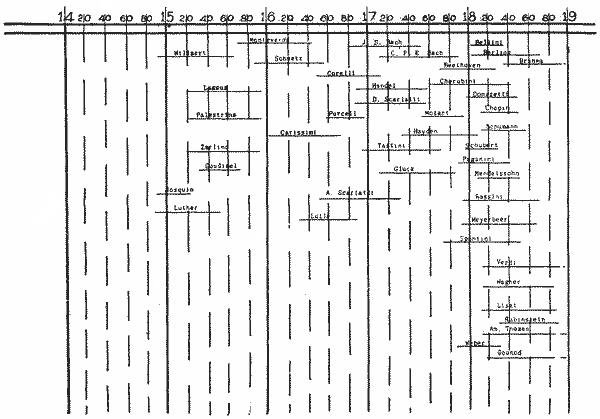
CHRONOLOGY OF THE GREATEST COMPOSERS.
(Copyright.)
Explanation.—The heavy vertical lines are century lines. Light vertical, twenty-year lines. Horizontal lines, the life of the composer.
[Enlarge]
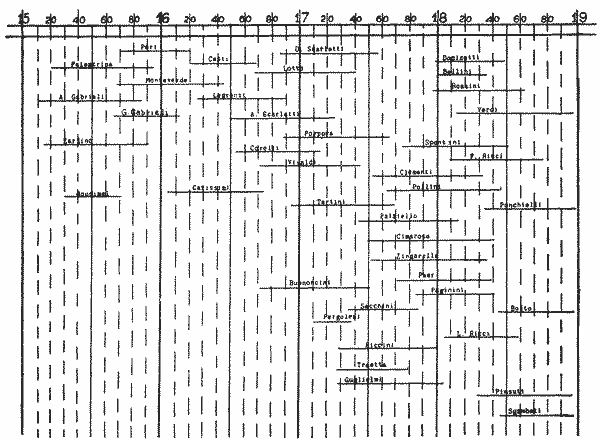
CHRONOLOGY OF PRINCIPAL ITALIAN COMPOSERS.
(Copyright.)
From Palestrina to Present Time. (See explanation, page 11.)
[Enlarge]
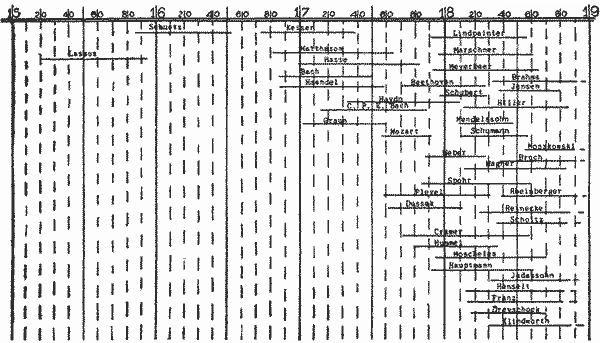
CHRONOLOGICAL CHART OF THE MORE IMPORTANT GERMAN COMPOSERS.
(Copyright.)
From Orlando Lassus to the Present Time. (See page 11.)
[Enlarge]
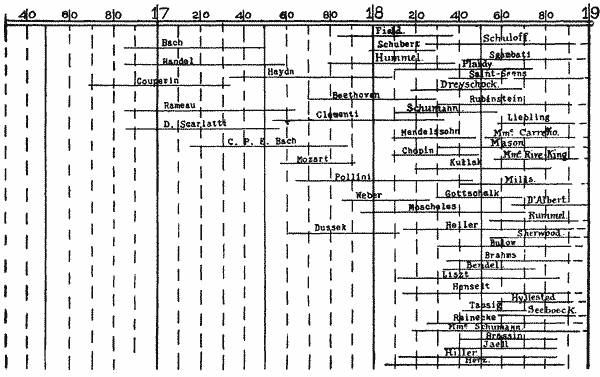
CHRONOLOGICAL SUCCESSION OF PIANISTS AND COMPOSERS FOR THE PIANOFORTE.
(Copyright.)
From 1660 to the Present Time (1891).
[Enlarge]