Chapter LI · LOUIS XV., THE REGENCY, AND CARDINAL DUBOIS. 1715-1723. (continued 2)
Robert Black translation
Cardinal Conti was old and feeble; all means were brought to bear upon him. Dubois had for a long time past engaged the services of Chevalier St. George; when the new pope was proclaimed, under the name of Innocent XIII., he had signed a conditional promise in favor of Dubois. The Regent, who had but lately pressed his favorite’s desires upon Clement XI., was not afraid to write to the new pontiff—
“MOST HOLY FATHER,
“Your Holiness is informed of the favor which the late pope had granted me on behalf of the Archbishop of Cambrai, of which his death alone prevented the fulfilment. I hope that Your Holiness will let it be seen, on your accession to the throne of St. Peter, that services rendered to the Church lose nothing by the death of the sovereign pontiffs, and that you will not think it unworthy of your earliest care to give me this public mark of the attention paid by the Holy See to the zeal which I profess for its interests. This kindness on the part of Your Holiness will crown the wishes I formed for your exaltation, will fill up the measure of the joy which it has caused me, will maintain our kindly relations to the advantage of the peace of the Church and the authority of the Holy See, and will fortify the zeal of the Archbishop of Cambrai in the execution of my orders to the glory of the Pontificate and of Your Holiness.”
On the 16th of July, 1721, Dubois was at last elected Cardinal; it was stated that his elevation had cost eight millions of livres. The frivolous curiosity of the court was concerned with the countenance the new Eminence would make in his visits of ceremony, especially in that to Madame, his declared foe at all times. “He had nearly two months to prepare for it,” says St. Simon, “and it must be admitted that he had made good use of them. He got himself up for his part, and appeared before Madame with deep respect and embarrassment. He prostrated himself, as she advanced to greet him, sat down in the middle of the circle, covered his head for a moment with his red hat, which he removed immediately, and made his compliments; he began with his own surprise at finding himself in such a position in presence of Madame, spoke of the baseness of his birth and his first employments; employed them with much cleverness and in very choice terms to extol so much the more the kindness, courage, and power of the Duke of Orleans, who from so low had raised him to where he found himself; gave Madame some delicate incense; in fine, dissolved in the most profound respect and gratitude, doing it so well that Madame herself could not help, when he was gone, praising his discourse and his countenance, at the same time adding that she was mad to see him where he was.”
The bearing of the newly-elected was less modest at the council of regency; he got himself accompanied thither by Cardinal Rohan; their rank gave the two ecclesiastics precedence. The Duke of Noailles, d’Aguesseau, and some other great lords refused to sit with Dubois. “This day, sir, will be famous in history,” said the Duke of Noailles to the new cardinal; “it will not fail to be remarked therein that your entrance into the council caused it to be deserted by the grandees of the kingdom.” Noailles was exiled, as well as d’Aguesseau.
The great lords had made a decided failure in government. Since 1718, the different councils had been abolished; defended by Abbe St. Pierre, under the grotesque title of Polysynodie, they had earned for the candid preacher of universal peace his exclusion from the French Academy, which was insisted upon by the remnants of the old court, whom he had mortally offended by styling Louis XIV.‘s governmental system a viziership. The Regent had heaped favors upon the presidents and members of the councils, but he had placed Dubois at the head of foreign affairs and Le Blanc over the war department. “I do not inquire into the theory of councils,” said the able Dubois to the Regent by the mouth of his confidant Chavigny; “it was, as you know, the object of worship to the shallow pates of the old court. Humiliated by their nonentity at the end of the last reign, they begot this system upon the reveries of M. de Cambrai. But I think of you, I think of your interests. The king will reach, his majority, the grandees of the kingdom approach the monarque by virtue of their birth; if to this privilege they unite that of being then at the head of affairs, there is reason to fear that they may surpass you in complaisance, in flattery, may represent you as a useless phantom, and establish themselves upon the ruin of you. Suppress, then, these councils, if you mean to continue indispensable, and haste to supersede the great lords, who would become your rivals, by means of simple secretaries of state, who, without standing or family, will perforce remain your creatures.”
The Duke of Antin, son of Madame de Montespan, one of the most adroit courtiers of the old as well as of the new court, “honorless and passionless” (sans honneur et sans humeur), according to the Regent’s own saying, took a severer view than Dubois of the arrangement to which he had contributed. “The councils are dissolved,” he wrote in his memoirs; “the nobility will never recover from it—to my great regret, I must confess. The kings who hereafter reign will see that Louis XIV., one of the greatest kings in the world, never would employ people of rank in any of his business; that the Regent, a most enlightened prince, had begun by putting them at the head of all affairs, and was obliged to remove them at the end of three years. What can they and must they conclude therefrom? That people of this condition are not fitted for business, and that they are good for nothing but to get killed in war. I hope I am wrong, but there is every appearance that the masters will think like that, and there will not be wanting folks who will confirm them in that opinion.” A harsh criticism on the French nobility, too long absorbed by war or the court, living apart from the nation and from affairs, and thereby become incapable of governing, put down once for all by the iron hand of Richelieu, without ever having been able to resume at the head of the country the rank and position which befitted them.
The special councils were dissolved, the council of regency diminished; Dubois became premier minister in name—he had long been so in fact.
He had just concluded an important matter, one which the Regent had much at heart—the marriage of the king with the Infanta of Spain, and that of Mdlle. de Montpensier, daughter of the Duke of Orleans, with the Prince of the Asturias. The Duke of St. Simon was intrusted with the official demand. Philip V. was rejoiced to see his daughter’s elevation to that throne which he still regarded as the first in the world; he purchased it by the concession made to the Regent.
The age of the Infanta was a serious obstacle; she was but three years old, the king was twelve. When the Duke of Orleans went in state to announce to Louis XV. the negotiation which tarried for nothing further but his consent, the young prince, taken by surprise, was tongue-tied, seemed to have his heart quite full, and his eyes grew moist. His preceptor, Fleury, Bishop of Frejus, who had just refused the Archbishopric of Rheims, seeing that he must make up his mind to please the Regent or estrange him, supported what had just been said. “Marshal Villeroy, decided by the bishop’s example, said to the king, ‘Come, my dear master; the thing must be done with a good grace.’ The Regent, very much embarrassed, the duke, mighty taciturn, and Dubois, with an air of composure, waited for the king to break a silence which lasted a quarter of an hour, whilst the bishop never ceased whispering to the king. As the silence continued, and the assembly of all the council, at which the king was about to appear, could not but augment his timidity, the bishop turned to the Regent, and said to him, ‘His Majesty will go to the council, but he wants a little time to prepare himself for it.’ Thereupon the Regent replied, that he was created to await the convenience of the king, saluted him with an air of respect and affection, went out and made signs to the rest to follow him. A quarter of an hour later the king entered the council, with his eyes still red, and replied, with a very short and rather low yes, to the Regent’s question, whether he thought proper that the news of his marriage should be imparted to the council.” “It was the assurance of peace with Spain, and the confirmation of the recent treaties; the Regent’s enemies saw in it the climax of the policy, by the choice of an infant, which retarded the king’s marriage.” [Memoires secrets de Dubois, t. ii. p. 163.]
Accusations of greater gravity had been recently renewed against the Duke of Orleans. The king had been ill; for just a moment the danger had appeared serious; the emotion in France was general, the cabal opposed to the Regent went beyond mere anxiety. “The consternation everywhere was great,” says St. Simon; “I had the privileges of entry, and so I went into the king’s chamber. I found it very empty; the Duke of Orleans seated at the chimney-corner, very forlorn and very sad. I went up to him for a moment, then I approached the king’s bed. At that moment, Boulduc, one of his apothecaries, was giving him something to take. The Duchess of la Ferte was at Boulduc’s elbow, and, having turned round to see who was coming, she saw me, and all at once said to me, betwixt loud and soft, ‘He is poisoned, he is poisoned.’ ‘Hold your tongue, do,’ said I; ‘that is awful!’ She went on again, so much and so loud, that I was afraid the king would hear her. Boulduc and I looked at one another, and I immediately withdrew from the bed and from that madwoman, with whom I was on no sort of terms. The illness was not a long one, and the convalescence was speedy, which restored tranquillity and joy, and caused an outburst of Te Deums and rejoicings. On St. Louis’ day, at the concert held every year on that evening at the Tuileries, the crowd was so dense that a pin would not have fallen to the ground in the garden. The windows of the Tuileries were decorated and crammed full, and all the roofs of the Carrousel filled with all that could hold on there, as well as the square. Marshal Villeroy revelled in this concourse, which bored the king, who kept hiding himself every moment in the corners; the marshal pulled him out by the arm and led him up to the windows. Everybody shouted ‘Hurrah! for the king!’ and the marshal, detaining the king, who would still have gone and hidden himself, said, ‘Pray look, my dear master, at all this company, all this people; it is all yours, it all belongs to you; you are their master; pray give them a look or two just to satisfy them!’ A fine lesson for a governor, and one which he did not tire of impressing upon him, so fearful was he lest he should forget it; accordingly he retained it very perfectly.”
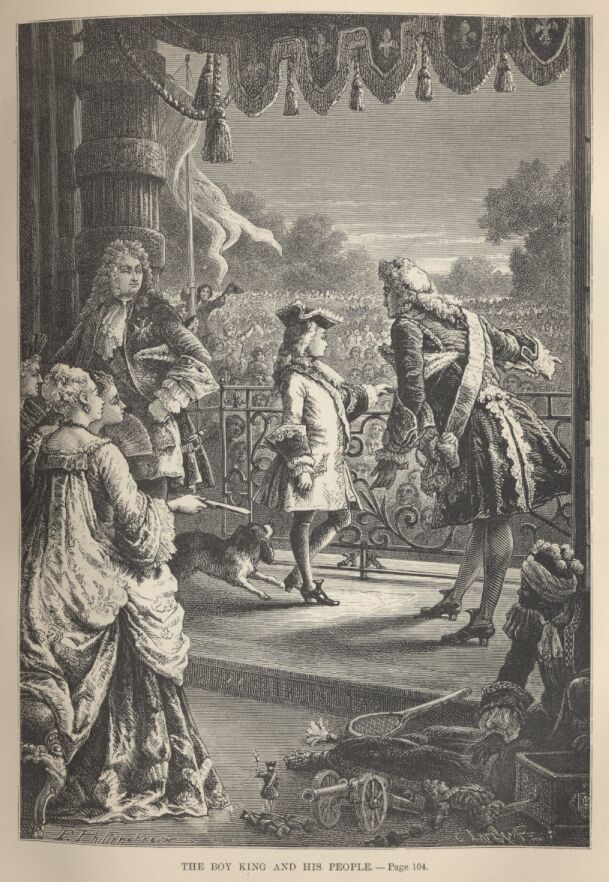
The Duke of Beauvilliers and Fenelon taught the Duke of Burgundy differently; the Duke of Montausier and Bossuet himself, in spite of the majestic errors of his political conceptions, had not forgotten in the education of the grand-dauphin the lesson of kings’ duties towards their peoples.
Already, over the very infancy of Louis XV. was passing the breath of decay; little by little that people, as yet so attached to their young sovereign, was about to lose all respect and submission towards its masters; a trait long characteristic of the French nation.
The king’s majority was approaching, the Regent’s power seemed on the point of slipping from him; Marshal Villeroy, aged, witless, and tactless, irritated at the elevation of Dubois, always suspicious of the Regent’s intentions towards the young king, burst out violently against the minister, and displayed towards the Regent an offensive distrust. “One morning,” says Duclos, “when the latter came to give an account to the king of the nomination to certain benefices, he begged his Majesty to be pleased to walk into his closet, where he had a word to say to him in private. The governor objected, saying that he knew the duties of his place, that the king could have no secrets from his governor, protested that he would not lose sight of him for an instant, and that he was bound to answer for his person. The Regent, then taking a tone of superiority, said to the marshal, ‘You forget yourself, sir; you do not see the force of your expressions; it is only the king’s presence that restrains me from treating you as you deserve.’ Having so said, he made a profound bow to the king and went out. The disconcerted marshal followed the Regent to the door, and would have entered upon a justification; all his talk all day long was a mixture of the Roman’s haughtiness and the courtier’s meanness.” [Memoires de St. Simon.]
“Next day, at noon, Marshal Villeroy repaired to the Duke of Orleans’ to excuse himself, fancying he might attempt an explanation as equal with equal. He crosses with his grand airs, in the midst of the whole court, the rooms which preceded the prince’s closet; the crowd opens and makes way for him respectfully. He asks, in a loud tone, where the Duke of Orleans is; the answer is that he is busy. ‘I must see him, nevertheless,’ says he; ‘announce me!’ The moment he advances towards the door, the Marquis of La Fare, captain of the Regent’s guards, shows himself between the door and the marshal, arrests him, and demands his sword. Le Blanc hands him the order from the king, and at the same instant Count d’Artagnan, commandant of the musketeers, blocks him on the opposite side to La Fare. The marshal shouts, remonstrates; he is pitched into a chair, shut up in it, and passed out by one of the windows which opens door-wise on to the garden; at the bottom of the steps of the orangery behold a carriage with six horses, surrounded by twenty musketeers. The marshal, furious, storms, threatens; he is carried into the vehicle, the carriage starts, and in less than three hours the marshal is at Villeroi, eight or nine leagues from Versailles.” The king wept a moment or two without saying a word; he was consoled by the return of the Bishop of Frejus, with whom it was supposed to be all over, but who was simply at Baville, at President Lamoignon’s; his pupil was as much attached to him as he was capable of being; Fleury remained alone with him, and Marshal Villeroy was escorted to Lyons, of which he was governor. He received warning not to leave it, and was not even present at the king’s coronation, which took place at Rheims, on the 25th of October, 1722. Amidst the royal pomp and festivities, a significant formality was for the first time neglected; that was, admitting into the nave of the church the people, burgesses and artisans, who were wont to join their voices to those of the clergy and nobility when, before the anointment of the king, demand was made in a loud voice for the consent of the assembly, representing the nation. Even in external ceremonies, the kingship was becoming every day more and more severed from national sentiment and national movement.
The king’s majority, declared on the 19th of February, 1723, had made no change in the course of the government; the young prince had left Paris, and resumed possession of that Palace of Versailles, still full of mementoes of the great king. The Regent, more and more absorbed by his pleasures, passed a great deal of time at Paris; Dubois had the government to himself.
His reign was not long at this unparalleled pinnacle of his greatness; he had been summoned to preside at the assembly of the clergy, and had just been elected to the French Academy, where he was received by Fontenelle, when a sore, from which he had long suffered, reached all at once a serious crisis; an operation was indispensable, but he set himself obstinately against it; the Duke of Orleans obliged him to submit to it, and it was his death-blow; the wretched cardinal expired, without having had time to receive the sacraments.
The elevation and power of Dubois had the fatal effect of lowering France in her own eyes; she had felt that she was governed by a man whom she despised, and had a right to despise; this was a deep-seated and lasting evil; authority never recovered from the blow thus struck at its moral influence. Dubois, however, was more able and more farsighted in his foreign policy than the majority of his predecessors and his contemporaries were; without definitively losing the alliance of Spain, re-attached to the interests of France by the double treaty of marriage, he had managed to form a firm connection with England, and to rally round France the European coalition but lately in arms against her. He maintained and made peace ingloriously; he obtained it sometimes by meannesses in bearing and modes of acting; he enriched himself by his intrigues, abroad as well as at home; his policy none the less was steadfastly French, even in his relations with the court of Rome, and in spite of his eager desire for the cardinal’s hat. He died sadly, shamefully, without a friend and without regret, even on the part of the Regent, whom he had governed and kept in hand by active and adroit assiduity, by a hardihood and an effrontery to the influence of which that prince submitted, all the while despising it. Dubois had raised up again, to place himself upon it, that throne of premier minister on which none had found a seat since Richelieu and Mazarin; the Duke of Orleans succeeded him without fuss, without parade, without even appearing to have any idea of the humiliation inflicted upon him by that valet, lying in his coffin, whom he had raised to power, and whose place he was about to fill for a few days.
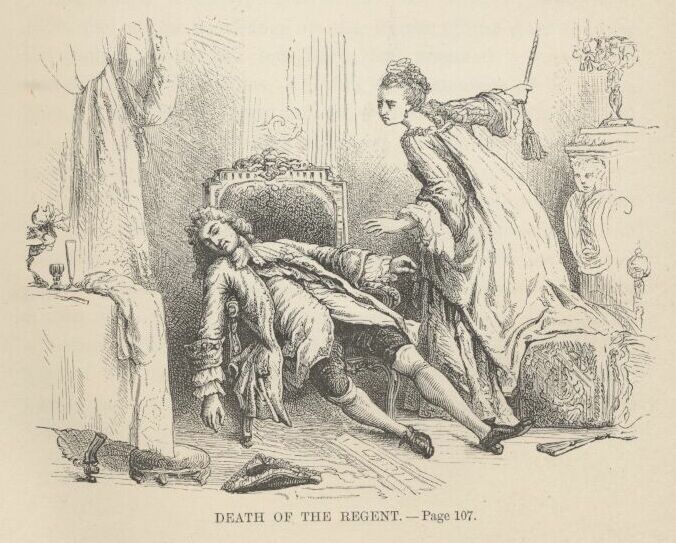
On the 2d of December, 1723, three months and a half after the death of Dubois, the Duke of Orleans succumbed in his turn. Struck down by a sudden attack of apoplexy, whilst he was chatting with his favorite for the time, the Duchess of Falarie, he expired without having recovered consciousness. Lethargized by the excesses of the table and debauchery of all kinds, more and more incapable of application and work, the prince did not preserve sufficient energy to give up the sort of life which had ruined him. For a long while the physicians had been threatening him with sudden death. “It is all I can desire,” said he. Naturally brave, intelligent, amiable, endowed with a charm of manner which recalled Henry IV., kind and merciful like him, of a mind that was inquiring, fertile, capable of applying itself to details of affairs, Philip of Orleans was dragged down by depravity of morals to the same in soul and mind; his judgment, naturally straightforward and correct, could still discern between good and evil, but he was incapable of energetically willing the one and firmly resisting the other; he had governed equitably, without violence and without harshness, he had attempted new and daring courses, and he had managed to abandon them without any excesses or severities; like Dubois, he had inspired France with a contempt which unfortunately did not protect her from contagion. When Madame died, an inscription had been put on the tomb of that honest, rude, and haughty German: “Here lies Lazybones” (Ci-git l’oisivete). All the vices thus imputed to the Regent did not perish with him, when he succumbed at forty-nine years of age under their fatal effects. “The evil that men do lives after them, the good is oft interred with their bones;” the Regency was the signal for an irregularity of morals which went on increasing, like a filthy river, up to the end of the reign of Louis XV.; the fatal seed had been germinating for a long time past under the forced and frequently hypocritical decency of the old court; it burst out under the easy-going regency of an indolent and indulgent prince, himself wholly given to the licentiousness which he excused and authorized by his own example. From the court the evil soon spread to the nation; religious faith still struggled within the soul, but it had for a long while been tossed about between contrary and violent opinions; it found itself disturbed, attacked, by the new and daring ideas which were beginning to dawn in politics as well as in philosophy. The break-up was already becoming manifest, though nobody could account for it, though no fixed plan was conceived in men’s minds. People devoured the memoirs of Cardinal Retz and Madame de Motteville, which had just appeared; people formed from them their judgments upon the great persons and great events which they had seen and depicted. The University of Paris, under the direction of Rollin, was developing the intelligence and lively powers of burgessdom; and Montesquieu, as yet full young, was shooting his missiles in the Lettres persanes at the men and the things of his country with an almost cynical freedom, which was, as it were, the alarum and prelude of all the liberties which he scarcely dared to claim, but of which he already let a glimpse be seen. Evil and good were growing up in confusion, like the tares and the wheat. For more than eighty years past France has been gathering the harvest of ages; she has not yet separated the good grain from the rubbish which too often conceals it.